“After [the funeral ceremony] took place, the body of Emperor Maximilian, of glorious memory, was placed and buried in the middle of the main Prague church before the choir, where the glorious memories of Emperor Ferdinand and his wife, Queen Anna, the parents of Emperor Maximilian, were also buried. Sic transit gloria mundi.”
Mikuláš Dačický of Heslov, Memoirs (1577)Footnote 1
The Habsburg mausoleum in St. Vitus Cathedral in Prague, designed and constructed in the second half of the sixteenth century, is often noted in modern scholarship as an early manifestation of the influence in Bohemia of the Habsburg dynasty, which had ascended the Bohemian throne in 1527 and ruled without interruption until 1918. Art historians—who have produced the major body of scholarship on the mausoleum—describe it as an “impressive dynastic burial monument” in Central Europe and a prime example of the influence of Italian Renaissance sculpture during its transition to Mannerism and the baroque.Footnote 2 Social and cultural historians, representing another major direction of research, have studied and brought forth a wealth of information about Habsburg burial practices and ceremonies. This latter group have recovered, among other things, detailed descriptions of the postmortem exam (which removed the heart and other interior organs and placed them in special vessels that were then buried apart from the rest of the body), the clothing and jewelry adorning the deceased and the objects buried with them, the public displays of the deceased, the multiple masses held for the dead, the paths taken by the funeral processions, the use of black cloth to dress pallbearers and drape the churches in which the funeral celebrations took place, and the elaborate castrum doloris (castle of grief) within which the coffin was displayed during the final Mass.Footnote 3
The divergent directions taken by art historians and sociocultural historians may, in part, explain why the mausoleum is not among the most cited or well-known artistic innovations of the early Habsburgs in Prague. Instead, the Lustschloß (later called the Belvedere)—a summer palace constructed in the royal garden behind the Prague Castle walls between 1538 and 1560—garners greater attention because it is considered one of the finest examples of Renaissance architecture outside the Italian peninsula. The Lustschloß was commissioned by Holy Roman Emperor and King of Bohemia Ferdinand I Habsburg (1503–64) and was intended for his wife, Anna Jagiellon (1503–47).Footnote 4 Another architectural structure of the period that has received more widespread attention is the Star Palace (Hvězda in Czech), which is formed in the shape of a six-pointed star. Located in an extensive game reserve founded by Ferdinand I in 1530, the Star Palace was designed by his second son, Archduke Ferdinand of Tyrol.Footnote 5 Although the mausoleum is a much smaller work than either of these buildings, its function as a funeral monument—which are, at times, the object of specialized subfields of art history and social-cultural history—might be another factor in its neglect.Footnote 6 Nevertheless, there are a number of points of intersection in research on the burial monument and on the ceremonies and rituals associated with Habsburg burial. In the case of the Habsburg Mausoleum, both approaches draw on sources and information that go beyond the individual studies’ immediate questions of interest and lend themselves to fruitful collaboration in other areas that have not been fully explored.Footnote 7 This article explores two such areas: location and space; specifically, the location and spatial features of the mausoleum with respect to those of other burial monuments and sculptural elements within St. Vitus Cathedral, and how these features contribute to the larger dynastic symbolism in the cathedral. The article also briefly compares its findings with features of more well-known Habsburg burial monuments in Innsbruck and the Escorial near Madrid. It argues that although the mausoleum is less visible and acts more subtly than other artistic and cultural projects of the early Habsburg rulers in Bohemia, it, more than any other single project, demonstrates and symbolizes their ambitions and commitment in Bohemia. It is also an important element in the transformation of Prague into a Habsburg residential city and in long-term Catholic renewal efforts. Moreover, the reception of the mausoleum in its day helps us better understand, together with other projects of the Habsburgs, the relationship of the court and the city in this important period.
* * *
When the Habsburgs ascended the Bohemian throne and up until the end of the eighteenth century, Prague was not one, but three (and after 1592, four) legally and politically independent, socially and economically linked, and spatially adjacent cities: the Castle Hill and the Small Side on the left bank of the Vltava River, site of the royal castle, St. Vitus Cathedral, and noble palaces; and the Old and New Cities on the right bank, home to thriving artisanal and merchant communities. The populations of these cities were diverse and included Czech and German speakers and adherents of a number of religious groups. Most Praguers were, or affiliated with, Utraquists, who evolved from a moderate branch of the Hussites. There were also minorities of Catholics and members of the Bohemian Brethren, who evolved from a more radical branch of the Hussites, and a small number of Lutherans. The Prague cities still exhibited the effects of the Hussite Revolution of a century earlier, which had brought about the expulsion of most Catholic orders, the vacancy of the archbishop's seat, and enormous physical destruction to a city that was once a monumental imperial residence, much of which had been designed by Charles IV Luxembourg (1316–78) in the middle of the fourteenth century.Footnote 8 The royal castle was uninhabitable and Saint Vitus Cathedral sustained major damage and was in the hands of an administrator and a small group of cathedral canons.
In the wake of the Hussite Wars, Bohemia experienced a tumultuous period marked by struggle between various parties and factions. A series of individuals assumed royal authority after the death of King Sigismund Luxemburg in 1435—Albrecht II (1437–39), George of Poděbrady (1458–71), Ladislas Posthumous (1453–57), Vladislav II Jagiellon (1471–1516), and Louis II Jagiellon (1515–26)—but real power remained in the hands of the estates of the upper and lower nobility and in the royal cities.Footnote 9 A few of these individuals pursued Catholic renewal by inviting orders back to Prague and undertook various renovation efforts. The Jagiellonians began the restoration of the living quarters of the castle and in 1483, after a failed attempt to install Catholic magistrates into the councils of royal cities, an agreement was made with the estates, the Peace of Kutná Hora (Kuttenberg), that established legal parity of Catholicism and Utraquism.Footnote 10 But it was the Habsburgs who ultimately brought back strong royal authority and successfully undertook important activities of Catholic reform by establishing a continual royal presence in Prague by sending Ferdinand II of Tyrol, the son of King Ferdinand I Habsburg, to Prague to serve as viceroy (1547), introducing royal officials in the city councils and courts (1547), inviting the Jesuits to establish a college (1555), renewing the archbishopric (1561), and then by moving the imperial residence to Prague (1583), making Prague the imperial capital for the second time in its history.Footnote 11
Many of the Habsburg policies were met with opposition, and the second half of the sixteenth and beginning of the seventeenth century were marked by political-confessional struggles between the Bohemian estates and people and the Habsburg kings. The outcome of these struggles was not clear or preordained.Footnote 12 As a foreign dynasty in a land that possessed and guarded its political and religious traditions and freedoms, it was important for the Habsburg dynasty to assert and legitimize their place in Bohemia if they were to have any success in their attempts at centralization of power and Catholic renewal. Alongside, or better yet as part of, their political and administrative policies, the early Habsburg rulers of Bohemia pursued other activities, which included completing renovation of the Prague castle, building new churches, and the cultivation of Renaissance culture. These left their mark on and transformed the Prague cities. The Habsburg mausoleum was an important part of those activities.Footnote 13
* * *
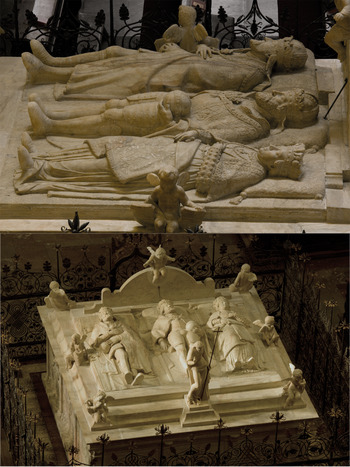
The mausoleum proper was constructed between 1566 and 1590 by Alexander Colin (1526/29–1612), a sculptor from Mechelen in the Low Countries (see Figures 1 and 2). The mausoleum was not the first Habsburg project on which Colin worked. In 1563 Ferdinand I invited Colin to Innsbruck to design and create marble reliefs for the ornate cenotaph at the center of the nave of the Hofkirche (Court Church), which Ferdinand commissioned as a memorial to his grandfather, Emperor Maximilian I (1459–1519).Footnote 14 While in Innsbruck, Colin also completed the Habsburg Mausoleum, a project that evolved during the last three quarters of the sixteenth century. In fact, all three of the first Habsburg rulers of Bohemia—Ferdinand I (1503–64), Maximilian II (1527–76), and Rudolf II (1552–1612)—contributed to the project. In the end, Ferdinand I, his wife Anna Jagiellon, and their son and Ferdinand's successor, Maximilian II, were buried in Colin's masterpiece, while the body of Rudolf II, the eldest son and successor of Maximilian II, was interred in a new-style pewter coffin in a newly constructed royal crypt located directly beneath the mausoleum.Footnote 15
Habsburg Mausoleum. Photos by Jan Gloc. From the collection and with permission of oddělení Uměleckých sbírek Správy Pražského hradu.

Ferdinand I was the first in a continuous line of Habsburgs who served as Bohemian kings and emperors. Ferdinand, who had married Anna Jagiellon in 1521, became king of Bohemia in 1526 after Anna's brother, Louis II, was killed fighting Ottoman forces at the Battle of Mohács in Hungary. The new king of Bohemia had been raised in Spain at the court of his grandfather, King Ferdinand of Aragon, and, like most Habsburgs, pursued an itinerant lifestyle. Indeed, Ferdinand's great-grandfather, Friedrich III, and his brother, Charles V, both maintained an itinerant court rather than a preferred residence. His grandfather, Maximilian I, however, maintained preferred residences in Innsbruck and Vienna Neustadt. Much like his grandfather, Ferdinand also spent long periods in different places in Central Europe, though he preferred Vienna and Prague. Still, it is interesting that in his testament of 1532—one of several he made—Ferdinand chose Prague as his future burial site.Footnote 16 Ferdinand's immediate imperial predecessors and contemporaries were buried in different locations with strong Habsburg connections: Friedrich III in St. Stephen's Cathedral in Vienna, Maximilian I in St. George's Chapel in Vienna Neustadt (rather than in the Court Church in Innsbruck as intended), and Charles V in the Monastery of San Lorenzo del Escorial near Madrid (see Table 1). In fact, it would be another hundred years before the crypt in the Capuchin Church in Vienna—immortalized through Joseph Roth's Die Kapuzinergruft (1938)—became the Habsburgs’ preferred burial place.Footnote 17
Burial Places of Holy Roman Emperors and Kings of Bohemia (late 15th to early 17th centuries)

Eight days after Queen Anna died in the Prague Castle (shortly after childbirth in 1547), Ferdinand made a codicil that expressed, among other things, his desire that a grave for himself and Anna be established in St. Vitus, though not necessarily a husband–wife or family tomb. Although the codicil provided no details regarding Ferdinand's own burial, it did give specific instructions for Anna's burial monument. Her tomb would include a realistic effigy of Anna wearing a royal crown and holding a scepter, and, above her head, an angel holding her coat of arms. In the meantime, Anna was interred in the royal crypt located below the choir of St. Vitus. There her body lay beside the remains of earlier Bohemian kings going back to the fifteenth century—with the exception of Anna's father, Vladislaus II, and brother, who were buried at the Székesfehérvár Basilica in Hungary.Footnote 18
Previous scholars have argued that Ferdinand's decision to be buried in Prague not only reflected a move away from the Habsburgs’ itinerant lifestyle but also underscored the importance of Prague to the Habsburgs decades before Rudolf II established the imperial court and residence there in 1583. That Ferdinand spent a great deal of time in Prague was surely influenced by the fact that it was a useful location from which to rally support among the Bohemian estates to defend the realm against the Ottoman Turks, who had made substantial advances into Central Europe after the Battle of Mohács and the first seige of Vienna (1529).Footnote 19 The decision to be buried in Prague might also have been influenced by the affectionate marriage that had developed between Ferdinand and Anna, which, although not unprecedented, was not self-evident among the rulers of the time, especially the Habsburgs, who were masters in pursuing dynastic marriages as a political strategy.Footnote 20 What is not surprising is that Ferdinand chose St. Vitus Cathedral as a burial site. The cathedral was built on the site of a pre-Romanesque rotunda and later a Romanesque basilica, which had served as the central burial site of Bohemia's saints, kings, bishops, and archbishops going back to the beginning of the consolidation of the Bohemian state and society in the tenth century. Construction of St. Vitus began in the middle of the fourteenth century as part of a program of imperial renewal instituted by King of Bohemia and Holy Roman Emperor Charles IV Luxembourg. Since then, it has served as a central site of pilgrimage and a place to celebrate baptisms, marriages, coronations, and funerals.Footnote 21
Yet, the realization of the Habsburg Mausoleum came about only after Ferdinand's death in Vienna in 1564. At that point, the executors of his will—his sons Maximilian II and Ferdinand of Tyrol—decided to honor his wish that he be buried in Prague. His sons chose a common tomb for Ferdinand and Anna, influenced perhaps by both the filial piety of the time and respect for their parents’ affectionate marriage. In 1566, Ferdinand of Tyrol, who served as the viceroy of Bohemia, entrusted Alexander Colin with the tomb. Because he was still working on Maximilian I's burial monument in the Court Church in Innsbruck when he received the contract to sculpt the Prague mausoleum, Colin decided to use marble from nearby quarries in Oberberg and Gries, which, sources note, were of the same high quality as Carrara marble.Footnote 22 He also decided on a prismatoid form that—although it was not the traditional burial form for Bohemian kings—was common in the Late Middle Ages. Colin's original design for Ferdinand's effigy portrayed him upright in a new style in which the ruler leans on his elbow; however, Maximilian insisted on the more traditional recumbent position.Footnote 23 Colin sculpted the imperial pair in life-size form with personal traits per Ferdinand's instructions for Anna's effigy. On the corners of the monument he sculpted children holding the king and queen's coats of arms and then crowned the monument with seven putti holding wreaths.Footnote 24 A statue of Christ rising was also created by Colin, perhaps as a way to bring movement to the monument after Maximilian rejected his plan to portray Ferdinand in an upright position.Footnote 25 Colin completed the pieces of the monument—forty-eight finished stones in all—in 1570, and three years later sent them to Linz unassembled in a box. In 1576, however, before the stones could be sent on to Prague, Maximilian died. His son and successor, Rudolf II, ordered the expansion of the still unassembled monument to include Maximilian.Footnote 26 (Rudolf likely did not plan to expand the mausoleum to include space for Queen Maria, Maximilian's wife and his mother, because, despite the fact that Maria was active in Prague in a number of Catholic renewal projects and apparently also had an affectionate marriage with Maximilian, she still had strong family bonds and other ties in her native Spain.) In any case, Rudolf instructed Colin to sculpt medallions on the side of the monument, representing Charles IV and his four wives; Václav IV, the son and successor of Charles IV; and the fifteenth-century Bohemian kings Ladislaus the Posthumous and George of Poděbradý, which were likely done by Colin's son Abraham.Footnote 27 Colin assembled and completed the monument in 1589 with the assistance of Abraham and a group of apprentices. An elaborate iron and golden lattice grill was constructed around the mausoleum by Jiří Schmidbauer, a master smith from the Small Side of Prague who had also worked on the tomb for Maximilian I in Innsbruck.Footnote 28 Rudolf subsequently ordered another group of artisans to repair the lower chambers below the mausoleum and, in 1590, instructed the deacon of St. Vitus, Jiří Pontán of Breitberk, to transfer the bodies of his predecessors in the old royal crypt below the choir to the new chamber crypt below the monument.Footnote 29
In all, stylistically speaking, the mausoleum was modest, containing mostly traditional features such as the prismatoid shape of the tomb and recumbent sleeping figures with a few distinctive, innovative elements, including the putti, the rising Christ, and the elaborate grill. Such Renaissance features can also be found on some other burial monuments of nobles and court figures in St. Vitus and other Prague churches, including the tomb of Vratislav of Pernštejn, the high chancellor of Bohemia, who died in 1582. Vlatislav's tomb was commissioned by his Spanish wife, Maria Manrique de Lara, who, along with Queen Maria, was of one of the most active supporters of the Catholic Reformation in Prague. Sources suggest that Vratislav of Pernštjen's tomb may have been designed by another Renaissance artist from the Low Countries, Hans Vredeman de Vries, and executed by the Prague stonecutter of Italian origin Giovanni Antonio Brocco. Vlatislav's tomb was carved in red marble with a relief effigy on top. Although the portrayal of the deceased is more dynamic than those of Ferdinand and Maximilian, it was executed in another traditional pose of the time: Vlatislav is depicted in armor with his left hand placed on a helmet and the right one on a sword. His head and bearded face are framed in a high Spanish collar.Footnote 30 Another funeral monument in St. Vitus showing Renaissance features is that of the high judge Jiří Popel of Lobkowicz. Carved out of red and white marble and framed by Corinthian columns, the monument stands approximately four and a half meters high, which is relatively tall considering the fact that earlier tombstones were typically two to two and a half meters. Like Vlatislav, Popel is depicted wearing armor and a high Spanish collar. He is also sculpted in another common motif of the age: the kneeling knight.Footnote 31 Still, most funeral monuments were much more modest, including those of prominent individuals like Ludmile of Thurn, also in St. Vitus Cathedral, and the Danish astronomer Tycho Brahé, who was active at the court of Rudolf II, in the Church of Mary-on-the-Teyn in the Old City—both of which had vertical grave plates.Footnote 32
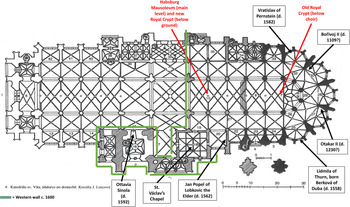
However, the prominent location of the mausoleum and new royal crypt is more important than the style and size of the Habsburg Mausoleum (see Figure 3). Although the mausoleum and new crypt are now located in the center of the choir, when they were first erected in the sixteenth century the western wall of the church was further east, which meant that the mausoleum and new royal crypt were positioned toward the rear of the church. This was a much more prominent position because it placed them in a spatial counterpoint to the older royal crypt, the tombs of much earlier Bohemian kings, and older dynastic sculptures located behind, below, and above the choir, respectively, that were reflected in the medallions on the mausoleum. The mausoleum is also on the same aisle as the Chapel of St. Václav and together forms a right angle to the old royal crypt and sculptures in the choir. This placement takes on an even greater meaning when one considers that Václav served as the Duke of Bohemia between 921 and 929 and is the patron saint of Bohemia. Unfortunately, there are no records explaining why, when, and by whom the location of the mausoleum was selected. In fact, the exact location might not have been selected until the monument was finally assembled. In addition, space was limited in St. Vitus. It had been a burial site going back to the tenth century. In any event, the mausoleum stands out spatially relative to the burial places of earlier Bohemian rulers and nobles.
Burial Locations within St. Vitus Cathedral. Basic diagram by J. Lencová, in Anežka Merhautová, Katedrála sv. Víta v Praze/K 650. výročí založení (Prague, 1994), 278–79.

The subsequent construction of the new royal crypt and the transfer of the remains of former kings also changed the symbolic program of the cathedral of King of Bohemia and Holy Roman Emperor Charles IV Luxembourg (1316–78), who commissioned the building of St. Vitus as part of a larger program of imperial renewal. Because Charles IV wanted his dynastic past included in the new structure, Charles had some of his predecessors—many of whom were buried elsewhere—reburied in the cathedral in tombs located in six chapels that were neatly arranged next to one another behind the main altar. Among the early rulers buried in the rear of the choir are Bořivoj I (852–59), the first documented duke of Bohemia and primogenitor of the founding Premyslid dynasty, and Ottokar II (1233–78), who ruled Bohemia as king during the peak of its power in the Middle Ages. Although unsuccessful, Ottokar had long sought the imperial crown that Charles IV and the Habsburgs later acquired. The busts of Bohemian patron saints were also placed around the exterior base of the clerestory, bridging the Bohemian past, present, and future with a series of portrait busts of Charles IV and his family, higher clergy, and architects above the entrances to the triforium. In addition, Charles had a royal crypt constructed below and in front of the main altar, where he, his successors, and some of their family members were later interred.
In addition to the adding to the existing dynastic iconography in St. Vitus designed by Charles IV, the Habsburg Mausoleum was surely informed by the intended mausoleum of Emperor Maximilian I Habsburg in Innsbruck, which Colin also worked on. After Charles IV, Maximilian I commissioned one of the most comprehensive mythical genealogical restructuring by a Central European ruler to date by instructing the most renowned humanists of his day to research and document his legendary past in chronicles, drawings, and architecture.Footnote 33 In addition to the main figure of the kneeling ruler praying before a crucifix, forty life-size statues of Maximilian's ancestral figures and more than thirty imperial busts were planned for his cenotaph in the Silver Chapel in the Court Church in Innsbruck, though only twenty were completed. The tomb is also decorated with scenes of the life of the ruler to ensure “his eternal memory” (zu ewiger Gedechtnus), which is inscribed on the tomb.Footnote 34
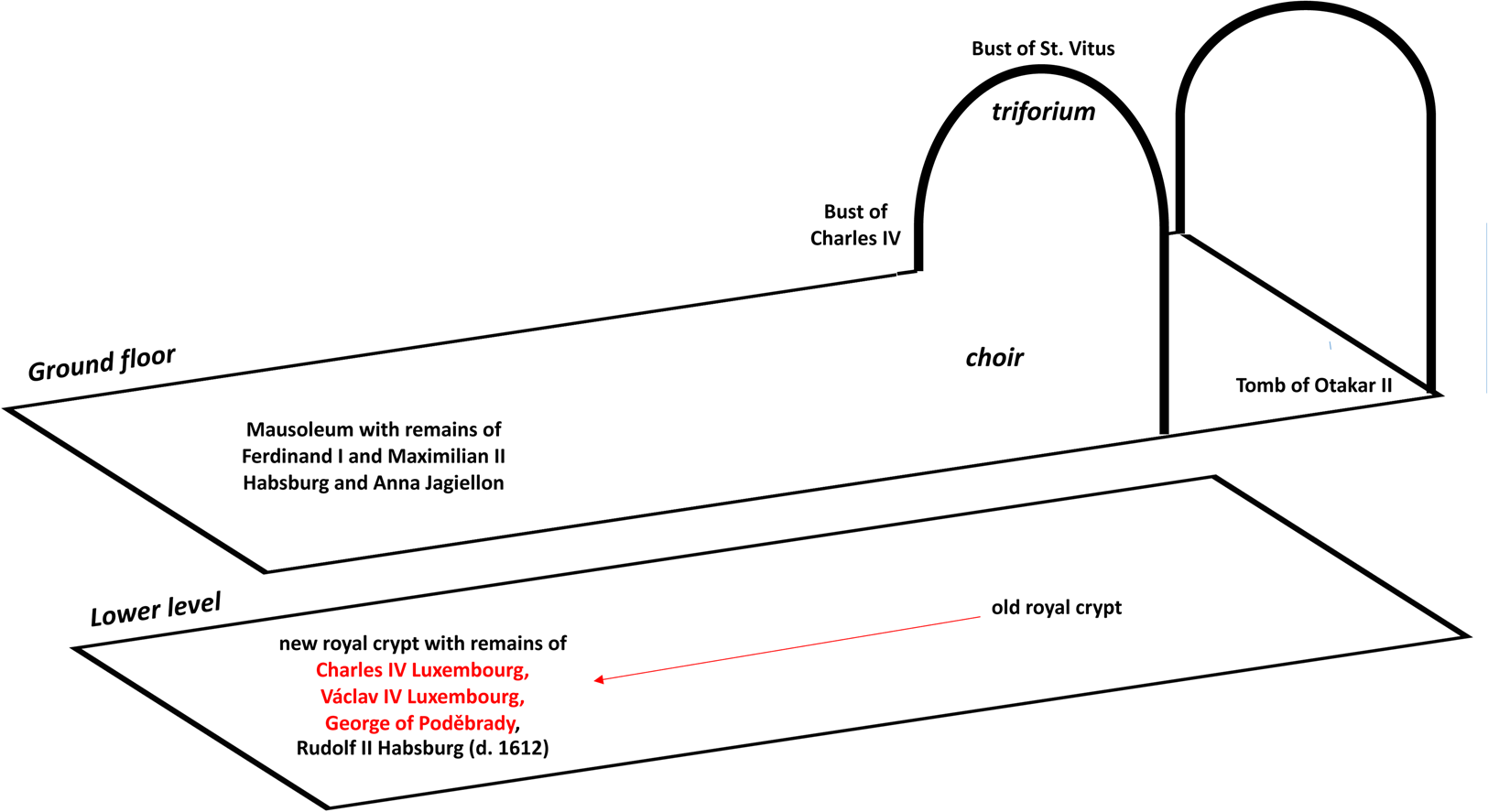
With the addition of medallions to the sides of the Habsburg Mausoleum in Prague, the construction of a new royal crypt, and the transfer of the remains of Charles IV and others from the old crypt to the new one, the monument-and-crypt complex took on a central position, not only spatially but also symbolically. The Habsburgs were now positioned as the central, unifying force in Bohemian history (see Figure 4). What's more, this new dynastic symbolism was now more three-dimensional than Charles IV's program because the old royal crypt had been empty when the cathedral was first built. Now, the old and old royal crypts on the main and lower levels represented a new symbolic center presided over by Charles IV's dynastic sculpture.
Schematic-Spatial Plan of Habsburg Mausoleum in St. Vitus Cathedral.

In its complexity, the mausoleum and new royal crypt share some features with the burial sites of the Spanish Habsburgs at the Monastery of San Lorenzo de El Escorial near Madrid. Commissioned by Phillip II Habsburg, a nephew of Ferdinand I and a cousin of Maximilian II, and completed in 1592, just two years after the mausoleum in Prague, the Escorial was at once a royal palace, church, pantheon, library, school, hospital, and almshouse. But, above all, as Carlos Eire has highlighted in his brilliant analysis, the Escorial is a family crypt and necropolis of the burial sites of five centuries of Spanish rulers.Footnote 35 The Escorial is arguably a much larger and complex environment than the Habsburg Mausoleum or St. Vitus Cathedral in Prague. But if one considers the Habsburg Mausoleum and St. Vitus Cathedral together with the adjacent complex of Prague Castle and the Castle Hill community, which included a royal palace, a cathedral, chapels, churches, and a library, the comparison makes more sense, even though the Escorial was a single structure (actually two structures). In 1483, Vladislav II Jagiellon connected St. Vitus Cathedral to the royal palace by creating a covered passageway between the palace and a new royal oratory, which he had constructed on the south side of the gallery of the choir of the cathedral.Footnote 36 But leaving aside any functional similarities, the Escorial and the Prague Mausoleum share a programmatic vision. Just as Philip II located the remains of ancestors buried elsewhere and reburied them in the Escorial to produce a monument to represent the continuity of the Habsburg dynasty in Spain, so his Habsburg relatives in the Austrian line reburied the remains of their ancestors in the mausoleum and new royal crypt in St. Vitus Cathedral. In so doing, Maximilian and Rudolf created a monument to the continuity of the Habsburg dynasty in Austria.Footnote 37
The Austrian historian Karl Vocelka has pointed to the broad array of media, including coins and drawings, that Rudolf II authorized to express and promote his imperial majesty.Footnote 38 However, the medallions on the mausoleum represent more than imperial majesty. They cultivated not only the memory and heritage of the Habsburg dynasty but also the larger line of dynasties in Bohemia, whose crown the Habsburgs inherited. What is curious is that the Jagiellonians are excluded from the dynastic line on the Habsburg Mausoleum. After the disorder of the Hussite Revolution and Wars (1419–34), in which the Hussites were branded as heretics and isolated from the rest of Europe, the new Jagiellonian rulers—Vladislav II (1471–1516) and Louis (1516–26)—sought to reconcile Bohemia with the universal church and Western Christendom. They welcomed religious orders back to Prague and sought local allies.Footnote 39 And although they didn't reside in Prague, they began the restoration of the royal palace. One highly visible sign of this restoration was the building of what has come to be called the Vladislav Hall, taking up an entire floor of the royal palace. A view of the hall with late Gothic vaulting and Renaissance windows and portal—representing some of the first elements of Renaissance design in Prague—was captured in etchings a century. The views suggest that the hall was multifunctional and could serve representational as well as market purposes, which meant it would have been fairly known to contemporary residents of the city.Footnote 40
The selection of the sculptural medallions deserves attention. The earliest ruler with a medallion is Charles IV Luxembourg, which serves to establish a direct connection between the early Habsburg rulers and this important Bohemian king and Holy Roman emperor. Medallions exist for almost all the subsequent rulers up to the Jagiellonian kings; and some of the additions and omissions are noteworthy. A medallion exists for Václav IV, Charles IV's son and successor, although he was deposed as Holy Roman emperor, while Sigismund, the last in the line of Luxembourg rulers on the Bohemian throne, is omitted. Sigismund's omission may not be surprising because he was not accepted by the Bohemian estates in the first part of his reign and led a crusading army against the Hussites. His successor, Albrecht II, also does not have a medallion, which may be explained by that fact that, although he was a Habsburg who came to the throne through marriage to Sigismund's daughter and heiress, Albrecht fought with Sigismund in the Hussite Wars—he even led the Battle of Domažlice in 1431 that ended in defeat for imperial troops—and died unexpectedly after two years.Footnote 41 Surprisingly, medallions are present, however, for the next two rulers, Ladislas Posthumous and George of Poděbrady. Ladislas Posthumous came to the throne as an infant after the death of his father, Albrecht, and the kingdom went into a period of chaos marked by struggles between a Catholic party led by the noble Ulrich of Rosenberg and an Utraquist party led by George of Poděbrady, who was from an eastern Bohemian noble family. Considered a heretic by some, George was named a regent by the Bohemian estates and successfully drove Ulrich from Prague. In 1458, after the death of Ladislas Posthumous, George became king of Bohemia with the support of the Catholic lords and was acknowledged by Emperor Friedrich III Habsburg—ultimately ushering forth an era of restoration.Footnote 42 According to the Czech historian Rudolf Urbánek, George of Poděbrady was “the pillar on which the vault of the Czech nation rested.”Footnote 43 That statement might be an exaggeration, but both Posthumous and Poděbrady can be viewed as serving as a needed link between Charles IV and the Hussite period.
Also puzzling is the omission of medallions for the Jagiellonian rulers Vladislaus II and Louis II. One possible explanation might be that their final resting places are neither in St. Vitus Cathedral nor in Bohemia, but in Hungary. Another is that the Jagiellonians are properly represented by the fact that Anna Jagiellon is buried in the tomb and has a sculptural effigy on top. The sculptural effigy could be seen as counterpoint to the medallion of Charles IV's wife, the only other woman to be included in the mausoleum. That could be seen as either as a further symbolic strengthening of the connection between the Habsburg and Charles IV (i.e., both have a wife represented on the tomb) and/or the affection and importance of Anna Jagiellon. Alternatively, leaving out medallions for Vladislaus II and Louis II might be seen as a wish for a slightly diminished presence of the Jagiellonian rulers (who are represented by Anna) to underscore the significance of the Habsburgs in Bohemian history. In any event, the Jagiellonians were viewed by Bohemians in the sixteenth century to hold a prominent place. In some historical chronicles of the period, albeit in circles not tied to the Habsburgs, the Jaigellonians were better integrated into the line of historical dynasties of Bohemia. Indeed, the Jagiellonians featured prominently in Daniel Adam of Veleslavin's popular Historical Calendar (1590) and the chronicle Zemach David (1593) by the Prague Jew David Gans—this despite the fact that both works appeared decades after the creation of the iconographic program of the mausoleum when the notoriety of the Jagiellonian heritage would have presumably diminished.Footnote 44
In the end, a crucial factor in the selection of the medallions might have been for choosing rulers going back to Charles IV who have their final resting places in St. Vitus Cathedral. In many ways it is an odd group of rulers whose policies and actions did not match those of the Habsburg dynasty in either the fifteenth or sixteenth centuries: a monarch who served only two years, another whose reign occurred during the chaos of the fifteenth century, and a “heretic,” all adding to the Jagellonian elements elsewhere on the monument. If the deeds and reputations of the rulers played a role, then it was their importance in the Bohemian context. Seen in that way, the medallions were another strategy that places the Habsburgs into Bohemian history and the present.
* * *
Yet, there are other factors that should be considered when attempting to understand the importance of the mausoleum and what it represented, especially in its day. This new burial monument was erected in a church that had been seriously devastated during the Hussite Wars in the early fifteenth century. Then, in June 1541, a fire swept through Castle Hill and the Small Side, damaging the roof of St. Vitus. Sections of the ceiling collapsed, and a great deal of the interior was ruined.Footnote 45 It would be seven years before repairs began on the cathedral's roof and some of the pillars. Around 1560, workers began restoring the curatorium and aisles. One of the most notable renovations was the installation of an organ choir with new vaulting between 1557 and 1559, which art historians have celebrated for its artistic distinction. Later, in the 1580s, the large tower was strengthened, which allowed the installation of three new bells.Footnote 46 Despite these renovations, much of the church was still in ruins during the sixteenth century when the mausoleum and new royal crypt were erected.
Moreover, while St. Vitus was the metropolitan church of a large see that embraced most of the kingdom and stood in a commanding location on Castle Hill overlooking the Small Side, Old City, and New City, the seat of the archbishop had been vacant since 1419 and was not restored until 1561, five years before the construction of the mausoleum began. In addition, the population of the Prague cities was largely non-Catholic and attended parish churches run by the Utraquist Consistory, whose center was the Church of Mary-on-the-Teyn on Old City Square, the burial site of some of the prominent Utraquist burghers and nobles. Thus, St. Vitus was neither in close proximity nor of prominent interest to most Praguers.
The construction of a new Jesuit complex and renewal of a number of monastic properties in the Old and New City were more proximate and visible sites of Catholic renewal than the Habsburg Mausoleum or St. Vitus Cathedral. The establishment of the first Jesuit College in Bohemia in 1555, located at a strategic site in the Old City near the bridge, began at the abandoned Dominican Church of St. Clement. The college then expanded through extensive property acquisitions, which resulted in a major renovation of the right bank of the Vltava River.Footnote 47 The St. Agnes Cloister and the Cloister and Hospital of the Knights of the Cross with the Red Star in the Old City—both had personal or other ties to the Jesuit College—and the Cloister of Mary of the Snows in the New City were also involved in projects to renew their extraterritorial rights and properties. These projects, which were supported after 1561 by Antonín Brus of Mohelnice, the newly installed archbishop of Prague who had played a crucial role in bringing the Jesuits to Prague when he was Grand Master of the Knights of the Cross with the Red Star, brought these monasteries into social, economic, and legal conflicts with the city councils of the Old and New Cities of Prague.Footnote 48 Indeed, these were the Catholic spaces that clearly caught the attention of most Praguers.
Some other contemporary perspectives from which to view the Habsburg Mausoleum and its real or perceived connections to Catholic renewal are presented in the memoirs of Mikuláš Dačícký of Heslov, one of the main sources about life in Prague in the sixteenth century. In fact, Dačický of Heslov's memoirs include a description of the funeral procession of Maximilian II in Prague on Saint Dorota's Day, 1577. According to Dačický, the “pushing, shouting out, and quarrels” that broke out along the route from St. Jacob's Monastery to St. Vitus caused church leaders in the procession “to run away, thinking there was an uprising among the common people.” Dačický attributed these disturbances to a “fear among the people.”Footnote 49 According to another chronicler, Marek Bydžovský of Florentín, the commotion started when an official in the funeral procession “tossed memorial coins, specially prepared for the occasion, into the crowd gathered at Old City Hall.” This caused others to “roar and clamor for the coins, pushing against each other and knocking down a few, from which shouting and a not so small rumble ensued, which then pressed and pushed into mercenaries, who also stood on the side.” As a result, a “not so small fear arose among the prelates, abbots and bishops in the procession … thinking there some treason was being committed, since just a short time earlier it was heard that the Jesuits had bought up many weapons, thinking that that should happen to them as it did in France in 1572,” during the St. Bartholomew's Day Massacre.Footnote 50
Whether the commotion or fear was a sign of anti-Catholic sentiment or a simple melee provoked by the tossing of memorial medallions into the crowd that some contemporaries misinterpreted as an anti-Catholic demonstration, Dačický of Heslov's account raises an interesting question because he only mentions the burial site in passing at the very beginning of his 1577 entry. He certainly does not comment on the central location of the monument, which had not yet been erected in 1577. In an entry from 1589, however, Dačický reports that,
[O]n Castle Hill in the main church of St. Vitus, in the center of that church, the bodies were extracted from the imperial and royal burial place, that is: Emperor Charles, called the Fourth …, Emperor Ferdinand …, and his son Emperor Maximilian the Second … [and] also Anna, the wife of Emperor Ferdinand, and other members of their house; and the burial place was built and expanded anew, and the bodies were placed in a chapel in that church and showed to some people. After the monument was completed, the bodies were placed back and a cover was placed on it, beautifully prepared with pictures engraved onto white alabaster in a masterful way.Footnote 51
In this entry Dačický of Heslov not only highlights the artistic quality of the mausoleum but also describes the transfer of the imperial bodies as a noteworthy event among his contemporaries. Indeed, it would be interesting to know who viewed the transfer of the bodies. Presumably it was a small, select group associated with the royal court, perhaps including representatives of the Prague cities, but likely not ordinary Praguers.
A few decades later there is clear evidence that the mausoleum was being linked to Catholic renewal and, for that reason, considered a sore spot. Following the Bohemian Uprising of 1618, which brought King Friederich V of the Palatinate (“the Winter King”), a Calvinist, to power, a group associated with Friederich's court that received support from some members of the Unity of the Brethren planned and undertook an iconoclastic attack on the Cathedral of St. Vitus in December 1619. The iconoclasts destroyed many of the altarpieces, crucifixes, pictures, and various chapels with what one critic described as a “horrendous, frightening atrocity.”Footnote 52 In the minds of the iconoclasts, they were “cleansing” St. Vitus of objects they considered idolatrous and, as such, in violation of scripture.Footnote 53 In the discussions and planning that preceded the attack, the notary of the Castle Building Office, Jacob Hübel, tried to convince the court preacher, Abraham Scultet, to refrain from damaging the burial site of King Václav when going after the portrait of Vratislav of Pernstein located in the Chapel of Václav. When discussion turned to the Habsburg Mausoleum, the high chancellor of the Kingdom of Bohemia, Václav Vilém of Roupov, the president of the High Appellate Court, Václav Budovec of Budov, and most of the others in attendance favored its removal. The vice chancellor of the Kingdom of Bohemia, Peter Milner of Milhaus, pejoratively described the mausoleum as a “crazy”—a bláznovský—monument that took up too much space in the cathedral's choir.Footnote 54 According to another report, the other participants agreed with Milner. “[The mausoleum] took up the best space,” they concluded, “and removing it would give more room.”Footnote 55 However, the individual with the deciding vote, the high burgrave of the Prague Castle, Bohuchval Berka of Dubá, spoke against the mausoleum's removal.Footnote 56
The questions surrounding the contemporary reception of the mausoleum are reminiscent of a previous debate concerning the reception of another Habsburg innovation: Rudolf II's Kunstkammer, located in Prague Castle, which was the largest and most sophisticated art and curiosity collection of its day. An earlier debate revolved around the question of whether only a select group within the royal circle was given access to the collection, or if the broader urban population was also given the opportunity to view it.Footnote 57 And how did those to whom access was given view it? Likewise, the Habsburg Mausoleum also highlights the issues of the impact of the imperial court and its perception by Prague city dwellers during a period in which Prague was transformed into a residential city under the Habsburgs. Of all the innovations created by the Habsburgs, the mausoleum was the least visible to the broader urban population. Besides the Jesuit College, the Belvedere can be seen today from some elevations in the Old City, while the Star Palace was on the much-traveled route that approached Prague from Nuremberg and the west. However, unlike the Belvedere and Star Palace, the mausoleum was part of a renovation of St. Vitus Cathedral, one of the most important Catholic spaces in Prague and Bohemia. In this way, the mausoleum can be viewed as part of a long-term Catholic renewal.Footnote 58 Much later than other Catholic spaces renewed in the late sixteenth century, it too became a sore spot for anti-Catholic forces. However, thanks to the intervention of some high officials, it was spared removal following the Bohemian Uprising of 1618. The most critical phase of Catholic renewal in Bohemia began, as is well known, after the Battle of White Mountain in November 1620, which brought an end to the uprising. This led to a forceful and sustained Counter-Reformation that resulted in persistent changes in belief and practice and a new Catholic identity—a potent symbol of which is the adornment of the bridge (today's Charles's Bridge) with Counter-Reformation saints.Footnote 59 But some of the earliest phases of Catholic Renewal were initiated by the Jagiellonian rulers, who welcomed back religious orders and sought local supporters, and then the first Habsburg rulers followed suit, inviting the Jesuits and renewing the archbishopric.
To sum up and conclude: while some city chroniclers noted the artistic value of the mausoleum, it is not clear if the mausoleum attracted much attention from the broader population in the second half of the sixteenth century as it was being designed and assembled. Although confessional tension was present in the largely non-Catholic population of the Prague cities at the time, the renewal project of the Jesuits and other religious orders in the Old and New Cities of Prague likely distracted attention from the renovations taking place in St. Vitus Cathedral, which was still in poor condition due to the devastation of the Hussite Wars and the fire of 1541. Despite this polarized confessional landscape, the opponents of the Habsburgs and Catholic reform did not focus their attention on the central location of the mausoleum until the arrival of Friedrich V of the Palatinate and his officials, who introduced a coherent plan for cleansing the cathedral in the second decade of the seventeenth century. With the construction and expansion of new imposing and ornate churches in the baroque style in the late seventeenth and eighteenth centuries, attention to the Habsburg Mausoleum likely waned once again. Although the Habsburg Mausoleum is, admittedly, neither a miniature Escorial nor a public, accessible monument like the Charles Bridge, it is nevertheless a powerful symbol of Habsburg power and Catholic renewal that deserves greater attention.