Social capital literature suggests that generalized trust is one of the most important attitudinal elements of social capital and social cohesion in general.Reference Putnam1, Reference Uslaner2 StolleReference Stolle3 distinguishes between particularized trust and generalized trust. In his words: ‘Private or personalized trust involves people personally known, and it results from cooperation experiences and repeated interaction with the immediate circle of known people, such as family. Generalized trust, on the other hand, is a trust that goes beyond the boundaries of kinship and friendship, and even beyond the boundaries of acquaintance’ (Ref. Reference Stolle3, p. 503). In addition to trusting particular friends, neighbors, or institutions, trusters hold to the trustworthiness of the average person; this ‘general trust’ reflects ‘a belief in the benevolence of human nature in general’.Reference Yamagishi and Yamagishi4 Each type of social trust is helpful for meeting different goals: particularized trust is good for solidarity and in-group loyalty and for reinforcing specific identities (i.e., trust within groups), whereas generalized trust (i.e., trust between groups) is better for information diffusion, and to generate broader identities and reciprocity.Reference Putnam1
Overall, generalized trust connects us to people who are different from ourselves. Generalized trusters are tolerant of immigrants and minorities, have more effective governments, higher growth rates, less corruption and crime, and have positive effects on democracy.Reference La Porta, Lopez-de-Silanes, Shleifer and Vishny5–Reference Paxton7 Generalized trust improves economic prosperity and growth in society,Reference Uslaner2, Reference Putnam8–Reference Fukuyama10 is related to higher government performanceReference Knack11 and less corruption,Reference Uslaner2 and is one essential factor for the development of democracy.Reference Paxton7, Reference Sztompka12–Reference Inglehart16 Trust has also been identified as a key element of successful conflict resolution, including negotiation and mediation.Reference Kelman17, Reference Lewicki and Wiethoff18 High degrees of trust lead to greater reconciliation among people of differing backgrounds.Reference Uslaner19
Specifically, the aim of this paper is to investigate several correlates of generalized trust, such as age, gender, marital status, education, immigrant status (natives versus immigrants), residence, life satisfaction, employment status, health, religiosity, political ideology, participation in voluntary organizations, tolerance of diversity, and confidence in institutions. To our knowledge, this is the first empirical study to test the correlates of generalized trust among Greek and Turkish Cypriots living on the island of Cyprus.
Research on Generalized Trust
This study specifically focuses on the individual determinants of generalized trust. This section outlines some of the major individual-level variables that previous studies found to have an effect on generalized trust. First, we will focus on the demographic variables. Some studies confirm that older people in general are more trusting.Reference Glaeser, Laibson, Scheinkman and Soutter20, Reference Alesina and La Ferrara21 Other research has suggested that partially due to increases in education, individuals grow more trusting between the ages of 18 and 40, after which trust levels off.Reference Robinson and Jackson22 Women tend to be more trusting than men,Reference Hooghe, Reeskens, Stolle and Trappers23, Reference Halman and Luijkx24 and higher education and more religiosity are found to affect generalized trust positively.Reference Putnam25–Reference Guiso, Sapienza and Zingales29 Negative life experiences that impact individuals significantly, such as divorce, are expected and empirically found to reduce generalized trust.Reference Lindstrom30
Beyond these demographic variables, prior research has also identified other individual- level variables that are determinants of generalized trust, one of which is immigrant status. The relationship, however, is not clear. Belonging to a minority ethnic group strongly predicts reduced trust.Reference Uslaner2, Reference Albanese and de Blasio31 On the other hand, immigrants who come from comparatively high-trusting societies, and those who are pleased with the people they live among or with the quality of the institutions in the host society, are expected to have high trust.Reference Uslaner32, Reference Dinesen33 Certain literature suggests that trusting people are more tolerant,Reference Uslaner2, Reference Reeskens34 whereas some other research suggests that interaction with tolerant citizens is likely to promote more positive influences with other people, which could lead to an increased level of generalized trust among immigrants.Reference Dinesen and Hooghe35 Using the same approach, we could expect interaction with more tolerant individuals to lead to an increased level of generalized trust in all individuals. Voluntary association membership is found to promote more generalized trust through different norms, social networks, and sanctions. In fact, membership in voluntary organizations has been one of the key factors in developing generalized trust.Reference Putnam1, Reference Putnam8, Reference Brehm and Rahn28, Reference Paxton36
The relationship between urban residence and generalized trust is not clear. Using the Gesellschaft model,Reference Tonnies37 which examines associations in which individuals act in their own self-interest and in which secondary relationships are emphasized more than ties between family or community members, PaxtonReference Paxton36 argues that residence in an urban environment is expected to reduce an individual’s generalized trust, which is supported in some studiesReference Putnam1 but not in others.Reference Paxton36, Reference Delhey and Newton38, Reference Levine, Norenzayan and Philbrick39 Considering that most of the ties in urban settings are weak and thus promote cross-cutting ties, the in-group boundaries become more permeable. Despite the fact that a person’s ties with another network may not be as tight as those with his or her own group, being acquainted allows a level of communication and some trust. ‘People with many weak ties are … best placed to diffuse such a difficult innovation, since some of these ties will be local bridges’.Reference Granovetter40 Using Granovetter’s40 argument, these weak ties are expected to promote generalized trust, which fosters openness and a welcoming view of the outside world. Thus, we could also expect a positive relationship between urban residence and generalized trust.
More liberal political ideology was found to be correlated with higher political trust, which is defined as trust in government.Reference Magnum41 Confidence in institutions was tested empirically, and found to have a positive effect on generalized trust.Reference Dinesen and Hooghe35, Reference Farrell and Knight42–Reference Steinhardt48 Considering the fact that confidence in institutions is highly correlated with generalized trust, we can expect more liberal political ideology to be correlated with higher generalized trust, which is consistent with some prior research.Reference Halman and Luijkx24, Reference Hooghe, Reeskens and Stolle49 Prior studies have concluded that loss of social trust can undermine life satisfaction,Reference Leung, Kier, Fung, Fung and Sproule50, Reference Bjornskov51 while life satisfaction can be an indicator of positive past experiences and be expected to promote higher generalized trust. This hypothesis was also empirically tested and supported in prior research.Reference Dinesen and Hooghe35, Reference Rothstein and Stolle45 Employment was found to be positively correlated with higher generalized trust.Reference Hooghe, Reeskens, Stolle and Trappers23, Reference Paxton36, Reference Lindstrom52 Higher levels of social trust were associated with less likelihood of reporting poor health.Reference Subramanian, Kim and Kawachi53–Reference Veenstra55 Considering the fact that trauma (defined as significant negative experiences) is negatively correlated with trust,Reference Lindstrom30, Reference Alesina and La Ferrara56, Reference Voicu57 poor health could also be associated with less trust.
Data and Methods
We use European Values Survey (EVS) data for this study. EVS is a large-scale, cross-national, and longitudinal survey on basic human values. It contains detailed measures on ideas, beliefs, preferences, attitudes, values, and opinions of citizens all over Europe. This creates a rich dataset that gives information on how Europeans think about life, family, work, religion, politics, and society. The first wave of the data was collected in 1981, with subsequent waves every nine years since then, and with an increase in the number of participating countries. We use the latest wave of EVS, from year 2008: the first and only wave where data from both communities in Cyprus was collected.
Measurement of Variables
Dependent Variable
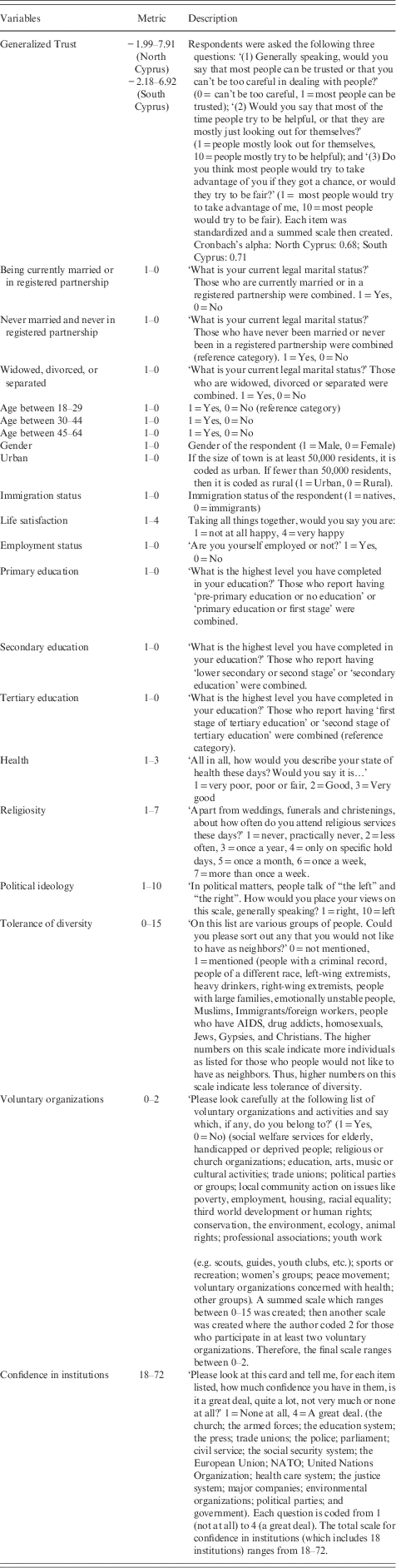
This study’s dependent variable is generalized trust towards other individuals. As noted earlier, generalized trust reflects ‘a belief in the benevolence of human nature in general’.Reference Yamagishi and Yamagishi4 It is argued that while trust in specific others might be important at the more micro-level of social capital, measuring generalized trust is more appropriate to determine a more aggregate level of trust.Reference Paxton7 As shown in Table 1, we use three dichotomous indicators to measure generalized trust towards individuals.Reference Paxton6, Reference Robinson and Jackson22 Since the two relevant EVS questions on fairness and help were highly skewed, we recoded both variables into three values. Respondents who gave values of 1, 2, or 3 were given a value of 0; those who answered 4, 5, or 6 were given a value of 1; and those who answered 7 and above were given a value of 2. Overall, then, the questions on fairness and help each range from 0–2. We combined these three variables to measure generalized trust, standardizing each item and then creating a summed score, with higher scores indicating higher trust in others.Reference Robinson and Jackson22 The Cronbach’s alpha, a measure of reliability, is 0.68 for North Cyprus and 0.71 for South Cyprus.
Measurement of dependent and all independent variables

Independent Variables
Consistent with prior research, we selected several variables as possible correlates of generalized trust.Reference Robinson and Jackson22, Reference Stromsnes27, Reference Paxton36, Reference Delhey and Newton38, Reference Curtis, Baer and Grabb58–Reference Liu, Wright Austin and D’Andra Orey60 These are marital status, age, gender, type of residence, life satisfaction, immigrant status (natives versus foreign-born), employment status, education, health, religiosity, political ideology, tolerance of diversity, participation in voluntary organizations, and confidence in institutions. Table 1 summarizes the measurement of dependent and all independent variables. To measure health, respondents are asked about how they describe their current health. This variable is highly skewed for both communities, with less than one percent reporting ‘very poor’ health. Therefore, we recoded this question to combine those who reported ‘very poor’ and ‘poor’ health; the resulting scale ranges from 1–3. To measure membership in voluntary organizations, respondents are asked whether they participate in any of the listed voluntary organizations. Among Turkish and Greek Cypriots, around 93 and 98% of the respondents, respectively, reported belonging to two or fewer organizations. This makes the variable highly skewed. Thus, we top coded this variable so that those respondents who are members of at least two voluntary organizations are given a value of 2. So, the recoded number of voluntary organizations measure has a score of 0–2.
In this study, we use the same measurement approach for tolerance of diversity and religiosity as prior research.Reference Stromsnes27, Reference Reeskens34 Respondents are asked whether they would not like to have as neighbors people from any of the 15 groups that were listed. If any group was mentioned, then it was recorded as 1, and 0 otherwise. Thus, the scale ranged from 0–15, with higher numbers indicating less tolerance of diversity. Religiosity is measured by asking the respondents how often they attend church (using seven values from ‘never’ to ‘more than once a week’). We also measure institutional trust or confidence in institutions. Respondents are asked a set of questions pertaining to confidence in 18 particular institutions, from ‘the church’ to ‘the press.’ Each question is coded from 1 (not at all) to 4 (a great deal). The total scale for confidence in institutions thus ranges from 18–72. We partially replicate the measurement for this scale from prior research.Reference van Oorschot and Finsveen61 Political ideology is measured by asking the respondent: ‘In political matters, people talk of “the left” and “the right”. How would you place your views on this scale, generally speaking?’ The answer ranges from 1=right to 10=left. We use the same measurement for this political ideology scale as prior research.Reference Halman and Luijkx24, Reference Hooghe, Reeskens and Stolle49
Dealing with Missing Cases
To handle missing data, we employed multiple imputation in all the analyses to address the research questions. Multiple imputation assigns values five different times based on all the variables used in the final models.Reference Allison62 Analyses are then performed five times separately, and the results of each analysis are combined to produce the final estimates. The advantage of multiple imputation is that it allows one to use all the data.Reference Allison62 The total sample size of the North Cyprus data is 465. Less than 2% of the sample has missing information on the generalized trust scale (N=9). After employing multiple imputation, we deleted those cases that are missing data on the dependent variable, leaving a sample of 456. The total sample size of the South Cyprus data is 745. Less than 3% of the sample has missing information on the generalized trust scale (N=22), leaving a sample of 723.
Analytical Strategy
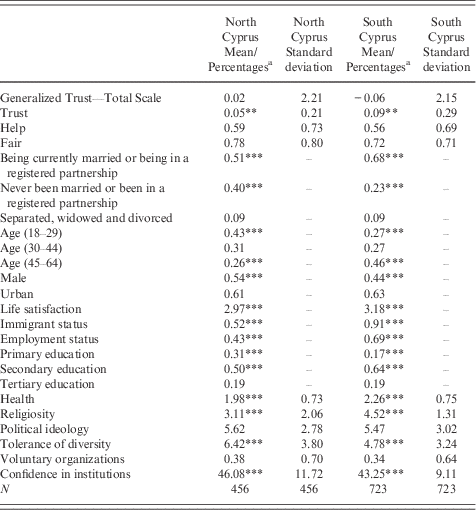
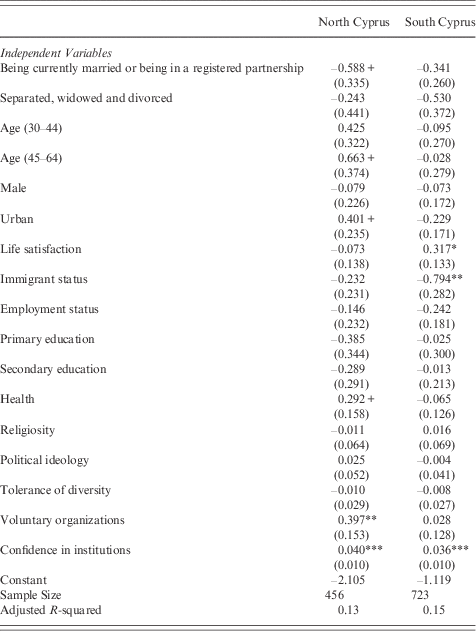
To analyze these data, we used Stata 11.0 statistical software, and employed multiple imputation to handle missing cases in the sample. The generalized trust scale has an interval measure; therefore, we used Ordinary Least Squares Regression (OLS) for all of the analyses. Table 1 summarizes the measurement of the dependent and all independent variables used in the analysis. Table 2 presents the descriptive statistics of the variables in North and South Cyprus. Table 3 presents the correlates of generalized trust, comparing North and South Cyprus.
Descriptive statistics of dependent and all independent variables
aPercentages rather than means are presented for the nominal (categorical) variables. These unweighted descriptive statistics are derived from one of the five datasets with imputed missing values.
***p<0.001, **p<0.01, *p<0.05.
Unstandardized OLS regression coefficients predicting generalized trust
***p<0.001, **p<0.01, *p<0.05, +p<0.10 Standard errors are in parentheses.
Descriptive Statistics
Table 2 compares the North and South Cyprus samples in terms of the variables used in this analysis. In terms of the dependent variable, when we compare the means of the three indicators used for the generalized trust scale, we see that the South sample has individuals who have significantly higher trust compared with those in the North sample, whereas there is no difference between how they think about the fairness and helpfulness of average people. Also, the North sample is made up of younger and less educated respondents, with a smaller proportion of currently married people. Another notable difference is percentage of immigrants: 48% in the North but only 9% in the South sample. After the separation of the island in 1974, many people migrated from Turkey to the northern part of Cyprus, where they have stayed to the present day. Finally, the North sample is less religious and has more confidence in institutions, but is less tolerant of diversity.
Analyses
Table 3 presents the correlates of generalized trust in both halves of Cyprus. In the northern part of the island older, healthier respondents are found to have higher trust levels. Consistent with previous literature, confidence in institutions and membership in more voluntary organizations are both positively related with higher trust. Urban residence is correlated with higher generalized trust, which supports Granovetter’s argumentReference Granovetter40 about the importance of weak ties in predicting generalized trust. In addition, those individuals who live in urban areas have a significantly higher education level (not shown here). Considering that higher education is correlated with higher generalized trust, urban residence is also correlated with higher generalized trust. Respondents who are currently married or who are in a registered partnership have lower trust levels than those who never married. This is contrary to our expectations. This is because our data show that those who are currently married or in a registered relationship participate in significantly fewer voluntary organizations compared with all other marital groups, which is consistent with some prior research that suggested that being married reduces participation in all types of associations, except those related to church.Reference Williams and Ortega63 Since higher participation in voluntary organizations is correlated with higher generalized trust, this does explain why this group has lower trust compared with those who have never been married or been in a registered relationship.
On the other hand, for the southern part of the island, those with higher life satisfaction have significantly higher generalized trust. More confidence in institutions is also correlated with higher generalized trust. Lastly, immigrants have higher generalized trust. When we explore this in more detail, our result are consistent with Voicu’s study,Reference Voicu57 which argues that immigrants come from a low-trust society to a high-trust one, and they are expected to have higher trust compared with natives, even after controlling for the individual backgrounds. According to Voicu,Reference Voicu57 this creates a negative trust gap which is found to increase the odds of generalized trust. The author argues that this is due to the institutionalization hypothesis, which posits that the quality of institutions in the host society matter more in predicting generalized trust than the primary socialization of the individual that took place in the country of origin. Consistent with this, in analyses not shown here, EVS data show that almost half of the immigrants to Cyprus come from Romania, Georgia, the UK, and Greece. Among these, the immigrants with the highest generalized trust in South Cyprus are from Romania and Georgia, which have been empirically shown to be among the low-trust societies.Reference Delhey and Newton38
Conclusion and Discussion
In this paper we have analyzed the correlates of generalized trust for two (dis)similar communities on the island of Cyprus. To our knowledge, this is the first attempt at such a comparison conducted in an empirical manner. The cross-sectional nature of our data makes causality difficult to establish. Therefore, we only present correlations, not associations, between each of our independent variables and generalized trust. The results reveal notable differences both within and between the communities. In comparing North and South Cyprus, we see several differences. Currently, being married, older age, urban residence, better health, and more participation in voluntary organizations are correlated with higher levels of generalized trust in the North but not in the South. On the other hand, those who are natives and have more life satisfaction have higher levels of generalized trust in the South but not in the North. The only significant correlate on both sides is confidence in institutions.
The main contribution of this paper is its analysis of the individual correlates of generalized trust in Cyprus, including both the northern and southern parts of the island. Cyprus has received a lot of attention from political scientists but not so much from sociologists. One reason was the lack of a good data source covering both sides. To the best of our knowledge no other research has used EVS 2008 to study North and South Cyprus. We thus believe that our work adds to the literature on understanding the individual-level correlates of generalized trust among Greek and Turkish Cypriots.
Despite our contributions, this study has some limitations. One limitation is that the current models that explore the individual determinants of generalized trust explain only a small percentage of the variance in generalized trust, as shown by the low R-square values for both communities. These low R-squares, however, are comparable to other studies that explore the individual-level factors affecting generalized trust.Reference Lindstrom30 On the other hand, some other studies explored the contextual factors of generalized trust, such as characteristics of the neighborhood or the country.Reference Hooghe, Reeskens, Stolle and Trappers23, Reference Paxton36, Reference Delhey and Newton38, Reference Bjornskov64 The models comparing individual-level versus contextual factors in predicting generalized trust suggest that the percentage of variance is significantly higher when contextual level variables are included in the models, compared with individual-level variables.Reference Hooghe, Reeskens, Stolle and Trappers23, Reference Bjornskov64, Reference Rothstein and Uslaner65 Some country-level factors that were found to affect generalized trust from the same studies include income inequality, ethnic homogeneity, democracy, and the proportion of Protestants. In addition, some other research has added the number of connected associations at the country level,Reference Paxton36 the presence of civil war in country’s history, and government effectiveness, to predict generalized trust.Reference Rothstein and Uslaner65
Given the importance of such contextual factors, we believe that future research on trust in Cyprus should include both individual and contextual variables (i.e., a multi-level design) where they could better explore the correlates of generalized trust. Second, due to cross-sectional data, we cannot test causality in the effects of individual variables in predicting trust. We hope that EVS continues to collect data from North Cyprus in future waves, and that new datasets follow its example, to gather longitudinal data on Cyprus so researchers can test causality. Where this study explored the individual correlates of generalized trust among both communities separately, with better measures and longitudinal data future research could benefit from exploring to what extent both these communities trust each other in Cyprus and whether (and how) trust towards each other changes over time. Given the presence of civil war between 1963–1974 and the opening of the several check points in 2003 that allowed individuals to cross to either side after having been completely separated for almost 30 years (since the end of the war), understanding to what extent these communities trust each other becomes more important to create a peaceful solution for the future of the island.
Despite some limitations, we believe that using a recent and rich dataset, this study takes an important step in the right direction. It is the first empirical study to explore the individual determinants of generalized trust among Turkish and Greek Cypriots living in the island. Given the importance of trust for conflict resolution,Reference Kelman17 this study makes a significant contribution to understanding the formation of generalized trust in Cyprus, where two completely segregated communities (Turkish and Greek Cypriots) strive for coexistence.
Deniz Yucel is an Assistant Professor in sociology who specializes in the sociology of family and education. Her research is on the intersection of work and family, particularly testing some of the consequences of the family–work struggle on marital outcomes, and on social stratification, in particular some of the early processes of social stratification within the life course.
Tufan Ekici is a quantitative social scientist with a background in econometrics. He uses various data sources to empirically analyze the behavior of individuals. His research includes topics such as the correlates of inter-cultural trust and reciprocity, policy implications of unregistered employment, and analysis of influence of psychological factors on household’s decision making.