Introduction
Why do some countries have large fiscal deficits whereas others do not? Why do some administrations achieve balanced budgets whereas others do not? What explains these variations in fiscal discipline?
Various social, political, and economic factors determine each country's fiscal outcomes. A large number of studies in Political Science look at the effects of political institutions on fiscal outcomes. Political institutions are largely divided into budgetary and electoral ones. Some emphasize the impact of the budget process on fiscal outcomes (e.g., Alesina et al., Reference Alesina, Hausmann, Hommes and Stein1999; Hallerberg and Marier, Reference Hallerberg and Marier2004; Hallerberg and von Hagen, Reference Hallerberg, von Hagen, Poterba and Hagen1999; Kontopoulos and Perotti, Reference Kontopoulos, Perotti, Poterba and Hagen1999; von Hagen and Harden, Reference von Hagen and Harden1995). They argue that setting numerical targets for the budget, the delegation of the budgetary powers to a financial minister, or a small number of spending ministers contributes to maintaining fiscal discipline. In contrast, others find the effects of electoral rules on fiscal outcomes, focusing on legislators’ incentives to cultivate a personal or party vote or on the type of governments (e.g., Edwards and Thames, Reference Edwards and Thames2007; Milesi-Ferretti et al., Reference Milesi-Ferretti, Perotti and Rostagno2002; Perotti and Kontopoulos, Reference Perotti and Kontopoulos2002; Persson and Tabellini, Reference Persson and Tabellini1999, Reference Persson and Tabellini2003; Persson et al., Reference Persson, Roland and Tabellini2000, Reference Persson, Roland and Tabellini2007; Stein et al., Reference Stein, Talvi, Grisanti, Poterba and Hagen1999).Footnote 1
Several former studies analyze executive power but most of them focus on the centralization of the budget process and generally ignore the importance of executive leaders as individuals. Most importantly, in spite of offering that strong executive power encourages a balanced budget, they do not clearly specify why leadership prefers fiscal discipline and how strong leadership in the executive branch maintains fiscal discipline.
This article aims to see what determines variations in fiscal discipline. While former studies explore the effects of structural institutions, I show that variations in the prime minister's strength as an individual make a difference in the spending size of the government; that is, I argue that strong executive leadership, especially a leader who receives strong public support, is more likely to restrain fiscal expenditure and maintain fiscal discipline. Emphasizing executive leadership will allow us to find how and why leadership in the executive branch of the government tries to keep fiscal discipline. Former studies do not fully explain this question.
In order to test my argument, I deal with the relationship between an executive leader and fiscal performance in Japan, and analyze how the strength of the prime minister influenced fiscal spending between 1961 and 2006. It is commonly accepted that the Japanese prime minister's leadership is very weak compared to executive leaders in other countries. Showing the impact of even the Japanese prime minister on fiscal policies will infer the influence of stronger executive leaders in other countries; that is, this analysis of the Japanese prime minister can work as a crucial case study.
This article has five parts. First, I analyze budget formulation in terms of collective action problems, and propose that party leadership has incentives to restrain fiscal spending and maintain fiscal discipline, while rank and file legislators have incentives to expand fiscal expenditure. Second, after defining strong leadership, I argue that executive leadership that receives stronger public support is more likely to restrain fiscal expenditure and maintain fiscal discipline. Third, in order to verify this argument in the case of Japan, I describe the Japanese budget process and the involvement of an executive leader (the prime minister) in budget formulation in Japan. Fourth, I introduce data used for verifying the argument and finally I test the argument by quantitatively investigating the relationship between public support for the prime minister and fiscal discipline.
1. Collective action problems in the budget-making process
Legislators face collective action problems in the policymaking process. They seek to maximize the probability of reelection. To this end, they need to develop both their individual reputation and their party's collective reputation. In cases of budget formulation, legislators’ individual reputation is enhanced when they bring special interests such as subsidies or public projects to their district. It is a private good that only each legislator can enjoy. On the other hand, a party's reputation is increased when a party formulates the appropriate budget as a whole and keeps fiscal discipline. It is a collective good that all party legislators can enjoy. Some party legislators, without paying any cost, can enjoy one encouraged by other members.
For legislators to attain high individual reputation, the marginal utility of pork-barrel effects exceeds their marginal costs because a constituency can receive the benefits but people nationwide bear the costs in the form of taxes. Therefore, to promote their own individual reputation, legislators try to bring as many special interest projects to their constituency as possible. However, excessive pork-barrel projects ruin a party's reputation. The electorate recognizes that excessive financial expenditure will cause future tax increases and will thus have suspicions about the party's ability to formulate a reasonable budget and manage the government. As a result, poor party reputation has adverse effects on each legislator's reelection. Indeed some are reelected but they may go out of power if many of their colleagues lose their seats.
Even if legislators face this situation, they will not stop influencing peddling politics because, as stated above, the marginal utility of influencing peddling exceeds its marginal costs without any rule or institution. Although some party members reduce pork-barrel effects, it is not certain that others will also do so. When a legislator alone restrains from influence peddling for a party's reputation, the decline of influence peddling will affect his or her individual reputation but the reputation of the party will not be improved.
In order to avoid this incompatibility between individual rational action and collective goals, a party needs to create leadership as a political entrepreneur (Cox and McCubbins, Reference Cox and McCubbins1993). Riker and Ordeshook (Reference Riker and Ordeshook1973: 73) define a political entrepreneur as a person who pursues political profits through achieving collective benefits. While rank and file members delegate their policymaking and decision-making authority to the party leadership, leadership enhances the party's reputation, which contributes to the development of all party members’ probability of reelection. The leadership tries to establish a high reputation for the party by showing voters the party's governing ability, such as reducing influence-peddling politics or formulating a reasonable budget.
For the sake of achieving the high reputation of a party, which is a collective good, the party leadership gives members selective incentives to follow the leadership. Selective incentives consist of rewards for members who follow the party leadership and sanctions for members who do not. In concrete terms, rewards are official party endorsement in an election or assignments to good positions in the legislative organization.
On the other hand, rewards for a party leader as a political entrepreneur are to govern a party and control policymaking or decision-making. If party leadership builds up the good reputation of the party, it can stay in this position. However, if it fails, it is dismissed. In particular, a leader who leads a party to electoral success or receives high public support can stay in power but a leader who fails to do so is removed from office.
The previous theoretical investigation produces the two following assumptions:
Assumption 1: Rank and file party legislators, whose primary goal is to promote their own probability of reelection, seek to expand government spending as much as possible since the more benefits they bring to their districts, the higher their reputations will be.
Assumption 2: Party leadership seeks to restrain government expenditure and maintain fiscal discipline because the leadership stays in office by developing the reputation of the party and leading party legislators to electoral success.
Some may disagree with Assumption 2, claiming that party leadership is supposed to dole out pork-barrel projects to receive public support. I respond to this objection for the two following points. First, after the end of high economic growth, most countries have a massive budget deficit. In these circumstances, general citizens often view pork-barrel projects in a negative light. Typical pork-barrel projects such as subsides or public projects do good for interest groups but bring few benefits for general citizens. Those who do not enjoy such benefits consider that pork-barrel projects will cause future tax increases that they will have to bear. In short, pork-barrel projects are not necessarily effective measures to enhance a party's reputation. Second, I do not insist that party leadership refuses all pork-barrel projects or that it seeks to restrain government expenditure and maintain fiscal discipline excessively. Instead, I argue that excessive fiscal expenditure will damage a party's reputation. In other words, I suppose that a leader aims to preserve the appropriate level of government expenditure or fiscal discipline.Footnote 2 Thus, I think that Assumption 2 is reasonable.
2. Executive leadership and fiscal policies
The assumptions suggest that the power relationship between the leadership and rank and file legislators influences fiscal discipline of the government. Strong leadership is supposed to restrain fiscal expenditure and maintain fiscal discipline. In parliamentary countries, a ruling party (or ruling parties) typically dominates policymaking and budget formulation, and a ruling party leader serves as the prime minister. The prime minister seeks to formulate a reasonable budget to remain in power; that is, I suggest that strong prime minister leadership is more likely to maintain fiscal discipline.
My analysis basically covers parliamentary countries. Yet, I imply that my theory can also be applied to presidential countries. In presidential systems, legislators require the government to expand fiscal spending so that they can promote their prospect of reelection by bringing benefits to their district. However, excessive fiscal expenditure will cause criticism against pork-barrel politics and ruin public support for the government. In order to be reelected or stably manage the government, the president seeks to preserve an appropriate level of spending; that is, stronger presidential leadership is more likely to maintain solid fiscal discipline. In summary, I assume that stronger executive leadership, whether the prime minister or the president, is more likely to restrain fiscal expenditure and maintain fiscal discipline.
What is ‘strong executive leadership’? How can ‘the strength of executive leadership’ be defined? I suggest two ways to establish strong leadership. One way is to rely on strong support and approval from legislators. In parliamentary courtiers, the prime minister requires support from a majority of legislators in a legislature to pass bills or budget drafts. Because a ruling party normally commands a majority of seats, the prime minister can pass all bills if ruling party legislators support him or her. Therefore, the prime minister who receives strong support from ruling party legislators can exercise strong leadership. Similarly, in presidential countries, the president needs support from a majority of legislators in a legislature to pass bills. The president who receives support from the most legislators can also exercise strong leadership. In contrast, the second way is to rely on strong support from the public. High public support allows the prime minister or president to control legislators and implement desired policies.
This article defines ‘strong executive leadership’ as leadership that controls legislators on the basis of strong public support because the executive leader and rank and file legislators disagree over expenditure policies. As already discussed, rank and file legislators have incentives to expand public spending for their own individual reputation, while the executive leadership has incentives to restrain public spending for the reputation of his or her party or the government. The role of the executive leadership in fiscal policies is to fend off legislators’ demands to enlarge the budget and to formulate a reasonable budget. For these goals, the leadership needs support from the public instead of legislators. When a leader receives high public support, he or she can push through his or her policies and control legislators. The high popularity of a leader is key to party reputation and to the success of rank and file legislators’ electoral performance. For example, in Japan the Cabinet approval rating has a positive impact on an individual ruling party legislators’ vote share (Krauss and Nyblade, Reference Krauss and Nyblade2005). If rank and file legislators challenge their leader, such intraparty conflict damages party reputation; that is, a leader with high public support can control rank and file legislators because his or her high popularity contributes to electoral success.Footnote 3 However, some will still claim that the executive with support from legislators can exercise strong leadership. Therefore, I will conduct empirical tests on which type of executive leadership is more likely to maintain fiscal discipline later in the article.
In summary, this article argues that executive leadership with stronger public support is more likely to restrain fiscal expenditure and maintain fiscal discipline.
3. The budget process in Japan
In order to test this argument, I focus on Japan and analyze how the prime minister influences fiscal spending. As already discussed, the reason for looking at Japan is that this country is thought to have very weak prime ministers. Showing the significant impact of even weak Japanese prime ministers on fiscal discipline will lead to finding that executive leaders in other countries do influence fiscal discipline.
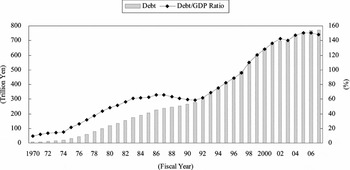
The Japanese government issued construction bonds in 1966 and deficit-covering bonds in 1976 for the first time in the postwar period. Figure 1 illustrates accumulative long-term debts of the central and local governments in Japan. Since the late 1970s, the government has been seriously concerned about budget deficits and attempted to reform fiscal balances. The Ohira Cabinet (1978–80) announced that Japan faced a severe fiscal crisis and that the government needed to rebuild public finances. The Suzuki Cabinet (1980–82) undertook administrative and fiscal reforms and the Nakasone Cabinet (1982–87) adopted a serious stance on reforms. The Nakasone Cabinet cut fiscal expenditure and reduced government size by imposing a ceiling on the budget and by privatizing public companies. After the Ohira Cabinet and the Nakasone Cabinet attempted to adopt a sales tax but failed, the Takeshita Cabinet (1987–9) succeeded in introducing it in 1989. The Hosokawa Cabinet (1993–94) attempted to raise the sales tax rate from 3% to 7% but failed, while the Murayama Cabinet (1994–96) raised it from 3% to 5%. The Hashimoto Cabinet (1996–98) and the Koizumi Cabinet (2001–06) pursued significant administrative and fiscal reforms to rebuild government finances. In particular, the Koizumi Cabinet succeeded in restraining fiscal expenditure and in reducing government size. In short, since the late 1970s, Japan has faced fiscal deficits and successive cabinets have tried to improve fiscal balances.
Accumulative long-term debts of the central and local government (1970–2006)
Source: the website of the Ministry of Finance http://www.mof.go.jp/jouhou/syukei/siryou/sy1903h.pdf.

Who formulates a budget in Japan?Footnote 4 It is the Ministry of Finance (MOF) that directly drafts a budget. Each ministry submits the necessary budget amount to the MOF and the MOF makes a draft budget every fiscal year. Each May, each ministry starts to make the Budget Request (Gaisan Yokyu), which shows necessary policy spending. In late July, the MOF indicates the Guideline for the Budget Request (Gaisan Yokyu Kijun), which sets an upper limit on the budget amount that each ministry can request. At the end of August, each ministry submits the budget request to the MOF. The Budget Bureau of the MOF conducts hearings with ministries in September and evaluates individual budget requests in October and November. In December, the MOF makes a draft budget. The MOF's draft budget is reported at a Cabinet meeting and announced to other ministries. After renegotiations between the MOF and each ministry, the government approves the MOF's draft as a government budget draft. The government submits a draft to the Diet the following January. The Diet usually enacts a government budget without making any increases or decreases in spending.
While the MOF drafts a budget as described above, the Liberal Democratic Party (LDP), which has almost consistently been in office since its formation in 1955, has positively engaged in budget formulation since the late 1960s and been involved in deciding total expenditure since the 1980s (Mabuchi, Reference Mabuchi1994, Reference Mabuchi2004). On the one hand, rank and file legislators try to expand spending. In particular, zoku legislators, who have special interests and expertise in each policy area, aim to obtain more budgets in cooperation with each spending ministry. On the other hand, the prime minister attempts to set a ceiling on total expenditure. Notably, the MOF which drafts the budget firmly sticks to its balanced budget principle. Thus, when the prime minister seeks to restrain fiscal expenditure and maintain fiscal discipline, he or she can make use of the MOF to formulate an austere budget. Although the prime minister and the MOF may fight with each other for leadership in formulating a budget, they can work together for the common goal of achieving balanced finances.
How can the prime minister control the budget size under this budget formulation process? The prime minister's method of restraining government expenditure is to first make a public commitment on expenditure targets at each stage such as party president elections, national elections, Cabinet meetings, or the prime minister's policy speeches in the Diet. If a candidate, offering fiscal objectives, wins a party president election, party legislators are forced to adopt his or her policies because his or her win means that the party approves his or her policies. Similarly, if the prime minister, as the president of the ruling party, wins a national election, party legislators and bureaucrats are forced to follow his or her policies and moreover have the responsibility to achieve these policies as members of the ruling party or the government. Party legislators and bureaucrats also have the responsibility to realize decisions made at a Cabinet meeting or the prime minister's policy speech in the Diet. In short, the prime minister's public commitment in each stage forces ruling party legislators and bureaucrats to accept his or her policies, and they have the responsibility of achieving them as members of the ruling party or the government.Footnote 5
Next, in the stage of the Guideline for the Budget Request (Gaisan Yokyu Kijun) the prime minister can set an upper limit on spending that each ministry can request from the MOF. The Guideline for the Budget Request is a significant stage that virtually determines the total amount of the budget. If the prime minister succeeds in setting a strict limit on spending, this will lead to restraints on government expenditure. In particular, using a council allows the prime minister to take the initiative of making the guideline. Due to outlines and numeric goals presented by a council, the prime minister can push through his or her budget plan against legislators and spending ministries.Footnote 6 In contrast, legislators and spending ministries will disagree with public spending cuts and demand to extend spending. In this case, whether or not the prime minister can execute austere budgets heavily depends on his or her popularity. If the prime minister receives high public support, legislators and bureaucrats tend to reluctantly accept an austere budget because the prime minister has civil legitimacy and can lead party legislators to electoral success.Footnote 7 In particular, the Cabinet approval rating has a positive impact on individual LDP legislators’ vote share (Krauss and Nyblade, Reference Krauss and Nyblade2005) and high Cabinet approval in fact contributes to rank and file LDP legislators’ electoral success. On the other hand, if the prime minister receives low public support, he or she is forced to accept legislators and bureaucrats’ demands to enlarge spending because he or she has no choice but to depend on ruling party legislators to maintain the government.
This section has shown that both the prime minister and rank and file legislator are fully involved in the budget process. Importantly, the MOF consistently aspires to maintain fiscal balances due to its responsibility as a fiscal authority. Therefore, when the prime minister aims to restrain fiscal expenditure, he or she can cooperate with the MOF and use it to achieve his or her goal.
4. Data and measurement
Through quantitative analyses, I test my hypothesis that executive leadership with stronger public support is more likely to restrain fiscal expenditure and maintain fiscal discipline. I make time series analyses regarding prime minister strength and fiscal discipline between 1961 and 2006 in Japan (data on Cabinet approval ratings has been available since 1961).
In making a time series analysis, we need to pay attention to problems of autocorrelation and heteroskedasticity. If errors correlate with each other (autocorrelation) or do not have homogeneous variance (heteroskedasticity), an ordinary least squares (OLS) regression cannot make effective estimates. Therefore, I first run standard OLS regressions and conduct the Breusch-Godfrey test for autocorrelation and the Breusch-Pagan test for heteroskedasticity. If autocorrelation or heteroskedasticity is detected, I will implement measures to solve the problem and run another model.
The dependent variable for fiscal expenditure is Fiscal Expendituret, which is the year-to-year percentage change in the ratio of the general account expenditure excluding the bond expenditure to GDP from term t − 1 to term t.Footnote 8 The general account expenditure is the annual closing of accounts including both the initial and supplementary budgets.Footnote 9 The annual closing of the general account expenditure including the initial and supplementary budgets is considered an appropriate measure for fiscal expenditure of national governments because it is a comprehensive and ultimate index of national government expenditure. The reason for excluding the bond expenditure is that it is expenditure for redemption and interests of past national bonds and thus the government cannot arbitrarily determine its size.Footnote 10 Using the year-to-year percentage change as the dependent variable for fiscal discipline is also reasonable because the Japanese budgetary process is incremental (Mabuchi, Reference Mabuchi2004: chapter 10). In Japan, budgetary formulation and negotiation within the government and the ruling party are based on the budget of the previous year. In particular, the MOF sets an upper limit of each ministry's budget request as compared with the previous fiscal year by indicating the Budgetary Request Guidelines (Gaisan Yokyu Kijun) before spending ministries request a budget.
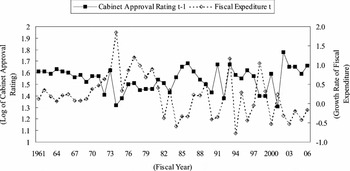
The key independent variable for the strength of the prime minister is Cabinet Approval Rating t− 1, which is the log of the average of the preceding fiscal year's Cabinet approval ratings (April–March). Ruling party legislators are always interested in the Cabinet approval rating as the indicator of how the popularity of the Cabinet affects their reelection popularity. Rank and file legislators will follow the prime minister when he or she is popular and can lead them to electoral success. The reason for using the preceding fiscal year's values is that the budget implemented in term t is formulated in term t − 1. The data of the Cabinet approval rating come from Jiji Yoron Chosa [the Jiji Opinion Poll] by Jiji Tsushin Sha.Footnote 11 The poll has been conducted every month since 1960. I average out of the Cabinet approval ratings between April and March. The hypothesis suggests that Cabinet Approval Rating t− 1 has a negative influence on the dependent variable.Footnote 12Figure 2 shows time series values of Cabinet Approval Rating t− 1 and Fiscal Expendituret.
The Cabinet approval rating and fiscal expenditure (1961–2006).

I add two control variables for political factors. First, while I define strong executive leadership as one with high public support, some may argue that it is when the prime minister has support from a ruling party or the president has support from legislators. Thus, I put Factionally Balanced Cabinet Line-Up t− 1, which is a correlation coefficient between each faction's share of the LDP's Lower House members and its share of Cabinet posts.Footnote 13 The LDP has strong factions and, by tradition, the prime minister proportionally allocates Cabinet posts to factions according to each faction's size (Cox et al., Reference Cox, Rosenbluth and Thies1999; Kawato, Reference Kawato1996; Köllner, Reference Köllner2004; Park, Reference Park2001; Sato and Matsuzaki, Reference Sato and Matsuzaki1986). Cabinet reshuffling is a top concern for ruling party legislators and the Cabinet portfolio determines each faction's attitude toward the prime minister. When the prime minister proportionally distributes posts to factions, he shows his cooperative attitude toward ruling party members and most of them will support him. In contrast, when the prime minister unproportionally distributes posts, it is the sign of his adversarial stand against some factions and thus members of discriminated factions turn against him. Hence, Factionally Balanced Cabinet Line-Up t− 1 represents the prime minister's attitude toward ruling party legislators. Including this variable allows us to examine whether or not the prime minister who receives high support from a ruling party is more likely to restrain fiscal expenditure. If it is appropriate to define a strong prime minister as the prime minister whom ruling party members strongly support, Factionally Balanced Cabinet Line-Up t− 1 is expected to be negative. The reason for using Factionally Balanced Cabinet Line-Up t− 1, instead of Factionally Balanced Cabinet Line-Up t, is that the budget implemented in term t is formulated in term t − 1.
Second, as stated above, a large number of studies find the effects of electoral rules on fiscal outcomes (e.g., Edwards and Thames, Reference Edwards and Thames2007; Milesi-Ferretti et al., Reference Milesi-Ferretti, Perotti and Rostagno2002; Perotti and Kontopoulos, Reference Perotti and Kontopoulos2002; Persson and Tabellini, Reference Persson and Tabellini1999, Reference Persson and Tabellini2003; Persson et al., Reference Persson, Roland and Tabellini2000, Reference Persson, Roland and Tabellini2007; Stein et al., Reference Stein, Talvi, Grisanti, Poterba and Hagen1999). In Japan the Lower House once had a multi-member district system (single non-transferable vote) between 1949 and 1993 and has a system that combines single-member districts (SMD) and proportional representation (PR) after 1996. I include a dummy variable, SMD & PR t− 1, which is coded 1 if the electoral system is a combination of SMD and PR. The reason for using SMD & PR t− 1, instead of SMD & PR t, is that the budget implemented in term t is formulated in term t − 1.
I include three control variables for economic factors. GDP growth and inflation are already controlled for because the dependent variable, Fiscal Expenditure t, is the year-to-year percentage change in the ratio of expenditure to real GDP. First, since an increase in tax revenue can cause an increase in fiscal expenditure, I put Tax Revenue t, which is the year-to-year percentage change in the ratio of the taxes and stamp revenue to GDP from term t − 1 to term t.Footnote 14 The taxes and stamp revenue is the annual closing of accounts. Second, Government Debt t, which is the year-to-year percentage change in the rate of the government debts and borrowings to the GDP from term t − 1 to term t, is included to control for the effects of accumulated fiscal deficits on budget formulation.Footnote 15 Finally, I include Population Ratio of People Aged 65 and over t, the log of the population ratio of people aged 65 and over. Aging of the overall population tends to enlarge public welfare expenditure. In addition, elderly people may demand government expenditure to expand because they do not have to worry about future tax increases caused by a present spending increase.
We may also need to control for political business cycles. Inoguchi (Reference Inoguchi1983) and Kohno and Nishizawa (Reference Kohno and Nishizawa1990) find that in Japan the government tends to expand fiscal expenditure around the time of an election. Furthermore, it is possible that a government with a very slim majority of seats in the Diet is more likely to expand the budget and stimulate the economy to maintain its majority position. On the other hand, the government holding an outright majority does not have to seriously worry about its seats. Therefore, I ran models including four control variables for the relationship between elections and fiscal spending: Lower House Electiont, the dummy variable coded 1 if a Lower House election is held in term t; Upper House Electiont, the dummy variable coded 1 if an Upper House election is held in term t; Ruling Party's (Parties’) Seat Share in the Lower Houset− 1; and Ruling Party's (Parties’) Seat Share in the Upper Houset− 1. Regression analyses showed that these four variables were not significant and adding them did not influence the effects of other independent variables. As a result, I exclude these four variables from the main analyses.
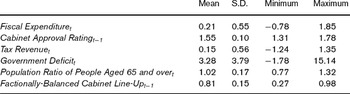
Table 1 indicates summary statistics of variables.
Summary statistics

5. Results
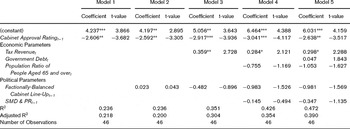
Table 2 reports the OLS regression results between 1961 and 2006. At the beginning, I verify whether the models can make effective estimates regarding autocorrelation and heteroskedasticity. First, I use the Breusch-Godfrey test for autocorrelation. The test indicates that the null hypothesis of no autocorrelation is not rejected at any order in all models (p < 0.05). Thus, it indicates no evidence of autocorrelation. Second, I used the Breusch-Pagan test for heteroskedasticity and it does not reject homoskedasticity in errors. As a result, the two tests demonstrate that the OLS regression models can make effective estimates.
Ordinary Least Squares Regression Analysis (1961–2006)

The dependent variable for fiscal expenditure is Fiscal Expendituret, which is the year-to-year percentage change in the ratio of the general account expenditure excluding the bond expenditure to GDP from term t −1 to term t. ***: p<0.001, **: p<0.01, *: p<0.05.
I run five regressions to test the model's robustness. Cabinet Approval Ratingt− 1, the key independent variable for the strength of the prime minister, is statistically significant at a 0.1% or 1% level and negative in all models. These results indicate that the prime minister with higher Cabinet approval ratings is more likely to restrain fiscal expenditure, and firmly support my hypothesis that executive leadership with stronger public support is more likely to restrain fiscal expenditure and maintain fiscal discipline.
The two variables for political factors, Factionally Balanced Cabinet Line-Up t−1 and SMD & PRt− 1, are not significant. In particular, the insignificance of Factionally Balanced Cabinet Line-Up t−1 illustrates that there is no evidence that the prime minister who receives stronger support from his ruling party, the LDP, maintains fiscal discipline. Similarly, due to the insignificance of SMD & PRt− 1, we cannot find electoral rules’ impact on fiscal spending.
Regarding control variables for economic conditions, Tax Revenuet is significant at a 1% or 5% level and positive in Models 3, 4, and 5. These results support a common theory that increases in tax revenues tend to inflate public expenditure. By contrast, Government Deficit t and Population Ration of People Aged 65 and overt are not significant.
The OLS regression analyses demonstrate that the stronger prime minister with high public support is more likely to restrain fiscal spending, and thus support my hypothesis. On the other hand, there is no evidence that the prime minister who receives strong support from the ruling party maintains fiscal discipline. Regarding fiscal policies, the analyses here support the view that strong executive leadership is based on strong public support instead of the alternative view that strong executive leadership is based on strong support from the ruling party or the legislative branch.
Conclusion and implications
This article has discussed what determines variations in fiscal discipline, focusing on executive leadership's influences on fiscal policies and performance in Japan. My research demonstrates that executive leadership has incentives to maintain fiscal discipline because it can stay in office by implementing appropriate fiscal management and developing the reputation of the party, and the leadership with stronger public support is more likely to maintain fiscal discipline.
In particular, this article has three findings. First, while former studies mainly emphasize the effects of budgetary and electoral rules on fiscal outcomes, I provide a different perspective and argue that variations in the prime minister's strength as an individual determine the spending size of the government. Second, this article contributes to defining strong executive leadership: leadership with strong public support or leadership with strong support from the legislative branch. My research shows that leadership with stronger public support is more likely to restrain fiscal spending whereas a legislative branch's support for executive leadership does not influence the size of fiscal spending; that is, regarding fiscal policies, my research suggests that it is reasonable to define strong leadership as being based on strong public support. Finally, this article shows that public support for an executive leader determines variations in his or her strength. In other words, strong public support for a leader allows him or her to exercise strong leadership and maintain fiscal discipline. In that sense, the public is one of the most important actors in determining economic and fiscal policies. I generate these three findings from Japanese cases. However, my theory needs to be tested on other countries including both parliamentary and presidential countries, which will make my theory more developed and generalized.
About the author
Naofumi Fujimura is Assistant Professor of Political Science, Graduate School of Law, Kyoto University, Japan. The author would like to thank Marie Anchordoguy, Mark Andrew Barnes, Akitaka Matsuo, Etsuhiro Nakamura, Hanako Ohmura, Hirotaka Ohmura, Robert Pekkanen, Saadia M. Pekkanen, Hironori Sasada, Michael Strausz as well as the editor and three anonymous reviewers of the journal for their helpful comments. The earlier versions of this article were presented at the 2007 annual meeting of the Association for Asian Studies and the 2007 annual meeting of the Canadian Political Science Association. The author would also like to thank all participants, particularly Eiji Kawabata, Robert Weiner, and Ito Peng for their valuable suggestions.