INTRODUCTION
The present study focuses on the morphophonology of Dutch past tense production in typically developing (TD) five- and seven-year-olds as well as in children with specific language impairment (SLI), investigating the productivity of the two past tense allomorphs in Dutch. Whereas allomorphy of past tense inflection has been studied in Dutch adults (Ernestus & Baayen, Reference Ernestus and Baayen2003), to our knowledge no Dutch data are available on the acquisition and productivity of these two allomorphs for regular past tense marking. We further wanted to investigate allomorphy in children with SLI as difficulties with the past tense are frequently reported in this group (see Leonard, Reference Leonard1998, for an overview). In addition, children with SLI demonstrate problems in the morphophonological domain (Chiat Reference Chiat2001; Joanisse & Seidenberg, Reference Joanisse and Seidenberg1998; Marshall & van der Lely, Reference Marshall and van der Lely2006; Dutch: de Bree & Kerkhoff, Reference de Bree and Kerkhoff2010). As the development of the regular past tense involves morphophonology, performance patterns on allomorph productivity will contribute to the debates concerning the nature of past tense problems in SLI.
In Dutch, as in English, inflecting regular verbs for the past tense depends on an interaction between morphology and phonology. Regular past tense marking consists of adding a one-syllable suffix to the verb stem, surfacing as allomorph de (/də/) or te (/tə/). Verbs ending in an underlyingly voiceless obstruent take te, all other cases take de (Ernestus & Baayen, Reference Ernestus, Baayen, van der Wouden and de Hoop2001). For example, the infinitive gapen ‘to yawn’, with the stem ending in a voiceless obstruent (gaap), becomes gaap-te in the past tense, whereas noemen ‘to name’ becomes noem-de.
Studies investigating the morphophonology of past tense inflection in English have found that past tense inflection of regular verbs shows different patterns for the three allomorphs (/t/: walked; /d/: loved; and /ɪd/: waited) in TD children (Berko, Reference Berko1958; Bybee & Slobin, Reference Bybee and Slobin1982; Marchman, Reference Marchman1997) and in children with SLI (Blom & Paradis, in press; Marchman, Wulfeck & Ellis Weismer, Reference Marchman, Wulfeck and Ellis Weismer1999; Marinis & Chondrogianni, Reference Marinis and Chondrogianni2011; Oetting & Horohov, Reference Oetting and Horohov1997; Paradis, Nicoladis, Crago & Genesee, Reference Paradis, Nicoladis, Crago and Genesee2010). Inflection of verbs with a stem ending in an alveolar with the /ɪd/ suffix triggers more errors in the form of zero-marking than inflection with /t/ and /d/, not only in TD children but also in children with SLI. Several explanations for this observation have been offered, such as the suggestion that verb stems ending in alveolar /t/ and /d/ resemble the past tense suffix, which may lead children to think that these forms are already marked for the past tense (Berko, Reference Berko1958; Marchman, Reference Marchman1997; Marchman et al., Reference Marchman, Wulfeck and Ellis Weismer1999). Also, verb stems demanding the /ɪd/ allomorph are similar to irregular verbs that are zero-marked for the past tense (for example cut–cut; e.g., Matthews & Theakston, Reference Matthews and Theakston2006). Furthermore, the complexity of the syllabic suffix /ɪd/ relative to the phonemic suffixes /t/ and /d/ may play a role. Frequency has also been proposed as a factor determining the production accuracy of the inflected form. The relatively low frequency of the suffix /ɪd/ may be the driving factor for omission of this suffix, especially when the bare stem has a higher frequency than the inflected form (Derwing & Baker, Reference Derwing, Baker, Prideaux, Derwing and Baker1980; Matthews & Theakston, Reference Matthews and Theakston2006).
Frequency plays a role in the acquisition of morphology according to the usage-based approach (e.g., Bybee Reference Bybee1995, Reference Bybee2001, Reference Bybee, Robinson and Ellis2008). Usage-based theory assumes that language experience enables the construction of networks in which items are stored based on their forms and meanings. Lexical items are associated with other items based on similarities of their semantic and phonological properties. These similarities lead to so-called schemas from which generalizations for new items emerge. Frequency, which is important for the construction of such schemas/patterns in language acquisition, can be divided into token and type frequency (Bybee, Reference Bybee, Robinson and Ellis2008). Token frequency refers to the number of times a lexical item, such as a specific verb, appears. Words with high token frequency have stronger memory representations, improving accessibility of that word, compared to low-frequency items. The former are thus processed more quickly and accurately than the latter. Experimental evidence has shown that token frequency influences past tense marking of regular verbs (e.g., Matthew & Theakston, Reference Matthews and Theakston2006; Oetting & Horohov, Reference Oetting and Horohov1997) and irregular verbs (e.g., van der Lely & Ullman, Reference van der Lely and Ullman2001) in children. In other words, the higher the frequency of the inflected form, the more likely it is to be retrieved. Ernestus and Baayen (Reference Ernestus, Baayen, van der Wouden and de Hoop2001) found evidence for token effects in the productions of past tense forms of Dutch adults.
Type frequency counts how many lexical items a certain pattern, for example a suffix, is applicable to (Bybee, Reference Bybee2007). It plays a role in past tense inflection, specifically with respect to morphological productivity (e.g., Bybee, Reference Bybee, Robinson and Ellis2008). A suffix tends to be applied to newly learned items if many different lexical items take that same suffix. For past tense morphology, it is assumed that highly frequent past tense markers (types) will be most productive. For English and Dutch, the regular past tense inflection is more frequent than the irregular ones. The combination verb + regular inflection -ed in English is more likely to be applied to new lexical items (e.g., blog–blogged; see Gor, Reference Gor, Gonzalez-Marquez, Mittelberg, Coulson and Spivey2007) than an irregular verb inflection. Similarly, in Dutch, new lexical verbs generally take the suffix de or te, rather than take an irregular inflection. However, within the type ‘regular past tense’ the frequency of the occurrence of the two types of allomorphs of the regular past tense also needs to be taken into account. In Dutch, the distributional frequency of the two allomorphs de and te in the input is different. On the basis of tallying past tenses in Dutch adult input to children in CHILDES corpora (MacWhinney, Reference MacWhinney2000), Kerkhoff, de Bree, Kager, and Zonneveld (Reference Kerkhoff, de Bree, Kager and Zonneveld2011) report that the majority (62%) of regular past tense types of all past tenses have the voiced allomorph de. They also report that this pattern holds when using the CELEX database (Baayen, Piepenbrock & van Rijn, Reference Baayen, Piepenbrock and van Rijn1995), in which 71% of all verbs take de. Thus, the type frequency of the allomorph de is higher than te as more verbs take de in Dutch than te. Given that high type frequency facilitates productivity it may thus be expected that inflecting verbs for the past tense demanding the de allomorph is more accurate than verbs that take te, and that novel verbs that demand the de allomorph will be produced more accurately for the past tense than those taking the te allomorph. In addition, as type frequency has been suggested to be influential for morphological productivity, we predict that it is more likely that children overgeneralize the de allomorph (thus applying a de allomorph to a voiceless verb stem) than the other way around.
Another frequency-related factor that has been demonstrated to play a role in past tense inflection is phonotactic probability (PP), that is, the probability with which adjacent phonemes appear together in actual words of the language (Jusczyk, Luce & Charles-Luce, Reference Jusczyk, Luce and Charles-Luce1994). A high PP of a target form (word or non-word) is likely to facilitate its inflection, given that it resembles the language-specific pattern (Vitevitch & Luce, 1998). Leonard, Davis, and Deevy (Reference Leonard, Davis and Deevy2007) looked at the role of PP in novel verb inflection. They found that four- to six-year-old children with SLI were less likely than age- or language-matched children to inflect novel verbs. Furthermore, they were less likely to use the past tense suffix with low PP novel verbs than high PP novel verbs. The control groups did not show this effect. Leonard, Davis, and Deevy (Reference Leonard, Davis and Deevy2007) propose that the verbs with low PP may be more difficult for children with SLI as they deviate from familiar lexical entries.
In addition to possible frequency effects, phonological preferences also need to be considered both in typical language development and in SLI for their impact on inflection (see Marshall & van der Lely, Reference Marshall and van der Lely2007; Song, Sundara & Demuth, Reference Song, Sundara and Demuth2009). In Dutch, there is evidence that the development of voiced segments/phonemes is different from that of voiceless ones. Dutch children around the age of three have been found to show a clear preference for voiceless over voiced segments (Kager, van der Feest, Fikkert, Kerkhoff & Zamuner, Reference Kager, van der Feest, Fikkert, Kerkhoff, Zamuner, van de Weijer and van der Torre2007) and acquire voiceless phonemes before voiced ones (e.g., Beers, Reference Beers1995). Dutch shows final devoicing, and has the tendency of voiceless word-internal clusters (Zonneveld, Reference Zonneveld, van de Broecke, van Heuven and Zonneveld1983). Currently, there is also a tendency of Dutch past tenses to be realized with voiceless clusters (Kerkhoff et al., Reference Kerkhoff, de Bree, Kager and Zonneveld2011). If phonology influences the development of grammatical morphemes, we may expect an advantage for te allomorphs in Dutch in the sense that verbs demanding a te allomorph are inflected for the past tense more accurately during development.
For SLI, different theoretical perspectives have been offered to account for the difficulty with past tense production (see Marinis (Reference Marinis2011) for a recent overview). Theories that pinpoint the deficit at the level of morphosyntactic representations (the Extended Optional Infinitive, for example; Rice, Wexler & Cleave, Reference Rice, Wexler and Cleave1995) do not readily predict a difference in the production between past tense allomorphs as token/type frequency are not viewed as particularly influential on the development of the past tense. A prediction from this theory is that in case of errors, assignment of the wrong allomorph is not expected, but rather an infinitive instead of a past tense form.
The ‘Surface hypothesis’ proposed by Leonard (Reference Leonard1998) attributes the tense-marking problems of children with SLI to a problem with perceptual processing combined with a general processing capacity limitation. According to this view, past tense marking is compromised in SLI as the grammatical markers are perceptually not highly salient, making such morphemes difficult to process. With respect to allomorph production, we deduce that regular past tense marking in Dutch may itself be difficult to acquire as the past tense markers are unstressed syllables, but there is no reason to expect a difference between allomorph production according to the surface hypothesis as the perceptual properties are the same for both allomorphs.
A somewhat related theory on the difficulties of past tense marking in SLI is proposed by Joanisse and Seidenberg (Reference Joanisse and Seidenberg1998). They claim that children with SLI have phonological processing problems which result in problems with developing accurate phonological representations. This will subsequently interfere with morphosyntactic development as the past tense is dependent on accurate phonological analysis of the verb stem. If the phonological representations of children with SLI are less robust in comparison with those of the TD children we may expect to find errors of assigning the wrong allomorph to the verb stem in our study, as children may have difficulty with retrieving the correct end phoneme of the verb stem. Joanisse and Seidenberg (Reference Joanisse and Seidenberg1998) further argue that frequency influences morphosyntactic learning and that a relatively high frequency of exposure to a morpheme may explain a developmental advantage for some grammatical morphemes (such as the plural /s/ versus the agreement marker /s/ in English). As discussed above, there is a frequency difference in the occurrence of Dutch allomorphs, and it can be predicted that children with SLI show the same type of frequency influences for allomorph production as the TD children.
This research was conducted to address several issues. A first aim of the current study was to investigate the sensitivity to morphophonology in past tense marking, using both existing and novel verbs. TD children aged five and seven years participated to investigate cross-sectionally the development of past tense productivity and a group of children with SLI participated to investigate past tense productivity from the perspective of disordered language development. We analyzed whether the error patterns of the children showed that they were sensitive to the phonological cue for past tense realization. If they were, incorrect allomorph selection such as a voiced verb final consonant followed by the te allomorph and vice versa should not occur.
Second, our aim was to investigate the influence of three types of frequency measures on the production of the past tense inflection: (1) token frequency of the existing verbs (both regular and irregular; half of the items were high/low in frequency); (2) type frequency (the allomorph de having a higher type frequency than te; and (3) the phonotactic probability of the novel verbs (half were high/low in PP).
A third aim of this study was to evaluate whether existing theories on impaired past tense production in SLI can accommodate the findings of the current study. All theories predict that the children with SLI would have more problems with past tense marking than the age-matched TD children. There would be differences, however, with respect to expecting influences of frequency and type of error patterns. These expectations were tested in this study.
METHOD
Participants
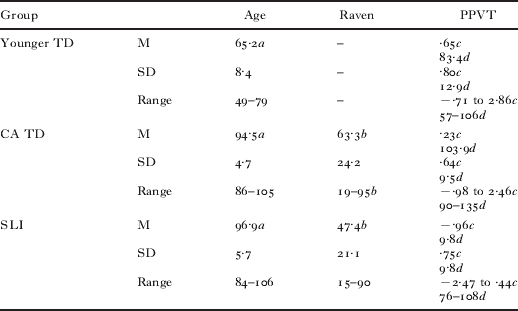
Three groups of children participated in this study, of which two were TD children: one group of seven- to eight-year-olds (CA TD: 39 children, mean age 7;9, 16 boys) and one group of five-year-olds (younger TD: 40 children, mean age 5;4, 25 boys). The third group consisted of children with SLI (36 children, mean age 8;1, 26 boys). The older TD group (CA TD) was matched on the chronological age of the SLI group (see Table 1).
The behavioural profiles of the three groups
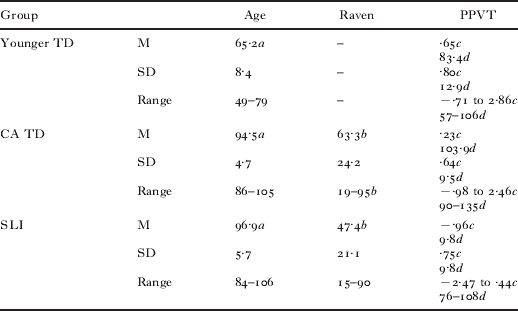
notes: a in months; b in Percentile; c in z scores; d in raw scores.
The CA TD children were selected from four primary schools that were located in the north, middle, and south-west regions of the Netherlands. All children attended second grade and only children who made normal progress in school and did not have any cognitive or emotional disturbances, such as ADHD, developmental dyslexia, or autism were selected for this study. All children had normal hearing and normal, or corrected-to-normal, vision. Only children who were raised in a family with at least one parent who was a native speaker of Dutch were accepted and children had to be raised with Dutch being the language spoken at home from birth onwards.
The younger TD children all attended kindergarten and came from three different primary schools located in the north and middle part of the Netherlands. The same exclusion criteria as the CA TD children were used for selection of the younger TD group.
The children with SLI were selected from three special schools for children with developmental language disorders. SLI was diagnosed when a child performed at least 1·5 SD below the mean in at least two language domains measured with Dutch standardized language tests, or when a child performed more than 2 SD below the mean on a Dutch standardized general language test. The testing for the diagnosis was carried out by a multidisciplinary team of the special needs schools, and the diagnosis of SLI was a requirement for acceptance by the special needs schools. Children who had evidence of (a history of) speech output problems, such as dyspraxia, were excluded from participation. All children had normal hearing and normal, or corrected-to-normal, vision. Only children who were raised in a family with at least one parent who was a native speaker of Dutch were selected and children had to be raised with Dutch being the language spoken at home from birth onwards. The special schools were located in two different regions (north and middle) of the Netherlands.
The children with SLI and the CA TD children were assessed with the Dutch version of the Raven Standard Progressive Matrices (Raven, Reference Raven2006) for an estimation of their non-verbal IQ performance at the time of testing. All children had a percentile score of at least 15 and the mean scores of both groups were within normal limits (the mean percentile score of the children with SLI was 47·4 and of the CA TD children 63·3). As the Raven has norm scores starting at the age of six, the younger TD children were not assessed with this measure. According to the kindergarten teachers, all younger TD children made normal progress in school, indicating that at least severe intellectual delay seems unlikely.
Furthermore, a receptive vocabulary measure (the Dutch version of the Peabody Picture Vocabulary Test-III-NL; Schlichting, Reference Schlichting2005) was administered to check whether the CA TD and younger TD children performed within normal limits. Importantly, both TD groups scored within normal limits (see Table 1 for the raw and standard scores). A one-way ANOVA demonstrated a significant difference between the groups (F(2, 111) = 36·06, p < ·001). The children with SLI performed significantly lower than the CA TD children (p < ·001). We had wanted to match the group with SLI children on the vocabulary level of the younger TD children, but the mean raw PPVT score of the younger TD children was significantly lower than that of the children with SLI (p = ·011). Matching the raw vocabulary scores of the two groups was difficult as there was a wide range of scores within both groups and therefore the standard deviations were large. Importantly, the mean score of the TD kindergarten children was lower than that of the group with SLI so that the TD kindergarten children could still function as a comparison group. That is, if the SLI group display a performance pattern similar to that of the younger TD group, we have some basis for concluding that their performance resembles typical development.
Materials
Two tasks were constructed to investigate past tense production: a task in which the past tense form of existing verbs was elicited and a task in which novel verbs were presented.
Task 1: past tense production of existing verbs
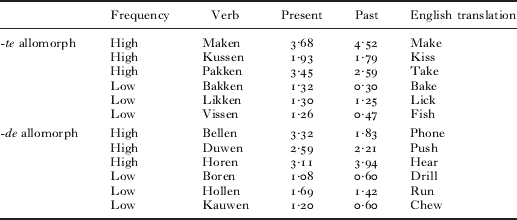
Two types of verbs were included in this task: regular and irregular verbs. Twelve regular verbs were selected based on high and low token frequency. The CELEX database (Baayen et al., Reference Baayen, Piepenbrock and van Rijn1995) was used and the Log frequency count was used for analysis. The frequency of both the past tense and non-past tense forms was counted and the 1st, 2nd, and 3rd person singular and plural verb forms (present and past) were included in the frequency count. The high token frequency regular verbs had a mean present tense frequency of 4·1 and a mean past tense frequency of 2·8, whereas the low-frequency regular verbs had a mean present tense frequency of 1·3 and a mean past tense frequency of 0·8 (see Table 2 for all the frequencies). Independent t-tests showed that there was a significant difference between the high- and low-frequency verbs, regardless of the tense (mean present tense frequency t(10) = 6·1, p = ·001; mean past tense frequency t(10) = 4·0, p = ·006).
Frequencies of regular verbs. Present and past tenses include 1st, 2nd, and 3rd singular/plural
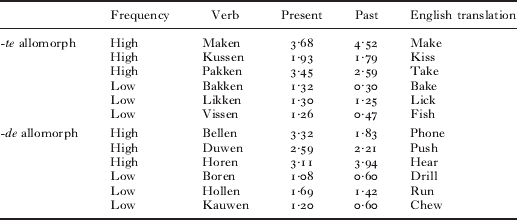
The verbs were furthermore classified according to the type of past allomorph with which the verbs are inflected. Half of the verb stems ended in an underlying voiceless obstruent (four times /k/ and twice /s/), the other half in a voiced consonant (twice /l/, twice /r/, and twice /w/). These stems were chosen as they are unambiguous with respect to devoicing and rendered unambiguous te or de expectations. All verbs in the infinitival form had a CVCVC structure (see Table 2 for an overview of the items).
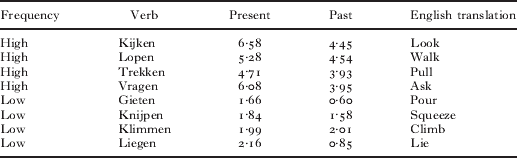
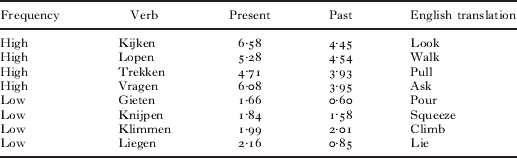
Eight irregular verbs were selected based on high/low token frequency following the same method as for the regular verbs. The mean frequency of high token frequency verbs in the present tense was 5·7, and 4·2 for the past tense forms, whereas the low-frequency items had a mean token frequency of 1·9 and a past tense form frequency of 1·3. The difference in frequency between the high and low verbs was statistically significant (present tense frequency t(6) = 8·75, p = ·002; past tense frequency t(6) = 8·19, p < ·001). All verbs in the infinitival form had a CVCVC structure. The verb forms plus their irregular past tense forms can be found in Table 3.
Frequencies of irregular verbs. Present and past tenses include 1st, 2nd, and 3rd singular/plural
Task 2: past tense production of novel verbs
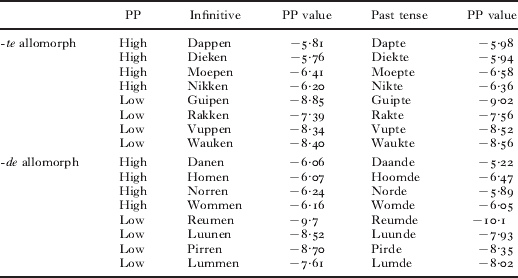
Sixteen novel verbs were created; see Table 4 for an overview. The novel verbs were divided into high and low PP sets and into voiced and voiceless sets with respect to the final consonant of the verb stem. As for the existing verbs, only verb stems ending in consonants that demand unambiguously the te or de suffix were chosen. PP was calculated using the database of Adriaans (Reference Adriaans2006), which is based on a corpus of spoken adult language (Corpus Gesproken Nederlands; Goddijn & Binnenpoorte, Reference Goddijn and Binnenpoorte2003). The PP count represents the probability that two phonemes occur together (biphones) in the Dutch language (positional probability). The calculations of the PP run from a negative outcome to zero as the most frequent probability. For the novel verbs we calculated the sum of the biphones within the novel verb form.
Phonotactic probabilities of novel verbs
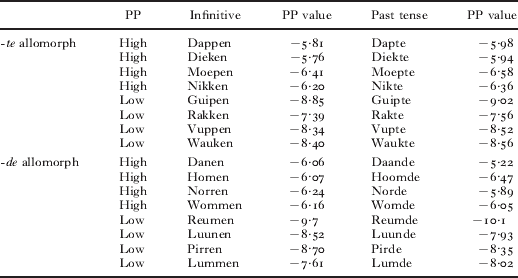
Two counts of measuring the PP of the verbs were made: one for the infinitival verb form was used (for instance vuppen) and another one for the past tense form (stem + allomorph, for instance vupte) was taken. The closer the logged sum is to zero, the higher the PP. The high PP infinitival verb forms had a minimum PP of −6·4 (the sum of PP for the whole item); the mean summed PP of all high PP items was −6·1. The maximum sum of the low PP items was −7·3; the mean of all low PP items −8·4. The PP of the past tenses did not differ much from that of the infinitival verb form: the mean sum of the items that were high in PP was −6·1; mean sum of the items low in PP was −8·5. An independent t-test demonstrated a significant difference in PP between the two groups of verbs (t(14) = 7·77, p < ·001). Half of all verbs ended in a voiceless stem (/k/ or /p/), requiring the te allomorph. The other half demanded the de allomorph, based on the voiced character of the final phoneme (/r/, /m/, and /n/). All verbs in the infinitival form had a CVCVC structure.
Inspection of the results showed that disproportionately more errors were produced for the item dieken compared with the other items, indicating that the item was an outlier. Specifically, the children within the younger TD and the SLI group demonstrated profound difficulties on that item, producing respectively 22% (younger TD) and 2·8% (SLI) of the past tense form correctly, whereas the overall percentage correct of novel verbs demanding the te allomorph was 64% for the younger TD group and 2·5% for the SLI group. We therefore decided to exclude the item from the analysis.
Procedure
The children were shown a picture on the screen of a laptop computer that depicted an action. Prior to testing, all experimental items had been read aloud by a female native speaker of Dutch and had been digitally recorded and stored on a PC. For the items in the task eliciting existing verbs, a photograph was presented; for the novel verbs, a drawing was presented. The latter pictures represented monsters or other fictional characters, or were created by the authors using software to draw the characters. The pictures were presented to the children within a PowerPoint presentation. During the presentation of the picture, the experimenter would click on a sound button and the child would hear a digitalized presentation of the infinitive form of the verb once before the story was told. The sound file was played to the children from the laptop computer using loudspeakers.
The pictures were presented to the children, one at a time, and they were accompanied by a little story during which the picture remained on the screen. This was a three-line story which first described what was going on in the picture. After saying that the characters performed this action often or every day, the children were asked to finish the final sentence in which they were prompted to give a past tense form. An example of the prompting procedure for the existing verbs is the following: a child is presented with a photograph of an elderly woman baking a pancake and the audio file of the infinitive form ‘bake’ is played simultaneously. The experimenter would tell the child: dit is een lieve oma. Zij bakt vaak pannekoeken. Gisteren ook. Gisteren … ‘This is a kind grandmother. She often bakes pancakes. Yesterday also. What did she do yesterday? Yesterday … .’ The experimenter would then wait for the child to finish the sentence. The children heard the present tense form of the verb within a sentence (once) and the verb in its infinitive form through an auditory file (once). In Dutch the subject comes after the verb in the sentences used in the tasks. A child would thus have to produce the verbs immediately after ‘yesterday’. Example answer: gisteren bakte zij ook pannekoeken ‘lit.: Yesterday baked she also pancakes’.
The task with the novel verbs was introduced by explaining to the children that in this task they would be presented with funny figures that do not exist and that these figures are doing something strange. The children were told that the experimenter would tell them a little story in which the name of the action would be told and that the children had to finish the story. For example: a child is presented with a drawing in which a monster is depicted waving its arms. The sound file vuppen was played to the children. The experimenter would say aloud: dit monster vindt het leuk om te vuppen. Elke dag vupt hij. Gisteren ook. Wat deed het monster gisteren? Gisteren: … ‘This monster likes to vup. Everyday it vups. Yesterday also. What did the monster do yesterday? Yesterday … .’ The experimenter waited for the child to finish the sentence. Two of the lead-in stories out of the sixteen items contained plural subjects, the others were all singular. The children never heard the past tense verb; they heard the present tense verb form once, and the infinitive twice (once before the story presented by the audio file and once within the lead-in story).
The responses of the children were recorded and transcribed on-line and scored afterwards. Only the verb was marked as correct or incorrect, the remainder of the sentence that a child would possibly utter was ignored. An item would be scored as correct if the choice of the past tense suffix was correct. Violations of agreement between the verb and the subject were not taken into account. An example of a correct past tense form with an agreement error would be gisteren bakten (plural) zij (singular) ook pannekoeken instead of gisteren bakte (singular) zij ook pannekoeken ‘yesterday she also baked pancakes’.
Some children would start the sentences that they had to finish with ‘also’ followed by the infinitive. For example, the experimenter would say: ‘yesterday … ?’, and the answer of the child was ‘also fish’. The child was then prompted to start their response with the target verb, as the experimenter would give the verb's first sound (e.g., experimenter: ‘yesterday f … ?’). The order of the presentation of the two tasks was pseudo-randomized: half of the children were first presented with task 2 (novel verbs) followed by task 1 (lexical verbs), the other half the other way around.
With respect to the novel verb inflection task, three of the CA TD children did not perform this task, given that the time for the scheduled testing session had ended, but the task had not yet been presented.
Qualitative error analysis
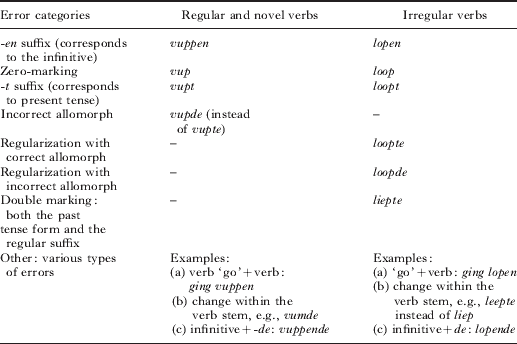
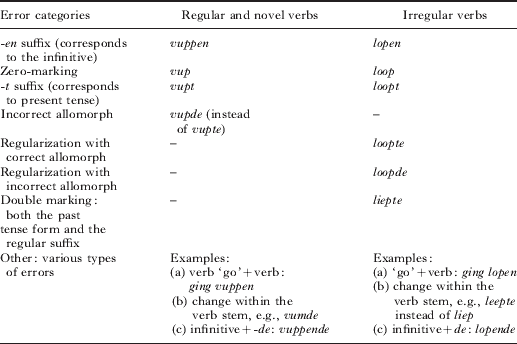
In addition to calculating the number of correct responses, we also assigned all erroneous responses to a category, based on the most frequently produced error types. For the regular existing verbs and the novel verbs, five categories were created (see Table 5). Note that especially the error category ‘incorrect allomorph’ is important for our research question. It measures the instances of assigning the wrong allomorph, which may indicate reduced sensitivity to morphophonology in past tense inflection and it may indicate overgeneralization due to the effect of type frequency. For the irregular verbs, seven error categories were used. Table 5 provides examples of the errors using the novel verb vuppen, of which the target past tense form is vupte, and the irregular verb lopen ‘walk’, which takes liep as the past tense. The error categories also include ‘other’. All responses that could not be classified to one of the error types were assigned to this category. This means that all responses were assigned to a category, as it never happened that a participant responded with silence. We calculated the mean of the errors as part of the total correct score: the mean errors plus the mean correct score add up to 100%.
Error categories for regular, novel, and irregular verbs. Target productions are vupte and liep: error categories show (potential) errors
RESULTS
Production of past tense of regular verbs
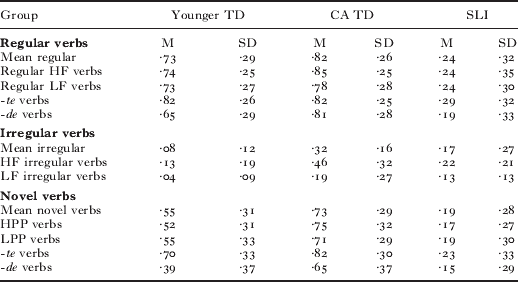
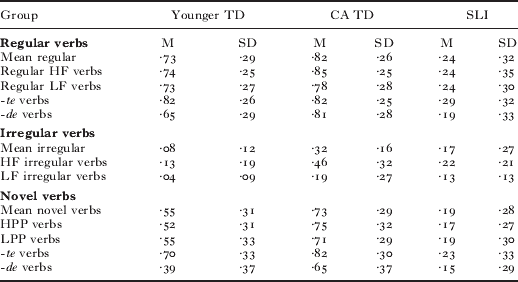
Table 6 presents the proportional scores of correctly inflected regular verbs for past tense divided by verb token frequency and allomorph.
Proportional scores of existing regular verbs, existing irregular verbs, and novel verbs correctly inflected for past tense for each group
notes: HF high frequency; LF low frequency; HPP high phonotactic probability; LPP low phonotactic probability.
A repeated-measures ANOVA was carried out on the proportion of correctly inflected verbs with verb token frequency (high/low) and allomorph (te/de) as the within-subjects variables and group (younger TD, CA TD, SLI) as the between-subjects variable. The results demonstrated significant main effects of allomorph type (F(1, 112) = 16·7, p < ·001, η2p = ·13) and group (F(1, 112) = 5·7, p < ·001, η2p = ·48), and an interaction between allomorph type * group (F(2, 112) = 4·5, p = ·013, η2p = ·08). Post-hoc tests, chance-level adjusted with the Bonferonni correction, showed that the CA TD (p < ·001) and the younger TD group (p < ·001) produced significantly more correct inflections than the children with SLI, but there was no significant difference between the older and younger TD children (p = ·28). Additional tests were carried out to investigate the group * allomorph interaction. Repeated-measures ANOVAs conducted within the different groups with allomorph as the within-subjects variable showed that children with SLI and the younger TD children made more errors when they had to inflect verbs demanding a de allomorph than a te allomorph (SLI: F(1, 35) = 7·6, p = ·009, η2p = ·18; younger TD: F(1, 39) = 12·4, p < ·001, η2p = ·24) but that the CA TD group did not show a significant effect of allomorph type (F(1, 38) = ·09, p = ·77, η2p = ·002).
In the omnibus repeated-measures ANOVA, no main effect of frequency was found (F(1, 112) = 1·9, p = ·17, η2p = ·017) and there was no significant interaction between frequency * group (F(1, 112) = 2·05, p = ·13, η2p = ·035). However, as the difference between the mean performances on the high- and low-frequency items was quite large, a repeated-measures analysis for the CA TD group was conducted. It revealed that the CA TD group performed significantly better on the high-frequency verbs compared to the low-frequency verbs (p = ·018, η2p = ·14). This frequency effect was not found for the children with SLI (p = ·76, η2p = ·003), nor for the younger TD children (p = ·80, η2p = ·002).
Error analysis of regular verbs
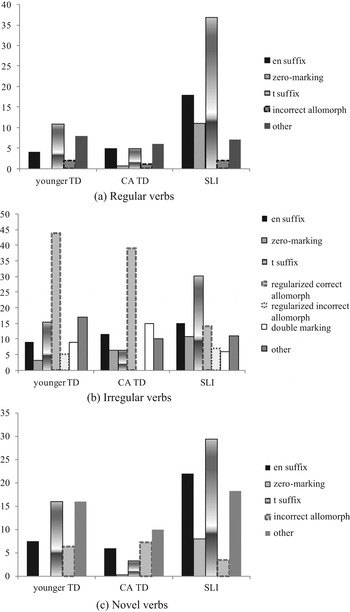
Figure 1 presents the mean percentage of errors coded as -en suffix, zero-marking, -t suffix, wrong past tense allomorph, and ‘other’ (see ‘Methods’ section for a description of the error types).
The mean percentage of different errors on the regular (1a), irregular (1b), and novel verbs (1c).

A repeated-measures ANOVA demonstrated a main effect of error type (F(4, 448) = 18·95, p < ·001, η2p = ·15) and group (F(2, 112) = 51·6, p < ·001, η2p = ·48), and a significant interaction between group and error type (F(8, 448) = 9·3, p < ·001, η2p = ·14). The main effect of group was unsurprising, as the previous results had already indicated a group effect. The interaction was investigated by pairwise comparisons of the error types within each group, chance level adjusted with Bonferroni correction. The children with SLI most dominantly produced a -t and -en suffix compared to the other error types (both error categories, p < ·001). The younger TD children also produced significantly more often a -t suffix (p < ·024), as well errors in the category ‘other’ (p < ·025) than the other error categories. In contrast, the CA TD group did not show a clear preference for an error type.
As this research focuses on sensitivity to morphophonology, it is important to note that for all groups the error type ‘incorrect allomorph’ was infrequent. The children with SLI produced a wrong allomorph in 2·2% of all past tense productions, the CA TD children in 1·3%, and the younger TD children in 2·1%. When we calculated how often this error was produced relative to the overall number of errors, thus excluding the correct responses from the results, it appeared that this error occurred in 4·3% of all errors in the group of SLI children, in 5·3% of all errors in the CA TD children, and in 5·3% of all errors in the younger TD children. This error rate was equal between the groups (F(2, 110) = ·39, p = ·68, η2p = ·007), and the errors were equally distributed over the two allomorphs (F(1, 110) = ·87, p = ·35, η2p = ·008), indicating no overgeneralization of a particular allomorph.
Production of the past tense of irregular verbs
Table 6 also presents the mean past tense production of the irregular verbs. A repeated-measures ANOVA with frequency (high, low) as the within-subjects variable and group (younger TD, CA TD, SLI) as the between-subjects variable demonstrated that there were main effects of frequency (F(1, 112) = 67·7, p < ·001 η2p = ·38) and group (F(2, 112) = 15·2, p < ·001, η2p = ·21). The younger TD group made significantly more errors than the other two groups (p < ·05), and the SLI group was outperformed by the CA TD group (p < ·05). A significant interaction between frequency and group was also found (F(2, 112) = 1·2, p < ·001, η2p = 0·15). Follow-up tests showed that all three groups produced past tense forms of high-frequency verbs more accurately than low-frequency past tense forms (CA TD: F(1, 38) = 6·9, p < ·001, η2p = ·62; SLI: F(1, 35) = 7·8, p =·009, η2p = ·18; younger TD: F(1, 39) = 11·2, p = ·002, η2p = ·23). The frequency effect was most pronounced for the CA TD group, causing the interaction between frequency and group.
Error analysis of past tenses of irregular verbs
A repeated measures ANOVA showed that there was a main effect of error type (F(6, 672) = 54·7, p < ·001, η2p = ·33), a main effect of group (already demonstrated by the accuracy scores above; F(2, 112) = 15·4, p < ·001, η2p = ·22), and a significant interaction between error type * group (F(6, 672) = 11·6, p < ·001, η2p = ·170 (see Figure 1). This interaction was investigated by pairwise comparisons of the error types within each group, chance level adjusted with Bonferroni correction. All three groups showed main effects of error type (p < ·001 for all the groups). The CA TD group often regularized the irregular past tense (39% of all errors) and did this significantly more often than producing a stem, an infinitive, or a present tense (p < ·05). Another frequent error in the CA TD group was producing an -en instead of the past tense (12% of all errors) and producing an ‘other’ (10%) error. For the children with SLI, the most frequent error was a -t instead of a past tense (31% of all errors), and this error was significantly more frequent than zero-marking, correct regularization with a correct suffix, and an -en suffix (p < ·05 for all three comparisons). An -en suffix (15%) was produced significantly more often than regularization with an incorrect suffix, and than double marking (p < ·05). For the children of the younger TD group the most dominant error type was regularization with a correct suffix (44%), and this was produced significantly more often than zero-marking and production of the suffixes -t and -en (p < ·05 for all comparisons).
The two TD groups thus replaced the past tense of an irregular verb most often with a regularization form with a correct allomorph, whereas the SLI group most dominantly produced a -t (present tense suffix) instead of a past tense suffix. Thus, as was the case for the regular verbs, selection of the incorrect allomorph was infrequent.
Task 2: production of past tense of novel verbs
The proportional scores of correctly inflected novel verbs for the different conditions are presented in Table 6. A repeated-measures ANOVA on proportion of correctly inflected verbs was carried out with allomorph type (de versus te) and PP (low PP versus high PP) as the within-subjects variables and group (younger TD, CA TD, SLI) as the between-subjects factor. A significant main effect of group (F(2, 109) = 32·2, p < ·001, η2p = ·37) was found. Post-hoc tests indicated that the SLI children were outperformed by both TD groups (both comparisons p < ·001) and that the CA TD group scored more accurately than the younger TD group (p = ·02). A significant main effect of allomorph type was found, showing that inflecting verbs for the past tense that require a te allomorph was significantly more accurate than de verbs (F(1, 109) = 4·8, p < ·001, η2p = ·27). Also, a significant interaction between allomorph type and group was found (F(2, 109) = 4·9, p = ·009, η2p = ·08). Post-hoc tests showed that this significant interaction was caused by the robust main effect of allomorph type for the five- and seven-year-olds (CA TD: p = ·003, η2p = ·229; younger TD: p < ·001, η2p = ·47), in contrast to the non-significant effect of allomorph type for the group of children with SLI (p = ·077, η2p = ·086). The absence of an effect of allomorph in the group of children with SLI might be explained by the floor effect of the accuracy scores, as the group only reached a mean of 18% correct. To assess whether the low inflection scores of the group of SLI children masked a potential effect of allomorph, a second analysis was carried out in which all children of the three groups who did not inflect at least one novel verb correctly for the past tense were removed from the database. Seventeen children (out of 36 = 44%) with SLI were excluded, and two children from both the CA TD (2/39 = 5%) and the younger TD group (2/40 = 5%). The mean score of this reduced SLI group improved to 35%, compared with the previous score of 18% correct. Using these new scores there was no significant interaction between group and allomorph type (p = ·13, η2p = ·053) for the three groups. In other words, all three groups show a similar advantage for the production of verbs taking a te allomorph if very poor inflection scores are excluded.
The omnibus repeated-measures ANOVA further showed that there was no main effect of PP (F(1, 109) = ·22, p = ·64, η2p = ·002), and no significant interaction between PP and group (F(2, 109) = 1·8, p = ·17, η2p = ·02). Thus, PP did not impact on the past tense realizations of novel verbs in any of the three groups. The results were the same for an analysis of the three groups, including children who at least produced one past tense form correctly.
Error analysis of novel verbs
Figure 1 shows the mean percentages of possible error types (-en suffix, zero-marking, -t suffix, incorrect allomorph, and other) the children produced. A repeated-measures analysis with error type as the within-subjects variable and group as the between-subjects variable showed a significant main effect of error type (F(4, 436) = 12·7, p < ·001 η2p = ·10) and group (F(1, 109) = 34·4, p < ·001, η2p = ·39), and a significant interaction between error type and group (F(8, 436) = 3·96, p < ·001, η2p = ·07). This interaction was investigated by pairwise comparisons of the error types within each group, chance level adjusted with Bonferroni correction.
The effect of error type was not significant (F(4, 140) = 2·7, p = ·06, η2p = ·07) for the children within the CA TD group. The group of SLI children showed a significant main effect of error type (F(4, 140) = 7·1, p < ·001, η2p = ·17). They replaced the past tense inflection significantly more often with -en and -t suffixes than zero-marking or with a wrong allomorph (p < ·01). The younger TD group also revealed a significant effect of error type (F(4, 156) = 7·9, p < ·001, η2p = ·17), showing the same pattern as the children with SLI.
As was the case for the regular and irregular verbs, selection of the incorrect allomorph was infrequent (see Figure 1). Of all errors (thus excluding the correct responses) the wrong allomorph occurred 9·2% within the group of SLI children, 26·6% within the age-matched TD children, and 16·8% in the younger TD children. To investigate whether children preferred to produce a past tense with a particular allomorph, a repeated-measures ANOVA was carried out with the error category ‘incorrect allomorph’ as the within-subjects variable and group as the between-subjects variable. There was a significant effect of allomorph type (F(1, 109) = 19·48, p < ·001, η2p = ·152), and a significant interaction between allomorph type and group (F(2, 109) = 4·19, p = ·02, η2p = ·07). The main effect indicated that more past tenses involving the de allomorph were realized as a te allomorph than vice versa. The interaction between group and allomorph type indicated that the children with SLI did not show a preference for te. It must be kept in mind that the children with SLI produced fewer instances of past tenses with a wrong allomorph than the TD children (producing a wrong allomorph in 3·5% of all their verb productions), making it difficult to observe a particular error pattern.
Discussion
This study was undertaken to answer three questions. The first was whether Dutch children were sensitive to the morphophonology involved in past tense formation. In other words, did they select the correct allomorph (de or te) to form the past tense? This question was addressed from a developmental perspective, by looking at younger and older TD children, as well as by looking at children with SLI. Real regular verbs, irregular verbs, and novel verbs were included to assess the production of past tense inflection, as well as to establish whether morphophonological sensitivity surfaced in inflecting them.
We found differences in overall ability in past tense marking, with the younger children performing worse than the older TD children on the irregular and the novel verbs, and with the children with SLI scoring more poorly than both the age-matched and younger TD children on the regular and novel verbs, except for the irregular verbs where they performed better than the younger TD children, but more poorly than the age-matched TD children. All children were sensitive to the phonological demands of past tense marking, as the error pattern demonstrated that the allomorphs were produced generally in the correct phonological context. The error type incorrect allomorph was not produced significantly more often than the other error types. Our findings can be aligned with those that looked at sensitivity to morphophonological voicing in Dutch plural realization (de Bree & Kerkhoff, Reference de Bree and Kerkhoff2010). Further, our findings of correct allomorph production, with infrequent incorrect allomorph production, agree with those of Kidd and Kirjavainen (Reference Kidd and Kirjavainen2011). They studied past tense marking in four- and six-year-old TD children of novel, regular, and irregular verbs in Finnish, which has a highly inflected past tense morphology, and found that they consistently used the correct allomorphs in the novel and regular verbs.
The second question concerned the effect of type frequency of the allomorphs (de versus te), token frequency of the verbs, and PP of the novel verbs on past tense inflection. The performance patterns of the CA TD and younger TD children differed for the regular and novel verbs. The correct responses on the regular verbs demanding the te allomorph were significantly higher compared with the de allomorph for the five-year-old children, but there were no differences between the production of the verbs demanding te and de allomorphs for the seven-year-old TD children. Nevertheless, for the novel verbs, both the five- and seven-year-old children demonstrated a similar pattern as they were significantly more accurate in inflecting te than de verbs. This is in contrast with the prediction that de suffixes would show an advantage, as the type frequency of de is higher as there are more verbs in Dutch that take a de allomorph. Similarly to the five-year-old TD children, the children with SLI produced significantly more correct past tenses for both novel and regular verbs demanding the te allomorph. We will return to the matter of the te allomorph preference below, after discussing the findings on the other frequency-related measures.
Token frequency, that is, the frequency of occurrence of the lexical verbs, was found to influence past tense inflection, especially for the CA TD children. For both regular and irregular verbs, past tense formation was better for high-frequency verbs than for low-frequency verbs. The SLI and younger TD children did not show this pattern for the regular verbs, but did show an effect of high >low frequency for irregular verbs. An advantage for high-frequency irregular verbs for TD children ranging from five to eight years old and an SLI group (mean age 11 years) was also reported in van der Lely and Ullman (Reference van der Lely and Ullman2001). It may be the case that the acquisition of a substantial vocabulary size generates an effect of token frequency and that therefore the effect was only observed in the CA TD group (see, e.g., Marchmann and Bates, 1994, and Kidd and Kirjavainen, Reference Kidd and Kirjavainen2011, for discussions on this matter). An explanation for the observation that there was a frequency effect for the irregular, but not the regular, verbs in the children with SLI and the younger TD group is that the frequency of the high-frequency irregular verbs is higher than that of the high-frequency regular verbs. This may suggest that token frequency influences past tense formation but that the effects are only visible in children with relatively small lexicons when verbs are highly frequent. For the novel verbs, the effect of PP was investigated. The results did not show a preference for high PP over low PP items for any of the three groups.
Thus, so far, the following observations have been made: (1) there was an effect of token frequency on past tense inflection of regular verbs for the seven-year-old TD children; and (2) there was an effect of token frequency on irregular verb past tense formation in all groups. Furthermore, (3) in the novel verb condition, all groups (the younger TD children and the children with SLI also in the regular verb condition) demonstrated that past tense production of verbs demanding the allomorph te was more accurate than de; the opposite of the pattern that was anticipated based on the higher type frequency of de.
How can the advantage for past tense formation in verbs taking the te allomorph be explained? As discussed in the ‘Introduction’, phonological development is constrained by voicing in Dutch. The fact that voiced phonemes are more marked phonologically than voiceless ones may be one explanation. However, it is important to note that that all children were able to produce voiced obstruents, as they showed voiced obstruents in the onset of the experimental items and regularly used de allomorphs. Also, none of the children had specific speech output problems. This is in line with other studies that have shown voicing to be intact in children with SLI (e.g., de Bree & Kerkhoff, 2010; Forrest & Morrisette, Reference Forrest and Morrisette1999). Phonological markedness of the verb stem combined with the allomorph de alone might thus not capture the data.
Another explanation for the higher te than de score is that the type frequency of the allomorph can be calculated differently. We stated that the type frequency of the de suffix is higher than that for te as there are more verbs taking de suffixes. However, it could be the case that the phonotactic frequency of the stem plus the allomorph rather than the frequency of the past tense allomorph itself provides the most important cue (Bybee, Reference Bybee, Robinson and Ellis2008). In other words, the type frequency of the past tense allomorph may need to be calculated by the combined PP of the verb stem + suffix te or de rather than the allomorph alone. Calculations of the PP of the consonants of the verb stems tested in this study (k, p, m, n, r, s, l, and w) + /tə/ or /də/ in a database of spoken Dutch language (CGN; Goddijn & Binnenpoorte, Reference Goddijn and Binnenpoorte2003) showed that the mean logged PP of the stem final consonant + /tə/ clusters is much higher than that of the stem-final consonant + /də/ clusters: that is, −6·16 as opposed to −1·55, with a score closer to 0 reflecting a higher probability. Thus, the cluster of a consonant + /tə/ is more frequent in the Dutch language, regardless of word class, than the cluster consisting of a consonant + /də/. The higher PP of stem + suffix may thus have facilitated the productivity of past tenses. Bear in mind that the PP of the novel verbs in our experiment was controlled for and that the results showed that there was no main effect of PP. It is thus not the case that the PP of the entire stimulus influenced the production of the past tense, but that specifically the PP of the verb stem and the suffix itself seems influential. The difference between the results of Leonard, Davis, and Deevy (Reference Leonard, Davis and Deevy2007), who demonstrated an effect of PP on past tense marking of novel verbs in children with SLI, may stem from differences in the design between their and our study. In their study the novel verbs always demanded the allomorph /d/, except for one instance of /t/. However, in our study the two past tense allomorphs were presented equally. It may be the case that different results for the effect of PP would have been obtained if only one allomorph type had been tested, as then there would not have been a confound between the PP of the allomorph and the PP of the novel verb stem.
Ernestus and Baayen (Reference Ernestus and Baayen2003) also looked at a frequency cue related to phonological environment. They found that in a (novel) verb inflection task, Dutch adults' proportion of de responses was guided by the number of similar words ending in a voiced obstruent, regardless of their frequencies of occurrence. Thus, the past tense can be driven by different types of frequency information. The question of how these types of frequency are related in development would merit more attention (see work by Moscoso del Prado Martín, Ernestus, and Baayen, Reference Moscoso del Prado Martín, Ernestus and Baayen2004, on simulation studies of adult data).
Frequency thus plays an important role in past tense productivity, but the type of frequency seems to be dependent on the stage of language development – token frequency in older TD children but not for younger TD children or children with SLI – and on task specificity: irregular verbs rendered token frequency effects for all groups, whereas regular verbs showed a frequency effect of stem + allomorph for five-year-old TD children and children with SLI but not for older children. Novel verbs, finally, led to an effect of frequency of occurrence of verb stem + allomorph for all groups (see also Matthews & Theakston, Reference Matthews and Theakston2006).
The results of both token frequency and the frequency of stem + allomorph (type frequency) significantly influencing past tense productivity are in accordance with the work of Bybee (Reference Bybee1995, 2002, Reference Bybee2007, Reference Bybee, Robinson and Ellis2008). Interesting in this respect is the finding that in the novel verbs we found that the TD children produced the past tense with a te in instances in which the wrong allomorph was applied (which we would like to stress did not occur frequently). This fits the assumption that morphological productivity is influenced by type frequency (calculated here as the verb stem + allomorph). They also align with recent findings of Paradis (Reference Paradis2010), who demonstrated that input properties affect the rate of past tense development in bilingual children, and those of Finneran and Leonard (Reference Finneran and Leonard2010), who demonstrated an effect of input frequency for the use of third person singular. These results thus establish that there are multiple interacting factors involved in successful inflection.
Our third aim was to evaluate theories on past tense marking in SLI. Importantly, our results showed that children with SLI have severe difficulties with past tense production, even more severe than children who are around two years younger than them (on the regular and novel verbs). They furthermore showed that children with SLI demonstrated morphophonological sensitivity, as there were low occurrences of wrong allomorph selection. The past tense production of the children with SLI followed the same pattern of that of the TD children (te verbs >de verbs). The observed allomorph effect in children with SLI therefore does not fit an account based on impaired/delayed syntactic representations. This is endorsed by the findings that infinitives were not the most common error types for the children with SLI in any of the three types of verbs. The results also do not readily fit the ‘surface’ hypothesis, as the perceptual saliency of both allomorphs is equal, but different performances between allomorphs were found. Further, as discussed, the children with SLI were sensitive to the phonological characteristics of the verb stem and thus to the morphophonological nature of past tense marking, as only a few allomorph selection errors were produced. This does not readily fit the account of Joanisse and Seidenberg (Reference Joanisse and Seidenberg1998). In sum, none of the three hypotheses are borne out completely in the present data.
Hsu and Bishop (Reference Hsu and Bishop2011) propose that children with SLI may have problems extracting the statistical regularities from the input that are necessary to form abstract patterns or schemas. They hypothesize that children with SLI learn language by exemplars rather than via statistical generalizations, as they cannot reach the stage of generalization. In a way, this model recasts the usage-based approach to learning and localizes an area of breakdown for the children with SLI. The results of the children with SLI partly corroborate this idea, as the children with SLI were significantly better at inflecting the regular verbs than the novel verbs, which could reflect exemplar-based learning, just like the advantage for the irregular verbs that were high in token frequency, despite their poor percentage correct scores. However, our data show that children with SLI are sensitive to the statistical, specifically distributional, cues from the input, as they show the same pattern for the production of the two allomorphs as the TD children. Further research is warranted to look into the learning mechanism of morphophonology.
In conclusion, our investigation has demonstrated that both children with SLI and their TD peers are sensitive to the interaction between phonology and morphology in past tense production, as they were accurate in choosing the correct allomorph according to the phonological context. They further showed the influence of the frequency of the lexical verb and of the phonotactic frequency of the combination of the verb stem and the allomorph with respect to past tense inflection.