


Background
Food insecurity, defined as the household-level economic and social condition of limited or uncertain access to food, is associated with adverse mental health outcomes such as anxiety, depression, and stress.(Reference Wolfson, Garcia and Leung1–Reference Sabião, Mendonça and Meireles4) In a nationally representative sample of adults in the United States, households with a person with depression reported a food insecurity prevalence of 40.5%.(Reference Reeder, Tolar-Peterson and Bailey3) In comparison, the food insecurity rate of US households in 2023 was 13.5%.(Reference Rabbitt, Reed-Jones and Hales5) The relationship between food insecurity and poor mental health is likely cyclical, with each reinforcing each other over time.(Reference Bruening, Dinour and Chavez6,Reference Abeldt7) In a meta-analysis including nineteen studies, food insecurity was associated with a 40% increased risk of depression and a 34% increased risk of stress.(Reference Pourmotabbed, Moradi and Babaei2) The magnitude of this association varies across sociodemographic characteristics. In the United States, adults over 65 years of age, adults with low incomes and low education levels, women, and non-White races tend to be most impacted by both food insecurity and poor mental health.(Reference Reeder, Tolar-Peterson and Bailey3,Reference Maynard, Andrade and Packull-McCormick8)
Another characteristic, resilience, may influence the relationship between food insecurity and poor mental health. Defined as the ability to successfully adapt to stress or bounce back from adversity,(Reference Smith, Dalen and Wiggins9) strong resilience has been associated with high diet quality, strong mental health, high quality of life, and low incidence of CVD and metabolic disturbances.(Reference Gloria and Steinhardt10–Reference Robert, Shankland and Bellicha13) A meta-analysis including six studies reported lower resilience levels among individuals with depression compared to controls.(Reference Imran, Tariq and Kapczinski14) In addition, there is evidence suggesting that resilience protects against the impact of stress on anxiety and depression.(Reference Gloria and Steinhardt10)
The relationship between resilience and food insecurity has been less explored. Studies among college students suggest that food insecurity is associated with lower resilience.(Reference DeBate, Himmelgreen and Gupton15,Reference Laska, Lenk and Lust16) At the same time, resilience may insulate against the stress of food insecurity through pragmatic strategies and trade-offs such as seeking social support, remaining hopeful, compromising on quality of nutrition, and budgeting.(Reference Leung, Stewart and Portela-Parra17–Reference Dryland, Carroll and Gallegos19) Despite this, the extent to which resilience shapes the relationship between food insecurity and symptoms of anxiety and depression remains unclear.
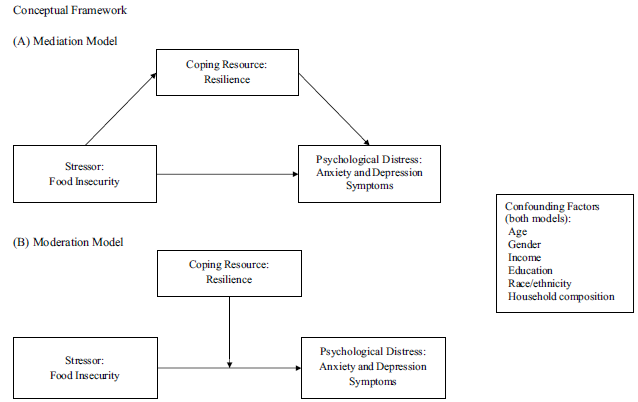
A conceptual framework for this study is presented in Figure 1 and is guided by the Transactional Model of Stress and Coping.(Reference Lazarus and Folkman20) Within this framework, food insecurity is conceptualized as a chronic stressor that may negatively influence psychological well-being, while depression and anxiety symptoms represent manifestations of psychological distress. Resilience is conceptualized as a psychological coping resource that may influence one’s ability to adapt to adversity. This model proposes that psychological outcomes arise from the dynamic interaction between stressful experiences and the coping resources available to manage them. Therefore, resilience may function as a mediator where exposure to food insecurity may lead to lower resilience, which in turn may increase vulnerability to symptoms of depression and anxiety. This is further supported by studies showing that coping responses, including social support, mastery, and resilience, mediate the association between food insecurity and depressive symptoms.(Reference Carandang, Lewis and Masters21,Reference Ciciurkaite and Brown22) In addition, resilience may function as a moderator, where individuals with greater resilience would be better able to cope with the stress associated with food insecurity, experiencing fewer mental health outcomes. Prior research has shown that resilience can buffer the relationship between stress and psychological distress, supporting its role as a moderator.(Reference Gloria and Steinhardt10,Reference Jeamjitvibool, Duangchan and Mousa23)
Conceptual framework guided by the transactional model of stress and coping with food insecurity as a stressor, resilience as a coping resource, and symptoms of depression and anxiety as psychological distress. (A) Resilience functions as a mediator of the path between food insecurity and symptoms of anxiety and depression. (B) Resilience functions as a moderator buffering the relationship between food insecurity and symptoms of anxiety and depression. All analyses controlled for age, gender, income, education, race/ethnicity, and household composition with children.

Therefore, the primary aim of this study was to investigate the relationship between food insecurity, resilience, and depression and anxiety symptoms after adjusting for sociodemographic factors. The secondary aim was to explore whether resilience moderates or mediates the relationship between food insecurity and depression and anxiety symptoms. Food insecurity is hypothesized to influence depression and anxiety symptoms both directly and indirectly through resilience (mediation pathway model). In addition, resilience is hypothesized to moderate the relationship between food insecurity and mental health symptoms (buffering model), where higher resilience attenuates the adverse impact of food insecurity.
Methods
Study design
This was a cross-sectional survey conducted in California. The study adapted the survey developed by the National Food Access and COVID Research Team (NFACT)(Reference Niles, Neff and Biehl24) and included additional measures of interest such as mental health and resilience. The survey was distributed online via Qualtrics Panel from April 25, 2022 to May 16, 2022. It was available in English and Spanish and took approximately fifteen minutes to complete. This study was conducted according to the guidelines laid down in the Declaration of Helsinki, and all procedures involving human subjects were approved by the San José State University Institutional Review Board (IRB Protocol Tracking Number: 22065). Participants provided a written informed consent prior to starting the online survey.
Participants and data collection
To participate in the study respondents had to be 18 years or older, a California resident, and living in the United States since January 1, 2020 or earlier. A Qualtrics panel was used to recruit a non-probability quota-based sample designed to approximate the demographic composition of California adults. The quotas were based on the California American Community Survey (ACS) 2019 data for gender, race, ethnicity, and household income. Quota controls were applied during recruitment. The final sample closely resembles ACS benchmarks for the quota variables, with small differences observed across categories (within 3.5%; supplemental table). A total of 1,459 respondents were eligible to take the survey. After excluding those with incomplete or poor data quality (speeding, incomplete data, and improbable data), the final sample size included 1,177 participants.
Main outcome measures
Food insecurity was measured using the validated (USDA) Department of Agriculture 6-Item Food Security Module, a shortened version of the 18-item food security module, which is a standard tool for measuring food security in the United States. The scores are calculated by summing affirmative responses to the 6 questions and the total score ranges from 0 to 6 with higher scores indicating more severe food insecurity. For statistical analysis, food insecurity was treated as a continuous variable. For descriptive purposes, a raw score of 0–1 was categorized as food secure (high or marginal food security) and a raw score of 2–6 is categorized as food insecure (low and very low food security).(25)
Psychological distress refers to the combined depression and anxiety symptoms measured using the Patient Health Questionnaire (PHQ-4). PHQ-4 is an ultra-brief version of the Patient Health Questionnaire that measures two subscales: anxiety with sum of items 1 and 2 (score range: 0–6) and depression with sum of items 3 and 4 (score range 0–6). Total score was used as a continuous outcome in statistical analyses and ranges from 0–12, with higher scores indicating higher symptoms of anxiety and depression. Scores were also categorized for descriptive purposes to indicate the level of psychological distress: none (0–2), mild (3–5), moderate (6–8), and severe (9–12).(Reference Kroenke, Spitzer and Williams26) The PHQ-4 has been shown to reliably and validly measure anxiety and depression symptoms with a reported Cronbach’s α of 0.82.(Reference Löwe, Wahl and Rose27) Similarly, high internal consistency was observed in our sample with a Cronbach’s alpha of 0.91.
Resilience was measured using the Brief Resilience Scale (BRS) that consists of six questions about one’s ability to recover from stress (e.g. ‘I tend to bounce back quickly after tough times: strongly disagree, disagree, neutral, agree, strongly agree’). Responses are shown on a 5-point Likert scale, with 1 indicating ‘strongly disagree’ and 5 indicating ‘strongly agree’. Items 1, 3, and 5 are positively worded, while items 2, 4, and 6 are negatively worded. BRS is scored by reverse-coding items 2, 4, and 6 and calculating the mean of the six scores. Higher average scores indicate higher levels of resilience with scores ranging from 1 to 5.(Reference Smith, Dalen and Wiggins9) Resilience was used as a continuous variable in regression and mediation analyses and categorized into tertiles for moderation analysis. The following cut-offs were used for low (1.00–2.83), medium (2.84–3.50), or high (3.51–5.00) resilience. In the present study, this scale showed a high internal consistency indicated by a Cronbach’s alpha of 0.80.
Covariates
Covariates were selected based on relevance as hypothesized confounders of the association between food insecurity and symptoms of depression and anxiety. Sociodemographic characteristics were obtained including categories for age (18–29, 30–45, 45–59 years, 60 or more years), gender (male and female), race/ethnicity (Asian American and Pacific Islander, Black, Hispanic, other/multiple, and White), household income per year (<$50,000, $50,000–$99,999, $100,000 or higher), education (up to high school, some college/associate, bachelor’s degree or higher), and households with children (no, yes).
Data analysis
Data analysis was performed using IBM SPSS statistical software (version 29.0.1.0). Descriptive statistics are presented as frequency counts and percentages for categorical variables and mean and standard deviation for continuous variables.
To test the relationship between food insecurity, resilience, and depression and anxiety symptoms, a 3-step hierarchical linear regression was conducted. This approach was used to assess the incremental contribution of key predictors beyond sociodemographic variables. Step 1 included covariates: age, gender, race/ethnicity, household income, education, and household with children. Step 2 added resilience to assess its independent association with depression and anxiety symptoms. Step 3 added food insecurity to evaluate its additional contribution beyond covariates and resilience. Changes in explained variance (ΔR 2) were examined at each step. The predictor variables resilience and food insecurity, in addition to the outcome variable depression and anxiety symptoms, were added into the model as continuous variables.
We also tested if resilience moderated or mediated the relationship between food insecurity and anxiety and depression symptoms using the PROCESS Macro (version 4.2) for SPSS. For the moderation analysis (Model 1), food insecurity was specified as the independent variable, depression and anxiety symptoms as the outcome, and resilience as the moderator. Resilience was categorized into tertiles to facilitate interpretation and visualization of the interaction between food insecurity and resilience across low, medium, and high levels. For the mediation analysis (Model 4), food insecurity was specified as the independent variable, resilience as the mediator, and depression and anxiety symptoms as the outcome. Resilience was modelled as a continuous variable to maximize statistical power and improve estimates of indirect effects. We estimated total, direct, and indirect effects, with the indirect effect representing the extent to which resilience mediated the association between food insecurity and depression and anxiety symptoms.(Reference Hayes28) All models were adjusted for age, gender, income, education, race/ethnicity, and household with children. These analyses were conducted using 5,000 bootstrapping intervals to produce 95% CI.
Results
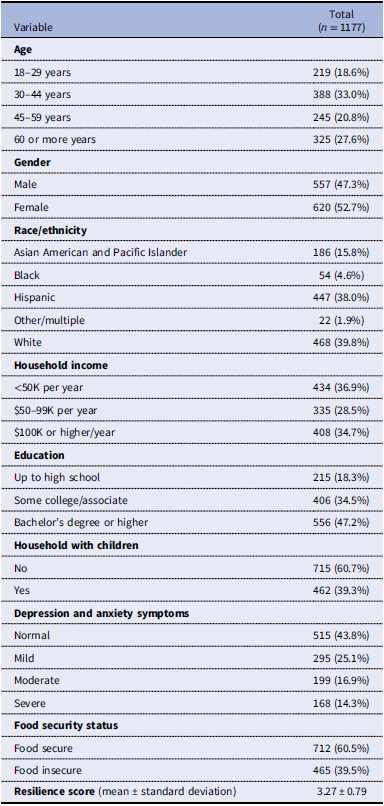
As shown in Table 1, 465 (39.5%) participants reported food insecurity. While most participants reported no depression and anxiety symptoms (43.8%), 25.1% reported mild symptoms, 16.9% reported moderate symptoms, and 14.3% reported severe symptoms. Participants had a mean resilience score of 3.27 ± 0.79, indicating medium resilience. Demographic characteristics are described in Table 1.
Descriptive statistics of study participants (n = 1177)

Table 1. Long description
A table summarizing demographic and health statistics of study participants. The table has 11 rows and 2 columns. The columns are labeled ‘Variable’ and ‘Total (n = 1177)’. The rows are labeled with different variables and their corresponding totals and percentages. Row 1: Age 18-29 years, 219 (18.6 percent). Row 2: Age 30-44 years, 388 (33.0 percent). Row 3: Age 45-59 years, 245 (20.8 percent). Row 4: Age 60 or more years, 325 (27.6 percent). Row 5: Gender Male, 557 (47.3 percent). Row 6: Gender Female, 620 (52.7 percent). Row 7: Race/ethnicity Asian American and Pacific Islander, 186 (15.8 percent). Row 8: Race/ethnicity Black, 54 (4.6 percent). Row 9: Race/ethnicity Hispanic, 447 (38.0 percent). Row 10: Race/ethnicity Other/multiple, 22 (1.9 percent). Row 11: Race/ethnicity White, 468 (39.8 percent). Row 12: Household income less than 50 K per year, 434 (36.9 percent). Row 13: Household income 50-99 K per year, 335 (28.5 percent). Row 14: Household income 100 K or higher per year, 408 (34.7 percent). Row 15: Education up to high school, 215 (18.3 percent). Row 16: Education some college/associate, 406 (34.5 percent). Row 17: Education bachelor’s degree or higher, 556 (47.2 percent). Row 18: Household with children no, 715 (60.7 percent). Row 19: Household with children yes, 462 (39.3 percent). Row 20: Depression and anxiety symptoms normal, 515 (43.8 percent). Row 21: Depression and anxiety symptoms mild, 295 (25.1 percent). Row 22: Depression and anxiety symptoms moderate, 199 (16.9 percent). Row 23: Depression and anxiety symptoms severe, 168 (14.3 percent). Row 24: Food security status food secure, 712 (60.5 percent). Row 25: Food security status food insecure, 465 (39.5 percent). Row 26: Resilience score (mean ± standard deviation), 3.27 ± 0.79.
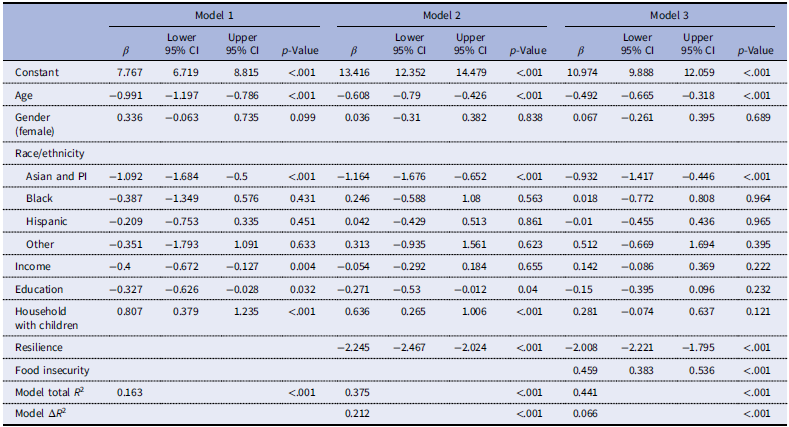
Table 2 presents the results from the hierarchical linear regression. Step 1 included the covariates that accounted for 16.3% of the variance in symptoms of depression and anxiety scores. A significant association was observed between psychological distress and younger age, lower income, lower education, and households with children. In addition, Asians and Pacific Islanders had lower levels of psychological distress compared to Whites. In step 2, resilience accounted for additional 21.2% of the variance in symptoms of depression and anxiety scores. In the final model (step 3), psychological distress was inversely associated with resilience (beta = −2.008, p < 0.001) and positively associated with food insecurity (beta = 0.459, p < 0.001). The final model accounted for 44.1% of the variance in psychological distress scores.
Hierarchical regression with predictors of depression and anxiety symptoms

Table 2. Long description
A table showing hierarchical regression results with predictors of depression and anxiety symptoms. The table has 13 rows and 15 columns. The columns are labeled as Model 1, Model 2, and Model 3, each with headers for β, Lower 95% CI, Upper 95% CI, and p-Value. The rows are labeled as Constant, Age, Gender (female), Race/ethnicity (Asian and PI, Black, Hispanic, Other), Income, Education, Household with children, Resilience, Food insecurity, Model total R², and Model ΔR². Row 1: Constant, β 7.767, Lower 95% CI 6.719, Upper 95% CI 8.815, p-Value <.001, β 13.416, Lower 95% CI 12.352, Upper 95% CI 14.479, p-Value <.001, β 10.974, Lower 95% CI 9.888, Upper 95% CI 12.059, p-Value <.001. Row 2: Age, β -0.991, Lower 95% CI -1.197, Upper 95% CI -0.786, p-Value <.001, β -0.608, Lower 95% CI -0.79, Upper 95% CI -0.426, p-Value <.001, β -0.492, Lower 95% CI -0.665, Upper 95% CI -0.318, p-Value <.001. Row 3: Gender (female), β 0.336, Lower 95% CI -0.063, Upper 95% CI 0.735, p-Value 0.099, β 0.036, Lower 95% CI -0.31, Upper 95% CI 0.382, p-Value 0.838, β 0.067, Lower 95% CI -0.261, Upper 95% CI 0.395, p-Value 0.689. Row 4: Race/ethnicity (Asian and PI), β -1.092, Lower 95% CI -1.684, Upper 95% CI -0.5, p-Value <.001, β -1.164, Lower 95% CI -1.676, Upper 95% CI -0.652, p-Value <.001, β -0.932, Lower 95% CI -1.417, Upper 95% CI -0.446, p-Value <.001. Row 5: Race/ethnicity (Black), β -0.387, Lower 95% CI -1.349, Upper 95% CI 0.576, p-Value 0.431, β 0.246, Lower 95% CI -0.588, Upper 95% CI 1.08, p-Value 0.563, β 0.018, Lower 95% CI -0.772, Upper 95% CI 0.808, p-Value 0.964. Row 6: Race/ethnicity (Hispanic), β -0.209, Lower 95% CI -0.753, Upper 95% CI 0.335, p-Value 0.451, β -0.429, Lower 95% CI -0.953, Upper 95% CI 0.095, p-Value 0.105, β -0.1, Lower 95% CI -0.455, Upper 95% CI 0.436, p-Value 0.965. Row 7: Race/ethnicity (Other), β -0.351, Lower 95% CI -1.793, Upper 95% CI 1.091, p-Value 0.633, β -0.313, Lower 95% CI -1.935, Upper 95% CI 1.561, p-Value 0.623, β -0.512, Lower 95% CI -0.669, Upper 95% CI 1.694, p-Value 0.395. Row 8: Income, β -0.4, Lower 95% CI -0.672, Upper 95% CI -0.127, p-Value 0.004, β -0.054, Lower 95% CI -0.292, Upper 95% CI 0.184, p-Value 0.655, β -0.142, Lower 95% CI -0.086, Upper 95% CI 0.369, p-Value 0.222. Row 9: Education, β -0.327, Lower 95% CI -0.626, Upper 95% CI -0.028, p-Value 0.032, β -0.271, Lower 95% CI -0.53, Upper 95% CI -0.012, p-Value 0.04, β -0.15, Lower 95% CI -0.395, Upper 95% CI 0.096, p-Value 0.232. Row 10: Household with children, β 0.807, Lower 95% CI 0.379, Upper 95% CI 1.235, p-Value <.001, β 0.636, Lower 95% CI 0.265, Upper 95% CI 1.006, p-Value <.001, β 0.281, Lower 95% CI -0.074, Upper 95% CI 0.637, p-Value 0.121. Row 11: Resilience, β -2.245, Lower 95% CI -2.467, Upper 95% CI -2.024, p-Value <.001, β -2.008, Lower 95% CI -2.221, Upper 95% CI -1.795, p-Value <.001. Row 12: Food insecurity, β 0.459, Lower 95% CI 0.383, Upper 95% CI 0.536, p-Value <.001. Row 13: Model total R², Model 1 0.163, p-Value <.001, Model 2 0.375, p-Value <.001, Model 3 0.441, p-Value <.001. Row 14: Model ΔR², Model 2 0.212, p-Value <.001, Model 3 0.066, p-Value <.001.
PI, Pacific Islander. Unstandardized coefficients are shown. Reference groups: gender = male, race/ethnicity = White, household without children.
Figure 2 shows that individuals with higher resilience consistently reported significantly fewer depression and anxiety symptoms across all levels of food insecurity. However, the strength of the association between food insecurity and symptoms of depression and anxiety does not differ by resilience level. The highest-order of interaction was not significant with a change in R 2 of 0.005 (p = 0.576), suggesting that resilience did not moderate the association between food insecurity and psychological distress.
Moderation analysis of the association between food insecurity score and depression and anxiety symptoms score by resilience level, adjusted for age, gender, income, education, race/ethnicity, and household with children.

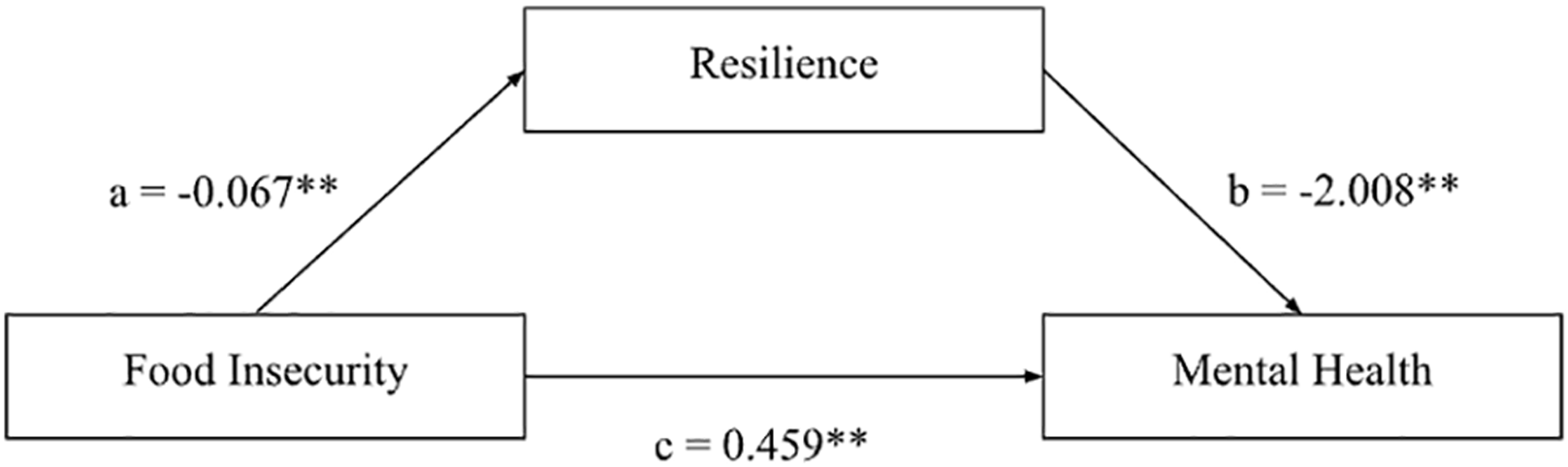
Figure 3 presents the mediation model examining resilience as a potential pathway in the association between food insecurity and symptoms of depression and anxiety. The mediation analysis reveals a significant total effect of the proposed model (beta = 0.594; 95% CI: 0.508, 0.680). Higher food insecurity was significantly associated with lower resilience, while resilience was significantly associated with depression and anxiety symptoms. The indirect effect of food insecurity on depression and anxiety symptoms was significantly mediated by resilience (beta = 0.135; 95% CI: 0.095, 0.176). The direct effect of food insecurity on depression and anxiety symptoms was also significant (beta = 0.459; 95% CI: 0.382, 0.536), suggesting that resilience partially mediated the relationship between food insecurity and depression and anxiety symptoms with 22.7% of the total effect explained by the mediation.
Mediation model for the relationship between food insecurity and depression and anxiety symptoms as mediated by resilience, adjusted for age, gender, income, education, race/ethnicity, and household with children. Coefficients are shown for each path. **p < 0.001.

Discussion
After analyzing a representative sample of California residents, it was determined that as food insecurity increases, so does the likelihood of elevated psychological distress such as symptoms of anxiety and depression. One unit increase in food insecurity score was associated with a 0.5 increase in depression and anxiety symptoms, suggesting a modest but potential cumulative association across the range of food insecurity. From a public health perspective, these findings are notable given the high prevalence of both food insecurity and moderate-to-severe depression and anxiety symptoms. Our results align with the numerous studies that found associations of food insecurity with psychological distress.(Reference Wolfson, Garcia and Leung1–Reference Sabião, Mendonça and Meireles4) Consistent with the proposed conceptual framework, food insecurity may function as a stressor, which can contribute to increased mental health risk. For example, households with food insecurity may experience stress from the difficulty of feeding their household, frustration over the lack of accessibility of healthy foods, stigma of using community resources, sadness about their food situation, as well as shame and guilt about the family situation.(Reference Leung, Stewart and Portela-Parra17,Reference Leung, Laraia and Feiner18) In addition, a bidirectional relationship proposes that poor emotional health contributes to a higher risk of food insecurity.(Reference Bruening, Dinour and Chavez6) Depression can contribute to food insecurity because it hinders an individual’s ability to provide, shop for groceries, cook, and manage household resources.(Reference Reesor-Oyer, Cepni and Lee29)
Consistent with the literature, we found that lower resilience, conceptualized as a coping resource, was associated with psychological distress. The magnitude of this association represented a meaningful shift across symptom severity categories, with one unit decrease in resilience corresponding to 2.2 higher depression and anxiety symptoms score on the PHQ-4 scale. Systematic reviews and meta-analysis studies have shown an inverse correlation between resilience and negative mental health outcomes such as anxiety and depression.(Reference Jeamjitvibool, Duangchan and Mousa23,Reference Hu, Zhang and Wang30) Less is known about the relationship between food insecurity and resilience. Our study shows that higher levels of food insecurity were associated with lower resilience. Similarly, a study analyzing the Minnesota College Student Health Survey reported that food insecure students had lower resilience compared to food secure students.(Reference Laska, Lenk and Lust16) Resilience may represent a modifiable factor that could be addressed through support services and health interventions.
Our results suggest that resilience partially mediated the association between food insecurity and psychological distress. This indicates that individuals experiencing food insecurity tend to have lower resilience, which in turn contributes to higher levels of depression and anxiety symptoms. These findings are consistent with the proposed conceptual framework and suggest that resilience may represent one pathway linking food insecurity and psychological distress. However, resilience did not moderate the association between food insecurity and psychological distress. This suggests that although resilience was associated with lower levels of depression and anxiety symptoms overall, it did not appear to buffer the mental health impact of increased food insecurity. Therefore, resilience may function more as a pathway through which food insecurity is associated with mental health rather than as a protective factor that modifies the strength of that relationship. Additional studies are needed to confirm these findings.
The observed mediating role of resilience may be explained by its function as a coping resource that helps individuals manage the psychological demands associated with food insecurity. Individuals experiencing food insecurity may also have reduced psychological and emotional capacity, as well as limited support resources, to manage stress associated with food insecurity.(Reference DeBate, Himmelgreen and Gupton15) As discussed in previous studies, resilience often shows itself through coping strategies.(Reference Leung, Stewart and Portela-Parra17–Reference Dryland, Carroll and Gallegos19) Perhaps food insecure individuals with lower levels of resilience could benefit from developing coping strategies that protect against mental health distress such as seeking social support from families and friends to reduce feelings of isolation, improving financial literacy, and working on stress reduction.(Reference Laska, Lenk and Lust16,Reference Leung, Laraia and Feiner18,Reference Dryland, Carroll and Gallegos19,Reference Hassan, Hassan and Kassim31) A meta-analysis of randomized control trials reported that digital resilience interventions have small favourable effects on resilience factors (e.g. active coping, mindfulness, and social support) as well as symptoms of depression and anxiety that were comparable to face-to-face interventions.(Reference Schäfer, von Boros and Schaubruch32) Thus, offering programmes to improve resilience may be beneficial, especially for individuals facing a psychological strain such as food insecurity; however, specific interventions targeting this population are needed to confirm this finding. In addition, integrating mental health screening and support services within community-based programmes may also provide an opportunity to address co-occurring issues in high-risk populations.
The mediation analysis also found that resilience accounted for 23% of the association between food insecurity and symptoms of depression and anxiety, suggesting a partial indirect association. Considering the large direct impact of food insecurity on psychological distress, public policies addressing systemic issues related to the social determinants of health, such as housing instability, childcare needs, and healthcare access, remain critical to improve mental health outcomes.(Reference Thompson33) Other strategies to support both food security and mental health include expanding access to food assistance programmes such as the Supplemental Nutrition Assistance Program and improving living wages. In addition to individual resilience, strengthening community-level resilience might support systemic changes to reduce the impact of food insecurity on poor mental health. Future research could examine how community resilience, which is defined as the ability to adapt and grow in adverse circumstances within the community,(Reference Asadzadeh, Kötter and Salehi34) may influence the relationship between food insecurity and mental health.
There are some limitations to this study, such as relying on self-reported data. While we used validated tools, some groups may be guarded in sharing their true state of food security or symptom severity. Others may not have accurate self-awareness of their mental health or resilience status. This study does not explore causality due to its cross-sectional nature. Although statistical models were adjusted for key sociodemographic factors, residual confounding from unaccounted variables such as stress, employment status, or access to healthcare may remain. In addition, it is important to note that the tool used to assess resilience addresses one dimension and is outcome-focused, meaning how well participants were able to overcome adverse circumstances.(Reference Smith, Dalen and Wiggins9,Reference Fisher and Law35) However, there are other dimensions of psychological resilience that have been identified such as attribute/resource-focused (addressing capacity for resilience) and processed-focused (addressing the mechanisms used to overcome adversity).(Reference Fisher and Law35) Therefore, future studies assessing the different dimensions of resilience and their association with food insecurity could provide insightful information. Nonetheless, this is the first study to assess if and how resilience may influence the relationship between food insecurity and mental health. In addition, this study used a representative sample of California, which was ranked as having the second highest state diversity index of the 2020 US Census.(36)
In conclusion, food insecurity and lower resilience were significantly associated with increased symptoms of depression and anxiety. In addition, the association between food insecurity and elevated psychological distress seems to be partially mediated by resilience. These findings highlight resilience as a potential modifiable factor to consider alongside social determinants of health. However, longitudinal studies are needed to confirm the directionality of these associations. Future research should further examine these relationships over time and explore individual- and community-level approaches to support mental health among populations experiencing food insecurity.
Supplementary material
The supplementary material for this article can be found at https://doi.org/10.1017/jns.2026.10139.
Data availability statement
The authors do not have permission to share data because consent for this was not obtained from survey participants.
Acknowledgements
None.
Author contribution
GAPP and MD developed the study design, managed data collection, and acquired funding. All authors contributed to conceptualization, data analysis, and interpretation. TMB wrote the original draft with contributions from GAPP. All authors reviewed and contributed to subsequent drafts of the manuscript and approved the final version of the manuscript.
Financial support
This work was supported by the San José State University Research, Scholarship and Creative Activity Seed Grant Program Award.
Competing interests
The authors declare none.


 Open access

