Young children learn words rapidly, often after only a few exposures to those words – a phenomenon known as ‘fast mapping’ (Carey & Bartlett, Reference Carey and Bartlett1978). For more than three decades, research on word learning has been partly aimed at understanding the processes that help children learn words so quickly and (seemingly) so easily (Bloom, Reference Bloom2000). This research is important because, in theory, learning words is a potentially intractable task that should be neither quick nor easy.
Following Quine (Reference Quine1960), every new word could potentially have a wide variety of meanings. In the famous gavagai example, Quine describes a scene in which a linguist is in a foreign land with a native speaker. A rabbit crosses their path and the native exclaims gavagai. The question is: How does the linguist determine the meaning of gavagai? Certainly gavagai could mean ‘rabbit’. But it could also have many other meanings (e.g. it could mean ‘food’, a part of the rabbit like the foot or tail, something unrelated to the rabbit like an open gate, a superstition like ‘there will be a storm tonight’, etc.) (see Bloom, Reference Bloom2000). In the gavagai example, the linguist must both consider the potential meanings of gavagai and form a hypothesis about which of those potential meanings might be the actual meaning. Rather than being quick and easy, this process could be slow and difficult as the linguist considers and then rejects many potential meanings (Markman, Reference Markman1990).
The gavagai example is often considered an analogy for what young children experience when learning words in their own, native language (Bloom, Reference Bloom2000; Koenig & Woodward, Reference Koenig, Woodward and Gaskell2007). In theory, because the process of considering and then rejecting potential meanings for a word could be slow and difficult, learning words and building a lexicon could also be slow and difficult. In practice, however, children make learning words and building a lexicon seem quick and easy. There are a couple of possible explanations as to why a slow and difficult process in theory could become a fast and easy process in practice. Contrary to Quine's suggestion, it is possible that words do not have a large number of potential meanings. Alternatively, and in line with Quine's suggestion, it is possible that words do have a large number of potential meanings but that children do not consider all potential meanings to be equal.
Research on the latter explanation has revealed several cues that help children narrow the set of potential meanings a word might have (for reviews see Golinkoff et al., Reference Golinkoff, Hirsh-Pasek, Bloom, Smith, Woodward, Akhtar, Tomasello and Hollich2000; Koenig & Woodward, Reference Koenig, Woodward and Gaskell2007; Woodward & Markman, Reference Woodward, Markman, Damon, Kuhn and Siegler1998), especially when identifying the referent of an object word. These cues are often, but not always, conveyed by the speaker (see Baldwin, Reference Baldwin, Moore and Dunham1995; Tomasello, Reference Tomasello, Moore and Dunham1995) or by the language (see Behrend, Reference Behrend1990; Markman, Reference Markman1990; though see Bloom, Reference Bloom2000; Samuelson & Smith, Reference Samuelson and Smith1998). For example, gaze and pointing are social or pragmatic cues indicating that the referent of a word is likely to be in line with the speaker's gaze or point (Carpenter, Nagell & Tomasello, Reference Carpenter, Nagell and Tomasello1998). Pragmatic cues are related to the speaker and lead to assumptions about a speaker's communicative or referential intentions (Baldwin, Reference Baldwin, Moore and Dunham1995; Clark, Reference Clark1993; Tomasello, Reference Tomasello, Moore and Dunham1995). In contrast, taxonomy (Markman & Wachtel, Reference Markman and Wachtel1988) is an example of a lexical cue indicating that two similar referents are likely to share the same word. Lexical cues are related to words and lead to assumptions about how words are used (Behrend, Reference Behrend1990; Markman, Reference Markman1990).
The presence of pragmatic and lexical cues, either separately or together, can increase the chances of learning a word by helping to narrow the set of potential meanings that a word might have. For example, if the native in the gavagai example had been gazing or pointing directly at the rabbit or if the linguist had not previously learned the native's word for rabbit, then the rabbit would likely have been high on the list of potential referents. However, if the native had been gazing directly at an open gate or the linguist had previously learned the native's word for rabbit, then the rabbit would likely have been low on the list of potential referents.
Generally, the referent of a word can be easier to identify when the pragmatic cues and the lexical cues converge on a single referent (Golinkoff et al., Reference Golinkoff, Hirsh-Pasek, Bloom, Smith, Woodward, Akhtar, Tomasello and Hollich2000; Hollich et al., Reference Hollich, Hirsh-Pasek, Golinkoff, Hennon, Chung, Rocroi, Brand and Brown2000; Moore, Angelopoulos & Bennett, Reference Moore, Angelopoulos and Bennett1999; see also Baldwin, Reference Baldwin1991; Reference Baldwin1993). However, there may be instances in which these cues do not converge (e.g. Jaswal & Hansen, Reference Jaswal and Hansen2006) or instances in which the word learner lacks the prerequisite knowledge needed to use these cues effectively. So, how might the linguist in the gavagai example narrow the set of potential meanings when pragmatic cues and lexical cues are unavailable or unhelpful?
One possible answer is that the referent itself can help to narrow the set of potential meanings for a word by possessing perceptual characteristics that increase its overall salience (for discussion see Hollich et al., Reference Hollich, Hirsh-Pasek, Golinkoff, Hennon, Chung, Rocroi, Brand and Brown2000; see also Houston-Price, Plunkett & Duffy, Reference Houston-Price, Plunkett and Duffy2006). Unlike pragmatic cues (which are related to the speaker) or lexical cues (which are related to the words), perceptual cues are related to the referent and operate by making the referent perceptually distinct from surrounding objects. Common examples of perceptual cues can include basic object features (e.g. size, color), physical states (e.g. motion), and/or spatial locations (e.g. proximity to the child or speaker), or any number of other referent-based cues – provided that those cues are perceptual in nature and increase the salience of that particular referent. The current studies aimed to examine one potential perceptual cue, movement, to see whether it might be uniquely helpful for learning words.
Understanding the potential role of perceptual cues is important because, when present, perceptual cues could help support or enhance word learning by increasing the salience of (i.e. drawing attention to) a particular referent. And, while the majority of children's word learning is likely to occur when a speaker is interacting directly with children (Tomasello, Strosberg & Akhtar, Reference Tomasello, Strosberg and Akhtar1996) and when the children are aided by a growing knowledge of their own language, there may be instances in which the cues provided by the speaker or the language are absent, ambiguous or otherwise unhelpful. The gavagai example is one potential instance of this. More common, however, might be instances in which there are many potential referents (e.g. several unknown things on a toy store shelf) and in which the speaker's gaze or point is inexact (e.g. at a distance from the shelf). In these instances, the potential helpfulness of pragmatic and lexical cues is limited because those cues would not isolate a single, likely referent. Such instances may not occur frequently, but they may occur frequently enough to leave occasional gaps in children's lexicons. These instances might benefit from perceptual cues that allow children to fill the lexical gap with a simple hypothesis based on salience.
When other cues are absent, ambiguous or otherwise unhelpful, children might assume that the most salient referent is the likely target of the word (Hollich et al., Reference Hollich, Hirsh-Pasek, Golinkoff, Hennon, Chung, Rocroi, Brand and Brown2000; Hollich, Golinkoff & Hirsh-Pasek, Reference Hollich, Golinkoff and Hirsh-Pasek2007; Houston-Price et al., Reference Houston-Price, Plunkett and Duffy2006; Moore et al., Reference Moore, Angelopoulos and Bennett1999; Pruden, Hirsh-Pasek, Golinkoff & Hennon, Reference Pruden, Hirsh-Pasek, Golinkoff and Hennon2006; see also Nelson, Reference Nelson1973). For example, a child might see a moving object and assume that the word refers to that object (e.g. ‘Maybe the moving object is the X’). While this assumption would certainly not be foolproof (for discussion see Pruden et al., Reference Pruden, Hirsh-Pasek, Golinkoff and Hennon2006; see also Hollich et al., Reference Hollich, Golinkoff and Hirsh-Pasek2007; Woodward, Reference Woodward and Clark1993), it might prove to be an easy way for children to use limited information to quickly form a rough hypothesis about the meaning of a word. So, had the linguist in the gavagai example favored referents that were moving (rather than stationary), then the rabbit might have been high on the list of potential referents – even if the native had not gazed or pointed at the rabbit and even though the linguist was unfamiliar with the language. In the end, the set of potential meanings for gavagai may have been narrower simply because one referent was more salient than others.
One possible problem with salience, though, is that it can differ across individuals and across settings. For example, an illuminated object might generally be salient (e.g. Moore et al., Reference Moore, Angelopoulos and Bennett1999), but when an illuminated target is placed in a setting with other illuminated objects the target might become less salient. Likewise, dull colors might not generally be salient but when a dull-colored target is placed in a setting with colorful objects, the dull target might become more salient. Similarly, novelty might generally be salient (e.g. Akhtar, Carpenter & Tomasello, Reference Akhtar, Carpenter and Tomasello1996; Fantz, Reference Fantz1963; Reference Fantz1964; Samuelson & Smith, Reference Samuelson and Smith1998), but an object that is known to one individual (e.g. a wedding ring or a yearbook photo) might be novel to another. These examples make determining the salience of a particular cue potentially problematic because almost any referent cue could make an object salient.
In addition, while movement seems like a good example of a perceptual cue that increases the salience of an object (Cohen, Reference Cohen1973; Houston-Price et al., Reference Houston-Price, Plunkett and Duffy2006; Slater, Morison, Town & Rose, Reference Slater, Morison, Town and Rose1985; Werker, Cohen, Lloyd, Casasola & Stager, Reference Werker, Cohen, Lloyd, Casasola and Stager1998), on the surface, movement may not seem like an ideal cue for learning words. Movement is not likely to be a permanent characteristic of an object (i.e. an object might be either moving or stationary across multiple encounters). The varied nature of movement could prevent it from being considered as being meaningful to the object (e.g. Houston-Price et al., Reference Houston-Price, Plunkett and Duffy2006) and therefore unhelpful for learning a word. Yet, because movement is not permanent, children might instead assume that its presence is especially meaningful. In this way, movement could be at an advantage over other word learning cues because it would spotlight a particular referent in a meaningful way – a way that would compel children to favor that referent when learning a word.
In support of this latter possibility, previous research has shown that movement can play a role in word learning, but mostly during infancy and early toddlerhood (Hollich et al., Reference Hollich, Hirsh-Pasek, Golinkoff, Hennon, Chung, Rocroi, Brand and Brown2000; Houston-Price et al., Reference Houston-Price, Plunkett and Duffy2006; Moore et al., Reference Moore, Angelopoulos and Bennett1999; Nelson, Reference Nelson1973; Pruden et al., Reference Pruden, Hirsh-Pasek, Golinkoff and Hennon2006; Werker et al., Reference Werker, Cohen, Lloyd, Casasola and Stager1998). Moore et al. presented children aged 1 ; 6 and 2 ; 0 with social–pragmatic cues (e.g. head turning and gaze) and salient perceptual cues (e.g. illumination and remote-controlled movement) where the pragmatic cues coincided, were neutral or conflicted with the salience cues. Moore et al. found that toddlers at both ages favored the pragmatic cues when the salience cues did not discriminate between objects. However, children aged 1 ; 6 (but not 2 ; 0) were less likely to exhibit word learning when the pragmatic cues were absent or conflicted with the salience cues. Moore et al. concluded that children at both 1 ; 6 and 2 ; 0 were sensitive to the speaker's referential intent but that those at 1 ; 6 were still transitioning to a clear understanding of referential intent.
This conclusion was supported by Hollich et al. (Reference Hollich, Hirsh-Pasek, Golinkoff, Hennon, Chung, Rocroi, Brand and Brown2000), who presented children aged 1 ; 0, 1 ; 7 and 2 ; 0 with pragmatic (e.g. gaze) and salience cues (e.g. colorfulness and movement) that sometimes coincided (where the pragmatic and salience cues indicated the same object) and sometimes conflicted (where the cues indicated different objects). Not surprisingly, when cues coincided, infants at each age favored the target object (i.e. the object that was both salient and gazed at) as the referent of a word. However, when cues conflicted, older infants and toddlers (i.e. those aged 1 ; 7 and 2 ; 0) generally tended to disregard the salience cues in favor of the speaker's pragmatic cues. In contrast to their older counterparts, and like the children aged 1 ; 6 in the Moore et al. (Reference Moore, Angelopoulos and Bennett1999) studies, younger infants (i.e. aged 1 ; 0) were generally unable to disregard the salience cues and therefore unable to consistently identify the referent of the word.
Studies that followed Hollich et al. (Reference Hollich, Hirsh-Pasek, Golinkoff, Hennon, Chung, Rocroi, Brand and Brown2000) further showed that children aged 0 ; 10 were likely to disregard the speaker's pragmatic cues in favor of the salience cues (Pruden et al., Reference Pruden, Hirsh-Pasek, Golinkoff and Hennon2006), thereby suggesting that infants place a higher premium on perceptual salience than on the speaker's intent. The Pruden et al. results are noteworthy because they suggest that perceptual cues (i.e. cues that increase an object's salience) play a key role in word learning (at least early on) and that, over time, children shift away from perceptual cues and toward pragmatic cues. Together, the studies reviewed here suggest that perceptual salience can play a role early in word learning, but that the significance of salience declines as toddlers are able to make richer inferences about a speaker's referential intent.
Despite the evidence from these studies that movement can help children learn words, there are several issues that remain unclear about the role of movement in the word learning process. First, it is unclear whether movement alone could help support word learning. In earlier studies, movement was usually one of a set of perceptual cues that increased the salience of a particular referent (e.g. along with colorfulness, illumination, etc.). Consequently, it is unclear what role movement itself played in determining the salience of the referent. Second, it is unclear whether the early preference to select a moving object might reappear in older children later in word learning. Salience is useful for learning words, but it has been argued that salience is especially useful early in word learning (Golinkoff & Hirsh-Pasek, Reference Golinkoff and Hirsh-Pasek2006; Golinkoff, Hirsh-Pasek & Hollich, Reference Golinkoff, Hirsh-Pasek, Hollich and Mac-Whinney1999; Hirsh-Pasek, Golinkoff, Hennion & Maguire, Reference Hirsh-Pasek, Golinkoff, Hennon, Maguire, Geoffrey Hall and Waxman2004; Hollich et al., Reference Hollich, Hirsh-Pasek, Golinkoff, Hennon, Chung, Rocroi, Brand and Brown2000; Pruden et al., Reference Pruden, Hirsh-Pasek, Golinkoff and Hennon2006), when children's mastery of other cues (e.g. pragmatic and lexical cues) is still emerging. The impression is that salience loses its value in word learning and is ultimately surpassed or replaced by pragmatic cues and lexical cues. Although, even if salience does not remain a primary word learning cue, it could frequently complement with pragmatic or lexical cues and, even in a complementary role, still support word learning. However, it is unclear whether salience plays a useful role later in word learning. Study 1 uses movement to help to clarify these issues.
STUDY 1
Study 1 was designed to examine whether an object's movement might compel preschool children to favor that object when learning a novel word. During the experimental trial, children heard the word while viewing one moving object and two stationary objects. During the control trial, children heard the word while viewing two moving objects and one stationary object. Of interest was whether children would prefer a moving object over a stationary object when selecting the referent of the word.
METHOD
Participants
Forty-four children, ranging in age from 2 ; 4 to 5 ; 4 participated in Study 1. Twenty-three three-year-olds (M=36 months, SD=4·6 months) and 21 four-year-olds (M=53 months, SD=5·6 months) were recruited with parent's consent and child's assent from preschools on or near the campus of a university in the southeastern US.
Materials
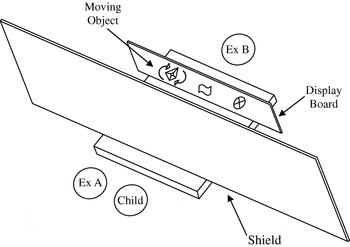
The materials used in this study were a stage, two display boards that each contained three novel objects, and a shield (see Figure 1). In addition, children were presented with novel words. The stage measured approximately 24 inches wide by 18 inches deep by 8 inches tall. The sides of the stage were raised and contained slats that were used to support the shield and a display board. The shield measured 54 inches wide by 30 inches tall and also stood upright in the front slats (i.e. closest to the child). Each display board measured 30 inches wide by 24 inches tall, contained three differently colored and differently shaped novel objects, and stood upright in the rear slats (i.e. farthest from the child). Screw hooks (i.e. a screw with a hook on one end) were used to fix the novel objects (i.e. t-joint, hinge, doorstop, x-joint, pipe extender, and an elbow joint) to each display board in a horizontal line. The screw was threaded into each object and the hook projected from the back of the display board. The objects selected were the same as have been used in previous studies and pilot testing showed that these objects were novel to preschool children. The novel words used in this study (i.e. scof and clem) were similar in structure and length to the novel words used in previous studies and were selected because they were believed to be unfamiliar to children (e.g. Behrend, Scofield & Kleinknecht, Reference Behrend, Scofield and Kleinknecht2001).
Set-up for Studies 1 and 2.

Procedure
Children completed two phases, a warm-up phase and a test phase, at a table near their preschool classroom. During the warm-up phase, children were asked to conduct various tasks on a set of small wooden blocks (e.g. stacking, arranging, etc.). The warm-up phase was designed to expose children to the experimenter and to the experimental setting, but did not expose children to any of the experimental materials. The warm-up phase lasted only a few minutes and was followed immediately by the test phase.
The test phase was administered by two experimenters, Experimenter A and Experimenter B, and consisted of an experimental trial and a control trial. Experimenter A was seated beside the child facing the shield, which blocked the view of the display board. Experimenter B was hidden behind the display board and thus out of sight of the child. Before the procedure began, Experimenter B selected one of the two display boards at random and inserted it in the rear slats of the stage and prepared for the first trial (i.e. either the experimental trial or the control trial). The remaining display board would later be used for the second trial.
During the experimental trial, Experimenter B began twisting one of the hooks causing the attached object to move while the other two objects remained stationary. Experimenter A then removed the shield revealing the display board and a single moving object (but not revealing Experimenter B). While the object moved, Experimenter A asked the child to select the one object out of the three that best matched a novel word (e.g. ‘A scof. Look, it's a scof. Which one of these do you think is a scof?’). Experimenter A was trained to carefully avoid using any unintended cues that might highlight a specific object. To accomplish this, Experimenter A was instructed to look directly at the child from the time the shield was removed to the time the child reached toward one of the objects, including during labeling. Given the simplicity of these instructions, the prior training and on-site testing at various preschools, no method of monitoring for Experimenter A during the actual session was used. The experimental trial was designed to measure the child's preference to select the moving object in response to a word.
However, because the moving object was different from the surrounding stationary objects, a control trial was also included. The control trial ensured that any preference children might show for the moving object in the experimental trial would be due to the object's movement and not to the object being different from surrounding objects. During the control trial, Experimenter B began twisting two of the hooks causing the attached objects to move while the other object remained stationary. Experimenter A then removed the shield revealing the display board and two moving objects (but again not revealing Experimenter B). While the objects moved, Experimenter A asked the child to select the one object out of the three that best matched a novel word (e.g. ‘A clem. Look, it's a clem. Which one of these do you think is a clem?’).
The experimental and control trials were counterbalanced such that half of the children completed the experimental trial first. The novel words, the display boards and the objects that moved on each display board varied randomly across children.
RESULTS
Of interest in Study 1 was whether children preferred to select the moving object in response to the novel word and whether this preference varied by age. To test whether children preferred to select the moving object for the word, selection of the moving object on the experimental trial was compared to chance and to selection of the stationary object on the control trial.
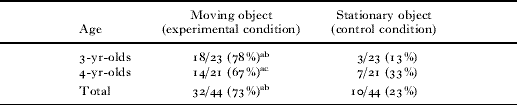
If children were selecting randomly, or according to chance, then the moving object should have been selected on 33% of trials, as the moving object was one of three options (i.e. one moving object and two stationary objects). However, a chi-square analysis revealed that the moving object was selected by 32 of the 44 children (i.e. 73%), a proportion that was significantly greater than chance (χ2(1, n=44)=30·73, p<0·01) (see Table 1). This overall pattern was demonstrated by both three-year-olds (χ2(1, n=23)=20·89, p<0·01) and four-year-olds (χ2(1, n=21)=10·50, p<0·01), though three- and four-year-olds' preference to select the moving object did not differ from each other (χ2(1, n=44)=0·74, p=ns). These results suggest that children's preference for the moving object was not random and that three- and four-year-olds' selection of the moving object did not differ.
Object selection in response to the novel word
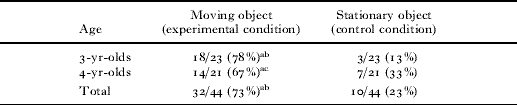
a p<0·05 (compared to chance).
b p<0·05 (compared to control).
c p=0·052 (compared to control).
A Cochran's Q analysis further revealed that children selected the moving object on the experimental trial more often than the stationary object on the control trial (Q(1, n=44)=16·13, p<0·01). This overall pattern was demonstrated by three-year-olds (Q(1, n=23)=13·24, p<0·01) and marginally by four-year-olds (Q(1, n=21)=3·77, p=0·052) (see Table 1). These results suggest that children's preference for the moving object was based on movement and not on difference.
Multinomial logistic regression was used to examine the possibility that performance in the experimental and control conditions interacted with age. That is, it was possible that the difference between conditions for three-year-olds was larger or smaller than the difference between conditions for four-year-olds. However, the likelihood ratio tests did not reveal a significant age by condition interaction (χ2(1, n=44)=0·75, p=ns).
STUDY 1 DISCUSSION
Study 1 examined whether object movement could help three- and four-year-olds learn words. During the test phase, children saw one moving object and two stationary objects and were asked to select the object that corresponded to a novel word. Results from Study 1 indicated that children preferred to select the moving object over the stationary objects when learning a novel word and that children were not simply selecting the object that differed from surrounding objects. Together these results suggest that children are able to use movement to quickly form a rough hypothesis about the meaning of a novel word.
Both results say something important about movement. Earlier studies tended to use movement as part of a larger set of perceptual cues to make a particular referent salient. For example, a colorful object might have an interesting moving part (Pruden et al., Reference Pruden, Hirsh-Pasek, Golinkoff and Hennon2006) or an illuminated object might exhibit remote-controlled movements (Moore et al., Reference Moore, Angelopoulos and Bennett1999). Because movement was not the only salient perceptual feature, it was unclear what role movement itself played in making the referent salient. Study 1 found that movement alone, when alongside other stationary objects, made a referent salient. Earlier studies also emphasized that cues like movement were important early in word learning but ultimately surpassed by other, richer cues later in word learning. Study 1 found that salience could continue to support later word learning, particularly when other cues were unhelpful. These findings suggest that the role of salience in word learning is not necessarily lost in infancy. In the end, Study 1 makes it clear that perceptually salient cues like movement can make an object stand out as a good candidate for a novel word.
Unclear from Study 1, however, is whether children's preference for the moving object is unique to word learning. Study 1 showed that movement was a useful cue for learning words, but movement might be equally useful for learning other types of information – especially considering that salience operates by drawing attention to a particular object, and it is reasonable to assume that an object's salience is independent of the type of information that is presented in the environment. Other word learning cues, like pragmatic and lexical cues, are sometimes described as being either domain-specific or domain-general. Lexical cues like mutual exclusivity and taxonomy are usually described as being domain-specific because they are thought to apply uniquely to learning words. Pragmatic cues like gaze and pointing, on the other hand, are usually described as being domain-general because they are thought to apply more broadly to learning in general. While Study 1 indicates that movement facilitates word learning, it does not indicate whether movement operates as a domain-specific cue (i.e. it supports word learning uniquely) or a domain-general cue (i.e. it supports learning more broadly).
Previous studies have separated these two possibilities by presenting children with either novel words or novel facts about an object (e.g. Behrend, Scofield & Kleinknecht, Reference Behrend, Scofield and Kleinknecht2001; Diesendruck & Markson, Reference Diesendruck and Markson2001; Markson & Bloom, Reference Markson and Bloom1997; Scofield & Behrend, Reference Scofield and Behrend2007; Waxman & Booth, Reference Waxman and Booth2000). Markson & Bloom (Reference Markson and Bloom1997) first used novel facts to examine whether children's ability to quickly learn and remember information about an object (i.e. a phenomenon known as ‘fast mapping’) was unique to word learning. Three- and four-year-olds were presented with a novel word for an object (e.g. ‘Let's use the kobas to measure which is longer.’) and a novel fact for an object (e.g. ‘We can use the things my uncle gave me to measure which is longer.’) If fast mapping applies uniquely to word learning, then children ought to quickly and easily learn and remember words but not facts. Alternately, if fast mapping applies to learning in general, then children ought to similarly learn and remember words and facts. Interestingly, findings indicated that children were similarly good at learning and remembering both words and facts for objects, leading Markson and Bloom to conclude that children's word learning is supported by basic learning and memory processes that are not specific to learning words.
Subsequent studies have used both words and facts to examine other traditional word learning paradigms (e.g. extension and disambiguation). Behrend, Scofield & Kleinknecht (Reference Behrend, Scofield and Kleinknecht2001) examined children's willingness to extend novel words and facts associated with a target object to other similar objects. Two-, three- and four-year-olds were presented with novel words and novel facts for target objects using a paradigm similar to Markson & Bloom (Reference Markson and Bloom1997). The children were then presented with an array of objects (including the original target, exemplars of the target and distracters) and asked to extend either the word (e.g. koba) or fact (e.g. ‘a thing that fell in the sink yesterday’) to other objects in the array (e.g. ‘Now when you look at these things, can you show me the koba/thing that fell in the sink yesterday? Is there another koba/one that fell in the sink or not?’) The findings indicated that two-, three- and four-year-olds were less likely to extend novel facts to exemplar objects than novel words. Behrend et al. concluded that extension was applied to words and facts differently (see also Waxman & Booth, Reference Waxman and Booth2000).
In a later study, Scofield & Behrend (Reference Scofield and Behrend2007) examined children's willingness to disambiguate novel words and facts. Two-, three- and four-year-olds were presented with novel words and novel facts for target objects using a standard disambiguation paradigm (e.g. Merriman & Bowman, Reference Merriman and Bowman1989). For example, children were initially presented with two novel objects, and one of those objects was labeled with either a novel word (e.g. ‘This is a koba.’) or a novel fact (e.g. ‘This is a thing my uncle gave me.’). Children were then asked for the referent of a different novel word (e.g. ‘Can you show me the nixon?’) or a novel fact (e.g. ‘Can you show me the thing my cat stepped on?’). The findings indicated that two-, three- and four-year-olds were less likely to disambiguate novel facts than novel words. That is, children were less likely to assume that the fact applied to the unlabeled object. Scofield and Behrend concluded that disambiguation, like extension, was applied to words and facts differently (although see Diesendruck & Markson, Reference Diesendruck and Markson2001).
Overall, these previous studies were designed according to Markson & Bloom's (Reference Markson and Bloom1997) original logic. If a cue uniquely supports word learning, then, in the presence of that cue, children ought to respond differently to words and facts. However, if a cue supports learning in general, then, in the presence of that cue, children ought to respond similarly to words and facts. Operating under that same logic, Study 2 uses facts to examine whether movement uniquely supports word learning or whether movement supports learning in general.
STUDY 2
Study 2 was designed to examine whether an object's movement might compel preschool children to favor that object when learning a novel fact. Similar to Study 1, during the experimental trial, children heard the fact while viewing one moving object and two stationary objects. During the control trial, children heard the fact while viewing two moving objects and one stationary object. Of interest was whether children would prefer a moving object over a stationary object when selecting the referent of the fact.
METHOD
Participants
Forty-five children, ranging in age from 2 ; 3 to 5 ; 2 participated in Study 2. Nineteen three-year-olds (M=39 months, SD=4·8 months) and 26 four-year-olds (M=56 months, SD=4·5 months) were recruited with parent's consent and child's assent from preschools on or near the campus of a university in the southeastern US.
Materials
The materials used in Study 2 were identical to those used in Study 1, except that children were presented with novel facts instead of novel words. The novel facts used in this study (i.e. ‘a thing I kicked into the door’ and ‘a thing I dropped in the sink’) were similar in structure and length to the novel facts used in previous studies (e.g. Behrend et al., Reference Behrend, Scofield and Kleinknecht2001).
Procedure
The procedure followed in Study 2 was similar to the procedure followed in Study 1, except that novel facts were used in place of novel words in the test phase. During the experimental trial, Experimenter B twisted one of the hooks causing one of the objects to move. While the object moved, Experimenter A removed the shield and asked the child to select the object that best matched a novel fact (e.g. ‘A thing I kicked into the door. Look, it's a thing I kicked into the door. Which one of these do you think is a thing I kicked into the door?’). The experimental trial was designed to measure the child's preference to select the moving object in response to a fact. During the control trial, Experimenter B twisted two of the hooks causing two of the objects to move. While the objects moved, Experimenter A removed the shield and asked the child to select the object that best matched a novel fact (e.g. ‘A thing I dropped in the sink. Look, it's a thing I dropped in the sink. Which one of these do you think is a thing I dropped in the sink?’).
The experimental and control trials were counterbalanced such that half of the children completed the experimental trial first. The novel facts, the display boards and the objects that moved on each display board varied randomly across children.
RESULTS
Of initial interest in Study 2 was whether children preferred to select the moving object in response to the novel fact and whether this preference varied by age. To test whether children preferred to select the moving object for the fact, selection of the moving object on the experimental trial was compared to chance and to selection of the stationary object on the control trial.
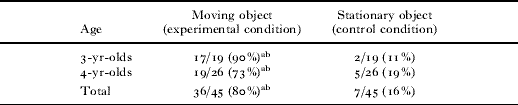
If children were selecting randomly, or according to chance, then the moving object should have been selected on 33% of trials. However, a chi-square analysis revealed that the moving object was selected by 36 of the 45 children (i.e. 80%), a proportion that was significantly greater than chance (χ2(1, n=45)=44·10, p<0·01) (see Table 2). This overall pattern was demonstrated by both three-year-olds (χ2(1, n=19)=26·95, p<0·01) and four-year-olds (χ2(1, n=26)=18·48, p<0·01), though three- and four-year-olds' preference to select the moving object did not differ from each other (χ2(1, n=45)=1·85, p=ns). These results suggest that children's preference for the moving object was not random.
Object selection in response to the novel fact
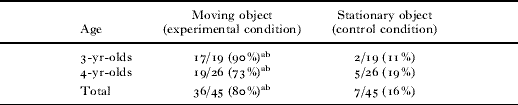
a p<0·05 (compared to chance).
b p<0·05 (compared to control).
A Cochran's Q analysis further revealed that children selected the moving object on the experimental trial more often than the stationary object on the control trial (Q(1, n=45)=27·13, p<0·01). This pattern was demonstrated by both three-year-olds (Q(1, n=19)=15·00, p<0·01) and four-year-olds (Q(1, n=26)=12·25, p<0·01) (see Table 2). These results suggest that children's preference for the moving object was based on movement and not on difference.
Multinomial logistic regression was again used to examine the possibility that performance in the experimental and control conditions interacted with age. That is, it was possible that the difference between conditions for three-year-olds was larger or smaller than the difference between conditions for four-year-olds. However, the likelihood ratio tests did not reveal a significant age by condition interaction (χ2(1, n=45)=1·96, p=ns).
Of additional interest was whether children were more likely to select the moving object in response to the novel word in Study 1 than in response to the novel fact in Study 2. A pre-planned chi-square analysis revealed that the proportion of children who selected the moving object in response to the novel word in Study 1 (i.e. 32 of 44), and the proportion of children who selected the moving object in response to the novel fact in Study 2 (i.e. 36 of 45), did not differ statistically (χ2(1, n=89)=0·65, p=ns).
STUDY 2 DISCUSSION
Study 2 examined whether object movement might uniquely help three- and four-year-olds learn words. During the test phase, children saw one moving object and two stationary objects and were asked to select the object that corresponded to a novel fact. If a movement uniquely supports word learning then children ought to respond differently to words and facts. Alternately, if movement supports learning in general then children ought to respond similarly to words and facts. Results from Study 2 indicated that children preferred to select the moving object over the stationary objects when learning a novel fact, that children were not simply selecting the object that differed from surrounding objects and that the preference to select the moving object in response to the novel fact in Study 2 was not different from the preference to select the moving object in response to the novel word in Study 1. Together these results suggest that children's ability to use movement to quickly form a rough hypothesis about the meaning of the novel word in Study 1 may not be unique to word learning.
These results also say something important about movement. Earlier studies also emphasized that perceptual cues like movement were important early in word learning because they drew the word learner's attention to a particular referent, allowing children to form a quick association between the word and the referent. However, learning through association is not unique to words (e.g. Markson & Bloom, Reference Markson and Bloom1997) or to infancy (e.g. Colunga & Smith, Reference Colunga and Smith2008). Indeed, Study 2 found that preschool children preferred a moving object over other objects when deciding the referent of a novel fact, suggesting that the value of salience extends beyond word learning. In the end, Study 2 makes it clear that movement can make an object stand out as a good candidate for a variety of information.
GENERAL DISCUSSION
The current studies examined whether a perceptually salient cue like movement could support word learning in preschool children when other word learning cues (e.g. pragmatic or lexical cues) were unavailable or unhelpful and, if so, whether this support would be unique to learning words. In these studies, three- and four-year-olds saw one moving object and two stationary objects and were asked to select the object that best corresponded to either a novel word (Study 1) or a novel fact (Study 2). Results indicated that both three- and four-year-olds favored the moving object over the stationary objects when deciding the referent of a novel word and when deciding the referent of a novel fact, and that neither was due to a simple preference for the object that was different. These results suggest that preschool children may be able to use perceptual cues that increase the salience of an object, like movement, to quickly form a rough hypothesis about the meaning of a word, but that such cues might not uniquely support word learning.
Previous studies showed that salience could facilitate word learning in younger children (Akhtar et al., Reference Akhtar, Carpenter and Tomasello1996; Hollich et al., Reference Hollich, Hirsh-Pasek, Golinkoff, Hennon, Chung, Rocroi, Brand and Brown2000; Houston-Price et al., Reference Houston-Price, Plunkett and Duffy2006; Moore et al., Reference Moore, Angelopoulos and Bennett1999; Nelson, Reference Nelson1973; Pruden et al., Reference Pruden, Hirsh-Pasek, Golinkoff and Hennon2006; see also Poulin-Dubois, Graham & Riddle, Reference Poulin-Dubois, Graham and Riddle1995; Werker et al., Reference Werker, Cohen, Lloyd, Casasola and Stager1998). However, the current studies are the first to show that: (a) salience continues to facilitate word learning in older children; and (b) salience may facilitate learning in general and not word learning specifically.
These findings are impressive, particularly because children were able to rely on movement in place of other, more typical word learning cues. Because all of the objects were unknown to children, lexical cues were unhelpful for reliably deciding which of the three objects was likely to be the referent of the novel word. For example, lexical cues depend on children's existing knowledge of words, and in Study 1 there were too many unknown words and unknown objects to support lexical assumptions (see also Akhtar et al., Reference Akhtar, Carpenter and Tomasello1996). Likewise, because the speaker provided no overt social–pragmatic cues (e.g. gaze, pointing, etc.) towards a specific object, the speaker's communicative intent was not as easily accessible. Pragmatic cues depend on children's ability to infer a speaker's intent, and in the current studies the speaker did not provide any obvious, immediate or ‘easily programmable’ (Akhtar et al., Reference Akhtar, Carpenter and Tomasello1996: 643) cues that might support a pragmatic assumption. And, while it is likely that children would have used (and may have even preferred) either lexical or pragmatic cues had they been available, it is certainly noteworthy that children were able to move on to other potentially helpful cues when they were not. That those ‘other’ cues were perceptual in nature is also noteworthy, given that features related to the referent are not commonly considered when explaining how preschool children learn words.
However, it is possible to argue that movement is not only perceptual in nature but that it is also pragmatic. To be considered a pragmatic cue, an object's movement would simply need to cause children to make an inference about the speaker's intent. As a perceptual cue, children would see a moving object and think ‘maybe the moving object is the X’. However, as a pragmatic cue, children would see a moving object and think ‘maybe the speaker meant to refer to the moving object’ (e.g. Moore et al., Reference Moore, Angelopoulos and Bennett1999). Though the mapping would be the same in both cases (i.e. the word would be mapped onto the moving object), the underlying rationale would be quite different.
Gaze and pointing are common examples of social–pragmatic cues, but previous research has suggested that pragmatic assumptions may not always be based on these kinds of overt social cues (e.g. Akhtar et al., Reference Akhtar, Carpenter and Tomasello1996; Bloom, Reference Bloom, Damon, Kuhn and Siegler1998; Diesendruck & Markson, Reference Diesendruck and Markson2001; Tomasello & Akhtar, Reference Tomasello and Akhtar1995). Instead, some pragmatic assumptions may be based on subtler inferences about how and why speakers communicate (Diesendruck, Reference Diesendruck2005; Diesendruck & Markson, Reference Diesendruck and Markson2001; for discussion see also Akhtar & Tomasello, Reference Akhtar, Tomasello and Braten1998; Baldwin, Reference Baldwin, Moore and Dunham1995; Tomasello, Reference Tomasello, Moore and Dunham1995). For example, Diesendruck and colleagues (Diesendruck, Reference Diesendruck2005; Diesendruck & Markson, Reference Diesendruck and Markson2001; see also Clark, Reference Clark1990; Reference Clark1993) have argued that conventionality (i.e. that speakers use agreed upon, conventional forms when communicating) and contrast (i.e. that a speaker who says two different things intends to communicate about two different things) lead to assumptions about a speaker's intent. In this way, though not overt social cues, conventionality and contrast can have the same pragmatic value as gaze and pointing.
The current studies do not speak directly to the possibility that preschool children view movement as a pragmatic cue. If children in the current studies viewed movement as a pragmatic cue and assumed that speakers communicate about salient things, then they should have shown a preference for the moving object in response to both novel words and novel facts. And indeed, this is exactly the preference that children showed. Children preferred the moving object and this preference did not vary by age or by the type of information. As Moore et al. (Reference Moore, Angelopoulos and Bennett1999) suggested for younger children, it may be that word learning in older children can also be supported by the ‘relatively subtle pragmatic assumption that the novel word must apply to the more salient target’ (p. 67), with the moving object playing the part of the salient object in the current studies. Particularly interesting would be the possibility that the perceptual cues which helped support word learning in infancy become pragmatic cues that help support word learning in toddlerhood and beyond (see Hollich et al., Reference Hollich, Hirsh-Pasek, Golinkoff, Hennon, Chung, Rocroi, Brand and Brown2000).
This would be similar to Akhtar et al.'s (Reference Akhtar, Carpenter and Tomasello1996) explanation for children's preference for novelty. Akhtar et al. familiarized two-year-olds, a parent and an experimenter with three novel objects. The parent then left the room and the child and experimenter played with a fourth novel object and placed it in an array with the other three. Upon returning, the parent excitedly commented on the array of objects (e.g. ‘Oh, a gazzer! Wow, a gazzer! Look at the gazzer!’). When later asked to identify the target of their parent's excitement (e.g. ‘Which is the gazzer?’), children tended to favor the fourth, novel object. Akhtar et al. suggested that children's preference for novelty indicated that word learning was visible across a variety of pragmatic contexts and that novelty belongs on the list of pragmatic cues that support word learning. The results of the current studies, as well as previous studies, suggest that movement might also belong on that list.
Contrary to what was stated earlier, it might appear as if the results of the current studies do then speak to the possibility that preschool children view movement as a pragmatic cue. However, there are also other, non-pragmatic explanations for why children may have treated words and facts similarly in Studies 1 and 2. Had children simply associated what was said with what was being attended (see Colunga & Smith, Reference Colunga and Smith2008; Samuelson & Smith, Reference Samuelson and Smith1998; Smith, Jones & Landau, Reference Smith, Jones and Landau1996), then they may have also shown a preference for the moving object in response to both novel words and novel facts. Though such a strategy could potentially lead to inaccurate hypotheses (Baldwin, Reference Baldwin1991; Reference Baldwin1993; for discussion see Baldwin, Reference Baldwin, Moore and Dunham1995), in Study 1 a simple association would have led to the same hypothesis about the referent of the novel word or fact as a complex assumption about the speaker's intent. Also, had children simply reasoned that salient objects were a good opening hypothesis for any new information, then they may have also shown a preference for the moving object in response to both novel words and novel facts. These possibilities are not based on pragmatic assumptions, and yet seem viable explanations of why children may have treated words and facts similarly in the current studies. Consequently, the current studies do not suggest that preschool children view movement as a pragmatic cue – though they certainly provide the background for studies that could.
Instead, the current studies suggest that children can use perceptual cues such as movement to discriminate between potential referents when other cues are unavailable or ambiguous (see also Houston-Price et al., Reference Houston-Price, Plunkett and Duffy2006; Moore et al., Reference Moore, Angelopoulos and Bennett1999). These studies further suggest that children show a preference for the moving object when mapping a novel word, though future studies are needed to determine the quality of this mapping (i.e. whether it would be retained over time, how it might compare to mappings formed via other cues and whether the type of movement affects the quality of the mapping), and whether the particular movement used in these studies was representative of object movement more generally. However, the overall finding that movement supported word learning in preschool children is noteworthy. The importance of salience has been well documented in the early stages of word learning, before children master lexical and pragmatic cues (Golinkoff & Hirsh-Pasek, Reference Golinkoff and Hirsh-Pasek2006; Golinkoff et al., Reference Golinkoff, Hirsh-Pasek, Hollich and Mac-Whinney1999; Hirsh-Pasek et al., Reference Hirsh-Pasek, Golinkoff, Hennon, Maguire, Geoffrey Hall and Waxman2004; Hollich et al., Reference Hollich, Hirsh-Pasek, Golinkoff, Hennon, Chung, Rocroi, Brand and Brown2000). But the current studies also show that salience could still be important in the latter stages of word learning. Finally, the current studies suggest that movement in particular, and salience more broadly, may not uniquely support word learning. Rather movement seems to be an example of a perceptual cue that supports learning more generally by increasing the salience of a particular referent, thereby narrowing the set of potential meanings a word, or a fact, might have.