In my three decades in the profession I have served on an uncountable number of search committees. In recent years I increasingly encountered an annoying (to me) practice among applicants, multiple vita entries for identically titled, and thus presumably identically written, conference papers. I originally dismissed such practices as vita padding, a not well socialized, nor particularly well accomplished, applicant seeking to make his or her research performance look more impressive than it actually is.
But the practice continued to grow from rare to increasingly common among a sizable minority of applicants. Something was changing from the expectations I had absorbed upon entering the profession. Curious, I wanted to find out more about this apparent transformation. To that end I gathered vitas that were available online from faculty and graduate students at seven regional institutions—a small number but still illustrative of trends at institutions across the nation. This process yielded 114 usable vitas, 87 from those holding faculty positions and 27 from doctoral students still working on their degrees.1
An additional 27 vitas were not usable because the individuals did not list titles for any conference papers presented.
Practice Frequency
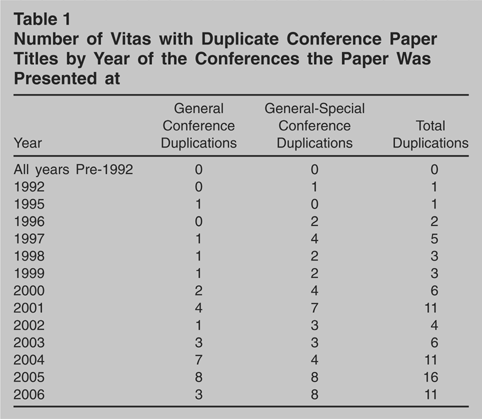
Table 1 shows the shifting pattern of conference papers across time with duplicate paper titles grouped by their year of presentation.2
In most cases authors presented multiple papers with the same title in the same calendar year. When crossing two successive years, such as presented at the APSA Annual Meeting in the fall of 2000 and the Midwest conference in 2001, I used the later year as the duplicate year.
Given the region I drew the vitas from, none contained papers presented at the Northeastern conference.
Number of Vitas with Duplicate Conference Paper Titles by Year of the Conferences the Paper Was Presented at

In all papers presented prior to 1992 I found no title duplications. From 1992 on you see the classic S-shaped curve, a gradual increase in the number of duplicate titles accelerating to a far more rapid increase from 2000 on. While first appearing primarily as a general conference paper later repeated at a specialized conference (or vice-versa), the trend since 2000 has been a noticeable growth in papers duplicated at two or more general conferences.
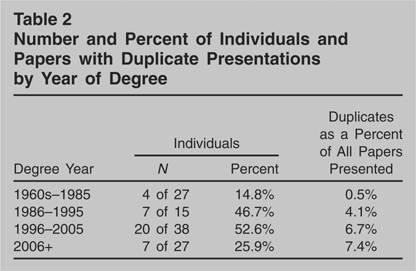
To date, the trend appears rather modest. These are pretty small Ns considering they are drawn from 114 vitas. However there is a clear generational element to this practice, as shown in Table 2. Here I divided individuals by the year they received their doctorate. Of the 27 individuals surveyed who received their degree before 1986, only about 15% had presented two or more conference papers with the same title. For those receiving their degrees between 1986 and 2005, approximately half had presented an identically titled paper more than once. The proportion drops for those with degrees after 2005, but most of these individuals are current students with limited conference appearances and thus limited opportunities for duplication. The final column in Table 2 provides another way of looking at the same phenomena—duplicate titles as a percent of all conference papers presented by members of the group. These data show a steady progression—the later the degree the higher the proportion of conference papers with duplicate titles. Duplicated papers remain a minority among all papers presented, but the growth curve continues and we don't know where it will level out.
Number and Percent of Individuals and Papers with Duplicate Presentations by Year of Degree

Individual and Collective Benefits and Drawbacks
This is the trend. What do we make of it? Personally, I am not fond of it. I have no problems with, and have often engaged in, examining the same question in more than one conference presentation. But I strive to take what I learned from the first presentation to make significant changes in the second. My rule of thumb is to gauge whether people who encounter both papers will find sufficient new material in the second—revised argument, hypotheses, or analysis—to make it worth their while reading it. Most readers would agree that this is not only acceptable but a wise practice. It is what conferences are all about, to test out our ideas, dump those that are going nowhere, and refine the ones with publication potential.
But what we are discussing here is not present-refine-present again, but present-present again with little to no refinement in between. Some newer members of the profession clearly see this practice as beneficial, or else they would not be doing it. And from an individual cost-benefit analysis it makes sense. Conferences provide benefits, the price of which is either: (1) preparing a paper; (2) volunteering to serve as a chair, discussant, or section head; or (3) attending without being on the program, often funded out of your own pocket. If you can reduce the price by recycling the same paper, why not do so? But regardless of benefits to the individual there is the question of whether the practice aggregates into profit or loss for the discipline as a collectivity.
I concede to seeing a few limited advantages to the practice, individually and collectively, but also sufficient potential pitfalls to tip the balance against it, and fairly strongly so. But it would be foolish to assume it will suddenly stop, no matter how compelling my arguments. Nor should it in all cases. So instead I propose guidelines to maximize benefit and minimize loss.
There is one definite collective advantage to repeat presentations of identically titled papers, academic integrity. This is far from insignificant to a profession that claims to speak truth to power. While an identical paper title implies an identical paper, differing titles, alas, do not ensure different papers. We have all encountered conference papers with modified titles, sometimes nothing more than rearranging word order, that are in effect the same paper. I find this particularly graceless. I show up at a conference panel hoping to hear added depth to a paper that interested me at a prior conference only to find I have wasted my time. Closer to home, on search committees and annual merit review committees I am forced to carefully scrutinize vitas to properly compare person A, who lists three clearly distinct conference presentations, to person B's much longer listing of activities that boil down to only one or two research projects presented over and over again under the guise of revised titles. This is not a notably injurious ruse, for we all learn to quickly spot, and discount it, but I take exception to being required to do so.
So if the choice is between making repetitive paper presentations obvious with identical titles versus clouding it with modified titles, I much prefer the honesty of the former to the insincerity of the latter. Moreover, I recommend we use the format that some senior scholars follow in carrying this honesty into their vita's visual grammar: one listing per paper title containing all of its conference presentations. If a substantially revised paper retains a prior title, record it twice with the added parenthetical note that it has been substantially revised. A judgment call to be sure, but one we all have the ethical good sense to make.
But this honesty argument doesn't speak to the practice itself, but only to whether we veil it or display it clearly. Conference attendance can provide multiple benefits to an individual, but they also have a communal goal of enhancing disciplinary vitality. This is accomplished in part through panels. Panel audiences are exposed to current issues and research programs in their fields of specialization while paper authors receive feedback from discussants, other panel members, and the audience. Beyond paper presentation and feedback, conferences enhance networking both in the panel setting and outside it in the multiple informal venues conferences offer.4
As I use “networking” here it refers to individuals discussing their academic interests. Also valuable is networking that involves catching up with old friends, making new ones, touching base with one another regarding job openings for yourself or your graduate students, and the like. However if this type of networking was the primary communal goal of a conference they would do away with panels entirely and simply host a three-day party. Panels exist because the exchange of information about current research taking place is both an important goal in and of itself and they also provide venues for networking stemming from overlapping research interests.
A number of conferences, primarily general ones, are not expanding sum games. Every paper accepted implies some other paper rejected. The APSA Annual Meeting, for example, accepted only 46% of paper proposals in 2003 and a slightly higher 53% in 2004 (Gupta and Waismel-Manor 2006). Not all conferences are so restricted. Gupta and Waismel-Manor noted in the same article that the 2005 MPSA conference accepted 88% of proposed papers.
Yet acceptance rates are only part of the story. All conferences have expanded their use of poster sessions to accommodate more participants within the limited time and meeting space they have available. The attendee survey of participants at the 2004 APSA Annual Meeting uncovered that while 90% of paper presenters qualified for attendance support from their home departments, only about 50% of chairs, discussants, and poster presenters did so.
The limitations some conferences face on both the number of papers they can accept, the space available for panel versus poster presentations, and limits on the funding departments can provide point to ways that paper duplications can undermine a conference's communal goals. The extent retreaded conference papers deny full, or any, participation by new papers, also means that some authors are likely denied the ability to network and exchange ideas at conferences. That is a cost to individuals denied participation, and also to the community then unable to network with, or hear the ideas of, absent scholars.
We are far from the stage of attending, say, a Midwest panel only to encounter an exact clone of a panel attended six months back at the APSA. But neither would such a specter be completely beyond the pale. The progression of acceptable free ridership could entice those striving to provide something different for each conference to begin to wonder: why bother? Nor would this necessarily be limited to only one repeat appearance. Presenting a paper only twice is the dominant pattern, but five individuals presented one of their papers three times, and two individuals did so four times.
In discussions with colleagues I have heard a number of rationales, some persuasive. But they tend to provide justifications only in selected circumstances, not as a general rule. And these conditions remain individually held, not professional principles. Hence some see only the behavior and mimic it regardless of the situation. Below I consider the most common justifications provided to see if we can tease out of them some ways to promote communal goals without undue sacrifice to some of the more compelling individual needs.
Duplication for Different Audiences
Both the networking and idea exchange goals are enhanced, not damaged, if a duplicated paper is presented to distinct audiences. This might be a paper presented to an American audience at the APSA and then later to an international one at the IPSA. Or, as some of us do, presenting a paper in different disciplines, such as a political science conference followed by a conference of economists, psychologists, or historians. This cross fertilization is to be encouraged, not discouraged, but it accounts for an infinitesimally small number of duplications in the data, nearly all of which are in different political science conferences where audience overlap is to be expected.
I can see this argument potentially applying to the general versus special conference distinction drawn in Table 1. In my own field of state politics a panel at the APSA or Southern PSA will often have 10–15 audience members at most. In contrast, the annual state politics conference holds only one or two panels during a time slot, producing audiences of 50 or more, all experienced and interested in the panel theme. Not all specialized conferences have such venues but the potential for a very dissimilar audience does provide some validation. Specialized conferences may not be pleased with becoming positioned as the primary locale for recycled papers, nor am I recommending this. Yet the disciplinary value of idea exchange suffers negligible damage, and may benefit somewhat, with a general-special conference duplication.
Were this the dominant pattern of duplication my concerns would be lessened, but it is not, as shown by the growth in general conference duplications in Table 1. Approximately half of the repetitions did follow the general-specialized pattern. The other half bypassed specialized conferences to present their duplicated papers at two or more general conferences. The modal pattern of this latter duplication was to present the same paper at the APSA and Midwest conferences, the two likely to have the greatest attendance overlap. This smacks of surrendering communal goals to individual preferences.
Duplication for More Feedback
A common plaint is that one needs useful feedback to prepare a paper for publication and, as we all know, this ideal is unevenly followed in panel reality. Neither the discussant nor audience may be well-versed in the literature of your topic, yielding few if any comments that aid in improving the paper. If one has been denied the promised benefits of conference participation then a second shot with the same paper is eminently defensible.
A plausible position, and undoubtedly sometimes applicable, but in many other cases a post hoc excuse. Proposal deadlines for the Midwest-APSA duo reflect what is true for most conferences, that one must propose a paper duplication for the second before attending, and assessing feedback quality, at the first. Nor are conferences our only, or even primary, source of feedback. Not only are there capable critics among colleagues in our home departments, but at the very time paper duplication has increased in frequency so has the technology—email, conferences posting papers on the web for all see, etc.—enabling us to garner viewpoints from a national, even global, array of scholarly contacts.
The argument becomes somewhat more persuasive if one differentiates between intellectual environments. Faculty at research-intensive institutions have more time and resources to upgrade papers between conferences, as well as proximity to more colleagues with experience and related research interests. Those at teaching oriented institutions face more restricted research time and may be the only comparativist or quantitative scholar in their programs. Our brethren in such situations can more credibly call on paper duplication as appropriate for them to remain fully engaged in the profession. Possibly acceptable as a validation, but not an explanation, for the data show that faculty at doctoral institutions duplicate just at frequently, even slightly more so, as those at non-doctoral programs.
Duplication by Graduate Students Versus Faculty
Similar to the research-teaching divide outlined above is the distinction between graduate students and those established in an intellectual home. We are all interested in socializing graduate students into the profession and conferences are an excellent tool for this purpose. To take full advantage of this resource graduate students should attend frequently, even if that requires proposing the same paper multiple times.
Should one of my doctoral students do this I might agree to its suitability, though grudgingly. As Gupta and Waismel-Manor stress in encouraging graduate student conference participation: “Incompletes can carry over from one semester to another, but conferences are a great incentive to be productive and act as a useful self-disciplining tool” (2006, 485). But, personally, I see this as a benefit to my students only during their first year of testing the conference waters. By their second year on the conference circuit they should begin testing different research projects as potential publications or dissertation topics. The goal now becomes not to discover the secret life of conferences, but to learn the art of present and revise. Barring the infrequent miracle, neither a dissertation prospectus nor a journal article is accepted “as is.” Revision is the name of the game for a prospectus, and the often hoped-for decision from a journal editor. If I did not insist on understanding and incorporating critiques to substantially revise a paper between presentations, I would not be training my students for the real world of dissertation and publication success.
Duplication and Conference Needs
Early in the paper I cited conference rejection rates as a reason for concern over paper duplication. Undoubtedly not all conferences have such a profusion of proposals that they can cherry pick only the best. Some occasionally struggle to fill out their panels and their commitments to fill a quota of hotel rooms. Conferences in this state would be more concerned with filling the program than with how often a proposed paper may have been delivered in the past. In this instance duplication, though far from the optimal solution, could support both individual and communal goals regardless of the prior distinctions drawn between audiences, institutional support, and degree status.
And such a state of affairs for a conference is not uncommon, but neither does it justify automatic duplication at the individual scholar's discretion. Conference organizers are the ones to evaluate what meets their goals and individuals should not preempt that right. When proposing a duplicate paper, inform the section chair. She may decide to accept the paper anyway as a useful addition to a panel. Or perhaps not. Every section chair receives some paper proposals they are disinclined to accept, even if there is room. Should the section chair know that half the papers on a tentative panel are repeats, the less appealing, but still new, paper might become a useful panel addition.
Summation: To Duplicate or Not Duplicate, That is the Question
So I have considerable reservations about paper duplication, holding it to be understandable only in selected circumstances—ones that often do not apply to its practitioners. So what? I am among the minority in this discussion (though I suspect I speak for a not insignificant number of colleagues). And it is not as though conferences are being inundated with repeated papers, at least not yet. Even among the most recent entrants to the profession, about half have not presented any duplicate papers. And those who do have limited it so far to but a paltry proportion of their total conference papers. But it is equally clear that it is growing rapidly with no obvious plateau in site. Conference organizers, hoping to create a “Hmmm, that's interesting” experience for participants may find the future reaction to their efforts to instead be “Been there—done that—have the T-shirt.”
At the individual level, the generational disconnect might add a few IEDs into the already complex minefield of acquiring a job and tenure. Disciplinary newcomers are most likely to engage in the practice. But we older killjoys may dominate their hiring and tenure judges. Not that we will call out the conference police to have them evicted from the profession, but both processes, hiring in particular, often involve choices at the margin. The hiring norm is too many potentially qualified applicants for an opening than can be interviewed in depth. Tie breaking can turn on subtleties. An applicant who appears to be hyping his vita with a plethora of conference presentations that, upon closer examination, turn out to contain multiple do overs might move from third place (invited for an on-campus interview) to fourth (not invited).
The problem is not massive but neither is the solution, both individual and communal, burdensome. It amounts to little more than awareness, restraint, and transparency. Awareness: graduate students and fresh Ph.D.s entering the profession at a time of growing paper duplication should be alert to the fact that it is not only not standard practice, but frowned upon in some corners. Restraint: if inclined to do it anyway, consider whether it is warranted in a particular situation. Simply wanting to go to another conference is not sufficient. Even if potentially justified, limit it to a small minority of your papers. Or else the benefits of your conference networking could be limited by a reputation for papers that are tedious repetitions not worth hearing about. Transparency: don't blindside a section chair. Notify her whenever a paper is a repeat so she can properly evaluate it. And be equally forthright on your vita, distinguishing between duplicated, substantially revised, and new papers. A few simple rules to maximize gain and minimize loss for both the individual and the profession.