Implications
Piglet mortality constitutes a major challenge in organic production. Studies suggest that piglet mortality is higher during summer and winter. Yet, causes underlying these fluctuations have not been identified. The current study suggests hut climate as a risk factor for stillbirths during summer, albeit, at temperatures higher than the upper critical temperature (UCT) for confined sows. This is likely due to outdoor sows having improved opportunities for thermoregulation. Management initiatives counteracting the effects of low temperatures during the cold part of the year appear sufficient to reduce liveborn mortality. Consequently, other factors may explain yearly fluctuations in liveborn mortality.
Introduction
Ambient temperature has a major impact on piglet survival either by acting directly on the piglets (low temperature) (Pedersen et al., Reference Pedersen, Malmkvist, Kammersgaard and Jorgensen2013) or by indirectly acting on the sows (high temperature), as shown for farrowing sows housed indoors (Vanderhaeghe et al., Reference Vanderhaeghe, Dewulf, Ribbens, de Kruif and Maes2010). The UCT of indoor-crated, lactating sows is around 25°C to 27°C (Prunier et al., Reference Prunier, de Bragança and Le Dividich1997; Quiniou and Noblet, Reference Quiniou and Noblet1999). Thus, when a sow is exposed to higher temperatures, there is a risk that it cannot thermoregulate sufficiently, resulting in increased body temperature (hyperthermia). Under confined indoor conditions, the high environmental temperature can result in a longer farrowing duration and longer inter birth intervals between piglets (Oliviero et al., Reference Oliviero, Heinonen, Valros, Hälli and Peltoniemi2008), more sick sows, reduced feed consumption and lowered milk production (Prunier et al., Reference Prunier, de Bragança and Le Dividich1997; Quiniou and Noblet, Reference Quiniou and Noblet1999). Therefore, results suggest that high temperatures affect piglet survival indirectly by changing the course of the farrowing, increasing the risk of stillbirths and non-viable piglets and by reducing milk production and consequently increasing the risk of piglets dying of starvation. When exposed to high temperatures, pigs will, if they have the opportunity, start to display wallowing (Heitman et al., Reference Heitman, Hahn, Bond and Kelly1962; Fraser, Reference Fraser1970; Bracke, Reference Bracke2011) and the behaviour is an effective mean of cooling (as reviewed by Bracke, Reference Bracke2011).
Contrary to this, low ambient temperature directly influences piglet survival, as it may lead to low body temperature (hypothermia) in piglets (Pedersen et al., Reference Pedersen, Larsen and Malmkvist2011; Panzardi et al., Reference Panzardi, Bernardi, Mellagi, Bierhals, Bortolozzo and Wentz2013). At birth, piglets experience a sudden decrease in ambient temperature, which is reflected by a drop in rectal temperature. In relation to birth weight, this temperature reduction has been identified as a factor influencing piglet survival (Baxter et al., Reference Baxter, Jarvis, Sherwood, Robson, Ormandy, Farish, Smurthwaite, Roehe, Lawrence and Edwards2009; Pedersen et al., Reference Pedersen, Larsen and Malmkvist2011). Furthermore, piglets are born covered in placental fluids and this condition, combined with the exposure to a reduced ambient temperature, may result in rapid cooling of piglets (Baxter et al., Reference Baxter, Jarvis, Sherwood, Robson, Ormandy, Farish, Smurthwaite, Roehe, Lawrence and Edwards2009), and consequently increase the risk of death due to hypothermia. The thermal comfort zone of a neonatal piglet at birth is 34°C to 35°C (Mount, Reference Mount1959), and in particular small and underweight piglets are at risk of experiencing hypothermia (Kammersgaard et al., Reference Kammersgaard, Pedersen and Jorgensen2011).
Under outdoor conditions, animals are exposed to more extreme thermal conditions than indoors, thus the risk of hyperthermia among sows and hypothermia among piglets is likely to be increased. Sudden changes in temperature could, in addition, reduce the ability of sows and piglets to adjust to the ambient temperature.
Studies on animals housed outdoors show changes in piglet mortality according to the season. Berger et al. (Reference Berger, Dagorn, Le Denmat, Quillient, Vaudelet and Signoret1997) found an increased mortality during autumn and winter (study conducted in France). In uninsulated huts in an outdoor pig unit in southern England, Randolph et al. (Reference Randolph, O’Gorman, Potter, Jones and Miller2005) saw indications of higher mortality during summer and a significant increase of early piglet mortality during winter. Rangstrup-Christensen et al. (Reference Rangstrup-Christensen, Krogh, Pedersen and Sørensen2016) found more stillborn piglets during summer, even in insulated huts (in Denmark). Part of the explanation for seasonality in piglet mortality may be caused by seasonality in hormones affecting parturition and lactation (Bassett et al., Reference Bassett, Bray and Sharpe2001; Macchi et al., Reference Macchi, Cucuzza, Badino, Odore, Re, Bevilacqua and Malfatti2010). However, hut temperature and humidity may also play an important role as suggested above. None of the studies on yearly variations in mortality under outdoor conditions focus on the hut climate, and hence there is a need to clarify the impact of hut temperature and humidity on piglet mortality for animals housed outdoors in insulated huts. The overall aim of the current study was to quantify the effect of yearly variation, hut temperature and humidity at the time of farrowing on piglet mortality in commercial organic herds.
It was hypothesised that more piglets would be stillborn during summer and at high hut temperature. It was also hypothesised that max humidity (100%), during high hut temperature, would result in more stillbirths due to an expected decrease in the effectiveness of evaporative cooling resulting in an increased risk of hyperthermia among the sows.
Furthermore, an increased liveborn mortality was expected during winter. It was hypothesised that at a low hut temperature and high humidity (at the level of water condensation, 100%), liveborn mortality would increase as the evaporation of placental fluids could be prolonged and death due to hypothermia increased.
Material and methods
Animals and housing
This study was conducted at five Danish commercial organic pig-producing herds from June 2015 to August 2016.
All farrowing sows were crosses of Danish Landrace and Yorkshire. Farmers introduced the sows to the farrowing field between 7 and 10 days prepartum. Sows and piglets were fed and managed according to the Danish legislation. All male piglets were castrated with pain relief; in addition, cross-fostering was conducted in all herds.
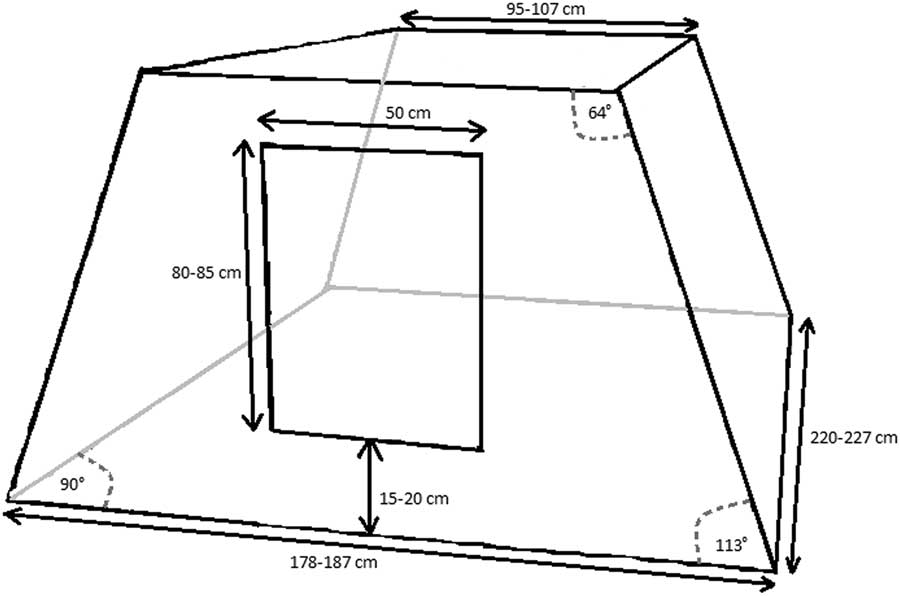
After relocation to the farrowing field, sows were housed in standard, individual grass-covered farrowing paddocks with access to individual farrowing huts. Huts were insulated (40 to 45 mm flamingo in roof, sides and end walls) A-frame huts (Figure 1) with a ventilation window either through the roof (measuring 25×25 cm) or in the back (measuring 15×25, 16×34, 25×34 or 30×30 cm) and a sow entrance in the front. A fender was placed in front of all huts before farrowing and removed again after castration. The opening of the ventilation window and removal of the fender were according to herd routines. All huts were provided with straw before insertion of sows into the farrowing field. The amount of straw supplied before insertion and after farrowing depended on weather conditions (temperature and rainfall). Additional straw was supplied according to the individual stockman’s decision.
A sketch of the standard A-frame sow hut used in the current study.

When outdoor temperature increased above 15°C, a wallow was created in each farrowing paddock, as required according to the Danish legislation. In late autumn and during winter, curtains were placed in the sow entrance of each hut.
In all herds, the farrowing huts were relocated within the paddock between farrowing batches. After the hut was moved to its new location, the remaining bedding was burned.
Study design
This was an observational study comprising seven farrowing batches of 30 farrowings in each of four herds (herd A to D), and five batches in the fifth herd (herd E). At herd E, batch one consisted of 30 farrowings, batch two and three of 10 farrowings and batch four and five of 20 farrowings.
Within herds A to D there were 8 weeks between farrowing batches, whereas in herd E data collection was distributed between two farrowing fields, thus there were ~4 weeks between farrowing batches in this herd.
Data collection
Environmental recordings
At the initiation of the study, each herd was visited, and a logger rack (Supplementary Figure S1) was placed in the north-eastern or north-western corner of each hut. The rack was made by an 18-cm long, triangular and hollow plastic tube. The tube was filled with PU SKUM (polyurethane foam sealant) (SAM Partner A/S, Kolding, Denmark) to lower the conduction of heat/cold to/from the hut wall. Furthermore, the logger was placed about 5 mm into a 15-mm thick layer of backing foam upon the tube. Above the data logger, a steel grid was mounted to protect against damage. The logger was not in direct contact with the steel grid. The logger rack was glued to the hut wall 55 cm above the ground. One data logger, in a rack facing north-east, was placed outside in the farrowing field 55 cm above the ground.
During the study, each herd was visited about a week before the expected farrowing of each batch. A data logger (Hygrochron™ iButton (DS1923), Maxim Integrated Products, Inc., San Jose, CA, USA) was then placed inside each hut in the logger rack and left until weaning.
The loggers recorded temperature and humidity every 10th min from 1 to 7 days before and until 7 days after expected farrowing. Loggers recorded data at a low resolution (accuracy: ±0.5°C and ±0.6% relative humidity (RH)).
The daily (24 h) average (DA) of the 10% highest values for the ambient temperature (T) and RH and correspondingly the DA of the 10% lowest T and RH were calculated for each farrowing on the day of farrowing (day 0, the 24 h leading up to 1200 h (midday) on the day piglets were observed in the nest) and the 1st day postpartum (day 1). Hereafter, both T and RH were converted to categorical values.
With respect to stillborn piglets, the main cause of stillbirth was expected to be high temperatures causing hyperthermia in sows and so three T categories were created ‘lowst’: T⩽22°C; ‘medst’ 22°C<T<27°C; and ‘highst’ T⩾27°C. These categories were based on the UCT for sows being 25°C to 27°C for lactating sows under indoor conditions (Prunier et al., Reference Prunier, de Bragança and Le Dividich1997; Quiniou and Noblet, Reference Quiniou and Noblet1999).
For liveborn mortality, both high and low temperatures were expected to influence mortality. Five temperature categories were made representing both critical values for low and high temperatures: ‘lowlb’: T⩽5°C; ‘lomlb’ 5°C<T<11°C; ‘medlb’ 11°C⩽T<22°C; ‘himlb’: 22°C⩽T<27°C; and ‘highlb’: T⩾27°C. The choice of the lower temperature categories was based on the knowledge about temperature span between the surroundings and the farrowing nest (Algers and Jensen, Reference Algers and Jensen1990). This suggests the nest temperature may be around 25°C warmer than the surroundings at low ambient temperatures, under semi-natural conditions. Thus, temperatures below 5°C measured above the nest would represent the lower extreme under Danish weather conditions.
In addition, two categories for RH were made: ‘normal’: RH<100% or ‘high’: RH=100% (the level of condensation). When humidity reached 100%, the evaporation of placental fluids was expected to be prolonged, and thus newly born piglets may have increased risk of hypothermia due to prolonged period of drying up (Baxter et al., Reference Baxter, Jarvis, Sherwood, Robson, Ormandy, Farish, Smurthwaite, Roehe, Lawrence and Edwards2009). In addition, when water condensed, it started dripping into the straw from the roof and sides of the hut thereby wetting the straw and affecting the piglets’ ability to uphold a sufficient body temperature. Furthermore, at high T, a high RH was expected to reduce the efficiency of evaporative cooling in the sows. Relative humidity category ‘high’ was however rare in the higher T categories (n=4 observations when T ‘highlb’, n=4 when T ‘himlb’, n=8 when T ‘medlb’), making it impossible to investigate an interaction between RH and T with the current data set.
Sudden and large fluctuations in T could be as important as the actual temperature for the thermal comfort of sows and piglets. Therefore, a variable describing hut T fluctuations was made. In the analysis of stillborn piglets, the difference between DA of the 10% highest T on day 1 prepartum (day -1) and day 0 was calculated (T diff,1−0=T 10% (day -1)−T 10% (day 0)). These days were chosen as sudden increases in T were expected to reduce sows’ ability to cope with high T and may thus affect the risk of stillbirths. In the analysis of liveborn mortality, the difference in the DA of the 10% highest T between days 0 and 1 was also calculated (T diff,0−1=T 10% (day 0)−T 10% (day 1)).
The diurnal span in temperature for days 0 and 1 was also calculated as the difference between the DA of the 10% highest T and the DA of the 10% lowest T values (T diff=T highest−T lowest). T diff was categorised into four based on its quartiles.
Recording of production results
All producers recorded production results and information about each sow in a booklet: sow parity, number of liveborn piglets, number of stillborn piglets, number of piglets euthanized at first inspection, number of piglets added to or removed from the litter at first inspection, number of piglets alive at castration and piglets weaned.
Data editing
All herds contributed with data for the analyses of stillborn piglets, and 646 farrowings were included. Herd A to D contributed with data to the analyses of liveborn deaths until castration (only litters where castration was performed on day 2 to 7 postpartum were included), and 568 farrowings were included.
Farrowings lacking production records were excluded from the analyses (84 excluded from the analyses of stillborn piglets and 162 excluded from the analyses of liveborn deaths). Furthermore, sows that had 10 or more piglets added to their litter were excluded as these sows were most likely used as nurse sows.
A total of 17 sows were recorded with two farrowings during the study period. Before final analysis, a sensitivity analysis was made by removal of the second farrowing for these sows. This did not change any results and therefore the litter in contrast to the sow was used as a statistical unit.
Statistical analyses
All statistical analyses were conducted with SAS (SAS 9.3; SAS Institute Inc., Cary, NC, USA). The effect of parity was included in the models as follows: sows in their first parity were assigned to parity group 1; sows in their second to fourth parity were assigned to parity group 2; sows in their later parities were assigned to parity group 3. The mean-centred count of total born piglets (litter size at farrowing (LF)) and quadratic of LF (LF2) were used to adjust for the effect of litter size in the analyses.
Effect of year variation on hut climate
The effect of year variation on the farrowing hut climate was analysed using linear mixed models:
 $$Y_{{ij}} {\equals}V_{i} {\plus}\vartheta _{j} {\plus}{\varepsilon}_{{ij}} $$
where V refers to year variation (i=1, 2, 3 and 4 indicating spring (March, April and May), summer (June, July and August), autumn (September, October and November) and winter (December, January and February)), ϑ is a normal distributed random effect to account for repeated measures (index j) at herd level (h=1, 2, 3, 4 and 5) and ε refers to the normal distributed residual error. The continuous values for the DA of the 10% highest and the 10% lowest T and RH, and T diff and RHdiff for both days 0 and 1 were used as response variables (Y).
Stillborn piglets
First, the effect of year variation on the proportion of stillborn piglets was investigated by use of the following binomial generalised linear mixed model, omitting dispersion and random effect parameters from the formula:
 $$\eqalign{{\rm logit}({\rm \pi }) {\equals}\beta _{0} {\plus}\beta _{1} {\rm LF}{\plus}\beta _{2} {\rm Spr}{\plus}\beta _{3} {\rm Sum}{\plus}\beta _{4} {\rm Aut}\cr \quad {\plus}\mathop \sum\limits_{i{\equals}1}^2 \alpha _{i} {\rm Parity}_{i} $$
β 0 refers to the intercept for the combination: year variation in winter and parity group 3. β 1 is the parameter describing the effect of LF. Spr, Sum and Aut are indicator functions (implying these sum to 0 (if year variation is in winter) or 1 (if year variation in Spr, Sum or Aut)). β 2–4 describe the effect of Spr, Sum, Aut in relation to the reference, winter. α 1 and α 2 describe the effect of parity group 1 and 2 in relation to the reference (parity group 3). Parity1 and Parity2 are indicator functions. The herd was included as a random effect. In the full model, LF2 was also included; however, this parameter was removed by backward model reduction of statistically non-significant effects (P>0.05).
For the analysis of the effect of hut climate on the proportion of stillborn piglets, only climate variables for days -1 and 0 were considered. Winter had a lower proportion of stillbirths compared with the remaining three seasons and was consequently analysed separately (model 3). As the categories ‘medst’ and ‘highst’ did not occur during winter, new categories were created: ‘lowst’: T⩽5°C; ‘medst’ 5°C <T⩽21°C. Data from spring, summer and autumn were merged and analysed by use of the original categories (‘lowst’ T⩽22°C; ‘medst’ 22°C<T<27°C; ‘highst’ T⩾27°C) (model 4).
For both analyses, a binomial generalised linear mixed model was used including herd as a random effect:
 $${\rm logit}\left( {\rm \pi } \right){\equals}\beta _{0} {\plus}\beta _{1} {\rm LF}{\plus}\beta _{2} T_{{{\rm diff},1{\minus}0}} {\plus}\mathop \sum\limits_{i{\equals}1}^2 \alpha _{i} {\rm Parity}_{i} $$
β 0 refers to Parity group 3, β 1 is the parameter describing the effect of LF and β 2 describes the effect of T diff,1−0. α 1 and α 2 describe the effect of parity group 1 and 2 in relation to the reference (parity group 3) and are indicator functions. LF2, T, RH and T diff were not statistically significant, and so these parameters were not included in the final model (3).
Below model 4, used for the analysis of hut climate in the merged warm part of the year (spr, sum and aut), is shown:
 $${\rm logit}\left( {\rm \pi } \right){\equals}\beta _{0} {\plus}\beta _{1} {\rm LF}{\plus}\mathop \sum\limits_{i{\equals}1}^2 \alpha _{i} {\rm Parity}_{i} {\plus}\mathop \sum\limits_{j{\equals}1}^4 \gamma _{j} T_{j} $$
β 0 refers to the intercept for the combination parity group 3 and T category 5 (‘high’). β 1 is the parameter describing the effect of LF. α 1 and α 2 describe the effect of parity group 1 and 2 in relation to the reference (parity group 3). Parity1 and Parity2 are indicator functions. γ 1–4 describe the effect of T category ‘lowst’, ‘lomst’, ‘medst’ and ‘himst’ in relation to T category ‘highst’. T 1–4 are indicator functions. LF2, RH, T diff,1−0 and T diff were removed from this model (4) by backward elimination of statistically non-significant parameters.
Mortality of liveborn piglets until castration
To account for the variation in days until castration between litters, the effect of year variation on postnatal mortality until castration was investigated using a negative binomial generalised linear mixed model. The response variable was the number of liveborn piglets that died before castration. As for the analyses of stillborn piglets, herd was included as random effect. Parity was included in the initial model, but was not statistically significant and is not included in the final model (5):
 $${\rm log}\left( \mu \right){\equals}{\rm log}\left[ L \right]{\plus}\beta _{0} {\plus}\beta _{1} {\rm LF}{\plus}\beta _{2} {\rm LF}^{2} {\plus}\beta _{3} {\rm Spr}{\plus}\beta _{4} {\rm Sum}{\plus}\beta _{5} {\rm Aut}$$
where log[L] is the log-offset of number of liveborn piglets times days until castration (L days at risk). β 0 refers to the intercept for year variation in winter. β 1 is the parameter describing the effect of LF and β 2 describes the effect of LF2. β 3–5 are the parameters describing the effect of year variation. Spr, Sum and Aut are again included as indicator functions, and β 3–5 describe the effect of Spr, Sum, Aut in relation to winter.
Again, an effect of year variation was found, and so for the analyses of the effect of hut climate variables on liveborn mortality, data were split into data from spring (model 6) and data from winter, summer and autumn (model 6). A negative binomial generalised linear mixed model was used for both. The random effect of the herd was omitted in the analysis of the data from spring as it was so small that the procedure set it to zero. In the analysis of the merged winter, summer and spring data, the herd was included as a random effect in the model:
 $${\rm log}\left( \mu \right){\equals}{\rm log}\left[ L \right]{\plus}\beta _{0} {\plus}\beta _{1} {\rm LF}$$
where log[L] is the log-offset of days at risk (L), β 0 refers to the intercept and β 1 is the parameter describing the effect of LF. No effects were found for LF2, RH, T, T diff,0−1 and T diff and so these variables were removed by backward elimination of statistically non-significant effects.
Results
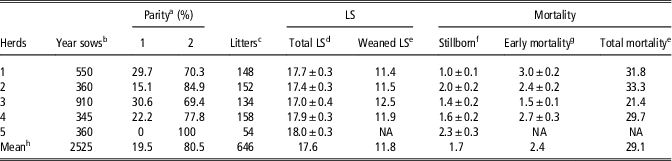
The median number of total born piglets during the study period was 18 (range 5 to 29) (n=646 farrowings) of which one (median, range 0 to 20) was stillborn. At castration, two (median, range 0 to 21) (n=568 farrowings) of the liveborn piglets had died. Informations regarding each herd can be found in Table 1.
Descriptive information about the five pig-producing herds

LS=litter size.
a Percentages of sows included in the analysis of year variation in stillbirth. Grouped according to parity where 1=first parity sows and 2=multiparous sows.
b Number of productive sows per year.
c Total number of litters included in the analysis of year variation in stillbirth.
d Average number of total born piglets per litter (±standard error).
e Weaned herd LS and total mortality (in%) after Rangstrup-Christensen et al. (Reference Rangstrup-Christensen, Schild, Pedersen and Sørensen2018).
f Average number of stillborn piglets (±standard error) per litter.
g Average number of liveborn piglets dying before castration (±standard error).
h Year sows and litters are given as totals.
Effect of year variation on hut climate
As can be seen in Table 2, year variation significantly affected hut climate both on days 0 and 1. Year variation influenced the DA of the 10% lowest and highest temperatures recorded both on day 0 (F 3,661=260.9, P<0.001 and F 3,657=239.2, P<0.001 for the lowest and highest temperatures, respectively) and 1 (F 3,549=288.5, P<0.001 and F 3,549=187.7, P<0.001 respectively, for the lowest and highest temperatures). The highest temperatures were recorded in summer (24.2±0.5°C and 25.2±0.3°C for days 0 and 1, respectively) and the lowest in winter (2.7±0.5°C and 6.1±0.4°C for days 0 and 1, respectively). T diff was also affected by year variation on both days 0 (F 3,657=43.3, P<0.001) and 1 (F 3,549=71.1, P<0.001). T diff was largest in summer (10.5±0.3°C and 8.8±0.3°C for days 0 and 1, respectively) and spring (10.5±0.3°C and 9.3±0.3°C for days 0 and 1, respectively) and lowest during winter (6.3±0.4°C and 5.8±0.4°C, respectively, for days 0 and 1).
The influence of year variation (summer, autumn, winter and spring) on the daily average of the 10% highest sow farrowing hut temperatures (T top10) and relative humidity (RHtop10) and correspondingly the daily average of the 10% lowest sow hut temperatures (T bot10) and relative humidity (RHbot10)

T diff is the difference between T top10 and T bot10. Day 0 refers to the day of farrowing and day 1 to day 1 postpartum. Least square means±standard error are given for each variable within each combination of season and day.
a,b,c,dSignificant differences (P<0.05) within row for each day.
*** P<0.001.
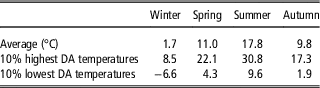
Descriptive values of the outdoor temperature recordings made in the farrowing fields can be found in Table 3.
Outdoor temperatures for unshaded loggers placed outside the hut

DA=daily average.
Recordings from all five pig-producing herds are included for winter (December to February), spring (March to May), summer (June to August) and autumn (September to November).
Stillborn piglets
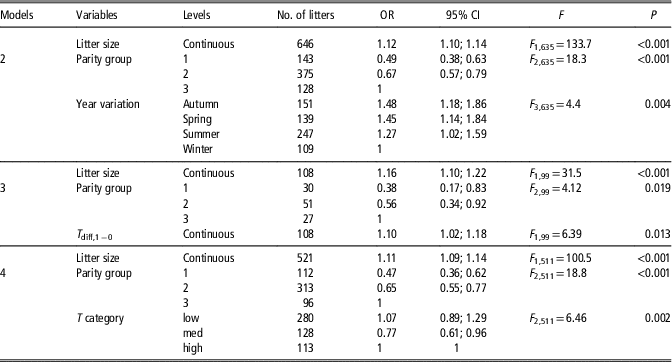
Year variation affected the risk of stillborn piglets (F 3,635=4.4, P=0.004, model 2), in that the risk was lowest in winter compared with the remaining part of the year (Table 4). In winter, T diff,1−0 affected the rate of stillbirths (F 1,99=6.39, P=0.013, model 3) with a one unit increase in T diff,1−0 increasing the odds of stillborn piglets by 10%, corresponding to an OR of 1.1. During winter, T diff,1−0 had a median of −1.9°C (range −9.3°C to 7.5°C).
Summary of the output from the final models of stillborn piglets

OR=odds ratio; CI=confidence intervals.
First output is from the final model 2 (effect of year variation), second output is from the final model 3 (effect of hut climate during winter) and third output is from the final model 4 (effect of hut climate during the remaining three seasons).
‘Parity group’ ‘1’ included sows in their first parity, ‘2’ sows in their second, third and fourth parity, ‘3’ sows in their later parities; ‘Year variation’ refers to the part of the year in which the farrowing occurred (autumn: September, October and November; spring: March, April and May; summer: June, July and August; winter: December, January and February). ‘T diff,1−0’ is the difference in the daily average of the 10% highest temperatures between day 1 prepartum and the day of farrowing; ‘T category’ refers to the temperature (T) on the day of farrowing, ‘low’ T⩽21°C; ‘med’ T=22°C to 26°C; ‘high’ T⩾27°C.
OR for each variable (and level) with corresponding 95% CI, F and P values are presented for the overall effect of each variable.
In the remaining part of the year, T category affected the risk of stillbirths (F 2,511=6.46, P=0.002, model 4). Farrowings on days with T in category ‘highst’ had a higher risk of stillbirths compared with farrowing days with temperatures in category ‘medst’. There was a 30% increased risk of stillbirths in category ‘highst’ compared with category ‘medst’, corresponding to an OR of 0.77 CI [0.60, 0.99]).
No significant effects of RH category or T diff were found. Across the year, T diff had a median of 8.4°C (range 0°C to 28.5°C).
Mortality of liveborn piglets until castration
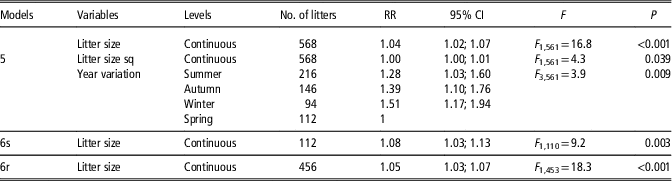
The median number of days until castration was 5 (range 3 to 8). There was an effect of year variation (F 3,561=3.9, P=0.009, model 5) with spring having a lower rate of postnatal mortality compared with the remaining part of the year (Table 5). With respect to the impact of hut climate, no significant effects of T or RH category, T diff,0−1 or T diff were found for mortality of liveborn piglets. T diff,0−1 had a median of −0.8°C (range −11.6°C to 14.5°C) and T diff a median of 6.8°C (range 0.0°C to 29.7°C).
Summary of the output from the final models of liveborn piglets that were found dead before the time of castration

RR=rate ratio; CI=confidence intervals.
First output is from the final model 5 (effect of year variation); second output (6s) is from the final model 6 for the effect of hut climate in spring and the third output (6r) is from the final model 6 for effect of hut climate in the remaining three seasons.
‘Litter size sq’ refers to the square of the mean-centred litter size; ‘Year variation’, the part of the year in which the farrowing occurred (autumn: September, October and November; spring: March, April and May; summer: June, July and August; winter: December, January and February).
RR for each variable (and level) with corresponding 95% CI, F and P values are presented for the overall effect of each variable.
Discussion
Stillborn piglets
The risk of stillborn piglets was lowest in winter, which is in accordance with Rangstrup-Christensen et al. (Reference Rangstrup-Christensen, Krogh, Pedersen and Sørensen2016) who found a lower risk of stillborn piglets during winter compared with summer (May to August). Still, a larger data set involving recordings across at least 4 years is needed in order to confirm a seasonal fluctuation in the rate of stillbirths. During summer, it was expected that a high T would increase the sows’ risk of hyperthermia resulting in more stillborn piglets (Vanderhaeghe et al., Reference Vanderhaeghe, Dewulf, Ribbens, de Kruif and Maes2010). In accordance, an effect of T was found. The risk of stillbirths was increased at high compared with middle-high temperatures, suggesting sows were heat stressed at high hut T. In category ‘highst’, T was ⩾27°C whereas the middle-high (‘medst’) category was for T between 22°C and 26°C, corresponding to the UCT measured for sows under indoor confined conditions (Quiniou and Noblet, Reference Quiniou and Noblet1999). The current results could, therefore, indicate a higher UCT for outdoor sows, which is likely due to the improved possibility for thermoregulation outdoors; however, more detailed animal level recordings are required to confirm this hypothesis. In particular, evaporative cooling is an important mean for thermoregulation in the pig (Lucas et al., Reference Lucas, Randall and Meneses2000; Vanderhaeghe et al., Reference Vanderhaeghe, Dewulf, Ribbens, de Kruif and Maes2010) and Vanderhaeghe et al. (Reference Vanderhaeghe, Dewulf, Ribbens, de Kruif and Maes2010) found fewer stillbirths in confined sows that were showered before parturition. The sows in the current study had the opportunity to regulate their body temperature through behaviour – for instance through wallowing. It is therefore likely that the problem with increased temperatures is not as great outdoors as for crated sows. It may first arise at higher temperatures than the UCT recorded in crated sows. In addition, hyperthermia may mainly occur during periods where sows are bound to the nest such as during farrowing. Our results suggest that initiatives for reducing hut temperature around farrowing in outdoor production may increase piglet survival.
It was expected that high farrowing hut humidity would decrease the effectiveness of evaporative cooling in hot periods, thereby increasing the risk of hyperthermia and consequently also stillbirths. However, this expectation could not be confirmed. A reason for the lack of effect of RH could be that sows may have remained outside the hut after wallowing. In addition, hut RH only rarely reached 100% in the warm periods likely due to the increased ventilation of the hut (open ventilation window and no curtain in front of the hut). This suggests that RH under outdoor conditions is not important to consider in relation to hyperthermia during summer in a temperate climate like that of Denmark. The mean hut humidity during summer was 90.1±0.4% (range 73.2% to 100%).
It was expected that sudden changes in hut temperature would reduce the sows’ ability to adapt to a high T thereby increasing the risk of hyperthermia, but this hypothesis was not confirmed. Nevertheless, during winter larger changes in T diff,1−0 increased the risk of stillbirths. Pigs may adapt when exposed to long-term high or low temperatures and have difficulties adjusting when the temperature suddenly changes. This may be part of the explanation for the effect of T diff,1−0. It remains unknown, however, why this effect was only seen during winter and why no effect of within-day temperature changes (T diff) was found.
In accordance with previous studies conducted both in outdoor production systems (KilBride et al., Reference KilBride, Mendl, Statham, Held, Harris, Cooper and Green2012; Rangstrup-Christensen et al., Reference Rangstrup-Christensen, Krogh, Pedersen and Sørensen2016) and in the indoor loose housing (KilBride et al., Reference KilBride, Mendl, Statham, Held, Harris, Cooper and Green2012; Hales et al., Reference Hales, Moustsen, Nielsen and Hansen2014), an increase in litter size was accompanied by more stillborn piglets. Furthermore, higher parities were also associated with more stillborn piglets. This may be caused by larger litter sizes in older sows, which corresponds with previous studies (Hales et al., Reference Hales, Moustsen, Nielsen and Hansen2014), but it may also be due to the weakening of high parity production sows.
Mortality of liveborn piglets until castration
Hypothermia is a known cause of piglet mortality (Pedersen et al., Reference Pedersen, Larsen and Malmkvist2011; Panzardi et al., Reference Panzardi, Bernardi, Mellagi, Bierhals, Bortolozzo and Wentz2013), and organic piglets are kept outdoors where the influence of the thermal climate is likely to be even more pronounced than in indoor systems. Hypothermia was therefore expected to be reflected in the piglet mortality by higher mortality during winter compared with the remaining part of the year as well as at a low T particularly if RH was high. This could not be confirmed by the current study.
In accordance with Randolph et al. (Reference Randolph, O’Gorman, Potter, Jones and Miller2005), no increase in liveborn deaths was found during winter in the current study. Contrary, Berger et al. (Reference Berger, Dagorn, Le Denmat, Quillient, Vaudelet and Signoret1997) showed increased mortality during autumn and winter but did not specify whether the farrowing huts studied were insulated or not. Randolph et al. (Reference Randolph, O’Gorman, Potter, Jones and Miller2005) showed that in uninsulated huts early mortality increases during winter and so the discrepancy between the study by Berger et al. (Reference Berger, Dagorn, Le Denmat, Quillient, Vaudelet and Signoret1997) and the current study could be differences in hut insulation. The DA of the 10% lowest temperatures inside the farrowing hut during winter was 4.6±0.5°C, whereas the DA of the 10% lowest outdoor temperatures was −6.6±0.8°C, indicating that hut insulation protected the animals against the more extreme T outside the hut and allowed sows to warm up the farrowing hut. In addition, all farrowing huts were supplied with plenty of straw during winter. The study by Algers and Jensen (Reference Algers and Jensen1990) showed that the temperature in a sow-built farrowing nest, composed mostly of straw, was on average 20.3°C. Temperature was recorded in 5 cm distance to the piglets and was reported not to be correlated with weather or ambient temperature. Thus, it is likely that in the current study nest temperature inside the farrowing hut was sufficiently high to prevent hypothermia. This is supported by Pedersen et al. (Reference Pedersen, Berg, Jorgensen and Andersen2016) who showed that a 30-cm layer of dry straw strongly reduced the immediate postpartum drop in rectal temperature under indoor conditions.
Daily average of the 10% highest hut humidity during winter was 96.3±0.5%. High humidity and low temperature were expected to prolong the evaporation of placental fluids, thereby increasing the risk of hypothermia (McGinnis et al., Reference McGinnis, Marple, Ganjam, Prince and Pritchett1981; Baxter et al., Reference Baxter, Jarvis, Sherwood, Robson, Ormandy, Farish, Smurthwaite, Roehe, Lawrence and Edwards2009). This could not be confirmed and may again be caused by the microclimate in the nest being sufficient for drying of piglets and prevention of hypothermia.
Mortality was lowest during spring. A more comprehensive data set is needed to confirm whether this was merely due to a random yearly fluctuation during the current study period or whether it reflects a seasonal pattern in outdoor liveborn mortality. The year variation seen could be due to the seasonal reproduction pattern in sows. Macchi et al. (Reference Macchi, Cucuzza, Badino, Odore, Re, Bevilacqua and Malfatti2010) found a seasonality in sow birth patterns with a peak in the spring related to the seasonality in the timing of oestrus hormones. Bassett et al. (Reference Bassett, Bray and Sharpe2001) showed seasonal changes in plasma luteinizing hormone and prolactin concentrations, suggesting a seasonal reproduction. These seasonal changes may be part of the reason for the reduction in stillbirths during winter and reduction in postnatal deaths during spring. Based on their results, Yun et al. (Reference Yun, Swan, Vienola, Farmer, Oliviero, Peltoniemi and Valros2013) suggested a positive correlation between circulating prolactin and oxytocin. Thus, the seasonal changes in prolactin may correlate with changes in oxytocin concentration affecting parturition. Oxytocin is well known for influencing the course of farrowing, and a low oxytocin level has been related to prolonged farrowings (Lawrence et al., Reference Lawrence, Petherick, McLean, Gilbert, Chapman and Russell1992; Oliviero et al., Reference Oliviero, Heinonen, Valros, Hälli and Peltoniemi2008), which may increase the risk of stillborn and weak-born piglets. In addition, in their review, Peltoniemi and Virolainen (Reference Peltoniemi and Virolainen2006) propose that the trend towards an increased weaning weight in piglets weaned from January to June (reported after Peltoniemi et al. (Reference Peltoniemi, Heinonen, Tuovinen, Saloniemi and Love1997) in Peltoniemi and Virolainen (Reference Peltoniemi and Virolainen2006)), and the seasonal changes in prolactin found by Bassett et al. (Reference Bassett, Bray and Sharpe2001) suggest a changed lactational performance of sows across the year. This could be part of why fewer postnatal deaths were seen during spring in the present study.
The current results showed litter size as a risk factor for liveborn mortality, which corresponds with previous findings (Pedersen et al., Reference Pedersen, Larsen and Malmkvist2011; Panzardi et al., Reference Panzardi, Bernardi, Mellagi, Bierhals, Bortolozzo and Wentz2013).
Conclusion
An increased risk of stillbirths was seen at high hut temperature during the warm part of the year. The lowest risk of stillbirths was seen in winter and the lowest rate of liveborn mortality in spring. This could be due to seasonality in hormones affecting parturition and lactation. In addition, the present results indicate that, in insulated farrowing huts and under careful management practices, sows are able to maintain a sufficient microclimate in the farrowing nest preventing hypothermia among piglets when hut temperature is low. Humidity did not appear to prevent evaporative cooling during summer or increase hypothermia in winter. Thus, humidity may not be relevant when considering piglet mortality in outdoor systems in a temperate climate.
Acknowledgements
The authors gratefully acknowledge the organic producers and their employees for their assistance; John Misa Obidah, Connie Hårbo Middelhede and Cecilie Kobek Thorsen for technical assistance. This work was funded as part of the VIPiglets project under the Organic RDD 2 programme, which is coordinated by International Centre for Research in Organic Food Systems (ICROFS). It has received grants, J.nr. 34009-13-0679, from the Green Growth and Development programme (GUDP) under the Danish Ministry of Food, Agriculture and Fisheries.
Declaration of interest
The authors have no conflicts of interest.
Ethics statement
Animal housing and handling complied with Danish legislation and the study conformed to the Guidelines for Ethical Treatment of Animals in Applied Animal Behaviour and Welfare Research by the ethics board of the International Society of Applied Ethology (Olsson et al., Reference Olsson, Whittaker, Martin, Peron, De Giorgio, Mejdell and VanVollenhoven2017).
Software and data repository resources
None of the data and models are deposited in an official repository.
Supplementary material
To view supplementary material for this article, please visit https://doi.org/10.1017/S175173111800201X