INTRODUCTION
Of the 17 syngnathid species known from the Mediterranean (Dawson, Reference Dawson, Whitehead, Bauchot, Hureau, Nielsen and Tortonese1986; Lourie et al., Reference Lourie, Vincent and Hall1999), seven have been recorded in Tunisian waters to date (Bradaï et al., Reference Bradaï, Quignard, Bouaïn, Jarboui, Ouannes-Ghorbel, Ben Abdallah, Zaouali and Ben Salem2004; Ben Amor et al., Reference Ben Amor, Ben Salem, Ben Souissi and Capapé2006, Reference Ben Amor, Ben Souissi, Ben Salem and Capapé2007a, Reference Ben Amor, Ben Salem, Ben Souissi and Capapéb, Reference Ben Amor, Ben Salem, Ben Souissi and Capapé2008a, Reference Ben Amor, Ben Salem, Ben Souissi and Capapéb): two seahorses, the short snouted seahorse Hippocampus hippocampus (Linnaeus, 1758) and the long-snouted seahorse Hippocampus ramulosus Leach, 1814; five pipefish, the straight-nosed pipefish Nerophis ophidion (Linnaeus, 1758), the black-striped piperfish Syngnathus abaster Risso, 1826, the greater pipefish S. acus Linnaeus, 1758, the deep- snouted pipefish S. typhle Linnaeus, 1758 and Nilsson's pipefish Syngnathus rostellatus Nilsson, 1855, which was first recorded in the Gulf of Tunis by Ben Amor et al. (Reference Ben Amor, Ben Salem, Ben Souissi and Capapé2008b).
The aim of this paper is to study length–weight relationships of four pipefish and two seahorses. Such relationships are important because they allow the estimation of condition in teleost species, the conversion of length to biomass, and to carry out comparisons of the condition of individuals of the same species caught in other marine areas. Additionally, they are useful to determine whether or not somatic growth is isometric, positively allometric, or negatively allometric.
MATERIALS AND METHODS
Between January 2000 and December 2007, sampling was carried out at fish landing sites located along the Tunisian coast and, in brackish lagoons such as Bizerte Lagoon, Tunis Southern Lagoon and Bahiret El Biban (Figure 1). Two seahorse species, Hippocampus hippocampus and H. ramulosus and four pipefish species, Syngnathus abaster, S. acus, S. typhle and Nerophis ophidion were collected monthly using trammel nets (mesh size 20 mm) and experimental mobile fishing gear (dredging) on seagrass beds of Posidonia oceanica and some algae species such as Caulerpa prolifera, C. racemosa, Cystoseira stricta, C. crinita and Rythiphlaea tinctoria.
(A) Map of the Mediterranean Sea showing map of Tunisia; (B) map of Tunisia showing the capture sites of syngnathid species in Tunisian waters: 1, Bizerte Lagoon (BL); 2, Tunis Northern Lagoon (TNL) and Tunis Southern Lagoon (TSL) separated by navigation channel (NC); 3, Bahiret El Biban (BB).

A total of 2424 specimens of these six different species of syngnathidae were collected and identified following field guides such as Dawson (Reference Dawson1982, Reference Dawson, Whitehead, Bauchot, Hureau, Nielsen and Tortonese1986) and Lourie et al. (Reference Lourie, Vincent and Hall1999). Sample sizes ranged from 14 Nerophis ophidion, to 1773 for Hippocampus ramulosus. Soon after captures, fresh specimens were studied in the laboratory. After identification, they were sorted by sex, measured to the nearest 1 mm (total length, TL) and weighed to the nearest 0.1 g (weight, W). Additionally, TL of seahorses is expressed as the sum of head length, trunk length and tail length, using a curved measurement of trunk length from the midcleithral ring to the last trunk ring (Lourie et al., Reference Lourie, Vincent and Hall1999).
The length–weight relationship for total body weight was fitted W = aL b (Ricker, Reference Ricker1973), where W is weight (expressed in grams), L is length (expressed in mm), a is the intercept and b is the slope (Beverton & Holt, Reference Beverton and Holt1996). The degree of association between the variables was computed by the coefficient of determination, r 2. The parameters a and b were estimated by linear regression using the log-transformed equation Log(W) = Log(a) + bLog(L). The significance of the regression was assessed by analysis of variance, and the Student's t-test was applied to verify whether the slope of the regression (constant ‘b’) differed significantly from 3.0, indicating the type of growth: isometric (b = 3.0), positive allometric (b > 3.0) or negative allometric (b < 3.0) (Spiegel, Reference Spiegel1991). In all cases, a significance level of 0.05 was adopted.
RESULTS AND DISCUSSION
Length–weight relationships of four pipefish and two seahorse species collected in Tunisian waters are given in Table 1. Relationships (linear regressions) were significant for all species, with r 2 values greater than 0.84. Estimated values of b were close to 3.0 (P > 0.05) for both Hippocampus hippocampus and H. ramulosus, indicating an isometric growth. The values of the exponent b were significantly (P < 0.05) higher than 3.0 for Nerophis ophidion exhibiting positive and allometric growth. The slopes for Syngnathus abaster, S. acus and S. typhle were also significantly different (P < 0.05), but lower than 3.0, reflecting a negative allometric growth. Differences observed among these species could, in part, be due to sampling, since only 14 N. ophidion were collected, compared to the much greater numbers of species of seahorses which are the most abundant syngnathid species in Tunisian waters (Ben Amor et al., Reference Ben Amor, Ben Salem, Ben Souissi and Capapé2008b). Hippocampus hippocampus and H. ramulosus both presented an isometric allometry. Additionally, no significant differences were found between them even though specimens of the latter species were collected in four different brackish areas, while the former was collected in a single one. By contrast, length–weight relationships of the three syngnathid species showed significant negative allometry, with these latter probably being more sensitive to unfavourable environmental conditions in restricted brackish areas.
Descriptive statistics and estimated parameters of length–weight relationship for six species collected from Tunisian waters.

N, sample size; SE, standard error; Range, minimum and maximum; a and b, parameters of the length–weight relationship; r 2, coefficient of determination; Mean TL, mean length in mm; Mean W, mean weight in g. *, P<0.05; ns, P > 0.05.
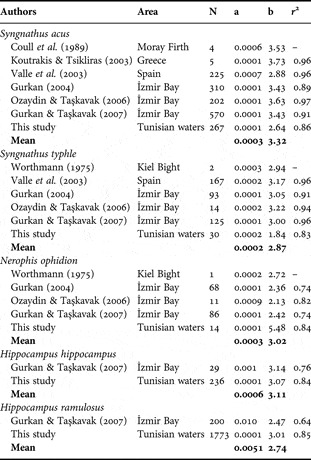
Studies conducted in other Mediterranean areas reported values ranging from 2.88 to 3.73 for Syngnathus acus, and from 2.94 to 3.22 for S. typhle, that are higher than those recorded for specimens from Tunisian waters, which were 2.64 for the former and 1.84 for the latter. These latitudinal differences could be due to sampling, but could also be associated to unfavourable environmental conditions in Tunisian waters. However, the higher value of b for N. ophidion than those from other areas suggests that the species probably finds favourable environmental conditions in Tunisian waters. Nevertheless, sampling effects cannot be neglected, but further observations are needed to confirm such a hypothesis. Our results showed that isometric allometries were recorded for both H. hippocampus and H. ramulosus. A similar pattern was observed by Gurkan & Taskavak (Reference Gurkan and Taskavak2007) for specimens from  zmir Bay, in Turkish waters. By contrast, there is a significant difference between the length–weight relationships for all pipefish and H. ramulosus of Tunisian waters and other sites. The length–weight relationship in fish can be affected by a number of factors including season, habitat, gonad maturity, sex, diet and stomach fullness, health and preservation techniques and differences in the length range of the specimen caught (Tesh, Reference Tesh and Ricke1971; Wootton, Reference Wootton1998). This difference in length–weight relationships between this and other studies could potentially be attributed to the combination of one or more of the factors cited above (Table 2).
Comparison between available studies on length–weight relationship for Syngnathus acus, S. typhle, Nerophis ophidion, Hippocampus hippocampus and H. ramulosus in other Mediterranean areas.

N, sample size; a and b, parameters of the length–weight relationship; r 2, coefficient of determination.