The global coronavirus disease 2019 (COVID-19) pandemic, first reported as cases of pneumonia of unknown etiology in Wuhan, China on December 31, 2019, had become a major public health burden and significantly influenced the delivery of health care. Reference Amin, Sharif and Saeed1 Compared with severe acute respiratory syndrome (SARS), the COVID-19 seemed to be more readily transmitted from human to human. On January 30, 2020, the International Health Regulations Emergency Committee declared the COVID-19 outbreak a Public Health Emergency of International Concern. This brings the cumulative numbers to over 88 million reported cases and over 1.9 million deaths globally as of January 10, 2021 according the World Health Organization. 2 As of today, a total of 980 patients with novel coronavirus have been confirmed in Xinjiang, China. Despite the development and administration of vaccines, sporadic cases of COVID-19 are still reported in China, and COVID-19 is still rampant in many countries and regions with the constant change of the epidemic situation around the world, putting great pressure on health-care services.
Pharmacists have been consistently working on the frontline during this pandemic, especially hospital pharmacists, continuing their vital role in supplying medicines and caring for the health needs of patients. Reference Johnston, O’Reilly and Cooper3 Hospital pharmacists have made a significant contribution in supporting hospitals and health-care organizations in planning for the worst case scenario, providing pharmacy operations, drug supply and distribution, drug information, health education, direct patient care advice on supply and product substitutions, collaboration and communication, medication advice and guidance, training, and virus detecting. Reference Karasneh, Al-Azzam and Muflih4 Research had shown that there were clear benefits to pharmacists’ involvement in patient care, clinical teams, and planning before and during disasters, especially when medications were being considered. Reference Aburas and Alshammari5 Therefore, it was of great importance for public health to ensure that pharmacists, especially hospital pharmacists, had a competent knowledge of transmission, prevention, and treatment of the virus.
Outbreaks and epidemics of COVID-19 may result from its high infectivity, lethality, and unpredictability. However, there were currently no drugs that specifically treat COVID-19. Reference Chen, Wang and Zhu6 The COVID-19 pandemic had not only significantly affected our community, society, country, and the whole world, but had also been responsible for adverse psychological impacts on health professionals. The COVID-19 pandemic increases depression, anxiety, distress, and insomnia problems of the global population, particularly health professionals. Reference Wu, Jia and Shi7 In addition, the epidemic of atypical pneumonia in China in 2003 might have residual effects on the Chinese population. Reference Main, Zhou and Ma8 The high work intensity and high risk of infection usually increased the psychological burden of health professionals, so that they were prone to anxiety, panic, depression, job burnout, sleep disorders, and other negative emotions. Reference Kochuvilayil and Fernandez9 The psychological distress of health professionals has attracted increasing attention. A meta-analysis of research on psychological distress included that the majority of work addressed nurses (45.7%) and physicians (25.0%) with all other health professionals, including pharmacists and other professional and technical personnel, accounting for only 29.3% of the studies. Reference Batra, Singh and Sharma10 In many surveys on the psychological distress of health professionals, there was no separate analysis on the psychological distress of pharmacists, only classified as second-line staff or medical technicians. Reference Li, Chen and Xu11
As an important part of the medical team, hospital pharmacists had also made great contributions to control of the epidemic, so their psychological distress should not be ignored, especially in the early stage of an epidemic when there was lack of infection prevention and control experience. The purpose of this study was (1) to investigate the knowledge of hospital pharmacists in Xinjiang on COVID-19 and explore its characteristics, so as to organize targeted training; (2) to investigate the influence of pandemic-associated distress and explore the influencing factors, so as to provide basis for psychological counseling.
Methods
This study was a cross-sectional survey study on-line. Considering the high infectivity of COVID-19, the popularity of WeChat in China and the feasibility of electronic questionnaires, a professional online questionnaire platform powered by www.wjx.cn was used in answering the paperless survey. The survey was started on February 23, aimed at pharmacists working in medical institutions in Xinjiang, China. At that time, approximately 2 wk had passed since the Xinjiang government of China officially declared a state of emergency. The invited participants were pharmacists working in different hospitals in Xinjiang, regardless of their hospital level or whether they were on duty at that time. According to scale, scientific research, talents, medical technology, hardware equipment, and so on, hospitals were officially graded and Class-A Grade-3 hospitals were top level in China. The participants included pharmacists who graduated from the pharmacy major of vocational colleges and had passed the national unified qualification examination and registered in China, but for some reason did not have university training. A total of 365 valid questionnaires were collected, a response rate of 68.7% from among the 100% sample of surveyed hospital pharmacists in Xinjiang. All participants gave informed consent and participated of their own accord. The questionnaire was completed by the respondents in an anonymous manner. Participants were asked to complete questionnaires on basic demographics, COVID-19 knowledge, and psychological assessment. All items were required to be answered before submission. A mobile Internet protocol address (WeChat account) was allowed to provide only 1 response to avoid duplication. A professional psychologist participated in the whole process of this research and assisted in interpreting the World Health Organization’s (WHO) Self-Reporting Questionnaire (SRQ-20) results.
Questionnaire
The questionnaire consisted of 4 sections and started with informed consent. All participants were provided with an informed consent form before the follow-up questionnaire, and they had the right to withdraw at any time. The first section was about the general demographic survey, including sex, age, hospital level, education, professional title, income, history of mental illness, contact with fever patients or suspected cases, home or hospital quarantine; the second part was about the knowledge of COVID-19. As COVID-19 was a new disease and there was no validated instrument for it, we wrote the section according to the latest diagnosis and treatment protocol and expert consensus: Diagnosis & Treatment Protocol for COVID-19 (Revision of Trial Version V) released by the National Health Commission of the People’s Republic of China, COVID-19 Infection: Expert Consensus on Hospital Pharmacy Guidance and Prevention and Control Strategies (First Edition) prepared by the Chinese Pharmaceutical Association, Corpus of COVID-19 Diagnosis and Treatment Protocols and Therapeutic Drugs (First Edition) prepared by the Hunan Pharmaceutical Association, and it was adopted after being reviewed and revised by 2 senior professional pharmacists, covering the access to professional knowledge, the way of virus transmission, the clinical characteristics of disease, the drug treatment protocols and precautions, and the discharge standards.
The third part was the SRQ-20 scale, which was first introduced as assessing depression, anxiety, physical discomfort, and other common psychological reactions, a total of 20 items. In the abstract, “psychological distress” was measured through the SRQ-20 scale. Reference Amin, Sharif and Saeed1,12,Reference Harpham, Reichenheim and Oser13 The SRQ-20 test method is simple and efficient, and its reliability and validity have been comprehensively analyzed in the SRQ Instruction Manual issued by the WHO. 12 The sensitivity and specificity of the SRQ-20 were 83% and 80%, respectively, Reference Harpham, Reichenheim and Oser13 and the internal reliability and validity were excellent among Chinese residents. Reference J-bo and M-li14 The sum of the individual item scores was the total score of SRQ-20, which was 20. According to the research by Harpham et al and others, the score of 8 or above was used as cutoff to classify the participant, and a higher score indicated a more serious psychological distress. Reference Amin, Sharif and Saeed1,Reference Wu, Jia and Shi7,12,Reference Harpham, Reichenheim and Oser13
Statistical Analysis
The data from the online a cross-sectional survey were exported into Microsoft Office Excel and into IBM SPSS Statistics 21. Count data were expressed by frequency and percentage, measurement data were described by mean and standard deviation (x ± s). SRQ-20 score and related knowledge score were used as dependent variables, demographic characteristics (such as sex, age, monthly income, primary place of practice, etc.) were used as independent variables, and univariate binary logistic regression was used to screen out the variables with P < 0.05. Then, the filtered variables were used as independent variables, multivariate binary logistic regression models were used to analyze predictors of knowledge of COVID-19 and psychological distress. For multiple-choice questions with more answers, no score would be given if multiple answers or wrong answers were selected in the section of knowledge. Knowledge score greater than or equal to 6 points was defined as qualified, but not satisfied. Getting 60% of the total score was the minimum standard for qualification on tests after training of the latest updated guidelines about COVID-19 (now updated to the Eighth Edition) in Chinese hospitals. And we also defined cases with psychological distress when the SRQ-20 score was equal to or over 8. Reference Amin, Sharif and Saeed1,Reference Wu, Jia and Shi7,12
Results
Participant’s Demographics
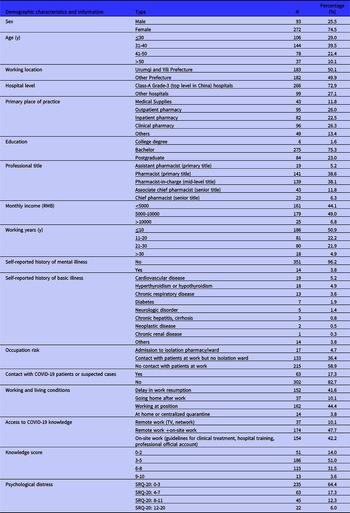
A total of 365 hospital pharmacists participated in the survey, including 74.5% of female and 25.5% of male; 71% of the respondents are aged 40 or below. The pharmacists from Urumqi and Yili Prefecture, the 2 regions with a relatively developed economy and the largest number of patients diagnosed with COVID-19, accounted for half of all participating pharmacists (50.1%). In the first quarter of 2020, there were 23 confirmed cases of COVID-19 in Urumqi, 32 in Yili, and 21 in other prefectures. More than half of the pharmacists worked in the prefecture with outbreaks (217; 59.5%), and most of them worked in outpatient dispensing (26.0%), inpatient dispensing (22.5%), and clinical pharmacy (26.3%) in hospitals. After the outbreak of COVID-19, due to the close-off management and “restriction” required by the government, nearly half of the pharmacists whose homes were not located in the same community as the hospital they worked in were detained and could not go home (44.4%); a small number of pharmacists were at home or centralized quarantine (3.8%); where temporary hospitals or quarantine hotels were retrofitted for the treatment and isolation of suspected cases (see Table 1).
Demographic characteristics and information for COVID-19 of hospital pharmacists (N = 365) in Xinjiang, China

Abbreviation: RMB, Renminbi, China’s legal currency.
Pharmacists’ Knowledge of COVID-19
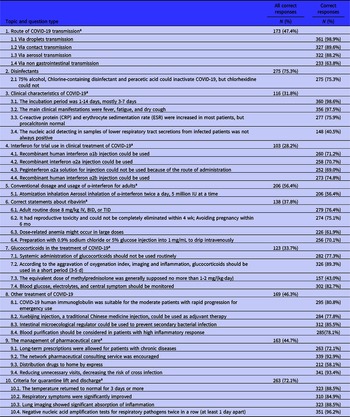
A total of 128 pharmacists (35.1%) correctly answered at least 60% of COVID-19 knowledge items correctly. The accuracy rates of the criteria for quarantine lift and discharge, disinfectant use, and interferon were relatively high, according to basic knowledge of COVID-19 consensuses/guidelines. The detailed results are shown in Table 2.
COVID-19 knowledge among hospital pharmacists (N = 365) in Xinjiang, China

a Multiple-choice questions: score would be given if all answers were selected right.
Abbreviations: BID, twice a day; IV, intravenously; TID, three times a day.
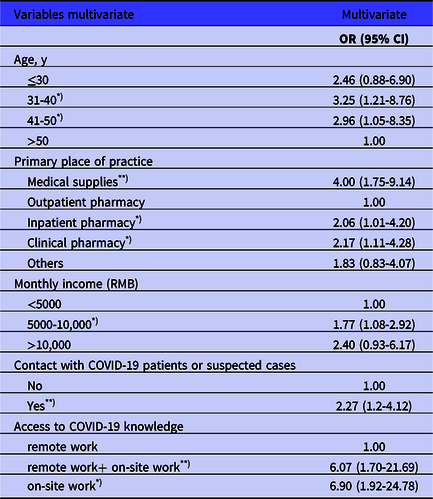
The univariate binary logistic regression analysis, with demographic characteristics as an independent variable, showed that high knowledge scores (≥6) were correlated with age, primary place of practice, monthly income (Renminbi [RMB]), contact with COVID-19 patients or suspected cases, and access to COVID-19 knowledge. Then, results of the multiple logistic analysis, with the screened variables used as independent variables, showed several statistically significant predictors of high knowledge score (≥6); see Table 3: (1) age: 31-40 y (odds ratio [OR] = 3.25; P < 0.05), 41-50 y (OR = 2.96; P < 0.05) versus >50 y (referent); (2) primary place of practice in hospitals: drug supply (OR = 4.00; P < 0.01), inpatient pharmacy (OR = 2.06; P < 0.01), clinical pharmacy (OR = 2.17; P < 0.05) versus outpatient pharmacy (referent); (3) monthly income (RMB): 5000-10,000 (OR = 1.77, P < 0.05) versus < 5000 (referent); (4) contact with COVID-19 patients or suspected cases (OR = 2.27; P < 0.01); (5) access to COVID-19 knowledge remote work+ on-site work (OR = 6.07; P < 0.05), single on-site work (OR = 6.90; P < 0.01) versus remote work (referent) were related to better knowledge of COVID-19.
Factors associated with knowledge via logistic regression analysis during COVID-19 period for hospital pharmacists (N = 365) in Xinjiang, China

* P < 0.05.
** P < 0.01.
Regarding the primary outcome, the presence of psychological distress, that measure depressive, anxiety, and somatic symptoms, 18.36% of pharmacists had a positive screening based on the SRQ-20 (see Table 1). The top 5 detected items of the SRQ-20 were: “easily frightened” (36.2%); “sleep badly” (32.3%); “feel unhappy” (30.1%); “feel nervous, tense, or worried” (23.8%); and “it difficult to enjoy your daily activities”(22.2%). The main fear was that the question number 17 of the SRQ 20 addresses suicidal ideation, and 7.1% of patients had a positive response to this item.
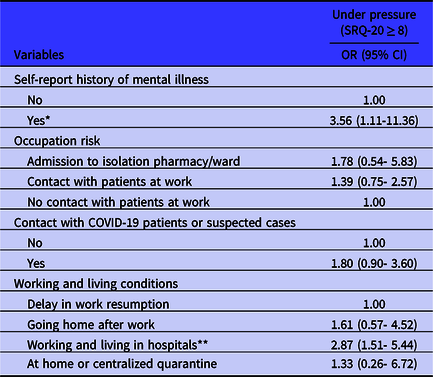
The univariate binary logistic regression analysis, with demographic characteristics as independent variables, indicated that psychological distress (SRQ-20 ≥ 8) were correlated with history of mental illness, occupation risk, and working and living conditions. Multivariable logistic regression analysis, with the screened variables as independent variables, showed that “Self-report history of mental illness” (OR = 3.56; 95% confidence interval [CI]: 1.11-11.36; P < 0.05), and “working and living in hospital” versus “delay in work resumption”(OR = 2.87; 95% CI: 1.51-5.44; P < 0.01) were more likely to produce psychological distress, see Table 4 for details.
Factors associated with overall mental health by means of logistic regression analysis during COVID-19 period for hospital pharmacists (N = 365) in Xinjiang, China

* P < 0.05.
** P < 0.01.
Discussion
The outbreak of novel coronavirus (COVID-19) first reported in Wuhan, China, triggered the global medical crisis. In this study, we evaluated the factors that affect pharmacists’ understanding of disease, with the aim to assess the hospital pharmacists’ knowledge of disease transmission, susceptibility, and drug therapy. We also described the overall psychological state of pharmacists during the pandemic in western China.
Pharmacists are front-line responders for COVID-19 patient care. As critical members of the multidisciplinary medical team, hospital pharmacists played a crucial role in the management of drug therapy for patients with COVID-19 during the outbreak. And they also played an active role in drug supply, medication consultation, and provision of drug information. Reference Zeenny, Ramia and Akiki15 In our study, hospital pharmacists got an average score of 4.73 ± 2.10 on the knowledge of COVID-19, a median score of 5, and only 128 (35.1%) scored ≥6. Pharmacists had a good knowledge of transmission routes, use of disinfectants and interferon, criteria for quarantine and discharge, with insufficiency knowledge of the clinical characteristics of the disease, the types of interferon, and the application details of glucocorticoids. In general, they had slightly weak knowledge preparation, similar to orthodontists, orthodontic residents, and nurses in China, most of whom only correctly answered less than half of the questions testing their actual level of knowledge. Reference Hua, Qin and Yan16 And an anonymous online survey sent out to 203 pharmacy students in high- and low-endemic areas of COVID-19 in China showed a medium level of knowledge of COVID-19. Reference Lv, Yuan and Hsieh17 Another reported an adequate level of knowledge about COVID-19, with no significant differences among the populations in Central China. However, Huynh et al. reported that 88.4% of participants had sufficient knowledge regarding COVID-19. Reference Huynh, Nguyen and Tran18 This finding may be related to right and wrong judgment questions and multiple-choice questions.
Multiple regression analysis showed COVID-19 knowledge was closely related to the age, work position, and monthly income of participating pharmacists, as well as their principal approach to access professional knowledge. Pharmacists aged 31-50 y had a significant advantage in knowledge score compared with those aged >50 y, the same as other research identified among Syrian residents and Ghanaians. Reference Al ahdab19,Reference Serwaa, Lamptey and Appiah20 It may be a result of different demands for specialized knowledge in work and life. In China, pharmacists aged from 31 to 50 y comprise the backbone of the department, and there was a higher demand for their professional knowledge. In addition, due to China’s gradually opening 2-child policy, the percentage of multiparous mothers and parturients who were ≥30 y old rose significantly, Reference Fan, Xiao and Zhang21 a considerable number of people in this age group have children at home, usually young children or infants, which are vulnerable to infection, Reference Dong, Mo and Hu22 so there was a positive need for protection. In the designated hospital for treatment of COVID-19 patients, the drug supply center and inpatient pharmacy needed to know the information of therapeutic drugs for COVID-19 in advance to ensure the drug supply.
In China, clinical pharmacists could monitor and evaluate medication therapy, provide dose adjustments, reduce multiple medical errors, and, therefore, had gradually been an essential part of health-care teams, Reference Wang, Kong and Xu23 with a more urgent demand for disease and drug therapy knowledge. In our participants, the mean knowledge score was significantly lower among lower monthly income levels. These results were similar to the results of a China and Egypt study, in which participants with high socioeconomic status were knowledgeable. Reference Zhong, Luo and Li24,Reference Abdelhafiz, Mohammed and Ibrahim25 Of note, 10.1% of pharmacists used social media as their main source for information, and 47.67% as one of their main sources. These findings were consistent with other studies, which reported that pharmacists included social media (33.0%), radio and television (27.0%), and newspapers and magazines (22.0%) to seek information on COVID-19. Reference Karasneh, Al-Azzam and Muflih4 Pharmacists should consult reliable sources to seek information regarding COVID-19. This is important as, in this global pandemic, there is also a pandemic of misinformation regarding COVID-19. Reference Saqlain, Munir and Rehman26 It is important that health-care authorities deliver clear and concise messaging of reliable COVID-19 knowledge and focus on dispelling misinformation for public, Reference Shafiq, Elharake and Malik27 especially for health professionals.
In this study, we found an 18.4% prevalence of psychological distress among pharmacists within nearly a month of detection of the first case of COVID-19 in Urumqi China, which means self-reported rates of psychological distress were high in investigated pharmacists. Liu et al., in September 2020, reported rates of anxiety symptoms, depression symptoms, and both were 13.3%, 18.4%, and 23.9%, respectively, among health professionals during the COVID-19 epidemic in China. Reference Liu, Chen and Zhang28 Another study reported that the rate of psychological distress was 15.9% among doctors and nurses from 31 provinces of mainland China during the COVID-19 epidemic. Reference Liu, Han and Jiang29 Pharmacists, as members of the medical team, were also facing psychological distress. It was worrying that 7.1% of pharmacists had thought of suicide; more attention should be given by the government and individual hospitals to this group.
Indeed, the COVID-19 pandemic increases the mental health problems of the global population, particularly health professionals. Reference Wu, Jia and Shi7 According to our current research, pharmacists who had to work and live in hospitals were more likely to develop psychological distress, which may be because, on the one hand, they worked long hours under great responsibility and pressure without rest; on the other hand, they by no means accompanied their relatives and had no proper entertainment. In addition, pharmacists who had contact with patients at work, dispensing medicine face to face, making pharmaceutical rounds of wards, providing drug information and pharmaceutical advice for patients, and so on, had their risk of infection increase significantly. Similar results have been obtained by a meta-analysis that there is a higher prevalence of anxiety and depression among front-line responders than second-line health-care workers. Reference Batra, Singh and Sharma10
History of mental illness was one of the most significant risks for psychological distress severity. In America and Italy, exacerbations of psychological distress had also been reported in patients with mental illness during the epidemic lockdown. Reference Tsai, Elbogen and Huang30,Reference Iasevoli, Fornaro and D’Urso31 A mix of factors contributed to this, including excessive fear of infection and increased economic hardship caused by lockdown, home isolation, and no social gathering. Reference Tsai, Elbogen and Huang30–Reference Saravanan, Mahmoud and Elshami32 Therefore, more attention should be paid to pharmacists with a history of mental illness, and psychological support should be provided to prevent exacerbation of psychological distress. In our study, contact with COVID-19 patients or suspected cases without significant difference in multiple logistic regression analysis, was inconsistent with the report of Kisely et al., Reference Kisely, Warren and McMahon33 which might relate to small sample size and availability of masks and other personal protective equipment. Reference Chou, Dana and Buckley34
This study was preliminary, and more research is needed to understand how a pandemic and other disasters impact the mental and psychological health of pharmacists and other health professionals. While our study did not address how to reduce the distress levels for these pharmacists or provide any timely feedback on their needs, fortunately the Xinjiang Health Committee set up a 24-h free mental health assistance line on January 31, 2020, at the beginning of the epidemic. Our study limitations include: it was a cross-sectional study using a 100% sampling frame. Because participation was voluntary, self-selection bias was possible, and availability of Internet might have influenced participation rate. Concern about anonymity being compromised with their responses being linked to them individually through WeChat and Internet protocol addresses might have also impacted participation.
Conclusions
The results from the current study demonstrated that only fewer than half (35.1%) of pharmacists were relatively fully and accurately knowledge-prepared, so it is necessary to provide further training for pharmacists. As specific pharmacist groups were prone to psychological distress, it was important for individual hospitals and government to consider and identify pharmacists’ needs and take steps to meet their needs with regard to pandemic and other work-related distress, during the epidemic period.
Acknowledgments
We thank all participants who gave their time to this research.
Author Contributions
Dongliang Yang: Conceptualization, Methodology, Investigation, Data curation, Writing—original draft. Xueying Ma: Investigation, Data curation, Formal analysis, Writing original draft as well as review & editing. Songnian Fu: Conceptualization, Methodology, Validation, Supervision. Jun Zhao: Conceptualization, Methodology, Supervision, Writing original draft as well as review and editing. Aizezijiang Aierken: Conceptualization, Validation, Investigation, Methodology. Liang Teng: Conceptualization, Methodology, Supervision, Project administration, Writing - review & editing. Xiaoli Gao: Conceptualization, Methodology, Investigation, Supervision, Project administration.
Declaration of Conflicting Interests
None