INTRODUCTION
Conservation practitioners and natural resource managers face an unprecedented challenge in planning and managing the local and regional effects of climate change. Examples of real-world adaptation planning are becoming more common (Roberts Reference Roberts2008; Charlton & Arnell Reference Charlton and Arnell2011), but more research and application are needed to improve interpretation of uncertainty and variability of climate models in the context of stakeholder decision-making (Lawler et al. Reference Lawler, Tear, Pyke, Shaw, Gonzalez, Kareiva, Hansen, Hannah, Klausmeyer, Aldous, Bienz and Pearsall2010). This is particularly acute in developing countries, where people's livelihoods tend to be more vulnerable to climate impacts but information is limited. Recently, there have been great strides made in providing tools and planning approaches useful for on-the-ground decision making. However, considerable work is still needed to understand how best to use currently available science for stakeholder-engaged natural resource climate adaptation planning.
Climate change information has become much more available to a broad audience of planners, and various stakeholder planning processes have been developed. Climate Wizard and similar tools translate general circulation models (also known as global climate models, GCMs) into synthesized information accessible to non-climate scientists for adaptation planning (Girvetz et al. Reference Girvetz, Zganjar, Raber, Maurer, Kareiva and Lawler2009). At the same time, several approaches to adaptation planning processes exist for decision making that are being modified for implementation through a climate change lens, including conservation action planning (Poiani et al. Reference Poiani, Goldman, Hobson, Hoekstra and Nelson2011), adaptation for conservation targets (Cross et al. Reference Cross, Zavaleta, Bachelet, Brooks, Enquist, Fleishman, Graumlich, Groves, Hannah, Hansen, Hayward, Koopman, Lawler, Malcolm, Nordgren, Petersen, Rowland, Scott, Shafer, Shaw and Tabor2012) and the open standards for conservation (Schwartz et al. Reference Schwartz, Deiner, Forrester, Grof-Tisza, Muir, Santos, Souza, Wilkerson and Zylberberg2012).
One of the places where these data and planning frameworks are needed is in the ecosystems of east Africa, where rich and charismatic biodiversity, as well as vulnerable people's livelihoods, are under threat from climate variability and change (Boko et al. Reference Boko, Niang, Nyong, Vogel, Githeko, Medany, Osman-Elasha, Tabo, Yanda, Parry, Canziani, Palutikof, van der Linden and Hanson2007). The Albertine Rift is one of the most important places for conservation in Africa. It includes forests, woodlands and freshwater systems that contain a host of diverse and endemic species (Plumptre et al. Reference Plumptre, Davenport, Behanyana, Kityo, Eilu, Ssegawa, Ewango, Meirte, Kahindo, Herremans, Peterhans, Pilgrim, Wilson, Languy and Moyer2007). Focusing on two biologically unique areas of Western Tanzania (Africa), this paper describes how publicly available science was used within a stakeholder engaged process to modify current conservation strategies in order to address three research questions. (1) What type and level of climate change information and scientific literature review is useful for climate adaptation planning? (2) What aspects of different adaptation planning processes are most useful for decision-making? (3) How do existing conservation strategies change and when are new strategies needed for adapting to future climate change impacts?
METHODS
Study area
This study focuses on the Greater Gombe Ecosystem (GGE) and Greater Mahale Ecosystem (GME) in the Albertine Rift on the western border of Tanzania with Lake Tanganyika. In these areas, people's livelihoods depend on the natural environment, and while most residents are agriculturalists and fisherfolk, they also depend heavily on the forests, woodlands and freshwater systems to provide food, water and shelter (Hess & Leisher Reference Hess and Leisher2011). This resource base is already stressed and degraded by overuse, with pressure on these natural systems increasing as population levels and poverty increase (Tanzania National Bureau of Statistics 2011).
Two of Tanzania's major rivers have recently been experiencing reduced flows due to declining regional rainfall, which has had ecological and economic impacts, such as water shortages, increased fungal and insect infestations, and decreased biodiversity (Orindi & Murray Reference Orindi and Murray2005). Over the past century, Lake Tanganyika has become warmer and more stratified (O'Reilly et al. Reference O'Reilly, Alin, Pilsnier, Cohen and McKee2003). Increased stratification has led to decreased net primary productivity, a decline in fish stocks, and changes in algal biomass, productivity and community composition (Tierney et al. Reference Tierney, Mayes, Meyer, Johnson, Swarzenski, Cohen and Russell2010). Assuming these impacts will continue due to increased temperatures, profound changes can be expected in nearshore habitat, which may have cascading effects on the highly diverse littoral communities and nursery areas for pelagic fish.
Chimpanzees and elephants are two conservation species of special interest in the project areas. Both species are long-lived, and projecting how their distribution and population dynamics will be impacted by a changing climate is challenging. Climate change impacts are expected to interact synergistically with other stresses, such as land use change. Increasing drought and reduced dry season runoff has the potential to reduce elephant populations (Dudley et al. Reference Dudley, Criag, Gibson, Haynes and Klimowicz2001). As temperatures increase, primates may need to adopt energy-saving patterns like reducing travel or living in smaller groups: for example Lehmann et al. (Reference Lehmann, Korstjens and Dunbar2010) modelled changes in chimpanzee time budgets due to projected future climate changes and found that in surviving chimpanzee populations, resting time almost doubled due to the combined effect of an increasingly leaf-based diet and increased temperature.
Some of the most profound and direct impacts of climate change to people in the project area over the next few decades will be on agricultural and food systems (Brown & Funk Reference Brown and Funk2008; Funk et al. Reference Funk, Dettinger, Michaelsen, Verdin, Brown, Barlow and Hoell2008). The negative impacts associated with climate change also are projected to have a number of more indirect effects on people's livelihoods, including the possibility of an increased spread of disease (Myers & Patz Reference Myers and Patz2009), a more difficult time finding wood to generate energy due to changes in forest distribution and structure, and increased potential for damaging wildfires.
Climate vulnerability assessment
Climate change analyses examined future annual and seasonal projected conditions in western Tanzania using the Climate Wizard tool for a small suite of indicators (Girvetz et al. Reference Girvetz, Zganjar, Raber, Maurer, Kareiva and Lawler2009; http://ClimateWizard.org): (1) temperature; (2) precipitation; (3) the aridity index plus (AI+; ratio between available water [based on precipitation] and potential evapotranspiration [based on temperature and the number of daylight hours; E. H. Girvetz & C. Zganjar, unpublished data 2012]); and (4) climatic moisture surplus (the amount of precipitation that falls in a specific time period above and beyond potential evapotranspiration, a surrogate for change in runoff [Wolock & McCabe Reference Wolock and McCabe1999]). Future climate change projections were assessed using an ensemble average of 16 GCMs run under three different greenhouse gas emissions scenarios, namely B1 (lower), A1b (middle) and A2 (higher), for the future time periods of 2040–2069 (mid-century) and 2070–2099 (end-century) compared to a historic baseline time period of 1961–1990. Seasons were defined as three-month time periods (Dec–Feb; Mar–May; Jun–Aug; Sep–Nov), which roughly correspond to western Tanzania's early rainy season (warm/wet), late rainy season (transitioning to cool/dry), cool/dry season, and late dry season (transitioning to warm/wet).
Information assembled from a review of the scientific literature was used in conjunction with the climate model data to consider impacts to species, ecosystems and human livelihoods. These preliminary results were then vetted and refined by local experts and stakeholders. Due to the limited availability of climate impact studies for the region, climate impacts documented in the east African region were modified to reflect the local characteristics of western Tanzania.
Stakeholder engaged adaptation planning
Three stakeholder engaged workshops were conducted to transform the climate vulnerability assessment into tangible climate adaptation strategies that could be implemented in the field (planning for both study areas was considered together at the workshops, but treated as two independent planning processes): the three workshops were attended by 21, 26 and 61 participants, respectively, composed of local stakeholders (for example staff working in local villages, landowners and government officials), elected politicians, and, in the final workshop, representatives from funding agencies.
The key objectives of the first three-day workshop were to use the vulnerability assessment to increase local awareness of climate change and its projected impacts, and to determine how these impacts would affect species and ecosystems of concern. Workshop participants shared personal observations about climate change, while learning what scientists know about climate change projections and impacts. The stakeholders then designed a ‘conceptual model’ for each project area, namely a visual diagram that showed the connection between key systems and species, key threats, and likely climate change impacts (following Cross et al. Reference Cross, Zavaleta, Bachelet, Brooks, Enquist, Fleishman, Graumlich, Groves, Hannah, Hansen, Hayward, Koopman, Lawler, Malcolm, Nordgren, Petersen, Rowland, Scott, Shafer, Shaw and Tabor2012). The final part of this workshop involved creating specific hypotheses of change and stating how climate change was likely to impact key systems and species, and selecting key indicators to monitor (following Poiani et al. Reference Poiani, Goldman, Hobson, Hoekstra and Nelson2011).
The key objectives of the second workshop were to review existing conservation strategies and revise them in one of three ways in light of climate change: (1) modify existing strategies to increase their effectiveness; (2) identify existing conservation strategies that do not require revision; and (3) identify new strategies that are required to fill gaps created by the incorporation of climate impacts.
The third workshop had the goal of increasing direct support for successful implementation of adaptation strategies and influencing policies and actions at the local, regional and national levels that might further successful strategy implementation.
RESULTS
Historic and projected changes in climate
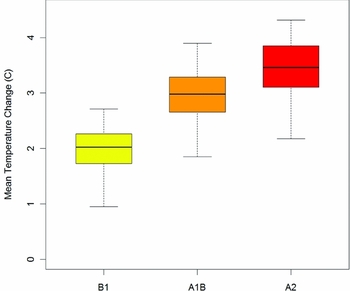
Future climate projections indicated a temperature increase of 1.3–2.3 °C by mid-century, and 1.7–3.8 °C by 2085 (Fig. 1). Precipitation was projected to increase in all climate models for western Tanzania, with an increase of 0.3–15.6% by 2055 and 12–28.6% by 2085. The GCMs indicated that rainfall may increase during the rainy season (December–May), decrease during the dry season (June–August), and remain roughly the same during September–November.
Projected seasonal change in mean temperature from historic (1961–1990) to end-of-century (2070–2099) across all climate models for the three greenhouse gas emission scenarios (B1, A1B, A2). The dark central line in each box represents the 50th percentile or median prediction of all sixteen global climate models (GCMs). The top and bottom of the box represent the 75th and 25th percentiles, respectively. The top and bottom ‘whiskers’ plot the maximum and minimum values from different GCM runs for each scenario.

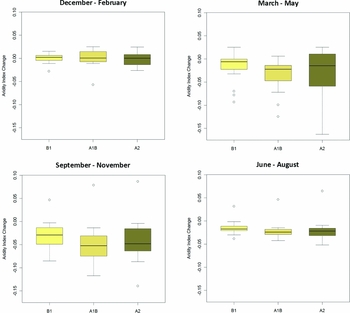
Aridity is projected to increase (decreasing AI+) annually, even in the face of increasing precipitation, regardless of the emissions scenario, with the most severe impacts in the period September–November (Fig. 2). The wet season was the only season where models closely agreed on no change in aridity. Climatic moisture surplus (surrogate for runoff) projections showed a wide range of changes annually (both increasing and decreasing), however there was good agreement among GCMs that this surplus would decrease during the dry season.
Projected seasonal change in the aridity index plus (AI+) from historic (1961–1990) to end-of-century (2070–2099) across all climate models for the three greenhouse gas emission scenarios (B1, A1b, A2). The dark central line in each box represents the 50th percentile or median prediction of all sixteen global climate models (GCMs). The top and bottom of the box represent the 75th and 25th percentiles, respectively. The top and bottom ‘whiskers’ plot the maximum and minimum values from different GCM runs for each scenario. The open circles represent outliers.

Stakeholder engaged adaptation planning
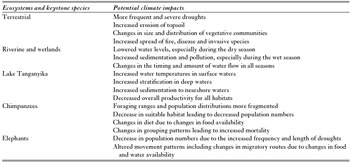
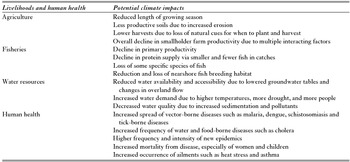
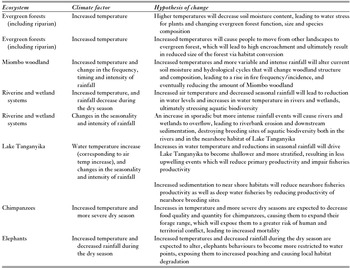
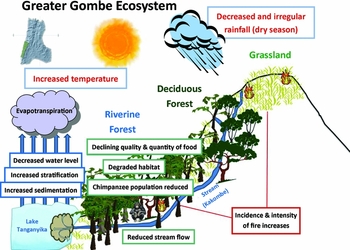
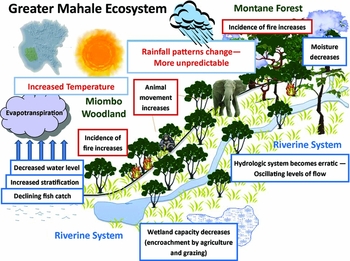
During the first workshop, participants agreed upon which potential impacts from climate change were likely to be seen in their project area (Tables 1 and 2), and created conceptual ecological models that visually depicted climate impacts to the system (Figs 3 and 4). In addition, they further broadened this model by developing explicit hypotheses of change for the most critical ecosystems and species, and identified indicators for monitoring climate change impacts across the project area (Table 3).
Overview of potential climate impacts to ecosystems in the study areas based on the climate change analysis and literature review. This list was used to develop simple conceptual models that ultimately informed conservation strategy revisions in a subsequent workshop.

Key potential climate change impacts to people's livelihoods in the study areas, agreed upon during the workshops and used to revise conservation strategies.

Hypothesis of change due to future climate for different ecosystems used to revise conservation strategies in the Greater Gombe and Greater Mahale Ecosystems.

Greater Gombe Ecosystem conceptual model developed through the stakeholder-engaged planning process.

Greater Mahale Ecosystem conceptual model developed through the stakeholder-engaged planning process.

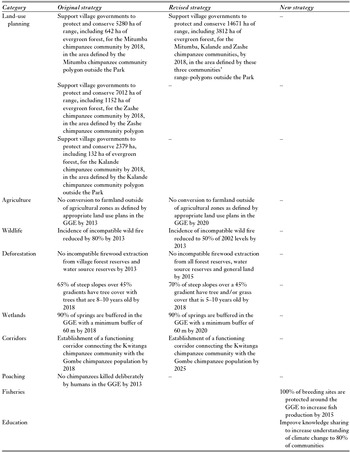
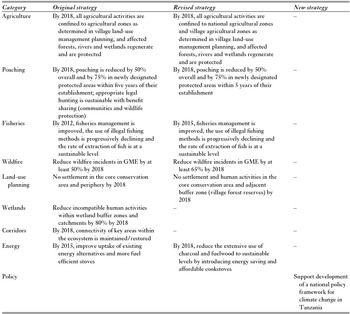
During the second workshop, participants used the conceptual models and hypotheses of change to identify areas where climate change adaptation would require either modification of existing strategies or development of new strategies to ensure project success, and subsequently crafted an initial set of action steps necessary to begin strategy implementation. Seven of the 10 strategies currently being implemented in the GGE project area were revised to make them more robust to climate change impacts (Table 4). In the GME project area, six of the eight strategies were revised to make them more robust to climate change impacts. In addition, the project teams identified new climate change adaptation strategies that were important to implement for overall project success, which were related to fisheries, education and policy.
Original, revised and new strategies for the Greater Gombe Ecosystem (GGE). Strategies were revised for a variety of reasons associated with rethinking original desired outcomes in the context of this new information on the potential impacts from climate change.

Original, revised, and new strategies for the Greater Mahale Ecosystem (GME). Strategies were revised for a variety of reasons associated with rethinking original desired outcomes in the context of this new information on the potential impacts from climate change.

In the final workshop, participants discussed how to advance implementation of climate change adaptation in western Tanzania, including which parties were best placed to lead the implementation of strategies focused on land-use planning, fisheries, connectivity, wildfire, energy, education and policy. Results of discussions revealed that successful implementation of climate adaptation strategies in western Tanzania will require close collaboration and coordination between local communities and village councils, district, regional and national government, non-governmental organizations, research institutions, donors, and the private sector. This workshop concluded with a commitment from the national government of Tanzania and workshop participants to work more closely together and to assist each other in the development of local, regional and national climate change adaptation policies and programmes that benefit the region's natural resources, economy, and human livelihoods.
DISCUSSION
This paper demonstrates that climate adaptation planning can be successfully accomplished in a data poor rural area of an economically developing nation. Climate adaptation planning takes a combination of useful scientific analyses, engaged stakeholders and a facilitated process. Following this approach, we demonstrate that it is possible to develop climate change adaptation strategies that have the degree of buy-in and support assumed necessary for successful on-the-ground implementation.
The climate change analysis and scientific literature review point to a need to plan for more frequent and severe droughts due to lower precipitation and reduced moisture surplus during the dry season. Increased precipitation during the wet season has potential to increase erosion of top soil. Increased temperatures and aridity can cause increased frequency and intensity of fire. Miombo woodlands are adapted to aridity, drought and fire (Werger & Coetzee Reference Werger, Coetzee and Werger1978), making them less vulnerable to these changes, whereas the other forests types are likely to experience changes in distributions from fire (Moyer et al. Reference Moyer, Plumptre, Pintea, Hernandez-Aguilar, Moore, Stewart, Davenport, Piel, Kamenya, Mugabe, Mpunga and Mwangoka2006), especially montane forests (Agrawala et al. Reference Agrawala, Moehner, Hemp, van Aalst, Hitz, Smith, Meena, Mwakifwamba, Hyera and Mwaipopo2003). Increased moisture surplus during the wet season and decreased moisture surplus during the dry season is expected to alter the timing and amount of water flow. Increased erosion may lead to increased sedimentation and pollution especially during the wet season.
It was clear from this study that useful information about impacts to ecosystems and people was important in decision-making, but specific quantitative numbers about climate change were not necessarily needed. In general, it did not appear useful in the planning process for stakeholders to learn that climate models project a 0.3–15.6% precipitation increase by end-century. However, participants did respond to the direction and general magnitude of projected changes. Participants altered strategies as a result of understanding that when temperature and precipitation change were analysed together, there was high climate model agreement that aridity was projected to increase (particularly in September through November), which resulted in greater fire risk, thus leading to a greater likelihood of chimpanzee-human conflicts. This observation was consistent with studies investigating how people interpret environmental information, which show that abstract numbers have limited impact on people's attitudes, yet information made relevant to everyday life is significantly more important to changing behaviours (see for example Ham Reference Ham1992). For quantitative-natured scientists, it is important to translate this information into a useful concept and avoid presenting complex data that can lead to confusion or complete dismissal of what may be important information. However, this finding may be dependent on the audience, here a mix of community-based and policy stakeholders, but others may require different types of information (such as more quantitative data) to overcome institutional constraints or requirements.
Increasing local stakeholder engagement in the development of climate adaptation actions was an objective of this process. Our hypothesis was that increased engagement and buy-in would lead to increased feasibility of strategy implementation. Stakeholders were engaged during the entire process from the analysis of climate data through development of conservation strategies, to policy negotiations and implementation of specific actions (although policy negotiations and strategy implementation are not discussed in this paper). It is our observation that good facilitation via clear communication of expected outcomes and a straightforward and transparent process to achieving these outcomes were important for engaging stakeholders. We adapted currently existing processes (see Poiani et al. Reference Poiani, Goldman, Hobson, Hoekstra and Nelson2011; Cross et al. Reference Cross, Zavaleta, Bachelet, Brooks, Enquist, Fleishman, Graumlich, Groves, Hannah, Hansen, Hayward, Koopman, Lawler, Malcolm, Nordgren, Petersen, Rowland, Scott, Shafer, Shaw and Tabor2012), to best address the specific needs of this stakeholder group. In particular, repeat workshops (three over the course of 1.5 years) provided the time needed for local staff to become not only comfortable with new climate change concepts and terminology, but also become adept enough to critically analyse and interpret this information. Repetition of assumptions and conclusions drawn from previous workshops appeared to help build the high degree of stakeholder acceptance to the scientific climate change information and its relevance.
The final workshop included representatives from the Tanzania Government (such as the Vice-President's Office, and Ministry of Natural Resources and Tourism). Active participation of government representatives helped to validate the work the stakeholders had accomplished in the first two workshops, and create needed support for implementing on-the-ground strategies. A key realization during this third workshop was that some national policies needed to be strengthened in order to support these local efforts. This further highlighted the need for better integration between district, regional, and national planning approaches.
Ultimately, only time will tell if the conservation strategies agreed upon as a result of this process will be successful in the face of climate change. It was our assumption that raising awareness of climate change risks, increasing local commitment and buy-in to strategy implementation, and strengthening local, regional and national collaboration were all factors necessary (but not necessarily sufficient) to successfully adapt to climate change. To these ends, this facilitated stakeholder-driven conservation planning process was successful and has laid out a set of conservation strategies to help people and ecosystems in Western Tanzania adapt to the climate change impacts projected to come.
CONCLUSION
Climate change has been viewed as a complicated science that is difficult to penetrate and make real to local people for climate adaptation planning. One of the benefits of this analysis and workshop process was that the best climate change expertise for this area shifted from an external suite of experts to the people that live in the region. All the workshop participants, through their engagement and involvement, have spent considerable time contemplating potential impacts of climate change on their community and natural resources. This was accomplished in part by using historical information as a benchmark to help bridge past, current and future time frames, making it easier for local people to assess potential future impacts.
In this process, the general concept of historical ecology and natural ranges of variability helped guide the assessment of vulnerability, then this information was tied to conservation strategies, ecosystem services and adaptive management, to develop on-the-ground actions. Although developing climate adaptation responses is not trivial, it can be accomplished even in data-sparse regions. To do so, we recommend combining targeted climate change data, relevant scientific information and local knowledge as part of a facilitated stakeholder-engaged decision process in order to best plan for the resiliency of ecosystems and human livelihoods in the face of a changing climate.