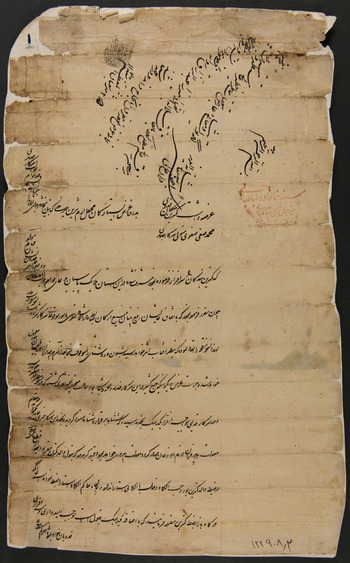
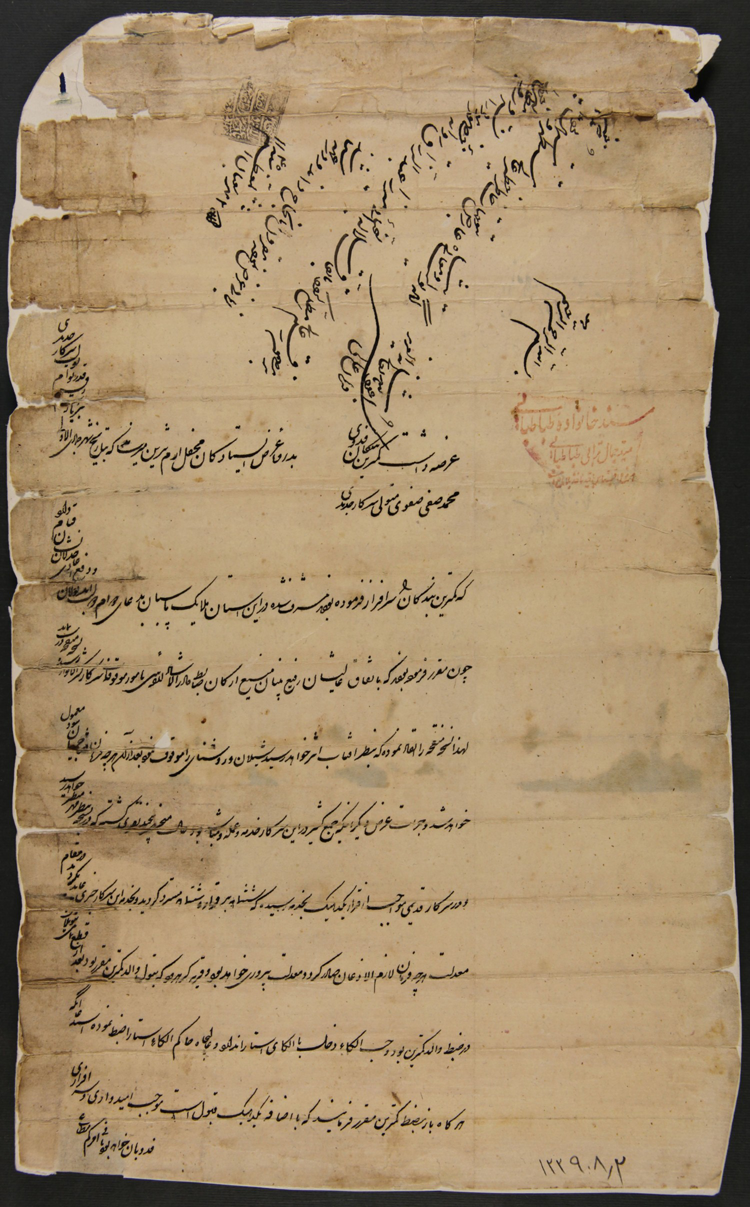
The document presented below with translation and commentary contains the earliest surviving decree of Nādir Shāh, regent of the Safavid ʿAbbās III (1732–36) at the time, in response to the petition of Muḥammad Ṣafī Ṣafavī, the head (mutavallī) of the new department (sarkār-i jadīdī) of the endowments of Ardabil. The earliest published decree of Nādir was up until now the one preserved in Yerevan at the Matenadaran, promulgated in Ẕī al-qaʿda 1146/5 April–4 May 1734.Footnote 1 This decree, however, was issued more than a year before, on 2 Shaʿbān 1145/18 January 1733.
The document, cataloged under No. 122908, is in the possession of the Organization of Libraries, Museums and Documents of the Āstān-i Quds-i Rażavī (Sāzmān-i kitābkhāna-hā, mūza-hā wa markaz-i asnād-i āstān-i quds-i rażavī) in Mashhad.Footnote 2 Based on the seal of Sayyid Jamāl Turābī Ṭabāṭabāʾī on the right-hand side of the paper, the document is originally from the private collection of the Ṭabāṭabāʾī family, and it must have been endowed or bequeathed to the Āstān-i Quds-i Rażavī at a later time.
Petition (Figure 1)
The petition of Muḥammad Ṣafī Ṣafawī and the decree of Nādir.
Source: Organization of Libraries, Museums and Documents of the Āstān-i Quds-i Rażavī (Sāzmān-i kitābkhāna-hā, mūza-hā wa markaz-i asnād-i āstān-i quds-i rażavī).
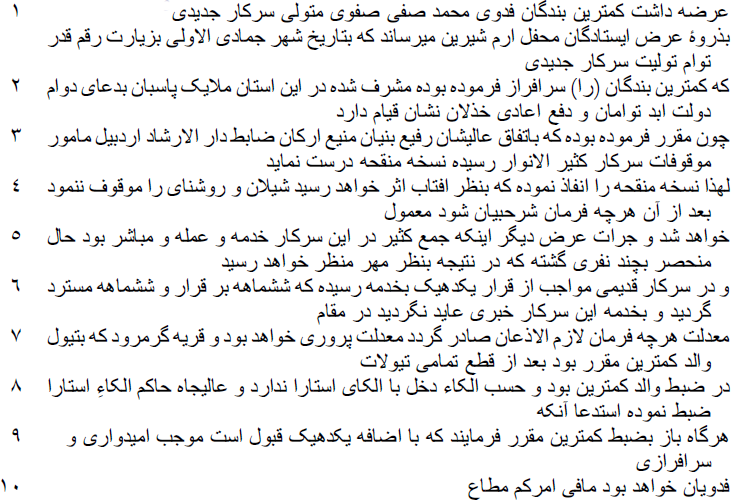
Petition of your most humble and devoted servant, Muḥammad Ṣafī Ṣafavī, head of the new administration.Footnote 4
It is submitted to the high place of petitioning of those who stand in the assembly of sweet earthly paradise, that in the month of Jumādā I the most humble servant had been distinguished and honored with the administration of the new department, by receiving the honorable raqam. At this threshold of guardian angels [this servant] attends to the praying for the permanence of the eternal reign and to the repelling of abandoned enemies.
It had been decided that a clarified list shall be prepared together with the exalted ranking, the elevated foundation, the lofty pillars, the revenue collector of Ardabil (which is the abode of right guidance), who was appointed to the pious foundations of the most radiant department. Hence the clarified list has been issued that will arrive before the resplendent sight. The feeding of the poor and the lighting were not withheld. At a subsequent time, all that the royal decree declares [and] describes, is going to be executed.
An audacious request is that a large number of people in this department are servants, lower-level staff and supervisors, and it is limited to no more than a few persons who will thereupon reach the luminous sight. In the old department, the servants receive their salaries on the basis of tithe, six months of which are established and six months of which are revoked. The servants of this department have no information regarding their pay. Whatever obeyed royal decree is issued by His Highness, it will be equitable.
The village of Garmrūd, which was assigned to the father of the most humble one as tuyūl; and following the termination of all the tuyūls, it [remained] administered by the father of the most humble one. From a regional perspective, it is no concern of the province of Āstārā. Still, the high-ranking governor of Āstārā has confiscated it.
The request is that when [the village] is assigned to the most humble one again, and the addition of the tithe is accepted, it will be the cause of the hopefulness and exaltation of the most devoted servant.
May Your Majesty’s order be ever obeyed.

Seal of ownership: Document of the Ṭabāṭabāʾī family, Sayyid Jamāl Turābī Ṭabāṭabāʾī. Any kind of quotation is permitted with the indication of the source.
Decree
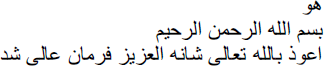
God
In the name of God, the Merciful, the Compassionate.
I seek refuge in God Almighty—A high decree was issued.
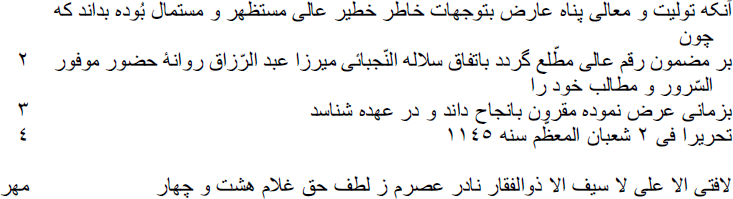
The asylum of administration and eminences, the petitioner, who was comforted and supported by the attention of the excellent and comprehensive mind, shall know that on being informed of the content of this sublime raqam, together with the progeny of grandees, Mīrzā ʿAbd al-Razzāq, he shall be dispatched to the court of abundant joy to submit his requests and to regard them as successful.
He shall consider it his responsibility.
Written on the 2 Shaʿbān 1145.
Seal: There is no hero like ʿAlī, no sword like Ẕū al-fiqār, I am the rarity of the age, by the grace of God, servant of the Twelve Imams.
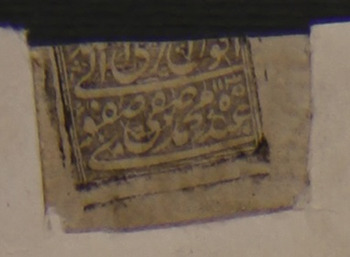
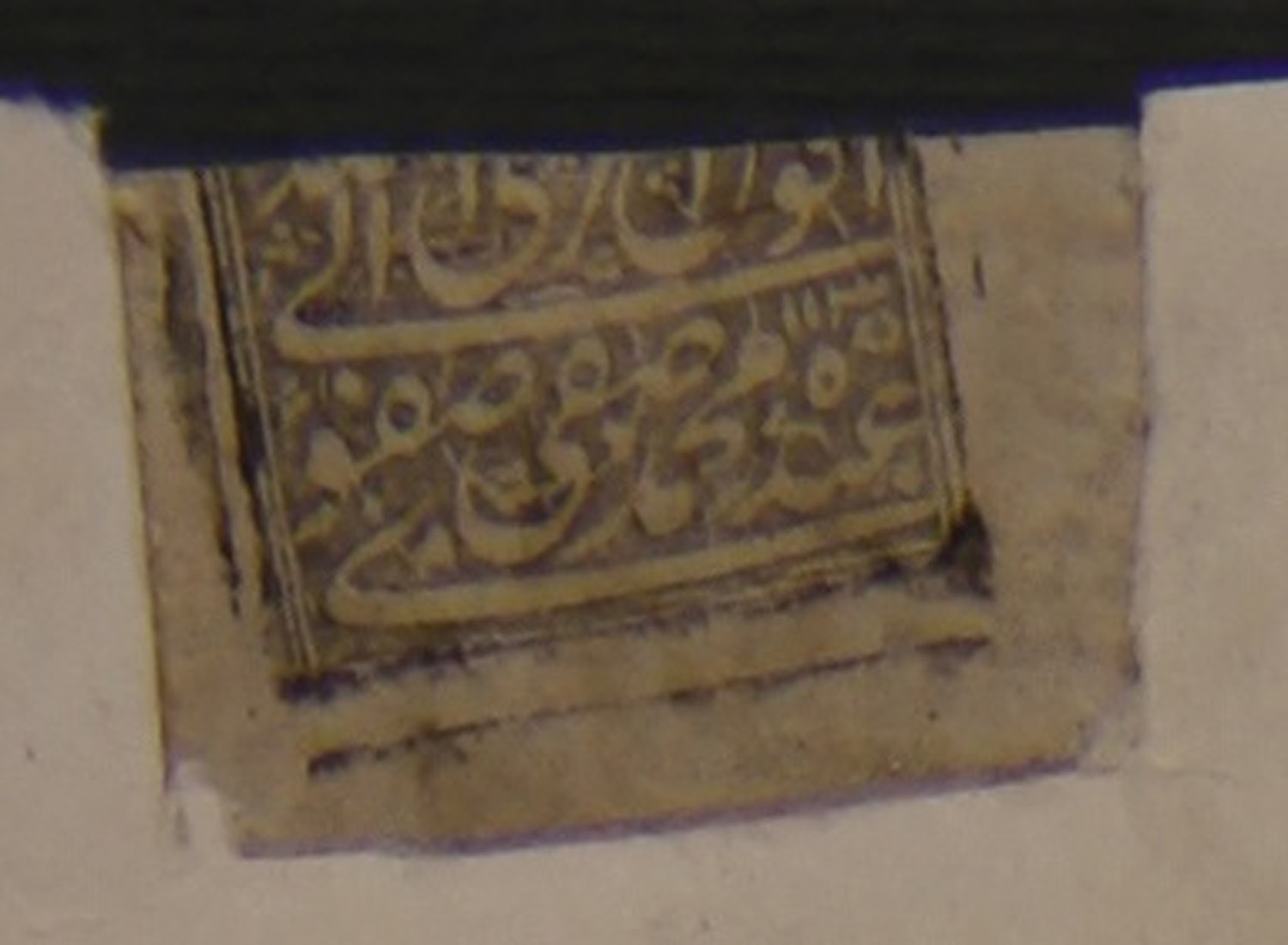
Back of the Document (Figure 2)

Seal: Muḥammad Ṣafī Ṣafavī 1135
The back of the document, showing the close-up of the seal.
Source: Organization of Libraries, Museums and Documents of the Āstān-i Quds-i Rażavī (Sāzmān-i kitābkhāna-hā, mūza-hā wa markaz-i asnād-i āstān-i quds-i rażavī).
Historical Background
After more than two centuries of rule, the Safavid dynasty was overthrown by the Hūtak Ghilzāʾī Afghans in the autumn of 1722, and the abdication of Sulṭān Ḥusayn (1694–1722) led to the disintegration of Persia. Central and south Iran was dominated by the Hūtak leader Maḥmūd, in the north and the east local war chiefs acceded to power. In the western and northwestern frontier, the Russians occupied Dāghistān and Gīlān, and the Ottoman Turks subjugated Kirmānshāh, Hamadān and Georgia in the first wave and Armenia, Shīrvān and Azerbaijan steadily until the end of 1725. Naturally, an emerging debate over the division of this region soon ignited considerable tensions between the two powers. Through French mediation efforts, an agreement was reached in June 1724 regarding the partitioning of western Iran and the recognition of the third son of the late shah, Ṭahmāsp II, as the ruler of the remaining lands of Persia. Ṭahmāsp II ascended to the throne in Qazwīn shortly after the fall of Isfahan. Following a short detour to Tabrīz, he was forced to leave for Ardabīl in July 1723 due to the Ottoman military campaign, and he resided there until the summer of 1725—when the city was occupied by the Ottomans. Ṭahmāsp II retreated in the direction of Tehran, however, due to an Afghan attack at the end of the year, he changed course towards Māzandarān. There he found shelter and was able to elicit the support of Fatḥ ʿAlī Khān, leader of the Qūyūnlū clan of the Ashāqabāsh branch of the Qajars. Ṭahmāsp II was eager to recover Isfahan and urged his new patron to embark upon an offensive against the Afghans. Fatḥ ʿAlī Khān, however, proposed a different strategy and suggested a target closer to Astarābād in order to muster more soldiers for the impending war with the new Afghan ruler, Ashraf.
Around this time, a general pattern began to arise according to which Ṭahmāsp II was always shackled, at times literally, to the ambitions of other powers that took advantage of his legitimizing force as the rightful Safavid ruler. With Ṭahmāsp on his side, Fatḥ ʿAlī Khān aspired to validate every territorial gain of the Qajars. Ultimately, the campaign against Mashhad was resolved; it was under the rule of Malik Maḥmūd Sīstānī at the time.
In the middle of 1726, one of the key figures in western Khurāsān was Nadr Qulī Bīg Afshār, later Nādir Shāh, whose accession to the royal camp marked a turning point in the fortunes of both Tahmāsp II and Persia. Each victory boosted the prestige of Nādir as an authority, and Fatḥ ʿAlī Khān was soon overshadowed and lost his grip on the ruler. Ironically, the meeting of Tahmāsp and Nādir was due to Fatḥ ʿAlī Khān in the first place, which, eventually, sealed his fate. The elimination of Fatḥ ʿAlī Khān on charges of treason and conspiracy was substantially facilitated by Nādir, in consequence of which he was elevated to the position of qūrchī-bāshī (commander of the royal household troops) and took the honorable title of Tahmāsp Qulī Khān. Moreover, Mashhad, his future capital, was also conquered in November 1726.
In the next three years, the attention of Nādir was devoted to subduing the Kurds, securing western Khurāsān and forcing his will upon Ṭahmāsp II. In the meanwhile, on the western parts of Iran, the Afghan–Ottoman war was concluded with a peace accord, in which the Ottomans recognized Ashraf as the shah of Persia, and the Afghans conceded the territories occupied by the Ottoman Turks.
The successful military campaign of Nādir in the spring of 1729 against the Abdālīs in Herat alarmed Ashraf, who mustered his troops and set out against Mashhad in the summer. Nādir, however, defeated him three times at Mihmāndūst, Varāmīn and outside of Isfahan at Mūrchakhūrt. After the expulsion of the Afghans, Nādir escorted Ṭahmāsp II to his capital in December. Although the wishes of Ṭahmāsp II were realized, so were a few expectations of Nādir. One of Ṭahmāsp’s sisters, Rażīya Bīgum, was betrothed to Nādir, and another sister, Fāṭima Bīgum, to his son, Riżā Qulī Mīrzā. Furthermore, Nādir was granted the right to levy and collect taxes and impositions for the purpose of supplying the army, whose allegiance to him was incontestable.
In the spring of 1730, Nādir redirected his attention to western Iran and commenced his campaign to retake the territories lost to the Ottomans. In a surprisingly swift offensive Hamadān, Kirmānshāh, Tabriz and Ardabil were reconquered until the end of August 1730. Although the Patrona Halil revolt erupted one month later in Istanbul, Nādir was not able to exploit the growing disorder, as the Abdālīs made an incursion into Mashhad. Since western Khurāsān, and Mashhad in particular, was to be considered Nādir’s power base, the safeguarding of the region was crucial for any future military efforts. Therefore, Nādir returned to Khurāsān, and the second campaign against Herat lasted until February 1732.
Almost immediately upon Nādir’s departure to the east, Ṭahmāsp II’s advisors in Isfahan encouraged and fostered the idea that this was the moment for Ṭahmāsp to prove his inherent aptitude for rule and leadership and to enhance his authority with regard to Nādir through a military campaign to recover Armenia and Georgia. Even though the Safavid shah reveled in the notion of demonstrating his worthiness, the army under his command left Isfahan only in January 1731. At this time, the Sublime Porte had already regained control of the streets of the capital, which was thrown into disarray by the uprising and the downfall of Sultan Ahmed III. The efforts of Ṭahmāsp II to retake Yerevan proved to be fruitless, and when the report reached him concerning Ahmed Pasha, the governor of Baghdad, setting his sights on seizing Kirmānshāh and Hamadān, the Safavid ruler at once returned to Hamadān. A battle followed at Kūrījān, northeast of the city, and he was defeated. In consequence of these events, the recaptured lands in 1730 were once again lost to the Ottomans. However, they only served as leverage for the negotiations. The Ottomans offered a proposition, according to which in return for the cities of Kirmānshāh, Hamadān and Tabriz, Ṭahmāsp II confirmed that Georgia, Armenia and territories north of the Araxes river belonged to the Ottoman Empire. In January 1732, the shah accepted these terms of the peace treaty.
Upon hearing the news, Nādir issued a manifesto regarding the inadmissibility of the treaty and his intention to nullify it. Nonetheless, the peace accord was advantageous for Nādir’s own aspirations and turned out to be the long-awaited justification for the dethroning of Ṭahmāsp II. Nādir had the opening and the means to widely publicize his rightful castigation of the shah on the grounds of that the Safavid ruler’s submission to a Sunni power was nothing other than a dereliction of duty towards his Shi’i subjects. As part of his preparatory arrangements, in order to strengthen his position, he nominated new governors loyal to him throughout the country and replaced most of the ministers in August 1732 as he arrived in Isfahan. The accounts regarding the coup d’état report more or less the same events: Ṭahmāsp II humiliated himself in a heavily intoxicated state in front of the entire court, and even his own supporters were desperate to distance themselves from him. Thus the dethronement happened with the backing of the entire political class, and it transpired without the shedding of blood. Nādir opted for the more cautious approach and involved all the prominent members of the establishment in his plot without their awareness. At this moment, the supremacy of Nādir was unchallenged, and he would have been able to assume the throne; however, as he was mindful of the lingering devotion to the Safavid dynasty, he deemed it expedient to strengthen his position. With this in mind, the investiture of the infant son of Ṭahmāsp, ʿAbbās III, took place on 7 September 1732, when the jīqa (aigrette) was placed next to the head of the new monarch by Nādir. Furthermore, Nādir renounced his title, Ṭahmāsp Qulī Khān, and adopted the ranks of wakīl al-dawla (regent) and nāʾib al-salṭana (chief minister). In October, the ex-shah was escorted to Mashhad accompanied by his courtiers and harem, and the Safavid court was transferred to Qazvīn with ʿAbbās III. Thus, the position of Isfahan as capital ceased to exist.
Following the deposition of Ṭahmāsp, Nādir led several punitive expeditions against the Bakhtiyārīs and the Zands. In accordance with the peace accord signed earlier that year, the Ottomans withdrew from Tabriz and Hamadān, but not Kirmānshāh. Therefore, the mind of Nādir soon reverted to the western marches. After retaking the city of Kirmānshāh, Nādir reached a decision to advance further in the direction of Ottoman Iraq. By January the following year, he was making forays into the region of Kirkūk and had placed Baghdad under siege. This second campaign of Nādir against the Ottoman Turks eventually culminated in July with a battle against Topal Osman Pasha, who defeated the Persian army. Although Nādir was forced to retreat, it subsequently proved to be a slight hindrance only, and the most renowned and triumphant conquests of Nādir were yet to follow.Footnote 5
As can be seen from the described historical events, the respective document was issued from Ottoman Iraq, probably from the regions of Kirkūk or Baghdad.
Commentary on the Content
Muḥammad Ṣafī Ṣafavī, the writer of the petition, has two requests in respect of a private and an official matter. The former is concerned with his family’s former tuyūl, which was a category of payments in the form of transfer of a source of income or the revenue of an area for a defined period of time. In this case, it was the latter, the revenue of the village of Garmrūd (today’s Miyāna), which is located about 100 kilometers southwest of Ardabil.Footnote 6 It was initially assigned to the father of the petitioner, and after the “abrogation of all the tuyūls” (qaṭʿ-i tamāmī-yi tuyūlāt), it still ended up in his possession. Indeed, Nādir Shāh limited the granting of tuyūl and turned most of them into khāliṣa, and the administrative personnel and military were remunerated by a fixed salary.Footnote 7 However, this petition shows us that—at least in Azerbaijan—it may have happened before 1733, which is surprising since the first one of these cases was reportedly in 1151/1737–38.Footnote 8 Muḥammad Ṣafī Ṣafavī does not elaborate in what form his father “administered” the village, though it was most probably in the form of a personal grant, as a salary or stipend. Later, the governor of Āstārā took possession of this income by unlawful means, and Muḥammad Ṣafī Ṣafavī requests its restitution. In this case, however, the problem arises that these grants were only assigned for a lifetime maximum,Footnote 9 therefore, Muḥammad Ṣafī Ṣafavī would have no legal basis to demand it, and there is no indication of a previous renewal of the grant for the petitioner.
This also links to a further problem. The province of Ardabil became a crown land (khāṣṣa) after the year of 1067/1656–57,Footnote 10 and crown lands were usually not assigned as tuyūl. Since the region is not included in the list of provinces of Azerbaijan in the Taẕkirat al-Mulūk, but it is present in the Alqāb va mavājib,Footnote 11 this organizational restructuring may have happened sometime between the compilation of the works of Mīrzā Samīʿā and Naṣīrī, 1725–29 and 1731. As a result, either the rule of not assigning tuyūls on crown lands was not applied so rigorously,Footnote 12 or Ardabil was turned from crown land into state land (dīvānī) at an even earlier date.
The other request of Muḥammad Ṣafī Ṣafavī concerning the salary of the servants of the old department (sarkār-i qadīmī) can be traced back to an earlier document. One of the decrees of Ṭahmāsp II, promulgated in Jumādā I 1144/November 1731, can be considered as one of the immediate precursors of this petition. The administrator is ordered to pay the salaries of the shrine’s employees according to the shah’s stipulation:
[He] shall pay the pensions and annuities of the servants, Quran reciters and others, according to his calculation, on the basis of the tithe. However, taking into account the total revenues in the coming years, he should divide them evenly and remit them to everyone. (īṣāl-i muqarrarī va vaẓā’if-i khadama va ḥuffāẓ va ghayra ba nahvī ki barāvard namūda az qarār-i ʿushr va sanavāt-i āyanda-rā naẓar bar madākhil bi-al-savīya taqsīm va vāṣil-i har yak namūda).Footnote 13
In light of Muḥammad Ṣafī Ṣafavī’s petition, it seems that this command was still legally binding. However, based on the text, six months of salary was not released. Although the remuneration of the staff was the task of the mutavallī, the text of the petition still clearly indicates that the matter was outside the purview of Muḥammad Ṣafī Ṣafavī. The most probable explanation for this should be in a previous royal order with respect to the matter.
In the royal decree of November 1731, it is stated that “in the order and arrangement of the lighting and feeding of the poor of the mentioned Holy Threshold … nothing should be withheld” (dar naẓm va nasq-i rawshanā’ī va shīlān-i āstāna-yi muqaddasa-yi mazbūra … mawqūf nadārad),Footnote 14 which are mentioned in the petition as provided. Moreover, “[the administrator] must prepare a clarified list of revenues and expenditures, and dispatch to the court, which is the refuge of the world” (har sāla natīja-yi munaqqaḥa bar kull-i madākhil va makhārij durust dāshta ba dargah-i jahān-panāh firistad).Footnote 15 At the beginning of the petition, Muḥammad Ṣafī Ṣafavī writes that the list is drawn up and sent, in accordance with the order.
It should be noted that the existence of two administrative apparatuses at a single waqf was examined by Busse, Fragner, and later Floor.Footnote 16 The reason for the bifurcation of the administration of the foundation of Shaykh Ṣafī’s tomb lies in the extensive endowments of the Safavid rulers, who established a separate, new organization for their endowments, the sarkār-i jadīdī, in contrast with the department of the old estates, the sarkār-i qadīmī. Later endowments to the sanctuary were always placed under the “new” organization, so that the “old” administrative apparatus lost its importance over time. Fragner’s assumption that the administrator of the “new” department was responsible for the affairs of the “old” one is underlined by the Dastūr al-Mulūk and this petition as well.Footnote 17 Muḥammad Ṣafī Ṣafavī’s intercession—as the administrator of the new department—on behalf of the servants employed in the old department sheds light on the fact that, although the terminology of the two organizations persisted, the old department was in the purview of the administrator of the new department. It would pose the question if there was even an administrator for the “old” organization.
Muḥammad Ṣafī Ṣafavī was, by his own admission, elevated to the position of head of the new administration (sarkār-i jadīdī) of the endowments of Ardabil in the month of Jumādā I. Taking into consideration that in a royal decree issued by Ṭahmāsp II in Jumādā I 1144/November 1731 Murtażā Qulī Bīg Ṣafavī was elevated to the same position,Footnote 18 it can be established that the promotion of Muḥammad Ṣafī Ṣafavī took place in the next year, Jumādā I 1145/20 October–18 November 1732. Thus, Murtażā Qulī Bīg Ṣafavī held this office for one year. It is worth mentioning that the position of administrator of the endowments of Ardabil was predominantly filled by relatives of the Safavids, but not exclusively.Footnote 19
The presumption of close familial ties between the two administrators is to be considered improbable. Although it was widely customary that certain tuyūls were attached in perpetuity to specific offices,Footnote 20 and occasionally became de facto hereditary,Footnote 21 based on the Dastūr al-Mulūk, tuyūl was not assigned to the office of the administrator of the endowments of Ardabil, and he received only pension (muqarrarī) and fees (rusūmāt).Footnote 22 Furthermore, I have found no example that tuyūl was assigned to any endowment administrator. In my opinion, this is a clear indication that his father was not employed as mutavallī.
In his succinct decree, Nādir acknowledges the content of the petition and summons Muḥammad Ṣafī Ṣafavī and Mīrzā ʿAbd al-Razzāq, the revenue collector, to the court. Interestingly, Nādir reveals nothing regarding the requests of the administrator of the endowment. It is attested by the fact that on the back of the raqam only the seal of the petitioner can be found; thus, no administrative decisions have been made on the requests in question.
Regarding Mīrzā ʿAbd al-Razzāq more information is provided by a decree from Muḥarram 1146/14 June–13 July 1733. The document identifies him as the revenue collector of Urūmīya.Footnote 23 How far this functionary’s jurisdiction reached is unknown, however, it can be safely established that Ardabil was not under his purview. Consequently, he must have been transferred to the district of Urūmīya during the time between the issuance of these documents. Furthermore, in Shaʿbān 1147/27 December 1734–24 January 1735 at the latest he was appointed the vazīr of Tabriz,Footnote 24 that is the appointee of the central government in charge of the province’s fiscal affairs.
Commentary on Diplomatics
Part of the royal decrees issued by the chancelleries survived as answers to petitions of eminent individuals. These were issued in two forms. Either the edict was placed above the written request, which carries the means of authentication and all the attributes of a royal decree, or it was composed separately on a new sheet of paper. In the latter case, only the text gives away that the decree was preceded by a petition: “[he] shall know that the petition he had written has arrived before the most holy sight” ( … bidānad ki ʿarīża ki dar īn vaqt nivishta būd ba naẓar-i aqdas rasīd).Footnote 25
Naturally, petitions written in eighteenth-century Iran have a structure different from that of royal decrees. The first line is always indented, and this lacuna contains the sentence of “petition of the most humble servant” (ʿarża-dāsht-i kamtarīn bandagān) which is occasionally extended with phrases such as dāʿī, duʿāgū or fadavī. It is closely followed by the name and position of the petitioner beneath it, placed between the first and the second line of the text of the petition. The back of the document, at the time of its dispatch, only contains the seal of the petitioner.
Following this section comes an introduction, which seems to be formulated and worded in line with more or less standard formulas, mostly in these forms: “it is reported at the place of petition of those who stand at the foot of the exalted and most sacred heaven-like throne” (ba mawqif-i ʿarż-īstādagān-i pāya-yi sarīr-i ʿarsh-naẓīr-i aqdas-i ʿālī mī-rasānad),Footnote 26 or “it is submitted to the high place of petition of servants who stand at the foot of the heaven-like throne, at which the Caliphate resides” (ba zirva-yi ʿarż-bāryāftagān-i pāya-yi sarīr-i khilāfat-maṣīr-i ʿarsh-naẓīr mī-rasānad).Footnote 27 In addition to these two examples, the different components have many variations and this segment appears in vastly diverse forms.
In the petitions of the Zand period, two kinds of extensions are joined to the introduction, which are constant elements and occur in every single petition of this era. The first is “may my soul be his sacrifice” (rūḥī fadāhu) sentence and the second is “may I be sacrificed for the blessed dust beneath your feet” (qurbān-i khāk-i pā-yi mubārakat shavam). It should be noted that the latter has a few earlier occurrences in the petitions sent to Nādir Shāh.Footnote 28
After this introductory element, the description of the preludes and circumstances is next, and the official request is introduced by the istidʿāʾ ānki phrase, which usually end with the “it will be indeed the cause of … ” (har āyina mūjib/bāʾis-i … khwāhad būd). Every petition sent to the shah has a closing which shows a few different versions, however, the most common is the “for the rest, may His [Majesty’s] most exalted royal order be ever obeyed” (bāqī amruhu al-aʿlā muṭāʿ). In analogy with the introduction of the petitions, these elements have no standard form, and every single component is varied and interchangeable.
Regarding the answers of the rulers to petitions, it can be observed that they always contain a few sentences at best and most of the time lack any formality, for the latter of which the following is the perfect example:
The coming of the Bakhtiyārī to Maḥallāt, Quhistān, and Sāyir al-Bulūk is outrageous. … what does this mean that each one goes off wilfully to those districts or even settles in them? (āmadan-i bakhtiyārī ba maḥallāt va quhistān wa sāyir al-bulūk ba ziyādat ast … chi maʿnī dārad ki har yak khwud sar ba maḥāl-i mazbūra rafta va yā sukanāʾ girifta-and).Footnote 29
It should be noted that during the Safavid period, petitions were received by the īshīkāqāsī-bāshī (chamberlain), with the exception of the petitions written by the amīrs of the court, which were remitted by themselves.Footnote 30 Although the current state of research does not allow it to be stated with certainty, it is possible to speculate that due to the relatively reduced size of the central administration in the eighteenth-century post-Safavid period the receiving of requests and petitions followed a more straightforward method.
Regarding the terse and brief decree, black ink was used in every section of the document, which is a distinctive feature of eighteenth-century Iranian royal decrees—as opposed to the Safavid era, when gold and red ink were often utilized under the different rules of the chancellery. On the respective document the pre-coronation seal of Nādir can be seen. Since setting the seal at the top of the decree was the prerogative of the shah, Nādir’s seal appears, accordingly, at the bottom left. The seal is rectangular, and the text is half in Arabic and half in Persian: “There is no hero like ʿAlī, no sword like Ẕū al-fiqār, I am the rarity of the age, by the grace of God, servant of the Twelve Imams” (lā fatā ’illā ʿalī lā sayf ’illā dhū al-fiqār nādir-i ʿaṣr-am zi luṭf-i ḥaqq ghulām-i hasht-u chahār).Footnote 31 The word “Nādir” in the writing of the seal was meant to pun on his own name, which means rare or uncommon. Furthermore, the Twelve Imams appear as the “Eight and Four.” Besides the fact that it is clearly a public declaration of his Shiʿi faith, the highlighting of the eighth imam, ʿAlī b. Mūsā al-Riżā, in this way is an apparent reference to the Āstān-i Quds-i Rażavī and Mashhad. As opposed to the Safavids, in Nādir’s world view Mashhad and Khurāsān were not only a sacred surrogate and a precarious and insecure border but the center.Footnote 32 After the coronation, any mention of the imams, which was an essential and constant characteristic of Safavid seals until the Safavid Sulṭān Ḥusayn, completely disappears from Nādir Shāh’s seals, which can be explained by his religious policy. Until 8 March 1736, namely the coronation of Nādir Shāh, this seal can be found on his every document.
By following the traditional application of the formulary as outlined by Heribert Busse,Footnote 33 the first part of the decree is the protocol, which consists of the invocatio and the introductory formula. The invocatio in this document contains the huwa and the basmala. As a rule, in the documents of Nādir Shāh this segment is a recurrent component, almost exclusively penned with black ink.Footnote 34
Before his coronation, at first Nādir Shāh followed the introductory formula of the provincial governors of the Safavid era, namely, “a high order was issued” (ḥukm-i ʿālī shud).Footnote 35 However, as this decree indicates, as early as January 1733 the text of this element was converted into a hybrid formula of the ruler and the governor: “a high decree was issued” (farmān-i ʿālī shud). That is, he replaced the word “order” (ḥukm) with “decree” (farmān). This introductory formula reflected Nādir’s position perfectly: not a ruler yet, but more than a public servant. Moreover, it would seem to be a reasonable assumption that the practice was initiated following the deposition of Ṭahmāsp II in September 1732.
The next section of the royal decrees is the corpus, starting with the promulgatio. The short comment following the reference to the addressee, Muḥammad Ṣafī Ṣafavī, should be highlighted. The remark that the respective person enjoys the support of the ruler is a characteristic element in the documents of Nādir. Between the years of 1734 and 1736, that is before his enthronement, it was usually in the same form as it appears in the document at issue: “comforted and supported by the attention of the excellent and comprehensive mind” (ba tavajjuh-i khāṭir-i khaṭīr-i ʿālī mustaẓhar va mustamāl būda).Footnote 36 However, after the coronation, the vocabulary changes and words reflecting the royal status of Nādir Shāh come to the fore, such as royal compassion (shafaqat-i shāhāna), under the princely auspices (tavajjuhāt-i khadīvāna), kingly favors (alṭāf-i mulūkāna), or unlimited regal mercy (marḥamat az ḥadd-i afzūn-i khusravāna).Footnote 37 Moreover, from the year 1739, the shadow of God (ẓill-i allāh) phrase appears,Footnote 38 which strengthened the divine legitimacy of the shah and can be considered as an innovation compared to the previous era. The comment in this form is inherited and employed regularly by the chancelleries of Aḥmad Shāh Durrānī, Shāh Rukh and Karīm Khān Zand, following the terminology typical of Nādir Shāh.Footnote 39
The arenga (details of the incentive for issuing the document), the narratio (report on the circumstances leading to the issuance of the document and/or reference to previously issued decrees) are missing from the decree and the dispositio comes straight after the promulgatio. In the documents of Nādir Shāh this segment is often introduced by the sentence, which can be seen in the respective decree, “on being informed of the content of this most noble raqam” (chūn bar mażmūn-i raqam-i ʿālī muṭṭaliʿ gardad).Footnote 40 In the adhortatio, the “regard it as successful” (maqrūn ba injāḥ dānad) phrase is a distinctive element of Nādir Shāh’s decrees,Footnote 41 which, interestingly, was inherited by Shāh Rukh alone.Footnote 42
In conclusion, the document in question enriches the small number of surviving decrees promulgated by Nādir before his coronation and supplements the collection of texts with reference to the vaqf of Ardabil. The content of the petition and the decree reveals that Garmrūd—and most likely the wider region as well—was still recovering in terms of land tenure and remuneration following the Ottoman interlude. Moreover, the request of Nādir for a financial summary of the vaqf, and the summoning of the mutavallī and the revenue collector, might be considered as indications of his desire to exercise closer oversight of the activities and transactions of the religious endowment. Against this backdrop, the decree, which was issued during the military campaign of Nādir against Ottoman Iraq, is devoid of any clear resolutions regarding the entreaties of the mutavallī. Concerning the administration of the vaqf, the petition verifies that in spite of the surviving terminology, the sarkār-i qadīmī at this time was without doubt under the supervision of the sarkār-i jadīdī. From the viewpoint of diplomatics, it can be ascertained that in spite of its brevity, this early decree of Nādir Shāh already bears a few significant traits—especially in the promulgatio and the adhortatio—characteristic of his later royal decrees.
The author is very grateful to Iván Szántó and Christoph U. Werner for reading the draft of this article with care and for making valuable suggestions. Special thanks are also due to the Department of Documents of the Āstān-i Quds-i Rażavī in Mashhad for approval of the publication.