INTRODUCTION
The sea urchin Glyptocidaris crenularis exists 15–100 m underwater in the Northern Yellow Sea of China and the Sea of Japan (Chang et al., Reference Chang, Ding, Song and Yang2004). Good gonad quantity and quality of G. crenularis shape the great potential for aquaculture. Luo et al. (Reference Luo, Tian, Zhao, Zhou, Zhang, Feng and Chang2014) reported a high variation in the somatic and gonad weight traits in G. crenularis, clearly suggesting a considerable potential for its selective breeding for aquaculture. However, G. crenularis is still an uncultivated marine species, in spite of great commercial value. Moreover, little information is available on the biological basis of aquaculture for G. crenularis. This lack greatly hampers the establishment and development of the aquacultural industry of G. crenularis.
Temperature is an important factor affecting gonad production and quality of sea urchins (Siikavuopio et al., Reference Siikavuopio, Christainsen and Dale2006; James et al., Reference James, Heath and Unwin2007; Lawrence et al., Reference Lawrence, Cao, Chang, Wang, Yu, Lawrence and Watts2009). Gonad production was significantly decreased in high temperature (22°C) in Strongylocentrotus intermedius, indicating that S. intermedius can hardly be cultured in waters with high temperatures (Lawrence et al., Reference Lawrence, Cao, Chang, Wang, Yu, Lawrence and Watts2009). In S. droehachiensis, however, there was no significant difference in gonad production at 12.9 and 16.1°C (McBride et al., Reference McBride, Pinnix, Lawrence, Lawrence and Muiligan1997). Within one species, urchins from different regions showed different temperature effects on gonad production and quality (Phillips et al., Reference Phillips, Niimi, Hamid, Silcock, Delahunty, Barker, Sewell and Bremer2010b). These studies clearly indicate that effects of water temperature on gonad production and quality are species dependent. More complexly, high (or low) temperatures might have opposite effects on gonad production and gonad quality (Phillips et al., Reference Phillips, Hamid, Silcock, Delahunty, Barker and Bremer2010a). Because of the complexity of temperature impact on gonad production and quality, it is not acceptable to culture an uncultivated species using the relevant information for a cultivated species (for example, S. intermedius). Therefore, it is essential and valuable to have this evaluation on G. crenularis, which has great potentials for aquaculture. The natural distribution of G. crenularis is in lower latitude waters compared to S. intermedius (Chang et al., Reference Chang, Ding, Song and Yang2004). This suggests that G. crenularis might be more resistant to higher temperatures. However, the aquaculture consequence has never been investigated at different temperatures in G. crenularis. This raises interesting questions including whether high or low temperature is preferred for gonad production and gonad quality, which temperature is suitable for G. crenularis aquaculture, and whether G. crenularis can be cultivated in their non-native areas with higher water temperatures. Here, we designed two temperature culture conditions to investigate the long-term temperature effects on production, colour and flavour of gonads of G. crenularis. This study provides valuable biological information for establishing aquaculture of G. crenularis.
MATERIALS AND MEDTHODS
Sea urchins
A batch of G. crenularis was artificially bred in May 2011 from parents collected from Zhangzi Island (38°58′N 122°39′E). They were cultured at the Key Laboratory of Mariculture and Stock Enhancement, Ministry of Agriculture, Dalian Ocean University, Dalian, until the experiment started.
Experimental design
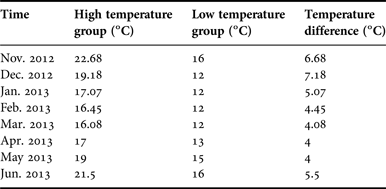
We designed two temperature conditions as experimental groups. One was held at high temperatures using a temperature controlling system. The other was at the natural seawater temperature in the laboratory. Both temperatures were recorded monthly. The water temperature ranged from 16.08 to 22.68°C and from 12 to 16°C in the high and low temperature groups, respectively (Table 1). Thirty G. crenularis was distributed into each of the experimental groups in November 2012. Urchin diameter ranged from 20 to 30 mm and there was no significant difference between groups. Excess kelp Laminaria japonica was fed to both groups. Seawater was changed every three days. The experiment lasted for 7 months until June 2013. Ten G. crenularis were randomly collected from each group for measurement. The sea urchins were weighed and the horizontal diameter was measured. One gonad was removed, weighed, dried at 72°C for four days and reweighed. Gonad moisture was calculated as follows:
 $${\rm GM \% = }\displaystyle{{{\rm gw} - {\rm gd}} \over {{\rm gw}}}{\rm \times 100}$$
where GM% = gonad moisture, gd = gonad dry weight, gw = gonad wet weight.
Water temperature of the two experimental groups.

The remaining gonads were evaluated for the flavour and colour. We used PANTONE Colour Cue® 2 to measure L*, a* and b* values (L* = lightness, a* = redness, b* = yellowness) under the standard light of D65. A well trained sensory panel of six individuals familiar with subjective colour and flavour analysis of sea urchin gonads evaluated the gonad quality (colour and flavour) of each sea urchin. The panelists had no interaction or knowledge of each other's evaluation. Gonad colour and flavour of sea urchins were evaluated according to the ranking standard used by Pearce et al. (Reference Pearce, Daggett and Robinson2002) with some revisions.
Colour
-
1. Bright yellow or orange
-
2. Pale yellow or orange
-
3. Yellow-brown, orange-brown, red-brown, cream
-
4. Dark brown, grey.
Flavour
-
1. Very sweet
-
2. Sweet
-
3. Bland (not sweet, not bitter)
-
4. Bitter
-
5. Very bitter.
Statistics
First of all, data were tested for normal distribution and homogeneity of variance before potential statistical analysis. Independent t-test was then performed to detect differences of growth, gonad production, colour and flavour of G. crenularis between the two experimental groups. All analysis was carried out using SPSS 16.0 statistical software. A probability level of P < 0.05 was considered statistically significant.
RESULTS
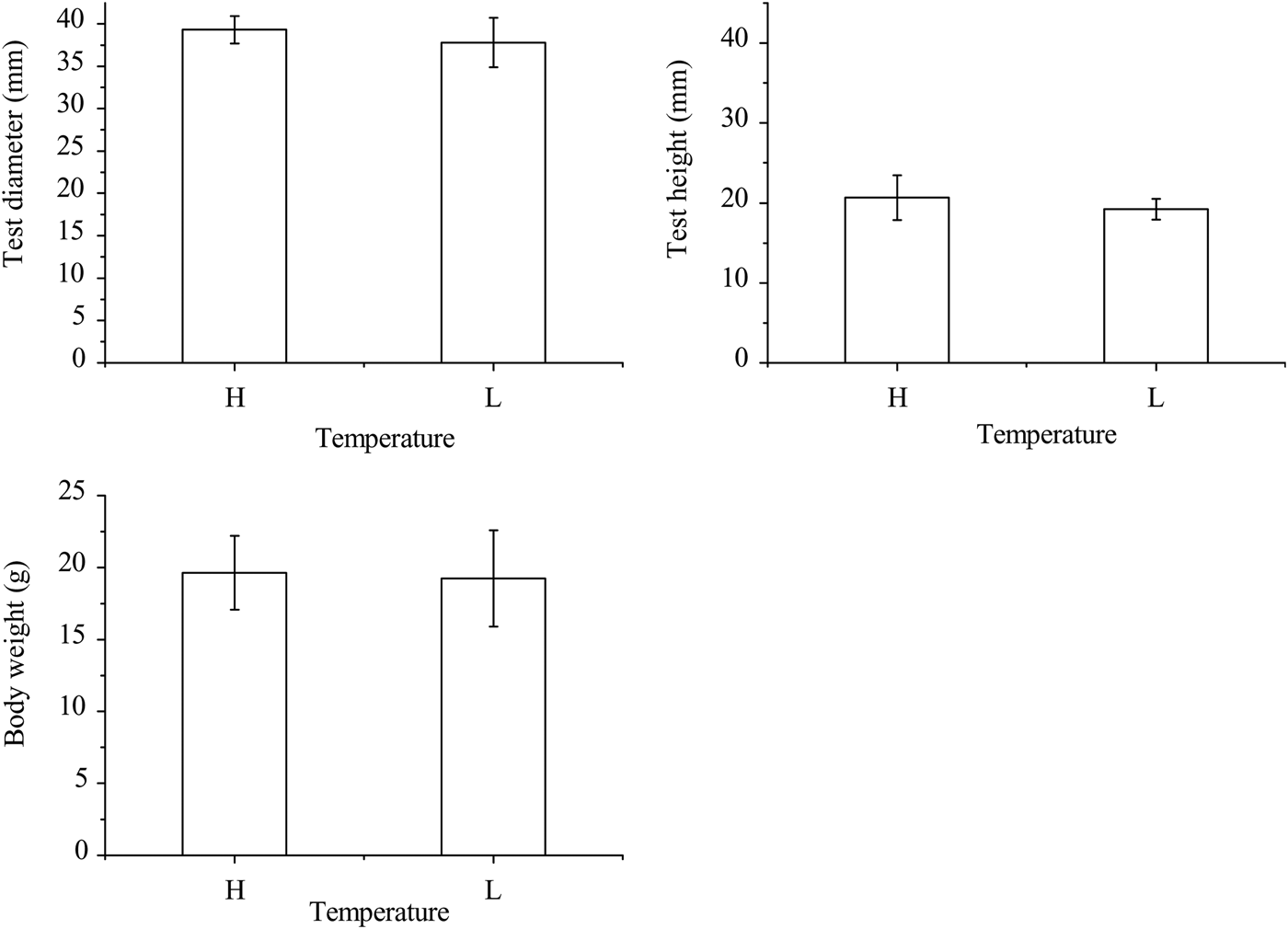
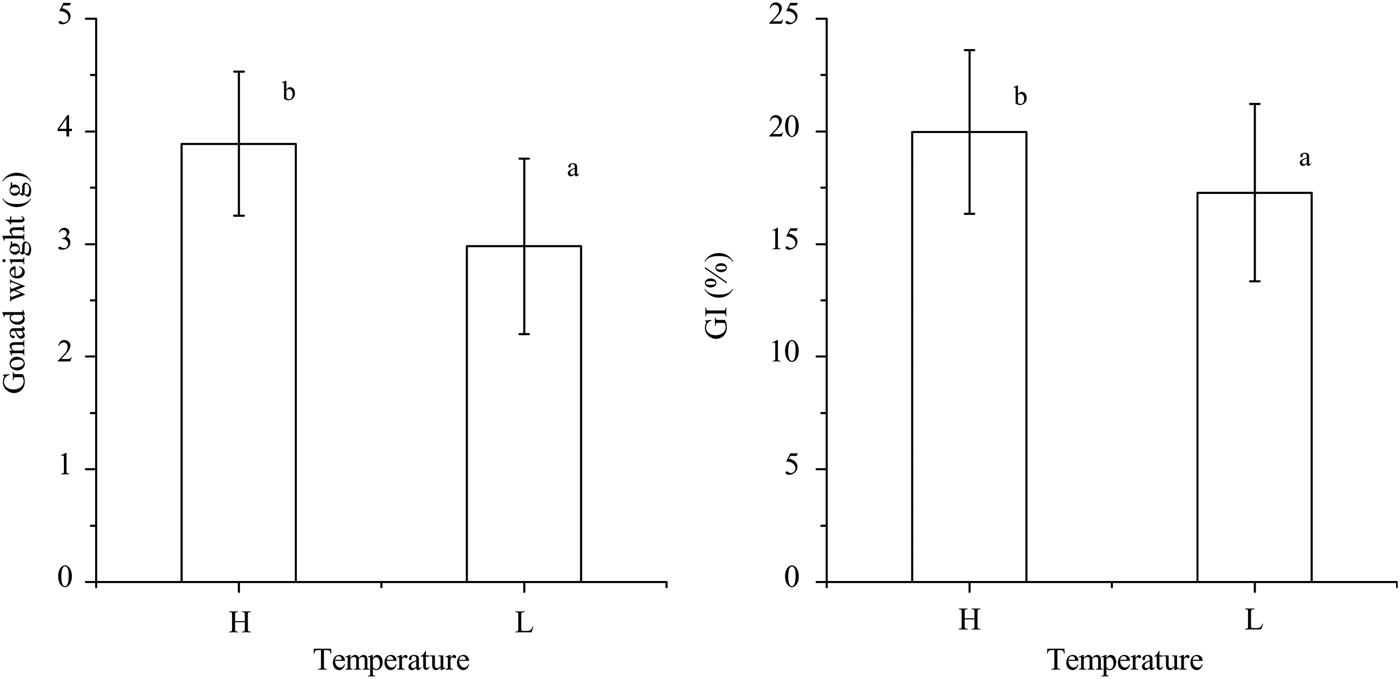
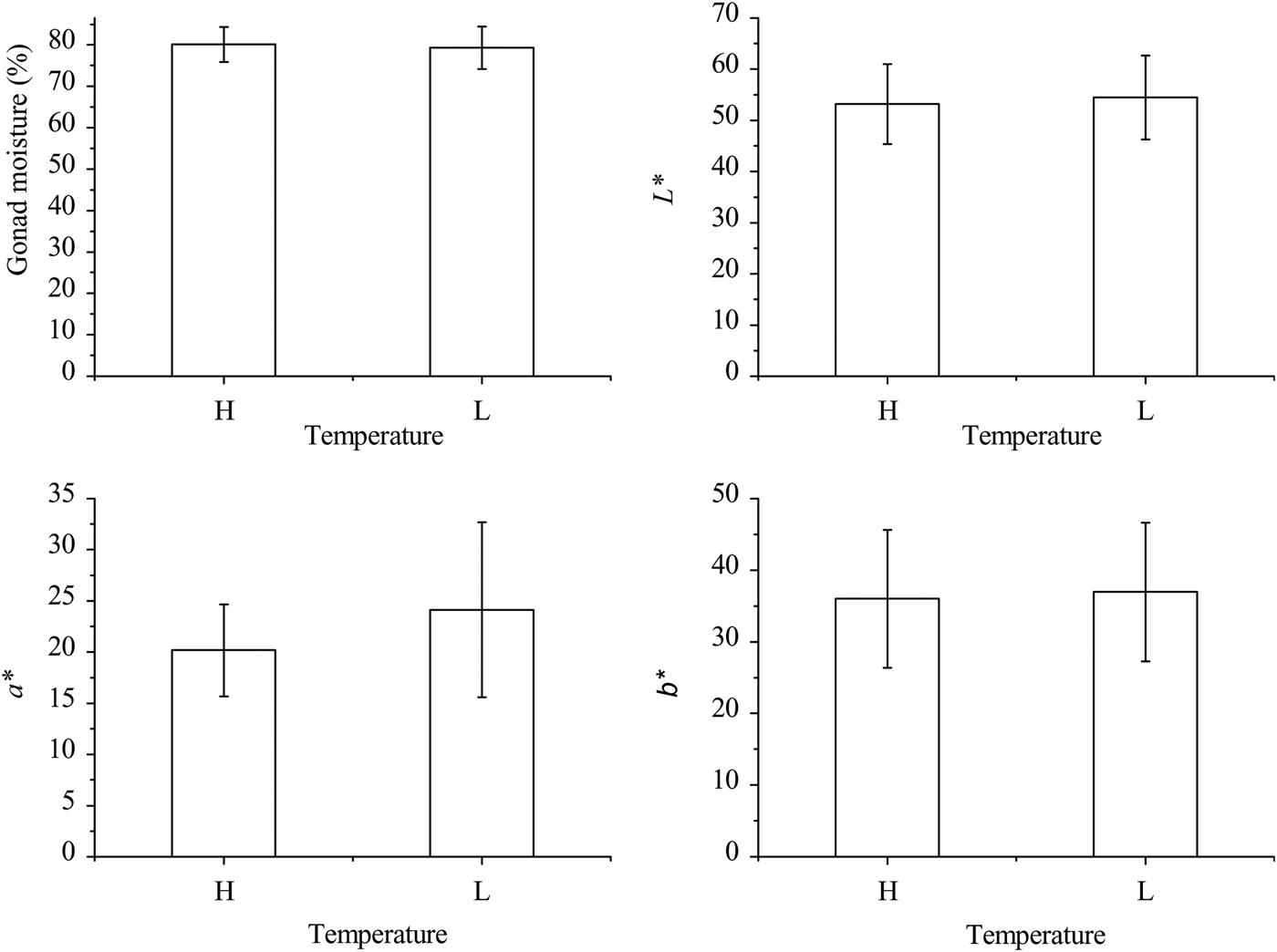
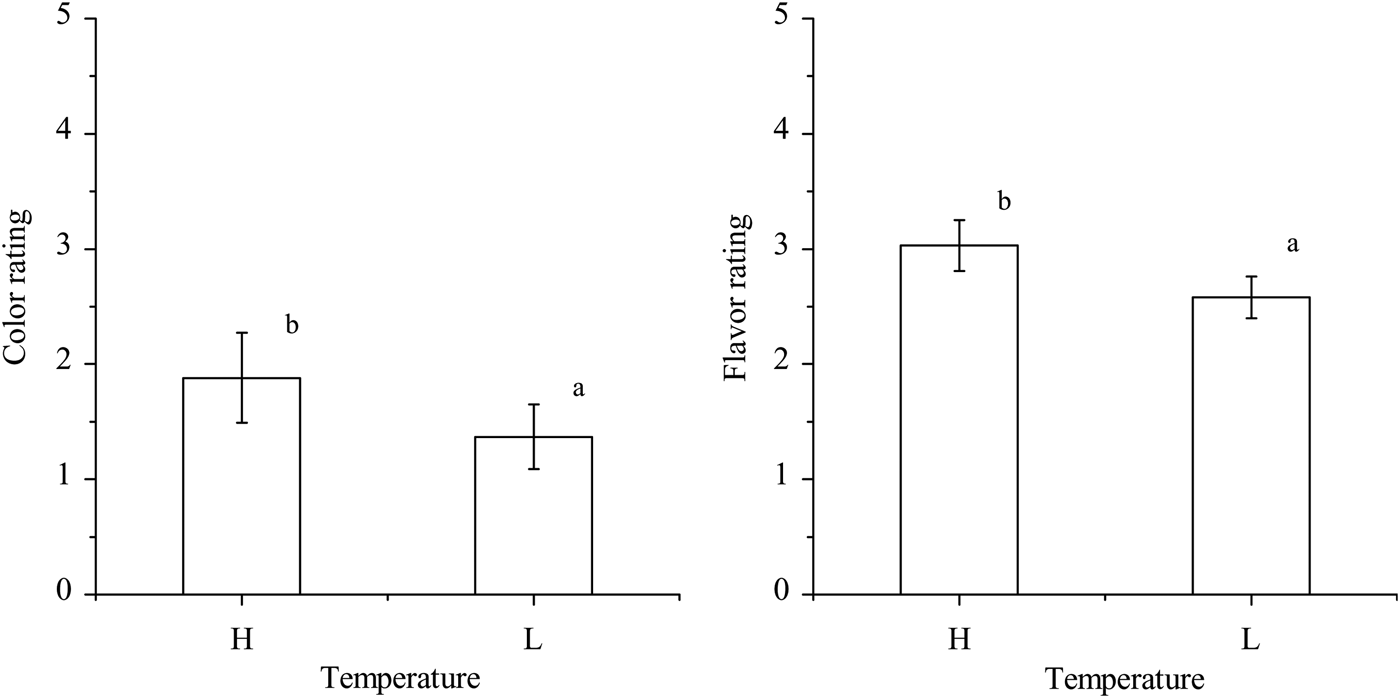
There was no significant difference in test diameter, height and body weight between the sea urchins in the two groups (P > 0.05, Figure 1). Glyptocidaris crenularis showed significantly higher gonad production and index in high temperature than in low temperature (P < 0.05, Figure 2). However, no significant difference of gonad moisture was found between the individuals cultured in different temperatures (P > 0.05, Figure 3). L*, a*, b* readings were slightly higher in the low temperature groups, although no significant difference was found (P > 0.05, Figure 3). Subjective colour and flavour ratings found that G. crenularis in the low temperature group showed significantly better colour (P = 0.003, Figure 4) and flavour (P < 0.001, Figure 4) than those in the high temperature group.
Test diameter, test height and body weight of Glyptocidaris crenularis in prolonged different temperature conditions (N = 10, mean ± standard deviation). H refers to high temperature; L refers to low temperature.

Gonad weight and index of Glyptocidaris crenularis in prolonged different temperature conditions (N = 10, mean ± standard deviation). H refers to high temperature; L refers to low temperature. Different letters above the bars refer to a significant difference.

Gonad moisture (%), L*, a* and b* of Glyptocidaris crenularis in prolonged different temperature conditions (N = 10, mean ± standard deviation). H refers to high temperature; L refers to low temperature.

Subjective colour and flavour ratings of Glyptocidaris crenularis in prolonged different temperature conditions (N = 10, mean ± standard deviation). H refers to high temperature; L refers to low temperature. Different letters above the bars refer to a significant difference.

DISCUSSION
There was no significant difference in test diameter, height and body weight between G. crenularis in the two groups. This result is not in agreement with the study by Lawrence et al. (Reference Lawrence, Cao, Chang, Wang, Yu, Lawrence and Watts2009), who found that high temperature (22°C) significantly reduced the growth (test diameter and body weight) in S. intermedius. However, the body weight of Lytechinus variegates held at 22°C was significantly higher than those held at 28 or 16°C (Watts et al., Reference Watts, Hofer, Desmond, Lawrence and Lawrence2011). Together with these investigations, the present study clearly indicates that mass response to temperature varies remarkably among different urchin species.
Provided food supply is constant and unlimited, temperature is the most important factor determining gonad growth in S. droebachiensis (Siikavuopio et al., Reference Siikavuopio, Christainsen and Dale2006). In S. purpuratus, Azad et al. (Reference Azad, Pearce and McKinley2011) reported that temperature did not significantly affect gonad index (GI) in a prolonged experimental duration of 12 weeks. However, in a similar duration, GI of Evechinus chloroticus was significantly higher in 18°C than in 14°C and 10°C (James & Heath, Reference James and Heath2008). Their further study revealed that the optimal culture temperature for gonad production in E. chloroticus was 18–20°C in the Mercury Islands (36°38′S 175°51′E) and 18°C in the outer Marlborough Sounds (41°01′S 174°16′E) (James et al., Reference James, Heath, Green and Wright2009). In the present study, we found that G. crenularis showed significantly higher gonad production and GI in high temperature group (16–23°C) than in low temperature group (12–16°C). This indicates G. crenularis probably has a similar optimal aquaculture temperature for growth as E. chloroticus between 16 and 23°C. It is not surprising because the distributional latitudes of G. crenularis and E. chloroticus are similar in the Northern and Southern Hemispheres, respectively. This result also supports the previous opinion that optimal gonad production was achieved for cool water species at higher temperatures in summer than in winter (Siikavuopio et al., Reference Siikavuopio, Christainsen and Dale2006).
In the present study, subjective colour and flavour ratings found that G. crenularis in the low temperature group showed significantly better colour and flavour than those in the high temperature group. This indicates the temperature contradiction between gonad production and quality enhancement in G. crenularis. This result is consistent with Phillips et al. (Reference Phillips, Hamid, Silcock, Delahunty, Barker and Bremer2010a)'s finding that autumn (13.6 ± 0.2°C) is the optimum season to harvest E. chloroticus for gonad quality although the roe production was significantly lower than that in summer (16.0 ± 0.1°C). Phillips et al. (Reference Phillips, Niimi, Hamid, Silcock, Delahunty, Barker, Sewell and Bremer2010b) further confirmed that E. chloroticus collected from southern regions of New Zealand (low temperature, 45°150′S 166°510′E) showed significantly better gonad quality than those from the northern area (high temperature, 36°18′S 174°48′E). A probable explanation is the relationship among temperature, gametogenesis and gonad quality. In E. chloroticus, nutritive phagocytes (NPs) were built over autumn (March–May), followed by gametogenesis during winter and into spring (June–October) (Barker, Reference Barker and Lawrence2007). Gonads containing fewer germ cells (GCs) than NPs are more preferred in markets (Walker et al., Reference Walker, Unuma, Lesser and Lawrence2007; Unuma & Walker, Reference Unuma, Walker, Durham-Harris, Böttger, Walker and Lesser2010). As gametogenesis proceeds, gonad quality gradually deteriorates, because of the oozing of gametes (Unuma, Reference Unuma, Yokota, Matranga and Smolenicka2002; Unuma & Walker, Reference Unuma, Walker, Durham-Harris, Böttger, Walker and Lesser2010). Low water temperature can significantly depress the gametogenesis (Walker et al., Reference Walker, McGinn, Harrington and Lesser1998), thus resulting in the enhancement of gonad quality of sea urchins.
In conclusion, high temperature (16–23°C) is suitable for gonad production enhancement and index, while low temperature (12–16°C) is optimal for gonad quality improvement in G. crenularis. Therefore, it is reasonable to choose different culture temperatures for different commercial orientations in G. crenularis. The present study provides valuable and insightful information into the establishing G. crenularis aquaculture.
ACKNOWLEDGEMENTS
We thank Yiran Fu and Junhao Ning for their assistance.
FINANCIAL SUPPORT
This work was supported by the Chinese National 863 Project (2012AA10A412).