Introduction
Dementia affects nearly 1.4 million people in Germany, the incidence of this disease being estimated at 300,000 per year (Bickel, Reference Bickel, Wallesch and Förstl2012). 60% of all dementia patients receive care in their own homes, mostly provided by family caregivers (Hallauer, Reference Hallauer2004). Dementia causes a huge psychosocial burden for patients as well as for their caregivers (Etters et al., Reference Etters, Goodall and Harrison2008). Burden of care is associated with an increase in depression and stress symptoms, a decrease of positive feelings as well as worsening physical health (Pinquart and Sörensen, Reference Pinquart and Sörensen2003). Cognitive and neuropsychiatric symptoms are associated with decreased quality of life (QoL) for both patients and caregivers (Shin et al., Reference Shin, Carter, Masterman, Fairbanks and Cummings2005). Changes in social interactions, the emergence of neuropsychiatric symptoms such as depression, apathy, agitation, and aggression, as well as memory impairment have been reported as the most stressful aspects of caring for relatives of dementia patients (Rainer et al., Reference Rainer, Jungwirth, Krüger-Rainer, Croy, Gatterer and Haushofer2002). Specifically, increased neuropsychiatric symptoms (Majerovitz, Reference Majerovitz1995; Lee et al., Reference Lee, McKeith, Mosimann, Ghosh-Nodyal and Thomas2013), the presence of apathy and social withdrawal (de Vugt et al., Reference de Vugt2003), rapid cognitive decline in the demented patients (Perren et al., Reference Perren, Schmid and Wettstein2006), and uncertainty about communication and dyadic interactions have been identified as significant sources of caregiver stress (Polk, Reference Polk2005). The QoL of family caregivers for dementia patients has been shown to be lower than those of caregivers for persons without dementia (Moraes and Silva, Reference Moraes and Silva2009). A study by Conde-Sala et al. (Reference Conde-Sala, Garre-Olmo, Turró-Garriga, López-Pousa and Vilalta-Franch2009) revealed that spousal caregivers had a better perception of QoL than daughter/son caregivers, and dementia patients showed a higher perceived QoL than all kinds of family caregivers. Dementia-related stress leads to a higher prevalence and incidence of depression and anxiety disorders in caregivers (Schulz and Martire, Reference Schulz and Martire2004). Furthermore, Pinquart and Sörensen (Reference Pinquart and Sörensen2007) show in a meta-analysis that physical health issues like susceptibility to infection due to increased hormonal stress-related changes are a consequence of caregiver stress. Among all kinds of informal caregivers, caregiving demands seem to have a stronger impact on physical health in older caregivers and in dementia caregivers (Pinquart and Sörensen Reference Pinquart and Sörensen2007).
The existing literature shows that informal caregivers of dementia patients have higher stress levels compared to caregivers of patients who suffer from other diseases (Ory et al., Reference Ory, Hoffman, Yee, Tennstedt and Schulz1999; Bertrand et al., Reference Bertrand, Fredman and Saczynski2006). In contrast, perceived stress in dementia patients has not been investigated thoroughly. Based on the Progressive Lowered Stress Threshold Model of Hall and Buckwalter (Reference Hall and Buckwalter1987), Cheung et al. (Reference Cheung, Chien and Lai2010) perceived stress, anxiety, and depression rise with the progression of neuro-pathological changes because of a lowered stress threshold. The findings of Arsenault-Lapierre and her colleagues (Reference Arsenault-Lapierre, Whitehead, Lupien and Howard2012) support this conceptual framework: Patients with a new AD diagnosis (< six months) showed a significantly lower PSS value than patients with a longer AD history (> six months). On the other hand, Innes et al. (Reference Innes, Selfe, Brown, Rose and Thompson-Heisterman2012) found a positive effect of a non-pharmacological intervention (meditation) on perceived stress in dementia patients and their family caregivers, admittedly in a very small sample. Subjective relationship quality is associated with significantly less perceived stress and higher well-being in caregivers (Knop et al., Reference Knop, Bergman-Evans and McCabe1998; Lawrence et al., Reference Lawrence, Tennstedt and Assmann1998) and can hence be operationalized as a protective resource within the dyad. Despite the importance of such dyadic resources, only few studies have examined the effects of dyadic variables on caregiver stress and functional status in dementia patients.
The construct of dyadic stress and coping (Bodenmann and Widmer, Reference Bodenmann and Widmer2000), which is based on the transactional theory of stress and coping (Lazarus and Folkman, Reference Lazarus and Folkman1984), can be used to characterize caregiver/patient dyads. Specifically, dyadic coping focuses on the maintenance and restoration of a “homeostasis between the partner primarily affected by a stressful situation, the dyadic system and the relationship between the dyad and its environment” (Bodenmann, Reference Bodenmann, Tesch-Römer, Salewski and Schwarz1997 (own translation)). Dyadic coping mechanisms have been identified as important predictors for both mental and physical health (Bodenmann, Reference Bodenmann, Tesch-Römer, Salewski and Schwarz1997). There are only few studies focusing on dyadic and relational variables as a part of illness and caregiving processes in spouses with dementia (Braun et al., Reference Braun, Scholz, Bailey, Perren, Hornung and Martin2009).
We aimed to examine the role of dyadic factors in the relationship between stress and QoL among couples in which one partner is affected by dementia. Therefore, our first goal was to analyze whether perceived stress predicts QoL in both patients and spousal caregivers. In addition, we investigated the mediating role of dyadic coping and relationship quality on the association of stress and QoL.
Methods
Study design
The present cross-sectional analyses reflect the baseline assessment of an intervention study involving dementia patient-spousal caregiver dyads in Berlin, Germany. The study was designed to assess the effects of a combined training and support program for patient–partner dyads with mild-to-moderate dementia in a randomized controlled trial with a primary focus to strengthen and foster resources associated with dyadic interactions and coping skills (DYADEM trial, BMBF 01ET1001A).
Participants
Participants were recruited from memory clinics, private practices, nursing services, and other social and medical institutions in the greater Berlin area. We included community dwelling couples with one spouse suffering from dementia as evinced by National Institute of Aging criteria for all-cause dementia (McKhann et al., Reference McKhann2011), ≥15 in the Mini-Mental State Examination (MMSE) (Folstein et al.,Reference Folstein, Folstein and McHugh1975). Exclusion criteria were other psychiatric diseases such as severe depression, psychotic disorders, and substance-related and addictive disorders for both spouses as well as a dementia diagnosis in the spousal caregiver. The study was approved by the Ethics Committee of the Charité Universitätsmedizin Berlin (EA1/215/11), and written informed consent was obtained from all participants and/or a caregiver holding power of attorney.
Data collection
We initially contacted 167 dyads, of whom 51 refused to participate (indicating reasons were lack of acceptance of the disease (n = 6), nursing home transmission or death (n = 7), being overburdened (n = 9), severe somatic diseases in one or both spouses (n = 9), as well as unstated reasons (n = 20)). Twenty six dyads were excluded because of dementia severity (MMSE < 15), six dyads because the assumed dementia could not be diagnostically confirmed and two dyads because of severe alcohol abuse in one of the spouses. We thus enrolled 82 dyads in our study. Sixty four of the included patients were suffering from Alzheimer's disease, five from vascular dementia, three persons had dementia in Parkinson´s disease. One patient had a diagnosis of Lewy-body dementia and in nine patients the dementia diagnosis was not otherwise specified. Data was collected from November 2011 to April 2013 by specially trained research assistants at participants’ homes.
Study assessments
All participants were examined with the Perceived Stress Scale, (PSS-14; Cohen et al., Reference Cohen, Kamarck and Mermelstein1983), the Geriatric Depression Scale (GDS; Sheikh and Yesavage, Reference Sheikh and Yesavage1986), and the Dyadic Coping Inventory (DCI; Bodenmann, Reference Bodenmann2008a), which were provided to both dementia patients and their partners.
The PSS is a 14-item self-report questionnaire that measures “the degree to which situations in one´s life are appraised as stressful” (Cohen et al., Reference Cohen, Kamarck and Mermelstein1983). The reliability and validity of the PSS-14 for dementia patients were verified in a master thesis by F. Deeken “Psychometric properties of the perceived stress scale in dementia patients and their caregivers”, 2014 (unpublished thesis). It was found that the PSS-14 showed good reliability related to internal consistency (alpha coefficient) for dementia patients (α = 0.83). There is evidence that the GDS shows validity in mild to moderate dementia (Mitchell et al., Reference Mitchell, Bird, Rizzo and Meader2010). We measured the relationship quality of the couple (completed by both dementia patients and their partners) with a visual analog scale based on the 6th item of Norton's Quality of Marriage Index (QMI; Norton, Reference Norton1983). QoL was assessed with the Quality of Life in Alzheimer's Disease scale (QoL-AD; Logsdon et al., Reference Logsdon, Gibbons, McCurry and Teri1999) for dementia patients (self-reported scores) and the WHOQOL-BREF (WHOQOL Group, 1998) for their partners. The WHOQOL-BREF consists of four domains: physical health (seven items), psychological health (six items), social relationships (three items), and environment (eight items). It also measures an overall score (two general items). As intended in the evaluation scheme, the scores of all WHOQOL-BREF subscales were transformed into the range of values 0–100 to allow comparison to the WHOQOL-100. Patient's dementia severity was approximated using the Mini-Mental State Examination (MMSE; Folstein et al., Reference Folstein, Folstein and McHugh1975).
Analysis
The characteristics of the sample were summarized in terms of frequency for categorical variables, and continuous variables were summarized as mean ± SD. Paired t-tests for continuous variables and the χ 2 test for categorical variables were used to examine differences in parameters between patients and partners.
The DCI proposed by Bodenmann (Gmelch et al., Reference Gmelch, Bodenmann, Meuwly, Ledermann, Steffen-Sozinova and Striegl2008) was validated in our sample, ensuring the validity of the inventory for people with dementia. We carried out a factor analysis with varimax rotation, and factors were extracted using principal components analysis (PCA) and the Kaiser–Guttman rule. Analogous to the findings of Gmelch et al. (Reference Gmelch, Bodenmann, Meuwly, Ledermann, Steffen-Sozinova and Striegl2008) and Ledermann et al. (Reference Ledermann2010), we found a comparable factor structure for own coping and for partners’ coping behavior, composed of four factors: stress communication, supportive dyadic coping, negative dyadic coping, and delegated dyadic coping.
To establish concurrent validity, the DCI was correlated with relationship quality (r = 0.60). To assess discriminant validity, the scales were correlated with age, which was hypothesized to be theoretically distinct to dyadic coping (r = 0.07). The internal reliability of the Dyadic Coping Total score scales was assessed using Cronbach's α (0.89).
Pearson's correlations were used to calculate the relationship among the main variables of the study. In order to test for mediating effects of dyadic coping and of relationship quality on the relationship between stress and QoL, we conducted a series of regression analyses using PROCESS (Model 4) developed by Hayes (Reference Hayes2013), with bias-corrected bootstrap estimates and 95% confidence intervals (CIs) based on 1,000 resamples. The analysis provides an overall measure of the indirect effect of stress on QoL via the mediator, based on regressions predicting QoL using stress (Step 1), predicting the mediator using stress (Step 2), and predicting QoL using both stress and the mediator (Step 3). A statistical correction of the multiple analyses has not been carried out, on account of the fact that we did not want to dilute results based on a rather small sample size and the possibility of inflation of the type II error rate (Sedgwick, Reference Sedgwick2012).
Results
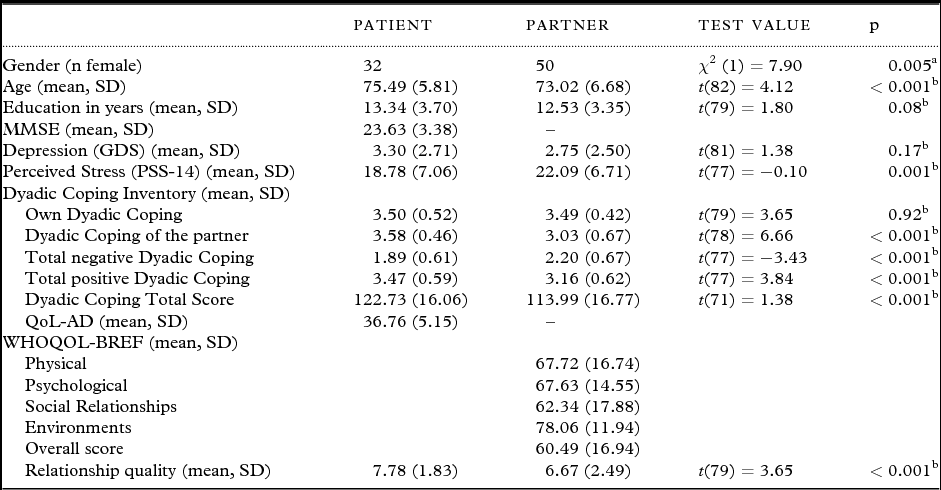
The mean age of the 164 participants was 74.26 (SD = 6.36) years. Caregiving partners in our sample were significantly more often female and younger than dementia patients (p < 0.05, see Table 1). Overall, the sample was highly educated. Patients’ average MMSE score was 23.63, which indicates mild dementia. 82.9% of the sample showed no relevant depressive symptoms, 17.1% showed mild depressive symptoms. No significant gender differences were found in perceived stress, neither in partners nor in patients.
Characteristics of the 82 participating dyads

Notes: MMSE: Mini-Mental State Examination; GDS: Geriatric Depression Scale; PSS: Perceived Stress Scale; QoL-AD: Quality of Life in Alzheimer's Disease; WHOQOL-BREF: World Health Organization Quality of Life.
a χ 2-test.
b t-test (paired samples).
Correlations between stress and quality of life
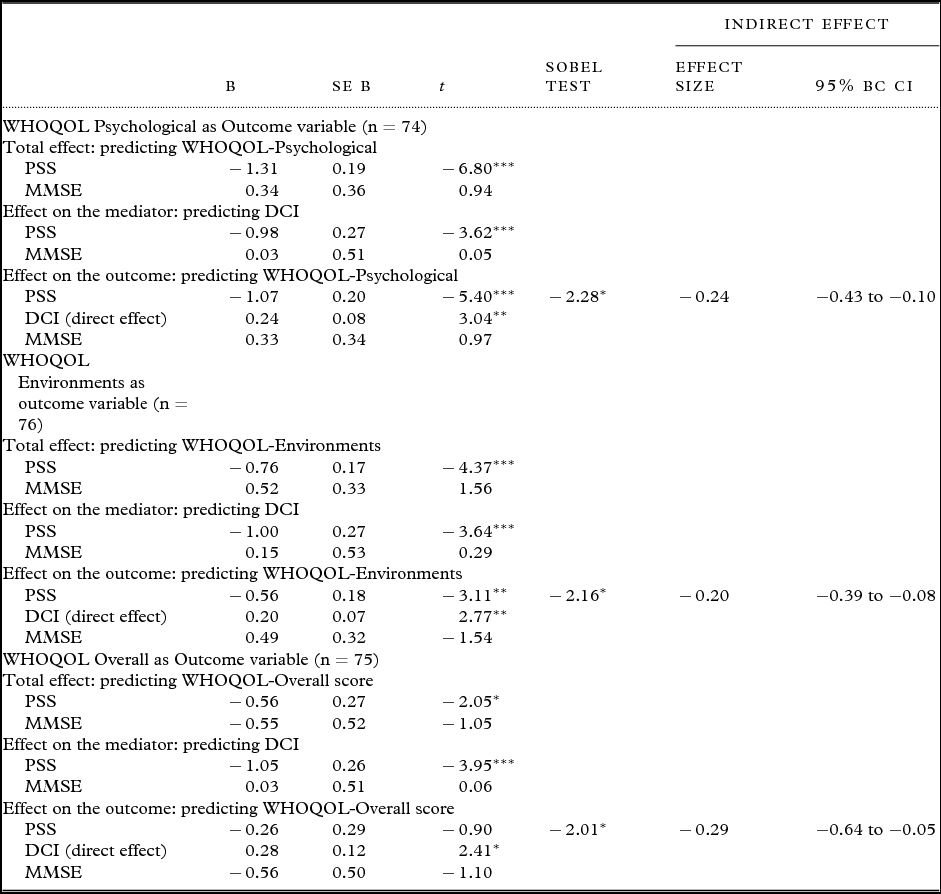
We found negative correlations between stress and QoL in both dementia patients (QoL-AD: r = −0.62; p < 0.001) and spousal caregivers (WHOQOL overall: r = −0.27; p = 0.02). Furthermore, spousal caregivers had a significantly lower Dyadic Coping total score than dementia patients (p < 0.001). Stepwise regression analysis showed a direct effect of stress on all domains of the WHOQOL as well as on the QoL-AD (for spousal caregivers’ WHOQOL overall: β = −0.56, p = 0.04; for patients’ QoL-AD: β= −0.43; p < 0.001, see Table 2).
Summary of regression models testing dyadic coping (DCI) as a mediator of the relationship between stress (PSS) and quality of life (WHOQOL-BREF) in partners of people with dementia, after controlling for patient's cognitive status (MMSE)
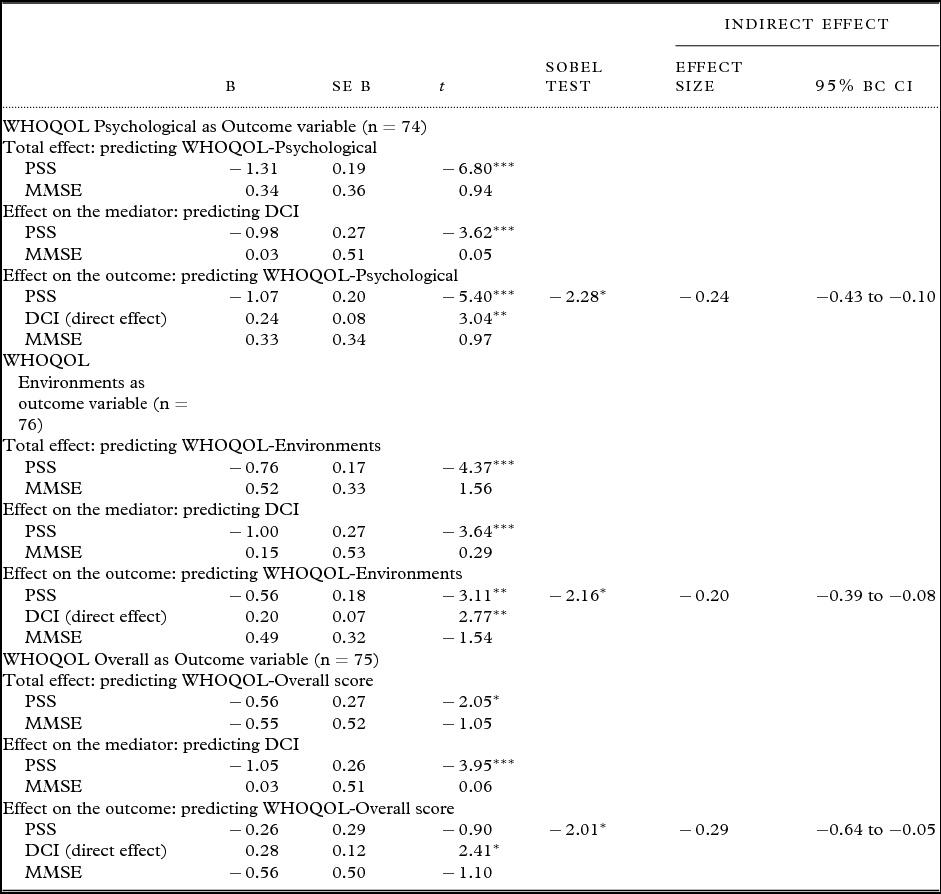
Notes: B: unstandardized coefficient; SE B: standard error of B; BC CI: bias-corrected bootstrap confidence interval; DCI: Dyadic Coping Inventory; PSS: Perceived Stress Scale; WHOQOL-BREF: World Health Organization Quality of Life; MMSE: Mini-Mental State Examination. Mediation models with non-significant indirect effects were not presented.
*p < 0.05; **p < 0.01; ***p < 0.001.
Mediation model for dyadic coping and relationship quality
In our mediation model, we found no mediating effects of dyadic coping and relationship quality in dementia patients, but could show these effects in spousal caregivers.
Mediating effect of dyadic coping on WHOQOL overall
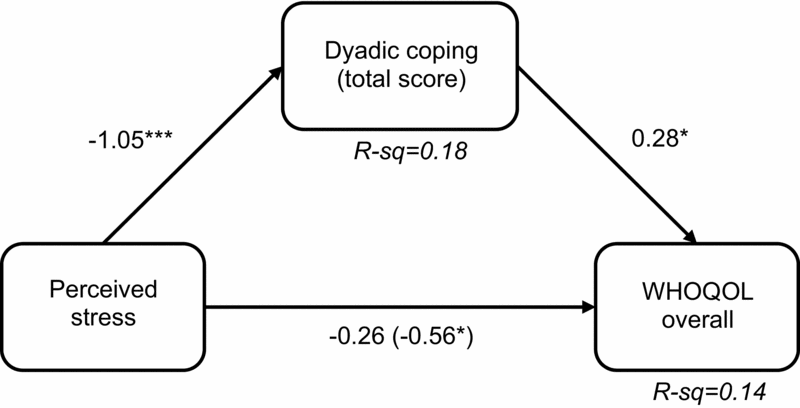
The indirect effect of perceived stress on WHOQOL overall score via Dyadic Coping total score was −0.29 (−0.64, −0.05) with a 95% bootstrapped CI. This did not include zero indicating the mediation to be significant (Sobel test z = −2.01, p = 0.04). Looking at the mediation model in more detail, the total effect path (Step 1), where WHOQOL overall score was regressed on perceived stress only, turned out to be significant (total effect: B = −0.56, t(72) = −2.05, p = 0.04). The regression of stress on the proposed mediator Dyadic Coping total score (Step 2) was also shown to be significant (B = −1.05, t(72) = −3.96, p < 0.001). Furthermore (Step 3), the proposed mediator (Dyadic Coping total score) was significantly associated with WHOQOL overall score controlling for stress (direct effect: B = 0.28, t(71) = 2.41, p = 0.02), whereas perceived stress was not a significant predictor of WHOQOL overall score (B = −0.26, t(71) = −0.90, p = 0.27). This implies that the Dyadic Coping total score fully mediates the relationship between perceived stress and WHOQOL overall score (see Figure 1).
Dyadic coping (total score) as a mediator between partners’ perceived stress and overall QoL in spousal caregivers.
Notes: *p < 0.05; ***p < 0.001. Regression coefficients of MMSE score of the patient on WHOQOL overall and on dyadic coping (total score) were not displayed. The indirect effect of perceived stress on WHOQOL overall score via Dyadic Coping total score was −0.29 (−0.64, −0.05) with a 95% bootstrapped confidence interval which did not include zero indicating the mediation to be significant (Sobel test z = −2.01, p = 0.04). Total effect of perceived stress on WHOQOL overall is shown in brackets. Unstandardized path coefficients were shown.

There were additional partially mediating effects of dyadic coping on the subscales WHOQOL psychological and environmental, as shown in Table 2.
Mediating effect of relationship quality on WHOQOL psychological score
The indirect effect of perceived stress on psychological QoL via relationship quality was −0.21 (−0.51, −0.04), with a 95% bootstrapped CI, which did not include zero (Sobel test z = −2.05, p = 0.04). Perceived stress was significantly related both to psychological QoL (Step 1, total effect: B = −1.40, t(75)= −7.32, p < 0.001) and to relationship quality (Step 2, B = −0.15, t(75)= −3.88, p < 0.001). Next (Step 3), relationship quality was associated with psychological QoL (direct effect: B = 1.38, t(74) = 2.49, p = 0.01), controlling for perceived stress. Perceived stress remained a significant predictor of psychological QoL although with a small reduction in the effect (B = −1.19, t(70) = −5.89, p < 0.001). The effect of perceived stress on psychological QoL can be considered as partially mediated by relationship quality.
Mediating effect of relationship quality on WHOQOL overall
The indirect effect of perceived stress on WHOQOL Overall score via relationship quality was −0.39 (−0.75, −0.15), with a 95% CI, which did not include zero (Sobel test z = −2.41, p = 0.02). The total effect of perceived stress on WHOQOL overall was significant (Step 1, total effect: B = −0.67, t(76)= −2.40, p = 0.02; and, as before, the effect on relationship quality was also significant (Step 2, B = −0.16, t(76) = −4.28, p < 0.001). However, relationship quality (Step 3) was associated with WHOQOL Overall score (direct effect: B = 2.38, t(75) = 3.01, p = 0.004) controlling for perceived stress, which turned out to be insignificant in this analysis, implying a full mediation of the relationship between perceived stress and WHOQOL overall scores via relationship quality.
In a model that contained both of the proposed mediators in parallel, the direct effect from dyadic coping (direct effect: B = 6.47, t(75) = 1.41, p = 0.16) as well as from relationship quality (direct effect: B = 1.72, t(75) = 1.87, p = 0.07) on WHOQOL Overall score became insignificant. Although the total indirect effect of dyadic coping and relationship quality combined yielded a significant result (total indirect effect: B = −0.46 (−0.90, −0.20)), we subsequently focused on simple mediation models looking into dyadic coping and relationship quality separately. The nullification of the two direct effects in a parallel mediation model could be due to shared variance of dyadic coping and relationship quality in the outcome and due to power problems related to the small sample size. The variance inflation factor (VIF) was 1.53 for dyadic coping and relationship quality indicating multi-collinearity was not present to a critical degree.
Discussion
Perceived stress
In patients suffering from dementia, we found a stress level comparable to other persons aged 65 years or older in normative studies (Cohen and Williamson, Reference Cohen, Williamson, Spacapan and Oskamp1988). In contrast, and consistent with the literature, spousal caregivers reported significantly higher stress levels as compared to their partners suffering from dementia (p = 0.003; see Table 1). We found no significant gender differences in perceived stress, neither in patients nor in their partners. Compared to other studies (Oken et al., Reference Oken, Fonareva and Wahbeh2011) that examined the stress level by means of the PSS-14 in different kinds of dementia caregivers, the spousal caregivers in our sample showed higher perceived stress. An explanation could be that spousal caregivers – living together with the patient – may be more affected by stress than offspring caregivers or professional caregivers generally included in such studies. This assumption is confirmed by findings of earlier studies (Brodaty and Hadzi-Pavlovic, Reference Brodaty and Hadzi-Pavlovic1990; Balducci et al., Reference Balducci, Melchiorre, Quattrini and Lamura2008), that spousal caregivers of dementia patients perceive their role as more stressful than non-spousal caregivers. Thompson et al. (Reference Thompson2004) examined only spousal caregivers, and reports higher PSS scores than in our sample. At the same time, we could not replicate the gender differences in caregivers’ stress found by Thompson et al.
Quality of life
Patients’ QoL in our sample is comparable to the findings of Bruvik et al. (Reference Bruvik, Ulstein, Ranhoff and Engedal2012) and Kaufman et al. (Reference Kaufman, Anaki, Binns and Freedman2007). Spousal caregivers’ overall score of the WHOQOL is a little lower than the score of the normative data for German adults of the same age, and 8 points lower than the score of caregivers of stroke patients (de Lima et al., Reference de Lima, Santos, Sawada and de Lima2014). In a study by Amendola et al. (Reference Amendola, Oliveira and Alvarenga2011) mostly female family caregivers of handicapped people showed a lower WHOQOL overall compared to our sample, while Grazziano et al. (Reference Grazziano, Reis, Leda and Lopes2014) found higher scores in caregivers of dementia patients, who were also mostly female.
Dyadic factors
Dyadic coping turned out to be a mediator on the relationship between stress and QoL in partners. This result supports the theory of Martin et al. (Reference Martin, Peter-Wight, Braun and Scholz2009), which suggests that dementia dyads that report effective dyadic coping and are able to adapt their way of supporting each other, can reduce the negative impact of stress and stabilize dyadic well-being. Furthermore, findings from our mediation model suggest that relationship quality is clearly mediating the stress/QoL relationship. In our study, relationship quality mediated the relationship between stress and overall QoL, as well as psychological QoL in the caregiving partner of the dyad, but not in the dementia patient. Dementia and caregiving can have a negative impact on the quality of the relationship between caregiver and care-recipient (Quinn et al., Reference Quinn, Clare and Woods2009). Nevertheless, certain aspects of spousal communication remain intact despite the progressive course of dementia, and many dementia partners maintain a sense of emotional closeness with their partner and still perceive some sense of marital satisfaction (Gallagher-Thompson et al., Reference Gallagher-Thompson, Dal Canto, Jacob and Thompson2001). Marital relationship has an impact on the caregiver's well-being, in that spouses who describe the caregiving experience as being a continued spousal connection and integrated the caregiving role in the marital relationship showed lower distress levels, lower burden, and higher caregiver competence (Lewis et al., Reference Lewis, Hepburn, Narayan and Kirk2005). Thus, dyadic coping significantly affects caregivers’ well-being.
Nevertheless, we see dyadic coping and relationship quality as related but not similar constructs. Dyadic coping is based on Transactional Model of Stress and Coping (1984) by Lazarus and Folkmans and is “viewed as a process in which three factors operate and interact: the stress signals of one partner, the perception of these signals by the other partner, and the reaction of this partner to the stress signals.” (Bodenmann, Reference Bodenmann2008b, p. 108). Dyadic coping with stress can be one factor among others that influence relationship quality. In a meta-analysis of 13 studies, Bodenmann found an average correlation between dyadic coping and relationship quality of r = 0.52, which affects particularly emotional supportive dyadic coping and common dyadic coping (Bodenmann, Reference Bodenmann2000).
There is, however, little prior evidence regarding the impact of relationship quality on the care recipient's well-being. Studies have found that the relationship with caregivers is an important component of the experience of living with dementia. Clare et al. (Reference Clare2012) found an association between better perceived relationship quality with the partner and better perceived QoL in people with dementia, and Woods et al. (Reference Woods2014) found that a good quality of the relationship with the family caregiver rated by the person with dementia was related to an increased QoL in people with dementia. We found a direct effect of stress on QoL in patients, suggesting that dyadic coping may not play a key role in reducing the negative impact of stress in patients suffering from dementia.
Given the worldwide demographic changes, an increase of dementia is to be expected (WHO, 2015). This, in turn will impact spousal caregivers’ disease-related distress. Although the resulting caregiver burden may not always be avoided, the relationship of stress and QoL can be modified, as our results show. A better understanding of the role of dyadic factors, e.g. dyadic coping and marital relationship quality, in the relation between stress and QoL should help to develop more effective dyadic interventions that can address differential effects of stress and coping in patients and caregivers, respectively. The consideration of dyadic aspects (i.e. improvement of individual and dyadic stress coping skills, shared problem solving, dementia-related dyadic communication competences) may aid primary care providers to offer specific interventions to improve the QoL of patients and their caregiving partners. However, we cannot specify from our study which aspects of dyadic coping mediate the effect of stress on QoL since our results refer to the DCI total score as a mediator.
Limitations
The strength of our study is that we demonstrated for the first time how a dyadic perspective rather than a separate view of dementia patients or caregivers issues can inform clinical interventions aimed at improving QoL in patients and caregivers.
The focus on community-dwelling dementia-affected couples complicated recruitment of participants and limited the sample size. As mentioned in the methods section, we therefore did not initially execute a statistical correction for multiple analyses. In the present study, a Bonferroni adjustment – which is discussed controversially in different aspects (Perneger, Reference Perneger1998) – would lead to trend-level effects in two of the reported mediation models (for mediation-model “DCI on PSS/WHOQOL overall”, p = 0.0444; for mediation-model “relationship quality on PSS/WHOQOL psychological score”, p = 0.0406), while the mediating effect of relationship quality on stress and overall QoL would remain significant.
The use of the MMSE as a tool for staging dementia severity is contentious; however, prior studies have shown some degree of external validity using, e.g. the Clinical Dementia Rating (Perneczky et al., Reference Perneczky, Wagenpfeil, Komossa, Grimmer, Diehl and Kurz2006).
Most of the patients in our sample suffered from mild dementia. The results of our study may not be generalizable to more severe dementia stages. It is possible that decline of cognitive functioning and ADL skills in dementia patients may lead to a reduction of dyadic coping in the couple, which may in turn increase caregiving partners’ perceived stress.
Conflict of interests
None.
Description of author´s roles
Häusler and Sánchez contributed equally to this work and Rapp and Nordheim shared last authorship. Rapp and Nordheim contributed in formulating the research questions and designing of the study. Rapp, Nordheim, Häusler, Krause-Köhler carried out the study. Statistical analysis and initial interpretation was done by Sánchez, Häusler, Nordheim, and Gellert. All authors contributed to the drafting and critical revision. Rapp obtained funding.
Acknowledgments
This study was funded by the German Federal Ministry of Education and Research (DYADEM trial, BMBF 01ET1001A).