INTRODUCTION
During the course of their disease, patients with cancer receiving palliative chemotherapy receive extensive amounts of information from physicians about diagnosis, prognosis, and therapy, which is considered important for the patient's autonomy and decision making (Schildmann et al., Reference Schildmann, Ritter and Salloch2013). Communication between patients and physicians is a complex and dynamic process. Several studies have shown that the majority of patients want as much information as possible about their diagnosis and prognosis, but patients do not always ask their physicians about such things (Barclay et al., Reference Barclay, Blackhall and Tulsky2007). Patients often express ambivalence about learning the whole truth when given bad news (Barclay et al., Reference Barclay, Blackhall and Tulsky2007; Innes & Payne, Reference Innes and Payne2009). In a study by Kutner et al. (Reference Kutner, Steiner and Corbett1999), all of their study respondents wanted their physicians to be honest, but 91% also wanted their physicians to be optimistic.
The patient's needs and wishes for information change during the course of cancer (Barclay et al., Reference Barclay, Blackhall and Tulsky2007). In a study by Schildmann et al. (Reference Schildmann, Ritter and Salloch2013), patients with pancreatic cancer described two stages of information and treatment decision making: the first included a feeling of having no choice and a feeling of having trust in the physician, while in the second stage patients played a more proactive role in information and decision making. Grunfeld et al. (Reference Grunfeld, Maher and Browne2006) showed that women with advanced breast cancer had greater information needs while being offered first-line chemotherapy compared to second-line treatments. There are indications in the literature that information can improve as well as degrade quality of life in palliative care. For example, accurate prognostic knowledge has been associated with anxiety and a lower quality of life (El-Jawahri et al., Reference El-Jawahri, Traeger and Park2014), and information about transition to end-of-life care has been associated with increased quality in end-of-life care without signs of worse pain or anxiety (Lundquist et al., Reference Lundquist, Rasmussen and Axelsson2011).
There are several contemporary examples in the literature of patients who received palliative chemotherapy or palliative radiotherapy but were not aware of their prognosis and the goals of care (Elkin et al., Reference Elkin, Kim and Casper2007; Chow et al., Reference Chow, Andersson and Wong2001; Mitera et al., Reference Mitera, Zhang and Sahgal2012; Lennes et al., Reference Lennes, Temel and Hoedt2013; Burns et al., Reference Burns, Broom and Smith2007; Weeks et al., Reference Weeks, Catalano and Cronin2012; Chen et al., Reference Chen, Cronin and Weeks2013; El-Jawahri et al., Reference El-Jawahri, Traeger and Park2014). In one study from 2007, the majority of elderly patients with metastatic colorectal cancer reported that chemotherapy was somewhat likely or very likely to cure them (Elkin et al., Reference Elkin, Kim and Casper2007). Mistaking palliative treatments as curative can cause patients to make treatment decisions that they might not make if they fully acknowledged their situation (Lennes et al., Reference Lennes, Temel and Hoedt2013).
Even if patients understand the goals of care, they can misunderstand the survival benefit from palliative chemotherapy. Palliative chemotherapy often causes considerable toxicity and offers modest survival benefits, which can make a physician's decisions about initiating or ceasing treatment difficult (Audrey et al., Reference Audrey, Abel and Blazeby2008). In addition, patients tend to overestimate their expected survival (Lux et al., Reference Lux, Bayer and Loehberg2013; Mende et al., Reference Mende, Trautmann and Rentsch2013).
Graugaard et al. (Reference Graugaard, Rogg and Eide2011) examined patient–physician meetings regarding prognostic information in hematological and rheumatologic settings and showed that one strategy that physicians use for softening bad news is to emphasize that the future development of the disease is uncertain, which was also found by The et al. (Reference The, Hak and Koeter2001). The practice of disclosing information to the patient varies (Hancock et al., Reference Hancock, Clayton and Parker2007). In Sweden, the practice usually is to inform patients about their health status, which is also prescribed by current law (Socialdepartementet, 2014).
A patient having an overly optimistic view of their prognosis is not only a matter of physician nondisclosure or lack of communication skills (The et al., Reference The, Hak and Koeter2001). The and colleagues showed that both patients and physicians focus on the treatment plan in the short term rather than on the prognosis (The et al., Reference The, Hak and Koeter2001). Patients with colorectal and breast cancer can use ongoing chemotherapy to deliberately shift their attention from the approaching end of life, which suggests that anxiety concerning the future can be a reason for wanting chemotherapy (Buiting et al., Reference Buiting, Terpstra and Dalhuisen2013). Jacobsen et al. (Reference Jacobsen, Thomas and Jackson2013) proposed several reasons for a patient to seemingly misunderstand information, including healthy coping strategies, language barriers, impaired cognitive function, and receiving conflicting information because of physicians having difficulties with prognostication or wanting to offer hope to the patient.
It is not fully understood why patients sometimes misunderstand their prognosis and the goals of care, and patients' perspectives on palliative chemotherapy are certainly not completely known (Buiting et al., Reference Buiting, Terpstra and Dalhuisen2013). Very few studies using qualitative research have been conducted on the subject. Greater knowledge about the perspectives of patients with cancer regarding information from physicians during palliative chemotherapy may identify potential areas for improvement.
The objective of our study was to describe patients' perspectives on the information they receive from physicians during palliative chemotherapy regarding their cancer diagnosis, treatments, prognosis, and future planning.
METHODS
Participants and Sampling
This qualitative study involved 15 patients at an outpatient oncology clinic at a surgery department of a middle-sized hospital in Sweden. The inclusion criteria were as follows: adult, Swedish-speaking, diagnosed with incurable cancer one month or more before the face-to-face interview, received palliative chemotherapy (intravenous chemotherapy that aimed at prolonging life and/or alleviating symptoms but not to cure) at least once during the last three months, and an ECOG performance status (Sørensen et al., Reference Sørensen, Klee and Palshof1993) score of 0–3 (not completely bedridden). The exclusion criteria were: not able to give informed consent and communication disabilities that would hinder the interview process.
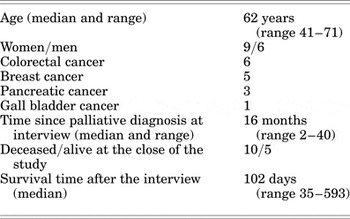
Participants were recruited using purposeful sampling, with the aim to include both women and men with a range of ages and cancer diagnoses. An initial sample size of about 15 patients was chosen based on the previous experience of the research group, supported by the findings of Guest et al. (Reference Guest, Bunce and Johnson2006), where saturation occurred within the first 12 interviews, meaning that no new information or themes were observed in the data thereafter. Suitable patients who met the criteria were selected by the second author in consultation with the clinic's oncology nurses, and 16 patients were contacted by the first author about participation via mail and telephone. No invited patient declined to participate. Participants were asked to choose a place for the interview. One of the 16 patients was excluded from the study at the interview meeting because of cognitive impairment. Information about cancer diagnosis, chemotherapy, and time of death was obtained from the medical records. Data on age, gender, cancer diagnosis, time since palliative diagnosis, and survival time for the remaining 15 patients is shown in Table 1.
Demographic information about the 15 participants

Interviews
The interviews were conducted in Swedish by the first author between May of 2013 and February of 2014. All participants chose to meet for the interview at the oncology outpatient clinic. A semistructured interview guide developed by the authors was employed that contained question areas concerning perspectives on information about diagnosis, treatment, prognosis, and future planning. Examples of initial questions and leading statements are as follows: “What information have you been given about your disease?” and “Tell me about your treatment.” The follow-up questions included: “Tell me more—” and “How did you feel about that?” At the end of an interview, participants were asked if there was anything else they wanted to add. The interviews were audiotaped and transcribed verbatim by the first author and had a median duration of 51 minutes, ranging between 36 and 89 minutes.
Data Analysis
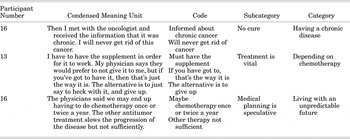
Qualitative content analysis using the manifest content of the interviews (Graneheim & Lundman, Reference Graneheim and Lundman2004) was used, since the aim of the study and the semistructured questions posed during interviews was to capture participants' perspectives. An inductive approach was chosen since there was no earlier theory or model about the phenomenon upon which to base our analysis. The transcribed interviews were read and reread to gain an initial understanding of the text. Meaning units referring to the same central meaning and related to the objective of the study were identified, condensed into fewer words with their essence preserved, and coded. Codes with closely related meaning units were sorted together into subcategories, which were then organized into categories to reflect the central content (Table 2). A category was defined as a “collection of similar data sorted into the same place” (Morse, Reference Morse2008). The authors have different clinical backgrounds: LM is a junior physician, BA is a surgeon and palliative medicine specialist, and CMJ is a specialist nurse with experiences from specialized palliative care, surgery, and primary care. All authors discussed the naming of categories and subcategories to obtain the clearest descriptions. It was not possible to check the results with participants since a majority of them were not alive when the analysis process was completed.
Illustration of the analytical process from meaning units to categories

Ethics
Our study was approved by the local ethics committee in Umeå, Sweden (registration number 2013/333-31Ö), and by the head of the surgical department. All participants received written and verbal information about the study prior to the interview, and written and verbal consent was obtained concerning data collection using interviews and medical records. They were informed that they could withdraw from the study at any time without affecting their future care. In the event that participants described any medical concerns during the interviews, there was a procedure for conveying these concerns to the responsible nurse, physician, or social worker, as long as the participant gave his or her consent to do so.
RESULTS
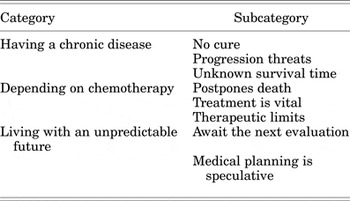
Three categories were disclosed during the analytical process: ‘having a chronic disease’, ‘depending on chemotherapy’, and ‘living with an unpredictable future’. Each category arose from two to three subcategories (Table 3). Quotes from the interviews, marked with the assigned number for each participant, are shown in the next section as illustrations of the subcategories.
Categories and subcategories

Having a Chronic Disease
No Cure
Participants described being informed that they had a chronic disease, and they therefore compared their cancer to other chronic illnesses, such as asthma or diabetes. They were informed that treatment would not cure them. This turned out to be difficult for them to grasp, and they often responded with anger and doubt. To understand the meaning of this message was a time-consuming process, but they appreciated the fact that the information had been direct and honest. The participants expressed hope about miracles and new or experimental treatments with the possibility of a cure, but they also described their situation as impossible to influence in any way:
And there was no way the tumor could be removed either. So I got that information straight up—no beating around the bush, so to speak. Which was good. If it's too sugarcoated, you're not sure of what you've heard. It has to be stated clearly. (7)
Progression Threats
Participants understood that they were not in imminent danger of dying, but they were aware that their situation could change rapidly at any point due to disease progression. Sometimes the physicians had emphasized that the chemotherapy may have potentially life-threatening side effects, which was perceived as a threat to life from time to time. Some participants also had previous experiences of treatment, thus underlining this threat. Even if the physicians had conveyed that the disease was under control for now, participants nevertheless felt that there was always a risk that the disease would suddenly flare up and become much worse:
It's like living with a pistol against your head, and Russian roulette, and not knowing whether it's going to go “click” this time or not. (16)
Unknown Survival Time
Participants had discussed survival time in general terms with their physicians, and some had asked about explicit survival time or whether they would live long enough to experience a specific event. The physicians had given patients some idea of survival time (ranging from weeks to many years for different individuals) but had also said that these prognostications were uncertain. Participants experienced that most physicians were cautious and did not dare to talk more explicitly about survival time. Some participants wished for more details based on general statistics, but comprehension was expressed for the fact that physicians were not able to provide that. Other participants were uninterested in speculating about survival time or felt unsure as to whether they would be able to handle more explicit information:
I understand the physicians who can't say anything. It's stupid. There are—it happens that they tell the patient, and then the patient outlives the prognosis by ten years. So, obviously, the physicians have to be careful about that. (5)
Depending on Chemotherapy
Postpones Death
After delivering the message about incurable cancer, the physicians had stated that there was palliative chemotherapy available. It had sometimes been explained that the chemotherapy could affect the cancer by stopping or reducing the growth rate of the tumors, or even by shrinking them. It was also common that physicians had used metaphors to explain the effect of palliative chemotherapy: “to hold the cancer in check” or “to apply a brake on the cancer.” The participants perceived that the palliative chemotherapy had the ability to postpone death, and so it was regarded as a lifeline:
They [the physicians] don't say it … cures the disease. They say it keeps it in check … They—they don't say it cures the disease or removes the tumor. They want to give me more time, slow things down a bit. (11)
Treatment Is Vital
Participants reported that their only option had been to accept the palliative chemotherapy offered, even though their right to decline had been stressed. They perceived that chemotherapy was both physically and mentally important and were willing to accept it in spite of potentially bothersome or dangerous consequences. The option of treatment was not perceived as a real option. Participants expressed that there was nothing else to choose from but an earlier death. If the start of chemotherapy was delayed or if a single dose of chemotherapy was not given, participants became very distressed and worried about what would happen to the cancer without treatment. Having blood values too low for treatment could be experienced as a personal failure:
Like I said to the nurse just now, “But what's going to happen now, if I don't get [chemotherapy]?” God! It'll be even worse! Can I cope with a week now without [chemotherapy]? I was, like, kind of upset, right? I am extremely goal oriented, and I said I consider it a personal failure. (5)
Therapeutic Limits
Participants had been informed by physicians that the outcomes of palliative chemotherapy are individualized and that no one could know whether the current treatment was going to have the wished-for effect. No participant had received statistical information about how likely it was that the treatment would cause the intended outcome. Some had been informed that the treatment was not going to work if they felt too unwell because of side effects and about a possible future cessation of chemotherapy. They had understood from previous occasional skipping of single treatments, reduced doses, or pauses due to side effects that their bodies would probably eventually be too worn down to withstand more chemotherapy. In some cases, the physicians also had informed them about a risk of becoming unresponsive to chemotherapy. Most participants felt unsure about how long it would be possible for the chemotherapy to continue and had not discussed it with their physicians, but future cessation of chemotherapy was seen as a threat to their existence:
When the day comes that I hear … if I learn, and when … that, “No, you're so full of cancer now, so there's no …” or “Your body cannot take any more chemo” … because, of course, that could happen—that it's just not possible any longer. (9)
Living with an Unpredictable Future
Awaiting the Next Evaluation
After regular radiological examinations for chemotherapy evaluation, participants usually met with the oncologist to discuss the next period of chemotherapy. There were other physicians available at the surgical clinic for acute problems, but other than that the participants seldom met with physicians during treatment periods. Some participants perceived that the role of the oncologist was mainly to discuss cancer treatment. The time until the next radiology examination and evaluation was described as a period of waiting and generated worries and fears about getting bad news from the physician:
It feels pretty hard, I have to say … I'm going to start taking this treatment. Then—then I'll wait for the next X-ray and … It feels sort of like a wait, somehow, when you have to wait for your next X-ray, and then the next X-ray. (8)
Medical Planning Is Speculative
In conversations with the physicians, participants perceived the medical plans as not going on further than the next radiological evaluation. Sometimes future treatment plans had been discussed, but only in speculative terms—for example, that the type of chemotherapy might be changed later. Some participants wanted more information about future plans, but others had come to the conclusion that it was impossible for the oncologist to accurately answer questions about treatment planning in the longer term. This uncertainty about how and when chemotherapy would be evaluated and given in the future made their personal lives harder to plan:
Like the primary breast cancer. Then, of course, you can draw a map … It's like a finished template. Yeah, but you're going to get six rounds of chemo. And then there's the radiation … And perhaps this path isn't so straight, but has more twists and turns, and it's harder to make a map. (15)
DISCUSSION
This study showed that when patients with cancer met with their physicians, the information they received was direct and honest regarding the fact that the cancer was incurable and would shorten their lives. They were also informed that the palliative chemotherapy was not curative, could have life-threatening side effects, and might cease at some points in the future. This prognostic information awoke strong feelings, and participants perceived themselves as having a chronic disease, being dependent on chemotherapy, and having an unpredictable future. Compared with other studies (Elkin et al., Reference Elkin, Kim and Casper2007; Chow et al., Reference Chow, Andersson and Wong2001; Mitera et al., Reference Mitera, Zhang and Sahgal2012; Lennes et al., Reference Lennes, Temel and Hoedt2013; Burns et al., Reference Burns, Broom and Smith2007; Weeks et al., Reference Weeks, Catalano and Cronin2012; Chen et al., Reference Chen, Cronin and Weeks2013; El-Jawahri et al., Reference El-Jawahri, Traeger and Park2014), the patients in our study seemed to be more aware of their prognosis and the goals of care. No other study that we found has examined which perceptions patients with incurable cancer have of information concerning the risk of dying as a consequence of palliative chemotherapy.
Participants had been informed that they had a chronic disease, and they compared it to asthma or diabetes, diseases with far better prognoses of survival time than advanced cancer. This can possibly be a way for physicians to soften bad news, which theoretically could foster patients' coping strategies. While it has been argued that cancer can be seen as a chronic disease (Markman, Reference Markman2011), it can be questioned whether patients fully understand the meaning of this.
Participants perceived a dependency on palliative chemotherapy and the possible future cessation of chemotherapy as a threat to their existence. No other studies that describe this have been found in the literature, but cessation of chemotherapy was described in a study by Back et al. (Reference Back, Trinidad and Hopley2014) as a moment when the patient knows that death is drawing closer. From a physician's standpoint, cessation of chemotherapy can be described as a way to carefully balance treatment choices to give as much benefit to a patient as possible. To continue with chemotherapy for too long into the progression of the disease could be a threat to a patient's existence by causing life-threatening side effects (Näppä et al., Reference Näppä, Lindqvist and Rasmussen2011). From a patient's point of view, the future cessation of chemotherapy seems to be thought of as an important event that will probably coincide in time with disease progression.
Coping strategies used by patients could be an explanation for wanting more chemotherapy. It has been described that patients with healthy coping strategies are not always realistic, and they could, for example, hope for a cure though informed that one is not possible (Jacobsen et al., Reference Jacobsen, Thomas and Jackson2013). Even if a patient is clearly informed about and understands a palliative prognosis, it does not necessarily mean that the patient will express this verbally (Friedrichsen et al., Reference Friedrichsen, Lindholm and Milberg2011), which could possibly hinder patient–physician communication about these issues. Salander (Reference Salander2003) has described how patients who have been informed about their progressive and life-threatening diseases sometimes express things that lead the healthcare team to believe that they have not understood the information given—for example, talking about plans for the future, which can be explained as a way to find meaning in life despite severe illness.
Similar to the results of our study, the feeling of having no choice other than the offered palliative chemotherapy was also found by Schildmann et al. (Reference Schildmann, Ritter and Salloch2013), where patients with pancreatic cancer described two stages of information and treatment decision making. The first stage included a feeling of no choice and a feeling of trust in the physician, while in the second patients took a more proactive role in information and decision making. The participants in our study perceived that it was stressful to not be able to get single doses of chemotherapy, and it generated worry about the disease getting worse. Similarly, Buiting et al. (Reference Buiting, Terpstra and Dalhuisen2013) found that chemotherapy-free periods were considered as more stressful by patients compared with periods when chemotherapy was given, despite better physical well-being.
Participants had not received much information about the expected outcomes of palliative chemotherapy. Audrey et al. (Reference Audrey, Abel and Blazeby2008) found that during discussions about starting palliative chemotherapy there was consistency in terms of informing patients that the chemotherapy did not aim to cure, but the amount of information given about survival benefits varied. The complexity of the topic may hinder adequate patient–physician communication.
The focus on short-term planning rather than a longer-term outlook, as shown by The et al. (Reference The, Hak and Koeter2001) and Buiting et al. (Reference Buiting, Terpstra and Dalhuisen2013), was also found in our study. This focus may be adopted by the patient as a way of coping with their situation (Buiting et al., Reference Buiting, Terpstra and Dalhuisen2013), but the physician focusing too much on short-term planning can also potentially hinder good patient–physician discussions about ending chemotherapy and about the future. In our study, a lack of discussion concerning the future made it unpredictable for participants. Back et al. (Reference Back, Trinidad and Hopley2014) examined patient–physician conversations about ending chemotherapy in patients with cancer and bereaved family members and found that the participants preferred that physicians focus on the future rather than review medical history. They also wanted physicians to be experts and guide patients about what happens after cessation of chemotherapy.
Methodological Considerations
Qualitative content analysis of the manifest content of the interviews was chosen, as the purpose of our analysis and the interviews was to describe participants' perspectives. The analytical process is described in tables and each subcategory is illustrated by quotation for clearness.
The study design of face-to-face interviews facilitated examining the information process, but there was the risk that participants had given answers during the interviews that they thought the interviewer wanted to hear. It is also possible that participants did not remember the source of information correctly during interviews.
It cannot be stated to what extent participants misunderstood the information they had received. All participants were patients at the same hospital, and so they had met a small number of physicians who potentially shared the same way of communicating with patients about these issues, which can be seen as a weakness regarding transferability. The inclusion of both women and men of different ages and with cancer diagnoses strengthens the generalizability of our results to other similar settings.
Clinical Implications
The participants in our study were aware of the palliative nature of their disease but also described uncertainty about survival time, treatment outcomes, and longer-term planning, which awoke strong feelings and was difficult to grasp. This may explain the tendency of patients to misinterpret or forget information. When physicians talk with patients about prognosis and palliative chemotherapy, it is important to keep in mind that patients can react with strong emotions, which may hinder information transfer. It is important for patients to be able to communicate several times with their physicians to sort out misunderstandings, but physicians could also dispel some of the perceived uncertainty by communicating more clearly about these issues.
ACKNOWLEDGMENTS
We would like to thank the staff at the department where the interviews were conducted for their kind assistance with patient recruitment and for their other help adjacent to the interviews.