INTRODUCTION
The giant devil ray Mobula mobular (Bonnaterre, 1788) is an epipelagic (Tortonese, Reference Tortonese1956; Brito, Reference Brito1991) and aplacental viviparous (Capapé & Zaouali, Reference Capapé and Zaouali1976; Dulvy & Reynolds, 1997) batoid. This species has a cosmopolitan distribution (Froese & Pauly, Reference Froese and Pauly2008), though it is considered Atlanto-Mediterranean by some authors (Fischer et al., Reference Fischer, Bauchot and Schneider1987; Capapé et al., Reference Capapé, Bouchereau and Tomasini1990) or at least endemic to the Mediterranean Sea by others (Notarbartolo di Sciara & Bianchi, Reference Notarbartolo di Sciara and Bianchi1998). In fact its occasional occurrences are documented for the eastern Atlantic (MacEachran & Capapé, Reference McEachran, Capapé, Whitehead, Bauchot, Hureau, Nielsen and Tortonese1984) and the Mediterranean Sea (Fischer et al., Reference Fischer, Bauchot and Schneider1987), being particularly concentrated in the latter area (Notarbartolo di Sciara & Bianchi, Reference Notarbartolo di Sciara and Bianchi1998; Serena, Reference Serena2005). The giant devil ray was recorded mostly in the western basin of the Mediterranean Sea, from its northern and central areas (Lacépede, Reference Lacépede1803; Risso, Reference Risso1810; Duméril, Reference Duméril1865; Moreau, Reference Moreau1881; Carus, Reference Carus1893; Lozano Rey, Reference Lozano Rey1928; Tortonese Reference Tortonese1956, Reference Tortonese1957; Grassé, Reference Grassé1958; Bougis Reference Bougis1959; Granier, Reference Granier1964; Krefft & Stehmann, Reference Krefft, Stehmann, Hureau and Monod1973; Capapé et al., Reference Capapé, Bouchereau and Tomasini1990; for Italian occurrences see below) to the southern ones, such as Tunisian (Capapé & Zaouali, Reference Capapé and Zaouali1976; Bradai & Capapé, Reference Bradai and Capapé2001) and Algerian waters (Guichenot, Reference Guichenot1850; Pellegrin, Reference Pellegrin1901; Dieuzeide et al., Reference Dieuzeide, Novella and Roland1953; Hemida et al., Reference Hemida, Mehezem and Capapé2002). Contrastingly, a low number of occurrences and sights indicated the species to be present in the eastern Mediterranean basin, i.e. Israeli (Ben Tuvia, Reference Ben Tuvia1971; Golani, Reference Golani1996; Golani & Levy, Reference Golani and Levy2005) and Greek waters (Ondrias, Reference Ondrias1971; Economidis, Reference Economidis1973). The present record represents the first documented occurrence of the giant devil ray for the Adriatic Sea, updating the geographical distribution of this species in the Mediterranean. Data are discussed in the context of previous records and distribution of this species.
MATERIALS AND METHODS
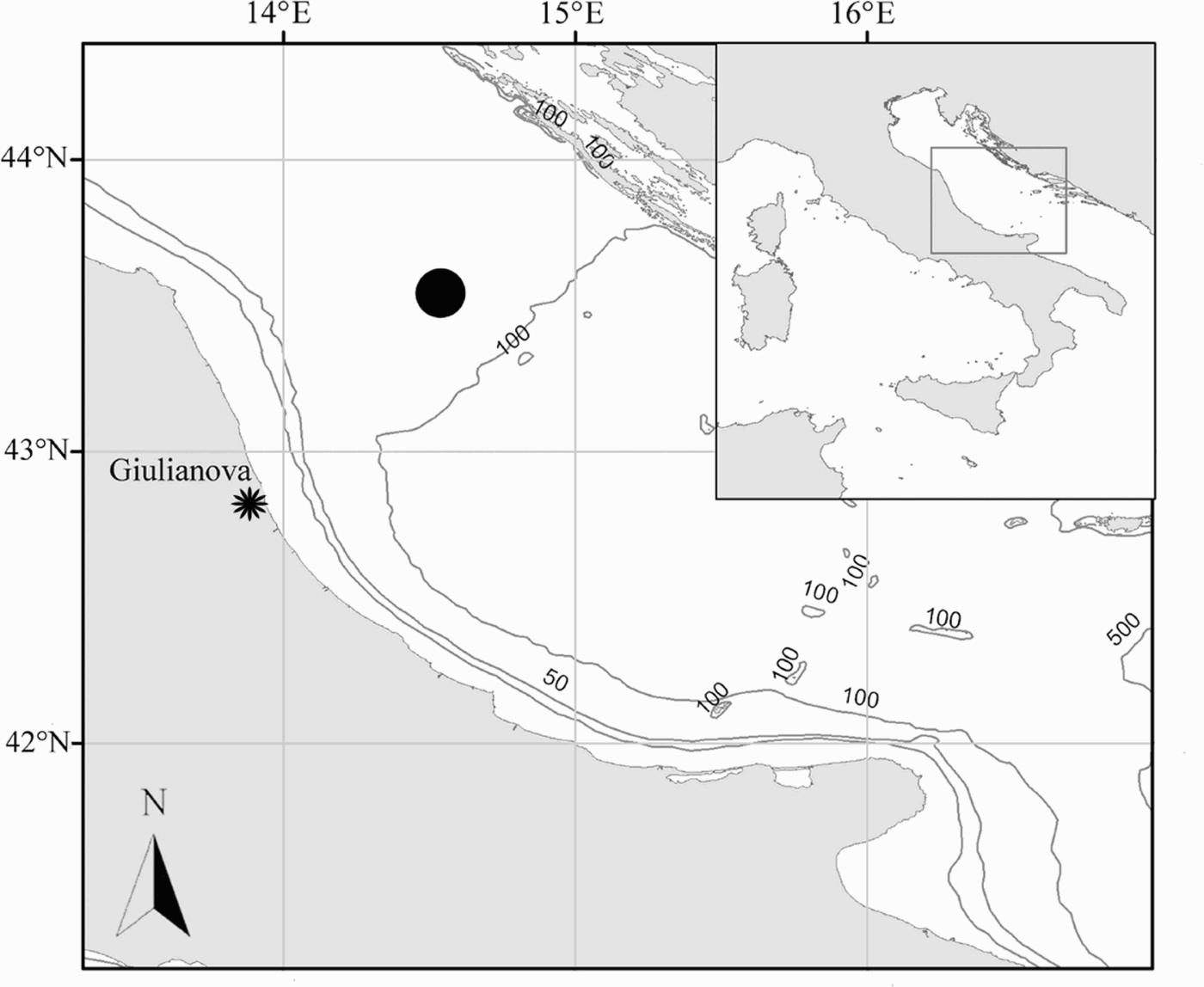
The present catch of the giant devil ray specimen occurred during the framework of the European monitoring programme ‘By-Catch II’, aimed at recording sea turtles, cetaceans and elasmobranch by-catches associated with the pelagic pair trawl fishing technique in the Adriatic Sea (Figure 1). Such a technique involves a pair of trawlers towing together a pelagic trawl net from dawn to sunset (Sassu et al., Reference Sassu, Cannas and Ferretti2001), targeting specifically small pelagic clupeids, such as Engraulis encrasicolus and Sardina pilchardus.
Map of the central Adriatic Sea representing the geographical position (filled circle) where the specimen of the giant devil ray Mobula mobular was by-caught by a pelagic pair trawler.

During opportunistic observations on board observers noticed that the by-caught batoid individual was trapped at the trawl net bottom before it was discharged alive on the boat deck. For this reason, morphometric measurements—disc length (DL), clasper (CL) and cephalic fin (CFL) length, disc width (DW) and total weight (W)—and photographs were quickly collected in order to facilitate the release at sea of the specimen in good condition. TL was measured from the tip of the cephalic fins to the tip of the tail. CL was measured from the tip of clasper to its insertion into the cloacal opening. CFL was the length between the tip of cephalic fin and its ventral insertion into the lower jaw. DW was the distance between wing's tips. All length measurements were taken by means of a tape measure and weight by means of a 1000 kg dynamometer. Taxonomic identification was based on dichotomic keys provided by Notarbartolo di Sciara & Bianchi (Reference Notarbartolo di Sciara and Bianchi1998) and Serena (Reference Serena2005).
RESULTS
The by-catch of a specimen of the giant devil ray occurred on 30 April 2008, during a pelagic pair trawl fishing trip in the central Adriatic Sea (43°16′978″N 14°29′197″E). The specimen was caught at early morning about 50 nm far from the Italian coastline, at a fishing depth of about 100 m. Fishing route was north-easterly with a boat fishing speed of 4 knots and weather conditions were good with calm sea and 2 knots north-westerly wind.
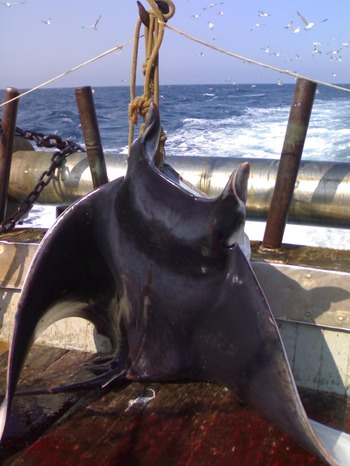
The specimen had a broad head with a straight anterior margin, cephalic fins well separated one from the other and with eyes and spiracles located laterally; the mouth was ventral, wide and straight, and presented small teeth. Pectoral fins were very large, compared to the dorsal and pelvic ones, and were acute at their tips. Body colour was dark-blue on dorsal surface whereas white on ventral surface. Claspers were well developed and calcified. Opportunistic observers noticed the presence both of the peculiar whitish arch-like shade located antero-dorsally and spine and prickles on the tail, confirming that the caught mobulid was Mobula mobular (Figure 2). The specimen was a male of 200 cm DL, 45 cm CL, 40 cm CFL, 300 cm DW and W of approximately 100 kg. When on board, the animal was alive and, after observers had quickly taken morphometric measurements, it was released at sea. After few minutes of immobility on its dorsal surface, the specimen restarted to purse regularly its gill openings augmenting breath ventilation. Subsequently, it regained its natural posture and it slowly swam deeper into the sea.
Dorsal view of the male specimen of the giant devil ray Mobula mobular by-caught by a pelagic pair trawler in the central Adriatic Sea.

DISCUSSION
Similarly to the whole Mediterranean Sea, documented records of the giant devil ray Mobula mobular for Italian seas are concentrated in the western part, from its norhern to southern basins: Risso (Reference Risso1810) and Boero & Carli (Reference Boero and Carli1979) for the Ligurian Sea, Bertolini (Reference Bertolini1934) off Ponza island; Notarbartolo di Sciara & Serena (Reference Notarbartolo di Sciara and Serena1988) and Vanni (Reference Vanni1992), off Tuscany coasts, for the central Tyrrhenian Sea; Doderlein (Reference Doderlein1881), probably off Palermo, and Di Natale (Reference Di Natale1997) recorded the species from the southern Tyrrhenian Sea. Celona (Reference Celona2004) reported several catches and sights in the Strait of Messina (Sicily, southern central Mediterranean) between 1970 and 2003.
Despite the fact that Jardas (Reference Jardas1996) included M. mobular in his Croatian fish faunistic list, documented records of this species are lacking in the Adriatic Sea. Therefore, the present occurrence is the first documented record of the giant devil ray from the Adriatic Sea.
The geographical distribution of M. mobular is still a matter of scientific debate. Notarbartolo di Sciara & Bianchi (Reference Notarbartolo di Sciara and Bianchi1998) hypothesized that this species may be considered endemic of the Mediterranean. Such a hypothesis is based on the higher frequency of records for this species in the Mediterranean, compared to other areas. Moreover, the authors hypothesize the existence of a seasonal migratory pathway in the Mediterranean: during the warm period (April–October); the lower surface water temperature in its northern area, compared to the southern one, could help the giant devil ray in migrating towards northernmost and cooler areas (Notarbartolo di Sciara & Bianchi, Reference Notarbartolo di Sciara and Bianchi1998; Bradai & Capapé, Reference Bradai and Capapé2001). This hypothesis was confirmed by Celona (Reference Celona2004) who observed small groups of M. mobular individuals to move northwards in late spring and summer time, sometimes together with some large marine animals, such as the common whale Balaenoptera physalus, dolphins (Tursiops truncatus, Stenella coeruleoalba), tunas (Thunnus thynnus) and other pelagic fish (Tetrapturus belone and Naucrates ductor). Furthermore, Hemida et al. (Reference Hemida, Mehezem and Capapé2002) noticed that Mediterranean records of the giant devil ray occurred in winter off its southern coasts, rather than in spring off the northern ones. In the present record; the giant devil ray specimen was by-caught at northern latitude, in middle spring.
On the other hand, according to Capapé et al. (Reference Capapé, Bouchereau and Tomasini1990; Reference Capapé, N'Dao and Diop1995), M. mobular is more likely an Atlanto-Mediterranean species because of the fact that it was also reported from the southern regions of the eastern Atlantic (Lozano Rey, Reference Lozano Rey1928; MacEachran & Capapé, Reference McEachran, Capapé, Whitehead, Bauchot, Hureau, Nielsen and Tortonese1984; Capapé et al., Reference Capapé, Diop and N'Dao1994, Reference Capapé, N'Dao and Diop1995) and, more recently from Irish waters (Quigley, Reference Quigley2006). In any case, likely taxonomic confusions with the circumtropical co-generic Mobula japanica (Notarbartolo di Sciara, Reference Notarbartolo di Sciara1987; Notarbartolo di Sciara & Bianchi, Reference Notarbartolo di Sciara and Bianchi1998), or the passage of M. mobular through the Strait of Gibraltar (Bradai & Capapé, Reference Bradai and Capapé2001) could not be excluded. According to Froese & Pauly (Reference Froese and Pauly2008), the giant devil ray has to be considered a cosmopolitan batoid since it has been reported also from the Indian Ocean (Kapoor et al., Reference Kapoor, Dayal and Ponniah2002), and, possibly, the species strays into the north-western Atlantic, from New Jersey to Cuba (Quigley, Reference Quigley2006).
This record concerned the catch of a single individual far from the coastline. According to the observed clasper condition and fish size (Capapé et al., Reference Capapé, Bouchereau and Tomasini1990), the caught specimen was considered as an adult individual. According to current knowledge, the giant devil ray was usually caught as a single and large individual (Capapé et al., Reference Capapé, Bouchereau and Tomasini1990). Pre-adult individuals were also observed, even if usually in groups ranging from 2 to 6 specimens both close to the coastline (Strait of Messina; Celona, Reference Celona2004) and in open waters (Ben Tuvia, Reference Ben Tuvia1971; Capapé et al., Reference Capapé, Bouchereau and Tomasini1990; Bradai & Capapé, Reference Bradai and Capapé2001; Golani & Levy, Reference Golani and Levy2005).
According to Di Natale (Reference Di Natale1997), all fishing gears and techniques dedicated to the fishing of large pelagic fish in the Mediterranean can potentially affect M. mobular. Based on recent literature, a wide range of fishing techniques and gears resulted to affect incidentally M. mobular: trammel nets (Bradai & Capapé, Reference Bradai and Capapé2001), otter trawl (Bradai & Capapé, Reference Bradai and Capapé2001; Hemida et al., Reference Hemida, Mehezem and Capapé2002), purse seine (Hemida et al., Reference Hemida, Mehezem and Capapé2002) and tuna purse seine (Capapé et al., Reference Capapé, Bouchereau and Tomasini1990), harpoons and drift nets (Celona, Reference Celona2004) and, including the present record, pelagic pair trawl also. In this case, the catch could have occurred either near to the surface, during the recovery of the net, or close to the bottom, while the net was targeting small clupeids, on which the giant devil ray usually feeds together with crustaceans (McEachran & Capapé, Reference McEachran, Capapé, Whitehead, Bauchot, Hureau, Nielsen and Tortonese1984).
As a matter of fact, the giant devil ray exhibits a very high vulnerability to fishing pressure (Cheung et al., Reference Cheung, Pitcher and Pauly2005). Notwithstanding that this species has been protected since 1995, thanks to the Annex II of the conservation of Mediterranean biodiversity, signed at the Barcelona Convention, it is so far categorized as an endangered species (EN A4) within the IUCN Red List (Notarbartolo di Sciara et al., Reference Notarbartolo di Sciara, Serena and Mancusi2006).
The new data provided in this biodiversity note, updates the geographical distribution and the fishing vulnerability of such a rare and fragile species. This information could help to establish a conservation strategy for the highly migratory giant devil ray, which urgently needs prompt protection synergies at larger geographical and institutional scales.
ACKNOWLEDGEMENTS
We would like to thank CoNISMa in the person of Dr Caterina Fortuna and Professor Antonio Mazzola for coordinating the project, funded by the Ministry of Agriculture, Food and Forestry, in compliance with EC Regulation 812/2004. We are particularly grateful to Captains Tonino and Michele Raffaele and their crews for collaboration and hospitality on board of the pair trawlers ‘Rebecca’ and ‘Nunzia’ belonging to the fleet of Giulianova. We also wish to thank the anonymous referees who reviewed the manuscript.