Introduction
The human whipworm, Trichuris trichiura, is a soil-transmitted helminth that is common in tropical and subtropical areas, and between 465 and 604 million humans are estimated to be infected with this parasite, accounting for 0.64 million disability-adjusted life-years (Pullan et al., Reference Pullan, Smith, Jasrasaria and Brooker2014).
The prepatent period is not known, but is normally considered to be about 60 days (Bundy & Cooper, Reference Bundy and Cooper1989), whereas it is known to be 6–7 weeks for the closely related Trichuris suis in pigs (Nejsum et al., Reference Nejsum, Roepstorff, Jørgensen, Fredholm, Göring, Anderson and Thamsborg2009). Eggs are shed with host faeces and will embryonate in the environment under favourable conditions.
In endemic areas, the prevalence of human trichuriasis increases with age during early childhood until a stable level is reached, which remains in the adult population. The intensity of infection with T. trichiura shows a somewhat different pattern, as it is highest among young children, declines in teenagers and the lowest levels are found among adults (Bundy, Reference Bundy1986). Whereas the change in infection levels among age groups probably reflects changes in host behaviour, the high prevalence found in all age groups underlines the chronic nature of this infection (Stephenson et al., Reference Stephenson, Holland and Cooper2000).
Drugs of choice for the treatment of T. trichiura are mebendazole (MBZ) and albendazole (ALB), and these anthelmintics are used extensively in mass drug administration (MDA) programmes, either as a single dose of 400 mg ALB or 500 mg of MBZ (WHO, 2013). However, a meta-analysis performed by Keiser & Ützinger (Reference Keiser and Ützinger2008), indicated that single-dose treatment of human trichuriasis is inefficient, resulting in cure rates below 40%.
The aim of the present study was to compare the expulsion dynamics of T. trichiura after MBZ treatment, when given as a single dose or multi-dose, in a person self-infected with this parasite. In addition, we would like to gain more fundamental knowledge on the prepatent period, egg excretion, lifespan and the chronic nature of T. trichiura infections under controlled clinical settings, as these studies, to our knowledge, have not previously been conducted.
Materials and methods
Experimental design
Two self-infection studies with T. trichiura were carried out by a healthy volunteer male (P.N.; age 38 years; weight 71–73 kg) with a 1-year interval.
Eggs for the first infection were obtained from a naturally infected human host from Uganda, and were isolated by wet sieving and embryonated for 3 months at 22°C in 0.05 m sulphuric acid (pH 1), according to in-house protocols, and then stored for 2 months at 5°C. Eggs deposited from this infection were isolated prior to treatment, using the same protocol, and were used in the second experiment.
First experiment
Six hundred infective eggs were ingested but, as faecal samples were negative after the expected prepatent period (8 weeks), another 650 infective eggs were ingested 9 weeks later. Sixteen weeks after the first ingestion of eggs, 100 mg of MBZ (Vermox™ © Janssen-Cilag Ltd, High Wycombe, Bucks, UK) was taken orally twice daily for five consecutive days. For estimation of number of T. trichiura eggs in the faeces, samples were collected weekly from 4 weeks prior to the first ingestion until 9 weeks post-treatment.
Second experiment
Six hundred infective eggs, originating from the first infection, were ingested and the course of infection was monitored for 23 weeks, after which a single dose of 500 mg of MBZ was taken (Vermox™). Weekly stool samples were collected from 2 weeks prior to ingestion and for the following 51 weeks, except for weeks 13, 14, 15, 20 and 30. In addition, samples were collected for weeks 60, 64, 68, 73, 78, 81, 86, 90 and 94. Two readings (technical replicates) were made on each sample. Due to logistic reasons, faecal samples from weeks 0–42 post-infection were frozen prior to estimation of faecal egg counts (FECs), except for weeks 16, 17, 18, 23 and 43 and onwards. At weeks − 4, 0, 12 and 47 post-infection (pi) blood samples were taken for eosinophil counts.
The identity of ten expelled worms as T. trichiura was confirmed by 18S sequencing followed by BLAST analysis in GenBank (unpublished data).
Faecal egg counts and worm recovery
The FECs were estimated using 4 g of faeces and the concentrated McMaster technique, which has a lower detection limit of 20 eggs/gram of faeces (epg) (Roepstorff & Nansen, Reference Roepstorff and Nansen1998). Egg count reduction rate (ERR) was calculated with the formula: [1 − (FECs post-treatment/FECs pre-treatment)] × 100. FECs 3 weeks post-treatment were used as recommended (WHO, 2013).
In both studies, stool samples were collected every day after MBZ treatment, and examined for the presence of worms by wet sieving, until no worms were recovered for two consecutive days. Simply, faeces were suspended in water, washed in a kitchen sieve (mesh size ~3 mm) and then carefully examined in a bucket. Recovered worms were stored in 70% ethanol, counted and sexed using a dissecting microscope.
Results
Faecal egg counts
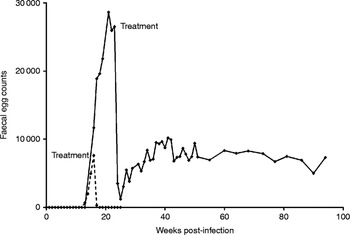
In Experiment 1, eggs were detected in faeces 13 weeks after first infection and FECs rose rapidly to 7620 epg by week 16 (fig. 1). After 5 days of dosing with MBZ, starting at week 16, the FECs dropped to zero within 2 weeks, giving an egg reduction rate (ERR) of 100% 3 weeks after (first) treatment.
Faecal egg counts (FEC) (eggs/g) of Trichuris trichiura as a function of time after (first) infection in Experiment 1 (–––, multiple MBZ dose) and Experiment 2 (——, single MBZ dose). In Experiment 2 samples were not taken on weeks 14, 15, 20, 30, 52–54, 56–59, 61–63, 65–67, 69–72, 74–76, 78–80, 82–85, 87–89, 91–93.

In Experiment 2, samples were missing for weeks 14 and 15, and the first positive sample had FECs of 11,680 epg 16 weeks pi and rose steadily thereafter, with a maximum FEC of 28,640 epg at week 21 pi. Due to stomach pain during the previous 4–6 weeks, a single dose of 500 mg MBZ at week 23 (26,520 epg) was taken and the FECs dropped subsequently to levels of 1210 epg at week 25, but soon egg excretion started to rise again. The FEC at week 26 was 3060 epg, giving a ERR of 88%. After some weeks FECs remained in the range around 6000–10,000 epg for the rest of the study period. The volunteer is still egg positive (February 2015). Blood eosinophil counts were within the reference range ( < 0.5 × 10⁹/litre) at weeks − 4 and 0 pi, rose to 1.09 × 10⁹/litre at week 12 and was just below the positive threshold at week 47 (0.45 × 10⁹/litres).
Worm expulsion
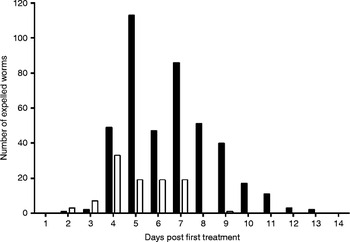
In both experiments, the first worms were recovered 2 days after the (first) treatment (fig. 2). In Experiment 1, the last worm was expelled on day 9 after commencement of the 5-day treatment, and the total number of worms expelled by treatment with multi-dose MBZ was 101. The week before MBZ treatment, 24 worms were removed during a planned colonoscopy, giving a total of 125 recovered worms. In Experiment 2, the last worms were recovered on day 13 after treatment and a total of 422 worms were expelled.
Worm expulsion of Trichuris trichiura as a function of time in Experiment 1 (white bars, multiple MBZ dose) and Experiment 2 (black bars, single MBZ dose). No faeces were produced on day 8 after treatment for Experiment 1. On day 6 in Experiment 2 reduced (~35%) faecal material was produced.

Sex ratio and fecundity
In Experiment 1, the FECs dropped from 7620 to 0 after treatment. Forty-two males and 83 females were recovered, giving a sex ratio of 66% and 92 epg/female. With a daily faecal production of 182 g (mean over 14 days), this gives fecundity around 16,700 eggs/female per day (assuming 100% recovery). In the second infection, the ERR was 89% 3 weeks after treatment and the numbers of recovered males and females were 199 and 223, respectively, giving a sex ratio of 53%. The epg/female was 105 and the fecundity was around 19,150 eggs/female per day. Having FECs of 3060 at week 26, this corresponds to about 30 females left in the host after treatment. However, considerably higher levels of egg excretion were found later on, indicating temporary suppression, or perhaps maturation of resting stages.
Discussion
To our knowledge, this is the first study describing the course of a chronic human T. trichiura infection under controlled settings. The experiments were carried out by one of the authors, by self-infections with the human whipworm, T. trichiura, once annually over a 2-year period. We fully acknowledge that this study only includes two experimental infections in the same individual, and general conclusions can therefore not be drawn. With this caveat in mind, it is, however, still believed that this unique study provides several key observations on T. trichiura, as discussed below.
In Experiment 1, applying five doses of MBZ (100 mg, twice daily), worm expulsion peaked at days 4–7. A total of 101 worms were expelled and the last worm was recovered by day 9. This pattern is similar to that reported by Olsen et al. (Reference Olsen, Namwanje, Nejsum, Roepstorff and Thamsborg2009), but differs from that reported by Bundy et al. (Reference Bundy, Thompson, Cooper and Blanchard1985), who found that the last worm was recovered by day 6 post-treatment. Unfortunately, faecal examination was terminated at day 7 post-treatment in the study by Olsen et al. (Reference Olsen, Namwanje, Nejsum, Roepstorff and Thamsborg2009), but this and the present study suggest a surprisingly long expulsion time of T. trichiura. This is further supported by Experiment 2 (500 mg MBZ), where the last worms were recovered by day 13 after treatment, and where similar expulsion dynamics were observed as found for multiple doses.
An observation from Experiment 2 that deserves particular attention, is the exceptionally high total number of worms being expelled, namely 422. First, this corresponds to a worm establishment rate of 70%, but since some worms survived treatment, the establishment rate is clearly even higher. Second, the number of recovered worms after this single dose is more than ten times higher than that recovered by Olsen et al. (Reference Olsen, Namwanje, Nejsum, Roepstorff and Thamsborg2009) after treating 21 infected children (mean intensity: 506 epg) with multiple MBZ doses.
Acquired immunity to helminths can result in different levels or types of immunity, e.g. protection against re-infections, lowering the female fecundity or worm expulsion (Stear et al., Reference Stear, Bishop, Doligalska, Duncan, Holmes, Irvine, McCririe, McKellar, Sinski and Murray1995). In areas of high endemicity, the intensity of infection with T. trichiura is age dependent, being considerably higher in children than in adults, while the prevalence also remains high in older humans (Bundy, Reference Bundy1986). As worms are expected to live for about 1 year (http://www.cdc.gov/parasites/whipworm/), a high prevalence among adults is indicative of re-infections and low acquired immunity to re-infections. The lower infection intensities, as measured by egg excretion among adults, is probably related to differences in behaviour and hygiene, leading to lower exposure; but acquired immunity specifically affecting egg-laying capacity, as is the case for sheep (Stear et al., Reference Stear, Bairden, Duncan, Holmes, Park, McKellar, Strain, Murray, Bishop and Gettinby1997), may also explain the age–intensity pattern. A generally low acquired immunity and the chronic nature of T. trichiura infection are supported in the present study, as the host was not able to clear the infection, which is evident by continuous egg excretion for more than 1 year (Experiment 2) despite no re-infection. In addition, even though the volunteer first had a T. trichiura infection (Experiment 1), the second infection established very well 1 year later. Thus, there was no indication of protective immunity.
The prepatent period was found to be 13–16 weeks in both studies, which is longer than the 8–9 weeks suggested by Bundy & Cooper (Reference Bundy and Cooper1989) but shorter than the 18 weeks reported by Horii & Usui (Reference Horii and Usui1985). However, in the latter study, humans were self-infected with non-identified Trichuris spp. from monkeys. In Experiment 1, a second dose was given 9 weeks after the first one and the prepatent period could be 4 weeks instead of 13. However, we find this unlikely when comparing it to the prepatent period of other Trichuris spp., and it would also be in contrast with the result obtained in the second experiment. Our study confirmed the enormous prolificacy of Trichuris (16,000–19,000 eggs/female per day), which is in the upper range of those values reported previously (Bundy & Cooper, Reference Bundy and Cooper1989), and documents that worms can live for at least 1 year and 10 months.
Acknowledgements
We gratefully acknowledge H. Namwanje, Vector Control Division, Ministry of Health, Kampala, Uganda for providing faecal samples from naturally infected human hosts.
Conflict of interest
None.
Ethical standards
The authors assert that all procedures contributing to this work comply with the ethical standards of our relevant national and institutional committees on human experimentation, in accordance with the Helsinki declaration of 1975, as revised in 2008. The responsible Central Denmark Region Ethical Committee found no reason to consider the protocol for formal ethical approval as the volunteer had taken part in planning the study and no other study participants were recruited. The study subject is an active researcher in parasitology and he proposed and designed the study. He volunteered by written consent for participation following complete written and oral information of the study plan and potential infectious and mechanical complications.