





Introduction
Maximum heart rate assessed directly during exercise tolerance testing can be used as a measured physiological parameter to confirm the degree of β-blockade in controlling heart rate and prevent exercise-induced arrhythmias and also to prescribe exercise training intensity. Reference Nikolaidis1,Reference Cleary, Hetzler, Wages, Lentz, Stickley and Kimura2 Indirect measurement of maximal heart rate relies on the use of prediction equations that estimate heart rate response to exercise, Reference Nes, Janszky, Wisløff, Støylen and Karlsen3,Reference Godlasky, Hoffman and Weber-Peters4 which is utilised when a maximal exercise tolerance test is either not possible or the individual completing the test is taking pharmacological therapy that blunts heart rate response to exercise. Indirect measurement is largely based on age regression formulas that predict a decline in maximal heart rate with age. The most commonly used prediction equation in clinical and non-clinical settings is an age regression formula originally designed for use in adults (Fox = 220-age Reference Fox, Naughton and Haskell5). Alternative age-predicted maximal heart rate equations have been proposed, some of which have been tested in children Reference Nikolaidis1,Reference Cleary, Hetzler, Wages, Lentz, Stickley and Kimura2,Reference Heinzmann-Filho, Zanatta and Vendrusculo6–Reference Colantonio and Kiss13 ; however, most paediatric studies have tested the equations on child and adolescent athletes for use in exercise training settings, or on those with specific chronic conditions, such as cerebral palsy Reference Verschuren, Maltais and Takken11 and childhood obesity. Reference Heinzmann-Filho, Zanatta and Vendrusculo6 Few of the published prediction equations have been tested for use on healthy, non-athletic children. The aim of the study was to examine the differences in measured and predicted maximal heart rate utilising published prediction equations, to determine their suitability for use in paediatric cardiology clinical practice.
Materials and methods
Patient population
Retrospective exertional heart rate data were collected for children with structurally and functionally normal hearts attending a single tertiary paediatric cardiology centre for exercise tolerance testing between 2015 and 2020. None were taking prescribed medications affecting heart rate. None had any physical restrictions in performing a treadmill exercise tolerance test. Local approvals were in place for this study. Consent was waived as data were collected retrospectively and anonymised. The data underlying this article cannot be shared publicly as data were collected retrospectively and consent was not obtained. The data will be shared on reasonable request to the corresponding author.
Exercise testing protocol
Exercise testing was performed using a GE T2100-ST2 treadmill and GE CardioSoft V6.73 software, following a locally validated 15-minute exercise testing protocol aimed at increasing heart rate quickly (high intensity protocol), which increases speed and incline at faster increments than traditional exercise tolerance testing protocols. The protocol consists of 7 stages, followed by a 6-minute recovery. Exercise tests were supervised by trained cardiac physiologists according to local protocol. Baseline 12-lead electrocardiogram, with modified limb electrode positions, was recorded prior to testing and then continuously during testing, with blood pressure recorded at the beginning of each stage of testing. The test was considered maximal for the specific patient group seen in the tertiary centre, determined by endpoint criteria modified from the 2023 Society for Cardiac Science and Technology guidelines, including the patient reaching maximum effort or the development of symptoms or safety-specific endpoints. The percentage of maximal heart rate achieved during testing is included in the final report calculated using the 220-age prediction equation.
Prediction equations
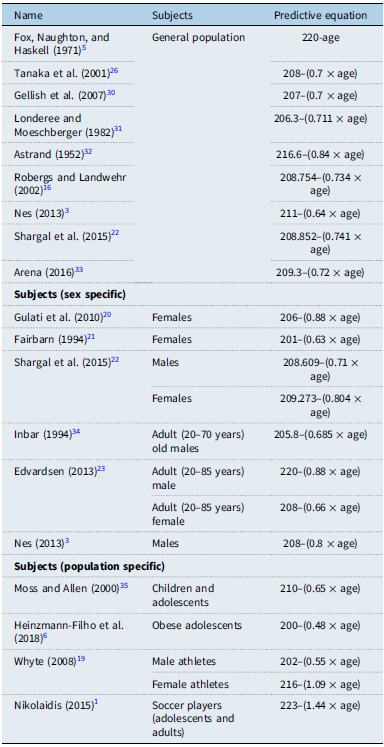
General population, sex-specific, and population-specific maximal heart rate prediction equations (Table 1) were tested against retrospective heart rate data obtained during routine exercise tolerance testing.
HRmax prediction equations

Table 1. Long description
Twenty two age regression maximal heart rate prediction equations were used to predict maximal heart rate. The table shows the equations and the populations they were intended for including general population, sex-specific and population specific prediction equations.
Statistical analysis
Statistical analyses were performed using Stata, version 18. Normally distributed data are presented as mean and standard deviation. Non-normally distributed data are presented as median and interquartile range. Linear regression analysis was performed to determine the association between measured maximal heart rate and age and measured and predicted maximal heart rate. Pearsons correlation coefficient (r) was used to indicate the magnitude and direction of the correlation between measured and predicted maximal heart rate for each equation and was interpreted as very small (r < 0.1), small (0.1 < r < .3), moderate (0.3 < r < .5), large (> 0.5 r < 0.7), very large (0.7 r <0.9), nearly perfect (r >0.9), and perfect (r = 1). Reference Batterham and Hopkins14 Paired t testing and Wilcoxon signed-rank testing was performed to determine whether there was a statistically significant difference between maximal heart rate achieved during exercise tolerance testing and predicted maximal heart rate for each equation. Male and female data were analysed separately to identify gender differences in maximal heart rate. Statistical significance was set at p = 0.05.
Results
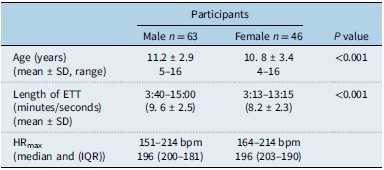
A total of 109 children and adolescents (63 males [58%]) were included. Age at exercise test ranged from 4 to 16 years (mean 11.00, ± 3.09). The characteristics of participants can be seen in Table 2. An additional three individuals were excluded from the analysis (two developed supraventricular tachycardia with heart rates exceeding 220 beats per minute during testing, and one suffered equipment failure resulting in an inaccurate maximal heart rate recording).
Characteristics, ETT length, and HRmax of participants

Table 2. Long description
Age in years is presented as mean and standard deviation for the 109 participants included in the study. Data is presented for males and females including the length of exercise testing in minutes and seconds and maximal heart rate presented as median and interquartile range.
bpm = beats per minute; ETT = exercise tolerance test; HRmax = maximal heart rate; IQR = interquartile range; SD = standard deviation.
Relationship between length of exercise test and age
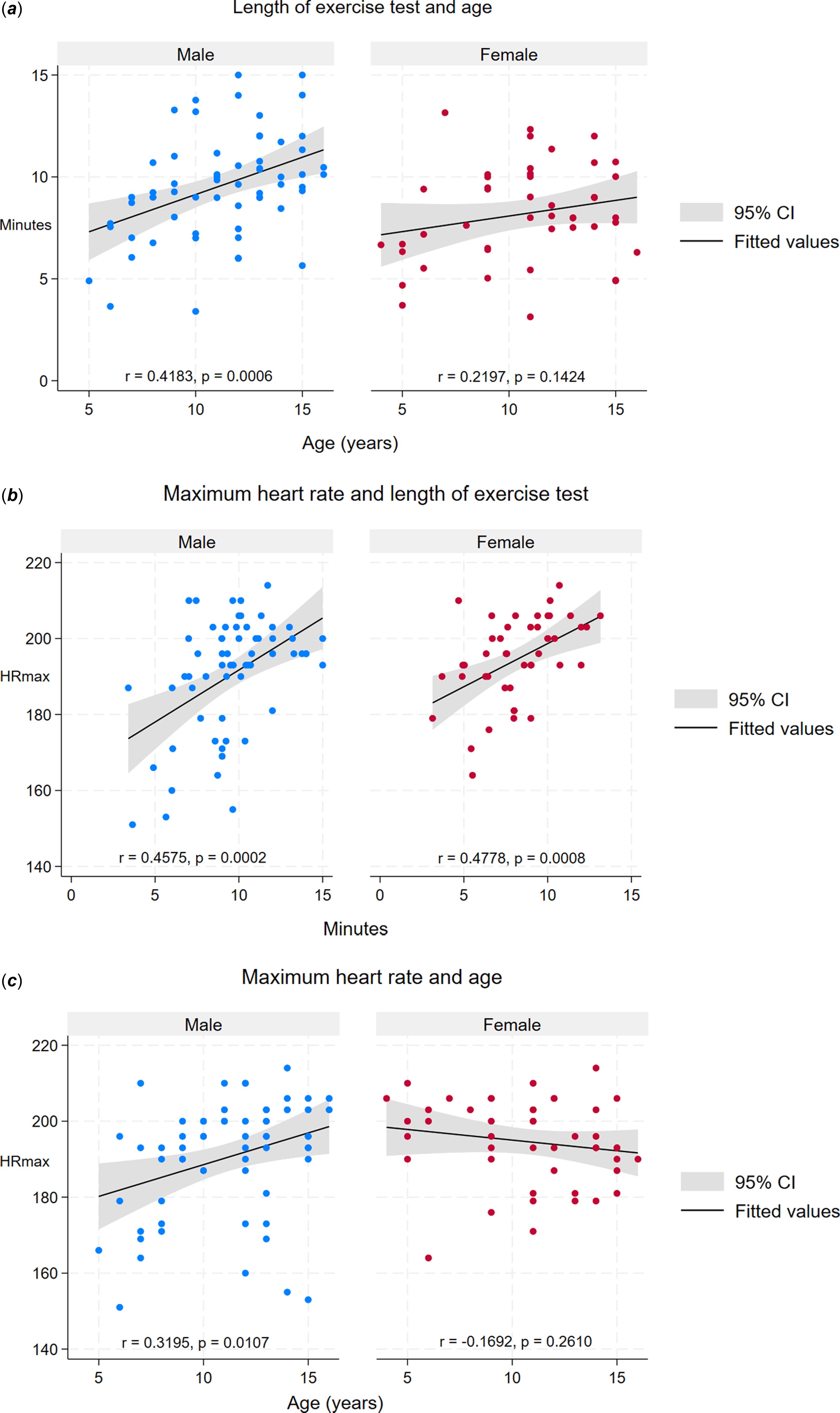
The length of exercise tests ranged from 3 minutes, 13 seconds to 15 minutes (mean 8.99, standard deviation 2.54). Males achieved longer testing times compared with females (Table 2). A total of two patients (both male) exercised for 15 minutes, achieving protocol completion. A positive correlation was demonstrated with increasing age and length of exercise test in males (r = 0.4183, p = 0.0006); no significant correlation was seen in females (r = 0.2197, p = 0.1424) (Figure 1 a ).
( a ) Males demonstrated a positive correlation with increasing age and length of ETT, whereas no significant correlation was seen in females. Alt text: Scatter plot illustrating the association between the length of ETT and age of males (blue dots) and females (red dots). ( b ) A moderate positive correlation between heart rate and length of ETT was demonstrated for both males and females. Alt text: Scatter plot illustrating the relationship between HRmax and the length of ETT for males (blue dots) and females (red dots). ( c ) Males demonstrated a moderate positive correlation between HRmax and increasing age, whereas no significant correlation was seen in females. Alt text: Scatter plot illustrating the relationship between HRmax and age for males (blue dots) and females (red dots). ETT = exercise tolerance test; HRmax = maximal heart rate.

Figure 1. Long description
1A:Males demonstrated a positive correlation with increasing age and length of exercise tolerance testing, whereas no significant correlation was seen in females. 1B: A moderate positive correlation between maximal heart rate and length of exercise tolerance testing was demonstrated for both males and females. 1C: Males demonstrated a moderate positive correlation between maximal heart rate and increasing age, whereas no significant correlation was seen in females.
Relationship between maximal heart rate and length of exercise test
There was a moderate positive correlation between heart rate and length of exercise test for males (r = 0.4575, p = 0.0002) and females (r = 0.4778, p = 0.0008) (Figure 1 b ). A total of 15 children (13.8%) achieved maximal heart rates less than 175 beats per minute (13 male [11.9%], 2 female [1.8%]). A total of 12 children (11%) exercised for less than 6 minutes (4 male [3.7%], 8 female [7.3%]), and of those, 5 (41.7%) had a maximal heart rate <175 beats per minute (3 male [25%], 2 female [16.7%]).
Relationship between maximal heart rate and age
Maximum heart rates achieved for the whole group were 151–214 beats per minute (median 196, interquartile range 203–187); maximal heart rate heart rate in females was 164–214 beats per minute (median 196, interquartile range 203–190) and in males 151–214 beats per minute (median 196, interquartile range 200–181). Males demonstrated a moderate positive correlation r = 0.3195, p = 0.0107 with maximal heart rate increasing with age, whereas there was no significant correlation in females (r = −0.1692, p = 0.2610) (Figure 1 c ).
Relationship between measured and predicted maximal heart rate
In females, there were no significant correlations between measured and predicted maximal heart rate with all equations. In males, a small negative statistically significant correlation was seen between measured and predicted maximal heart rate for three equations (Fairbarn, Whyte [female], Edvardsen [male]). The remaining equations demonstrated a moderate negative statistically significant correlation (Table 3 and Figures 3–24 [supplementary material]). In males and females, most equations significantly overestimated maximal heart rate (Tables 4 and 5 [supplementary materials]).
Discussion
This study shows that most published age regression maximal heart rate prediction equations overestimate measured maximal heart rate in healthy children, with significant differences between males and females. The findings are clinically relevant when applied to the evaluation of maximal heart rate measured during exercise tolerance testing in children’s cardiology services.
Clinical utility of maximal heart rate
In clinical practice, maximal heart rate is used to guide exercise prescription and exercise training intensity. In chronic cardiovascular conditions, such as inherited arrhythmic syndromes, maximal heart rate derived through exercise testing is an essential method of determining the degree of β-blockade and other therapy prescribed to limit exertional heart rate and prevent exertional ventricular arrhythmias occurring. Reference El Assaad, Heilbronner, Zahka, Hammond, Patel and Aziz15 In children, doses of β- blocker therapy are up-titrated following exercise testing, with the maximal heart rate achieved during testing used to identify if doses remain at a sufficient level as the child grows and as their heart rate response to exercise changes. Accurate measurement of maximal heart rate is an important component of testing to ensure adequate pharmacological control and reduction of risk.
Measurement of maximal heart rate
Direct measurement of maximal heart rate in children is achieved through maximal exercise testing; however, in children taking therapy that limits chronotropic response to exercise, indirect methods of predicting maximal heart rate are utilised, where the maximal heart rate achieved during testing is expressed as a percentage of the expected predicted maximal heart rate value. In most clinical settings, the same prediction equation, Fox (220-age), Reference Fox, Naughton and Haskell5 is used during exercise testing for adults and children; however, methodological concerns have been raised about this equation in both adults and children. Reference Robergs and Landwehr16 In line with the findings of previous childhood studies, Reference Nikolaidis1,Reference Heinzmann-Filho, Zanatta and Vendrusculo6–Reference Papadopoulou, Papadopoulou and Alipasali8,Reference Mahon, Marjerrison, Lee, Woodruff and Hanna10–Reference Colantonio and Kiss13 the results of the current study demonstrated that the Fox equation significantly overpredicts maximal heart rate in both males and females, suggesting that this is not an accurate method for assessing maximal heart rate in children.
Sex and age differences in maximal heart rate
Maximal heart rate regression equations, including Fox, Reference Fox, Naughton and Haskell5 are largely devised for use in adults, based on the assumption that maximal heart rate declines with age; however, children’s exertional heart rates do not decline with age at the same rate as in adults. Reference Washington, Bricker and Alpert17 Furthermore, children’s exertional heart rates are generally higher than adults, and there are important sex differences. Girls demonstrate higher heart rates at submaximal exertion; however, no differences in maximal heart rate between boys and girls have been reported. Reference Winsley18 Post-puberty and once maturation is achieved, maximal heart rate is thought to decline by approximately 1 beat per minute per year in males and females, in line with adult heart rate decline. Sex-specific prediction equations have been proposed, but these are also intended for use in adult populations. Reference Whyte, George, Shave, Middleton and Nevill19–Reference Edvardsen, Hansen, Holme, Dyrstad and Anderssen23
Our data show that maximal childhood heart rates during exercise over 200 beats per minute are common, with higher values possible, albeit with large inter-individual variation. We also saw differences in the relationship between age, heart rate response, and sex.
Males’ maximal heart rate increased with age, resulting in a small to moderate, negative significant correlation with all predicted maximal heart rate values. Similarly, a statistically significant mean difference for most equations was apparent when compared with measured mean maximal heart rate, suggesting those equations overpredict. In contrast, in females, maximal heart rate appeared to decline slightly with age, resulting in a small positive correlation with maximal heart rate and some prediction equations. Similarly, statistically significant mean differences were seen with most equations and overprediction of maximal heart rate. The data suggest that paediatric sex-specific maximal heart rate equations are required to assess exertional heart rate response during childhood.
Clinical implications
When heart rate prediction equations are applied for exercise prescription purposes, errors in estimating maximal heart rate can result in inaccurate prescription of cardiorespiratory effort during exercise. Reference Heinzmann-Filho, Zanatta and Vendrusculo6 Further, outside the exercise prescription setting, the implications of overprediction of maximal heart rate in children’s clinical cardiology practice during exercise testing may result in a lower percent predicted maximal heart rate value being calculated, which is then utilised to determine whether dose up-titration is required. Studies investigating the applicability of the Fox equation in child athletes found that Fox overpredicts maximal heart rate. Reference Nikolaidis1,Reference Machado and Denadai7,Reference Verschuren, Maltais and Takken11,Reference Cicone, Holmes, Fedewa, MacDonald and Esco24,Reference A., Aniuska, dM, dC, Aline and Paulo25 The findings from the present study also demonstrated that this is also the case for both male and female non-athletic children. If using the Fox equation to predict maximal heart rate in a 5-year-old child, the predicted maximal heart rate would be 215 beats per minute. If the maximal heart rate achieved during testing was 150 beats per minute, this would be reflected as 70% of the predicted maximal heart rate achieved. In the current study, Fairbarn and Whyte predicted most closely to measured maximal heart rate. If using either of these equations, for example, the predicted maximal heart rate would be 197.85 beats per minute (76%) or 199.25 beats per minute (75%), respectively, resulting in a 5–6% difference compared with Fox. Depending on the cut-off for β-blocker adjustment, which is also subject to variation between clinicians, this difference could influence the dose of β-blocker being deemed as sufficient, suggesting a dose increase is not required. Whereas if using an equation that predicts more closely to measured maximal heart rate, a dose increase would be advised.
Other studies have focused attention on the equation of Tanaka et al., Reference Tanaka, Monahan and Seals26 with some suggesting this as a more accurate equation to use in children and adolescents Reference Mahon, Marjerrison, Lee, Woodruff and Hanna10, whereas others have demonstrated an underestimation of predicted maximal heart rate. Reference Nikolaidis1,Reference Papadopoulou, Papadopoulou and Alipasali8,Reference Nikolaidis, Padulo, Chtourou, Torres-Luque, Afonso and Heller12 In the current study, the Tanaka equation also significantly overpredicted in both males and females. Alternative age regression prediction equations evaluated for validity and applicability in children and adolescents have all been found to demonstrate a low correlation with measured maximal heart rate. Reference Gelbart, Ziv-Baran, Williams, Yarom and Dubnov-Raz9,Reference Cicone, Holmes, Fedewa, MacDonald and Esco24,Reference Cicone, Sinelnikov and Esco27
A novel finding in our study is the demonstration that sex-specific and discordant differences exist between mean measured and predicted maximal heart rate. In females, most equations appeared to overpredict, but two equations underpredicted: Fairbarn (devised specifically for females) and Heinzmann-Filho (devised specifically for obese adolescents). The equation of Whyte, Reference Whyte, George, Shave, Middleton and Nevill19 an equation established for male athletes, was found to predict most closely in females; whereas in males, the equation of Fairbarn, originally devised for use in females, was found to most closely predict maximal heart rate. Together, these findings demonstrate that existing prediction equations are not suitable for use in the paediatric population and highlight the importance of developing paediatric-specific and sex-specific maximal heart rate prediction equations as a clinical priority.
Limitations
This study is limited by a relatively small sample size, although the numbers are similar to other studies testing these equations in children and adolescents. Reference Nikolaidis1,Reference Heinzmann-Filho, Zanatta and Vendrusculo6,Reference Machado and Denadai7,Reference Mahon, Marjerrison, Lee, Woodruff and Hanna10,Reference Nikolaidis, Padulo, Chtourou, Torres-Luque, Afonso and Heller12,Reference Colantonio and Kiss13,Reference Cicone, Sinelnikov and Esco27,Reference Nikolaidis28 Similarly, many of the prediction equations were derived from relatively small sample sizes.
There was variation in the length of time children remained on the exercise treadmill, resulting in shorter testing times and lower maximal heart rate, possibly representing a submaximal test, and thus potentially impacting the range in maximal heart rates achieved; however, the included exercise tests were representative of the wider population. The likelihood that children attain a true maximal heart rate during exercise testing has also been questioned, Reference Robergs and Landwehr16 suggesting that other forms of testing may produce higher maximal heart rates.
Finally, pubertal stage, which may account for the decline in heart rate seen in some of the females, was not evaluated in this study and requires additional research. Reference Cicone, Holmes, Fedewa, MacDonald and Esco24 In this context, previous studies have suggested that other anthropometric variables may impact maximal heart rate requiring additional research. Reference Cicone, Holmes, Fedewa, MacDonald and Esco24,Reference Carli, Moraes Junior, Menezes-Junior, Tadiotto, Mota and Leite29
Conclusion
This study shows that adult age regression equations do not accurately predict childhood maximal heart rate. In the absence of direct measurement, alternative methods of predicting maximal heart rate should be defined to ensure appropriate estimation when prescribing pharmacological therapy and during subsequent exercise prescription particularly for children with inherited arrhythmic syndromes.
Supplementary material
The supplementary material for this article can be found at https://doi.org/10.1017/S1047951126124056.
Acknowledgements
None.
Financial support
Catherine Renwick is supported by National Institute for Health and Social Care Research (NIHR) predoctoral clinical academic fellowship (NIHR: 301166) and NIHR Doctoral and Clinical and Practitioner Academic Fellowship (NIHR: 303085).
The views expressed are those of the author and not necessarily those of the NIHR or the Department of Health and Social Care.
Gabrielle Norris is supported by British Heart Foundation (FS/ICRF/25/26121) and Great Ormond Street Hospital Children’s Charity.
Juan Kaski is supported by Max’s Foundation and Great Ormond Street Hospital Children’s Charity. Prof Kaski was supported by a Medical Research Council Clinical–National Institute for Health Research Clinical Academic Research Partnership award and a University College London Hospitals NIHR Biomedical Research Centre Excellence award.
All other authors have reported that they have no relationships relevant to the contents of this paper to disclose.
Competing interests
No disclosures or conflicts of interest declared.


 Open access

