With living men regarded as dead, dead men returning to life, and the same man considered alive for one purpose but dead for another, the realm of legal fiction acquires a touch of the supernatural under the paradoxical doctrine of civil death.— The Harvard Law Review Association, 1937
Several times lately our novelists have attempted to make us live with people very dull and dead.— E. S. Dallas, Times review of Our Mutual Friend, 29 November 1865
On his last trip to America in 1868, Charles Dickens would write a letter to his friend and biographer John Forster, which paints a sobering picture of postbellum Baltimore: “It is remarkable to see how the Ghost of Slavery haunts the town; and how the shambling, untidy, evasive, and postponing Irrepressible proceeds about his free work, going round and round it, instead of at it.” While Dickens's phrase “the Ghost of Slavery” indicts a slave system that persists despite abolition, his representation of the former slave body – “the shambling, untidy, evasive, and postponing Irrepressible” – suggests another kind of ghost, an identity that toggles between the spectral and the grossly embodied. Dickens reinforces this conjunction of the ghostly and the corporeal as he goes on to note that “[t]he melancholy absurdity of giving these people votes, at any rate at present, would glare at one out of every roll of their eyes, chuckle in their mouths, and bump in their heads, if one did not see . . . that their enfranchisement is a mere party trick to get votes” (Letters 27). Resorting to the crudest racial stereotypes, Dickens portrays recently manumitted slaves as dolls devoid of speech and political agency. In depicting the “postponing Irrepressible” as stripped of personhood and civil capacities, Dickens conjures the legal fiction of “civil death” – a medieval English common law that divested a prisoner accused of treason any rights by proclaiming him dead in the eyes of the law. In stark contrast to Dickens's impassioned pleas for the abolition of slavery and prison reform in American Notes (1842), his private remarks in this letter some twenty-five years later convert former slaves into the objects of satire – minstrelsy puppets in a larger political game in which they play no civil part – as it were, dead again. However, even as Dickens attempts to constrain the former slave body through a kind of stereotypical branding, his language – the “postponing Irrepressible” – registers an unease that this corporeal ghost won't die. It is precisely in this form of the living dead that the “ghost of slavery” surfaces in Our Mutual Friend (OMF).
In this essay, I focus on the economy of slavery that subtends OMF, which Dickens started composing as early as October 1863 (Poole xi) and serialized between May 1864 and November 1865 (Hecimovich 973n1), thus, during and several months after the American Civil War.Footnote 1 Although a substantial body of criticism exists on Dickens's vexed responses to American slavery, it has tended to focus on American Notes (1842) and his co-authored Household Words pieces on the American Civil War.Footnote 2 However, “the ghost of slavery” haunted Dickens throughout his career, as recent scholarship on Bleak House and Great Expectations attests.Footnote 3 The slave tropology in OMF differs from that of Bleak House and Great Expectations in several ways: Dickens summons the ghost of slavery not simply by mobilizing tropes from slave narratives and the rhetoric of abolitionist reform, but also by deploying the legal fiction of “civil death” meted out to the prisoner and the “social death” allotted to the slave, persons whom Caleb Smith defines as “two classes of the living dead” (34). Thus, in OMF, Dickens takes his engagement with the slave narrative to a new level: dispensing with the intimate “autobiographical” mode of, say, Pip in Great Expectations, where the figure who stands in for the slave gets to tell his own story, Dickens in OMF presents John Harmon/Rokesmith as a character devoid of personhood and civic attachment, who delivers fractured and fragmented monologues on his ghostlike identity.
In focusing on the novel's engagement with slavery, my argument is informed, in part, by what falls under the broad category of “thing theory.”Footnote 4 First, I answer Elaine Freedgood's call to take things seriously in the Victorian novel; secondly, I look at different moments in OMF as reminiscent of “it-narratives,” which Jonathan Lamb suggests are forbears of slave narratives (218); and thirdly, I bring “thing theory” into conversation with legal discourse studies that pivot on concepts of negative personhood and civil death.
Freedgood sums up the method for the first half of The Ideas in Things as seeking “the historically and theoretically overdetermined material characteristics of objects . . . beyond the immediate context in which they appear. These objects,” she states, “are then returned to their novelistic homes, so that can inhabit them with a radiance or resonance of meaning they have not possessed or have not legitimately possessed in previous literary-critical reading” (5–6). The historical luster that Freedgood shines on objects allows her to read Jane Eyre's mahogany furniture not simply as a marker, or, as she puts it, “a weak metonym for taste and wealth,” but also as an object that “tells a story of imperial domination – the history of deforestation and slavery from Madeira to Jamaica – that crosshatches the manifest narrative of Jane Eyre” (3). Similarly, in excavating a history of “Cape wine,” “black diamonds,” and a mahogany secretary – objects associated with John Rokesmith – I not only support my interpretation of John as a slave but also suggest a more unsettling history and future for both John and Britain as imperial agents.
However, it is not just things that encode John Harmon/Rokesmith as the slave of the text; Dickens also figures John Harmon/Rokesmith as a “living-dead man” (367; bk. 2, ch. 13) – that uncanny status peculiar to prisoners and slaves. To make this argument, I draw on recent studies that reveal the “social death” of the slave and the “civil death” of the prisoner as structurally similar, or, as Smith puts it, “counterparts” in the long history of disenfranchisement and dehumanization (41). Although slaves were ostensibly protected under the law as persons, I’m in accord with Colin Dayan's argument that that legal “existence [was] rigidly curtailed and qualified” (Law 54) and used as a way to justify punishments as legal effects on the slave's person (“Poe” 410). This essay, in part, examines how Dickens anticipates a similar critical leap in correlating prisoners and slaves in their civil and social death in his compound figure of John Harmon/Rokesmith. In summoning the “ghost of slavery,” in his 1868 letter, Dickens registers and gives shape to what Dayan (following the logic of the Thirteenth Amendment) calls “the disabilities of the post-Civil War period, when slaves were reborn as criminals and translated into ‘slaves of the state’” (Law 45). Indeed, casting civil death as a prime example of the dehumanizing “sorcery of the law” (39), Dayan argues that “[i]n rereading the claims of civil death into the history of slavery and incarceration, we recognize the continuum between being judged a felon, being declared dead in law, and being made a slave” (46).
Following in the wake of Dayan's insights, Caleb Smith, in The Prison and the American Imagination, characterizes the performative force of the draconian legal fiction of civil death as “divesting the inmate of rights and transforming him into a legal nonperson comparable to a slave” (29). Dickens was well aware of these “death sentences.”Footnote 5 Indeed, Smith cites Dickens's account of the Eastern State Penitentiary in American Notes as possibly “the most powerful nineteenth-century literary example of the carceral gothic” (62) and argues that “Dickens's narrative exposed how the discipline of and rituals of the penitentiary were producing prisoners who seemed literally to incarnate that legal fiction: an assembly of cadaverous men and women buried alive, dead to the world” (61). Dickens's engagement with inhumane prison cultures would not stop with American Notes; he recasts his interviews with inmates in Philadelphia in The Tale of Two Cities, Little Dorrit, and less overtly, though no less incisively, in OMF. In his memoranda book for OMF, Dickens, borrowing from legal nomenclature, jots down the beginnings of a new kind of character: “A man – young and eccentric? – feigns to be dead, and is dead to all intents and purposes external to himself, and . . . for years retains that singular view of life and character” (Poole xi). Through protagonist John Harmon's “fictitious death” at the outset of the novel (782; bk. 4, ch. 16), Dickens evokes the legal fiction of civil death and invites his readers to consider what it would mean to be stripped of one's legal identity but still exist among the living like a prisoner or slave.
In addition to exposing the psychologically scarring effects of the gothic legal structures that undergird the institution of slavery, Dickens, through “the living body” of his protagonist John Harmon, sets in motion the fugitive slave plot and a metaphorical blackening of John in order to suggest that despite the abolition of the slave trade in 1807 and Britain's “heroic” role in its demise, “the ghost of slavery” persists in other forms right at the heart of British society – that Britain's mutual friend is slavery. Dickens reveals this through an elaborate play of names and various forms of surrogacy, which I examine below.Footnote 6 In what follows, I will be arguing that OMF is Dickens's answer to Uncle Tom's Cabin, that he makes good on his claim to “want to help the wretched Slave” (qtd. in Lee 114), and that the novel should be read as a sequel to his sections on prisons and slavery in American Notes.
In this sense, although American slavery is never directly addressed, OMF can be read as Dickens's abolition novel. In its attempt to understand slavery as a global system, its geographical and political reach is vast. John Harmon/Rokesmith, like slavery, touches almost every continent and every character in the novel. “I come . . . from many countries,” John Harmon/Rokesmith claims, and “I have been in many places” (101; bk. 1, ch. 8). If, as Amanda Claybaugh asserts, the reform novel, which seeks to effect global political change, can be understood as part of larger transnational network of social reformers, then OMF is bound up in that movement in its critique of “free trade imperialism”Footnote 7 and that system's necessary ties to various forms of enslavement. However, as I shall suggest in my concluding remarks, to cast John Harmon – a white property-owning citizen – as the figurative slave of the text carries with it implications that trouble the novel's abolitionist tenor.
I. “Am I not a Man and a Brother?”: John Harmon in Chains
As many critics have suggested, OMF is a novel obsessed with death;Footnote 8 here, I want to nuance that argument by contending that death is given the peculiar shape of civil and social death in the character of John Harmon/Rokesmith. Beyond Dickens's strategy in the novel of rendering persons into things and everything into the universal equivalent, he depicts his protagonist John Harmon as the ghost of the text. Unlike most ghosts, this one is embodied: to use the language of the novel, John is the “living-dead man” (367; bk. 2, ch. 13); or, to use John's uncanny summation in a graveyard: “I no more hold a place among the living than these dead do” (360; bk. 2, ch. 13). Similar to the civil and social death meted out to prisoners and slaves, respectively, John Harmon undergoes a series of ritualized degradations that reduce him to that peculiar status of nonpersonhood. According to Orlando Patterson, “the most distinctive attribute of the slave's powerlessness was that it always originated (or was conceived of as having originated) as a substitute for death, usually violent death” (5). This symbolic death is achieved through stripping the subject of his or her identity, which traditionally is conferred through a name and kinship ties. Thus, in Patterson's words, “[a]lienated from all ‘rights’ or claims of birth, [the slave] ceased to belong in his own right to any legitimate social order. . . . He was truly a genealogical isolate” (5). Dickens enacts John Harmon's symbolic death through similar means: John not only has escaped a violent death, but also, under his assumed name, John Rokesmith, has become a genealogical isolate. As Rokesmith, he has no ancestors or kinship ties. As the etymology of his renaming suggests, Rokesmith has no presence or substance: he is a smithy of “roke” – “smoke . . . [s]team; vapour, mist, fog” (“Roke”) – a nonperson. Bella underscores John Rokesmith's ghostliness when he first moves into the Wilfer household; she laments that his presence as a lodger is “another of the miseries of being poor, that you couldn't get rid of a haunting Secretary [Rokesmith], stump – stump – stumping overhead in the dark, like a Ghost” (207; bk.1, ch. 16).
Furthermore, as John Harmon physically recuperates from a violent attack, he has a sentence of death foisted upon him: “[I]t seemed as if the whole country were determined to have me dead. The Inquest declared me dead, the Government proclaimed me dead; I could not listen at my fireside for five minutes to the outer noises, but it was borne into my ears that I was dead” (366; bk. 2, ch. 13). The Government has the power not only to kill (if not in body, then in name), but also to erode John's private sense of self. Declarations and proclamations – speech acts – penetrate John's fireside (the domestic sphere), confirming his status as dead, the consequences of which have far-reaching effects on John's character. As William Blackstone writes in his Commentaries on the Laws of England:
When sentence of death, the most terrible and highest judgment in the laws of England, is pronounced, the immediate inseparable consequence by the common law is attainder. . . . He is then called attaint, attinctus, stained, or blackened. He is no longer of any credit or reputation; he cannot be a witness in any court; neither is he capable of performing the functions of another man: for, by an anticipation of his punishment, he is already dead in law. (4.29.380)
As if to literalize John Harmon's attainder – that process of declaring dead through a kind of staining – Dickens “blackens” John, first in his renaming, then by emphasizing John's “dark” and “troubled” appearance (46; bk. 1, ch. 4), his “kept-down manner” (329; bk. 2, ch. 10), and his characterizations as a “Hindoo baby” (302; bk. 2, ch. 7) and an “Indian Prince . . . beautifully coffee-coloured” (316; bk. 2, ch. 8).Footnote 9
The novel suggests an even more obvious connection between John's degradation and civil death with slavery: through the first and only appearance of “a black man” in the narrative. In what follows, John Rokesmith questions whether he should resurface as John Harmon:
John Harmon is dead. Should John Harmon come to life?
‘If yes, why? If no, why?’
‘Take yes, first. To enlighten human Justice concerning the offence of one far beyond it who may have a living mother. To enlighten it with the lights of a stone passage, a flight of stairs, a brown window-curtain, and a black man. To come into possession of my father's money, and with it sordidly to buy a beautiful creature whom I love. (366; bk. 2, ch. 13)
Positing himself as the object of a fictional trial, John Harmon arbitrates over his own life or death sentence. John's self-questioning is no less than a questioning of the fate of “human Justice,” not simply a matter of self but of humanity. It should come as no surprise then that slavery plays a key role here: first, in Dickens's cryptic invocation of “a black man” who is grouped with a series of things (stone passage, stairs, and brown window-curtain); then, in the form of Bella, here reduced to a “beautiful creature” that Harmon can “sordidly . . . buy.” John's associative digressions ultimately lead to a direct meditation on slavery as he recalls Bella's comment about how John Harmon “should have purchased her, caring nothing for me, as a Sultan buys a slave” (367; bk. 2, ch. 13). John's questioning of who he is and who he should become bleeds into the ethics of restoring his legal identity, which would strip another “creature” (Bella Wilfer) of her own; in other words, John's assertions of personhood are contingent upon the subjection of others. Furthermore, John's project “[t]o enlighten human Justice,” which promises to shed light on those dark passages of his identity, implicates him within the circuit of “the old rust and tarnish on [his father’s] money” (366; bk. 2, ch. 13), which has the power to buy people. Although John Rokesmith groups himself among the clutter of things that render him a slave, John Harmon as master has the legal authority to lift his sentence of civil death.
If “a black man” signals the event that has led to John's figurative attainder, then other dark materials indicate his passage into servitude: namely, mahogany. When Noddy Boffin first employs John Rokesmith as his secretary, he informs John of his initial confusion over the position: “[W]e have always believed a Secretary to be a piece of furniture, mostly of mahogany, lined with green baize or leather, with a lot of little drawers in it. Now, you won't think I take a liberty when I mention that you certainly ain't that” (180; bk. 1, ch. 15). Taking into account the way Boffin comes to treat his Secretary, he is just that. Boffin's description of this “piece of furniture” is not far from how Rokesmith is characterized in the novel – as dark, of foreign provenance, and intensely secret. In his mention of mahogany, Boffin also fastens John to a commodity that is linked to the former slave colonies of Madeira and Jamaica; hence, John, in his transformation into a mahogany secretary, encrypts and embodies the slave labor that went into his re-fashioning. In “Souvenirs of Sadism: Mahogany Furniture, Deforestation, and Slavery in Jane Eyre,” Freedgood tracks the colonial history and cultural freight of mahogany, arguing that “Jane's purchase and placement of mahogany furniture symbolizes, naturalizes, domesticates, and internalizes the violent histories of deforestation, slavery, and the ecologically and socially devastating cultivation of cash crops in Madeira and Jamaica” (35).Footnote 10 If initially this link between mahogany and Rokesmith as a slave seems remote in OMF, it is made explicit when Boffin claims him as chattel: “If I pay for a sheep, I buy it out and out. Similarly, if I pay for a secretary, I buy him out and out” (457; bk. 3, ch. 5).
Dickens registers John Harmon/Rokesmith's slave-like state not only through his civil death and attainder but also through certain geographies that become attached to his identity. Other characters – namely, “Society” and his intended Bella Wilfer – weave their colonial fantasies around John Harmon before he even arrives on English shores. Dickens introduces the idea of John Harmon at the Veneerings’ dinner party as “the man from Somewhere” (23; bk 1, ch. 2). However, that somewhere of “romance” becomes quite particular as Mortimer Lightwood, Harmon's solicitor, “fix[es] him with a local habitation” (23; bk 1, ch. 2). Mortimer informs the company about the young John's banishment from England and his fate abroad: “Venerable parent promptly resorts to anathematization, and turns him out. Shocked and terrified boy takes flight, seeks his fortune, gets aboard ship, ultimately turns up on dry land among the Cape wine: small proprietor, farmer, grower – whatever you like to call it” (25; bk. 1, ch. 2). John's exile from Britain gives way to a precise location of residence through a commodity – Cape wine, hence, Cape Colony.
Although John hails from Cape Colony, Lady Tippins initially assumes that John Harmon's “somewhere” is the West Indies:
‘I insist upon your telling all that is to be told about the man from Jamaica.’
‘Give you my honor I never heard of any man from Jamaica, except the man who was a brother,’ replies Mortimer.
‘Tobago, then.’
‘Nor yet from Tobago.’ (22; bk. 1, ch. 2)
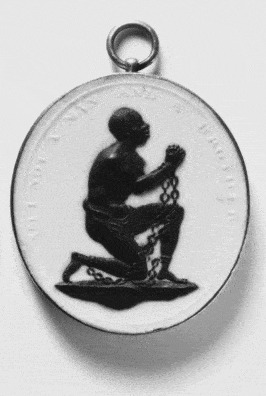
Mortimer's allusion to the Society for the Abolition of the Slave Trade (SEAST) motto “Am I not a man and a brother?” points directly to debates surrounding slavery and the possible results of manumission. Read by a Victorian audience, the SEAST motto would no doubt have conjured the image of a “widely disseminated cameo of a black man in chains, which bore this inscription” (Poole 804n12). Marcus Wood comments on the ubiquity of this “mass-produced Wedgwood ceramic medallion” which could “be worn as a broach or hairpin by society ladies, and was incorporated into the lids of snuff boxes” (22; see Figure 7). In Lady Tippins and Mortimer's flirtatious exchange, Dickens seems to be commenting on the emptying of the symbolic weight of this cameo, now a verbal cliché bandied about in high society drawing rooms with little or no connection to its political cause. In any case, the motto becomes another link in the chain of associations that tie John Harmon/Rokesmith to slavery and colonial territories.
William Hackwood (modeller). Josiah Wedgwood and Sons (maker). Society for the Abolition of the Slave Trade medallion (white jasper with a black relief and mounted in a gilt-metal, 1787). Given by Lady Charlotte Schreiber. © Victoria and Albert Museum, London.

Thus, from its formal to informal territories, a veritable map of the British empire can be drawn by tracking John Harmon/Rokesmith's “habitations” and dislocations through his metonymic associations. The mark of colonial “taint” is noted when John Harmon as John Rokesmith first enters the Wilfer household. He is cataloged as “[a] dark gentleman. Thirty at the utmost. An expressive, one might say handsome, face. A very bad manner. In the last degree constrained, reserved, diffident, troubled” (46; bk 1, ch 4). When asked where he's from, Rokesmith replies cryptically, “I come from many countries” (101; bk. 1, ch. 8) – an apt response, for, in the imagination of the metropole, this colonial from “somewhere” is the man from slave colonies in general: Jamaica, Tobago, Cape Colony. In an effort to divert Boffin from detecting his identity, Rokesmith mispronounces his own name as “Harmoon’s” (103; bk. 1, ch. 8), a possible riddle that ties him to the Jamaican maroons: in short, an escaped and rebellious slave – a runaway.
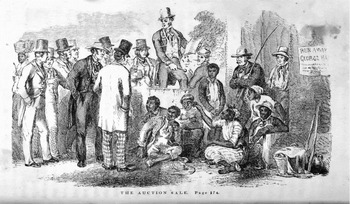
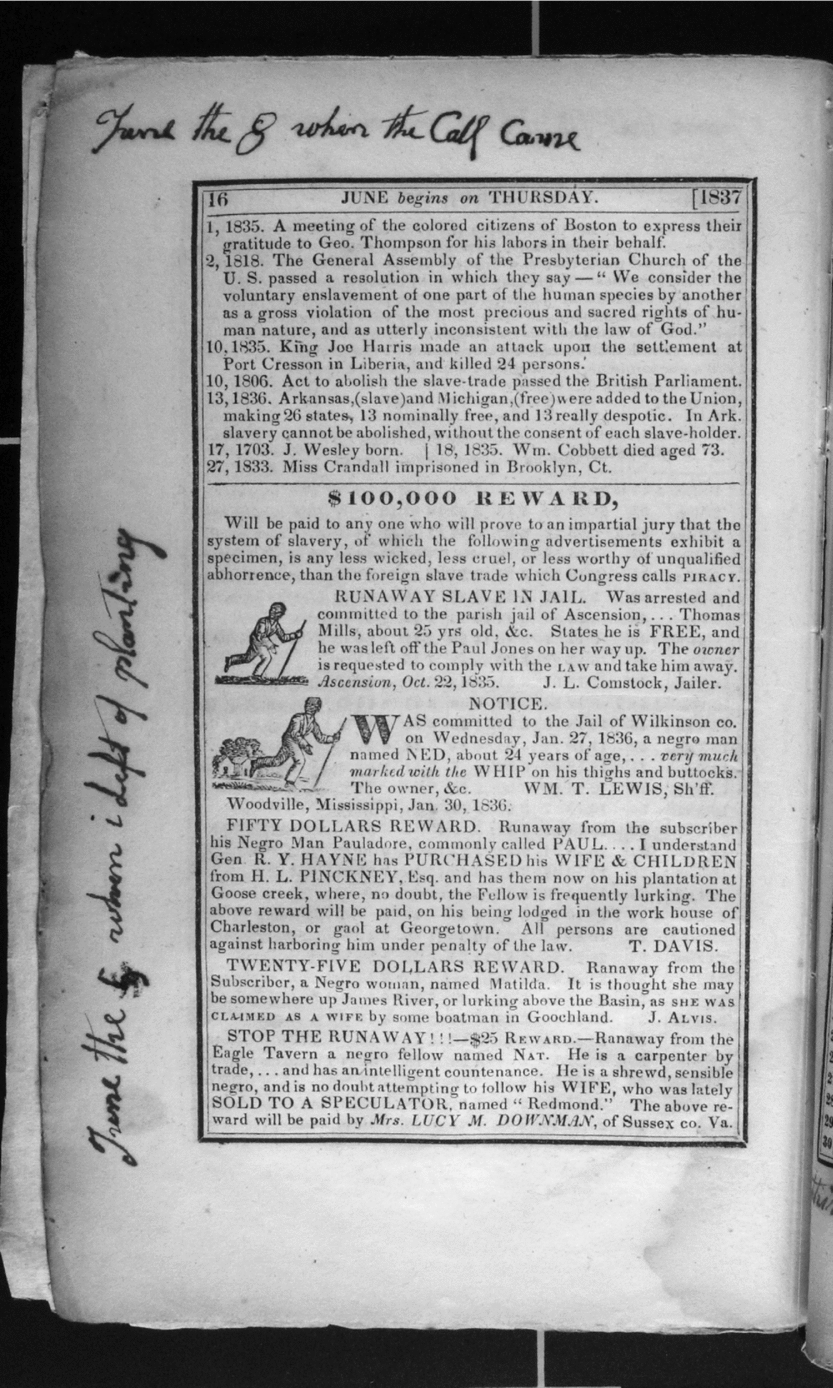
Indeed, John first appears on English soil as “a paper on the wall, with the police heading, BODY FOUND” (31; bk. 1, ch. 3). In American Notes, Dickens rails against the ubiquity of advertisements crying the loss of runaway slaves littering the streets of the American South.Footnote 11 One of the illustrations in Uncle Tom's Cabin, “The Auction Sale,” displays such an advertisement: two sticks, or guns point to the sign, “RUN AWAY / GEORGE H” (see Figure 8). As part of their identifying mechanism, these advertisements clinically described the slave's body – often maimed, branded, or otherwise violently marked (see Figure 9). A substantial part of Dickens's condemnation of master-slave relations in American Notes is based on this unabashed public paper trail, which, he argues, illustrates the cruelty that slavery naturalizes across all classes and races (250–65). In anti-slavery literature, the invocation and display of these advertisements was de rigueur, so much so that Wood has argued that abolitionists’ mobilization of these illustrated advertisements rendered slaves into an absence or void (79). Although these advertisements offer precise records of a specific slave body, ultimately, Wood contends, “[t]he runaway emerges as a metaphor for white moral failure” (82). Thus, the slave's body is erased in the service of shriving the soul of the morally corrupt slaveholder, or used to enlist other whites to join the abolitionist cause. Theodore Weld's American Slavery As It Is (1839), Dickens's unacknowledged source for his chapter on slavery, collates and reprints newspaper advertisements of runaways for such an end (see Figure 10).Footnote 12
“The Auction Sale.” Illustration from Harriet Beecher Stowe, Uncle Tom's Cabin; or, Life Among the Lowly. Vol. 1. (Boston: John P Jewett, 1852), 174. Courtesy of the Department of Archives and Special Collections, William H. Hannon Library, Loyola Marymount University.

American Anti-Slavery Almanac for 1837 1.2 (Boston: N. Southard & D. K. Hitchcock, 1837), 16. Courtesy of the Department of Archives and Special Collections, William H. Hannon Library, Loyola Marymount University.
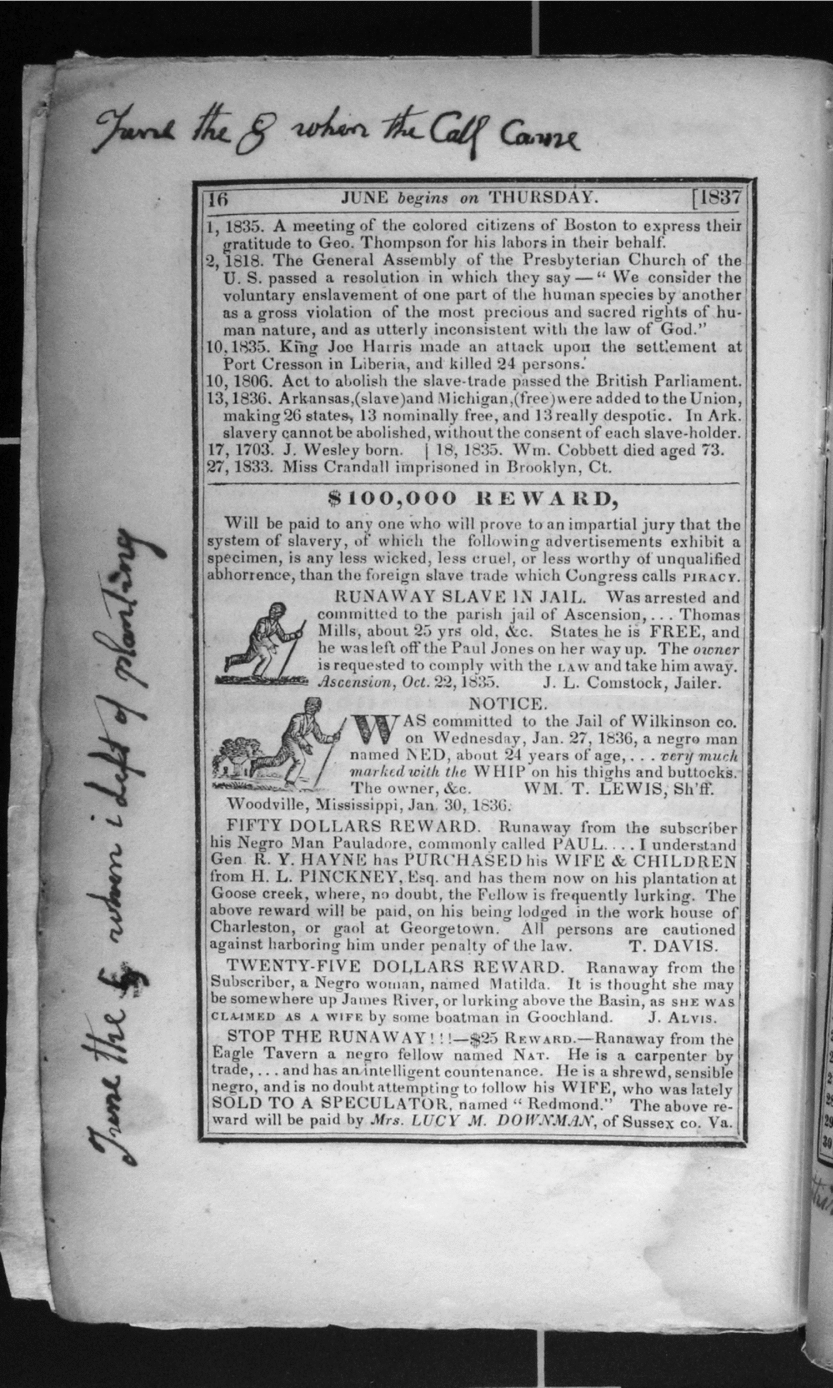
Page from Theodore Weld, American Slavery As It Is: Testimony of a Thousand Witnesses (1839). (New York: Arno, 1968), 79.

In OMF, Dickens addresses this contradiction between the particular and the general, between precise identification and anonymity through other means. One of the more affecting passages of OMF is Gaffer Hexam's “reading” of the handbills publicizing the marked corpses he's dredged from the Thames, as if novel writing could bring the dead, anonymous, and unclaimed back to some kind of life. Here, unlike abolitionist pamphleteering, mutilated bodies are not read as a moral script but as a testament to the lost, broken, and unrecoverable: “This one was the young woman in grey boots, and her linen marked with a cross. . . . This is him as had a nasty cut over the eye. This is them two young sisters what tied themselves together with a handkecher. This is the drunken old chap, in a pair of list slippers and a nightcap . . .” (31–32; bk.1, ch. 3). Recasting the fugitive slave plot, which typically resolves itself in the slave's successful escape from bondage, Dickens, in this passage, presents the gap of the irrecuperable and disappeared of history – the fate of most slaves.
In addition to drawing his reader's attention to John Harmon's fugitive status through publicly “advertising” his lost and purportedly found body, Dickens makes an overt reference to the fugitive slave plot in the following scene: “As some dogs have it in the blood, or are trained, to worry certain creatures to a certain point, so – not to make the comparison disrespectfully – Pleasant Riderhood had it in the blood, or had been trained, to regard seamen, within certain limits, as her prey” (345; bk. 2, ch. 12). In this instance, John Harmon, disguised as a seaman, becomes the victim of Pleasant's desire. While Dickens's analogy is presented in a comic register, the Fugitive Slave Act (1850) precipitated such scenes of carnage. Some eight years earlier in his “Slavery” chapter in American Notes, Dickens wrote bitterly, “To make [slaves] wear iron collars by day and night, and to worry them with dogs, are practices almost too ordinary to deserve mention” (257). What further aligns the Pleasant Riderhood passage with the fugitive slave plot is the undisclosed identity of the seaman. John Harmon/Rokesmith incognito remains unknown to the reader throughout the chapter, as if he were the runaway of the text. It should also be noted that John's place of work (his former home before his banishment to the colonies) is alternately referred to as “the halls of slavery” (600, 601; bk. 3, ch. 16) and “a Dismal Swamp” (208, 211; bk. 1, ch. 17) – a possible allusion to Stowe's Dred; A Tale of the Great Dismal Swamp (1856), Longfellow's abolition poem “The Slave in the Dismal Swamp,” or any number of slave narratives that use the swamp as part of what Wood deems “the iconography of slave escape” (78). To boot, the chapter in which Bella and John Rokesmith elope is called “A Runaway Match” (647; bk. 4, ch. 4). In his excessive allusions to the fugitive slave plot, Dickens perversely signals how exhausted the genre had become by the 1860s, reigniting it by charging his readers to question how John Harmon/Rokesmith both is and is not a slave and how, by proxy, they too might be bound to some fugitive form of slavery.
II. “But it was not I”: John's Disappearing “I”
I have been discussing the tropological structures that render John a slave. Now I’d like to turn to perhaps one of the more notable features that contributes to his alienated and alienating character – his lack of one. Like returned colonial settler Arthur Clennam of Little Dorrit before him, John's defining attribute is an uncanny sense of his not being there. Arriving at the police station “pale” and “agitated” with his own “BODY FOUND” advertisement in hand, John Harmon's first words of the novel are, “I am lost! . . . I – I – am a stranger, and don't know the way. I – I – want to find the place where I can see what is described here. It is possible I may know it” (32; bk. 1, ch. 3). That “it” is the body that has been dredged from the river and misidentified as his own. Borrowing from the legacy of eighteenth-century “it-narratives” – those stories written from the first-person perspective of a “pin, feather, coin” (Lamb 218) – Dickens reduces his protagonist to a thing, the “it” of a corpse, and, later, as the “it” of a secretary. Despite his writing skills, John shares the consciousness of the narrator of “it-narratives,” a form that Jonathan Lamb argues is a forebear of the slave narrative, features of which include a desire to be something or someone else and the difficulty of narrating from the “I” position having been stripped of personhood, which John Rokesmith's first stuttering “I – I” announces.Footnote 13 In a twist on the stock slave narrative that presents literacy as a route to liberation (Lee 9, 115), John's writing signals his indentures as a secretary and a route to erasure and self-effacement.
In a crux chapter, “A Solo and a Duett,” John Harmon/Rokesmith attempts to explain to himself the dissolution of his “I,” and to identify the process that has converted him into a kind of fugitive (359; bk. 2, ch. 13), “a living-dead man” (367; bk. 2, ch. 13), and a thing:
‘When [George Radfoot] came back, I had his clothes on, and there was a black man with him, wearing a linen jacket, like a steward, who put the smoking coffee on the table in a tray and never looked at me. I am so far literal and exact? Literal and exact, I am certain.
‘Now, I pass to sick and deranged impressions; they are so strong, that I rely upon them; but there are spaces between them that I know nothing about, and they are not pervaded by any idea of time.
‘I had drank some coffee, when to my sense of sight he began to swell immensely, and something urged me to rush at him. We had a struggle near the door. He got from me, through my not knowing where to strike, in the whirling round of the room, and the flashing of flames of fire between us. I dropped down. Lying helpless on the ground, I was turned over by a foot. I was dragged by the neck into a corner. I heard men speak together. I was turned over by other feet. I saw a figure like myself lying dressed in my clothes on a bed. What might have been, for anything I knew, a silence of days, weeks, months, years, was broken by a violent wrestling of men all over the room. The figure like myself was assailed, and my valise was in its hand. I was trodden upon and fallen over. I heard a noise of blows, and thought it was a wood-cutter cutting down a tree. I could not have said that my name was John Harmon – I could not have thought it – I didn't know it – but when I heard the blows, I thought of the wood-cutter and his axe, and had some dead idea that I was lying in a forest.
‘This is still correct? Still correct, with the exception that I cannot possibly express it to myself without using the word I. But it was not I. There was no such thing as I, within my knowledge.’ (362–63; bk. 2, ch. 13)
In this hallucinatory passage, the distinction between pronouns blurs, as does the narrating subject's sense of time. Once John Harmon drinks the poisoned coffee, he can no longer narrate stable “I’s” and “he’s,” which shift and morph into exaggerated body doubles – “its” ripped out of time. This space outside of body and time is inaugurated by a non-encounter: “[T]here was a black man with him, wearing a linen jacket, like a steward, who put the smoking coffee on the table in a tray and never looked at me” (362, my emphasis). The black man's coffee – another colonial import and “drug”Footnote 14 – induces exaggerated images: “I had drank coffee, when to my sense of sight he began to swell immensely, and something urged me to rush at him.” In the black man's vaporous and exaggerated state – a kind of “rokesmith” in his own right – he marks the desubjectification of John Harmon into a symbolic slave. The black man, earlier cataloged with “a stone passage, a flight of stairs, a brown window-curtain” (366), functions as a threshold figure who inaugurates Harmon/Rokesmith's transition from a “full” person to the “not I” (363) of “sick and deranged impressions” (362). Although George Radfoot is John's obvious double, the black man “serves” as his shadow avatar. Both John and the black man wear professional attire – sailor, servant costumes – and are not what they appear: John's disguised as a sailor, while the black man is dressed “like a steward” (a title John later suggests for himself during his service to Boffin [180; bk. 1, ch. 15]). If John ineffectively acts the part of his double, George, he is subsumed by his black body double. After the black man's appearance and disappearance, John Harmon narrates from the position of a brutalized slave: he is “turned over by a foot,” “dragged by the neck,” “trodden upon,” and “fallen over.” As if to emphasize his position as nonperson, no longer the agent of his actions, “something” urges him to act.
The evacuating of John Harmon's subjectivity is expressed in his splitting and silencing into non-being: “I could not have said that my name was John Harmon – I could not have thought it – I didn't know it.” A dissolution even beyond the negation of his legal identity as John Harmon is the erasure of the “I” tout court: “I cannot possibly express it to myself without using the word I. But it was not I. There was no such thing as I, within my knowledge” (363; bk. 2, ch. 13).Footnote 15 This version of John can understand himself only as an “it,” divorced from any sense of personhood. The fear of non-being is underscored by John's “dead idea” of the wood-cutter's blows in a forest, which suggests the fear of a total disappearance. Did the event really happen? The forest also highlights the non-location of the event; in fact, John Harmon never does return to the exact site of his “murder.”
Further complications emerge when one examines the resurfacing of the subject John Harmon. Although John Harmon narrates his story in the first-person, he posits himself in the third, calling his name as if authoring himself into being again: “‘This is John Harmon drowning! John Harmon, struggle for your life. John Harmon, call on Heaven and save yourself!’ I think I cried it out aloud in a great agony, and then a heavy horrid unintelligible something vanished, and it was I who was struggling there alone in the water” (363; bk. 2, ch. 13; my emphasis). The resurfacing of his “I” is contingent upon sloughing off “a heavy horrid unintelligible something,” as if the doubled John had to shed one of his skins, i.e., the black man/corpse. Nonetheless, the “I” that is returned is not the same “I” that was lost; after all, the narrator of these events is the composite Harmon/Rokesmith: a divided self, still compromised by “the poison that had made me insensible having affected my speech” (363). The scene of John Harmon's subjection remains unresolved in the text, even after John Harmon has reappropriated his name and inheritance.
At what cost does John Harmon come into his property and his wife – in other words, his free British identity? Is the price concealed in the unknowable story of John Harmon's arrival on British shores? And, if so, why the suppression of his settler past? I would like to return to the beginning of John Harmon's “murder” in order to suggest that the black man's poisoned coffee allows him to re-experience the scenes of carnage he experienced in Cape Colony. In Wine and Slaves, Mary Rayner notes that in the Cape and Stellenbosch districts “throughout the period of expansion in wine farming, producers remained heavily dependent upon slave labour. More specifically, the burden of the wine boom must have been carried by a diminishing number of aging slave men” (57–58). Wayne Dooling maintains that even after the abolition of the slave trade, the Cape gentry did “well under British rule, established for the first time in 1795 and more permanently in 1806. After emancipation, and from the middle of the nineteenth century with greater access to the coercive apparatus of the state, former slave-owners continued to farm their estates successfully at the expense of a divided, dependent, impoverished and alcohol-addicted labour force.” In light of these facts, Dooling characterizes emancipation as a “non-event” for the settler population (4). As a Cape wine farmer, and a possible slave owner, does John Harmon bring that violence of settlement home with him as punishment? Here, what Freedgood has called “the imperial repressed” in Victorian novels (3) returns with a vengeance in OMF's metonymic referencing (“Cape wine” for Cape Colony, South Africa) and in John Harmon/Rokesmith's assumption of a master-slave identity.
When John first enters the Wilfer and Boffin households, he is described as a marked man:
As on the Secretary's face there was a nameless cloud, so on his manner there was a shadow equally indefinable. . . . Yet the something never left it. It has been written of men who have undergone a cruel captivity, or who have passed through a terrible strait, or who in self-preservation have killed a defenseless fellow-creature, that the record thereof has never faded from their countenances until they died. Was there any such record here? (193; bk. 1, ch. 16)
In this portrait, John Harmon/Rokesmith's face bears the record of a double history: that of the slave and slaveowner. In the first part of the passage, he is figuratively described as a slave undergoing capture and something akin to the Middle Passage. At the same time, he is the murderer, who, in his own “self-preservation,” has sacrificed others, who lives with this guilt until his death. With this in mind, one might argue that Harmon's own “civil death” expiates him from the taint of colonial brutality.
However, unlike later compensatory narratives of imperial triumph, like John Buchan's Prester John, John Harmon's story represents, in part, a colonial tale of disappearance and death, a “going native” beyond retrieval. In her study of Dickens's last novel, Edwin Drood, Eve Kosofsky Sedgwick suggests this kind of narrative unraveling and blending when she draws a contrast between American and British conceptions of race: “Americans, in the dichotomized fantasy of our racism, are Black or white, and from birth. Colonials, on the other hand, can ‘go’ native: there is a taint of climate, morale, or ethos that, while most readily described in racial terms, is actually seen as contagious” (183). In a similar vein, Michael Hardt and Antonio Negri develop this concept of contagion in Empire:
The horror released by European conquest and colonialism is a horror of unlimited contact, flow, and exchange – or really the horror of contagion, miscegenation, and unbounded life. Hygiene requires protective barriers. European colonialism was continually plagued by contradictions between virtuous exchange and the danger of contagion, and hence it was characterized by a complex play of flows and hygienic boundaries between metropole and colony and among colonial territories. (135–36)
In OMF, boundaries are crossed not only in the substitution of bodies (Harmon's for Radfoot’s, Headstone's for Riderhood’s), but also in the novel's dominant metaphors of river and dust heap, both suggesting a dangerous fecundity that threatens the loss of identity. It is from the river, after all, that another hybridized John is born: first the dredged corpse, then Julius Handford soon-to-be John Rokesmith. What exactly has John Harmon “caught” in the colonies, and what is covered over when he is reinstated as John Harmon, English property owner?
One could argue that the internally divided subject Harmon/Rokesmith expresses and literally embodies the Hegelian master-slave dialectic. Hegel first explains the two facets of self-consciousness as “two self-conscious individuals . . . prov[ing] themselves and each other through a life-and-death struggle” (113–14). He goes on to stipulate that “the duplication which formerly was divided between two individuals, the lord and the bondsman, is now lodged in one.” The single but divided figure of John Harmon/Rokesmith struggles within the self for unity of self-presence: Harmon or Rokesmith. Within this Hegelian struggle, John Harmon comes to ultimately inhabit the “Unhappy Consciousness . . . the consciousness of self as a dual-natured, merely contradictory being” (126). John Harmon/Rokesmith short-circuits at this stage of the dialectic: the production of the new through pure negativity is foreclosed, because John Harmon's reemergence is staged as a return of the same identity that was before the awakening of self-consciousness. To signal this return of the same, time is rewound: “Mr. and Mrs. John Harmon's first delightful occupation was, to set all matters right that had strayed in any way wrong, or that might, could, would, or should, have strayed in any way wrong, while their name was in abeyance” (782; bk. 4, ch. 16). Once the master and lady are at home, all matters are set right, as if time itself and that of the narrative had not happened in the master's absence. In the end, John Harmon comes to live the fantasy of total mastership, expunging a past, which, nonetheless, remains as an unconscious trace in the afterlife of things that attach themselves to his presence: Cape wine, mahogany, “a black man” – that is, the various ghosts of slavery.
My goal here is to foreground the crisis of personhood that surrounds the contradictory figure of John Harmon/Rokesmith, the master/slave. The terror and unease that different characters register when they encounter him stems from his shifting status as debased servant and omniscient ruler/narrator. Although silent, he is figured as constantly watching: a vigilance so general, it is presented and felt as invisible and ubiquitous. In sum, Harmon/Rokesmith can be understood only as an embodied contradiction, a doubled self.
Part of the horror of this gothic tale of the double could be freedom's dependence on bondage – that the master can be mistaken for the slave or, rather, that the slave is in fact constitutive of the master's identity. A goal of Patterson's Slavery and Social Death is to show “that slavery and freedom are intimately connected” (ix); he offers a new paradigm for the master-slave relation: one of “human parasitism” (334–42). Through the concept of slavery I have been tracing, I would argue that OMF performs that same work: behind ostensibly free characters rattle the chains of bondage. In a novel that emphasizes the disparity between capitalist wealth (in speculation and trade) and the poverty of the so-called free wage-laborer (Lizzy Hexam, along with capitalism's reserve army, e.g., Jenny, Hexam, Riderhood, Betty Higden), it is not surprising that one should find the trace of slavery that is marked as both from elsewhere and internal in the figure of John Harmon.
In general terms, OMF can be read as an anxious meditation on the complicity of England's free trade policies with colonialism and slavery. Karl Marx makes explicit free trade's dependence on colonial expropriation and enslavement in his chapter on “The Genesis of the Industrial Capitalist”:
The colonial system ripened trade and navigation as in a hothouse. . . . The colonies provided a market for the budding manufactures, and a vast increase in accumulation which was guaranteed by the mother country's monopoly of the market. The treasures captured outside Europe by undisguised looting, enslavement and murder flowed back to the mother-country and were turned into capital there. (Capital 918)
OMF stages the nightmare of nothing being separate or free from an exploitative relation and the violence dictated by capitalism and colonialism; it is a text that does not let John Harmon forget his colonial history. As the textual revenant, John brings to consciousness the repressed of slavery: both the slavery that inheres in free trade imperialism and the “slavery” of the so-called free wage laborers of British industry.Footnote 16
Bella Wilfer's “enchanting” chat with her father on the banks of the Thames makes this parasitism between slavery and economic freedom all too clear:
[A]s they sat looking at the ships and steamboats making their way to the sea with the tide that was running down, the lovely woman imagined all sorts of voyages for herself and Pa. Now, Pa, in the character of owner of a lumbering square-sailed collier, was tacking away to Newcastle, to fetch black diamonds to make his fortune with; now, Pa was going to China in that handsome three-masted ship, to bring home opium, with which he would for ever cut out Chicksey Veneering and Stobbles, and to bring home silks and shawls without end for the decoration of his charming daughter. (315; bk., ch. 8)
Bella spans the globe in her vision of Pa's trading exploits. While Bella's reference to Newcastle “to fetch black diamonds” is an obvious reference to the local coal industry up north, it also expands her global reach to the Pacific Northwest. The mining settlement of Nanaimo was “known alternately as Colviletown, Newcastle of the Pacific Coast, and Black Diamond City” (Peterson 7). Once the island's lucrative seams were discovered in the 1850s, British immigration commenced under the auspices of the Hudson Bay Company, whose workforce not only included Scottish miners but also indigenous and Chinese laborers who worked for half or a little more than a quarter the wages.Footnote 17 As if Bella's double reference to Newcastle were not enough, Pa's Chinese opium venture crystallizes the rapacious nature of colonial enterprise and its ties to various forms of enslavement. Here, instead of the British selling opium to the Chinese, Dickens brings the crop home, underscoring British financial dependency on colonial drug trafficking. Writing in 1857 for the New-York Daily Tribune, Marx titles one of his articles “English Atrocities in China,” declaring, “We hear nothing of the illicit opium trade, which yearly feeds the British treasury at the expense of human life and morality” (Dispatches 23). Summoning the fresh memory of the Second Opium War that resulted in the enforced opening of China to British trade interests, Dickens challenges the very notion of free trade agreements.Footnote 18 At the close of the passage, Bella's reference to silks and shawls condenses both the apogee and demise of Indian textile manufacture. Beginning in the 1860s, the Indian textile industry was on the wane “due primarily to the influx of cheap British shawls in European markets” (Daly 251) and colonial embargoes on Indian textile exports (Freedgood 66).Footnote 19 It should not go unnoted that through other metonymies – “She was going among the coral reefs and cocoa-nuts and all that sort of thing, . . . and she was going, for his sole profit and advantage, to fetch a cargo of sweet-smelling woods” – Bella, in her fantasies of immense wealth, encompasses British commodity markets in the West and East Indies and South Pacific (316; bk. 2, ch. 8; my emphasis). Bella's modifying statement “for his sole profit and advantage” also makes it clear that she and Pa are not in it for the greater good of mankind, or to experience new exotic lands. In his “lovely woman’s” speech, Dickens dispenses with the hypocrisy of rhetoric tied to what Rudyard Kipling would later popularize as the “the white man's burden” and goes for the gold.
While, on the surface, this passage seems like a light-hearted moment in the novel, it is precisely because of its whimsical tone that the reader should take pause. The “delightfulness” of Bella's rhapsody reminds us of the invisible nature of slavery and colonial violence when it has been converted into wealth.
III. Slavery, Our Mutual Friend
As Gregg Hecimovich suggests, OMF offers itself up as a kind of rebus. Recovering the original look of the novel, he informs us “that a slip of paper overlaps the opening paragraph” with the following “instructions addressed to the reader” (955):
While the reader does discover on page 115, book one, chapter nine of my edition who “Our Mutual Friend” is – Mr. Rokesmith – she does not understand why he is designated as such. What is curious about this “discovery” is that it isn't one: while “our mutual friend” may be identified on this page, that identification does not shed any light on Rokesmith's character or the significance of “mutual friends” in the novel. However, the fog that cloaks Rokesmith is precisely the point. If, as I have been arguing, John Rokesmith stands in as the figurative slave of the novel, then Dickens, through his riddle, seems to be suggesting that our mutual friend is slavery. The novel implicates everyone – society, every character, and reader alike – in supporting, if indirectly, our mutual friend. In part, Dickens's masterstroke is played for Swiftian satiric ends – that is, everyone is complicit in the hypocrisy and evasions that uphold a “civilization” bound to free trade imperialism. It is also a way in which Dickens can write a critique of Britain's continued though veiled support of slavery through its colonial ventures and at the same time not fall prey to an exhausted and sentimental abolitionist rhetoric. Steering clear of the conventional means of expressing outrage over American slavery, Dickens avoids what Carol Lasser has called “voyeuristic abolitionism” – antislavery rhetoric that harrows the slave body in order to “shock . . . readers into action” (97).
Furthermore, Dickens's strategy counters the banalization and emptying out of the term slavery. According to Lee, “the sheer ubiquity of slavery as metaphor . . . threatened to diminish the unique horror of the institution” (19); she goes on to quote from Douglass's 12 May 1846 “Appeal to the British People” where he chastises those who “distinguish every bad thing by the name of slavery. Intemperance is slavery; to be deprived of the right to vote is slavery, says one; to have to work hard is slavery, says another; and I do not but know but that if we should let them go on, they would say that to eat when we are hungry, to walk when we desire to have exercise, or to minister to our necessities, or have necessities at all, is slavery” (Frederick 31–32; also partially qtd. in Lee 19). In this short sentence, Douglass performs the attenuation of the term slavery: we move from the serious issues of temperance and suffrage to the inconvenience of human bodily needs. While Douglass says he does not want to belittle the temperance or suffrage campaigns, he does want to divorce the term slavery from its figurative applications because such use “detract[s] much from the horror with which the term slavery is contemplated” (31). Once Douglass provides a legal and concrete definition of what an American slave is – “He is a piece of property – a marketable commodity, in the language of the law, to be bought or sold at the will and caprice of the master who claims him to be his property” (32) – he catalogues the institution's cruelties, enjoining his British audience to “read the chapter on slavery in Dickens's ‘Notes on America’” if they harbor any doubts as to the tortures used to keep the slave down (33). Douglass concludes his speech with a justification of why he condemns American slavery in London, arguing that condemnation from a distance has more impact and that “slavery is the common enemy of mankind” regardless of where it occurs (38).
Thus, in OMF, Dickens heeds Douglass's speech in two ways. First, he demonstrates the wholesale misuse of the term slavery by letting the word run riot in the mouths of the most superficial characters in the novel, namely Mrs. Tippins and Mrs. Wilfer – a society lady and a social climber, respectively. At the same time, Dickens answers that other call – to condemn the institution of slavery from a distance – by offering an incisive critique of slavery through indirect means. While American slavery is not mentioned once, Dickens's novel displays the effects of a slave mentality in the character of John Rokesmith, who is subjected to both physical and psychological abuse and degradation. In part, this allows the reader to sympathize and understand what it would mean to be stripped of personhood. The cipher of the “black man” (think the SEAST cameo of a black man in chains) is replaced by a white individual who slowly reveals his sense of loss and pain in private moments to which only the (presumably white) reader is privy;Footnote 20 in other words, the abstract of slavery is brought home to the fireside. In the story of the Golden Dustman (Noddy Boffin) who goes from bad to worst, we also have one of Dickens's preoccupations concerning slavery played out: how the institution degrades and dehumanizes all involved, especially slaveowners. As the novel demonstrates, slavery permeates all facets of society; in Douglass's words, it “is the common enemy of mankind” – or, more disturbingly, as Dickens seems to suggest, our mutual friend.
Of course, OMF cannot be reduced to a political tract advocating the reappraisal of Britain's participation in various forms of slavery. What's more, the novel contrasts with Dickens's increasingly conservative views on the subject of American slavery, its aftermath, and racial inequality, such as the letter that opens this essay suggests.Footnote 21 In another 1868 letter from America to Samuel Cartwright, Dickens represents former slaves as ghosts, penning an awful fate for African-Americans: “I have a strong impression that the race must fade out of the States very fast. It never can hold its own against a striving restless shifty people.” In this letter, Dickens not only figures manumitted slaves as “the ghost of slavery haunt[ing] the houses” (Letters 26) but also consigns them to a second death beyond their social one: he erases them as a future presence – “the race must fade out.”Footnote 22 Toni Morrison addressing the “haunting” of an Africanist presence in American literature might be illuminating here. In revealing buried and unnoted black presences in literature, she argues that this “American Africanism makes it possible to say and not say, to inscribe and erase, to escape and engage, to act out and act on, to historicize and render timeless. It provides a way of contemplating chaos and civilization, desire and fear, and a mechanism for testing the problems and blessings of freedom” (7). OMF, like its American literary counterparts, enacts a similar form of engagement with its silent “black man” and its elaborate play with surrogacy in which the “blackened” or attainted John Harmon stands in for the slave who is ultimately transformed into the free and “honorable John,” a kind of corporate identity that cannot shed the slave body that enables it to shine. In this regard, the bound black body serves as staffage propping up a white identity that constantly needs to assert itself as independent and free. Perhaps this is why Henry James, in his excoriating review that deems OMF “dug out as with a spade and pickaxe,” can rail, “The word humanity strikes us as strangely discordant, in the midst of these pages; for, let us boldly declare it, there is no humanity here” (786, 787). This, one might argue, is precisely Dickens's point: to reveal a world without humanity that disturbingly looks like our own. In his last completed novel, Dickens performs a punishing act, or as another reviewer put it, makes readers “familiar with transactions that suggest . . . horror” (Dallas 6). Disinterring with his “spade and pickaxe” what no one wants to see, Dickens lets loose the revenant of John Harmon, who points to the atrocities of slavery in the past as well as in the present and future in its more disguised form of free trade imperialism.
Through Dickens's use of civil and social death and several commodities of empire – namely, Cape wine, mahogany, black diamonds, and opium – I’ve attempted to uncover the repressed of slavery and its mutual friend free trade imperialism. However, one of the effects of transposing the state of slavery through all these things onto John Harmon's shoulders is that Dickens seems to be presenting the white property owner as the ultimate victim of “the system.” If OMF is Dickens's abolition novel, as I proposed in the opening of this essay, then, paradoxically, it might also offer us an early portrait of white victimage. John Harmon is bound up in institutions he did not create but is compelled to maintain. He is an unwilling inheritor of his father's dust heaps that force him to sully his hands in so much human waste in order to keep his “golden gold.”