Introduction
Plant community dynamics in many ecosystems are largely shaped by wildfires (Brown and Smith, Reference Brown and Smith2000; Bond and Keeley, Reference Bond and Keeley2005). Many plants are able to regenerate by mechanisms such as resprouting and seeding after fires, especially in Mediterranean-type ecosystems (Keeley and Zedler, Reference Keeley and Zedler1978; Pausas and Verdú, Reference Pausas and Verdú2005). Post-fire regeneration by seeds is driven by fire-induced seed release or germination in Mediterranean plant species (Keeley et al., Reference Keeley, Bond, Bradstock, Pausas and Rundel2012). The important role of fire-related cues (heat and smoke) in the stimulation of germination in many plants is well known. Heat-stimulated germination, which is a common property among hard-seeded plants, has been shown in fire-prone Mediterranean-type ecosystems (Thanos et al., Reference Thanos, Georghiou, Kadis and Pantazi1992; Keeley and Bond, Reference Keeley and Bond1997; Herranz et al., Reference Herranz, Ferrandis and Martínez-Sánchez1998; Moreira et al., Reference Moreira, Tormo, Estrelles and Pausas2010). Smoke-stimulated germination has also been demonstrated in a wide range of species from both fire-prone (Brown, Reference Brown1993a; Dixon et al., Reference Dixon, Roche and Pate1995; Keeley and Bond, Reference Keeley and Bond1997; Keeley and Fotheringham, Reference Keeley and Fotheringham1998; Moreira et al., Reference Moreira, Tormo, Estrelles and Pausas2010) and non-fire-prone areas (Pierce et al., Reference Pierce, Esler and Cowling1995; Adkins and Peters, Reference Adkins and Peters2001; Daws et al., Reference Daws, Davies, Pritchard, Brown and Van Staden2007) of the world.
Lamiaceae is a plant family containing over 240 genera and 6500 species worldwide. Although the family has a worldwide distribution, it shows great diversity in the Mediterranean Basin, Irano-Turanian floristic region and eastern Asia (Takhtajan, Reference Takhtajan2009), and is represented by many endemic taxa in local floras of this region (e.g. Yeşilyurt and Akaydın, Reference Yeşilyurt and Akaydın2012). Many members of the family are of economic importance, including medicinal plants, culinary herbs, fragrance plants and ornamentals (Simpson, Reference Simpson2010). In particular, species of Lavandula (lavender), Mentha (mint), Melissa (lemon balm), Ocimum (basil), Origanum (oregano), Rosmarinus (rosemary), Salvia (sage), Satureja (savory) and Thymus (thyme) are widely used as culinary herbs by local people of circum-Mediterranean areas (Naghibi et al., Reference Naghibi, Mosaddegh, Motamed and Ghorbani2005; Gürdal and Kültür, Reference Gürdal and Kültür2013) and in North America (Small, Reference Small2006). At the same time, Lamiaceae taxa are of ecological importance in plant communities of the Mediterranean area, and can be found in various Mediterranean habitats, such as maquis and phyrgana, where fire plays a key role in shaping the structure of plant communities (Verdú and Pausas, Reference Verdú and Pausas2007; Keeley et al., Reference Keeley, Bond, Bradstock, Pausas and Rundel2012). Species of Lamiaceae are also found frequently in burned Mediterranean habitats (Kazanis and Arianoutsou, Reference Kazanis and Arianoutsou2004; Kavgacı et al., Reference Kavgacı, Čarni, Başaran, Başaran, Košir, Marinšek and Šilc2010; Tavşanoğlu and Gürkan, Reference Tavşanoğlu and Gürkan2014) on account of seedling emergence after fire (Paula et al., Reference Paula, Arianoutsou, Kazanis, Tavsanoglu, Lloret, Buhk, Ojeda, Luna, Moreno, Rodrigo, Espelta, Palacio, Fernández-Santos, Fernandes and Pausas2009). This can be attributed to their enhanced germination ability after fires (Moreira et al., Reference Moreira, Tormo, Estrelles and Pausas2010). Indeed, Lamiaceae is one of the main families found in the Northern Hemisphere with numerous species showing smoke-stimulated germination (Keeley et al., Reference Keeley, Bond, Bradstock, Pausas and Rundel2012).
Although there are records of smoke-stimulated germination in Lamiaceae taxa worldwide, many of these come from outside of the Mediterranean-type ecosystems (Clarke et al., Reference Clarke, Davison and Fulloon2000; Tang et al., Reference Tang, Boulter and Kitching2003; Pennacchio et al., Reference Pennacchio, Jefferson and Havens2005; Tierney, Reference Tierney2006; Todorović et al., Reference Todorović, Živković, Giba, Grubišić and Mišić2007; Ervin et al., Reference Ervin, Daugherty, Coutant and Coons2010; Schwilk and Zavala, Reference Schwilk and Zavala2012; Tavşanoğlu et al., Reference Tavşanoğlu, Çatav and Özüdoğruin prep.). This suggests that the possibly significant role of smoke in the recovery of Lamiaceae species in fire-driven Mediterranean ecosystems might have been overlooked (but see Keeley and Fotheringham, Reference Keeley and Fotheringham1998; Moreira et al., Reference Moreira, Tormo, Estrelles and Pausas2010). In the Mediterranean Basin, in particular, few studies have tested the germination response of Lamiaceae species to smoke (Crosti et al., Reference Crosti, Ladd, Dixon and Piotto2006; Reyes and Trabaud, Reference Reyes and Trabaud2009; Moreira et al., Reference Moreira, Tormo, Estrelles and Pausas2010; Çatav et al., Reference Çatav, Bekar, Ateş, Ergan, Oymak, Ülker and Tavşanoğlu2012). As a consequence, there is still a shortage of information on the role of smoke in post-fire germination of the members of the Lamiaceae family.
Based on the records of smoke-stimulated germination in many species belonging to the Lamiaceae worldwide, we hypothesized that smoke will enhance germination of Mediterranean Lamiaceae species. To test this hypothesis, we performed a germination experiment with seeds of seven Lamiaceae taxa growing in natural Mediterranean habitats. The percentage and rate of germination of each taxon were assessed in aqueous smoke treatments at different concentrations, and these results were compared to the controls to determine if smoke treatments resulted in any increment in germination percentage and rate in the studied taxa. By conducting this experiment, we aimed to clarify the role of smoke in enhanced germination of Mediterranean Lamiaceae species.
Materials and methods
Study taxa, study area and seed collection
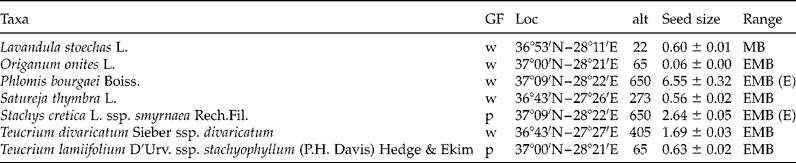
We collected the seeds of seven Lamiaceae taxa growing in natural habitats of Muğla province, south-western Turkey, the eastern Mediterranean Basin (Table 1). These taxa have a soil seed bank, have obligate or facultative seeder regeneration mode, and are found in post-fire environments in the study area (Tavşanoğlu and Gürkan, Reference Tavşanoğlu and Gürkan2014). The study area has a Mediterranean climate with wet winters and dry summers. The collections were carried out between July and September 2012, coinciding with the propagule dispersal period of each taxon. Ripe nutlets (seeds) of each taxon were collected from a minimum of ten individuals of the same population, except Phlomis bourgaei in which fewer individuals could be found. Seeds were separated from the dry flower parts by hand and stored in paper envelopes under laboratory conditions until the start of the experiment in October 2012. For each taxon, mean seed mass was determined for four replicates of 100 seeds (three replicates in P. bourgaei due to the limited number of seeds).
List of the studied taxa. Growth form (GF), seed collection locality (Loc) and altitude (alt; m a.s.l), mean (± SE) seed size (in mg) and distributional range of the taxa are given. Nomenclature follows Davis (1965–Reference Davis1985)

w, woody; p, perennial herb; MB, the whole Mediterranean Basin; EMB, the eastern MB; E, regionally endemic to Turkey and the east Aegean islands.
Preparation of aqueous smoke solutions
Since the active compounds of smoke for germination are very stable in aqueous solutions (Van Staden et al., Reference Van Staden, Brown, Jäger and Johnson2000) and aqueous extracts of smoke are equally as effective as airborne smoke in stimulating seed germination (Brown, Reference Brown1993b; Dixon et al., Reference Dixon, Roche and Pate1995), we used aqueous smoke solutions as smoke treatment for the experiment. Dry needles of Pinus brutia, the pine species dominating the vegetation in most of the study region, were separated into small pieces to use as the plant material needed for preparing aqueous smoke solutions. Four replicates of 5 g of this plant material were heated separately in metallic containers in the oven for 30 min at 193 ± 1°C (Jäger et al., Reference Jäger, Light and Van Staden1996; Moreira et al., Reference Moreira, Tormo, Estrelles and Pausas2010; Çatav et al., Reference Çatav, Bekar, Ateş, Ergan, Oymak, Ülker and Tavşanoğlu2012). The mouth of each container was tightly covered by an aluminium slab to capture the smoke generated from the burnt plant material. After the treatment, 50 ml of distilled water was added to the plant material in the container and was left for 10 min (Jäger et al., Reference Jäger, Light and Van Staden1996). By this procedure, the active chemicals found in smoke dissolved in the water in the container. The solution was filtered into a bottle to obtain concentrated smoke solution (hereafter, smoke 1:1; pH 4.32). One millilitre of concentrated solution was diluted in 10 and 100 ml of distilled water to prepare lower concentrations of smoke solutions (hereafter, smoke 1:10, pH 4.40, and smoke 1:100, pH 5.03, respectively). Since previous observations revealed that smoke-stimulated germination was independent of the pH value (Brown and Van Staden, Reference Brown and Van Staden1997), we did not adjust the pH of the different concentrations of smoke solutions and the control.
Germination experiment
Seeds of each taxon were incubated in different concentrations of smoke solution for 24 h. A group of seeds from each taxon was also incubated in distilled water (pH 5.75) for 24 h to be used as a control for the aqueous smoke treatments. After the treatments were applied, seeds were sown in Petri dishes containing agar (0.7%) as substrate. Each treatment consisted of four replicates of 25 seeds. Petri dishes were placed in an incubator set at 20.0°C ( ± 0.5°C) in darkness, i.e. favourable conditions for the germination of many Mediterranean species (Thanos et al., Reference Thanos, Georghiou, Douma and Marangaki1991; Luna et al., Reference Luna, Pérez, Torres and Moreno2012). The seeds were monitored for germination on a daily basis during the first 10 d of the incubation, and then weekly until the end of the experiment. The criterion of germination was the observation of visible radicle protrusion. Germinated seeds were counted and removed from the Petri dishes at every check. The experiment was finalized after 7 weeks of incubation. The viability of non-germinated seeds was determined by the cut test, and the seeds with an intact embryo were classified as viable.
Data analysis
For each taxon we included the germinated versus non-germinated seeds (including intact but not empty ones) in the analysis. The probability of germination stimulation by each smoke treatment was determined using analysis of deviance (GLM) with binomial error distribution (Moreira et al., Reference Moreira, Tormo, Estrelles and Pausas2010). Mean germination time was calculated using the equation Σ(nD)/Σn, where n is the number of seeds germinated on day D and D is the number of days from the beginning of the incubation period (Tompsett and Pritchard, Reference Tompsett and Pritchard1998). Dunnett's test was used for comparison of mean germination time for smoke treatments and the control in each taxon. Data normality and homoscedasticity were tested using the Shapiro–Wilk and Bartlett's tests before each analysis, respectively. Since the prerequisites for parametric tests were obtained in all cases, germination time data were not transformed before analysis.
Results
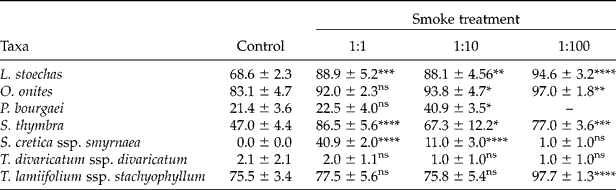
Of the seven taxa examined, six showed significant increments in germination percentage in at least one smoke solution compared to the control (Table 2). Among the studied taxa, Lavandula stoechas, Origanum onites and Teucrium lamiifolium ssp. stachyophyllum had relatively higher germination percentages (>68%) in control conditions. On the other hand, Stachys cretica ssp. smyrnaea and Teucrium divaricatum ssp. divaricatum had very low germination percentages ( < 3%) in control conditions, suggesting the presence of a high degree of dormancy in these taxa (Table 2). Application of any smoke solution did not break the dormancy in T. divaricatum ssp. divaricatum, but Stachys cretica ssp. smyrnaea responded positively. In the taxa showing significant increments in germination percentages after aqueous smoke application, at least one single concentration of smoke solution did not stimulate the germination, except in L. stoechas and Satureja thymbra which responded positively to all aqueous smoke treatments. On the other hand, none of the smoke concentrations significantly decreased the germination percentages (Table 2).
Mean (± SE) germination percentage in the control and after smoke treatments. The concentrations of different smoke treatments are shown as 1:1, 1:10 and 1:100. The significance of the pairwise comparison of each treatment with the corresponding control (GLM) is given (ns, not significant; *P<0.05; **P<0.01; ***P<0.001; ****P<0.0001)

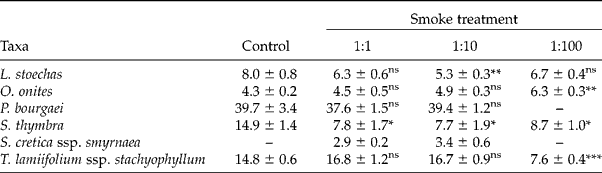
L. stoechas, S. thymbra and T. lamiifolium ssp. stachyophyllum had faster germination in at least one smoke solution than in the control (Table 3). No significant difference in germination rate was found between the control and aqueous smoke treatments in the other taxa tested, except O. onites which had a significantly slower germination rate in smoke 1:100 treatment (Table 3). No result of mean germination time was obtained for T. divaricatum ssp. divaricatum for any treatment, due to very low germination percentages.
Mean (± SE) germination time (in days) in the control and after smoke treatments. The concentrations of different smoke treatments are shown as 1:1, 1:10 and 1:100. The significance of the pairwise comparison of each treatment with the corresponding control (Dunnett's test) is given (ns, not significant; *P<0.05; **P<0.01; ***P<0.001). No statistical analysis was performed for T. divaricatum ssp. divaricatum and for S. cretica ssp. smyrnaea since very little and no germination was observed in the control, respectively.

Discussion
Our study shows that aqueous smoke treatments improved germination of six out of the seven Mediterranean Lamiaceae taxa studied. Our results provide the first record of smoke-enhanced germination in four taxa endemic to the eastern Mediterranean Basin (Origanum onites, Teucrium lamiifolium ssp. stachyophyllum, Phlomis bourgaei and Stachys cretica ssp. smyrnaea). The records of germination stimulation by aqueous smoke in the latter two taxa are of additional importance since those taxa are regionally endemic to Turkey and the east Aegean islands, and especially when it is considered that the high-level dormancy (zero germination in the control) in S. cretica ssp. smyrnaea was broken by smoke solutions.
Aqueous smoke application resulted in faster germination in three taxa, besides the stimulation of germination. One of the outcomes of earlier germination of seeds is earlier emergence of seedlings. This is likely to have ecological consequences at the plant community level since early emergence of seedlings has a competitive advantage over the species with late-emergent seedlings (De Luis et al., Reference De Luis, Verdú and Raventós2008). In post-fire environments, similarly, early appearance of seedlings may give an advantage to a species to outcompete the others. The observed faster germination rate in aqueous smoke treatments in L. stoechas, S. thymbra and T. lamiifolium ssp. stachyophyllum, therefore, possibly contributes to the establishment success of these taxa after fire.
An increase in germination percentage and rate in aqueous smoke treatments has previously been observed in L. stoechas (Moreira et al., Reference Moreira, Tormo, Estrelles and Pausas2010, Reference Moreira, Tavsanoglu and Pausas2012), similar to the results of our study. However, two studies (Crosti et al., Reference Crosti, Ladd, Dixon and Piotto2006; Çatav et al., Reference Çatav, Bekar, Ateş, Ergan, Oymak, Ülker and Tavşanoğlu2012) failed to show an increase in germination percentage in this species, possibly because of loss of dormancy due to longer seed storage time (Çatav et al., Reference Çatav, Bekar, Ateş, Ergan, Oymak, Ülker and Tavşanoğlu2012). Charred wood also stimulated germination in L. stoechas (Keeley and Baer-Keeley, Reference Keeley and Baer-Keeley1999). Çatav et al. (Reference Çatav, Bekar, Ateş, Ergan, Oymak, Ülker and Tavşanoğlu2012) found an improvement in germination percentage in aqueous smoke treatment in a population of S. thymbra from around 100 km to the east of the seed collection area in the present study.
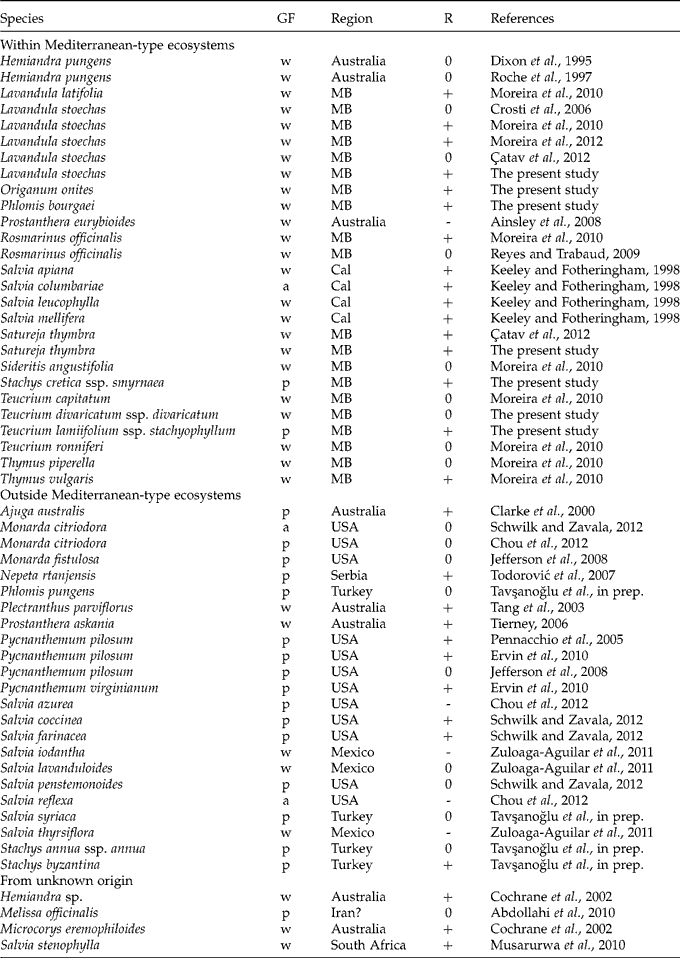
The importance of smoke in fire-induced germination in Mediterranean-type ecosystems of California (Keeley and Fotheringham, Reference Keeley and Fotheringham1998), South Africa (Brown, Reference Brown1993a) and Australia (Dixon et al., Reference Dixon, Roche and Pate1995) has long been known. However, it had been overlooked in the Mediterranean Basin, based on the presence of few records of smoke- or charred-wood-stimulated germination in this region (Keeley, Reference Keeley, Arroyo, Zedler and Fox1995; Keeley and Baer-Keeley, Reference Keeley and Baer-Keeley1999; Buhk and Hensen, Reference Buhk and Hensen2006), until more evidence was reported for Mediterranean Basin flora in recent years (Moreira et al., Reference Moreira, Tormo, Estrelles and Pausas2010; Çatav et al., Reference Çatav, Bekar, Ateş, Ergan, Oymak, Ülker and Tavşanoğlu2012). Physiological seed dormancy (Baskin and Baskin, Reference Baskin and Baskin2004; Karlsson and Milberg, Reference Karlsson and Milberg2008) and a water-permeable seed coat (Moreira et al., Reference Moreira, Tormo, Estrelles and Pausas2010) are characteristics of the Lamiaceae family. Thus, the chemical compounds in smoke responsible for the stimulation of germination (such as karrikinolides) can pass the seed coat and break dormancy and/or improve germination in Lamiaceae species. Smoke-enhanced germination in a number of Lamiaceae species was previously demonstrated in fire-prone environments of the Mediterranean Basin (Moreira et al., Reference Moreira, Tormo, Estrelles and Pausas2010) and California (Keeley and Fotheringham, Reference Keeley and Fotheringham1998). Our results also support the hypothesis that germination in species of the Mediterranean Lamiaceae is improved by the existence of smoke chemicals. The Lamiaceae is one of the families in which a seeder mechanism is found in the Mediterranean Basin, as a result of phylogenetic clustering of fire-adapted traits (Verdú and Pausas, Reference Verdú and Pausas2007). Fire-enhanced germination is one of these traits that allow Lamiaceae species to persist in frequently burned Mediterranean habitats. Indeed, 11 out of the 17 tested Lamiaceae species from Mediterranean ecosystems (including the present study) give a positive germination response to smoke (Table 4), while only five have no response and one has a negative response. On the other hand, studies performed with Lamiaceae species from outside the Mediterranean-type ecosystems showed a similar pattern (χ2= 2.1, df = 2, P>0.05) with 9 positive, 7 neutral and 4 negative responses (Table 4). This suggests that smoke-enhanced germination in Lamiaceae is not restricted to Mediterranean-type ecosystems; however, more studies are needed to clarify this conclusion.
List of the Lamiaceae species in which smoke-stimulated germination has been tested (including this study). The studies, conducted both with aqueous smoke solutions and with airborne smoke, are included in the table. GF is growth form and R is the germination response of the species to smoke

a, Annual herb; p, perennial herb; w, woody; +, positive response; –, negative response; 0, neutral response; MB, Mediterranean Basin; Cal, California, USA; USA, United States of America.
Lower concentrations of smoke solutions improved germination in T. lamiifolium ssp. stachyophyllum, O. onites and P. bourgaei, while the concentrated solution (1:1) had no effect on the germination percentage in these taxa. Conversely, S. cretica ssp. smyrnaea positively responded to the concentrated smoke solution but not to the 1:100 smoke solution treatment. This suggests the presence of a species-specific germination response to aqueous smoke solutions with different concentrations. This supports the suggestion of Keeley et al. (Reference Keeley, Bond, Bradstock, Pausas and Rundel2012) that reporting a lack of smoke-stimulated germination is inconclusive ‘without conducting an experiment over a large concentration gradient’.
In conclusion, our results contribute to the current limited knowledge on the smoke-enhanced germination in Mediterranean Lamiaceae, and support the idea that smoke is an important germination cue for this family.
Acknowledgements
The seeds were collected in the field with the permission of the Ministry of Food, Agriculture and Livestock of Republic of Turkey (no. 1379, dated 9 March 2012). The experiments were conducted in the laboratories of the Department of Biology, Muğla Sıtkı Koçman University, Turkey. We thank Costas A. Thanos and three anonymous reviewers for their comments, which helped improve the manuscript.
Financial support
The fieldwork of this study was supported by Hacettepe University Scientific Researches Unit (project no. 012.D06.601.0013).
Conflicts of interest
None.