

1. Introduction
1.1 Why We Need Discount Rates
1.1.1 Much of actuarial work concerns the analysis of future cash flows, arising from both assets and liabilities. The technique of “present values” or “discounted cash flow” is a way to summarise these future cash flows in terms of a more manageable value measured in today's terms. There is a loss of information in moving to a present value, and discounted cash flow analysis is not always the best way of analysing or presenting financial data. It remains, however, a very widespread tool.
1.1.2 A particular need for discount rates arises in the area of financial transactions. If a transaction includes the transfer of a series of cash flows, potentially over a number of years, then for the purposes of a placing a current value on the cash flows in the context of the transaction, it is often necessary to use discount rates. Examples of transactions that may be analysed using discounted cash flows include:
• the purchase or sale of an insurance product, eg an annuity;
• taking a transfer value from a defined benefit pension scheme;
• surrendering an insurance policy;
• exchanging a pension for tax free cash at retirement or an additional spouse's benefit;
• the splitting of pension assets on divorce;
• the takeover or merger of an insurance company;
• the purchase or sale of most types of investment (including most types of debt issued by companies and other entities)Footnote 1;
• the acquisition of a company (or possibly even a single share in a company) with a defined benefit pension scheme;
• comparing the value of different employee (or director) remuneration packages with deferred components, including e.g. different levels of pension benefits; and
• assessing employment costs (including pension and other longer-term benefits) as part of an outsourcing contract.
1.1.3 A transaction does not need to take place for a transaction value to be helpful. For example, analysts commenting on a company's share price will need to consider the impact on share value of any defined benefit pension scheme.
1.1.4 The need for manageable current value numbers is also important to aid decision making by company management and trustees and for use in communicating information to potential buyers of financial products, holders of insurance contracts and pension scheme members.
1.1.5 Actuaries are not the only users of discount rates. Within firms, capital budgeting importantly and fundamentally relies on discounting, where a weighted average cost of capital is derived from estimates of the costs of equity and debt. However the focus of this paper is the use of discount rates in actuarial work and primarily, therefore, in liability measurement.
1.2. Why The Project Is Needed
1.2.1 Section 2 of this paper and the work carried out by Chinu Patel and Chris Daykin show how the practice and use of discount rates in actuarial work (and outside the Actuarial Profession) has developed in many different ways, not all of which are consistent. In particular, different practice areas of the Profession have had to face very different regulatory and other constraints. Consequently, it is possible that two actuaries working in different areas may come up with very different answers to essentially a similar question: “what is the appropriate discount rate to apply to a particular series of cash flows”?
1.2.2 This project is therefore important for a number of reasons:
• A common framework and language for expressing discount rates should help actuaries in their work and consideration of appropriate discount rates.
• A common framework and language for expressing discount rates should promote a common understanding amongst actuaries and help improve consistency in the use of discount rates where this is appropriate.
• There may be very good reasons for the use of different discount rates in different circumstances (and in different practice areas). A common framework for communicating discount rates will assist in explaining the rationale for such differences.
• Recent failures in global financial systems seem, in part, to have stemmed from a misunderstanding of risk and a resultant failure of risk management. This highlights the need for actuaries, as risk management professionals (even if not the ones commonly associated with the types of organisation most adversely affected by the recent financial crisis), to communicate impartially and effectively. A common framework for discount rates (which are at the heart of many risk management models) will greatly assist.
• If the Actuarial Profession is to speak with a clear and consistent voice to regulators, standard setters and other professional bodies, this will be greatly assisted by a common approach and framework for the setting of discount rates. In particular, there have been many examples of discount rates having been set by regulators or other standard setters to satisfy a particular political or alternate objective. It represents a danger to the Actuarial Profession and the professional reputation of actuaries when a political objective (e.g. on the appropriate funding standard for pension schemes) becomes confused with an actuary's professional advice on appropriate discount rates. A common framework for expressing discount rates will highlight where actuarial theory has been impacted or compromised by other external factors.
• Actuaries deal with complicated financial models and systems. But the results of the actuaries’ work often need to be communicated to non-experts or the general public. The creation of a common framework for discount rates and also a common language for communicating discount rates and risk will help improve understanding of actuaries’ work. Moreover, it should help avoid some of the problems that can arise when non-experts misinterpret the work or the outcome of the work (e.g. in a financial product) of an actuary.
1.2.3 The development of a common framework will not take away the need for actuaries to apply careful professional judgment in the advice they give on the use of an appropriate discount rate. But it should aid them in their work and make it easier for users and recipients of actuarial advice to understand the implications of the advice they receive.
1.3 What Happens When Discount Rates Go Wrong?
1.3.1 Discount rates can “go wrong” in several ways. A discount rate which is “too high” will result in the current value of a cash flow or series of cash flows being understated. A discount rate which is “too low” will result in the current value being overstated. The impact of such an incorrect valuation can result in poor decision making in transactions. For example, a management decision to buy an insurance company or a company with a large defined benefit pension scheme may be faulty, if it is based on an incorrect valuation of the liabilities; a management decision to embark on an early retirement/redundancy programme may be faulty, if it is based on an incorrect assessment of the cost; a personal decision to buy a financial product or take a transfer value from a defined benefit pension scheme may be faulty, if it is based on an incorrect assessment of the financial implications.
1.3.2 The persistent use of a discount rate which is “too low” or “too high” can result in assets or reserves being built up which are unnecessarily high or dangerously low. In the event of a failure of, say, an insurance company or company pension scheme this can then result in individuals losing out on significant life savings.
1.3.3 Also, it is not just the case that a discount rate may be “too high” or “too low”, discount rates can “go wrong” if they are “too volatile” or “not volatile enough”. If an actuarial model suggests a discount rate which is “too volatile” then this can give the impression that the financial system being modelled contains greater risk than it does. Wildly fluctuating current values caused by volatile discount rates can also lead to companies or trustees being unable to make decisions, as the financial analysis (and related actuarial advice) keeps changing. On the other hand, a discount rate which is “not volatile enough” can give rise to complacency and a misunderstanding of the level of risk involved.
1.3.4 The framework introduced in this paper recognises that different approaches to setting discount rates may be needed depending on the purpose of the calculations and the questions being addressed. It is vitally important, if discount rates are not to “go wrong”, for the correct approach to be used depending on the circumstances and for the limitations of the approach used to be clearly understood and communicated. This paper is aimed principally at actuaries and readers with a specialist knowledge and understanding of discount rates. However, this question of the importance of communication highlights the possible need for a simple follow-up paper to this technical paper which explains discount rates and our proposed framework for setting discount rates in terms which are accessible to non-specialist readers.
1.3.5 A common framework for determining discount rates cannot guarantee that problems with discount rates will not arise in future. But better communication, transparency and understanding of discount rates should result in greater appreciation of the potential problems and hence reduce the risk of such problems arising.
2. Current Practice and Existing Research
2.1 The report “Actuaries and Discount Rates” by Patel & Daykin (Reference Patel and Daykin2010) is the result of their initial research into past and current practice in the use and setting of discount rates in the UK, and a survey of existing research and debate. The report covers some initial steps towards developing a common language whilst acknowledging further work is needed on the most appropriate classification and ways of describing the concepts involved. The report was gratefully received by the Discount Rate Steering Committee giving as it does a most useful platform from which to both explain and enhance the contribution that actuaries can make to this important topic.
2.2 The Discount Rate Steering Committee recommends that actuaries interested in this subject study the Patel & Daykin (Reference Patel and Daykin2010) report, but recognise that for some, the conclusions will be of more interest than the detail across all practice areas. Chapter 1 of the report gives a very readable overview both of the principal findings and the issues the authors still feel need to be tackled. This section of our paper does not repeat even this level of detail but is intended to give only the briefest of summaries to help guide actuaries to the areas that interest them and to introduce some of the ideas developed later in this paper.
2.3 In Chapter 1 “Overview and principal findings”, Patel & Daykin (Reference Patel and Daykin2010) look at the questions asked and set out their recommendations. In their historical study and review of current practices they identified a wide variety of applications for which calculations involving discount rates are necessary and where a number of different methodologies are employed. In almost every case they found that the purpose and context were the principal drivers to the approach selected. But with the high profile of pensions, the increasing convergence between insurance and pensions, and the ongoing debate between solvency, funding and accounting, the authors suggest that the Actuarial Profession is well placed to take steps to improve communication about the nature of discount rates for different purposes and how the different approaches can be reconciled, or rationally explained. Vital to this is understanding the different “risk spaces” in which actuaries operate in banking, asset management, insurance and pensions, and how the different calculations can be rationalised in terms of the nature and degree of risk embedded in the discount rate. Whilst the appropriate level of risk retained is driven by the purpose and context of the calculations, Patel & Daykin recommend that a framework is developed which enables each discount rate to be expressed in terms of its embedded risk. They introduce two reference categories to help in the development of such a framework, namely matching calculations and budgeting calculations. Much of the fabric of their report is an investigation into how current practice can be described in these terms.
2.4 The family of matching calculations are introduced as those where the liability is valued by reference to market instruments (or models to simulate market instruments) which seek to match the characteristics of the liability cash flows. The discount rates used are those implicit in the market prices of the matching market instruments or a reasoned best estimate if there is no deep, liquid and transparent market. These calculations are particularly appropriate for transactional work and include not only those used for hedging but also those commonly described as market consistent. Even though it is a main characteristic of matching calculations that the discount rate should include a low level of risk, the report acknowledges that there are many different variants and that generally some judgement is involved in the setting of discount rates and so varying elements of risk are embedded.
2.5 The family of budgeting calculations covers those where the measurement of the liability is approached from the viewpoint of how the liability is going to be financed and so the discount rate is based on the expected returns from a pre-determined investment strategy. These calculations are useful in planning and budgeting work and the discount rate usually retains a much larger element of embedded risk, often incorporating credit for an equity risk premium. For more on matching and budgeting calculations see Sections 3 and 4 of this report.
2.6 Patel & Daykin's overview concludes by setting out some areas where, by improving communication about discount rates, they see that actuaries will be able to improve the product they deliver and so optimise decision-making across practice areas, especially for external stakeholders. Chapters 4 and 5 on concepts, characteristics and risk structure in discount rates in their report (summarised in brief below) provide a start in developing a common language. Patel & Daykin highlight better disclosure of how risk has been accommodated in discount rates as key to improving communications to external stakeholders to help them understand the consequences of the decisions that they make. Linked to this is better education so that actuaries and other stakeholders can better understand when different approaches are appropriate and why often even so-called market consistent valuations can contain a considerable degree of judgement, such as when the liability cash flows are influenced by the behaviour of policyholders, beneficiaries and customers in exercising any contractual options to which they might be entitled.
2.7 Chapter 4 of their report investigates some of the concepts associated with discount rates as a start to developing a common language. The authors return to first principles by considering money and the financial markets, highlighting, as does Kemp (Reference Kemp2009), that money has two important characteristics: as a medium of exchange and as a store of value. The relationship between these two characteristics over time introduces the concepts of the ‘time value of money’, compound interest and accumulated and present values. These simple concepts are the foundations of financial markets and financial mathematics and allow the identification of ideas such as diversification, immediate and deferred consumption, liquidity, deep markets and credit risk. This all leads to the concept of interest rates used to accumulate cash flows and the inverse process of discounting to present values in order to facilitate an easier comparison of non-identical cash flows. An important principle identified early on was for consistency between the discounting of assets and liabilities with discount rates serving as a simple tool to communicate complicated cash flows by condensing the time dimension. Discounting becomes more significant the larger the mismatch between assets and liabilities.
2.8 Chapter 4 of their report also explores the difference between ‘price’ and ‘value’ with the former based on the amount for which a product changes ownership between a willing buyer and a willing seller. In contrast they define ‘value’ as the utility the product provides to the holder, which means that there will be some subjective elements in its quantification, requiring a framework within which value is suitably described and disclosedFootnote 2. They explain that price is determined by marginal transactions with a market in part existing because different people have different ideas on perceptions of value/utility, different liabilities, different investment timescales, different tax positions and different views of what the future may hold. They also note that some of the theoretical concepts implicit in the effective functioning of markets, such as no arbitrage may be difficult to reconcile with the value different investors ascribe to products due to the behavioural aspects of investment, even though these do not necessarily imply ‘irrational’ behaviour.
2.9 Their report introduces some types of discount rates which have little if any dependence on assets, such as a social time preference rate (‘STPR’). This is a tool primarily used by governments to balance the estimated costs and benefits to society that might arise at different times in the future from some planned activity, bearing in mind the perceived virtue of having a benefit sooner rather than laterFootnote 3.
Patel & Daykin (Reference Patel and Daykin2010) look at the term ‘market consistent value’ and associated concepts such as ‘mark-to-market’ and ‘fair value’, where the value of an asset or liability is its market value if readily traded in a deep, liquid and transparent market, or a reasoned best estimate of what its market value would have been if such a market existed. Discount rates consistent with such a valuation are referred to as ‘market consistent’ discount rates.
Patel & Daykin (Reference Patel and Daykin2010) explore the issues associated with market consistent valuations highlighting that in practice it may be difficult to identify financial instruments which have precisely the same characteristics as a liability (with liquidity, credit risk, mortality, longevity and options all playing a potential role). Market consistent approaches seem particularly appropriate for real-time transactions and for dealing with the evaluation of solvency or asset adequacy at a particular date. More controversial is whether such approaches are appropriate for ongoing financing of liabilities which are still accruing and developing with future economic and market conditions being as important as the current market situation. Accounting for liabilities falls in between these extremes. A market consistent approach (or some modification of it) may seem appropriate for such purposes as it is aiming to put a realistic value on existing assets and liabilities. It may, however, also change behaviour by potentially turning long-term financing considerations into short-term measurement issues.
2.12 Their report also looks at how different people use discount rates and how this might be used in a conceptual framework. It discusses what the IAA says on the benefits of market consistent rates. It also describes the BAS conceptual framework, which identifies two different contexts for discounting: transactional/reporting and planning/target-setting. The classification suggested by Patel & Daykin (Reference Patel and Daykin2010) in their matching and budgeting calculations is a somewhat different one to the BAS classification although, as noted in Chapter 5 of this paper, is in broad terms compatible with it.
Patel & Daykin (Reference Patel and Daykin2010) distinguish at least the following purposes for discounting:
• Pricing for immediate market transactions.
• Valuation of assets and accrued liabilities for monitoring solvency and asset adequacy.
• Accounting for financial institutions and pension plan sponsors on a going-concern basis.
• Aggregate funding of liabilities e.g. for an open pension fund.
• Transactions involving mutuality (e.g. so-called DC plans operating in a manner akin to participating insurance contracts).
They suggest that market consistency seems essential for the first two, debateable for the third and possibly more of a hindrance than a help for the last two categories where long term considerations prevail. These points are considered in further detail in later sections of this paper.
2.13 Chapter 5 of their report looks at the characteristics and risk structure of discount rates, exploring concepts such as the risk and term structure of discount rates and risk-free rates and reference rates. The main components of market consistent discount rates are identified as a low-risk reference rate with potential additions for credit and liquidity risk. Budgeting style discount rates might additionally include components corresponding to an equity risk premium and a diversification premium. These are not elaborated here as they are covered in more detail in sections 3 and 4 below. The issue of a long-term versus a short-term perspective is revisited with the authors suggesting that market consistency becomes less relevant the further ahead that one's time horizon isFootnote 4, but also suggesting that insurance and pension funds may need to manage longer term strategy simultaneously with short-term volatility. This issue too is revisited later in this paper.
2.14 A significant part of Patel & Daykin (Reference Patel and Daykin2010) is taken up with a review of current practice across practice areas (life assurance, general insurance, pensions, finance, asset management, banking, enterprise risk management and Government projects).The purposes considered vary by practice area but include the following. Not all of the acronyms used below may be familiar to all potential readers of this paper which is one reason why we have included a glossary of terms at the end of this paper.
• FSA regulation – twin peaks/technical provisions.
• Accounting – (SORP, IFRS/IAS, sponsor's accounts).
• Embedded value (shareholder).
• Pricing.
• Surrender values and PUPs, member options, contracting-out, bulk transfers, entry to PPF.
• Reinsurance.
• Pension funding and reserving (technical provisions, future service contribution rates, recovery plans, solvency).
• Investment strategy (Section 75 ‘employer debt’, cash equivalent transfer values, asset-liability modelling).
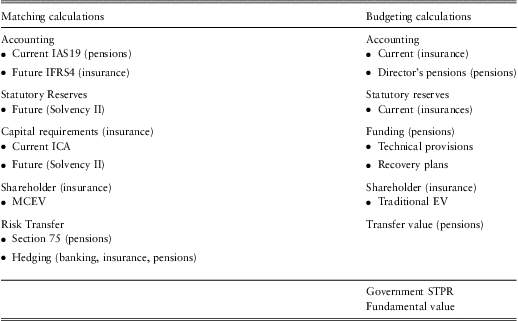
2.15 This current report does not attempt to summarise their analysis of current practice. We have, however, for reference included their classification of purposes, subdivided into ‘matching’ and ‘budgeting’ calculations, in Table 1:
Classification of purposes by type of calculation
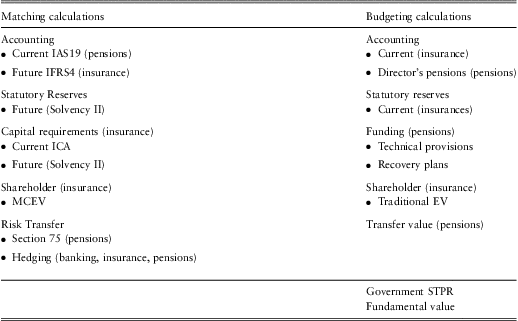
As explained in later sections, we think that their proposed classification of purposes is in some cases too ‘binary’ in nature. In some situations a blended approach involving elements of both ‘matching’ and ‘budgeting’ calculations seems to us a more appropriate description of current practice.
2.16 Their report concludes, in its Chapter 10, with a review of current developments. These focus on Solvency II and accounting standards. For Solvency II the discussions surrounding technical provisions, risk-free rates (including the merits of swap rates and government bonds) and liquidity premiums are considered by the authors. Developments in accounting standards in both insurance and pensions are looked at including the increasing convergence between them. The concepts of exit value and fulfilment value are introduced but discussions continue between accounting standards setters and other interested parties on the final approach(es) that will be recommended. Some of the implications of these developments for setting and communicating discount rates are explored further in later sections of this paper.
3. Developing Matching Calculations
3.1 Motivation
3.1.1 The family of matching calculations are introduced as those where the liability is valued by reference to market instruments (or models to simulate market instruments) which seek to match the characteristics of the liability cash flows. The discount rates used are those implicit in the market prices of the matching market instruments or a reasoned best estimate if there is no deep, liquid and transparent market. Given that market values can be volatile and (in some commentators’ view) irrational, why would we consider it as a basis for financial management or reporting?
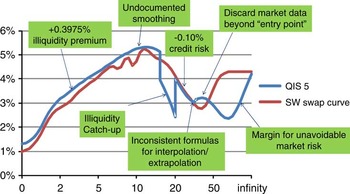
3.1.2 This section considers the rationale for matching calculations. The next section, i.e. Section 3.2, and Appendix A consider the practicalities of constructing reference curves from market data, with a case study based on QIS 5, which is expected to be a precursor to the forthcoming Solvency II regime for insurance supervision in Europe.
3.1.3 Static Replication And The Law Of One Price
3.1.3.1 Let us suppose an insurer or pension fund has promised a series of cash flows to policyholders or pension plan members. Suppose that the institution can find a “matching portfolio” of bonds or other financial instruments whose cash flows exactly replicate those promised to beneficiaries, in all possible outcomes. In that special case, we would expect assets and liabilities to be accounted consistently, so that values are equal and future income statements show neither profits nor losses. This implies that the market consistent value of the liabilities is the market value of the corresponding replicating portfolio.
3.1.3.2 What if the firm declines to hold the matching portfolio? Maybe there is another portfolio with higher expected returns. Does this alternative strategy reduce liability costs? For a matching calculation any higher returns expected from an alternative portfolio may be interpreted as a market reward for bearing the mismatch risk against liabilities. These rewards are earned over time as the risk is borne. The underlying premise is that the initial ‘value’ placed on the liabilities should not be reduced merely because we hope to benefit from future risky investment returns.
3.1.3.3 The matching process fails if we can find no matching portfolio. It also fails if we can find more than one matching portfolio with the same cash flows but different market values. In theory, the latter case is economically implausible in competitive traded markets; if two portfolios have the same cash flows with different prices then arbitrageurs should enter the market, buying the cheaper and selling the more expensive to make a risk-free gain. The assumption that such arbitrages do not exist (or are only of a fleeting nature) implies the law of one price, which states that to each set of cash flows there exists a unique market consistent price.Footnote 5
3.1.4 Avoidance Of Accounting Arbitrage
3.1.4.1 Accounting arbitrage means a rearrangement of financial affairs to give a different accounting treatment, when little of economic substance has changed.
3.1.4.2 The best known example of accounting arbitrage arises in the context of historic cost accounting, under which assets are accounted at their original purchase price. This creates an accounting option for management; they can move from historic cost to market value by “bed and breakfasting”, which is selling an asset and immediately buying it back.
3.1.4.3 Accounting arbitrages can also arise when the specified treatment depends on management's classifications of contracts. For example, firms may designate bonds as “available for sale” or “held to maturity”, with treatment on a market basis in the first case and historic cost in the latter. Financial derivatives are accounted differently if they qualify for “hedge accounting” or if structured as a reinsurance contract.
3.1.4.4 Exley et al. (Reference Exley, Mehta and Smith1997), illustrate some of the effects of taking advance credit for risky asset returns in risky liability valuation. In §3.3 of their paper, they show a “conjuring trick” in which two underfunded pension schemes both become overfunded merely by exchanging asset portfolios. This accounting arbitrage is avoided by the use of market consistent valuation techniques.
3.1.4.5 It is generally considered that scope for accounting arbitrage is reduced by the use of market consistent valuation techniques, as long as they are applied consistently to both sides of the balance sheetFootnote 6. Matching calculations for liability assessment can substantially reduce opportunities for accounting arbitrage. If assets are held at market prices, then purchase or sale has no balance sheet or revenue impact. If risk management tools are valued consistently with markets regardless of their legal form, be it investment, derivative or reinsurance, then there is no accounting benefit from restructuring one in the form of another.
3.1.4.6 Users of financial statements might then place more confidence in financial statements produced using market consistent techniques because they are less amenable to arbitrage flatteryFootnote 7. Markets provide an objective measure of value on which participants can agree.
3.1.5 Dynamic Hedging
3.1.5.1 Another type of hedging is dynamic hedging. Dynamic hedging involves the adoption of a strategy in which the disposition of assets, liabilities or both is altered in a manner that seeks to align the economic behaviour of the assets with the behaviour of the liabilities. Where liabilities do not involve any option-like elements then usually there is little need to resort to extensive use of dynamic hedging processes. Where option-like elements (e.g. guarantees) are present then organisations can hedge statically using corresponding derivative instruments (to the extent that they are available) or hedge dynamically by investing in dynamically altering portfolios of simpler (and therefore hopefully more liquid) instruments. Dynamic hedging might also be implicit in other management actions not directly linked to just the asset portfolio. If we know that we would respond in a particular way (e.g. reduce bonus rates) were particular types of economic outcomes to arise, then we may be allowed to take credit for the risk mitigating impact of such management strategies. Usually, however, dynamic hedging is not as reliable a form of hedging as exact static hedging; the effectiveness of the dynamic hedge may, for example, depend on future volatility which is usually not known with certainty in advance.
3.1.5.2 For pension plans or insurers, hedging would often be part of an asset strategy, for example matching the duration of assets to liabilities. Hedging might also use derivatives to bridge any mismatch between existing assets and liabilities. However, it is also important to realise that the underlying purpose of the hedge may also influence its effectiveness at delivering against a range of possible objectives.
3.1.5.3 We might for example characterise into two main categories the two tools by which a financial institution might seek to limit exposure to market and other moves. We have already considered cash flow replication, matching asset cash flows to those of liabilities, with regard to timing, currency and amount. However, our current financial reporting systems seldom disclose cash flow projections, making it difficult to monitor the effectiveness of cash flow matching.
3.1.5.4 The alternative to cash flow replication is a balance sheet hedge. A balance sheet hedge means that the balance sheet values of assets and liabilities move together over short periods of time and under various defined stress conditions. The definition of a balance sheet hedge is therefore dependent on how assets and liabilities are valued on the balance sheet. This means that they do not necessarily behave ‘sensibly’ in terms of underlying economic behaviour. For example, if assets are valued at historic cost and fixed liability cash flows are discounted at a fixed discount rate, then any asset strategy is a liability hedge (until it is sold), as the “values” placed on neither assets nor liabilities respond to changes in economic conditions.
3.1.5.5 The worst possible outcome is that a balance sheet hedge exists but is a poor match over time. What appears to be a great hedge in the short term fails to keep pace over time. This was arguably the case with the MFR basis for pension liability valuation, and may yet turn out to be an unintended consequence of the combined valuation adjustments in solvency II.
3.1.5.6 A matching valuation reconciles the cash flow and balance sheet perspectives. If asset and liability cash flows match, then the balance sheet valuations also reconcile.
3.1.6 Shareholder Value And Performance Measurement
3.1.6.1 We have described the merits of market consistent valuation in the context of liability replication or hedging. But it is not inevitable or even typically likely that financial institutions will invest in such a way as to minimise risk. For example defined benefit pension plans frequently invest to profit from the perceived higher longer-term returns available from equity markets, deliberately running the resulting mismatch and higher risk. For the same reason, insurers may invest in corporate bonds, judging that the higher yield more than compensates for the higher risk. This raises the question of whether a market consistent valuation remains an appropriate measure of liabilities when a mismatched strategy is being followed. The alternative is that advance credit might be taken for the expected additional asset returns, in the form either of assets valued above market or liabilities below.
3.1.6.2 Hancock et al. (Reference Hancock, Huber and Koch2001), provide techniques for financial management in the situation where investment strategy deviates from the theoretical match. Their methodology interposes a replicating portfolio between the assets and the liabilities, providing a transfer pricing mechanism that separates asset and liability elements of profit. The replicating portfolio forms a benchmark against which the experienced asset risks and returns are to be measured. The performance of the insurance function is measured not relative to the actual portfolio but the returns on the replicating portfolio. This means that the measurement of pricing and reserving effectiveness is free from the distorting effect of market moves. Conversely, the investment strategy relative to the benchmark can be considered without distortion from the liability side.
3.1.6.3 The conclusion of their analysis is that a matching valuation remains appropriate even when assets and liabilities are mismatched. In this case, reported income will reveal some volatility, but this is arguably an appropriate reflection of the chosen risk profile.
3.1.6.4 Their reasoning relies on tracing the risks (and returns) of balance sheet trades through to shareholders. If the balance sheet is accounted on a market value basis, then asset and liability values flow into accounting equity, directly impacting shareholders. This mechanism is less clear when accounting is based on historic cost or subject to reporting delays. Some other risks, rewarded in financial markets, may not flow through to end users at all. For example, an insurer may invest in illiquid assets but that illiquidity does not necessarily impact the insurer's shareholders, who may be able to buy or sell the insurer's shares regardless of the underlying asset illiquidity.
3.2 Building Blocks For Matching Calculations
3.2.1 There are a number of “building blocks” required when establishing discount rates for matching calculations as follows:
• Selection of instruments to be used in constructing discount curves.
• Default Risk.
• Allowance for taxation and other expenses.
• Premiums for Illiquidity.
3.2.2 These “building blocks” are discussed in detail in Appendix A which sets out methodology for constructing discount rates in matching calculations. A priority in any actuarial calculations is the need for transparency. It is important that the construction of discount rates in matching calculations is clearly understood. In particular there may be occasions when additional risk margins or other adjustments to discount rates are desired. In such circumstances a high degree of transparency may be required to separate the construction of discount rates designed to be consistent with valuation in financial markets and the impact of any adjustments (e.g. as required by regulators or other standard setters).
3.3 Market Consistent Value And The Efficient Market Hypothesis
3.3.1 The efficient market hypothesis states that market prices reflect all available information and therefore markets provide the best indicator of fundamental worth. If markets are believed to be efficient, then market consistent valuation consists of distilling the information from asset market prices and using it to value liabilities.
3.3.2 Empirical evidence for and against market efficiency is hotly disputed but is largely irrelevant to the question of whether there is merit in adopting market consistent valuation techniques. There may be a view of the world that is more statistically predictive than the view implied from market prices. In this case, it is still possible to calculate a market consistent valuation, but this can no longer be claimed as a fundamental value in an absolute sense. The market consistent valuation incorporates the market view as expressed in asset prices, without venturing an opinion as to whether those prices are precisely where they ought to be. However, it is important to recognise that hedging and arbitrage-free aspects of market consistency stand whether or not markets are efficient. The justification for market consistency is not related to market efficiency but to the assertion that markets generally respect the law of one price/principle of no arbitrage.
4. Developing Budgeting Calculations
4.1 Requirements/Distinguishing Features
4.1.1 The family of budgeting calculations covers those where the measurement of the liability is approached from the viewpoint of how the liability is going to be financed and so the discount rate is based on the expected returns from a pre-determined investment strategy. These calculations may be useful in planning and budgeting work and the discount rate usually retains a much larger element of embedded risk, often incorporating credit for an equity risk premium. It should be noted that this increased embedded risk (typically) in budgeting calculations puts a much greater onus on actuaries to communicate the risks of adverse consequences.
4.1.2 Budgeting calculations generally arise where a long term series of future cash flows needs to be met and resources accumulated to pay for them, rather than seeking a value assessment at a particular point in time. Thus, in contrast to the previous section which looked at market consistent discount rates, this section considers how discount rates are selected where there are rather different objectives. In earlier sections we have described some situations where a budgeting rather than a matching approach to establishing discount rates may be appropriate. We will resist the use of the term “valuation” in connection with these budgeting calculations to try to avoid confusion with the “market consistent valuations” that have been the subject of the previous section. Such market consistent valuations can be viewed as a special case of a budgeting calculation – one where substantial (but not necessarily all) risk of not meeting future cash flows has been eliminated through investing the available funds in appropriate instruments.
4.1.3 This section considers the areas where budgeting calculations are appropriate and examines the approach in the specific area of UK defined benefit pension schemes (DB schemes). It also addresses the issues around the additional information to be communicated to understand fully the implications of adopting a budgeting calculation approach. However, the essential feature is to look at how the liability is to be financed. In particular, this will mean considering how any funds being accumulated to meet the future cash flows are investedFootnote 8. The underlying asset strategy within the entity concerned is thus the normal starting point. This raises the question of what approach might be appropriate where a series of future cash flows are unfunded or have inadequate asset coverage. How should the discount rate be established in either of these situations?
4.2 Where Budgeting Calculations Are Relevant
4.2.1 Examples of situations where budgeting calculations are currently used in the insurance environment include assessment of shareholder or enterprise value or some current approaches to statutory reserving and accounting liabilities. In a UK pensions environment the chief example is around the funding of DB schemes, a topic that we return to in Section 6. A budgeting approach is also often followed currently for individual transfer values taken by members out of such schemes. In all these cases the argument put forward is that funds are being accumulated to meet future cash flows, and part of the management process is to assess whether the likelihood of meeting the liabilities successfully is sufficiently high.
4.2.2 A distinction can be drawn in a pensions context between the series of future cash flows derived from the target benefits that have already been earned and those yet to be earned through future membership of the pension scheme. More generally, it is important to differentiate between cash flows arising from pre-existing contractual ‘rights’ which may not in practice be disclaimed by the sponsor or firm, and those cash flows that involve a greater element of discretion as to whether they will come into existence.
4.2.3 In relation to the (pension) benefits already earned, a notional or actual pool of assets will exist and assessments made of the investment returns that can be anticipated on which to base the discount rate. However, for the future benefits where future contributions will be accumulated to meet them (and where the benefits might not come into existence if the sponsor does not think it is able to provide these contributions), assumptions will typically be made about both the type of investments that will be made and the level of return that can be anticipated. When considering future returns, the long term nature of the pension scheme's liability cash flows, and the discretionary flexibilities applying to future benefit accrual, allows the budgeting calculation to take into account aspects of the underpinning assets such as:
• Illiquidity premium/default risk.
• Equity risk premium or other “out performance” premium.
• Effects of tax and expenses of investment.
Features of these quantities are described in Appendix A of this paper.
4.2.4 In many of these budgeting/funding scenarios there is uncertainty over the future cash flows – when might a sum insured become payable or how long might an uncertain amount of future pension be paid. There are opportunities to reduce the extent of any uncertainty – some sources of variation can be hedged at a cost. The pace of accumulation of the resources will also be a source of uncertainty and even whether some of the benefits will exist at all may be uncertain. All future investment returns are uncertain (at least in some respects), and a budgeting calculation discount rate will have regard to this.
4.2.5 In budgeting calculations it is accepted that there is a level of uncertainty attaching to a plan achieving its objectives. This is typically driven by cost considerations. Within the UK financial system different approaches to this question have been followed by insurers and by managers of DB schemes. At a high level, for the former, a combination of regulation of reserving requirements and the reluctance of shareholders to provide additional finance has led to the elimination of much of the uncertainty associated with an insurance operation. Whilst the situation is developing, many DB schemes are routinely managed with a higher level of uncertainty (and corresponding lower immediate contribution payments), backed by sponsors who recognise that additional costs will arise should anticipated investment returns not be achieved. In many cases an intended degree of mismatching exists between the anticipated liability and asset cash flows.
4.3 So How Might Appropriate Discount Rate/Rates Be Assessed?
4.3.1 We will use as an example an approach commonly adopted for the funding of a UK DB scheme. The trustees or managers of the scheme will have an agreed approach to investment strategy, which will have been set having regard to both the expected return from these assets and the uncertainty around achieving that return. Significant factors that go into this assessment are the current financial position of the pension scheme and the level of support from the sponsor standing behind the pension scheme. The Trustees may well have a pre determined investment strategy designed to evolve as the characteristics of the future cash flows change with time. Therefore there is an existing framework that can be used as a starting point for determining the appropriate discount rate/rates in a funding assessment.
4.3.2 Continuing with the example of the DB scheme, the managers need to understand the extent and implications of any potential mismatch between future asset and liability cash flows. The assets and liability values in a funding assessment will usually consist of the existing assets in the fund taken at their mid- or bid-market values and the anticipated liability cash flows at a discounted value. The main question is what discount rate (or rates) might be appropriate for this purpose. However, there is an explicit assumption that following an asset strategy which anticipates higher but more volatile investment returns, will lead to lower long term contribution costs.
4.3.3 Investments that might be characterised as return seeking (equities, property or alternative asset classes for example) rather than matching (fixed or index linked bonds or synthetic instruments exhibiting the same features) will experience more volatile future returns. A starting point in assessing the discount rates to use is the return that the pre determined investment strategy could be expected to achieve, together with the range of future returns that might be experienced around this expected level. The expected return can be viewed as a realistic outcome but in any funding review the managers would generally take a margin to produce a more prudent view of the current target fund needed to meet the future liability cash flows.
4.3.4 Every manager of a pension scheme will be faced with the issue of what is the appropriate level of prudence to adopt in a funding assessment. There are usually only two resources for meeting the liability outgo – future investment return and future new contributions. Where the level of prudence is pitched will alter the anticipated balance between these two sources of funds. Any such funding assessment for a DB scheme will need to be contrasted with the higher target fund consistent with the elimination of all (or at least as much as is reasonable) risk associated with meeting the future liability cash flows.
4.3.5 An extreme illustration of this balance is the case of an unfunded pension arrangement where the cash flows are met fully from contribution income – there is no fund to be a source of investment return. In a corporate environment the liabilities for such cash flows will be included on the balance sheet and, additionally (possibly requiring a different calculation approach) for financial planning purposes, a view will be needed of the outstanding liability. An approach would be to start the assessment of the discount rate from analysis of the return from a notional portfolio made up of the assets that would be held if the benefits were on a funded basis. Alternatively resources to meet these benefit cash flows have to compete with other cash demands within the business and the discount rate for assessing the liability would be based on an estimate of the internal rate of return reasonable to assume over the term of these cash flows. There are specified approaches for valuing such unfunded arrangements for the purposes of the entity's accounts, but whether the requirements governing these rates were consistent with the principles underlying the budgeting exercise would have to be considered. Turning to the situation where there is a funded DB scheme but the level of cover is low or inadequate, it is clearer that the discount rate can be based on assessing the expected returns both on the actual assets held and those that might be held if/as the financial position improves.
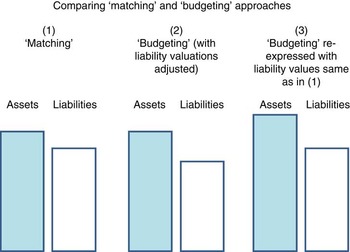
4.3.6 Budgeting calculations are not limited to pensions. Appendix C sets out a simple financial planning example of budgeting which also highlights the difference between budgeting calculations and matching calculations.
4.4 Rationalisation Of Discount Rates
4.4.1 Up to this point the discount rate (or rates) employed in a budgeting calculation has been viewed from the top down. The difference between the different target funds from the ongoing funding assessment and that associated with the more market consistent value (where risks of failure have been eliminated) will reflect the ultimate exposure to the pension scheme's sponsor. Such comparison will demonstrate the overall risk of failure that is embedded in the chosen funding strategy for the DB scheme. This exposure to the pension scheme's sponsor is an inherent part of the current regime for regulating the funding of UK defined benefit pension schemes.
4.4.2 A further aspect of a funding investigation is the reappraisal of any existing investment strategy and the impact on the funding requirement of adopting alternative strategies. This can then introduce an almost inevitable circularity into the process of analysis – revised investment strategy leads to revised discounted value of the future liability cash flows and revised funding requirements. This process is capable of rationalisation as the missing element is the change in level of potential support for the pension scheme from the scheme's sponsor.
4.4.3 There could be a number of legitimate reasons for the “budgeting” discount rate (or rates) to be higher than the “matching” discount rates in a “market consistent valuation”. However, one difficulty with this analysis is the choice of the reference rates that are the starting point. Whilst there is a range of so called risk free rates that could be chosen, as mentioned in the previous section, no single choice is obviously universally correct. Examples of imperfections are differences in term structure that cannot be eliminated or aspects of uncertain future liability cash flows that cannot be hedged.
4.5 Assessment Of Prudence
4.5.1 As referenced in 4.3 a key aspect of any budgeting calculation is the level of prudence attributable to the particular discount rate/rates employed. The starting point is the investment strategy (fixed or evolving) underpinning the ongoing funding plan. The expected returns, volatilities and correlations between the different underlying asset classes involved can be modelled to establish reasonable overall expected returns and the dispersion of return that might be experienced in different unfolding futures. Marrying up this modelling of future returns with the corresponding expected benefit (and contribution) cash flows in asset liability modelling can illustrate a range of financial outcomes. Such analysis can be used to assess the likelihood of the chosen investment strategy delivering the anticipated return. This type of analysis can examine different investment strategies that the managers of the DB scheme might employ in order to refine the most appropriate approach.
4.5.2 In the specific context of setting the target fund in an ongoing funding assessment for a UK DB scheme, the assessment of prudence can take on wider aspects than merely the likelihood the chosen asset strategy will achieve a level of return. This wider view is associated with whether the selected target fund is appropriately prudent and satisfies the requirements set out in the legislation governing such exercises. Here we are concerned with whether (and to what extent) sufficient support should be forthcoming from the entity sponsoring the DB scheme. This support takes the form of the sponsor's covenant and some broad guidance on the approach that should be taken on this is set out in the Final Report of the Sponsor Covenant Working Party, November 2005.
5. Proposed Framework
5.1 Introduction
5.1.1 The two previous sections developed two broad alternative approaches to setting discount rates in actuarial work, namely a “matching” approach and a “budgeting” approach:
(a) A “matching”, i.e. “market consistent”, type of approach is characterised by use of discount rates that are consistent with the current (market) value of assets that, as far as possible, replicate the (future) economic behaviour of the liabilities to which the discount rate(s) might be applied. If financial markets are sufficiently deep, liquid and transparent to approximate to their idealised behaviour and rationale for existenceFootnote 9 then the (market) value of the replicating portfolio of assets should, except as explained below, correspond to the (market) value at which a liability would trade were there to be a ready market in the liability cash flowsFootnote 10.
(b) A “budgeting” type of approach is characterised by use of discount rates that are consistent with the expected future returns the party carrying out the valuation or planning exercise believes will accrue from the assets expected to be held to provide for the future cash flows as they fall due.
5.1.2 Either approach encompasses a range of variants, see in particular Section 5.2 and Appendix C. One of the most important of these is whether (and by how much) to take account of the creditworthiness of different stakeholders in the arrangement to which the liabilities (and assets) in question relate. In Section 5.3 we show that this possible source of variation has a strong conceptual linkage to how to identify the amount of capital that an organisation should hold in order to demonstrate solvency.
In this Section we explore which of these two types of approach (as well as which variant) might be most appropriate in which circumstances. We focus on similarities and differences between the approaches, on the mindsets underlying them and on the impact that choice of approach might have on conclusions drawn and decisions reached. Ultimately, discounting is not an end in itself but merely an element, albeit an important one, in a wider analytical process ultimately resulting in financial consequences to one or more parties.
5.2 The Difference Between Matching And Budgeting
There are many differences between matching and budgeting, but there are also circumstances when matching and budgeting calculations produce the same answer. Appendix C considers these issues in some detail and in particular looks at:
• Circumstances when the choice of methodology is irrelevant.
• Valuation, utility and the impact of markets.
• Transparency.
• Budgeting for stochastic models.
• Matching for stochastic models.
• Who are actuaries advising.
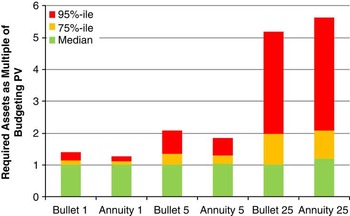
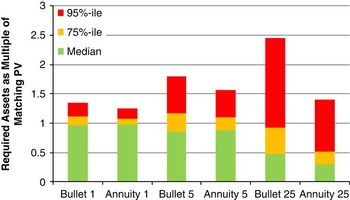
Appendix C then concludes with a simple practical example illustrating the difference between matching and budgeting.
5.3 Solvency Assessment
5.3.1 A fundamental actuarial activity is to provide information that ultimately works its way into the solvency assessment of an organisation.
5.3.2 To navigate through the many issues involved in such calculations it helps to have a clear conceptual framework capable of differentiating between the different aspects of and approaches to capital adequacy. Ideally it should be capable of incorporating the subtleties that exist in practice (e.g. the preference regulators and others might have for firms to use one sort of capital rather than another in addition to merely having a particular quantum of capital to hand).
5.3.3 Kemp (Reference Kemp2009), describes such a conceptual framework. He argues that (absent future new business or capital raising) the balance sheet of any financial firm or organisation can be conceptually organised as per Figure 1Footnote 11.
Schematic representation of any financial organisation's balance sheet

5.3.4 In this representation, ‘customer liabilities’ correspond to liabilities to depositors (for a bank), policyholders (for an insurance company) or beneficiaries (for a pension fund). There may be some liabilities that rank above customer liabilities (e.g. mortgages secured on particular assets), but usually most non-customer providers of the organisation's capital have a priority ranking below that of the firm's customers (i.e. in the event of default customers will be paid in preference to these capital providers).
5.3.5 Stand-alone entities may only be able to replenish capital ranked below customer liabilities by raising new capital from elsewhere. The entity's ability to do so will depend heavily on the extent to which it is expected by outsiders to have access to profitable new business flows in the future.
5.3.6 A similar representation can also be used for a DB (or DC) pension fund even though such a fund does not have precisely the same profit-focused outlook that is typical of a commercial firm.
5.3.7 Importantly, the asset part of the portfolio may include both assets actually directly held within the scheme's balance sheet and also implicit or explicit access that the fund may have to capital that is currently held on its sponsor's balance sheet. This latter part of the capital structure is usually termed the sponsor covenant and is akin to a contingent IOU that the fund may be entitled to call upon in times of trouble. Some of this IOU may be ‘committed’ in the sense that the sponsor may be committed to pay it as part of a recovery plan, if the scheme is currently in deficit). The rest may be ‘uncommitted’, but with expectation that it would actually be forthcoming if experience was worse than expected or benefit accrual greater than expected.
5.3.8 If a DB pension fund has no sponsor (e.g. because the sponsor has defaulted) and therefore no sponsor covenant to fall back on then its position is akin to a stand-alone entity as above except that, not being commercial, it is unlikely to be able to raise much capital ranking below its own beneficiaries in the event of getting into trouble.
5.3.9 All other things being equal, the greater the amount of capital the organisation has ranking below its own customer liabilities the better protected are its customers against the organisation running into difficulties. Only after this capital cushion is exhausted would customers start to find their liabilities not being fully honoured. A corollary is that ‘solvency’ is never absolute. As long as there are some customer liabilities there will always be outcomes we can envisage that are severe enough to result the exhaustion of this cushion and hence in customer liabilities not being honoured in full. For example, the organisation (or its sponsor, if the organisation is dependent on a sponsor covenant) might suffer a particularly massive fraud, be hit with a particularly large back tax or liability claim, suffer reputational damage which exhausts its future earning power, or just make the wrong business decisions and end up making losses which exhaust its capital base.
5.3.10 Kemp's innovation is to specify the problem of how much capital an organisation should hold to be ‘solvent’ in terms of the yield spread (versus risk-free)Footnote 12 that would or should apply to customer liabilities were they to be traded freely in the market place. Such a conceptual framework highlights a large number of the subtleties that arise in theory and in practice with solvency computations, see e.g. Kemp & Varnell (Reference Kemp and Varnell2010).
5.3.11 Such a framework is not in practice exactly how any current regulatory framework operates, except if we adopt the somewhat circular logic that any existing combination of technical provision and solvency capital requirement can be re-expressed as equivalent to some level of spread versus the situation where the liabilities are completely risk-free. However, it still provides a strong theoretical underpin favouring the use of market, i.e. ‘matching’ based calculations in solvency assessments. The underlying arguments can also be restated to tie in with the benefits of objectivity and fairness between parties that we have already noted are possessed by market based approaches.
5.4 What Are The Cash Flows and Purposes Of Valuing Them?
5.4.1 In order to bring this together into an overarching framework for setting and using discount rates we believe it is necessary to simplify matters and consider actuarial calculations within a limited number of defined categories. We initially focus on the discounting of liability cash flows. Inevitably this results in some compromise and risks certain calculations falling outside our framework. However we believe the very large majority of actuarial calculations will fit into our framework and thus the compromise is acceptable. We believe it is first helpful to consider that there are essentially three different types of liabilities or cash flows:
1. Liabilities that the entity in question is contractually obliged to honour.
2. Liabilities that are ‘constructive’ in the sense that on any reasonable going concern type assessment, the entity in question might expect to need to honour them in the future. In a pensions context this might relate to the impact of future pay growth on accrued pension liabilities or the impact of early retirement terms on accrued pension liabilities.
3. Liabilities that are more or less discretionary in nature and may, for example, be contingent on asset performance.
5.4.2 Whilst it will often be obvious which category a particular liability falls into, there are grey areas that may require exercise of judgement or on which different regulators may have different views. In particular, it will be possible for projected cash flows to contain more than one of the above types of liabilities and it may therefore be necessary in certain circumstances for the cash flows to be separated into their constituent parts. It should also be noted that in our view the possibility of default on the cash flows should, in most circumstances, be a consideration in the determination of the discount rate rather than in the determination of the cash flows.
5.4.3 In Solvency II, this issue is referred to by the phrase ‘contract boundary’. For example, if one contract gives the policyholder the right to enter at a future date into another contract (e.g. includes a guaranteed renewability component) then usually the additional contract would also be included as a constructive liability from a regulatory perspective. However, allowance would typically then be made for exactly what the ‘guarantee’ involved. For example, guaranteed renewability should be less onerous to the insurer if it has largely unfettered flexibility over the premium rates it will charge under the new policy or policy extension.
5.4.4 Similar grey areas can also arise with pension obligations. For example, some liabilities may be accrued but not yet vested, i.e. entitlement to the cash is given but dependent on the paying entity being in existence at some future (vesting) point, such as an accrued pension for someone who may only be entitled to a refund of contributions as an early leaver. We might view such a liability as being in category 1 if the pension scheme winding up clause meant that the accrued pension would be promised to the beneficiary in the event of a wind-up, or in category 2 if it did not until the vesting period had elapsed. Alternatively, we might take the view that if the sponsor could still sack the employee within the relevant vesting period, thus making the employee an early leaver, then any accrued pension would still only move to category 1 at the end of the vesting period.
5.4.5 Differentiating between categories 2 and 3 (and sometimes between 1 and 3) may also be potentially challenging in practice. In a pensions context, we might view category 3 as primarily representing opportunity for discretionary pension increases if asset performance is good. In an insurance context, with-profit policyholders may expect to benefit in certain circumstances from future distributions of surplus in the estate. However, unless the fund is closed to new business the extent to which that benefit will fall to existing policyholders rather than future generations of policyholder may be unclear. Therefore in considering the position of current policyholders only, as one might for solvency or reporting purposes, there is a greater contractual right to benefits reflecting asset shares and policy guarantees than to benefits representing distributions of estate surplus.
5.4.6 The use of a matching or budgeting style discount rate may be dependent on the nature of the cash flow. However it is also necessary to consider the purpose of the calculations.
5.4.7 We believe there are three broad purposes for actuarial calculations which require discount rates to be determined for placing values on cash flows:
A. Solvency – where the purpose is to assess the assets required to meet the liability cash flows in the absence of any other supporting financial entity.
B. Transactions – where the purpose is to assess a (fair) value of assets to be transacted in exchange for the liability cash flows.
C. Funding – where the purpose is to advise on the accumulation of assets to meet the liability cash flows as they fall due in the (largely hypothetical) situation where we can ignore any consideration of the likely sufficiency of the assets to meet the cash flows in the interim event of the absence of any supporting financial entity.
5.4.8 A matching approach will generally be more suitable for type A and type B calculations, whereas a budgeting approach may be more suitable for type C calculations. Unfortunately, many types of actuarial calculations do not fall precisely into these categories, even if the terminology used to describe them appears to imply that they do.
5.4.9 For example, arguably in a pensions context the only types of ‘funding’ calculations that would fall exclusively into category C would be ones where the scheme was a ‘pure’ DC scheme with no guaranteed underpin (and even then there is the question of whether the scheme member would view the asset allocation underlying the pension assets as being entirely unfettered). This might have been a reasonable approximation many years ago when benefit guarantees were low and wind-up liabilities small in relation to ongoing liabilities. It might still be the case for very well funded schemes with very strong sponsors. But for most UK pension schemes nowadays, the pace of funding derived from funding calculations can be expected to have some material impact on outcomes for beneficiaries in the event that the sponsor defaulted prior to payment of the liability, in which case perhaps ‘funding’ calculations for such entities should blend A and C together.
5.4.10 We might also expect the different sorts of calculations that actuaries might undertake which involve transactions to fall firmly within category B. However, actuaries’ advice may in these circumstances depend on whom they are advising. Where their advice is to be unbiased between different parties then a matching approach may be thought intrinsically desirable. Where their advice implicitly or explicitly requires an expression of an investment view then a more funding orientated approach may be considered more desirable.
5.4.11 Even category A is potentially open to interpretation. For example, to what extent if any should solvency calculations take into account implicit or explicit support arrangements that the entity might be able to call upon if it becomes distressed? Organisations that have the potential to obtain funding from third party sources may be better placed to weather financial storms than those that have absolutely no-one else to turn to.
5.4.12 This suggests that in practice it may be necessary in a budgeting style framework to include matching framework constraints on the calculations. The challenge then becomes how to explain and justify the constraints. Appendix C shows that we can always arrange for matching and budgeting style approaches to come up with the same answer by altering the ‘expected’ return on the budgeting approach in an appropriate manner, where ‘expected’ is shorthand for the combination of the statistically expected return and the degree of prudence being assumed. So, we can achieve equivalence merely by setting the desired level of prudence without altering our own views about the likely future distribution of returns. We might view ‘0% prudence’ as corresponding to category C above (in which the guaranteed liabilities are so small in relation to the available assets that explicit prudence over and above any implied by the prudent person principle is deemed irrelevant to the computation) and we might view ‘100% prudence’ as corresponding to category A or B above (or more onerous than this if we are adopting a mismatched investment strategy, to reflect the extra risks then being run). Where along this spectrum should any particular discount rate be set for any particular purpose?
5.4.13 Discounting is not always applied only to liability cash flows. Other examples include the discounting of pension contributions or of distributable profits in life assurance (the latter often called “embedded value” – see Salmon & Fine, Reference Salmon and Fine1991). In each of these cases, the usual purpose is the assessment of worth to shareholders and, following the principles of this section, we consider a matching approach to be preferable. This is consistent with the recommendations of Chapman et al. (Reference Chapman, Gordon and Speed2001) in the pensions field and with the CFO forum's Market Consistent Embedded Value principles in the life assurance field.
5.5 Encapsulating All Of The Above In An Overarching Framework
5.5.1. In our opinion:
(a) Both matching and budgeting style discount rate derivations can be relevant in actuarial work
(b) Where objectivity and fairnessFootnote 13 between parties is paramount, and the assets and liabilities in question are essentially already contractual commitments then a matching, i.e. market consistent, approach is nearly always likely to be preferable.
(c) Where assets and liabilities are more malleable, e.g. when they have not yet crystallised, and particularly when actuaries are specifically advising just one party (an extreme example being when actuaries are asked to advise on whether the current market price of an asset or liability represents good or bad ‘value’ to that party) then budgeting/planning style computations become more applicable.
(d) When assets and liabilities are more malleable but actuaries’ advice will, in effect, be relied upon by multiple parties then some blend between matching and budgeting style approaches may be deemed most desirable. This blend may be more objectively achieved by specifying matching calculation constraints on the budgeting approach. In the interests of comparability, standardised assumptions, if they can be defined by a suitable industry-wide body, may have merit (e.g. as is the case with embedded value type computations).
(e) Where some liabilities are more contractual and some are less, e.g. as with a UK DB pension scheme where certain benefits are discretionary then some blend of matching versus budgeting style approaches may also be appropriate. Again this will be more objectively achieved by specifying matching calculation constraints on the budgeting approach.
5.5.2 In summary, our views can be presented in matrix form in Table 2:
Proposed selection of calculation type depending on cash flow purpose and nature of liability

Notes: 1. A matching framework would be appropriate for projections of future solvency
2. It may be necessary to introduce matching framework constraints in budgeting calculations. The need for such constraints will be greater if the liabilities/cash flows are predominantly guaranteed rather than constructive or discretionary.
5.5.3 Solvency calculations typically implicitly involve multiple points of view (e.g. shareholder, customer and regulator and, in extremis, government or industry sponsored investor protection arrangements) and place a premium on objectivity, putting them squarely into (b) above. However, overlaid on any purely market derived discount rate elements will be some implicit yield spread versus risk free as described in Section 5.3. This might vary within an individual entity's own policyholder or beneficiary base, depending on e.g. the liquidity characteristics of the relevant liability.
5.5.4 To aid transparency we believe that, where practical, any material divergence between the values placed on contractual asset or liability cash flows and their market or market consistent values should be highlighted in actuarial work, together with an explanation of the main contributors to this divergence.
6. Recommendations
6.1 This paper and the recommendations contained within it are intended to be of assistance to actuaries in their work. The Discount Rate Steering Committee recognises that actuaries do not have a monopoly of expertise and experience on discount rates and that discount rates are used in many other areas outside actuarial work. Whilst the scope of the Actuarial Profession's discount rate project and this paper does not extend to areas outside the normal work of an actuary, it is hoped that the framework outlined in this paper will prove useful not only to actuaries but also to others using discount rates in their work.
6.2 In their report Actuaries and Discount Rates, Patel & Daykin (Reference Patel and Daykin2010) highlighted two families of calculations:
• Matching Calculations where a calculated value of the liability is assessed by reference to market instruments (or models to simulate market instruments) which seek to match the characteristics of the liability cash flows.
• Budgeting Calculations where a calculated value of the liability is assessed by reference to how the liability is going to be financed and hence the discount rate is determined by reference to expected returns from a pre-determined investment strategy or some other external financing criteria.
We believe that the very large majority of actuarial calculations can be defined as matching calculations or budgeting calculations but, in limited circumstances, a blend of matching and budgeting can be relevant as described in section 5.
Recommendation 1 – Actuaries should seek to determine discount rates (and be able to justify their choice of discount rate) within a matching framework and/or budgeting framework as described in Section 5.
Recommendation 2 – Where practical, any material divergence between the values placed on contractual asset or liability cash flows and their market or market consistent values should be highlighted in actuarial work, together with an explanation of the main contributors to this divergence.
Recommendation 3 – In presenting advice based on the use of discount rates actuaries should communicate clearly the framework, building blocks and level of embedded risk they have used to determine the discount rate(s). Moreover, actuaries should take great care over the terminology they use making every effort to promote understanding by users.
6.3 In the rest of this section the different uses of discount rates in actuarial calculations are considered in turn and recommendations are made on which framework/building blocks should be used.
6.4 Pensions
6.4.1 Funding and Reserving
6.4.1.1 There are a number of actuarial calculations required in funding and reserving for pension liabilities and to a large extent the form of the calculations is driven by legislative requirements.
6.4.1.2 A budgeting framework can be used for valuing and assessing funding requirements for discretionary obligations and some constructive obligations. Moreover, where we can ignore any consideration of the likely sufficiency of the assets to meet the cash flows in the event of the absence of any supporting financial entity, because we are simply interested in the accumulation of assets to meet the liability cash flows as they fall due, then we can use a budgeting calculation.
6.4.1.3 However, budgeting calculations will always be inadequate as a measure of security. If a funding calculation of the liabilities is targeted which is typically less than the solvency calculation of the liabilities, then even if the funding plan is exactly on course at all times, in the event of the failure of the supporting employer at any time before the settlement of the final liability cash flow, the assets are unlikely to be sufficient to meet members’ benefits. Moreover, as it is likely that the relationship between the budgeting calculation and the solvency position will vary from time to time, the budgeting calculation will not give consistent reliable information on the solvency position.
6.4.1.4 Regulators and others are increasingly driving the purpose of funding a pension liability to be to provide security for members’ benefits in the event of the employer becoming insolvent. In such circumstances the reserves which are required to be held should be judged against a value of the liabilities for the contractual benefits determined on a matching framework. However UK regulations require pension schemes to target a level of funding, referred to as the Technical Provisions, calculated within a budgeting framework and to put in place a formal recovery plan if an assessment shows that the scheme's assets do not fully cover its Technical ProvisionsFootnote 14.
Recommendation 4 – Actuaries and the Actuarial Profession should be clear (to their clients and to regulators) that the use of a budgeting calculation alone in the assessment of Technical Provisions will not provide adequate information on the assessment of the security of members’ benefits.
6.4.1.5 The calculation of Technical Provisions under UK regulations requires the use of a “prudent” discount rate determined by the trustees on the advice of the Scheme Actuary. Prudence is not defined, but the Regulator has given guidance to trustees on how they should approach the setting of assumptions (see Patel & Daykin (Reference Patel and Daykin2010), Chapter 8). In particular, regulations require that the discount rate must be chosen prudently taking into account either or both:
• The yield on assets held by the scheme to fund future benefits and the anticipated future investment returns, and
• The market redemption yields on government or other high-quality bonds.
6.4.1.6 It is apparent that there is no unique understanding over what represents a “prudent” discount rate. The Pensions Regulator would seem to be encouraging trustees and actuaries to consider factors which are wider than simply an assessment of the likelihood of a desired investment return being achieved on the pension scheme assets. We believe that this wider test of prudence might reasonably be applied to the overall funding test but cannot meaningfully be translated into the derivation of the discount rate (or any other actuarial assumption) in isolation. We believe that a “prudent” discount rate can only meaningfully be assessed by reference to the actual or evolving pension scheme investment strategy (and not to factors such as alternative investment strategies or the strength of the sponsor's covenant). We also believe that an overall test of “prudence” on the level of Technical Provisions (which might have regard, inter alia, to the strength of the sponsor covenant) is better done at the aggregate level (with explicit guidance), rather than at the level of each assumption.
Recommendation 5 – In assessing what is a “prudent” discount rate for the purposes of calculating Technical Provisions under UK regulations, consideration should be given primarily to the current or evolving pension scheme investment strategy, it being noted that there may then need to be other explicit elements of prudence included in the liability calculation if the overall result is to be sufficiently prudent as far as the Pensions Regulator is concerned.
6.4.1.7 When a UK pension scheme is in deficit a recovery plan has to be put in place which seeks to restore the funding position of the pension scheme up to the level of the Technical Provisions.
Recommendation 6 – For the purposes of establishing a recovery plan to restore pension scheme funding up to the level of Technical Provisions a budgeting framework may be used with a realistic assessment of the expected investment return that can be anticipated during the recovery period. However, actuaries should be clear, as per Recommendation 4, that such a framework will not provide adequate information on the assessment of the security of members’ benefits during and at the end of the recovery period.
6.4.1.8 An actuarial valuation must include the actuary's estimate of the solvency position of the pension scheme based on the contractual benefits. For the purposes of calculating this estimate of solvency we believe a matching framework should be used.
Recommendation 7 – For the purposes of calculating an estimate of pension scheme solvency a matching framework should be used (making no adjustment for sponsor default on the pension obligation).
6.4.1.9 It is a requirement of UK disclosure regulations that trustees should communicate information regularly to pension scheme members on the funding position of the pension scheme. Much of the information disclosed is laid down in regulations and focuses on the financial position relative to the level of Technical Provisions and the recovery plan. However, from a member's perspective this information is of limited use. Moreover, it reflects badly on Regulators, Trustees, Employers and the Actuarial Profession when schemes which are stated to be ‘fully funded’ fail to pay benefits in full after sponsor insolvency.
6.4.1.10 The information which is more useful to members relates to the security of their benefits and how much security is provided in turn by pension scheme assets, the Pension Protection Fund and the employer covenant and how this is expected to develop in the future (given agreed funding plans etc).
Recommendation 8 – For the purposes of disclosing pension scheme funding information to members, trustees and regulators should be encouraged to focus on the solvency position and how it is expected to develop under the agreed funding plan.
6.4.2 Accounting For Pension Benefits
6.4.2.1 The calculations for reporting the cost of pension benefits in sponsors’ accounts are prescribed under accounting standards FRS17 and IAS19. These accounting standards prescribe a matching framework with the use of a discount rate derived from market yields on high quality corporate bonds.
6.4.2.2 The purpose of company accounts is to present information to shareholders relevant to the value of their shareholding. As such the information required for company accounts is fundamentally transactional in nature (i.e. a type B calculation in section 5). We therefore support the use of a matching framework for the calculation of pension liabilities in company accounts. However, it is not clear that shareholders get any benefit from a possible default on pension promises. It therefore follows that the discount rate used for calculating pension liabilities in company accounts should more appropriately make no allowance for sponsor default (and hence be based on the yield on gilts rather than on high quality corporate bonds).
6.4.2.3 Despite the above comments, an overriding consideration in accounting standards is one of consistency. This means consistency in the treatment of the essentially identical economic liabilities represented by the annuities in an insurance company's annuity portfolio as against the pensions in payment under its own pension scheme. However, it also means consistency between the treatment of pension liabilities in company accounts and the treatment of other long term financial liabilities.
Recommendation 9 – The Actuarial Profession should call for pension liabilities in company accounts to be calculated in a matching framework (making no adjustment for sponsor default), subject to this principle being consistent with all long term financial liabilities (including insurance liabilities).
6.4.3 Member Options And ‘Transactions’
6.4.3.1 There are a number of areas in pension schemes where members have the option to exchange one form of benefit for another. These include:
• Cash equivalent transfer values.
• Commutation of a pension for a lump sum at retirement.
• Trivial commutation of pensions.
• Exchanging (part of) a pension for a spouse's pension.
• Exchanging (part of) a pension for a temporary pension payable until State Pension Age.
• Exchanging (part of) an escalating pension with pension increases for a flat pension with no pension increases.
6.4.3.2 There are also a number of other occasions when actuaries advise on ‘transactions’ in DB Pension Schemes. These include:
• Calculating the cost of providing a certain level of benefits or the cost of making changes to the benefits (for example, implementing a programme of early retirements).
• Comparing alternative remuneration strategies/packages (for example, the calculation of directors’ pension benefits in company accounts).
• Calculating the value of pension benefits on divorce.
• Calculating the cost of the contracting-out rebate.
6.4.3.3 The natural starting point for the calculations described above (particularly where equivalence in value is desired) should be a matching framework. However, there are regulations which cover the calculation of cash equivalent transfer values and for many pension schemes the calculation of member options is determined by specific wording in the pension scheme rules or otherwise, which may indicate an alternative calculation framework. Member options also give rise to the possibility of selection against the pension scheme which needs consideration and possible allowance in the calculations.
6.4.3.4 The regulations governing the calculation of cash equivalent transfer values define the minimum calculated value as being the expected cost of providing the benefits within the pension scheme. This is consistent with the use of a budgeting framework for transfer value calculations resulting in higher discount rates/lower transfer values than a matching framework might produce. This can result in members concluding that the cash equivalent transfer value is less than a market consistent value (although it should be noted that trustees may have good reason for wishing cash equivalent transfer values to be lower than a market consistent value, for example, if there are security concerns in respect of the benefits of continuing scheme members). It is relevant to note though that under UK regulations, the assumptions for the calculation of transfer values are determined by trustees having taken the advice of an actuary.
Recommendation 10 – Actuaries should advise on member options and transactions within a matching framework. Even where an alternative approach is indicated by other considerations (e.g. legislation or pension scheme rules) the matching framework calculations should be considered in any advice given.
Recommendation 11 – Actuaries should encourage trustees to consider cash equivalent transfer values in a matching framework and the Actuarial Profession should encourage regulators to revisit the regulations on cash equivalent transfer values from a matching framework perspective.
6.5 Life Assurance
6.5.1 Reserving
6.5.1.1 Historically reserving standards for regulatory purposes have been based on discounting of liabilities at a discount rate based on the expected yield to be earned on the assets backing the liabilities. This approach is effectively a budgeting framework. However, the “expected yield” has been subject to deductions partly to allow risk but also more generally and at different times various limits based on market discount rates. As such the standards have had some of the characteristics of a matching framework. The balance between the two approaches has typically been dependent on the relative yields on the assets backing liabilities and the yield on the market instruments or indices prescribed to define the market rate.
6.5.1.2 For a period since 1985 the situation was further complicated by the introduction of a resilience reserve requirement which subjected the regulatory liability to an addition based on the effect of a mismatch test applied to the difference between the impact of a stress test, or worst case of a range of stress tests, on the value of assets and liabilities. This requirement has since been modified on many occasions. As such the actual quoted liability value is not specifically attributable to a single set of valuation assumptions. However, more recently to the extent that the requirement remains it forms part of the required capital and the complication is removed from the reserving requirement.
6.5.1.3 During the period 2002 to 2004 a requirement was gradually introduced requiring companies with a with profit fund over a prescribed size to produce a realistic “peak 2” valuation determined using what is essentially a matching framework. The reported with profit liabilities have thus been the higher of the result obtained using a matching framework and that derived from a heavily modified “peak 1” budgeting framework.
6.5.1.4 Looking ahead to the Solvency II regime, although much remains to be published there is an expectation that the ‘basic’ liabilities will be determined using a matching framework. This is sensible provided assets continue to be valued at market value since the most important consideration from a regulatory perspective is consistency. Some commentators have questioned the use of market value for valuing assets in this context and if there were a move away from this approach then it would require a reconsideration of the liability valuation.
6.5.1.5 The expected approach to the determination of the Solvency II capital requirements for a firm adopting the standard formulae leads to a result which is based on movements in the excess of assets over liabilities determined using a matching framework where the movements are derived from historic experience. This tends to result in capital requirements different from those that would be derived by attempting to assess the 1 in 200 year stress level implied by calibrating to a market view of such stresses. Although this may appear inconsistent there is little perceived benefit in moving to a matching framework approach for the determination of capital requirements.
Recommendation 12 – The Actuarial Profession should support the apparent move to a matching framework for liability valuation under Solvency II and encourages the UK regulator to preserve this principle in the UK implementing measures.
6.5.2 Accounting
6.5.2.1 The accounting for life insurance liabilities has historically been based on the regulatory approach subject to modifications to reflect explicit prudence included in the regulatory approach thought to be inappropriate for an accounting measure.
6.5.2.2 More recently for larger with profit funds an adjustment is made to the realistic regulatory approach to exclude the value of shareholder transfers in determining the technical provisions. This remains essentially a matching framework.
6.5.2.3 Also where contracts do not contain significant insurance risk the contract is considered to be an investment contract and the liability is based on International Accounting Standard 39 rules which allow a choice of fair value and amortised cost approach. As such it is very difficult to be certain that the accounting liability valuation approach is either a budgeting framework or a matching framework.
6.5.2.4 Looking forward, current proposals under phase 2 of the insurance project International Financial Reporting standards suggest the use of a market discount rate with no allowance for own risk but with an allowance for an illiquidity premium based on the characteristics of the liabilities, independent of the assets backing them, with a residual margin designed to eliminate profit at point of sale, which would be released over the term of the contract.
6.5.2.5 Where liabilities are determined for accounting purposes it is often the movement over time which is reflected in profit and loss statements which is the most important element. Thus the consistency between valuation of assets and liabilities becomes even more critical.
6.5.2.6 Depending on the form of the application of this additional margin the resulting profit emergence may or may not achieve this constancy for contracts considered to be life insurance contracts under IFRS rules. Clearly the use of consistent approaches will leave residual profit volatility where assets and liabilities are mismatched. Where liabilities are illiquid it is unlikely that assets will be found that exhibit the same price dynamics as the liabilities, so residual volatility will be expected to emerge in any event.
6.5.2.7 Thus provided the asset valuation approach remains based on market values it is suggested that a matching framework is most appropriate for liability valuation.
Recommendation 13 – The Actuarial Profession should support a move to a matching framework for liability valuation under International Financial Reporting Standards provided that market valuation remains the approach for valuation of assets.
6.5.3 Pricing
6.5.3.1 There have historically been few regulatory constraints to the pricing of life insurance products, and no obligation on firms to take actuarial advice. However, there is a requirement to ensure that the firm's resources are sufficient to cover the obligations taken on.
6.5.3.2 As such it is difficult for an actuary to direct the company to a particular approach. However, where an actuary is involved in providing advice to a firm it is important that the advice is seen to be meaningful and in that context it is helpful if the advice derives from application of a consistent framework.
6.5.3.3 Many factors will be taken into account in setting the premium rates and the precise form of any actuarial advice will reflect the approach taken. For convenience it is assumed that the advice to be provided includes the expected financial impact on the firm of writing policies on the terms set out and it is in this context that the choice of calculation is being made. In the event that the rate was being set to deliver a target profitability target identical considerations would apply.
6.5.3.4 Given that the transaction of a life insurance product is an exchange of cash (premium) for obligations (claims), or one set of obligations (a series of premiums) for other obligations (claims), it is possible to take a view derived from the framework that a matching approach should be used.
6.5.3.5 Whilst in a number of situations, for example in the pricing of a bulk purchase annuity, where the trustees of a pension scheme decide it is appropriate to transfer out a large part of the investment and longevity risk, it is almost certainly the case that a matching framework will be required.
6.5.3.6 In other situations, for example the provision of annuities to individuals retiring it may again be appropriate to adopt a matching framework. However, practicalities may dictate in this case that the approach be modified to guarantee rates for a period after quotation to meet the practical needs of the market place. In this case, in which the actual computation may be carried out using a matching framework at a point in time, the actuary advising will also need to advise on the appropriate limitations of the continued use of those premium rates, providing an indication of the risks involved through the process adopted for guaranteeing and modifying rates in the future. It may also be appropriate to advise on the thresholds to be adopted for changing rates.
6.5.3.7 However, many life insurance products are provided on a basis that regular changes in premium rates are not desirable. These would typically be products where there is sensitivity to the discount rate but where the sensitivity is such that an averaging approach may be acceptable without giving rise to adverse selection. In such situations whatever approach is used it is likely to be one which makes assumptions about future average earning rates, possibly subject to a margin. In principle, given the transactional nature of the “exchange” it is suggested that any estimate should provide similar sensitivity information to that provided under a matching framework in the context of immediate annuities as described in 6.5.3.6
Recommendation 14 – In providing advice in relation to premium rates for life insurance an actuary should have regard to the specific needs and requirements of the firm proposing to sell the products. However, where the price is calculated other than using a matching framework or where the intention is to use the premium rates over a period of time, actuaries should provide sufficient information to enable the recipient to assess the continued appropriateness of the rates recommended as economic conditions vary over time.
6.5.4 Policyholder Calculations
6.5.4.1 The need for calculations for policyholders arises in two situations. The first is where a policyholder wishes to change the form of the benefits under their policy, including the common but extreme case where the policyholder wishes to exchange their policy for cash. The second situation is where a policyholder wishes to take a view as to the likely level of benefits available under his/her policy with a view to assessing the adequacy of a policy, which provides benefits linked to the performance of specific assets or of a with profit fund. Such projections may be used, for example, to assess the adequacy of pension provision under a money purchase pension plan.
6.5.4.2 Where the calculations are being performed to cost the change in the form of benefits under a policy, the situation is very similar to that described in 6.5.3 above. In general there would be a natural bias towards a matching framework. However, practical considerations may require a reconsideration of this approach.
6.5.4.3 As with the premium calculations large one off transactions can be costed on a matching framework basis. Small transactions, particularly where they have a low interest rate sensitivity may use a different approach. However, in such cases consideration should still be given to the impact of not using a matching framework. Also quantification of sensitivities etc is again desirable.
6.5.4.4 Where the basis of the change of policy is subject to constraints such as policy conditions or TCF considerations requiring a different approach it is suggested that the cost of using an approach other than matching be provided.
6.5.4.5 Where the projection is being carried out to give policyholders an indication of the likely value of the benefits available at some future point under a policy where the benefits are linked to the performance of particular assets then it would seem appropriate, and consistent with the framework, to assume the anticipated return on those assets for the purposes of the calculation. Although unlikely to be used as a discount rate the rolling up of benefits, effectively the reverse of the discounting process.
Recommendation 15 – In providing advice in relation to modifying policy terms for life insurance an actuary should have regard to the specific needs and requirements of the policy including its conditions and any TCF implications. However, where the pricing is calculated other than using a matching framework or where the intention is to use the basis over a period of time, the actuary should provide information to enable the recipient to assess the continued appropriateness of the rates recommended as economic conditions vary over time.
Recommendation 16 – Where a projection of benefits under a policy with the benefits payable are linked to the performance of a defined pool of assets, the projection should be based on a budgetary framework having regard for the specific assets to which the benefits are linked or are expected to be linked.
6.6 General Insurance
6.6.1 Unpredictability Of Cash Flows
6.6.1.1 In contrast to other areas of actuarial practice, general insurance (GI) involves far greater uncertainty around the timing and amounts of future liability cash flows, with correspondingly limited scope to apply a matching approach to their evaluation. Indeed, it is extremely rare for there to be contractually fixed cash flows, beyond the recent introduction of Periodical Payment Orders (PPOs), which allow courts to award lifetime payment streams in the most serious third-party bodily injury cases.
6.6.1.2 General insurance claims may be subject to liability specific inflationary forces, such as those affecting repair costs, medical costs or awards in court, presenting difficulties both in the measurement and prediction of inflation, and in finding suitable hedging investments against those future increases. Actuaries should also be careful in considering the source of their inflation rate assumptions, if they are seeking to adopt a matching approach calibrated to observable market prices.
6.6.1.3 In addition to these uncertainties, cash-flow durations have tended to be relatively short, with the result that investment returns have played a relatively minor role in reserving, pricing and general valuation work carried out by GI actuaries. Furthermore, the distinction between budgeting and matching approaches has been less relevant, and is rarely discussed within general insurance. However, with recent developments in regulatory solvency and in international accounting standards, GI actuaries will be required to move towards a matching approach to their work, as anticipated in our recommendations.
6.6.2 Reserving
6.6.2.1 Historically there has been limited use of discounting in determining reserves in general insurance; the more common practice being to hold undiscounted reserves, with the consequent over-statement being justified as a prudent response to the uncertainties inherent in the timing of the claims and expense liability cash flows. However, for longer duration liabilities with a mean term of four years or more, discounting based on risk-free rates of return is allowed and Solvency II will require the use of discounting based on risk-free rates of return. It is therefore expected that GI reserving will move to a discounted basis, consistent with that used for life insurance.
Recommendation 17 – The Actuarial Profession should support the apparent move to a matching framework for liability valuation under Solvency II and encourages the UK regulator to preserve this principle in the UK implementing measures.
6.6.3 Accounting
6.6.3.1 Developments in accounting standards are on-going and it is clear that the use of a matching framework is central to these discussions. However, it is important that the standards should achieve consistency between asset and liability valuations, and be sufficiently sensitive to changes in market conditions over time to provide a meaningful assessment of the cost of matching the assessed liabilities.
Recommendation 18 – The Actuarial Profession should support a move to a matching framework for liability valuation under International Financial Reporting Standards provided that market valuation remains the approach for valuation of assets.
6.6.4 Pricing
6.6.4.1 As reflected in past and current reserving practices returns on investments have played a secondary role within the determination of the value of GI liabilities. However, the requirements of Solvency II and the introduction of Periodical Payment Orders (PPOs) within the UK will lead to greater focus on the discounting rates. As such, consideration of appropriate matching assets and the selection of suitable discount rates will be of far greater interest to GI actuaries.
Recommendation 19 – In providing advice in relation to pricing GI products an actuary should have regard to the relative importance of investment returns on assets to the cost of providing those products. However, where the price is calculated other than using a matching framework or where the intention is to use premium rates over a period of time, the actuary should provide sufficient information to enable the recipient to assess the continued appropriateness of the rates recommended as economic conditions vary over time.
Acknowledgements
We would like to thank the Management Board of the Actuarial Profession for taking a lead on the important question of discount rates in actuarial work and we are grateful to them for their encouragement.
We are grateful to those who have made many helpful comments in the drafting stages of this paper, in particular John Hawkins, Gary Hibbard, Cliff Speed and Peter Wright.
Glossary
ALM – asset-liability management/modelling calculations where the aim is to assess the likely impacts of particular strategies, which are generally of a budgeting nature although approximate matching strategies may also be assessed.
BAS – Board of Actuarial Standards. Following the Morris Review of the Actuarial Profession, published in March 2005, HM Treasury asked the Financial Reporting Council (FRC) to take on responsibility for oversight of the UK Actuarial Profession and the independent setting of actuarial technical standards. This latter task is the remit of the BAS.
CDO – Collateralised Debt Obligations. A type of structured asset-backed security whose value and payments are derived from a portfolio of fixed-income underlying assets.
CDS – credit default swaps. A swap designed to transfer the credit exposure of fixed income products between parties.
CETV – cash equivalent transfer value. Early leavers have the option (except for a short period prior to pension age) to transfer their benefits out of the scheme into another approved pension scheme or a personal pension by taking a CETV. Legislation defines a CETV as the expected cost of providing the member's accrued benefits within the scheme.
Credit risk – this includes the risk of default and the risk of widening spreads as a result of increased perceived risk of future default. The credit risk might be further split between default, downgrade, liquidity, convenience etc (as in Creedon et al., 2008 and CEIOPS, 2010).
DB – Defined Benefit
DC – Defined Contribution
Diversification premium – in a portfolio of investments, because the investments are not perfectly correlated to each other, the return from the portfolio should be less volatile than the sum total of the components’ variability. This term is also sometimes used as an extension of the equity risk premium concept, but taking into account that the additional yield is derived from investing in a diversified portfolio of assets other than government bonds, and not just equities.
Entity specific – in some matching calculations, particularly of fulfilment value, it is necessary to reflect the specific circumstances of the entity that holds the liabilities.
Equity risk premium – additional yield that may be achieved from investing in equities as compared to government bonds, bearing in mind the long-term character of the investment and the absence of any need to realise investments.
Exit value – defined as the amount the entity would rationally pay a contractor at the future date to carry out the service on its behalf. If a market exists for such services, the amount is the price that a contractor would charge and, if no market exists, the entity must estimate that amount.
FSA – Financial Services Authority. The regulator of financial services in the UK.
Fulfilment value – is the entity-specific value of the cash flows which the entity will experience in fulfilling the liability.
IAA – International Actuarial Association is the worldwide association of professional actuarial associations, with a number of special interest sections for individual actuaries.
IFRS/IAS – International Financial Reporting Standards/ International Accounting Standards: International Accounting Standards Board IFRS 4 is the relevant international accounting standard dealing with insurance contracts and covers both life and non-life insurance. The current version is intended only to be an interim standard and permits the continuation of many existing practices.
Liquidity risk premium – credit for additional yield arising from less marketable/liquid investments or in respect of liabilities deemed to be illiquid.
Market consistent value, mark-to-market, fair value – A commonly held definition of a market-consistent value of an asset or liability is its market value if readily traded in a deep, liquid and transparent market, or a reasoned best estimate of what its market value would have been if such a market existed Bankers use the expression mark-to-market to signify the same. The accountants’ concept of fair value has similar connotations.
MCEV – Market Consistent Embedded Value
MFR – Minimum Funding Requirement, introduced by the Pensions Act 1995. In force in 1997 by means of The Occupational Pension Schemes (Minimum Funding Requirement and Actuarial Valuations) Regulations 1996. (SI 1996 No.1536).
PPF – Pension Protection Fund was established to pay compensation to members of eligible defined benefit pension schemes, when there is a qualifying insolvency event in relation to the employer and where there are insufficient assets in the pension scheme to cover Pension Protection Fund levels of compensation.
PPFM – Principles and Practices of Financial Management which sets out how the firm describes what it is seeking to achieve with its financial management and, in particular, its bonus distribution policy.
PPO – Periodical Payment Orders allow courts to award lifetime payment streams in the most serious third-party bodily injury cases.
Price – The price of a financial instrument or product is the amount for which ownership changes hands between a willing buyer and a willing seller.
PUP – Paid-up policy, where premiums have ceased.
QIS – Quantitative Impact Study is an exercise, commonly used by regulatory bodies in Europe, to test the quantitative aspects of proposed risk-based capital regime such as Solvency II, to assess their design and calibration, and to give firms a preview of their likely capital requirements.
Recovery plan – sets out how a pension scheme deficit will be eliminated
Section 75 ‘employer debt’ – Section 75 of the Pensions Act 1995 provides for the calculation of a debt when a scheme winds up or when an employer ceases to participate in a multi-employer scheme. The calculation determines the level of any shortfall to be met by the employer. The wording in the legislative references relating to the liability calculations is exactly the same as for the solvency estimates, but set out separately in the Employer Debt Regulations.
SIVs – Structured Investment Vehicles
Solvency II – Directive 2009/138/EC of the European Parliament and of the Council of 25 November 2009 put in place a new regulatory system for insurance companies in the EU, known colloquially as Solvency II. The Directive constitutes Level 1 legislation under the current (Lamfalussy) legislative procedures (similar to an Act of Parliament in the UK). The Level 1 legislation will be supplemented by Level 2, currently being drafted by the Commission and subject to consultation with Member States and with stakeholders. In addition there will be Level 3 measures which will be promulgated by CEIOPS – the Committee of European Insurance and Occupation Pension Supervisors (and in due course by EIOPA – the European Insurance and Occupational Pension Authority – once it has been established in 2011).
SORP – ABI Statement of Recommended Practice on Accounting for Insurance Business
Sponsor covenant – implicit or explicit access that a pension fund may have to capital that is currently held on its sponsor's balance sheet. It is akin to a contingent IOU that the fund may be entitled to call upon in times of trouble.
STPR – social time preference rate. This is a tool primarily used by governments to balance the estimated costs and benefits to society that might arise at different times in the future from some planned activity, bearing in mind the perceived virtue of having a benefit sooner rather than later.
TCF – Treating Customers Fairly
Technical provisions – in an insurance company or pension scheme, a calculation for regulatory purpose placed upon its liabilities, particularly in relation to unpaid benefits and claims. For more information see Appendix A (for insurance companies) and Appendix C (for pension schemes) in Patel & Daykin (Reference Patel and Daykin2010).
TPR – The Pensions Regulator is the UK regulator of work-based pension schemes working with trustees, employers, pension specialists and business advisers to protect members
Twin peaks – The twin peaks approach to capital requirements requires larger UK life insurers to carry out two separate liability calculations in respect of their with-profits funds and to hold sufficient capital to cover whichever calculation proves more onerous The statutory reserves/Peak 1 reserve calculation methods and assumptions are set by requirements in the FSA rule-book (the Prudential Sourcebook for Insurers), which replaced formal regulations approved by Parliament after the FSA took over responsibility for supervision of the industry from HM Treasury. Calculations are based on traditional deterministic methods. Realistic reserves (or Peak 2 reserve calculations) are required for realistic basis life firms.
Appendix A: Building Blocks for Matching Calculations
A1. Constructing Discount Curves
A.1.1 It is clear from market prices that different financial instruments exhibit different internal rates of return. The traditional actuarial model of a flat discount rate is no recipe for market consistent valuations, at least not unless the market consists of a single instrument (or in the exceptional case when the yield curve is entirely flat). Furthermore, the discount rate depends on more than the instrument's maturity date, as it is quite possible for instruments with a common maturity date to be priced with different yields. This frustrates any attempt to explain the yields on all instruments with a single yield curve depending only on an instrument's maturity.
A.1.2 The most successful theory for explaining fixed income instrument prices is the “fungibility hypothesis”. This states that the market value of a financial instrument with fixed cash flows can be built up from by valuing each cash flow at a discount rate that reflects the term of that cash flow. The price of an instrument such as a bond is explained using a set of discount rates, one for each cash flow date. The practical problem is how to reconstruct the curve of discount rates from market instruments, given that each instrument references more than one discount rate.
A.1.3 We might attempt to replicate a set of promised cash flows using government bonds, using interbank instruments such as deposits and swaps, or using corporate bonds together with purchased default protection using credit default swaps. These portfolios could produce equivalent promised cash flows, but in recent times the initial market values would have been quite different. This does not necessarily violate the law of one price, because we could argue that the cash flows are not exactly the same in all cases; for example all of these structures involve some risk of counterparty default but the details are different in each case. As no future cash flow promise can be absolutely free of default risk, the question remains as to which of these portfolios should be used to value a set of promised cash flows and what adjustment, if any, should be made for credit risk.
A.2. Mathematical Problem Statement
A.2.1 We can express discount curve estimation as a linear mathematical problem, given the market prices of a set of calibration instruments. The inputs to the curve estimation are:
• market prices of financial instruments;
• cash flow amounts and dates for those instruments;
• a family of curves to be fitted, and
• a weighting scheme to define goodness of fit.
A.2.2 A weighting scheme requires an assessment of relative reliability for different price inputs. An extreme version of a weighting scheme is to use as many calibration bonds as the formula has parameters so that the formula exactly replicates all calibration bonds. This could be interpreted as giving unit weight to the calibration bonds and zero weight to the rest of the bond universe. One advantage of specifying an exact fit for a small set of bonds is that an auditor can easily verify the fit is achieved. It is much more difficult to demonstrate that a proposed curve truly optimises goodness of fit.
A.2.3 Many different algorithms are in use for this purpose. The book by Anderson et al. (Reference Anderson, Breedon, Deacon, Derry and Murphy1996) gives a good survey of techniques available. Other specific algorithms are published by CEIOPS (2010) and European Central Bank (2004 and later).
A.3. Default Risk
A.3.1 Fixed income instruments are promises of future cash. None of these instruments is certain to be honoured in full, although some are more secure than others. For many developed economies, government bonds are considered the most secure, with collateralised bank instruments second and various other forms of corporate debt falling into third place. In the event of default, investors may still recover some portion of the debt even if it is not paid in full. Although bonds may default there is almost never any provision for a bond to overpay, except in the sense that a bond subject to default risk may trade at a lower price than a risk-free bond and therefore offer higher returns in good outcomes.
A.3.2 There is therefore a difference between the promised cash flows and the expected cash flows. In a mathematical sense, the expected cash flows will be lower because of the contribution of default scenarios.
A.3.3 There are several measures of a bond's (or a bond issuer's) financial strength. Specialist rating agencies collate statistics for the frequency of bond defaults, split according to the previously ascribed rating. Another measure of bond default risk is the internal rate of return (or yield to maturity) on a bond given its promised cash flows and market price. The internal rate of return, however, is only a relative measure of default risk in the sense that a bond with a higher internal rate of return has a higher spread. The prices of some derivatives, e.g. credit default swaps (CDS), are also sensitive to the perceived likelihood of a given issuer defaulting.
A.3.4 There is a rough correspondence between credit risks as measured by credit rating agencies and credit risk as reflected in bond yields or CDS spreads. A strong credit rating usually translates into lower yields, although this is not a hard and fast rule and there are usually exceptional bonds where the market's view and the rating agency views are different.
A.3.5 Rating agencies compile statistics about the historic default rates for bonds with different credit ratings. The surprising fact is that although the better bond grades have lower default rates, differences in historic default frequencies are far smaller than the differences in yields. This implies that, if historic patterns of default repeat themselves, then investors in riskier bonds earn a higher return.
A.3.6 There are several possible explanations for this.
• Defaults are uncertain, and the higher expected return (net of defaults) compensates investors for that uncertainty.
• Historic defaults may not be an accurate guide to future defaults. For example, there may be some rare but catastrophic events which are missing from the data set or ignored by the analyst in questionFootnote 15.
• Riskier bonds may also entail other higher costs, for example wider dealing spreads or higher management expenses, so that the additional return net of costs and defaults is smaller than appears at first sight.
A.4 Adjusting Bond Yields For Default Risk
A.4.1 A yield curve applies to bonds or financial transactions with a defined element of credit risk. These yields may then be applied to a promised cash flow stream. Use of unadjusted bond yields implies that the credit risk of the cash flows to be valued is in some sense consistent with the credit risk of the bond.
A.4.2 If the cash flows are to be valued at a different credit standing to the calibration instruments, then a relative adjustment is required to move from the calibration status to the desired reporting basis. This default adjustment can take several forms: an adjustment for historic defaults, an adjustment for spread differences or an adjustment for the proportion of spreads ascribed to default riskFootnote 16.
A.4.3 An adjustment for historic defaults means subtracting from a bond yield the historic losses for bonds assessed as of similar credit risk. Table 3 shows historic losses that may be used for such an adjustment. The yield remaining after deduction for historic closes then gives an estimate of the prospective return based on expected (rather than promised) cash flows. However, such a calculation relies on a number of assumptions, not all of which appear to be realistic, including:
European Issuer-Weighted Cumulative Default Rates, 1985–2009. Source : Moody's Investors Service
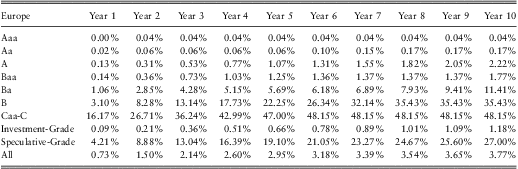
• Consistent application of credit rates between bonds and over time.
• Past experience is a good estimate of future default losses.
• An assessment of loss given default. Rating agencies publish statistics on default frequency by monitoring trigger events but often do not keep track of subsequent recoveries. Using the published default frequency as a deduction is equivalent to assuming 100% loss given default.
A.4.4 Just as a default rate can be subtracted from an input yield, a default rate may also be added to the yield to reflect the credit standing of the liabilities to be valued.
A.4.5 An adjustment for expected defaults leaves within the yield the market's required reward for the uncertainty in defaults. The combined effect of expected losses and market require risk is captured in the difference, or “spread” between yields on two instruments, other things such as term and liquidity being equal. This provides a mechanism for adjusting for the total default risk effect, although like any measure based on spreads this is only a relative adjustment rather than an absolute adjustment that entirely removes the effect of default risk.
A.4.6 We note that adjusting discount rates is not always an appropriate tool for reflecting default risk, especially if the underlying cash flows are correlated with the risk of default. For example, let us suppose a reinsurer is assessed to have a ruin probability of 1%, and we wish to value a high layer catastrophe reinsurance policy with a 1% probability of claim (the claim then being likely to be much larger than the reinsurer's available capital resources). If the claim event and the default event coincide then the reinsurance policy is worthless, as the reinsurer is never able to pay a valid claim. The fact that the reinsurer survives in the other 99% of cases is irrelevant for evaluating this particular reinsurance contract.
A.4.7 There is some circularity in the relation between default risk and discount rates. The perceived default risk in a set of promised cash flows will affect how creditors assess that promise. There is also an effect in the reverse direction. A discount rate used in a valuation to determine funding or capital requirements also affects the cash flow security. For example, if a pension funds its liabilities assuming 10% per annum future investment returns, this may result in lower contributions and lower accumulated assets, and hence lower benefit security, compared to assuming 1% per annum investment returns. The use of a low-risk discount rate does not necessarily imply that the benefits are correspondingly secure. For example, if a pension fund determines its contributions by reference to a liability discounted at gilt yields, this does not imply that the benefit promise to members is of the same default quality as government bonds. The pension promise could be less secure, for example if the sponsor allows themselves twenty years to make good any deficits, or could be more secure than government bonds if the sponsor covenant is exceptionally strong.
A.5 Premium For Price And Default Risk
A.5.1 Historic experience shows significant differences in long term returns from different asset classes. Over very long periods of time, equities have returned more than bonds which, in most economies, have earned more than cash. [Dimson et al, Reference Dimson, Marsh and Staunton2002]. These observations can be explained in terms of a risk premium. Investors demand, and therefore capital markets supply, higher expected returns for riskier assets. The higher returns exist only in the sense of expected values and underperformance can also occur. There is no finite time horizon over which we can be sure that risky assets will outperform low risk assets.
A.5.2 Investment risk takes many forms. The easiest to measure is risk associated with price volatility. The prices of long bonds are typically more volatile than those of shorter bonds. Even in the absence of defaults, the prices of credit risky bonds are typically more volatile than prices of bonds with lower risk of default. That is because the market's assessment of future credit risk is, itself, volatile (and not, in general, negatively correlated with bond yields). While historic risk premiums are observable on many asset classes, decomposition of an observed premium into risk types has proved difficult, with both the methodology and numerical values subject to rigorous debate.
A.5.3 How do these risk premiums appear in discount rates? Matching methodologies do not usually require an assessment of risk premiums. For example, under a matching methodology the present value of a 10 year cash flow is calculated with reference to the market price of a 10 year bond. Risk premiums might explain why this ten year bond yield is higher than expected returns on shorter bonds, rolled over, but such decomposition is unnecessary for the matching calculation.
A.5.4 An exception to this rule arises when a cash flow is of a longer term than any available investment. In this case there is no perfect match and one is left to select between various imperfect alternatives. One alternative is to hold the longest available bond, rolling it over on maturity into another bond whose future yield is unknown but whose mean may be estimated for example by time series analysis. A second alternative is to construct a theoretical yield from expected rolled over returns but also extrapolating risk premiums. The latter approach typically gives higher yields (and so lower liabilities) to the extent of the chosen risk premium.
A.6 Allowance For Taxation And Other Expenses
A.6.1 Allowances for tax and other expenses may appear in several different places within a matching calculation. For example, the yield on a bond includes, among other things, an allowance for expected defaults. If that bond yield is then used in a matching calculation, then the defaults might be deducted from the discount rate. Alternatively, discounting may be based on the promised return and defaults modelled separately as an item of expense. These two calculations could give the same answer; the difference is a matter of presentation. However, neither of these two acceptable approaches give the same answer as counting the default risk twice, or as not counting it at all.
A.6.2 Similar issues apply to fund management expenses, where these are incurred as a percentage of the fund value. One has the option of an explicit expense allowance or, alternatively, a deduction from the discount rate. However, here a matching calculation creates a further complexity when the institution chooses not to hold the matching portfolio and when the actual expenses on the current portfolio are different from the expenses on a matching portfolio. Examples of difficult decisions might include:
• A pension fund who could match liabilities with a government bond portfolio incurring management fees of 0.2% per annum. They choose instead to invest in actively managed equities incurring a management fee of 1.5% per annum. The matching argument suggests a discount rate based on government bonds minus 0.2%.
• An insurer writes annuities in a currency for which long dated bonds are mostly issued by corporate and not the government. The insurer therefore invests in corporate bonds and uses a liability discount rate based on the bond yields minus an allowance for defaults, which they interpret as a theoretical yield on government bonds. Their expense provision is based on their actual expenses, as the hypothetical government bond does not exist and so there is no way to establish the expenses involved in such a non-existent portfolio.
A.6.3 Considering default losses or percentage management fees, we are at least in the comfortable situation where the cost is proportional to the value assets held. It is less clear how to allow for non-proportional expenses. Non proportional expenses may either be concave (the marginal expense reduces with the asset quantity) or convex (marginal expense increases with asset quantity).
A.6.4 Examples of concave costs include costs of software systems, ALM department, internal and external audit.
A.6.5 The most common example of convex costs is dealing costs, including the cost of forced asset disposal. The convex feature applies for two reasons – firstly because the market price impact of a large trade exceeds that of a small one. Secondly, where asset disposal is forced in order to pay benefits, an institution may retain discretion over the order in which assets are sold, starting with the most liquid assets. The illiquidity costs are then convex in the quantity of illiquid assets held, as the illiquid assets not only incur higher disposal costs but these costs are also more frequent if large illiquid asset holdings squeeze out the cushion of liquid assets that would otherwise be sold first.
A.6.6 Tax is roughly linear but may have concave or convex elements depending on the investor's situation. A particular difficulty with tax is that calculations such as pooling for capital gains assessment purposes cut across particular definitions of liabilities. An example of a difficult situation is as follows:
A life insurer writes term assurance with fixed liability cash flows (apart from the mortality risk). However, the insurer decides to hold equities as investments in order to benefit from investment income franking and indexation relief, which has more favourable tax treatment than on the theoretically matching government bond assets. However, the existence of term assurance liabilities causes a change in the relative magnitude of life assurance versus pension's liabilities, which has the effect of drawing the income from government bonds backing pension business into the tax calculation, even though pension's business is not usually taxed in this way. How should the insurer allow for tax in the discounting of the term assurance liability?
A.6.7 These dilemmas reach to the heart of a question related to discounting, namely – what, precisely, are the cash flows to be valued? Are we to include only the cash flows promised to the beneficiary, or are we to include other associated costs of meeting the liability? Are those costs to be measured relative to the current portfolio or to the hypothetical costs of managing a theoretical matching portfolio? Are costs to be measured on a marginal or average basis? Are they to be recognised as an explicit cash flow, or included within general expense provisions, or expressed as a reduction to the discount rate?
A.7 Premiums For Illiquidity Or Expenses
A.7.1 It is convenient in investment theory to ignore tax, administrative costs, bid-offer spreads and the market impact of trades. This gives rise to investment optimisation problems in which the probability distribution of gross-of-tax mid-market-to-mid-market returns is the primary input. It also gives rise to the elegant matching theory for pricing which has so successfully been applied to traded financial markets such as derivative exchanges.
A.7.2 While this theory has given us many insights, there is also much that it fails to explain. In particular, investors incur tax, administration and illiquidity costs. These costs also affect market prices; an investor will pay more for an investment that saves on later expenses even if it has no effect on the cash flows promised to beneficiaries of an insurance or pension fund. However, at the current stage of knowledge, we lack an encompassing theory that explains all of these prices simultaneously. We must also recognise that illiquidity itself is uncertain, so a bond illiquidity premium necessarily contains an element of risk premium as well as expected losses. What we can do is can investigate statistically how yields are affected by measures of liquidity (for example, bid-offer spread, issue side or trading volumes). This results in a decomposition which is shown schematically in Figure 2.
Decomposition of a bond gross redemption yield

A.7.3 What we lack is a unifying theory to say how liquidity and expense elements should be reflected in the value of an arbitrary cash flow. We might measure bond liquidity by reference to bid-offer spreads or trade market impact but these are meaningless for liabilities. This gives a degree of arbitrariness to any matching attempt which seeks assets and liabilities of equivalent liquidity. The fact that any such assessment is arbitrary does not prevent actuaries searching for it, nor indeed from announcing discoveries, as the prize is a lower stated liability, see CRO forum and CFO Forum (2010). QIS 5 Technical Specification, Risk-free interest rates. European Commission.
A.7.4 Part of the conceptual difficulty in formulating a unifying theory is the mismatch between linear premiums and non-linear costs. If a bond yield contains a certain reward for illiquidity, then the investor's reward for illiquidity increases linearly with the quantity of this bond held. On the other hand, illiquidity costs are typically convex in the quantity held. An optimising investor then increases the illiquid bond holdings until the varying marginal cost reaches the given marginal reward. At this point, the average cost will be lower than the marginal cost (because of the convex schedule) so the investor can, in some sense, count the difference as a gain. There is a vigorous debate regarding where this gain belongs in accounting terms – is it a higher recorded asset value, a lower recorded liability or should it be excluded altogether from the balance sheet and recognised by investors as franchise value?
A.8. Case Study
A.8.1 Development of the European Solvency II framework for insurance supervision provides an interesting case study for how these elements may be combined in practice. While the final rules have yet to be established, the European Commission has issued a series of quantitative impact studies to test possible specifications for the new rules. At the time of writing (November 2010) European insurers had just submitted their calculations for the fifth quantitative impact study, know as QIS5. These calculations were performed as at the 31 December 2009.
A.8.2 Figure 3 shows some raw data: the mid-market swap rates against 6 month EURIBOR at various terms at 31/12/2009, according to Bloomberg. In this chart, we have used a non-uniform scale for the bond term. If t is the term, then we have used a uniform scale for 6t/(10+t). The purpose of this transformation is to make the short and long limits of the curve more visible.
Mid-market swap rates at 31/12/09

A.8.3 The input swap rates are not used for discounting, as each rate refers to a stream of several cash flows. Instead, QIS 5 published spot rates and a formula (the Smith Wilson formula) for interpolation or extrapolation. These curves are often used as input for economic scenario generators, which are then used for valuing future guarantees in relation to interest rates or to asset returns. To understand these valuations, it is helpful to express the yield curve as a table of forward rates, that is the implied short interest rates in future years. These are show below for the 31/12/2009 Euro data set in Figure 4.
Yield curve at 31/12/09, expressed as a curve of forward rates

A.8.4 Seven adjustments are applied to move from the input data to the final published curve for with-profits business (the adjustments are slightly different for other business lines but the principles are the same). The effect of these adjustments is shown in Figure 5.
Adjustments to swap curve for with-profits business

A.8.5 The adjustments can be described as follows:
• The 0.3975% adjustment for illiquidity is calculated as follows. A market yield on corporate bonds is supposed to be 1.46% higher than swap yields. Of this, 0.4% corresponds to expected losses, leaving an expected premium of 1.06% net of expected losses. This expected premium is assumed to be half (0.53%) a reward for bearing the uncertainty of defaults, and half (another 0.53%) for illiquidity. With profits business is assumed to be only 75% illiquid, so a provision is made for a quarter of the illiquidity premium (0.1325%) to be incurred as illiquidity costs. Rather than providing for these costs as cash flows, the effect is deducted from the discount rate, leading finally to a net 0.3975% addition to the discount rate.
• Between 5 and 10 years there is some irregularity in the forward curve; there is an implicit differentiation in going from swap curves to forward curves, and this often gives rise to small oscillations in the forward curve. The curves have been smoothed using a cubic spline algorithm, the precise details of which have not been published.
• Between 15 and 20 years there is an illiquidity catch up effect. The illiquidity premium is assumed to apply only for terms as far as the existing bond market, deemed to be a maximum term of 15 years. Firms are prevented from taking credit for future investments in illiquid bonds. This is reflected in a requirement that spot rates beyond 20 years are unaffected by the illiquidity premium adjustment. Combining this with a 15 year rat that does include such an adjustment, forces an unwind effect between 15 and 20 years where the effect of illiquidity premiums is to reduce the implied forward rate.
A.8.6 Over the whole term structure, there is a deduction of 0.1% to make a nominal allowance for the credit risk inherent in the use of 6 month EURIBOR. Over most of the term structure, this effect is dwarfed by other adjustments, but it is visible between 20 and 30 years.
A.8.7 At long terms where data is sparse, some sort of interpolation or extrapolation is needed. Within QIS 5, two approaches were used. The published Smith Wilson approach was used for extrapolation while a proprietary spline approach was used for interpolation. This creates a discontinuity at the point where the curve switches from one point to another.
A.8.8 Although swap data exist for the Euro up to terms of 50 years, for the purpose of QIS 5 the data beyond 30 years was considered unreliable as these swaps were illiquid. As a result, these points were discarded and the extrapolation commences after 30 years rather than 50. This could be regarded as another form of illiquidity adjustment.
A.8.9 Finally, Solvency II introduces the idea of unavoidable market risk. The best estimate value of a 50 year liability is determined with respect to an extrapolated curve, but in addition the firm must add a risk margin to the best estimate, in recognition of the uncertainty surrounding the determination of the 50 year rate and the likely imperfection in any attempt to hedge this risk. In the chart above we have re-expressed this risk margin as a deduction from the discount rate.
A.8.10 While each of these building blocks has its own rationale, in combination the effect is to produce QIS 5 yield curves whose shape is dramatically at odds with the input data. Some of the advantages of matching valuation – particularly the consistency with possible hedging instruments, may in this case be lost.
Appendix B: Formulas to Reconcile Budgeting and Matching Approaches
Suppose that the investment total return index takes the form exp(μt + σBt) where Bt is a Brownian motion. The risk free rate is r.
B.1 Single Cash Flows
Consider a future cash flow of 1 at time t. The present value of that cash, discounted at stochastic return, is exp(−μt−σBt). The p th quantile of this present value under the budgeting approach is:

where Φ−1 is the inverse Normal cumulative distribution function.
B.2. Perpetual Annuity
Consider an annuity paying continuous cash flows at a rate exp(γt) per annum, where γ<min{r, μ}. Negative values are usual, in which case the mean future life time is −1/γ.
The present value of this annuity using the matching approach is:
Matching value=

It is easily seen that this is also the discounted mean term of the annuity.
We can identify the integral of the p th quantile, by carrying out the integral:
Integrated p th quantile =
We substitute (μ−γ)t = z 2/2 and write




By way of a reality check, we notice that if δ is very large this tends to infinity, while it tends to zero when δ is large and negative.
This calculation does not, however, give the percentile of the underlying present value. Instead, we can use a result of Dufresne (Reference Dufresne1990) who proved that the reciprocal of the present value has a Gamma distribution:

If we discount at the median return μ, the present value is 1/(μ−γ) which is also the discounted mean term. Scaling, the distribution is:

This then depends only on  , that is, the volatility divided by the discounted mean term.
Appendix C: The Difference Between Matching and Budgeting
C.1 Circumstances When The Choice Of Methodology Is Irrelevant
C.1.1 Both ‘matching’ and ‘budgeting approaches ultimately involve applying ‘time value’ adjustments to future monetary cash flowsFootnote 17. A highly important, if self-evident, corollary is that the two may produce the same answers (or may at least result in application of the same discount rates), if the resulting time value adjustments are the same. It is therefore first helpful to explore the circumstances in which the two give the same answers (and hence choice between them is irrelevant) before moving on to identifying which one to use when choice between them actually makes a difference.
C.1.2 For the two approaches to result in different ‘values’ being placed on future (liability) cash flows we need one or more of the following to apply:
a) The assets or liabilities being assessed in different possible exercises need to vary in some manner not itself linked to the discount rate being used. For example, in a pension fund ongoing planning ‘valuation’ the future liabilities might be assumed to include some allowance for discretionary pension increases, whereas in a corresponding discontinuance ‘valuation’ carried out for the same pension scheme we might only wish to include liabilities for which an explicit contractual guarantee of payment exists. There might be similar divergences in liabilities being included in equivalent types of exercises carried out for, say, with-profits books of life insurance companies;
b) We need to believe it appropriate to handle un-hedgeableFootnote 18 aspects of the liabilities differently in different possible exercises. If any liability elements fall into this category then this necessarily creates some subjectivity in how a market consistent value might be derived for the liabilities;
c) For liability elements that are hedgeable, we need to disagree on what are the market values of assets that best match the liabilities. This highlights another possible element of subjectivity in the computation of market consistent values. Market values are only tightly bound if markets are deep, liquid and transparent and if bid-offer spreads are very small. Few markets come close to this level of ‘perfection’. In practice there will be some blurring between (b) and (c). Most liabilities that actuaries work with are only partly hedgeable. Their market consistent values thus involve a blend incorporating some (objective) market based data as well as some subjective valuer input as per (b), see e.g. Kemp (Reference Kemp2009).
d) The ‘expected’ future returns on the assets assumed to be used to fund the liabilities need to differ from the market implied future returns available on the (possibly notional) asset portfolio that best matches or replicates the liabilities. By ‘expected’ we here mean the combination of:
(i) The ‘statistically’ expected return (e.g. arithmetic or geometric mean) of the distribution of returns that the actuary and/or client thinks will apply to the assets in question (loosely speaking corresponding to a ‘best estimate’ in a going concern accounting exercise), and
(ii) Any adjustment for ‘prudence’ overlaid on the (i) as per Section 4Footnote 19
e) The treatment of credit risk between the two partiesFootnote 20 involved in the asset or liability needs to differ from that implicit in the market value of the corresponding ‘matched’ assets.
C.1.3 We can view C.1.2(b) and C.1.2(c) as involving subtleties relating to exactly how we might derive a ‘market consistent’ valuation. They are not therefore really issues in relation to choice between a ‘matching’ and a ‘budgeting’ approach, although they do highlight that market consistent valuation techniques may not always be as objective as we might ideally like.
C.1.4 We might also view (a) in a similar vein, given that the differential there arises because of application of discounting to two different liability streams and thus not ostensibly linked to choice of discount rate.
C.1.5 However, such a stance could miss out some of the many different types of exercise potentially carried out by actuaries and some of the meanings conventionally ascribed to the term ‘valuation’ in them. In some types of exercise different elements of the overall assumption set may be formulated in tandem rather than singly. Margins may be deliberately included in one element of the assumption set even though this is known to be unrealistic in isolation, because a corresponding unrealistic assumption is used in another part of the assumption set. For example, Patel & Daykin (Reference Patel and Daykin2010) describe the net premium valuation methodology as applied to with-profit, i.e. participating, life insurance business. This methodology may now be considered rather historic. In its time, however, it was deemed an appropriate one for providing (relatively) smooth emergence of surplus even though individual assumption elements (including the discount rates used) were often obviously unrealistic when considered in isolation. It only ‘worked’ because the liabilities being valued also assumed other unrealistic elements (e.g. unrealistically low bonus rates) that in some appropriate sense could be expected to ‘compensate’ for lack of realism in the discount rates being used.
C.1.6 It would also gloss over some essential differences between:
a) future cash flows that already correspond to firm commitments present at the ‘valuation’ date; and
b) future cash flows the existence of which is more or less discretionary in nature.
Traditional UK defined benefit final salary pension schemes provide a good example of the difference between (a) and (b). It is difficult, if not impossible, for a solvent employer to renege on pension promises relating to existing accrued benefits of scheme members, so cash flows relating to these benefits would fall into category (a). However, sponsors do have the option to close their scheme to new benefit accrual (either merely for new entrants or for existing active members too), or to award smaller salary increases to existing or future members, so the eventual magnitudes of cash flows arising from future accruals is more mutable in nature and these would more commonly fall into category (b).
C.1.7 We believe that the more ‘contingent’ nature of liabilities falling into category (b) makes it more justifiable to adopt a budgeting style calculation in relation to them, at least for some purposes. Inherent in their nature is a ‘plan’ that the employer is following, with a corresponding range of outcomes, which the employer can modify if circumstances so dictate. Less attention therefore needs to be paid to any potential ‘fair’ or ‘realistic’ value ascribed by the market to such liabilities (if they are incompatible with other elements of the overall ‘plan’ that the employer has for continuing in business) unless and until the liabilities become more clearly crystallised in nature.
C.1.8 However, there is an implicit assumption in such an assertion. It is that the computation being carried out is solely applicable to the employer itself in its endeavour to trade profitably. More common in practice is for actuarial work to be used or applied, implicitly or explicitly, by more than one party. We consider the additional issues this raises in Section C.6 below.
C.2 Valuation, Utility And The Impact Of Markets
C.2.1 The lack of unanimity in what should be understood by the terms ‘value’ and ‘valuation’ is one reason why we refer to the approaches set out in sections 3 and 4 by the epithets ‘matching’ and ‘budgeting’ respectively.
C.2.2 In broad terms, ‘matching’ and ‘budgeting’ approaches can be viewed as corresponding respectively to the types of technique underlying ‘valuation’ and ‘planning’ exercises as referred to in relevant BAS Standards. Unfortunately, the terms ‘value’ and ‘valuation’ are already used in many different ways in different branches of the actuarial profession (and outside it). We are wary of using terms that readers may think that they understand when in practice they have a different understanding to the writers. When we have had to use terms such as ‘value’ and ‘valuation’ we have generally tried to add additional describing terms to them, e.g. ‘market’, ‘market consistent’ or ‘intrinsic’ value.
C.2.3 Of course, terminological issues can also arise with the use of terms such as ‘matching’ and ‘budgeting’. For example, the word ‘matching’ might unwittingly give the impression that the only exercises to which ‘matching’ approach might apply are ones where the investment strategy being adopted is a ‘matched’ investment strategy. As we saw in Chapter 3, this is not the case. The term ‘budgeting’ is also potentially open to misinterpretation. However, we think that the risk of this happening is less than with the use of ‘matching’ or ‘valuation’. ‘Budgeting’ generally gives the flavour of there being some risk of not meeting the budget (as, to a lesser extent, does ‘planning’). This, as we shall also see below, is a key element in whether a budgeting type approach might be relevant for a particular exercise, although not the only element.
C.2.4 An example of how ‘value’ can be interpreted in a variety of different ways in a financial context is the situation in which an investor is thinking about buying (or selling) some shares in a company (or, indeed, someone thinking about buying or any other type of asset or liability). We might expect the investor/analyst to first carry out an analysis of what ‘value’ he or she thinks a share in the company is worth, based on a subjective analysis and incorporating subjective assumptions about its future business prospects etc. Here the term ‘value’ is really shorthand for the investor's view of the ‘intrinsic’ value or worth (to him) of the security. The investor might then only invest in the company if this subjective value assessment is materially higher than its then current market value (or might sell some or all of his or her existing exposure, if any, if the subjective value assessment is materially lower than its current market value).
C.2.5 Technically speaking, such an exercise is most akin to a ‘budgeting’ or ‘planning’ exercise. The investor has in mind a ‘plan’, here involving possible investment in the company, and wishes to formulate a view as whether to go ahead with the plan. Indeed, it is prototypical of many other budgeting/planning exercises.
C.2.6 For example, it highlights the importance of investment views in choice between ‘matching’ and ‘budgeting’ approaches. Suppose we deem possibilities C.1.2(a), (b) and (c) as not really relevant to this choice and for the moment park to one side possibility C.1.2(e). We then see that differences in practice between ‘matching’ and ‘budgeting’ approaches to determining liability discount rates are driven primarily by differences in the returns assumed to be available in the future on the assets used to fund the liabilities vis-à-vis those that we would expect to be available were we to follow a matched investment strategy.
C.2.7 Whilst not always articulated as such, any such difference in assumed returns ultimately corresponds to expression of an investment view about the different returns potentially available on different assets. This is true even if the view is dressed up as, say, involving, an ‘equity risk premium’ rather than an investment view as such. The assertion that equities will outperform in the future is just that, i.e. an assertion rather than a known fact. This is true even if historic evidence is that they have done so in the past and there is good economic rationale for believing that they might do so in the future, given a long enough time-frame. Even more obviously just an assertion, and hence actually an investment view being expressed by a particular commentator, is that any such equity risk premium should have a particular value.
C.2.8 This example is also prototypical in terms of its interaction with utility theory, see e.g. Kemp (Reference Kemp2010). The underlying premise of utility theory is that different goods or services may have different utilities to different economic participants and may therefore have different intrinsic ‘values’ to those participants.
C.2.9 This logic is difficult to fault but does need some refinement if the good or service being valued is monetary in natureFootnote 21 and there is a deep, liquid and transparent market in it (and such a market is expected to continue to exist in the future).
C.2.10 The reason is simple. The mere existence of such a market can be expected to influence the behaviour of economic participants relative to the situation where no such market existed.
C.2.11 Just because an investor believes that shares in a company are intrinsically ‘worth’ X to him does not by itself mean that he or she will be happy to buy it for X less some small margin. It is not as if the investor will actually ‘consume’ in any physical sense the cash flow stream implicit in the investment. Instead, any benefit or otherwise that he receives from such a holding will ultimately need to involve monetary transactions (this being the essence of a financial good or service)Footnote 22.
C.2.12 In particular, if the market value of the asset is Y and Y is noticeably smaller than X then we can expect rational market participants who are buying modest amounts of shares in the company to be prepared to buy shares at only Y or thereaboutsFootnote 23. A corollary is that sellers will also only be prepared to sell at (approximately) Y, even if, in their opinion, the intrinsic worth of the share to themselves is much lower than this.
C.2.13 Of course, not all market participants may be ‘rational’ in this respect. However, most commentators (and most actuaries) would agree that the greater is the perceived differential between X and Y the more likely it is that the economic participant will behave ‘rationally’ in this regard, and not, in his own opinion, (materially) overpay for (or under-sell) something relative to its market price.
C.2.14 In short, market valuations, to the extent that they exist, may be expected to have a strong influence on how utility theory interacts with the actual behaviour of economic participants. The underlying arguments may still apply but they then have less impact on (now market) price and more impact on quantity of exposure bought or sold.
C.3 Transparency
C.3.1 The existence or otherwise of a ready market in an asset or liability can thus be expected to have a major impact on behaviour patterns of economic participants, including nearly all types of institution advised by or employing actuaries. Indeed, we think it is such an important contributor that we recommend, where practical, that any material divergence between the values placed on contractual asset or liability cash flows and their market or market consistent values should be highlighted in actuarial work, together with an explanation of the main contributors to this divergence.
C.3.2 Such a recommendation ought to provide better transparency, and ought to enable recipients of actuarial advice to understand better the factors contributing and assumptions underlying this advice.
C.3.3 It also implicitly reflects some longer-term trends in actuarial work. Another similarity between ‘matching’ and ‘budgeting’ calculations at least as far as actuaries are concerned is that both are typically now in practice applied primarily to liabilities rather than to assets. This partly reflects the types of organisation that are advised by or employ actuaries and the services that they expect from these actuaries. However, we suspect that this characteristic of modern actuarial advice is also partly presentational and provides some clues as to how non-actuaries typically interpret valuation disciplines.
C.3.4 In general, actuarial work ultimately focuses on interactions between assets and liabilities, rather than on each entirely in isolation. It ought, therefore, in theory to be agnostic between the two sides of the balance sheet, with no particular bias towards application to liabilities rather than assets. Similar overall conclusions can arise even if quite different approaches to discounting future liabilities are used, if the ways in which discounting is applied to future asset cash flows are adjusted accordingly.
C.3.5 However, this does not accord with how actuarial practice has actually evolved. Some years ago, as explained in Patel & Daykin (Reference Patel and Daykin2010), it was relatively common for UK actuaries to value assets in pension budgeting exercises at values other than their market value. The assets in question were then (and still are) typically relatively liquid so it was (and still is) relatively straightforward to determine a reasonably accurate market value for them. More recently, this type of approach has become less usual, and asset valuations used in pension budgeting exercises have become more commonly more market value driven, more in line with approaches adopted in most other actuarial disciplines.
C.3.6 Implicit in this shift seems to be recognition that the more liquid and easily quantifiable is the market value of a set of cash flows, the more difficult it is to explain to clients a calculation in which some different valuation is placed on these cash flowsFootnote 24. Typically, actuaries advise organisations whose liabilities are less liquid and less easily quantifiable in market value terms than their assets. Thus, to the extent that actuaries have diverged from market value based approaches in budgeting calculations, the tendency seems to have been for them to concentrate this divergence solely on the side of the balance sheet that is less liquid and therefore more difficult to value (in a market value based manner).
C.3.7 Whilst such an approach may be desirable from a presentational perspective in one respect, it is potentially undesirable in another respect. As we have seen above, divergences between ‘matching’ and ‘budgeting’ approaches are primarily driven by assumptions concerning return on assets rather than being linked to how liquid or otherwise the assets are relative to the liabilities. We can always re-express a comparison between a ‘matching’ and a ‘budgeting’ approach applied to the same organisation in a manner in which the values placed on the liabilities are identical, but the values placed on the assets differ, see Figure 6.
Comparison of balance sheets arising using example ‘matching’ and ‘budgeting’ approaches, if the liabilities are the same in either case

C.4 Budgeting For Stochastic Models
C.4.1 Deterministic budgeting and matching calculations share the form of a discounted cash flow calculation. Stochastic calculations show greater differences in the methodology.
C.4.2 Ford et al. (Reference Ford, Benjamin, Gillespie, Hager, Loades, Rowe, Ryan, Smith and Wilkie1980), set out a stochastic budgeting framework which has been re-used many times since, notably by Wilkie et al. (Reference Wilkie, Waters and Yang2003) who contrast this to a matching approach. Their approach is to consider the probability that a given quantity of assets is ultimately sufficient to meet the liabilities, with a certain probability of success. Success is defined only with reference to cash flows; there is no need to pass intermediate solvency tests provided at that all cash flows are ultimately met. A “best estimate” basis is sometimes equated to a 50% probability of sufficiency.
C.4.3 This “best estimate” basis has a number of limitations as a valuation measure. In particular, taking the example of Wilkie et al. (Reference Wilkie, Waters and Yang2003), a liability may be valued at zero if it is zero with 50% probability and positive otherwise. This seems intuitively wrong, and various devices have been developed to address this and other shortcomings, most obviously the use of higher (more prudent) percentiles, for example the 75%-ile or 95%-ile.
C.4.4 Deterministic present value calculations satisfy several properties that prudent stochastic valuations do not inherit. For example, to value a stream of cash flows in a deterministic calculation, we can simply add together the present values of each cash flows. This does not work in a stochastic setting. For example, these calculations for a stream of cash flows, are quite different:
(a) For each cash flow, determine the initial quantity of assets sufficient to meet that cash flow with 75% confidence. Then add together these asset requirements.
(b) Determine the initial quantity of assets sufficient to pay all cash flows as they fall due, with 75% confidence.
C.4.5 At larger percentiles, Method (a) usually produces a higher asset requirement. This is because method (a) is the sum of 75%-iles for several random variables, while method (b) is the 75%-ile of the sum.
C.4.6 To illustrate the ideas, we consider six specific liabilities. These are:
• A fixed single cash flow, or bullet, at time horizons 1, 5 and 25 years.
• An annuity, based on a constant force of mortality, with discounted mean terms of 1, 5 and 25 years.
We assume that asset total returns are a lognormal random walk with volatility of 20%. The liabilities are standardised so that the present value, discounted at the median return, is 1. See Figure 7.
Comparison of present values: single payment v. annuity

C.4.7 The calculations in Figure 7were performed used method (b) above, that is, the percentile of the total present value, rather than the total of percentiles. Method (a) gives slightly higher values at the 75% and 95% levels for the annuity. For the bullet cash flows, methods (a) and (b) are of course equivalent.
C.4.8 Unsurprisingly, the effect of prudence is more marked for longer time horizons as there is more time for things to go wrong. We see that the median requirement for annuities is greater than the present value discounted at the median return. This is particularly visible for the 25 year annuity.
C.5 Matching for Stochastic Models
C.5.1 In contrast, matching valuations contain no concept of a prudent valuation. The market value of a matching asset portfolio is a single number, not a distribution. Prudence is more often incorporated as a series of stress tests – for example a requirement that assets should still exceed the value of the matching portfolio after a 40% fall in asset prices. We can therefore re-express a given level of confidence under a budgeting calculation in terms of the size of asset fall which could be sustained and remain solvent on a matching basis. Equivalently, we can express the required assets under a budgeting calculation as a multiple of the matching present value. For example, if assets are required to be sufficient after a 40% fall, this is equivalent to requiring assets equal to 1.67 times the matched present value.
C.5.2 It is common in budgeting to take credit for expected returns on risky assets, as this may be offset by an explicit use of a prudent quantile. In the examples below we assume a 3% per annum risk premium, on a geometric mean basis.
C.5.3 We can now show the budgeting asset requirements as a proportion of the matching valuation for the six example cash flows. See Figure 8.
Some typical patterns comparing budgeting to matching calculations

C.5.4 Firstly, we see that the median requirement falls with the liability term. This reflects the effect of the risk premium, which features in the budgeting calculation but is excluded from the matching calculation. The longer the time horizon, the greater the impact of the risk premium.
C.5.5 At higher levels of confidence, there are two competing effects. Firstly, there is the effect of volatility, which is greater for longer time horizons. Ultimately, however, the risk premium term dominates. Broadly speaking, this is because, in terms of the log total return index, the risk premium effect is proportional to time t while the standard deviation is proportional to the square root of t. This effect is particularly visible in our 25 year annuity example, where the budgeting asset requirement at 75% confidence is only just over half the matching requirement.
C.6 Who Are Actuaries Advising?
C.6.1 The share analyst example introduced in Section C.2.4 is less prototypical of actuarial work in one major respect. Everyone expects a share analyst to be acting only for one side of a possible transaction or legal framework. If the investor buys cheap and sells dear then this is beneficial to the investor following the advice of the good analyst, presumably ultimately at the expense of someone else whose market activities are less profitable.
C.6.2 In contrast, a large fraction of actuarial advice is actually implicitly or explicitly relied upon by a range of interested parties. This is still often true even if the actuary has a single client. For example, a scheme actuary will typically legally have as his or her client the trustee body responsible for the scheme. However, in practice, their work output might still influence a range of different parties in different ways. They might, for example, advise on the cost of augmenting benefits of some but not all scheme members. Even if contributions are provided by the sponsor to meet these benefit improvements, the scheme might subsequently get into difficulties, and their advice might ultimately lead to some beneficiaries being advantaged relative to others, at least relative to the situation in which their advice had been different.
C.6.3 Most types of provision of information for statutory accounting purposes ultimately fit this characteristic. Accounting information will normally be used by many different parties for many different purposes. Most recipients will expect it not to favour unduly one party over another.
C.6.4 Many commentators strongly favour market based approaches when fairness between parties is perceived to be paramount. Market based prices are seen as more objective and less open to bias than potentially any other way of valuing cash flows, even if they are not always easy to identify reliably.
C.6.5 Another important objective of accounting data is to achieve comparability. We can think of this as conceptually expanding ‘fairness’ between participants to include ‘fairness’ in comparisons between the reported positions of different companies. Whilst accounting standards setters and other interested parties are still engaging in (sometimes heated) debate on such topics, the general trend appears to be towards greater use of market based approaches where the assets and liabilities are clearly crystallised, except perhaps when the debate turns to issues of pro-cyclicality.
C.6.6 Assets and liabilities that have less obviously already crystallised are more challenging to handle in such a context. At one extreme would be the valuation of intangibles or other goodwill items. Considerable variation in approach can apply in practice if there is considerable uncertainty about what cash flows might arise.
C.6.7 This differentiation mirrors the one that we introduced in Section C.1.6 between liabilities that were akin to contractual commitments and those that were more discretionary in nature.
C.6.8 Ignoring ‘discretionary’ assets and liabilities in their entirety may be misleading, since it may present an overly optimistic or pessimistic view of the likely costs and benefits of continuing to operate the current business model. More usually, there would be some attempt to formulate approaches that sought a suitable balance between the greater comparability that ought to arise by including standardised assumptions about such cash flows versus the potential for misinformation by doing so. This arguably explains some of the not ‘fully’ market consistent elements present in, say, ‘market consistent’ embedded valuations.
C.6.9 Choice of discount rates can also be strongly linked with the potentially thorny topic of profit recognition. The more favourable are the future return assumptions that we adopt for the assets/liabilities, the greater will be the deemed current ‘profit’.
C.6.10 However, what we assume in this respect does not (we may presume) influence actual outcomes. So, all that may be happening here is that ‘value’ creation may be being front-loaded into the present and away from the future. Over the long term this may not appear to matter very much, but again different people may benefit depending on how the numbers are calculated and incentive arrangements may be altered.
C.7 A Simple Practical Example
C.7.1 John Smith has a house with a mortgage of £250,000. He also has a savings policy, the proceeds of which he intends to use to repay his mortgage in 20 years’ time. The savings policy currently has accumulated funds of £50,000.
In assessing how much John should pay into his savings each month (in addition to his interest costs) John carries out a budgeting calculation, which might look as follows:

Limitations of this budgeting calculation:
(a) It gives no information on the value of the outstanding liability.
(b) It gives no information on the likelihood that the annual payments will be adequate to meet the mortgage liability after 20 years.
(c) It gives no information on what the potential shortfall might become if the investment strategy does not go to plan.
C.7.2 Of course (b) and (c) above can be addressed by further more sophisticated budgeting calculations (looking at different possible investment returns and their likelihood). However to address (a) above, a matching calculation as required. This matching calculation might simply be:

C.7.3 The importance of the matching calculation is obvious when a “solvency” or “transaction” question is being asked, for example:
• What is the value of the outstanding liability if need to make immediate repayment (e.g. because the house is being sold)?
• What is the overall value of the estate for inheritance tax purposes?
• What is the overall value of the marital assets/liabilities in a divorce?
C.7.4 In all of the above situations it is clear that the shortfall calculated on the matching approach (i.e. £200,000) is the correct figure for consideration rather than the shortfall calculated on the budgeting approach (i.e. £56,516).
C.7.5 Both the budgeting and matching calculations have their relevance and importance. The key is to ensure that the correct approach is used depending on the question being asked.