INTRODUCTION
Natural products are valuable sources of chemotherapeutic agents and have been traditionally used by native cultures to treat infectious diseases. In the last few years interest in the research on natural products has intensified and it is not surprising that many plant-derived compounds have been demonstrated to have anti-protozoan activity: for instance, it has been shown that various essential oils present inhibitory action against diverse human parasites such as Plasmodium falciparum (Valentin et al. Reference Valentin, Pelissier, Benoit, Marion, Kone, Mallie, Bastide and Bessiere1995), Trypanosoma brucei, Leishmania major (Mikus et al. Reference Mikus, Harkenthal, Steverding and Reichling2000), Leishmania amazonensis (Monzote et al. Reference Monzote, Montalvo, Almanonni, Scull, Miranda and Abreu2006) and Trypanosoma cruzi (Santoro et al. Reference Santoro, Cardoso, Guimarães, Salgado, Menna-Barreto and Soares2007).
Cymbopogon citratus (DC) Stapf (Gramineae) is a worldwide herb commonly known as lemongrass. Tea made from its leaves is popularly used in Brazil because of its anti-spasmodic, analgesic, anti-inflammatory and anti-pyretic properties (Carlini et al. Reference Carlini, Contar, Silva-Filho, Silveira-Filho, Frochtengarten and Bueno1986). Furthermore, the essential oil of lemongrass has anti-microbial (Onawunmi, Reference Onawunmi1989; Ibrahim, Reference Ibrahim1992), anti-fungal (Viollon and Chaumont, Reference Viollon and Chaumont1994; Wannissom et al. Reference Wannissom, Jarikasem and Soontorntanasart1996) and anti-bacterial (Onawunmi et al. Reference Onawunmi, Yisak and Ogunlana1984) activity. A study on the in vivo anti-malarial activity of C. citratus essential oil demonstrated a significant effect in reducing Plasmodium berghei growth (Tchoumbougnang et al. Reference Tchoumbougnang, Zollo, Dagne and Mekonnen2005). It has been also demonstrated that this essential oil exerts anti-protozoan effects on the insect trypanosomatid Crithidia deanei (Pedroso et al. Reference Pedroso, Ueda-Nakamura, Dias Filho, Cortez, Cortez, Morgado-Díaz and Nakamura2006).
The haemoflagellate parasite T. cruzi is the causative agent of American trypanosomiasis (Chagas disease), which affects 24 million people from Southern California (USA) to Argentina and Chile (WHO, 2002). According to World Health Organization reports, mortality rates vary from 8% to 12% depending on country, age and treatment received (WHO, 2002). The chemotherapy currently available is based on the nitroheterocyclic compounds nifurtimox and benznidazole. The mechanism of action of nifurtimox suggests that intracellular reduction of this compound generates nitro-radicals, followed by redox cycling and hydrogen peroxide and anion superoxide production, while benznidazole does not depend on oxygen radicals. This treatment is inadequate because it presents serious toxic side-effects. Furthermore, these compounds are not capable of achieving parasitological cure. Therefore, development of new, more efficient drugs is necessary.
Thus, in this paper we have evaluated the effects in vitro of the essential oil of C. citratus (lemongrass) and its main constituent (citral) on growth, ultrastructure and infectivity of T. cruzi evolutive forms.
MATERIALS AND METHODS
Parasite
Culture epimastigote forms of T. cruzi, strain Y (Silva and Nussenzweig, Reference Silva and Nussenzweig1953), were maintained by weekly passages at 28°C in liver infusion tryptose (LIT) medium (Camargo, Reference Camargo1964) supplemented with 10% inactivated fetal bovine serum (FBS). Five-day-old culture forms were used in the experiments.
Bloodstream trypomastigotes were obtained by cardiac puncture of infected Swiss albino mice, at the peak of parasitaemia (7 days post-infection). Blood was collected using 2 ml syringes containing 0·2 ml of 3·8% sodium citrate as anti-coagulant. Blood samples were pooled in 15-ml tubes and then centrifuged for 15 min at 500 g to isolate the parasites from red blood cells and leukocytes. The pellet containing the parasites was maintained for 20 min at 37°C to allow the trypomastigotes to swim to the supernatant. The supernatant was then centrifuged for 10 min at 1500 g to eliminate platelets and the isolated trypomastigotes were transferred to RPMI-1640 medium (Sigma Chemical Co., St Louis, MO, USA), supplemented with 10% FBS. After homogenization, they were re-suspended and kept in this same medium until use.
Plant material and essential oil isolation
C. citratus (DC) Stapf (lemongrass) was collected at the Medicinal Plants Garden of the Universidade Federal de Lavras (UFLA), Brazil. Collection was always performed in the morning around 08:00, during October 2005, at a temperature of 20°C and in the absence of rain. Essential oil was obtained by steam distillation, employing a modified Clevenger apparatus (Craveiro et al. Reference Craveiro, Fernandes, Andrade, Matos, Alencar and Machado1981).
The essential oil and citral (isomeric mixture of geranial and neral) were initially dissolved in dimethyl sulphoxide (DMSO) at a concentration of 100 mg/ml. This solution was then dissolved in either LIT or RPMI-1640 culture media to obtain stock solutions at 1 mg/ml (DMSO was diluted at 1%). Both solutions were stored at −20°C. The stock solutions were then diluted at different concentrations for the experiments, where the highest oil concentration used was 200 μg/ml. Under this setting, the final DMSO concentration in the essays was never higher than 0·2%, a condition that was not toxic for the protozoa.
Gas chromatography/mass spectrometry (GC/MS) analyses
Analysis of the essential oil sample was performed by gas chromatography/mass spectrometry (GC/MS), with identification of constituents made by comparing the spectra obtained with those of the equipment data bank and by the Kovats index calculated for each constituent (Adams, Reference Adams1995). The GC/MS analysis was performed with a Shimadzu CG-17A (Shimadzu Corporation, Kyoto, Japan) chromatograph coupled with a QP-5000 mass selective detector. Operating conditions were: capillary DB5 fused silica column (30 m×0·25 mm; 0·25 μm film thickness); injector temperature 220°C; column temperature set initially at 40°C and then programmed at 3°C/min to 240°C; carrier gas helium, with linear gas velocity of 1·0 ml/min; split ratio 1:10; injected volume 1·0 μl (1% dilution in dichloromethane); inlet pressure 100·2 kPa. Mass spectra were taken at 70 eV; decomposition speed 1·000; decomposition interval 0·50; fragments from 45 to 450 Da were decomposed. A mixture of hydrocarbons (C9H20 to C26H54) was injected under these same conditions.
Gas chromatography/flame ionization gas chromatography (GC/FID)
The chemical constituents were quantified by GC/FID, using the same GC/MS column. The conditions were: capillary DB5 column, injector temperature 220°C; detector temperature 240°C; column temperature set initially at 40°C and then programmed at 3°C/min to 240°C; carrier gas nitrogen, with linear gas velocity of 2·2 ml/min; split ratio 1:10; injected volume 1 μl (1% dilution in dichloromethane); inlet pressure 115 kPa. Quantification of each constituent was estimated by area normalization (%).
Epimastigote and trypomastigote assay
Five-day-old culture epimastigotes (5×10⁶ cells per ml) were incubated for 24 h at 28°C in the absence or presence of different concentrations (25 to 200 μg/ml) of lemongrass essential oil or citral. The IC50/24 h (concentration that inhibited 50% parasite growth) was then evaluated by direct counting of the cells in a Neubauer chamber. Each test was made in 3 experiments conducted in triplicate.
Bloodstream trypomastigotes (5×10⁶ cells per ml) were incubated for 24 h at 37°C with different concentrations (25 to 200 μg/ml) of lemongrass essential oil or citral. The IC50/24 h (concentration that lysed 50% of the parasites) was then evaluated by using a Neubauer chamber. Each test was made in 3 experiments conducted in triplicate.
Cytotoxicity assay
Mouse peritoneal macrophages were obtained from Swiss mice weighing 18–20 g. The cells were seeded on cover-slips placed in 24-well plates (106 cells/well) and maintained at 37°C for 24 h in RPMI-1640 medium. Thereafter, the cultures were washed with medium and incubated for 24, 48 or 72 h with different concentrations (3·9 to 200 μg/ml) of lemongrass essential oil. The cover-slips were then stained with Giemsa and observed in a Nikon Eclipse E600 (Nikon, Tokyo, Japan) light microscope. Cytotoxicity was evaluated by comparing the morphology (cell rounding, cell vacuolization and lack of adhesion to the substrate) of treated and control macrophages. Cytotoxicity was positive when 10% of the cells presented at least one of the alterations listed above.
Use of mice to perform the above-mentioned experiments (isolation of bloodstream trypomastigotes and obtaining peritoneal macrophages) was made in adherence to the ethical standards of Fundação Oswaldo Cruz and was approved by an ethics committee (CEUA-FIOCRUZ, Protocol no. P0099-01).
Intracellular amastigote assay
Mouse peritoneal macrophages were seeded at 106 cells per ml in 24-well plates containing glass cover-slips and RPMI-1640 medium, and then maintained at 37°C for 24 h to allow cell adhesion to the cover-slips. The parasite-macrophage interaction analysis was performed by using 2 approaches: (a) adhered macrophages were pre-treated for 24 h with different concentrations (7·5 to 60 μg/ml) of lemongrass essential oil and then the cultures were washed and infected with bloodstream trypomastigotes (ratio 10:1 parasites/host cell). After 3 h of interaction, non-internalized parasites were removed by washing with PBS, and fresh RPMI medium containing 10% FBS (RPMIS) was added; (b) untreated, adhered macrophages were washed and then infected with bloodstream trypomastigotes (ratio 10:1 parasites/host cell) as described above, and fresh RPMIS containing different concentrations (7·5 to 30 μg/ml) of lemongrass essential oil was added and changed daily.
At the specific times the cover-slips were collected, fixed in Bouin's solution, stained with Giemsa and parasite infection was quantified using a Nikon Eclipse E600 light microscope. The percentage of infected macrophages and the number of intracellular amastigotes per infected cell were evaluated by counting a total of 300 host cells in 3 different experiments, performed in duplicate. The Association Index was obtained by multiplying the percentage of infected macrophages by the mean number of parasites per infected cell. The IC50/48 h was then estimated as the dose that reduced the Association Index by 50%.
Analysis by scanning (SEM) and transmission (TEM) electron microscopy
Epimastigotes and bloodstream trypomastigotes were incubated for 24 h in the absence (control) or presence of the concentration corresponding to the IC50/24 h value of lemongrass essential oil for each form, collected by centrifugation at 5500 g, washed with 0·1 m phosphate buffer (pH 7·2), and then fixed for 30 min with 2·5% glutaraldehyde in 0·1 m phosphate buffer.
For SEM, the cells were adhered for 15 min to 0·1% poly-L-lysine coated glass cover-slips, washed in buffer and then post-fixed for 30 min with 1% osmium tetroxide in 0·1 mol/ml cacodylate buffer, pH 7·2. Thereafter, the samples were dehydrated in acetone, critical-point dried and mounted on SEM stubs. The samples were coated with a 20-nm thick gold layer and examined in a Zeiss (Oberkochen, Germany) DSM940 scanning electron microscope. Digital images were acquired and stored in a computer.
For TEM, the fixed cells were washed 3 times with 0·1 m phosphate buffer and post-fixed for 15 min with 1% osmium tetroxide/0·8% potassium ferricyanide/5 mm CaCl2 in 0·1 m cacodylate buffer, pH 7·2 (Meirelles and Soares, Reference Meirelles and Soares2001). After rinsing in this same buffer, the cells were dehydrated in graded acetone, infiltrated overnight in an acetone-PolyBed 812 mixture (1:1) and embedded for 72 h at 60°C in PolyBed 812 (PolySciences, Warrington, PA, USA) resin. Ultra-thin sections were stained with 5% uranyl acetate and lead citrate and observed in a Zeiss EM10C transmission electron microscope.
RESULTS
Qualitative and quantitative analysis of lemongrass essential oil
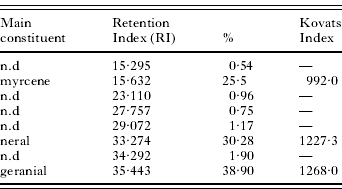
The compounds identified in the C. citratus essential oil, and their relative proportions, are listed in Table 1. The main components were geranial (38·9%) and neral (30·3%).
Quantitative and qualitative composition of Cymbopogon citratus (lemongrass) essential oil, as determined by GC/MS and GC/FID
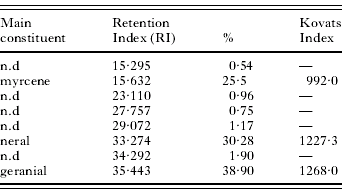
n.d, Not detected. These peaks were detected by GC/FID, but were not detected by GC/MS.
Trypanocidal activity
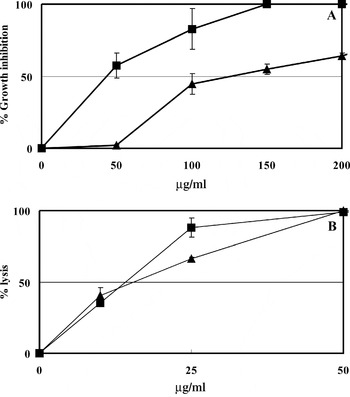
Incubation of T. cruzi epimastigotes and bloodstream trypomastigotes with lemongrass essential oil and citral showed a dose-dependent effect. For epimastigotes, the IC50/24 h value was 126·5 μg/ml for the oil and 42 μg/ml for citral (Fig. 1A). For trypomastigotes, values were lower: 15·5 μg/ml for the oil and 14·2 μg/ml for citral (Fig. 1B). At 50 μg/ml the lemongrass oil induced 100% lysis of the trypomastigotes. Accordingly, about 100% trypomastigote lysis was obtained with 50 μg/ml citral.
Effect of lemongrass essential oil and citral on Trypanosoma cruzi epimastigotes and trypomastigotes after incubation for 24 h, with determination of IC50/24 h values. (A) Percentage growth inhibition of epimastigote cultures treated with 25 to 200 μg/ml of lemongrass essential oil (▲) or citral (■). (B) Bloodstream trypomastigotes treated with concentrations ranging from 10 to 50 μg/ml lemongrass essential oil (▲) or citral (■), showing the percentage cell lysis. Each bar represents the mean±standard deviation of 3 different experiments.

Cytotoxicity and amastigote infectivity
Incubation of mouse peritoneal macrophages for 24 to 72 h with lemongrass essential oil caused no cytotoxic effect with concentrations up to 31·2 μg/ml, as visualized by light microscopy examination. This concentration was about 2-fold higher than the IC50/24 h value for trypomastigotes.
Pre-treatment of macrophages with lemongrass essential oil did not reduce the percentage infection and the number of amastigotes/infected cell. Only at essential oil concentrations higher than 30 μg/ml after 48 h was a small decrease in the percentage infection observed (data not shown). On the other hand, treatment of T. cruzi-infected macrophages with lemongrass essential oil led to a decrease in the number of amastigotes/infected cells after 48 h (Table 2). The association indices after 48 h were reduced by 72·3%, 89·4% and 77·3% after treatment with 7·5, 15 and 30 μg/ml, respectively. The predicted IC50/48 h value for the Association Index was 5·1 μg/ml.
Effect of lemongrass essential oil treatment on the Trypanosoma cruzi-macrophage interaction after 48 h
(Mean±standard deviation of 1 representative experiment, performed in duplicate.)

* Numbers in parentheses refer to percentage reduction in the Association Index relative to the control.
Ultrastructural analysis by scanning (SEM) and transmission electron microscopy (TEM)
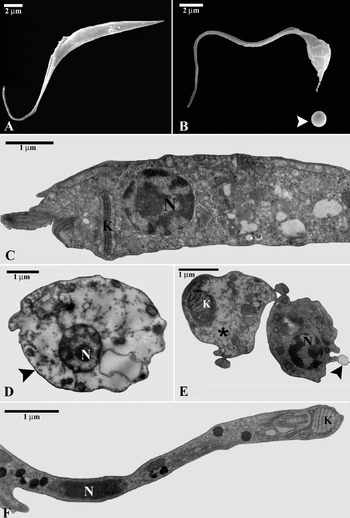
Epimastigote forms treated with a concentration corresponding to the IC50/24 h value of lemongrass essential oil and then observed by SEM demonstrated apparently no plasma membrane alteration, but rounding of the cell body (Fig. 2B), as compared to control parasites (Fig. 2A). Occasionally small plasma membrane blebs seemed to detach from the parasite surface (Fig. 2B). Such detachment of membrane vesicles was more frequent in epimastigotes than in trypomastigotes. Observation of treated cells by TEM revealed that lemongrass-treated epimastigotes presented cytoplasmic and nuclear extraction (Fig. 2D), as compared to control cells (Fig. 2C). However, the plasma membrane remained morphologically preserved.
Effect of lemongrass essential oil on epimastigotes and bloodstream trypomastigotes, as observed by scanning (SEM) or transmission (TEM) electron microscopy, after treatment with IC50/24 h. (A) Untreated, control parasite observed by SEM. (B) SEM of lemongrass-treated epimastigote after incubation with 126·5 μg/ml essential oil. Note the rounding of the parasite body and a small vesicle (arrowhead) that appears to have been detached from the parasite plasma membrane. (C) Untreated epimastigote showing normal organelles by TEM. (D) Treated epimastigote, showing cytoplasmic extraction. The plasma membrane and the subpelicular microtubules remain unaltered (arrowhead). (E) Bloodstream trypomastigotes treated with the IC50 (15·5 μg/ml) of lemongrass essential oil as observed by TEM, showing intense cytoplasmic extraction (asterisk) and formation of a membrane bleb (arrowhead). (F) Control, untreated bloodstream trypomastigote showing typical organelles. K, kinetoplast; N, nucleus.

Trypomastigotes treated with the IC50/24 h of lemongrass essential oil and then observed by TEM also demonstrated cytoplasmic extraction (Fig. 2E), as compared to control cells (Fig. 2F). Although the plasma membrane remained intact, some membrane blebs could be occasionally observed (Fig. 2E).
DISCUSSION
In the search for new alternative drugs for the treatment of Chagas disease, phytocompounds such as plant extracts and essential oils appear as promising anti-proliferative agents. Several studies have already demonstrated the potential use of essential oils for killing trypanosomatid protozoa. Incubation of the monoxenic trypanosomatid Herpetomonas samuelpessoai showed that 91–100 μg/ml (IC50/72 h) of Ocimum gratissimum (alfavaca) essential oil inhibited parasite growth, leading to different ultrastructural alterations (Holetz et al. Reference Holetz, Ueda-Nakamura, Filho, Cortez, Morgado-Díaz and Nakamura2003). Treatment with the essential oil of C. citratus (lemongrass) resulted in a dose-dependent effect on growth of other lower trypanosomatid, Crithidia deanei, with IC50/24 h values between 60 and 120 μg/ml producing ultrastructural alterations in the parasites, such as vacuolization and alteration of the flagellar pocket membrane (Pedroso et al. Reference Pedroso, Ueda-Nakamura, Dias Filho, Cortez, Cortez, Morgado-Díaz and Nakamura2006). Studies on Leishmania spp. with various essential oils such as Croton cajucara (Rosa et al. Reference Rosa, Mendonça-Filho, Bizzo, Rodrigues, Soares, Souto-Padrón, Alviano and Lopes2003), O. gratissimum (Ueda-Nakamura et al. Reference Ueda-Nakamura, Mendonça-Filho, Morgado-Diaz, Maza, Dias Filho, Cortez, Alviano, Rosa, Lopes, Alviano and Nakamura2006) and Chenopodium ambrosioides (Monzote et al. Reference Monzote, Montalvo, Almanonni, Scull, Miranda and Abreu2006) demonstrated that essential oils can be effectively used as potential new anti-leishmanial drugs. More recently it has been demonstrated that T. cruzi growth was inhibited after incubation with essential oils from oregano (Origanum vulgare L.) and thyme (Thymus vulgaris L.) (Santoro et al. Reference Santoro, Cardoso, Guimarães, Salgado, Menna-Barreto and Soares2007).
Our data showed that the essential oil of C. citratus was effective in killing T. cruzi, with low IC50/48 h (5 μg/ml) for intracellular amastigotes and IC50/24 h (15 μg/ml) for bloodstream trypomastigotes. Furthermore, this essential oil also inhibited epimastigote growth at low concentrations, inducing ultrastructural alterations. An interesting finding was the detachment of small vesicles from the parasite plasma membrane, suggesting release of injured membranes by the protozoa. The high trypanocidal activity of both lemongrass essential oil and citral indicates this essential oil to be a good candidate for further phytoterapic analysis. Further evaluation in a T. cruzi-mouse model may provide stronger evidence for the real potential of this essential oil.
The anti-bacterial and anti-fungal activities of lemongrass essential oil and its components have been reported (Mishra and Dubey, Reference Mishra and Dubey1994; Cimanga et al. Reference Cimanga, Kambu, Tona, Apers, De Bruyne, Hermans, Totte, Pieters and Vlietinck2002). Lemongrass essential oil also showed significant anti-malarial activities after a 4-day test in vivo with mice, with an 86·6% suppression of parasitaemia after treatment with 500 mg/kg body weight (Tchoumbougnang et al. Reference Tchoumbougnang, Zollo, Dagne and Mekonnen2005). It has been pointed out that the lemongrass essential oil properties are mainly due to citral (Onawunmi et al. Reference Onawunmi, Yisak and Ogunlana1984), for which the anti-fungal activity has previously been demonstrated (Kurita et al. Reference Kurita, Miyaji, Kurane, Takahara and Ichimura1981). It has been shown that the compounds neral and geranial (isomers of citral) were effective against epimastigotes of T. cruzi in the concentrations of 3·1 μm (Saeidnia et al. Reference Saeidnia, Gohari, Uchiyama, Ito, Honda and Kiuchi2004). Our data demonstrated that incubation of T. cruzi with citral resulted in reduction of epimastigote growth/trypomastigote number at low concentrations, showing its high microbicidal activity.
No cytotoxic effects were observed when mouse peritoneal macrophages were incubated with lemongrass essential oil at concentrations corresponding to the IC50 for trypomastigotes. The moderate toxicity against this mammalian cell type indicates that this essential oil may be further evaluated on other host cell types.
The Association Index when macrophages were first infected with T. cruzi trypomastigotes and then treated with the essential oil presented a drastic decrease, due to a reduction in both the percentage of infected host cells and the mean number of amastigotes per cell. Similar results have been described in assays with Leishmania-macrophage interaction and C. cajucara (Rosa et al. Reference Rosa, Mendonça-Filho, Bizzo, Rodrigues, Soares, Souto-Padrón, Alviano and Lopes2003) and O. gratissimum (Ueda-Nakamura et al. Reference Ueda-Nakamura, Mendonça-Filho, Morgado-Diaz, Maza, Dias Filho, Cortez, Alviano, Rosa, Lopes, Alviano and Nakamura2006) essential oils. Rosa and coworkers (Reference Rosa, Mendonça-Filho, Bizzo, Rodrigues, Soares, Souto-Padrón, Alviano and Lopes2003) observed that treatment of the host cell with the essential oil induced an increase of 220% in nitric oxide production by the infected macrophages.
On the other hand, our data indicated that pre-treatment of macrophages with lemongrass essential oil, followed by interaction with T. cruzi, did not influence the course of infection. It has been shown that pre-treatment of macrophages with essential oils of Croton cajucara (Rosa et al. Reference Rosa, Mendonça-Filho, Bizzo, Rodrigues, Soares, Souto-Padrón, Alviano and Lopes2003) and Ocimum gratissimum (Ueda-Nakamura et al. Reference Ueda-Nakamura, Mendonça-Filho, Morgado-Diaz, Maza, Dias Filho, Cortez, Alviano, Rosa, Lopes, Alviano and Nakamura2006), followed by Leishmania infection resulted in reduction in the association indices. Possibly, infective mechanisms related to the parasite species (cell entry mechanism and amastigote survival in the parasitophorous vacuole) may play a role in these differential results.
This work has been supported by CNPq, FAPEMIG, FIOCRUZ, PAPES-IV and MCT/CNPq/MS-SCTIE-DECIT 25/2006 (Process nr: 410401/2006-4). The authors thank Dr Luiz Cláudio de Almeida Barbosa (Departmento de Química, Universidade Federal de Viçosa, Minas Gerais) for the help with the chromatography analysis, Dr Solange De Castro for valuable discussions while writing this paper, Ms Patrícia Meuser Rego for technical assistance and Mr Bruno Ávila (Departamento de Ultra-estrutura e Biologia Celular, IOC/FIOCRUZ) for the help with image treatment.