Introduction
The ability to exercise choice contributes to autonomy and quality of life (Kane et al., Reference Kane2003; Stevens et al., Reference Stevens2011). Dementia may progressively affect memory and judgement, including abilities to weigh up options, reasoning, and to retain information. People with dementia may increasingly rely on carers or staff to help them consider choices and to take decisions The morality and legality of family carers or specially appointed parties making “proxy” decisions on behalf of a person with dementia evoke interest from ethicists, lawyers, and professionals.
There is growing literature investigating substituted decision-making, especially the major decisions necessitated when arranging long-term care (Tyrrell et al., Reference Tyrrell, Genin and Myslinski2006) and healthcare treatments (Livingston et al., Reference Livingston2010). However, shifts in decision-making may be gradual as well as unilateral; the latter being exemplified by the formal displacement of individual autonomy by court-appointed decision-makers or judicial rulings. Evidence suggests that carers become involved in shifts of decision-making from the early stages of a person's dementia, prompting access to clinical assessments, arranging care in the home, negotiating and making legal arrangements around finances, and making risk assessments over driving or personal safety (Livingston et al., Reference Livingston2010).
In England and Wales, the Mental Capacity Act 2005 set out the legal framework for decision-making among adults lacking capacity to make specific decisions (Ministry of Justice, 2007), such as the requirement for proxy decision makers to act in the person's best interests. The Mental Capacity Act 2005 codified the process of capacity assessments to determine whether an adult is able to make specific decisions. It further enlarged the scope for adults to appoint proxy decision makers – enabling a person to appoint an individual(s) to make health and welfare decisions as well as financial ones on their behalves if so desired under new Lasting Power of Attorney (LPA) arrangements.
Although the capacity to make decisions is known to deteriorate over time with dementia (Barbas and Wilde, Reference Barbas and Wilde2001), how day-to-day decision-making itself changes has rarely been explored. Studies of decision-making have tended to focus on the individual autonomy of the person with dementia and how this may be threatened, sustained, or eroded (Holm, Reference Holm2001; Macquarrie, Reference Macquarrie2005). Other studies have investigated major decisions around driving (Adler, Reference Adler2010), treatment (Sessums et al., Reference Sessums, Zembrzuska and Jackson2011), relocation to nursing or care facilities (Thein et al., Reference Thein, D'Souza and Sheehan2011), and end-of-life care (Caron et al., Reference Caron, Griffith and Arcand2005). In the wider literature, parties to decisions are often nursing or care professionals making decisions for or discussing them with patients they do not know well, sometimes in the context of group living and service routines (Edge, Reference Edge2001). However, as Stanley and Manthorpe (Reference Stanley and Manthorpe2009) suggested, “small acts of care” are likely to form the majority of debate and discussion among people lacking decision-making capacity and those supporting them. The interpersonal and domestic nature of such decisions risks them being overlooked, particularly when professionals are not involved in such negotiations. The focus of the current study was on possible changes and continuities in how people with dementia and carers describe making decisions in the context of the legal framework of the Mental Capacity Act 2005 (Ministry of Justice, 2007). The research question was: How does everyday decision-making occur and change among people with dementia and carers from their perspectives?
Methodology
Study design
A qualitative longitudinal study design was selected to capture, over time, experiences of everyday decision-making among people with dementia and carers and how decisions were negotiated. We wanted to understand types of decisions arising in everyday situations, rather than one-off life events or long-term planning, and designed the study to investigate the factors that influenced these processes.
Resting on the principles of social constructionism, we accepted that individuals are constantly negotiating social identities through social interaction (Todd et al., Reference Todd, Nerlich, McKeown and Clarke2004). We therefore focused on exploring power dynamics, how these were negotiated, and the impact of this process on decision-making in close dyadic relationships. Qualitative face-to-face interviews were conducted with people with dementia and carers every three to four months for a period of one year. We offered to conduct interviews where participants felt most comfortable – in a public or office location, or at their own homes; the latter being the choice of all participants. Interviews were digitally recorded with permission and transcribed verbatim.
Our specific approach was phenomenological (Smith, Reference Smith2004) in that we treated every individual participant's perspective as contributing to a common shared reality. No participant's account was verified for factual accuracy and even an absence of discussion around dementia was seen as potentially significant and examined (Bond et al., Reference Bond, Corner, Lilley and Ellwood2002; Macquarrie, Reference Macquarrie2005). Furthermore, our approach rested on the premise that an individual's awareness of their feelings and emotions may be independent of their awareness of their dementia (Brod et al., Reference Brod, Stewart, Sands and Walton1999; Ready and Ott, Reference Ready and Ott2003). Therefore, we explored how people were feeling about and reacting to their current situation rather than whether or not they were aware they had dementia.
Recruitment
A range of sources was contacted, including day centers, community centers, and other gatekeepers, enquiring if there were people with dementia and carers who would be potentially willing to participate in our research. We liaised with Alzheimer's Society branches in London and asked them to publicize our study and to refer participants to us. Using snowball sampling, we also asked all participants to encourage friends and family in similar situations to contact us if they were interested in participating in the study.
Ethical issues
Only participants who had capacity to consent to take part in an interview were recruited at Time 1 (T1; 2011). This was deemed as an appropriate strategy in conjunction with the Research Ethics Committee for a longitudinal study where we could be involving people potentially for a year. Capacity was assessed by a simple four-stage test assessing: Whether people had understood the information about the study and their anticipated participation, were able to weigh up the information provided about the study and the choice of participating or not, were able to recognize the potential implications of participating, and were able to communicate their decision to us (Ministry of Justice, 2007). Two people with dementia who had volunteered to take part in the study were considered as not having capacity to make the decision to participate at T1, and the implications of this, as well as the reasons for excluding them from the study, were explained to their carer. In both instances, the carer and the person with dementia were thanked for considering participation and excluded from the study.
All participants recruited to the study were informed that they would be contacted every three months over the course of a year. It was explained that they need not feel that they needed to participate in an interview on each occasion, and that they would be able to suggest a later date if they so wished. At subsequent interviews, those (two people with dementia) who had lost capacity to consent to participate in the study were not interviewed but information provided at earlier interviews was retained. This possibility was explained to all people with dementia and carers at T1 and their consent sought. All participants gave permission for their anonymized responses and verbatim quotes to be used in publications. Ethical approval for the study was obtained from the NRES Social Care Research Ethics Committee (Ref. no.: 09/IEC08/10).
Methods
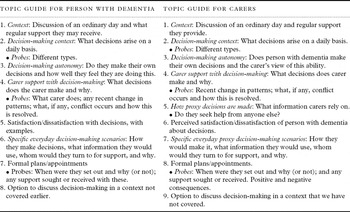
Topic guides were based on existing literature, and included open-ended questions to encourage participants to talk in as much detail as they liked. Separate topic guides were developed for people with dementia and carers, and summaries of both are included in Box 1. The same topic guide was used at all time points. The study materials were reviewed by the project advisory group, comprising a person with dementia, two carers, one former carer, and four health and social care practitioners.
Interview topic guides

We conducted separate and joint interviews according to the preference of those interviewed. Most interviews lasted around an hour. Initially many carers wished for joint interviews but later relaxed this view. For example, one carer set off for a medical appointment when the researcher visited; hence this interview with the person with dementia took place in the carer's absence and the carer's interview followed subsequently.
Data analysis
Using thematic analysis, the first five transcripts were initially repeatedly read independently by the authors. Each author then separated the data into meaningful fragments to identify salient or emerging themes. These were labeled with codes to describe the data. We compared these to reach consensus on a preliminary descriptive thematic table, including both manifest and latent codes (Braun and Clarke, Reference Braun and Clarke2006). The coding framework was then applied to the rest of the transcripts. Through a process of interpretation, as well as thematic discussions, conceptual meanings and patterns were identified. Analysis ceased on reaching theoretical saturation when no new themes were being identified from the data.
Participants
Number of participants
A total of 15 people with dementia and 15 carers were recruited to the study for T1 interviews. Two participants later lost capacity to consent to participation in the study and were excluded. Nine participants declined the interview at Time 2 (T2) for different reasons; one couple rejoined the study for Time 3 (T3) and Time 4 (T4). This resulted in a total of 11 people with dementia and 12 carers interviewed at T4 (Table 1). Only the longitudinal data are presented here, although earlier interviews were used to contextualize findings.
Number of participants interviewed over time

Sample characteristics
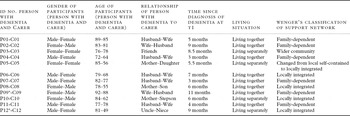
Table 2 presents the overall characteristics of all participants, their gender and age range, and the relationship and living situation with their carers. Using Wenger's (Reference Wenger1977) classification of social network types, we classified six as having a family-dependent support network with close family ties and relatively few neighborhood and friend links; all of these were spouse couples. Four participants had locally integrated support networks, which included close relationships with local family, friends, and neighbors. One participant had a local self-contained support network, relying primarily on neighbors but evolved into a locally integrated support network after she moved to live with her daughter. One participant had a wider community-focused network typified by a wide circle of friends. None in the sample had private restricted support network with few nearby friends and low levels of community involvement.
Overall characteristics of participants

*P12 did not complete Time 3 interview and P09 did not complete Time 4 interview.
People with dementia had all received their diagnosis within 3 to 11 months before the interview. We did not independently assess their cognitive impairment and used time from diagnosis as a marker for their condition to be “mild to moderate dementia.” All participants lived in the London area, in a mix of accommodation reflecting UK housing tenure – ranging from owner occupation (10) to privately rented (2). There was a mix of carer relationships with the person with dementia, and all but one dyad were white British; the one uncle and his niece described themselves as Asian/Indian (P–C12).
Results
Three underlying core principles framing decision-making arose in all interviews, albeit in different degrees of strength and at different time points:
1. People with dementia and carers described the importance of maintaining autonomy over decisions, although seldom using this term. Most were aware that their abilities were likely to deteriorate over time and hence were keen to use strategies to manage or maintain the autonomy of the person with dementia for as long as possible.
2. Everyday decisions were made in context, often embedded in daily conversations. Most people with dementia and carers adopted what might be termed a decision-specific approach – i.e., each decision was seen as distinct and the person with dementia's ability to make it was evaluated separately and in the immediate context by the carer. Numerous routine everyday decisions were made by people with dementia and carers, covering meals, shopping, and holidays. Many of these were described as joint endeavors.
3. Any decision made on behalf of someone else was reported as being made with the other's best interests or well-being in mind (Williams et al., Reference Williams, Boyle, Jepson, Swift, Williamson and Heslop2012). Often, this was not articulated but emerged in discussion of reasoning and in illustrations of approach.
Longitudinal interviews enabled us to explore changes in decision-making across a range of carer relationships and living situations. Although we took a person-centered approach to interviewing people with dementia and their experiences were vital to the study, our aim was to understand how decisions are made by them, around them, and for them. We therefore focused on findings and discussion of decision-making in the context of dementia rather than general decision-making. In the extracts below, C is used to denote a carer and P is used to denote the person with dementia. While the majority of the carers were family members as Table 2 illustrates, two people were long-standing friends. They both had been widowed around the same time and lived near each other.
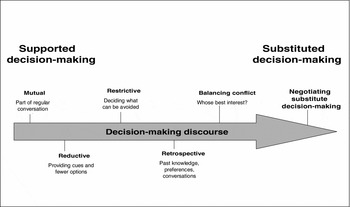
Responses over time enabled us to conceptualize a continuum that represents the decision-making discourse temporally (Figure 1), as carer participants were perceived to be gradually making a transition from “supported decision-making” to “substitute decision-making” in their engagement with the person with dementia. It is important to stress that not all participants started at the beginning and reached the end. Furthermore, categories present are not absolute, nor does it represent a “pathway” that all participants followed, and there was considerable nonlinear movement between categories. There is a danger of continuums of this sort simplifying complex inter-personal phenomena and subjecting it to reductionism. However, the intent of developing and presenting a continuum in this manner is to better understand patterns of meaning in participants’ accounts and to show the development over time of decision-making between people with dementia and carers.
Decision-making discourse.

The following five salient points along this continuum were identified:
1. Mutual decision-making
2. Reductive decision-making
3. Restrictive decision-making
4. Retrospective reflections on decision-making
5. Best-interests decision-making
The end point of this decision-making discourse was conceptualized as when carers felt they were undertaking substitute decision-making on a very regular basis and for some the process of substitution was predominant.
Mutual decision-making
Decision-making was seen as part of everyday lives at this time and not something to which people with dementia or carers reported giving much thought. A number of everyday decisions were provided as illustrations of what people with dementia and carers made jointly, including what to do, what to wear, what to eat, and what holidays to plan. Nonetheless, both people with dementia and carers talked of the potential of making one's own decisions as important to individual autonomy. At this stage during the first interviews, most people with dementia declared they felt capable of and were keen to make their own decisions. Most expressed a desire to remain involved in decisions that concerned their well-being, but also reflected on their confidence in their relative or friend making the right decision on their behalf. Decisions were often made together, with boundaries respected by spouses in particular, as part of shared regular everyday conversations:
If there's something I'm worried about, I would speak to him (husband with dementia) about it first of all. I believe that he tries to be as open as he possibly can. We talked about the confidentiality thing right at the start, and he said, “Don't worry about that, I don't care who knows what about me. I make decisions as to whether I think it's sensitive or not.” But his memory is . . . I think he has recognition memories, not terribly good recall short-term memory. But he knows his own mind. That's what I was trying to say about you arriving. He does know his own mind. I might try and push him in a friendly way. I can do that, because I know if he doesn't want to, he'll say no. (T1 C04)
Participants with dementia seemed particularly surprised at being asked about individual decision-making, indicating they felt that joint decision-making was an inherent part of living with a partner, many had been married over 50 years. As many of these decisions were embedded in everyday conversations, they found it hard to distinguish who had actually made a decision:
Well, sometimes we decide whether we want to go out, or whether we don't want to go, and whether we go first or early in the afternoon or in the evening, it's just one of those things, you know. We talk a lot and we discuss things like that. I would always discuss things, definitely. I wouldn't do anything without her consent shall we say, and she wouldn't do anything without mine. Well, that's it, it's habit you know, you can't get out of it. (T2 P02)
Among our sample of seven spousal carers, most were retired from full-time employment; although one wife carer (C04) currently volunteered at a local charity shop. Retirement had been a significant time for the couples at many levels and was described by many as a time when decision-making on everyday matters had changed. Retirement appeared to have been a transition point when joint domestic decision-making became more evident in the domestic sphere. This was a world of activity but also routine and joint enterprises. For example, one man with dementia talked about how, when he was working, he left thinking about meals to his wife, but since retirement, they had discussed and made such decisions together. Similarly, deciding how to spend the day was a joint enterprise, another change since retirement:
I like retirement. I like being at home. We [wife and him] have breakfast together and decide what we're going to do all day. Mostly we're together but if she has one of her Ramblers’ (organized walking in countryside) outings, I don't stop her. I'm not that kind of husband! But mostly we do things together. (T1 P06)
In relationships which featured more stereotypical gendered roles, change was less apparent. For instance, in one couple where the wife had stayed at home during the marriage and undertaken all cooking, the fact that her husband could no longer manage to be involved in this part of domestic life was not a notable marker of any change. On the other hand, in this marriage, the wife had always managed the family finances:
I mean a lot of things we have in joint names because . . . he has always left me to do the finances, he has never done it, I have always you know he would say “you do it, you do it,” so really you know when somebody says “does he know where his money is invested?,” I say well “no” because he never has you know he knows, oh I am getting a good interest there or something that was all he was interested in he couldn't tell you, where, you know, five or six years ago he wouldn't have been able to tell you. (T2 C01)
Two carers, however, talked of making decisions together with their partner but admitted that this often reflected their own choices and preferences because the person with dementia was now experiencing trouble making decisions for themselves:
It's mostly mine (the decisions in the family). We talk about it but it's mostly mine. I mean, as I was saying to you, we'll have to go into town today because we need to do some cooking for a meal tonight, not so much for Wednesday and Thursday because he goes to the club and they do lovely food there. We have a meal when he comes back but it won't be a main meal, it's more of a snack meal. But it will probably be poached salmon salad today and a lovely wicked pudding. See? That kind of stuff, like what to eat and when, I have to decide because he just won't. (T3 C11)
Reductive decision-making
Over time, the impact of dementia on everyday decision-making was gradually acknowledged, and almost half of the participants with dementia in follow-up interviews (T2–T4) said they were finding it more difficult to make decisions. In many of these instances, the family member or carer was taking on a larger share of domestic and caring responsibilities, such as cooking meals and prompting washing and bathing:
Well, as I say, do buttons up and, you know, always get her clean clothes out, I never did that before, I mean otherwise I don't know when she would change and that sort of thing, you know and I really just sort of do things – a lot more than I used to, especially because she lives with me now. She is not bothered about what sort of clothes she wears, I sort of – you know when her clean clothes are done – I just put them out for her. But she manages to dress herself. (T2 C05)
Despite this, carers’ declared commitment to engage with the person they were supporting remained strong. Carers described being keen to involve their relatives or friend with dementia through employment of a range of strategies to reduce “cognitive overload,” such as posing a question at the “right” time, gauging when their relative was likely to be most engaged in conversation, and presenting a limited number of options. While most of the people with dementia in our study discussed their trust and faith in their relative or friend deciding for them, two reported not wanting their choices or autonomy to be compromised and a desire to remain closely involved in any decisions that concerned them (P10 and P12).
One carer (C12) talked explicitly of anticipating having to change her attitude toward her uncle with dementia as they gradually were coming to terms with the deterioration in his abilities:
I myself treat him no differently . . . I know that if the Alzheimer's develops, my attitude towards it will have to change. I treat him as a normal person, everyday friend, increasing friend. But as things develop, it would have to be something different. I would have to change my way of thinking, and the relationship would have to change. (T1 C12)
Another carer (C03) talked of her efforts to engage her friend with dementia in decision-making in order that her friend did not feel disempowered. This carer was also very aware of her friend's growing dependence on her for taking decisions and expressed her worries about this responsibility:
But she's got two or three [wine] bottles, and I'm trying to get rid of those, that she's had . . . opened and used, in her cupboard. And I've tried to tell her that it will go off, and upset her. It could even poison her. “Will it really?” “Yes.” “Oh well, I'll get rid of it.” I said, “Throw it away.” And I made sure she did it. Yes, I leave it to her to do that, yes. Well, I don't want to intrude. But I said, “If you want a bottle of wine in your place, to have, say, once a night or whatever, buy one of those small bottles, and you can get one glass in for tonight and another glass in for tomorrow.” “Oh yes, alright then, I'll do that.” So it's a good job I think the right way otherwise . . . because she'd do everything I tell her to do. And I've got to be so careful, it worries me, it does. (T2 C03)
Restrictive decision-making
Over time, people with dementia and carers described their lives as having shrunk – they were doing less, eating simpler meals, and through successful adjustments, were managing with less, as a result many talked of fewer decisions arising.
Some carers talked of changes in behavior that were emerging among those they supported giving rise to increased management of day-to-day interactions and more careful engagement with the outside world:
No, I mean I have to give him (husband with dementia) his tablets and now when he goes he, has had quite a few illnesses, a few operations, but now if he doesn't feel well or anything it is up to me to take him to the doctors and I have to go in wherever he goes now for anything medical – I have to go in with him now and just, you know, and speak for him really. (T4 C02)
Others tried to continue their relative or friend's involvement in general or domestic decisions through using strategies that appeared to be successful in reaching this aim. One such strategy frequently employed by carers to keep their relative with dementia engaged in decision-making was orchestrating the situation around them. For instance, carers talked of reducing decision-making opportunities for their relatives by making smaller everyday decisions on their behalves. This management, carers felt, thereby enabled them to “save” their relative's decision-making capacities for bigger and more significant decisions:
You have to remember that we've been retired for over 20 years now! So it's easy for me to know what he likes for dinner, I don't bother asking him things like that. Save him for the bigger decisions, if you know what I mean! [Laughs.] But it's true in a way, I suppose, he can't do everything now so I guess I try to manage our life in that way. (T2 C11)
Retrospective reflections for decision-making
As time progressed in some cases and for some decisions, carers reported that they needed to make decisions on behalf of their relative with dementia. While most carers assumed this added responsibility gradually and in order to make the best of things, some hinted at or directly expressed their frustration about this and reported feeling strained and confused by being the person upon whom all such decisions rested.
Spouse carers reported that they most often tended to fall back on their accumulated familiarity with and knowledge of their partner, including their preferences, habits, beliefs, which carers felt were still intrinsic parts of the person. Using a retrospective approach, they thought back to what the person with dementia might have wanted or would have done. All carers talked of the importance of reflecting these elements of people with dementia when making proxy or unilateral decisions. Adult child carers were more likely to base proxy decisions on previous conversations with their parent. These included discussions, for instance, of moving if matters got worse. In three cases where an adult child carer had not had the chance to have such conversations with their parent with dementia, they seemed to lack confidence and were more worried about making proxy decisions.
A few recollections of what were seen to be helpful examples of professional advice arose in the interviews, for example, that it may be best to wait before worrying over something that may never arise:
Well somebody said you should plan for the future but how can you plan you don't know what the future is going to be, how can you plan for the future? I mean I have seen it at first hand, I mean I think probably everybody is different I should imagine, I think it doesn't necessarily – I mean my friend's mother lost her speech, she didn't speak for years, but she never went into a home the family looked after her you know. And I would hope to look after Mum in the same way (P10 and C10 lived in separate but adjacent housing). But well, how can you make plans because you don't know what is going to happen do you, really? I mean the only thing I spoke to somebody, erm I think it was at the memory clinic, I was anxious that she wouldn't be able to get up the stairs, and I think they said well leave it until more or less, you know. . . (T4 C10)
Despite some accounts of receiving helpful professional advice, many carers talked of the burden of responsibility and associated guilt of making decisions for someone with dementia. This was most apparent in the carer who was a friend rather than a family member. Carer 3 was particularly concerned about her friend's growing dependence on her advice and opinions. While she was happy to support her friend over practical tasks, such as taking her for shopping, she was very reluctant to make decisions with and for her friend with dementia:
But every time I go now, she's asking me if she should be in a home. Now I can't make that decision. Her son can't make that decision because he's too far away. She's got to make that decision on her own. It's not like it used to be years ago, when you were put into a home like that. I mean the law's changed now, and she can stay in her own home as long as she likes. But if she becomes a danger to herself or the neighbors . . . Sometimes she does feel like she should. Nobody has suggested it, but she feels like she should. If she can't think straight for herself, then she'll burst into tears, and that's when she thinks she should be in a home. And if I said, “Yes, I think you ought to,” it would worry me to death, because I can't do that. I can't do that. I just can't do that. She is the one that's got to make the decision. (T3 C03)
Participants were asked whether or not they had made or registered an LPA to establish whether contact with services and solicitors had impacted on their decision-making; all but one dyad (P08–C08) had not. Despite professional recommendations to inform patients and carers of this facility, only two further dyads had heard of this but were unclear about details.
Whose best interests?
The principle of making a decision in the best interests of the person with dementia appeared to underlie many carers’ interactions with their relatives with dementia, although many discussed their own and their relative's best interests as inter-connected. For instance, some carers talked of their relative's well-being as depending on their ability to provide care and, therefore, prioritizing taking a break was deemed important by carers, even though it could impact negatively on their relative with dementia. Many carers, therefore, struggled to meet the practical challenge of how to weigh up best interests. Common examples included decisions about using respite care and giving up driving. Adult child carers talked about the challenge of deciding whether to encourage their parent with dementia to move closer to family members.
Carers acknowledged that some decisions were easier or more straightforward than others. For instance, C09 gave the example of his wife being increasingly “feeble,” and not making meals anymore. While he was keen that she retained her sense of control or autonomy over lifelong habits and routines, he argued that it was in her best interests and her safety for him to cook their meals. Other decisions, particularly concerning individual well-being, were less straightforward:
My doctor's told me that I need to make sure that my health does not suffer, and I have started to a bit more. I eat better now. I know I should be doing anything that's good for her, and I would. But I get so tired these days and I worry . . . if I go what will happen to her? So sometimes I need to force myself to rest . . . for her benefit, if you see what I mean? (T2 C09)
In many cases, carers confessed feeling guilty which seemed to be associated with prioritizing their own needs over their relative's:
Well, one of the big decisions was going to the day center because he didn't want to go, but I said, well, it would be good for him and good for me. And then when he knew the other people from Friday mornings were going there, he went. But I made all the arrangements on that, because I really needed that break, you see? (T3 C07)
Few carers described receiving support around decision-making. One carer was very grateful for the help she had already gained from her local carers’ center, but felt that decision-making was often seen as a personal matter than no-one wanted to pry into. She described feeling isolated when left to weigh up different options when making decisions on behalf of her husband whose decision-making capacity was rapidly deteriorating.
Most carers were keen to receive practical support with decision-making. As noted, one carer was experiencing difficulty getting advice regarding her friend's situation, which she ascribed to professionals viewing her friend as retaining many abilities, while she saw her friend differently. Support of this kind, which enabled carers to make proxy decisions confidently, was reported as not generally available:
I asked the psychiatric nurse at the Drop-in center there how do you tell and she says you kind of know – I said how do I know when he says he has got a pain or an ache if it is just a pain or an ache or – because you could be running to the doctors every week – and she said well you kind of tell by his color and that if he really doesn't feel well . . . that is what I have kind of done, I mean he suffers with aches and pains so I would be forever at the doctors if I took notice of every one. (T2 C01)
Similarly, in terms of giving up driving – one carer recognized that having the decision made by the Driving and Vehicle Licensing Agency (DVLA) made it easier to explain that the decision was not hers. However, her husband was very depressed about this and she felt that some emotional support around this area would have been useful:
He's still not happy that he's not allowed to drive but I'm happy that that decision's been made because while the car was there and he'd still got a licence, the temptation was to say, “Oh, you pop down the road for me.” (T3 C07)
Negotiating substituted decision-making – a balance of all factors
The end point of this decision-making continuum appears to be when carers were routinely making substitute decisions for their relatives with dementia. This was more commonly reported during the later interviews (T2, T3, and T4), as this extract illustrates:
Oh I don't ask her what she wants anymore. I know what she'll say anyway – “anything you like, you decide.” So I just do what's best for us both. She has never had sugar in her tea. Never! And lately, she seems to like it. So I let her be, let her have it if that's what makes her happy. When the sugar runs out, I'll get some more but I'm not going to break my back getting the sugar for her because she's never liked it before, you know? (T4 C09)
In families where adult children were actively involved in decision-making along with a parent carer, some decisions were made jointly without explicit consent. In all of these cases, adult children had determined that it was in their parents’ best interests for the decision to be made and, in almost all cases, parents seemed happy to go along with these decisions. In the example below, which touches on a small but telling example, the children of P04 and C04 had evidently decided that their parents needed a new television as their current one was expensive (on a hire purchase scheme):
But they [adult children] discuss and they decide . . . whether it's the right thing they're doing, I don't know, but they're only trying to be helpful.
Interviewer: And you're happy to leave it to them?
Well, I have no choice, they do it! The television was replaced because [husband with dementia] had always . . . I mean, you'll know this, you will know this that in life he'll do this and you'll do that, which is what I do . . . we did. And [husband with dementia] always rented the television from X and it was something like £32.99 per month and the children were horrified. So that's why . . . [son] rang to say, “I'm coming up briefly, overnight, I'm bringing you a new television.”
Interviewer: How did you feel about that?
Actually, I wouldn't have . . . well, this is what I'm saying. They're trying to be very helpful. I wouldn't have chosen that if it had been me, choosing a new one, I would have bought another one. But, having said that, it's fine, they're only trying to help. (T4 C04)
Discussion
Using a phenomenological approach to understanding everyday decision-making, our study tentatively identifies a decision-making discourse, where everyday decisions evolve from being made jointly between people with dementia and their partner to one where decisions are made almost wholly by carers. This reflects sociological research about joint decision-making among married couples especially in later life (Askham, Reference Askham1994; Padula and McNatt, Reference Padula and McNatt2004). People with a newly diagnosed dementia and their marital partners do not change habits of a marriage suddenly, and tend to rely on habits in order to maintain stability (Steeman et al., Reference Steeman, de Casterlé, Godderis and Grypdonck2006). Beyond marital relationships, all carers stressed that all decisions should be made in context, apparently unknowingly reflecting the decision-specific principle advocated by the Mental Capacity Act 2005 (Ministry of Justice, 2007).
Over time, carers’ involvement in day-to-day decisions changed as they began to provide cues for the person with dementia they were supporting, such as offering fewer options. These evolved into the carer being more restrictive in the choices they extended to the person they were supporting and making smaller, apparently inconsequential, decisions on their behalves. Again, over time, carers used retrospectively gained information to make decisions on behalf of the person with dementia, reliant on their knowledge of their beliefs, habits, and preferences, and any specific conversations they may have had. An important divergence in views between people with dementia and carers in our sample appeared to be that some people with dementia wanted decisions to be made on their behalves, while carers were more inclined to want to preserve their relatives’ autonomy through the use of strategies and cues. Substitute decision-making in this study occurred only after carers had used other strategies and, using all the information on hand, had to decide on behalf of their relative with dementia (Livingston et al., Reference Livingston2004).
It is important to note that only one-third of the dyads we interviewed operated in isolation or mutual dependency. Most talked of being part of strong family networks with other family members actively involved in practical caring support and decision-making (Wenger and Tucker, Reference Wenger and Tucker2002). Spouse couples often demonstrated the strongest mutual relationships in terms of their knowledge and intimacy of the person with dementia they were supporting; however, the niece of P12 also showed a deep understanding of her uncle's preferences and habits despite not living with him. She attributed this to close family ties in her family, and this illustrates the importance of not overly simplifying marital partners or adult children as having privileged positions when decisions arise.
Principles such as respecting autonomy, decision-specificity, and making decisions in a person's best interests were inherent in participants’ accounts and reflected the principles embedded in the Mental Capacity Act 2005 (Ministry of Justice, 2007). However, the lack of knowledge about LPAs some five years after the Mental Capacity Act 2005 was implemented suggests that there is scope for practitioners to discuss decision-making and advance planning with people newly diagnosed with dementia and their carers and to touch upon this subject over the trajectory of dementia. Carers in our study indicated a lack of information, support, and person-centered guidance and would have welcomed more constructive discussion, advice, and feedback in this area. Such support for carers requires volunteers, primary and specialist healthcare, and social care staff to be confident in raising the subject, aware of clues that it could be broached, and accuracy over further sources of expertise (Manthorpe et al., Reference Manthorpe, Samsi and Rapaport2012).
Our study supports others’ findings that people with dementia and carers initially often manage the condition through assimilating it into everyday life (Pearce et al., Reference Pearce, Clare and Pistrang2002; Werezak and Stewart, Reference Werezak and Stewart2002; Clare, Reference Clare2003). Decision-making too appeared to be framed in the context of long-standing dyadic relationships of continuity and routine. Spouse carers appeared to have strongest relationships when it came to deciding for and knowing the preferences and habits of the person they were supporting, compared to adult children carers; the sole friend carer in our study articulated maximum difficulty in deciding with, for, and on behalf of her friend with dementia. Practitioners may wish to facilitate discussion of the stresses of taking on responsibility in carer groups and individual support for carers could explore subjective difficulties or confusion. More research is needed to consider whether people with dementia themselves would find professional support helpful to assist them to manage negotiations around declining choices along this continuum of decision-making.
Our study is limited by the size and possible non-representativeness of the study sample. However, by aiming to recruit a range of participants, we achieved a diversity of caring relationships and living situations. Moreover, by aiming to put the person at the center of the interview, individual accounts contributed to an understanding of the larger phenomenon. Our ethnic group variation was limited by interviews being conducted in English, and apart from the difference in carer relationship in the Indian dyad, no other apparent differences were noted. Further work on decision-making is needed to understand it in the context of different networks, including those from different cultures, and where individuals have lived alone for many years and are newly facing possible “intrusions” in their domestic and personal lives. Our research was interview-based and there is accordingly room for more detailed observational studies, alongside conversational interviewing, to see how domestic life and decision-making are undertaken (see Briggs et al., Reference Briggs, Askham, Norman and Redfern2003). Nonetheless, this present study has illuminated an area of domestic life that surprisingly is under-explored in dementia studies and has identified opportunities for professionals to raise such subjects as well as asking about wishes and plans for long-term care and end of life. Further research is required among the growing number of people living alone with dementia, or with distant relatives as carers, to determine how they negotiate everyday decision-making with little assistance.
Conclusion
Using qualitative methods, explorations of decision-making among dyads of people with dementia and carers over time identified how this transitioned from “supported” to “substituted” decision-making, with carers gradually making increasing amounts of decisions. While carers used some cues such as reduced options and using retrospective information, they struggled with weighing up what was in their relative's best interests and how to determine their relative's capacity. Practitioners and support services should provide timely advice to carers and people with dementia around everyday decision-making, and be mindful of how situations may change.
Conflict of interest
None.
Description of authors’ roles
Jill Manthorpe is the lead investigator of this study and developed the research questions, designed the study, supervised data collection, and wrote the paper. Kritika Samsi liaised with recruitment sources, collected the data, analyzed the findings, and wrote the paper.
Acknowledgments
This paper presents independent research commissioned by the National Institute for Health Research (NIHR) under its Programme Grants for Applied Research scheme (RP-PG-0606-1005). The views expressed in this publication are those of the author(s) and not necessarily those of the NHS, the NIHR, or the Department of Health.