Implications
Currently, many producers feed their ewe lambs without distinguishing between market ewe lambs and replacement ewe lambs. Ewe lambs usually have free access to diets promoting rapid weight gain until they reach an acceptable weight for selection as a breeding animal. In this study, we show that a high plane of nutrition before puberty has a negative impact on milk production over the first two lactations. This suggests that allowing free access to feed and a near maximum growth rate for ewe lambs during the allometric growth phase reduces the milk potential of future ewes.
Introduction
Currently, sheep producers do not apply any feed restrictions to replacement ewe lambs. They usually have free access to diets promoting rapid weight gain and fat deposition until they reach an acceptable weight for breeding selection. The negative effect of rapid weight gain and fattening during early rearing on mammary gland development and lactation performance in replacement dairy heifers is well documented (Sejrsen, Reference Sejrsen1978; Sejrsen et al., Reference Sejrsen, Huber, Tucker and Akers1982; Valentine et al., Reference Valentine, Dobos, Lewis, Bartsch and Wickes1987; Mäntysaari et al., Reference Mäntysaari, Ingvartsen, Toivonen and Sejrsen1995; Meyer et al., Reference Meyer, Capuco, Ross, Lintault and Van Amburgh2006). Accelerated gain before puberty reduces mammary secretory tissue in dairy heifers (Sejrsen et al., Reference Sejrsen, Huber, Tucker and Akers1982) and in ewes (Zidi et al., Reference Zidi, Caja, Ayadi, Castillo, Flores and Such2007; Villeneuve et al., Reference Villeneuve, Cinq-Mars and Lacasse2010). It also increases fat deposition in the mammary gland in heifers (Capuco et al., Reference Capuco, Smith, Waldo and Rexroad1995; Charles et al., Reference Charles, Vonnahme, Yelich, Dolezal and Wettemann1999) and in ewes (Johnsson et al., Reference Johnsson, Hart and Turvey1986; Peclaris et al., Reference Peclaris, Nikolaou, Kann, Eleftheriou, Yupsanis and Mantzios1994, Reference Peclaris, Nikolaou, Kann, Eleftheriou, Yupsanis, Mantzios and Koutsotolis1997; Villeneuve et al., Reference Villeneuve, Cinq-Mars and Lacasse2010). Restricted feeding in the prepubertal period improves milk production in the first lactation in dairy heifers (Foldager and Sejrsen, Reference Foldager and Sejrsen1991; Peri et al., Reference Peri, Gertler, Bruckental and Barash1993; Hohenboken et al., Reference Hohenboken, Foldager, Jensen, Madsen and Andersen1995; Van Amburgh et al., Reference Van Amburgh, Galton, Bauman, Everett, Fox, Chase and Erb1998; Lammers et al., Reference Lammers, Heinrichs and Kensinger1999; Radcliff et al., Reference Radcliff, Vandehaar, Chapin, Pilbeam, Beede, Stanisiewski and Tucker2000) and in dairy ewes (Zidi et al., Reference Zidi, Ayadi, Caja, Such, Ghirardi and Albanell2005). Umberger et al. (Reference Umberger, Goode, Caruolo, Harvey, Britt and Linnerud1985) and McCann et al. (Reference McCann, Goode, Harvey, Caruolo and Mann1989) observed that restricted feeding also improved the milk production of meat type breeds (Dorset and Suffolk). Although in both studies the restriction period ended at breeding, milk production was recorded for the first lactation only and offspring growth performance was not measured. Therefore, the negative relationship between accelerated weight gain during the allometric phase of growth and mammary gland development in ewes could reduce subsequent milk yield and lifetime ewe productivity. The aim of this study was to determine the effects of a restricted diet in replacement ewe lambs before puberty on reproduction, lactation and the growth performance of their offspring over two breeding seasons.
Material and methods
This project was evaluated and approved by the Dairy and Swine Research and Development Centre’s Institutional Committee of Animal Protection, whose capacities and responsibilities are in keeping with the guidelines of the Canadian Council on Animal Care (1993). Experience was performed at the Centre d’Expertise en Production Ovine du Québec (latitude 47°21′00″ North, longitude 70°2′00″ West).
Experimental procedures
Forty-four (44) Dorset ewe lambs born in spring 2007 were weaned at 53.4 ± 2.1 days of age, mean weight of 23.2 ± 1.0 kg. They were kept in an individual pen surface area of 1.12 m2. Pens allowed for tactile and visual interactions between lambs. The space between dividing bars of the pens was 7 cm (Villeneuve et al., Reference Villeneuve, Méthot, Cinq-Mars and Bergeron2009). Animals were kept under natural photoperiod.
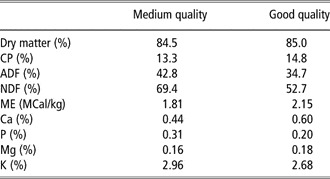
Ewe lambs were randomly assigned to three different diets. In diet A-medium-quality forage (MQF; control, A for ad libitum), both MQF and concentrate were offered ad libitum. Diet R-MQF (R for restricted) consisted of a restricted amount of concentrate and ad libitum access to the same forage as in diet A-MQF. Lastly, diet F-high-quality forage (HQF; F for forage) consisted of a diet with HQF offered ad libitum with less concentrate than diet R-MQF. The concentrate served to A-MQF lambs contained 86% barley, 12% pelleted soybean meal and a mineral mix and averaged 16% of crude protein (CP) and 2,69 Mcal of metabolizable energy/kg of dry matter. The restricted lambs (R-MQF and F-HQF) were fed with a concentrate containing 82% barley, 14% pelleted soybean meal and a mineral mix and averaging 16% of CP and 2,62 Mcal of metabolizable energy/kg of dry matter. Sodium decoquinate (Deccox, Alpharma Inc., Bridgewater, NJ, USA) was included in the blend as a coccidiostat. Forage composition is presented in Table 1. The quantity of concentrate served to the group R-MQF and F-HQF ewe lambs was adjusted weekly to obtain an average daily gain (ADG) that was 70% of that of the group A-MQF ewe lambs. During the treatment period, ewe lambs from A-MQF, R-MQF and F-HQF received a concentrated-to-forage ratio of 93 : 7, 69 : 31 and 40 : 60, respectively. The diets were offered for 75 days after weaning to cover the allometric phase of mammary gland development that occurred between 2 and 5.5 months of age according to Anderson (Reference Anderson1975) and Johnsson and Hart (Reference Johnsson and Hart1985). After the restricted period, the animals had enough time to make a compensatory growth and reached ideal weight for breeding at 8 months of age (Villeneuve et al., Reference Villeneuve, Cinq-Mars and Lacasse2010).
Nutrient composition of experimental foragesFootnote a, dry matter basis

a Medium-quality forage (MQF) was served to groups A-MQF and R-MQF and high-quality forage (HQF) was served to group F-HQF.
During the experimental phase, three ewe lambs from group A-MQF died. The 41 remaining ewe lambs received a haylage and barley diet formulated according to the National Research Council (NRC, 2007) recommendations. Ewe lambs were housed individually until breeding, and then moved into groups of 10 with 1 Dorset ram for a 35-day period. After this period, ewe lambs were penned in groups. First breeding occurred when animals reached 8 months of age and weighed around 55 kg.
At the first and second lambings, body weight (BW) and body condition score (BCS) on a 1 to 5 scale were recorded at parturition and at the end of lactation. The gestation rate, number of lambs born, total and mean weight of litter, birth and weaning weight of lambs and ADG and total gain of lambs were also recorded.
The litter was standardized to one lamb per ewe. For the first lactation, ewes were milked at day 7, 14, 21, 28, 35, 42, 49 and 56. For the second lactation, ewes were milked at day 4, 7, 14, 21, 28 and 35. Lambs and ewes were separated before the first milking and each ewe was milked on a milking platform. Udder and teats were washed with impregnated wipes (Ukal Elevage, Ste-Hyacinthe, QC, Canada) and dried, and then 5 I.U. of oxytocin was injected i.m. into the ewes. Ewes were milked with an Udderly EZ Milker™ (EZ Animal Products, LLC, Ellendale, MN, USA). Three hours later, ewes were milked again by the same method as above. After the second milking, lambs were returned with their dams. Milk weight was recorded and samples were analyzed for fat and protein content using an infrared milk analyzer (Bentley 2000, Bentley Instruments, Chaska, MN, USA). Milk yield was standardized to get the same level of milk energy at 5 MJ/l using the equation developed by Bocquier et al. (Reference Bocquier, Barillet, Guillouet and Jacquin1993). During the lactation period, lambs had free access to creep feed in a small pen area unavailable to ewes. The creep feeds consist of 18% CP concentrate and HQF, both offered ad libitum.
Statistical analysis
Gestation rate and the number of lambs born were analyzed with the LOGISTIC procedure of the Statistical Analysis Systems Institute (SAS, 2002). All other data were analyzed by the MIXED procedure of SAS. Milk production and composition data were analyzed as repeated measurements. Preplanned contrasts were used to compare treatments. Age of lambs at weaning was used as a covariable for analysis of weaning weight, ADG and total weight gain. Similarly, litter size was used as a covariable for the analysis of birth weight. An overall analysis of milk production and lamb growth over the two lactation cycles was performed by calculating an average per lactation (milk production data) and then analyzing the data as repeated measurements with the MIXED procedure of SAS.
Results
Growth of ewe lambs
Feed restriction is reported to have effects on the growth of replacement ewe lambs (Villeneuve et al., Reference Villeneuve, Cinq-Mars and Lacasse2010). Briefly, ADG was 223 and 229 g/day for groups R-MQF and F-HQF, respectively, compared to 305 g/day for group A-MQF (P < 0.0001) during the allometric phase of mammary gland growth. After this period, compensatory growth was observed for the ewe lambs of groups R-MQF and F-HQF, such that BWs at breeding (240 days) and around lambing (390 days) were similar for all groups.
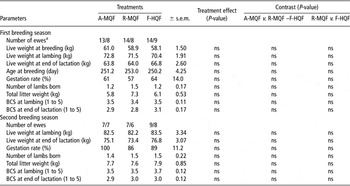
Reproductive performance
The reproductive performance of ewes during the first and second breeding seasons was similar across the three groups for all parameters (P > 0.10; Table 2). At the first and second lambings, respectively, ewes weighed 71.6 ± 1.9 kg and 82.7 ± 3.3 kg and the gestation rate averaged 61% ± 14% and 92% ± 11%. The number of lambs born per ewe and litter weight averaged 1.32 ± 0.17 kg and 6.42 ± 0.53 kg, respectively, for the first lambing and 1.48 ± 0.22 kg and 7.72 ± 0.85 for the second lambing.
Reproductive performance over two breeding seasons of ewes fed an ad libitum diet A-MQF, a restricted diet with R-MQF or restricted diet with a F-HQF from weaning to 135 days

MQF = medium-quality forage; HQF = high-quality forage; BCS = body condition score.
aNumber of ewes at breeding/number of ewes impregnated.
Lactation performance
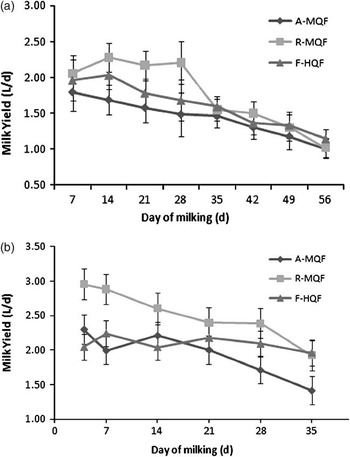
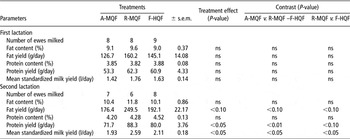
The first and second lactation curves are presented in Figure 1 and average standardized milk production is presented in Table 3. For the first lactation, preplanned contrast A-MQF v. R-MQF–F-HQF showed a trend toward greater milk production in ewes in groups R-MQF and F-HQF (P = 0.07), while milk production was similar for groups R-MQF and F-HQF (P > 0.10). For the second lactation, contrasts showed that feed-restricted ewes produced more milk than ewes fed ad libitum (P < 0.05) and ewes of group R-MQF produced more milk than those of group F-HQF (P < 0.05). Contrasts showed that over the two lactations ewes of the groups R-MQF and F-HQF produced more milk than those of group A-MQF (P = 0.05). Milk fat and protein contents were similar between treatments (Table 3). When each lactation was analyzed separately, protein yield was higher for ewes of groups R-MQF and F-HQF than for group A-MQF and there was a trend for fat yield being higher for restricted ewes compared to the unrestricted ones during the second lactation. Over the two lactations, milk protein yield was higher (P < 0.05) and milk fat yield tended to be higher (P = 0.08) in restricted ewes.
Standardized milk yield at (a) first lactation and (b) second lactation in ewes fed an ad libitum diet (A-MQF), a restricted diet with medium-quality forage R-MQF) or a restricted diet with high-quality forage (F-HQF) from weaning to 135 days of age.

Milk fat and protein content and yield for the first and second lactations of ewes fed an ad libitum diet A-MQF), a restricted diet with R-MQF or a restricted diet with a F-HQF from weaning to 135 days old

MQF = medium-quality forage; HQF = high-quality forage.
Lambs’ growth performance
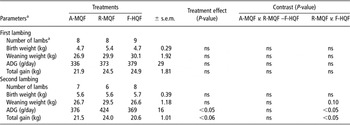
The lambs’ performance is presented in Table 4. At the first lambing, there was no difference between the groups for any of the parameters. All lambs had similar birth and weaning weights, ADG and total gain (P > 0.10). At the second lambing, lambs from group R-MQF had better weaning weight and ADG than group F-HQF (P < 0.05). When both lambings are considered, lambs from ewes of the R-MQF and F-HQF treatments tended to grow faster than those in treatment A-MQF (P = 0.10).
Growth performances of lambs born to ewes fed an ad libitum diet (A-MQF), a restricted diet with R-MQF or a restricted diet with F-HQF, from weaning to 135 days old, at the first and second lambing

MQF = medium-quality forage; HQF = high-quality forage; ADG = average daily gain.
aOne lamb from group F-HQF died, so the data for all parameters except for birth weight represent the mean of eight lambs.
Discussion
In this study, we observed that a high plane of nutrition before puberty has a negative impact on the lactation performance of ewes. There are a good number of studies that indicate that a high plane of nutrition before puberty has a negative impact on the subsequent milk yield of dairy heifers (see Le Cozler et al., Reference Le Cozler, Lollivier, Lacasse and Disenhaus2008 for a review). However, similar studies in ewes are scarce. Umberger et al. (Reference Umberger, Goode, Caruolo, Harvey, Britt and Linnerud1985) reported data from three trials in which Dorset and Suffolk ewe lambs were fed on a high or moderate plane of nutrition from weaning to close to breeding and milk yield was estimated using the weigh-suckle-weigh method at 20, 40 and 60 ± 5 days of lactation. Milk yield was consistently higher for the moderate group but statistical significance was only reached in the last trial. Subsequently, McCann et al. (Reference McCann, Goode, Harvey, Caruolo and Mann1989) reported the results of three similar trials in which ewes were milked with a portable milking machine at around 25 ± 5 days of lactation. They also reported an insignificant 10% trend of greater milk production for ewes maintained on a moderate plane of nutrition before breeding as compared to a high plane of nutrition. More recently, Sormunen-Cristian and Jauhiainen (Reference Sormunen-Cristian and Jauhiainen2000) compared three planes of nutrition (low, moderate and high) for ewes from 2 months of age until breeding and from 2 months pre partum to 8 weeks of lactation in Finnish Landrace ewes. Although ewes of the high plane treatment were fed a diet higher in energy during lactation, they tended to produce less milk. Zidi et al. (Reference Zidi, Ayadi, Caja, Such, Ghirardi and Albanell2005) evaluated the impact of plane of nutrition from weaning to 5.5 months of age in the Manchega and Lacaune dairy breeds. In the Manchega breed, they observed a greater milk production in moderately fed ewes compared to well fed ones during both the first and second lactations (88% and 32%, respectively). However, no effect of plane of nutrition was observed in the Lacaune breed. Although these experiments vary widely in terms of experimental methods and breeds, they generally support the finding of this study that restriction feeding during the prepubertal period enhances milk production in ewes.
In heifers, the effects of the prepubertal plane of nutrition on milk production have been attributed to modulation of mammary gland development (Foldager and Sejrsen, Reference Foldager and Sejrsen1991; Radcliff et al., Reference Radcliff, Vandehaar, Chapin, Pilbeam, Beede, Stanisiewski and Tucker2000). During this period, duct extremities lengthen and ramify into the fat pad. Well-elaborated and arborescent ducts allow the development of more milk secretory cells during pregnancy. Therefore, although most mammary growth occurs during gestation, duct network formation during the first allometric phase determines the extent of lobulo-alveolar development and milk production potential. Accordingly, plane of nutrition during gestation did not affect subsequent milk production in lambs (Umberger et al., Reference Umberger, Goode, Caruolo, Harvey, Britt and Linnerud1985) and heifers (Lacasse et al., Reference Lacasse, Block, Guilbault and Petitclerc1993). In a companion paper (Villeneuve et al., Reference Villeneuve, Cinq-Mars and Lacasse2010), we reported that the mammary gland of restricted ewe lambs, groups R-MQF and F-HQF, was more developed than that of group A-MQF ewe lambs. Thus, the lower milk yield reported in this study supports the hypothesis of reduced mammary gland development. It appears that a high plane of nutrition before puberty during the allometric growth phase of the mammary gland compromises mammary gland development, leading to lower milk yield for at least two lactations.
Milk production of group R-MQF ewes was numerically greater than that of group F-HQF at first lactation and significantly greater at second lactation. These results were unexpected since the body growth of both groups was restricted to the same extent during the allometric phase of mammary gland development. The mammary gland development of lambs slaughtered at the end of the treatment period was similar for both the R-MQF and F-HQF treatments, although most parameters (DNA, protein and DFFT content) were numerically higher for R-MQF lambs (Villeneuve et al., Reference Villeneuve, Cinq-Mars and Lacasse2010). In heifers, the effect of nutrition on mammary gland development and subsequent milk production appears to be independent of the amount (Pirlo et al., Reference Pirlo, Capelletti and Marchetto1997) or the degradability (Mäntysaari et al., Reference Mäntysaari, Ingvartsen, Toivonen and Sejrsen1995; Van Amburgh et al., Reference Van Amburgh, Galton, Bauman, Everett, Fox, Chase and Erb1998) of dietary protein or dietary energy concentration (Sejrsen and Foldager, Reference Sejrsen and Foldager1992). No ovine studies have evaluated the effect of type of diet on milk yield independently of growth rate. McFadden et al. (Reference McFadden, Daniel and Akers1990) reported that feeding prepubertal lambs a supplement containing formaldehyde-treated sunflower seeds (a source of essential fatty acids protected from ruminal biohydrogenation) resulted in an increase in mammary parenchymal weight. In mice, a diet deficient in essential fatty acids (linoleic and linolenic acids) resulted in a reduction of mammary development (Miyamoto-Tiaven et al., Reference Miyamoto-Tiaven, Hillyard and Abraham1981). In the present experiment, diet R-MQF contained more concentrate than diet F-HQF and, therefore, more unsaturated fatty acids. Nevertheless, the difference in the fatty acid content of the diets was probably small and fatty acids were not protected from ruminal biohydrogenation. In heifers, an unprotected high oil diet did not affect mammary development and milk production (Thibault et al., Reference Thibault, Petitclerc, Spratt, Leonard, Sejrsen and Lacasse2003). More research is needed to explain the observed difference between the R-MQF and F-HQF diets.
Although significant differences were only observed at the second lactation, lambs’ growth performance improved when ewe milk production increased. Accordingly, Johnsson and Obst (Reference Johnsson and Obst1984) observed that Hereford cows fed a restricted diet between 2 and 8 months of age produced more milk for the first three lactations and weaned heavier calves. In this study, milk yield and ADG were significantly correlated (P < 0.01), but the correlation coefficient was low (r = 0.39), indicating that other factors contributed to lamb performance. In this study, lambs had free access to creep feeds from the first week of age until weaning. Creep feed intake could not be measured in this experiment. However, it is possible that lambs ate more concentrate feed to compensate for the lack of mother’s milk. Indeed, Araujo et al. (Reference Araujo, Pires, Susin, Mendes, Rodrigues, Packer and Eastridge2008) reported that lambs can compensate for lower dam milk production by eating creep feed when available. In addition, the number of lambs per ewe was standardized to one. At one lamb per ewe, it is likely that most lambs had enough milk to express their growth potential. Raising twins or triplets imposes more demand on the mammary gland to meet the needs of the offspring, and milk production is more likely to be limiting for their growth. In this study, despite free access to creep feed and a litter size standardized to one lamb per ewe, a trend was observed at the first lactation and a significant difference at the second lactation in favor of restricted ewe lambs. Therefore, it is possible that creep feeding does not fully compensate for the reduction in the dam’s milk production.
The number of lambs born following two breeding seasons was not significantly different between treatments in this study. McCann et al. (Reference McCann, Goode, Harvey, Caruolo and Mann1989), Susin et al. (Reference Susin, Loerch, McClure and Day1995) and Zidi et al. (Reference Zidi, Ayadi, Caja, Such, Ghirardi and Albanell2005) reported a similar number of lambs per ewe in the first breeding seasons across all treatments. In this study, restricted feeding ended around 5.5 months of age. As breeding took place at 8 months of age, ewe lambs had 2.5 months to reach an ideal weight for reproduction. It is known that the Dorset breed reaches puberty at around 7.5 months of age (Quirke et al., Reference Quirke, Stabenfeldt and Bradford1985) and 50% to 70% of adult BW (Dýrmundsson, Reference Dýrmundsson1981). In our study, ewe lambs were first bred at over 8 months of age (251.5 ± 4.3 days of age) and more than 70% of their adult BW (59.24 ± 1.50 kg/85 kg: adult BW of mature ewes at the experimental farm). All ewe lambs were thus probably physiologically ready for breeding as shown by the similar litter size between groups at the first lambing. In this study, feeding restriction did not compromise the reproductive performance of ewes over two consecutive gestations. The present results diverge from those of Umberger et al. (Reference Umberger, Goode, Caruolo, Harvey, Britt and Linnerud1985), who obtained a greater litter size in the non-restricted group. However, the longer period of restriction probably explains the lower litter size reported in Umberger’s study. Indeed, a higher energy amount around the time of breeding increases the ovulation rate in sheep (Lassoued et al., Reference Lassoued, Rekik, Mahouachi and Ben Hamouda2004) and goats (Mani et al., Reference Mani, McKelvey and Watson1992). Live weight and BCS of ewes at both lambings were similar among groups in this study (Table 2). Zidi et al. (Reference Zidi, Ayadi, Caja, Such, Ghirardi and Albanell2005) also reported similar BW and BCS for restricted and unrestricted prepubertal ewe lambs after first lambing. It appears that reproductive performance is not affected by moderate prepubertal feed restriction when enough time is subsequently allowed for full compensatory growth.
Conclusion
The results of this study suggest that feeding ewe lambs on a moderate plane of nutrition during the allometric phase of growth does not compromise reproductive, lactation or offspring growth performance for any parameters. On the contrary, it has positive effects on ewe milk production and lamb growth. It would be interesting to evaluate this finding in prolific and dairy breeds where milk demand is greater. The concentrate-to-forage ratio of the diet may also have an impact on milk yield and on pre-weaning lambs’ growth performance.
Acknowledgments
The authors thank Steve Methot for his assistance with the statistical analyses and the staff of the CEPOQ for animal management and technical assistance. The authors are grateful to the Conseil pour le Développement de l’Agriculture du Québec (CDAQ) for their financial support.