Introduction
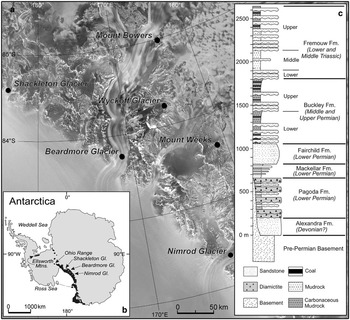
The Permo-Triassic sequence in the Transantarctic Mountains (Fig. 1) is dominated by terrestrial sediments laid down at high southern palaeolatitudes (Fig. 2). This area yields striking sedimentological evidence of depositional environments, typically with virtually total exposure in snow free areas. Fossils vary in abundance and include plants (in coal deposits, as leaf compressions, in silicified peat and as tree stump horizons), vertebrates (Collinson et al. Reference Collinson, Hammer, Askin and Elliott2006, Sidor et al. Reference Sidor, Damiani and Hammer2008a) and trace fossils (both vertebrate and invertebrate: e.g. MacDonald et al. Reference MacDonald, Isbell and Hammer1991, Miller & Collinson Reference Miller and Collinson1994b, Sidor et al. Reference Sidor, Miller and Isbell2008b). Body fossils of invertebrates are extremely rare; the record consists of a few occurrences of conchostracans (Doumani & Tasch Reference Doumani and Tasch1965, Babcock et al. Reference Babcock, Isbell, Miller and Hasiotis2002) and bivalves (Bradshaw Reference Bradshaw1984). Trace fossils are an important indicator of the presence of animals that are not represented as body fossils in these clastic settings, and as evidence of behaviour. Here we describe rare arthropod trackways and resting traces collected in 2003 in the Beardmore Glacier area; to our knowledge they are the first arthropod trackways described from Permo-Triassic deposits of Antarctica. The Permo-Triassic units of the Transantarctic Mountains record a transition from Permian carbonaceous and coal-bearing fluvial deposits to Triassic fluvial deposits with a much lower organic content (Collinson et al. Reference Collinson, Hammer, Askin and Elliott2006, table 1). The trace fossils are from the Permian Mackellar Formation and Buckley Formation, and the Triassic Fremouw Formation (Fig. 1). They are held by the Burke Museum of the University of Washington (abbreviated UWBM). Trace fossil terminology used is that of Trewin (Reference Trewin1994) and Braddy (Reference Braddy2001).
a. Permo-Triassic arthropod trace fossil localities in the Beardmore Glacier area (from US Antarctic Program). b. Antarctica showing rock outcrops (black) in the Transantarctic Mountains and the position of the Beardmore Glacier. c. Generalized stratigraphic column for the Beardmore Glacier area.

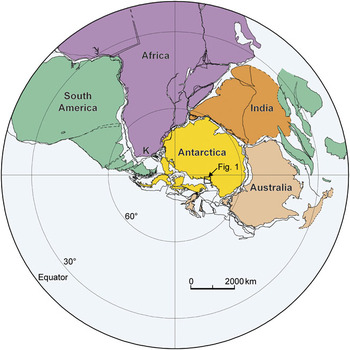
Palaeogeographic reconstruction of the southern hemisphere during the Early Permian (Sakmarian) from the University of Texas at Austin Institute for Geophysics. K indicates the position of the Karoo Basin; the square shows the area in Fig. 1.

Trace fossil occurrences
The Mackellar Formation (Lower Permian)
Material
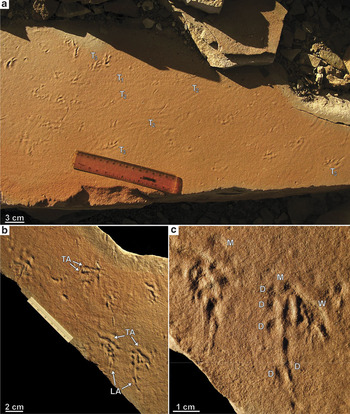
One large slab (UWBM 98803) was collected from a bedding plane in the Mackellar Formation (Fig. 3a). Three different types of traces occur on this surface. A trackway (Fig. 3a, T1) is assigned to Diplichnites isp., and meandering trails, which lack individual tracks (Fig. 3a, T2), are assigned to Diplopodichnus isp. A larger and more complex resting trace (Fig. 1a–c) is similar to Orbiculichnus. The collected specimen is a 2 cm thick slab of uniform fine sandstone.
Mackellar Formation. a. Field photograph of a bedding plane surface showing Diplichnites (T1), meandering Diplopodichnus (T2) and randomly distributed cf. Orbiculichnus (T3). b, c. UWBM 98803: Slab (epichnial) with specimens of cf. Orbiculichnus. TA = transverse axis, LA = median longitudinal axis, D = depression, M = median depression, W = wrinkles.

Locality and horizon
The slab was found in situ at Mount Weeks (83°30′30″S; 160°48′00″E), approximately 20 m below the top of the Mackellar Formation and 64 m above the base of the unit (Barrett et al. Reference Barrett, Elliot and Lindsay1986) (UWBM locality B7213).
Palaeoenvironment
Whereas typical interbedded sandstone and shale of the Mackellar Formation record deposition as underflow currents within a lacustrine turbidite system (Miller & Collinson Reference Miller and Collinson1994a, table 1), the sandstone unit at Mount Weeks in which the trace fossils occur contains symmetrical ripples and locally profuse bioturbation. It is interpreted to reflect shallow lake margin, possibly, in part, emergent depositional conditions (Barrett et al. Reference Barrett, Elliot and Lindsay1986).
Description
The trackway (Diplichnites, Fig. 3a, T1) consists of two parallel rows of poorly defined tracks. The simpler trail (Diplopodichnus, Fig. 3a, T2) is gently meandering and consists of two parallel grooves separated by a slightly wider median area; the maximum width of the trail is about 14 mm. There is no evidence of tracks within the grooves.
The more complex resting trace (Fig. 3a–c), similar to Orbiculichnus, is crudely ‘T’ shaped. The spacing of individual traces on the surface of the slab is essentially random (Fig. 3a & b) but they show a tendency to be oriented in approximately the same direction. The median (longitudinal) axis of the T is about 45 mm long, the transverse axis about 25 mm. The median axis is a long, narrow groove (flanked by low ridges), tapering distally, which may be straight or curved (Fig. 3b & c). The transverse axis is defined by a groove with wrinkles (W in Fig. 3c) on its anterior face; the wrinkles suggest that the sediment surface was bound by a thin microbial mat. Forward of this groove is a low push-up ridge. A small median anterior depression may coincide with the transverse groove (M in Fig. 3c right) or lie beyond it (M in Fig. 3c left); the transverse groove is angled backwards on each side, but this angle may be greater on one side than the other (it is about 50° in Fig. 3C right). The extremities of the transverse groove may curve forward distally (Fig. 3b & c). In at least one case two such grooves, parallel one to the other, are present (Fig. 3b). Behind the transverse groove up to three depressions flank the anterior part of the median axis on each side. These depressions are convex outward, tapering posteriorly, and may be associated with push up structures. A pair of shallow circular depressions may also flank the posterior part of the median groove (D at the bottom of Fig. 3c right). Individual traces show some variability even though they are on the same bedding plane: in some cases the transverse groove is not clearly evident and other elements of the trace may not be clear. These differences presumably reflect variation in the behavior of the trace maker or in the dampness/consistency of the sediment.
Interpretation
Diplichnites (Fig. 3a, T1) was produced by an arthropod, probably a myriapod, walking on the sediment surface. The meandering grooves of Diplopodichnus (Fig. 3a, T2) were presumably produced by the same type of arthropod walking on the sediment while it was too damp to retain individual tracks (see Johnson et al. Reference Johnson, Briggs, Suthren, Wright and Tunnicliff1994, fig. 7). The traces do not preserve sufficient detail to allow assignment to an ichnospecies.
The more complex T-shaped traces, with their random distribution yet similar orientation, posteriorly extending median groove, and small number of individual lateral tracks, suggest resting traces of insects alighting and jumping off damp sediment. In such an interpretation, the elongate median groove was made by the abdomen, which was flexible and extended posteriorly into a median ‘filament’, and the lateral tracks were made by the thoracic appendages. The transverse anterior groove with its wrinkled surface (indicating cohesive sediment perhaps with a thin biofilm) is more problematic to interpret but may represent an impression of the anterior of the head or robust antennae. Where two such grooves occur in parallel they presumably indicate two successive impressions. The trace must represent the combined effects of landing and taking off, the latter facilitated by using the abdomen, which may have borne a pair of appendages near the rear.
An isolated claw fragment from the underlying Pagoda Formation at Mount Butters was described as a freshwater crayfish (Crustacea: Decapoda) (Babcock et al. Reference Babcock, Miller, Isbell, Collinson and Hasiotis1998) but reinterpreted as a euthycarcinoid (Babcock et al. Reference Babcock, Isbell, Miller and Hasiotis2002, p. 71) prompting consideration of this group of arthropods as the trace maker. The head shield of Palaeozoic euthycarcinoids, however, is typically narrower than the following tergites, the walking appendages number 11, and their trackways are linear rather than isolated (i.e. there is no evidence that they jumped) (Schram & Rolfe Reference Schram and Rolfe1982, McNamara & Trewin Reference McNamara and Trewin1993, Vaccari et al. Reference Vaccari, Edgecombe and Escudero2004). It is more likely that the trace from the Mackellar Formation was made by a monuran or by a mayfly naiad.
A list of valid resting traces is provided by O’Brien et al. (Reference O’Brien, Braddy and Radley2009). Similar traces to the isolated, bilaterally symmetrical T-shaped example described here have been reported from the Upper Carboniferous of Kansas and Indiana (Mángano et al. Reference Mángano, Buatois, Maples and Lanier1997, Reference Mángano, Labandeira, Kvale and Buatois2001), the Lower Permian Robledo Mountains Member of New Mexico (Braddy & Briggs Reference Braddy and Briggs2002), and the Rotliegend Supergroup of Europe (Holub & Kozur Reference Holub and Kozur1981, Walter Reference Walter1983). They include the ichnogenera Hedriumichnus, Orbiculichnus, Rotterodichnium and Tonganoxichnus. The trace described here is most similar to Orbiculichnus Holub & Kozur, Reference Holub and Kozur1981 although it differs in the presence of the pronounced transverse element and in the absence of fine detail (reflecting the coarser lithology).
The Buckley Formation (Upper Permian)
Material
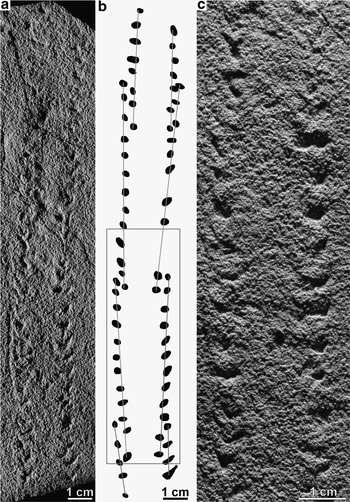
Two specimens of trackways (UWBM 98804, 98805) were recovered from the Upper Permian Buckley Formation of the Beardmore Glacier area, only one of which (UWBM 98804: Fig. 4) is well preserved. The trackways are epichnial, on the surface of a fine-grained pale yellow weathered sandstone with some argillaceous and organic content. There is no sign of ripples or other evidence of current action on the surface of the slabs. Both trackways are assigned to the ichnotaxon Diplichnites gouldi (Gevers in Gevers et al., Reference Gevers, Frakes, Edwards and Marzolf1971).
UWBM 98804, Buckley Formation, Mount Bowers, Diplichnites gouldi. a. Trackway. b. Distribution of tracks (epichnial) showing arrangement in overlapping series. c. Detail of tracks outlined in grey box in b.

Locality and horizon
The trackways were found at 84°59′54″S; 164°05′51″E on the slope of Mount Bowers on the west side of the Beardmore Glacier (UWBM locality B7214). In this area the Buckley Formation is ∼430 m thick (Barrett et al. Reference Barrett, Elliot and Lindsay1986). The trackways were recovered from the upper part of the formation, 95 m below the diabase sill that caps Mount Bowers. The succession beneath the capping sill consists of sandstone with clasts of coal, underlain by a Glossopteris-rich shale and coal sequence that has been intruded by a dolerite sill. These beds are underlain by a fine- to medium-grained sandstone unit about 20 m thick. The arthropod trackways were found in blocks of float from the lower sandstone unit 30 m below the sill in the coal and shale sequence.
Palaeoenvironment
The Buckley Formation records braided stream and alluvial plain (e.g. levees, crevasse splays, floodplain lakes, and mires) deposition (Isbell Reference Isbell1991, Collinson et al. Reference Collinson, Isbell, Elliot, Miller and Miller1994). The trackway-bearing sandstones are fine- to medium-grained, horizontally laminated with parting lineations on some bedding surfaces. Adjacent sandstones are cross-laminated with rare scours and pebble layers. The sandstone units thin and interfinger with mudrocks laterally. Bioturbation is absent from both bedding plane and vertical surfaces (BPBI = 1; Miller & Smail Reference Miller and Smail1997). Plant debris is common in the form of fragments of leaves, stems and logs. These features are consistent with crevasse splay deposits (Bridge Reference Bridge1984), with the abundant plant material suggesting that there were significant forests nearby. There is no direct evidence of subaerial exposure, although the parting lineation and horizontal lamination are consistent with extremely shallow sheet flow during overbank flooding.
Description
The better preserved of the two specimens of Diplichnites gouldi (Fig. 4) preserves a section of near straight trackway ∼21 cm long. The maximum external width of the trackway is 25 mm and the minimum internal width about 9 mm. The second trackway (more poorly preserved and not figured) is 21 mm wide. Four overlapping series of tracks can be identified, with a preserved maximum of 13 tracks (Fig. 4a & b). It is not known whether there is any track fallout due to undertracking. The maximum length of a series is 88 mm and overlap, equivalent to two or three tracks, is up to ∼25%.
There are no obvious push up mounds that might indicate the direction of progress (Fig. 4c). The tracks are oriented somewhat transverse to the trackway axis and are slightly concave in a consistent direction. They are less than 1 mm deep as preserved and there is no evidence of coincident footfalls. The tracks tend to shallow and taper toward the axis of the trackway. The concave pattern may be the result of the appendages swinging forward as they were removed from the substrate during walking. The tracks on either side of the trackway (Fig. 4c) are more or less aligned (i.e. ‘opposite’) implying an in phase gait. The stride length was at least 67 mm.
Interpretation
The trackway was produced by an arthropod with at least 13 pairs of walking appendages (the number observed in a series). The high ratio of stride length to the width of the trackway suggests a high ratio of forestroke to backstroke and a relatively high geared gait (see Wright et al. Reference Wright, Quinn, Briggs and Williams1995) indicating that the arthropod was walking easily (i.e. if the trace was made subaerially the arthropod was well adapted to this environment). The presence of at least thirteen apparently undifferentiated walking appendages eliminates all but a myriapod-like trace maker (the phyllopodous limbs of a branchiopod crustacean are unlikely to have produced such distinct tracks).
Remarks
The ichnogenus Diplichnites has a wide stratigraphic and geographic distribution and complicated taxonomy. Briggs et al. (Reference Briggs, Rolfe and Brannan1979) recommended that Diplichnites should be confined to the type of trackways generated by myriapods, even though the ichnogenus is widely used for trilobite trackways. The systematics of Diplichnites, and specifically Diplichnites gouldi, were discussed by Trewin & McNamara (Reference Trewin and McNamara1995), Buatois et al. (Reference Buatois, Mángano, Maples and Lanier1998) and Smith et al. (Reference Smith, Braddy, Marriott and Briggs2003). Terrestrial trackways from various stratigraphic levels have been assigned to this ichnogenus, from the Cambrian–Ordovician Potsdam Group of Ontario (MacNaughton et al. Reference MacNaughton, Cole, Dalrymple, Braddy, Briggs and Lukie2002), Middle Ordovician of Cumbria, England (Johnson et al. Reference Johnson, Briggs, Suthren, Wright and Tunnicliff1994), Upper Silurian of Newfoundland (Wright et al. Reference Wright, Quinn, Briggs and Williams1995) and Western Australia (Trewin & McNamara Reference Trewin and McNamara1995), and Lower Devonian of Antarctica (Gevers et al. Reference Gevers, Frakes, Edwards and Marzolf1971, Bradshaw Reference Bradshaw1981), northern India (Draganits et al. Reference Draganits, Braddy and Briggs2001) and Scotland (Walker Reference Walker1985, Trewin & Davidson Reference Trewin and Davidson1996). Large Carboniferous Diplichnites have been interpreted as made by giant arthropleurids (Briggs et al. Reference Briggs, Rolfe and Brannan1979, Pearson Reference Pearson1992).
The Fremouw Formation (Triassic)
Material
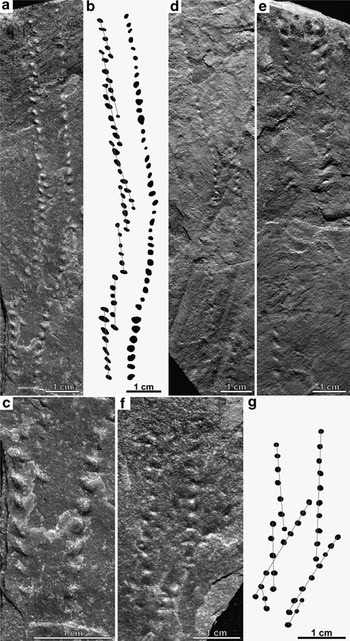
Nine specimens bearing trackways (UWBM 98806-98814) were recovered from the lower part of the Triassic Fremouw Formation. Some specimens include both part and counterpart (epichnial and hypichnial surfaces), and are preserved on thinly bedded grey-green mudstone. The trackways are assigned to Diplichnites gouldi (Gevers in Gevers et al. Reference Gevers, Frakes, Edwards and Marzolf1971). They are associated with Cochlichnus-like horizontal burrows (UWBM 98813).
Locality and horizon
Wyckoff Glacier (84°13′5″S; 165°06′59″E) (UWBM locality B7215). The trace fossils occur near the top of a 1.5 m thick siltstone unit that forms a pronounced re-entrant in medium to coarse grained cross-bedded sandstone 50 m below the top of the outcrop.
Palaeoenvironment
The lower part of the Fremouw Formation records braided stream channel deposition with abundant reactivation surfaces within cross-stratified facies (Collinson et al. Reference Collinson, Isbell, Elliot, Miller and Miller1994). Abundant trace fossils within the channel sandstones were produced by animals that colonized the sands during periods of low flow (Miller & Collinson Reference Miller and Collinson1994b). The Diplichnites-bearing siltstone records deposition in a small impoundment, either in the channel during extreme low water, or marginal to the channel. There is no evidence for or against subaerial exposure.
Description
The trackways are straight to gently curved. One of the most clearly preserved (Wyckoff 3: Fig. 3a–c) is ∼115 mm long, measured along the axis. The maximum width of the trackway is 10 mm. The tracks on one side of the trackway form clearly offset series with a maximum of eight tracks in each; it is difficult to distinguish the series on the other continuous side. The maximum length of a series is 22 mm and the overlap, equivalent to three to four tracks in places, is up to 45%. The tracks in the offset series are elongate oblique to the axis whereas those on the other side are near to circular. There is no median drag. Tracks tend to be widest abaxially and taper and shallow toward the axis (Fig. 5c). The stride length is about 15 mm. The tracks show no clear evidence of push-up mounds such as might indicate the direction of movement. A second example (Fig. 5g) shows two overlapping similar trackways, one at an acute angle to the other.
Fremouw Formation, Wyckoff Glacier, Diplichnites gouldi. a–c. UWBM 98806. a, b. Distribution of tracks (hypichnial) and diagram showing arrangement in overlapping series. c. Detail of track shapes. d, e. UWBM 98807. Two trackways on striated surface. f, g. UWBM 98808. Two overlapping trackways.

A greater range in trackway dimensions is illustrated by a heavily striated and reddened surface (Fig. 5d & e). The smaller trackway is ∼8.5 mm wide (Fig. 5d), the larger one 14 mm (Fig. 5e). In these examples the tracks form an acute angle with the axis of the trackway. It is difficult to estimate the number of tracks in a series, but the larger example shows at least eight.
Interpretation
The trackway was produced by an arthropod with at least eight walking appendages (the number observed in a series). The much lower ratio of stride length to width compared to the trackways in the Buckley Formation indicates a much lower geared gait. The tendency to asymmetry suggests the influence of a bottom current; the arthropod was probably walking subaqueously. The presence of eight pairs of walking limbs is a small number for a myriapodous arthropod. This, and the absence of a median drag, suggest a crustacean trace maker - some kind of freshwater shrimp.
Remarks
The trackways fall within the diagnosis of Diplichnites gouldi (Gevers in Gevers et al., Reference Gevers, Frakes, Edwards and Marzolf1971). The number of tracks in a series (eight) exceeds that (five) characteristic of Umfolozia sinuosa Savage, Reference Savage1971 (Anderson Reference Anderson1981). A specimen of a similar Diplichnites trackway, associated with vertical burrows, is known from the Triassic Lashley Formation of the Allan Hills (J.W. Collinson, personal communication 2009). Four forms of trace fossil, also attributed to arthropods, have been described from both the Buckley and Fremouw Formations in the Beardmore Glacier area (Miller & Collinson Reference Miller and Collinson1994b, Miller Reference Miller2000). They comprise vertical to oblique shafts, horizontal tunnels, bilobed horizontal traces often with transverse scratch marks, and series of chevrons. These trace fossils were formed within the sediment and all were interpreted as made by the same arthropod, possibly an insect. Although the size range of these other traces is similar to that of the trackways in the Fremouw Formation (they are smaller than the trackways in the Buckley Formation), these trackways show evidence of too many appendages to have been created by an insect; they may have been formed on the surface of the sediment by a myriapod-like arthropod.
Discussion
The specimens described herein represent virtually the entire collection of trackways and resting traces known from the Permo-Triassic of the Transantarctic Mountains. Given the large amount of bedding plane exposure that has been examined for evidence of bioturbation (Miller et al. Reference Miller, McDowell, Smail, Shyr and Kemp2002 and personal observations), and with the full advantage of the low angle Antarctic summer sun, it is surprising that more trackways have not been found considering the number of reports from fluvial and lacustrine facies worldwide (Buatois & Mángano Reference Buatois and Mángano2007). The Mackellar, Buckley, and Fremouw formations record deposition in a wide variety of fluvial and lacustrine settings, so the depauperate trackway ichnofauna cannot be attributed to absence of suitable depositional conditions. This raises the question as to whether or not epifaunal continental arthropods were poorly represented at the high polar latitudes occupied by Antarctica during the Permo-Triassic (Fig. 2).
Other Permian ichnofaunas are much more abundant and diverse than those described from the Beardmore Glacier area. The Robledo Mountains of southern New Mexico have yielded upward of 23 invertebrate ichnotaxa (Hunt et al. Reference Hunt, Lockley, Lucas, MacDonald, Hotton and Kramer1993, Braddy Reference Braddy1995, Reference Braddy1998, Braddy & Briggs Reference Braddy and Briggs2002) in a red bed transitional sequence, including tidal flat deposits and possible freshwater conditions. Braddy (Reference Braddy1998) recorded 452 specimens, the majority of them arthropod trackways. Specimens are rarer in the Lower Permian of the Provencal basins in southern France (Demathieu et al. Reference Demathieu, Gand and Toutin-Morin1992) but 17 invertebrate ichnogenera are known. The Rotliegend Supergroup yields over 30 invertebrate ichnogenera in Germany (Walter Reference Walter1983) and at least 18 further east in Poland and the Czech Republic (Holub & Kozur Reference Holub and Kozur1981). The Robledo Mountains and European localities lay in tropical latitudes during the Permian: the Robledo Mountains lay south of the equator and France and Germany lay north of the equator. There is less information on similar Triassic environments, but a comparable diversity of ichnotaxa is recorded from the Early–Mid Triassic of England and southern Germany (Pollard Reference Pollard1981) and the Upper Triassic of East Greenland (Bromley & Asgaard Reference Bromley and Asgaard1979) and it is clear that trace fossils are not rare in these areas which also lay in tropical latitudes. The lower diversity and abundance of invertebrate trace fossils in the Transantarctic Mountains is more similar to that in the Permian Dwyka and Ecca groups of the Karoo in South Africa (Savage Reference Savage1971, Anderson Reference Anderson1981, Braddy & Briggs Reference Braddy and Briggs2002) which were deposited at similarly high latitudes (Fig. 2).
A trend of reduced diversity with latitude has long been recognized, although the causes of this pattern are complex (e.g. Stehli et al. Reference Stehli, Douglas and Newell1969). The use of trace fossils even as a crude proxy for organism diversity is problematic, given the vagaries of preservation. Determining the factors controlling the distribution of trace fossils in fluvial and lacustrine settings is challenging, in part because both the environments (e.g. lake margins, floodplain ponds) and the arthropod tracemakers are ephemeral (Minter et al. Reference Minter, Krainer, Lucas, Braddy and Hunt2007). The unique conditions at high latitudes (e.g. highly seasonal light and productivity regime, perhaps large seasonal fluctuations in moisture availability and/or winter freeze up of the lakes and streams) added to the complexity of both the environmental and preservational regimes. However, it is probable that the polar position of the Transantarctic Mountains during the Permo-Triassic was a contributory factor to the low diversity and abundance of trackways produced and preserved.
Acknowledgements
We are grateful for support from NSF ANT-0440889 (DEGB), NSF ANT 0440954 and OPP 0126146 (MFM), NSF ANT 0440919 and OPP 0126086 (JLI), and NSF ANT-0551163 (CAS). Simon Braddy commented on the manuscript and Lorna O’Brien provided important information on resting traces. Loren Babcock, Margaret Bradshaw and David Cantrill reviewed the original submission and made helpful suggestions for improvement. Erica Champion prepared the figures and helped with editing.