INTRODUCTION
This study examines the internal and external factors that constrain the realization of rhotics in the variety of Portuguese spoken in São Tomé and Príncipe. São Tomé and Príncipe, the second smallest African country (after the Seychelles), is a former Portuguese colony and has had Portuguese as its only official language since its independence in 1975. Beginning in the twentieth century, a process of nativization of Portuguese, related to the loss of proficiency in the three native creole languages of the islands (Forro, Angolar, and Lung'Ie) and to language shift from these creoles to Portuguese, has been under way in the country. This process of language shift resulted in irregular transmission of Portuguese (Lucchesi & Baxter, Reference Lucchesi, Baxter, Lucchesi, Baxter and Ribeiro2009) and gave rise to a variety that differs from its original standard, European Portuguese (Gonçalves, Reference Gonçalves2012). In São Tomé and Príncipe, some registers are highly influenced by the creoles (Afonso, Reference Afonso2008; Lorenzino, Reference Lorenzino, Duarte and Leiria (Org.)1996), and others are closer to the European standard. This variation between speakers is believed to depend on social factors such as schooling, social class, and place of residence (urban/rural) (Hagemeijer, Reference Hagemeijer2009). The variation in Santomean Portuguese is certainly a reflection of the recent past where most of the inhabitants of the islands who spoke Portuguese used it as a second language. The younger generations (people under 50 years old) now speak Portuguese as a first language and Forro as a second language, if they know it at all, unlike the older generations (people over 50 years old) who speak Forro as a first language and Portuguese as a second language or are bilingual.Footnote 1 It is this transition of Portuguese from a second to a first language, as well as the everyday contact with Forro, that is resulting in the emergence of a Santomean variety of Portuguese.
According to observations during fieldwork, one of the most salient variables that distinguishes Santomean Portuguese from other varieties of Portuguese is the use of rhotics. In fact, some Santomeans pronounce a strong-R [r, ʀ, x, ɣ, χ, ʁ, h, ɦ] in phonetic environments that require a weak-r [ɻ, ɾ, Ø] in other varieties of Portuguese. The study of rhotics in Santomean Portuguese is of particular interest because their distinctive use appears to be a recent phenomenon that is arising in the speech of youth. Studying Santomean Portuguese is an opportunity to investigate an emerging variety of Portuguese in Africa, as São Tomé and Príncipe is at present, or will soon be, the only African country where most of the population speak Portuguese as a first language. The objectives of this paper are to increase interest in the sociolinguistic study of African varieties of Portuguese, to make a contribution to the study of rhotics in Portuguese, and to better understand the possible outcomes of language contact.
RHOTICITY IN THE PORTUGUESE-SPEAKING WORLD
In the Portuguese-speaking world, rhotics can be pronounced as a trill [r], a tap [ɾ], a retroflex approximant [ɻ], an uvular trill [ʀ], a fricative [x, ɣ, χ, ʁ, h, ɦ], and can also be deleted. The r-sounds that contrast intervocalically in Portuguese are, on the one hand, the weak-r [ɻ, ɾ, Ø], and, on the other hand, the strong-R [r, ʀ, x, ɣ, χ, ʁ, h, ɦ] (Rennicke, Reference Rennicke2015).
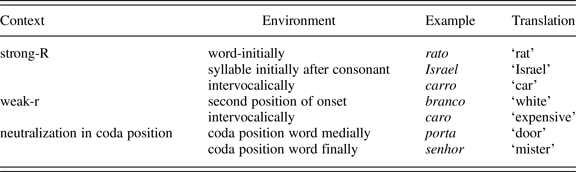
In European and Brazilian Portuguese, the distribution of rhotics is determined by syllable structure (Bonet & Mascaró, Reference Bonet, Mascaró, Martínez-Gil and Morales-Front1997). There are two environments where strong-R is required (Table 1): word initially and, inside the word, syllable initially if the preceding syllable ends with a coda consonant. Weak-r is required when the rhotic is the second element in an onset consonant cluster. In coda position, rhotics are realized as either strong-R or weak-r, depending on various social factors. Similar to other Iberian Romance languages, European and Brazilian Portuguese have a phonemic contrast of rhotics intervocalically; the choice of the r-sound will depend on the word.
Distribution of rhotics in Brazilian and European Portuguese

Bonet and Mascaró (Reference Bonet, Mascaró, Martínez-Gil and Morales-Front1997:122) argued that the choice of rhotic in Iberian Romance languages is assigned based on the sonority principle and the dispersion principle, and that the exceptional rhotic is the flap: “the feature that distinguishes flaps and trills receives one value or the other depending on which one best satisfies Clement's [Reference Clements, Kingston and Beckman1990] principle of the Sonority Cycle.” Mateus and D'Andrade (Reference Mateus and D'Andrade2000:16) disagreed with them and proposed that the tap is the single underlying rhotic in Portuguese, and that the strong-R is an exceptional rhotic. In their view, the phonetic realization of the strong-R depends on the application of specific rules; for instance, the underlying rhotic ([ɾ]) triggers specific rules word-initially as well as syllable-initially after a consonant.
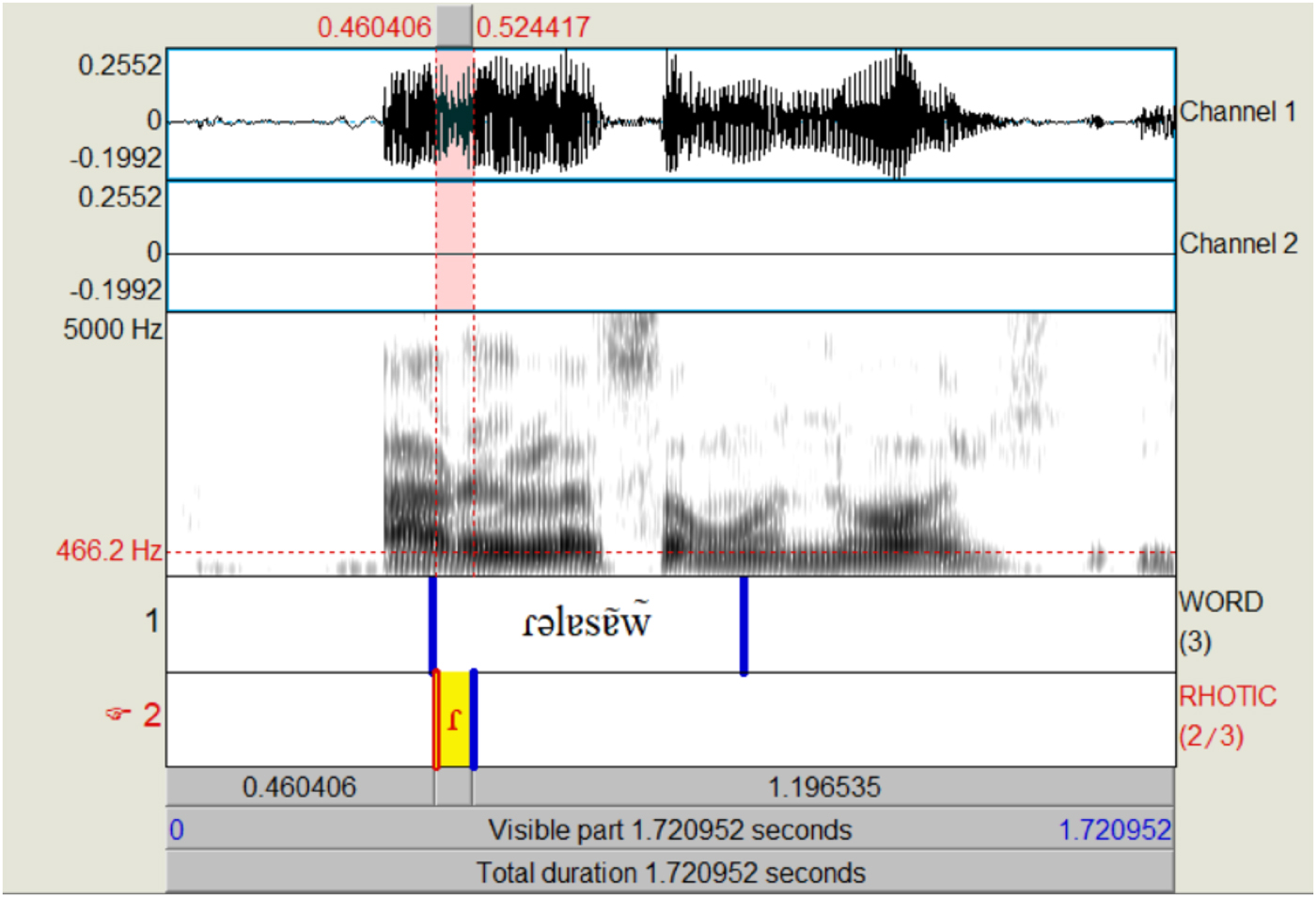
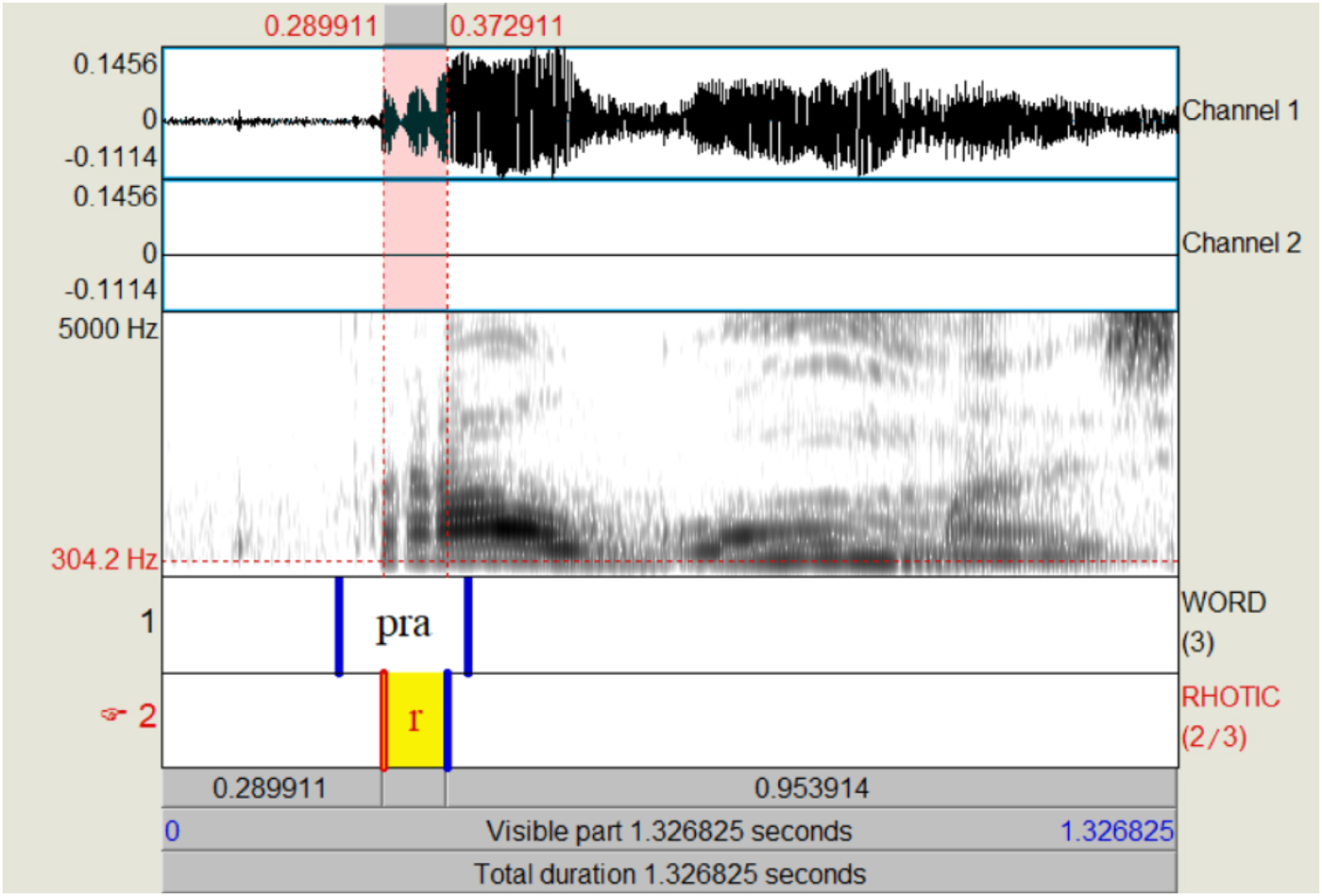
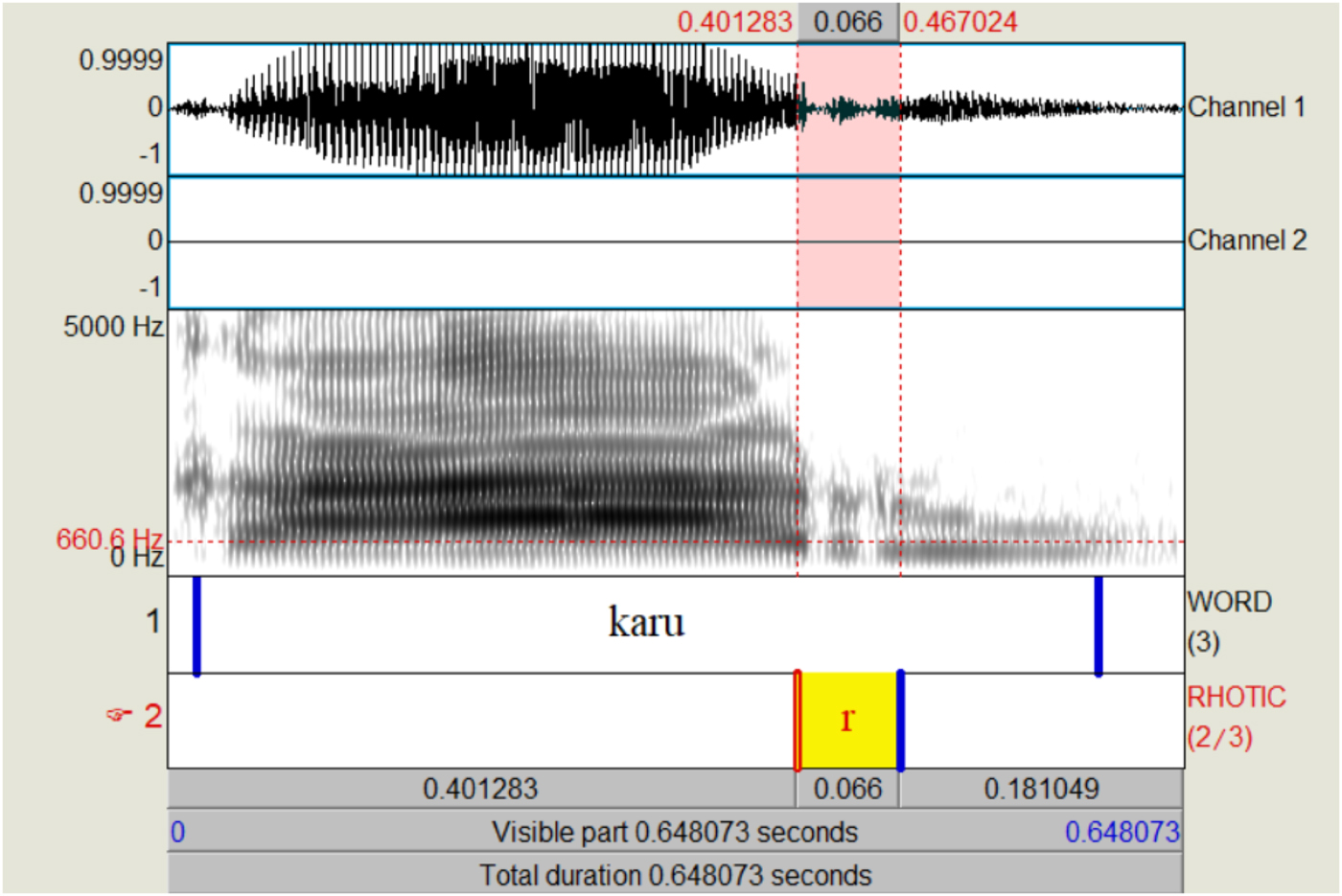
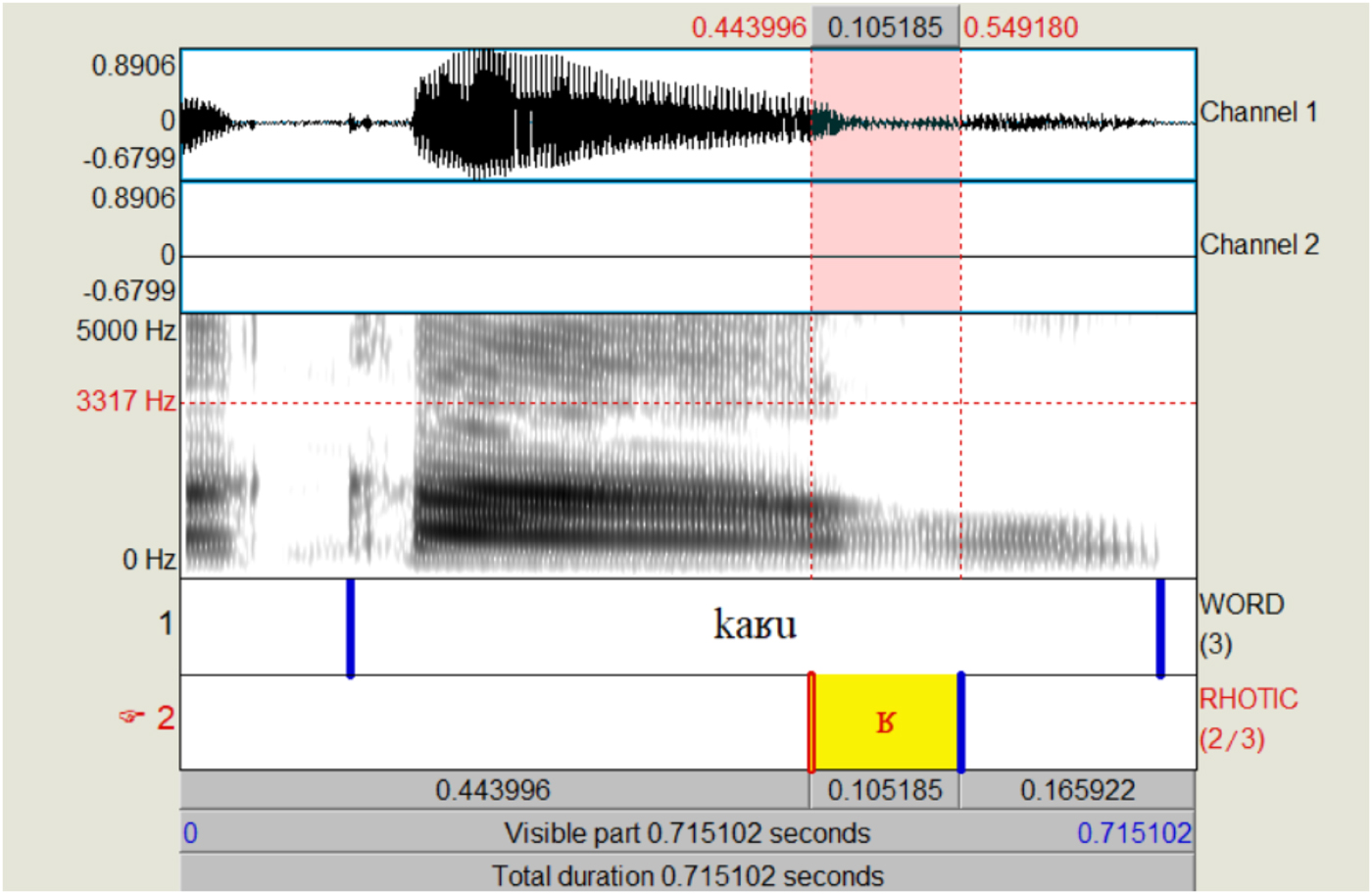
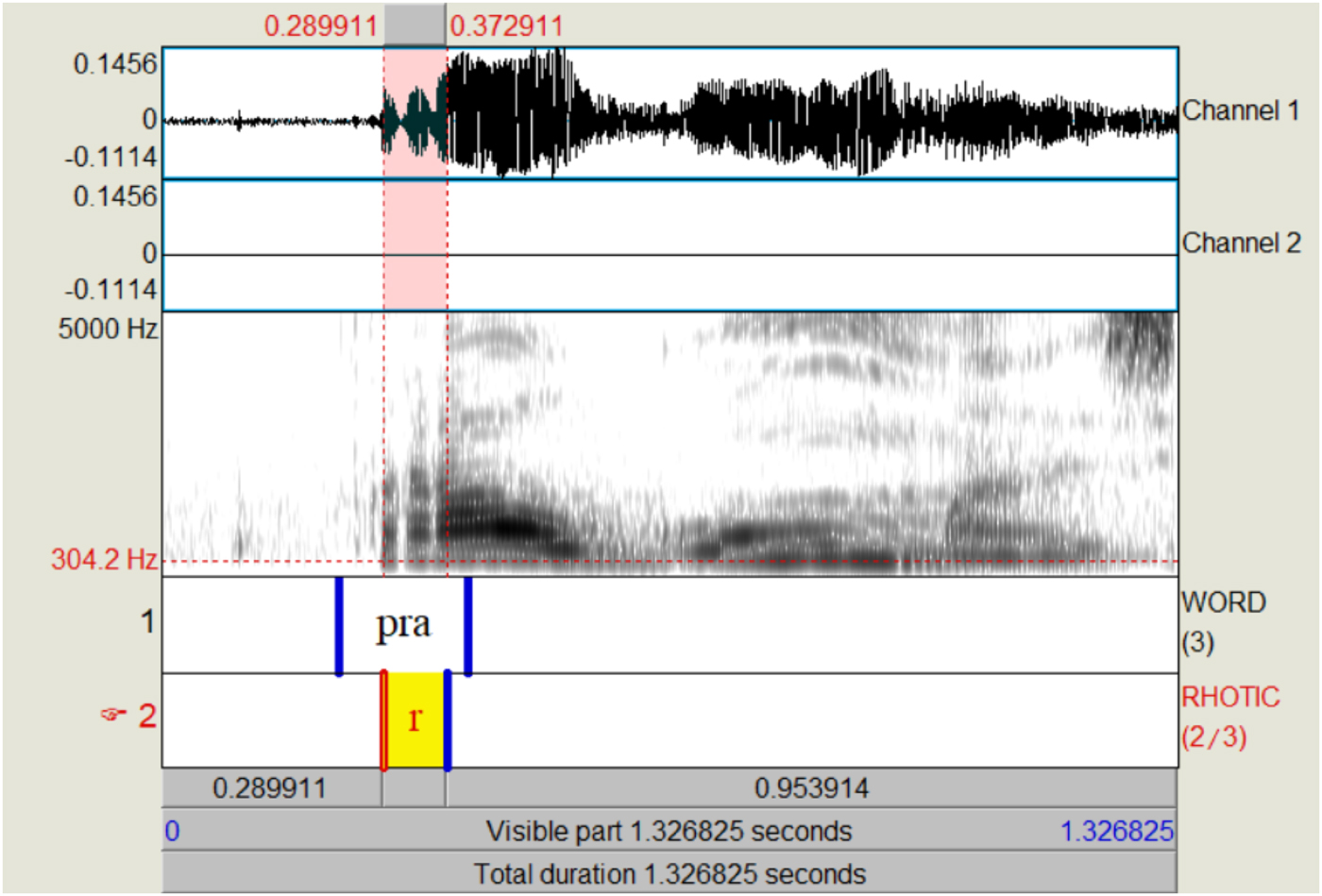
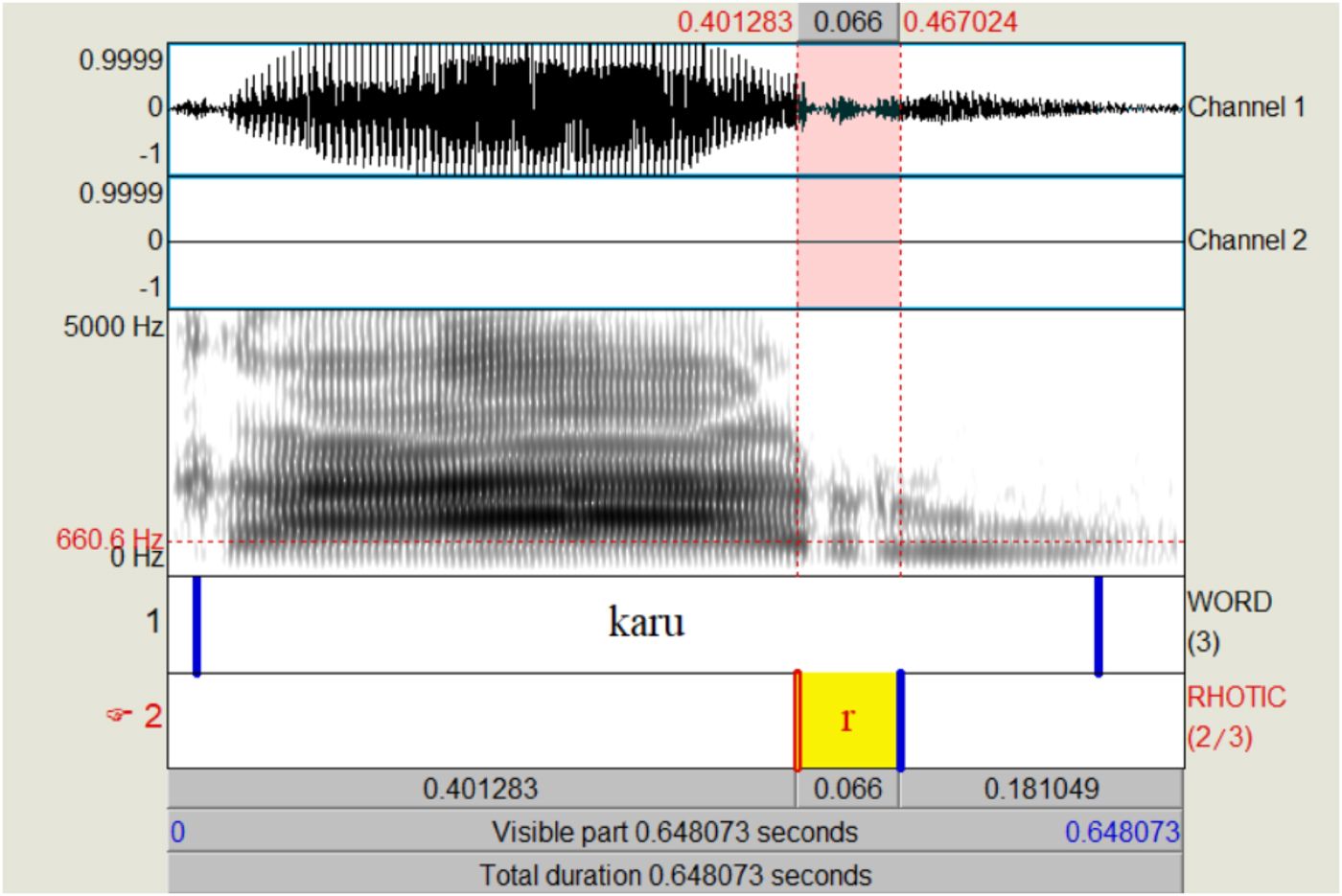
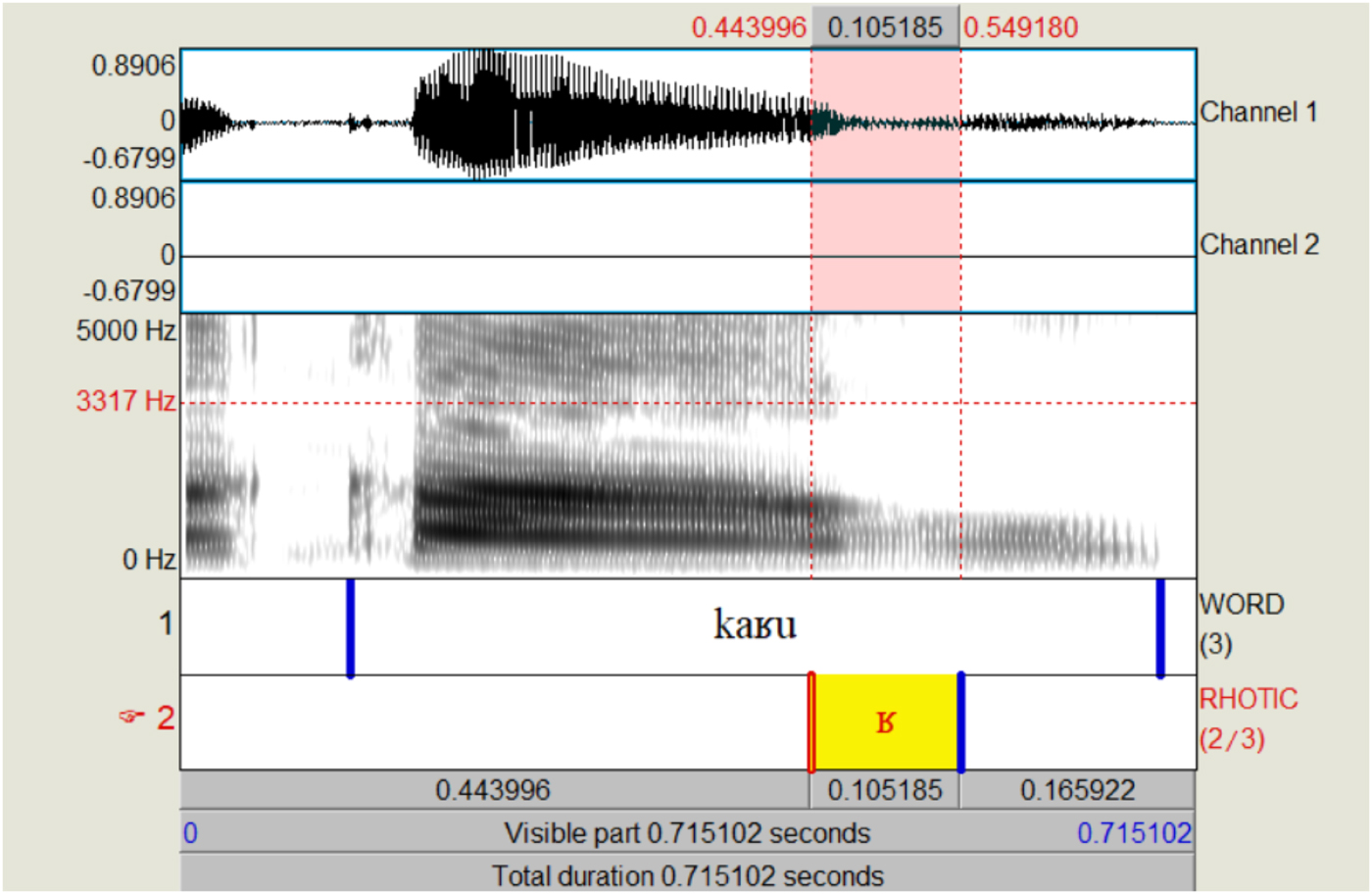
That being said, Santomeans use rhotics differently from Brazilians and Europeans; for them, strong-R can appear in weak-r positions, and weak-r can appear in strong-R positions. This distinctive use of rhotics appears in non-contrastive environments, challenging patterns taken for granted in other varieties of Portuguese. For instance, Mateus and D'Andrade (Reference Mateus and D'Andrade2000:11) wrote about European Portuguese that the tap “is simply not allowed word-initially, in any dialect.” Bonet and Mascaró (Reference Bonet, Mascaró, Martínez-Gil and Morales-Front1997:108) also wrote that, in Iberian Romance languages, “[t]he trill (never the flap) occurs in syllable initial position, when it is the only element of an onset. On the other hand, the flap (never the trill) occurs in second position of an onset.” But in Santomean Portuguese, a flap can occur word-initially, as in the word relação ‘relation’ (Figure 1), and a trill can occur in second position of an onset, as in the word pra ‘for/to’ (Figure 2). Santomeans also show their distinctive use of rhotics in place of phonemic contrast. For instance, although a tap is expected in caro ‘expensive’ (otherwise, it becomes carro ‘car’), Santomeans can pronounce this word with an alveolar trill (Figure 3) or with a uvular fricative (Figure 4). Within the context of the interviews in which these words were recorded, it is clear that the meaning is “expensive,” and not “car.” The current work seeks to understand how the use of rhotics varies according to internal and external factors in order to shed light on the mechanisms of language variation and language change.
Tap in word-initial position in the word relação ‘relation’ in Santomean Portuguese (Zeca, 73 years old).

Alveolar trill /r/ in consonant cluster in the word pra ‘for’ in Santomean Portuguese (Natália, 33 years old).
Alveolar trill /r/ in intervocalic position in the word caro ‘expensive’ in Santomean Portuguese (Clara, 60 years old).
Uvular fricative /ʁ/ in intervocalic position in the word caro ‘expensive’ in Santomean Portuguese (Priscila, 18 years old).
METHODS
Field site
São Tomé and Príncipe was a Portuguese colony for 500 years (1470s-1975), one of the longest periods of European colonial domination. During this rule, the Portuguese colonized the islands twice. The first colonization, related to sugar production, created the actual creole society with its native ethnic groups (Forros and Angolares on São Tomé Island, and Principenses on Príncipe Island). The second colonization, associated with coffee and cacao production, entailed continuity and structural changes that were significant for local developments (Hagemeijer, Reference Hagemeijer2009). Inequalities and frustrations dating from these colonization phases brought Santomeans to gain their independence in 1975 (Seibert, Reference Seibert2006). From the sixteenth century to the beginning of the twentieth century, Forro, Angolar, and Lung'Ie (three native creoles) were the most widely spoken languages on the islands (Hagemeijer, Reference Hagemeijer, Álvarez López, Gonçalves and Avela2018). However, the massive arrivals of contract laborers starting at the end of the nineteenth century and the use of Portuguese as a lingua franca completely changed the sociolinguistic setting. As a consequence, a process of linguistic shift (from creoles to Portuguese) started to take place. This shift was intensified from the 1960s onwards through the rise of the nationalist movement, the independence of the country (in 1975), and the generalized access to education. The majority of Portuguese left the islands abruptly as soon as São Tomé and Príncipe became independent, and just as Portuguese settlers abandoned the rest of the collapsing Portuguese colonies in Africa in 1974–1975. Since then, children have been growing up with the local variety of Portuguese as their first (and often only) language. Today, Portuguese is the only official language of the country, and it is spoken by 98.4% of the population.Footnote 2 Among the national languages, Forro is the most widely spoken creole in the country, with 36.2% of the population reporting speaking it. Also, 6.6% of the population reported speaking Angolar, 1.0% reported speaking Lung'Ie, and 8.5% reported speaking Cape Verdean Creole (INE, 2012).
This study is based on 15 months (between June 2015 and March 2017) of ethnographic fieldwork and sociolinguistic interviews on São Tomé Island. Observations made through participant observation were integral to this study in order to understand group dynamics as well as community and local practices that are important to participants. The data collected is primarily natural speech and indicative of the speech that participants use in everyday interactions (Labov, Reference Labov1972:43). Interviews were carried out employing techniques from both sociolinguistic interviews (Labov, Reference Labov, Baugh and Sherzer1984) and ethnographic interviews (Spradley, Reference Spradley1979). Interviews with adults lasted between 33 and 82 minutes, and interviews with teenagers lasted between 24 and 30 minutes (with the exception of one interview that lasted an hour).
Sample
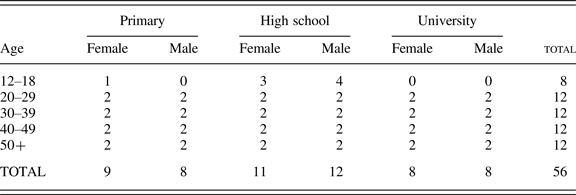
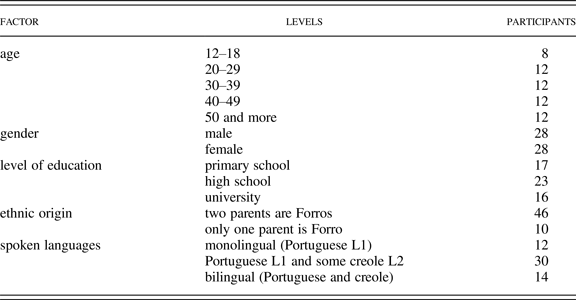
This study is based on roughly 46 hours of tape-recorded sociolinguistic interviews from 48 adults and 8 teenagers, of which half are women and half are men. Participants are aged between 12 and 73 years old and were born and raised in the capital of São Tomé and its surroundings. Three social categorizations were used to select participants: age, gender, and level of education. The adult sample (people over 20 years old in this case) are evenly distributed for gender, age, and education level. What makes the entire sample unevenly distributed are the teenagers, as they are less numerous, with seven out of the eight in high school (none of them had started at university) (Table 2).
Sample of Santomeans for data, by age, education level, and gender

Coding
The initial dataset consists of 6720 tokens of rhotics (including all syllable positions), or 120 rhotics from each of the 56 participants. Tokens were extracted from about the middle of the interview in order to reduce the “observer's paradox” (Labov, Reference Labov1972:209). The same word was not included more than five times per speaker in order to have a greater variety of words but also to consider word-internal variation (cf., Becker, Reference Becker2014:152). The expression quer dizer ‘I mean’ was not included in the tokens, as Mateus and Rodrigues (Reference Mateus, Rodrigues, Freitas and Mendes (org.)2004) noted that the high percentage of non-realization of rhotics before an obstruent in their data from Braga (Portugal) was partly due to the high frequency of this expression. In 109 occurrences out of 140, the final r-sound was not pronounced in this expression. Also excluded were sequences where the rhotic was preceded or followed by another rhotic in a different word, such as sair rápido (sa[ír]ápido) ‘to get out fast,’ as two contiguous rhotics in a sequence of two words become one (Mateus & D'Andrade, Reference Mateus and D'Andrade2000).
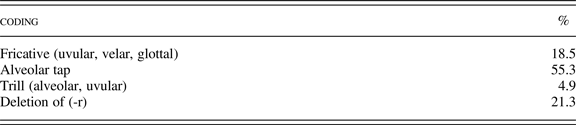
All tokens were analyzed using Praat (Boersma & Weenik, Reference Boersma and Weenink2017). In the few cases where the spectrographic evidence was indeterminate, auditory judgments were used. Tokens were first coded as a fricative (uvular, velar, and glottal), a trill (alveolar and uvular), a tap, or a deleted-r. Their general distribution in percentage of use is presented in Table 3.
General distribution of rhotics in sample of Santomean Portuguese (n = 6720)

The deleted-r represents an important portion of the sample (21%). This is mainly due to the high rate of deletion of the morpheme (-r) in word-final position (at 79% in the present dataset), and the preference in Santomean Portuguese for the CV syllable (Afonso, Reference Afonso2009) that probably favors the deletion of the final (-r). As this might skew the data, the deleted-r tokens (in all positions) are removed from the dataset in order to get a clearer picture of the factors that constrain the use of rhotics, and, most specifically, of strong-R. The deletion of (-r) is likely the final stage of a weakening process of the rhotic in word-final position (Callou, Morães, & Leite, Reference Callou, Morães and Leite1998). The new dataset (without deleted-r) consists of 5287 tokens, coded as strong-R (fricatives and trills) or weak-r (taps).
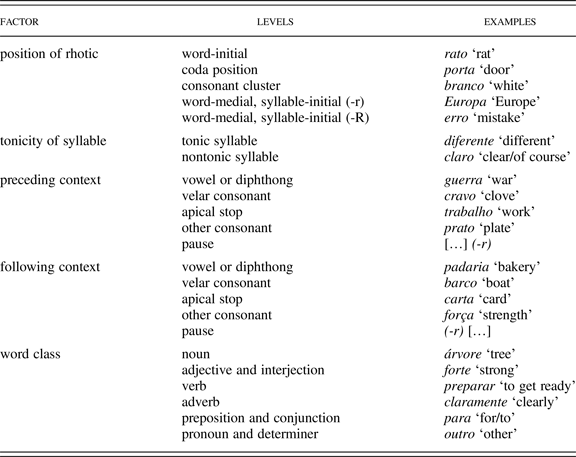
Table 4 presents an overview of the internal factors and levels for analysis. Certain positions of rhotics in the word might favor the production of the strong-R instead of the weak-r (Callou, Morães, & Leite, Reference Callou, Morães and Leite1996). position of rhotic is divided into five levels.Footnote 3 tonicity is included to determine whether tonic syllables favor the use of strong-R. Syllables were first coded as pre-tonic, tonic, or post-tonic. Because pre-tonic and post-tonic syllables behaved similarly, they were grouped together. For preceding context and following context of the rhotic, velar consonants and apical stops are set apart from the other consonants in order to investigate possible coarticulation effects; there could be assimilation or dissimilation between the velar consonants and the pronunciation of rhotics as uvular fricatives and between the apical stops and the taps. word class is included to investigate any difference between lexical items of different classes, more specifically between function (pronoun, determiner, preposition, conjunction) and content words (noun, adjective, verb, adverb).
Internal factors and levels

Table 5 presents the external factors investigated, including age, gender, level of education, ethnic origin, and spoken languages. Regarding age, note that São Tomé and Príncipe has a youthful age structure, with 60% of the population under the age of 25, and just 6.5% over 55 (CIA, 2017). Investigating age will allow for investigation of change in progress (Labov, Reference Labov1963, Reference Labov1966), applying the apparent-time construct (Bailey, Reference Bailey, Trudgill, Chambers and Schilling-Estes2004; Bailey et al., Reference Bailey, Wikle, Tillery and Sand1991). As for gender, sociolinguistic studies have shown that linguistic variation often correlates with the gender (or sex) of speakers. I choose the word gender to refer to the social and cultural elaboration of sex difference, as sex has become more politicized and problematized in the past few decades (Cheshire, Reference Cheshire, Trudgill, Chambers and Schilling-Estes2004). Gender separation is manifested in a number of domains of social life in São Tomé, including the division of labor regarding housekeeping, parenting, tasks, and jobs, among others. As in many other countries, level of education is a good indicator of socioeconomic status in São Tomé. All participants attended school, and some of them were still in school at the time of the interviews (12–18 years old). The school grade that was attributed to them is the grade that was completed. Labelling by ethnic origin is problematic (cf., Fought, Reference Fought, Trudgill, Chambers and Schilling-Estes2004), especially among a mixed-race and mixed-ethnic population such as São Tomé and Príncipe. The original intention was to focus this research on Forros (with two Forro parents) only. However, this did not work out as planned, as some of my “Forro” participants appeared to have one non-Forro parent (usually Angolar or Cape Verdean). Therefore, participants are divided into two (unbalanced) groups: 46 participants have two Forro parents (representing 82% of the sample), and 10 have only one Forro parent (representing 18% of the sample). spoken languages is included, as the possible influence of creole on Portuguese is relevant. Speakers are divided according to whether they were monolingual in Portuguese L1 (with no knowledge of creole), speakers of Portuguese L1 with “some” knowledge of creole, or bilingual (Portuguese and creole). Note that Forro is the creole that is the most widely spoken in the capital and its surroundings, where this research was conducted.
External factors and levels

The following sections present the data analysis, first for the use of the strong-R (i.e., fricatives and trills together versus weak-r [taps]), and second for the emergence of the rhotic fricatives within the strong-R category (i.e., fricatives versus trills). Note that each analysis for the use of the strong-R comprises a different envelope of variation, with different variants.
RESULTS
The use of the strong-R in Santomean Portuguese
position of rhotic is not orthogonal to the other linguistic factors–in fact, not all levels of position of rhotic can co-occur with the other linguistic factors. Therefore, position of rhotic is not included in the same regression analysis with the other linguistic factors.
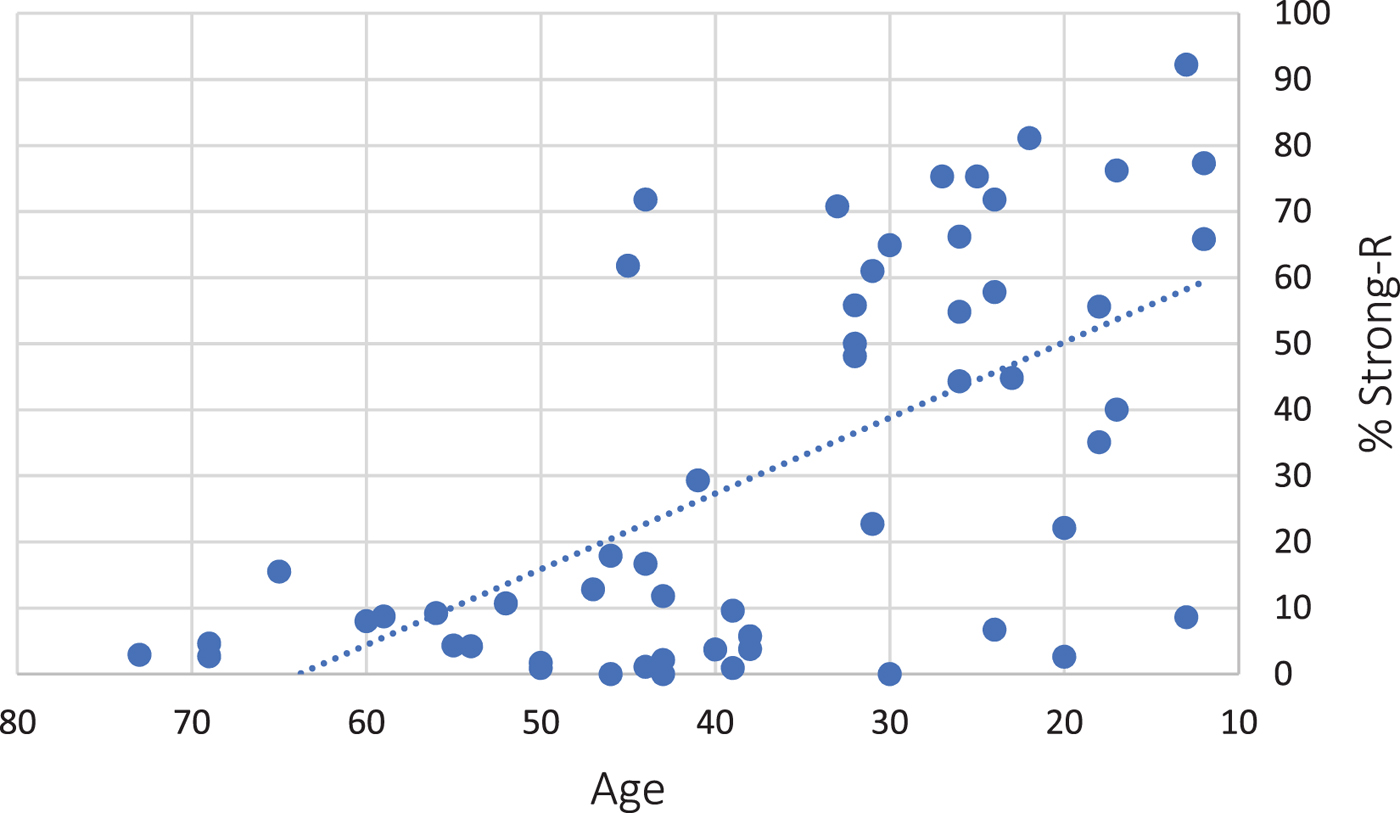
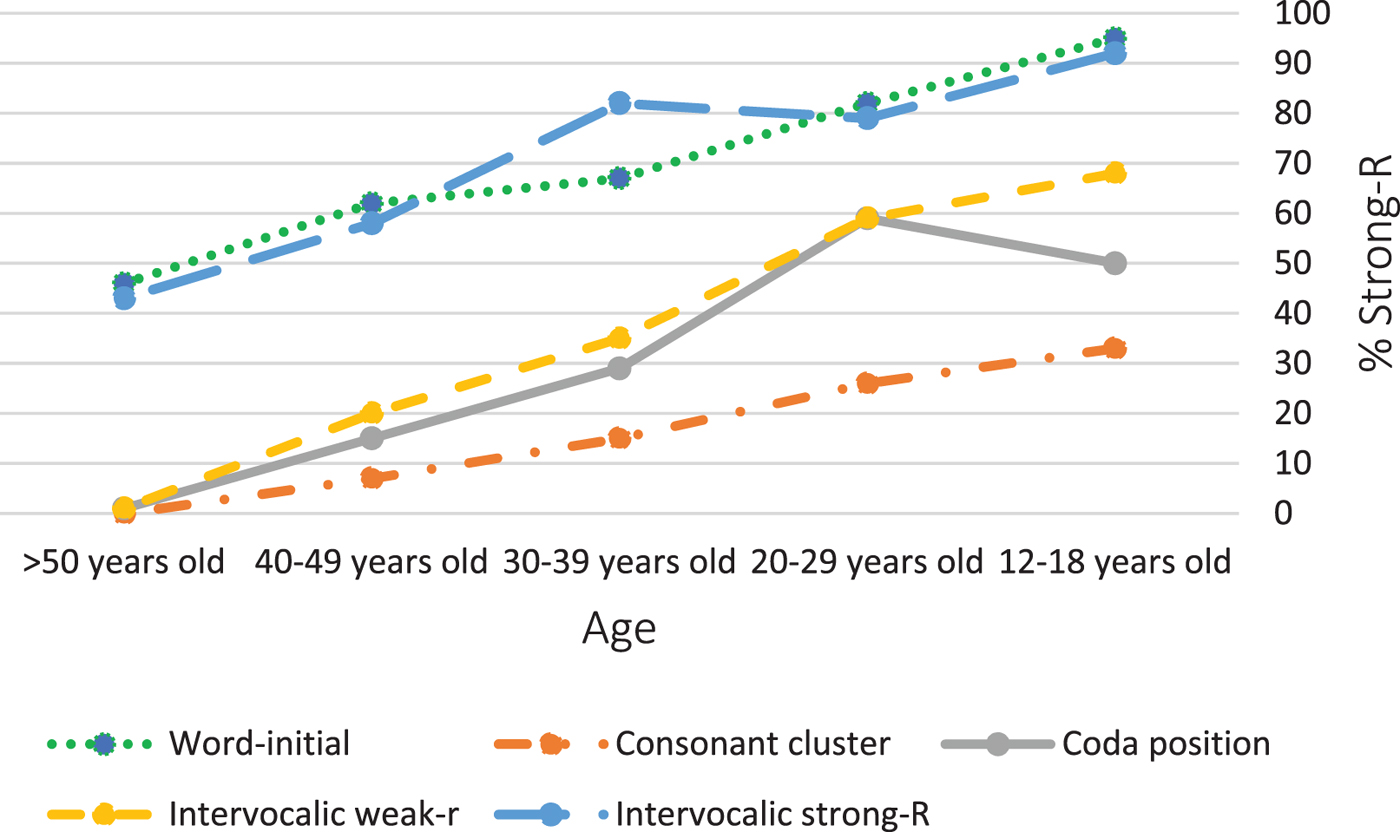
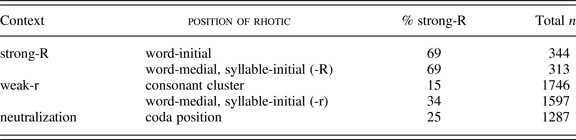
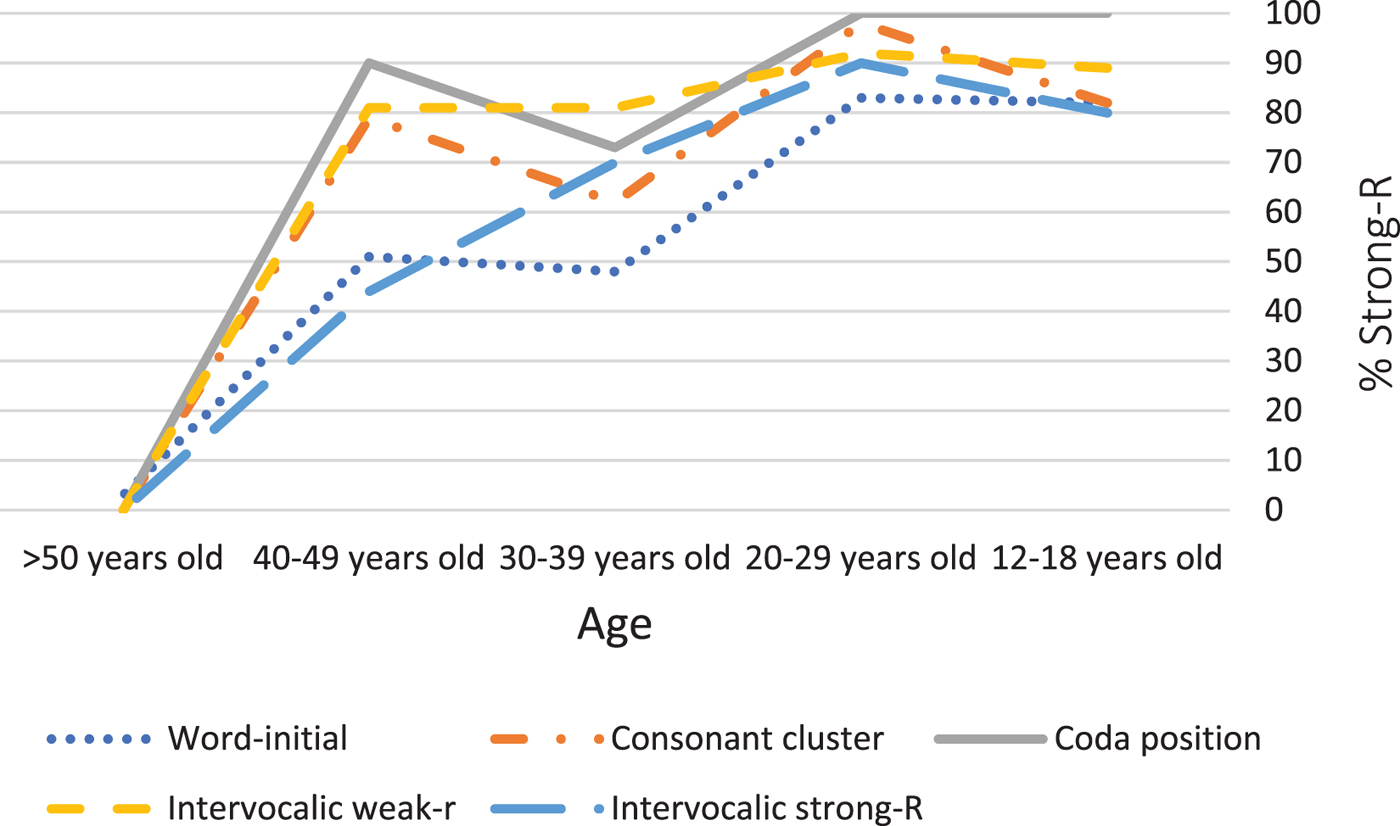
Results in Table 6 show that Santomean Portuguese mainly follows the Portuguese and Brazilian standard in that strong-R is more frequent word-initially (69%) and intervocalically in words that require a strong-R (69%), and less frequent in consonant clusters (15%) and intervocalically in words that require a weak-r (34%). In positions that show variability in other varieties of Portuguese, that is, coda position, Santomeans use a strong-R 25% of the time. Thus, although strong-R is not the most frequently used rhotic in positions that require a weak-r in other varieties, the strong-R remains a possibility for Santomeans. In these positions, in other varieties of Portuguese, the number of strong-R tokens would be close to zero. Conversely, weak-r is found in intervocalic position where a strong-R is expected in 31% of the tokens. In other varieties of Portuguese, the number of weak-r tokens in this position would again be essentially zero. This might indicate that these speakers lack a robust phonemic distinction between strong-R and weak-r, that is, these two rhotic categories are overlapping or partially merged in this variety. Or following Mateus and D'Andrade (Reference Mateus and D'Andrade2000), it might suggest that the underlying rhotic ([ɾ]) can trigger the use of the strong-R in different contexts in Santomean Portuguese than it does in European and Brazilian Portuguese. A logistic mixed-effects regression model with speaker and word as random effects was fit to the data using R package lme4 (version 1.1–12; Bates, Maechler, Bolker, & Walker, Reference Bates, Mächler, Bolker and Walker2015; R Core Team, 2014), investigating position of rhotic and external predictors, run as binary variables. After backward model selection, the final best-fit model showed significant effects for position of rhotic and age (gender, education level, ethnic origin, and spoken languages are non-significant).Footnote 4 Results clearly show a change in progress in the use of the strong-R (Figure 5). Figure 6 shows that in all levels of position of rhotic, the younger generations use the strong-R distinctively from the older generations. In positions that do not require a strong-R (consonant cluster, intervocalic weak-r, and coda position), the older generation never uses a strong-R.
Rate of strong-R according to age (gradient variable).

Rate of strong-R according to age (discrete variable) and position of rhotic.

Rate of strong-R according to position of rhotic (n = 5287; strong-R = 29.7%)

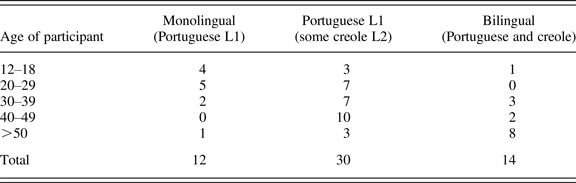
Note that there is some collinearity between age and spoken languages, which means that these two predictors explain some of the same variance in the use of strong-R. Generally speaking, there are more older Santomeans who are bilingual and more younger Santomeans who are monolingual in Portuguese (Table 7). But still, many Santomeans of all ages have some knowledge of creole, some younger Santomeans are bilingual, and some older Santomeans are monolingual in Portuguese. The modeling indicated that the factor age was more significant in the model-fitting process; the model was first tested with age and spoken languages together (with a significance of <0.001 for age and <0.05 for spoken languages), then only with age (<0.001), and only with spoken languages (<0.05). The stronger significance of age in all cases justifies the discussion of this factor as more important than spoken languages.
Crosstabulation between age and spoken languages (number of participants)

In the following analyses, position of rhotic is not included as a predictor but is rather used as a variable that defines different contexts of variation: contexts that require a strong-R in European and Brazilian Portuguese, contexts that require a weak-r in European and Brazilian Portuguese, and the context where rhotics may vary (see Table 6). This division of the dataset in three subsets will map the change in progress more clearly. Note that European and Brazilian Portuguese are not assumed to represent the norm for Santomean Portuguese, but they rather serve as a point of comparison.
The use of the strong-R in contexts that require a strong-R
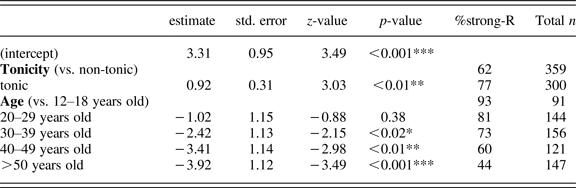
Results from follow-up logistic mixed-effects regression analyses, including only the tokens with a rhotic word-initially and intervocalically (strong-R contexts) (n = 659) show that tonicity and age are the only significant fixed-effect factors. (speaker and word are significant as random factors [p < 0.001]). Table 8 presents the best-fit model. As for tonicity, the strong-R is more frequently used in tonic syllables (77%) than in non-tonic syllables (62%). Because the stressed syllable is the most salient one in a word, it might favor the use of a strong-R. Among the external factors, age ends up as the only significant factor. Again, based on the apparent-time construct, results show language change in progress in the use of the strong-R, with the younger speakers using it the most (93%), and the older speakers using it the least (44%). This last result is of particular interest as it also indicates that older Santomeans use the tap (56%) in positions that require a strong-R in other varieties of Portuguese. Brandão (Reference Brandão2016) argued that frequency of use of creole (which in the current study correlates with age and spoken languages, as it is the older speakers that speak creole more frequently) was the most relevant social factor in the use of tap in strong-R position. The use of the weak-r in positions that require a strong-R could in part explain the low rate of strong-R among older Santomeans.
Results of the mixed-effects logistic regression for the use of strong-R in positions that require a strong-R in Brazilian and European Portuguese (n = 659; strong-R = 69%)

The use of the strong-R in contexts that require a weak-r
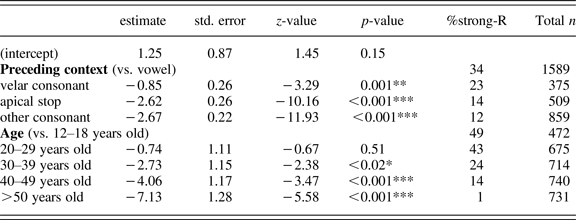
The following analysis only includes the tokens with a rhotic in a consonant cluster and intervocalically (weak-r contexts) (n = 3332). preceding context and age are significant fixed-effect factors (Table 9). (speaker and word are significant as random factors [p < 0.001].) Note that pause was removed from the regression analysis because word-initial position (i.e., following a pause) never requires a weak-r.
Results of the mixed-effects logistic regression for the use of strong-R in positions that require a weak-r in Brazilian and European Portuguese (n = 3332; strong-R = 24%)

Results regarding preceding context indicate a significant difference in the use of strong-R in weak-r positions after a vowel versus after a consonant: strong-R is more frequently used following a vowel (34%) than following a consonant (15%). This result is not surprising, as the strong-R is the least frequent in consonant clusters (15%), as shown previously in Table 6. Regarding age, young Santomeans use the strong-R in weak-r positions quite frequently (49%), while Santomeans over 50 years rarely do so (1%).
The use of the strong-R in contexts that show variability
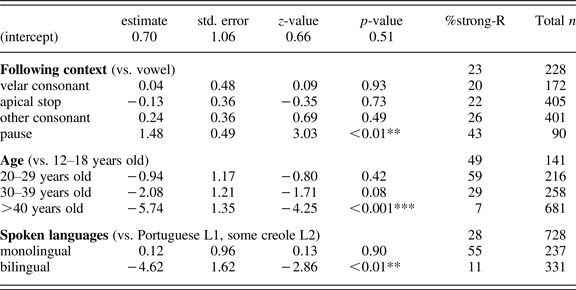
In the following analysis, the two older age groups are put together; when kept apart, results did not correspond to what was expected based on percentages, maybe because the older generation (>50 years old) has no instances of strong-R used in this context. The best-fit model shows significance in following context, age, and spoken languages (Table 10).
Results of the mixed-effects logistic regression for the use of strong-R in positions that show variability in Brazilian and European Portuguese (n = 1296; strong-R = 24.5%)

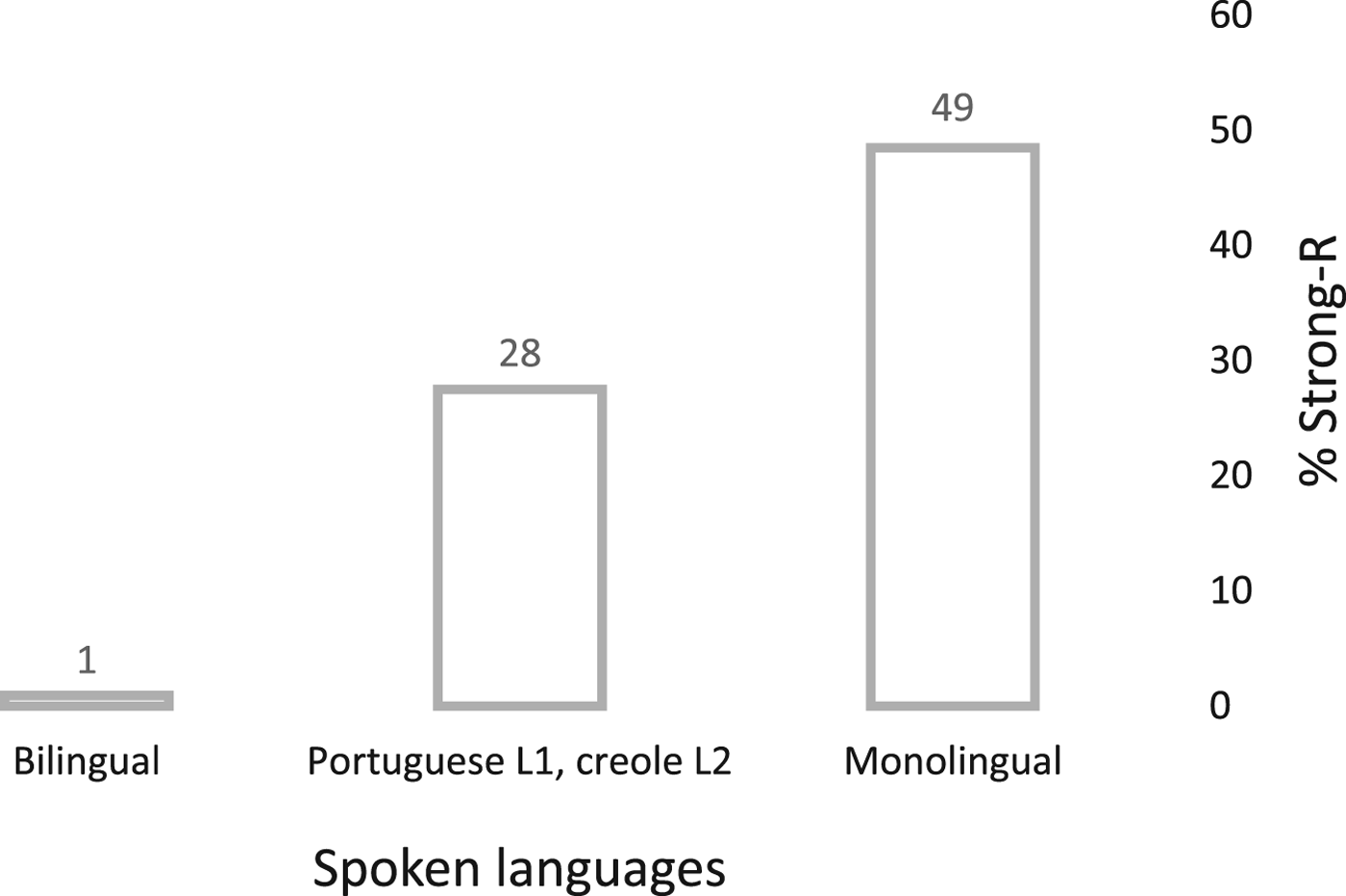
Strong-R is more frequent when the following context is a pause (43%), that is, word-finally; it is the only context that is significantly different from the vowel (23%). There is also a significant difference between the younger and older generations, again with the younger speakers favoring the use of strong-R in this position. This time, results also show a significant difference between the bilingual participants and the ones who only have some knowledge of creole. Figure 7 illustrates the higher rate of strong-R in coda position among monolingual Santomeans.
Rate of strong-R in coda position according to spoken languages, based on percentage.

Results in Table 10 and Figure 7 do not indicate that the use of strong-R in Santomean Portuguese is an outcome of language contact. If that were the case, speakers of Forro (L1 or L2) would most likely have shown a higher rate of strong-R than monolinguals do. Note that Ferraz (Reference Ferraz1979) wrote that the two rhotic phonemes in Portuguese correspond to the phoneme /l/ in Forro.
The emergence of rhotic fricatives within the strong-R category
Fricatives represent the majority of the strong-R in my dataset (79%, n = 1570). Results from another logistic mixed-effects regression analysis (with random speaker and word effects) comparing fricatives to trills show that position of rhotic and age are the only significant fixed-effect factors. (Both speaker and word are significant as random factors [p < 0.001].) Note that no follow-up analyses divided into different envelopes of variation are presented for this second sound change, as there are fewer tokens and some predictors display no variation.
Regarding position of rhotic, the use of rhotic fricatives word-initially is statistically different from the use of rhotic fricatives in consonant clusters (p = 0.03), coda positions (p < 0.001), and intervocalically (weak-r) (p < 0.01) (Figure 8). Word-initially and intervocalically (strong-R) are the two positions where European Portuguese historically had an obligatory strong-R, and where the uvular trill was frequently used. In the Brazilian literature, linguists have argued that rhotics are undergoing a lenition process (cf., Callou et al., Reference Callou, Morães and Leite1996; Rennicke, Reference Rennicke2015): r-variants → fricatives → Ø, or more specifically, as presented in Rennicke (Reference Rennicke2015:228): r → ʀ → ʁ → χ → ɦ → h. Therefore, this move from trill to fricative in Santomean Portuguese could be part of a broader lenition process underway in the Portuguese language.
Rate of rhotic fricatives according to position of rhotic and age.

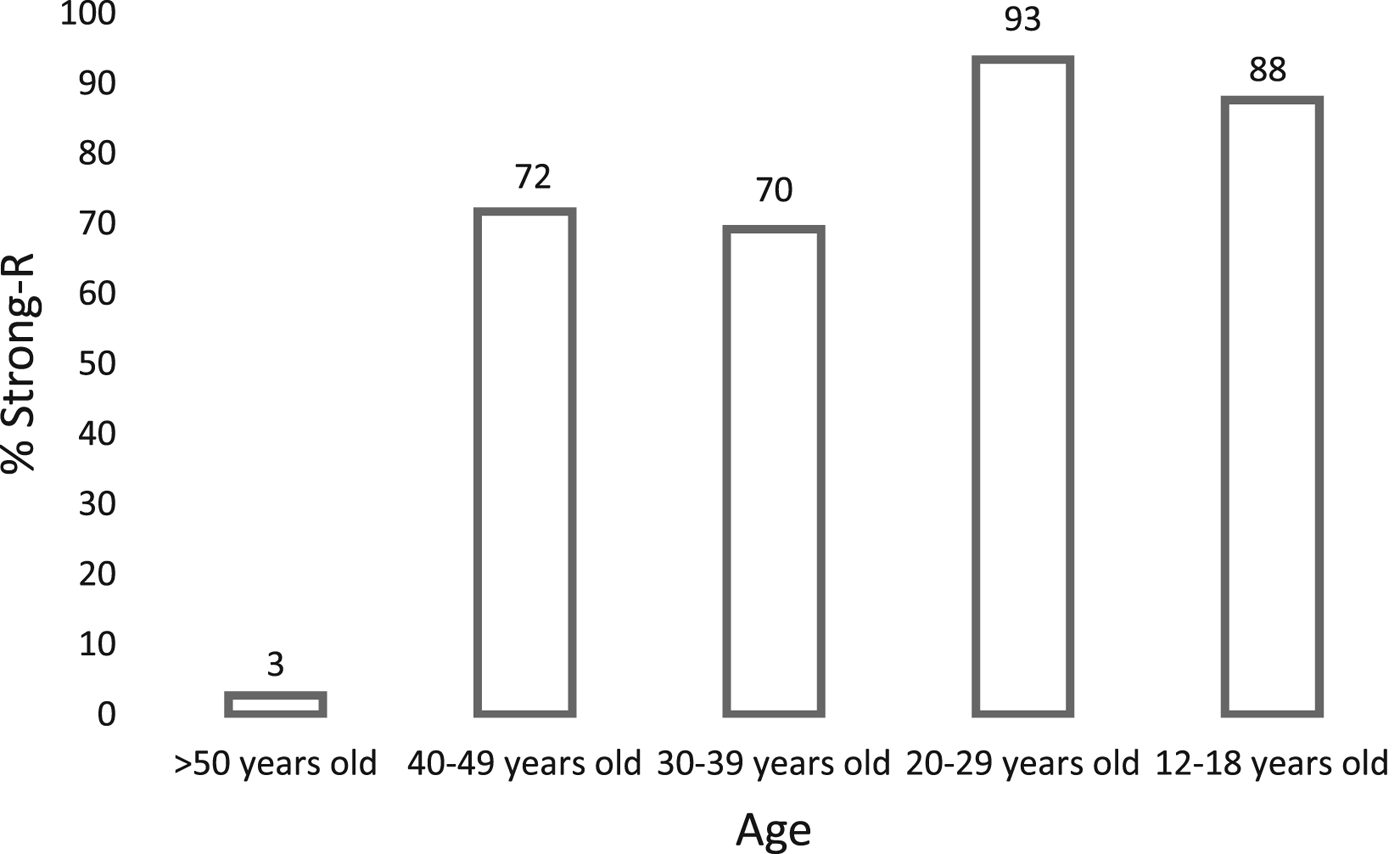
Regarding age, results highlight again that the use of the rhotic fricatives is an innovation led by the younger speakers. However, in this case, when looking at Figure 9, we see a drastic change between the speakers who are over 50 years old and the ones who are under 49 years old. This marks an important difference in the speech of the people born before the struggle for the independence of the country (1960s), and the ones born after. These findings about the emergence of the rhotic fricatives in Santomean Portuguese challenge Massini-Cagliari, Cagliari, and Redenbarger (Reference Massini-Cagliari, Cagliari, Redenbarger, Wetzels, Costa and Menuzzi2016:60), who wrote that, “[p]honetically, the trill is still a coronal trill [r] in Portuguese Africa—the original historical pronunciation.”
Rate of fricative rhotics according to age.

DISCUSSION
Linguistic change in apparent time
The results for age, the use of the strong-R by Santomean participants, and the emergence of the rhotic fricatives indicate a language change in progress in the Portuguese of São Tomé. In all positions of word, younger Santomeans use strong-R the most, and older Santomeans use it the least. Within the strong-R category, younger speakers favor the use of fricative rhotics over trills.
Rhotics are probably the sounds that underwent the greatest number of changes in the Portuguese language in the last century (Veloso, Reference Veloso, Simões, Barreiro, Santos, Sousa-Silva and Tagnin2015). In Portugal and Brazil, dialectologists, sociophoneticians, and sociolinguists take interest in rhotics in part because of their great variability as a class of sounds (e.g., in Portugal: Barbosa, Reference Barbosa1983; Rennicke & Martins, Reference Rennicke, Martins, Silva, Falé and Pereira2013; and in Brazil: Callou et al., Reference Callou, Morães and Leite1996, Reference Callou, Morães and Leite1998; Oushiro, Reference Oushiro2014; Rennicke, Reference Rennicke2015). From a historical point of view, three main sound changes affected the rhotics system in Portuguese over the past few centuries: the introduction of the uvular trill [ʀ] in the subclass of strong-R (replacing the alveolar trill) in the nineteenth century, the substitution of the uvular trill by a uvular fricative that began in Portugal between the nineteenth and twentieth centuries (becoming more widespread in the mid-twentieth century), and the diversification of possible rhotic sounds in coda position (including the introduction of a retroflex approximant [also called the English r]) (Rennicke, Reference Rennicke2015; Veloso, Reference Veloso, Simões, Barreiro, Santos, Sousa-Silva and Tagnin2015).
According to Veloso (Reference Veloso, Simões, Barreiro, Santos, Sousa-Silva and Tagnin2015:324), the uvular trill (the second sound change in rhotics) had a sudden start among urban and educated Portuguese speakers who wanted to sound more cosmopolitan and sophisticated. The origin of the uvular trill is unclear, but Barbosa (Reference Barbosa1983:193) objected to explaining the passage from an alveolar to a uvular to the influence of French. Similar observations can be made about the emergence and the use of the fricative in Santomean Portuguese:
(1) The fricative had a sudden start; this was mentioned to me on a few occasions by linguists who have returned to São Tomé and Príncipe and noticed the obvious difference, as well as by Santomeans who had left the islands and found this rhotic pronunciation when they came back.
(2) It started among urban and educated speakers; although the urban/rural contrast is not discussed much in this article, the urban Santomeans are considered to speak better.
(3) The origin of the fricative is unclear, but this innovative feature is not related to the influence of French or Forro.
This recent and innovative use is a change in progress being initiated by younger speakers. For non-Santomeans, the pronunciation of rhotics iconically indexes Santomean Portuguese, and more so than any other feature. However, maybe because it is still recent, most Santomeans are not aware of their distinctive use of rhotics, and when they are, the ideologies that surround this use of the rhotics are pejorative. On the one hand, most (if not all) of the Santomeans with a lower socioeconomic status I questioned about the pronunciation of rhotics in their variety of Portuguese did not know about this linguistic difference, and many could not hear the difference between b[ɾ]anco and b[ʁ]anco, ‘white,’ for example. The same can be said for middle-class Santomeans who have never traveled outside the country or who have not been in touch with Portuguese speakers from abroad. This is the case of Aurélia (44 years old) who is a teacher and an undergraduate student in linguistics and who cannot tell if her son is a strong-R user or not, although they have already discussed rhotics and Santomean pronunciation in her sociolinguistics class with a non-Santomean professor: “I don't know, nobody notices that, we don't care about that (laughs)!”Footnote 5
On the other hand, Santomeans with a higher socioeconomic status who studied or worked abroad and who had come into contact with Portuguese or Brazilians had a greater metalinguistic awareness (Silverstein, Reference Silverstein1981); some are conscious of it but do not care, and others do care and feel ashamed, as it is the case for Célia (27 years old):
I did not realize. I admit that I did not realize that I speak like this. [Ok.] I really didn't have any idea. […] I do speak differently, I think that I do speak differently. I don't know. I have this pronunciation this accent because my colleagues, they all lived abroad [hum] in Portugal. […] I'm ashamed of the way I speak. I'm actually ashamed.
The quantitative results and content analysis of the interviews suggest that this is a change from below. Typically, linguistic changes from below enter language from below the level of consciousness, through the vernacular, and spread throughout the community without the speakers being consciously aware of them in the early stages of the change. This is the case in São Tomé, where most speakers are not aware of this distinctive use of rhotics unless they have been in contact with Portuguese-speaking foreigners. The social facts show that this particular use of the rhotics indexes the youth and the post-independence period.
The mapping of the use of rhotics onto national identity
Most of the interviews were conducted in 2015–2016, when São Tomé and Príncipe was celebrating its 40 years of independence from Portugal. When São Tomé and Príncipe became independent, all Portuguese nationals were sent back to Europe (with a few rare exceptions). This means that the contact with European Portuguese was suddenly greatly reduced. post-colonization, Santomeans started to create their own nation, their own identity, and their own variety of Portuguese. Results indicate that the distinctive use of the rhotics and the emergence of the fricative rhotics appeared at a point in time that was an important milestone in the history of São Tomé and Príncipe. I suggest that this language change marks the new Santomean identity, as it started a few years before the independence from Portugal, in the 1960s, when the struggle for independence began (Seibert, Reference Seibert2006).
The use of the strong-R in different word positions and the emerging fricative (which is an alternative to the traditional trill), mark the difference between the Santomeans born before and after the independence of the country. The fact that speakers born after independence use them more frequently suggests that this feature might be construed as a marker of national identity, a way to distinguish Santomean Portuguese from European Portuguese, the variety spoken by the ex-colonizers. Santomean identity is still under construction, and Santomean Portuguese is the language that is slowly becoming attached to Santomean identity. There is still the nostalgia for the past and the creole languages, as if they embodied the Santomean identity, and not the Portuguese of the colonizers. But now that the colonizers are gone, leaving their language as a trace of their long stay on the islands, Santomeans are becoming a nation with its own variety of Portuguese.
Interestingly, these younger Santomeans who more frequently use the strong-R also highly regard their variety of Portuguese more so than the older generations, who tend to consider Santomean Portuguese to be errado ‘wrong’ and European Portuguese to be certo ‘right.’ Following is an excerpt from the interview with Michel (22 years old):
Well, many people say that the right Portuguese is the one spoken in Portugal… [Hum hum… Do you agree with that?] No, I don't agree. [Why?] Because I even noticed that they don't speak that well there… [Ok.] I think people believe that the best Portuguese is spok… is the one spoken there [Hum hum…] because it comes from there… we speak Portuguese, but it doesn't mean that the best Portuguese comes from there.
Pilar, who is a strong-R user in her forties, associates the distinctive use of the strong-R to being Santomean. In her opinion, some Santomeans adopt the European Portuguese accent in order to show that they are in (or have been to) Portugal:
I think… that… when… if maybe they want to show that they're in Portugal, things like that, they adopt the accent from there, but when not… at least in my case, nothing influenced me.
This certainly reflects the higher status attributed to European Portuguese. However, more subtly, Pilar's explanation of the adaptation to European Portuguese also implies a certain lack of authenticity when she proudly says that nothing influenced her speech.
CONCLUSION
What happens to the variety of Portuguese spoken in São Tomé now that European Portuguese is not there anymore? In fact, Santomean Portuguese can be seen as a language in contact with Forro and other creole languages, but it is also a language that is no longer in close contact with its superordinate language. The outcomes of language contact on the use of rhotics were somewhat hidden behind the age effects. However, as seen in Figure 7, monolingual Santomeans are strong-R users, and bilingual Santomeans are less (or not at all). Further studies comparing monolingual and bilingual Santomeans of the same ages are necessary to investigate more specifically any effect of language contact on the use of the strong-R in Santomean Portuguese.
In this paper, we have seen that the distinctive use of the rhotics in Santomean Portuguese, and more specifically of the strong-R, sets this variety of Portuguese apart from Brazilian and European Portuguese. It probably sets Santomean Portuguese apart from other African varieties of Portuguese too, but there is no information on the matter.
Based on the literature on the history of the Portuguese language and change in rhoticity (Rennicke, Reference Rennicke2015; Veloso, Reference Veloso, Simões, Barreiro, Santos, Sousa-Silva and Tagnin2015), we know that rhotics have changed throughout the history of the language and that they are still changing. Rhotics show flexibility, and they appear as a likely place for innovation. And, in fact, it is in their use of rhotics that Santomeans stand out from the other Portuguese speakers. Santomeans use the strong-R in word positions that would be considered non-standard to European and Brazilian norms; this could be reflecting a partial merger of the two rhotic phonemes of European Portuguese, or, following Mateus and D'Andrade (Reference Mateus and D'Andrade2000), it could be that the single underlying rhotic ([ɾ]) in Santomean Portuguese triggers rules for the use of the strong-R in different contexts than in European and Brazilian Portuguese. Is this variation in the use of rhotics in Santomean Portuguese limited to phonetic productions or is it mirroring a reshaping of the phonological system of the language? Answering this question goes beyond the scope of this paper. Further studies, including perception tests, are necessary to examine how Santomeans store lexical representations (and to find out if they distinguish caro from carro, for example).
That being said, I suggest that this distinctive use of the strong-R is a change from below as a marker of Santomean identity initiated by younger monolingual speakers. However, maybe because it is still recent, ideologies that surround this use of the rhotics are still highly pejorative.
Within this strong-R category, the rhotic fricatives have emerged, a phenomenon that clearly distinguishes two generations (the Santomeans over 50 years old and the ones under 49 years old). This cut-off also marks the rise of the independentist movement, which was an important milestone in the history of São Tomé and Príncipe and the formation of its national identity. This suggests that fricative rhotics also mark the emergence of a still-forming Santomean identity. This also relates to the words of the Mozambican writer Mia Couto (Reference Couto2014) in an interview when referring to Brazilian Portuguese: “Brazil, by becoming independent the way it did, I mean, hum… it had to inscribe its difference in the language that was common, so, Brazilians have to say we speak this language from Portugal, but we speak differently.” Santomeans are now doing the same.