


Introduction
Social anxiety disorder (SAD) is defined as a ‘marked fear or anxiety about one or more social situations in which the individual is exposed to possible scrutiny by others’ (American Psychiatric Association, 2013, p. 202). SAD frequently starts in the adolescent years. A large US study found a prevalence rate of 8.6% of adolescents who met lifetime criteria for SAD (Burstein et al., Reference Burstein, He, Kattan, Albano, Avenevoli and Merikangas2011). However, not all socially anxious individuals meet the criteria for SAD. Social anxiety is considered a continuous variable ranging from very low to very high levels (Rapee and Spence, Reference Rapee and Spence2004). For lower, subclinical levels of social anxiety, studies have reported adolescent prevalence rates between 27 and 47% (Essau et al., Reference Essau, Conradt and Petermann1999; Wittchen et al., Reference Wittchen, Stein and Kessler1999).
Compared with other anxiety disorders, the treatment of SAD is relatively difficult, both in adults (Norton and Price, Reference Norton and Price2007) and youth (Crawley et al., Reference Crawley, Beidas, Benjamin, Martin and Kendall2008). In a recent study, Hudson and colleagues (Reference Hudson, Rapee, Lyneham, McLellan, Wuthrich and Schniering2015) found that conventional, ‘broad-based CBT’ has relatively poor outcomes for children with SAD compared with those with a generalized anxiety disorder. They proposed that broad-based CBT is not tailored to the specific needs of youth with SAD. Referring to the theoretical work of Clark and Wells (Reference Clark, Wells, Heimberg, Liebowitz, Hope and Schneier1995) and Rapee and Heimberg (Reference Rapee and Heimberg1997), Hudson and colleagues (Reference Hudson, Rapee, Lyneham, McLellan, Wuthrich and Schniering2015) suggested that treatment of social anxiety in youth should pay particular attention to the negative social cognitions that are considered a crucial factor in SAD. This recommendation is in line with treatment ideas in the adult literature (e.g. Hofmann, Reference Hofmann2007).
The cognitive theories of social anxiety propose that negative self-cognitions are an important maintaining factor (Clark and Wells, Reference Clark, Wells, Heimberg, Liebowitz, Hope and Schneier1995; Rapee and Heimberg, Reference Rapee and Heimberg1997) or even a causal factor (Spence and Rapee, Reference Spence and Rapee2016) in the development of social anxiety. Socially anxious individuals are assumed to have negative expectations about their social performance beforehand, evaluate it negatively afterwards, and to ruminate in the hours and days after their performance, repeatedly re-experiencing their negative self-cognitions and feelings of anxiety (Clark and Wells, Reference Clark, Wells, Heimberg, Liebowitz, Hope and Schneier1995; Rapee and Heimberg, Reference Rapee and Heimberg1997). The negative cognitions of socially anxious individuals are assumed to increase their anxiety in social situations and the increased anxiety, in turn, makes their cognitions even more negative, resulting in a vicious cycle of anxiety and negative cognitions. Negative cognitions are also thought to be immune to changes in a positive direction in response to the actual quality of an individual's performance and other people's reactions to it. Cognitive theories posit that socially anxious individuals pay less attention to their performance and the responses of others to their performance because they focus on their feelings of anxiety and negative self-evaluative thoughts, constructing an image of themselves from an observer's perspective (Clark, Reference Clark, Crozier and Alden2001; Clark and Wells, Reference Clark, Wells, Heimberg, Liebowitz, Hope and Schneier1995). Consequently, the Clark and Wells (Reference Clark, Wells, Heimberg, Liebowitz, Hope and Schneier1995) theory implies that socially anxious individuals’ self-cognitions are not, or only slightly, affected by the quality of their performance, whereas non-anxious individuals’ self-cognitions are affected by performance quality. The aim of the present study was to learn more about this moderating effect of social anxiety in the relationship between adolescents’ social self-cognitions and social performance.
In line with the cognitive theories of social anxiety (Clark, Reference Clark, Crozier and Alden2001; Clark and Wells, Reference Clark, Wells, Heimberg, Liebowitz, Hope and Schneier1995; Heimberg et al., Reference Heimberg, Brozovich and Rapee2010; Rapee and Heimberg, Reference Rapee and Heimberg1997; Rapee and Spence, Reference Rapee and Spence2004) there is ample empirical evidence of a rather strong relation between social anxiety and negative social self-cognitions in adolescents (see review by Miers et al., Reference Miers, Blöte and Westenberg2011). Studies have shown that adolescent social anxiety is associated with negative self-cognitions before, during and after a social situation (Alfano et al., Reference Alfano, Beidel and Turner2006; Hodson et al., Reference Hodson, McManus, Clark and Doll2008; Inderbitzen-Nolan et al., Reference Inderbitzen-Nolan, Anderson and Johnson2007; Miers et al., Reference Miers, Blöte, Bögels and Westenberg2008; Ranta et al., Reference Ranta, Tuomisto, Kaltiala-Heino, Rantanen and Marttunen2014). This evidence includes an association between social anxiety and negative rumination as proposed by the cognitive theories of social anxiety (Clark and Wells, Reference Clark, Wells, Heimberg, Liebowitz, Hope and Schneier1995; Heimberg et al., Reference Heimberg, Brozovich and Rapee2010; Rapee and Heimberg, Reference Rapee and Heimberg1997).
Post-event rumination (also known as ‘post-event processing’ and referred to as ‘rumination’ in this paper) is described as repetitive reviewing of a social situation, with special attention paid to one's own role in it, one's behaviour, anxiety, and self-cognitions (Wong, Reference Wong2016). Cognitive theories of social anxiety have described how negative rumination may change a person's initial self-evaluative thoughts about a social event, making these evaluative thoughts even more negative. The rumination would result in negative expectancies for their performance in future social situations and increase the tendency to avoid these situations (Clark and Wells, Reference Clark, Wells, Heimberg, Liebowitz, Hope and Schneier1995; Rapee and Heimberg, Reference Rapee and Heimberg1997). Empirical studies indeed found that negative rumination in youth was related to social anxiety (Hodson et al., Reference Hodson, McManus, Clark and Doll2008; Miers et al., Reference Miers, Blöte, Heyne and Westenberg2014; Schmitz et al., Reference Schmitz, Krämer, Blechert and Tuschen-Caffier2010), negative self-evaluation after an event (Schmitz et al., Reference Schmitz, Krämer, Blechert and Tuschen-Caffier2010), and avoidance of social situations (Miers et al., Reference Miers, Blöte, Heyne and Westenberg2014).
Socially anxious individuals’ negative cognitions may either be warranted (i.e. when the performance is indeed poor), or negatively biased (i.e. when the performance is in fact effective). The question whether the negative self-cognitions of socially anxious adolescents are warranted has not yet been clearly answered. Only a small number of studies have addressed this topic and the results of these studies are ambiguous (Miers et al., Reference Miers, Blöte and Westenberg2011). Some studies found that independent observers rated the performance of socially anxious adolescents as worse compared with their non-anxious counterparts, confirming the negative self-evaluations of the socially anxious adolescent (Alfano et al., Reference Alfano, Beidel and Turner2006; Inderbitzen-Nolan et al., Reference Inderbitzen-Nolan, Anderson and Johnson2007). For example, Alfano et al. (Reference Alfano, Beidel and Turner2006) concluded that the negative self-cognitions (expected performance and after-performance evaluation) of socially anxious youth were warranted because independent observers rated their performance as poorer; that is, socially anxious youth looked more anxious and their performance was less effective compared with a non-anxious control group. Other studies did not find differences in observer ratings between socially anxious and non-anxious groups (Cartwright-Hatton et al., Reference Cartwright-Hatton, Tschernitz and Gomersall2005; Erath et al., Reference Erath, Flanagan and Bierman2007; Miers et al., Reference Miers, Blöte, Bokhorst and Westenberg2009). In this case, the negative self-evaluations of the socially anxious adolescents would be negatively biased. Thus, some (but not all) previous studies suggest that the self-cognitions of socially anxious adolescents are not influenced, or only weakly influenced, by the quality of their performance.
Empirical studies have focused on biased self-perceptions of socially anxious adolescents and have only partially tested the proposed relation between self-cognitions and performance quality described in the cognitive models (Clark and Wells, Reference Clark, Wells, Heimberg, Liebowitz, Hope and Schneier1995; Rapee and Heimberg, Reference Rapee and Heimberg1997). To the best of our knowledge, no previous studies have investigated the role of performance quality in the relationship between adolescents’ performance expectations before a social situation and their self-evaluation afterwards. Because such studies also seem to be lacking for adults (for a review of adult studies on cognitive factors in SAD, see Hofmann, Reference Hofmann2007), this denotes an important gap in the literature. The present study aims to address this gap. We propose that in the general population, adolescents’ self-cognitions after a speech performance (i.e. their self-evaluated performance and rumination) will be related both to the expectations they had before the speech and the quality of their actual performance (rated by independent observers). In contrast, socially anxious adolescents are assumed to be less aware, or even not aware, of the quality of their performance. For them the role of performance quality in the link between expected and self-evaluated performance and between expected performance and rumination may not apply. Socially anxious adolescents’ feelings of anxiety and their negative self-cognitions before their performance are expected to continue during and after their speech, irrespective of the quality of their speech.
We designed a mediation model with two possible paths between adolescents’ expectations before the speech and their self-cognitions after the speech, a direct path and an indirect path through performance quality (see Fig. 1). The model was tested once with self-evaluated performance as self-cognition variable and once with negative rumination as self-cognition variable. Social anxiety is expected to moderate the paths from performance quality to self-evaluation/rumination and from performance expectations to self-evaluation/rumination. Based on the Clark and Wells (Reference Clark, Wells, Heimberg, Liebowitz, Hope and Schneier1995) model, we expected that the self-evaluation and negative rumination of adolescents with higher levels of social anxiety would be less influenced by the quality of their performance compared with adolescents with lower levels of social anxiety. Adolescents with higher levels of social anxiety were expected to persist with the negative self-cognitions (i.e. low expectations) they had before their performance. They would negatively evaluate their speech performance and would ruminate irrespective of the quality of their speech. This would result in a stronger direct relation between expectations and self-evaluation/rumination and a weaker indirect effect compared with adolescents with lower levels of social anxiety.
Diagram of the moderated-mediation model with self-evaluated performance and negative rumination as respective dependent variables. Performance quality is a mediator and social anxiety a moderator in this model. a, direct path; b and c, indirect path through performance quality.

Youth studies have shown a substantial overlap between self-reported social anxiety and depression (Brady and Kendall, Reference Brady and Kendall1992; Seligman and Ollendick, Reference Seligman and Ollendick1998) and negative self-cognitions and negative rumination are not only found in socially anxious but also in depressed individuals (Kirkegaard Thomsen, Reference Kirkegaard Thomsen2006). Because we were primarily interested in the role of social anxiety, we statistically controlled for depression.
Method
Participants
Participants were drawn from the Social Anxiety and Normal Development (SAND; Westenberg et al., Reference Westenberg, Bokhorst, Miers, Sumter, Kallen, van Pelt and Blote2009) study. This longitudinal community study included four assessment waves conducted over a period of 5 years (Miers et al., Reference Miers, Blöte, de Rooij, Bokhorst and Westenberg2013). The participants attended primary or secondary schools in an urban area of the Netherlands. Participants were required to give a speech at Wave 1 and Wave 3 with a 2-year time interval. The present study used Wave 3 data because, after having given the speech already at Wave 1, they were familiar with the task, which was important for measuring their expected performance. At Wave 3, 229 of 248 participants (116 boys, 113 girls; age range 11 to 18 years) had complete data for all variables except one, rumination. Unfortunately, only 161 adolescents (80 boys, 81 girls) completed the rumination measure. (Participants were required to complete this measure at home a week after giving the speech; not all responded.) Missing data for the other variables (n = 19) were mainly a result of the poor quality of some speech recordings (n = 17) and one missing value on the depression and one on the expected performance measure.
The SAND study was approved by the university's Medical Ethical Committee. Parents gave their written consent and adolescents their written assent for participation in the study.
Instruments
Social Anxiety Scale for Adolescents (SAS-A; La Greca and Lopez, Reference Greca and Lopez1998). A Dutch translation of the SAS-A (H. Koot and E. Utens, unpublished) was used to measure social anxiety. The SAS-A is a questionnaire that measures self-reported social anxiety. It contains 22 items, 18 of which relate to social anxiety (e.g. ‘I get nervous when I meet new people’) and four are filler items. Participants are required to rate each statement in terms of how true it is for them using a 5-point Likert scale (1 = not at all, 5 = all the time). The SAS-A has good psychometric properties (La Greca and Lopez, Reference Greca and Lopez1998; Storch et al., Reference Storch, Masia-Warner, Crisp and Klein2005). The Dutch version has a good internal consistency (Blöte and Westenberg, Reference Blöte and Westenberg2007; Miers et al., Reference Miers, Blöte, Bögels and Westenberg2008). Cronbach's alpha in the present study is .93. A SAS-A sum score >50 is considered indicative of clinical levels of social anxiety (La Greca and Lopez, Reference Greca and Lopez1998); 16.2% of the participants met this criterion.
Children's Depression Inventory (CDI; Kovacs, Reference Kovacs1985). The Dutch translation of the CDI (Timbremont and Braet, Reference Timbremont and Braet2002) was used as the depression measure. For each of the 27 items of the questionnaire, participants are asked which of three statements best describes how they felt in the last 2 weeks. For example, ‘I do most things OK’, ‘I do many things wrong’, and ‘I do everything wrong’. Scores range from 0 to 2 (most depressed). The Dutch version has good reliability and validity (Roelofs et al., Reference Roelofs, Braet, Rood, Timbremont, Van Vlierberghe, Goossens and van Breukelen2010; Timbremont and Braet, Reference Timbremont and Braet2002). For ethical reasons, the item asking about suicide was removed from the questionnaire. Cronbach's alpha at Wave 3 of the SAND study was .84.
Expected and Evaluated Performance questionnaires (EP; Miers et al., Reference Miers, Blöte, Bokhorst and Westenberg2009; Spence et al., Reference Spence, Donovan and Brechman-Toussaint1999). A Dutch translation of the EP was used to measure participants’ expectation for their speech performance (EP-before) and their self-evaluation of their speech performance (EP-after). The items of the EP-before and EP-after versions are similar except that EP-before asks about the expected performance and the EP-after to evaluate the speech performance (e.g. ‘Compared to other kids your age, how good will you be (were you) in giving the speech?’). Miers et al. (Reference Miers, Blöte, Bokhorst and Westenberg2009) added two items to the five items of the original versions (Spence et al., Reference Spence, Donovan and Brechman-Toussaint1999). In addition to the existing items that ask about the judgement by other children they added items about the judgement by a teacher (e.g. ‘How good do you think a teacher watching the video will think you are at giving a speech?’). The version of the EP we used has five items. We excluded two questions from the original EP, about feeling nervous and making errors, because they do not focus on the overall quality of the speech . The items are rated on a 5-point scale (1 = lowest, 5 = highest performance judgement). In the present study, Cronbach's alpha for the five items of the EP-before is .69 and of the EP-after .81.
Performance Questionnaire-Observer (PQ-Obs). An adapted and translated version (Miers et al., Reference Miers, Blöte, Bokhorst and Westenberg2009) of the PQ (Cartwright-Hatton et al., Reference Cartwright-Hatton, Hodges and Porter2003, Reference Cartwright-Hatton, Tschernitz and Gomersall2005) was used to measure the quality of adolescents’ speech performance. The adapted version consists of ten items describing behaviour related to social skills (e.g. ‘How loud and clear was the voice of the speaker?’) and nervousness (e.g. ‘How nervous was the speaker?’). Behaviors are rated on a 4-point scale ranging from very much to not very much. Two trained raters who were blind to the study's hypotheses and worked independently filled in the PQ-Obs. For this purpose, the recorded speeches were projected onto a life-size screen. The inter-rater agreement for the present sample is adequate; average measure ICC= .92. Average scores over the two raters were used. Items were recoded such that a high score on this measure indicates a good performance.
Thoughts Questionnaire (TQ; Edwards et al., Reference Edwards, Rapee and Franklin2003). The TQ was used to measure negative rumination about participants’ speech performance in the week after the speech. For the SAND study, the questionnaire was translated into Dutch and adapted for use with children and adolescents (Miers et al., Reference Miers, Blöte, Heyne and Westenberg2014). The SAND version includes 24 items, 14 of these describing negative rumination (e.g. ‘How awkward I felt’ and ‘What a failure I was’). The items are answered on a 5-point scale (0 = never, 4 = very often) according to how often the participant had the thought in the week since the speech. Cronbach's alpha of the negative rumination scale in this study is .92.
Procedure
Participants came to the university twice, for a ‘Pre-Lab’ session and again a week later for a ‘Lab’ session. During the Pre-Lab session participants received instructions about the speech task in the study, the Leiden Public Speaking Task (Leiden-PST; Westenberg et al., Reference Westenberg, Bokhorst, Miers, Sumter, Kallen, van Pelt and Blote2009) and filled in a number of questionnaires including the SAS-A, CDI and EP-before. Participants were required to prepare for this speech task as if giving a speech in their classroom. The speech takes 5 minutes and its topic is the type of films they liked and/or disliked and why. During the Lab session the participants gave their speech in front of a pre-recorded audience consisting of eight same-aged peers (different ones for different age groups) and a female teacher who all behaved in a neutral way. The audience was projected life-size onto a screen without a soundtrack. Participants were told that the audience was pre-recorded but that a recording of their speech would be evaluated by peers and teachers. The Leiden-PST induces both subjective and physiological arousal (Van den Bos and Westenberg, Reference Van den Bos and Westenberg2015; Westenberg et al., Reference Westenberg, Bokhorst, Miers, Sumter, Kallen, van Pelt and Blote2009). Immediately after the speech the participants completed the EP-after. One week after the speech, the participants were required to complete the TQ at home on a website designed specifically for the SAND study. The percentage of adolescents in the present sample that returned the TQ was 70%. Of these, 80% returned it within 3 weeks after the speech and the remaining 20% within 2 months.
Data analysis
Analyses used the sum scores of the different instruments. First, descriptive statistics and correlations were calculated for all variables in the study. To address the study's research questions we used a moderated mediation model (see Fig. 1) as computed by the PROCESS macro retrieved from www.processmacro.org (Hayes, Reference Hayes2013; Hayes and Rockwood, Reference Hayes and Rockwood2016). The macro uses ordinary least squares (OLS) analysis for calculating the moderated mediation effects, and boot-strapping for calculating the confidence intervals (CI). We used bias-corrected bootstrap CIs based on 10,000 boot samples with a 95% level of confidence. In the first model, we entered performance quality (PQ-obs) as a mediator of the link between expected performance (EP-before) and self-evaluated performance (EP-after), and entered social anxiety (SAS-A) as a moderator of the links between expected performance and self-evaluated performance and between performance quality and self-evaluated performance. In the second model, we entered performance quality as a mediator of the link between expected performance and negative rumination (TQ-neg), and again entered social anxiety as a moderator of the links between expected performance and negative rumination and between performance quality and negative rumination. In case of significant moderation effects, effects are presented for three social anxiety levels: low, average and high (SAS-A = mean – 1SD, SAS-A = mean, and SAS-A = mean + 1SD), respectively. The analyses were first performed with gender, age and depression included as control variables. As no significant effects for gender were found, new analyses without gender were performed which are presented here. In order to obtain β values for effect sizes as output from the OLS analyses, we entered the z-scores of the different variables. Data from participants with missing values were deleted list-wise resulting in n = 229 for analyses with self-evaluation as outcome variable and n = 161 for analyses with negative rumination as outcome variable. All analyses were performed in IBM SPSS 23.
Results
Preliminary analyses
Participants who completed the rumination measure did not differ from those who did not on any of the variables in the study. ANOVAs yielded F values (1,227) between 0.22 (for expected performance) and 3.20 (for social anxiety), all p values > .05. The length of the time period between the speech and returning the rumination list did not significantly correlate with the negative rumination score, r = .08.
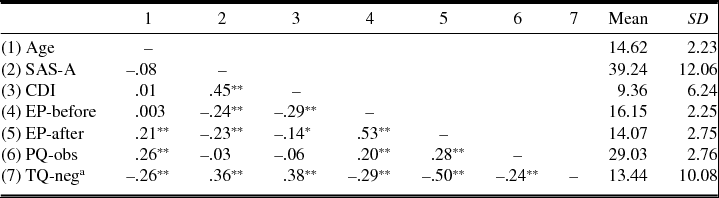
Table 1 presents means and SDs for the study's variables. The SD of the observed performance scores was relatively small, indicating that adolescents did not greatly differ in their performance. Interestingly, adolescents’ self-evaluation after the speech was less positive than their performance expectation before the speech, paired t (228) = 8.98, p < .001, d = .60.
Means, SDs and correlations between the main variables in the study (n = 229)

a n = 161; SAS-A, Social Anxiety Scale for Adolescents; CDI, Children's Depression Inventory; EP-before, expected performance; EP-after, self-evaluated performance; PQ-obs, Performance Questionnaire for Observers; TQ-neg, Thought Questionnaire (negative rumination). *p < .05, **p < .01 (one-tailed).
Social anxiety was negatively related to expected and self-evaluated performance, positively related to negative rumination, and not related to performance quality (see Table 1). Additionally, we found that depression was related to social anxiety and showed a similar pattern of correlations with the other variables as social anxiety. The self-cognition variables – expected performance, self-evaluated performance, and negative rumination – were all inter-related. Importantly, expected and self-evaluated performance were positively related and negative rumination was negatively related to performance quality. Some variables correlated with age. With increasing age, the quality of the speech was better and the self-evaluation of the speech more positive. Negative rumination decreased with age. Social anxiety, depression and expected performance were not significantly related to age.
Predicting self-evaluated performance
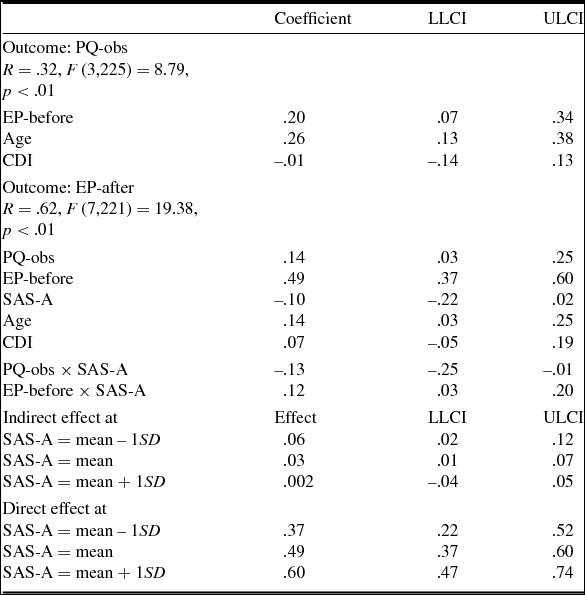
The moderated mediation effect was significant, index = –.03, CI = –.07 to –.001 (the index is significant because the confidence interval does not include zero). Performance quality significantly mediated the relation between expected performance and self-evaluated performance. Expected performance predicted self-evaluated performance both directly and indirectly, through performance quality (see Table 2). In line with hypotheses, the linear regression analysis predicting self-evaluated performance yielded significant interaction effects for social anxiety with expected performance and performance quality. For participants with higher compared with lower levels of social anxiety, the direct relation between expected and self-evaluated performance was stronger and the indirect relation, through performance quality, was weaker (see Table 2). For the highly anxious participants (SAS-A score 1SD above the mean) performance quality was not a significant mediator in the link between expected performance and self-evaluated performance.
Moderated mediation results for the link between expected and self-evaluated performance with 95% bias-corrected confidence intervals (n = 229)

LLCI, lower limit confidence interval; ULCI, upper limit confidence interval; SAS-A, Social Anxiety Scale for Adolescents; CDI, Children's Depression Inventory; EP-before, expected performance; EP-after, self-evaluated performance; PQ-obs, Performance Questionnaire for Observers.
Predicting negative rumination
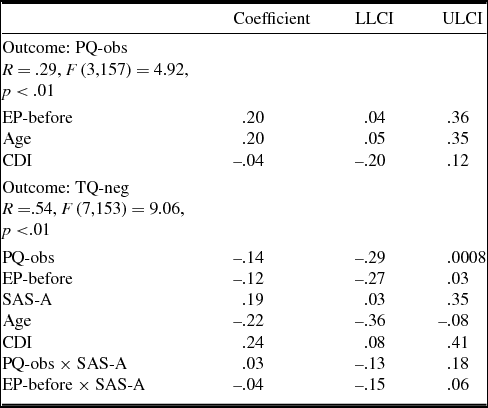
The moderated indirect effect of expected performance on negative rumination through performance quality was not significant, conditional mediation index = .01 (CI = –.02 to .05). The direct effect of expected performance on rumination was not significant either, effect = –.12 (CI = –.27 to .03; see Table 3). Rumination was significantly predicted by social anxiety, depression and age. The prediction of rumination by performance quality showed a trend towards significance (CI = –.29 to .0008; p = .051). Higher social anxiety and depression, and lower performance quality and age, predicted negative rumination. Contrary to the hypothesis, social anxiety did not moderate the respective relations of expected performance and performance quality with negative rumination.
Moderated mediation results for the link between expected performance and rumination with 95% bias-corrected confidence intervals (n = 161)

LLCI, lower limit confidence interval; ULCI, upper limit confidence interval; SAS-A, Social Anxiety Scale for Adolescents; CDI, Children's Depression Inventory; EP-before, expected performance; EP-after, self-evaluated performance; PQ-obs, Performance Questionnaire for Observers; TQ-neg, Thought Questionnaire (negative rumination).
Because the moderated mediation effect was not significant, we performed a simple mediation analysis without the moderator. This analysis, with performance quality as mediator of the relation between expected performance and negative rumination, showed that controlled for age, social anxiety and depression the indirect path through performance quality was significant, effect = –.03 (CI = –.08 to –.004), indicating that for a fixed value of age, social anxiety and depression the link between expected performance and rumination is mediated by performance quality. The direct effect of expected performance on rumination was not significant, effect = –.13 (CI = –.28 to .02).
Discussion
Cognitive theories of social anxiety posit that socially anxious individuals’ negative self-cognitions are firmly established and are therefore not easily changed by their experiences during a social performance (Clark and Wells, Reference Clark, Wells, Heimberg, Liebowitz, Hope and Schneier1995; Rapee and Heimberg, Reference Rapee and Heimberg1997). However, as yet no empirical study has evaluated the effect of performance quality on the cognitions of socially anxious individuals. The present study focused on the importance of performance quality relative to performance expectations in relation to individuals’ self-evaluation and rumination after a speech performance.
The main findings of the study are as follows. First, across all participants self-evaluated performance was significantly related to performance quality. As expected, performance quality mediated the link between performance expectations and self-evaluated performance. Second, in line with our expectations this mediation effect was moderated by social anxiety. In adolescents with lower and medium levels of social anxiety, performance expectations statistically predicted adolescents’ self-evaluations after the speech both indirectly, through performance quality, and directly. In adolescents with higher anxiety levels, performance expectations predicted self-evaluated performance only directly. That is, the quality of their speech performance did not play a role in their self-evaluation after the speech. Third, performance quality mediated the link between performance expectations and negative rumination, but contrary to expectations, this mediation effect was not moderated by social anxiety. Additionally, the following two findings are noteworthy. First, adolescents with higher levels of social anxiety had lower expectations about their performance, evaluated their performance more negatively, and reported more negative rumination after their performance. Second, social anxiety was not related to the quality of the performance. The study's findings are discussed in more detail in the following paragraphs.
Adolescents with higher levels of social anxiety had lower self-evaluations. They reported that their speech performance was relatively poor, and that they would be negatively evaluated by peers as well as teachers. However, independent observers did not perceive social anxiety-related differences in speech performance between participants, their observations comprising both general and specific behavioural characteristics. Thus, participants’ social anxiety-related negative self-evaluations were not confirmed by independent observations. This strongly suggests that a negative bias was present in the self-perceptions of relatively high socially anxious adolescents. This study thus extends existing knowledge about biased cognitions in high socially anxious adolescents (Cartwright-Hatton et al., Reference Cartwright-Hatton, Tschernitz and Gomersall2005; Erath et al., Reference Erath, Flanagan and Bierman2007; Miers et al., Reference Miers, Blöte, Bokhorst and Westenberg2009). Furthermore, the results suggest that this negative bias is not a binary variable that occurs in socially anxious individuals and not in others. The negative bias appears to be a continuous variable that correlates with social anxiety level. The higher the social anxiety, the more negatively biased the self-evaluations are. Ultimately, the self-evaluations are only very weakly, or not at all, related to the quality of their performance. In adolescents with high social anxiety levels, self-evaluations after the speech are only related to their performance expectations before the speech. This is different for adolescents with lower levels of social anxiety. Although their self-evaluations after the speech are also related to their performance expectations, the actual quality of their performance contributes to their self-evaluations. These results support the suggestion by Clark and Wells (Reference Clark, Wells, Heimberg, Liebowitz, Hope and Schneier1995) that the negative self-cognitions of socially anxious individuals compared with non-anxious individuals are not altered by how they actually perform.
The model of Clark and Wells (Reference Clark, Wells, Heimberg, Liebowitz, Hope and Schneier1995) describes how high levels of social anxiety are maintained. Socially anxious individuals are too focused on how nervous they are and the impression this would make on others, looking at themselves from an observer perspective, to pay attention to their performance and the responses from the audience. This focus on themselves would prevent them from changing their self-perceptions in a positive direction and would maintain their social anxiety. The model implies that non-anxious individuals are to some extent aware of their performance and the responses from their audience. Consequently, their self-cognitions can change. If their performance is poor and negatively judged by others, their self-cognitions may become negative over time and social anxiety may develop. Youth with a shy/inhibited temperament would be at particular risk (Spence and Rapee, Reference Spence and Rapee2016).
Social anxiety did not moderate the respective relationships of performance quality and expected performance with negative rumination. In contrast with the results on self-evaluation, performance quality mediated the link between expected performance and negative rumination irrespective of the social anxiety level of the participant. This finding is not in line with our expectation that performance quality predicts negative rumination only in adolescents with lower levels of social anxiety. Adolescents with higher levels of social anxiety were expected to ruminate irrespective of the quality of their performance. In contrast, we found evidence for an additive model where a combination of social anxiety, depression, performance quality, and age best predicts negative rumination. That is, a younger adolescent who is depressed and socially anxious, and gives a poor speech, will most likely have frequent negative ruminations in the days after the speech.
The finding that social anxiety (Hodson et al., Reference Hodson, McManus, Clark and Doll2008; Schmitz et al., Reference Schmitz, Krämer, Blechert and Tuschen-Caffier2010) and depression (Burwell and Shirk, Reference Burwell and Shirk2007; Wilkinson et al., Reference Wilkinson, Croudace and Goodyer2013) are related to negative rumination is in line with other youth studies. In the present study, regression analysis showed that social anxiety and depression each explained a unique part of the variance in negative rumination. This finding is not in line with a previous study which found that rumination was more closely related to anxiety than depression (Muris et al., Reference Muris, Roelofs, Meesters and Boomsma2004). However, differences between the methods of the studies make comparison of the results difficult.
Negative self-evaluations after the performance correlated significantly and relatively strongly with negative rumination. Other youth and adult studies found similarly strong relations between self-evaluation and rumination in socially anxious individuals (Brozovich and Heimberg, Reference Brozovich and Heimberg2011; Dannahy and Stopa, Reference Dannahy and Stopa2007; Schmitz et al., Reference Schmitz, Krämer, Blechert and Tuschen-Caffier2010). Evidently, negative self-evaluations after the task are the basis for further negative self-reflections on one's performance in the following days and these reflections in turn result in even more negative self-evaluations. This then constitutes a vicious cycle of self-cognitions and social anxiety (Brozovich and Heimberg, Reference Brozovich and Heimberg2011).
Age effects were found for some of the variables in the study. The quality of the speech performance improved with age. The self-evaluations also improved while negative rumination decreased with age. In contrast, the other measure of self-cognitions, performance expectations, was not related to age. Possibly, younger adolescents were too positive and older adolescents were realistic about their expected performance. Because older adolescents were in fact better than the younger adolescents, the expectations would not differ between them and no relation between expected performance and age would occur. We did not find a relation between social anxiety and age. This finding is in line with the results of previous studies in this age range (Rapee and Spence, Reference Rapee and Spence2004).
The present study used a short version of the expected and self-evaluated performance (EP) scales designed by Spence et al. (Reference Spence, Donovan and Brechman-Toussaint1999) and adapted by Miers et al. (Reference Miers, Blöte, Bokhorst and Westenberg2009). Although important differences between the present study and the original Spence et al. (Reference Spence, Donovan and Brechman-Toussaint1999) study exist (their participants were younger, were selected on the basis of being diagnosed with SAD; and the social tasks they performed, social interaction and reading aloud, were different) the current study's results on the relation between the EP and social anxiety are in line with those of Spence et al. (Reference Spence, Donovan and Brechman-Toussaint1999). This presents evidence for the validity of the adapted version of the EP used in the present study.
A strong point of this study is that the behaviour of the audience, because it was pre-recorded, could not differentially influence speakers with different levels of social anxiety or performance quality. The participants were also not informed afterwards about how their speech was evaluated. Therefore, the relation between their expected performance, self-evaluated performance, and rumination was not influenced by these external variables. However, because the behaviour of the audience in the study was the same for each speaker, the study could not present information about the influence of audience behaviour on adolescents’ self-cognitions. Future studies may wish to use two or more pre-recorded audiences that vary in their responses.
The present study has some limitations that need to be mentioned. First, a relatively large proportion of the participants did not complete the rumination scale or completed it later than required. Although we did not find direct effects in the data related to this constraint (participants who did not complete the rumination scale did not differ from participants who completed it on other variables; and length of time between the speech and filling in the rumination scale did not correlate with the rumination score), it may have had consequences, for example for the statistical significance of results related to rumination. Second, we utilized a community sample of adolescents representing a broad range of self-reported social anxiety. It would be informative if our results could be replicated in adolescents diagnosed with SAD. Third, because of the correlational design of the study, causality in our results is only suggested, and not demonstrated. Studies with an experimental design that manipulate the quality of participants’ performance, for example by teaching them both effective and ineffective skills to communicate with an audience, are needed to strengthen our results. Fourth, speech performance was judged by adult observers. Peers of the same age as the speakers may have rated the quality of the speeches differently. Because the judgment of peers is very important to adolescents and has a large influence (Ollendick and Hirshfeld-Becker, Reference Ollendick and Hirshfeld-Becker2002; Scholte and van Aken, Reference Scholte, van Aken, Jackson and Goossens2006), future studies may wish to choose same-aged peers as observers.
In conclusion, socially anxious adolescents’ negative self-cognitions are not related to their actual social performance. Therefore, in support of the Clark and Wells (Reference Clark, Wells, Heimberg, Liebowitz, Hope and Schneier1995) and Spence and Rapee (Reference Spence and Rapee2016) models, our results suggest that a good performance does not help socially anxious adolescents to replace their negative self-cognitions with more positive or realistic cognitions. This will perpetuate their social anxiety and might even result in the development of SAD (Spence and Rapee, Reference Spence and Rapee2016). Therefore, specific intervention strategies should be tailored to the needs of socially anxious adolescents who perform well. Video-feedback may be an effective intervention strategy for this group (Morgan and Banerjee, Reference Morgan and Banerjee2006). In order to offer such intervention specifically tailored to their needs (changing their cognitions in a positive direction) it is, obviously, important to include a measure of social skill in the diagnostic process (see e.g. Le and Beidel, Reference Le and Beidel2017, who introduced the assessment of social skills in a virtual environment). Interventions that train good performers to focus on the positive aspects of their performance and evaluate this performance in a more realistic way, may help them to develop more positive self-cognitions and prevent them from developing SAD. Poor performers may first need a specific social skill training, followed by a cognitive restructuring approach.
Acknowledgements
Ethics statement: All procedures performed in studies involving human participants were in accordance with the ethical standards of the institutional and/or national research committee and with the 1964 Helsinki declaration and its later amendments or comparable ethical standards.
Financial support: This research received no specific grant from any funding agency, commercial or not-for-profit sectors.
Conflicts of interest: Anke Blöte, Anne Miers, Esther van den Bos and Michiel Westenberg have no conflicts of interest with respect to this publication.




Comments
No Comments have been published for this article.