The oft-reported status of Imam ʿAlī b. Abī Ṭālib as inventor of jafr (letter divination) guaranteed a perennial interest among Shiʿi and Sunni elites alike in the science of letters (ʿilm al-ḥurūf), or lettrism, Hebrew kabbalah's coeval Arabic twin.Footnote 1 Like kabbalah, lettrism came to epitomize the Hellenic-Abrahamic dialectic of late antiquity, predicated on the philosophical, cosmogonic fusion of letter and number, and hence of reason and revelation, of nature and scripture: world as (Arabic or Hebrew) mathematical text.Footnote 2 From the thirteenth century onward, it naturally emerged as the primary vehicle of Pythagoreanism in Islam. Lettrism is therefore of central importance to any history of Western philosophy and science, though historians have only just begun to take it seriously as such—this while kabbalah studies is now an industry in its own right. Unlike its twin, however, lettrism—simultaneously the most Islamic of the occult sciences in its focus on the Quran and the Imams and the most mathematical-cosmic in its epistemological universalism—also became integral to the theory and practice of Persianate universalist imperialism in the globalizing post-Mongol era.Footnote 3
This quranic-imamic and mathematizing science was likewise an important means by which Safavid scholars achieved the Shiʿization of Iran: our sources testify to their embrace of a specifically Mamluk, Timurid, Aqquyunlu, and Ottoman—and thus decidedly Sunni—brand of imamophilic-Pythagorean lettrism. But this crucial, distinctive, and paradoxical feature of Safavid Shiʿi intellectual culture has been little noted in the scholarship to date, which has tended to prefer confessionalism to occultism as an analytical category or elide the latter as mere apolitical “mysticism.” This tendency is inspired in the first place by Henry Corbin's (d. 1978) antimodernist, valorizing equation of Shiʿism and mysticism, on the one hand, and Michel Mazzaoui's (d. 2013) emphasis on “folk Islam” and painting of the Safavid takeover as alien rupture, on the other.Footnote 4 In either case, there can be no question of Shiʿi occultism as an elite, scientific, or Sunni pursuit. Most historians of Iran now working continue to reflexively follow suit, either politely ignoring it or openly dismissing it as popular fetishism.Footnote 5 The smooth continuity of Safavid occult-scientific culture with immediate Mamluk, Timurid, and Aqquyunlu Sunni precedent, and thence its Ottoman and Mughal rivals, has thereby been historiographically safely siloed off.
This is not to suggest that Safavid imperial confessionalism was not often stridently anti-Sunni both rhetorically and corporally—it certainly was, and many Sunni scholars (including high-profile occultists) fled Iran for the greener pastures of Mughal India, Ottoman Anatolia, or Uzbek Transoxania as a consequence. Yet it was precisely this scholarly diaspora that ensured a Safavid-Mughal-Ottoman-Uzbek occult-scientific continuity.Footnote 6 Most remarkably, Safavid anti-Sunnism—in sharp contrast to contemporary Protestant anti-Catholicism—was tempered and complicated by the Shiʿi scholarly embrace of Sunni occultism as a primary mode for the practice of Safavid Twelver philosophy, science, and empire.
Maḥmūd Dihdār, Early Modern Ecumenical Occultist
The oeuvre of Maḥmūd Dihdār Shīrāzī “ʿIyānī” (fl. 1576) epitomizes this continuity. A passionate and outspoken Twelver divine, he was the most prolific Persian author on lettrism of the sixteenth century. While his attempts to install himself as court prognosticator and ideologue failed, and he died in obscurity, Dihdār's pivotal role as teacher in the occult sciences to Shaykh Bahāʾī (d. 1621) himself—supreme polymath, shaykh al-islām, and architect of the Safavid state—makes his oeuvre an important key to Safavid imperial cosmology in its formative, experimentalist phase.Footnote 7 As the manuscript record shows, his influence only increased in the seventeenth century, not least through the efforts of his more famous son Muḥammad Dihdār “Fānī” (d. 1607), émigré to India and author of many works in the Ibn al-ʿArabian vein; it is then that various forms of Persianate occultism reached maturity and the production of accessible grimoires boomed. This is the ferment that gave birth, for instance, to the pseudo-Būnian Great Sun of Knowledge (Shams al-maʿārif al-kubrā), the most popular grimoire ever produced in Islamdom.Footnote 8 Indeed, Dihdār's own magnum opus, the comprehensive lettrist and talismanic manual Keys to All Locks (Mafātīḥ al-maghālīq), remains a bestseller to this day, especially online, and is thus a window onto postcolonial Persianate occultism too.Footnote 9
So why has such a worthy been totally erased from the historical record by Safavid chroniclers and modern historians alike? In the case of the former, it was a case not of witch-hunting but of court intrigue: Dihdār's association with the controversial and brief reign of Shah Ismāʿīl II (r. 1576–77), purported “Sunnizer,” on the one hand, and his status as protégé of the court poet Amrī Shīrāzī (d. 1590), who was blinded by Shah Ṭahmāsb I (r. 1524–76) and later executed by Shah ʿAbbās I (r. 1587–1629) on suspicion of Nuqṭavī leanings, on the other, disqualified him from court. The Nuqṭaviyya, like its parent Sufi movement, the Ḥurūfiyya, was an anarchic thorn in the side of the state—and yet Shah ʿAbbās flirted with using Nuqṭavī materialist-reincarnationist lettrist doctrine as a basis for his claim to imperial legitimacy, this as a means to compete with the more robustly occult Mughal and Ottoman claims to the same. But he ultimately rejected it as too risky and by systematic persecution drove the Nuqṭavīs from Iran to Mughal India, where they enjoyed much more ideological success.Footnote 10 Nuqṭavī doctrine thus being a Safavid sore point, my sense is that similar accusations of guilt by association led to the erasure of Maḥmūd Dihdār—most certainly not a Nuqṭavī—from official accounts, despite his perfectly orthodox and indeed passionate Twelverism.
For modern historians, by contrast, his case hits on sore points less political and more sociological and cosmological. Sociologically, Dihdār's exclusive dependence on Sunni authors, Sufi and otherwise, to advance his Twelverizing project complicates our narratives of Sunni-Shiʿi divergence, often inappropriately patterned on the Protestant-Catholic rupture, which featured not the embrace of “magic” but its weaponization as polemical, demonological slur. Cosmologically, “Magic in Islam” remains a stumbling block for Islamicists and Europeanists alike due to materialist-colonialist orthodoxy, no less demonological, whereby non-European forms of occultism can only be the superstition of the natives.Footnote 11
Dihdār's oeuvre thus uncomfortably subverts several binaries that are bedrock to the modern constitution: Shiʿi vs. Sunni, East vs. West, Mind vs. Matter, Religion vs. Science. Yet it is for precisely this reason that Dihdār and his fellow Muslim lettrists must be recruited as a much-needed control for the study of European Renaissance occultism, genetically related if also divergent, in which his kabbalist counterparts centrally figure. Dihdār's project closely parallels those of Giovanni Pico della Mirandola (d. 1494), Johann Reuchlin (d. 1522), and Heinrich Cornelius Agrippa (d. 1535) in particular, all of whom have been assiduously investigated by Europeanists. Where these Christian scholars embraced Jewish kabbalah to wage ideological warfare on Judaism, with centuries of pogroms following, Dihdār used Sunni sources to argue for the theological and even ontological supremacy of Twelver Shiʿism at a time when the Safavids were militarily jockeying for position among their more powerful Sunni rivals. At the same time, occultism, even more ascendant in Islamdom than in Christendom, never became a primary means of demonizing the confessional other in the early modern Persianate world, but rather a primary cultural tie binding that world together.Footnote 12
Shiʿi “Esoteric Ir/rationality”?
The early modern apex of the Twelver Shiʿi “esoterique nonrationelle” tradition is represented by al-Ḥāfiẓ Rajab al-Bursī's (d. after 1410) most infamous work, Dawnings of the Lights of Certain Knowledge: On the Secrets of the Commander of the Faithful (Mashāriq anwār al-yaqīn fī asrār amīr al-muʾminīn), which boomed in popularity during the high Safavid period after two centuries of neglect.Footnote 13 Therein Bursī, employing an explicitly Akbarian-Būnian—which is to say Sunni—mystical-philosophical framework, posits the fourteen members of the House of the Prophet as eternal cosmological principles and Imam ʿAlī himself as just shy of divine. While certainly theologically extremist in some respects, and criticized by more straitlaced scholars as such, it was avidly read (well over a hundred manuscript copies survive in Iran) and the subject of several translations and commentaries; the most telling index of its celebrity status is the Mashāriq's incorporation as a source in Muḥammad-Bāqir Majlisī's (d. 1699) monumental Seas of Lights (Biḥār al-anwār) itself.Footnote 14
But whence this sudden interest in Bursī? Crucially, his retrieval coincided in the Safavid realm with a similar boom in popularity of works by Timurid lettrists like Ibn Turka (d. 1432), Ḥusayn Vāʿiẓ Kāshifī (d. 1505), and his son ʿAlī Ṣafī (d. 1533), who similarly synthesized Ibn al-ʿArabī and Būnī to create a coherent system of occult-scientific theory and occult-technological practice—one both perfectly Sunni and deeply imamophilic—expressly for imperial use. Ibn Turka in particular was the foremost philosopher of the self-styled New Brethren of Purity, a network of occultist, Pythagoreanizing, imamophile scholars radiating from Cairo and the axial person of Sayyid Ḥusayn Akhlāṭī (d. 1397), lettrist, alchemist, and geomancer to the Mamluk court and rumored messiah—and likely an inspiration to Bursī during his visit to the same city.Footnote 15 (The immense intellectual and imperial influence of this network and their later heirs for centuries gives the lie to modern orientalist, reformist, and Salafist fixations on reactionary figures like Ghazālī, Ibn Taymiyya, and Ibn Khaldūn as defining a fabled Sunni normativity, puritanically stripped of the occult.) Such is the immediate textual context and inspiration for Maḥmūd Dihdār's own Twelver Sunni project: in various works he declares himself the direct disciple of Akhlāṭī too. It is his synthesizing oeuvre, I argue, that helped provide the necessary theoretical and practical support for this florescence of Safavid imperial lettrism, especially that of Shaykh Bahāʾī and Mīr Dāmād (d. 1631), without which it is indecipherable.Footnote 16
Reread in the light of Dihdār's oeuvre, moreover, the Safavid Bursī cult of the seventeenth century can no longer be categorized as a late expression of Shiʿī esoteric nonrationalism only; it was a scientific and hence rational pursuit too. Our Safavid lettrist shares Bursī's semi-extremist cosmology in every detail—and goes further to develop a full-fledged Twelver technology: for if the Fourteen Infallibles (chahārdah maʿṣūm) are indeed cosmological principles, then they, like the planets, may be talismanically harnessed in the service of empire and religion.Footnote 17 By his own account, Dihdār was the first scholar to work out a complete system of Twelver talismanry as the cutting edge in Būnian magic. His unprecedented project must be read in tandem with that of ʿAlī Ṣafī in particular, Naqshbandī Sufi and Herati preacher, who dedicated three lettrist manuals to the Qizilbash cause. Most important is his best-selling summa Amulet of Protection from the Trials of Time (Ḥirz al-amān min fitan al-zamān), which similarly uses only Sunni sources within an explicitly Twelver framework to propose an experimentally vetted lettrist technology of governance, especially mind-control of erratic Turko-Mongol sovereigns. As he declares:
The experiential findings of lettrists stand irrefutable testimony to the fact that the imaginal forms of the letters can be harnessed to produce effects in the physical world … Experimentation (tajriba) aimed at manifesting the effects and properties of the letters has often been successfully repeated; and experiment is among the forms of proof that produce certainty.Footnote 18
This experimentalist creed is Dihdār's own, regardless of confessional orientation. His choice of the pen name ʿIyānī, or “Eyewitness,” was not meant as emblem of an “esoteric, nonrational” approach, much less a solely “religious” (in this case Twelver Shiʿi or Sufi) commitment. To the contrary: it is a consciously modern, anti-esoteric, democratizing, scientific statement of fact. We must incorporate it in the historiography of Twelver Shiʿism—and Western science—as such.
Dihdār's Būnian-Bursian Paean to ʿAlī
To help repair the Sunni/Shiʿi and Religion/Science historiographical breaches, and to facilitate the comparative study of early modern lettrism and kabbalah, I provide below a translation of Maḥmūd Dihdār's Unveiling Secrets (Kashf al-asrār), a passionate paean to Imam ʿAlī as cosmic principle. This is the only strictly theoretical work in his oeuvre, the fullest expression of the cosmology he technologically applies throughout, and hence equal parts Akbarian and Būnian as recast in Twelver terms.Footnote 19 In another sense, it may be considered purely Būnian, in that Būnī's authentic writings are frequently cosmological too.Footnote 20 In sharp contrast to these two fathers of lettrism, however, who went to great lengths to make their works incomprehensible to noninitiates through the time-honored esotericizing technique of “scattering knowledge” (tabdīd al-ʿilm), Dihdār is concerned to systematize and de-esotericize the science for general scholarly and imperial use, as its very title testifies.Footnote 21
Like most of his works, Unveiling Secrets is prosimetrical and didactic; unlike them, it intersperses passages in rather inelegant and occasionally ungrammatical Arabic—of which he clearly was not a master—among the Persian. Thematically, it is in explication of ʿAlī's famous declaration I am the dot beneath the B (anā l-nuqṭa allatī taḥt al-bāʾ), and the bayyināt and zubur of divine names more generally.Footnote 22 Most significantly, this treatise features a citation of ʿAlī's Sermon of the Clear Declaration (Khuṭbat al-bayān)—a primary basis of Shiʿi “esoteric nonrationalism”—wherein the first Imam claims for himself expressly divine attributes. Specifically, here Dihdār explicates the phrase wherein ʿAlī declares himself to be the First and the Last, the Manifest and the Occult (Q 57:3)—precisely the motto of Ibn Turka and the New Brethren of Purity.Footnote 23 Of an especially Bursian tenor are sections wherein our Shirazi mage variously derives the names of Muḥammad and ʿAlī as primordial cosmic pair, as well as the twin Shiʿi doctrinal affirmations “Muḥammad is the Prophet of God” (Muḥammad nabī ʾLlāh) and “ʿAlī is the Saint of God” (ʿAlī walī ʾLlāh), from the word nuqṭa (dot), from their names’ initial letters M and ʿ, and from their various associated divine names. He also dwells on the gematrical equivalence of ʿAlī walī ʾLlāh to the divine names All-knowing (al-ʿalīm) and Lord (al-rabb), thus proving the Imam's status as historical locus and manifestation of Godlike omniscience and lordship, the scientific and political implications of which are weighty indeed. Dihdār further gematrically analyzes key terms like “Imam,” the ontological status of the twelfth Imam and the concept of ʿAlī as the Speaking Quran,Footnote 24 as well as the concepts, dear to Bursī too, of ʿAlī as Moon to Muḥammad's Sun, and of their combined status as the primordial Light.
In short: Unveiling Secrets is best understood as the ultimate lettrist key to Bursī's Dawning of the Lights of Certain Knowledge, without which its specifically scientific tenor cannot be appreciated.
The theologically semi-extremist project of its author aside, as noted, Dihdār's offering—like ʿAlī Ṣafī's Amulet of Protection—is based solely on Sunni authorities. Almost certainly written during the reign of Shah Ṭahmāsb, the treatise opens by attributing lettrism as a science to the Imams, in standard Sunni-Shiʿi fashion—but then identifies their greatest heirs as being in the first place Sayyid Ḥusayn Akhlāṭī (the author's prime exemplar here and elsewhere, as he was to Ibn Turka), then Saʿd al-Dīn Ḥamūya, Abū l-ʿAbbās Būnī, Ibn al-ʿArabī, and ʿAfīf al-Dīn ʿAbd Allāh Yamānī, whose works on the subject, he avers, can only be understood by those committed to serving the House of the Prophet (ghulāmī-yi ahl-i bayt).Footnote 25 Dihdār also freely and admiringly quotes verses from the Timurid Sufi masters Qāsim-i Anvār (d. 1434), Shāh Dāʿī Shīrāzī (d. 1465), and their master Shāh Niʿmat Allāh Valī (d. 1431), eponymous founder of the Niʿmatullāhiyya order, as well as Maḥmūd Shabistarī's (d. ca. 1340) celebrated Mystery Garden (Gulshan-i rāz). The Kashf al-asrār is, in other words, blatantly, irreducibly Timurid in tenor.Footnote 26
Dihdār breaks with his exemplars in one significant respect, however: he submits certain Persian words (mah or “Moon” and various number names) to lettrist analysis on a par with Arabic—an unorthodox move suspiciously reminiscent of the more freewheeling Ḥurūfī and Nuqṭavī approach. Given his otherwise unimpeachable commitment to the mainstream lettrist tradition, this should not be read as evidence for the author's anarchic leanings, I would suggest, but perhaps a reflection of Dihdār's implication in the Nuqṭavī controversy that destroyed his chances at court.
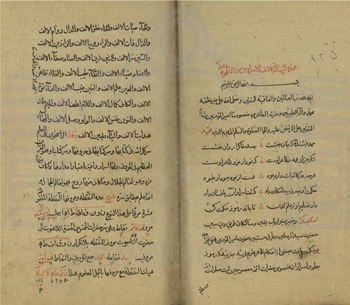
For reasons of space and readability, my translation below is slightly abridged (by about ten percent), but includes almost all lettrist analyses; the passages dropped either expand on Akbarian-Būnian cosmology or constitute rhetorical flourishes. The work is preserved in two known manuscripts in Iran: Qom, Marʿashī Library, MS 13678/4, ff. 46–53, copied in the eighteenth century; and Tehran, Majlis Library, MS 12653/4, ff. 140b–61b, copied by Muḥibb ʿAlī b. ʿAlī Yazdī in February of 1819 (see Fig. 1). As I did not have access to the first manuscript at the time of writing, the translation is based entirely on the second, which, apart from a few slips and several corrections, is clear and reliable.
Maḥmūd Dihdār Shīrāzī, Kashf al-asrār, Tehran, Majlis Library, MS 12653/4, ff. 140b–41a.

Unveiling Secrets
Maḥmūd Dihdār Shīrāzī
In the name of God, All-merciful, Ever-merciful.
Praise be to God, Lord of the Worlds, and the ultimate issue is to the godfearing (Q 7:128, etc.); God bless the best of His creation, Muḥammad, and his righteous Family and pure House, especially the Commander of the Faithful and Leader of the Godfearing, ʿAlī the Well-pleasing, upon whom and his House be blessings and peace to the Day of Doom.
Praise profuse as the gift of spirit,
as the gift of soul to this body of earth!
’Tis that which all besides is but its sites of manifestation
bodying forth its manifest light.
All that has being among existents
has it from the existence of its munificence,
Its wisdom the beautification of contingency
unveiling the secrets thereof as a gift to man.
It teaches by means of the science of divine proximity
establishing the allusive wisdom of Be! Footnote 27
To proceed: It will be evident to the illumined minds of masters of certain knowledge and travelers on the path of the manifest religion of the holy Lord of Messengers and the clear roads of the holy Commander of the Faithful that the proper understanding of various manifest principles of the lettrist occult sciences (ʿulūm-i gharība-yi jafriyya)—whose nonmanifest secrets are peculiar to the holy Infallible Imams (God's blessings and peace be upon them all)—are restricted to knowledge of what is signified by the dot, the modalities of the letters, the principles of letter permutation (zubur u bayyināt) and the promontories of their numerical values, likewise communicated through the allusive expressions of those holy eminences (blessings and peace be upon them). Those who know and operate with this noble and subtle science, who have taken their portion from the harvest of these holy eminences, include [in the first place] that holy guide possessed of sacral power (valāyat) Amir Sayyid Ḥusayn Akhlāṭī, as well as the eminences Shaykh Saʿd al-Dīn Muḥammad Ḥamūya, Shaykh Abū l-ʿAbbās Būnī, Shaykh Muḥyī l-Dīn Aʿrābī, Shaykh ʿAfīf al-Dīn ʿAbd Allāh Yamānī, and others (God sanctify their spirits), who have written books and treatises in explication of these allusive expressions. Their expositions notwithstanding, these realities and meanings cannot be understood by everyone, save those granted divine aid and who enter upon the track of servitude to the Holy Family (ghulāmī-yi ahl-i bayt) in all sincerity, begging of them this most useful effluxion.
An Explanation of the Accession
The Chosen One is him whom the whole world of being
sought just before coming into being.
The arena of Be! and it was is but his progeny,
angel, jinn, and human all his army.
His essence is the epitome of the two worlds,
his attribute Lord of the Two Weights.Footnote 28
His is the City of Knowledge, in that there is no doubt,
by whose virtue all prophets embarked on the sea of knowledge.
This Messenger, this mine of knowledge,
this ocean of goodness, this ship of grace—
’Tis he who said: “ʿAlī and I are of one light
and of one kind and of one soul.
If I am the city of knowledge, ʿAlī is its gate:
for only he can open its gates.”
Thus did he declare the Saint (valī) the secret knowledge of the Prophet (nabī),
thus did the Chosen One equate his state with ʿAlī's.
None but ʿAlī has this standing,
blazer of the trail to these mysteries.
Only he possesses the key to the gates of knowledge
and his sons successively after him.
After seventy years this secret
became manifest in the sixth generation.Footnote 29
The manifest W was then winnowed
to expose the A at its heart (WAW).
Just as W has A as its central long vowel
the opening of secrets comes from their center—
That is, from the leader of those speaking the truth
Jaʿfar, son of Muḥammad, the Veracious.
The revelation of secrets to him came as sciences
named and famed as jafr:
For jafr was promulgated by Jaʿfar the lordly diviner
till that it found its experts.
The ʿ added to jafr [to make Jaʿfar]
signifies the elapse of seventy years.
The gate of this glorious king
links to heaven as Moon to religion!
All I have here said in explanation
comes but from his explication,
So open your mind's ears and your heart's eyes
that you may find the path to riddling this saying:
Said the Imam Muḥammad, son of ʿAlī, son of Ḥusayn, son of ʿAlī, son of Abū Ṭālib (upon whom be peace): Our science is of that past and of that written [to be], a subtlety in the heart and a susurrus to the ear; we possess the Red Calfskin and the White Calfskin and the Codex of Fāṭima.
This treasury of secrets is
so jewel-bedecked that in the end
Young and old alike take their portion
from the talismanic seal of the Imams, now manifest.
The point being: all the [magic] that others possess
is taken from this shoreless sea,
And to the extent masters discourse of it aright
’tis but to explain the discourse of this Imam of humanity.
If you, like me, have some portion from him
’tis but two or three grains from the whole of his harvest.
The Explication (continued)
In no instance does this refer to those who would aggrandize themselves and dupe the masses by citing a little from the exoteric meaning of the Imams’ expressions, claiming their babble to be the true interpretation thereof, with the aim of deceiving the simpleminded and gullible. Beware, beware! For any intelligent person can distinguish between light (nūr) and fire (nār), and seeks the former and avoids the latter.
Fire destroys, light creates;
the one caresses, the other melts.
By the blessing of the revelatory spirit of the holy Commander of the Faithful and the Infallible Imams [after him] (God's blessing and peace be upon them all), this worthless wretch, Maḥmūd son of Muḥammad Dihdār, pen name “Eyewitness” (ʿIyānī), has learned the explication of somewhat of this science. He has therefore made so bold as to incorporate certain of their bejeweled and pearl-scattering sayings in the present treatise and explicate them concisely to the best of his ability, to serve as useful exemplar for right-thinking beginners to enter the ranks of the initiated, and as sufficient warning to crooked-minded impostors to quit the path of deception. Success is through God alone.
A Clarification
This undertaking is beyond my limit
being fit only for those pure of heart and body—
Yet I pray the Worshipped One
that He show me the way to the goal.
A Prayer
O Creator! By the might and glory of the Prophet
and the reverence due his virginal bride, [Fāṭima],
By the Prophet's two grandsons, Shubayr and Shabar,Footnote 30
by ʿAlī, by Muḥammad, by Jaʿfar,
By the miracles of Mūsā, by ʿAlī,
by the Muḥammad following,
By ʿAlī, by the merit of Ḥasan,
by Muḥammad, Imam occultly yet manifestly,
The ultimate Guide to religion with whom it concludes,
pivot to the cycling of the world;
By the commissionings of the great prophets,
by the prayers of the noble saints:
To this wretch, Eyewitness, grant opening
of the gates of knowledge and certainty,
And aid him in expounding these secrets
and explicating them in truth.
And God only gives success. In the name of God, through God, from God, to God: there is no power nor might save in God, the Exalted, the Supreme! O God, give us to see truth as truth and grant that we follow it; give us to see error as error and grant that we eschew it! Revive us again as You revived us before with knowledge and writing, and grant us faith and deputize us—for You alone answer prayer! O God, preserve us from slips of the tongue and errors of exposition by virtue of Your own essence and attributes and prophets and saints—for You are most gracious and answer prayer! In the name of God, All-merciful, Ever-merciful: all praise be to God, Who has irradiated the hearts of all worldlings with the lights of knowledge and certainty and opened the breasts of all gnostics with the effects of discernment and empowerment. The most perfect and complete and noble blessings and peace be upon the Sun of the firmament of prophethood and messengerhood, Muḥammad, the Chosen One, exalted, purified, and faithful, and upon his pure Family and holy infallible line, especially the Moon of the sphere of sacral power, Commander of the Faithful, Leader of the Godfearing, Chief of All Unifiers of the Divine, ʿAlī the Well-pleasing—upon him and his Family blessings and peace until the Day of Doom.
To proceed: The present treatise is but a drop from the overflowing oceans twain that are the Seal of the Prophets and the Lord of the Saints, to wit, Muḥammad the Chosen One and ʿAlī the Well-pleasing, upon whom be a thousand thousand blessings and encomiums until the Day of Doom—and God gives knowledge to whomever He will.
By way of blessing and auspiciousness, the treatise opens with the names of the Prophet and the Saint as analyzed through the derivation of their bayyināt and the terms equivalent thereto, as granted by the Creator of all worldlings. Said God Most High and Blessed: By means of the bayyināt and zubur (Q 3:184, 16:44). Said the Most High also: Calculate everything by its number (Q 72:28).
۞ khātam-i anbiyāʾ (Seal of the Prophets): the bayyināt of KhATM ANBYAʾ are ALFAYMLFWNAALF; these 14 letters equal 440, and 14 plus 440 equals 454.
۞ shāh-i awliyāʾ (King of the Saints): the bayyināt of ShAH AWLYAʾ are YNLFALFAWAMALF; these 14 letters equal 440, and 14 plus 440 equals 454.
۞ Muḥammad rasūl Allāh (Muḥammad the Messenger of God) and zawj-i batūl (Husband of the Virgin [Fāṭima, ʿAlī]) likewise both equal 454, which reduces to 13, which reduces to 4; and 13 plus 4 equals 17.
۞ The bayyināt of zawj-i batūl are AAWYMAAAWAM, which equals 108, plus the 2 dots of the Y equals 110, which equals B plus ḥaqq (ḤQ, or 2 + 108), and also equals ʿAlī (ʿALY = 110), hence the phrase “by the right of ʿAlī”/B is the reality of ʿAlī.”
These forms are two but have one meaning
nor in their form or meaning is there any doubt.
The one is the Seal of all prophets,
the other the King of all saints.
These two are one light from which were kindled
the Sun and the Moon by God's decree.
This is a glorious secret by the Eyewitness revealed
in manner sublime, by the grace of God,
This a gleam from the mountain of light,
this a drop from the ocean of mysteries.
By the grace of the Chosen One, Maḥmūd has fashioned a key
to this treasury overflowing with pearls and jewels,
The effluxion of spirit has made him master of mysteries
and unveiled this gorgeous bride.
Every subtle point that he has here made clear
his heart's ear heard from his bejeweled expression.
It is a gracious gift from God to this Eyewitness
who beheld the heavenly Sun shining in the darkest night:
For he took as kohl the dust of the Well-pleasing's sandals
and used it to illumine the eyes of his heart.
The Beginning of Unveiling Secrets
Lord, open my breast and ease for me my task, and unloose the knot in my tongue that they may understand my words! (Q 20:25–28). Know—God bring you to the Lordly secret and furqanic knowledge—that One (waḥda) was the first of all existents in reality. It gave rise in turn to the dot (nuqṭa), the first of all sensible objects in potentiality: for it is the origin of the sphere, the first of all subjects [of predicates] in actuality. The science of the dot [as key] to the reality of the letters is therefore a sublime and supremely demonstrative science according to the master expositors of divine Oneness and those who have experienced it through single-minded devotion. Knowledge of the secrets of the letters is thus predicated on [a thorough understanding of] the principles of this science, particularly as established in the allusive expressions of the Great Prognosticon (al-jafr al-kabīr) (blessings and peace from God the Exalted, the All-aware, upon its inventor). As such, the secrets of divine Oneness are preserved in the science of the dot and the letter, not in linguistics or grammar!
Certain of these secrets are explicated, by God's aid, in the present noble treatise, which is therefore titled Unveiling Secrets—but success is through God alone, the Almighty, the All-forgiving. Its author is the wretch Maḥmūd son of Muḥammad Dihdār (God forgive them both), who craves the mediation of the chosen Prophet and the care of the warrior Saint. But God leads whomsoever He will to a straight path.
Therefore know, dear reader, that this is a rare science and a wondrous secret, and peculiar to the beloved of God's beloved, the triumphant Lion of God and besought of every seeker, the Commander of the Faithful, ʿAlī son of Abū Ṭālib (upon him be blessings and peace). After him it passed exclusively to his noble and heroic sons, then to all those who follow them till the Day of Resurrection: they are the stars of the firmament of religion and the planets of the spheres of sure knowledge (upon them be the blessings of God, the Manifest King). For as the Lord of Messengers and Seal of Prophets (the blessings of all those who bless be upon him and his House) declared: I am like the Sun, and ʿAlī like the Moon, and my children like the stars—follow any of them and you will be guided aright (truthfully spake the Messenger of God). He (blessings and peace be upon him and his House to the Day of Resurrection) likewise said: I am the city of knowledge, and ʿAlī is its gate. And said the Saint of God and Legatee of the Messenger of God, Commander of the Faithful and Leader of the Godfearing, ʿAlī the Well-pleasing (upon whom be a thousand blessings and greetings and encomiums), on the knowledge of the dot and the letter: The first created thing God Most High manifested was the dot. And when the dot beheld its createdness, it prostrated itself. Seeing its humility and gratitude, the Creator approved of its prostration and extended it, whereupon it became an A, site of [primordial] increase. Therefore the first of engendered beings manifested was the A. Thus does that letter's manifestation denote exclusive divine Oneness. For as it has been said: “The first thing God Most High manifested was a notional dot, before the intellect and before every other thing.” Said the Saint of God: Knowledge is a dot that is multiplied by the ignorant. Again: All the secrets of God Most High are contained in the heavenly scriptures; everything in those scriptures is in the Quran; everything in the Quran is In its Opening [sura]; everything in the Opening is in its opening basmala; everything in its basmala is in its B; everything in the B of its basmala is in the dot under the B. I am the dot under the B (truthfully spake the most knowing Imam and Saint of God).
Said the perfect Imam Abū Muḥammad Ḥasan, son of ʿAlī, son of Abū Ṭālib (upon whom be blessing and peace): The knowledge of everything is in the Quran, and the knowledge of the Quran is in the [disconnected] letters at the beginning of the suras, and the knowledge of the letters is in LA, and knowledge of LA is in the A, and knowledge of the A is in the dot, and knowledge of the dot is in the primordial knowledge of sempiternity, and knowledge of sempiternity is in the [divine] will, and knowledge of the [divine] will is in the occult profundity that is the [divine] ipseity, and knowledge of the occult profundity that is the [divine] ipseity is in There is nothing His like (Q 42:11) (truthfully spake the valiant Imam, upon whom be blessing and peace). And said the speaking Imam, the irradiating Sun, the Veracious Jaʿfar son of Muḥammad (upon him and his noble fathers a thousand thousand blessings and peace): The secret of God Most High is in His books, and the secret of His books is in their letters, and the secret of their letters is in the A, and the secret of the A is in the dot, and the secret of the dot is in inclusive Oneness, and the secret of inclusive Oneness is in exclusive Oneness, and the secret of exclusive Oneness is in the Ipseity, and the secret of the Ipseity is in the Occult, and the secret of the Occult is in the Occult of the Occult and the No-knowing and the Cloud. Or in another version: The secret of the dot is in the Ipseity, and the secret of the Ipseity is in the Occult, and the Occult is in the Occult of the Occult and the No-knowing. Said he also (upon him be blessing and peace): The dot is the secret of the Command, while the A is the secret of Creation (truthfully spake the Imam of Mankind, upon whom be blessing and peace).
As such, the science of the dot is a most recondite science investigating the reality of the letters and the attributes of the ipseity of the divine essence. Let me therefore embark upon an explication of some part of it, this through the overflowing grace of the All-generous, God the All-knowing King willing.
Know, my brother, that the dot is a gleam from the light of the absolute essence that is the Ipseity, which resides in the Occult and the Occult of the Occult and the No-knowing and the Cloud; and that gleam manifests its sublime, glorious, and pure attributes of Will and Love, manifested in Command and Creation, respectively. For as the Most High said in a holy hadith: I was a hidden treasure, but loved to be known; so I created creation in order to be known.
The origin of all letters is the dot in the center of a circle:  . This dot self-manifests from the center to the circumference by way of the two dots governing all divine attributes, to wit, the gleamings of Beauty (jamāl) and Majesty (jalāl):
 . This is the exclusive union encompassing all the levels of the written letters and their ascending and sensible forms as comprised by their peculiar features, which forms and entities are but veils. The relation of these forms to the cycling of letters and words is that of the first entification to that entified among the various levels of the entities behind engendered existents. The manner in which they comprehensively efflux through all existents, whether intelligible or sensible, and manifest among the universals, is as follows:
 . The center [dot represents] the absolute reality, and its circumference the secret of the Universal Spirit, the Universal Intellect, and the Universal Soul.
As for the motion of the dot, it has two modes: linear, thusly:  , and circular, thusly:
 . The linear motion is the secret of the exclusive Oneness that is the A, denoting the Command and manifestation and their secreting, while the circular motion is the secret of the eight positive divine names. The reality of the dot is by virtue of its occultation in the form of the A yet manifestation thereby; the form of the A is likewise occulted in the forms of the written letters yet manifests thereby, as well as by the oral articulation of the letters through the extension of human breath. The reality of the A likewise is the secret of the supernal Pen through its graphic correspondence. For as the Chief of Messengers and the Seal of Prophets, Muḥammad, the Chosen One (God bless and keep him and his Family) said: The first thing God created was the Pen.
Given that the A is the unificatory form of the dot, through which its reality subsists, the dot is its constituter, for all that it is subsumed and veiled thereby. The bayyināt of the A are therefore the secret of inclusive Oneness, that is, the root of Manyness and origin of the Names, as definitively stated in the clearest of terms in the divine Book and Speech: By means of the clear signs (bayyināt) and the books (zubur) (Q 3:184, 16:44) and He has reckoned everything by number (Q 72:28).
The specifics of the secrets of the bayyināt are as follows:
[The bayyināt of] A (ALF > LF) equal 110, equal to lā ilāha illā huwa (There is no god but He). Halved it is 55, equal to [the divine names] Answerer (Mujīb) and Enduring (Dāʾim). Fifthed it is 22, equal to Beloved (Ḥabīb). Tenthed it is 11, equal to He (Huwa). These divisions added equal 88, equal to Clement (Ḥalīm). A is the opening key [letter] of the [Prophet's] name the Most Praised (al-Aḥmad) (God bless and keep him), whose value is one (aḥad), in Persian yakī (YKY), which word is the secret of the M of al-Muḥammad (God bless and keep him) and the secret of the ʿ of al-ʿAlī (blessings and peace be upon him), thusly: YKY equals 40 which equals M; YAKAFYA equals 130 [sic] which equals ʿ. M is the opening key of mulk and malakūt, the manifest [physical and psychical realms], as well as Love (maḥabba) and Affection (mawadda) and the Praised Station (al-maqām al-maḥmūd), wherein lie the secret of the terms Kingdom (mulk) and King (malik) and Angel (malak); it likewise closes Seal (khātam) and Adam (Ādam). 40 [spelled out], ARBʿYN, equals 333, the secret of the noble name Abū l-Qāsim Muḥammad, and the secret of this number is Ṭ (9), which is likewise the secret of the being of Adam (3 + 3 + 3 = 9). For the number 40 is the secret of the singular Intellect (ʿaql), the singular Soul (nafs), the 9 spheres (aflāk), the 12 signs of the zodiac (burūj), the four elements (ʿanāṣir), the three kingdoms (mavālīd, scil. mineral, plant, and animal) and [the singular orders of] angel (malak), jinn (jānn), and human (insān) [whose values added equal 40]. In this number is therefore a subtle point as to the creation of the being of Adam (upon him and our Prophet be peace), as God Most High intimated in [one of] His direct statements (aḥādīth qudsiyya): With My hands did I knead Adam's clay for forty mornings. Sang the Sayyid and Ḥājj—that Harmony (Niẓām) of Reality and Law and Path and Truth—Maḥmūd al-Dāʿī (God sanctify his secret) in explication of this hadith:
For forty mornings my beloved had his hands in my clay:
like clay dropping from my beloved's hands I come, climbing.Footnote 31
Allusions of 9: Spirit (rūḥ > RWḤ), Intellect (ʿaql > ʿQL), and Soul (nafs > NFS) have three letters each, which equal the nine of Adam (Ādam > [ADM = 45 >] 9), and similarly Beginning (avval > AWL), Middle (vasaṭ > WSṬ), and End (ākhir > AKhR), as well as Spirit (jān > JAN), Heart (qalb > QLB), and Body (jism > JSM).
Allusions of 7: Spirit (rūḥ > RWḤ), Intellect (ʿaql > ʿQL), and Soul (nafs > NFS) with Fire (nār > NAR), Air (havā > HWA), Water (mā > MA), and Earth (turāb > TRAB) make 7.
Allusions of the 3 dots: Black refers to the Essence (zāt), white refers to the Attributes (ṣifāt), and red refers to the Creation (khalq). Sang the Sayyid of Free Men and Lamp of the Community, the Truth, the Path, and the Law, Qāsim al-Anvār (Splitter of Lights):
The dot comes as three. Those who don't know
when you hear this, assent!
Black then white, for certain,
and its third is red, so see!Footnote 32
As for the lettername of M (mīm), it has two Ms and a Y. The first M stands for Beloved (maḥbūb) and the second for Lover (muḥibb), and the intervening Y (10) for the secret of love (ḥubb) and affection (wudd), thusly: ḤB and WD both equal 10. Whoso tastes the sweetness of these secrets, his heart shall never die within his body, but live always in the worlds twain.
A Subtle Point
Know that the name of the dot (nuqṭa > NQṬH) is the treasury of all the Names revealed to the Arab Prophet in the Quran: N—by the Pen and what they inscribe (Q 68:1), Q—by the glorious Quran (50:1), ṬH—We have not sent down the Quran that you should suffer (20:2). All of these Names incorporate the three dots as they occur in the isolated letters, which three dots are the basis of the A. As for B, it is the glory (bahāʾ) of the A, the T its crown (tāj), the Th its praise (thanāʾ), the J its beauty (jamāl), the Ḥ its life (ḥayāt), the Kh its creation (khalq), the D its perdurance (davām), the Dh its essence (dhāt), the R its spirit (rūḥ), the Z its beauty (zayn), the S its secret (sirr), the Sh its honor (sharaf), the Ṣ its purity (ṣafāʾ), the Ḍ its brilliance (ḍiyāʾ), the Ṭ its goodness (ṭīb), the Ẓ its manifest aspect (ẓāhir), the ʿ its knowledge (ʿilm), the Gh its density (ghayn), the F its understanding (fahm), the Q its power (quwwa), the K its perfection (kamāl), the L its kindness (luṭf), the M its dominion (mulk), the N its soul (nafs), the W its connection (vaṣl), the H its guidance (hidāyat), the Y its certitude (yaqīn).
Say the rooted in knowledge (Q 3:7, 4:162): The secret of each community lies in its Book, and the secret of that Book lies in its letters. Thus the secret of our Book—the glorious Quran—is in its letters, which have secrets vast when accounted by their numerical values. The odd among them pertain to the realm of Majesty (jalāl), and the even among them to the realm of Beauty (jamāl). But God knows best His secret truths.
Explication: The numerical value of nuqṭa fully spelled out in ten letters, NWNQAFṬAHA, is 303, which equals nearest (aqrab > AQRB), while god (ilāh > ALH) equals 36. The name Enduring (Dāʾim > DAYM), which equals 55 and has five dots when fully spelled out, is the secret of fivefold presences, from the divine to the human. Without repetition, the letters of nuqṭa are 7, NWQAFṬH, and their dots four, which added equal 11. This is same value of the He in He is God (huwa ʾLlāh > HWALLH), God being 66, the product of 5 times 11. The configuration of the dot and its letters according to the standard gematrical method is NQṬH (50 + 100 + 9 + 5 = 164). There is no god but God (lā ilāha illā ʾLlāh > LAALAHALALLH) equals 165, when reduced according to the smaller gematria (165 > 12 > 3) comes to 3, the secret of the letters of the Greatest Name in the Holy Quran and Mighty Furqan: ALM. This is the Greatest Name and Holiest Secret, sent down from the Presence of exclusive Oneness to the Presence of the Most Praised (God bless and keep him and his Family), which is composed of three letters. Its beginning A stands for exclusive Oneness (aḥadiyya), its middle L for Subtle [Nonphysical Form] (laṭīfa), and its final M for the Muḥammadan [Station] (muḥammadiyya) (God bless and keep him).
I shall explicate but one gleam of its radiant gleams and one subtle point of its many such points, this [likewise] according to the rule of the zubur and bayyināt—though God knows best the reality of matters occult.
An Explication of the A
A is the opening key of “exclusive Oneness” (aḥadiyya) and of “secrets” (asrār), and none know its interpretation but the rooted in knowledge. For they declare the clear bayyināt [of the letter] by way of allusion: LF equals 110, half of which is 55 and a tenth of which is 11. Their sum is 176, equal to the sum of God—there is no god but He (Allāh lā ilāh illā huwa > ALLHLAALHALAHW), a phrase with 14 letters. Half of 176 is 88, a quarter 44, a tenth 22, half of which is 11, whose sum is 165, equal to the value of There is no god but God (lā ilāh illā ʾLlāh > LAALHALAALLH). According to the smaller gematria, L equals 3 and F equals 8, the sum of which is 11, the value of He (huwa > HW), whose letters spelled out (HWWAW) equal 19, which reduces to 10, which reduces to 1. This is the secret of the A. But God knows and judges best.
An Explication of the L
L is the opening key of “subtlety” (laṭīfa) and “grace” (luṭf). Spelled out, its lettername LAM consists of 3 letters whose added value is 71, and by gematria of the root is 30, half of which is 15, a third of which is 10 and a sixth of which is 5; their sum is 134, equal to the value of laṭīfa (LṬYFH). But God knows best the truth of things.
An Explication of the M
M is the opening key of “kingdom” (malakūt) and [realm of the] “visible” (mushāhada), as well as the secret of the name of the Meccan and Medinan, Qurayshī and Abṭaḥī Arab Prophet, described above with respect to the number 40. Fully spelled out, this supreme name is ALFLAMMYM, which equals 272, as does “Arab” (ʿarab > ʿRB). Its letters added to their dots equal 12 (with [the Prophet's title] “Purified” [muzakkā] equaling 77), and the sum of 272 and 12 is 284. This is an amicable number to “Beloved” (maḥbūb > MḤBWB = 58) and its divisors amicable to “Lover” (muḥibb > MḤB = 50) by the following method: 284 divided by two is 142 and quartered is 71, and its levels come to 7, the sum of these divisors being 220, which is equal to the [divine name] Pure (ṭahūr > ṬHWR), Say: He is God, One (Q 112:1) (qul huwa ʾLlāhu aḥad > QLHWALLHAḤD) and “Muḥammad is the Prophet of God” (Muḥammad nabī ʾLlāh > MḤMDNBYALLH). This in turn is equal to the value of the 2 letters RK, which 2 added to 220 equals 222, the value of “ʿAlī is the Saint of God” (ʿAlī walī ʾLlāh > ʿLYWLYALLH)—upon them both be the blessing of God, the All-knowing King. To finish the exposition of M: it alone equals 40 and its lettername mīm (MYM) equals 130, the same value as ʿ.
As for the word “seventy” (sabʿīn > SBʿYN), it equals 192, the same value as “Imam ʿAlī” (imām ʿAlī > AMAMʿALY). And if the vowel is removed from the middle letter of alif, it gives alf (1,000), the secret of Gh, the terminus of the single letters of the alphabet and first of the compound thousands. The dot over the Gh thus refers to the multiplicity of [divine] attributes, while the dot removed makes it ʿ, the secret of the name of the [divine] essence, as an analysis of the zubur and bayyināt shows: Allāh (ALLH) equals the sum of the bayyināt of ʿ (YN), Y (10 > 1) and N (50 > 5), which is also 66. And God speaks the truth and guides on the way (Q 33:4).
As for the equivalence between the word “dot” (nuqṭa) and the names of the Prophet and the Saint: It has four letters, NQṬH, which reduced are 5-1-9-5, adding up to 20, which reduces to 2, which is B. Similarly, MḤMD (Muḥammad) has four letters, which reduced are 4-8-4-4, adding up to 20, which reduces to 2, which is B. And ʿLY (ʿAlī) partially reduced is 7-3-10, adding up to 20, which reduces to 2, which is B.
Know (God illumine your heart with the light of Oneness) that the opening letter of the word nuqṭa in speech is the N, so the form of the dot is in the three letters of N (NWN), which equal 106. Adding two doubled As or two Bs, this is numerically equivalent to ʿAlī (ʿLY) (that site of manifestation of wonders and marvels and master of the knowledge of the ancients and the moderns, upon him be a thousand blessings and peace), which equals 110. For as he (upon him be blessing and peace) stated in his Sermon of the Clear Declaration: I am the secret of secrets; I am the tree of lights; I alone have the keys to the Occult, known to no one after Muḥammad but me (truthfully spake the Saint of God and Legatee of the Messenger of God, upon them both be God's blessings).
As for ʿ, it is the opening letter of “knowledge” (ʿilm), “intellect” (ʿaql), “love” (ʿishq), “high rank” (ʿuluww al-darajāt), “clemency” (ʿafw), “end” (ʿāqiba)—and likewise the opening letter of the Names “Sublime” (ʿAlī), “Exalted” (ʿĀlī), and “Most Sublime” (Aʿlā). The secrets of this letter are many, though God alone is the All-knowing, the All-aware.
ʿYN: its letters and dots added make 6, its bayyināt (2 letters, YN) plus their value (60, reduced to 6) make 8, and the base value of ʿ is 70, which reduces to 7—and 786 is the value of In the name of God, All-merciful, Ever-merciful (BSMALLHALRḤMNALRḤYM), 784 [plus] its 2 bayyināt. [Moreover, its 2 bayyināt] equal 60 (the value of S), half of which (30) added to a sixth (10) equals 40 (the value of M). Their base value of 60 added to their tenth, 6, equals the value of Allāh (ALLH = 66), the [divine] name of Majesty.
To further clarify the bayyināt of the ʿ: There comes forth from their inward parts a potion of various hues wherein is healing for mankind—surely a sign for those who reflect (Q 16:69) (God the Exalted, the Almighty, speaks the truth). The bayyināt of Allāh (LFAMAMA) equal 193, which equals “He is the Riser” (huwa ʾl-Qāʾim > HWALQAYM), the value of QṢJ, whose bayyināt (AFADYM) equal 136, which is the value of “believer” (muʾmin > MWMN), as well as the value of “say!” (qul > QL) with its base of “saying” (qawl > QWL) as arranged in a magic square, whose bayyināt (AFAMAW) equal 129, the value of [the divine name] “Subtle” (laṭīf > LṬYF). This is the value of QKṬ, whose bayyināt (AFAFA) equal 163, the value of [the divine name] “Preceder” (sābiq > SABQ). This is the value of QSJ, whose bayyināt (AFYNYM) equal 191, the value of [the divine name] “Hearts’ Beloved” (ḥabīb al-qulūb > ḤBYBALQLWB). This is the value of QṢA, whose bayyināt (AFADLF) equal 196, the value of [the divine name] “He is the Pre-eternal” (huwa ʾl-Qadīm > HWALQDYM). This is the value of QṢW, whose bayyināt (AFADAW) equal 93, the value of [the divine name] “O Praiseworthy” (yā ḥamīd > YAḤMYD).Footnote 33 This is the value of ṢJ, whose bayyināt (ADYM) equal 55, the value of [the divine name] “Perduring” (dāʾim > DAYM). This is the value of NH, whose bayyināt (WNA) equal 57, the value of [the divine name] “Glorious” (majīd > MJYD). This is the value of NZ, whose bayyināt (WNA) also equal 57, which added to the number of its letters, 3, make 60, and 60 added to its reduction, 6, makes 66, the value of “God” (Allāh > ALLH)—and God make His light complete!
Verifiers hold that the [divine] essence combined with an attribute constitutes a name in its own right for their purposes, and speaking it makes it the name of a name. So sings the rigorous, gnostic verifier and sayyid Niʿmat Allāh, Grace of the Religion, the Law, the Path, and the Truth, in one of his accessions (vāridāt):Footnote 34
The word Allāh is but the name of His name—
the second the treasury, the first the talisman protecting it.
O God! Aid me in achieving what You love and delight in and put away from me everything You hate, this by virtue of Your essence and Your attributes, for You are the All-knowing, the All-wise!
The Divisors of the Two Numbers
The value of ʿ is 70, half of which is 35, a fifth of which is 14—the value of [the divine name] “Giver” (wahhāb > WHAB)—, a seventh of which is 10—the value of abjad (ABJD)—and a tenth of which is 7—the value of “eternity” (abad > ABD). These values added make 66, equal to [the divine name] “Guarantor” (wakīl > WKYL). The value of this lettername, ʿayn (ʿYN), is 130, half of which is 65—the value of [the divine name] “Judge” (dayyān > DYAN)—, a fifth of which is 26—the value of [the divine name] “Folded” (ṭāwī > ṬAWY)—, a tenth of which is 13—the value of “One” (aḥad > AḤD). These values added make 104, the value of [the divine names] “Actor” (jāʿil > JAʿL) and “Causer” (musabbib > MSBB). 104 plus 66 makes 170, the value of [the divine name] “Most Holy” (quddūs > QDWS). The value of ʿ plus that of its lettername make 200, equal to [the divine name] “Benefactor” (munʿim > MNʿM). Reduced and added again, ʿ and ʿayn make 220 (200 > 20), the value of “Muḥammad is the Prophet of God” (Muḥammad rasūl Allāh > MḤMDRSWLALLH); further reduced and added (200 > 20 > 2), they make 222, the value of “ʿAlī is the Saint of God” (ʿAlī walī ʾLlāh > ʿLYWLYALLH).
[…]
M opens the name al-Muḥammad and ʿ the name al-ʿAlī. Said the Messenger of God (God bless and keep him and his House): I and ʿAlī are from one light—and he spoke the truth. For M (40) plus ʿ (70) equal 110; ʿAlī equals 110, which reduced equals 2, which equals B; and 2 plus 110 equals 112, which equals “Saint of God” (walī ʾLlāh > WLYALLH), whose value is 112.
O Eyewitness!Footnote 35 Prepare yourself
to explicate this allusion with proofs.
An Explication of the Allusions
You who are intelligent and able to comprehend,
hear the explication of this pure one—if you too are pure:
All that manifests in the realm of being
subsists through the being of God,
Without peer and without like,
Lord of Lords and Knower of the Unseen!
Gh as [divine] oneness and ʿ as divine entifications give 200 which reduces to 2, 222 being the value of “Lord” (rabb > RB = 202 + its bayyināt YY = 20), which name comprises all the entifications by way of Muḥammad (MḤMD = 92) added to ʿAlī (ʿLY = 110). Reduced only once it gives 20 plus 220, 220 being the value of “Muḥammad is the Prophet of God” (MḤMDNBYALLH), and reduced twice it gives 2 plus 20 plus 200, 222 being the value of “ʿAlī is the Saint of God” (ʿLYWLYALLH) as well as [ʿAlī's sobriquet] “Lion” (Ḥaydar > ḤYDR). Adding them as digits (2 + 2 + 2) gives 6, the value of W, the opening key of “sainthood” (walāya). Further adding 6 to its half, 3, to its third, 2, to its sixth, 1, gives 12—hence “Imam” (AMAM > ALFMYMALFMYM).
The servant remains a servant however much he ascends,
the Lord remains Lord however much He descends.
The heaven of religion has a full Moon,
the exalted King of All Men, ʿAlī!
By declaring knowledge is a dot
he disclosed the secret basis of God's relation to creation.
Said he: the secret of the knowledge that is in the divine Speech
lies in the cryptic implications of the dot of the B.
The dot under the B is my very being:
I behold the mystery of the two worlds.
For its meaning is most assuredly
the A itself, the secret of the realm of the Unseen.
Thus did he pierce the pearl of Ask me—
then said: before you lose me.
How happy are they who behold his face,
who pluck a rose from his garden!
His is the path that guides them,
his the truth that opens their souls.
But how can I, unknowing as a corpse
and alien to the path of truth,
Possibly explicate this recondite matter?
Only through the grace of my Teacher.
A Plea
O Saint of God, by your perfect grace
fill my cup with the sweet waters of your grace!
Give this Eyewitness to taste the wine of realization
and grant him success by your munificence.
Thus has he by the effluxion of your glorious name
acquired a name for himself through servitude to you.
One and one, twice one (huwa > HW = 11):
how can reason doubt one?
There is naught but one in all the numbers,
from 1 to 1,001 only one (1,001 > 11 > 2 = 13 = aḥad > AḤD).
Know that Oneness pervades all here
while manyness is merely extrapolation therefrom.
One with one is eleven
in which we behold the value of the Supreme Name, “He” (huwa).
One with twice thirty make seventy,
the value of ʿ.
K and N (kun), the creative command,
likewise make seventy.
Seventy is thus the secret of the essence of existence,
of all that was, is and is to come.
Making-One
Manifest and Occult, Right and Left,
Behind and Before, Above and Below:
Account them not the place of the Real—
and yet they are the Real, without Whom nothing is.
Nonbeing becomes being through His self-manifestation,
the two worlds pervaded by their Lover's appearance.
Thus does the Manifest come from the Unseen
and the Nonexistent become the mirror of Existence.
Entifications
Every engendered being that is
is but a shadow of the Essence, which only appears.
An example of this principle I shall give
to drive away all doubt:
In that B comes after A
it appears as its shadow,
And A as the veil of B's dot
which only B's pith can remove.
For A is 1 and B is 2:
J (3) thus appears from the name of B (bā > BA = 2 + 1).
Three makes W and 14
and so does such multiplicity come to be.
Yet from the point of view of the Essence
it can only be established metaphorically,
And since it has no thatness in itself
can hardly be a comment on true Oneness.
A Verification of These Entifications
Before the gaze of those who witness
is naught but the Real; nothing else exists.
As gnostics have verified, the Essence that is the true One can nowise be addressed by multiplicity, and likewise incomparable is the infinitude of the Essence and the Face and the Soul, for His being (be it exalted) is free of all multiplicity. All existents are but a gleam from the rays of His light, as is alluded to in the sayings All that is upon the earth is perishing—yet still abides the Face of your Lord, majestic, splendid (Q 55:25–26) and All things perish but His Face (Q 28:88).
[…]
Verifiers say: That which exists cannot not exist, and that which does not exist cannot exist: absolute nonexistence cannot exist. The exception here is the written form of this very word [nonexistence (ʿadam)], or its spoken form, or its form when engraved on an object, the reality constituting these three forms of existence—written, spoken, and engraved. And while one of these forms is aural, and the other two visual, absolute existence itself has no visual existence in reality, and cannot actually be applied to these three forms. For as it is said: “There is no existent but God!”
An Explanation
Those whose hearts see
know that nothing exists but the Real.
Every existent apart from God
is but a mirror showing God,
These mirrors making visible the reality of His essence
by reflecting His attributes.
Thus does He become manifest and the site of mirrored manifestation
manifesting in every mirror.
For all that His essence is hidden from sight
His attributes are seen in every mirror.
Theoretical Verifications
The basic digit places for representing numerical multiplicity are four, while one is the genesis of all other numbers. These four-digit places are the units, the tens, the hundreds, and the thousands, as established in the gematrical values of the letters: from A to Ṭ are the nine units; from Y to Ṣ are the nine tens; from Q to Ẓ are the nine hundreds; and Gh is the first of the thousands. This organization corresponds to the four elemental natures; most of the divine names likewise have four letters. In the number four are endless occult properties, which are, however, beyond the scope this treatise—but “the free man needs no elaboration.”Footnote 36
A Simple Example of the Occult Properties of the Gematrical Value of All-knowing (ʿalīm > ʿLYM > 4,444)
Every divine name that you invoke the number of times written under the name “All-knowing” above [i.e., 4,444] is certain to elicit a response, and this number is to be recited according to its four digit places—units, tens, hundreds, thousands. One of the configurations of these four places is their form as 160, and 4 plus 160 equals 164, the value of nuqṭa (NQṬH, dot), which when reduced (164 > 11 > 2) is the value of B. But according to the digit places these four forms come out to 4,444, the number of invocations necessary.
A Clarification
This point on the dot of the B (ب) have I boldly declared to faithful friends:
The 1 with 1 here in view
makes 11 by reckoning,
And when the dot increases further
a treasury of secrets is revealed therein:
The two 1s within the dot
may both be raised by digit places.
When these two 1s are befriended by the dot
each are considered the beginning of multiplicity:
For when the dot aids these two
it makes the first 10 and the second 100.
This dot is none other than that of the B
from which manifests the secret of God!
[That is:] These two forms whose meaning is O He (yā hū = YA HW = 11 11)
are in the points of There is no god but He (lā ilāh illā hū = LAALHALAHW = 110)—
And 110 is the secret behind the letters of ʿAlī's name
from which manifests the mystery of the Creator.
My purpose in this exposition is to glorify him
whose sweet fragrance fills my senses!
His name restores my soul,
its utterance feeds my spirit and body both,
Remembrance of ʿAlī is my eternal heart's litany,
the nādi ʿAlī on my lips forever.
Thus repeating it I make his name known
that I may repeatedly profit from its blessings.
For ʿAlī (ʿLY = 110 > 11 > 2 > B) is two 1s as shown by this B
whose dot manifests therefrom.
When the two 1s are properly joined
they become wholly one in form:
Any who beholds its form
must immediately count it the letter B,
For the dot beneath it
removes the veil of that letter.
How wondrous to witness this—
these two manifesting in existence as one!
Two become one to manifest two 1s,
thereby moving multiplicity to unveil herself.
Oneness sits veiled in the A
while manyness shows her face in the B—
Yet it is the dot that is [primordial] Oneness
that manifests so mightily to distinguish the B!
Three dots define the A—
in this wise does the A appear.
And yet the dot is hidden within the A,
only distinguished then recombined in the letter Th (ث ).
So does oneness manifest under the B (ب ),
whose twoness only manifests in the T (ت ).
The letter Th, separating and combining,
completely manifests this order.
Like a globe does the dot appear,
becoming A and B and T and Th.
A Gnostic's Saying
Enlightened seekers hold these three dots
to be individually distinct, as follows:
The first they call the Holy Spirit,
the secret of the divine essence.
The second they call the Spirit of God
from which sainthood most assuredly proceeds.
The third they call the Faithful Spirit
that defines prophethood.Footnote 37
From He is the First and He is the Last,
from He is the Occult and He is the Manifest,
Have expositors derived this explanation
and eyewitnesses defined these dots.
Attributes of the Three Dimensions
The dot becomes line and line becomes plane
and both then open onto body.
The line that is A is the plane of B,
then J makes up its talismanic body,
Which is defined in the world of being
as possessing length, width, and depth.
But my thought has strayed from its objective
and is here wide of its mark:
I return to my explanation of the dot under the B,
an operation that slays my heart.
A Prayer
O Lord, grant me your grace
and crown my efforts with success!
Wake me fully
and fill my cup with the wine of ecstasy!
Make me know the truth
and lead me not to the laze-abouts’ alley!
May Your grace accompany on this path
and make me know the secret of Oneness!
Keep me with Your mercy
and guide me on the way!
An Act of Gnosis
When the dot is deleted and the 1 comes forth
2 is reduced to two 1s,
Becoming 110, the form of the B,
and its dot beneath manifest.
The dot is the treasure-house of the divine mystery
in that it serves to distinguish the letter B.
Manifest, this number is equal to B;
occult, to the Real (ḥaqq > ḤQ),
Which equals 110. Minus 2
the number 108 emerges,
Which equals Ḥ plus Q, 8 plus 100:
recite therefrom the name the Real.
This is but one point from the mysteries of the dot,
but one pearl from its treasure hoards,
That I disclose for the benefit of the intelligent and faithful,
that I thread for the benefit of the pure.
Thus do I pull back the veil from its meaning
and reveal the path to its riches.
My name is Eyewitness, and this is what I have eyewitnessed:
my exposition discloses secrets.
The recesses of my mind
hide a treasure of pearl and coral.
If the surface sense remains opaque
to those who see only surface, that's their own failing.
Thanks be to God that I have kept my inward self
replete by the grace of the Living, the Forgiving!
But to those who understand
I am pure within and without.
Verifications
The word dot (nuqṭa > NQṬH) has four letters
which have three dots in total.
Those who know their arithmetic
know that the sum of 1 to 4 equals 10—[the tetractys].
Thus 3 added to 10
reveals the beauty of the name One (aḥad > AḤD = 13).
As you can see, these three letters
that come to 13 equal this sum.
Likewise, 13 added comes to 4,
and its three dots correspond to its three letters.
Thus is the word “dot” occult in its number
but manifest in that of the word “one.”
A Principle
You who recite this secret
reflect on it while you recite!
Observe closely its recitation
that you may penetrate the cryptic secret of number.
I shall break the talisman on the treasury that is Name,
demonstrating this principle with the example of one Name:
“God” (Allāh > ALLH), the supreme Name—
count its number that I may explicate aright.
It comprises four letters, each its own site of analysis,
here exemplifying the four place values of number.
Its opening A is the units
which manifestly makes 1.
Its second letter, L, belongs to the tens,
which makes 300.
Its third letter, L, makes 3,000,
duly passing beyond to the hundreds.
The value of its fourth letter,
normally 5, here takes the place value of thousands.
Added all together, the sum is clear:
8,301.
And when you remove the place values,
the number 13 remains.
Behold the treasury that is the talisman of number!
For this is the same value as the name “One” (aḥad > AḤD = 13).
A Classification
A (1) is units, L (30) is tens, L (300) is hundreds, H (5,000) is thousands—all told equivalent to ḤGhShA (1 3 1 8), lowered by a digit place, which equals “one” (aḥad > AḤD = 13).
When will you think to invoke and seek?
You must invoke every name like this.
Therefore learn from me this invocation by way of inculcation:
In the name of God, All-merciful, Ever-merciful. My God! I ask You by virtue of Your perfect names by which You have manifested Yourself in Your sole and exclusive knowledge of Your own essence that You activate them for me to accomplish my desires by necessity of Your Reality, that I may praise You in a way worthy of You—for You are as You have praised Yourself! O divinity within all humanity! O God of all that is worshipped! O God! O God! O God! My temporality persists through Your eternality, not mine! The sublimest of lights is the secret of Your name All-supreme, Ever-supreme, which irradiates the frame of my humanity. For there is nothing but You: whatever persists of me does so through Your perdurance, and whatever perishes of me persists in my knowledge of You. I pray You through the holy A and the latter H! O God, You are You and I am me—therefore empty me of myself and fill me with You, for You are powerful over everything (Q 2:20, etc.) and answer prayer. There is no power nor might save in God the Exalted, the Supreme; God bless Muḥammad, the best of His creation, and all his House. Praise be to God, Lord of all worlds!
A Reminder
For those who would seek out the royal gate,
remember: that gate is the letter of secrets!
But just because my shell is stuffed with pearls
doesn't mean those pearls are fit for every ear.
What is required is a manly self-transcendence,
such that the intelligent and the striving
Separate themselves from the mass of evildoers
and hearken well to these secrets.
And if you would hearken
you must first be scrupulous in observing the Law.
If you wish to overcome your self-obsession
meditate on the supernal realities,
With no other purpose but to witness
the self-manifestations of the One.
Summary of the Exposition
Those who have witnessed unveiling hold the correspondence between [cosmic] horizons and [personal] souls to be established—And in your souls, do you not see? (Q 51:21)—, according to which principle every intelligent person is able to read the book of their own soul, wherein the forms of letters and words achieve manifestation from out the Occult of divine knowledge: And God knows everything (Q 2:29, etc.). First, a spiritual (maʿnavī) entification comes to be in the heart, but one formless and imperceptible by the senses. This is why a single meaning (maʿnī) takes on various forms depending on language and speaker, whereupon it instantly becomes an imaginal (misālī khayālī) form unconnected to any physical or graphic substrate at first, after which it is essentially realized through such connection. The same principle applies to horizons: everything that emerges from the occult into the manifest has a spiritual entification in the angelic realm of spirits (malakūt, rūḥāniyyat), one that necessarily also acquires an imaginal likeness, which acts as a joining isthmus (barzakh) between the angelic, spiritual realm and its physical body: for as long as a meaning is not clothed in an imaginal form it cannot be expressed in speech or writing. But God knows best matters occult. Know furthermore that verifying [gnostics] term the human imagination the “realm of delimited likeness” (ʿālam-i misāl-i muqayyad)—but God knows best the reality of the hidden mysteries He has treasured up.
A Clarification
Everything comes from the occult to the entity
to display its beauty in the heart,
Not the beauty perceived by the senses
but that which only the pure heart knows.
It does not clothe itself in active properties
so as not to be specified in such an entification—
But then in the realm of likeness,
that isthmus between the occult and the manifest,
It becomes entified, the First and the Last,
moving from the Occult to the Manifest.
Once it is entified in the realm of image
that image can no longer fade.
Image's angel is without doubt the isthmus
joining the realm of the senses with that of the Unseen.
And when the delimited image becomes undelimited
the isthmus of the hereafter is realized,
One beyond the world,
to the day they are resurrected (Q 7:14, etc.).
Thought only estranges me from this path—
passion arrives and obliterates my senses.
But then I return to my reason
and cite the sayings of the great.
An Act of Gnosis
Verifying [gnostics] affirm that true reality is naught but the Real Himself. Thus the Real manifests in the mirrors that are entities, which allows creation to persist despite its fundamental nonexistence: God was and there was naught with Him—and He is now as He was. This is the primary revelation of this school of thought. Thus does Shaykh Shabistarī sing in his Mystery Garden:
The realizer who beholds Oneness
looks first to the light of existence.
They likewise affirm that creation is existent insofar as it manifests in the mirror that is the existence of the Real Most High, Who abides in His primordial Occultness. This is the second degree of revelation, peculiar to those veiled from witnessing the light of Oneness. The third degree mediates between the first two, whereby witnessing the Real in creation itself or witnessing creation in the Real Itself are not mutually exclusive, but unite the Real and creation—a very specific state, as He declared: He is with you wherever you are (Q 57:4).
A Clarification
That revealer whose revelation is unification
is candle to the séance of all beings,
Center to the circle
that encompasses all compounds and simples.
The world entire is under his protection
and all creation in his care.
Be! and it was comes to its full glory in him,
the world emanates resplendently from him.
He is from the line of the Prophet and the Saint,
his honorific referring to the Fourteen Moons.
I shall reveal the truth of his stemming
and unveil the face of his honorific,
Making manifest his noble name
that every thoughtful heart may grasp it.
He is the Seal of Sainthood's writ,
the Mahdi and Lord of Guidance,
Lord of the Command (ṣāḥib al-amr) without doubt,
possessor of the secret of the realm Occult.
۞ M = 40 = arbaʿīn > ARBʿYN = 333 = Abū l-Qāsim Muḥammad > ABWALQASMMḤMD
۞ 333 > 9 = Ṭ
۞ mahdī > MHDY = 59 (?)
۞ M + ARBʿYN = 373 = ṣāḥib al-amr > ṢAḤBALAMR
Any who experience transport in this world
have it as a transfer from him.
He is the Sun and the rest are Moons
who seek to borrow their light from his—
And a Moon whose rays are the Sun's
is a body dark and lightless without it.
For those who find unveiling
find it perfectly in his name.
In sum: he is the eternal revealer
through the effluxion of eternity itself,
The crowning pearl in the King of Men's treasure box,
the emperor of the realms of possibility.
Thus have I revealed my creed,
this my revelation and my creed.
An Act of Gnosis
The first revelation is at the level of separation between the Real and creation, whereby the gnostic witnesses the Real to the exclusion of creation, overcome by Oneness: Say: God! then leave them (Q 6:91). Then follows witnessing creation to the exclusion of the Real, whereby manyness predominates over Oneness: It is He Who created you from a single soul (Q 7:189). At this point the wayfarer knows and understands that existence is truly One, such that the Real is the creation in a certain respect and creation is the Real in a certain respect, according to the principle of togetherness, while according to the principle of separation the Real is the Real and creation creation. Thus he knows that all is the Real to the exclusion of creation while occupying the station of absolute unification, and that all is creation to the exclusion of the Real while occupying the station of absolute separation. Having traversed these stations, the realizer arrives at the circle exclusive to unifiers of the divine (muvaḥḥidān), whose center and circumference constitute an essential totality and encompass all [divine] attributes, as was described above and its glorious name invoked.
[…]
An Image
If the Sun cast not shadows upon the Earth
how could it be perceived?
Only the Earth's body can show
its shadow, its purest shadow.
And if it gave not its light to the Earth
how could it radiate its shadow?
Such art is not of the Earth itself
but only the effect of the Sun.
If the light cast not its shadow on the Earth
how could its face ever be seen?
Yet the Sun's body of light casts its own shadow
that manifests even without the Earth,
Manifesting in itself from its own light,
manifest and present within itself,
While the Earth can only manifest from its shadow
and otherwise cannot truly be known.
Thus is the Earth's manifestation the Sun's too
and the product of its overflowing effluxion.
Its shadow shows on Earth
and minds are overbowled by trying to discern:
What is its mode? How is it grasped?
Does it appear from Earth's own hand?
From whom does it efflux and pulsate,
and nonbeing come into being?
Love declares this secret with a heavy heart:
color comes from colorlessness.
Ah—yet again has Love snatched the reins
of thought from my hand and boiled my brain!
Let me calm the boil with the water of penitence
and proceed with the task at hand.
An Exposition of [ʿAlī's Saying] “I am the dot beneath the B”
A manifests from three dots
and B from the letter A,
Its dot the secret of One,
occult in the compendium of Aḥmad
But its secret made manifest by ʿAlī—
for ʿAlī is the gate of that city.
A dot grasps A;
thus dotted, the letter speaks:
Said he (peace be upon him): I am the Speech of God, speaking (anā kalām Allāh al-nāṭiq)—and spake truthfully did the Saint of God and most knowing Imam.
He is the speaking Speech indeed
for his heart is the spring of all realities!
Thus his name as gematrically calculated (ʿAlī > ʿLY = 110; reduced, 7 + 3 + 1 = 11) equals O He (yā huwa > YAHW = 11 + 11); its inner value equals There is no god but He (lā ilāha illā huwa > LAALHALAHW = 110). Its bayyināt (YNAMA = 102) are 5 letters and their dots 3, making 8, and 8 plus 102 is likewise 110.
There is no god but He is also his manifest form
for certain—in this there is no doubt.
For ʿLY added (70 + 30 + 10) make 110 too.
He is the Master of the Kingdom (Q 3:26), the King of Kings,
who grasps the secret of reality.
[That is, the zubur and bayyināt of his name added together,] ʿYNLAMYA, make 212, the value of Master of the Kingdom (mālik al-mulk > MALKALMLK).
These three numbers produce the form 5
to indicate the five [cosmic] treasuries.
First is the treasury of the kingdom of divinity (lāhūt)
followed by that of the kingdom of power (jabarūt);
Dominion (malakūt) and the realm of the kingdom (mulk) are two further treasuries,
and finally that of humanity (nāsūt) makes five.
The kingdom of humanity is that in which
all kings find comfort:
This is his bright-minded being
for whom the world came to be.
ʿYNLAMYA: its letters and dots make 13, the value of One (aḥad > AḤD), as well as Aḥmad (AḤMD = 53) with M (40) added.
Letters and dots 13 make up this name
perfectly equal to the name Aḥmad reduced.
Seek “One” and “Aḥmad” from “ʿAlī”!
If you want the Prophet, seek the Saint!
As fully spelled out, the name of that Assailant (karrār)
with its dots, minus repetition, equals 9,
Which is the secret of the sum of “Adam” (ADM = 45 > 4 + 5),
equal in turn to “Moon” (mah > MH = 45), neither more nor less.
Nine and five by way of arithmetic
thus equal his special name most evidently.
ʿYNLAM are 6 letters with 3 dots, equaling 9 (Ṭ); times 5 it equals 45, the value of “Adam” (45 = 1 + 2 + 3 + 4 + 5 + 6 + 7 + 8 + 9). [Likewise, the words] “nine” (nuh > NH = 55) and “five” (panj > BNJ = 55) added equal 110, the value of “ʿAlī” (ʿLY = 110 > 2), “the Saint of God” (WLYALLH = 112 = 110 + 2) (peace be upon him).
Insofar as my logic is irrefutable
it is but the inspiration of ʿAlī the Well-pleasing.
ʿAlī means the Highest of the High,
Commander of form and meaning both.
Hear from this servant these wondrous allusions
that you may find the way to these treasures occult.
Truly the Creator's secret is ʿAlī,
His treasury's mystery manifest in ʿAlī.
Know this well, blessed reader:
ʿAlī is the Saint in whom the [divine] attributes manifest.
You only need seek from the letters of his glorious name
that of the [divine] name “Lord.”
“Lord” (rabb > RB = 202 + its bayyināt YY = 20 = 222) equals “ʿAlī is the Saint of God” (ʿAlī walī ʾLlāh > ʿALYWLYALLH = 222).
Open your eyes to what's right before you:
this number appears as three 2s.
Then open the eyes of your heart, and know for certain
that the secret of the W of walāya (WLAYH) is also three 2s.
Its base value is 6, half of which is 3, a third of which is 2, and a sixth of which is 1. These parts added also make 6, and 6 with 6 is 66, the value of “God” (Allāh > ALLH), which reduces to 12, which reduces to 3, the value of J. The letter J (jīm > JYM = 53) is equal to “Aḥmad” (AḤMD).
Thus by this rule these three figures of 2
make 222, and twice make 22, with one 2 remaining—
Know therein the secret of the B of the basmala
in its manifest and occult realities both,
Applying the kohl of Oneness to your sight
write thereupon the naskh of the Other.
If you be a man, step beyond the bounds of multiplicity
and join the ranks of those who make God One (muvaḥḥidān).
Allusions
These numbers have a peculiar product
as number and form and name and property.
If you add the form of 1 to 2
it makes 3, with the two forms 2 and 1,
Which paired make 21,
an operation in which there is no doubt.
Reversed the same pair makes 12—
and “twelve” (davāzdah > DWAZDH) equals “eleven” (yāzdah > YAZDH).
If you further calculate their letternames
by the correct method
A number will be produced
that has other special properties:
“Two” (dū > DW) equals 10, and “ten” (dah > DH) equals 9, clearly,
and “nine” (nuh > NH = 55) equals “five” (panj > BNJ) when properly analyzed.
Thus “five” and “nine” added together
equal There is no god but He (lā ilāha illā huwa > LAALHALAHW = 110),
And are 5 letters and 4 dots in total—
so possess the perfect light of Ṭ as 9.
[…]
An Exposition
A world of wonders is the realm of the [divine] attribute,
the only path to knowledge.
The whole of the kingdom, manifest or occult,
is certainly naught but a single being.
Though Oneness self-manifests in a million colors
and dons the clothes of engendered multiplicity
It remains essentially uncolored,
neither entering nor exiting, neither clothing itself nor doffing.
Above all and with all through continuous manifestation—
all manifests Him in the form of the other.
Other than Him manifests—and yet does not exist
for none has existence apart from Him.
The world is but a trace of His overflowing effluxion
as His saying Be! and it was does testify.
There is none but Him in the realm of being
whose being is not merely metaphorical.
There is only one Being—but when it comes to manifestation
its extrapolations are endless.
All these veils and covers that appear
are like bubbles that froth at the confluence of waters,
But these waves of the sea
only hide its essence.
[…]
A Closing Prayer
My God, open the eyes of my heart
and ease my difficulty!
Do not prevent this wretch's lightless eyes
from attaining to the light of Your presence!
Look upon this Eyewitness graciously
and summon him to the gate of Your grace,
Apply kohl to the eye of his soul
and supply him with Your new light,
Bind his sight from seeing any other
and give him to make for Your alley,
Deprive him not of Your manifest grace
and give him therefrom his heart's desire!
He was formerly content to remain poor
and hobbled by affliction;
But dress him now in luxurious robes
and sate his hunger unto death,
Make him drunk on the wine of ecstasy
and fill his cup with this bliss,
Till that all his sorrow flees
and he dwells forever in the solitude of Your presence.
O Lord, accept this prayer! O Lord, resurrect [its author] with the Messenger!
Copied by the lowest of God's servants, Muḥibb ʿAlī b. ʿAlī Yazdī, on Monday, [5] Rabīʿ II 1234 (1 February 1819), the Year of the Tiger.