The Cambridge Companion to the Symphony (CCS) views its subject as having a beginning, a middle and, quite possibly, an end. Anxieties about the future of the symphony appear on the first page – initially as a historical topic. D. Kern Holoman, near the end of his vigorously written The Orchestra: A Very Short Introduction (OVSI), quotes Ernest Fleischmann's declaration back in 1987 that ‘the orchestra is dead’ before noting Alex Ross's more recent wry comment that ‘music is always dying’.Footnote 1 Holoman himself protests that ‘proclamations of the death of culture, meanwhile, are not only tedious but also boring: “The Day the Music [the Movies, Democracy] Died”, the vocabulary of morbidity and necromancy, amounts to fecklessness’ (OVSI, 129). It is perhaps reassuring to realize (from both books) that successive generations have reported on or predicted the symphony's demise (just as the observation that audiences are ageing has been being made since at least the early twentieth century). Although offstage for much of CCS, the spectre of total collapse as a consequence of the apparent unsustainability of professional orchestras in twenty-first-century economies hovers over the final chapter by Alan Street, ‘The Symphony, the Modern Orchestra and the Performing Canon’ (to which I shall return).
Multi-authored companions of this kind face the challenge of achieving coherence and coverage. (Holoman faces a challenge of a different kind: achieving brevity without over-simplification – but more of that later.) With a companion to the symphony there are questions of definition that create contingent issues of scope. While there is clarity about the formal characteristics of a symphony from the closing years of the eighteenth century and the early years of the nineteenth, the boundaries between this and other genres blur just about everywhere else. In ‘The Symphony in Britain: Guardianship and Renewal’, Alain Frogley notes that ‘most of [Peter Maxwell Davies's] younger colleagues, including Mark-Anthony Turnage and Thomas Adès, have avoided the symphony, though they have certainly written large-scale orchestral works that can be described as symphonic’ (CCS, 392). In fact, many of the essays in CCS focus on ambiguity and divergence in symphonic history – programmatic vs absolute, symphony proper vs symphonic poem, continuity vs reinvention, expansive inclusiveness vs rigorous logic, and so on. This last-mentioned binary is encapsulated in a conversation between Mahler and Sibelius that is referred to in four essays (obliquely, too, in the introduction). As more than one footnote admits, there is, regrettably, no firm evidence that this exchange ever took place, but it is clearly too good to lose (se non è vero, è ben trovato).
One might expect ambiguity when the symphony was an emerging concept, during the period in which the term, having been applied in countless contexts to music that was not even orchestral, was becoming attached to a specific genre, one championed by Haydn (still acknowledged in The New Grove (2nd edn) as ‘the father of the symphony’) and his contemporaries. Mercifully, we are spared any detailed consideration of early uses of the term and its numerous variants. The pre-history of the symphony is restricted to chapters by John Irving (‘The Viennese Symphony 1750–1827’), Mary Sue Morrow (‘Other Classical Repertories’, where the ‘other’ equals non-Viennese) and Michael Spitzer (‘Six Great Early Symphonists’). Spitzer presents thumbnail accounts of Sammartini, Stamitz, J. C. Bach, C. P. E. Bach, Joseph Martin Kraus and Boccherini, whose combined contribution to the genre's development, he argues, outstripped that of Viennese symphonists like Monn, Holzbauer and Wagenseil. Taken as a group, these three essays illustrate one of the underlying preoccupations of the volume – the struggle to free the symphony from the sense of its being Austro-German cultural property.
What – apart from accidents of terminology – are the defining features of works that are viewed as legitimately falling within the purview of CCS? The symphony is seen as essentially a public genre (basically a consequence of the conditions needed for performance), as one that has prestige and, therefore, as one that has been looked to as significant in the manufacture of cultural identity. But preceding all of this, there are formal considerations – some trace of a relationship to eighteenth- and early nineteenth-century sonata procedures. That relationship might reside in an expansion or modification of sonata (first-movement) form or in a whole-work layout that somehow derives from the four-movement sequence established in the mature works of Haydn and Mozart (a sequence originating, as Spitzer reminds us, in the Austrian partita; CCS, 134). Richard Will (‘The Symphony and the Classical Orchestra’) contributes the only essay directly concerned with orchestration. He deals interestingly with ‘orchestration as variation’, but in discussing exposition/recapitulation rescoring omits to mention that this is often a structural matter, imposed by the limitations of eighteenth-century instruments (as with the second group in the opening movement of Beethoven's Fifth). Simon P. Keefe's ‘Harmonies and Effects: Haydn and Mozart’ begins with an elegantly written and interesting account of eighteenth- and early nineteenth-century reception of Haydn and Mozart symphonies, and then – via a comparison of features acquired in the process of each completing Parisian commissions (K.297 in Mozart's case and the six ‘Paris’ Symphonies in Haydn's) – moves on to examine some fairly celebrated passages in the later symphonies. The nineteenth-century extensions of Classical symphonic principles are admirably covered in two central chapters by the volume's editor, Julian Horton, the first on cyclical thematic processes, the second on tonal strategies. The second of these outlines a number of scenarios which came to displace the dominant–tonic polarity that determines the dramatic argument of the Classical symphony.
The problem of defining genre boundaries is at its most obvious in the nineteenth century where the programme symphony challenges the symphony as absolute music. David Brodbeck crystallizes the issue in ‘The Symphony after Beethoven after Dahlhaus’. The Dahlhaus proposition alluded to here is that there is a ‘dead era’ between the symphonies of Mendelssohn and Berlioz in which the symphony proper attracted the attention of second-raters such as Gade, Raff and Rubinstein while, off to the side, the symphonic poem developed by Liszt emerged ‘as the epoch-making genre of orchestral music in the grand style’ (CCS, 61).Footnote 2 Brodbeck's essay is informative and interesting – but it stays away from the symphonic poem, which is seen as lying outside the strict confines of the genre under discussion. Nevertheless, Steven Vande Moortele (‘“Two-Dimensional” Symphonic Forms: Schoenberg's Chamber Symphony, Before, and After’) sees the symphonic poem as the catalyst in introducing to the symphony proper works in which single-movement sonata form and a multi-movement sonata cycle are overlaid. He notes that Richard Strauss's Sinfonia domestica (a tone poem described as a symphony) gets the concept in ‘through the back door’ (CCS, 277).
Twentieth-century orchestral writing produces different questions about genre boundaries. The term ‘symphony’ was attached not only to works that can trace their lineage back to Haydn, but also to some very non-compliant compositions. In ‘Symphony/Antiphony: Formal Strategies in the Twentieth-Century Symphony’, Daniel Grimley deftly negotiates the problem of dealing with the heterodox notion of the symphony in the twentieth century through a series of carefully chosen case studies that include Stravinsky's Symphony of Psalms and Berio's Sinfonia. The approach here is a deliberate strategy, distancing even the possibility of delineating overarching trends. Stravinsky's appropriation of the genre description in the titles of various works (not just the Symphony of Psalms) exposes a certain arbitrariness in privileging works called ‘symphony’ over those that exhibit greater continuity with the Classical paradigm.
Post-Schoenberg, post-Stravinsky, more orthodox symphonies bring their own baggage. Horton describes the genre in the modern world as open to charges of ‘anachronism, cultural redundancy or incompatibility with modern musical systems or expressive needs’ (CCS, 2). Other contributors enumerate a range of pressures that have encouraged composers (and sometimes public funding bodies) to persevere with a form so rooted in tradition. Some of these apply to specific repertoires. Frogley, in his chapter on the symphony in Britain, describes the sheer number as ‘impressive’ but later acknowledges that this may be symptomatic of the relative conservatism of British composers (CCS, 376, 390). Continuing loyalty to the symphony thus becomes a trait that helps to define Britishness. But other factors, too, have led to the symphony being seen as a focus for the expression of national identity (a subject to which I shall return shortly).
As noted above, the symphony has a very ‘public’ dimension. Irving emphasizes that the symphony's dependence on concert presentation has affected composers’ organization of their material. Clarity of structure, for instance, has been a priority. For all that this is post hoc argument, it is apparent that Haydn and Beethoven reserved certain kinds of sophistication for more intimate genres. After all, Haydn's annotation ‘Dieses war vor gar zu gelehrten Ohren’ (‘This was for too learned ears’) referred to excised bars in a symphony (the Symphony in D major, Hob. I/42) rather than a string quartet or piano sonata.Footnote 3 His offer to explain aspects of the Piano Sonata in E♭, Hob. XVI/49 to Maria Anna von Genzinger could hardly have been made to the users of one of his symphonies: ‘Es hat sehr vieles zu bedeuten, welches ich Euer Gnaden bey gelegenheit zergliedern werde, es ist etwas mühesam aber vie[l] Empfindung’ (‘It contains many things which I shall analyze for Your Grace when the time comes; it is rather difficult but full of feeling’).Footnote 4 Mark Evan Bonds (‘Beethoven's Shadow: The Nineteenth Century’) also sees the rise of public culture as critical in helping to endow Beethoven's symphonies with an ‘aura of insuperability’. Given a steady rise through the nineteenth century in the orchestral demands of at least a significant strand in symphonic writing, the symphony's attachment not just to the concert hall but to ever-larger auditoria was inevitably reinforced.
Adorno's fulminations in his 1941 essay ‘The Radio Symphony: An Experiment in Theory’ against the then newish practice of broadcasting symphonic concerts is interesting in this regard.Footnote 5 As Horton points out in his introduction, what Adorno objected to was the way in which this development removed the symphony from being a shared public experience, turning it instead into ‘a piece of furniture’ (CCS, 1). What would Adorno have made of the iPod, on which symphonies – chopped up into separate ‘songs’ as components of an individual listener's playlist (perhaps even set to ‘shuffle’) – are heard on private headphones in public situations? How will this new norm impact on the composition and presentation of symphonic music in the twenty-first century? We don't know, and CCS (wisely, I guess) doesn't embark on speculation.
Adhering to the view that the symphony is essentially an experience to be shared in a concert hall, Irving suggests that Salomon's chamber-ensemble arrangements of Haydn's London symphonies were understood as ‘adaptations for domestic purposes’ (CCS, 22). The same could be said, of course, of Schoenberg's domestication of Mahler symphonies. In other words, rather than genre-shifting recomposition, these arrangements need to be regarded as simulacra of the real thing. Not mentioned in CCS is that symphonies have, from early in the history of the genre, had a domestic existence through piano (solo and duet) transcriptions that were the key to so many musicians and music lovers coming to know these works at all.
The public nature of the symphony, however, is the precondition for another defining characteristic that is well covered in CCS – that the symphony as a genre has prestige. Horton notes that ‘the symphony continues to attract composers even as the idioms and musical systems from which it arose slip from universal usage, because symphonic mastery still confers technical legitimacy’ (CCS, 4). The desire to establish mastery through the symphony is clearly the other side of the coin from Brahms's and Schumann's nervousness about embarking prematurely on works in this genre. But the sense of prestige feeds the notion that the symphony is an important vehicle for expressing or nurturing national identity. Again, Horton observes that in the early years of the twentieth century the symphony was central ‘to the construction of nationally defined traditions in Britain, France, Scandinavia, Russia, the Czech lands and the USA’ (CCS, 7).
Britain we have already touched on. It is the subject of Frogley's chapter. (David Fanning also surveys the British symphony between the wars in ‘The Symphony since Mahler’.) Noting that the 1950s and 1960s were the most fertile period for the British symphony, Frogley lists ten composers (four, as he points out, émigrés) who contributed to the genre. None has established a secure place in the repertoire, and in some cases their inclusion here is hardly warranted in terms of musical achievement (I am thinking, for example, of Malcolm Arnold and his trite pastiches). To be fair, interesting perspectives are offered on major figures – Elgar, Vaughan Williams and Britten. Fanning champions Robert Simpson, contrasting his integrity and inner substance with ‘whole swathes of audience-friendly symphonism – especially in the USA’ which, he writes, seems ‘feeble minded by comparison’ (CCS, 121).
The American symphony is, in fact, less well covered. Elliott Carter's Symphony of Three Orchestras is selected as one of Grimley's case studies. But Copland receives only a series of passing references, Bernstein fewer. Roy Harris (with 11 symphonies to his credit) has only his 1933 First Symphony cited – described as a ‘near miss’ in the hunt for Koussevitzky's ‘great symphony from the West’ (CCS, 113). The attitude to Charles Ives, who composed six symphonies (or eight, if we include the ‘Concord’ and ‘Universe’ Symphonies, which were respectively orchestrated or completed by others), is ambivalent. Fanning acknowledges the aesthetic and technical achievements of the Fourth Symphony and describes Ives as ‘the godfather to avant-garde experimentalism of a non-doctrinaire inclusive kind’ (CCS, 120); but he dismisses Ives as ‘maverick’ and ‘bizarrely individualistic’, and says that he was unable to match his calls for self-reliance among American composers with sufficient ‘symphonic know-how’ (CCS, 103, 105, 112). Korngold (admittedly with only one proper symphony to his credit) gets a passing mention in a list of film composers who also wrote symphonies.Footnote 6
Russian symphonic writing attracts more attention (as, indeed, it should), but is still not accorded the central place in the twentieth-century history of the genre that it deserves. Pauline Fairclough's essay ‘“Symphonies of the Free Spirit”: The Austro-German Symphony in Early Soviet Russia’ offers a succinct and illuminating account of the pressures shaping the Soviet revision of the canon and informing the ideology that had such an impact on composition in the Stalinist era. Prokofiev and, more particularly, Shostakovich are recognized as major figures. Fanning goes so far as to say: ‘Hardly a single symphonist anywhere in the world after 1942 could continue to compose symphonies without having Shostakovich's Fifth and Seventh at some level in their consciousness.’ This echoes the Beethoven effect on nineteenth-century composers, which is thoroughly traversed in the volume. Yet, apart from numerous passing references, there is no strong focus on Shostakovich (surely the most significant composer of symphonies in the twentieth century). Not a single music example is drawn from one of his works. Yet in Shostakovich we see both motivation and achievement in relation to the traditional (‘anachronistic’) symphony. Such are the accidental gaps that can so easily open up in a multi-authored volume.
Horton acknowledges this in the introduction, writing: ‘Neither does it advance a comprehensive or unified appraisal: the volume's coverage is wide, but lacunae inevitably occur’ (CCS, 10). Fair enough. But those lacunae are nevertheless revealing. For all that any attempt at comprehensiveness is denied, some contributors evidently felt that their assigned topics demanded something of an overview. Thus Irving's account of the early Viennese symphony includes the names of a dozen or more Kleinmeister, while Morrow provides a table of composers who were part of an Austro-German diaspora. Brodbeck's ‘The Symphony after Beethoven’ has figures like Kalliwoda, Lachner, Gade, Rietz, Volkmann, Raff and Dietrich. ‘The Symphony since Mahler’ throws up the names of Silvestrov, Kancheli, Rihm and Bristow – and so it goes on.
Why quibble about inclusions and non-inclusions in such a study? Because they tell us something about the relationship between apparent musical significance and, for want of a better term, political influence. Putting aside the minor imbalance caused by British bias in a British publication, it is apparent that what gets included in quasi-comprehensive studies such as CCS is directly related to non-musical weight. As a New Zealander, I am used to my compatriots not making the cut. Douglas Lilburn's Third Symphony might have warranted a mention in Vande Moortele's chapter on two-dimensional forms but, for all its inherent interest, it remains relatively unknown. Ross (not Roy) Harris has thus far composed five symphonies which arguably have as much intrinsic merit as those of Robert Simpson that are so generously treated in CCS. I write this not out of any grudge, but as illustration of the fact that the symphony's public aspect (a function, in part at least, of its unwieldy practical requirements) also complicates its dissemination beyond national boundaries. (Barriers to distribution exist in other genres, too; but they are magnified in the case of the symphony.)
Unsurprisingly, few of the supporting cast make it into Street's chapter. Building on earlier discussions of the canon, Street presents a pessimistic view in which orchestras struggle to remain solvent by trying to ensure that they maintain market share of ‘retirement-age entertainment consumption’. He reduces Virgil Thomson's notorious ‘50 pieces’ (unmentioned here) to ‘the clichéd competition tie-breaker formula of fifteen words or fewer, namely: Beethoven, Berlioz, Bruckner, Dvorak, Haydn, Mahler, Mendelssohn, Mozart, Rachmaninov, Schubert, Schumann, Shostakovich, Sibelius and Tchaikovsky’ (CCS, 398). Street undertakes an analysis of repertoire trends between 2010 and 2013 by examining the programmes of seven orchestras in seven countries. His conclusions are interesting, but the rationale for his selections is not at all clear (Egypt as one of the countries, the Orchestra of the Age of Enlightenment as the sole representative of the United Kingdom).
Political objectives might elevate a particular work or composer for a number of years, only to see them languish later. Street mentions the 46 performances of Shostakovich's ‘Leningrad’ Symphony given in the USA in 1942–3 and the use of Mahler's ‘Resurrection’ Symphony both after the assassination of John F. Kennedy in 1963 and on the tenth anniversary of 9/11. (The Sibelius programme in Bernstein's cold-war era ‘Young People's Concerts’ provides another striking example of music being harnessed to promote a particular ideology.Footnote 7)
Although Street is alert to the ways in which artistic vision in symphony orchestras’ programming is compromised by non-musical factors, the capacity for financial and political considerations or even competing critical perspectives to distort the symphonic repertoire (Kerman defined repertoire as ‘a program of action’, as Street reminds us on p. 399) is still understated.Footnote 8 The essential public dimension of the symphony and the inertia created by the sheer scale (and cost) of a professional symphonic establishment mean that the impact of policies forged well away from the concert hall is especially obvious. This is, of course, particularly the case in countries where the arts are primarily dependent on public (rather than private philanthropic) funding.
One could construct a narrative along the following lines. By and large, symphonic programmers strive for coherence, originality and the kind of broad appeal that will ensure financial viability for the orchestra (or concert promoter). They will see this as balancing respect for the canon with an openness to innovation. Critics (music journalists) have different priorities. The personae that they construct for themselves in their writing lead them to privilege adventure over tradition. Works that mainstream audiences cherish as ‘masterpieces’ are dismissed as ‘warhorses’ or ‘potboilers’. (Find me the critic who will praise an orchestra for consistently programming Beethoven. Yet how many regular symphonic audience members have had the chance to hear, say, more than 20 live performances of the ‘Eroica’?) There is also enormous pressure to be seen to be encouraging new composition – particularly from national composers. These critical imperatives are fuelled by some familiar articles of faith: that reaching out to younger audiences (who supposedly favour challenge over comfort) must be a priority, that the imbalance between music by living and dead (especially dead white male) composers needs to be redressed, and that publicly funded musical institutions should be doing their bit for developing national identity. These values are embraced by policy analysts (many of whom make choices other than symphonic concerts for their personal discretionary activities and spending). Funding is delivered accordingly. New works (predominantly) by the orchestra's own nationals become a programming priority, nearly exhausting the paying audience's capacity for contemporary music (and thus crowding out newish international composition that might have some chance of attaining canonic status). Street quotes Stravinsky's ridicule of ‘buying up surplus symphonies as the Government buys up surplus corn’ (CCS, 407).
But then, there are other structural problems that inhibit an orchestra's capacity for innovation (or for realizing Boulez's vision of the symphony orchestra as ‘an ensemble of possibilities’). Works that demand resources beyond the salaried establishment present enormous financial challenges for symphonic managements who need to utilize a great deal of ingenuity to end the year without unsustainable deficits. (Street touches on this, acknowledging that ‘amateur orchestras […] are of course less constrained by either tradition or salary-related obligations’ (CCS, 406).) Another underestimated inhibiting factor that limits performances of recent works is the cluster of rights payments that attaches to them – payments that not even the composers can easily waive. (The celebration of the Britten centenary in 2013 was more muted than it might have been had his works been freely available to performing companies – and not just the amateur ones.)
Street notes that ‘orchestral touring continues to function as a significant mode of cultural transmission’. One might think so, but the New Zealand Symphony Orchestra's 11-concert European tour in 2010 (undertaken while I was chief executive) shows how complicated this can be. The process/infrastructure sitting behind the NZSO tour was reasonably typical. The tour was managed through the Orchestral Touring division of IMG Artists International, who sold individual concerts to promoters (more often than not, the hosting venue) in various cities. Those promoters – faced with the need to market their concert to a paying audience – expressed programme preferences based on a list of options provided by the NZSO. During this phase of negotiations, the choices of symphony narrowed from a list of four (that had included Shostakovich's Fifth and Prokofiev's Fifth) to two: Tchaikovsky's Fifth and the Berlioz Symphonie fantastique. We regarded it as part of our mission to promote music by New Zealand composers on the tour and were delighted that a number of promoters chose Lilburn's overture Aotearoa as an opener. But getting the works of more recent (and less well-known) composers accepted was a struggle. In an effort to produce something that would spark promoters’ (and then audiences’) curiosity, we commissioned Ross Harris to write a set of three pieces, each of which was to draw on the musical traditions of one of the cities that we were to visit. The plan was to have something that could be played either as a suite or, separately, as individual movements. The result – pieces entitled ‘Vienna (Mahler)’, ‘Lucerne (Wagner)’ and ‘Düsseldorf (Schumann)’ – was, I think, musically superb. The strategy worked – up to a point. A majority of promoters agreed to have one of these pieces included in their concert, but most – because of performing rights complications – specifically requested that these not be included in the printed programme and that they be either introduced from the stage or performed as an encore. While the tour was acknowledged as a triumph for the orchestra, the programmes performed looked more conservative than the promise held out by the initial repertoire offering.
In claiming that orchestras themselves are constrained in their ability to present ‘edgy’ or challenging symphonic programmes, there are some interesting exceptions that prove the rule. The BBC Proms have championed new music for decades. The London Philharmonic Orchestra marketed their 2013–14 season as ‘a year-long festival’ under the banner ‘The Rest is Noise’ – the title of Alex Ross's engaging book on twentieth-century music. This was not new music (not a festival of music by living composers), but was more ‘adventurous’ than most orchestras would risk. Could this have happened outside London – where five quality full-size symphony orchestras compete for market share and where a very large resident population is supplemented by a constant through-traffic of visitors eager to experience something of the city's cultural life? The LPO's situation is unusual in needing to establish a point of difference within its home market. (Interestingly, the LPO's concerts outside London in 2013–14 were dominated by nineteenth-century repertoire.)
Holoman's OVSI on the whole engages more directly with agency – or, at least, with the kind of non-musical considerations that impact on the delivery of artistic vision – than does CCS. Holoman's little book (almost in the traditional libretto format) is pitched at the general reader, but embodies a very interesting musicological perspective. The fact that it is part of OUP's Very Short Introduction series inevitably means that the author is restricted to cursory coverage of many topics. But this can make for stimulating reading, as big and contentious issues are given carefree treatment and then quitted without development or apology. Occasionally coverage and succinctness conflict (see the statement in the section on historically informed performance that (in the late 1960s) ‘orchestras assembled around the harpsichordists Trevor Pinnock, Christopher Hogwood and Raymond Leppard’), glossing over extreme differences in outlook. The repertoire chapter, disappointingly, is the one that reads most like an abstract for a larger study. There are some oddities here, too. Holoman places in inverted commas (but without explaining that he is quoting J. Peter Burkholder) criteria for the inclusion of new music on symphonic programmes.Footnote 9 There are chapters on ‘Venue’, ‘Money’, ‘Recordings’, ‘Commentary’ (concerned with music critics) and ‘Peace’ (cultural diplomacy). The money chapter is, needless to say, where viability looms largest as an issue.
Some of the territory traversed by Holoman has already been visited by writers like Norman Lebrecht (cited in OVSI) and even Blair Tindall, in her semi-autobiography Mozart in the Jungle: Sex, Drugs and Classical Music (London, 2005). Both of these writers revel in exposing supposedly unsavoury aspects of industry practice. One of the exciting things about Holoman's intervention is that OVSI becomes a study of the way in which the profile of symphonic repertoire is conditioned by more than unalloyed artistic judgment. Holoman mentions, for example, the role of Philip Morris cigarette commercials in popularizing Grofé's Grand Canyon Suite in the USA (OVSI, 17).Footnote 10
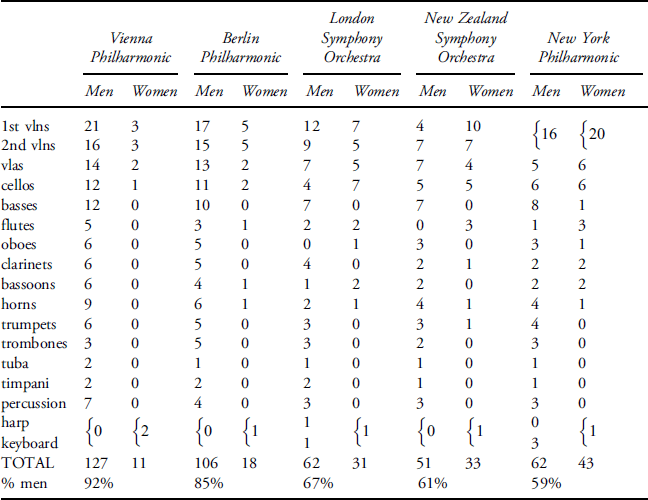
The subheadings in Chapter 2 (‘Musicians’) – ‘Democracy’, ‘Gender and Race’, ‘Union Labor’ and ‘Contracts’ – give some indication of the way in which Holoman is interested in the impact of infrastructural concerns on artistic product. The gender and race section begins with the unsurprising statement: ‘European white male musicians dominated the profession until toward the end of the twentieth century.’ One aspect of the current situation not noted here is that, while something approaching parity has, in many orchestras, now been reached in overall gender balance (reactionary institutions like the Vienna Philharmonic notwithstanding), there appear to be some pre-hiring factors determining balances within sections which flow on into overall numbers. The male membership of the New York Philharmonic (which in 1958 had a man even in the principal harp chair) has now reduced to approximately 60%. Women now often outnumber men in violin sections, but they are absent from the lower brass and percussion. A similar picture emerges from snapshots of other orchestras (see Table 1).Footnote 11 Assuming that behind-screens auditions ensure at least some degree of equal opportunity at the point of entry to the profession, current numbers suggest that male and female learning preferences create internal imbalances.
| Vienna Philharmonic | Berlin Philharmonic | London Symphony Orchestra | New Zealand Symphony Orchestra | New York Philharmonic | ||||||
|---|---|---|---|---|---|---|---|---|---|---|
| Men | Women | Men | Women | Men | Women | Men | Women | Men | Women | |
| 1st vlns | 21 | 3 | 17 | 5 | 12 | 7 | 4 | 10 |  |
 |
| 2nd vlns | 16 | 3 | 15 | 5 | 9 | 5 | 7 | 7 | ||
| vlas | 14 | 2 | 13 | 2 | 7 | 5 | 7 | 4 | 5 | 6 |
| cellos | 12 | 1 | 11 | 2 | 4 | 7 | 5 | 5 | 6 | 6 |
| basses | 12 | 0 | 10 | 0 | 7 | 0 | 7 | 0 | 8 | 1 |
| flutes | 5 | 0 | 3 | 1 | 2 | 2 | 0 | 3 | 1 | 3 |
| oboes | 6 | 0 | 5 | 0 | 0 | 1 | 3 | 0 | 3 | 1 |
| clarinets | 6 | 0 | 5 | 0 | 4 | 0 | 2 | 1 | 2 | 2 |
| bassoons | 6 | 0 | 4 | 1 | 1 | 2 | 2 | 0 | 2 | 2 |
| horns | 9 | 0 | 6 | 1 | 2 | 1 | 4 | 1 | 4 | 1 |
| trumpets | 6 | 0 | 5 | 0 | 3 | 0 | 3 | 1 | 4 | 0 |
| trombones | 3 | 0 | 5 | 0 | 3 | 0 | 2 | 0 | 3 | 0 |
| tuba | 2 | 0 | 1 | 0 | 1 | 0 | 1 | 0 | 1 | 0 |
| timpani | 2 | 0 | 2 | 0 | 2 | 0 | 1 | 0 | 1 | 0 |
| percussion | 7 | 0 | 4 | 0 | 3 | 0 | 3 | 0 | 3 | 0 |
| harp |  |
 |
 |
 |
1 |  |
 |
 |
0 |  |
| keyboard | 1 | 3 | ||||||||
| TOTAL | 127 | 11 | 106 | 18 | 62 | 31 | 51 | 33 | 62 | 43 |
| % men | 92% | 85% | 67% | 61% | 59% | |||||
Holoman writes of the institution becoming ‘fixed, standardized’ with an ‘industrial strength aggregation of today's philharmonic of 110 or more’. Later he talks of ‘the hundred players on stage’ (OVSI, 18) and quotes the question posed by Thomas Wolf to the American Symphony Orchestra League back in 1992: ‘How viable is the full-time 90- to 100-piece orchestra?’ What is missing in these (unstandardized) numbers is any rationale for today's minimum (standardized) configurations, which – with a bit of backup capacity in the strings, additional percussionists and, ideally, two harpists instead of one – can easily reach 110 or more.Footnote 12 With a full-size symphony orchestra, the range in actual employment numbers relates primarily to backup capacity in servicing repertoire which for the most part has been conceived for, essentially, a standard ‘instrument’ of 90 players. This standard instrument concept is obliquely acknowledged by Holoman at the beginning of his chapter on repertoire, which he says ‘necessarily pivots around Beethoven and Brahms, since the orchestra itself is defined by their work’ (OVSI, 76).
Balancing the English-centredness of CCS, Holoman's book is written from a strongly American perspective. This is most graphically illustrated in a table of ‘Orchestras by Date of Founding’ that lists twelve orchestras from the United States, six from continental Europe (none of them from Eastern Europe), four from the UK (all London), one from Russia and one from Japan, plus the Israel Philharmonic Orchestra and the West-Eastern Divan Orchestra. This is not presented as anything more than a selection, but the underlying bias is reflected in more serious ways. The book recognizes only two types of orchestral foundation – the city-philharmonic model (the norm in the USA) and a smaller number of orchestras founded by broadcasting companies. (Interestingly, despite their omission from the summary table, Holoman mentions orchestras established by ‘the Australian and Canadian broadcasting companies’ in this latter category.)
These two volumes will be stimulating additions to undergraduate reading lists. For all that Holoman is addressing audiences rather than students, he succeeds in providing a lively account of a context that has a direct, but often overlooked, impact on such areas as reception studies. The Cambridge Companion (despite the underlying problems of definition, a very uneven use of music examples and a less-than-perfect integration of topics) is a welcome addition to the literature.