The ghostly ship, seen at night battling a storm, and fully rigged for battle, was said to be the tall tale of sailors. Then, during the years of British overseas expansion, the image lent force to the idea of empire while it fed a popular market of cultural goods increasingly attuned to the powers of spectacle. The Flying Dutchman became a popular commodity, mechanically reproduced by engraving and lithography, and repurposed in the media of literature and theatre – softer modes of replication and reiteration. The ship became a topos in popular travel literature towards the end of the eighteenth century. John MacDonald, a gentleman’s valet, mentioned it in his memoirs of 1790.Footnote 1 So did George Barrington, the actor and notorious pickpocket who had been sentenced to hard labour at Botany Bay, in his travel narrative reprinted many times between 1789 and 1810.Footnote 2 In ‘Vanderdecken’s Message Home’, a short story published in Blackwood’s Edinburgh Magazine in 1821, the Flying Dutchman came out of darkness, surrounded by the din of thunder and waves, ‘scudding furiously before the wind, under a press of canvass’. A sailor cried, ‘There she goes, top-gallants and all.’Footnote 3 And five years later, the same image made an even more sensational entrance on the stage, in Edward Fitzball’s nautical drama The Flying Dutchman (1826), as a vision produced by a yet more popular technology of reproduction: the phantasmagoria.Footnote 4
The phantom image projected night after night at the Adelphi Theatre, and on the other London stages that pirated the play, brought fresh paying audiences to the theatre and gave rise to an important number of after-images – visual and literary reiterations of the nautical motif sold well both at home and, eventually, abroad. As a result, the phantom ship sailed into a variety of new stories after 1826: the novella The Flying Dutchman; or, the Demon Ship (1830), Heinrich Heine’s Memoirs of Herr von Schnabelewopski (1834), and Captain Marryat’s novel Phantom Ship (1839), a widely read novel that was swiftly translated into German and French.Footnote 5 The ghost ship reappeared as a phantasmagoria of cosmic dimensions in ‘Le Grand voltigeur hollandais’ (1836), in which Jules Lecomte would write: ‘the great Dutch flyer takes seven years to turn around. When she rolls – which rarely happens, because of the resistance that its mass opposes to the sloshing blades – whales and sperm whales are left high and dry on its ropes. The hull nails serve as a pivot to the moon. The halyard flag puts to shame the master cable of our most powerful three-decker.’Footnote 6
The ubiquity of the image lends itself to the traditional tasks of collecting and pondering lineages pursued by the conscientious historian and yet, as Walter Benjamin observed, it is in the nature of the commodity to elude the question of what is original or authentic.Footnote 7 In the mid-nineteenth century, the domain of art was thought to be ‘the whole sphere of authenticity’, a bastion of genuine expression, which many – Wagner among them – hoped would withstand the corrupting influence of commodified art. Nevertheless, the phantom ship, a product of popular entertainment, caught the imagination of artists who, while loath to associate with the marketplace of reproduced goods, readily adopted the image. The question of how Wagner repurposed the image is important here, as is the question of what he acquired with it – the assets of the imagination, the techniques of display, and the regime of perception that made the phantom ship viable in phantasmagoria, nautical theatre and in opera. The Flying Dutchman was a lowly nautical image until the 1830s, to be purchased cheaply as a novella, short story, lithograph or play. And yet Wagner would bank his artistic future on it with Der fliegende Holländer (1843).
This article investigates what can be learnt from the phantom ship about the relatively unexamined relationship between opera and the emerging culture of spectacular commodities in the mid-nineteenth century. I pursue my argument in two parts, by reading the auratic status of Wagner’s Holländer alongside the decidedly non-auratic history of nautical theatre in nineteenth-century London and in Paris, where Wagner settled on the idea of nautical opera; and by considering the affinity of the compositional manner he developed in Holländer to the techniques of visual composition employed by earlier visual artists and phantasmagorists involved with the art of marine representation. Despite the fact that no evidence exists of Wagner’s familiarity with nautical theatre, his direct knowledge of Fitzball’s Flying Dutchman, or his awareness of the apparitional spectacles seen at the Adelphi and elsewhere after 1826, I argue that Holländer can profitably be described as an instance of operatic remediation, adapting the visual regimes of phantasmagoria and of nautical spectacle to the musical medium of opera.
Holländer’s aura
Holländer was a fundamental piece in Wagner’s narrative of artistic progress, and he considered it carefully before including it among the works to be performed in the three concerts given at the Théâtre Italien in January and February 1860. He rewrote the overture and the end of the opera, abandoning the original idea of ending the work with the motif of the Dutchman – a musical statement of force – in favour of the idea of transfiguration. He thus added an acoustic aura to the piece, enhanced with a touch of chromaticism and harp arpeggiation derived from the advanced language of Tristan und Isolde.Footnote 8 The effect of the revised ending was more showy and sensational than purely artful, aiming to dazzle the novelty-seeking mélomanes of the Second Empire, but it has lent a musical aura to the myth of Holländer, another creation of Wagner’s. The composer invested the work with the value of a creative breakthrough, famously describing it as a ‘completely new genre’ and a ‘new path’ that had taken him away from the unsatisfactory poetics of grand opéra and towards the new art, which he would describe as music drama after 1850.Footnote 9
Wagner’s personal and artistic mythologising since he started his initial work on Holländer has steered much of the subsequent interpretation of the opera. Gentle mocking of the composer’s ‘famous journey’ from Riga to London and onwards to Paris has not been matched by scrutiny of the composer’s assertion that the work was inspired at once by nature – the sounds of singing sailors echoing in Norwegian fjords – and by an inner call towards his artistic homeland.Footnote 10 Wagner lent Holländer an air of authenticity when he wrote poetically to Ferdinand Heine that ‘a wide wild ocean with its far-flung legends is an element which cannot be reduced compliantly and willingly to a modern opera’.Footnote 11 The symbolism of the sea was developed further in the ‘Communication to My Friends’ of 1851, where the composer theorised grandly on the contribution of the nautical experience to civilisation. He lined up the stories of Odysseus, Ahasuerus and the Flying Dutchman, lending the weight of myth to his own sense that an existence at sea awoke in man a feeling of longing and made the experience of return meaningful.Footnote 12
No one would fault the émigré for waxing Romantic about homecoming. But the narrative has provided Wagner’s readership not just with a poetic apology for the idea of a rooted life and art, but also with an understanding of Holländer as an artwork unmoored from the historical circumstances of its creation. The work has typically been imagined as entirely separate from the operatic environment and artistic marketplace of Paris, which was vehemently rejected by Wagner after 1840. In this regard, Wagner’s narratives about Höllander have produced a form of forgetfulness that has obscured the inventive history of early nineteenth-century theatre and spectacle on the subject of the sea, and the fact that Höllander was imagined for Paris, and only Germanised a posteriori.
In keeping with the idea of homecoming, musicologists have mined Holländer for knowledge of Wagner’s return to German forms, moods and sensibilities. Studies of generic lineage and romantic mood typically gravitate towards a group of modest but honourable German precedents, including earlier Schaueroper by Weber, Marschner, Lortzing and Spohr, and Beethoven’s Fidelio.Footnote 13 And it is against the background of these works – so clearly the expressions of landlocked imaginations – that Holländer makes a paradoxical case for the virtues of staying put; one informed by the experience of travel and the right of return. Wagner’s fantasies, and the stories of many listeners and scholars who have since written about Holländer, have lent to it a retrospective border mentality, as expressed in its double allegiance to tradition and the value of one’s home, as these stand in strange contradiction to the libertarian ethos of nautical art in which Holländer was also invested, and which was among the most radical expressions of the age. It was an ethos Charles Baudelaire would later contemplate at the end of ‘Voyage’, the last poem of Les Fleurs du mal, in which he contemplated the freedom of uncompromising travel: ‘Into the abyss, Heaven or Hell, what difference does it make? / To the depths of the Unknown to find the NEW!’ (‘Plonger au fond du gouffre, Enfer ou Ciel, qu’importe? Au fond de l’Inconnu pour trouver du NOUVEAU!’).Footnote 14
Flying Dutchman in London
Wagner travelled westward to Paris via London to write his opera of the sea, but nothing about London theatrics can be learned from even the most careful reading of his correspondence and of his various autobiographical narratives. Wagner’s reader would never suspect, for instance, that nautical theatre was by 1839 a well-honed art in England, an invention of Londoners spurred by the supremacy of the British navy during the revolutionary wars. Staged nautical representations drew much from the sea: water on stage, the figure of the sailor, the patronage of blue jackets, the know-how of the naval industry and habits of plain-mindedness and inventiveness that brought those who worked in the theatre into a special fellowship with professional seamen.Footnote 15 The cultivation of expertise and the exploitation of circumstance – said to be defining traits of mariners – were even integral to the theatrical ethics cultivated in London in the early 1800s, as seen at popular theatres such as Sadler’s Wells and the Surrey, which also featured water tanks and naval themes.Footnote 16 Historians of British theatrical culture have remarked on the forms of creative improvisation favoured in these theatres. According to Jane Moody, writing for the minors (the London stages without a licence to perform spoken drama) in the 1820s was a job that proceeded along ‘illegitimate’ lines of free adaptation and plagiarism, often counteracted by lawsuits.Footnote 17 Even at this early stage, the sea was already quite visible within the theatre as a topos, and by 1830 the history of ship sighting and shipwrecking in the minor theatres, above all within melodramas and burlettas, was extensive and original.
The phantom ship first appeared on London stages in the context of aqua-theatrics. James Q. Davies has noted that this was a disturbing entrance: Fitzball’s Flying Dutchman, conceived after ‘Vanderdecken’s Message Home’, was premiered at the Adelphi Theatre in December 1826 and quickly reappeared in pirated versions at the Surrey Theatre, Coburg Theatre and Sadler’s Wells before 1830.Footnote 18 Thereafter, the play remained an enduring attraction. Mid- and late nineteenth-century editions suggest that the work, described alternately as a melodrama and a burletta, continued to be popular. By then, the piece had become an international sensation, performed in English-speaking theatres all over the globe.Footnote 19
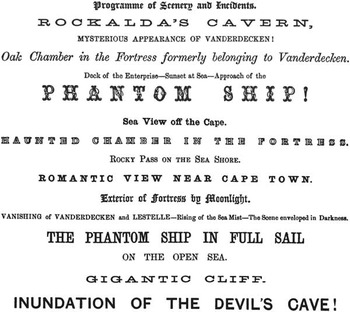
The success of the Flying Dutchman had everything to do with images. The play was assembled from pictures, a peculiarity retained in the special format of its first publication. The printed play included a Programme of Scenery and Incidents in the two initial pages of the booklet (see Fig. 1). The Programme was eye catching, consisting of a list of stage sets printed using a spectacular variety of fonts of different sizes. It mentioned ‘Rockalda’s Cavern’ followed by the ‘MYSTERIOUS APPEARANCE OF VANDERDECKEN!’ along with other frightful and poetic sets. And it emphasised the two capital moments of the play: the ‘Approach of the PHANTOM SHIP!’ at the end of the first act and then its reappearance ‘IN FULL SAIL ON THE OPEN SEA’ followed by a ‘GIGANTIC CLIFF. INUNDATION OF THE DEVIL’S CAVE!’ at the close of the second. Gradations in typesetting suggested to the reader that the play’s images followed each other in two thrilling crescendos, separated by the curtain after the first act.
Programme of scenery and incidents. Edward Fitzball, The Flying Dutchman: A Nautical Drama (London, 1866), 5–6.

In the play, special attention was lavished on the appearance of the phantom ship in full sail. The first apparition was preceded by talk about a small image seen in a painting hanging towards the left side of the stage. In Act I, Lestelle (the pre-Senta) and Lucy (the pre-Mary) are seen having a conversation with a certain Captain Peppercoal about the legend of Vanderdecken. Peppercoal leaves, and they turn to the picture. A storm rages outside, signalled by thunder, and the stage darkens. Lucy reminds Lestelle that the painting is a centenary image of Vanderdecken’s ship. She helpfully adds, ‘If the old Dutchman be not making his rounds tonight, I am much mistaken.’Footnote 20 Lestelle then joins Lucy in front of the painting. She confesses that she ‘sees the ghost of that Flying Dutchman [the ship] in every ray of moonlight’. Lestelle’s admission prompts the audience to see something extraordinary, the reverse effect of phantasmagoria: instead of an image emerging from a point of light, ‘the picture becomes illuminated, [and Lestelle and Lucy] see it, scream and run off’. As obvious trickery, the illuminated image signals deception; Lucy and Lestelle are spooked; and the audience, in turn, laughs at their naïve spectating.
The appearance of the ‘true’ phantasmagoric ship was meticulously prepared in the drama. At the end of Act I, Vanderdecken, the captain of the phantom ship, appears on stage, clad exotically, his skin tinged a sensational blue, the colour of spectres and supernatural villains. The Dutch captain is afflicted with muteness – like a ghost produced by the machinery of phantasmagoria he gestures but does not speak. He then steals a letter from the cockney Von Bummel, initiating a series of diversions described in the play:
Music – Von Bummel attempts to snatch the letter when it explodes – a sailor is about to seize Vanderdecken, who eludes his grasp and vanishes through the deck – Tom Willis and von Swiggs both fire at Vanderdecken, but hit the sailor who falls dead on the deck – Vanderdecken, with a demoniac laugh, rises from the sea in blue fire, amidst violent thunder – at that instant the Phantom Ship appears in the distance and the crew in consternation exclaims ‘The Flying Dutchman,’ tableau and end of the act.Footnote 21
The disorderly scene was played without words, in a burst of noise, laughter, colour and music followed by the imposing phantasmagoria. The attention of the spectator, dispersed at first by this assortment of small actions and sights on stage, refocused later on the space beyond it, on a single light that became the source of the unprecedented image.
This moment of shared awe was drawn by Robert Cruikshank and inserted into the published play, memorialising the instant in which drama and an image of the sea merged in a moment of theatre. The engraving invites the viewer to partake in the spectacular pleasures of the stage and to consider the carefully planned nature of the sighting (see Fig. 2). The sail and the mast bordering the right side of the drawing suggest a curtain and a column, architectural elements that frame the theatrical proscenium. Rather than delivering a panoramic sense of infinite space, these visual elements reveal the overdetermined vista afforded by the stage. The image also inscribes the seascape within the limited space of make-believe through a variety of other compositional elements. The sailors stand in two groups, one to the right and the other to the left, both groups looking towards the back of the stage. Their lines of sight converge on Vanderdecken, hovering beyond their ship. Their pose inspires the viewer to observe with trepidation as well. Only one man turns away from the image: he covers his head and cowers, posing in fright. The illustrator portrayed the two feelings of masculine awe and feminine fright that the ship was expected to elicit from the audience. These gendered responses were also described by George Daniel in his introductory remarks to the play.Footnote 22
‘The Flying Dutchman!’ Edward Fitzball, The Flying Dutchman: A Nautical Drama (London, 1866), 3.

Beyond the groups of men stands Vanderdecken, attired in old Dutch costume, pointing towards but facing away from the apparition and to his audience, grimacing with fear. The impression of fury generated by the dense undulations of the pen around the ship suggests that the vessel exists in another environment, apart from the calm seascape in which the sailors stand. This sense of a space apart – of a reality beyond the stage – is delivered by yet another feature of the image: the ship shines brightly and indeed serves as the source of illumination for the stage. The light emanating from the ship produces the long shadows that trail behind the sailor-spectators.
The illustration depicts the apparitional ship as a form of modern spectacle, which Jonathan Crary describes as ‘a detachment of an image from a wider field of possible sensory stimulation … [which] creates a calculated confusion about the literal location of the painted surface as a way of enhancing its illusions of presence and distance’.Footnote 23 Cruikshank’s visual composition reflects on the conditions for spectacular viewing that Crary has linked to the emergence of a public behaviour of docility and awed submission in nineteenth-century entertainment. It also accounts for an event of technological significance. The phantasmagoria in The Flying Dutchman was among the first examples of the use of the optical projection on the stage, made possible by the introduction of gaslight illumination in the theatre.Footnote 24 The gas flame was sufficiently bright to project the illuminated slide over large enclosed spaces, but it was also easy to modulate, even to the point of total darkness. In 1826, the image of the phantom ship was the latest and most imposing manifestation of phantasmagoria in London.
Theatrical phantasmagoria
Phantasmagoria had become a London entertainment in 1801 when Paul Philipsthal (aka Paul Philidor, previously active in Vienna and in Paris), announced new optical shows at the Lyceum Theatre.Footnote 25 He advertised his shows as didactic entertainments, as he had done in the Austrian and French capitals, promising to unveil the supernatural and demystify it, and the announcement of his demonstration of ‘Spectrology’ read as follows:
The Optical Part of the Exhibition
Will introduce the Phantoms or Apparitions of the Dead, or Absent, in a way more completely illusive than has ever been offered to the Eye in a Public Theatre, as the Objects freely originate in the Air, and unfold themselves under various Forms and Sizes, such as Imagination alone has hitherto painted them, occasionally assuming the Figure and most perfect Resemblance of the Heroes and other Distinguished Characters of past and present times.
This Spectrology, which professes to expose the practices of artful Impostors and pretended Exorcists and to open the Eyes of those who still foster an absurd Belief in Ghosts or Disembodied Spirits, will, it is presumed, afford also to the spectator an interesting and pleasing Entertainment; and in order to render these apparitions more interesting, they will be introduced during the progress of a tremendous Thunder Storm accompanied with vivid lightning, Hail, Wind, etc.Footnote 26
Philipsthal’s shows exposed the figuration of the supernatural to the scrutiny of reason; the phantasmagorist insisted that his work was nothing but an amusing exercise, conceived with the purposes of enlightening the audience. Another typical advertisement for his shows read:
This exhibit forms a wonderful object of admiration; for while the acuteness of our vision is so far imposed upon by these illusive representations, as to impress upon the imagination the idea of something supernatural, that faculty of mind, which dispassionately considers the nature and property of things, and draws rational conclusions, is pleasingly and actively employed in counteracting the deception effects of this ingenious and celebrated invention.Footnote 27
In London, as in Paris before, phantasmagoria offered a recreational means to practice reason, one notably adapted to local taste. Philipsthal’s initial spectacles kept to the necromantic topics he had explored earlier in Paris, projecting ghosts, skeletons, bloody nuns, devilish figures and heroes past and present. In time, his visual repertory expanded beyond the horizon of the gothic to embrace the more exclusively English theme of the sea. At the Lyceum, there would be shipwrecks, seascapes and, of course, Lord Nelson. But what really distinguished English phantasmagoria from the continental varieties, beyond the maritime theme, was the magnitude and technical sophistication of the spectacle. In France, innovation in spectacle waned after Robert Étienne Robertson, a successor of Philidor, organised his celebrated séances at the Convent of the Capuchins in 1798 and 1800, while technology lost intellectual prestige in the ensuing years such that by the 1820s the phantasmagoria was no more than a social entertainment. In England, by contrast, innovation in this area flourished.Footnote 28 From the early 1810s onwards, the construction of double and triple lanterns allowed for the display of ‘dissolving views’, projections that drew their effect from finely manipulated gradations of light. The quality of projected slides also improved considerably in the 1820s with the invention of a new system of image transfer onto glass, patented by Philip Carpenter.Footnote 29 English optical projectionists deployed the new techniques in their shows, and phantasmagoria became a key exhibit of the Royal Polytechnic Institute after 1838. The first celebrated projectionist of the Institute was Henry Langdon Childe, Philipsthal’s former assistant, who further developed the technique of dissolving views. He was also the projectionist behind the apparition of the Phantom Ship at the Adelphi in 1826.
The playwright George Daniel described the effects of phantasmagoria in Fitzball’s Flying Dutchman. He wrote about ‘the infinite delight’ that the drama delivered to ‘an intellectual public, who think the day’s meal incomplete until they have supped full with horror’, and suggested that the story of the phantom ship had more in common with the intellectual pleasures of phantasmagoria than with the sentimental world of the Jolly Tar.Footnote 30 Signs of horror could be found aplenty on stage: Vanderdecken appeared with a ‘ghostly cyan tint about him’ and surrounded by blue fire. This colour put him in the company of Frankenstein and Samiel, devils and gothic monsters previously seen on stage and in optical projections. And Vanderdecken was ghastly in other ways as well: his inverted world was awful, the violence perpetrated by him senseless, his laughter terrifying, and his muteness – for most of the performance he shared in the silence of phantasmagorical types – even worse.
Daniel noted, finally, that the play contained something for everyone, satisfying even the most incompatible demands:
For those whose taste inclines them to the terrible, [Fitzball] has provided thunder and lightning in abundance, thrown in a grotesque dance of water imps, and served up a death’s head (not according to the old adage, stewed in a lantern) but picturesquely mounted on a black flag, and garnished with cross bones; while to the laughing souls, to whom – ‘A merry jest is better far / Than sharp lampoon or witty libel’, he presents a bill of fare irresistibly comic. We may, therefore, congratulate the ‘violent spirits’ of the present day on the production of a piece where mirth and moonshine – murder and merriment – fire and fun, are so happily blended!Footnote 31
The playwright therefore saw the Flying Dutchman as a novel kind of theatre that cast aside well-honed distinctions between theatrical genres and moods, all for the purpose of amusing and amazing. The piece pushed towards something new in the theatre, presenting itself as a mechanism for the production of awe and hilarity.
Dialectics of spectatorship
The phantasmagoric image projected by Langdon Childe was conceived after the literary description of the ship found in ‘Vanderdecken’s Message Home’. In the theatre, as in the novella, the vision of the ship was preceded by the noise of distant thunder and sudden darkness, the two elements of acoustic saturation and visual inhibition that habitually prepared audiences for the display of phantasmagoria. Then the Flying Dutchman emerged fully rigged and illuminated from within, battling the storm. Meticulously, the projection reproduced the effect of the picture, and thus caused the spectator to return to that previous sublime rendition. This was a terrific pleasure that the audience enjoyed with a grand and grave enthusiasm.Footnote 32 Like all instances of the Kantian sublime, the image kept at bay the fear felt before a real force, uncontrollable and threatening, and placed the viewer in a pleasurable position of mastery. At the Adelphi, the Flying Dutchman recast violence as aesthetic force, fashioning a manifestation of power that viewers found in turn empowering.
The pursuit of awe was one side of this spectacle; the other was the pursuit of merriment. At the Adelphi, merriment came in many forms, as Daniel noted. There was, first of all, the title: The Flying Dutchman, so much like the ‘Flying Pieman – with pantaloons, pumps, white apron and powered toupee, puffing off his pastry to a merry troll-my-dame’.Footnote 33 The Flying Pieman was a peddler of baked goods well known to contemporary Londoners; he was a hyperactive man, who walked briskly through the streets of London, selling his pies. Then there was the fun of anarchy. Daniel put Fitzball’s creation in the company of those seventeenth-century plays fit for earlier ‘violent spirits’. He quoted Gayton’s ‘Pleasant Notes on Don Quixot’ (1674) to remind his readers of the popular Elizabethan plays that had featured stage fights and sometimes ended after six acts with a destructive form of audience participation. At the end of these violent plays the public, composed of ‘sailors, watermen, shoemakers, butchers and apprentices’, mounted the stage and ‘made a more bloody catastrophe amongst themselves than the players had done’.Footnote 34 Thus he observed that the wayward drama so in vogue in the London minor theatres during the 1820s owed something to the spectacular values of earlier days.
Theatrical travels
Saint-Esteben, a Parisian playwright, filed a request with the French government in 1833 to produce nautical theatre in Paris. The privilege was accorded in August of that year for a restricted form of spectacle which the Journal des débats described as ‘pantomimes of all kinds, with the exception of equestrian exercises, for which the Cirque has exclusive permission. The pantomimes may be interspersed with instrumental harmony, but may not, under any pretext, include an actor who sings or speaks’ and which could also contain ‘water effects’.Footnote 35 The idea of a theatre of the sea was welcomed by Parisian journalists and in 1834 the newly inaugurated Le Ménestrel predicted, ‘The director of the Théâtre Nautique will put everyone in their place and will perform a great service to the science of staging which is still very behind in our theatres in France, including at the Académie Royale de Musique; we will have the occasion to mention the lack of sense [in staging] observed in this theatre.’Footnote 36
The argument made by Le Ménestrel reminds us that artists and impresarios in Paris at this point looked across the Channel for inspiration and knowledge of stage spectacle. Parisian theatres imported gaslight illumination from London in 1822, and they subsequently adopted many other spectacular devices. Jules Moynet, a Parisian authority on scenographic matters, noted in his acclaimed L’Envers du théâtre of 1874 that the ‘English loved water effects produced by natural means or by false ones. They exceed in that respect, and we have borrowed from them some of their most exciting effects.’Footnote 37 The Théâtre Nautique, created by Saint Esteben, was first to enthusiastically welcome this form of borrowing. Details of the stage spectacle were documented in Le Ménestrel:
An enormous basin made of lead will hug the middle of the stage. Limpid and pure water, to be frequently replenished, will be kept at the necessary level and so that all parts of the theatre may survey its surface. The real length of the basin will allow for the show of moving barges of large dimensions. These constructions, made larger by a double illusion of optics and by paintings, will offer the most complete and truest image of ships navigating on the high sea.
A new manner of illumination, inverting the old routine in which the rays of the sun emanated from the prompter’s box, will complete the illusion, in giving back to this dazzling star its free movement in the upper reaches, from which it should never have descended either for the honour of art or for its own self respect.Footnote 38
The writer of Le Ménestrel was enthusiastic about the added values of water and illumination in the theatre – these were two important aspects of the technical knowledge that Parisians found in Britain. After 1834, and despite the rather unsuccessful two-year run of the Théâtre Nautique, aquatic theatre remained at the pinnacle of stagecraft in Paris, where it had become a spectacular commodity cultivated by the popular stages in particular. Moynet’s account of the genre, for instance, paid particular attention to the scenes of nautical war and shipwreck that captivated the spectator by a tour de force of imitation, as performed at the Cirque Olympique.Footnote 39
Nautical theatre seems to have been appreciated in Paris not only for its virtuosic display of theatrical labour but also for the unruly ambiance that pervaded the stage and the venue in general. The bawdy reputation of nautical drama preceded the first demonstration of aquatic theatrics at the Théâtre Nautique in 1834, and was the object of the vaudeville Le Prix de folie, premiered at the Théâtre du Vaudeville on 31 December 1833. The comedic scene, written by Étienne Arago, may have served as an advertisement for the upcoming theatrical enterprise, and highlighted the waywardness that was said to be the essence of the genre.
Le Prix de folie was a play of assorted delusions. It takes place in an insane asylum, where inmates act out their deranged imaginings in homespun theatrical productions. In the first scene, the inmates pose as academicians. They are entrusted with the task of awarding a prize for display of a virtue, and, being mad, they decide to reward the virtue of madness. The contestants for the prize are ushered in for judgement. The first is a theatrical impresario by the name of Duford. He explains his project to the academician Bidard:
We have had one of the most ingenious of ideas ... I will not hide from you that we are going to represent a real shipwreck, all ships will be made wet on the bottom of the hull with true and purified water … The storm, a grand natural one; my poor friend, we will have live fish, such as whales, sharks, blowers, seals and sardines.Footnote 40
Later he sings:
[One will see, swimming to safety, / English sailors in shorts. / One will see, taken by boarding, / a frigate of forty cannons. / And when the frigate is conquered, / it will tilt, all will fall into the water.]Footnote 41
Later yet, he concludes, again in song:
[I hope to win admiration, / I’ll gain momentum on my ships; / Like a maritime Franconi,/ I will run this giant project. / The acrobat of the ocean! / Heavens, listen to my request! / Sly navigator, / May the whistling of the storm among us / sound louder than that of our spectators!]Footnote 42
Duford gave the full list of theatrical effects: purified water, entire schools of fish, naval battles, shipwrecks, sailors swimming to safety. He was delusional, of course, espousing ‘ideas’ that put the theatre on a par with the mental hospital. And he described himself as the ‘Franconi of the ocean’, ‘the sly acrobat’, thereby suggesting an affinity between nautical theatrics and the circus act. (His analogy also recalled that the most popular theatres of the sea in London – the Sadler’s Wells, for instance – hired famous clowns.)Footnote 43 Closer to home, it underlined the idea that the enterprise of the nautical might fit well with the kind of theatrics practised by the Cirque Olympique, managed by Antonio Franconi.
The spectacular values of nautical theatre were compatible with those of the Cirque, the only Parisian stage that matched the exacting standards of the Opéra, according to the journalist J. P. Valier.Footnote 44 Yet the mention of Franconi was also political. Like the largely proletarian institutions of Sadler’s Wells and the Surrey, the Cirque was known in Paris for its commitment to a people’s art, republican in tone. The theatre celebrated all Napoleon’s victories during the Directorate and the Empire, and it remained a political force in the Parisian theatrical establishment after the 1820s. Sometime before 1834, Franconi’s venue had staged an acclaimed tableau vivant of Géricault’s Le Radeau de la Méduse. The performance revisited the controversial event of the shipwreck in 1818 that became a cause célèbre of the left during the Restoration. Géricault’s masterpiece and the historical events it memorialised went unrecognised by the state during the 1820s, receiving official acceptance only in 1834 when Louis-Phillipe formally acknowledged that the shipwreck of the Méduse had been a national tragedy and when the French state acquired the painting.Footnote 45
A year later, in 1835, the Cirque produced its first nautical drama, La Traite des noirs. The piece by Charles Desnoyer and Alborze made a strong statement against the slave trade. It was the story of the brave lieutenant Léonard who left an honourable career in the French navy to fight for the abolitionist cause under the nom de guerre of ‘Corsaire noir’. The piece contained many scenes at sea and ended with a battle fought between the ship of the Corsair and a slave ship that would remain exemplary for decades.Footnote 46
Nautical theatre in Paris in the 1830s therefore sustained a mood of freedom and self-reliance, and French critics portrayed the genre as a breath of fresh air that enabled new forms of behaviour in the theatre. An essay in Le Figaro on the subject of the Théâtre Nautique observed:
The spectators are asked not to bring their dogs to the theatre because these estimable animals might like to throw themselves into the water. The characters that find themselves to be too hot [on the stage] will easily be able to take a bath. On the other hand, and during winter, it is possible that a sudden coldness will freeze the water ... The actors will traverse the space on ice skates.Footnote 47
Finally, the knowledge and joys of nautical theatre propelled the Parisian imagination outwards and towards the unfamiliar world of London theatres. After 1834, Parisian periodicals such as the Gazette des théâtres and Le Ménestrel occasionally reported on the popular stages across the Channel, including the plebeian Surrey Theatre.Footnote 48 This was a departure from earlier editorial procedure, which had restricted reporting from abroad to prestigious venues, mostly opera houses.
Opera and the sea
Richard Wagner arrived in Paris via London at the beginning of 1840, in time to attend the first Parisian opera of the sea, Le Naufrage de la Méduse (1839), by Friedrich von Flotow and Auguste Pilati, at the Théâtre de la Renaissance. He may have also known the vocal score of the work, published that same year.Footnote 49 Yet, he never wrote a word about Le Naufrage, nor about the power that images of horror at sea held over his contemporaries in Paris. His apparent obliviousness to the popularity of nautical spectacle in Paris and London has therefore insulated Der fliegende Holländer from a provocative history of entertainment in the two Western metropoles.
Instead, as mentioned above, Wagner claimed a unique status for Holländer, as a new genre of opera derived from the narrative force of the ballad. In his telling, he began work on the piece by composing Senta’s ballad and ‘unwittingly planted the thematic seed of all music in the opera’ in it. Later,
in the eventual composition of the music, the thematic picture I had already conceived quite involuntarily spread out over the entire drama in a complete, unbroken web; all that was left for me to do was to allow the various thematic germs contained in the ballad to develop to the full, each in its own direction, and all the principle features of the text were arrayed before me in specific thematic shapes of their own making.Footnote 50
Musicologists have questioned this improbable story. Carl Dahlhaus wrote that it would be ‘a major exaggeration, or even a mistake, to speak of the “thematic image of Senta’s ballad spreading out” over the entire drama’.Footnote 51 Carolyn Abbate later pointed out the prospective quality of the statement when she suggested that ‘this characterization of Holländer as an interrelated “web of themes” reflects a vision in 1851 of yet-uncomposed music for the Ring: a vision projected in retrospective interpretation of the earlier work’.Footnote 52
One detail of Wagner’s prose here is particularly revealing. Wagner used the word ‘Bild’ (picture) to describe a song: he wrote about a ‘condensed picture’ (‘verdichtete Bild’); a ‘thematic picture’ (‘thematisches Bild’) and also, more simply, a ‘picture’. Thus, he paired the song (about the Dutchman) with a picture (of the Dutchman). In more than one way, Wagner suggested that the ballad served not simply as an archive for composition but more specifically as an archive of musical ideas related to the idea of seeing.
Faced with the prospect of inscribing the ‘wide wild ocean’ in music, the composer proceeded like a painter. He worked out the details of his seascape in miniature format, knowing he would have to bring them up to scale later on. Or perhaps Wagner approached his seascape like a phantasmagorist who begins to plan his act by painting miniature images. Later, he projected his miniatures onto the wide openness of his canvas: the opera. Both imagined scenarios resonate with the composer’s claims that ‘various thematic germs contained in the ballad’ later ‘develop[ed] to the full, each in its own direction’.Footnote 53 This visualist reading of compositional procedure opens another perspective on the quality of interruption said to shape Holländer. Arthur Groos has observed that three key moments of operatic singing – the song of the helmsman in Act I, the chorus of the spinning girls in Act II and the chorus of Norwegian sailors in Act III – are interrupted by music representing the supernatural. These moments, as mentioned above, align Holländer with the tradition of the Romantic Schaueroper: ‘of horror-opera with its emphasis on the disruptive intrusion of the supernatural in the natural world’.Footnote 54 Groos comments, however, that Wagner’s work went beyond earlier dramaturgies of horror by monumentalising the instance of intrusion, letting it spread over the length of a scene, and endowing it with a new paranormal aura.
The new dramaturgy of intrusion, a tour de force of musical composition, did not come out of nowhere. It extended to opera a process of medial interruption already in existence in the theatre and significantly developed within nautical spectacle. Indeed, Wagner grappled with the same problem of medial interruption that Fitzball addressed by bringing together drama and phantasmagoria in Flying Dutchman. In matters of spectacle, Holländer remained a close cousin to the burletta, reproducing the great coup de spectacle of the play – the apparition of the phantom ship.
Audio-visions
Marine landscapes have a generic quality. They involve one or more ships, perhaps some land, a wide oceanic horizon and a certain type of weather. Each artist will render the oceanic quality uniquely through a quality of trace, colour and light. Wagner did precisely that in Senta’s ballad, a narrative song containing miniature seascapes. The piece begins with a cluster of three identifiable nautical motifs, etched into the song: the first is the foghorn, the second is ‘joo-hee’, the sailor’s signal, and the third is a storm.
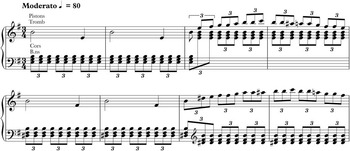
Nineteenth-century ships had modest foghorns by modern standards. They were equipped with bells or horns, instruments of limited signalling capacity at sea. We do not know if there was a foghorn in Fitzball’s burletta, but the overture to Flotow and Pilati’s Le Naufrage de la Méduse opened with a repeated falling fifth (B–E) played to a rhythm of long–short–long–short by cornet and trumpets over an E minor chord in the strings (see Ex. 1). The open fifth inscribed the nautical signal into the score; Senta’s ballad and the overture of Holländer also, of course, began with a fanfare built on a fifth. Unlike the never-discussed fanfare of Le Naufrage, that of Holländer has remained the object of intense scrutiny. To Klaus Kropfinger, for instance, the fanfare in the overture to Holländer suggests a form of compositional distillation that adapts to the realm of nautical opera the idea of transition from pure resonance to musical sound, as explored by Beethoven at the beginning of the Ninth Symphony.Footnote 55 It has also been scrutinised because Wagner went on to develop his own dramaturgy of primal sounds in the Ring. The tetralogy mobilised the open fifth for the creation of a new musical rhetoric of nature that aligned the world of the stage with archaic earthliness. Following this idea, Thomas Grey reads the acoustic signal in Holländer as a precursor to the Ring. He notes that the fifth resonates in the constellation of musical motifs that anchor the idea of the earth in the tetralogy: ‘the Rhinegold motif, Freia’s golden apples, the sword motif, Siegfried’s horn-call’.Footnote 56
Flotow and Pilati, Le Naufrage de la Méduse (1839): Overture, bb. 1–8.

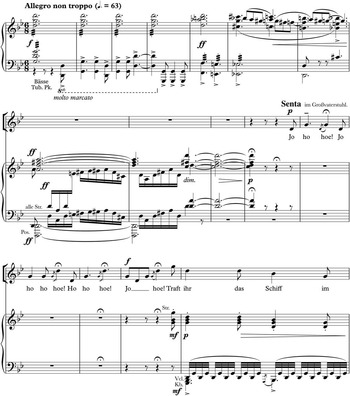
The abstraction of the open fifth is a theatrical effect that may index land as well as the sea. In Holländer, though, it directs us most of all back to the idea of the nineteenth-century foghorn, deployed in Le Naufrage, and made much more impressive by Wagner, who extended the acoustic signal so as to produce a grandiose reality-effect with majestic length and force. The ballad begins with a high G minor tremolo in the strings, setting an upper limit to its acoustic horizon (see Ex. 2). There then emerges from the depths of the brass section a great unison, played fortissimo. The brass instruments play through an ascending chain of fourths and fifths that open up an imposing tonal space. Afterwards, darkness reigns. The musical horizon dims under the pressure of harmonic dissonance and an acoustic space saturated with sweeping and chromatic ascending gestures. The textural and chromatic thickening of the field of audition leads to the high D major dominant seventh that trails off acoustically, like the end of a phantasmagoria. This first audio-vision, placed before the ballad, suggests an impressive metamorphosis whereby a foghorn becomes as large as a ship. The listener hallucinates about an object so powerful it could for a moment overpower the ear, but which then fades away and vanishes.
Audio-visions one and two. Richard Wagner, Der fliegende Holländer, Act II, scene 1: Ballade, bb. 1–16.

The second audio-vision is a fragment of song voiced by Senta. She sings ‘Jo-ho-hoe!’ based on that same acoustic signal of the fifth (see Ex. 2). Senta imitates the warning signal often sung by and to a sailor. She performs realistically without a note of accompaniment. After the end of the second audio-vision, the music strays briefly into song, and the audience hears the beginning of the ballad. The open fifth outlines the beginning of a melody. The interval of a third is added, and Senta shapes the descending diatonic arpeggio into the melody of a lulling barcarolle.
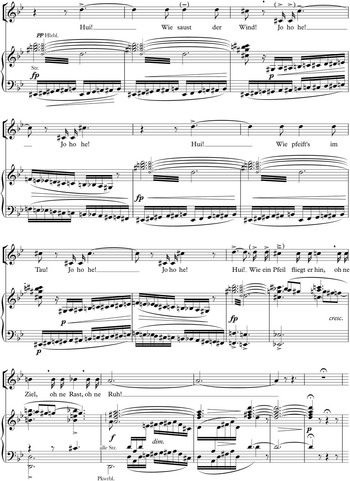
The third audio-vision interrupts the ballad just as it begins. It is a storm, the inescapable condition of weather at sea, which Wagner composes in light of melodramatic convention. He juxtaposes two musical gestures (see Ex. 3). A tremolo in the upper register leads from a diminished fifth to a major seventh, while elongated chromatic runs saturate the lower register, mimicking the force of storm gales. Senta hears this storm and turns her attention to it, just like a sailor. She comments on the wind and, straying from the performance of the barcarolle, even sings an octave of alert (‘Jo-ho-he!’), as if she was on a ship and it fell to her to alert her mates to danger. This third vision confirms something the audience already knows about Senta: her mind is elsewhere.
Audio-vision three. Richard Wagner, Der fliegende Holländer, Act II, scene 1: Ballade, bb. 22–36.

The audio-visions suggest that Wagner followed a two-step process in the composition of Holländer. First, he learned to think visually through music. Then his audio-pictures proceeded to colonise the opera. One might celebrate the modernity of this idea. The notion of sound and sight synthesised in a perfect theatrical illusion was, after all, an aesthetic ambition of grand opera. It was also a pervasive utopia in nineteenth-century art to which Michel Chion gives full due.Footnote 57 Holländer, however, does not present us with a complete and grandiose audio-visual spectacle, but only with an opera to which bits of image-music have been attached.
Wagner’s ship resembles the English image of the Flying Dutchman in several ways. In Holländer, the phantom ship is seen twice on stage, in Acts I and III, and both times it shows alarming signs of animation. In Act III, ‘the sea, which otherwise is quite calm, now begins to heave around the Dutchman’s ship and a violent wind whistles through the yards. A blue flame burns on the mast and lights up the crew, who have hitherto been invisible.’Footnote 58 The description returns us to the image of the Flying Dutchman as a ship battling a storm over a placid sea, made famous at the Adelphi Theatre. Other theatrical elements, also seen at the Adelphi, were a part of Wagner’s visual script. The blue light was, of course, a gothic convention by the 1840s, yet it saturated the image of the undead crew with the same disturbing indigo that had covered the figure of Vanderdecken at the Adelphi since 1826. And the red that tinged the underworld from which the Dutchman emerged became the bright colour that tinted the sails of the infernal ship. Wagner specified the colour of the sails and the quality of the theatrical entrance of the ship: ‘In the distance is seen the ‘Flying Dutchman’s’ ship, with blood-red sails and black masts; she rapidly nears the coast, on the side opposite to where the Norwegian ship is lying’, ‘the anchor [is] thrown over with a terrific crash’.Footnote 59
Wagner’s apparition contained elements seen in Landgon Childe’s famous projection at the Adelphi: the storm, the speed of approach, the magnitude of the object, the fully unfurled sails. It improved on the first phantom ship by sonorising it. In phantasmagoria, images are formed from a single point of light. Similarly, Wagner’s foghorn emerges from a point of near silence in the opera. On stage, the helmsman has dropped out of song and into sleep, and the sea has grown agitated. The storm – Senta’s third vision – surrounded the song of the helmsman from its beginning; now it breaks loose on stage. Stage directions indicate that the storm ‘begins to blow furiously again, and the darkness increases’.
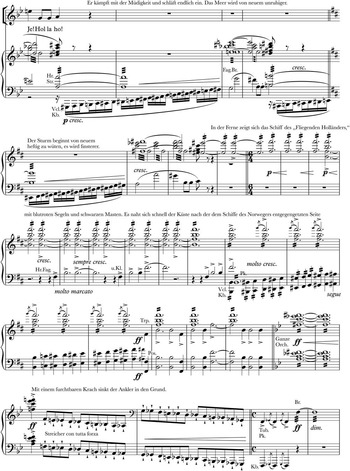
The sudden darkness and the din of the storm are hallmarks of phantasmagoria, and a turn to spectacle overtakes Wagner’s musical score (see Ex. 4). Chromatic ascents played over octave tremolos produce the musical equivalent of gales while darkness is registered acoustically by a reduction of sound. Eventually, the orchestra fades with only the second violins remaining. From almost nothing, like a flame that begins weakly and grows in intensity, the E sharp in the violins moves upward and swells into a larger sound, gaining in acoustic presence. Then, the strange foghorn is heard in the horns and the bassoon. The shape grows, as an impressive wall of sound is erected by the woodwinds, and it crescendos even further. The foghorn is heard again, as if closer, certainly louder, and it becomes plaintive – animated by a grace-note figure, as if sighing or crying. Then an ascending chromatic gesture played molto crescendo by the cellos and basses reinforces the sense that a great object approaches. The foghorn is finally heard in its full monumental form, marcato and fortissimo, played across three octaves by the tuba, trombone and trumpets. The imposing architecture of sound climaxes on the F sharp diminished chord sustained by the entire orchestra and resolves deceptively to a dominant seventh on F. The chord is sustained in the loudest fortissimo and punctuated by the tam-tam, followed by a chromatic descent on the strings and three final thumps – low Fs performed fortissimo with upper neighbour grace notes by the cellos, double basses, tubas and timpani. It is at this point that the aforementioned instructions in the score call for the anchor to be thrown over with a great crash. Afterwards, the orchestra returns to nothingness, a single F octave played in tremolo by the violas ritardando and diminuendo. The show is over.
Song of the helmsman and apparition of the Phantom Ship. Richard Wagner, Der fliegende Holländer, Act I, scene 1, bb. 67–96.

This sound-image begins and ends almost ex nihilo, from a sound so small it evokes a feeble light. Like the lamp of a projection machine that begins weakly and then grows to full, blinding radiance, and shapes itself into full forms, the music conquers space, moulds itself into shapes and ultimately delivers strange nautical objects – a magnified foghorn, a monumental anchor – enveloped by the ambiance of a storm. Wagner’s audio-visions are sublime: they overwhelm our ear and saturate the acoustic space in which they move. Sound objects come closer with every reiteration, they are maximised, and, at the end, appear to be at very close range. The sonorised phantom ship awes in the manner of a horror show, only to disappear in the same manner, almost into oblivion: one soft high note that stands for a single and weak point of light.
Wagner’s apparitional poetics in Holländer are reminiscent of those of earlier phantasmagoria, cultivated by Philipsthal and Childe, while they remain distinct from the forms of acoustic illusion the composer cultivated in later years, and which Theodor Adorno described as the quintessential device of music drama. The sound mirages of later Wagner produce the illusion of distance and immobility delivered by a calculated thinning of orchestration.Footnote 60 These later figures exploited the idea of miniaturisation and proceeded in the exact opposite direction to that taken in the composition of the phantom ship, in which audio-visions draw on the spectacular values of saturation, proximity and aggrandisement.
Opera as spectacle
The phantasmagorical Holländer introduced a new regime of timelessness to the theatre. Wagner’s well-known remarks on the performance of Holländer, sent to Franz Liszt in 1852, addressed the consequences of this shift to slow motion. He insisted that the Dutchman should move on land following a precisely timed choreography, performing prescribed single steps in bars 1, 3, 8 and 10. He insisted on a bleak deportment (‘a grim external composure’) throughout. And he restricted his gestures to a set of fixed rhetorical poses, progressing slowly from ‘arms crossed, head bowed’, ‘head turned’, ‘gesture of terrible scorn’, and so on.Footnote 61 Wagner’s instructions prescribed a quieting of the stage while reining in established conventions of performance.
The composer sought to banish natural expression and gesture from the soliloquy of the Dutchman. He imagined that the scene ought to proceed with the same flatness and slow gradual motion of a diorama. He indicated that the stage should reproduce a deathly register of images and asked the singer to fashion from this register the ultimate goal of phantasmagoria: an illusion of life. Wagner’s ideal Dutchman was a singer who played at being an image that produced the illusion of a character, while he remained undisturbed by the terrible fracas, produced by audio-visions of gales, roars and cracks unleashed around him. The performing instructions constituted a form of coercion not altogether dissimilar to that imposed on Thomas Cooke, the English actor who created Fitzball’s Vanderdecken. Cooke, an actor acclaimed for the creation of the frightful Frankenstein in Richard Brinsley Peake’s Presumption, or the Fate of Frankenstein (1823) and the brooding Long Tom Coffin in Fitzball’s The Pilot (1825), found the muteness of Vanderdecken trying.Footnote 62 According to Fitzball, ‘during the rehearsals … Cooke walked through his part like a person who submits with noble resolution to a martyrdom’, and only truly embraced the dramatic limitations of the role when he saw the effect it produced in the theatre.Footnote 63
The Dutchman embodied and envoiced the idea of non-existence in Act I scene 2, in an extended soliloquy that Wagner planned as a recitative and scena in four parts. The Allegro molto agitato in C minor – the tempo d’attacco – laid out the predicament of endless voyage with the turbulence of the fast, chromatic, ascending runs that lead to the audio-vision of the storm. The maestoso in A flat minor – a lyrical moment – followed as a prayer, solemn and baroque, that envoiced the sincere plea of the repented. Un poco più moto – a reduced tempo di mezzo – returned the Dutchman to the reality of being stranded amid the fury of the sea. Finally, in the molto passionato in C minor – the concluding lyrical section of the scena – the Captain would sing of resignation. He, who could not be saved, would wait for the end of time. The final song of the doomed mariner nodded towards a previous intersection of horror and heroism in opera: the finale of Don Giovanni. The regal quality of the Commendatore’s undead authority was retained in the double-dotted rhythm of the mariner’s melody, while Don Giovanni’s heroic defiance still sounded in the ascending melodic waves sung by the Dutchman. The irony of this musical glance towards the operatic past remains inescapable: Don Giovanni’s melodies once expressed great courage and human vigour in a battle against prescribed fate; they rang with a desire for freedom. The Dutchman’s song speaks instead of acquiescence, or, as Groos puts it, of entrapment.Footnote 64 Wagner composed a sound-image of ‘admirable’ defeat against the grain of Mozart’s expression of brave defiance. In 1852, he described the ethos of the scena as one of monumental submission. The composer recommended to all baritones that ‘following the closing words, “ew’ge Vernichtung, nimm mich auf!” [‘Endless destruction, take me home’] the performer remains in a fixed, erect position, imposing and statue-like, throughout the fortissimo portion of the postlude’.Footnote 65 The constraint of spectacle, intensified as it collides with the idea of destiny, reconfigured grand opera as a scene of cruel immobility.
In Act I, entire scenes were imagined as sequences of dissolving images. Wagner’s procedure coaxed the audience into a new, quiet state of attention, willing a new kind of mélomane: a fellow gripped and delighted by a long, if dark, illusion. Wagner made the point in a letter to his first wife Minna, written from Berlin in 1843: ‘The second act began and it gradually dawned on me that I had achieved my aim: I had woven a spell around my audience such that the first act had transported them into that strange mood which forced them to follow me wherever I chose to take them.’Footnote 66 The composer who casts spells is an illusionist of music. Wagner’s fantasy condensed in a nutshell was for spectacle to function as a regime of domination.
The crisis of spectatorship
Guy Debord observed that ‘the spectacle aims at nothing but itself’.Footnote 67 It thus forces the attention of its audience. Phantasmagorias staged the gaze and the response of audiences by regulating lines of sight, the separation of the viewer from the object on the screen, illumination and darkness, and the use of sound effects; they also choreographed the appearance of images carefully, pretending that ghosts emerged from acts of conjuring. Illustration, theatre and opera remediated by phantasmagoria imposed similar rules on perception. Cruikshank therefore composed not simply an illustration of the apparition of the phantom ship, but also remediated the very medium of the illustration to convey the quality of the spectacle. He composed a scene of spectating the apparition that instructed viewers on how to attend to the image.
Spectating was of central importance to Holländer as well.Footnote 68 Indeed, Wagner followed the nautical spectacle of Act I with the spectacle of spectatorship in Act II. Here, the curtain rises on the familiar scene of grand opera. A group of young women is seen at work in a large hall. Collectively, they work their spinning wheels with a song on their lips, delivering a cohesive scene of everyday contentment. While they sing, the attention of the audience converges on the strange sight of an extra spectator sitting on stage, in a large armchair positioned with its back to the public. Someone – a girl – occupies the armchair, her eyes turned towards an old portrait on the wall, refusing to join in the amusement of her companions. Her behaviour is so much against the grain of social and theatrical conventions that critics often feel compelled to put in a good word for her.
To David Levin, for example, Senta’s behaviour signals social defiance. It is action taken against the constraints of a small town existence: the restrictions imposed by community habits, the whims of patriarchy, the limitations of domesticity, of menial labour and so on.Footnote 69 If she is so encumbered by life, why should she not imagine herself on a ship, ‘jo-ho-he’-ing away with adventurous shipmates? Yet the image of freedom is not freedom itself; Senta may dream of grand oceanic horizons and a destiny beyond, but she does so as the most constrained of individuals. While others work and enjoy themselves, she sits in idle devotion to the image she fetishises.
Senta thereby plays out a form of spectatorship that mid-nineteenth-century audiences would likely have found unsettling. She is a girl who pays too much attention to a portrait and listens too intently to the song about the man in it. To audience members mindful of the ill effects of fiction on impressionable (female) minds, her obsessive behaviour might have suggested an enervation brought about by overexposure to the media of spectacle. Wagner understood the pertinence of this diagnosis, and he tried to salvage the character of Senta from the suspicion of modern illness. He stated in his ‘Remarks on the Performance of the Opera’ that she is a naïve Nordic girl and not a ‘dreamy character, [to be imagined] in terms of a modern sickly sentimentality’.Footnote 70 Yet, he also did not entirely safeguard his creation from further inquiry, writing into the opera two small scenes on the theme of spectating. Mary, the old servant, asks the brooding girl in Act II scene 1, ‘Will you dream your life away before this counterfeit?’ [‘Willst du dein ganzes junges Leben verträume vor dem Konterfei?’], offering a pointed critique of the commodity character of the portrait. Later, Senta herself second-guesses her own obsession with the image. She asks Erick, apparently innocently but ultimately disingenuously, ‘I’m but a child, and know not what I sing … But say, what is it? Do you fear a song, a picture?’ [‘Ich bin ein Kind und weiss nicht, was ich singe! O sag, wie? Fürchtest du ein Lied, ein Bild?’] For a brief moment, the heroine joins the group of those who question the reality-effect of representation. She acknowledges that art – the painting, the song – offers only semblances, and nothing beyond it.
Yet Senta takes on the pose of the analytical spectator only after insisting on her right to spectate. She asks her huntsman boyfriend Erick, on the subject of the picture, ‘Can I stop my eyes from seeing?’ [‘Kann meinem Blick Teilnahme ich verwehren?’], and later, ‘Should not the most pitiful terrible fate touch me?’ [‘Soll mich des Aermsten Schrekenslos nicht rühren?’] She also points at the image to ask, ‘Do you feel the grief, the deep sorrow, with which he looks down at me?’ [‘Fühlst du den Schmerz, den tiefen Gram, mit dem herab auf mich er sieht?’] She thus surmises the truth of the image and invests it with powers of interpellation. No real suffering, least of all the very palpable distress of her Erick, can compare to that of the portrait.
Senta, the ideal spectator, is beholden to semblances and therefore acts to their (imagined) satisfaction. Consequently, she has become a figure of viewership venerated in Wagnerian scholarship. Senta alone offers respite from a history of grand opera and the theatre populated by unruly audiences – mélomanes given to capricious gestures of partisanship and devoted to self-gratification; spectators prone to distraction and misbehaviour; viewers who would gladly exchange drama for the promise of special effects. Holländer dispensed with all these unruly audiences, too unreliable to serve the spectacle, and portrayed the modern spectator as a cog in its machinery.
Wagner developed a new technique of musical interruption in Holländer that bore important consequences for grand opera. Interruptions cracked the predictable modes of operatic closure, formalised in set numbers, and they allowed for the emergence of a new possibility of musical continuity.Footnote 71 A tradition of Wagnerian scholarship celebrates the technical breakthrough and yet this step towards the regime of total spectacle in opera did not give freedom to audiences.Footnote 72 If anything, continuous music brought the listener more in line with the demands of the opera machine. Listeners became the new labourers of the imagination, deprived of the benefit of breaks, and required to work continuously on behalf of the spectacle. Meanwhile, Senta, the inaugural Wagnerian spectator, was made unimpeachable by her aura of self-sacrifice. The idea of fate and greatness to which she submits, then, might be considered in two complementary senses: as the dramatic device that fitted the formerly free manners of nautical drama to Wagner’s mechanism of spectacle, and as the chosen moral ground used by the composer to incentivise further acts of self-remediation. In Holländer, the promise of greatness urged listeners to mitigate their unruly humanity better to serve the spectacle of opera.