The ongoing slow recovery from the worst economic downturn since the Great Depression has cast in stark relief the economic insecurity of American workers and their families. The numbing statistics on job loss, depressed home prices, eroding health insurance, and other economic dislocations speak not just to the health of our economy, but also to the ability of our government to achieve a key policy goal articulated by political leaders since Franklin Roosevelt: to provide “economic security and independence” in a modern economy.Footnote 1
Students of public affairs have long recognized the crucial importance of economic security. From work on such diverse “isms” as socialism, populism, nativism, and fascism to scholarship on the wellsprings of the welfare state, popular concerns about economic security have been linked to a wide range of critical outcomes,Footnote 2 particularly concerning redistribution and social insurance.Footnote 3 In the study of American politics, the economic basis of political behavior has represented an abiding concern.Footnote 4 A half-century of scholarship has documented robust and persisting patterns of class bias in participation,Footnote 5 income stratification in partisan identification and liberal-conservative ideology,Footnote 6 and strong links between general assessments of the economy and vote choice.Footnote 7
And yet, even in the wake of the Great Recession, we know strikingly little about how the experience of major economic dislocations and worries about them affect Americans' attitudes toward the economy and politics. This reflects a deeper blind spot in contemporary behavioral scholarship: despite much work on the economic roots of political attitudes, citizens' dynamic economic experiences have not been a major focus of American politics research. On the one hand, leading work on citizens' economic perceptions does not place much emphasis on personal experience as a shaper of policy views, emphasizing instead “symbolic attitudes” (ideology, partisanship, and so on).Footnote 8 On the other hand, relatively few sources of evidence allow us to examine how various sources of economic uncertainty and loss translate into politically relevant attitudes. More than a quarter century ago, three distinguished scholars of American politics argued that the “frail measurement of changing personal economic well-being” posed a major barrier to a fuller understanding of how economic experiences affected citizens' views of politics and policy.Footnote 9 Today, the situation is little improved. Detailed panel studies dominate research in many subfields of economics, yet these studies contain few, if any, questions assessing political or policy attitudes.Footnote 10 Meanwhile, the main surveys used in political science, including those that track citizens over time, offer little information about household economic dynamics.
Our ignorance in this regard is all the more disturbing because rising insecurity is one of the most notable features of the post-1970 American economy.Footnote 11 Insecurity did not suddenly appear during the Great Recession, and it is certain to remain a powerful influence on our politics in the coming years. Over the last generation, the implicit social contract of the mid-twentieth century—based on longer-term employment, health and retirement security through a combination of public and private benefits, and broad unionization of the workforce—has come undone. Many economic risks once borne collectively through public programs or pooled private benefits (such as traditional, defined-benefit pensions) have shifted back toward workers and their families. As we will show, worries about major economic risks—high health costs, loss of health coverage, inadequate retirement income—were already strikingly high before the 2007 recession. And they have remained elevated even with the recession's official end.
Moreover, growing insecurity has gone hand-in-hand with growing inequality and related changes in American political life, from greater elite polarization to the decreased clout of labor unions and voluntary membership associations and the increased role of money in elections and lawmaking.Footnote 12 The result has been rising middle-class economic strains and intensifying political battles over them. Yet political science has had relatively little to say about the roots or effects of these new realities.
We begin to fill this gap by developing an argument about the role of personal economic experiences in the formation of policy attitudes that we validate using a distinctive opinion survey of our own design, the Survey of Economic Risk Perceptions and Insecurity (SERPI), fielded not long after the onset of the Great Recession. As part of research underway when the downturn hit, we had a unique opportunity to examine Americans' experiences and attitudes during an 18-month interval from March 2008 to September 2009. Embedded in the 2008–2009 Panel Survey of the American National Election Studies (ANES), the SERPI affords an unparalleled picture—across two interviews, the first of which contained extensive retrospective questions—of risk perceptions, economic experiences and worries, protections against economic loss, and attitudes toward existing and prospective economic policies. In combination, these features allow us to examine in considerable depth how policy attitudes were affected by the economic events that disrupted so many lives in 2008 and 2009.
What these investigations show is that economic insecurity shapes policy attitudes in systematic and significant ways. Citizens' economic worries largely track exposure to substantial economic shocks. Citizens' policy attitudes in turn appear highly responsive to economic worries, as well as to economic shocks—with worries and shocks creating greater support for government policies that buffer the relevant economic risk. Attitudes are more closely related to shocks involving employment and health care (compared with family and wealth), shocks that are more temporally proximate, and shocks befalling households that have weak private safety nets. These attitudinal effects are frequently substantial, rivaling and at times exceeding the magnitude of partisanship and ideology and almost always exceeding the influence of conventional economic measures used in survey research. For instance, major disruptions to employment—losing a job, having a family member lose a job, or losing substantial time from work due to illness or injury—are roughly equal predictors of people's views of the federal government's responsibility to secure employment as are partisanship and ideology. Similarly, health care shocks like losing health insurance or experiencing high out-of-pocket costs are powerful predictors of attitudes toward government spending on health insurance, even though these attitudes were reported in the midst of a highly ideological and partisan debate over national health reform.
In sum, the SERPI provides not only a detailed new picture of citizens' dynamic economic experiences; it also allows for a deeper understanding of the relationship among economic shocks, worries about economic risks, and attitudes toward government and social policies. Though much existing research has cautioned against assuming that personal economic experiences shape policy attitudes, we suggest that the proper response is better conceptualization and measurement of dynamic economic events and more careful theorizing about the link between economic experiences and political behavior. With regard to conceptualization, we argue that economic worries (how concerned people are about specific economic risks) provide an important bridge between experience and attitudes. We also stress what much scholarship has neglected: that economic experiences are dynamic and multiple. The combination and repetition of shocks shape attitudes in ways that singular events may not. This can partially be represented in measures of households' private safety nets, or “buffers,” such as the amount of savings set aside for hard times—a crucial aspect of households' economic circumstances that is in part a running tally of past economic events, in part a measure of current circumstances, and in part a reflection of future expectations.
Above all, we argue that how insecurity shapes citizens' political behavior should be a much greater concern of political science than it is now. Given the long-term increase in economic insecurity and the ongoing sluggish recovery, the economic ups and downs charted by the SERPI have become an increasingly central aspect of American political life—and need to be incorporated into our understanding of American political behavior.
We begin to make this case in the next section by discussing the motivation and design of the survey. We then present our main findings regarding Americans' experiences in 2008–2009 and how they differed across major lines of cleavage in American society. Finally, we move from experiences to attitudes, and show that in some domains of risk, personal economic experiences powerfully shape both citizens' economic worries and their views of public policy.
The Survey of Economic Risk Perceptions and Insecurity (SERPI)
Our exploration of the impact of economic insecurity on policy attitudes is predicated on a relatively simple conceptual model, albeit one that incorporates several key attributes absent from past analyses. Following a substantial body of past research, we define economic insecurity as the psychologically mediated experience of inadequate protection against hardship-causing economic risks.Footnote 13 We presume that households see themselves as insecure when perceived risks exceed their expected capacity to adjust to or otherwise buffer those risks in ways that do not cause hardship. Households that see themselves as relatively insecure, we further presume, will be more supportive of an expansive role for redistributive or risk-buffering public policies.Footnote 14
Though simple, our conceptual framework departs from past treatments of the political impact of economic insecurity in three respects. First, in contrast to the conventional wisdom that personal economic experience has limited relationship to policy attitudes, we argue that economic shocks have the potential to powerfully influence support for policies designed to reduce economic insecurity. Major economic dislocations not only can create economic hardship that translates into immediate support for greater government action; they may also teach seminal “lessons” about the prevalence and impact of economic instability that can shape expectations about the need for government help in the future, as well as more general orientations toward risk-buffering policies.Footnote 15 The main manifestation of such lessons in our framework is individuals' worries about the future, which are related to, but not synonymous with, the experience of economic shocks. Put simply, some households may support risk-buffering policies because they worry about shocks, even though they have not directly experienced those shocks.
Second, building on an emerging literature in cognitive psychology, we posit that risk perceptions and preferences are domain specific.Footnote 16 Consequently, support for risk-buffering policies in any given domain will be most closely correlated with perceived insecurity within that domain, with more intense shocks—for example, repeated shocks within a domain—causing greater policy support. However, we also posit that shocks in other domains of economic risk and households' past history of shocks can magnify these domain-specific effects. These spillover and cumulative effects weaken as shocks become less intrinsically relevant to attitudes within the primary domain and as time passes, since shocks only weakly related to the domain in question or temporally distant have less bearing on expectations about the future.Footnote 17
Finally, we posit that a separate pathway through which past and outside-domain shocks affect attitudes is through their negative effect on households' capacity to buffer economic shocks. In other words, the strength of households' private safety nets is an independent influence on policy attitudes, with weaker private buffers associated with greater support for redistributive or risk-buffering policies. Households' buffers are, in turn, shaped by their past history of economic shocks. Thus even if shocks may no longer loom large in individuals' thinking, they can be a primary reason why individuals are privately ill-prepared for future shocks and, hence, more supportive of public protections.
To explore these more nuanced ways in which economic insecurity shapes policy attitudes, we therefore need to measure the broad spectrum of economic risks, identify how those risks coincide across different domains of economic life, examine households' ability to buffer those risks on their own, and explore how the interaction and cumulative effect of these risks and buffers alter American's worries about their economic security as well as their political and policy attitudes. The SERPI was designed to provide this broader scope of evidence.
The SERPI in Brief
The SERPI was constructed to measure a wide range of events and perceptions that might leave families feeling insecure. Fielded twice in 2009 to the same representative sample—over 2,000 respondents repeatedly interviewed as part of the 2008–2009 Panel Survey of the ANES—the survey tracked American's experience of specific economic disruptions within four broad domains: employment, medical care, familial arrangements, and wealth. In addition to specific questions about economic dislocations, the SERPI gauged the extent and distribution of respondents' worries about economic risks, as well as the capacity of households to safeguard themselves against economic risks or to buffer the financial shocks that they experienced, including individuals' assessment of how long it would take for a typical household to recover from various adverse events. Finally, the survey asked an extensive set of questions assessing spending preferences on existing programs and support for additional policies and programs. Because the SERPI was incorporated as a part of the ANES Panel Survey, data collected on economic experiences, perceptions, and expectations during these two waves can be merged with socio-demographic and other personal characteristics and attitudinal measures (such as reported partisanship and ideology) collected from respondents in other waves of the survey.
The sections to come explain the SERPI in greater detail. Here, we briefly introduce our key measures: (1) questions designed to assess the scope of economic insecurity in four broad domains, (2) questions regarding households' capacity to buffer against economic risk, (3) assessments of other aspects of the economy that allow us to distinguish the impact of insecurity from related but distinct economic concerns, and (4) our measures of support for public policies that might protect Americans against these risks.
The scope of insecurity.
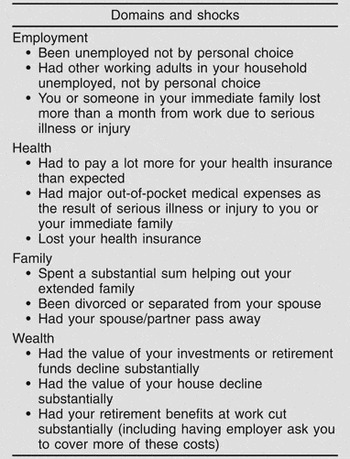
The heart of the survey was an extensive set of questions about people's encounters with unstable economic circumstances—or what we call “economic shocks”—in both the recent and more distant past (refer to Table 1). In the March 2009 wave, respondents were asked about whether they had experienced such shocks in the prior twelve months; in September 2009, the same respondents were asked if they had experienced the shocks in the prior six months. For those completing both waves of the survey, therefore, we have information about shocks that occur in two bounded periods—March 2008–March 2009 and March–September 2009—providing a unique 18-month history (March 2008–September 2009) of Americans' experiences during the recession.
List of shocks, grouped by domain

Note: Wave 15: “At any time in the past 12 months, have you: …”
Wave 21: “At any time since March 2009, have you: …”
In addition to asking about the experience of economic shocks, we also asked respondents about their level of worry about those same risks, as well as about their economic security in general. Because “economic security” is not a term in common usage, it was defined in the opening question as “your security in being able to keep your job, maintain your income, have health insurance coverage, and retire comfortably.” Respondents were then asked about their extent of worry regarding more specific outcomes in the four domains. To allow comparison of pre- and post-recession responses, the SERPI questions regarding worry (including the definition of economic security) were modeled after a poll sponsored by the Rockefeller Foundation in February 2007.Footnote 18
Risk Buffers.
As already discussed, the extent to which economic uncertainty feels threatening depends in large part on a household's capacity to buffer economic shocks, should they occur.Footnote 19 To assess the capacity and distribution of these risk buffers, the SERPI included a series of questions about households' debt levels and financial reserves, use of retirement accounts to finance current bills, and ability to borrow from “family members and close friends” in a time of need.
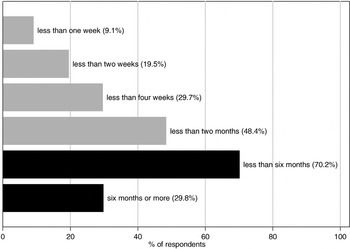
At the core of these measures is the respondents' own estimates of how long their household could get by, without hardship, if their current earnings stopped. As Figure 1 shows, self-reported buffering capacity is both variable and relatively low. Just over 29 percent of Americans reported that their household could go six months or longer without experiencing hardship if their earnings were to stop. Nearly half of households could go no longer than two months, however, and one in five could last no more than two weeks. A common threshold for asset sufficiency in the literature on earnings risk is the capacity to go at least three months without hardship if earnings stop.Footnote 20 Using this as a standard for adequate reserves, more than half the American population appears to lack adequate buffers to deal with economic shocks.
Ability to buffer
Note: Shown are frequencies of answers to the following item: “If you suddenly stopped getting your paychecks for some reason, about how long could you and your family get by before being in real financial trouble?” Data are averaged across the March and September 2009 waves.

Economic assessments.
Past analyses of the economic roots of policy attitudes have focused on citizens' general perceptions of the state of the economy. Our comprehensive measures of self-assessed household insecurity make it possible to differentiate expectations for the macro-economy from anticipations of how the national economy will affect the economic stability of the respondents' own households—a crucial distinction, as we will show. To incorporate general economic assessments, we draw upon two measures from October 2008 (wave 10): a short term retrospective question (Is the economy better or worse than a year ago?) and a question about expected prospects for the economy over the next year. Most (92.4 percent) of Americans felt national economic conditions had worsened between October 2007 and October 2008. Yet the majority (72 percent) was relatively optimistic about the economy's immediate future, anticipating it would remain stable or improve in the next year.
Attitudes toward government policy.
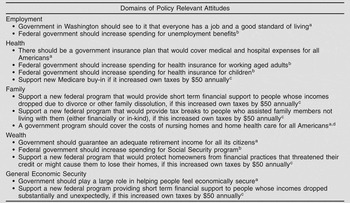
Finally, and crucially, the SERPI included a battery of questions about social and economic policies linked to the four domains of employment, health care, family, and wealth. These questions took three basic forms: (1) questions about the general role for government, relative to the private sector, in taking responsibility for addressing various economic concerns; (2) questions assessing support for existing government programs, in terms of respondents' willingness to devote more or fewer tax dollars to these purposes; and (3) questions asking respondents to evaluate new policy initiatives, each of which was given an explicit price tag in terms of additional taxes required to finance the initiative (refer to Table 2).
List of policy questions, grouped by domain

a public vs. private: “Now we're going to ask about your assessment of and support for various roles for government in American society. On some issues people have two very different viewpoints. Some people agree entirely with the first position, others entirely with the second position. And, of course, some other people have opinions somewhere in between” [7 categories].
b govt spend: “Consider a list of existing federal programs. If you had a say in making up the federal budget this year, should federal spending be increased or decreased for …” [7 categories].
c new program: “How much would you support or oppose each of the following new ways of having government address social issues? This would increase your taxes by $50 per year.” [5 categories].
d This item could also be mapped onto the Health Care or Retirement domain, but it makes little difference for the results.
Below, we combine these items into scales; the reliability coefficients (Cronbach's alpha) are: 0.5025 (Employment), 0.7956 (Health), 0.5441 (Family), 0.5004 (Wealth), 0.5583 (General Economic Security), and 0.8912 (all items together).
Thus the SERPI allows us to explore how economic worries and experiences affect a wide range of social policy attitudes. In the next section, we look at what those worries and experience were. Then we turn to the crucial links between experiences and attitudes.
Economic Perceptions and Experiences amid the Great Recession
The SERPI provides a comprehensive portrait of expressed economic concerns in 2009, with questions regarding a wide range of different sources of potential worry. These questions show, not surprisingly, that economic worries were widespread. Coupled with our evidence on economic experiences, they also suggest that the relative prevalence and intensity of worries line up fairly closely with the chance of actually experiencing the relevant dislocations, though with some important exceptions. For a subset of these questions, moreover, we can compare responses between the SERPI and previous surveys regarding economic worries going back to the economic expansion of the mid-2000s, including the identically-worded questions on the aforementioned 2007 Rockefeller survey. This comparison suggests that several major economic worries—concerning medical expenses, adequacy of resources for retirement, and, surprisingly, housing affordability—were already widespread before the downturn. Thus, while the downturn caused unusually intense economic shocks, there is good reason to believe our main findings would hold in the period leading up to the Great Recession and, indeed, given the long-term shift toward increased insecurity, possibly earlier as well.
The Prevalence of Worries and Shocks
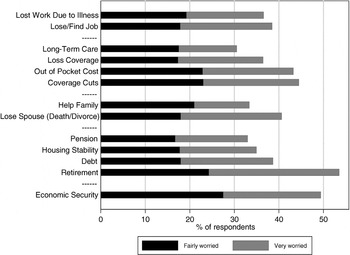
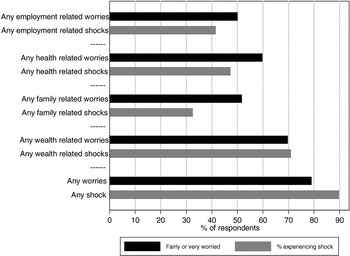
Economic worries were widespread in 2009. Looking across more than a dozen different sources of potential worry asked about in the SERPI, Figure 2 shows the share of Americans who were “very” or “fairly” worried about each specific economic risk, grouped by domain, as well as the share who expressed worry about their economic security in general. In Figure 3, we show the prevalence of worry within each domain—measured as the proportion very or fairly worried about at least one domain-specific risk—alongside the share of Americans experiencing at least one major economic shock within that domain during the 18 months preceding the fall of 2009.
Scope of worries
Note: Data are averaged across the March and September 2009 waves.

Scope of worries and shocks, by domains
Note: Data are averaged across the March and September 2009 waves.

A glance at Figure 3 suggests that the ranking of worries roughly reflects the ranking of risks—the risks people worry most about are, in general, also most common. Comparing worries and experiences within each domain (the share very or fairly worried about at least one risk and the share experiencing at least one shock), it is clear that more people are worried about an event occurring than actually experience the relevant shock. This makes sense, since more people are at risk of an economic disruption than actually experience it. What is more notable is that, at the aggregate level, the proportion of the public worried about adverse economic events is both high and generally seems to reflect the actual incidence of those events.
Still, this alignment does not hold for all shocks. About as many Americans worry about losing their partner or spouse as about substantial out-of-pocket medical expenses, and many more do so than worry about needing to assist family members in financial need. But divorce or death of a spouse or partner is, in fact, much less common than either of these sources of nondiscretionary spending. Similarly, worries about losing health coverage are almost as common as worries about high out-of-pocket medical costs, even though such losses actually occur only about half as often as high costs.
These divergences may reflect public misperception. People tend to inflate the chance of unpredictable events that induce great fear or anxiety, such as terrorism and crime.Footnote 21 Heightened worry associated with certain risks may also reflect the expected severity of the resulting losses. An intuitive measure of expected severity is the estimated length of time it takes for a household's financial circumstances to return to the level enjoyed before the event occurred. We therefore asked respondents to estimate how long recovery would typically take in the event of key economic shocks.Footnote 22 They predicted that disruptions in family (death of spouse or divorce) would have the longest-lasting consequences, with nearly 8 in 10 (77 percent) saying it would take more than six months to recover economically. Unemployment and investment losses, by contrast, were seen as having more transitory effects, although even in these cases not more than 29 percent of respondents expected to recover within six months. Thus, heightened concerns about family dissolution may reflect perceptions that it induces particularly severe or lasting consequences as well as exaggeration of the prevalence of the disruption.
Comparing Worries with Pre-Recession Levels
The Great Recession represented an unusually turbulent economic period—the worst economic downturn in more than half a century. During the 18 months preceding September 2009, according to the SERPI, nearly 9 in 10 American households reported experiencing at least one shock in the four domains covered by our survey, and more than two-thirds (70 percent) of all Americans experienced a shock related to domains other than wealth. These shocks were often quite substantial. During these 18 months, for example, almost a quarter of all households reported a decline in earnings totaling 25 percent or more of their previous annual income.
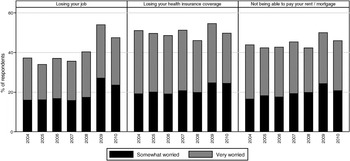
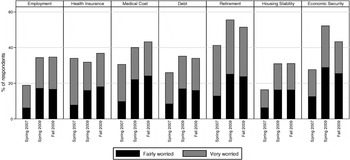
It is therefore natural to ask how historically distinctive the level of economic worries seen during the Great Recession was. Figures 4 and 5 present the results of public opinion surveys that were fielded prior to 2008 that assess the same sorts of worries that we examined in the SERPI: the Kaiser Health Tracking Poll (Figure 4), and the 2007 Rockefeller survey mentioned already (Figure 5). The Kaiser series makes clear that Americans were quite worried about a wide range of economic risks before the downturn. Indeed, only with regard to job loss do we see a dramatic climb in economic concerns in 2008 and 2009. Comparing the SERPI with the identically worded questions in the 2007 Rockefeller survey, we see a more substantial jump in worries. Most of the rise occurs, however, in the share “fairly worried”—the share “very worried” is more stable—and for some risks, worries change only modestly. Thus, while the Great Recession clearly intensified economic concerns, such concerns were commonplace even before 2008 and 2009.
Scope of worries, over time (Kaiser)
Source: Kaiser Health Tracking Poll (June 2010)


The Uneven Experience of Economic Insecurity
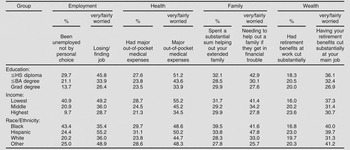
Nevertheless, economic insecurity is not experienced by all Americans equally. Despite the wide reach of the Great Recession, economic worries were far greater in 2008–09 among those with more limited education and income, and racial and ethnic minorities—disparities that have substantial implications for the political effects of different forms of economic risk.
Table 3 shows the prevalence of worries and shocks across a number of salient divides. Two conclusions stand out: First, insecurity—whether measured in terms of worries or actual economic shocks—is far greater for racial minorities, households with limited education, and lower-income households with wealth shocks the exception. Second, worries are more stratified by socioeconomic status than are shocks themselves. Commentators often suggest that higher-income Americans are more worried about their economic security than their material abundance warrants.Footnote 23 This would imply that worries are greater relative to actual risks among the advantaged than among the disadvantaged. Yet outside the employment domain, the experience of shocks differs much less between the advantaged and disadvantaged than the level of worry does, with more educated, higher income, and white Americans appearing much less worried at any given level of risk.
The unequal incidence of shocks and worries

Note: Shocks refer to time-period March 2008 to September 2009.
Disparities in Private Protections
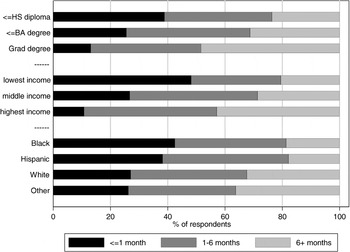
This seemingly counterintuitive finding is likely related to another crucial disparity: high-income and highly educated individuals have much greater private protections against economic shocks, which in turn makes those shocks a much less salient worry. Figure 6 shows the average amount of time that individuals in different socio-demographic groups said they could go without hardship if their earnings disappeared. The magnitude of the disparities is striking: Risk buffers are far more resilient for financially and educationally advantaged households. Similarly, African-Americans and Latinos have distinctly weaker buffers than do whites.
Ability to buffer (by groups)
Note: Shown are frequencies of answers to the following item: “If you suddenly stopped getting your paychecks for some reason, about how long could you and your family get by before being in real financial trouble?”
Data are averaged across the March and September 2009 waves.

Thus, the significance of the uneven exposure to economic risks depends in large part on the distribution of private buffers. It might be expected that those most subject to economic instability would have the greatest incentive to prepare, and indeed, these Americans are clearly worried about their economic security. What the SERPI shows, however, is that households facing the greatest risk also have the weakest private buffers. This suggests that these households face considerable constraints in building up adequate private reserves.Footnote 24 It also suggests that private buffering capacity may have a crucial influence on people's policy positions, since the main alternative to private buffering is public social insurance. Although the impact of some economic shocks can be lessened by purchasing private insurance—for example, acquiring health insurance to protect against high medical costs—private insurance against large-scale economic risks is often unavailable or beyond the means of less affluent citizens. This is why public programs like unemployment insurance are of such crucial concern to citizens. The next section will examine how economic worries, the experience of shocks, and the strength of household's private buffers affect individual attitudes toward these sorts of public protections.
Economic Insecurity and Attitudes toward Social Policy
Do economic shocks and worries correspond with individuals' attitudes toward government's role? In this section, we show that they do—and powerfully so. Direct economic experiences are strongly correlated with support for risk-buffering social policies—at times rivaling partisanship and ideology as correlates. This is particularly true of recent shocks, but also true of more temporally distant shocks. Support for domain-specific policies are most closely associated with past shocks in that domain, but policy attitudes also appear to be associated with shocks experienced in other domains. Shocks to family arrangements and wealth are weaker and less consistent in their association with attitudes than are shocks in the domains of employment and medical care—which reflects, we believe, the weaker relationship between insecurity and wealth volatility in the first case, and the lack of understood and recognized policy mechanisms for addressing family shocks in the second. Nonetheless, wealth and family shocks still generally correlate with acceptance of a broader role for government in these domains.
At least as important, these economic experiences—and the worries associated with them—do not appear to be simple proxies for political predispositions or attitudes. Experiences and perceptions of economic insecurity are notably distinct from either partisanship and ideology or the general evaluations of the economy often used in attitudinal analyses. All this may seem intuitive, but as discussed earlier, it actually runs counter to dominant strains in behavioral research on American politics. The ups and downs of individuals' economic lives clearly shape their policy views alongside ideological and partisan influences; we just need to look more closely and with more realistic theoretical expectations than previous analyses have.
The “DNA” of Insecurity
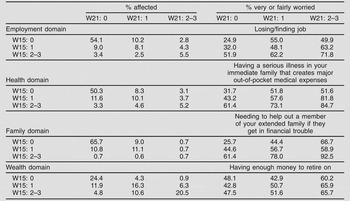
Americans experience a multiplicity of economic shocks, even within a single domain. To construct a relatively simple and coherent portrait of their relationship with policy attitudes, we start by constructing a stripped-down taxonomy of their occurrence over time (March 2008-March 2009, March-September 2009) and across domains (employment, health care, family, and wealth). The result is a series of tables that cross-tabulate the number of shocks (0, 1, 2–3) by wave (wave 15—March 2008 and March 2009—on the vertical axis; wave 21—March 2009-September 2009—on the horizontal axis). The first set of cells shows the percentage of respondents experiencing this combination of shocks across the two waves; the second set shows the average level of worry expressed by these respondents. These basic charts can be thought of as the “DNA” of household insecurity, since they are constructed from the sequence of individual shocks and serve as building blocks for citizens' worries and policy attitudes.
The first set of columns in Table 4 shows the pattern for shocks in each domain: employment, health, family, and wealth. As is clear from the table, the experience of shocks is widespread. For every domain except family disruption, roughly half or more of respondents—45.9 percent in employment, 49 percent in health, and 75.6 percent in wealth—reported at least one shock in the 18 months preceding September 2009.Footnote 25 Of those who experienced shocks, the most common reported pattern, not surprisingly, is a single shock in one of the two periods. Yet many households experience multiple shocks in one or both periods.
The DNA of insecurity

Note: W15: number of shocks in domain between March 2008 and March 2009.
W21: number of shocks in domain between March 2009 and September 2009.
Percentage worried for W21; in these samples, the average percentage of very or fairly worried respondents is 37.3% (employment), 45.4% (health), 34.4% (family), and 52.8% (wealth).
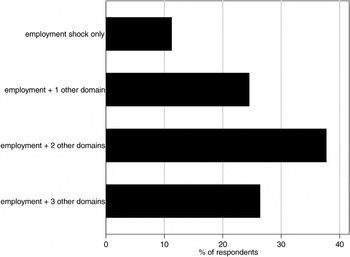
This highlights a crucial pattern overlooked by past analyses: economic shocks are rarely isolated. Rather, they often reoccur, continue over time, or coincide with other shocks. The SERPI allows us to calculate the prevalence of persisting shocks (continuing or repeated across waves) and clustered shocks (different shocks occurring at the same time across two or more domains). As it turns out, persisting shocks are close to the norm among those experiencing an economic disruption. About half of all respondents who experienced a shock between spring 2008 and spring 2009 also reported that the same shock had occurred over the next six months.Footnote 26 Not only do shocks often persist, but many households also experience clustered shocks across the four domains (employment, health, family, and wealth). For instance, the vast majority of Americans who experienced a shock to employment in this 18-month period also reported a shock in one of the other domains (health, family, wealth), and often in several at once (refer to Figure 7).
Clustering of shocks
Note: Frequency of co-occurring shocks across multiple domains reported by respondents who had experienced at least one employment shock in that wave of the survey. Data are pooled from the March and September waves.

The prevalence of persisting and clustered shocks has important implications. Besides the obvious hardship these interwoven shocks can cause, their ubiquity means that realistic models of the effect of economic shocks on policy attitudes should treat shocks not as a binary measure but as a continuum, varying in intensity across at least two dimensions: how many or long shocks are (what we have termed persistence), and how spread they are across different aspects of economic life (what we have termed clustering).Footnote 27 Ignoring persistence and clustering distorts analyses in at least two ways. On the one hand, lumping together those who have experienced a single shock with those who have experienced persisting shocks may lead analysts to miss the real effects of highly-intense economic shocks. On the other hand, failing to take into account clustering across domains may sometimes lead analysts to ascribe the effect of one shock (say, loss of health insurance) to an attitudinal shift that is more closely linked to another, clustered shock (say, job loss).
The second set of columns in Table 4 drives the first point home: worries are much greater for those who experience a larger number of shocks. Thus, for example, respondents who have lost their job and report being out of work six months later are markedly more worried (at that later date) about losing a job (or finding a new one) than are those who have avoided job loss in the recent past and than those who report job loss only in the first survey. The patterns are especially marked in the family domain, about which 34.4 percent of all respondents are fairly or very worried. Of those respondents who did not experience any family-related shock, only 25.7 percent were fairly or very worried. But of those who reported two or more family-related shocks, more than 92 percent were fairly or very worried. Although this simple demonstration includes no statistical controls, Table 4 suggests that the most recent shocks (within six months of the survey) loom largest in people's thinking about economic risks, though more temporally distant shocks (six to eighteen months before the survey) seem to induce worries as well. Most important, it suggests that the occurrence of shocks is associated with very large deviations from average levels of worry; dynamic economic experiences appear highly related to people's worries about economic risk.
The Association of Shocks with Worries
Because the frequency of shocks could reflect other features of citizens' lives that correlate with expressed worry, the DNA evidence is only suggestive. When we include statistical controls, however, the conclusions remain the same: those who have experienced direct economic shocks are significantly more worried than those who have not, in rough proportion to the intensity of those shocks—with the effects highly mediated by the resilience of one's personal financial buffers. Reported worries are powerfully shaped by experiences even after taking into account socio-demographic characteristics, partisanship and political ideology, and other influences on personal financial assessments identified by prior scholarship.
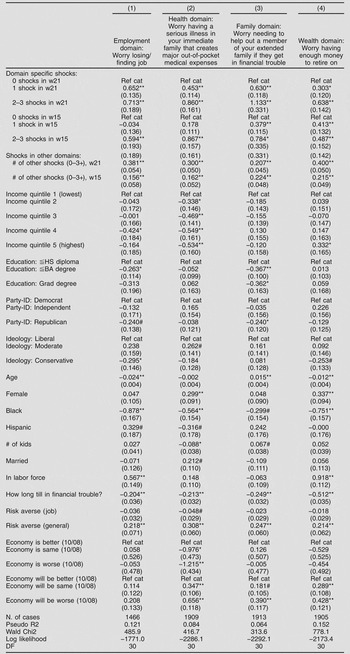
Table 5 presents the results of a multivariate model predicting worries based on the DNA patterns just introduced. We look at three shocks within each domain (employment, health, family, and wealth) and, as before, distinguish between one and two-to-three shocks in each wave.Footnote 28 In keeping with our discussion of intensity in the last section, we also include a variable capturing the number of shocks outside the domain under examination (for example, in the analysis of the employment domain, shocks associated with medical spending).
The DNA of insecurity (multivariate)

# p < 0.1,
* p < 0.05,
** p < 0.01.
Coefficients above standard errors in parentheses.
Ordered logit estimations.
Evaluations of the economy are from wave 10 (October 2008).
Number of shocks in other domains are top-coded at 3 (theoretical range is 0 to 9).
Categories for dependent variable are: 1 = not at all; 2 = slightly; 3 = fairly; 4 = very worried.
Most of these controls are straightforward, but two require explication. We include two controls developed by economists and psychologists to capture how willing individuals are to take risks: a measure of risk aversion related to earnings and employment (“Risk averse (job)”)Footnote 29 and a general attitudinal measure of risk-seeking (“Risk averse (general)”).Footnote 30 These controls capture people's broad outlook toward risk—which might otherwise confound our findings—and they perform as expected, though the general attitudinal measure seems more clearly associated with worries than the narrower measure related to jobs and income.
Table 5 shows that in every domain the number of shocks is strongly correlated with the degree of worry in Wave 21, both about general economic security and about a wide range of specific economic risks, from unemployment to the loss of health insurance. And the substantive effects of shocks are large. Since table 5 displays coefficients from ordered logit estimations, we report predicted probabilities of being very worried for a hypothetical respondent without any shock in that domain to one with at least two shocks in both waves. For these simulations, the predicted probability of being very worried almost doubles in the wealth domain (0.204 to 0.371), more than doubles in the employment domain (from 0.166 to 0.384), almost triples in the health domain (from 0.153 to 0.448), and almost quadruples in the family domain (0.096 to 0.379). But even experience with single shocks (one in each wave) is associated with fairly large simulated changes in the predicted probability of being very worried, with the predicted probabilities falling roughly in the middle of the ranges reported above (employment: 0.255, health: 0.243, family: 0.206, wealth: 0.304).
One striking finding is the importance of personal financial buffers (“how long you and your family [could] get by before being in real financial trouble” if family earnings were interrupted).Footnote 31 People with weaker financial buffers are significantly and substantially more worried about their economic security, even controlling for income and education. Of course, buffers are highly correlated with socioeconomic status, but the correlation is far from perfect. For studies of insecurity, measures of household buffering capacity are in many ways a much more appropriate—and again, easy to measure—assessment of the degree to which economic shocks will pose immediate risks to a household's standard of living.
In contrast, the performance of education and income is modest and inconsistent once buffers are taken into account. Neither income nor education is consistently positively associated with lower levels of worries—and, indeed, with regard to retirement wealth, the richer and more educated are actually more worried (although the coefficients are not always significant).
To be clear, this does not mean that higher-income Americans are as worried about their economic security as are lower-income Americans. Generally speaking, those with greater incomes or education are much less worried. What it does mean, however, is that a good deal of the conventionally measured relationship between income and policy attitudes appears to be mediated through the greater vulnerability of the less affluent to major economic risks and the greater weakness of those families' personal financial buffers. This helps explain the results for other controls as well. African-Americans, for example, appear to be less worried about their economic security than other Americans controlling for shocks and personal buffers. But because they are so much more subject to economic instability than other Americans and have such weak buffers—weaker than Hispanics, on average—their worries about economic security are generally quite intense.
Meanwhile, partisanship and ideology appear to have a limited role in explaining individuals' worries about economic security. Once direct economic shocks and risk buffers are taken into account, Republicans and conservatives appear only modestly less worried than Democrats and liberals; the coefficients, moreover, are rarely significant. Whatever else citizens' worries about their economic security express, they are not simply a proxy for preexisting ideological or partisan preferences. Instead, they appear to closely reflect the intensity and character of unstable economic circumstances.
The Association of Worries with Policy Attitudes
If worries are strongly related to economic experiences, the obvious next question is how closely these assessments are associated with support for risk-buffering social policies. To gauge attitudes toward social policy, the SERPI incorporated multiple batteries of questions about social policy within each domain, as well as two policy questions related to economic security in general (refer back to Table 2). For ease of exposition, we aggregate these measures within domains to construct a simple index of support for more active government measures in the four domains and with regard to general economic security.Footnote 32 Similar findings hold, however, when we use the individual responses to the survey questions, rather than these aggregate measures.
Let us start by exploring the role of worries as a transmission belt connecting experiences and attitudes: How closely are economic worries associated with attitudes toward social policy? Although some past research explores how economic circumstances affect support for certain risk-related social policies (unemployment benefits, health insurance subsidies, and so on), none has explored how perceptions of economic insecurity in multiple domains relate to support for the wide range of ways in which government might help buffer economic risk. Do reported levels of worry capture a crucial set of considerations that factor into citizens' policy preferences?
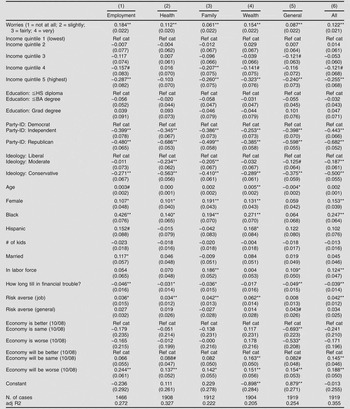
The answer is yes—and clearly so. In Table 6 we present the results of a simple model predicting support for social policies designed to protect citizens against risk in our core areas: employment (column 1), health care (column 2), family (column 3), and wealth (column 4), as well as for an active general role for government as a guarantor of economic security (column 5). We also aggregate all the policy attitudes into a single measure of support for government risk buffering (column 6). Our crucial independent variable is a respondents' level of worry about economic security, which is simply the average of the non-missing values of all economic worries just discussed. The controls are the same as before.
Explaining social policy attitudes with worries (multivariate)

# p < 0.1,
* p < 0.05,
** p < 0.01.
Coefficients above standard errors in parentheses.
OLS estimations.
The dependent variables are scales of policy attitudes with zero mean and standard deviations of one. Higher values indicate greater support for government intervention.
The results in table 6 are striking. Respondents' level of worry is associated with their level of support for government action across all the domains. Although worries appear only weakly, albeit significantly, related to support in the family domain—a recurrent pattern that we will discuss later—the level of worry is strongly correlated with support in the three others, with regard to general attitudes toward an active government role providing security, and with average support for risk-buffering across all the policy questions. Indeed, in most of the domains, worries rival or exceed partisanship and ideology in the magnitude of their effects. Given that worries are not consistently and strongly related to partisanship or ideology, this is a suggestive demonstration of their substantial independent effect on policy attitudes, above and beyond the ideological and partisan measures on which political scientists have so focused.
Table 6 displays coefficients from ordinary-least-squares estimations, and therefore allows for direct assessment of substantive effects. The strongest findings are for employment policy attitudes, where the difference between someone who is very worried (average worries = 4) and someone who is not worried at all (average worries = 1) is 0.552 (=(4 − 1) * 0.184). This effect is about twice as big as the difference between highest and lowest income (which is −0.287); it is also larger than the difference between Republicans and Democrats (−0.48) as well as conservatives and liberals (−0.271). But with the exception of attitudes toward family policies, worries are strong substantive predictors in the other policy domains as well, oftentimes surpassing or rivaling the explanatory power of partisanship or ideology.
The Association of Shocks with Policy Attitudes
Worries are a subjective component of citizens' economic experiences. We know from the results so far that they are not merely a reworked expression of ideology or partisanship—that respondents do not “pick” their worries simply to validate their party- or ideology-based positions. But it is still the case that our last model essentially compares one set of attitudes with another, and that both could, in theory, be a reflection of some other characteristic of respondents' worldview or circumstances for which we do not control.
The most obvious is citizens' general view of government, which could influence both perceptions of risks and attitudes toward policy. It should be noted, however, that if worries and policy attitudes both reflect general views of government, that would likely weaken, rather than strengthen, the link between greater worry and greater support for government action. After all, citizens who don't trust government to deal with threatening economic risks should be less inclined to see government as a source of protection and thus more worried about the risk itself—which cuts against the grain of our strong finding of the opposite relationship.
Still, for some analytic purposes it makes sense to eliminate the attitudinal middleman, so to speak, and look at the direct relationship between experienced economic shocks and attitudes toward social policies, controlling for partisanship and ideology as well as key demographic factors. If nothing else, this allows us to hone in on the most obvious omitted variable in our prior model: jarring financial events in respondents' lives that could influence both levels of worry about economic risk and levels of support for policies to buffer those risks.
Before we take this step, however, we want to emphasize that for many analyses, worries may be at least as good a measure as experienced risks. As documented above, Americans are often worried about economic risks that their households have not personally experienced—and these secondhand worries may be no less powerful in activating support for risk-buffering public policies. Moreover, individuals' expressed levels of worry incorporate a whole series of basic judgments about how the world works—an understanding drawn from personal experience, their larger social networks, their media exposure, and so on. Greater study of how worries are formed and, in turn, shape policy attitudes could ultimately provide a richer understanding of citizens' economic psychology than could examinations of the correlation between experienced economic losses and attitudes. In favor of this strategy, worry measures are already common in surveys, though regrettably almost never alongside political and policy questions.
Nonetheless, the direct correlation between experienced shocks and policy support is a valuable linkage in its own right, especially given the general demotion of experience-oriented explanations of policy attitudes in American politics research.Footnote 33 Do people who experience a major economic shock have different views of relevant economic policies than those who do not? How strong are these effects when compared with the effects of partisanship, ideology, and basic demographic and socioeconomic characteristics? How do they compare with the effects of the general economic evaluations so ubiquitous in contemporary opinion research on the economy?
To answer these questions, we turn once again to shocks and attitudes within our four domains (employment, health, family, and wealth). In each, we are interested in the relationship between support for social policies that address risks in that domain and the number of direct shocks experienced by the respondents. As before, we aggregate all the questions asked about support for existing or prospective government policies in each domain into a single domain-specific index of support. Because the various questions in each domain might tap into different dimensions of economic security, however, we also report results using a single question for each domain. These questions concern general government responsibility (except in the family domain, where no such question was asked and we use instead a question about support for a new policy to help those caring for a family member not living with them, such as an elder parent). For our purpose, government responsibility questions are preferable to other items because they are concretely linked to existing policies (unlike questions about hypothetical future policies) but not dependent on existing spending levels (unlike questions about support for additional spending for existing policies).
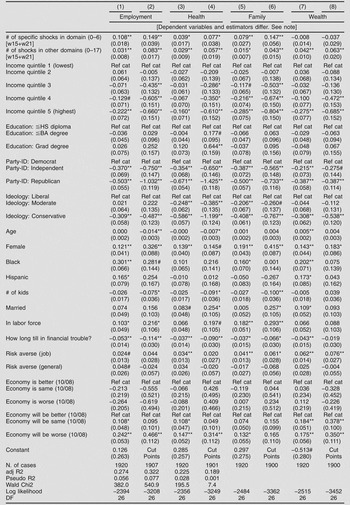
Table 7 shows the results by domain for the general index of support and the one specific question in each domain. In all domains but wealth, the number of shocks is significantly correlated with support for risk-buffering policies. In these domains, the substantive effect of shocks (comparing zero with six shocks) surpasses that of education and income in all cases, and that of party identification and ideology in the employment and family domains. For example, the predicted probability of answering that “some people feel the government in Washington should see to it that every person has a job and a good standard of living” is more than twice as high for someone that experienced six shocks (compared to someone with no shocks), and it is roughly twice as high for Democrats compared to Republicans.
Explaining social policy attitudes with shocks (multivariate)

# p < 0.1,
* p < 0.05, **p < 0.01.
Coefficients above standard errors in parentheses.
Odd-numbered models are OLS estimations. Even-numbered models are ordered logit estimations.
The dependent variables are (higher values indicate greater support for government intervention):
(1) Scale on (un)employment policy attitudes (mean = 0, SD = 1; OLS)
(2) Gov resp: Guaranteed Good Employment (1 to 7; ordered logit)
(3) Scale on health policy attitudes (mean = 0, SD = 1; OLS)
(4) Gov resp: Health Insurance (1 to 7; ordered logit)
(5) Scale on family policy attitudes (mean = 0, SD = 1; OLS)
(6) Gov resp: Long Term Care (1 to 7; ordered logit)
(7) Scale on wealth/retirement/housing policy attitudes (mean = 0, SD = 1; OLS)
(8) Gov resp: Guaranteed Retirement Income (1 to 7; ordered logit)
With respect to health policy attitudes, however, partisanship and ideology clearly outperform our shock variable. Since our survey was in the field during the highly partisan health care debate, this may not be too surprising. What may be surprising is that shocks still have a large effect on health policy attitudes, even in the midst of a highly partisan policy debate. Moreover, our measure of the strength of individuals' risk buffers proves to be a consistent, statistically and substantively significant (negative) correlate of support for government action.
The estimated relationship between general economic evaluations and support for social policies generally confirms conventional expectations, though the relationships are not particularly strong. Past scholarship suggests that individuals who believe the economy is worse than it used to be or is going to be worse in the future will be more supportive of risk-buffering.Footnote 34 However, retrospective economic perceptions are never significantly related to policy attitudes in our models, and the relationship is negative when significant (if the economy is perceived to be poorer, support for social policies is lower). Forward-looking perceptions—will the economy be better in six months?—are almost always significant and, as past scholarship suggests, positively related to support for more active social policies. All these evaluative questions, it should be noted, were asked before the 2008 election, so as not to confuse reactions to President Obama's election with economic assessments. Still, a serious shortcoming of general evaluations of the economy is that they are biased by partisan affiliation, a problem that appears much less severe with the measures of security we have proposed.Footnote 35
Implications and Future Directions
The recent sharp downturn has cast in stark relief the problem of economic insecurity. Yet students of American politics have had surprisingly little to say about how people experience and understand economic risks. This is unfortunate, not just because insecurity is such a salient public concern—and was so even before the Great Recession. It is also unfortunate because insecurity is so central to longstanding historical and theoretical debates within the discipline. From voting to revolting, from support for the welfare state to antagonism toward ethnic and racial minorities, economic instabilities have long been thought to shape the most fundamental aspects of political life. For the most part, however, insecurity has been a shadow factor in political analysis—presumed but not probed, theorized but not measured. And it has been largely absent in the behavioral tradition so strong in the American politics subfield.
We have sought to lay some basic foundations for a stronger behavioral research program examining insecurity and its role in American politics, building on work in political psychology, behavioral economics, and survey research. Too often the discussion of the economic roots of policy attitudes has declared—based on, at best, limited measures of dynamic economic experiences—that economic factors are largely irrelevant and that, when relevant, general sociotropic evaluations, rather than egocentric concerns, always dominate.Footnote 36 While work carrying this message provides an important corrective to crude self-interest accounts, it has had the unfortunate effect of deterring better conceptualization and measurement of changes in economic standing. As we have tried to show, there are substantial opportunities for political science and allied disciplines to understand the mass effects of the ongoing transformation of the American political economy by developing stronger conceptions of how economic security affects policy attitudes and political reasoning.
Citizens value their economic security, especially at times of upheaval.Footnote 37 And they construct expectations based on their own experiences and the experiences of those around them. These views mix the sociotropic and personal, the self-interested and other-regarding, in ways that defy simple categorization. But they clearly shape how people think about their economic lives and about government's role in making those lives more secure. Citizens' dynamic economic experiences matter for their public policy positions in ways that are both substantively significant and theoretically explicable.
To be sure, scholars seeking to capture the dynamic economic situation of citizens and how it affects political behavior will have many thorny problems to tackle. In this article, for example, we have relied primarily on correlations among responses, which given the richness of the SERPI is highly revealing. Research on economic security should consider experimental investigations as well, along with the use of longer-term panel data that make it possible to carefully parse the time-sequencing of economic shocks and attitudinal changes. With regard to the former, a particularly promising approach would be to study the downstream effects on worries and policy attitudes of experiments designed to test alternative social policy approaches that differently expose citizens to economic risk (for example, the expansion of Medicaid in Oregon, where—because of limited resources—applicants within a given income range were randomly chosen to receive coverage). With regard to the latter, there is a felt need for the incorporation of standard political and policy questions into panel income surveys and the inclusion of more fine-grained economic measures in panel surveys of public opinion. Such analyses will require greater collaboration between those doing different kinds of research—between program monitoring and behavioral political science, for example, or between public opinion research and panel economic studies.
Nor is it clear how long the attitudinal effects of shocks we find will persist. In our analyses, economic shocks in the first wave (March 2008 to March 2009) were still clearly associated with attitudes in September 2009. But in additional analyses not reported here, we found weak to non-existent effects for shocks prior to March 2008. Our measure of pre-2008 shocks, however, is a question asking respondents if they had ever experienced the relevant shock in the years prior to March 2008, thus mixing both relatively recent shocks (say, in 2007) and ones quite temporally distant. Ultimately, political researchers require ongoing panel surveys—ideally, ones like the Panel Study of Income Dynamics that continue for many years—that trace both economic experiences and political attitudes over long spans of time.
The SERPI assessed Americans' experiences and perceptions of economic insecurity in the depths of the recession, raising the concern that the magnitude of the relationships identified in our models are unique to these particularly difficult economic circumstance. Yet, as Figures 4 and 5 based on previous polling showed, 2009 was not as unusual as one might expect. Many economic worries were already quite common before the downturn began. The Great Recession exposed a broader cross-section of Americans to economic risks, but those risks were very much a part of American economic life even before it hit—and they are certainly still a part of it today. Still, the Great Recession was an unusually intense period of economic distress, and individuals may not respond to economic shocks in exactly the same way in more stable economic times. Here again, continued panel surveys that persist across the business cycle are essential.
If our central contribution is to show that economic instability matters for individuals' policy attitudes, we also have tried to untangle how it matters, and what this means for future investigations. As a starting point, we can confidently say that people's worries about their economic security are not simply reworked partisanship or ideology. This is theoretically interesting, since we know other evaluations of the economy are heavily partisan-tinged. It is also methodologically useful, since worries are already common in surveys (though not in those with measures of political attitudes and behavior) and have an established place in the psychological literature.Footnote 38 Since it seems that worries are heavily shaped by personal economic experiences, adding worry questions to opinion surveys would be an important step toward introducing economic insecurity into survey-based research.
Another important step is to broaden the range of economic risks examined. Though job loss looms large in people's economic thinking—and even larger in what research there is on the political consequences of economic instability—insecurity is a reflection of multiple, intersecting risks. These extend beyond employment risks to include major economic losses driven by family, wealth, and health changes. We have shown a relatively smooth stepwise relationship between risk intensity and policy attitudes: greater intensity, more support for government risk protections. We have also shown substantial spillover effects across domains, especially between employment and health—the two domains where shocks and worries seem to have the strongest relationship to policy attitudes. Most theories ignore and most surveys miss how the persistence and clustering of economic risks shapes attitudes toward risk-buffering policies.
They tend to miss as well the characteristic of households most relevant to how they respond to unstable economic circumstances—namely, their capacity to deal with economic risks on their own. This buffering capacity is associated with attitudes even when income, education, and other demographic characteristics are controlled for. In economics and sociology, the role of wealth has been a prominent concern. But political science has generally looked at “flow” measures of household resources, such as income, rather than “stock” measures, such as wealth. It is wealth and other private buffers, however, that allow families to deal with threatening economic risks without public protections, and so it is not surprising that our measure of buffers is more strongly associated with policy attitudes than standard measures of household income.
Until now, we have refrained from discussing the implications of our findings for public opinion as a whole, and for good reason. At the individual level, the experience of intense economic shocks is associated with greater support for risk-buffering policies. At the collective level, however, these experiential drivers blend with other influences on public opinion. Aggregate support for government action may be enhanced, for example, if economic instability weakens trust in markets or other private institutions. On the other hand, support may be counterbalanced by greater sensitivity to taxation during straitened economic times, or doubts about the efficacy of policies intended to soften downturns. There remains the question, moreover, whether changes in opinion translate into changes in political mobilization of the sort that most directly shapes electoral outcomes and policy making.Footnote 39
Nor have we considered how intensely citizens hold their preferences, or how active they are in pursuing them. Each is likely to depend on the concentration of risks—that is, how conjoined they are across multiple domains of risk, and how closely correlated they are with other fundamental socioeconomic divides, such as race, education, and income. If risks are highly concentrated, the result is opinion polarization, as we show in other work, looking both across nations and areas of US social policy.Footnote 40 In particular, when less-affluent citizens face much greater insecurity than more-affluent citizens, opposition to the welfare state among the relatively secure is stronger. The continuing concentration of insecurity even during the worst downturn since the Great Depression is surely one factor in the political crucible that forged the Tea Party. Disproportionately middle-aged or older and male with greater income and education than average (and, often, secure retirement and health benefits), Tea Party members frequently express the view that assistance for economic distress or new health coverage goes to “someone else.“Footnote 41
Although the ramifications of rising insecurity for American politics are uncertain, no one can doubt it deserves to be a salient concern of public officials. In this light, it is notable how little we know not just about the opinion effects of economic shocks, but their basic incidence and character. No official public statistic measures the individual-level dynamics of household economic well-being. Even the unemployment rate—the closest measure—speaks only indirectly to these dynamics. With a broader team of researchers, we have developed an index that captures the share of Americans experiencing large economic losses, the Economic Security Index.Footnote 42 But a huge amount of room remains for new and better measures, both of household economic dynamics and of how Americans think about and respond to them.
A huge amount of room also remains for new and better policies that reflect the reality that risks are generally clustered across domains. In the United States, health and pension benefits are tied closely to work, and family supports that allow two-earner and single-earner couples to balance work and care-giving are generally private and incomplete. Both left and right—for different reasons and with different emphases—are likely to be drawn into addressing the growth of new and newly-intense economic risks created by the post-1970s transformation of work and family.
Practitioners of American politics know that the search for security is a powerful motive, whether harnessed for good or ill. Scholars of American politics have been much slower to recognize this reality. This neglect, once regrettable, is now untenable. If the Great Recession signaled anything, it is the stark reality of economic insecurity in many Americans' lives. The last generation has seen sweeping changes in our economy, our society, and our global context—from the breakdown of the framework of private workplace benefits that has defined America's distinctive social policy model to the increased globalization of trade and finance to the rise of two-earner and single-parent families caught between the pull of the labor market and the demands of care-giving. We live in an age of increased individual exposure to economic risk. As candidates square off over how to respond to this new world, political scientists need to step in to understand it.We have explored its implications for policy attitudes, but a wide horizon of research agendas opens up once we cast clear eyes on the insecure American.