Introduction
Obsessive–compulsive disorder (OCD) is a chronic and disabling mental disorder characterized by the presence of obsessions and/or compulsions that are time-consuming, cause major distress, and impair important areas of functioning (personal, social, occupational).Reference Abramowitz, McKay and Storch 1
Community lifetime prevalence of OCD ranges from 1.6% to 2.3%, with a point prevalence of 1%. The onset of obsessive–compulsive symptoms (OCSs) generally occurs during childhood and adolescence, but the average time-to-treatment is 11 years. About 9 out of 10 patients with OCD have comorbid psychiatric diagnoses.Reference Brock and Hany 2
A high proportion of clinically diagnosed OCD patients fulfill diagnostic criteria of a schizophrenia spectrum disorder (SSD), to the point that significant evidence in the literature supports the existence and the clinical relevance of a schizo-obsessive spectrum of disorders, including schizophrenia (SCZ), schizotypal personality disorder (SPD) with OCD, OCD with poor insight/with psychotic features (ie, OCD individuals who do not meet the criteria of SCZ but fail to recognize their OCS as senseless or exhibit delusional transformation of obsessions or even hallucinations, respectively), SCZ with OCS, and SCZ with OCD. In this sense, new clinical entities have been proposed to describe individuals showing the dual diagnoses “SCZ–OCD” (schizo-obsessive disorder, a diagnosis proposed for individuals who meet the criteria of both SCZ and OCD and whose existence seems to be supported by epidemiologic, clinical, and brain functional patterns) or “SPD–OCD” (schizotypal OCD). 3-5
SPD is a pervasive pattern, beginning in early adulthood, of social and interpersonal deficits, accompanied by acute discomfort with, and reduced capacity for, close relationships as well as by cognitive or perceptual aberrations and eccentricities of behavior. 6
In the International Classification of Diseases (ICD)-9 to ICD-11, SPD is listed under SSDs, whereas in Diagnostic and Statistical Manual of Mental Disorders (DSM)-III to DSM-5, it is labeled as a (Cluster A) personality disorder.Reference Kirchner, Roeh and Nolden 7 At the same time, however, DSM-5 describes SPD as a disorder related to the “schizophrenia spectrum and other psychotic disorders.” 6
Point and lifetime prevalence of SPD in general population are 1.3% and 3.9%, respectively.Reference Morgan, Zimmerman, Livesley and Larstone 8 , Reference Torgersen, Oldham, Skodol and Bender 9 Compared to other personality disorders, SPD appears to be more common in younger individuals and is characterized by a higher level of dysfunction and disability.Reference Morgan, Zimmerman, Livesley and Larstone 8 , Reference Torgersen, Oldham, Skodol and Bender 9
The aim of this paper is to provide a brief but comprehensive analysis of the literature on the epidemiological, psychopathological, and clinical coexistence between OCD and SPD. We believe that the so-called schizotypal OCD may have clinical validity, therefore, a comprehensive investigation of the relationship between SPD features and obsessive–compulsive phenomena in clinical OCD samples could bring significant insight into the strength and nature of the relationship itself.Reference Poyurovsky, De Haan, Schirmbeck and Zink 10
Methods
Search strategy, selection criteria, and articles identified
To conduct a review of the literature on the topic “SPD in clinical OCD samples,” we used the following search strategy and selection criteria.
References were identified through searches of PubMed/MEDLINE, Scopus, LILACS, and Cochrane Library for articles published from inception until November, 2019, by use of the following search string: (“obsessive compulsive disorder” or “OCD” or “obsessive compulsive symptoms” or “OCS”) AND (“schizotypal” or “schizotypal personality” or “schizotypal disorder” or “schizotypal personality disorder” or “SPD” or “STPD” or “schizotype” or “schizotypy” or “schizotypic”). Other relevant articles were searched in the authors’ personal files (eg, relevant articles known by the authors but potentially not detected by the electronic search strategy) and in Google Scholar. Research and review articles resulting from these searches were reviewed, as well as relevant references cited in those articles were carefully reviewed to identify additional pertinent studies.
Articles that: (1) were original peer-reviewed articles, published in any language, (2) provided empirical data, and (3) reported findings about the presence of SPD or schizotypal personality traits (SPTs) in clinical OCD samples were considered eligible for inclusion. Diagnosis of OCD had to be based on prespecified diagnostic criteria of a standard classification system (DSM or ICD). To examine prevalence rate, studies reporting prevalence rate of SPD had to assess the disorder using diagnostic measures or instruments based on standard classification systems. However, we also included studies reporting findings about the presence of SPTs in OCD in order to provide a more accurate clinical description of schizotypal OCD.
Body
Articles identified
A total of 603 articles were identified from the selected search terms. After removal of duplicates and abstract screening for relevant studies, a total of 91 abstracts remained for full-text reading. Sixty-six original research reports were selected based on the above inclusion criteria. Fifteen review articles were selected as relevant.Reference Scotti-Muzzi and Saide 5 , 11-24 Ten articles were rejected because they did not meet the search criteria (articles on subclinical OCS). Additionally, 25 original research articles were identified after reference cross-checking and from the 15 selected relevant review articles.
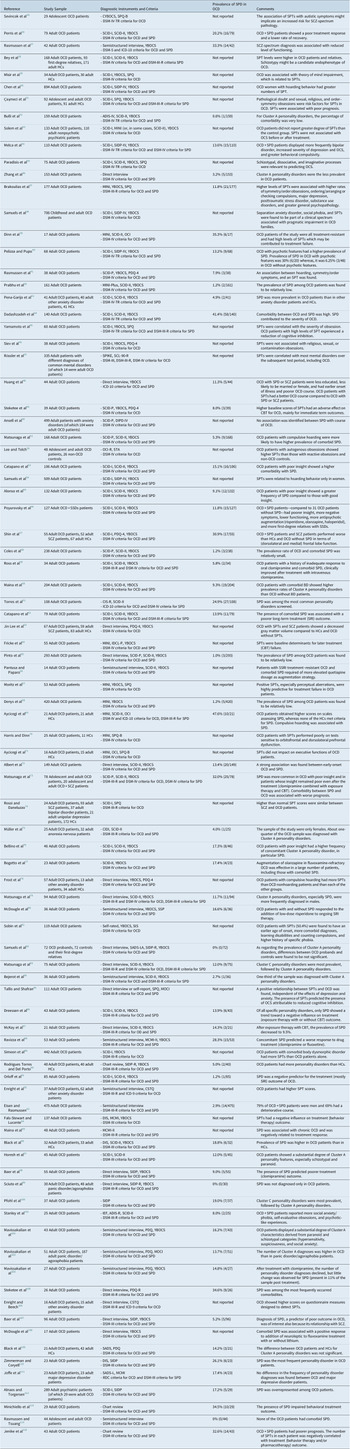
Therefore, the final set comprised 91 research articles. 25-115 Five types of data elements (authors and year of publication of the study, study sample, diagnostic instruments and criteria, prevalence of SPD in OCD—when reported—and comments on main findings) were extracted from the 91 selected studies, as presented in Table 1.
Studies on Comorbidity Between Obsessive Compulsive Disorder (OCD) and Schizotypal Personality Disorder (SPD) or Traits (SPTs)

Abbreviations: ADIS, Anxiety Disorder Interview Schedule; BD, bipolar disorder; CBT, cognitive behavioral therapy; DIS, Diagnostic Interview Schedule; DSM, Diagnostic and Statistical Manual of Mental Disorders; HC, healthy control; IEF, Initial Evaluation Form; OCD, obsessive–compulsive disorder; MCMI, Millon Clinical Multiaxial Inventory; MINI, Mini International Neuropsychiatric Interview; MOCI, Maudsley Obsessive-Compulsive Inventory; PDQ, Personality Diagnostic Questionnaire; RDC, Research Diagnostic Criteria; SADS, Schedule for Affective Disorders and Schizophrenia; SCZ, schizophrenia; SCID, Structured Clinical Interview for DSM; SIDP, Structured Interview for DSM-IV Personality Disorders; SIS, Structured Interview for Schizotypy; SPD, schizotypal personality disorder; SPT, schizotypal personality trait; SPQ, Schizotypal Personality Questionnaire; SSD, schizophrenia spectrum disorder; SSRI, selective serotonin reuptake inhibitor; YBOCS, Yale-Brown Obsessive–Compulsive Scale.
Epidemiological and sociodemographic profile of OCD–SPD comorbidity
In all studies, OCD diagnosis was based on DSM. Sixty-one out of 91 studies reported prevalence rate of SPD in OCD. The observed rates of co-occurrence varied considerably in reviewed studies: prevalence ranged from 0%Reference Samuels, Nestadt and Bienvenu 82 , Reference Sciuto, Diaferia and Battaglia 99 , Reference Rasmussen and Tsuang 114 to 47.6%.Reference Aycicegi, Dinn and Harris 69 A number of factors could explain, at least in part, this substantial range in prevalence, for example, the different diagnostic instruments used, the methods of evaluation (structured, semistructured, or direct interview, chart review, self-report), the study design (cross-sectional observational study, retrospective study, prospective observational or interventional follow-up study), and the patient population studied (treatment-naïve OCD individuals, OCD individuals in treatment, or treatment-resistant OCD individuals). Taken together, the pooled mean prevalence rate and the median prevalence of SPD in OCD patients were 10.1% and 13.2%, respectively, which are values higher if compared to those found in general population (1.3% and 0.6%).Reference Morgan, Zimmerman, Livesley and Larstone 8 , Reference Torgersen, Oldham, Skodol and Bender 9
OCD patients with comorbid SPD were most frequently malesReference Huang, Hwang and Huang 48 , Reference Matsunaga, Kiriike and Matsui 79 and were found to be younger,Reference Albert, Picco and Maina 72 , Reference Sobin, Blundell and Weiller 81 , Reference Eisen and Rasmussen 93 unemployed, less educated, and less likely married,Reference Huang, Hwang and Huang 48 , Reference Poyurovsky, Faragian and Pashinian 56 compared to OCD patients without SPD.
Clinical and psychopathological correlates of OCD–SPD comorbidity
This review found also significant differences in clinical and psychopathological characteristics of OCD patients with and without SPD/SPTs, so supporting the clinical validity of a schizotypal OCD.
In particular, OCD patients with SPD/SPTs exhibited higher rates of autogenous, sexual, religious, and order/symmetry obsessions,Reference Çeşmeci, Yüksel and Kaya 31 , Reference Brakoulias, Starcevic and Berle 37 , Reference Rasmussen, Steketee and Silverman 41 , Reference Lee and Telch 52 and higher levels of ordering/arranging, counting, and checking compulsions.Reference Brakoulias, Starcevic and Berle 37 , Reference Sobin, Blundell and Weiller 81 They also showed increased severity of OCSsReference Dadashzadeh, Alizadeh and Arfaie 44 , Reference Yamamoto, Tsuchida and Nakamae 45 and greater behavioral compulsivity in general.Reference Melca, Yücel and Mendlowicz 34 Noteworthy, higher levels of schizotypal features appeared to be associated to compulsive hoarding,Reference Rasmussen, Steketee and Silverman 41 , Reference Matsunaga, Hayashida and Kiriike 51 especially in women,Reference Çeşmeci, Yüksel and Kaya 31 , Reference Samuels, Bienvenu and Pinto 54 , Reference Aycicegi, Dinn and Harris 69 , Reference Frost, Steketee and Williams 78 and to body dysmorphic disorder.Reference Simeon, Hollander and Stein 89
Also, comorbidity with other psychiatric disorders was found to be common in schizotypal OCD. The most common comorbid diagnoses were major depressive disorder,Reference Melca, Yücel and Mendlowicz 34 , Reference Brakoulias, Starcevic and Berle 37 bipolar disorder,Reference Melca, Yücel and Mendlowicz 34 , Reference Maina, Albert and Pessina 60 posttraumatic stress disorder,Reference Brakoulias, Starcevic and Berle 37 substance use disorder,Reference Brakoulias, Starcevic and Berle 37 and specificReference Sobin, Blundell and Weiller 81 and social phobia.Reference Stanley, Turner and Borden 101
Furthermore, the presence of SPD/SPTs was associated with more autistic traits,Reference Sevincok, Kutlu and Memis 25 , Reference Mısır, Bora and Akdede 29 , Reference Samuels, Shugart and Wang 38 poorer insight,Reference Catapano, Perris and Fabrazzo 53 , Reference Alonso, Menchón and Segalàs 55 , Reference Poyurovsky, Faragian and Pashinian 56 , Reference Matsunaga, Kiriike and Matsui 73 , Reference Bellino, Ziero and Ceregato 76 psychotic features or psychotic-like experiences,Reference Pelizza and Pupo 40 , Reference Poyurovsky, Faragian and Pashinian 56 , Reference Stanley, Turner and Borden 101 learning disabilities,Reference Sobin, Blundell and Weiller 81 reduced level of general functioning,Reference Rasmussen, Nordgaard and Parnas 27 , Reference Poyurovsky, Faragian and Pashinian 56 and greater general psychopathology.Reference Brakoulias, Starcevic and Berle 37 Interestingly, OCD patients with comorbid SPD were found to be more clinically similar to SCZ patients rather than to OCD patients without SPD.Reference Huang, Hwang and Huang 48 , Reference Shin, Lee and Park 57 , Reference Jin Lee, Wook Shin and Wee 63 , Reference Rossi and Daneluzzo 74 But the question whether OCD patients with SPD are more susceptible for developing SCZ still needs to be verified by further prospective research.Reference Poyurovsky, De Haan, Schirmbeck and Zink 10
Last, OCD patients with comorbid SPD/SPTs showed more frequently some neurocognitive dysfunctions, such as reduced cognitive inhibition abilities,Reference Yamamoto, Tsuchida and Nakamae 45 , Reference Tallis and Shafran 85 orbitofrontal, dorsolateral and medial frontal lobe dysfunction,Reference Shin, Lee and Park 57 , Reference Harris and Dinn 70 or even a reduced gray matter volume,Reference Jin Lee, Wook Shin and Wee 63 when compared to their “pure” OCD counterparts.
However, it is necessary to mention that not all reviewed studies found a significant clinical relationship between schizotypal features and OCSs.Reference Solem, Hagen and Wenaas 33 , Reference Siev, Steketee and Fama 46 , Reference Ansell, Pinto and Edelen 50 , Reference Aycicegi, Dinn and Harris 71
Impact of SPD on OCD prognosis and treatment outcome
OCD is usually a persistent condition with some fluctuation in the severity of symptoms over time. Selective serotonin reuptake inhibitors (SSRIs)—in particular, escitalopram, fluoxetine, fluvoxamine, paroxetine, and sertraline—are considered first-line drug treatment for OCD. Clomipramine is recommended as a second-line treatment for OCD, if SSRIs fail. A combined drug and psychological (in particular, cognitive behavioral therapy, CBT, or exposure and response prevention therapy) approach is generally considered the most effective option to treat OCD patients with moderate to severe functional impairment. Adjunctive treatment is usually the addition of low doses of antipsychotics (unlicensed).Reference Taylor, Barnes and Young 116 , Reference Szechtman, Harvey and Woody 117
Most studies of this review reported that SPD/SPTs had a significantly negative impact on OCD course and predicted poor response to standard psychopharmacological and behavioral treatments in OCD patients.
Almost always, SPD/SPTs in OCD patients were strong clinical predictors of chronic course, (SSRIs/clomipramine and/or cognitive and behavioral) treatment resistance, lower rate of recovery, or poor prognosis in general.Reference Perris, Fabrazzo and De Santis 26 , Reference Çeşmeci, Yüksel and Kaya 31 , Reference Dinn, Aycicegi-Dinn and Göral 39 , Reference Huang, Hwang and Huang 48 , Reference Steketee, Siev and Fama 49 , Reference Poyurovsky, Faragian and Pashinian 56 , Reference Catapano, Perris and Masella 62 , Reference Fricke, Moritz and Andresen 64 , Reference Pantusa and Paparo 66 , Reference Moritz, Fricke and Jacobsen 67 , Reference Matsunaga, Kiriike and Matsui 73 , Reference Dreessen, Hoekstra and Arntz 86 , Reference Ravizza, Barzega and Bellino 88 , Reference Orloff, Battle and Baer 91 , 93-95 , Reference Baer, Jenike and Black 98 , Reference Mavissakalian, Hamann and Jones 104 , Reference Baer, Jenike and Ricciardi 107 , Reference Minichiello, Baer and Jenike 113 , Reference Jenike, Baer and Minichiello 115
Pharmacological augmentation strategies for nonresponders to SSRIs or clomipramine, however, demonstrated efficacy, namely: (a) treatment with intravenous clomipramine in OCD patients with comorbid SPD and a history of inadequate response to oral clomipramine;Reference Ross, Fallon and Petkova 59 (b) high-dose quetiapine addition in OCD patients with comorbid SPD and a history of inadequate response to oral SSRIs;Reference Pantusa and Paparo 66 (c) olanzapine addition in OCD patients with comorbid SPD and a history of inadequate response to fluvoxamine;Reference Bogetto, Bellino and Vaschetto 77 (d) low-dose risperidone addition in OCD patients with comorbid SPD and a history of inadequate response to serotonin reuptake inhibitors;Reference McDougle, Epperson and Pelton 80 and (e) neuroleptic (pimozide, thioridazine, or thiothixene) addition in OCD patients with comorbid SPD and a history of inadequate response to fluvoxamine with or without lithium.Reference McDougle, Goodman and Price 108 However, it is necessary to clarify that findings on these augmentation strategies were based on single case reports and therefore, as such, they are suggestive and not definitive.
Further analysis of factors differentiating OCD patients with SPD from OCD patients without SPD
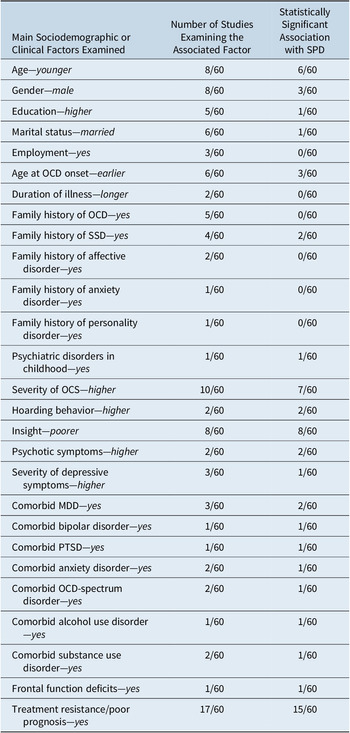
When only studies reporting prevalence rates of SPD in OCD patients were examined, a number of statistically significant associated characteristics differentiating OCD patients with SPD from OCD patients without SPD were found (see Table 2 for a detailed list).
Associated Characteristics Differentiating OCD Patients with SPD from OCD Patients without SPD (only Studies Reporting Prevalence Rate of SPD were Examined)

Abbreviations: MDD, major depressive disorder; OCD, obsessive–compulsive disorder; OCS, obsessive–compulsive symptom; PTSD, posttraumatic stress disorder; SSD, schizophrenia spectrum disorder.
Specifically, OCD patients with comorbid SPD were younger, more likely to be male, unmarried, unemployed, and less educated. Furthermore, they exhibited an earlier age at OCD onset and more severe OCSs, had poorer insight and more psychotic features, and demonstrated increasing resistance to standard treatment. All together, these characteristics could be identified as the most relevant sociodemographic and clinical factors associated with schizotypal OCD.
Methodological limitations of this overview
Some methodological limitations of this work deserve mention. Firstly, bibliographic references were identified through searches of PubMed/MEDLINE, Scopus, LILACS, and Cochrane Library. As optimal searches in systematic reviews should search at least Embase, PubMed/MEDLINE, Web of Science, and Google Scholar as a minimum requirement to guarantee adequate and efficient coverage,Reference Bramer, Rethlefsen and Kleijnen 118 we do not describe this review as systematic, but we have described our methods, have searched in four databases systematically, and searched in our personal files and Google Scholar for other relevant articles. In addition, references cited in selected original research and review articles were carefully reviewed to identify additional pertinent studies, without temporal and language limitations. Second, we excluded articles that examined the relationship between schizotypal and obsessive–compulsive phenomena in nonclinical samples. In fact, we chose to use only clinical samples of OCD patients in order to provide more homogeneous results. However, we are aware that a research taking into account studies on individuals with subclinical OCSs and schizotypal features is desirable in future too because it would permit to exclude confounding factors such as medication use and hospitalization.Reference Poyurovsky, De Haan, Schirmbeck and Zink 10
Conclusion
This review paper found that SPD is commonly observed in OCD patients. About 10% of OCD patients have a full categorical diagnosis of SPD. Patients with this comorbidity seem to have a distinctive sociodemographic, psychopathological, clinical, and treatment profile. Early clinical identification of SPD features—and, more generally, of psychotic features and personality disorders—in OCD patients is strongly recommended. A proper and early diagnosis with early treatment may have, in fact, benefits for prognosis. As Poyurovsky suggested, augmentation with low-dose antipsychotics might be required for SRI-resistant schizotypal OCD patients.Reference Poyurovsky, De Haan, Schirmbeck and Zink 10 However, although schizotypal OCD seems to have clinical and predictive validity, further neurobiological and genetic studies on etiological specificity are needed, and evidence-based guidelines are still lacking.Reference Scotti-Muzzi and Saide 5 , Reference Poyurovsky, De Haan, Schirmbeck and Zink 10 More clinical investigation is necessary in order to elucidate the psychopathological interrelationships between OCSs and schizotypal/psychotic features, as well as their implication to schizo-obsessive spectrum disorders.Reference Scotti-Muzzi and Saide 5 In this line of thought, a spectrum model of psychopathology might be useful to distinguish subgroups of patients on a possible clinical schizo-obsessive continuum, with potential implications for prognosis and treatment.Reference Attademo, Bernardini and Paolini 119
Disclosures
Luigi Attademo and Francesco Bernardini have no conflicts of interest to report. The authors express gratitude to all healthcare workers and the scientific community involved in the fight against COVID-19 worldwide.