





Introduction
Syphilis is preventable and treatable; however, it continues to cause morbidity and mortality globally [1–Reference Korenromp3]. Congenital syphilis (CS) is caused by mother-to-child transmission (MTCT) of infection during pregnancy and is the most common infectious cause of stillbirth [Reference Gomez2, Reference Korenromp3]. In 2022, approximately 8 million adults acquired syphilis globally [4]. During the same year, maternal syphilis caused nearly 400000 adverse birth outcomes, including 150000 early foetal deaths and stillbirths, and 70000 neonatal deaths [5]. The burden of CS remained high globally with incidence estimated at 425 and 523 cases per 100000 livebirths in 2020 and 2022 [6]. CS is preventable provided the pregnant woman receives adequate treatment 30 days prior to delivery [7]. In 2007, the World Health Organisation (WHO) launched a global initiative to eliminate CS as a public health problem by reducing cases to <50 cases per 100000 livebirths [8]. Elimination of MTCT will not be achieved unless there is improvement in care and management and availability of confirmatory testing to clearly determine disease burden [8].
Fiji is a Pacific Island country that provides universal screening for syphilis among pregnant women at their first antenatal care (ANC) visit [9]. There are limited data on the rate of maternal syphilis in Fiji. In 2011, a single-centre study estimated the prevalence at 5% [Reference Tuinakelo10]. Subsequently, a modelling study found similar rates of maternal syphilis between 2000 and 2017 (3.7% and 3.9%, respectively) [Reference Nishijima11]. There are no published data on CS in Fiji. According to the 2022 national case reporting to WHO, there were 334 CS cases per 100000 livebirths in Fiji [4]. Given the critical gap on CS data and the lack of recent study on maternal syphilis in Fiji, we opportunistically analysed maternal syphilis data among pregnant women enrolled in a clinical trial (Prevention of Young Infant Infections using Azithromycin at Labour – Bulabula MaPei) [Reference Hume-Nixon12] and determined the seroprevalence of maternal syphilis and estimated the rates of CS.
Methods
Study setting and design
Fiji had a population of 884887 in 2017 of which 62.8% are iTaukei (indigenous Fijians) [13]. Antenatal and obstetric care are provided free of charge with ANC coverage of over 95% [14]. Fiji has obstetric, paediatric, and sexually transmitted infection (STI) guidelines, which are adapted from the WHO [9, 15, 16] and provide comprehensive information on syphilis screening, diagnosis, treatment, and follow-up requirements for pregnant women and infants born to mothers with positive syphilis serological results at birth. The recommended treatment for maternal syphilis constitutes three doses of benzathine penicillin intramuscular weekly with post-treatment testing [9, 15]. The guidelines also recommend the clinical assessment and testing of all infants born to mothers with syphilis and prompt treatment accordingly [9, 15, 16].
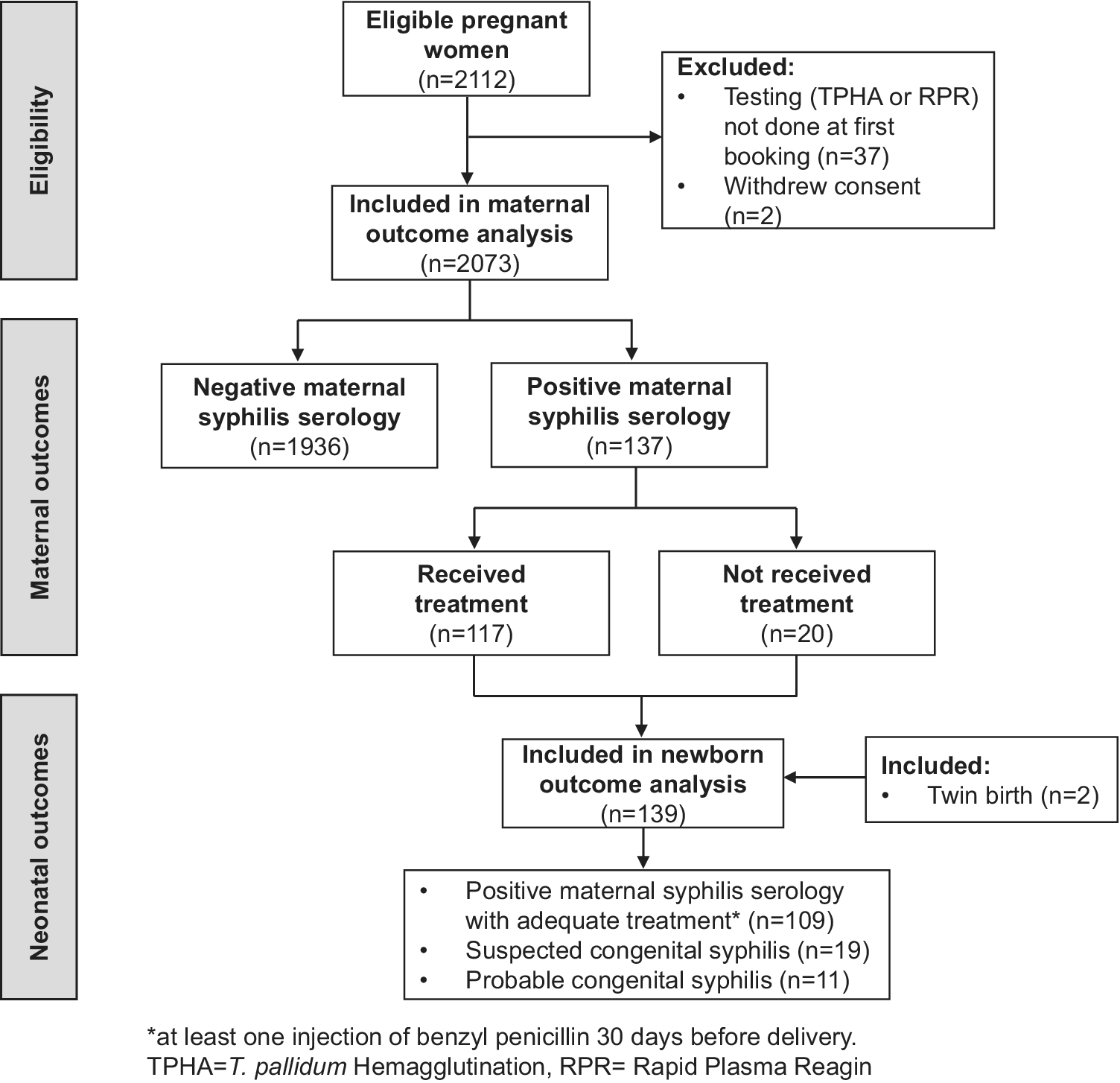
The Bulabula MaPei was a randomised controlled trial enrolling healthy pregnant women to determine the effect of a single dose of oral azithromycin during labour on maternal and infant infections. The study design and procedures have been described elsewhere [Reference Hume-Nixon12, Reference Hume-Nixon17]. The trial was conducted in the Colonial War Memorial Hospital (CWMH), a tertiary hospital in the capital city, Suva, that attends to approximately 44% of all births in Fiji [Reference Hume-Nixon12]. The study enrolled eligible healthy, pregnant women, aged 18 years or older and intending to deliver at CWMH [Reference Hume-Nixon12]. Participants were enrolled between July 2019 and January 2022, with interruptions for 42 weeks due to the COVID-19 pandemic [Reference Hume-Nixon12]. The analysis for this study included women who were enrolled in this trial and their newborns (Figure 1).
Participants included in the analysis.

Figure 1. Long description
The flowchart is organized into three vertical stages.
1. Eligibility stage:
- Top box: Eligible pregnant women (n equals 2112).
- An arrow points right to an Excluded box: Testing (T P H A or R P R) not done at first booking (n equals 37) and Withdrew consent (n equals 2).
- Main flow continues down to: Included in maternal outcome analysis (n equals 2073).
2. Maternal outcomes stage:
- The flow splits into two: Negative maternal syphilis serology (n equals 1936) and Positive maternal syphilis serology (n equals 137).
- From the positive group, the flow splits again: Received treatment (n equals 117) and Not received treatment (n equals 20).
3. Neonatal outcomes stage:
- Arrows from both treatment groups converge at: Included in newborn outcome analysis (n equals 139).
- A side box points into this group: Included: Twin birth (n equals 2).
- The final box lists outcomes for these newborns: Positive maternal syphilis serology with adequate treatment (n equals 109); Suspected congenital syphilis (n equals 19); Probable congenital syphilis (n equals 11).
Footnotes define adequate treatment as at least one injection of benzyl penicillin 30 days before delivery and define initialisms: T P H A equals T. pallidum Hemagglutination, R P R equals Rapid Plasma Reagin.
Laboratory testing
CWMH’s standard laboratory-based syphilis serology testing includes a treponemal (Treponema pallidum hemagglutination – TPHA) and non-treponemal (rapid plasma reagin test – RPR) tests that are conducted for each individual undergoing a syphilis screening test. There is no capacity for syphilis specific immunoglobulin M (IgM), polymerase chain reaction (PCR), or direct fluorescent antibody testing in Fiji. RPR tests are not performed on cerebrospinal fluid (CSF) samples of infants; however, microscopic venereal disease research laboratory (VDRL), which is also a non-treponemal test can be performed on CSF. Upon request, CSF samples are sent to LabPLUS, a referral laboratory in New Zealand for VDRL testing which delays the turnaround time (6–8 weeks). During the study period, there were reported shortage of syphilis tests, and samples from pregnant women or infants were not processed.
Study procedures
Maternal and infant data were collected from medical records by study staff as previously described [Reference Hume-Nixon12, Reference Hume-Nixon17]. Data collected included demographics (age, marital status, education status, residential location), laboratory results (maternal and infant RPR and TPHA and CSF findings for infants), and clinical characteristics (gravidity, parity, maternal and infant syphilis treatment and, gestational age at birth) [Reference Hume-Nixon12, Reference Hume-Nixon17]. The CWMH electronic medical and laboratory records were searched to obtain missing information and laboratory results.
Case definitions
The WHO case definitions [1, 7] were used for maternal syphilis and CS (Box 1). The case definitions report on overall maternal syphilis seroprevalence; however, they do not differentiate between active and latent syphilis.
Case definitions used for maternal syphilis and CS.
Pregnant women:
Maternal syphilis is a pregnant woman with a positive TPHA or RPR at first antenatal visit.
Newborns:
Positive maternal syphilis serology with adequate treatment
-
• An infant born to a woman with positive syphilis serology and with adequate syphilis treatment, which is defined as at least one injection of benzathine penicillin 30 days prior to delivery [1].
A case of suspected CS
-
• An infant born to a woman with positive syphilis serology and without adequate treatment.
A case of probable CS
-
• A suspected CS case with both clinical evidence and laboratory suggestive evidence.
Clinical evidence includes any one of the following findings:
• Any evidence of CS on physical examination (includes stillbirth).
• An elevated cerebrospinal fluid (CSF), white cell count (WCC), or protein (without other cause) in the child.
Laboratory suggestive evidence requires at least one of the following:
• Infant with a reactive RPR titre four-fold or more than that of the mother.
• Infant is seropositive on non-treponemal testing (RPR) in the absence of syphilis specific IgM testing.
Data analysis
Data were entered into a REDCap database and analysed using SPSS 29.0.2.0 (Armonk, NY). Descriptive analysis of demographic, clinical, and laboratory data were performed. Categorical variables were presented as counts and percentages while continuous variables were described as medians with interquartile ranges (IQR), as the data were non-symmetrical. Due to the small number of mothers and infants in the study, the 2.5-year pooled rates were calculated to estimate the CS cases per 100000 livebirths [1].
Results
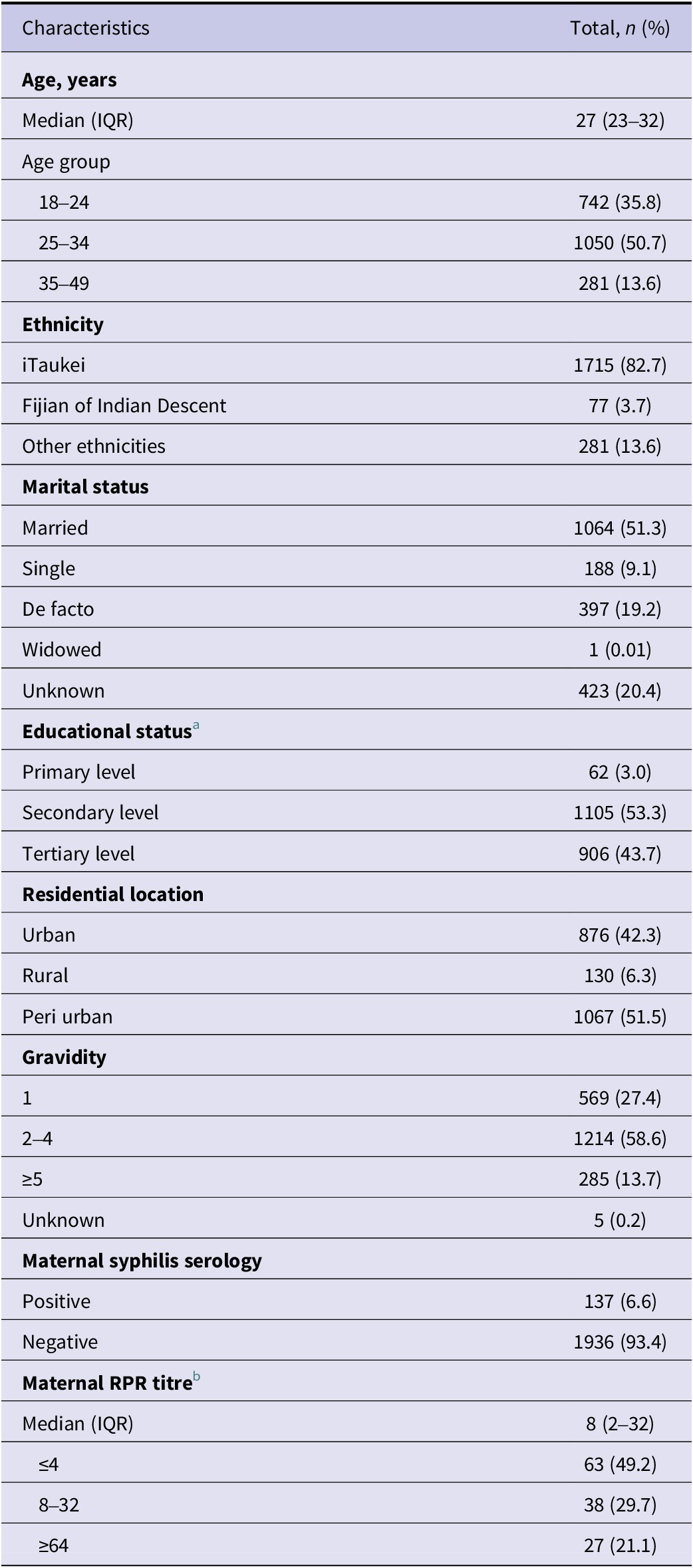
A total of 10827 pregnant women were screened and 2112 were enrolled in the trial. Of these, 39 were excluded: Two withdrew consent from the trial, and for 37 women screening test results were not available. (Figure 1). A total of 2073 pregnant women were included in our analysis, of whom 1669 had both TPHA and RPR tests at the first antenatal visit, while the remaining 396 and 8 had only RPR and TPHA tests, respectively. Table 1 shows the socio-demographic characteristics of the participants. The median age was 27 years (IQR 23–32); most mothers (82.7%, n = 1715) were iTaukei (indigenous Fijians); 51.3% (n = 1064) were married; and 53.3% (1105) had some or completed secondary level education.
Socio-demographic characteristics of pregnant women included in the study (N = 2073)

Table 1. Long description
The table presents socio-demographic and clinical data for N = 2073 pregnant women.
* Age: The median age is 27 with an I Q R of 23 to 32. The largest age group is 25 to 34 years at 1050 (50.7 percent), followed by 18 to 24 years at 742 (35.8 percent), and 35 to 49 years at 281 (13.6 percent).
* Ethnicity: iTaukei represents the majority at 1715 (82.7 percent), followed by Other ethnicities at 281 (13.6 percent), and Fijian of Indian Descent at 77 (3.7 percent).
* Marital status: Married women account for 1064 (51.3 percent), Unknown for 423 (20.4 percent), De facto for 397 (19.2 percent), Single for 188 (9.1 percent), and Widowed for 1 (0.01 percent).
* Educational status: Secondary level is highest at 1105 (53.3 percent), followed by Tertiary level at 906 (43.7 percent), and Primary level at 62 (3.0 percent).
* Residential location: Peri urban is the most common at 1067 (51.5 percent), followed by Urban at 876 (42.3 percent), and Rural at 130 (6.3 percent).
* Gravidity: The majority have a gravidity of 2 to 4 at 1214 (58.6 percent), followed by 1 at 569 (27.4 percent), and greater than or equal to 5 at 285 (13.7 percent).
* Maternal syphilis serology: 137 (6.6 percent) tested Positive and 1936 (93.4 percent) tested Negative.
* Maternal R P R titre: Among 128 women with positive results, the median is 8 with an I Q R of 2 to 32. Titres are distributed as less than or equal to 4 at 63 (49.2 percent), 8 to 32 at 38 (29.7 percent), and greater than or equal to 64 at 27 (21.1 percent).
IQR: interquartile ranges; RPR: rapid plasma reagin test.
a Participants with some or completed education for each level.
b Among 128 women with positive syphilis serological result.
A total of 137 pregnant women had a positive syphilis serological result at their first antenatal visit. Of these, 124 were reactive to TPHA and RPR, 9 reactive to TPHA, while the remaining 4 were only reactive to RPR with titres ranging between 1:16 and 1:128. The maternal syphilis prevalence was 6.6% (n = 137). The majority of pregnant women with maternal syphilis had their first ANC clinic in the second (35.1%, n = 48) or third (40.1%, n = 55) trimester (Supplementary Figure 1). RPR results at the first antenatal visit were available for 93.4% (n = 128) of pregnant women with positive syphilis serology. The median RPR titre was 1:8 (IQR 1:2–1:32) with half (50.8%, n = 65) of women with titres ≥1:8 (Table 1). With regard to treatment, 85.4% (n = 117) of pregnant women with positive syphilis serological result had a record of at least one injection of benzathine penicillin 30 days prior to delivery and 65.7% (n = 90) had post-treatment RPR results. Around half of the pregnant women (11 out of 20) with no treatment history booked late in the third trimester. Of the women with positive serological result, 46% were in the azithromycin group (n = 63) and 54% were in the placebo group (n = 74).
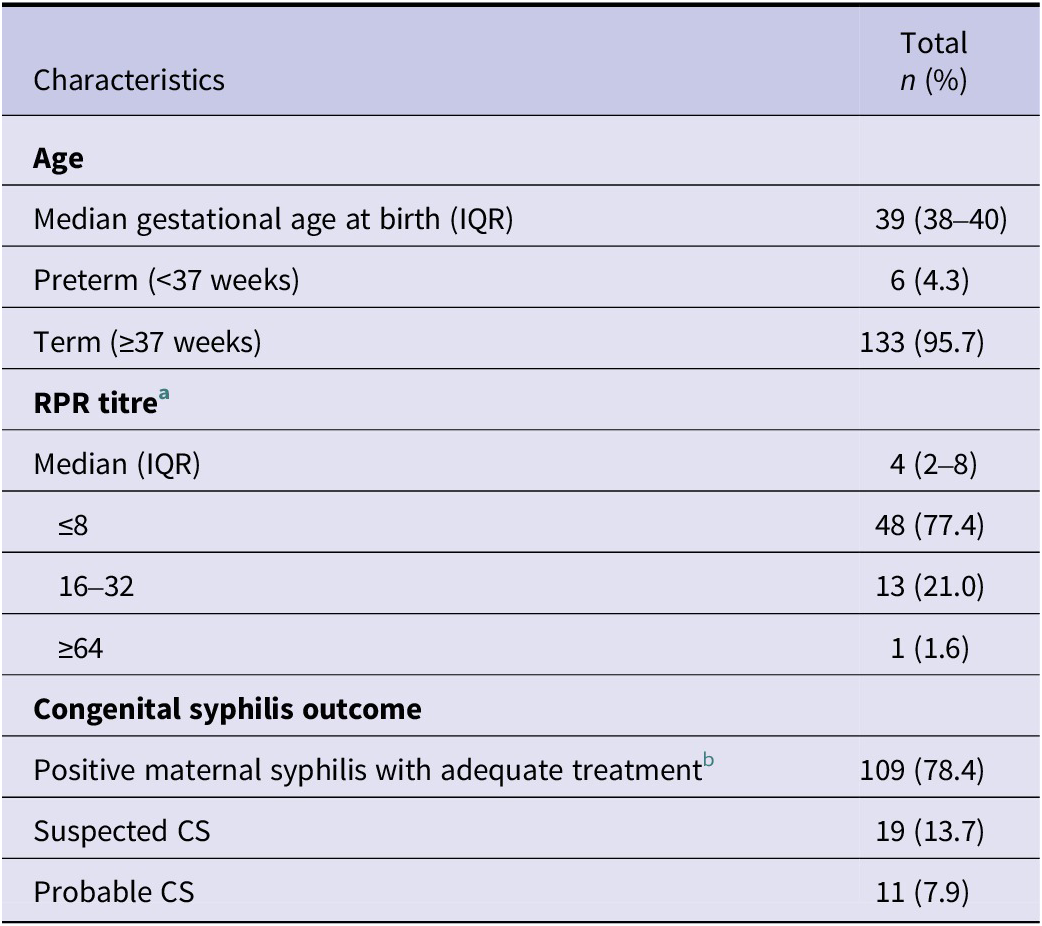
A total of 139 infants (135 singleton and two sets of twins) were born from 137 mothers with positive syphilis serological result. Most infants were born full term (95.7%, n = 133) with a median gestational age of 39 weeks (IQR 38–40) (Table 2). Close to half (44.6%, n = 62) of infants had positive RPR results, while 25.9% (n = 36) were RPR negative and no test results were recorded for the remaining 29.5% (n = 41) of infants. Of the infants with positive RPR (n = 62), the majority (77.7%, n = 48) had titres ≤1:8; 21.0% (n = 13) had titres between 1:16 and 1:32; and 1.6% (n = 1) had titres ≥1: 64 (Table 2). None of the infants had RPR titre four-fold or more than that of the mother at screening or post treatment. Treatment history was recorded for 33% (n = 46) of infants born to mothers with positive syphilis serological result and post-treatment RPR results were available for four of these infants. Regarding the infants’ outcomes, 109 (78.4%) infants were born to mothers with adequate syphilis treatment. Of the remaining 30 infants,19 were suspected to have CS while 11 probably had CS based on the elevated CSF protein or WCC (Supplementary Table 1). In all, 10 of the 11 infants with probable CS were born to mothers who received adequate treatment. Post-treatment titres were available for six of the mothers with only one achieving a four-fold decline from pretreatment titre. The overall 2.5-year pooled incidence of CS was 578.0 cases of per 100000 livebirths. Of these, 366.1 were suspected and 212 probable cases per 100000 livebirths. It was not possible to determine cases of confirmed CS as confirmatory testing is not available.
Characteristics of infants born to mothers with positive syphilis serology (N = 139)

Table 2. Long description
The table consists of two columns: Characteristics and Total n (%).
* Age section:
- Median gestational age at birth (I Q R): 39 (38 to 40).
- Preterm (less than 37 weeks): 6 (4.3%).
- Term (greater than or equal to 37 weeks): 133 (95.7%).
* R P R titre section (among 62 infants with reactive R P R):
- Median (I Q R): 4 (2 to 8).
- Less than or equal to 8: 48 (77.4%).
- 16 to 32: 13 (21.0%).
- Greater than or equal to 64: 1 (1.6%).
* Congenital syphilis outcome section:
- Positive maternal syphilis with adequate treatment: 109 (78.4%).
- Suspected C S: 19 (13.7%).
- Probable C S: 11 (7.9%).
Footnotes indicate that adequate treatment is defined as at least one injection of benzyl penicillin 30 days before delivery. I Q R stands for interquartile ranges and R P R stands for rapid plasma reagin test.
IQR: interquartile ranges; RPR: rapid plasma reagin test.
a Among 62 infants with reactive RPR.
b At least one injection of benzyl penicillin 30 days before delivery.
There were two deaths among infants born to mothers with positive syphilis serological result. The first was a term baby born to a seropositive mother (reactive TPHA and pretreatment RPR titre of 1:32). The mother received three doses of benzathine penicillin injection 2 months prior to delivery, but the post-treatment RPR test was not done. The newborn was in respiratory distress at birth and was admitted to the neonatal intensive care unit (NICU). The baby’s RPR titre was 1:16 and CSF VDRL was non-reactive. Subsequently, the baby died in NICU at 5 days of life. CS was presumed to be the cause of death for this newborn. The second death was a preterm baby born to a seropositive mother (reactive TPHA and pretreatment RPR titre of 1:2). The mother received three doses of benzathine penicillin prior to delivery, but the post-treatment RPR test was not performed. No syphilis test result was recorded for the infant. At 7 months of age, the child died at home with the cause of death unrelated to CS.
Discussion
In this secondary analysis, we found maternal syphilis in 6.6% of participants and estimated the 2.5-year pooled incidence of probable CS to be 212 cases of per 100000 livebirths. The pregnant women in this study had a higher educational status and were otherwise healthy [Reference Hume-Nixon12, Reference Hume-Nixon17]; so the maternal syphilis rate may be an underestimate for the mothers in the study. As part of the global control effort, the regional framework for the elimination of MTCT of syphilis in the Western Pacific Region (WPR) outlines goals to reduce the incidence of CS to <50 cases per 100000 livebirths by 2030 [7]. In 2016, the incidence of CS in WPR was estimated at 156 cases per 100000 livebirths [Reference Gilmour and Walls18]. In our study, we found the incidence of probable CS to be higher than this regional target, although it is not known what the incidence of confirmed CS actually is, as confirmatory testing is not available. Nevertheless, maternal syphilis and CS are common in Fiji.
For maternal syphilis, there have been many reports of increasing rates from many countries [Reference Leslie and Vaidya19, Reference Moseley20], but there are very few recent studies on syphilis among pregnant women in Fiji. There have been three published studies examining syphilis prevalence during pregnancy in Fiji since 1996 [Reference Tuinakelo10, Reference Nishijima11, Reference Schramm21]. In the first cross-sectional study among ANC attendees from CWMH, the syphilis prevalence was 3.6% between 1978 and 1980 increasing to 5.9% in 1992–1995 [Reference Schramm21]. The second cross-sectional retrospective review of antenatal records in a health centre outside Fiji’s capital reported a maternal syphilis prevalence of 5% in 2011, suggesting the rate being relatively similar in the intervening 16 years [Reference Tuinakelo10]. The third study constituted the first national-level modelling (Spectrum-STI) study that estimated the prevalence of maternal syphilis to be 3.9% in 2017 [Reference Nishijima11]. Methodological differences limit direct comparison of these studies. According to the 2023 annual report from CWMH, maternal syphilis rates were 3.2% and 5.3% at first ANC visit and at delivery, respectively. (CWMH, unpublished data). Routine analysis of systematically collected ANC data could provide national level estimate of maternal syphilis prevalence and can be used to assess trends over time and for programme evaluation. Similar to Fiji, up-to-date national level data on maternal syphilis in other the Pacific Island Countries (PICs) are scarce [Reference Bell22]. In 2019, 9.3% ANC attendees enrolled in a cross-sectional study at the national referral hospital in Solomon Islands had positive syphilis serological result [Reference Lifigao23]. While national level STI surveillance data in Samoa reported lower syphilis prevalence (<1%) among women including pregnant women attending ANC as well as blood donors and immigration screening [Reference Carney24]. According to the data reported to WHO, syphilis seropositivity rates among ANC attendees were 24.8% in Solomon Islands (2018), 3.8% in Papua New Guinea (2024), 0.3 in Samoa (2019), 0.4 in Tuvalu (2024) and 0% in Tonga (2024) [25].
For CS in this study, we estimated the 2.5-year pooled incidence of CS suspected and probable at 366.1 and 212.0 cases of per 100000 livebirths, respectively. In 2022, Fiji reported 334 cases of CS per 100000 livebirths [4], although these rates are probably not directly comparable as the latter included stillbirths. Data on CS (suspected or probable) in other PICs is scarce due to limited diagnostic capacity and syphilis being an asymptomatic infection in the neonatal period [Reference Bell22]. A study from the Solomon Islands national referral hospital found over half of infants born to VDRL positive mothers had positive syphilis serological result with 9.7% exhibiting signs of CS; however, the incidence of CS was not reported [Reference Lifigao23].
According to the guidelines in Fiji, all pregnant women should be screened for syphilis at the first antenatal visit and repeated tests in the third trimester as needed [9], but due to limited resources it has not been implemented. The CS case definitions and diagnostics approaches as well as recommendations on post-treatment testing and follow-up are outlined in the guidelines [9, 15, 16]. Our study has identified some critical gaps in maternal and infant testing. While syphilis testing coverage at ANC was above 95%, almost one-third of infants born to syphilis-positive mothers had no record of syphilis serological results. Post-treatment testing coverage was suboptimal, raising concern for delayed diagnosis, treatment of CS, and inadequate follow-up care. Several factors could have contributed to suboptimal testing including inconsistent availability of test kits, sample quality, and the COVID-19 pandemic. During the study period, frequent stock outs of testing kits were reported for about 5 months each year. Testing is further compounded by late first antenatal visit, leaving little time for post-treatment testing before childbirth. We have noted that CSF or blood samples were collected but not processed due to unsuitability of the sample for testing. The COVID-19 pandemic and subsequent lockdowns also likely contributed to low testing uptake due to a lack of access to usual ANC. Syphilis testing at ANC peripheral clinics requires sending samples to the CWMH hospital laboratory, so results may not be available in a timely way for ongoing clinical care and loss to follow-up is problematic. For women booked prior to 32 weeks of gestation, there is a longer interval (>2 weeks) between the first and second visit, further delaying reporting of test results and treatment.
Strengthening ANC testing should aim towards a system of same-day result reporting with a consistent supply of testing kits. Point-of-care (POC) rapid syphilis tests provide results in 10–15 min have been found to be cost-effective in Asia and Latin America [Reference Kuznik26, Reference Unemo27]. With the current surge in HIV cases, testing among pregnant women is being prioritised in ANC clinics since early 2025. This includes POC testing for HIV, syphilis, and hepatitis B at first ANC visit with repeat tests 4 to 6 weeks apart [28]. This has enabled syphilis treatment to be commenced on the same day if POC is positive while waiting for the confirmatory test results. This will ensure any false-negative results associated with POC are identified by confirmatory tests. Furthermore, the ANC visit timelines have been revised. The second ANC visit prior to 32 weeks of gestation is now booked within 1 to 2 weeks to enable timely repeat testing and follow-up.
Enhanced testing of infants born to seropositive mothers is needed to improve detection and treatment of CS in Fiji. Implementation of the WHO CS diagnostic criteria [1] will enable the detection of probable cases through already available tests, including CSF protein and WCC. Further introduction of confirmatory tests such as syphilis-specific IgM or PCR in the national reference laboratory will ensure in-country confirmation of CS. While syphilis is a nationally notifiable disease in Fiji [29], CS is not. In recognition of the high burden and the sequelae for infants, there should be consideration given to include CS as a nationally notifiable disease which could improve testing and reporting nationwide.
Fiji’s obstetric, paediatric, and STI guidelines incorporate treatment regimens for pregnant women and infants, which are adapted from the WHO global guidelines [9, 16]. Furthermore, the national STI guidelines provide framework for treatment of other population groups [15]. In our study, 85% of pregnant women had treatment information recorded for at least one injection of benzathine penicillin 30 days prior to delivery, which is lower than the elimination target of >95% [1]. Similarly, an internal review of maternal syphilis treatment in 2019 also illustrated low treatment coverage with 26% of the 156 maternal syphilis cases receiving three doses of penicillin according to the national guidelines and 31% showing four-fold drop in RPR titres (CWMH, unpublished data). Similar to challenges seen for testing, delayed first ANC visit is one of the main challenges for provision of effective treatment. With the increasing prevalence of maternal syphilis, it is expected the rates CS will continue to increase. Therefore, healthcare workers in Fiji should be aware of the current burden of syphilis and follow the national guidelines to ascertain syphilis status among all women at childbirth and evaluate all infants born to mothers with positive syphilis for prompt diagnosis of CS and provision of treatment before discharge from the hospital, with planned follow up. There is a need to ensure continuum of care through linkage with the maternal and child health clinics and public health services for follow-up and confirmation of CS. Further awareness raising and routine training of healthcare workers are required for prompt diagnosis, improved treatment coverage, and accurate record keeping.
This study has a number of limitations. The data were analysed opportunistically from a clinical trial of healthy pregnant women from the main hospital in Fiji. The findings are likely to be an underestimate of the prevalence of maternal syphilis and CS, as the study population is not representative of the entire Fiji population due to the inclusion criteria for the clinical trial which excluded pregnant women under 18 years of age, residents of rural areas, and pregnant women with underlying comorbidities or other pregnancy risk factors. There were also few preterm births suggesting a non-representative sample population. Our study reported overall maternal syphilis seroprevalence and did not differentiate between active and latent syphilis or considered the possibility of false-positives with regard to testing. The study recruited more iTaukei participants. This is similar to CWMH unpublished internal report where 80% to 85% of the ANC attendees were iTaukei women. This disparity may be due to pregnant Fijian of Indian Descent women receiving ANC from private clinics. However, it might underrepresent Fijian of Indian Descent women, who contribute to 29% of the total population in the CWMH catchment area [30]. The calculated CS rates are post intervention, and it is unlikely that azithromycin affected the results as it was given intrapartum and the infant would likely have already been infected. The estimation of the CS incidence using a small number of cases can be sensitive to year-to-year variability; therefore, we used the pooled data to obtain more stable estimates [1] but recognise the limitations of accurately reporting these rates in this setting. Nevertheless, our findings in the absence of systematically collected data provide a valuable update on the burden of maternal syphilis and CS in Fiji.
Conclusion
Our study showed a substantial burden of maternal and CS among study participants in Fiji. Enhanced surveillance to collect comprehensive maternal and infant data across Fiji along with confirmatory testing for CS, such as syphilis-specific IgM ELISA or PCR, are needed to better understand the burden of disease and case management as well as assess the progress towards elimination of MTCT of syphilis in the country.
Supplementary material
The supplementary material for this article can be found at http://doi.org/10.1017/S0950268826101782.
Data availability statement
The data used in this study are included in this manuscript and its supplementary files.
Acknowledgements
We would like to thank the participating families of the Bulabula MaPei study and the dedicated Fijian study staff. We also wish to thank the Ministry of Health and Medical Services and the Fiji Centre for Disease Control for supporting the study. We sincerely thank the Data Safety Monitoring Board for their helpful comments, time, and experience including Prof. Jeremy Oats (Chair), Dr Sabine Braat, Prof. Keith Grimwood, Prof. Philip Hill, and Dr Pushpa W. Nusair. FMR was funded by an NHMRC Investigator grant. This study was supported by the Victorian Government’s Operational Infrastructure Support Programme (grant number: N/A). MHN was supported by an RACP Research Entry Scholarship from the RACP Foundation.
Author contribution
F.M.R. conceived the clinical trial and acquired the funding. M.H.N. co-led study establishment with T.R. who managed ongoing fieldwork and staff in Fiji. F.M.R., S.C. and A.G.S. designed the secondary analysis of the clinical trial data for this paper. S.C. and A.G.S. analysed the data and wrote the first draft manuscript with input from K.S., I.T., A.M., L.S. and F.M.R. EN provided database curation and management for the study. C.N. provided statistical oversight for the study. All the authors contributed to the manuscript and approved the final version submitted to the journal.
Funding statement
This work was supported by the National Health and Medical Research Council (NHMRC) GNN1144111.
Competing interests
The authors declared no competing interests.
Ethical standards
The clinical trial (ClinicalTrials.gov identifier: NCT03925480; https://clinicaltrials.gov/study/NCT03925480) was approved by the Royal Children’s Hospital Human Research Ethics Committee (ID 38057) and the Fiji National Health Research and Ethics Review Committee (ID 2018.190.C.D.).


 Open access

