INTRODUCTION
The current emphasis on household archaeology in Mesoamerica (e.g., Ashmore Reference Ashmore1981; Becker Reference Becker1999; Haviland Reference Haviland1963, Reference Haviland1972, Reference Haviland1985; Santley and Hirth Reference Santley and Hirth1993; Wauchope Reference Wauchope1938; Wilk and Ashmore Reference Wilk and Ashmore1988) has found numerous field researchers spending ever more time excavating structures and patios that were once the focus of domestic activities. The abundance of broken pottery recovered from these household ruins implies that households routinely replaced quantities of ceramic vessels as part of their normal domestic cycle. Even if very little pottery was discarded annually, a substantial accumulation could develop over the long time spans with which archaeologists work.
In this article I compare ethnographically reported data from the Maya highland area (Deal Reference Deal1983, Reference Deal1998; Nelson Reference Nelson1981, Reference Nelson1985, Reference Nelson and Longacre1991) with archaeological assemblages from the Classic Maya lowland site of Aguateca (Inomata and Triadan Reference Inomata and Triadan2010) to develop a ceramic consumption model. After discussing similarities and differences between the respective household pottery assemblages, I apply ethnographically derived vessel use-lives to estimate annual consumption rates from archaeological contexts. Finally, I compare the Aguateca ceramic inventories to composite data from household discard contexts from the Classic Maya center of Tikal, in order to consider the transformation from a systemic inventory to a discard assemblage.
I argue that the range of 18–21 pottery vessel discards per household calculated by applying ethnographic statistics to the archaeological assemblages at Aguateca is best viewed as a maximum figure. Although household pottery inventories from the Classic period site were just as extensive as those from modern Maya villages, the specific proportions of different form classes differ substantially. The very high frequency of serving wares combined with a paucity of recognizable cooking vessels in the archaeological assemblages contrast with the composition of pottery inventories of Maya households in the ethnographic present.
In conclusion, I urge caution in assuming that large systemic household pottery inventories produce proportionately higher discard rates. Familiarity with ethnoarchaeological studies aid in developing a more accurate and nuanced approach to estimating pottery consumption in antiquity. Data from living societies, however, cannot be applied uncritically to archaeological contexts. Far from developing one universal model, this paper emphasizes the need to address the unique parameters of each case study before applying mean statistics and standardized equations.
OPERATIONAL CONSIDERATIONS
Household ceramic assemblages are comprised of vessels that break after variable amounts of time. It logically follows that the use-lives of different vessel classes systematically affect the composition of archaeological accumulations and this has implications for estimating the time span of a site's occupation and/or population size (de Barros Reference de Barros1982; Baumhoff and Heizer Reference Baumhoff and Heizer1959; David Reference David1972; David and Henning Reference David and Henning1972; DeBoer Reference DeBoer1974; Foster Reference Foster1960; Varien and Potter Reference Varien and Potter1997; Varien and Mills Reference Varien and Mills1997). Nevertheless, the average life span of any vessel class should translate to a stable proportion of the discard assemblage over time. Although long-lived vessel classes might be underrepresented in discard assemblages at settlements with short occupation spans, proportional differences reach equilibrium after several years and remain constant thereafter (Mills Reference Mills1989). Ethnographic research has provided more precise information concerning the longevity of vessels of different functional classes (e.g., Arnold Reference Arnold1988; Deal Reference Deal1983, Reference Deal1998; DeBoer and Lathrop Reference DeBoer, Lathrop and Kramer1979; Hildebrand and Hagstrum Reference Hildebrand and Hagstrum1999; Longacre Reference Longacre and Nelson1985, Reference Longacre, Kvamme and Kobayashi1988; Nelson Reference Nelson1981, Reference Nelson1985, Reference Nelson and Longacre1991; Neupert and Longacre Reference Neupert, Longacre, Longacre and Skibo1994; Tani Reference Tani, Longacre and Skibo1994; Tani and Longacre Reference Tani and Longacre1999; Varien and Mills Reference Varien and Mills1997) and archaeologists are now better equipped to quantitatively approach the accumulation of discarded pottery at ancient households.
The focus here is on quantifying use, discard, and replacement rates for pottery vessels, not estimating household size or duration of occupation. Although a standard discard equation (Mills Reference Mills1989; Schiffer Reference Schiffer1975:840) is mathematically sound, formulating a pottery consumption model from archaeological data can be complex. Beyond estimating consumption levels for the Classic Maya, the challenges endemic to quantitative modeling from archaeological data are underscored.
CONFOUNDING VARIABLES
Vessel Use-life
Ceramic vessels do not last indefinitely: they break for a number of reasons. Ethnographic studies attest to the variable longevity of different vessel classes both within a single community and between geographically separated communities. Foster (Reference Foster1960:607) noted that one of his study households in Tzintzuntzan had a large, infrequently used pot that his informant estimated to have been 40 to 50 years old at the time of interview. A Morrope potter from the north coast of Peru reckoned that one of his tinajas (jars) would last only about a month if used for boiling chicha (maize beer) once a week (Bankes Reference Bankes1985:272). Vessel use-lives generated from informant responses, annual replacement rates, and systematic inventorying methods invariably fall between these two extremes.
A number of variables influence pottery use-lives. Perhaps the least understood is the most basic, vessel durability (Bronitsky Reference Bronitsky1986:92; Neupert Reference Neupert1994:718; also see Reid Reference Reid1984; Skibo et al. Reference Skibo, Schiffer and Reid1989; Steponaitis Reference Steponaitis1983). How and how often a ceramic vessel is used conditions how long it will remain in a household assemblage before being discarded. In general, higher use-frequency equates to shorter use-life (Arnold Reference Arnold1988; DeBoer Reference DeBoer and Nelson1985; Longacre Reference Longacre, Hodder, Isaac and Hammond1981, Reference Longacre and Nelson1985; Nelson Reference Nelson and Longacre1991). Over time, cooking pottery becomes weaker and more prone to failure with increasing thermal fatigue (see Rice Reference Rice1987c:363–369) from repeated subjection to fire. The frequent movement of vessels also increases the likelihood of breakage. Water carrying jars tend to have shorter use-lives than larger water storage vessels kept stationary (and often protected). Shott (Reference Shott1996) has suggested that vessel size correlates positively with use-life and is the most accessible and reliable variable for estimating the use-lives of pottery from excavations.
The presence of domestic animals, number and age of children, frequency and degree of inebriation, and the adequacy of storage facilities also influence breakage (DeBoer Reference DeBoer and Nelson1985:349; also see Deal Reference Deal1998:168). Hildebrand and Hagstrum (Reference Hildebrand and Hagstrum1999:27) note that all vessels, regardless of age and/or use pattern, have an equal chance of breaking from a massive impact; all things being equal, accidents will happen unpredictably.
Why Pots Exit, Enter, and Shift Function Within Household Assemblages
Broken vessels are not always immediately discarded; some are repaired, repurposed, or kept in “provisional discard” mode—the retention of damaged vessels against the possibility for unspecified future use (Deal Reference Deal1983:193–196, Reference Deal1998:118–119, 134, 169; Deal and Hagstrum Reference Deal, Hagstrum, Skibo, Walker and Nielsen1995). Nelson (Reference Nelson and Longacre1991:171) used the term “dead storage” to refer to the “retention of old vessels after their useful life is basically exhausted.” Repurposed pots, no longer serving their primary intended use, can make up 20–25 percent of household assemblages (DeBoer and Lathrop Reference DeBoer, Lathrop and Kramer1979:125–127; Deal and Hagstrum Reference Deal, Hagstrum, Skibo, Walker and Nielsen1995:122; Nelson Reference Nelson and Longacre1991:171).
Pottery is removed from household inventories for a number of reasons, including breakage, selling or bartering, gift giving, and loss (Tani Reference Tani, Longacre and Skibo1994:52). How, when, and why pots enter households are also important variables to consider. Having a potter as a member of the family increases household procurement potential. Deal (Reference Deal1998:80) found a degree of lending and borrowing of ceramic vessels between households in the central Maya highlands, often associated with upcoming festivals or celebrations of life stage events.
These ethnographically reported behaviors suggest that pottery distributions from archaeological contexts were influenced by analogous practices. This is a particularly frustrating problem for archaeologists working with fragmented pots and the limitations of recovery programs. It is unlikely that all ceramic vessels recovered from an ancient household were completely intact or serving their original purposes at the time of abandonment (see Deal and Hagstrum Reference Deal, Hagstrum, Skibo, Walker and Nielsen1995:124).
Stockpiling
Before estimating discard rates, it is important to discriminate the number of pots currently in a state of usage from the entire systemic inventory (Varien and Mills Reference Varien and Mills1997:160; Varien and Potter Reference Varien and Potter1997:197). The practice of “stockpiling” pottery for future use or sale can inflate the total number of vessels (the systemic inventory), while the in-use assemblage is made up of fewer vessels for cooking, storage, serving, and ritual purposes. Large pottery assemblages may reflect limited access to replacement vessels and can mitigate the impact of unexpected breakage or bolster anticipated needs for upcoming events (Arnold Reference Arnold1988:368, Reference Arnold2000:115; Longacre Reference Longacre and Nelson1985:334).
In this community [San Mateo Ixtatan] most households do not have their own potters, and may not be able to replace a broken pot at will. To get a new pot, one usually must have cash, a market day, and a potter present with the right product. The probability of these conditions occurring simultaneously is somewhat low, since market days are infrequent, cash is scarce, and pottery is made seasonally even by specialists. Also, cooking pots must be seasoned before use, so that even if pots could be acquired instantly, there would still be some ‘downtime’ after each failure (Nelson Reference Nelson and Longacre1991:171).
Within these constraints, households keep extra vessels on hand to be used immediately when a pot fails, eliminating the lag time between breakage and replacement—another confounding variable in assessing any systemic inventory at a single point in time. Conversely, greater access to replacement vessels appears to account for the low vessel counts in the Peruvian households studied by Hagstrum (Reference Hagstrum1985, Reference Hagstrum1987) and Tuxtlas households studied by Arnold (Reference Arnold1988). In these later cases, the systemic inventory and the in-use assemblage are virtually equal and any stockpiling effect is negligible.
Divestiture
Ethnoarchaeologists working with communities using traditional pottery must account for the introduction of vessels made from industrial materials (metal, plastic). This is often a gradual process, with pottery increasingly outcompeted by cheaper alternatives as they are introduced in local markets. Due to culinary taste preferences, cooking pots are typically the last class replaced, while households tend to use plastic, metal, and industrial ceramics for serving food, transporting items, or storing goods (Arnold Reference Arnold1988:360; Rice Reference Rice1987c:296). Traditional foods—tamales, tortillas, atole, maize, and beans, in Mesoamerica—are usually cooked in traditional pottery (Reina and Hill Reference Reina and Hill1978:243).
The use of perishable containers alongside pottery represents the other side of the divestiture coin. Fiber baskets or bags, gourds, and wooden bowls abound in the same communities that use traditional pottery for cooking and storage. Due to the rare “Pompeii” preservation, both painted and undecorated gourd vessels were documented at the archaeological site of Cerén (Beaubien Reference Beaubien1993; Sheets Reference Sheets2002:54–55, 85–87, 113). In the Maya region through the twentieth century, plain gourd vessels have served as everyday household containers (Thompson Reference Thompson1958:146; Vogt Reference Vogt1970:41) or in ritual activities (Deal Reference Deal1998:90). However, in the same area tecomates, ceramic “canteens” for transporting drinking water to work, are “modeled after the bottle gourd and are produced in as much variation as natural ones” (Reina and Hill Reference Reina and Hill1978:177).
Investiture
Some households invest in more than one vessel dedicated to the same purpose. I will term this phenomenon “investiture”—the propensity to acquire multiple vessels for the same or similar function. Cooking pots are perhaps the most susceptible vessel class. Contemporary American kitchens exemplify this tendency, with abundant pots and pans each used with variable frequency depending on what is being cooked and how. In San Mateo Ixtatan, corn gruel, beans, vegetables, eggs, and coffee are all prepared in similar ceramic jars, although any particular vessel is used for only one of these substances (Nelson Reference Nelson and Longacre1991:174). Kalinga households have separate vessels for cooking meat and vegetables or rice, further distinguished by size classes (Longacre Reference Longacre, Hodder, Isaac and Hammond1981; Stark Reference Stark1991).
Household consumption patterns
Household demographics are not static (Goody Reference Goody1958) nor completely predictable (Yanagisako Reference Yanagisako1979) and do influence the size of vessel inventories. Although average household size (as in family or number of cohabitating individuals forming a basic social and economic unit) has been fairly stable cross-culturally (Berkner Reference Berkner1972:417–418, Table 7; Burch Reference Burch and Laslett1972; Hajnal Reference Hajnal1982; Laslett and Wall Reference Laslett and Wall1972; compare Berkner Reference Berkner, Laslett and Wall1975; Kertzer Reference Kertzer1991; Medick Reference Medick1976; see Kolb Reference Kolb1985 for Mesoamerica in particular), a considerable range in number of residents from household to household is to be expected.
Additionally, the evolving composition of households by age categories (such as infancy, childhood, adolescence, and maturity) complicates correlating the number of residents with their domestic pottery assemblage because individuals of different ages differ in the amounts of food and water they require. Fluctuations in wealth, social status, and the organization of domestic craft production also influence pottery requirements. In general, household size is not a good predictor of overall vessel assemblage size (Arnold Reference Arnold2000:115; DeBoer and Lathrop Reference DeBoer, Lathrop and Kramer1979; Kramer Reference Kramer1985; Longacre Reference Longacre and Longacre1991:109; Nelson Reference Nelson and Longacre1991:170; Tani Reference Tani, Longacre and Skibo1994:57). Finally, the archaeological record is usually too compressed to factor in more than estimated averages.
Pottery Availability
In addition to pressures at the household level, entire communities differ in access to pottery. The purpose of this paper is to assess consumption levels to understand the demand side of the system. Nevertheless, ceramic systems are dynamic and wrought with feedback effects. Just as demand affects production and exchange mechanisms, supply factors also impact consumption practices. The organization of local pottery manufacture (e.g., Costin Reference Costin1991)—number of potting households, diversity of wares produced, and annual and seasonal fluctuations in output—will also influence consumption patterns.
Beyond local manufacture, distances from other communities specializing in the production of functional types not produced (or under produced) locally require attention. The structure of marketplace exchange and market systems—including scale, periodicity, and hierarchical and horizontal integration (Blanton Reference Blanton and Berdan1996; Bromley and Symanski Reference Bromley and Symanski1974; Bromley et al. Reference Bromley, Symanski and Good1975; Brookfield Reference Brookfield1973; Hassig Reference Hassig1982; Hill Reference Hill1966; Hodder Reference Hodder1965; Hodder and Ukwu Reference Hodder and Ukwu1969; Nash Reference Nash1966; Skinner Reference Skinner1964; Smith Reference Smith1974, Reference Smith and Smith1976; Symanski and Webber Reference Symanski and Webber1974; Wanmali Reference Wanmali1980; Webber and Symanski Reference Webber and Symanski1973; Wood Reference Wood1975)—likewise deserve scrutiny.
CHOOSING A STRONG ANALOGY
Ethnographic Comparison
Applying different ethnographically derived ceramic vessel use-lives to particular archaeological household assemblages will produce a range of consumption estimates. Perhaps it is paramount to apply use-life figures from an ethnographic case study where the systemic inventory parallels that of the archaeological context (Varien and Mills Reference Varien and Mills1997:159). Similar ecological conditions, reliance on the same staple agricultural products, and persistent storage and food processing technologies may lead to equivalent ceramic assemblages (Longacre Reference Longacre and Longacre1991:106; Nelson Reference Nelson and Longacre1991:180). On the other hand, variation in production and exchange systems may introduce disparities not forecast by ecological, cultural, and historical similarities.
Ethnographic studies report highly variable average sizes for pottery assemblages maintained by domestic households of New World agrarian communities (Arnold Reference Arnold1988; Deal Reference Deal1983, Reference Deal1998; DeBoer and Lathrop Reference DeBoer, Lathrop and Kramer1979; Foster Reference Foster1960; Hagstrum Reference Hagstrum1985, Reference Hagstrum1987; Nelson Reference Nelson1981, Reference Nelson1985, Reference Nelson and Longacre1991; Pastron Reference Pastron, Donnan and William Clewlow1974). The advantages of counting pots in a contemporary situation are obvious: the researcher can determine if all pots are in use at the same time and can ask living residents when and how vessels were acquired, how often they are used, and why they have been retained after breakage.
Nonetheless, all inventorying methods are imperfect. Ethnographers’ inquiries and informants’ responses can be misunderstood and introduce error (Beck Reference Beck2009) and pots broken between inventory counts might not get recorded (see Tani and Longacre Reference Tani and Longacre1999). Beck's two inventories of Kalinga households, several months apart, found that the initial tally had underestimated assemblage size (number of pots) by four percent. Some households had pots that they did not own while others had vessels that had simply evaded the first survey. One respondent even hid vessels, knowing that they could not be borrowed (and never returned) if they remained unknown (Beck Reference Beck2009:92).
Archaeological data from the Classic Maya Lowlands
Even with complete horizontal excavation of ancient households, only rare instances of exceptional preservation will demonstrate vessel assemblage size. Most archaeological recoveries are not “Pompeii” assemblages reflecting the original in-use or systemic inventories (DeBoer Reference DeBoer and Nelson1985:348). In an archaeological context, it would be truly fortuitous to report an accurate average assemblage size calculated from a sample of 50 or 100 “Pompeii” households (and exorbitantly expensive and time consuming to collect).
Horizontal excavations at Aguateca in the Petexbatun region of the Classic Maya lowlands revealed a number of artifact assemblages left in situ on the floors of rapidly abandoned and burned structures following an attack and sacking of the capital ca. a.d. 810 (Inomata et al. Reference Inomata, Ponciano, Santos, Chinchilla, Román and Breuil-Martínez2004). After meticulous excavations and an intensive ceramic refitting program, reconstructed household ceramic assemblages have been fully published by Inomata and Triadan (Reference Inomata and Triadan2010) and colleagues. At Structure M8–4, 85 ceramic vessels were recovered from tight concentrations indicative of a relatively undisturbed context. The 77 ceramic vessels from Structure M8–8, 62 from Structure M8–13, and 95 from Structure M7–34 (including two ancillary buildings, M7–91 and M7–92) demonstrate that Classic Maya households kept very large ceramic inventories. Given the “utilitarian” character of this pottery and the range of common household forms (bowls, jars, dishes, and the occasional comal) it is highly likely that the original distributions are represented (Inomata Reference Inomata, Inomata and Triadan2010:372).
At the Classic-period (ca. a.d. 600) village of Cerén, El Salvador, a few households, each comprised of several structures made from clay and perishable materials, have been (at least partially) excavated from beneath the five meters of volcanic ash deposited during a series of eruptions of the Illopango volcano (Sheets Reference Sheets1979, Reference Sheets2002). Considered the most impoverished, Cerén Household 1 has four structures, a kitchen garden, and a small maize field. The bodega structure housed 28 ceramic vessels, five of which were imported painted polychromes. Ten storage vessels had been retained in spite of minor damage to their rims and even large sherds were kept. Another 15 ceramic vessels were recovered from inside the domicile structure, five outside under the eave of this house, and 26 from the kitchen building, for a total of 74. Another dozen vessels are expected given full excavation of this one household (Sheets Reference Sheets2002).
The areal excavation strategy, near complete recovery, and detailed publication of the Aguateca household archaeology facilitate estimating ceramic vessel consumption rates for the Classic period by applying vessel use-life statistics calculated from ethnographic studies. Although the Aguateca households represent persons of high rank, many vessels likely served typical utility functions (i.e., jars and bowls). The comparably sized pottery assemblages from the smaller village of Cerén imply that Classic Maya households of varied socioeconomic status regularly maintained large systemic inventories.
The preservation of perishable containers at Cerén confirms that extensive household pottery assemblages were augmented by non-ceramic vessels in the past, as in the twentieth century Maya highlands. The presence of perishable (as well as industrial) vessels can complicate applying ethnographic analogies. Assuming perishable containers at Aguateca that did not survive in the archaeological record, this variable is treated as a constant in the following model.
HIGHLAND TZELTAL AND CHUJ MAYA ETHNOARCHAEOLOGICAL DATA
The ethnographic, or ethnoarchaeological, data from the highland Maya areas of Guatemala (Huehuetenango) and southern Mexico (Chiapas) reviewed here derive from the Coxoh Ethnoarchaeological Project (Hayden and Cannon Reference Hayden and Cannon1982, Reference Hayden and Cannon1983, Reference Hayden and Cannon1984) initiated in 1976 by Brian Hayden. In the late 1970s, Deal (Reference Deal1983, Reference Deal1998) and Nelson (Reference Nelson1981, Reference Nelson1985, Reference Nelson and Longacre1991) worked in different settlements collecting information at the household level to address basic issues of pottery consumption. Questionnaires and field methods varied minimally to acquire commensurate data sets (Michael Deal, personal communication 2014). It was believed that the information garnered from such research would lend itself to the study of the prehistoric Maya (Deal Reference Deal1998:1; Nelson Reference Nelson and Longacre1991:164).
I have relied on the published figures from these studies in formulating the pottery consumption model that follows. The full contextual parameters (i.e., geographic, ecological, cultural) of these research programs will not be recounted here. Readers not familiar with these studies are encouraged to consult the original publications (e.g., Deal Reference Deal1983, Reference Deal1998; Nelson Reference Nelson1981, Reference Nelson1985, Reference Nelson and Longacre1991).
Systemic Inventories and Replacement Rates in the Maya Highlands
The distributions of different vessel form classes (presumably related to function) differ markedly between the ethnographic and archaeological examples reviewed here, while the average number of vessels forming the household assemblages are comparable. Extensive systemic inventories suggest that either some pots were not part of the household in-use assemblage or that not all pots were used on a daily basis. Simply multiplying the number of pots (in the ethnographic or the archaeological context) by use-life estimates would “grossly overestimate the total discard” (Varien and Potter Reference Varien and Potter1997:198).
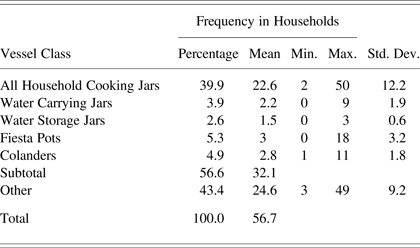
Nelson (Reference Nelson1981:115) reports that household cooking jars (those used in the everyday preparation of food to be consumed by the household) comprise 56 percent (n = 32.1) of the mean household inventory at San Mateo Ixtatan. It should be noted that this figure subsumes five different vessel classes: all household cooking jars, water carrying jars, water storage jars, fiesta pots, and colanders. Vessels routinely subjected to direct fire cooking (all household cooking jars) comprise 40 percent of household assemblages, while four other vessel classes account for another 16 percent of the systemic inventory, on average (Table 1; Nelson Reference Nelson1981:Table 1).
Systemic Inventory at San Mateo Ixtatan (after Nelson Reference Nelson1981:Table 1)

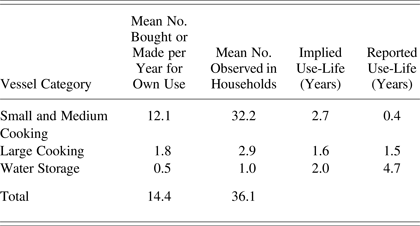
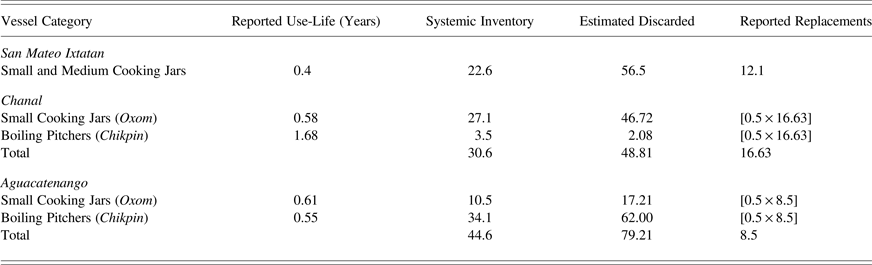
Ceramic vessel replacement rates are much lower than discards predicted employing use-life estimates and the discard equation (Nelson Reference Nelson and Longacre1991:177–178). Everyday cooking jars have a reported mean use-life of 0.4 years, suggesting that an average household would replace about 80 of these annually. Informant responses from questionnaires, however, state that an average of 12.1 of these vessels were “bought or made for own use” per year (Nelson Reference Nelson and Longacre1991:176, Table 8.4). If 12 cooking jars with a mean use-life of 0.4 years were replaced annually, this implies about 5 of these were in use daily. In fact, the mean number of everyday cooking jars per household was 32 (23 used directly over a hearth fire). From this discrepancy, Nelson calculated an “implied use-life” of 2.7 years for this vessel class (Table 2).
Ceramic Vessel Replacement Rates at San Mateo Ixtatan (after Nelson Reference Nelson and Longacre1991:Table 8.4)

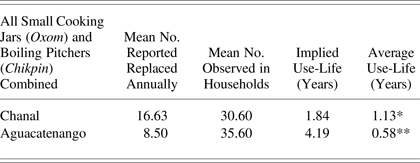
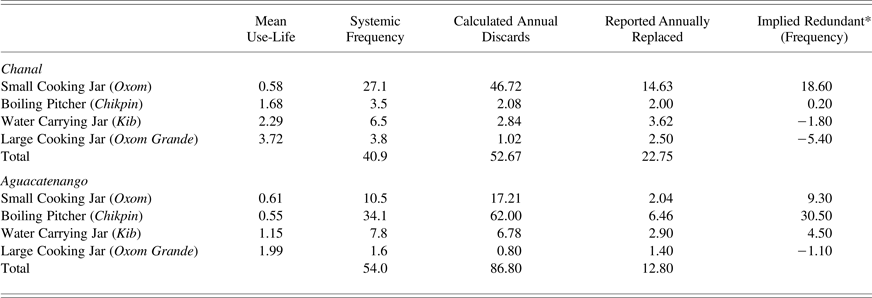
The implied use-life of cooking vessels is also longer than the use-life reported by informants in the communities of Chanal and Aguacatenango (Deal Reference Deal1998). Although informants provided estimated replacement rates for the combined vessel category of small cooking jars (oxom) and boiling pitchers (chikpin), dividing the combined number of both classes by their averaged replacement rate still produces an implied use-life greater than either use-life reported for one or the other vessel class alone or the mean use-life of the two vessel classes combined. Again, multiplying the use-life estimate by the number of cooking pots in the systemic inventory calculates far more annual discards than recollected by informants (Table 3).
Cooking Vessel Replacement Rates at Chanal and Aguacatenango (after Deal Reference Deal1998)

* Mean use-life of oxom (0.58) and chikpin (1.68).
** Mean use-life of oxom (0.61) and chikpin (0.55).
When households have stockpiled a particular vessel class it may be replaced less often than its reported use-life because replacement vessels are already in the household for immediate use when one fails. At San Mateo Ixtatan, everyday cooking jars were stockpiled in anticipation of immediate need (Nelson Reference Nelson and Longacre1991). At Chanal (where stockpiling was rare) and Aguacatenango, households had multiple cooking pots that were not all used each day; a rotating supply remained in active service (Michael Deal, personal communication 2014).
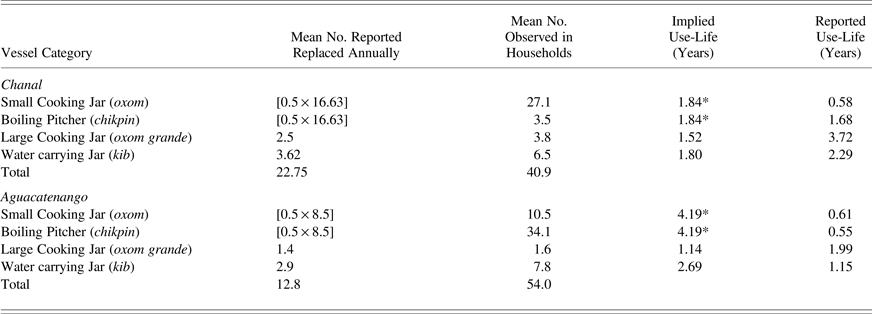
The pattern of everyday cooking jars having longer implied use-lives than their reported use-lives does not hold for other vessel classes. Water storage vessels at San Mateo Ixtatan had a reported use-life more than twice as long as their implied use-life (see Table 2). At Chanal and Aguacatenango the implied use-life of large cooking vessels is shorter than informant estimates, while at San Mateo Ixtatan the implied use-life is about the same as the reported use-life of these vessels (Table 4).
Ceramic Vessel Replacement Rates at Chanal and Aguacatenango (after Deal Reference Deal1998)

* Calculated from combined oxom and chikpin.
Implications of Applying Use-lives To Systemic Inventories
For each village, everyday cooking jars have high systemic frequencies and short use-lives. Accordingly, estimated discards would far exceed the number of pots reportedly replaced and the number in the systemic inventory (see Table 5). At this rate, within one year there would be no cooking vessels at all! The logical flaw here is the assumption that all everyday cooking pots were used simultaneously. A more parsimonious solution accepts investment in multiple cooking pots used in rotation or stockpiled, plus a number of retained, repaired, and repurposed ones.
Discard and Replacement Rates for Cooking Vessels in the Highland Maya Area

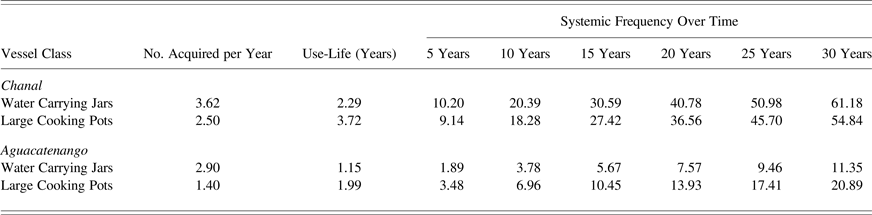
The statistics for other vessel classes suggest alternate trajectories. Why would a Chanal household replace 2.5 large cooking pots each year when they reportedly last over 3.5 years on average? The mean number of residents per Chanal household is about seven, with a mean systemic inventory of 6.5 water carrying jars. If the average household obtained 3.62 water carrying jars, each lasting over two years, these vessels would soon outnumber humans. In fact, extrapolating procurement rates from use-lives and the discard equation, the systemic number of water carrying jars and large cooking pots would grow over time (Table 6), while everyday cooking jar discards would exceed their acquisition rate almost immediately (see Table 5).
Implied Frequencies of Ceramic Vessels over Time in Chanal and Aguacatenango

The mathematical calculation in Table 6 is unrealistic because it assumes that all vessels are used simultaneously and that every pot used to exhaustion is immediately replaced with a new one. While cooking pots used on the hearth were almost certainly replaced immediately upon failure, the replacement vessel was likely already in the household systemic inventory. Either it simply transitioned from stockpiled to in-use status, or the loss of one pot's utility was diffused over a number of others suitable for the same purpose.
So why did Chanal households apparently replace more of some kinds of vessels than they exhausted? Of course, no actual household ever acquired 3.62 vessels, this is a mathematical mean calculated from the composite behavior of the entire community. The mean household size of about seven individuals implies that overall population was growing. Regardless of the specific demographic statistics, there will always be newly formed households alongside previously established ones. In turn, some households will fission into two, fuse into one, grow increasingly larger, or go completely extinct. Over time, a single household might go through all of these stages.
Households are long-lived institutions, usually surviving beyond the life span of any individual, and consumption patterns will fluctuate as the composition of the household evolves. Just as households change over time, systemic vessel inventories have dynamic life cycles (Arthur Reference Arthur2006, Reference Arthur2009). No household would acquire the exact mathematically calculated mean number of yearly replacement vessels; some would obtain more and some less. Very large systemic inventories are symptomatic of development over time; time to invest in more vessels and to accumulate repaired, repurposed, and provisionally discarded pots.
Exchange Patterns
At San Mateo Ixtatan, ten percent of the population was manufacturing pottery at the time of study. The very low production rates partially supported local consumption, not an export market. Most households acquired pottery through periodic marketplace exchange, mainly supplied by two other villages a few kilometers distant and connected by footpath (a 45-minute walk) (Nelson Reference Nelson and Longacre1991:165–166). At the time of study, 15–20 percent of Chanal households (over 150 active potters) manufactured pottery at a very low rate with seasonal variability (Deal Reference Deal1998:25, Table 3.1, Figure 13.11). Almost no pottery was exported and over 40 percent of vessels consumed by the community were imported (Deal Reference Deal1998:64).
In spite of exchange opportunities, including weekly markets and annual fairs, most Chanal potters were primarily concerned with provisioning their own household, replacing vessels broken the previous year, or bolstering the household assemblage in anticipation of a growing family (Deal Reference Deal, Pool and Bey2007:40). Pottery was largely acquired through gift giving, barter, and occasionally inherited from relatives. Produce could be bartered for a pot directly from the potter's residence (Deal Reference Deal, Pool and Bey2007:52–53), a practice well-attested ethnographically (Bankes Reference Bankes1985:275; Graves Reference Graves and Nelson1985:10; Longacre Reference Longacre and Longacre1991:109; Mohr Chávez Reference Mohr Chávez, Bey and Pool1992:77; Rice Reference Rice1987c:196–197; Sillar Reference Sillar2000:83–85).
Although reconstructing the organization of production and circulation of ceramics in the Maya lowlands is ongoing (Ball Reference Ball, Sabloff and Henderson1993; Bishop Reference Bishop1975, Reference Bishop and Zelst2003; Bishop et al. Reference Bishop, Rands, Holley and Schiffer1982; Fry and Cox Reference Fry and Cox1974; Fry Reference Fry1979, Reference Fry and Fry1980, Reference Fry and Sabloff2003a; McAnany Reference McAnany2009:199–268; Pool and Bey Reference Pool and Bey2007; Rands Reference Rands, Riley and Taylor1967, Reference Rands1969, Reference Rands, Rice and Sharer1987, Reference Rands and Kolb1988; Rands and Bishop Reference Rands, Bishop and Fry1980, Reference Rands, Bishop and van Zelst2003; Rice Reference Rice, Brumfiel and Earle1987a, Reference Rice, Rice and Sharer1987b, Reference Rice1996a, Reference Rice1996b, Reference Rice2009; Stanton and Gallareta N. Reference Stanton and Tomás2001; West Reference West, Masson and Freidel2003), my working hypothesis is that households of the Classic period acquired pottery through multiple provisioning strategies. At the very large Classic Maya center of Tikal, I have suggested that similar pottery forms were manufactured by fairly redundant production units (see Foias and Bishop Reference Foias, Bishop, Pool and Bey2007) and probably circulated through peripheral markets, among other distribution mechanisms (Straight Reference Straight2012, Reference Straight and López Varela2014).
Reconciling Replacement Rates with Pottery Availability
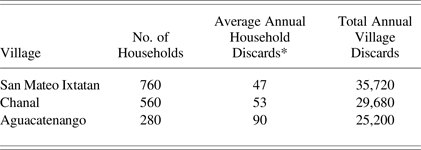
Applying estimated replacement rates to mean household systemic inventories at San Mateo Ixtatan, Chanal, and Aguacatenango and then multiplying this figure by the total number of households, annual village consumption rates were calculated (Deal Reference Deal1998:137–140, Tables 5.6 and 5.7; Nelson Reference Nelson and Longacre1991:178). In this exercise, the standard discard equation (Schiffer Reference Schiffer1975:840) was employed, resulting in quite substantial discard rates (Table 7).
Annual Village Pottery Consumption in Three Highland Communities

* Estimated by applying the discard equation to mean systemic inventories.
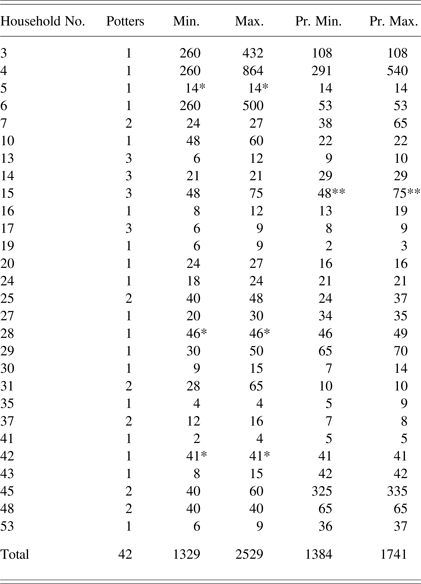
We can estimate the amount of pottery locally available from production rates elicited from 43 potters of 28 Chanal households (Table 8; Deal Reference Deal1998:Table 3.1). Using the minimum and maximum estimates of pottery manufacture, total production for these 43 potters is 1,329–2,529 pots per year (see Deal Reference Deal, Pool and Bey2007:56). Extrapolating this figure to all 150 potters in Chanal, 4,636–8,822 pots would have been produced annually. If we add another 45 percent to this figure to account for pottery imported into Chanal, annual availability comes to 8,430–16,040 pots. The maximum number of pots produced locally and imported, 16,040, covers just 54 percent of the total number of pots estimated to have been consumed per year, 29,680, by directly applying the standard discard equation. The mean number of pots available is 12,235, about 41 percent of estimated consumption.
Pottery Production Rates of Chanal Potters (after Deal Reference Deal1998:Table 3.1)

* Estimated based on reported production from previous year.
** Estimated based on reported production from year of study.
In this instance, the systematic application of vessel use-lives to entire systemic inventories does appear to “grossly overestimate” total discards as predicted by Varien and Potter (Reference Varien and Potter1997:198). The estimated combined production and importation of pottery indicates there were a maximum of 28.6 replacement vessels annually available per Chanal household (and a mean of 21.8). This figure suggests that the number of pots reportedly replaced annually is a more realistic estimate of consumption (Table 9).
Annual Discard and Replacement Rates for Cooking and Water Carrying Vessels in Chanal and Aguacatenango

*Redundant here refers to vessels used for the same purpose in rotation, stockpiled, or in a partial/repurposed state.
Estimating In-use Assemblages
In general, the age, size, and type (function) of the pot as well as the informants’ age, degree of education, and level of familiarity with pottery manufacture will affect the accuracy of vessel use-life reports (Neupert and Longacre Reference Neupert, Longacre, Longacre and Skibo1994:74). Nelson (Reference Nelson and Longacre1991:176) was specifically concerned with the discrepancy between the 4.5 year use-life of Kalinga cooking pots generated through the systematic inventorying method (Longacre Reference Longacre and Nelson1985) and informants’ reports that these vessels would last only 2 to 3 years. Tani and Longacre's (Reference Tani and Longacre1999) reappraisal of their own use-life estimates found that many pots had not been counted in the original study. Their corrected mean use-life of 2.2 years suggests that informants do accurately report use-lives, at least for shorter lived vessel classes.
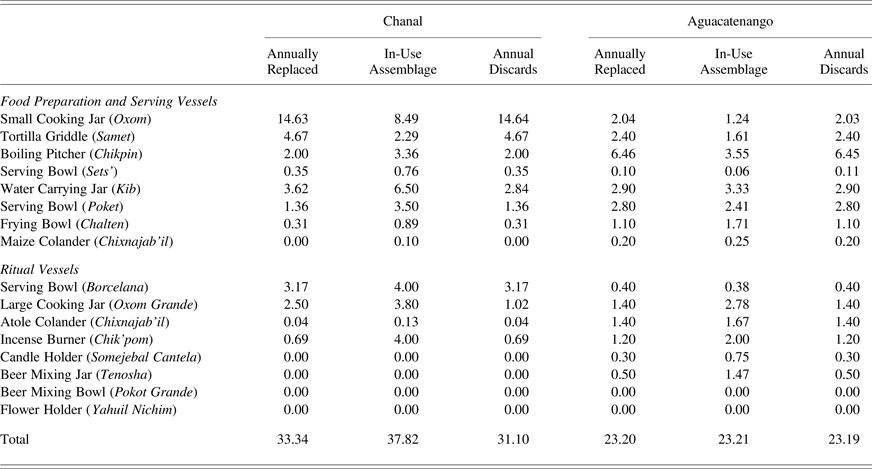
Accepting the reported vessel use-lives for the highland Maya villages studied by Deal (Reference Deal1998), we can calculate the mean in-use ceramic vessel assemblage necessary to account for the reported replacement rates. Table 10 extrapolates the frequencies of in-use vessels necessary to produce a number of annual discards equal to the annual replacement rates reported by informants. This hypothetical mean assemblage would be at equilibrium, with each failed pot replaced with a new one. Although this does not account for changing household composition or life-stages of vessels it does give a rough idea of the mean number of pots forming the average in-use assemblage.
Estimated In-Use Ceramic Vessel Assemblages for Chanal and Aguacatenango

Since the estimated replacement rate (33.3) (Table 10) is higher than the maximum sum of production and importation rate estimated for Chanal (28.6), I suspect that I have either exaggerated the in-use assemblage or underestimated use-lives (or both). This estimated mean in-use assemblage of 38 ceramic vessels at Chanal subsumes about 62 percent of the mean systemic inventory, while at Aguacatenango the estimated in-use set accounts for only 28 percent of the mean systemic inventory.
Paradoxically, Aguacatenango households, with more ceramic vessels than Chanal households on average, were probably maintaining smaller in-use assemblages. At Chanal, industrial replacements were more likely to augment assemblages, whereas they were more often used as alternatives to ceramic vessels at Aguacatenango (Deal Reference Deal1998:168). This evolution of vessel assemblages will undoubtedly continue into the future, with ever more accessible cheaper industrial vessels infiltrating traditional villages previously more dependent upon ceramic and perishable containers for domestic needs.
LOWLAND MAYA ARCHAEOLOGICAL DATA FROM CLASSIC PERIOD AGUATECA
Three structures excavated at Aguateca, M8–4 (House of Mirrors), M8–8 (House of Axes), and M8–13, are interpreted as domestic households and their entire ceramic vessel inventories have been reported (Inomata and Triadan Reference Inomata and Triadan2010). The following summary is derived from Inomata and Triadan (Reference Inomata and Triadan2010) and previous publications of the Aguateca Archaeology Project (Aoyama Reference Aoyama2007, Reference Aoyama2009; Emory and Aoyama Reference Emory and Aoyama2007; Inomata Reference Inomata1997, Reference Inomata, Inomata and Webb2003; Inomata and Stiver Reference Inomata and Stiver1998; Inomata et al. Reference Inomata, Triadan, Ponciano, Terry and Beaubien2001, Reference Inomata, Triadan, Ponciano, Pinto, Terry and Eberl2002, Reference Inomata, Ponciano, Santos, Chinchilla, Román and Breuil-Martínez2004).
Structures M8–4 and M8–8 were likely home to elite couples with sleeping, storage, food preparation, and craft production areas. Both are internally divided into three rooms (south, center, and north), with a raised bench against the back wall, and subsequently added rooms onto their northern sides; Structure M8–8 also had a small south room addition. The central rooms appear to have been used by male household heads of elite rank as dormitory and reception areas. There were also scribal implements in the central room of Structure M8–8. The northern rooms were associated with storage, food preparation, and cooking paraphernalia.
Structure M8–13, also internally divided into three rooms (west, center, and east), shared a plaza with M8–10 (House of Scribes). Artifacts reflecting domestic activity (i.e., food storage and preparation) are similar to those from elite residences (Structures M8–4, M8–8, M8–10, and M7–35), while fewer valuable objects (i.e., jade beads and fine shell ornaments) suggests a household of lower status. The division of space within Structure M8–13 is similar to that of M8–4 and M8–8 with a central room dedicated to sleeping and reception and one side room outfitted for food preparation.
We can rank these three households in terms of architectural quality and quantity of prestige goods. Accordingly, Structure M8–13 ranks lowest of the three and had the fewest (62) ceramic vessels. Structure M8–8 had the finest quality architecture and abundant prestige goods but an intermediate number (77) of ceramic vessels, while Structure M8–4 housed the largest systemic inventory of pots (85), even though it ranked intermediate in terms of architectural investment and non-ceramic prestige goods.
The Kitchens of Aguateca Households
Each of the three Aguateca structures considered here has a room with associated pottery and other artifacts indicating a food preparation area, or “kitchen.” Contrary to expectation, no hearths can be securely identified in association with these kitchens or elsewhere. Perhaps most congruent with the kitchen identifications are the maize grinding apparatus found in situ. The north room of Structure M8–4 contained a pile of nine manos and a large limestone metate remained on the floor following abandonment. An inverted tripod metate and mano were found on the floor of the north room of Structure M8–8 and the west room of Structure M8–13 contained two paired manos and metates (one very worn and one fairly new).
Considering the high percentage of cooking vessels reported ethnographically for the highland Maya, numerous examples were expected at Aguateca. Unfortunately, identifying cooking vessels from these households has not been so straightforward. Inomata (Reference Inomata, Inomata and Triadan2010:178) concluded that, “[t]he identification of cooking pots is difficult, but they probably include large bowls of both closed and open forms.” For Tikal, Culbert (Reference Culbert and Sabloff2003:159) seems to equate large slipped bowls with cooking and unslipped widemouthed jars with storage, although he had difficulty identifying cooking vessels in archaeological contexts from highland Chiapas (Culbert Reference Culbert1965:43).
The failure to include cooking pots among the functional classes of vessels does not indicate any doubt that such vessels existed in the prehistoric Highlands. The omission is due to the fact that it was impossible to determine which specific vessel forms might have belonged to this class. From a consideration of modern ethnographic data, it seems likely that smaller examples of either large-diameter bowls or widemouthed jars might have served this function (Culbert Reference Culbert1965:44).
Since the Aguateca structures were burned and collapsed before rapid abandonment, unambiguous identification of cooking vessels is lacking. Soot may have been burned off and distinctive use-wear patterns are not always clear due to erosion and the fragmented state of the vessels, even after reconstruction. Nonetheless, an abundant supply of cooking jars conforming to the modern highland Maya examples is unmistakably absent.
Identifying Vessel Function in the Aguateca Assemblages: Cooking Vessels
Varien and Potter (Reference Varien and Potter1997:198) attribute the corpus of ethnographic, experimental, and archaeological research focused on cooking vessels to the fact that they have some of the shortest use-lives of any vessel class and “tend to be represented in most pottery assemblages, often comprising the most common vessel type.” From Mills’ (Varien and Mills Reference Varien and Mills1997:Appendix 1) compiled statistics, cooking vessels represent over 50 percent of the household systemic inventories of nine out of eleven communities.
The kitchen rooms of Structures M8–4, M8–8, and M8–13 produced 39, 22, and 14 ceramic vessels, respectively. Few of these are obvious cooking vessels. The Aguateca researchers (Inomata et al. Reference Inomata, Triadan, Ponciano, Inomata and Triadan2010:104) do state that, “[t]he west room [of Structure M8–13] contained storage jars, Tinaja/Pantano jars, and possible cooking vessels.” Two medium sized open form bowls with rounded bases from the kitchen of M8–13 are the best candidates.
Unlike the highland Maya cooking vessels (and water carrying jars), few pots from Aguateca have handles. Only eight widemouthed jars in total (3.4 percent) from the three Aguateca households discussed resemble the common cooking jars (sans handles) that so dominate (ca. 40–60 percent) the highland Maya assemblages. Two of these have polychrome exteriors and were not likely used on the hearth. These eight Aguateca pots have a mean volume of 1.2 liters, well below the mean capacity of 4.3 liters reported for San Mateo Ixtatan cooking jars (Nelson Reference Nelson1981:Table 1).
In their study of prehistoric Anasazi pottery, Turner and Lofgren (Reference Turner and Lofgren1966) calculated vessel capacities of jars used for cooking food for a single household. Stable carbon and nitrogen isotopic analysis of skeletal remains (Chisholm and Matson Reference Chisholm and Matson1994) and macroplant analysis of coprolites (Minnis Reference Minnis1989) confirm that the Anasazi diet was dominated by maize during this period. Since cooking jar capacities evidence a bimodal distribution after ca. a.d. 700, those with a capacity over 8 liters were considered fiesta pots, reserved for feasting events, and were omitted from calculation. By measuring ladle and serving bowl volumes, Turner and Lofgren (Reference Turner and Lofgren1966) estimated the average serving portion at 0.691 liters.
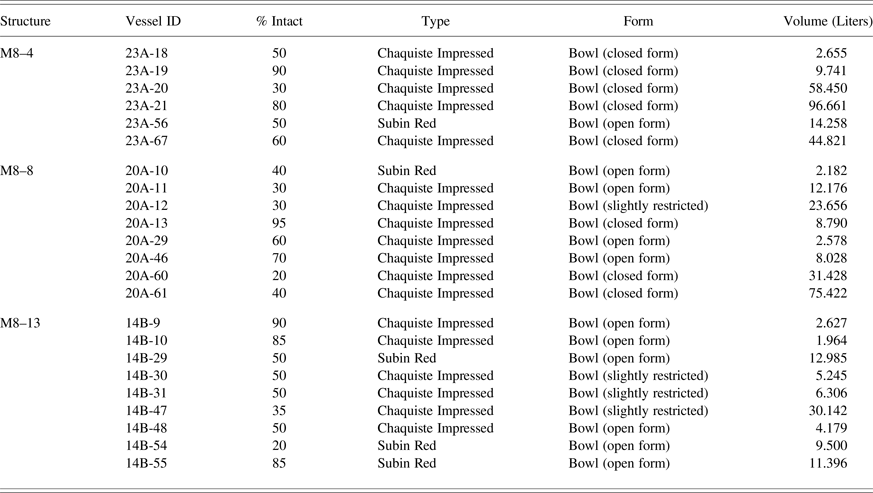
Assuming a 0.691 liter serving size, a cooking pot for serving 6 adults would have a capacity of 4.146 liters. This is in accord with the Chuj Maya data from San Mateo Ixtatan, where Nelson (Reference Nelson1981:Table 1) calculated an average household size of 6.5 individuals and a mean everyday cooking vessel volume of 4.3 liters. From the Aguateca assemblages, eight large bowls with capacities less than 8 liters might have been everyday cooking vessels (Table 11).
Large Utility Bowls from Aguateca Households Possibly Used for Cooking (after Inomata and Triadan Reference Inomata and Triadan2010)

If the utility bowls from Table 11 were intended for cooking, they should have technological attributes in common with one another, and with cooking vessels in general. Most of these vessels have the same slipping scheme: interiors are entirely slipped red and exteriors have slipped rims only. According to Reid (Reference Reid and Bronitsky1989:169–170) watertight pots facilitate simmering and boiling. Burnishing, smudging, or slipping decreases permeability and promotes heat retention (Rye Reference Rye1981:27; Schiffer Reference Schiffer and David Kingery1990:378). Although traditional cooking pottery is usually unslipped in ethnographic case studies, perhaps cooking pots of the ancient Maya were routinely slipped. At Cerén, gourd bowls presumably used for serving food had been painted with cinnabar (mercuric sulfide), a toxic substance which could have caused health problems for the residents (Sheets Reference Sheets2002:67).
Tempering also affects cooking performance. Course sand tempering likely improves thermal conductivity, increasing effective cooking directly over a fire (Braun Reference Braun, Moore and Keene1983; Reid Reference Reid and Bronitsky1989; Pratt Reference Pratt1999:81; Skibo et al. Reference Skibo, Schiffer and Reid1989:131). Most of the vessels from Table 11 are described as having a large or very large amount of calcite temper up to 1.2 mm in size (Inomata and Triadan Reference Inomata, Triadan, Ponciano, Inomata and Triadan2010:204–299). Although the thermal expansion coefficient of calcite has been linked to ameliorating thermal stress (Rye Reference Rye1976:116–117), calcite temper is ubiquitous in the Aguateca vessels.
To be clear, the Aguateca researchers have specifically noted the absence of physical evidence supporting a cooking vessel identification for many of the pots in Table 11 (see Inomata and Triadan Reference Inomata, Triadan, Ponciano, Inomata and Triadan2010:202–299). Although I suspect that some of these were water basins, this form class is still the top contender for cooking pottery. Although some of the larger vessels might be fiesta pots used infrequently to prepare food in bulk for feasting events, some were clearly fragmented and had transitioned to alternate functions. This only reinforces the low frequency of cooking vessels in the Aguateca assemblages.
Ethnographic Comparisons
In their survey of traditional pottery from the Guatemala highlands, Reina and Hill (Reference Reina and Hill1978) describe several common vessel forms that approximate some of the large bowls from the Classic Maya lowlands. The apaste (Reina and Hill Reference Reina and Hill1978:Figure 6) is a “basinlike bowl” used as a general purpose cooking vessel, especially popular for cooking beans, while the apaste grande (Reina and Hill Reference Reina and Hill1978:Figure 5) is a very large version of the same vessel form, “conforming to the European notion of a basin.” The apaste grande is used for dry storage of maize or beans and sometimes by potters for soaking quantities of clay in water. I suspect that these were also fiesta pots, occasionally used to cook large quantities of food for feasting events.
In his study of Yucatecan Maya pottery production, Thompson (Reference Thompson1958:117) recorded water storage vessels termed cat in Yucatecan and apaste in Spanish (from the Nahuatl apaztli) which he translated to “basin or tub.” Cat were usually slipped red. A similarly shaped unslipped vessel, the cum, was used directly over a three stone hearth fire to boil water, cook beans, or boil meat and stews (Thompson Reference Thompson1958:115). Most cum vessels had an exterior appliqued filet placed below the rim or at the vertical tangent where the rim restricts slightly (Thompson Reference Thompson1958:Figures 29g–29h, 34h, 34j–34l, 35d, 35g–35h) and are remarkably similar to Late Classic vessels from Aguateca and Tikal.
Thompson's (Reference Thompson1958:117) brief review of linguistic references indicates overlapping function for the same shape class: cum/cat. Morphologically, cum tend to have rounded bases while cat have flat bases (see Thompson Reference Thompson1958:113–119, Figures 34–36). Very close in shape, cum and cat substituted for one another in practice and the distinction between these functional classes was no longer made by many residents (Thompson Reference Thompson1958:146).
Of the six vessel forms used for cooking in the Guatemalan highlands (Reina and Hill Reference Reina and Hill1978:Figures 6–11), three have close cognates in the Classic Maya assemblages: the apaste, olla, and tamalero. The olla (Reina and Hill Reference Reina and Hill1978:Figure 8) is a “caldronlike vessel” close in form to everyday cooking jars described by Deal (Reference Deal1998) and used as a general-purpose cooking pot. The tamalero (Reina and Hill Reference Reina and Hill1978:Figure 11) has a restricted mouth and is used to cook or steam tamales. I suspect that some of the open form bowls from Aguateca were apastes used for general-purpose cooking and that many closed form bowls were, indeed, tamaleros for steaming maize tamales.
Two other vessel forms from the highlands relate to maize processing and cooking. These are not common in the assemblages from the Classic-period lowlands. The pichacha (Reina and Hill Reference Reina and Hill1978:Figure 11) is a perforated olla used as a colander for straining maize after it has been soaked. The strained maize is then ground wet and boiled to be consumed, either as a mush or formed into tortillas and cooked on a comal (Reina and Hill Reference Reina and Hill1978:Figure 7). The few ceramic vessels from Aguateca that look like comales did not have soot or wear patterns indicating they had been use on the hearth.
The general absence of pichacha and comal forms, along with epigraphic and iconographic evidence (Reents-Budet Reference Reents-Budet1994:Figures 2.20, 3.4, and 4.11; Taube Reference Taube1989) suggests that the Classic Maya did not consume maize as tortillas—the dominant practice among modern Maya. Nonetheless, maize is processed in a similar fashion before eaten as a gruel, dried into a dough, or made into tamales. Although the Tarahumara of northern Mexico generally favor dry grinding, “[w]hen wet grinding is done…the rinsing is performed in a basket (Kennedy Reference Kennedy1978)” (Nelson Reference Nelson and Longacre1991:169), eliminating the need for a colander pot. This is a stark reminded that baskets, gourds, and wooden vessels were available to the Classic Maya, although they do not generally preserve well in the archaeological record.
Water Carrying and Water Storage Vessels
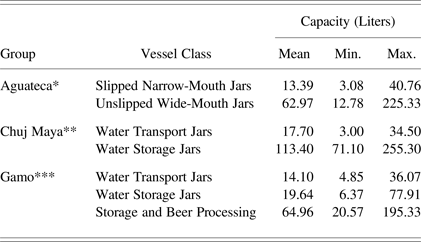
A comparison of vessel capacities reported ethnographically for the Chuj Maya of highland Guatemala (Nelson Reference Nelson1981:Table 1) and the Gamo of southwest Ethiopia (Arthur Reference Arthur2009) with those of archaeologically recovered slipped narrow-mouth jars from Aguateca supports the conclusion that these were water transport vessels. The Gamo are subsistence agriculturalists with a similar annual rainfall cycle as the highland Maya. They have an average household size of 5 persons and mean ceramic assemblage sizes of 11.1, 17.3, and 24.5 vessels in the three villages studied by Arthur (Reference Arthur2009:39, Table 2). The similar mean and range of slipped narrow-mouth jar capacities at Aguateca closely mirror those of the two ethnographic data sets, suggesting that the Aguateca vessels were, in fact, water carrying jars (Table 12).
Water Jar Capacities at Aguateca Compared to the Chuj Maya at San Mateo Ixtatan and the Gamo of Ethiopia

* After Inomata and Triadan Reference Inomata and Triadan2010.
** After Nelson Reference Nelson1981.
*** After Arthur Reference Arthur2009.
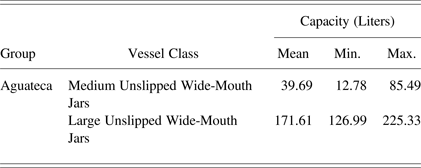
There is a discrete bimodal distribution of vessel capacities for water transport and water storage jars from San Mateo Ixtatan, with a complete absence of water jars in the 34.5 to 71.1 liter range. The capacities of slipped narrow-mouth jars and unslipped widemouthed jars at Aguateca overlap considerably, as they do for water transport and storage vessels of the Gamo. Vessel capacities for unslipped widemouthed jars from Aguateca form a discrete bimodal distribution with an absence of unslipped jars in the 85.49 to 126.99 liter range (Table 13).
Capacities of Medium and Large Unslipped Wide-Mouthed Jars from Aguateca (Calculated from Data in Inomata and Triadan Reference Inomata and Triadan2010)

In the Aguateca household assemblages, the mean volume of unslipped widemouthed jars between 40.75 liters (the largest slipped jar) and 225.33 liters is 101.1 liters, close to the mean capacity at San Mateo Ixtatan. This may indicate that some of Aguateca's medium-sized unslipped widemouthed jars had a different primary function, perhaps for dry storage. It seems likely that slipped narrow-mouth jars were made to be used for water transport while, at least some, large unslipped widemouthed jars were household water storage vessels at Aguateca.
The data from the Gamo suggest other interpretations. While nearly all water storage jars among the Gamo are smaller than those of the Chuj Maya, all jars with capacities greater than 77.91 liters are used for brewing and storing beer. Nelson (Reference Nelson1981, Reference Nelson and Longacre1991) does not mention beer brewing in his publications, however Deal (Reference Deal1998) documented beer mixing bowls and beer storage jars in Tzeltal Maya communities. At Aguacatenango, a slipped large hemispherical bowl for mixing maize beer (chicha) and a slipped and painted large composite jar used to ferment the beverage for festivals—and dry storage the rest of the year—are similar in shape and size to vessels from the Aguateca assemblages (see Deal Reference Deal1998:193, 189, Figures B19 and B27).
Revisiting the Aguateca Household Assemblages
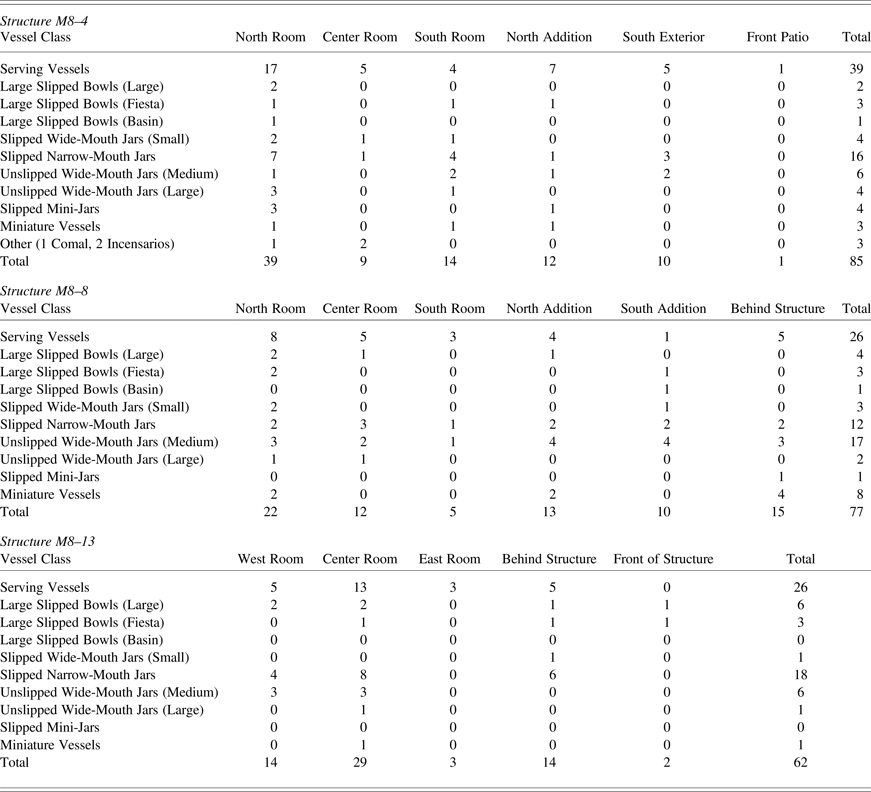
The alleged kitchens of the three Aguateca households contained likely cooking, serving, water transport and storage, and dry storage vessels. The north rooms (kitchens) of Structures M8–4 and M8–8 had more vessels and a greater variety of vessel classes than the other rooms or areas of these households. At Structure M8–13, the central room had the greater number of vessels and variety of vessel classes than other rooms or outside of the structure, although the west room was still stocked with a complete “kitchen” assemblage (Table 14).
Aguateca Vessel Class Frequencies by Room/Area

Although smashed and burned at the time of abandonment, many reconstructed vessels appear to have been worn from use, damaged, or modified and retained as partial vessels. Some serving vessels—the numerically dominant class—may have been new and not currently in use. With a mix of new and old, partial, and complete vessels, the Aguateca household inventories are similar in this respect to those reported ethnographically from the Maya highlands.
COROLATING THE ETHNOGRAPHIC AND ARCHAEOLOGICAL DATA SETS
In their final assessment of the future of pottery accumulation studies, Varien and Mills (Reference Varien and Mills1997:174) advocate an approach that “tacks…among experimental, ethnoarchaeological, and archaeological evidence.” Although it may be difficult to differentiate cooking vessels (or other functional classes) from the rest of the inventory, it is still worth evaluating archaeological assemblages to ascertain the likely functions of pots in their original contexts (e.g., Hally Reference Hally1986). Before estimating pottery consumption and accumulation rates, the in-use assemblage must be discriminated from the systemic inventory and the degree of stockpiling, divestiture, investiture, repurpose/reuse, and provisional discard assessed.
While the total number of pots from Aguateca households are similarly high as those reported ethnographically for the highland Maya, the distributions of shape classes differ between these two contexts. I have suggested functions for many of the Aguateca vessel forms based on ethnographic analogies and archaeological context. Substantive differences in vessel class frequencies remain, however, between the ethnographic and archaeological assemblages.
Comparing Vessel Class Frequencies
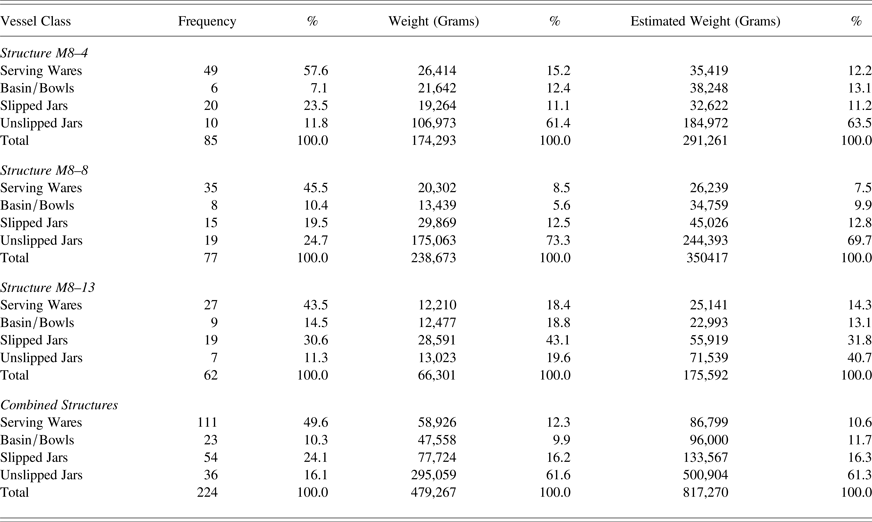
Table 15 presents the number of vessels, their recovered weights, and estimated complete vessel weights from the three Aguateca households. The four categories are based on Culbert's (Reference Culbert1993, Reference Culbert and Sabloff2003) “shape classes” (also see Fry Reference Fry and Sabloff2003a, Reference Fry2003b; Kosakowsky Reference Kosakowsky2003). While these broad inclusive categories likely conflate vessels used for different purposes, they do reflect basic divisions based on function. Of particular notice, small bowls and slipped mini-jars are included in the serving vessel category alongside cylinder vases and dishes (plates).
Vessel Class Frequencies from Aguateca Households

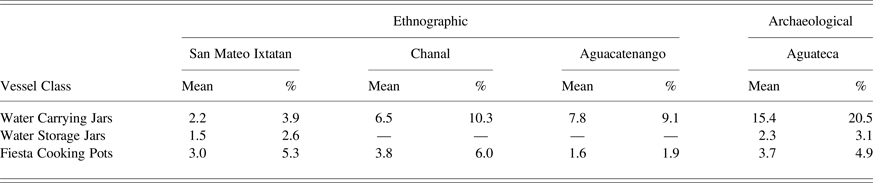
In addition to abundant everyday cooking jars, the highland Maya households also keep jars for water transport, water storage, and fiesta cooking. On average, narrow-mouth jars (kib [cantero]) for carrying water account for 10.3 percent of the systemic inventory of Chanal households and 9.1 percent of those at Aguacatenango, even though the latter was closer to the production center from where these were imported (Michael Deal, personal communication, 2014). The Aguateca households had twice this number of narrow-mouth slipped jars, likely for water transport. Chanal and Aguacatenango households do not generally use distinct vessels for water storage; water is simply kept in the water transport vessel. Water carrying jars had the lowest systemic frequency in San Mateo Ixtatan, where water transport and water storage jars combined represent just 6.5 percent of the mean systemic inventory (Table 16).
Vessel Class Frequencies in the Ethnographic and Archaeological Contexts

Large widemouthed jars (oxom grande [olla]) used for intermittent feasting events and dry storage between these events make up about 6 percent of Chanal household inventories but only 1.9 percent of Aguacatenango assemblages (Deal Reference Deal1998:Table 3.12). The frequency of large bowls (fiesta or basin) in the Aguateca assemblages (mean = 3.7, see Table 14) is similar to the highland Maya households. But the archaeologically recovered assemblages have few identifiable cooking vessels, in stark contrast to the highland Maya households. Large slipped bowls (apastes) account for only 5 percent (mean = 4) of the Aguateca household inventories and some of these were likely used as water basins.
Serving Vessels in Classic Times
Just as “cooking pots” is an obvious vessel category in most ethnographic case studies, “serving vessels” are ubiquitous in Lowland Maya archaeological contexts. Serving vessels make up half of the Aguateca assemblages by vessel count but only around one-ninth by weight, a discrepancy explained by their smaller sizes and thinner walls. The time dedicated to decorating Classic serving wares suggests that not all of these vessels were strictly utilitarian containers for dispensing food. “The serving-vessel category includes a variety of shapes, many of which were probably multifunctional and served both for household uses such as food serving and containers and for ritual purposes” (Fry Reference Fry and Sabloff2003a:68).
Based on data from household excavations, Fry (Reference Fry1969:252; see Culbert Reference Culbert and Patrick Culbert1973:86) first reported a 41 percent frequency of serving wares from peripheral Tikal and intersite areas close to Tikal (Table 17). He found that “[t]he percentage of serving vessels correlated directly with the size of the group: the larger the group, the greater the frequency of serving vessels” (Fry Reference Fry and Sabloff2003a:68). “Such high frequency can be explained by a higher frequency of feasting events and the economic possibility of having multiple sets of serving dishes” (Fry Reference Fry2003b:86).
Vessel Class Frequencies (Percentages) from Discard Contexts at Tikal (after Fry Reference Fry2003b:Table 1)

This does not indicate that only larger or wealthier groups had access to polychrome serving vessels. On the contrary, polychrome pottery accounts for one quarter to one third or more of the total recovered ceramic assemblages of low status groups in peripheral Tikal (Culbert Reference Culbert and Sabloff2003:69). “It seems clear that—at least in the sense of access to specialist-produced painted pottery—even the lower-class inhabitants of Tikal had a high standard of living” (Culbert Reference Culbert and Sabloff2003:69). The archaeologist's interest in serving vessels seems justified in light of the widespread occurrence of these vessels at homesteads ranging the gamut of socioeconomic status in ancient Maya society.
ESTIMATING CERAMIC VESSEL DISCARD RATES FOR THE AGUATECA ASSEMBLAGES
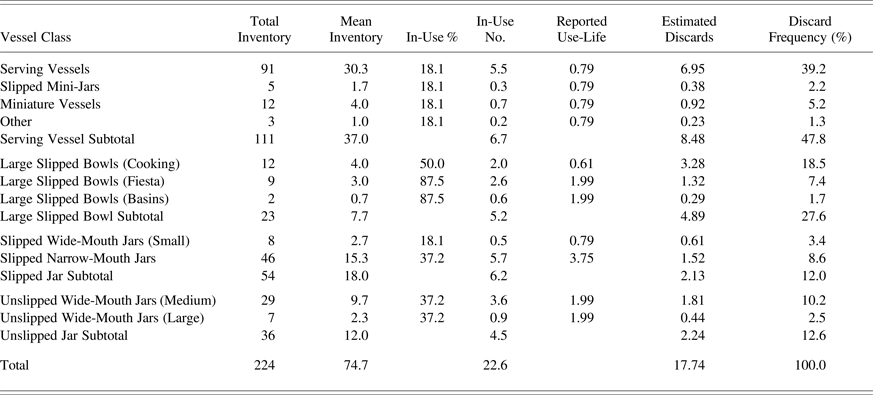
In the following ceramic consumption model, slipped narrow-mouth jars are treated as water carrying jars (kib), large bowls as cooking vessels, and very large bowls (fiesta or basin) as fiesta cooking pots (oxom grande). The statistics for Aguateca serving wares are averaged from the three serving bowl forms reported from the Tzeltal area: sets’, poket, and borcelana. These serving ware statistics were also applied to slipped jars unlikely to have been used as either cooking vessels or water transport jars (small widemouthed slipped jars, miniature jars, and other miniature vessels). The mean in-use vessel assemblage for Aguateca households was calculated from the in-use frequency of each vessel class implied by the discrepancy between replacement rates and systemic numbers in the highland Maya villages. Based on the Aguateca descriptions of recovered large bowls, I have applied a 50 percent in-use frequency to this vessel class.
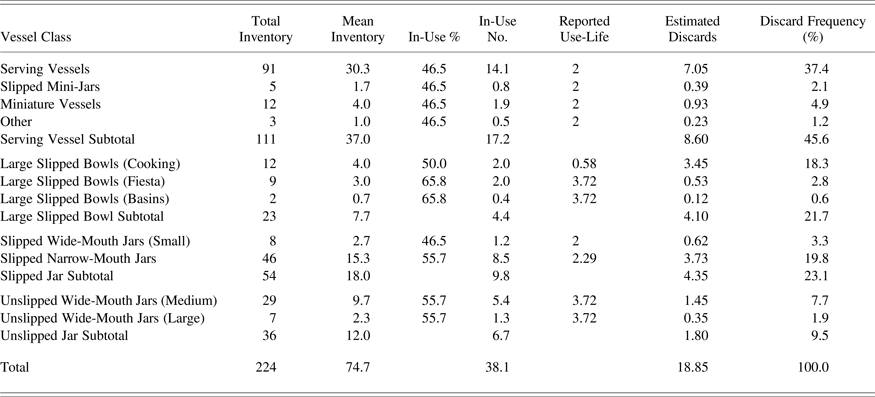
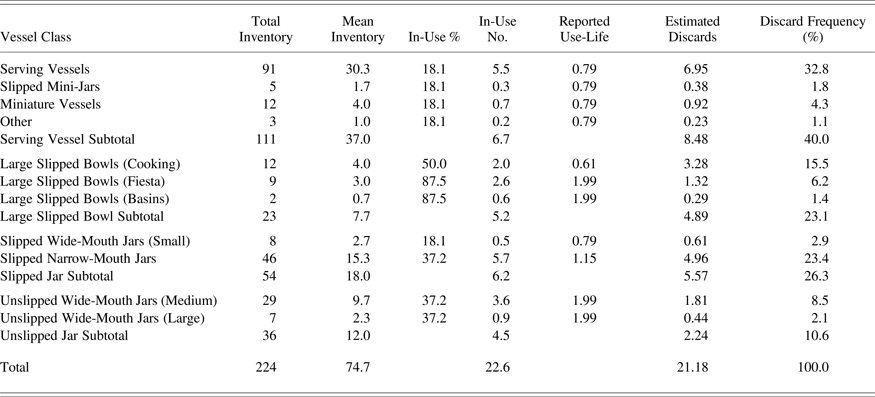
Applying the reported data for Chanal to the mean systemic inventory from the archaeological assemblages at Aguateca, about 19 vessels would be discarded annually per household on average (Table 18). Repeating this exercise with the Aguacatenango data, just over 21 pots would need to be acquired per year to maintain the average Aguateca household assemblage (Table 19). Since these simulations employ mean frequencies of vessel classes, not whole pots, they are at equilibrium and the discard frequencies would remain constant over 10, 100, or 1000 years (see Mills Reference Mills1989).
Ceramic Vessel Discard Simulation for Mean Aguateca Household Assemblage Applying Chanal Data

Ceramic Vessel Discard Simulation for Mean Aguateca Household Assemblage Applying Aguacatenango Data

RELATIVE USE-LIVES OF ARCHAEOLOGICALLY RECOVERED VESSEL CLASSES
Use-lives influence the accumulation of discarded pottery in predictable ways, so differences between the Aguateca systemic inventories and the Tikal accumulated discard assemblages should indicate which vessel classes had relatively shorter or longer use-lives. The data here are not entirely equivalent, though. The Tikal data are biased by excavation strategy and some vessel classes might be underrepresented for various reasons. Largely compiled from test pit data, the Tikal vessel class frequencies were certainly influenced by household discard patterns.
Although it is important to acknowledge the formation processes (Binford Reference Binford1981; Reid et al. Reference Reid, Schiffer and Rathje1975; Schiffer Reference Schiffer1972, Reference Schiffer1975, Reference Schiffer1976, Reference Schiffer1985) responsible for the transformed archaeological record sampled at Tikal, there is good reason to believe that these midden deposits are actually the best proxy for discard habits in antiquity (see Beck Reference Beck2006:41). The Classic-period settlement pattern at Tikal found most peripheral households separated from one another (Carr and Hazard Reference Carr and Hazard1961; Webster et al. Reference Webster, Silverstein, Murtha, Martinez and Straight2004), although some clustering correlates with advantageous topography (see Becker Reference Becker1999; Puleston Reference Puleston1983:Tables 17–19). Assuming that the Tikaleños reasonably adhered to least-cost principles when discarding refuse (see Beck and Hill Reference Beck and Hill2004:308, 315–316), there should be little to no mixing of pottery between households.
Table 20 compares the vessel class frequencies from the large-scale University of Pennsylvania project at Tikal, 1955–1959, published by Fry (Reference Fry and Sabloff2003a:159, Table 5.2; Reference Fry2003b: 86, Table 1) with frequencies calculated from peripheral Tikal middens by Straight (Reference Straight2012) and the household frequencies adapted from Aguateca (Inomata and Triadan Reference Inomata and Triadan2010). The data from the Penn State Tikal Project (PSTP) were calculated from test pit data collected from middens at peripheral Tikal households in 2005–2006 (see Straight Reference Straight2012:673–722) and serve as an independent check (and confirmation) on the previously published Tikal data. The PSTP results were calculated from rim sherds only, while the Aguateca frequencies reported represent numbers of reconstructable vessels from areal excavation.
Ceramic Vessel Class Frequencies from Tikal Discard Contexts Compared to Aguateca Simulated Discard Assemblages

*Using Chanal data.
** Using Aguacatenango data.
The discard simulations in Tables 18 and 19 do bring the frequency of large slipped bowl discards in line with those from the Tikal discard assemblages. The vessel class “large slipped bowls” is likely comprised of shorter-lived cooking vessels, perhaps longer-lived water/dry storage vessels, and almost certainly long-lived fiesta pots. In these simulations the composite category, large slipped bowls, produces a higher discard rate compared to its systemic frequency over time, suggesting that some of these were cooking vessels with shorter use-lives.
The Aguateca discard frequencies calculated by applying the highland Tzeltal ethnographic data to the mean archaeological assemblage (see Table 20) are similar to those from Tikal for the first two vessel classes but differ significantly for slipped and unslipped jars. It does remain a very real possibility that unslipped storage jars are actually underrepresented in the Tikal discard contexts because of household discard patterns. Likewise, water transport jars have a higher likelihood of breaking somewhere between the water source and the household, never making it into a household midden (Beck Reference Beck2006:41; Deal Reference Deal1998:122; DeBoer and Lathrop Reference DeBoer, Lathrop and Kramer1979).
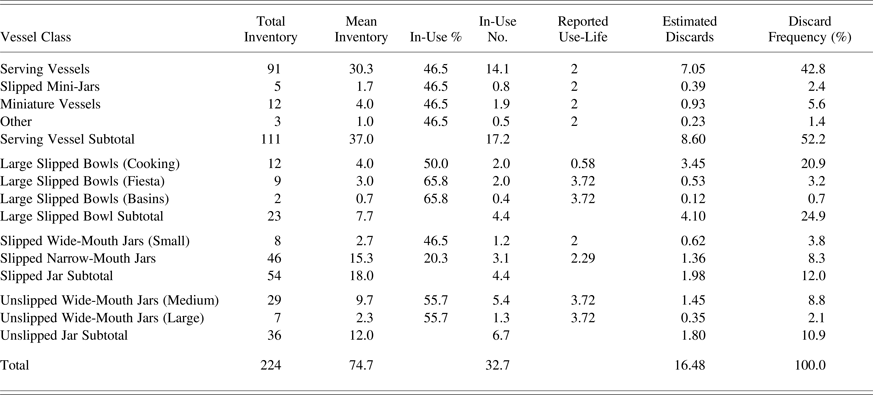
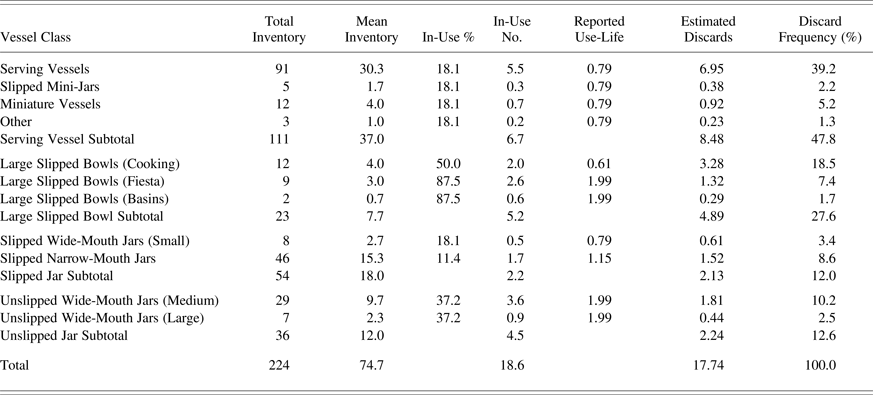
For the frequency of slipped narrow-mouth jars in the simulated Aguateca discard assemblages to approach those from Tikal discard contexts, either the use-life of the vessel class must be longer or the number of these jars in the in-use assemblage must be fewer (or both). With either “correction” the total number of all vessel discards would decrease slightly. Lowering the in-use frequency of slipped narrow-mouth jars in the discard simulations from Tables 18 and 19 to account for a 12 percent discard rate affects the discard frequencies for the other three vessel classes. In this iteration, discard frequencies for serving vessels are higher, and those for unslipped jars lower, than the Tikal composite discard data (Tables 21 and 22).
Ceramic Vessel Discard Simulation for Mean Aguateca Household Assemblage Applying Chanal Data with Slipped Narrow-Mouth Jar In-Use Frequency Modified*

*With slipped narrow-mouth jar in-use frequency lowered from 55.7% to 20.3% to account for a 12% discard rate.
Ceramic Vessel Discard Simulation for Mean Aguateca Household Assemblage Applying Aguacatenango Data with Slipped Narrow-Mouth Jar In-Use Frequency Modified*

*With slipped narrow-mouth jar in-use frequency lowered from 37.2% to 11.4% to account for a 12% discard rate.
Use-life and in-use number are codependent variables. The exact same discard frequencies are reached by substituting a longer use-life for slipped narrow-mouth jars (Tables 23 and 24) instead of substituting a lower in-use frequency (Tables 21 and 22). In either case total discards remain the same. However, water transport (and storage) vessel frequencies and use-lives are expected to vary with proximity to, and the character of, available water sources. Perhaps Aguateca residents simply had more water carrying jars because of geography and environment.
Ceramic Vessel Discard Simulation for Mean Aguateca Household Assemblage Applying Chanal Data with Slipped Narrow-Mouth Jar Use-Life Modified*

*With slipped narrow-mouth jar use-life increased from 2.29 to 6.3 years account for a 12% discard frequency.
Ceramic Vessel Discard Simulation for Mean Aguateca Household Assemblage Applying Aguacatenango Data with Slipped Narrow-Mouth Jar Use-Life Modified*

*With slipped narrow-mouth jar use-life increased from 1.15 to 3.75 years to account for a 12% discard frequency.
ISSUES
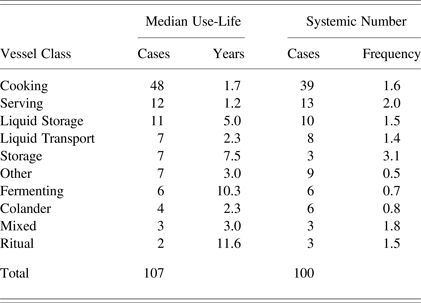
Beyond very high systemic inventories, both absolute and relative use-lives of different vessel classes in the highland Maya ethnoarchaeological data diverge from general patterns. The figures (Varien and Mills Reference Varien and Mills1997:Table 2, Appendix 1) indicate that the use-lives of serving vessels are generally lower than the use-lives of cooking pots (Table 25). This situation is reversed in the Tzeltal and Chuj Maya communities. Although it is not uncommon for cooking pots to make up 50 percent or more of systemic inventories in many culture groups, the very high systemic numbers of cooking vessels combined with their very short use-lives in highland Maya villages remains an outlier. Nelson (Reference Nelson and Longacre1991:176) brought up the important point that materials and manufacturing techniques (especially firing) influence the durability and longevity of pots: “I raise the question of atmospheric conditions because San Mateo Ixtatan may be a poor environment for pottery manufacture.”
Median Use-Life and Assemblage Frequency by Vessel Class in Ethnographically Documented Cases (after Varien and Mills Reference Varien and Mills1997:Table 2)

Decorated serving vessels are a distinct aspect of Classic Maya ceramic assemblages for which there are few strong ethnographic analogies. As the name implies, this vessel class includes pottery used for serving food and drink (Houston et al. Reference Houston, Stuart and Taube1989). However, pottery users distinguish a greater variety of emic vessel categories than archaeologists typically do (see Allen Reference Allen, Bey and Pool1992; Costin and Hagstrum Reference Costin and Hagstrum1995; Longacre et al. Reference Longacre, Kvamme and Kobayashi1988) and some serving vessels were certainly used for purposes not related to food preparation and serving.
Classic-period serving vessels make appearances in scenes painted on pottery, modeled in stucco, and carved in stone. Although Classic Maya iconography favors predominantly elite contexts, dishes filled with food and cylinders (presumably filled with drink) were painted into palace scenes. Dishes filled with ritual paraphernalia, apparently being used in ceremonial rites, are also depicted on Classic period carved monuments. The fully oxidized fabric of Petén Gloss Wares and unmarred painted decorations of Classic polychrome vessels are indicative of controlled firings, maybe in high temperature kiln environments (see Becker Reference Becker2003; Bryant and Brody Reference Bryant and Jill Brody1986). Anecdotally, many Classic serving vessels were well-built, symmetrically formed, hard fired, and, ultimately, quite durable. At one Aguacatenango household, a Terminal Classic Fine Orange bowl had been scavenged from an archaeological context and eventually used as a dog's water (or food) bowl (Deal Reference Deal1998:128, Figure 5.7). The complete vessel was about 1,100 years old!
Serving vessels are numerically dominant in the Aguateca assemblages as they were at all Lowland Maya centers during the Classic period. If these vessels were also inherently more durable than cooking and storage pottery, their annual discard rate at the household level might have been quite low. Perhaps greater interest in making ceramic strength tests (e.g., Beck Reference Beck2002; Bronitsky and Hamer Reference Bronitsky and Hamer1986; Mabry et al. Reference Mabry, Skibo, Schiffer and Kvamme1988; Neupert Reference Neupert1994; Simon and Coghlan Reference Simon and Coghlan1989) routine in both archaeological and ethnographic contexts will produce the data needed to evaluate this hypothesis.
Beyond physical durability, cultural practices certainly influenced the systemic frequency and use-lives of serving wares. In the animate Classic Maya world, ceramic vessels (and greenstone beads/pendants, shell artifacts, and stucco and stone monuments) were ritually “terminated”—purposefully destroyed and scattered (e.g., Bock 1998; Straight Reference Straight and Marken2007). At the household level, ceramic dishes have been recovered with “kill holes” or had their tripod supports removed before they were interred with burials or cached as structural offerings. Whatever the specifics of their production, exchange, use, and consumption, understanding Classic serving wares is imperative to comprehending pottery consumption patterns in antiquity.
CONCLUSIONS
This article tackles the rather thorny methodological issue of estimating household pottery consumption from archaeological contexts using ethnoarchaeological information. Statistics from twentieth century Maya villages were adapted and applied to Classic period Aguateca households because these studies provided sufficiently complete data to estimate use and discard. This process required significant theoretical argument to construct and support the mathematical simulations.
I first addressed the apparent paradox of highland Maya households keeping high systemic numbers of short-lived cooking pots, concluding that pottery consumption levels can easily be exaggerated by applying the standard discard equation uncritically. Merely identifying cooking pots in the archaeological context has been difficult and only partially successful. Cooking hearths remain unidentified at Aguateca, and even the term “kitchen” implies a kind of organization of food preparation not entirely in evidence (Foxhall Reference Foxhall2000, Reference Foxhall2007).
The dynamic nature of household demographics is mirrored by their pottery assemblages with vessels aging and moving through life cycles. This relates to the idea of systemic inventories becoming greatly inflated through stockpiling, investiture, repairing, repurposing, and provisionally discarding pottery over time. The total system of ceramic production, circulation, consumption, and discard is in constant motion. This helps to explains why household size is not a good predictor of vessel assemblage size. The age of the household (time since formation), wealth, and social status are all influential factors.
The discard simulations applying highland ethnoarchaeological data to the Classic period archaeological assemblages suggest a fairly narrow range in discard frequency; a maximum of about 18–21 vessels discarded (and usually replaced) per Aguateca household. I hope this gives an idea of the level of pottery consumption to be expected in modeling aspects of production and circulation in the Classic period. Estimating consumption levels is a logical first step in modeling the total pottery system.
Some of the use-lives calculated from highland Maya communities of the twentieth century employed in the discard simulations are lower than use-lives reported for the same vessel classes used by other culture groups or cross-cultural median use-lives (Table 25; Varien and Mills Reference Varien and Mills1997:Table 2). I doubt that these modern highland Maya pots were inherently longer lived than their Classic Maya counterparts. In fact, I suspect that Classic Maya serving wares were quite durable, although they may have been broken, discarded, or otherwise removed from household assemblages for other culturally specific reasons. The near complete lack of stockpiling everyday cooking pots at Aguateca suggests that either these vessels did not have very short use-lives or that they could readily be procured year round.
I suspect that Classic Maya serving vessel use-lives were longer than estimated in this paper and that households of the Classic period were consuming even fewer pots than estimated by applying the highland Maya data. The same proportional discard rates calculated for the Aguateca assemblages would still derive if the use-lives of all vessel classes were two, three, or four times as long. As one reviewer commented on a previous draft of this paper, “OK, granted, we have to start somewhere in this complex set of relations to try to disentangle the various threads and make sense of things.” Unfortunately, the rarity of exceptional archaeological preservation (i.e., Aguateca or Cerén) and the changing composition of ceramic assemblages in ethnographic settings limit the potential for this kind of analysis.
RESUMEN
Estimar el número de ollas consumidos por los hogares antiguos es crucial para la reconstrucción de la organización de la producción y el intercambio de cerámica en la antigüedad. En este artículo comparar datos cerámicos etnográficamente divulgados desde el área de las tierras altas mayas con conjuntos arqueológicos desde el sitio de las tierras bajas mayas de Aguateca del clásico tardio. Después de revisar y comentar sobre cerámicos datos registrados desde el altiplano maya etnográficamente y datos de las investigaciones arqueológicas de estructuras domésticas de Aguateca, discutir las similitudes y diferencias entre dichos conjuntos cerámicos domésticos de los dos zonas separado temporalmente y geográficamente. Entonces aplico el buque etnográficamente derivado uso-vive para los ensambles de Aguateca recuperados arqueológicamente para estimar las tasas de consumo anual. Finalmente, comparo a los conjuntos de descarte de Aguateca simulados a datos compuestos de conjuntos de descarte hogar recuperado de reconocimientos arquológicas desde el centro clásico maya de Tikal. Concluyo con una discusión de cómo y por qué conjuntos de cerámica doméstica de las tierras bajas mayas del clásico difieren de las de Mayas del siglo XX y las implicaciones que estas distinciones tienen para interpretar el patrón de consumo para los mayas del clásico.
En conclusión, insto precaución en el supuesto de que los grandes inventarios de cerámica hogar sistémicos producen proporcionalmente más altas tasas de descarte. Sostengo que la media de 18 a 21 descartados de las vasijas de cerámica por hogar calculados mediante la aplicación de estadísticas etnográficas de los conjuntos arqueológicos en Aguateca se ve mejor como una cifra máxima. Lejos de desarrollar un modelo universal, este artículo hace hincapié en la necesidad de abordar los parámetros únicos de cada estudio antes de aplicar las estadísticas medias y ecuaciones estandarizadas.
ACKNOWLEDGMENTS
I wish to thank Carrie Dennett for all her help with this submission to Ancient Mesoamerica. Editing and formatting by Anna Seiferle-Valencia and Lauren Marra enriched readability of the text and tables. Reviewer comments from Prudence Rice and Margaret Beck helped to improve this paper immensely. I am grateful to Michael Deal for the encouragement to publish this article and for providing clarifications and sharing thoughts concerning his ethnoarchaeological studies in Chiapas. All mathematical and grammatical inaccuracies as well as any errors of transcription remain solely my responsibility. I alone should also be blamed for all logical and theoretical inconsistencies.