Introduction
Consanguineous marriage is defined as a marriage between people who are related as second cousins or closer (Bittles, Reference Bittles2001). Consanguineous marriages are supported for social, economic, psychological, religious and geographical reasons in some cultures (Kelmemi et al., Reference Kelmemi, Chelly, Kharrat and Chaabouni-Bouhamed2015). According to the 2011 Geneva International Consanguinity Workshop report, the prevalence of consanguineous marriages throughout the world is estimated to be approximately 20%, and this rate varies from 20% to 60% in North Africa, the Middle East and Western Asia. According to a report by Hamamy et al. (Reference Hamamy, Antonarakis, Cavalli-Sforza, Temtamy, Romeo and Kate2011), the frequency of family-based, close-relation consanguineous marriage at the country level is 32–34% in Yemen, 29–33% in Iraq, 25–30% in Afghanistan, 14–24% in Egypt, 6–26% in Iran, 7–52% in South India, 44–49% in Sudan and 15–25% in Turkey. According to the Turkish Demographic and Health Survey (TDHS), the consanguineous marriage frequency in Turkey varied between 22.0% and 29.2% from 1968 to 2008, and has increased over the years (TDHS, 2008). According to data from the Turkish Family Structure Survey (TFSS), the consanguineous marriage rate in Turkey in 2011 was 23.3% – 21.1% in urban areas and 28.2% in rural areas. Consanguineous marriage is most common is the Southern Anatolian Region of Turkey (44.8%), and least common in the Western Marmara Region (6.4%) (TFSS, 2011).
Women in consanguineous unions tend to have a lower level of education, lower labour force participation rate, have extended and traditional family types and be more likely to be married and to start childbearing at an earlier age. Women in consanguineous unions have generally been reported in rural areas and among communities of low socioeconomic status (Reddy, Reference Reddy1988; Tuncbilek & Ulusoy, Reference Tuncbilek and Ulusoy1988; Saedi-Wong et al., Reference Saedi-Wong, Al-Frayh and Wong1989; Baki et al., Reference Baki, Karaguzel, Beser, Cakmakci, Ucar and Omeroglu1992; Tuncbilek & Koc, Reference Tuncbilek and Koc1994; Shami et al., Reference Shami, Grant and Bittles1994; Hussain, Reference Hussain1999; Koc, Reference Koc2008). Consanguinity increases the prevalence of rare genetic congenital anomalies and nearly doubles the risk of neonatal and childhood death, intellectual disability and other anomalies in first cousin unions (WHO, 2014a). In this context, it is important to develop international and national policies and strategies to prevent consanguineous marriages within Turkey, which has a high rate of consanguinity. Similarly, it is also important to provide educational and counselling services to societies most at risk, as well as to carry out more studies about the social, cultural and economic reasons for consanguineous marriage.
The present study was carried out to determine the prevalence of consanguineous marriage and its correlates with socio-demographic and obstetric risk factors in Turkey, with a view to contributing to the development of policies in connection with consanguineous marriage.
Methods
The study was carried out by the Turkish Republic Ministry of Health between October and December 2013. The population of the study, designed on a cross-sectional, national level, was composed of women between the ages of 15 and 65. The sample size was calculated as 9290 houses in a total of 81 provinces so as to improve the Turkish Rural–Urban expectations by means of a systematic stack sampling according to the Turkish Statistical Institute’s address-based vital statistics system. A total of 9290 house visits were undertaken, and interviews were held with 6364 families. Of these, 4913 eligible women, who had been married, were included in the study. As the response rate to the study (69%) was lower than expected (80%), the sample size was appropriate for obtaining a prevalence for the entirety of Turkey, but prevalence at the rural–urban level could not be determined.
A questionnaire was developed that included a total of 47 questions related to the socio-demographic and obstetric characteristics of women. Face-to-face interviews were conducted by 62 surveyors in respondents’ houses. All individuals, including women aged between 15 and 65 living in each house, were listed, along with their addresses. At the final stage, eligible women were selected by means of the Kish method (Leslie, Reference Leslie1965). For interviews, three separate visits were foreseen, and if the persons to be interviewed were not in the house during the first visit, the day and time they would be at home was established and they were re-visited.
All women who reported being married to either their first cousin (F=0.0625), second cousin (F=0.0156) or less than second cousin (F<0.0156) were included in the category of consanguineously married women (Bittles, Reference Bittles2001). Thus marriages were grouped as non-consanguineous, first cousin marriages, second cousin marriages and less than second cousin marriages. Age at first pregnancy was grouped as <18 years (adolescent), 18–34 years (normal) and ≥35 years (advanced age); inter-pregnancy interval was grouped as ≤24 months and >24 months (Coimbra et al., Reference Coimbra, Figueiredo, Silva, Barbieri, Bettiol and Caldas2007). Women who had at least one antenatal care (ANC) visit during her pregnancy were considered as ‘ANC serviced’. Low birth weight was defined as weight at birth of less than 2.500 g (WHO, 1992). Spontaneous abortion was defined as the natural loss of a pregnancy prior to the 20th week of pregnancy or the loss of an embryo/fetus of less than 400 g. Stillbirth was accepted as the death prior to the complete expulsion or extraction from its mother of a product of fertilization, at or after 20 completed weeks of gestation (Zegers-Hochschild, Reference Zegers-Hochschild, Adamson, Mouzon, Ishihara, Mansour and Nygren2009). Congenital malformation was defined as a physical defect in a baby at birth, which can involve many different parts of the body, including the brain, heart, lungs, liver, bones and intestinal tract (Zegers-Hochschild, Reference Zegers-Hochschild, Adamson, Mouzon, Ishihara, Mansour and Nygren2009).
Data were transferred to the Statistical Package for Social Sciences 21.0 (SPSS) package software. Descriptive analyses (percentage distribution, mean and standard deviation), and grouped variable comparison, chi-squared and logistical regression analyses were employed. Weighting processes, in compliance with sampling design, were made during the study, and multi-staged sampling method-compatible analyses were made by using a corrections complex samples module according to these weightings and non-response speed. All percentages are given as weighted and numbers are given as weightless. For statistical significance, situations for which type 1 error level was under 5% were deemed significant.
Ethical permission was obtained from the Research Ethics Board of the State Hospital in Turkey (dated: 13.06.2013; number: 18). The written approval of the women included in the study was obtained. The rules specified in the Helsinki Declaration were observed in the data collection phase.
Results
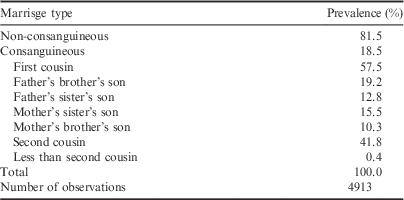
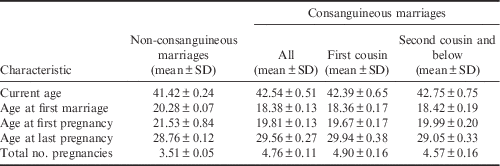
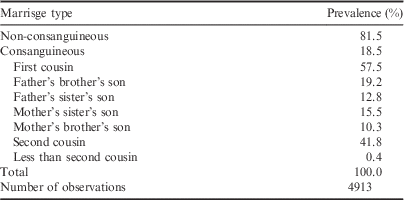
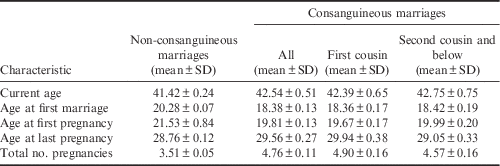
The study was conducted on 4913 married women aged between 15 and 65 years. Their mean age was 41.63±0.22 years (min.=15; max.=65). Of these, 59.4% graduated from primary school, 74.9% lived in rural areas and 18.5% were married to a spouse related as less than second cousin or closer. First cousin unions were the most common type of consanguineous unions, and constituted 57.5% of all consanguineous marriages. Of the first cousin unions 32.0% were patrilateral first cousin unions, while 25.8% were marriages between matrilateral offspring. Second cousin unions accounted for 41.8% of all consanguineous marriages. The remaining 0.4% of the consanguineous marriages were unions between less than second cousins (Table 1).Women in consanguineous unions were more likely both to be married and to start childbearing at an earlier age. In addition, women in consanguineous unions were more likely to have experienced their last pregnancy at a later age, and have a greater number of pregnancies (Table 2).
Prevalence of consanguineous marriages, women aged 15–65 years living in Turkey, 2013
Distribution of sample women by consanguinity status and sociodemographic characteristics
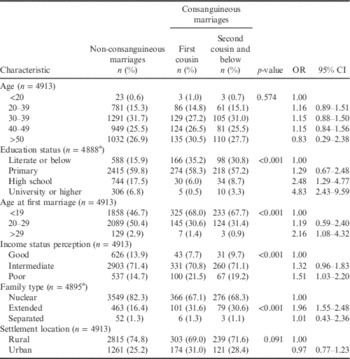
A statistically significant difference was found between groups with or without consanguineous marriage according to education status, marriage age, income status and family type (p<0.001) (Table 3). Whereas 35.2% of women whose education level was literate and below were married to their first cousin, this figure was 0.5% for those who were university graduates or higher. Whereas 68.0% of the women whose age at first marriage was under 19 were married to their first cousin, only 46.7% of women in non-consanguineous marriages were married to their first cousin. The consanguineous marriage frequency for women who perceived that their economic status was good was 7.7%, and 21.5% for women who perceived that their economic status was poor. The percentage of women with a first cousin marriage living in extended families was 31.6%, whereas this figure was 16.4% for those who were in non-consanguineous marriages. Although there was no statistically significant difference between groups with and without consanguineous marriage by age (p>0.05), for women aged over 50 the consanguineous marriage frequency was 30.5%, and the non-consanguineous marriage frequency was 26.9%. Similarly, for women living in urban areas the first cousin marriage frequency was 31.0%, and the non-consanguineous marriage frequency was 25.2%. There was no statistically significant relation between settlement location and consanguineous marriage frequency (p>0.05).
Distribution of sample women by consanguinity status and individual characteristics
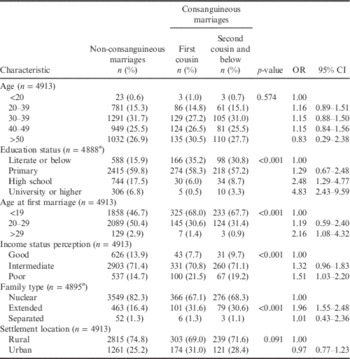
a Number decreased due to unanswered questions.
χ2 test.
Table 3 shows the consanguineous marriage status of women by individual characteristics (age, education status, first marriage age, income status perception, family type and settlement location), analysed using logistic regression with multivariable models. Consanguineous marriage frequency was found to be higher for women who were high school graduates (OR=2.5; 95% CI=1.2–4.7) and whose education status was literate or below (OR=4.8; 95% CI=2.4–9.5), compared with those who were university graduates or higher. The consanguineous marriage frequency of those whose first marriage age was below 19 years was 2.1 times higher than that of women whose first marriage age was 29 and above (OR=2.1; 95% CI=1.082–4.329). Furthermore, the consanguineous marriage frequency of the group with a perception of poor economic status was 1.5 times greater than that of the group with a perception of good economic status (OR=1.5; 95% CI=1.037–2.209). Consanguineous marriage frequency was higher for women living in extended families compared with those living in nuclear families (OR=1.9; 95% CI=1.5–2.4). Also, there was no significant difference between age, settlement location variables and consanguineous marriage frequency.
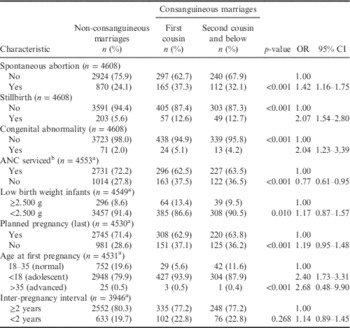
The distribution of women by consanguinity status and obstetric characteristics is shown in Table 4. The spontaneous abortion frequency of women in first cousin marriages was 37.3%, and that for women in non-consanguineous marriages was 24.1% (p<0.001). Furthermore, although there was a statistically significant difference between stillbirths and consanguineous marriage (p<0.001), the stillbirth frequency for women in first cousin marriages was 12.6%, whereas this rate was 5.6% for those in non-consanguineous marriages. Similarly, 5.1% of the women in first cousin marriages had babies with congenital abnormalities, whereas this frequency was 2% for those with non-consanguineous marriages (p<0.001). Although there was a significant relation between women receiving ANC (ANC serviced) and marriage type (p<0.001), the frequency of receiving ANC was 72.2% for the group without consanguineous marriage. Furthermore, the frequency of women having an adolescent pregnancy in first cousin marriages was 93.9%, whereas this rate was 79.9% for those with non-consanguineous marriages.
Distribution of sample women by consanguinity and obstetric characteristics
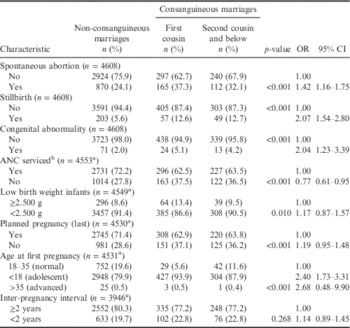
a Number decreased due to unanswered questions.
b A woman who received at least one antenatal care (ANC) visit during her pregnancy was considered to be ‘ANC serviced’.
χ2 test.
CI, confidence interval; ANC, antenatal care.
The consanguineous marriage frequency of women with a history of spontaneous abortion was 1.4 times greater than that of women with no history of spontaneous abortion (OR=1.4; 95% CI=1.16–1.75). The consanguineous marriage frequency of women with a history of stillbirth was 2.0 times greater than that of women with no history of stillbirth (OR=2.0; 95% CI=1.54–2.80). The consanguineous marriage frequency of women with a history of congenital abnormality infants was 2.0 times greater than that of women with no history of congenital abnormality infants (OR=2.0; 95% CI=1.2–3.3). Furthermore, the consanguineous marriage frequency of women who were ‘ANC serviced’ was 0.8 times more than that of women who were not (OR=0.8; 95% CI=0.61–0.95). The consanguineous marriage frequency of women who were of adolescent age at first pregnancy (OR=2.4; 95% Cl=1.7–3.3) was 2.4 times higher compared with women whose first pregnancy age was at ‘normal’ age (18–35 years). There was no significant difference between having low birth weight infants, planned pregnancy, inter-pregnancy interval variables and consanguineous marriage frequency.
Discussion
One of the most discussed marriage types today is consanguineous marriage (Hamamy et al., Reference Hamamy, Antonarakis, Cavalli-Sforza, Temtamy, Romeo and Kate2011; Kelmemi et al., Reference Kelmemi, Chelly, Kharrat and Chaabouni-Bouhamed2015). Studies conducted worldwide show that countries with the highest prevalence of consanguineous marriage are geographically located in the Middle East (Shami et al., Reference Shami, Grant and Bittles1994; Hussain, Reference Hussain1999; Gunaid et al., Reference Gunaid, Hummad and Tamim2004). The consanguineous marriage prevalence is 25–42% in Saudi Arabia, 20–30% in the United Arab Emirates, 17–31% in Kuwait, 6–26% in Iran, 17–38% in Pakistan and 14–24% in Egypt. The prevalence is significantly lower in European and American societies: 1% in France, 4.6% in Spain, 0.36% in The Netherlands, 5% in Belgium and less than 2% in America (Hamamy et al., Reference Hamamy, Antonarakis, Cavalli-Sforza, Temtamy, Romeo and Kate2011). According to the TDHS, the consanguineous marriage frequency in Turkey varied between 22.0% and 29.2% from 1968 to 2008 and has increased over the years (TDHS, 2008). According to TFSS data, the consanguineous marriage rate in Turkey is 23.3%, with a rate of 21.1% in urban areas and 28.2% in rural areas (TFSS, 2011). In this study, the consanguineous marriage prevalence in Turkey was determined to be 18.5% (Table 1). While this is lower than in Middle Eastern countries, when compared with developed countries Turkey’s consanguineous marriage rate is still high.
First cousin marriages are preferred in Turkey for reasons such as protecting assets and the family’s territorial integrity, and preventing strangers from entering a family (Ayan et al., Reference Ayan, Beder, Unal and Yurtkuran2001). In this study, the fact that more than half of consanguineous marriages (57.5%) were first cousin marriage is an interesting finding. According to TDHS data, 76.3% of consanguineous marriages were first cousin marriages in Turkey in 2008 (TDHS, 2008). In a study in the eastern region of Turkey, 75% of consanguineous marriages were found to be first cousin marriages (Akbayram et al., Reference Akbayram, Sari, Akgun, Dogan, Tuncer, Caksen and Oner2009), and another study in Ankara found 81% of consanguineous marriages to be first cousin marriages (Ayan et al., Reference Ayan, Beder, Unal and Yurtkuran2001). Thus first cousin marriages are still common in Turkey.
Of the factors affecting the frequency of consanguineous marriages, education status has one of the strongest influences. Evidence that consanguineous marriage frequency decreases as women’s education level increases has been obtained from regional-level studies (Hussain & Bittles, Reference Hussain and Bittles2000; Liascovich et al., Reference Liascovich, Rittler and Castilla2001; Gunaid et al., Reference Gunaid, Hummad and Tamim2004; Yuksel et al., Reference Yuksel, Kutlubay, Karaoglu and Yologlu2009; Bhasin & Kapoor, Reference Bhasin and Kapoor2014; Jabeen & Malik, Reference Jabeen and Malik2014). According to TFSS data, the consanguineous marriage frequency of women who are not literate is three times greater than that of women who graduated from university or above (TFSS, 2011). It is an especially interesting finding that consanguineous marriages are 4.8 times more frequent for women whose education level is literate or below, compared with women who graduated from university or above (p<0.001) (Table 3). These results show an awareness that consanguineous marriages and their medical consequences increase as the education level of women increases.
The preference for consanguineous marriage has been shown to increase as income status decreases (Shami et al., Reference Shami, Schmitt and Bittles1989; Hussain & Bittles, Reference Hussain and Bittles2004; Hamamy et al., Reference Hamamy, Jamhawi, Al-Darawsheh and Ajlouni2005; Koc, Reference Koc2008; Barbour & Salameh, Reference Barbour and Salameh2009; Assaf & Khawaja, Reference Assaf and Khawaja2009). In the present study it was found that women with a perception of poor income status were 1.5 times more likely to have a consanguineous marriage compared with women with a perception of good income status (p<0.001) (Table 3). According to TFSS 2011 and TDHS 2008 data, consanguineous marriages are more frequent in regions with lower income statuses in Turkey (Koc, Reference Koc2008; TFSS, 2011). Akbayram et al. (Reference Akbayram, Sari, Akgun, Dogan, Tuncer, Caksen and Oner2009) found that the frequency of consanguineous marriages was lowest for women with a high income level. It is generally thought that giving women a greater chance to participate in the labour market will increase their autonomy around their marriage decisions.
One interesting findings of this study is that the consanguineous marriage frequency of women who married under the age of 19 was 2.1 times higher than that of women who married at the age of 29 or above (p<0.001) (Table 3). This supports previous findings that there is a significant relation between early age at marriage and consanguineous marriage (Shami et al., Reference Shami, Schmitt and Bittles1989; Hussain & Bittles Reference Hussain and Bittles2004; Koc, Reference Koc2008; Akbayram et al., Reference Akbayram, Sari, Akgun, Dogan, Tuncer, Caksen and Oner2009). According to the 2013 TDHS, the mean marriage age in Turkey is 21 (TDHS, 2013). In this study the mean marriage age was found to be 19.9, and shows a wide age range of 12 to 45 years. Furthermore, when international studies are considered, mean marriage age is 31.8 in The Netherlands, 30.8 in Spain, 30.6 in France and 31.5 in Germany (UNECE, 2011; Statistics Netherlands, 2013). Compared with these statistics, women are still marrying at an early age in Turkey. This situation is negatively affecting women, as they are making marriage decisions before they are emotionally mature (Koc, Reference Koc2008).
In Turkey consanguineous marriages are entered into for reasons such as maintaining continuance of the same race, prevention of the distribution of assets and so that related children can have more harmony as they share the same culture and religion. This view is especially supported in wide and paternalistic families, where different generations live together (Akin, Reference Akin2000). This study found the consanguineous marriage frequency of women living in extended families was 1.9 times higher compared with that of women living just with their immediate nuclear families (Table 3). In the 2008 TDHS it was found that consanguineous marriage was two times more frequent in extended families compared with those living only with their nuclear families (Koc, Reference Koc2008). Denic et al. (Reference Denic, Agarwal and Nagelkerke2012) found that populations with extended families can have higher rates of first cousin marriages. Thus the results of this study are similar to those of other surveys.
Traditional culture encourages the continuance of consanguineous marriage, especially in rural areas of Turkey (TDHS, 2008). According to TFSS data, the consanguineous marriage frequency in rural regions of Turkey is higher than in urban regions (TFSS, 2011), and this has been confirmed by other studies (Khoury & Massad, Reference Khoury and Massad1992; COSIT, 2006; Alper et al., Reference Alper, Erengin, Manguoglu, Bilgen, Cetin, Dedeoglu and Luleci2004; Othman & Saadat, Reference Othman and Saadat2009). In the present study, no significant difference was found between consanguineous marriage frequencies in urban and rural regions (p>0.05) (Table 3).
Previous studies have shown that consanguineous marriage increases the obstetric risks of women (Tuzun & Elyas, Reference Tuzun and Elyas1996; Ozcan, Reference Ozcan1997; Yakinci et al., Reference Yakinci, Kutlu, Pac, Durmaz, Gul and Egri1999; Samli et al., Reference Samli, Toprak and Solak2006). The present study found that the spontaneous abortion frequency of women with consanguineous marriages was 37.3%, and 24.1% for women in non-consanguineous marriages (p<0.0001). Also, women with a history of spontaneous abortion had a consanguineous marriage frequency 1.4 times greater than those with no history of spontaneous abortion (Table 4). In a study performed in the city of Malatya in Turkey, the spontaneous abortion frequency in first cousin marriages was 16.7%, and 10.7% for those in non-consanguineous marriages (Yakinci et al., 1999). In another study, performed in Elazig in Turkey, while the spontaneous abortion frequency of families in consanguineous marriages was 8.4%, it was 5.2% for those who in non-consanguineous marriages (Tuzun & Elyas, Reference Tuzun and Elyas1996). A study by Ozcan (Reference Ozcan1997) found the spontaneous abortion frequency to be 9.3% for the consanguineous marriage group, and 1.7% for the non-consanguineous marriage group. A study by Samli et al. (Reference Samli, Toprak and Solak2006) found the spontaneous abortion frequency of families with consanguineous marriages to be 30.9%, and 28.7% for those in non-consanguineous marriages. It is interesting that the spontaneous abortion frequency of women in first cousin marriages is so high.
Another obstetric risk related to consanguineous marriage is stillbirth. This study found that the stillbirth frequency of women in consanguineous marriages was twice that of women in non-consanguineous marriages (p<0.001) (Table 4). Donbak (Reference Donbak2005) found that there was a close relation between consanguineous marriage and stillbirths, as well as in infant deaths. Ozcan (Reference Ozcan1997) found that there was at least one stillbirth for approximately every four consanguineous marriages cases. Mohammadi et al. (Reference Mohammadi, Hooman, Afrooz and Daramadi2012) found that there was a significant relation between stillbirths and consanguineous marriage. In this context, it is important to offer counselling services to couples in consanguineous marriages, starting from the preconception period.
Congenital abnormalities occur during the prenatal stage and they can be seen in any part of the body. Some of the abnormalities are minor and only cause cosmetic problems, but approximately 3% disturb normal body functioning and cause early death or various disabilities, which continue for a lifetime. The most frequently experienced major abnormalities are neural tube defects, split palate–lips, congenital pyloric stenosis and heart abnormalities (Balci et al., Reference Balci, Taviloglu, Yilmaz, Coskun, Varan and Almacioglu2012). Studies have shown that there is close relation between consanguineous marriage and the birth of infants with congenital abnormalities (Ozcan, Reference Ozcan1997; Samli et al., Reference Samli, Toprak and Solak2006; Hamamy, Reference Hamamy, Masri, Al-Hadidy and Ajlouni2007). This study found that 5.1% of the women with consanguineous marriages had babies with congenital abnormalities, and that there was a significant relation between marriage type and the birth of infants with congenital abnormalities (p<0.001). In addition, consanguineous marriages are 2.0 times more frequent for the women with a history of infant congenital abnormality, compared with those who do not. It is known that while the direct reason for 10% of congenital abnormalities is genetic and chromosomal factors, 10% are caused by environmental factors and 80% are caused by both environmental and genetic factors (Ersoy et al., Reference Ersoy, Ersoy and Yalcin1999). In consanguineous marriages, as the incidence of mutations, which are rarely faced and progress recessively in the population, at the homozygote level increases, the frequency of congenital abnormalities also increases (Modell & Darr, Reference Modell and Darr2002). Although congenital abnormalities are significantly and commonly seen in the families of consanguineous marriages, these abnormalities are also significantly affected by the age of the mother, inadequate health care services, poor environmental conditions and low socioeconomic and cultural levels (Bittles, Reference Bittles1994; Koç, Reference Koc2008; Hamamy et al., Reference Hamamy, Antonarakis, Cavalli-Sforza, Temtamy, Romeo and Kate2011).
Antenatal care aims to improve the health of pregnant women and their babies from start of pregnancy until birth (Republic of Turkey Ministry of Health, 2005). The World Health Organization recommends at least four ANC visits during the pregnancy period (WHO, 2014a). According to World Health Statistics 2014, the percentage of women receiving at least one ANC during pregnancy was 81% globally in 2006–2013 (WHO, 2014b). According to TDHS (2013) data, 97% of pregnant women in Turkey received at least one ANC visit, and this has increased over the years. In this study, the percentage of women who received at least one prenatal care service during the pregnancy period was 70.4%. Also, it is interesting that the ANC service receiving frequency of women in first cousin marriages is 62.5%, but 72.2% in non-consanguineous marriages (p<0.001). In addition, consanguineous marriages are 0.8 times more frequent for women not receiving ANC compared with receiving ANC (Table 4). It is evident that the ANC service receiving rate of women in consanguineous marriages in Turkey is low. It is very important to start the pregnancy follow-up of women from consanguineous marriages at an early stage, see them at regular intervals and employ prenatal diagnosis methods for early determination of genetically transmitted diseases.
The results of this study indicate that consanguineous marriage exerts a differential impact on some reproductive behaviours. Women in consanguineous unions were more likely both to be married and to start childbearing at an early age (Hussain & Bittles, Reference Hussain and Bittles2004; Koç, Reference Koc2008; Islam, Reference Islam2013). In the present study, consanguineous marriages were found to be 2.4 times more frequent for the women whose first pregnancy was at adolescent age compared with those whose first pregnancy was at age 18–35. Turkey has a high rate of adolescent marriage, and pregnancies in this age group do not receive enough ANC (TDHS, 2013). Women at this age have not completed their intellectual, social and physical development and are emotionally immature. So, the problems that develop due to consanguineous marriages tend not to be diagnosed early, or are overlooked. Therefore, preconception counselling of adolescent-age women in consanguinity is important (Goossens et al., Reference Goossens, Kadji and Delvenne2015; Karabulut et al., Reference Karabulut, Güler, Karahan, Özkan, Koyuncu and Demirciler2015).
Consanguinity also has a differential impact on contraceptive use behaviour. Husband–wife communication about use of family planning methods is significantly lower among women in first cousin unions, while current use of family planning methods is also lower among women with consanguineous marriages than in those with non-consanguineous marriages (Islam, Reference Islam2013). A lower planned pregnancy rate and shorter inter-pregnancy intervals have been found in consanguineous marriages (Tunçbilek & Koç, Reference Tuncbilek and Koc1994). The present study found a lower planned pregnancy rate and shorter inter-pregnancy intervals in consanguineous marriages, which have a negative impact on maternal and child health. Consanguinity is associated with an increased risk of low birth weight. Low birth weight has been found to be significantly more frequent among children with a parental history of consanguinity (Morton, Reference Morton1958; Sibert et al., Reference Sibert, Jadhav and Inbaraj1979; Kulkarni & Kurian, Reference Kulkarni and Kurian1990; Jaber et al., Reference Jaber, Merlob, Gabrieli and Shohat1997; Mumtaz et al., Reference Mumtaz, Tamim, Kanaan, Khawaja, Khogali, Wakim and Yunis2007; Joseph et al., Reference Joseph, Pavan, Ganapathi, Apoorva, Sharma and Jhamb2015), and the present study’s results agree with these findings. A sufficient number of ANC visits by qualified personnel of pregnant women can be effective in reducing the incidence of low birth weight infants.
Conclusion
This study found that approximately one in five marriages in Turkey was consanguineous. Most of the consanguineous marriages were first cousin marriages. Consanguineous marriage frequencies were higher for women living in extended families, and whose education level and first marriage age were low, as well as those whose perceived economic status was poor. No statistical relation was found between age and settlement location and consanguineous marriage frequency. Furthermore, spontaneous abortions, stillbirths and infant births with congenital abnormalities increase with consanguineous marriages.
In this context, it is recommended that national and international policies and strategies are developed to raise awareness in Turkish society about the risks of consanguineous marriage, and to apply and maintain these effectively. It is also particularly recommended that genetic counselling services on genetically transmitted diseases are offered to couples prior to marriage, and if pregnancy occurs after consanguineous marriage, to implement regular follow-ups. There is a need for further epidemiological research on the socio-cultural and economic reasons for consanguineous marriages.
Acknowledgment
The authors thank the Turkish Republic Ministry of Health for providing support.