Introduction
The recent fertility increases in the countries of Central Asia have remained largely off the radar of demographers. This is surprising since the (period) Total Fertility Rate (TFR) in some countries of the region (Kazakhstan, Kyrgyzstan and Tajikistan) has been increasing for nearly 15 years, following a swift decline in the 1990s. This neglect is even more surprising because the increases in TFR have been much larger in Central Asian countries compared with those in European countries (Goldstein et al., Reference Goldstein, Sobotka and Jasilioniene2009). For example, the level of fertility in Kazakhstan rose by 0.94 children over 14 years, from 1.80 children per woman in 1999 to 2.74 in 2014 (UNICEF Regional Office for CEE/CIS, 2016). Similarly, 0.80 children were added to the TFR in Kyrgyzstan between 2001 (2.39 children per woman) and 2014 (3.19 children per woman). Surprisingly, very few studies have examined the fertility upturns in the region.
Despite being of much less importance, the recent fertility increases in Central and Eastern European countries have been studied in more detail. The fertility upturns in these countries have been the result of two processes: a recuperation of postponed births at older ages and a stabilization of fertility at younger ages, indicating a pause in the postponement process (Sobotka, Reference Sobotka2011; Sobotka et al., Reference Sobotka, Zeman, Lesthaeghe and Frejka2011; Bongaarts & Sobotka, Reference Bongaarts and Sobotka2012; Burkimsher, Reference Burkimsher2015). The changes in level of fertility have been accompanied by the gradual development of a differentiation by social status in fertility behaviour, especially in the timing of childbearing and the marital status of mothers (Sobotka, Reference Sobotka2011). As a result, the age pattern of fertility has become less concentrated and non-marital births have spread rapidly. Although the fertility upturns are much more striking than those observed in Central and Eastern Europe, the recent fertility development in Central Asian countries has remained poorly studied. The few available data and studies show, however, that similar changes are at work in the region. Marriage has been gradually postponed to later ages and marriage rates have reached historically low levels after 1990, being replaced by more diverse forms of unions (Nedoluzhko & Agadjanian, Reference Nedoluzhko and Agadjanian2015; UNICEF Regional Office for CEE/CIS, 2016). At the same time, non-marital births have continuously increased and around 2010 up to a third of births occurred outside marriage (UNICEF Regional Office for CEE/CIS, 2016). The changes in the ethnic population composition, the economic recovery and renewed growth, as well as the reduction of childbearing postponement, have contributed to push fertility up in the region (Spoorenberg, Reference Spoorenberg2015).
If the general forces driving fertility up in Central Asia are better understood, several pieces of evidence are still missing to get a full picture of the dynamics at work. Among those, demographers have not considered several heterogeneous aspects of the fertility increase in the countries of the region. Two perspectives are important here: the parity dimension of fertility, and the ethnic dimension of fertility. The study of parity-specific fertility behaviours introduces important information about the recent reproductive experience of women into the measurement of current fertility (Lutz, Reference Lutz1989), whereas the disaggregation by ethnic group allows factoring into the analysis a social dimension that is of prime importance in the demography of Central Asia. Central Asian societies are multi-ethnic and this dimension has contributed to shape the past and present demographic development of the region (Blum, Reference Blum1987; Agadjanian et al., Reference Agadjanian, Dommaraju and Nedoluzhko2013; Spoorenberg, Reference Spoorenberg2013).
The present study offers a descriptive account of the recent fertility upturn in Kyrgyzstan, focusing on the heterogeneity dynamics of fertility development among the main ethnic groups in the country. Parity-specific fertility behaviours were analysed in order to understand better the contribution of the different birth orders to the recent fertility upturn in the country. The ethnic groups in Central Asia have long differed in terms of their reproductive behaviours, with the indigenous ethnic groups presenting distinct fertility trajectories from the groups of European origin – the latter following closely the fertility levels and trends observed in Russia (Spoorenberg, in press). After the collapse of the Soviet Union, fertility declined swiftly in the region. The drop in fertility was mostly due to a reduction in the transition to higher order births (Spoorenberg, Reference Spoorenberg2013). Fertility also differed markedly between ethnic groups, with a higher proportion of women of European origin stopping their childbearing after their first child (ibid.).
The choice to focus solely on Kyrgyzstan was dictated by the availability of data. Given its large share of non-titular population, Kazakhstan can also provide interesting, if not better, insights into the ethnic differences in fertility, but only aggregated data were available for this country. In comparison, micro-datasets were easily accessible in the case of Kyrgyzstan, allowing more detailed examination of the recent parity-specific fertility development.
Kyrgyzstan is one of the Central Asian countries with the largest amount of demographic data available, but not all data sources can serve to study the parity and social dimensions of fertility. Due to limitations in sample surveys and vital statistics (see below), the study used a micro-data sample from the 2009 Census and applied an innovative method to approximate women’s reproductive histories from household member listings in order to investigate the parity and social dimensions of fertility.
To date, most studies have concentrated on the fertility decline in the region. A reduction in high-order births – mostly birth orders three and higher (Spoorenberg, Reference Spoorenberg2013) – explains the fertility decrease in the 1990s. Comparatively, transition to first and second births has remained fairly stable. However, much less is known about the parity dimension of the fertility increase. Despite an increase for almost 15 years, demographers have generally neglected the most recent development of fertility in the region. Existing studies have concentrated on aggregated indicators of fertility, either at the national level or by ethnic group. These studies have shown that the fertility increase in Central Asia is the result of the conjunction of change in the population composition, improved economic conditions, and a reduction of childbearing postponement. These three factors have contributed jointly to push up the fertility level in the region (Spoorenberg, Reference Spoorenberg2015). In Kyrgyzstan, the reduction of childbearing postponement is one of the main factors pushing up the level of fertility. The fertility increases in Central Asia have also been concentrated in specific ethnic groups, with women of the titular and indigenous ethnicity experiencing the largest increase (Spoorenberg, Reference Spoorenberg2015).
Methods
This study examines how parity-specific behaviours have changed during the recent fertility increase in Kyrgyzstan – a phase about which little is known. As part of the Soviet state apparatus, Central Asian countries inherited functioning civil registration and vital statistics systems after the collapse of the Soviet Union. Furthermore, population censuses were conducted in each country of the region after 1989, with the exception of Uzbekistan. A series of national sample surveys are also available. Demographic and Health Surveys (DHSs) have been conducted in Kazakhstan (1995 and 1999), Kyrgyzstan (1997 and 2012), Tajikistan (2012), Turkmenistan (2000) and Uzbekistan (1996 and 2002), as well as Multiple Indicator Cluster Surveys (MICS) (Kazakhstan: 2006, 2010–11 and 2015; Kyrgyzstan: 1995, 2005–6 and 2014; Tajikistan: 2000 and 2005; Turkmenistan: 1995, 2006 and 2015–16; Uzbekistan: 2000 and 2006).
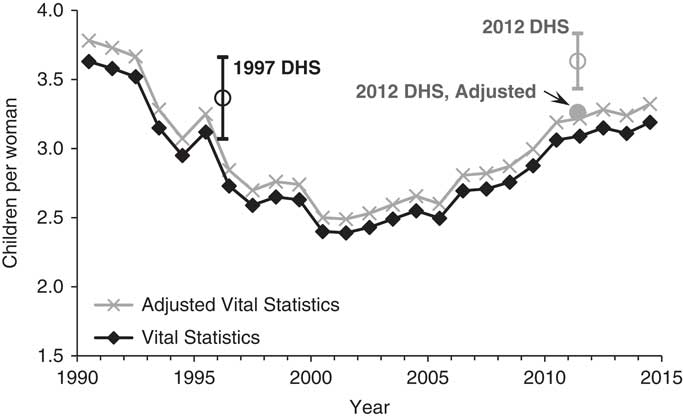
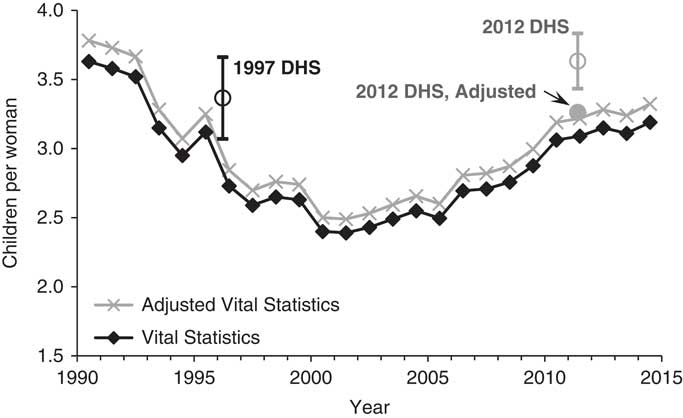
The parity and ethnic aspects of the fertility increase in Kyrgyzstan could be examined using birth history data collected in the 2012 DHS. However, the DHS data have some sample issues that prevent their use for the present study. Figure 1 illustrates the extent of this problem. The estimates of total fertility from the vital statistics were plotted together with the estimates from the birth history data collected in the DHS. The 95% confidence intervals were also provided for the DHS estimates. The fertility estimate from the 2012 DHS was further adjusted by applying the proportion of single women recorded during the 2009 Census in order to consider if the DHS sample had missed single women. When adjusted for the missing single women, the TFR estimate of 3.63 children per woman published in the 2012 DHS report falls to 3.26. This latter value is closer to the figure of 3.09 children per woman in 2011 given by the vital statistics. The issue of the sample representativeness is not specific to Kyrgyzstan, but is found in other sample surveys as well (Hull & Hartanto, Reference Hull and Hartanto2009; Spoorenberg, Reference Spoorenberg2014) and refers to the broader issue of data comparability (Hertrich & Lardoux, Reference Hertrich and Lardoux2014). The adjustment procedure applied here allowed returning in the denominator only the portion of single women that were left out of the sample survey, assuming that these women have no children, and therefore not correcting the full birth history of these women. For this reason, it was decided to consider an alternative data source to study the parity and ethnic aspects of the fertility increase in Kyrgyzstan.
The TFR (children per woman) estimates from various data sources and methods, Kyrgyzstan, 1990–2014. Sources: various Statistical Yearbook of the Kyrgyz Republic, National Statistical Committee of the Kyrgyz Republic; DHS estimates and confidence intervals from survey reports: Research Institute of Obstetrics and Pediatrics [Kyrgyz Republic] & Macro International Inc. (1998); National Statistical Committee of the Kyrgyz Republic (NSC) et al. (2013). Adjusted DHS series and Adjusted Vital Statistics computed by the author.
The civil registration and vital statistics system provides an alternative data source that can be employed to examine the recent development of fertility. Age-specific fertility rates by birth order are available for Kyrgyzstan. For the 1990s and the first decade of the 21st century, tempo-adjusted TFRs indicate that the fertility increase was mainly due to a reduction in the postponement of childbearing (Spoorenberg, Reference Spoorenberg2015). These data could be used to investigate further the heterogeneity dynamics of the fertility development in the country, but vital statistics data do not allow disaggregation of the analysis by ethnic group, which is a key component of the demography of Central Asia.
To investigate the parity and ethnic aspects of the fertility rise in Kyrgyzstan, Sibling Progression Ratios (SPRs) were applied to population census records to reconstruct parity-specific family building behaviours (Guilmoto, Reference Guilmoto2015). The information on family relations collected in the 2009 Population and Housing Census of Kyrgyzstan was used to approximate women’s reproductive histories. A sample of the 2009 Census micro-dataset was used (Minnesota Population Center, 2016). Using the variable MOMLOC available in IPUMS-International samples, children were first linked to their mother. For this purpose, a new file was created where each line corresponded to a woman in a given household. Information on the dates of birth of the woman’s children (if any) was added as a variable to the corresponding line. Maternal histories could therefore be reconstructed using the information on the children’s birth dates to determine their birth order. Only the children under the age of 15 (i.e. born in 1995 or after) were considered in the analysis. Parity was determined based on the date of birth of the children declared in the census. The SPRs were computed using the Kaplan–Meier estimator in a period perspective. Starting from the beginning of the observation period (see below), survival functions were estimated conditional on the occurrence of a birth of a given rank based on the reconstructed birth histories. The successive SPRs give the proportion of women age 15 and older who had a birth of a given rank after the beginning of the observation period. The duration was determined as the time between the entry into observation and the occurrence of a birth of a specific rank, or the exit of the observation period in the case of right censoring (i.e. women who did not bear a child of a given rank by the end of the observation period).
The study period was divided into two parts (i.e. 1995–2001 and 2002–2009) in order to distinguish the family-building behaviours at a time when fertility reached its nadir in 2001 and at a time when fertility was increasing. By comparing the SPRs of both periods, the change in fertility can be better understood. The SPR method builds on the use by demographers of: (1) the information on the relation to the household head, which is usually collected in the population census and can serve to estimate the average number of children per woman (TFR) applying the own-children method (Cho et al., Reference Cho, Retherford and Choe1986) and (2) the information collected in full birth histories to reconstruct parity progression ratios to understand family-building behaviours (see Feeney & Yu, Reference Feeney and Yu1987; Nί Bhrolcháin, Reference Ní Bhrolcháin1987; Hinde, Reference Hinde1998; Spoorenberg, Reference Spoorenberg2010). The main differences between SPRs and period parity progression ratios (Feeney & Yu, Reference Feeney and Yu1987; Nί Bhrolcháin, Reference Ní Bhrolcháin1987) and the synthetic parity progression ratios (Hinde, Reference Hinde1998; Spoorenberg, Reference Spoorenberg2010) is that SPRs are not computed from the information on full birth histories, but from a reconstruction of the past parity behaviours derived from the information on the relation to the household head.
As earlier studies have stressed the importance of the ethnic factor in the demography of the region, the analysis examined SPRs for the main ethnic groups in the country. The mother tongue spoken in the household was used to determine ethnic membership. Given their relative importance in the population of Kyrgyzstan, the study focused only on the three main ethnic groups: the Kyrgyz (the titular ethnic group), the Russian (the largest group of European origin) and the Uzbek (the largest indigenous ethnic group in the country). The 2009 Census collected information on the ethnicity of household members, but this information is not included in the micro-data sample made available in IPUMS-International. For this reason, the ethnic membership ought to be determined using the mother tongue spoken in the household as a proxy variable. The reliance on language to determine ethnicity can sometimes be problematic, especially in Central Asia where many people from a given ethnic group, particularly in urban areas, do not speak the language of their ethnic group at home, but Russian (Dave, Reference Dave2004). Despite these potential problems, the percentage of ethnic groups determined by language spoken is very close to the percentage of ethnic groups based on the information collected on ethnicity. According to the 2009 Census report, 70.9% of the population of Kyrgyzstan is of Kyrgyz ethnicity, 14.3% of Uzbek ethnicity and 7.8% of Russian ethnicity. In comparison, ethnic membership based on language spoken gives very similar figures, with 69.6% of the population being Kyrgyz, 11.9% Uzbek and 13.2% Russian.
The use of the information on family relations and date of birth to infer reproductive histories is affected by a survival bias. Only children (and mothers) that are alive can enter the reconstruction of past reproductive behaviours. In other words, SPRs are somewhat underestimated as children who have died before the time of the census cannot be properly accounted for in the fertility reconstruction. Yet, given the infant and under-five mortality rates in Kyrgyzstan (i.e. respectively 30.1 and 34.4 per thousand in 2008, and 41.6 and 48.7 per thousand in 2000; see www.childmortality.org), the non-inclusion of dead children in the reconstruction of maternal histories only marginally affects the results presented below.
As a consistency check of the level of fertility given by the maternity histories reconstructed based on the 2009 Census data, the TFR implied by the SPRs was computed by multiplying the proportion of women having a child of a given rank by the rank number and summing these products. The sum of these products indicates a fertility level of 2.54 children per woman in 2001 and 3.04 in 2009. In comparison, the vital statistics give a TFR figure slightly lower, with 2.39 children per woman for 2001 and 2.88 for 2009. Part of the difference can be explained by the fact that live births are not reported fully in the civil registration system of Kyrgyzstan (United Nations Statistics Division, 2014), contributing to an underestimate, to some extent, of the level of fertility. Once adjusted for under-registration, the vital statistics indicate a TFR of 2.49 children per woman in 2001 and 3.00 in 2009 (Fig. 1) – a difference of 2% and 1.3%, respectively, with the TFR implied by the SPRs. These latter values are very close to the SPR-based TFRs and serve to validate the results presented below.
Results
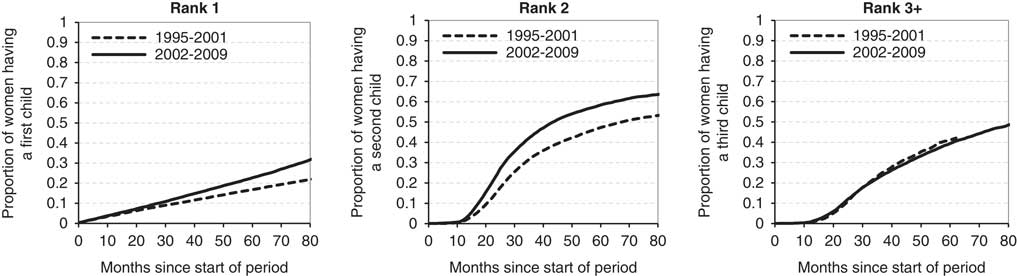
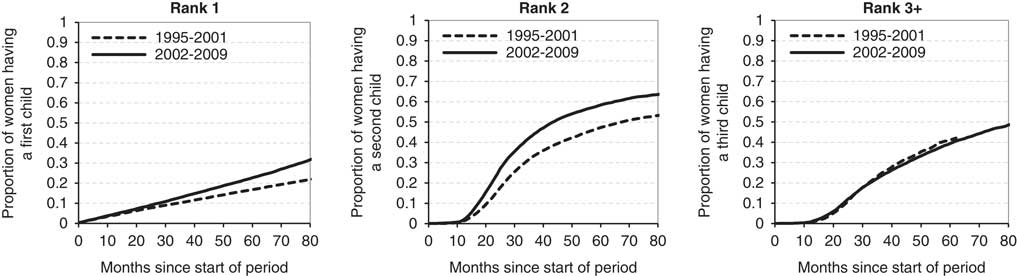
The SPRs for Rank 1 (the transition to first birth), Rank 2 (the transition to second births) and Rank 3+ (the transition to third births) are presented in Figs 2 and 3. For each child rank, SPRs at the country level are first compared between the period when the fertility reached its nadir (1995–2001) and when it was increasing (2002–2009). Second, SPRs are examined by main ethnic group and compared between periods. Figure 2 shows the SPRs by period at the country level. Between 2001 and 2009, first births increased by 45%. In comparison, the proportion of second births rose by less than 20%, whereas the proportion of third births increased by 15% between the two periods. The fertility increase in Kyrgyzstan was caused by a decline of childlessness among women (i.e. an increase of the percentage of women having at least one child), and an increase in second and third births.
Sibling progression ratios (SPRs) by child rank (Rank 1, Rank 2 and Rank 3+), Kyrgyzstan, 1995–2001 and 2002–2009. Source: computed from the 2009 Census micro-data sample (Minnesota Population Center, 2016).
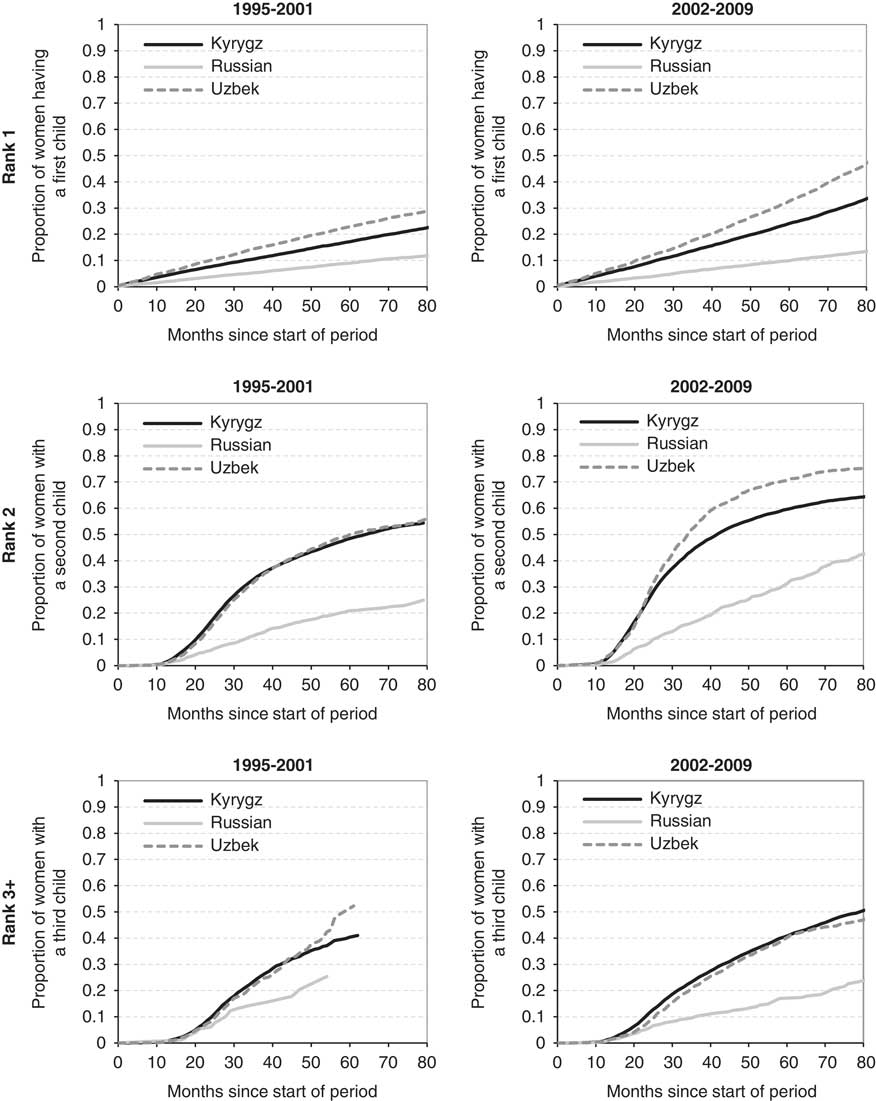
Sibling progression ratios (SPRs) by child rank (Rank 1, Rank 2 and Rank 3+) and main ethnic group, 1995–2001 and 2002–2009. Source: computed from the 2009 Census micro-data sample (Minnesota Population Center, 2016).
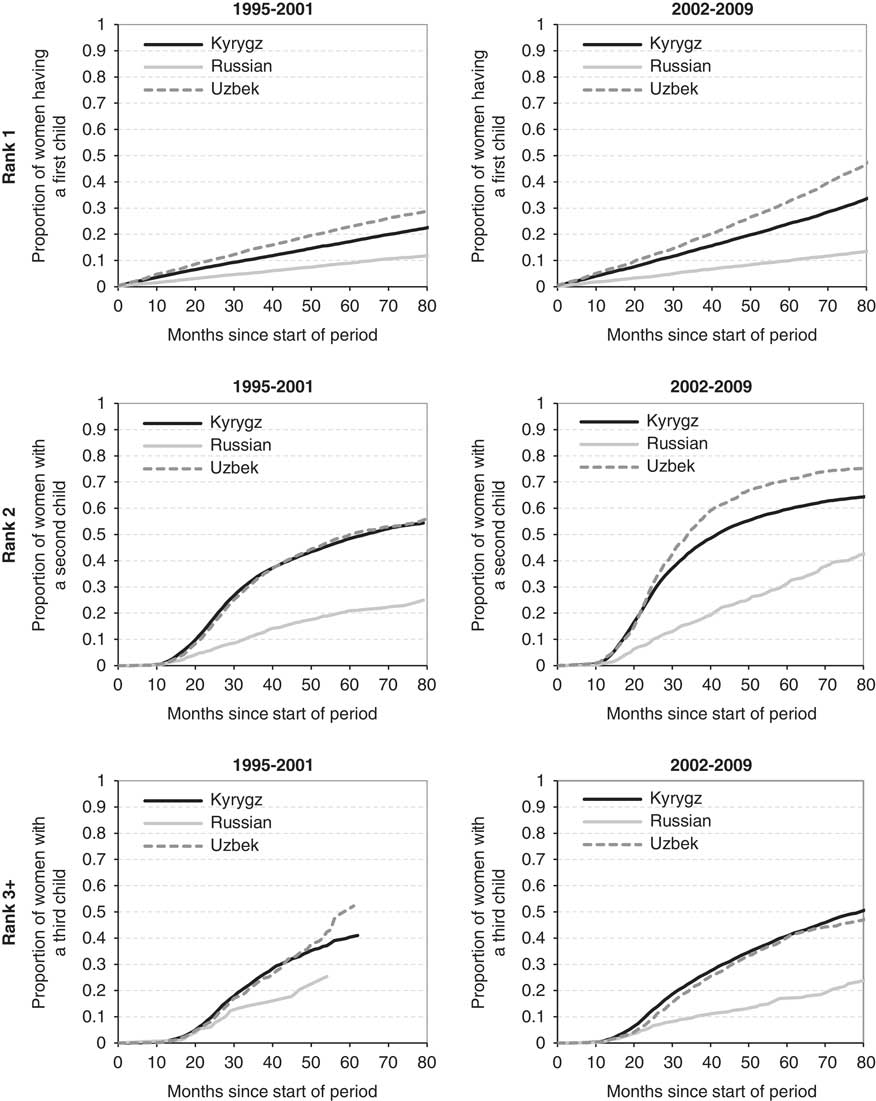
As described in previous studies on the demography of Central Asia, the national figures conceal important variations by ethnic group that need to be examined in order to understand fully population development in the region. Figure 3 presents a disaggregated view of the SPRs by main ethnic group in Kyrgyzstan. The first row of Fig. 3 shows the cumulated proportion of women of all ages who have had a first child only during the two periods of study. Between 1995–2001 and 2002–2009, first order births increased the most among Kyrgyz and Uzbek women, with an increase of close to 44% for the former and 63% for the latter. In comparison, first order births among women of Russian origin increased only by 13% between the two periods.
During the time of the fertility increase (2002–2009 period), the proportion of second births increased in each ethnic group. With a 69% increase, the proportion of second births rose the most among Russian women. Kyrgyz and Uzbek women experienced an increase in second births of 18% and 36%, respectively.
As shown at the national level (Fig. 2), the changes were less important for the third child among the main ethnic groups. The proportion of second births followed by a third one did not show an increase as important as those recorded for the first or second births. Indeed, the proportion of third birth was even lower in 2009 compared with 2001 for women of Russian and Uzbek origin, whereas it increased by 23% among Kyrgyz women. Lastly, the reconstruction of maternity histories from the 2009 Census suggests that no women had a third child in 2000 and 2001 (i.e. 60 months (5 years) after 1995).
Discussion
The results presented in Figs 2 and 3 indicate that the fertility increase in Kyrgyzstan between 2001 and 2009 was mainly the result of an increase in first and second births. Compared with 2001, more women were having a first birth in 2009, especially Kyrgyz and Uzbek women. Second births were also on the rise in all ethnic groups, but especially among Russian women.
The increase in first births seems to be in contradiction to the recent changes in marriage in Kyrgyzstan. Marriage has recently reached its lowest levels in the country’s history – both as a result of the economic crisis of the 1990s and the subsequent modernization of the nuptiality regime in the region (i.e. decline of the traditional form and function of marriage in society, accompanied by marriage postponement and rising informal unions; Nedoluzhko & Agadjanian, Reference Nedoluzhko and Agadjanian2015). First births (and fertility in general) would be expected to go hand in hand with marriage and decline simultaneously. In fact, the retreat from traditional marriage went along with a continuing increase in the proportion of live births occurring outside marriage (from 15.3% on average for the period 1990–1995 to 31.6% on average for the period 2005–2010; UNICEF Regional Office for CEE/CIS, 2016). Such a trend, observed as well in Central and Eastern European countries (Sobotka & Toulemon Reference Sobotka and Toulemon2008), indicates that childbearing has been increasingly becoming dissociated from marriage over recent years in Kyrgyzstan. In this regard, the country is taking an ‘expected’ trajectory and follows the paths of other Western, Central and Eastern European countries.
The changes in SPRs described above need to be interpreted critically. The percentages of first, second and third births differ markedly, both at the national and ethnic level. Given the population composition of the country, a change of 5% among the Kyrgyz women would influence the level of fertility differently from a 10% increase among women of Russian origin would, because Kyrgyz women constitute a larger share of the population of the country compared with Russian women.
From the set of SPRs, implied TFRs can be estimated by multiplying the proportion of women having reached a given parity at the end of the observation period by the parity (i.e. the number of children they stop at). The contribution to the fertility increase of the different ethnic group and/or parity can be evaluated using the SPRs obtained at the end of each observation period (i.e. 2001 and 2009). By keeping a given SPR at its 2001 level, the effect of the change at this parity can be assessed by comparing the resulting TFR with the original TFR for 2009 (i.e. the implied TFR in 2009). For example, at the country level, the increase of 45% in the proportion of first births between 2001 and 2009 has contributed to push up the level of fertility by a meager 0.1 children per woman, because the percentage of woman ending their childbearing at one child is fairly low. In comparison, the change in the proportion of second births (+19.9%) rose the TFR level by 0.21 children per woman and the increase of 15% in the proportion of third births increased the TFR level by a further 0.19 children.
Further decomposition can be made by ethnicity and parity and indicate that first births contributed to add 0.1 births per woman to the fertility increase recorded among Kyrgyz women, 0.18 births per woman in the fertility increase of Uzbek women, and a meager 0.02 births per woman in the fertility increase of women of Russian origin. The effect of second births is larger and contributed to increase the fertility level of women of Kyrgyz, Uzbek and Russian origin by an additional 0.20, 0.27 and 0.35 children per woman respectively. Finally, the change in third births pushed the fertility level of Kyrgyz women by a further 0.28 children per woman, whereas it reduced the fertility level of the Uzbek and Russian women by −0.02 and −0.08 births per woman respectively. In sum, the TFR of the Kyrgyz women increased by 0.59 children per woman between 2001 and 2009, against 0.42 and 0.28 for the Uzbek and Russian women respectively.
The fertility increase in Kyrgyzstan was experienced across the main ethnic groups. Yet, given their respective importance in the population of the country, the contribution of each ethnic group to the fertility increase differs somewhat. Based on the percentage of the ethnic group determined by the language spoken in the household used in this study, 82.4% of the fertility increase in Kyrgyzstan between 2001 and 2009 was due to an increase in the fertility of Kyrgyz women. In comparison, Uzbek and Russian women contributed 10.2% and 7.4%, respectively, to the fertility increase. These estimates do not account for the changes in the population composition that have taken place over the last decade. Because the 2009 Census was only considered here, the study makes the implicit assumption of a constancy of the ethnic composition of the population of Kyrgyzstan. The best way to consider the effects of the large-scale emigration of European origin population in the 1990s is to run similar analysis on the 1999 Census and compare the results from both censuses. The difference for the late 1990s is likely to be marginal, however, because the largest share of the population of European origin left the country in the first half of the 1990s – a period that was not covered in this study. As mentioned above, the high consistency between the level of fertility estimated based on the SPRs in 2001 and the official fertility figure for the same year gives further confidence on the conclusions formulated here.
As it stands, the present descriptive study cannot address the factors explaining the fertility increase in the country. Previous research has shown that the fertility increase at the national level was mainly due to a reduction in the postponement (tempo effect) of childbearing in Kyrgyzstan (Spoorenberg, Reference Spoorenberg2015). In comparison, the role played by economic development was much less important in the country (ibid.). The data used in this study do not allow the application of a similar method to examine if changes in tempo effect are affecting childbearing in each ethnic group in the same way, nor if women of different ethnicity respond differently to the economic development in the country. Yet, the economic recovery and stability that followed the deep economic crisis of the 1990s certainly contributed to renew people’s confidence about the future and helped families realize their childbearing aspirations. Elements related to the position and status of each ethnic group within society could not be addressed in this analysis. Given the strong link between fertility and identity, fertility could act as a means to ascertain, increase or recover ethnic position or status within society, and this dimension needs to be accounted for in future studies.
Yet, the inclusion of parity and social dimensions to the analysis has added some of the missing pieces to the picture of fertility development in Kyrgyzstan, and gives a more subtle view and understanding of the forces driving the fertility increase in Kyrgyzstan. It is true that the fertility rate in Kyrgyzstan (and generally in Central Asia) did not reach as low a level as elsewhere in Asia, but the case study of Kyrgyzstan provides useful insights into some fertility aspects that are still not properly considered in studies examining the development of low fertility: the heterogeneity dynamics of fertility development (Lutz, Reference Lutz1989). The heterogeneous aspects of fertility were examined here considering both the parity component through the study of sibling progression ratios and the social component through a disaggregation by ethnic group. Examining such aspects of fertility gives important disaggregated information not only on family-building behaviours per se, but on the social dimension, which is of importance for the full comprehension of Central Asian demography.
In a broader perspective, factoring heterogeneous aspects into the analysis of fertility development provides important information on family-building behaviours, which are essential for the formulation of appropriate and more effective social policy aimed at sustaining and/or increasing fertility.
Looking beyond classic fertility indicators and national averages requires the development and application of innovative methods and approaches either relying on the collection of new data or making the best use of data sources that already exist and which are easily available for analysis. In this regard, the present study constitutes an illustration of how simple information such as household member listing collected during population censuses can be employed to approximate women’s reproductive histories, which can be further used to understand fundamental fertility dynamics and serve ultimately to the formulation of better-informed and evidence-based social policies. The application of the method used in this study to census data from other countries could ultimately lead to a better understanding of the heterogeneity dynamics of fertility development across the world and improve demographers’ ability to anticipate the future course of fertility.
Acknowledgments
The author wishes to acknowledge the National Statistics Committee of the Kyrgyz Republic, which provided some of the underlying data making this research possible.