I. INTRODUCTION
Hiperco® 50A (simply Hiperco hereafter) is a soft magnetic alloy with nominal wt% composition of Fe49Co49V2. Hiperco has the highest magnetic saturation of any commercial alloy, with high permeability and low coercivity. It is used in applications such as solenoids, electric motors, and generators that take advantage of its excellent magnetic behavior. However, Hiperco in bar form has low mechanical strength and is well-known to exhibit low ductility at room temperature.Reference Sourmail1 The poor mechanical properties limit its application in high performance components that may encounter mechanical stresses due to shock, vibration, etc. Hiperco in a high-strength condition has previously only been available as cold-worked sheet, not in bulk products with larger cross-section.2
The focus of Part I of this work is to investigate the role of severe plastic deformation (SPD) of bulk samples via equal channel angular extrusion (ECAE), also known as equal channel angular pressing, on mechanical properties, in comparison to conventional rolled/forged bar and cold-worked sheet materials. In ECAE, a billet is extruded through a die with an abrupt corner, usually with a 90° angle. Large simple-shear deformation, i.e., >100% effective strain, is applied to the bar as it progresses through the die corner but the overall dimensions of the bar do not change. The material undergoes SPD and, as a result, fine grain sizes are achieved via either substructure formation and grain fragmentation or dynamic recrystallization, depending on the homologous temperature of the process. Grain refinement and work hardening are responsible for the dramatic increases in yield and tensile strength observed with SPD processes, such as ECAE. Increased strength of Hiperco would generally be beneficial for bulk magnetic components requiring high-strength levels. In most materials, a dramatic increase in strength would come with a concomitant decrease in ductility. However, it has been shown that high levels of cold-work, as obtained in sheet products, can actually be associated with higher ductility in Hiperco.Reference Pinnel and Bennett3–Reference Kawahara7 Thus, the possible beneficial effects of ECAE on both strength and ductility of Hiperco provided the motivation for exploring ECAE in the present work.
Zhao and Baker performed conventional extrusion on binary Fe–Co alloys and observed moderate reductions in grain size for 7.5:1 area reduction extrusion at 1000 °C followed by a 4:1 area reduction extrusion pass at 750 °C.Reference Zhao and Baker8 Wießner et al. performed ECAE on a ductile FeCo17 alloy at room temperature.Reference Weißner, Gröb, Bruder, Groche and Müller9 They reported an increase in magnetic coercivity as a result of ECAE, but no mechanical properties were reported. No prior research was found on ECAE of Hiperco 50A or similar alloys with composition near 50/50 FeCo.
In the cold-worked Hiperco sheet, high strength is obtained through grain refinement, i.e., the Hall–Petch effect.Reference Sourmail1,Reference Shang, Cammarata, Weihs and Chien10–Reference Stoloff, Dillamore, Kear, Sims, Stoloff and Westbrook21 The improved ductility, sometimes observed for the sheet product, could be due to an increase in the disordered bcc phase after cold rolling as opposed to the more brittle ordered B2 structure. But even with post-rolling heat treatment to induce ordering, relatively high ductility in the sheet can be retained. The reasons for this are not well understood and could involve the following: (i) the formation of local concentration-disordered zones as proposed by KawaharaReference Kawahara4–Reference Kawahara7 or (ii) second phase particles, very fine grain size, or partial recrystallization with subgrains acting to prevent dislocation pileups and crack propagation, i.e., “slip partitioning” or “slip dispersion”.Reference George, Gubbi, Baker and Robertson18,Reference Stoloff, Dillamore, Kear, Sims, Stoloff and Westbrook21–Reference Thornburg25 Note that these explanations are separate from the theories put forth to account for the ductility from vanadium additions in FeCo–V compared to (very brittle) ordered binary FeCo.Reference Sundar and Deevi26
In addition to mechanical properties, the magnetic performance of Hiperco must also be considered when assessing the effects of thermomechanical processing. Well-annealed, soft Hiperco with large grain size and the fully ordered B2 crystal structure displays the best soft magnetic behavior because there is little impedance to magnetic domain wall movement. Unfortunately, this material in bar form is mechanically weak and brittle. In materials with fine grain size and/or high levels of cold work (resulting in internal stress and/or high dislocation density), domain wall movement is restricted and coercivity increases and permeability generally decreases.Reference Orrock27–Reference Volbers and Gerster29 Magnetic properties will be discussed separately in the accompanying Part II study. The goals of the present Part I study are to identify a feasible ECAE processing window for Hiperco, utilizing a special ECAE tool with sliding walls to minimize frictionReference Segal, Goforth and Hartwig30 and to evaluate the mechanical response of the processed materials in light of the resulting microstructures after ECAE.
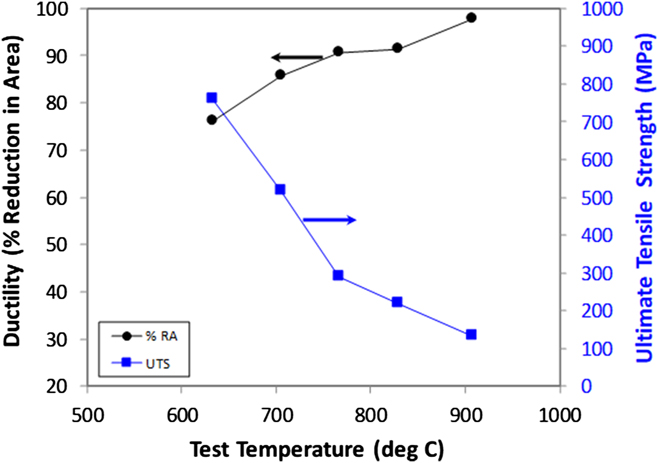
Due to its low ductility at room temperature, Hiperco would not normally be considered a good candidate for SPD processing. However, since ECAE can be performed at elevated temperatures, it was considered that the high-temperature ductility of Hiperco might be sufficient to survive the ECAE process without catastrophic failure. Therefore, prior to beginning any ECAE trials, the hot ductility of the Hiperco bar was investigated using a Gleeble thermomechanical simulator. The Gleeble 3500A employs resistive heating to generate high temperatures within a sample while simultaneously applying tensile or compressive forces. Hot ductility tensile tests were performed between 650 and 900 °C, as shown in Fig. 1. Hiperco displays substantial necking prior to failure with reduction in area larger than 75% and increasing with test temperatures above 650 °C. This behavior contrasts the brittle nature of Hiperco near room temperature where little reduction in area and no necking are observed prior to failure. Based on the hot ductility results, Hiperco was deemed amenable for ECAE trials at high temperatures.
Elevated temperature mechanical properties (hot ductility) of Hiperco obtained with a Gleeble thermomechanical simulator.

II. EXPERIMENTAL PROCEDURE
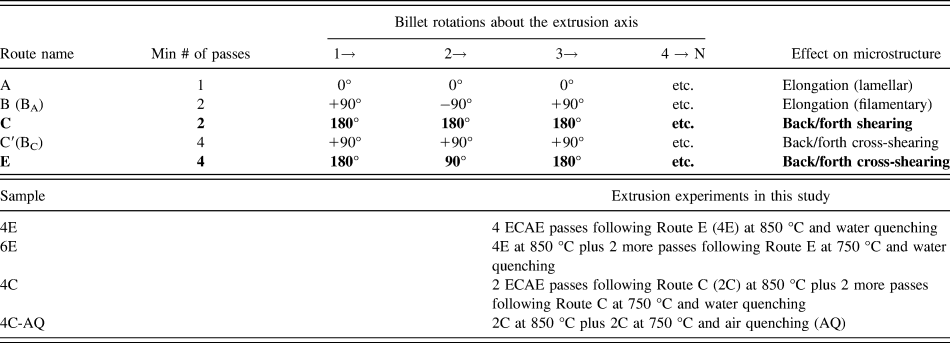
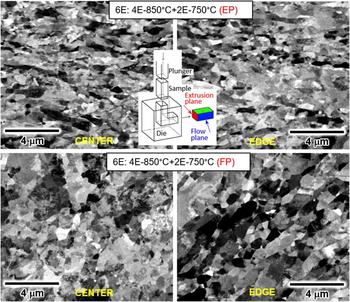
ECAE billets with a 25.4 mm by 25.4 mm square cross section and 150 mm length were prepared from Hiperco (Carpenter Technology Corp., Reading, Pennsylvania) with composition: 49.1 wt% Co, 1.93 wt% V, 0.051 wt% Nb, and balance Fe. ECAE routes C and E were utilized in this work, Table I. The extrusion rate for all the billets was 12.7 mm/s. Prior to heating, the bars were coated with a high-temperature lubricant: Bonderite L-FG 151 forging lubricant, known as Deltaglaze 151, from Henkel Corporation. The billets were held in a furnace at the specified temperature for 30 min, while the die was held at a constant 350 °C, thus the extrusions were carried out nonisothermally. The billets were water quenched immediately after each ECAE pass, with the exception of one ECAE trial which used air cooling after the final extrusion pass. The billets were slightly milled between each pass to create flat and level surfaces. Samples for microscopy were cut in extrusion plane (EP) and flow plane (FP) orientations, Fig. 2, at least 3 mm away from the surface, and mechanically polished to 0.06 μm colloidal silica as the final step. Microstructural characterization was performed using a FEI Quanta 600 scanning electron microscope (SEM; FEI, Hillsboro, Oregon) with 25 kV accelerating voltage. For uniaxial tension tests, flat dog-bone samples, 25 mm long and 8 mm gage length with ∼1 mm thickness, were cut along the extrusion direction (ED, EP normal direction) and flow direction (FD, FP normal direction) using wire EDM. The tension samples were tested using an MTS test frame. The strain was measured using an 8 mm clip-on extensometer. Two or three samples were tested in each direction to confirm the repeatability. Conventional Hiperco bar samples, with 6.35 mm diameter, were also tensile tested for comparison.
ECAE route descriptions and those used for Hiperco extrusions.

BSE micrographs of ECAE 6E samples showing the EP (top) and the FP (bottom) microstructures.

Two ECAE routes were investigated in this work, namely routes C and E, and the microstructure and properties of the extrusions will be discussed below. In between each ECAE pass, the billet is rotated axially either 90 or 180° as shown in Table I, which is simplified by the use of square cross-section billets. The reason for the selection of these routes was to obtain near equiaxed fine grains and a weak crystallographic texture to minimize texture-induced magnetic anisotropy since these routes are known to lead to the weakest texture among the known ECAE routes. The original goal was to investigate solely the role of grain size refinement on strength and ductility, and in Part II on magnetic properties, of Hiperco bars, without too much interference from crystallographic texture effects. However, as described in the Part II study, the resulting crystallographic textures, even though they are weak, led to unexpected, but favorable magnetic properties, even though refined grain sizes were expected to negatively impact soft magnetic properties such as coercivity and permeability.
Based on the hot ductility results, an initial extrusion temperature of 850 °C was chosen. Successful ECAE results were achieved with four passes of Route E at 850 °C, sample 4E. Next, the intent was to keep the temperature as low as possible to attain the greatest microstructural refinement, i.e., by limiting grain growth during ECAE. Initial passes at 750 or 700 °C proved to be unsuccessful presumably due to the formation of the brittle ordered B2 phase; the order/disorder temperature is approximately 720 °C in the Fe–Co system.Reference Nishizawa and Ishida31 However, a few passes at 850 °C allowed for subsequent finishing passes at 750 °C as shown in Table I, suggesting improved ductility from SPD and grain refinement from the initial passes. Finally, sample 4C-AQ was a repeat of 4C, except after the last pass the sample was air cooled instead of water quenched, to approximate the suggested cooling rate for obtaining good magnetic properties.2
III. RESULTS AND DISCUSSION
Backscattered scanning electron (BSE) micrographs of sample 6E are shown in Fig. 2 to illustrate the fine grain size obtained with ECAE. The microstructure is generally a representative of all extruded billets in this study. The top micrographs show the EP and the bottom images display the FP structure. Average grain sizes of 1.5–3 μm were estimated based on analyses of the BSE channeling contrast micrographs. No significant differences were detected between the microstructure near the center of the ECAE billet and that near the outside edge. It is clear that significant grain refinement occurs during ECAE, even at 850 °C, which is about 0.64 × T m homologous temperature for Hiperco. The two extra passes and the lower ECAE temperature do not appear to significantly alter the microstructure as compared to sample 4E (not shown), which was processed at 850 °C only. The fine grain size indicates that dynamic recrystallization occurs during ECAE at these temperatures without extensive grain growth, which is likely limited due to the short duration of the extrusion process. In addition, note that 500 ppm Nb was added to this lot of Hiperco. The formation of NbC precipitates could pin grain boundaries to maintain a fine grain size during ECAE, similar to the effect of Nb additions (∼3000 ppm) in the Hiperco 50HS sheet.2,Reference Fingers, Carr and Turgut20 Grain refinement and partial recovery can lead to increase in both strength and ductility as shown in a few recent ECAE studies, such as for a Nb–1% Zr alloy.Reference Niendorf, Canadinc, Maier, Karaman and Yapici32 For comparison to Fig. 2, the conventional rolled or forged Hiperco bar exhibits grain sizes in the range of ∼20–75 μm, depending on the heat treat temperature.Reference Jordan and Stoloff15–Reference Zhao and Baker17 The conventional bar is typically used in the heat treated condition, but the as-received (not heat treated) bar possesses a grain structure on a similar scale resulting in yield strengths similar to the heat treated bar,Reference Susan, Rodelas, Robino and Greenwood16 but with inferior magnetic properties. Note also that conventional bar, unlike ECAE material, typically exhibits a grain size gradient, with larger grains near the bar exterior and finer grains near the center, again depending on heat treat temperature.Reference Susan, Rodelas, Robino and Greenwood16 Post-ECAE annealing, which may be performed to induce ordering and enhance magnetic performance, will result in coarsening of the ECAE microstructure (Part II). Nevertheless, an important aspect here is that there is significant heat treat processing space to be explored between the as-ECAE structure and conventional bar microstructure. That is, intermediate heat treatment times and temperatures may be investigated to potentially improve magnetic performance without excessive grain growth, thereby maintaining a high-strength level.
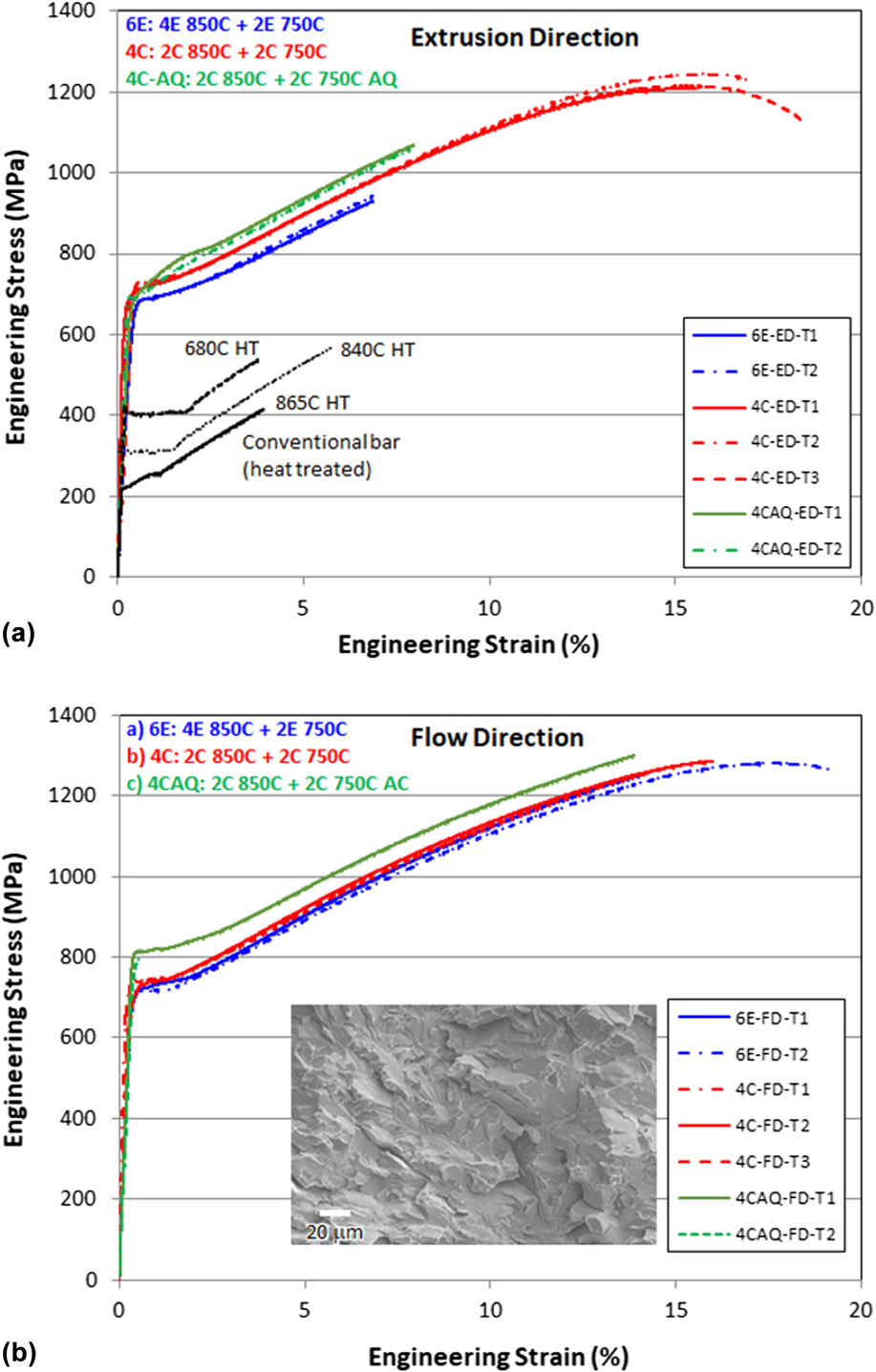
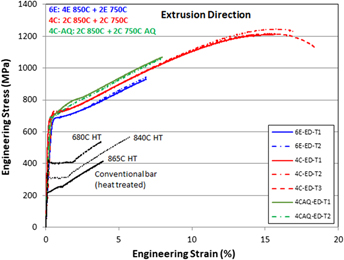
After ECAE processing, the Hiperco bar exhibits very high strength as shown in Fig. 3. The yield strength of 713 ± 50 MPa (103 ± 8.5 ksi) from a total of 20 tests of the ECAE material is comparable to yield strengths found in highly cold-worked sheets. The UTS values are also generally very high, but with appreciable scatter: ECAE trial 4E UTS 819 ± 215 MPa, trial 6E UTS 1101 ± 191 MPa, trial 4C UTS 1135 ± 232 MPa, and trial 4C-AQ UTS 1055 ± 206 MPa. The reason for the high degree of scatter in UTS stems from the fact that Hiperco exhibits a high work-hardening rate and does not undergo ductile necking but rather fails in a stochastic manner with a brittle cleavage micromechanism (see the inset micrograph, Fig. 4 below) during the work hardening portion of the stress–strain curve. This behavior makes the material susceptible to surface flaws, with appreciable scatter in failure strain. Due to this behavior, the fracture stress is equal to the ultimate tensile stress. For samples that survive to higher strains, the UTS will be correspondingly higher. Therefore, while UTS is reported here, and generally shows the high strength achieved with ECAE, a more meaningful measure of mechanical behavior is yield strength. The high overall strength level of the ECAE material correlates well with the small grain size discussed previously in Fig. 2, i.e., Hall–Petch considerations. High strengths have not been previously achievable in bulk sections of Hiperco. The as-ECAE condition represents more than a 2-fold increase in strength compared to the conventional Hiperco bar (200–400 MPa, 29–58 ksi) yield strength, Fig. 3. The conventional bar data are from three different heat treatments from a previous study.Reference Susan, Rodelas, Robino and Greenwood16 It will be shown in the companion Part II study that the ECAE bar possesses a crystallographic texture different from the conventional rolled or forged bar. However, the developed texture is mild and is not expected to contribute significantly to strengthening.
Stress–strain curves from ECAE-processed Hiperco in the (a) extrusion direction and (b) flow direction. The results also shown for conventional bar heat treated at 680, 840, and 865 °C. The inset micrograph shows brittle cleavage fracture micromechanism of ECAE sample 6E.

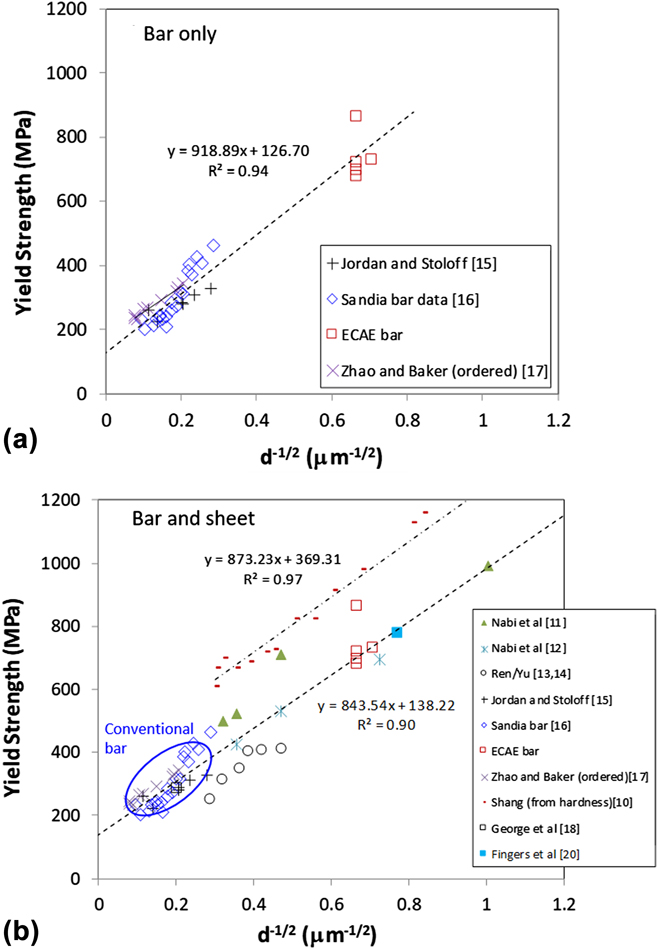
The Hall–Petch grain size dependence of yield strength for the (a) FeCo-based alloy and ECAE Hiperco bar and (b) bar and cold-worked sheet.

The failure strains between 15 and 20% for the flow direction in the 6E billet and for both directions in the 4C billet are among the highest reported for Hiperco in any condition.Reference Kawahara4–Reference Kawahara7,Reference Duckham, Zhang, Liang, Luzin, Cammarata, Leheny, Chien and Weihs19,Reference Sundar and Deevi26 Due to water quenching after ECAE, it is likely that the as-ECAE material is in the disordered (bcc) or only slightly ordered condition. In general, the disordered material displays higher ductility than the alloy in the ordered state and this is likely the primary reason for the high ductility obtained in tensile tests of the ECAE material. However, some observed differences may be attributable to the final pass finishing temperature. Only the ECAE samples with the finishing temperatures of 750 °C are displayed in Fig. 3. Extrusion 4E, processed only at 850 °C, also had high strength but its ductility was lower, ∼4–6%, similar to the conventional bar. The reasons for relatively low ductility in extrusion 4E are not fully understood but, by comparison to extrusions 6E and 4C, it appears that the finishing temperature of 850 °C is high enough for recovery and recrystallization (but with minimal grain growth). It is possible that extrusions 6E and 4C, with final ECAE passes at 750 °C, contain a subgrain structure contributing to ductility. Such a mechanism would be consistent with “slip partitioning” or “slip dispersion” as proposed by Pitt and Rawlings and others.Reference George, Gubbi, Baker and Robertson18,Reference Stoloff, Dillamore, Kear, Sims, Stoloff and Westbrook21–Reference Thornburg25 Along with fine grains (higher grain boundary density to decrease slip concentration), subgrains or dislocation networks may also interrupt local regions of slip deformation and prolong the concentration of slip necessary for crack initiation.Reference Sourmail1,Reference George, Gubbi, Baker and Robertson18,Reference Stoloff, Dillamore, Kear, Sims, Stoloff and Westbrook21–Reference Thornburg25 Further microstructural characterization at the TEM scale, along with determination of the degree of order, would be necessary to determine if other proposed mechanisms are active besides simply enhanced ductility from a disordered bcc structure. Overall, the higher ductility obtained with high-temperature SPD and grain refinement is consistent with the higher ductility reported for cold-worked sheet by Kawahara and others.Reference Kawahara4–Reference Kawahara7,Reference George, Gubbi, Baker and Robertson18,Reference Thornburg25
Typical ECAE processing involves water quenching in between extrusion passes and after the final pass. ECAE billet 4C-AQ utilized the same ECAE parameters as trial 4C, except that air-cooling was used after the final pass. This ECAE trial was an attempt to produce a partially or fully ordered B2 crystal structure by slower cooling through the ordering transformation, which may impart better magnetic performance. It would be highly desirable to produce both high strength (and good ductility) and good magnetic performance without the need for a separate heat treatment step. As shown in Fig. 3, high yield and ultimate strengths of sample 4C-AQ are retained with air-cooling. Some ductility is lost, however, and anisotropy in ductility is also exhibited for extrusion 4C-AQ. Even so, the failure strains of ∼7–8% and ∼14% in the ED and FD directions, respectively, compare favorably to the conventional Hiperco bar material. With regard to a mechanism for enhanced ductility, the 14% strain developed in the FD orientation suggests that good ductility can be obtained even in the material with a presumably higher degree of ordering. Again, this supports the assertion of other mechanisms contributing to the sustainment of strain accumulation as discussed by George, Pitt and Rawlings, and other researchers.Reference Sourmail1,Reference George, Gubbi, Baker and Robertson18,Reference Stoloff, Dillamore, Kear, Sims, Stoloff and Westbrook21–Reference Thornburg25
A few other features of interest are found in Fig. 3. First, unlike conventional rolled or forged bar, the material in the as-ECAE condition does not show an upper/lower yield point (discontinuous yielding portion of the stress–strain curve), although a slight plateau is evident just after yielding. Upper/lower yield point with 1–2% discontinuous strain and the propagation of Lüders bands are typical of large-grain annealed Hiperco bar.Reference Kawahara4,Reference Susan, Rodelas, Robino and Greenwood16,Reference Pitt and Rawlings24,Reference Hug, Hubert and Guillot28 Second, the material fails without appreciable necking, with the possible exception of ECAE billet 4C, which is also a characteristic of Hiperco alloys. And third, SEM examination of the fracture surface (inset of Fig. 3) confirms a brittle, transgranular, quasi-cleavage fracture mode even after significant tensile straining is incurred. This fairly unique tensile behavior contributes to the correlation between failure strain and UTS (failure stress = UTS) and the high degree of scatter in UTS as well. In addition, conventional Hiperco occasionally failed at low strain in the threaded grip region of the round tensile samples. This behavior was observed in previous studies of Hiperco bar and illustrates the notch sensitivity of this material.
To summarize the tensile behavior, Hall–Petch plots of yield strength versus (grain size)−1/2 were constructed in Fig. 4 according to the following equation:
 $${\sigma _{\rm{y}}} = {\sigma _{\rm{o}}} + k{d^{ - 1{\rm{/}}2}}\quad ,$$
where σy is the yield strength in MPa, σo is the intrinsic friction stress (Peierls stress) in MPa, k is a constant (Hall–Petch coefficient, MPa/μm1/2), and d is the grain size in microns. The results for ECAE processed bar in this work and a few studies on conventional bar are shown in Fig. 4(a). The Hiperco conventional bar material (listed as “Sandia bar” in Fig. 4) was heat treated in the range of 680–870 °C. The ECAE data points were produced from grain size measurements with SEM backscatter channeling contrast, while the grain size of the conventional bar was determined from optical micrographs. Other results from the literature have similar Hall–Petch slopes with some degree of scatter.Reference Jordan and Stoloff15,Reference Zhao and Baker17 The data from Zhao and Baker include only their results for the material in the ordered condition, slowly cooled from high temperature. Figure 4(b) also comprises the Hiperco sheet material from Nabi et al., Ren and Yu, George, and Fingers.Reference Shang, Cammarata, Weihs and Chien10–Reference Yu, Basu, Zhang, Parvizi-Majidi and Xiao14,Reference George, Gubbi, Baker and Robertson18–Reference Stoloff, Dillamore, Kear, Sims, Stoloff and Westbrook21
Here it is confirmed that the ECAE bar lies in a similar strength/grain size regime as the cold-worked sheet. The dashed trendline in Fig. 4(b) is a combined fit to the present results and several studies from other researchers for the sheet as well as the bar (see Table II), with the exception of the higher strength values from Shang. Shang performed Knoop hardness measurements, from which yield strengths were estimated in a review by Sourmail.Reference Sourmail1,Reference Shang, Cammarata, Weihs and Chien10 The Hall–Petch slope from Shang is about the same as that shown from the other studies and the shift to higher strengths may be due to uncertainty in the hardness to strength conversion. Sourmail discussed the fact that details were not given in the Shang paper on quenching versus slow-cooling; the degree of order could have a significant influence on the Hall–Petch behavior as well. Based on Fig. 4, the estimated k-value (Hall–Petch slope) and σo (Peierls stress) are 919 MPa μm−1/2 and 127 MPa, respectively, for the material from the same heat lot processed by conventional forging or ECAE. These parameters are presented along with values from other studies and a combined fit of data from several sources in Table II. In general, for both Hiperco bar and sheet, the relationship between yield strength and grain size was described by Hall–Petch slopes in the range 714–919 MPa μm−1/2 and σo of 100–200 MPa at room temperature (with the exceptions of results from Shang and Yu et al.). Again, the σo estimated from Knoop hardness (Shang/Sourmail) is higher than the others. Regardless, there are differences among Peierls stresses reported in different studies, the reasons for which are not clear. However, it might be because of the differences in the fraction of the ordered phase and microalloying additions. It is challenging to compare the various reported data on Hall–Petch constants from the literature without exactly knowing the degree of order in these materials, and further systematic studies on this topic are needed.
Hall–Petch parameters, σo and k, for FeCo-based alloys.

IV. SUMMARY AND CONCLUSIONS
In summary, in Part I of this two-part study, significant grain refinement through ECAE at high temperatures was demonstrated in bulk Hiperco soft magnetic alloys for the first time. The ECAE material exhibited high-strength levels comparable to the cold-rolled Hiperco sheet and the ductility was higher than the heat treated conventional bar with large grain size. The Hall–Petch slope in the present work was comparable, but slightly higher than those obtained from large-grain-size bars and cold-rolled sheets. The high ductility obtained in the as-ECAE condition was attributed primarily to a disordered bcc structure due to water quenching after ECAE, along with possible beneficial effects from fine grain size and a warm-worked microstructure. The crystallographic texture and magnetic properties of the ECAE processed fine-grained Hiperco bar will be evaluated thoroughly in Part II of this study.
ACKNOWLEDGMENTS
The authors wish to thank P. Duran for Gleeble experimentation and M. Reece, A.C. Kilgo, and B.B. McKenzie for materials characterization. Dr. B. Clark, Dr. J.R. Michael, and Dr. R. Kellogg provided helpful discussion during this work and Dr. A. Kustas provided careful review of the manuscript. Sandia National Laboratories is a multimission laboratory managed and operated by National Technology and Engineering Solutions of Sandia LLC, a wholly owned subsidiary of Honeywell International Inc. for the U.S. Department of Energy’s National Nuclear Security Administration under contract DE-NA0003525. The FE-SEM acquisition was supported in part by the National Science Foundation under Grant No. DBI-0116835.