INTRODUCTION
As Jason Thompson has recently pointed out: ‘it is often the undisplayed items … [in museums] that serve as the best raw material for future research. All major and most minor collections contain potential for new insights.’Footnote 1 This is certainly true of almost all major collections of Egyptian antiquities around the world, where space constraints inevitably mean that no matter how many artefacts the visitor sees in the galleries, there will be many more hidden away in the storerooms. Both the objects on display and those locked away have the potential for providing new information. A case in point are the British Museum’s granodiorite statues of the goddess Sekhmet from the period of Amenhotep iii. Ongoing excavations and discoveries at the funerary temple of Amenhotep iii at Kom el-Hettan, in Luxor, where hundreds of Sekhmet statues and statue fragments have been uncovered in recent years, and at the Mut Temple at Karnak, where many Sekhmet statues remain in situ, have led to a reassessment of these statues.Footnote 2
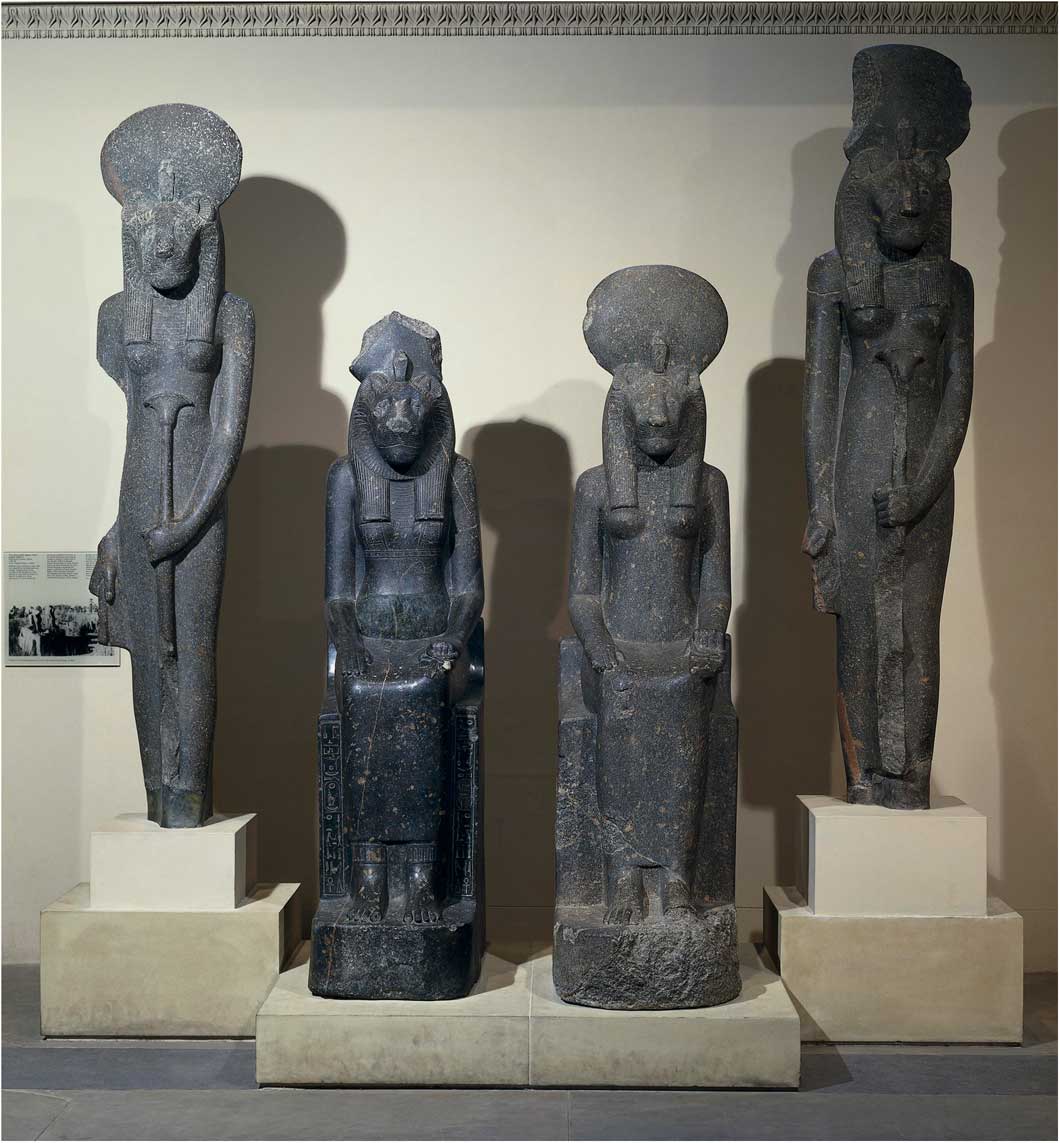
Four of the statues – two standing and two showing the goddess seated on a throne – are currently on display in the British Museum’s Sculpture Gallery on the ground floor (fig 1).Footnote 3 They attract a great deal of attention from visitors, who are fascinated by these exotic-looking creatures, half-woman, half-lioness. The leonine features hint at this ancient goddess’ fierce nature. Sekhmet, whose name means ‘powerful’, was a solar goddess, daughter of the sun god Re and consort of the god Ptah. She was regarded as the bringer of destruction, but also as a healer who could protect against illness and plague.Footnote 4 Her ‘power was used to protect the king’, and she was also symbolic of the king’s ‘own power in battle’.Footnote 5 As well as the distinctive leonine features, the statues usually have a sun disc and cobra uraeus crowning the head, or there is a notch (or groove) atop the head where a separate sun disc could be attached. The standing type holds a papyrus sceptre in the left hand and an ankh (symbol of life) in the right, while the seated examples hold an ankh in the left hand. Other common details include a collar necklace and a traditional wig beneath a stylised leonine mane, which frames the face.
(left to right) British Museum statues EA 76, EA 57, EA 62 and EA 80 in the Sculpture Gallery. Photograph: © Courtesy of the Trustees of the British Museum.

THE SEKHMET STATUES AT THE BRITISH MUSEUM
The Sekhmet statues currently on display in the British Museum are just the tip of the proverbial iceberg, as the museum holds as many as thirty-nine near complete or fragments of Sekhmet statues. A handful are on loan to museums in the UK and abroad, but the rest remain in store due to inevitable space constraints.Footnote 6 The group includes thirteen standing statues, eleven seated, thirteen statue fragments, two previously uncatalogued head fragments and two bases with feet from standing statues that may be from Sekhmet statues.Footnote 7 This is the largest collection of this statue type outside Egypt.Footnote 8 Not only does the museum hold both standing and seated examples, but the museum’s group of statues and fragments are extremely varied, displaying a range of stone colours, proportions and detailing, as well as inscriptions and evidence of reuse by later pharaohs. They, therefore, have the potential to be an excellent sample group for further analysis.
Sekhmet statues were among the first Egyptian antiquities to be acquired by the British Museum, arriving as part of a group of antiquities received from the French with the signing of the Treaty of Alexandria in 1801 and donated to the museum by King George iii in 1802.Footnote 9 In the following decades, further statues of the goddess, many unearthed by the pioneer Egyptologist Giovanni Belzoni (1778–1823), were acquired from Henry Salt (1780–1827), the British consul-general in Egypt, who sold a large collection of Egyptian antiquities to the museum in 1823.Footnote 10 In 1840, the upper part of a Sekhmet statue was donated by William Richard Hamilton, who had negotiated the handover of the French antiquities to the British under the Treaty of Alexandria.Footnote 11 In 1843, two seated statues came to the museum via the family of Lord Belmore, who had acquired them from Belzoni while travelling in Egypt.Footnote 12 Indeed, the Society of Antiquaries of London may have inadvertently played a small but significant part in some of the inscribed Sekhmet statues and fragments making their way to the British Museum, for the Society had sent a request to Salt to collect antiquities with hieroglyphic inscriptions, as well as drawings or casts of inscriptions, which might assist Dr Thomas Young with his researches into hieroglyphs and the Rosetta Stone.Footnote 13
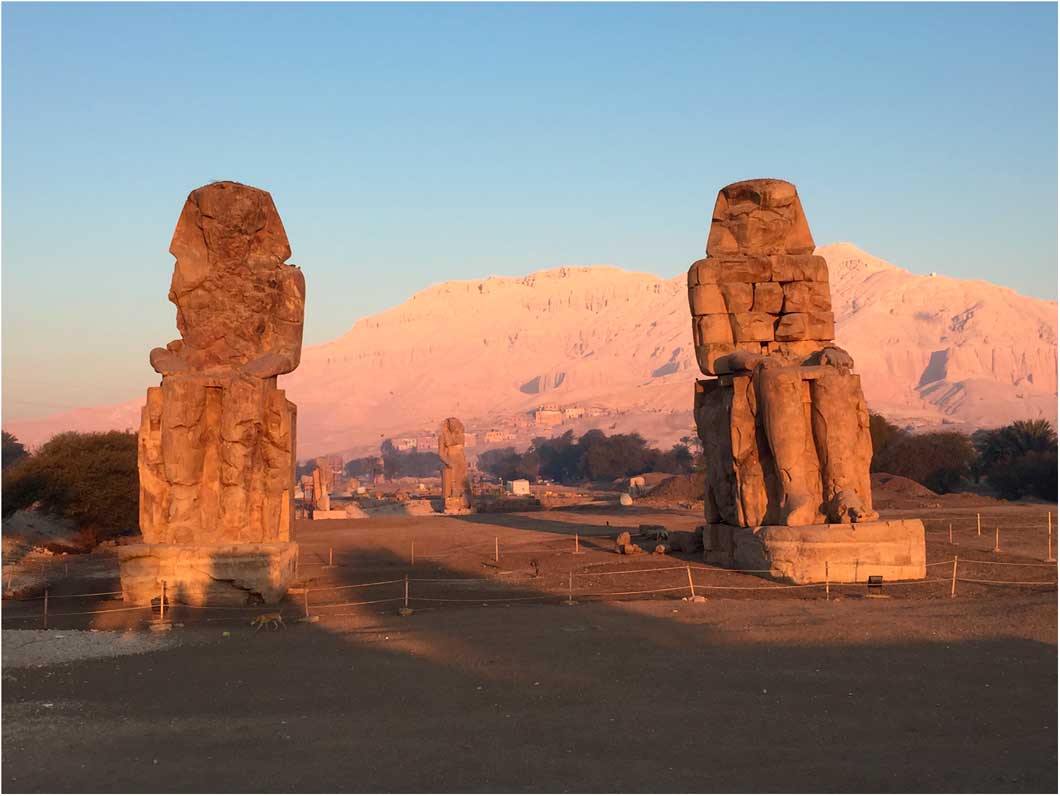
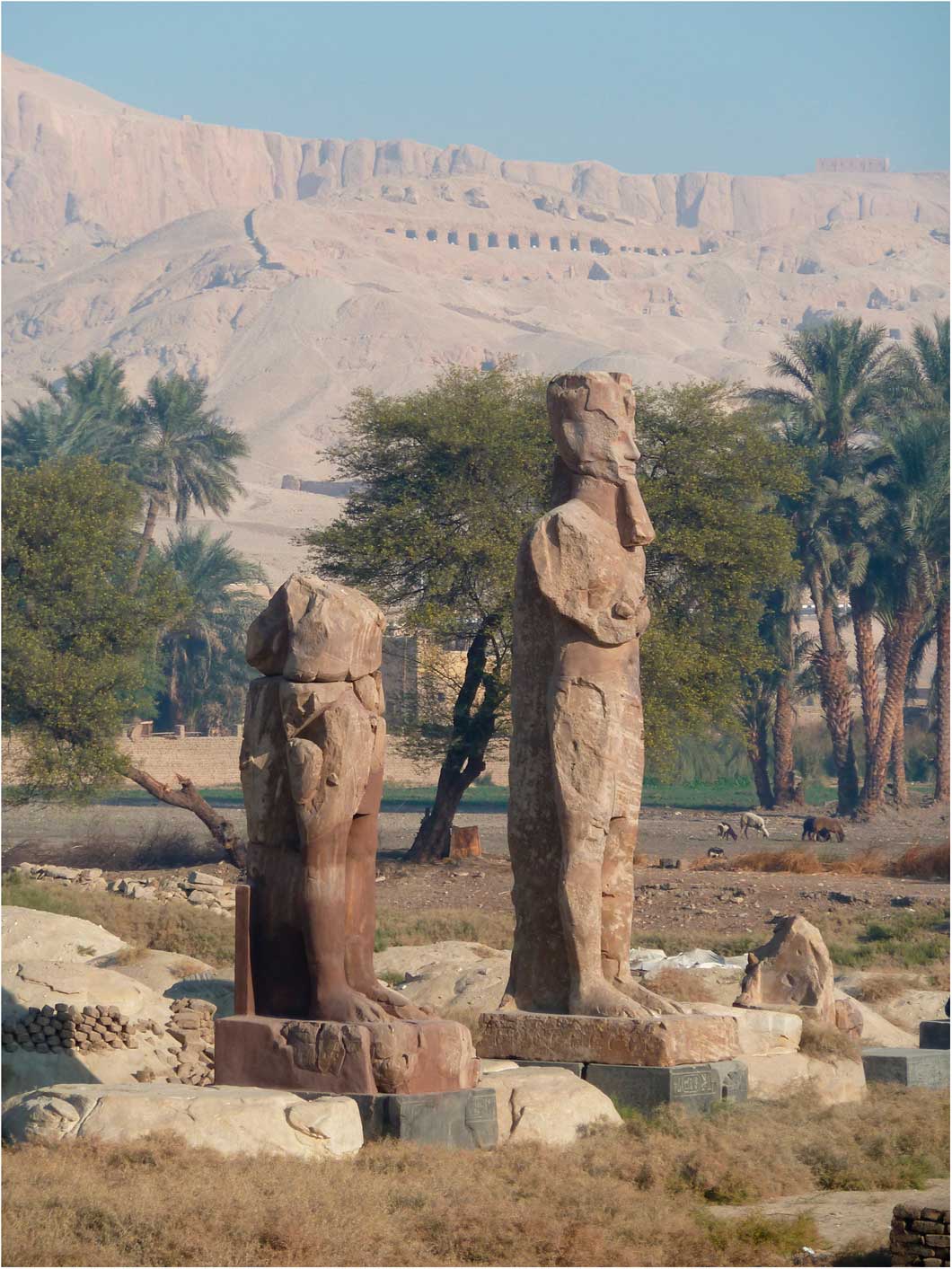
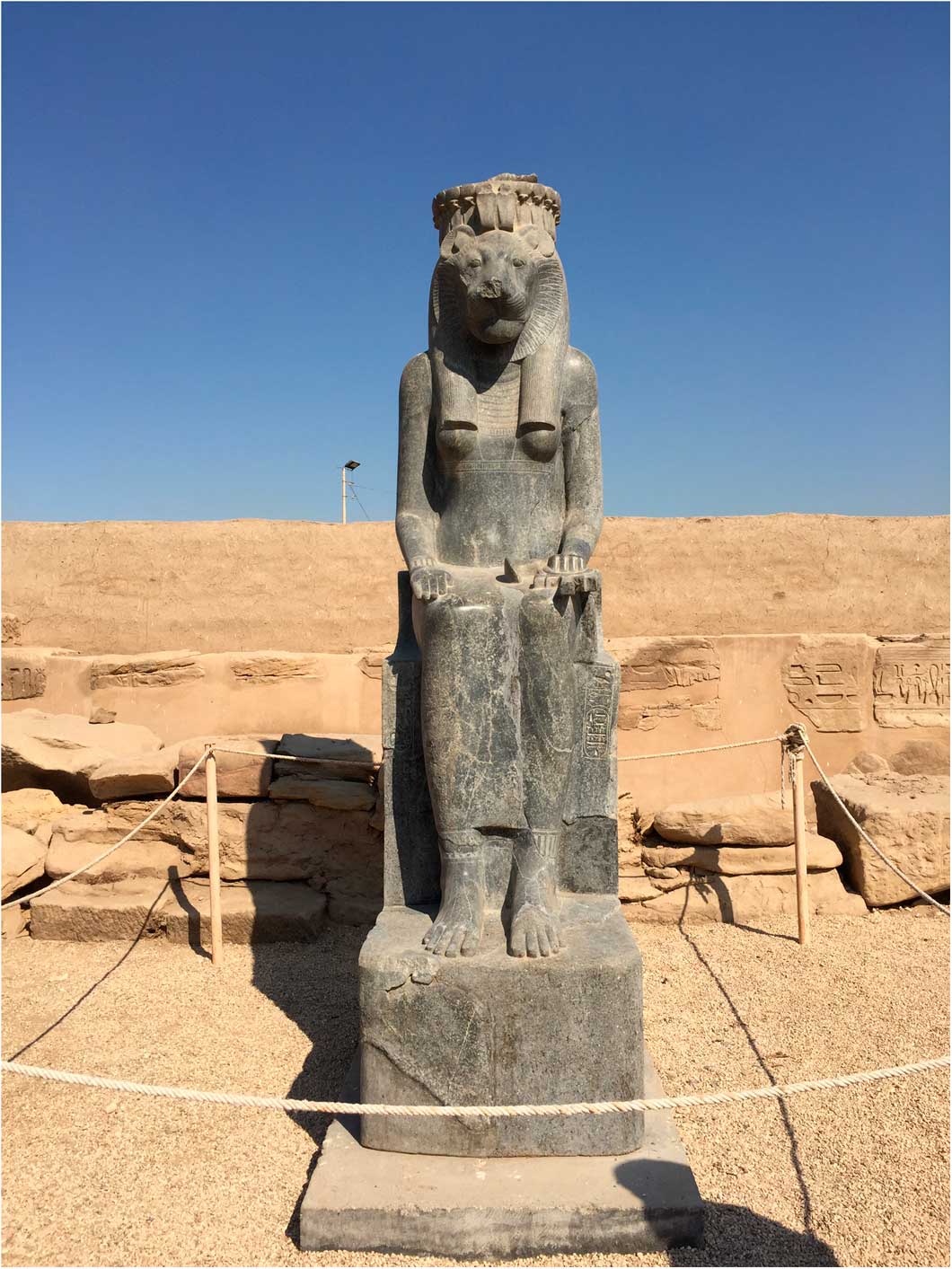
The accepted consensus is that these statues, along with many others of the gods and colossal statues of the king, were made in preparation for Amenhotep iii’s Sed festival or jubilee, celebrated in year 30, and placed in his funerary temple on the west bank at ancient Thebes (Kom el-Hettan) (figs 2 and 3).Footnote 14 Sekhmet statues may also have been commissioned for the Mut Temple at Karnak, or were moved there, possibly from the reign of Ramesses ii (c 1279–1213 bc; nineteenth dynasty) onwards (fig 4).Footnote 15 The British Museum almost certainly has statues excavated from both sites, with the French statues originating from the Mut Temple. In the Description de L’Égypte, a multi-volume series of engravings and descriptions based on the French expedition’s researches in Egypt, published between 1809 and 1829, the French described uncovering ‘plus de quinze statues … elles ont la plupart des têtes de lion’ at the Mut Temple, and plate 48 in volume 3 of Description de L’Égypte appears to correspond to British Museum statues EA 57 and EA 88.Footnote 16 It is difficult to say with absolute certainty which of the British Museum Sekhmets come from which site, since their provenance was generally not noted down at the time of their excavation, nor did it tend to be recorded when they arrived at the museum. However, Belzoni did note that he and Salt found ‘standing and sitting lion-headed statues’ at Kom el-Hettan, though he does not make a similar declaration regarding statues he found at the Mut Temple.Footnote 17 We could, therefore, theorise that the standing statues in the British Museum that are clearly associated with Salt may have originated from Kom el-Hettan.Footnote 18
The Colossi of Memnon in Luxor, Egypt. Photograph: Tara Draper-Stumm, 2016.

Reconstructed statues in the peristyle court of Amenhotep iii’s funerary temple at Kom el-Hettan. Photograph: Tara Draper-Stumm, 2011.

Sekhmet statues in the outer court of the Mut Temple. Photograph: Tara Draper-Stumm, 2011.

A PREVIOUSLY UNCATALOGUED HEAD FRAGMENT
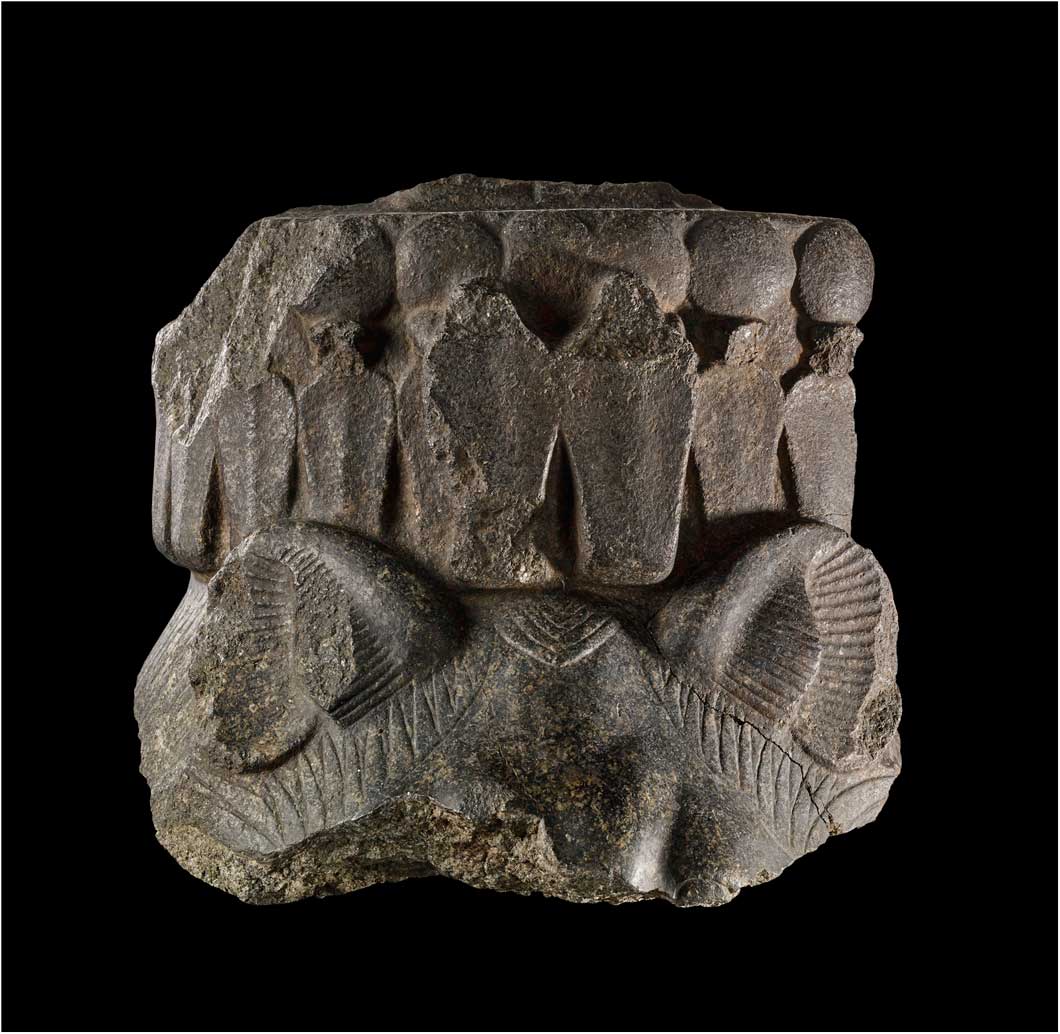
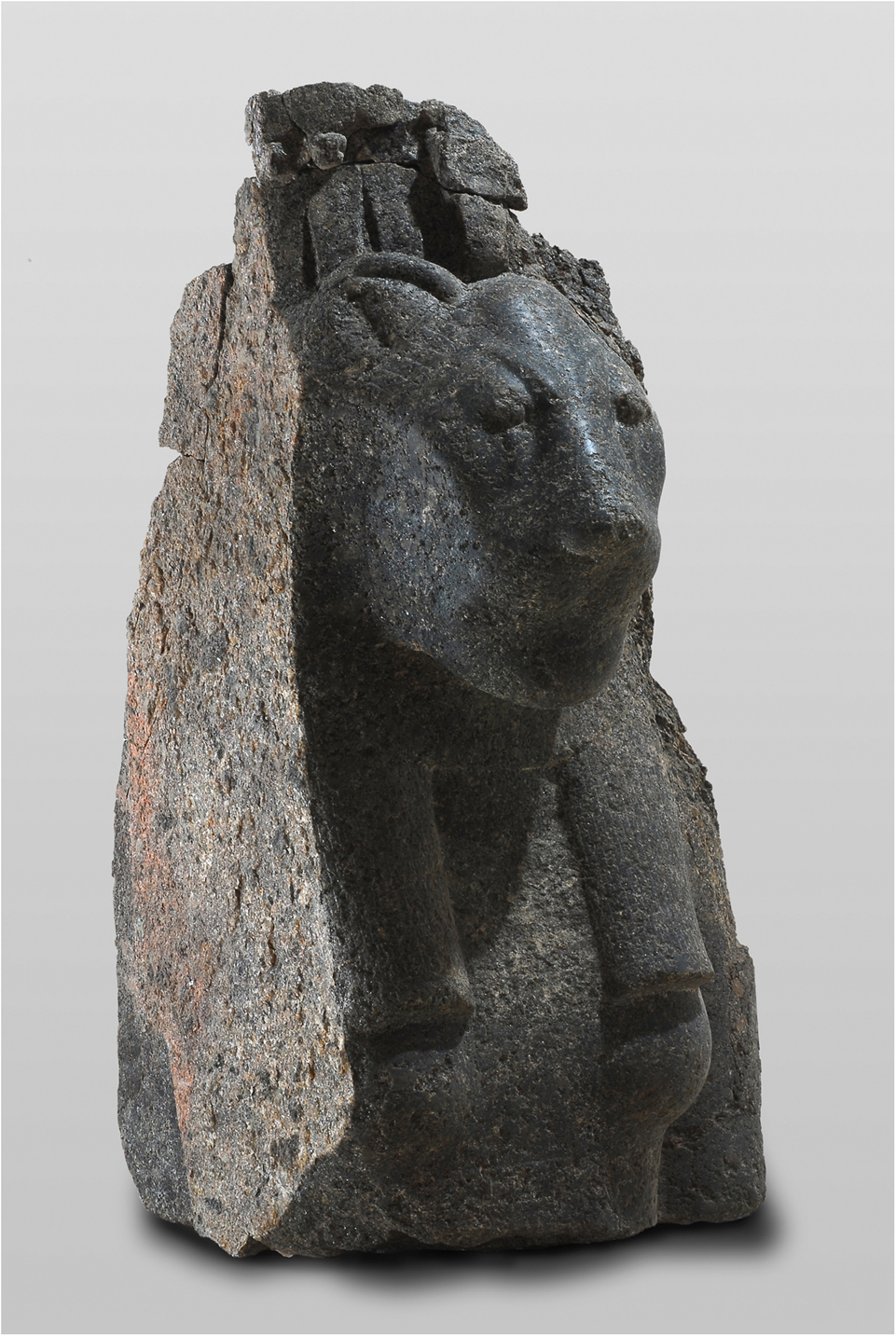
One interesting mystery among the statues of Sekhmet at the British Museum is a previously uncatalogued head fragment currently in the storerooms (fig 5). This head fragment, recently catalogued and numbered EA 90784, comprises the upper part of a Sekhmet head and ears above the level of the eyebrows. It is highly unusual in that it is topped with a crown of uraei, with two additional uraei at the front, rather than the usual sun disc with single uraeus.Footnote 19 It measures 38cm wide and 33cm in height, which would suggest that it corresponds to the larger type of Sekhmet statue, which generally has a facial width of 38cm or more.Footnote 20 While the Sekhmet statues usually averaged approximately 2m tall (or roughly four cubits), these larger statues were at least 3m tall.Footnote 21
Recently catalogued Sekhmet head fragment in the British Museum (EA 90784). Photograph: © Courtesy of the Trustees of the British Museum.

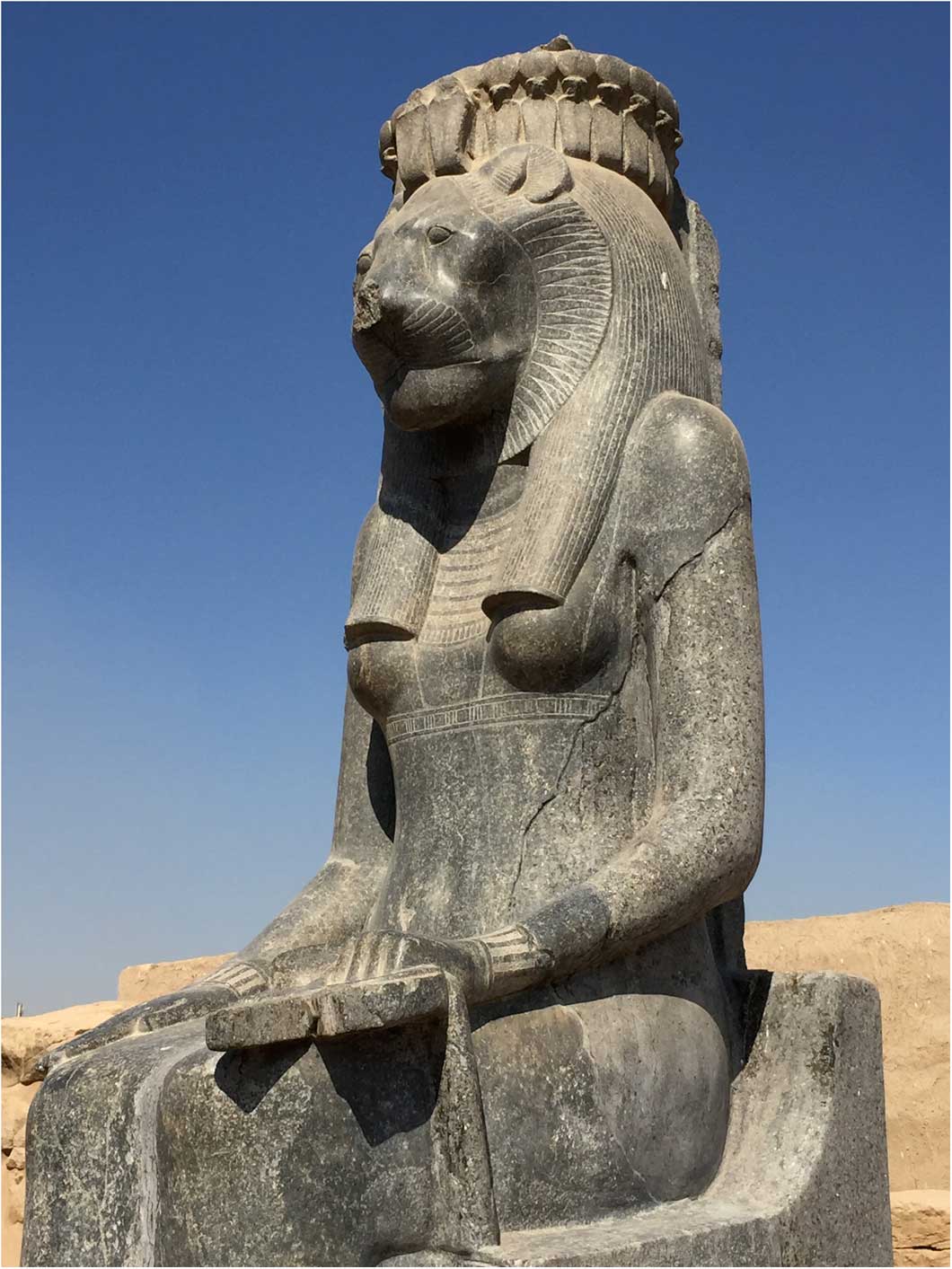
The fragment has recently been restored and photographed, but when it was originally seen in the storerooms it was attached to a stone or concrete block and had two numbers (possibly excavation or collection numbers) painted onto the forehead – ‘105’ painted in white and ‘194’ in red below it.Footnote 22 No information relating to these numbers or the origin of the fragment could be uncovered in the museum archives. While it is not known where or when the fragment was uncovered and entered the museum’s collection, the unusual uraei crown may suggest its origin was Luxor, as it seems to correspond to similar examples found at both the Mut Temple and Kom el-Hettan. A large seated statue of Sekhmet with uraei crown was uncovered at the Mut Temple by Margaret Benson and Janet Gourlay in the 1890s in the second court of the temple, where it can still be seen today (figs 6 and 7).Footnote 23 This statue, which was later re-inscribed for Sheshonq i (945–924 bc; twenty-second dynasty), was conserved and restored by the American Research Center in Egypt (ARCE) in 2013. The upper torso of another example of this larger type of Sekhmet with uraei crown (inventory number 6500) was found at Kom el-Hettan, in the vicinity of the peristyle court and hypostyle hall in 2006 (fig 8).Footnote 24
Restored statue of Sekhmet with uraei crown at the Mut Temple, in Karnak, Egypt. Photograph: Tara Draper-Stumm, 2016.

Side detail of restored statue of Sekhmet at Mut Temple. Photograph: Tara Draper-Stumm, 2016.

Fragment of Sekhmet statue with uraei crown no. 6500, found at Kom el-Hettan, Egypt. Photograph: © Copyright The Colossi of Memnon and Amenhotep III Temple Conservation Project/Antoine Chéné.

CONCLUSION
It is possible that these larger statues were originally grouped together at Amenhotep iii’s funerary temple at Kom el-Hettan. They may also have been placed in front of the pylons at the Mut Temple, which may be suggested by a depiction of the Mut Temple precinct in the Ramesside period tomb of Khabekhnet (TT2) at Deir el-Medina, and they may have had a role to play during the Festival of Drunkenness, which took place at the Mut Temple from the New Kingdom onwards.Footnote 25 Dr Betsy Bryan has also suggested that these larger Sekhmet statues may have been paired with similarly proportioned statues of Amenhotep iii and Queen Tiye found at the Mut Temple in the second court and which had been altered, re-inscribed and re-used in later periods.Footnote 26
Whatever their later use may have been, it seems clear from their size and unusually elaborate uraei crowns that these were a special group within the vast corpus of Sekhmet statuary, which, if surviving numbers are a guide, numbered well over 700 statues. British Museum fragment EA 90784 is, therefore, a rare and valuable addition to our overall understanding of the Sekhmet statues of Amenhotep iii. Further study of this and other Sekhmet statues in the British Museum, along with those in other museums and private collections, may eventually unlock the key to why Amenhotep iii commissioned so many statues of this goddess, and what their original function was.
ABBREVIATIONS & BIBLIOGRAPHY
Abbreviations
- ASAE
Annales du Service des Antiquités de l’Egypte
- ARCE
American Research Center in Egypt
- BM
British Museum, London
- EA
Egyptian Archaeology
- KMT
KMT A Modern Journal of Ancient Egypt
- MDAIK
Mitteilungen des Deutschen Archäologischen Instituts Abteilung Kairo
- PSBA
Proceedings of the Society of Biblical Archaeology
Primary sources
1822. A Catalogue of the Valuable Collection of Antiquities of Mr John Belzoni, in Egypt, Nubia, &c which will be sold by Auction by Mr Robins; at the Egyptian Hall, Piccadilly on Saturday, the 8th of June, 1822 at Twelve o’Clock, London
1809–1811. Description de L’Égypte ou Recuil Des Observation et Des Recherches qui ont été Faite en Égypte Pendant l’Expedition de L’Armée Française, vols I & III, L’Imprimerie Impériale, Paris
BM, Birch Slips, Egyptian Saloon Catalogue, 517–53 and 574–608.