Introduction
Geriatric rehabilitation is an important aspect of care of older adults. As the population ages, the need for appropriate geriatric rehabilitation services will also grow (Melton, Reference Melton2003). At the same time, healthcare facilities must achieve clinically meaningful results with limited resources. Given this socioeconomic context, clinicians in this area have strived to better understand the variables associated with rehabilitation outcomes in order to select the most suitable candidates for rehabilitation services (Wells et al., Reference Wells, Seabrook, Stolee, Borrie and Knoefel2003). A number of factors – including age, cognitive status, medical complexity, and mood – are known to play a role in rehabilitation outcome (Patrick et al., Reference Patrick, Leber and Johnston1996; Reference Patrick, Gaskowski and Rexroth2002a; Heruti et al., Reference Heruti, Lusky, Barell, Ohry, Adunsky and 1999; Wells et al., Reference Wells, Seabrook, Stolee, Borrie and Knoefel2003). Of these issues, cognition has perhaps garnered the most interest and is currently most often investigated as a predictor of rehabilitation outcome (Landi et al., Reference Landi2002; Ghisla et al., Reference Ghisla, Cossi, Timpini, Baroni, Facchi and Marengoni2007; Hershkovitz et al., Reference Hershkovitz and Brill2007) and discharge disposition (MacNeill et al., Reference MacNeill, Gerskovich, Caron and Lichtenberg1997; Patrick et al., Reference Patrick, Perugini and Leclerc2002a).
The Mini-Mental State Examination (MMSE) is perhaps the best-known measure of cognition and is often an integral part of the geriatric assessment (Schultz-Larsen et al., Reference Schultz-Larsen, Lomholt and Kreiner2007). It has been extensively validated and is highly appealing due to its ease of administration. As such, it is the assessment tool most often used by researchers in this area. However, the MMSE cannot always detect mild cognitive deficits, and it has been criticized for its lack of attention to certain aspects of cognition (e.g. Tombaugh and McIntyre, Reference Tombaugh and Mclntyre1992; Nasreddine et al., Reference Nasreddine, Philips, Bedirian, Charbonneau, Whitehead and Collin2005).
The Montreal Cognitive Assessment (MoCA), a newer screening measure, assesses a broader range of domains and was specifically developed to assist in detecting mild cognitive changes (Nasreddine et al., Reference Nasreddine, Philips, Bedirian, Charbonneau, Whitehead and Collin2005). To date, however, there is still only limited published data on the use of the MoCA in various clinical populations, and still less is known about the relation between MoCA scores and patients’ everyday function. Studies with Parkinson's disease patients (Zadikoff et al., Reference Zadikoff2008; Nazem et al., Reference Nazem2009), cancer patients (Olson et al., Reference Olson, Chhanabhai and McKenzie2008), patients with cerebrovascular disease (Martinic-Popovic et al., Reference Martinic-Popovic, Serci and Demarin2007) and community-dwelling cohorts (Liu-Ambrose et al., Reference Liu-Ambrose, Ashe, Graf, Beattie and Khan2008; Luis et al., Reference Luis, Keegan and Mullan2009) suggest that the use of the MoCA results in a wider range of scores than the MMSE, and that patients score below the cut-off on the MoCA more often than on the MMSE, reflecting a higher degree of sensitivity to cognitive impairment (Olson et al., Reference Olson, Chhanabhai and McKenzie2008; Zadikoff et al., Reference Zadikoff2008; Luis et al., Reference Luis, Keegan and Mullan2009; Nazem et al., Reference Nazem2009). The MoCA exhibits high sensitivity (100%) and specificity (87%) in distinguishing between normal cognitive status, mild cognitive impairment and dementia of the Alzheimer's type (Nasreddine et al., Reference Nasreddine, Philips, Bedirian, Charbonneau, Whitehead and Collin2005) using the recommended cut-off of 26/30. There is also evidence that the sensitivity of the MoCA can be further optimized by using an even lower cut-off score of 23/30 as recent studies have found some cognitively intact individuals to score below 26/30 (Lee et al., Reference Lee2008; Luis et al., Reference Luis, Keegan and Mullan2009). Furthermore, analyses of the component subscales of MoCA have also proven useful in increasing the predictive ability of this tool (Hoops et al., Reference Hoops2009; Fullam et al., Reference Fullam, Howard, Pridham, Callaghan, Craufurd and Thompson2010). Regardless of the cut-off point or component subscales used, increased sensitivity in detecting cognitive impairment is important for implementing early intervention (Kidd, Reference Kidd2008); moreover, from a functional point of view, mild cognitive impairment identified using the MoCA may be related to an increased risk of falls (Liu-Ambrose et al., Reference Liu-Ambrose, Ashe, Graf, Beattie and Khan2008). The MoCA may also be a better tool when tracking cognitive status and decrements over time (Martinic-Popovic et al., Reference Martinic-Popovic, Serci and Demarin2007).
To our knowledge there are no published studies on the use of this measure in a geriatric rehabilitation sample. The increasing use of this measure means that clinicians and researchers must further examine its psychometric characteristics, including how it relates to other indicators of cognitive status, as well as its value in anticipating functional status and rehabilitation outcome in this particular clinical group.
In the context of rehabilitation, functional status and rehabilitation outcomes are evaluated in various ways. One of the most commonly used functional assessment tools is the Functional Independence Measures (FIM; Dodds et al., Reference Dodds, Martin, Stolov and Deyo1993). The FIM is a scale designed to determine the patient's level of disability, as reflected by the need for assistance. Patients participating in a rehabilitation program obtain higher FIM scores as their level of independence grows. This indicator of function can then be used to evaluate successful rehabilitation outcome. Rehabilitation outcome may be considered in terms of absolute and relative functional gains. Absolute functional gains (AFG) and AFG while controlling for length of stay, referred to as absolute functional efficiency (AFE), are two indicators that evaluate in raw terms how much a patient improves over the course of rehabilitation. That is, it simply reflects the total amount of points gained on the FIM during the patient's stay in the rehabilitation program. However, measures of absolute gain fail to account for the wide variability that exists in functional ability at the time of admission, leading to difficulty in interpreting change scores (Ottenbacher et al., Reference Ottenbacher, Mann, Granger, Tomita, Hurren and Charvat1994) when the potential for improvement is more limited in higher functioning patients (ceiling effect). In order to overcome these limitations, researchers have proposed indicators of relative functional improvement, which take into account the patient's actual potential for change (Drubach et al., Reference Drubach, Kelly and Taragano1994). These indicators, known as the Montebello Rehabilitation Factor Scores (MRFS), include a measure of relative functional gains (RFG) and relative functional efficiency (RFE). Specifically, the measure of RFG takes into account the difference between the maximum possible and admission FIM scores, while the RFE further takes in account the length of stay. These scores allow the extreme variations in functional ability reported at admission, and associated potential for functional change, to be controlled statistically.
In terms of efficiency, criterion-based and self-relative objectives have been proposed. The criterion-based approach suggests that successful rehabilitation patients should gain one FIM point per day (that is an AFE above 1.0) whereas satisfactory self-relative gains calculated using the MRFS method imply having achieved 50% of the individual's possible potential for improvement (that is an RFG or RFE score greater than 0.5) (Heruti et al., Reference Heruti, Lusky, Barell, Ohry, Adunsky and 1999). From a clinical standpoint, successful rehabilitation outcome may also be considered in terms of discharge disposition (e.g. returning home after rehabilitation as opposed to being discharged to a supportive facility). As such, the goals of a rehabilitation program are to have their patients gain at least one FIM point per day, achieve a relative improvement of 50% of potential gain, and be well enough to return home.
The objective of the present study was to determine the applicability of the MoCA to a geriatric rehabilitation sample. More specifically, the aims were to: (a) evaluate the psychometric characteristics of the MoCA as a screening tool with a cohort of patients participating in a specialized in-patient geriatric rehabilitation program, and (b) evaluate the association between mental status, as measured by the MoCA, and rehabilitation outcome. First, we hypothesized that associations between the MoCA, the MMSE and the FIM, specifically its cognitive subscale, would be significant. Given the MoCA's assessment of a wider range of cognitive domains, we also hypothesized that the MoCA would be more sensitive to impairment than the MMSE and the Cognitive FIM, that it would be associated with functional status, and that it would discriminate well between patients who achieve successful outcomes in rehabilitation and those who do not.
Methods
Setting and participants
Participants were a convenience sample of 47 patients admitted to the geriatric rehabilitation inpatient service at Bruyère Continuing Care, Ottawa, Canada. This service adopts an interdisciplinary treatment approach designed to optimize independent function in frail older adults. For the purposes of this study, patients with aphasia, a diagnosis of delirium upon admission, and those who could not effectively communicate in English were excluded.
Participants were on average 83.5 years old (range 70 to 102 years, SD = 6.38) with a mean of 12.5 years of education (range 7 to 24 years, SD = 3.53). Sixty-eight percent were female. In most cases (62%), an orthopedic injury was cited as the health condition responsible for admission to the unit. Neurological conditions prompted the admission in 19% of cases and the remaining patients were admitted for management of medically complex conditions (11%), and cardiac issues (4%). Average total FIM at the time of admission was 70.4 (SD = 11.91). Patients had an average length of stay on the unit of 41 days (SD = 15.13). Although this is a convenience sample, the sample characteristics are consistent with program census data showing that patients in our program are on average 83 years old, score 70 on the admission FIM, and stay in the program for an average of 41days. On average, the patients received 30 active therapy days. Moreover, with the exception of the length of stay (which is now shorter), our sample characteristics are consistent with those described in other published studies conducted with patients from this program (see Patrick et al., Reference Patrick, Perugini and Leclerc2002a).
Procedure
As part of the admission process, interdisciplinary team members completed a comprehensive assessment of each patient's functional status in terms of self-care, mobility, and cognition, using the FIM. Mental status examinations (MMSE and MoCA) were administered by a research assistant as soon as possible after admission. Participants then completed the rehabilitation program, which typically consisted of daily physiotherapy, occupational therapy several times per week, engagement in structured social activities, and implementation of therapeutic strategies within day-to-day activities, with the help of the nursing staff. Patients’ functional and mental status were reassessed by the research assistant within a few days of discharge. Information related to discharge destination, illness burden (comorbidity) and depressive symptomatology was also obtained from the medical chart.
Measures
Mini-mental Status Examination (MMSE; Folstein et al., Reference Folstein, Folstein and McHugh1975): The MMSE is a well-established, reliable, valid and brief cognitive screening instrument. It measures orientation, memory, language abilities, attention and visuo-construction and requires 5 minutes to administer.
Montreal Cognitive Assessment (MoCA, Nasreddine et al., Reference Nasreddine, Philips, Bedirian, Charbonneau, Whitehead and Collin2005): The MoCA is a relatively new 30-point test administered in 10 minutes. The MoCA assesses orientation, short-term memory, visuo-spatial abilities, attention/concentration, language, and aspects of executive functioning. Data on its psychometric properties are limited, but preliminary results suggest that it has good test-retest reliability (+/- 1 point) and internal consistency (0.83) (Nasreddine et al., Reference Nasreddine, Philips, Bedirian, Charbonneau, Whitehead and Collin2005).
Functional Independence Measure (FIM): The FIM is an ordinal scale used to determine the patient's level of ability, as reflected by their need for assistance and/or aids during the execution of activities of daily living (Dodds et al., Reference Dodds, Martin, Stolov and Deyo1993). It is composed of 18 items: 13 functional or motor activities and five communication/cognitive components. The scores are based on observations or evaluations done by rehabilitation staff, and each item is rated from 1 to 7, with higher scores reflecting increased autonomy. Scores can be reported as Total FIM score (range 18–126) or subscores, including Motor FIM (sum of scores on motor items) and Cognitive FIM (sum of scores on cognitive items). In addition, the FIM scores serve as the basis for calculating gain and efficiency scores as described above (see Table 1).
Glossary of scores

Note: Motor and Cognitive FIM scores are calculated by summing the patient's scores on the motor and cognitive FIM items only
FIM = Functional Independence Measure
Discharge disposition: This information was extracted from the health record and defined according to the National Rehabilitation Reporting System criteria (Canadian Institute of Health Information, 2010). As such, the patient's “post discharge living setting” was retained and defined as living alone with or without health services and living in a facility (i.e. retirement home or long-term care).
The Cumulative Illness Rating Scale (CIRS): The CIRS is a measure of medical comorbidity which provides an estimate of illness burden. Physicians use a 5-point scale (0–4) to rate the severity of pathology in each of 13 categories (systems such as cardiac, respiratory, renal, musculo-skeletal and psychiatric). The total Cumulative Illness Rating Score (TCIRS) was used and was obtained by summing the ratings across all categories (i.e. scores can range from 0 to 52). Higher scores are indicative of greater medical complexity. Studies have demonstrated adequate psychometric properties, including in geriatric samples (Knoefel et al., Reference Knoefel, Helliwell, Seabrook, Borrie, Stolee and Wells2003).
Geriatric Depression Scale – Short Form (GDS): The GDS is a measure of depressive symptomatology. The abbreviated version, developed by Brink et al. (Reference Brink, Yesavage, Lum, Heersema, Adey and Rose1982), is designed for use with physically ill older patients. The use of the short form yields results comparable to the original form. Possible scores range between 0 and 15, with scores of 5 and above being indicative of at least mild depressive symptomatology.
Statistical analyses
Descriptive statistics were used to outline our sample's cognitive, emotional, medical and functional status. In order to evaluate differences in performance on both screening measures, we applied independent samples t-tests. Paired t-tests were used to ascertain changes in scores over time. Bivariate correlations were used to assess the degree of association among the variables. Regression analyses were also performed to evaluate the ability of the cognitive measures to predict rehabilitation outcome. Quantitatively, successful rehabilitation was defined as RFG > 0.5. Clinically, successful rehabilitation was defined as discharged home with or without health services. Using these definitions, we applied independent group t-tests in order to compare the admission mental status scores of patients who would be deemed successful rehabilitation clients with those of patients who had not attained these criteria for success. Sensitivity and specificity of the cognitive measures for detecting successful rehabilitation candidates were derived using cross-tabulations.
Results
Cognitive, emotional and medical status of rehabilitation patients
The mean MMSE score at the time of admission was 26.22 (SD = 3.09) whereas the mean MoCA score at admission was 21.94 (SD = 4.41). Patients scored slightly higher on mental status testing at discharge, with a mean of 27.53 on the MMSE (SD = 2.57) and a mean of 23.68 on the MoCA (SD = 4.09). Using the recommended cut-off score of 26/30 on the MoCA resulted in only 25% of our sample having “normal” cognitive status at the time of admission. In contrast, 80% of our sample would be considered to have “normal” cognitive status when using the traditional guidelines for the MMSE (≥ 24/30). The difference in proportions is significant, χ2(1, N = 47) = 26.64, p < 0.001. At the time of discharge, the proportion of patients scoring normally on the MMSE remained relatively stable (82%) whereas 39% of the patients achieved a “normal” score on the MoCA after rehabilitation. The difference in proportions is again significant, χ2(1, N = 34) = 17.75, p < 0.001.
Unfortunately, because of incomplete clinical documentation, data pertaining to illness burden and depression were only available for a portion of our sample. A total score on the CIRS was available for 27 patients, while the GDS score was obtained for only 13 of our patients. Based on the available data, the mean CIRS was 15.15 (SD = 3.29) and the mean GDS score was 2.69 (SD = 2.32).
Functional and rehabilitation outcomes
For the total sample, mean total FIM at admission was 70.36 (SD = 11.99), mean total FIM at discharge was 102.00 (SD = 14.76), mean AFE was 0.88 (SD = 0.30), mean RFG was 0.59 (SD = 0.15) and mean RFE was 0.02 (SD = 0.01) based on obtained functional outcomes.
Patients gained an average of 31 points (SD = 8.52) on the FIM during their stay in the rehabilitation service, a statistically significant improvement (t = 18.17, p < 0.001). Based on raw FIM data, fewer individuals met criteria for successful rehabilitation (38% of patients achieved an AFE > 1.0) than when the actual potential for gain was considered (75% of patients achieved an RFE > 0.5). The discharge destinations for this sample were varied: 28% were discharged home without services, 45% were discharged home with services, 11% were discharged to assisted living, and 13% went to unknown destinations.
Psychometric properties of the MoCA
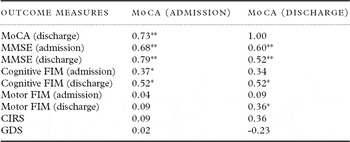
The mean change in MoCA was 1.52 (SD = 2.96), which was statistically significant (t = -3.02, p<0.005). MoCA scores at admission were highly correlated with those documented at discharge, along with other measures of cognition (MMSE and Cognitive FIM) at both admission and discharge (Table 2). Correlations between the MoCA and Motor FIM scores, CIRS, and GDS did not reach statistical significance.
Correlations between MoCA scores and other measures

* p<0.05; **p<0.005
MoCA = Montreal Cognitive Assessment; MMSE = Mini-Mental State Examination; FIM = Functional Independence Measure; CIRS = Cumulative Illness Rating Score; GDS = Geriatric Depression Scale
Relationship between mental status and rehabilitation outcome
MMSE score at admission was significantly correlated with AFG (r = 0.41, p<0.009), though the MoCA was not. Neither of the admission mental status scores correlated significantly with AFE. Significant positive associations were found between admission mental status testing and RFG (MMSE, r = 0.56, p < 0.001 and MoCA, r = 0.40, p < 0.01).
We compared the mental status of patients who successfully completed rehabilitation with those patients who did not. Success was defined on the basis of efficiency and relative efficacy, with successful completion of rehabilitation defined as AFE >1.0 and an RFE >0.5, respectively. Patients who successfully completed rehabilitation performed similarly on both mental status measures (MMSE, t = -0.21, p = 0.83; MoCA, t = 0.81, p = 0.94). However, when the subscale scores of the MoCA at admission were simultaneously regressed on AFE, attention was found to be uniquely predictive of rehabilitation success while controlling for the other subscales (β = -0.55, t = 2.52, p < .05).
When defining successful rehabilitation on the basis of relative efficacy, those who achieved successful rehabilitation obtained significantly higher scores on the MMSE than those who did not attain this level of efficacy (t = -3.11, p < 0.001). A trend in the same direction was also seen for the MoCA (t = -1.92, p = 0.06). At admission, the MoCA scores of patients who were discharged home (with and without health services) did not differ significantly from those of patients who were ultimately discharged to a facility (nursing home or retirement home) (t = 0.96, p = 0.34).
Sensitivity and specificity
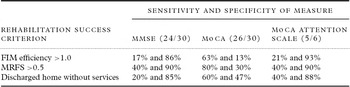
Using the recommended cutoff score of 26 on the MoCA (i.e. scores ≤25 indicated impairment), a cutoff of 24 on the MMSE and a cutoff of 5 on the attention scale of the MoCA (the only uniquely predictive subscale), we divided the sample into those with normal MoCA, MMSE and attention scores and those with one or more abnormal scores at the time of admission. Similarly, rehabilitation outcomes were dichotomized as successful or unsuccessful on the basis of FIM efficiency scores, MRFS scores, and discharge disposition, using the criteria outlined above. Sensitivities and specificities within these parameters are presented in Table 3.
Sensitivity and specificity of measures

MoCA = Montreal Cognitive Assessment; FIM = Functional Independence Measure; MRFS = Montebello Rehabilitation Factor Scores
One drawback with the analyses outlined above is that many patients in our sample (75%) performed below the recommended cut-off of the MoCA. A lower cutoff has been used to overcome this finding (e.g. MoCA (23/30); Lee et al., Reference Lee2008; Luis et al., Reference Luis, Keegan and Mullan2009). We repeated sensitivity and specificity analyses using this alternative cut-off score, and found a sensitivity of 54% and a specificity of 33% in identifying patients who do not achieve optimal efficiency during rehabilitation. Sensitivity and specificity improved to 80% and 47%, respectively, when identifying patients who did not achieve the desired level of relative gains. In looking at discharge destination (i.e. unsuccessful discharge vs. successful discharge), we found 100% sensitivity and only 29% specificity.
Discussion
The purpose of the current study was to evaluate the applicability and relevance of the MoCA to a geriatric rehabilitation sample, a population in which the MoCA has yet to be evaluated. The psychometric properties of the MoCA as a screening tool for cognitive impairment were examined with a cohort of patients in a specialized inpatient rehabilitation program. The association between mental status, as measured by the MoCA, and rehabilitation outcome was also assessed. The results were compared to that of the MMSE in terms of each instrument's ability to predict functional gain and to detect cognitive impairment.
This study provided evidence of the construct validity of the MoCA in this population, finding significant correlations between MoCA, MMSE and FIM cognitive scores (0.68 and 0.37, respectively). However, we also found substantial differences between these screening measures. Based on the MMSE, 80% of the sample was found to score in the normal range of cognitive function, while only 25% of patients displayed “normal” cognitive status based on the MoCA. Therefore, many individuals assessed as cognitively intact according to the most widely used screening instrument for cognitive impairment (the MMSE) are likely to display some level of impairment when assessed on a more comprehensive and sensitive cognitive measure. Although the MMSE was not developed to detect MCI, it remains a widely used instrument, and our results suggest that the earliest stages or milder forms of cognitive impairment in this population may go unrecognized in routine rehabilitation settings (Nazem et al., Reference Nazem2009).
In certain studies, cognitive impairment – defined by low scores on mental status questionnaires – has been found to correlate with limited functional gains and suboptimal rehabilitation outcome in older adult patients (e.g. Heruti et al., Reference Heruti, Lusky, Barell, Ohry, Adunsky and 1999; Landi et al., Reference Landi2002; Ghisla et al., Reference Ghisla, Cossi, Timpini, Baroni, Facchi and Marengoni2007). Conversely, other studies have shown that patients with mild to moderate cognitive difficulties can profit from geriatric rehabilitation services (e.g. Diamond et al., Reference Diamond, Felsenthal, Macciocchi, Butler and Lally-Cassady1996; Patrick et al., Reference Patrick, Leber and Johnston1996; Goldstein et al., Reference Goldstein, Strasser, Woodard and Roberts1997). Given these disparate findings, the implications of cognitive impairment within the framework of geriatric rehabilitation services have been unclear and further research was needed to clarify the clinical association between cognition and rehabilitation outcome.
The current study found that rehabilitation success differed between cognitively impaired and intact patients. Results showed that less cognitively impaired patients had better relative functional gains. More specifically, those who attained successful rehabilitation criterion, again defined by relative efficacy, were found to score significantly higher on the MMSE with a strong trend in the same direction for the MoCA. This finding is consistent with other studies (Heruti et al., Reference Heruti, Lusky, Barell, Ohry, Adunsky and 1999; Reference Heruti, Lusky and Dankner2002) that have found cognitively impaired patients to benefit less from rehabilitation programs. Given this association, the MoCA may prove more useful in improving rehabilitation treatment planning and outcome by identifying even mild cognitive impairment.
Additionally, the attention subscale of the MoCA was uniquely predictive of absolute functional efficiency when controlling for the other scales of the MoCA. The relationship between attentional abilities and rehabilitation outcome has been established by previous research. McDowd et al. (Reference McDowd, Filion, Pohl, Richards and Stiers2003) found that lower attention scores were associated with a more negative impact of stroke on daily functioning. An association has also been reported between attention and functional status two years after stroke rehabilitation (Robertson et al., Reference Robertson, Ridgeway, Greenfield and Parr1997), as well as with rehabilitation outcome following a brain aneurysm (Bottger et al., Reference Bottger, Prosiegel, Steiger and Yassouridis1998). Finally, even mild deficits in attention have proven to be a barrier to treatment adherence and, hence, rehabilitation outcome (Paolucci et al., Reference Paolucci, Antonucci, Guariglia, Magnotti, Pazzamigli and Zoccolotti1996). These results are consistent with our finding that attention, measured by the MoCA, is uniquely predictive of rehabilitation outcome in a geriatric rehabilitation sample and that, therefore, attentional abilities may need to be attended to specifically in post-stroke rehabilitation.
It should be noted that these results contradict some previous research that reports no association between cognitive impairment and changes in functional gain. However, unlike the present study, these previous studies used only the absolute gain to evaluate rehabilitation outcome (Diamond et al., Reference Diamond, Felsenthal, Macciocchi, Butler and Lally-Cassady1996; Goldstein et al., Reference Goldstein, Strasser, Woodard and Roberts1997). The use of an absolute score does not control for the extreme variations in functional ability reported at admission. As a result, using absolute numbers to calculate change is subject to misinterpretation because of the potential ceiling effect (Ottenbacher et al., Reference Ottenbacher, Mann, Granger, Tomita, Hurren and Charvat1994). Patients with lower FIM scores at admission can make the largest range of improvement during rehabilitation, while higher admission FIM scores have a smaller range in which to improve. This ceiling effect was overcome in the present study through the use of a relative index (MRFS). This accounts for each individual's relative potential for improvement during rehabilitation.
Although these results indicate better outcomes for cognitively intact patients, it is important to emphasize that individuals with cognitive impairment also benefited from the rehabilitation program, as demonstrated by their absolute functional gains. This is a significant point because rehabilitation programs have excluded patients with cognitive problems (Gray, Reference Gray2000). Consistent with many other studies, our results indicate that patients with cognitive impairment should not be excluded from rehabilitation programs (Diamond et al., Reference Diamond, Felsenthal, Macciocchi, Butler and Lally-Cassady1996; Heruti et al., Reference Heruti, Lusky, Barell, Ohry, Adunsky and 1999; Reference Heruti, Lusky and Dankner2002; Hershkovitz and Brill, Reference Hershkovitz and Brill2007), because these patients can still make significant gains. It is possible that cognitively impaired patients would benefit from a more specialized geriatric rehabilitation program (Heruti et al., Reference Heruti, Lusky and Dankner2002) or from more intense rehabilitation (Barnes et al., Reference Barnes, Conner, Legault, Reznickova and Harrison-Felix2004). Regardless of the strategy used in treatment planning, it is clear that the use of a reliable, valid, and brief cognitive screening instrument for patients entering a geriatric rehabilitation setting is essential.
Important differences were observed in the ability of these measures to identify patients correctly who would go on to achieve successful rehabilitation. Rehabilitation outcomes were dichotomized as successful or unsuccessful on the basis of relative functional gains (RFG scores >0.5). On this basis, the specificity of the MoCA was limited (30%), while the sensitivity was moderate (80%). Using a cut-off of 5/6, the attention subscale of the MoCA was found to have limited sensitivity (40%) but excellent specificity (90%). Results were similar when using functional efficiency and discharge destination as the criterion for successful rehabilitation, with the MoCA displaying high sensitivity and the MMSE and attention subscale displaying better specificity and limited sensitivity. In concert, these results suggest the MoCA can have a considerable advantage over the MMSE in sensitivity, and equivalent specificity, if both the total score and the attention score are used. The MoCA may thus be the more useful measure to assess a wide range of cognitive impairment and predict rehabilitation outcomes in a geriatric rehabilitation population.
Our findings are consistent with those of previous studies that have identified difficulties with the MMSE in detecting milder forms of cognitive impairment (e.g. Ihl et al., Reference Ihl, Frolieh and Martin1992; Tombaugh and McIntyre, Reference Tombaugh and Mclntyre1992; Wind et al., Reference Wind1997; Nasreddine et al., Reference Nasreddine, Philips, Bedirian, Charbonneau, Whitehead and Collin2005). Even patients suffering from a dementing illness may achieve a perfect score on the MMSE (Shiroky et al., Reference Shiroky, Hyman, Bergman and Chertkow2007). Given the close relationship between cognitive status and functional impairments, it may be beneficial to utilize a tool that is more sensitive to mild to moderate cognitive impairments. The substantial difference in sensitivity between the MoCA and the MMSE is likely the result of the broader range of cognitive domains assessed and the higher difficulty of the MoCA relative to the MMSE.
The present study provided evidence of the validity and sensitivity of the MoCA in identifying patients who would go on to have successful rehabilitation outcomes. However, certain limitations must be acknowledged. Most importantly, because neuropsychological testing (which is the gold standard for assessing cognition) was not employed, it cannot be definitively stated that lower scores on the MoCA are detecting meaningful cognitive differences. Furthermore, short- and long-term follow-up will be necessary to examine eventual outcomes in the study population in terms of both cognitive decline and rehabilitation outcome. A potential bias in this study could also have resulted from non-randomization and the inclusion of a convenience sample, leading to difficulty in generalizing the results to the total population. However, this sample is consistent with previous studies of this population (Patrick et al., Reference Patrick, Perugini and Leclerc2002b) and is therefore likely to be a typically representative sample.
In summary, this study shows a significant association between cognitive status at admission to a rehabilitation program and rehabilitation outcome. This should encourage the regular and consistent use of a cognitive measurement scale such as the MoCA or MMSE upon admission to such a program. Our results provide the first evidence of the construct validity of the MoCA, as well as good test-retest reliability in a geriatric rehabilitation population. Furthermore, the MoCA can be used to attain greater sensitivity than the MMSE while retaining specificity in identifying patients who go on to achieve a successful rehabilitation outcome on the basis of relative potential gain. Future research should continue to evaluate the MoCA in a larger sample of this population.
Conflict of interest
None.
Description of authors’ roles
L. Sweet designed the study, supervised the data collection and wrote the paper. M. Van Adel and V. Taler assisted with carrying out the statistical analysis and writing the article. The other authors assisted in the design of the study and were responsible for recruiting participants and data collection.
Acknowledgments
The research reported here was supported by a research grant awarded by the Bruyère Academic Medical Organization. Many thanks go to Christine Walter for patient recruitment and assistance in data collection.