Introduction
Caddisflies (Trichoptera) are among the most diverse primary aquatic insects worldwide. Only aquatic Diptera exceed them in number of species (Mackay and Wiggins, Reference Mackay and Wiggins1978). Moor and Ivanov (Reference Moor and Ivanov2008) noted that about 12,627 species were identified by 2006. Caddisflies often dominate in abundance and biomass of aquatic insects in small streams and rivers, thereby constituting an important component of food for fishes. They are also used as indicators of water quality since most caddisflies species require clean water (Dohet, Reference Dohet2002). As such, sound knowledge of the fauna is important for proper management and conservation of inland freshwater ecosystems. However, not much is known about the Trichoptera fauna of Nigeria when compared with that of other West and East African countries. Major studies of the fauna of those countries include Gibbs (Reference Gibbs1973), Statzner (Reference Statzner1984), Johanson (Reference Johanson1992) and Johanson and Oláh (Reference Johanson and Oláh2006). Medler (Reference Medler1980), in a survey of the insects of Nigeria, listed nine families in Nigeria's Trichoptera fauna. Most of them were not identified to the species level. Ever since Medler's (Reference Medler1980) survey, there has been no published comprehensive faunistic study of the caddisflies of Nigeria. In a study of hydropsychid caddisfly larvae in Nigeria, Ogbogu (Reference Ogbogu2001) observed some larvae in a reservoir spillway in Ile-Ife. The larvae were identified only to the generic level and no adult specimen was examined. Subsequently, Ogbogu (Reference Ogbogu2006) reported the presence of Cheumatopsyche digitata (Mosely, 1935) for the first time in Ile-Ife and listed the caddisfly species as part of the hydropsychid Trichoptera fauna of the southwest rain forest belt of Nigeria. Ogbogu (Reference Ogbogu2006) further noted that the species might exist in different forms, co-existing with other hydropsychid caddisflies in streams of this part of the country. A study was also carried out in the Opa River catchment basin in the Ile-Ife area, documenting nine genera in six families (Ogbogu, Reference Ogbogu2007). Again, no adult specimens were examined. The present study therefore intends to identify the adult Trichoptera species occurring in the freshwater ecosystems of Ile-Ife. It also aims to provide useful information on the seasonal abundance and distribution of the caddisfly species in the freshwater ecosystems.
Materials and methods
Study area
Ile-Ife is an ancient city in southwestern Nigeria, located between latitudes 07° 30′–07° 35′N and longitudes 04° 30′–04° 35′E. The area can be described as a local countryside that is predominantly dominated by farmland with a little presence of industrialization. The climate of Ile-Ife is of the moist monsoon (Equatorial type) (Papadakis, 1965; Ojo, Reference Ojo1977). Two major seasons prevail in the Ile-Ife area: dry and wet seasons. The dry season extends from November to March while the rainy season covers the remaining part of the year (Akinbuwa and Adeniyi, Reference Akinbuwa and Adeniyi1996). Heavy rains accompanied by thunderstorms characterize the rainy season, while the dry season is characterized by high temperature and low humidity. The annual rainfall in Ile-Ife ranges from 923 to 2116 mm with a mean of 1389 mm (Adediji, 2002). The average air temperature is between 29.4 and 31.26°C. The vegetation is of the Guineo–Congolian rainforest type (Adeniyi and Olabanji, Reference Adeniyi and Olabanji2005). However, secondary forests and regrowths are found in most parts of Ile-Ife, while gallery forests are found along the river courses. Agricultural practices and other anthropogenic activities have changed the natural vegetation to mainly agricultural mosaic and tree-crop vegetation (Ekanade, Reference Ekanade1984).
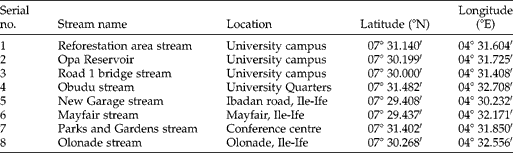
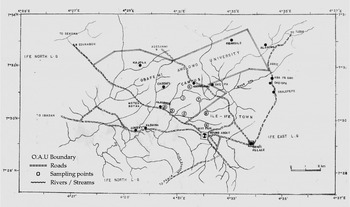
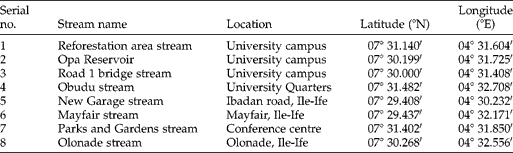
Eight sampling stations (Table 1), located in Ile-Ife, were established for the collection of caddisflies. The sampling stations were located on land, over soil around the riparian vegetation zone perpendicularly upright and just about 5 m from the streams. The stations were selected on the basis of accessibility, proximity to streams and availability of water in the streams all year round (Fig. 1). The selected sampling stations include Reforestation area (station 1), a slow-flowing stream that has a sandy substratum. The canopy cover is about 60%. Common riparian trees include Elaeis guineensis (Arecaceae), Ficus capensis (Moraceae) and Bridelia micrantha (Phyllanthaceae). Opa Reservoir (station 2) is a very large water body with a variety of riparian vegetation. The canopy cover is about 80%. Common trees found around this station include Spondias mombin (Anacardiaceae), Acacia spp. (Fabaceae: Mimosoideae) and Morinda lucida (Rubiaceae). The substratum consists of gravel, sand and larger rocks. Road 1 bridge stream (station 3) is about 15 m wide with a rocky bottom. It is bordered on one side by deciduous woodland mainly comprising Acacia spp., Daniella oliveri (Leguminosae) and some ornamental plants. The canopy cover is about 60%. The stream is situated near a major road. Obudu stream (station 4) is a slow-flowing lowland stream located near residential buildings. Cultivation of food crops and vegetables is prominent here. The canopy cover is about 40%. New Garage (station 5) is a fast-flowing stream, deeply shaded by riparian vegetation that includes D. oliveri and Terminalia spp. (Combretaceae). The canopy cover is about 70%. Mayfair stream (station 6) is a slow-flowing stream with a stony bottom. The canopy cover is about 50%. Fishing activity is prominent here. Parks and Gardens (station 7) is a small, calm stream with a variety of ornamental plants such as Aloe nobilis (Aloaceae), Agave palmeri (Agavaceae) and Aeonium arboreum (Crassulaceae) around its riparian zone. The canopy cover is about 60%. Olonade stream (station 8) is a narrow, calm and slow-flowing stream with a fine sandy substratum. Agriculture is the main activity in this station. The predominant plant in this area is Manihot esculenta (Euphorbiaceae). The canopy cover is about 60%.
Location and description of the sampling stations in Ile-Ife, southwestern Nigeria, for the collection of caddisflies
Map of the study area showing the sampling stations (1–8) for collection of caddisflies. (Inset is the map of Nigeria showing the position of Ile-Ife.)

Collection of caddisflies
Adult caddisflies were collected from the sampling stations with the aid of an improvised light trap adapted from Blahnik and Holzenthal (Reference Blahnik and Holzenthal2004). The light trap comprised white cotton (bed) sheet suspended with a rope between two props and mercury light (18 W LED tube lamp). In addition to the mercury light is a white fluorescent light (18 W LED tube lamp) that provides visible light on the sheet and illuminates the surrounding area. The white light also represents a portion of the electromagnetic spectrum that is not covered by a UV light source, which attracts some caddisfly species. A portable electric power generator (650 W Tiger TG950; Tiger Industrial Group Co., Ltd, China) supplied the energy for the light. Caddisflies were manually collected from the white cotton sheet with collecting jars. The collection of caddisflies lasted for 2 h (usually between 19.00 and 21.00 h) for each sampling occasion at each station. Caddisflies were collected bimonthly between May 2009–April 2010, covering both the wet and dry seasons (each stream was sampled on eight occasions).
Sorting, mounting and identification
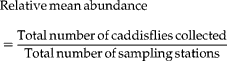
The insects were sorted, preliminarily identified and counted in the laboratory. Thereafter, they were kept in a bottle containing 70% ethyl ethanol. The male genitalia of the caddisfly specimens were removed and cleared. The clearing of the genitalia was done in Pyrex® tubes (15 mm × 125 mm), partially filled with 85% lactic acid, which were heated at a constant temperature of about 130°C for about 30 min on a heating plate. The abdomens of the specimens were removed from the Pyrex tubes with a probe and transferred to a small dish of distilled water (Petri dish size 60 mm × 15 mm). The remains of the specimens were lifted from the fluid, rather than dragged along the sides because they tend to be somewhat fragile after heating. Once submerged in water, a syringe was used to flush any remaining, incompletely macerated tissues from the abdomen. The abdomens were then transferred into glycerine for identification purposes (Blahnik et al., Reference Blahnik, Holzenthal, Prather, Bueno-Soria, Barba-Alvarez and Armitage2007). The cleared genitalia were examined under the microscope and identified using the identification keys suggested by Statzner (Reference Statzner1984) and illustrations described by Tobias and Tobias (2006). The mean relative abundance of caddisflies was calculated by dividing the total number of caddisflies collected for the period by the total number of sampling stations:
 $$\begin{eqnarray} \end{eqnarray}$$
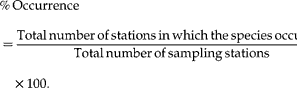
The percentage occurrence (% occurrence) of the species was determined by dividing the total number of sampling stations in which the species occurred by the total number of sampling stations:
 $$\begin{eqnarray} \end{eqnarray}$$
Results
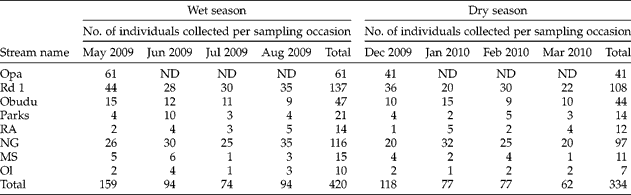
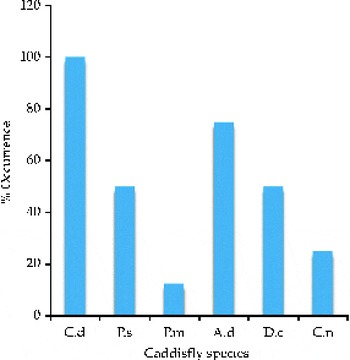
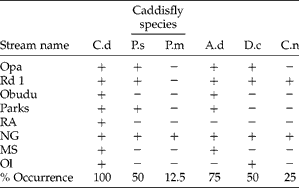
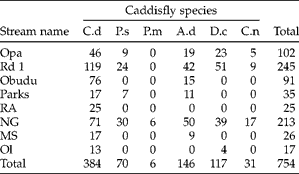
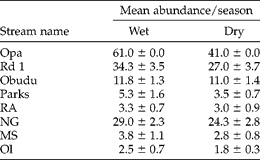
A total of 754 (caddisfly) specimens were collected over the sampling period. Of the total specimens, 420 individuals were collected in the wet period with a mean relative abundance of 52.50, while 334 individuals were collected during the dry season with a mean relative abundance of 41.75 (Table 2). This implies that caddisflies were more abundant over the wet period than during the dry period. Six species of Trichoptera that represent six genera in three taxa were identified. The identified species are members of the Hydropsychidae (Aethaloptera dispar Brauer, 1875, C. digitata (Mosely, 1935) and Polymorphanisus similis Ulmer, 1912), Leptoceridae (Ceraclea njalaensis (Mosely, 1933)) and Dipseudopsidae (Dipseudopsis conformis Navas, 1931 and Pseudoneureclipsis mlangensis Mosely, 1939). Cheumatopsyche digitata was the dominant and most widely distributed species. They were present and abundant in all the sampling stations (Fig. 2). Polymorphanisus similis and D. conformis were found in 50% of the stations. Aethaloptera dispar, C. njalaensis and P. mlangensis occurred in 75, 25 and 12.5% of the sampling stations, respectively (Table 3). A total of 384 individuals of C. digitata were collected, showing the highest frequency of occurrence (51%) relative to the total number of caddisflies collected. A total of 146 individuals of A. dispar were collected, while a total of 117, 70, 31 and 6 individuals of D. conformis, P. similis, C. njalaensis and P. mlangensis, respectively, occurred in the sampling stations (Table 4). This shows that the species accounted for more than half of the total number of individuals collected. Aethaloptera dispar, D. conformis, P. similis and C. njalaensis had a relative abundance frequency of 19, 15, 9 and 4%. However, Pseudoneureclipsis mlangensis was the least abundant and occurred with the lowest frequency of occurrence (0.8%). Only six individuals of P. mlangensis were collected over the sampling period (Table 4). Opa Reservoir recorded the highest abundance of caddisflies with a mean abundance of 61.0, while Olonade stream had the lowest abundance of caddisflies with a mean abundance of 2.5 (Table 5). Road 1, New Garage, Obudu, Parks and Gardens, Mayfair and Reforestation area had mean abundances of 34.3, 29.0, 11.8, 5.3, 3.8 and 3.3, respectively (Table 5).
Seasonal occurrences of caddisflies in the Ile-Ife streams (each stream sampled on eight occasions) in the 2009/2010 wet and dry seasons
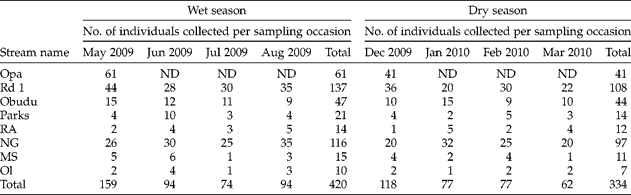
Opa, Opa Reservoir; ND, not determined; Rd 1, Road 1 bridge stream; Obudu, Obudu stream; Parks, Parks and Gardens stream; RA, Reforestation area; NG, New Garage stream; MS, Mayfair stream; Ol, Olonade stream.
(colour online) Distribution of the caddisfly species in the sampling stations in Ile-Ife (relative to the total number of sampling stations). C.d, Cheumatopsyche digitata; P.s, Polymorphanisus similis; P.m, Pseudoneureclipsis mlangensis; A.d, Aethaloptera dispar; D.c, Dipseudopsis conformis; C.n, Ceraclea njalaensis.

Distribution of the caddisfly species in each sampling station in Ile-Ife
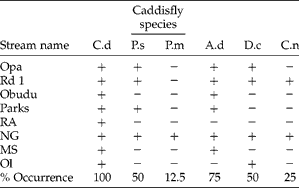
C.d, Cheumatopsyche digitata; P.s, Polymorphanisus similis; P.m, Pseudoneureclipsis mlangensis; A.d, Aethaloptera dispar; D.c, Dipseudopsis conformis; C.n, Ceraclea njalaensis; Opa, Opa Reservoir; Rd 1, Road 1 bridge stream; Obudu, Obudu stream; Parks, Parks and Gardens stream; RA, Reforestation area; NG, New Garage stream; MS, Mayfair stream; Ol, Olonade stream. + indicates the occurrence of the species in the sampling stations; − indicates the absence of the species in the sampling stations.
Individual species of caddisflies collected from each sampling station in the 2009/2010 wet and dry seasons
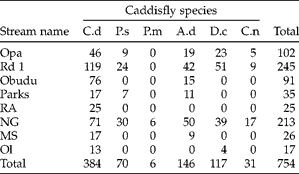
C.d, Cheumatopsyche digitata; P.s, Polymorphanisus similis; P.m, Pseudoneureclipsis mlangensis; A.d, Aethaloptera dispar; D.c, Dipseudopsis conformis; C.n, Ceraclea njalaensis; Opa, Opa Reservoir; Rd 1, Road 1 bridge stream; Obudu, Obudu stream; Parks, Parks and Gardens stream; RA, Reforestation area; NG, New Garage stream; MS, Mayfair stream; Ol, Olonade stream.
Mean abundance and standard deviation of caddisflies collected from each sampling station in the 2009/2010 wet and dry seasons
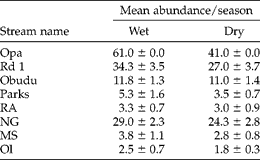
Opa, Opa Reservoir; Rd 1, Road 1 bridge stream; Obudu, Obudu stream; Parks, Parks and Gardens stream; RA, Reforestation area; NG, New Garage stream; MS, Mayfair stream; Ol, Olonade stream.
Discussion
The dominance and widespread distribution of C. digitata in freshwater ecosystems of Ile-Ife can be explained by the fact that they are found in many types of flowing water of varying sizes, currents and temperatures. This species shows a wide range of tolerance to climatic, physical and chemical conditions and is more tolerant to mild pollution of various kinds than are most other Trichoptera species (Anonymous, 2002). The findings in this study further support the earlier observation by Statzner (Reference Statzner1984) that C. digitata is well distributed in streams and rivers in non-mountainous areas and could inhabit intermittent streams where its abundance is usually high. It could also adjust to increases and decreases in stream discharge. This adaptability may explain the abundance, dominance and wide distribution of this species compared with the generally lower occurrence of the members of Dipseudopsidae and Leptoceridae in the present study. The findings of this study also support the results of a survey in northern Thailand (Thapanya et al., Reference Thapanya, Chantaramongkol and Malicky2004), where the Hydropsychidae are more abundant with the highest number of species. Another factor that could also be responsible for the large number of hydropsychids occurring in three stations – Opa Reservoir, New Garage and Road 1 – is the fast-flowing water in these streams, especially during the wet season. High current supports the thorough mixing of the water, a condition usually preferred by hydropsychids (Mackay and Wiggins, Reference Mackay and Wiggins1978).
The relatively lower occurrence of leptocerids represented by C. njalaensis may be due to weak flight ability, weak attraction to a light source and preference for a quiet atmosphere as noted by Novak (Reference Novak and Moretti1981). Crichton (Reference Crichton1960) earlier noted that some Leptoceridae might be less likely to reach a light source under windy conditions because of their weak flight. Human disturbance may also be responsible for the low occurrence of leptocerids in the sampling stations because they are highly sensitive to interference and avoid areas with human disturbance (Carnagey and Morse, Reference Carnagey and Morse2006). Most of the water bodies in the study area are very close to residential and agricultural areas and, as such, the species are prone to human disturbance.
The occurrence of D. conformis and P. mlangensis in the relatively larger water bodies (Opa Reservoir, Road 1 and New Garage) was unanticipated because Wichard (Reference Wichard1995) and Flint et al. (1999) had earlier noted that the Dipseudopsidae prefer small, cool and clear streams. Four individuals were collected from the relatively smaller and clearer streams (Olonade, Reforestation area and Parks and Gardens). This may be because the vegetation around these streams is less dense when compared with the larger streams.
The result of this study is indicative of a poor Trichoptera fauna as only six species were identified. The reasons for this indication are probably anthropogenic in origin. Agricultural practices and other anthropogenic activities, as observed in many of the sampling stations, may have also altered the wide variety of natural habitats and adversely affected the water bodies for the survival of caddisflies. The altered conditions could account for the generally low diversity of caddisflies in the sampling stations. However, the areas with a greater abundance of caddisflies might have benefited partly from more diverse microhabitats available for colonization. Another possible reason for the poor Trichoptera fauna is that the habitats sampled for this order do not have a wide range of aquatic biotopes that would have supported a more diversified fauna. In addition, eight sampling stations might not be adequate to detect all the occurring species, but they were sufficient to recognize the quantitatively and qualitatively poor fauna.
This study adds to the few earlier studies on caddisflies conducted in this part of the country, as adult caddisflies were collected from all major streams in Ile-Ife and were identified to the species level for the first time. This has enabled us to discover the adult caddisfly species that contribute to the Trichoptera fauna in freshwater ecosystems of Ile-Ife. This study also confirms the earlier observation by Ogbogu (Reference Ogbogu2006), which listed C. digitata as part of the hydropsychid Trichoptera fauna in the rainforest belt of southwestern Nigeria and observed that the species may co-exist with other hydropsychid caddisflies (as also observed in this study) in the streams of southwestern Nigeria.
Acknowledgements
The authors are grateful to Isaac Ehiohamale, Dare Ogungbile and Kayode Jegede for their assistance in the collection of the caddisfly samples. Identification of the caddisfly specimen was carried out using appropriate identification keys as listed in the Materials & Methods. Professor S.S. Ogbogu (co-author) is a caddisfly expert.