This paper examines some of the affordances of digitized archives—specifically, that those archives can and should collect, catalogue, and present time-based audiovisual materials in ways distinct from the treatment of both images and texts. My primary focus for this research is historical sound materials, as found in both sound-only and film and video materials—specifically, sound materials in the collection of the State Library of Queensland, that I investigated as the Mittelheuser scholar-in-residence at the State Library of Queensland, part of the Library's Queensland Memory Awards.
My scholarship project was titled “sound as historical material: developing a new way of cataloguing, describing and accessing sound in the archive.” Over the course of this project, now concluded, I developed and suggested to the Library strategies for representing sound materials in their archived collection—both digitised, and yet-to-be-digitised—that would make those sounds better represented, more accessible, and more useable by the public. This means re-thinking to a degree how we treat sound as a material in the first place, and how we catalogue it.
This project arose out of my interest in sound as an affective trigger of past experience, and in using sound as a means to create more evocative narratives of historical place. Sound is both a visceral connection to the past, and the most unknowable thing about the pastFootnote 1. On the one hand, sounds can cause immediate, phenomenological re-living of past events in the present. Far from being intangible, sound is one of the few historical materials that touches the participant - it enters your ear. On the other hand, sounds die quickly, and the majority of sounds made by humans have never been recorded. When we address sounds beyond performance and language, it opens up the possibility of critically and imaginatively addressing the spaces of human life, and the way that we occupy them.
Archived media as archives of narratives
Archived media such as photographs can function as themselves archives of memory, as Van Alphen suggests:
The photograph is not only an archival record, it is also an archive in itself. The photographic image is a spatial configuration of one moment, a configuration that consists of a great number of details. All these details or elements are stored in the image in order to be ordered or classified, leading to one reading or another. Conversely, such use of photographs further illuminates the archive and makes its principles more widely visible and thus common. Acknowledging this double, mutual relationship between photography and the archive, one can say that, in the words of Philip Monk, photographs are lodged and lodging at the same time.Footnote 2
A photography archive is an archive of archives, but in most cases the secondary archive—photo-as-repository—remains invisible, uncatalogued, and undescribed. This secondary archive is necessarily subjective, consisting of personal and social histories, observations, and interpretation. In order to treat the photo-as-repository as an archive, we need to treat narratives as a type of metadata.
The “doubling” relationship of archived photographs — and, I will argue, of other mediated, audiovisual representations in collections and archives — can be recognised not only in academic writing, but in museological practice, through the implementation of community-sourced narrative information, as is being done in various forms around the globe. Collecting these strategies into a single conceptual framework of “emergent archives” — the archives of personal or social histories embedded in a collected object such as a photograph, and the interactions of the public with it — is a useful way to understand and strengthen the particular affordances of the digital archive.
This paper does not suggest a novel method of opening library catalogues to community input, or of radically restructuring these foundational back-stage informational structures to admit of more and more types of metadata on a case-by-case basis. I suggest however that one of the positive aspects of digital collection is community participation; that this participation can take the form of storytelling; and that it will be difficult to fully embrace the power of this distributed, crowdsourced storytelling unless we evolve pragmatic strategies to treat narrative as metadata. Digital archives are foundationally different from physical archives, and the objects they create — digital entries — offer different affordances not only for surface-level community participation, but for deep cataloguing, description, and accessibility. Narrative as metadata is also a useful model for re-cataloguing audio-visual materials, by treating the digitised mediations of those objects as durational materials that can be annotated and “transcribed” in a model borrowed from the digitisation of oral histories.
Ala Rekrut has written extensively on “material literacy” in archival studies—that is, the way that sensitivity to the material aspects of records within an archive can also reveal information about the past:
The physical object is already a conceptual, as well as a physical, “data” object. It is a physical site where a variety of kinds of information reside the most obvious being the written text and images on the surface of the records – but it also bears information about itself as a record-object, about the text and images on its surface, and about the culture which produced, cared for, and used it…
Changes to the records and to their meaning is ongoing, for as David Lowenthal notes: “artifacts are simultaneously past and present; their historical connotations coincide with their modern roles, commingling and sometimes confusing them … . The tangible past is in continual flux, altering, ageing, renewing, and always interacting with the present.Footnote 3
More lately, Burns has extended the concept of material literacy to suggest that it ought also to encompass digitised archives; the digital version of an object, she suggests, has its own nature, history, and presence.
As a marker, the digital image itself is an additional form of metadata for the object, as it captures and preserves not only the content but also the current state of its material existence at a particular moment in time. The digital image solidifies the object in time. Because the original and its digital counterpart age differently, the surrogate essentially provides two versions of the same singular object.Footnote 4
These writers are dealing largely with the digitisation of physical objects, such as photographs. Sound materials in collection go one step further; the original “sound object,” the sound-as-made, necessarily lasts for only a few seconds; if it exists in collection at all, it is by definition already mediated by recording technology. In treating “sound” as historical material, the production and re-production of copies must be a central concern. Unlike other, “tangible” artifactual objects, sound can only be preserved as a copy of itself.
Collected sound and how to find it
The requirements of an “object” that exists only as mediation can be deduced from the nature of sound materials as described in many collections’ catalogues, including that of the State Library of Queensland. In the case of many entries, the object is identified as sound, but the sound itself is not identified. In other cases, the presence of sound is hidden behind one-word entries like “film;” there is no further information even whether the film has sound attached, let along what the sound consists of. The most usual result is, it is possible to search for sound, but not possible to search for particular sounds.
Sounds cannot be digitized and made searchable for content in the same way as text. How then can we make the contents of audio-visual materials visible to the catalogue, and thereby accessible to public search and use? In my project I suggested treating the audio-visual object as an archive in itself, in the manner Van Alpern identifies. Because audio-visual materials are time-based, however, we need a different strategy for exploring that secondary, object-based archive.
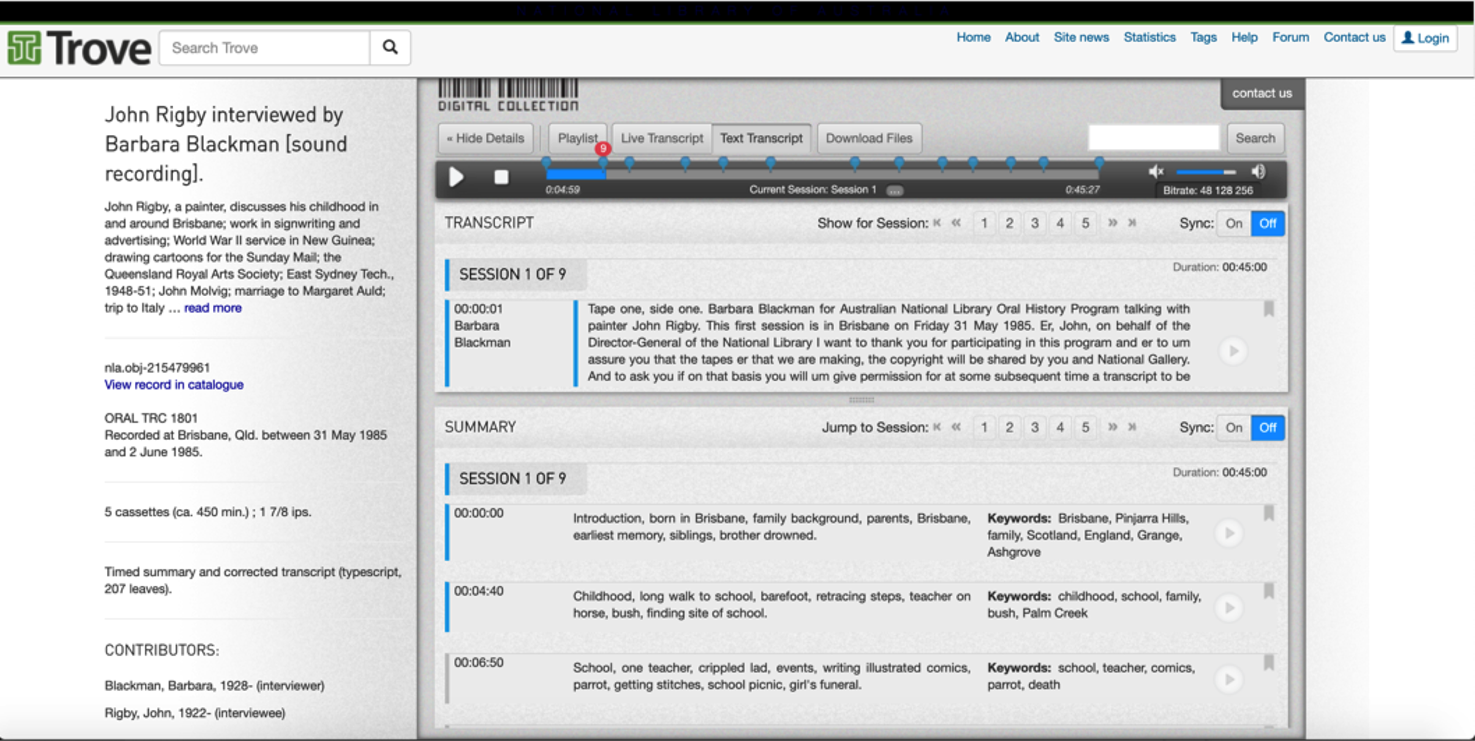
I adapted techniques from the catalogue descriptions of oral histories to suggest that individual audio-visual objects could be “transcribed” in the manner of oral histories, no matter what the sounds. Specifically, I looked at the strategies used at Trove, a collaboration between the National Library and Australia and many other partner ogranisations in Australia that host collections and archive; it is a free online research portal of collection material held in Australia (figure 1). As an initial test case I used a documentary in the John Oxley Collection, Palen Creek: A changing community by John Moloney, and “catalogued” each non-vocal sound in its run time.
An oral history entry in Trove, with transcription and summaryFootnote 5

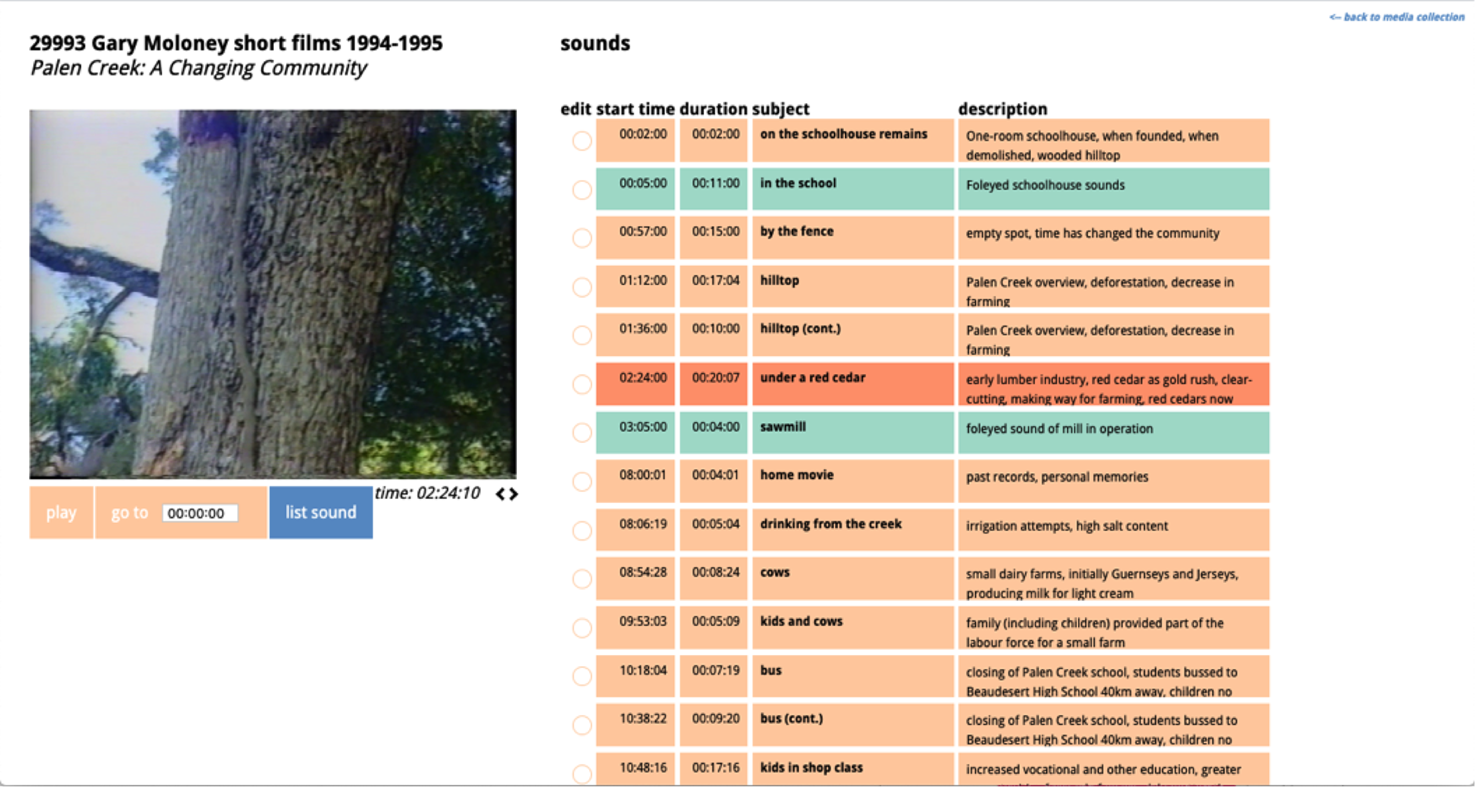
This granular approach to sound materials proved useful in identifying the contents of long time-based media, and in making those contents accessible both through simple search and through auto-generating tags from commonly used identifiers. It became apparent early in the development process that this mode of cataloguing was only deeply useful, however, with the presence not only of the subject matter, but of the description. Historical sound becomes an evocative measure of the past when we are able to contextualise it. In the case of Moloney's documentary, this was easy to achieve, since Moloney helpfully narrated the meaning of his sounds and visuals himself. Thus the sound of a shop classroom becomes the sound of small dairy farms in the area losing their children to good-paying industrial jobs; the “sound” of a lone red cedar in a field evokes the massive forests of red cedar that fell prey to the logging industry, now defunct itself (figure 2).
A web app I created to identify and describe non-vocal sounds in audio-visual materials.

The narrative of historical context was an important component of making sound affective in its evocation of the past. But in other materials the sound was less easily described by those who were not there at the time. Indeed, even the visuals of a home movie, for instance, are often mysterious except at the shallowest level. We see the dirt yard of a country station, but without prior experience we don't know what's just off camera, how near its neighbors are, whether they more ride often ride horses or in cars, et cetera. In fact, the sense of what's happening outside the visual frame is what we often use sound for, to create a fuller sense of place. But without narrative context we don't know how to interpret the sound either; and in some cases there is no sound, or rather, the sound is the unnatural silence of soundless film media.
As the project progressed, it became apparent that the only way to approach the contextualisation and description of sound materials would be to crowdsource it, in the way proven effective by many community-based initiatives by collections. Once such example at the State Library of Queensland was the Corley Explorer.
The Corley Explorer: an experiment in community cataloguing
In 1995, the State Library of Queensland acquired the Corley Archive, a collection of 61,000 photos. Frank and Eunice Corley had spent more than a decade in the 1960s and 1970s taking photos of houses around suburban southeastern Queensland, and selling them to homeowners. Two-thirds of their photos were sold; the collection acquired by the Library constitutes the remainder.
For twenty years this enormous mass of photo-documentation remained in Library storage, rarely accessed and mostly unseen. In 2015 the Library began a massive effort to digitise all the photos—with what metadata existed, which was only a few handwritten notes from the Corleys. The Library worked with Annerley Stephens History Group and the University of Queensland's Architecture Theory Criticism History Research Centre to identify what houses they could and what stories could be gleaned from them. The result was, first, the Home exhibition in the Library, which ran from December 2018 to July 2019, showcasing the photos and their interpretations in various ways; and second, the Corley Explorer, an online tool for crowdsourcing further identification of houses in the photos.Footnote 6
The Corley Explorer was developed by Mitchell Whitelaw and Geoff Hinchcliffe at the Data Design Lab, ANU School of Art & Design. Their original purview from the State Library was to address community accessibility of the Corley Archive, and also to create a structure whereby community members could assist in filling out the metadata for specific photos in the collection.Footnote 7 The resulting online interface went public upon the opening of the Home exhibition on 7 December 2018. Although it mapped as many photos as possible to their physical location, it also allowed logged-in users, members of the public, to add information in several ways: by placing indicators on the map, by adding tags, and by contributing stories.
Following the State Library's previous experience with community volunteer efforts, the Library expected to get a relative handful of history enthusiasts contributing their time in particular to tagging photos. To this end, they suggested tags that had mostly to do with the architectural nature of the houses: “pitched roof,” “single storey,” “weatherboard walls,” and so forth. This strategy is of especial significance in Queensland, whose “Queenslander” cottages make up one of the very few regional vernacular architectural styles in Australia. This effort has been very successful thus far, surpassing the Library's expectations; over the first weekend after the Explorer's launch, more than 3000 people visited and contributed to the Explorer's information.Footnote 8 Over time, as is usual in the case of open-participation strategies, the contributions in tagging and placing have evolved into considerable efforts by a relative handful of “superusers” who do much of the work, and occasional efforts by other members of the public.Footnote 9
Less expected was the enthusiasm in the public for contributing and sharing stories about the houses represented in the Archive. As of this writing, 2041 photos have had stories attached by members of the public—a tiny fraction of the total number of photos, but a considerable collection in itself.Footnote 10
Within the first year of community contributions, it was clear to Whitelaw and Hinchcliffe, as well as to the librarians at the State Library, that the contributed stories themselves constituted a considerable archive, and that they thus deserved to be preserved and to be accessible in the manner of any other archive. While the stories are of course online, and are thus in theory accessible to anyone with an internet connection, in practice the stories are not deeply searchable or structured. An Explorer 2.0 is currently under development, that will more thoroughly store and structure the emergent archive as searchable metadata.Footnote 11
Conclusion: sound “transcription” and community outreach
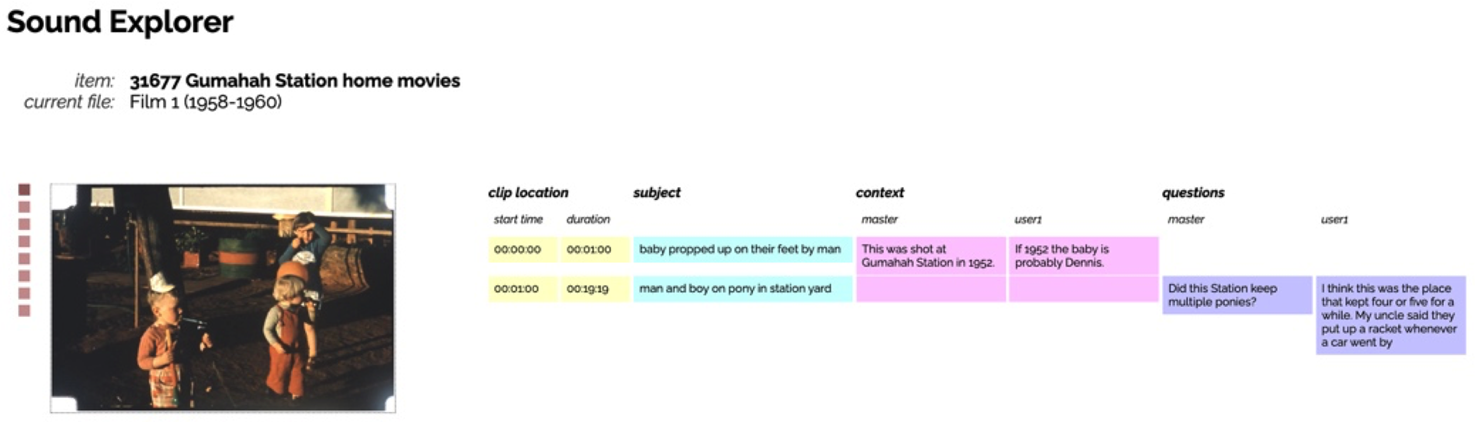
Thus the newest version of my cataloguing strategies and platform, developed in parallel with the Explorer 2.0, suggests a framework in which information can be added by, and exchanged amongst, members of the public (figure 3). This public contribution might be suggested by specific inquiries from library staff or from others: thus the construction of a category of contribution as “questions,” highlighting the degree to which investigation of the past is an inquisitive and collaborative act. The aim is to use lacunae in the catalogue—indeed, in the manner catalogues are constructed—as spaces that can be filled with public authorship and storytelling, within a structured archival setting.
A new version of the web app allowing for additions from the public.

There are considerable historical tensions in the GLAM sector between the two imprimaturs of archival collections: archiving and accessibility. Digitising collections is of course one way to improve accessibility, though only to a mediated version of the original collected object. Much of the materiality of the original object—the paper and ink of diary entries, the celluloid of home movies—remains hidden from view. What digitised archives do afford, however, is the ability not only to create new public interactions but to create new knowledge emerging from those interactions. Community participation can consist not only of letting community members in the door—whether the door is physical or virtual—but of soliciting new archival material in modes that will, increasingly, need to be structured according to community's interest and ability to participate. Using emergent community narratives as archivable material, tying this new archive to an existing collection archive on a deep structural level, is one strategy that can provide exciting new possibilities in how institutions create and store knowledge.
Editors note: this article is an adaptation of a paper first presented at the “Collect and Connect” conference held online in November 2020.