Fruit and seed consumers can both positively and negatively affect plant recruitment through seed dispersion and seed predation, respectively. In turn, fruits influence the abundance and distribution of consumers sustained by local plant assemblages. These interactions are key processes in plant recruitment and the dynamics of tropical forests, where most plants depend on dispersal by frugivorous animals (Corlett Reference CORLETT1998). An understanding of these interactions and the functional role of particular seed-dispersing animals is increasingly important nowadays, given that human impact on tropical forest ecosystems may negatively impact seed dispersal and forest regeneration in both natural and human-altered forests (Wright et al. Reference WRIGHT, ZEBALLOS, DOMINGUEZ, GALLARDO, MORENO and IBANEZ2000).
Small mammals generally comprise species-rich and abundant assemblages in tropical forests that exploit various habitats on the ground and in the different strata above (Bourlière Reference BOURLIÈRE, Harmelin-Vivien and Bourlière1989, Malcolm Reference MALCOLM1991, Voss & Emmons Reference VOSS and EMMONS1996, Wells et al. Reference WELLS, PFEIFFER, LAKIM and LINSENMAIR2004). Most of the commonly encountered small mammals in South-East Asian forests are considered to have an omnivorous and opportunistic diet, including a wide array of plant and animal materials (Emmons Reference EMMONS1991, Langham Reference LANGHAM1983, Leighton & Leighton Reference LEIGHTON, LEIGHTON, Sutton, Whitmore and Chadwick1983, Lim Reference LIM1970). However, detailed information on diet composition and the types or quantities of seeds being consumed are rarely available, and the presumably important role of small mammals as seed dispersers remains anecdotal and has yet to be quantified.
Generally, the majority of studies on small mammals and seeds have been centred on seed dispersal via scatterhoarding fruits (Asquith et al. Reference ASQUITH, WRIGHT and CLAUSS1997, Blate et al. Reference BLATE, PEART and LEIGHTON1998, Brewer & Rejmánek Reference BREWER and REJMÁNEK1999, Forget & Milleron Reference FORGET and MILLERON1991, Guariguata et al. Reference GUARIGUATA, ROSALES and FINEGAN2000, Hoch & Adler Reference HOCH and ADLER1997, Vieira et al. Reference VIEIRA, PAISE and MACHADO2006, Wells & Bagchi Reference WELLS and BAGCHI2005, Yasuda et al. Reference YASUDA, MIURA and HUSSEIN2000). Little information is available on the diversity and quantity of seeds that are swallowed and defecated by a large number of animals within consumer assemblages. In particular, there is not only a lack of knowledge of which seeds might be dispersed this way but also on the relative contribution of different small-mammal species to seed dispersal. In this study, seed contents were examined in 701 faecal samples from 13 non-volant small-mammal species in rain forests in Borneo (Sabah, Malaysia).
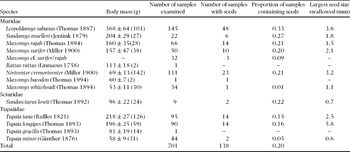
Small mammals were captured in three old-growth forest sites (Danum Valley Conservation Area, Kinabalu National Park, Tawau Hills Park) and three logged forests (Kampung Monggis, Kampung Tumbalang, Luasong) located at distances between 17–236 km from each other. We conducted a total of 16 trapping efforts lasting 16 d each, continuously alternating between the various forest sites between September 2002 and November 2004 (Wells et al. Reference WELLS, KALKO, LAKIM and PFEIFFER2007). Faeces from first captures of permanently marked individuals were collected from the floor below the trapped animals and stored in 3% formalin. Small-mammal faecal samples from the families Muridae, Sciuridae and Tupaiidae (Table 1) were screened under a light microscope and all visible seeds extracted. All seed samples were photographed to aid in classification and information exchange with other research groups. As we were unable to identify most seeds, they were assigned to different classes based on their size, shape, colour and surface.
Seed content in faecal samples from non-volant small mammals captured in various logged and unlogged forest sites in northern Borneo. Body masses of adults are given as the mean proportions of body mass with 1 SD of individuals captured (number of individuals for each species is given in parentheses) as part of the entire trapping effort (Wells et al. Reference WELLS, KALKO, LAKIM and PFEIFFER2007).

In total, 138 out of 701 faecal samples contained seeds (Table 1), from 13 species of small mammal. We were able to divide seed samples into at least 11 different seed morphotypes. Specific seed identification was not possible, as seeds from faeces and those extracted from known fruits were not comparable. Faecal samples from rats contained seeds significantly more often (106 out of 462; 23%) than samples from tree shrews (30 out of 230; 13%) (χ2 = 6.08, df = 1, P < 0.05).
We found significantly fewer seeds in samples from the rat Maxomys whiteheadi compared with Leopoldamys sabanus, while we were not able to reveal any differences in seed incidences for other species pairs. However, the relatively low sample sizes together with low powers of most performed chi-square tests urges for caution when interpreting the lack of differences in the proportions of samples with/without seeds across species.
Seeds of figs (Ficus sp.) were present in 74 out of 701 samples (11%), including samples from all commonly caught species with the exception of Tupaia minor. These fig seeds were around 0.5–1 mm in width and 0.4–1 mm in length with a yellowish colour. Another seed type occurred in 28 samples (4%). These seeds were around 2.5–3.5 mm in width and 2.5–6 mm in length with a brown seed coat and a white endosperm. This seed type appeared to be intact in faecal samples from the rat L. sabanus and the two larger tree shrews T. longipes and T. tana, while it usually occurred in fragments in samples from the medium- to small-sized rats M. rajah, M. surifer and Niviventer cremoriventer.
Overall seed incidences in faecal samples from logged forests were significantly greater than in unlogged forests for the rats L. sabanus and M. rajah (both χ2 > 7.27, df = 1, P < 0.01). However, there was no obvious difference in the occurrence of specific seed types in samples from either forest type.
These results show that small mammals such as rats and tree shrews contribute to seed consumption in South-East Asian forests. In particular, our faecal screening revealed that a considerable number of samples contained seeds between 0.5 mm to 5 mm in diameter, with fig seeds being most frequent amongst the commonly caught small-mammal species. The frequent prevalence of fig seeds in faeces confirm that figs serve as an important fruit resource for small mammals (Shanahan & Compton Reference SHANAHAN and COMPTON2000). The occurrence of seeds in 23% of rat samples analysed suggests that rats might play a more important role in seed dispersal in tropical forests than previously assumed (Shanahan et al. Reference SHANAHAN, SO, COMPTON and CORLETT2001, Vieira et al. Reference VIEIRA, PAISE and MACHADO2006). In fact, rats comprise most individuals and species within small-mammal assemblages on both the ground and in the canopy of tropical forests (Adler Reference ADLER2000, Bourlière Reference BOURLIÈRE, Harmelin-Vivien and Bourlière1989, Malcolm Reference MALCOLM1991, Voss & Emmons Reference VOSS and EMMONS1996, Wells et al. Reference WELLS, PFEIFFER, LAKIM and LINSENMAIR2004). Such a ubiquitous presence, together with diverse rat assemblages of species that explore the forest throughout its three-dimensional space, should thus comprise a suitable prerequisite for efficient seed dispersal.
However, our results are preliminary lacking exact seed identification and not knowing which seeds were viable or not. Despite this limitation, the recorded seed contents suggest that specific characteristics of small-mammal species as well as the type of forest may impact patterns of seed consumption.
The larger seed content in faeces from rodents compared with tree shrews was expected due to their more general feeding behaviour and physiology. The strong incisors of rats and other rodents allow them to feed on hard-shelled fruits such as Parashorea (Dipterocarpaceae) and Lithocarpus (Fagaceae) (Wells & Bagchi Reference WELLS and BAGCHI2005, Yasuda et al. Reference YASUDA, MIURA and HUSSEIN2000). In contrast, tree shrews are well known to feed mostly on soft-shelled fruits such as figs (Ficus sp.), as their relatively weak jaws and teeth likely limit the consumption of hard fruits and seeds (Emmons Reference EMMONS1991, Reference EMMONS2000; Shanahan & Compton Reference SHANAHAN and COMPTON2000). Notably, the simple digestive tract of tree shrews leads to quick food transition with estimated retention times as short as 20–60 min (Emmons Reference EMMONS1991), limiting the dispersal distances between food consumption and defecation (Kalko et al. Reference KALKO, HERRE and HANDLEY1996). Additionally, species-specific characteristics such as eating behaviour and body size may influence the fate of consumed seeds. For example, we found more destroyed and fragmented seeds in faeces of small to medium-sized rat species (e.g. Maxomys sp. and Niviventer cremoriventer), while the same seed type was found intact in samples from the larger rat Leopoldamys sabanus. Although our knowledge on specific interactions between small mammals and seeds is rather poor, the overall significance of small mammals and the differing potential of species as seed dispersers is of much interest with regard to large-scale forest changes by logging. While the altered abundance or species composition of small-mammal assemblages might influence seed dispersal of plant species in logged forests, different plant composition in disturbed forests, in turn, may influence fruit availability for small mammals. The observed increases in overall seed defecation by two rats, for example, suggest that logging influences the proportion of fruits in the diet of some small-mammal species. Our tentative results, with a lack of seed identification and detailed insights into animal–seed interactions, act more to highlight some gaps in our knowledge rather than solve these issues. Logged forests are known to differ in tree and overall plant composition and thus also in the availability of food resources (Bischoff et al. Reference BISCHOFF, NEWBERY, LINGENFELDER, SCHNAECKEL, PETOL, MADANI and RIDSDALE2005, Howlett & Davidson Reference HOWLETT and DAVIDSON2003). To date there is little consensus on the result of logging on fruit availability and fruit consumption patterns by vertebrates (Heydon & Bulloh Reference HEYDON and BULLOH1997, Knop et al. Reference KNOP, WARD and WICH2004, Lambert et al. Reference LAMBERT, MALCOLM and ZIMMERMAN2005). In other study locales, altered vertebrate populations and defaunation reduced seed recruitment (Asquith et al. Reference ASQUITH, WRIGHT and CLAUSS1997, Guariguata et al. Reference GUARIGUATA, ROSALES and FINEGAN2000, Wright et al. Reference WRIGHT, ZEBALLOS, DOMINGUEZ, GALLARDO, MORENO and IBANEZ2000).
More detailed data on seed consumption patterns in terms of specificity and strength of interactions in different forests are needed in order to draw conclusions on how interactions between small mammals and seeds pay off for each other in this mutualistic relationship and how they contribute to ecosystem maintenance.
ACKNOWLEDGEMENTS
We thank the Economic Planning Unit Malaysia for a research permit and Sabah Parks, Yayasan Sabah and the Universiti Malaysia Sabah for cordial support during fieldwork. The German Academic Exchange Service (DAAD) provided financial support. We are particularly indebted to the local people and staff at all forest sites for their friendly support and warm hospitality. We thank two anonymous reviewers for comments that have improved this paper.