1. Introduction
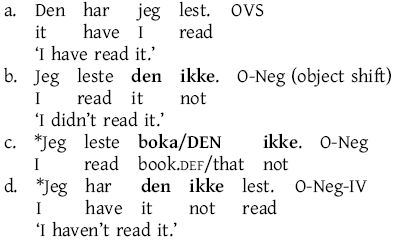
Norwegian is a V2 language: the verb moves to the C-domain in main clauses (and certain embedded clauses; Julien Reference Julien2015, Reference Julien2020), and one constituent moves across the verb to the clause-initial position (see Eide Reference Eide2011, Holmberg Reference Holmberg2020, and many others). In declarative main clauses, the initial phrase is often the subject, as in (1a). If a non-subject is topicalized, the subject must be postverbal, as in (1b). A post-verbal subject can either precede or follow negation and sentence adverbs; see (1c) and (1d) (see, e.g., Lundquist & Tengesdal Reference Lundquist and Tengesdal2022 and references therein).

Also objects can occur in sentence-initial position in Scandinavian, as in (1b), and weak object pronouns can be topicalized, too (see Lindahl & Engdahl Reference Lundquist and Tengesdal2022; cf. also Anderssen et al. Reference Anderssen, Bentzen and Rodina2012); an example is given in (2a). As is well known, non-initial objects can undergo so-called object shift across negation and sentence adverbs (Holmberg Reference Holmberg1986) under certain conditions; see (2b). In Norwegian, only weak object pronouns can shift across negation; thus, (2c) with an object noun or a constrastive (strong) pronoun is unacceptable. Object shift is only possible if the main verb has moved out of the VP (Holmberg’s generalization, Holmberg Reference Holmberg1986). In practical terms, this means that object shift is restricted to main clauses (and clauses with embedded V2) in which the main verb is the only verb. In clauses with auxiliaries, the non-finite main verb stays in situ; see (2d).

In the following, we refer to the clause-initial position as Spec-CP (for a more detailed structure of the C-domain, see section 3). Non-initial subjects that precede negation (and sentence adverbs) are referred to as shifted (1c), and subjects that follow negation are unshifted (1d). Similarly, objects that precede negation are referred to as shifted (2b), following standard practice, and VP-internal objects are referred to as unshifted. An example of an unshifted object pronoun is given in (3).

The variation in argument placement described above has been much discussed in the literature on Scandinavian (see, e.g., Svenonius Reference Svenonius and Svenonius2002, Westergaard Reference Westergaard2011 on subject placement, Holmberg Reference Holmberg1986, Anderssen & Bentzen Reference Anderssen and Bentzen2012, Erteschik-Shir et al. Reference Erteschik-Shir, Josefsson and Köhnlein2021 on objects). It has been shown that argument placement depends on a number of different factors: the form of the argument (pronoun or full DP), information structure, and prosody. For object shift, the type of antecedent (nominal or non-nominal/type referent) has been shown to be important (see, e.g., Andréasson Reference Andréasson, Butt and Holloway King2010, Anderssen & Bentzen Reference Anderssen and Bentzen2012 and many others); it is not a coincidence that the shifted pronoun in (2b) has nominal reference, whereas the object pronoun in (3) has a non-nominal antecedent (see further in section 5 below). Recent studies based on experimental data also show that there are subtle differences within the Scandinavian languages, and that, for example, first- and third-person pronouns (with nominal antecedents) might undergo object shift to different extents (see Lundquist & Tengesdal Reference Lundquist and Tengesdal2022). Andréasson (Reference Andréasson, Butt and Holloway King2010), Bentzen & Anderssen (Reference Bentzen and Anderssen2019) and Lindahl & Engdahl (Reference Lundquist and Tengesdal2022) also show the importance of including the sentence-initial position in discussions of object shift; the patterns of fronting to the preverbal position have consequences for the variation between shifted and unshifted positions in the middle field (i.e., the T-domain, between VP and CP).
In this article, we investigate how the variation in argument placement is transmitted over time, comparing two different social contexts, namely homeland Norwegian dialects and (North) American Norwegian heritage language (AmNo); we define a heritage language as a language acquired in the home, which is not the dominant language of the larger society (see, e.g., Rothman Reference Rothman2009). As heritage languages such as AmNo exist in contexts of reduced input and use, they can reveal important properties of grammar (e.g., Lohndal et al. Reference Lohndal, Rothman, Kupisch and Westergaard2019), and they are also windows into the mechanisms of language change and the effects of language contact (Kupisch & Polinsky Reference Kupisch and Polinsky2022). AmNo has been shown to retain V2 to a high degree (Eide & Hjelde Reference Hjelde2015, Reference Eide and Hjelde2018, Westergaard & Lohndal Reference Westergaard, Lohndal, Lightfoot and Havenhill2019, Westergaard et al. Reference Westergaard, Lohndal and Lundquist2021), but the frequency of SV order (i.e., subject-initial main clauses) has increased considerably (see Westergaard & Lohndal Reference Westergaard, Lohndal, Lightfoot and Havenhill2019, Westergaard et al. Reference Westergaard, Lohndal and Lundquist2021). In this article, we look in more detail at this change and discuss its consequences for subject shift and object shift. Subject shift and object shift have been investigated previously, as well. Anderssen & Westergaard (Reference Anderssen and Westergaard2020) show that the proportions of shifted arguments are smaller in AmNo as compared to present-day homeland Norwegian; they suggest that this is at least partly due to cross-linguistic influence from English in AmNo. They also mention that there are fewer contexts for subject shift, as a consequence of the stronger preference for SV. The connection between SV order and subject shift will be investigated in detail in the present article.
While previous studies of argument placement in AmNo mainly focus on present-day heritage speakers, available corpora of spoken homeland Norwegian and AmNo now make it possible to trace the development of argument placement over time in the Norwegian diaspora in America. This has not been possible before, and it is one of the main concerns of the present article.Footnote 1 In the following, we establish a baseline for comparison using old homeland recordings from the time of mass emigration (the Language Infrastructure made Accesible (LIA) corpus; Hagen & Vangsnes Reference Hagen and Vangsnes2023), which approximates the language of the first emigrants (see, e.g., Polinsky Reference Polinsky2018). In addition, we investigate old recordings of emigrant speakers and heritage speakers of AmNo from the 1930s and 1940s and compare them to recent recordings of AmNo also available in CANS, the Corpus of American Nordic Speech. As will become clear, there is a considerable increase in SV order (cf. Westergaard & Lohndal Reference Westergaard, Lohndal, Lightfoot and Havenhill2019, Westergaard et al. Reference Westergaard, Lohndal and Lundquist2021). Crucially, on our account, this has consequences for the frequencies of subject shift and object shift, because the increase in SV does not affect the shifted and unshifted positions in the same way. We argue that the decline in subject shift and object shift is largely epiphenomenal; when the effect of the increased preference for SV order is controlled for, the frequencies of subject shift and object shift appear to be rather stable in the heritage language. Building on Larsson & Kinn’s (Reference Larsson and Kinn2022) study of American Swedish, we propose that the increase in SV order is a consequence of pressure to ease processing, possibly in combination with CLI (along the lines suggested by Westergaard et al. Reference Westergaard, Lohndal and Lundquist2021), and that the development is permitted by an essentially unchanged grammar.
The article is structured as follows. Section 2 gives an overview over the data sources and annotation used in this study. In section 3, we discuss V2 and the C-domain in AmNo and investigate the clause-initial position in main clause declaratives (Spec-CP). Section 4 is concerned with subject shift, and in section 5 we turn to object shift; in both cases, also the clause-initial position will turn out to be important. In section 6, we discuss the findings. Section 7 concludes the article.
2. Data sources
In this section, we give an overview of our data sources. Section 2.1 presents the heritage and emigrant speakers, and section 2.2 is concerned with the homeland dialect speakers. In section 2.3, we describe the corpus searches and annotation.
2.1. Heritage speakers and emigrants
Samples of AmNo are available in the Corpus of American Nordic Speech (CANS; Johannessen 2015). The current version of the corpus (version 3.1) was recently extended with new transcriptions of recordings from the 1930s and 1940s (collected mainly by Einar Haugen; see also Kinn & Larsson Reference Kinn and Larsson2022). In addition, the corpus includes recent recordings of emigrant and heritage speakers of Norwegian and Swedish in the US and Canada. Altogether, the corpus consists of 774,000 word tokens. The CANS interface allows us to restrict the search to certain generations of speakers (first-, second-generation immigrants, etc.), to speakers recorded at specific times, and to speakers with backgrounds from specific areas in Norway and Sweden. For the present study, we have selected three groups of speakers from CANS. Mostly (except in the “emigrant” group, to which we return shortly), we have focused on speakers with ties to Eastern Norway, in particular to the (former) county of Oppland or neighboring counties.Footnote 2 Rural Eastern Norway (and particularly certain parts of Oppland, such as the Gudbrandsdalen valley) had a high rate of emigration, and dialect features of this area have played an important role in shaping the AmNo language as spoken today (Johannessen & Laake Reference Johannessen and Laake2012, Reference Johannessen and Laake2017, Hjelde Reference Hjelde2015).
First, our data set includes 13 emigrant speakers recorded in the 1940s (generation 1 in the corpus metadata). These speakers were born in Norway between 1849 and 1903, and they emigrated to the US later in life. At the time of recording, all but one speaker were aged 50 or older. Emigrant speakers are generally not heritage speakers on the current definition (see section 1), but their language represents (some of) the linguistic input that the next generation of speakers were exposed to.Footnote 3 The 13 emigrant speakers (who we refer to as “emigrants” in the following) have more diverse Norwegian dialect backgrounds than the other speakers we have selected from CANS.Footnote 4 We have chosen an inclusive approach for the emigrant group partly because of limited data availability (the 13 speakers are the only emigrants represented in the Norwegian part of CANS), but also because the dialect variation that was present in the early American-Norwegian communities is potentially relevant for the further development of AmNo over the next generations.Footnote 5
Second, we have included all speakers in CANS recorded in the 1930s or 1940s who are not emigrants according to the corpus metadata, which amounts to 75 speakers. These speakers are second- or third-generation immigrants;Footnote 6 most of them (54 individuals) have an Eastern Norwegian dialect background (often Oppland or the neighboring counties Hedmark and Buskerud).Footnote 7 These speakers were born between 1862 and 1927; thus, different age groups are represented, but many of them were over 50 at the time of recording. We refer to their language as older AmNo in the following.
The third group of speakers in CANS includes 11 speakers recorded in 2010. These speakers are at least second-generation heritage speakers, and have ancestors from Oppland. They were born between 1918 and 1946; most were in their 70s or older at the time of recording. These speakers represent what we refer to as modern AmNo. Although the speakers in this group are fewer than the speakers representing older AmNo, they produce a higher number of word tokens in the corpus (see table 1).Footnote 8
Data sets

As is evident from the previous paragraphs, we have divided the heritage speakers into groups depending on time of recording (rather than, for example, year of birth or generation since immigration, as suggested by a reviewer). Due to changes in the community (and in language policy), we expect the speakers of older AmNo to be less dominant in English than the modern AmNo speakers, even when they are the same generation immigrants. After the first wave of emigration, some Norwegian settlements in the Midwest grew quite large and were in some respects self-reliant, with Norwegian being widely used in several arenas and local institutions (Haugen Reference Haugen1953, Hjelde Reference Hjelde2015, Riksem Reference Riksem2017). Although this period was coming to an end (or was already over) around the time of recording of the older AmNo speakers (see Natvig Reference Natvig2022 for a detailed case study of Ulen, Minnesota), we expect many of the speakers to have lived at least parts of their lives in this sort of community.Footnote 9 Changes in the language use and language dominance of the community clearly affect the input of the speakers (see Eide & Hjelde Reference Eide and Hjelde2023 for a detailed study), and we expect present-day second-generation speakers to have received more limited input in their heritage language than second-generation speakers 80 years ago (but precisely what input individual speakers received we cannot know, of course). Moreover, the older data are restricted (and have less systematic metadata), so it is not possible for us to discern the factor of generation independently of time of recording and language dominance in a consistent way. Most of the older AmNo speakers are closer to the time of emigration than the modern AmNo speakers, in terms of generation, time of birth, and time of recording, and, as mentioned, expected to be less dominant in English.Footnote 10
2.2 Older homeland Norwegian dialects
In addition to the data from CANS, we have used the LIA corpus (Language Infrastructure made Accessible), which contains digitized old dialect recordings from all of Norway. Our data collection is based on the first version of LIA (available at https://tekstlab.uio.no/glossa2/lia), which comprises 1,511,000 word tokens. Some of the speakers in the LIA corpus were born as early as the late 1800s, at the time of mass emigration, and the corpus is therefore well suited to establish a baseline for the heritage language. As pointed out by Polinsky (Reference Polinsky2018:11) and Aalberse et al. (Reference Aalberse, Backus and Muysken2019: chap. 6), the appropriate baseline, or reference point to which a heritage language can be meaningfully compared, depends on the research questions. As our goal is to understand if and how AmNo has changed over time, the ideal baseline is the language that was brought along by the first emigrants (see also Kinn & Larsson Reference Kinn and Larsson2022). We are fortunate to have some of the actual early emigrants represented in CANS (see above); however, they are rather few, and as Polinsky (Reference Polinsky2018:14) notes, the language of emigrants may already display certain differences from the homeland variety, especially in emigrants who have lived in the new country for a long time. The LIA corpus helps us get a more comprehensive understanding of the most relevant Norwegian dialects as spoken in the homeland around the time of mass emigration, by speakers who were not affected by the bilingual situation in the US and Canada.
From the LIA corpus we have included data from 27 speakers born in Oppland county. Most of the speakers were born between 1889 and 1926, and one was born in 1955. This data set represents the homeland Norwegian baseline, and we refer to it as LIA in the presentation below.
The four data sets presented in this subsection and section 2.1 are summarized in table 1.Footnote 11
2.3 Corpus searches and annotation
We have searched the corpora for sentences with negation; in this way, we can investigate both subject shift and object shift across negation.
The discussion of Spec-CP in section 3 is based on declarative V2 clauses (see below) with negation. The data have been annotated manually for type of initial element (subject, object, short adverb, topic drop, other).
The investigation of subject placement includes main and embedded clauses with negation and an unmodified personal pronoun as the subject; clauses with non-pronominal subjects have been excluded (see further in section 4). The data have been annotated manually, and irrelevant hits have been discarded. A couple of examples with sentence-initial negation have been excluded. Sentences with topic drop are included, and categorized among SV clauses if the dropped element is a subject. Other clauses without an overt subject (e.g., subject relatives, imperatives, and subject-less second conjuncts) have been excluded. A couple of unclear cases have also been excluded. The relevant hits have been annotated for clause type (main declarative, V1 clause, wh-question, or embedded clause) and position of the subject (Spec-CP, shifted, unshifted). In the LIA corpus there are unambiguous cases of embedded V2 (i.e., embedded V-to-C movement, leading to the order verb–negation); for simplicity, we have included them among the declarative main clauses. This means that the category of “main clause declarative” includes all the examples that have three potential subject positions; in the other clause types, Spec-CP is unavailable. In AmNo, the order verb–negation is not necessarily restricted to clauses with V2 (since AmNo has independent V-to-T movement, which we do not define as V2, as the verb stays below the C-domain; Larsson & Johannessen Reference Larsson and Bondi Johannessen2015a, b); for AmNo, embedded clauses with verb–negation order have therefore been excluded; we return to this in section 4 below. We assume that emigrant Norwegian does not have V-to-T (following Larsson & Johannessen Reference Larsson and Bondi Johannessen2015b), and we have therefore included cases with embedded verb–negation order in the “main clause declaratives” also in this data set, as in LIA.Footnote 12 V1 clauses include both verb-initial conditional clauses and polar questions (yes/no-questions, including tag questions). The wh-questions also potentially include wh-exclamatives; as we will see, the total number of main wh-clauses is, however, small.
Since object shift is only possible in clauses with a pronominal object where the main verb has moved out of the verb phrase, the investigation of object shift (section 5) is limited to a much smaller data set. We include sentences with negation, an object pronoun, the main verb in C, and no other potential interveners (unshifted subjects or indirect objects; see, e.g., Holmberg Reference Holmberg1986, Sells Reference Sells1998, Berger Reference Berger2022, for a discussion of the restrictions on object shift). For instance, examples like (4) below, where an unshifted subject blocks object shift, have been excluded.Footnote 13

Only weak object pronouns shift in Norwegian, and the prosodic realization of the pronouns might be important; it is therefore particularly useful that the sound files can be accessed through the corpus interface.
3. V2 and the clause-initial position
As mentioned in the introduction, Norwegian is a V2 language. This is true also for older and modern AmNo, as examples like the following illustrate:

In (5), the finite verb (skal) has moved out of the VP, across negation and the subject, to the C-domain. Since the verb is preceded by an adverbial, the subject must follow the verb (see, e.g., Holmberg Reference Holmberg2020 for a recent analysis of V2).
There are certain systematic exceptions to strict, linear V2 in Norwegian, providing evidence for a more complex C-domain (e.g., Eide Reference Eide2011, Holmberg Reference Holmberg2020, Meklenborg Reference Meklenborg, Woods and Wolfe2020; see also Nilsen Reference Nilsen2002, Lundquist Reference Lundquist2018 and references therein). One is so-called copy-left dislocation (CLD), where the initial phrase is followed by either a weak pronoun (if an argument) or the light adverb så ‘so’ (if an adjunct). CLD is also found in AmNo, illustrated in (6) (see also Bousquette et al. Reference Bousquette, Melum Eide, Hjelde and Putnam2021).

Another type of left dislocation is hanging topic left dislocation (HTLD), which typically involves a prosodic break, and which allows a discourse particle to intervene between the hanging topic and the rest of the clause (Eide Reference Eide2011, Holmberg Reference Holmberg2020). This can also be found in AmNo; see (7), where ja ‘yes’ is a discourse particle following the hanging topic.

In homeland Norwegian, HTLD and CLD may co-occur within the same main clause in a fixed order (HTLD is always first; see Eide Reference Eide2011 and Holmberg Reference Holmberg2020). This strongly suggests that the two types of left dislocation involve different positions in an extended C-domain. We have not attested co-occurrences of HTLD and CLD in AmNo; however, this does not in itself imply that the underlying structure of AmNo is different – the size of CANS is limited, and co-occurrence of the two types of left-dislocation is a low-frequency phenomenon. As argued by Larsson & Kinn (Reference Larsson and Kinn2022) for heritage Swedish in North America (AmSw), data like (6) and (7) provide evidence for a stable C-domain in the heritage variety. Following Eide (Reference Eide2011) and Holmberg (Reference Holmberg2020), we assume that the AmNo C-domain has the structure in (8a) (which is also what Larsson & Kinn Reference Larsson and Kinn2022 propose for AmSw). The finite verb moves to Fin, and one constituent (subject or non-subject) moves across Fin, to Spec-FinP or Spec-ForceTop. Following Eide (Reference Eide2011) and Holmberg (Reference Holmberg2020), we assume that copy-left dislocation (CLD) involves both FinP and a higher projection labeled Force/TopP by Holmberg; the resumptive pronoun or så is realized in ForceTop (see the sketched analysis of (6) in (8b)). Hanging topics (as in (7)) are base-generated in a Frame-domain above ForceTop, and therefore do not interact with V2 (see the sketched analysis of (7) in (8c)).

Some V2 violations can be observed in AmNo; see (9), where the finite verb is preceded by both a clause-initial adverb and the subject:

Westergaard et al. (Reference Westergaard, Lohndal and Lundquist2021) find 2.2 percent non-V2 in declaratives in the Norwegian part of CANS (N = 10.609) (cf. also Eide & Hjelde Reference Hjelde2015; Larsson & Johannessen Reference Larsson and Bondi Johannessen2015b). As suggested by Westergaard & Lohndal (Reference Westergaard, Lohndal, Lightfoot and Havenhill2019) and Westergaard et al. (Reference Westergaard, Lohndal and Lundquist2021), these V2 violations can be analyzed as involving cross-linguistic influence (CLI) from English. Larsson & Kinn (Reference Larsson and Kinn2022) argue, based on very similar data from American Swedish, that the heritage speakers sometimes fail to inhibit their dominant non-V2 English grammar and access their heritage grammar, leading to CLI on their Norwegian.Footnote 14 Westergaard et al. (Reference Westergaard, Lohndal and Lundquist2021) similarly propose that lack of activation of the V2 grammar is the main reason for V2 violations in present-day AmNo (and that this is in part related to the proportion of subject-initial clauses; see further below). Note that according to our account, the observed V2 violations do not involve representational change in the grammar of AmNo speakers; their Norwegian grammar is still a V2 grammar, but it is sometimes “supressed” by the structures of the more dominant language, English. In conclusion, evidence from left-dislocation structures and the relative robustness of V2 suggests that the C-domain of AmNo is generally stable, as proposed above.
Although the structure of the C-domain appears to be stable overall, it has been observed (Westergaard & Lohndahl Reference Westergaard, Lohndal, Lightfoot and Havenhill2019, Westergaard et al. Reference Westergaard, Lohndal and Lundquist2021) that modern AmNo has considerably more SV order (i.e., subject-initial main clauses) than present-day homeland Norwegian. In homeland Norwegian, around 70 percent of declarative main clauses are subject-initial (SV) (Keihl Olsen Reference Keihl Olsen2019; see also Lohndal & Westergaard Reference Lohndal, Rothman, Kupisch and Westergaard2019:96, Westergaard et al. Reference Westergaard, Lohndal and Lundquist2021:3 and references therein); thus, around 30 percent are non-subject-initial (XVS). In a study of fifty speakers of modern AmNo, Westergaard et al. (Reference Westergaard, Lohndal and Lundquist2021:14) find a proportion of 18.5 percent non-subject-initial declaratives, which is significantly lower than in the homeland. (See Larsson & Kinn Reference Larsson and Kinn2022 on a similar change in American Swedish.)
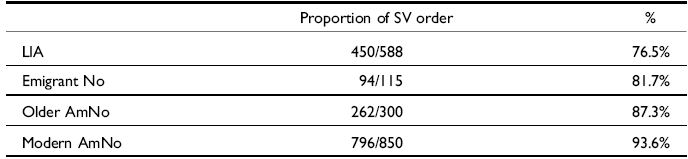
An increase in SV order can be observed also in our data (which includes only clauses with negation); see table 2.Footnote 15 In older homeland Norwegian (LIA) and emigrant Norwegian, the frequency of SV is around 75–80 percent; the difference between the two corpora is not statistically significant.Footnote 16 There is, on the other hand, a significant increase (p < 0.01) in SV order in older AmNo (87.3%) compared to LIA.Footnote 17 Moreover, there is an additional significant increase in the frequency of SV order from older to modern AmNo (p < 0.01).
SV order in declarative main clauses in the baseline and AmNo (clauses with negation). V2 violations are included

The modern AmNo data in table 2 include four V2 violations. There are no clear examples of V2 violations in our older AmNo data. In other words, the increase in SV seems to predate the first non-V2 declaratives (at least in clauses with negation). We will assume that the SV clauses in AmNo, although superficially ambiguous, involve the C-domain given schematically in (8) above: in V2 clauses with SV order, the verb moves to Fin, and the subject moves at least to Spec-FinP.Footnote 18
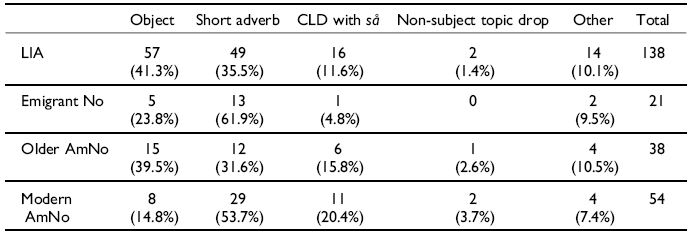
In table 3, we look in detail at the initial constituents of declarative main clauses that are not subject-initial (XVS); here, the V2 violations have been excluded. Topic drop of a non-subject (typically of a short adverb) is treated as a separate category (topic drop of a subject is counted as SV; see section 2.3). We also distinguish copy-left dislocation (CLD) structures with the adverb så from clauses with just a short adverb preceding the verb. In CLD with så, the dislocated phrase is an adverbial (e.g., a conditional clause or a temporal adverbial). None of the object-initial clauses has left dislocation.Footnote 19
Initial constituent in declarative main clauses with V2 in the baseline and AmNo (clauses with negation, subject-initial clauses excluded)

Larsson & Kinn (Reference Larsson and Kinn2022) note that when SV order is excluded, the distribution of various topicalization structures (relative to each other) is strikingly similar in homeland and heritage Swedish. Larsson & Kinn investigate all declaratives with a main verb in the past tense, whereas the present study only includes sentences with negation (irrespective of tense); it is possible that this has some effect on the results. However, comparing LIA and older AmNo, there is considerable similarity: around 40 percent of the XVS clauses are object initial, and around one-third are introduced by a light adverb (often nå ‘now’ or da ‘then’).Footnote 20 There is a slight increase in the frequency of CLD, which could also be observed in AmSw (this is in line with the observations of Bousquette et al. Reference Bousquette, Melum Eide, Hjelde and Putnam2021); still, our general impression is that there is a high degree of continuity between LIA and older AmNo. Modern AmNo, on the other hand, is different: the number of topicalized objects has decreased significantly compared to LIA (p < 0.01), and the frequency of initial short adverbs has increased (p < 0.05).
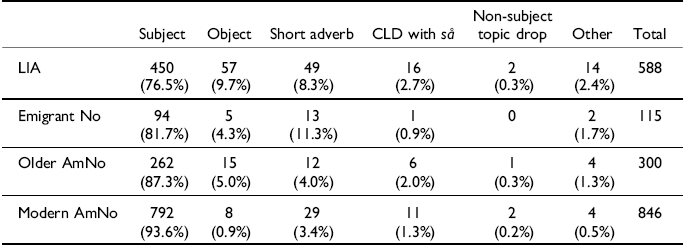
The change in topicalization patterns is even clearer when SV order is included; see table 4, which gives the distribution of different initial elements in declarative main clauses with V2, including subjects. It is likely that some of the SV clauses have left dislocation, but this has not been investigated here (see footnote 19 above).
Initial constituent in declarative main clauses with V2 in the baseline and AmNo (clauses with negation)

Table 4 shows two striking differences between LIA and emigrant Norwegian, on the one hand, and AmNo, on the other: the frequency of SV order increases, and the proportion of topicalized objects drops considerably. The change can be observed already in older AmNo, but the development continues along the same trajectory into modern AmNo. It can be noted that 47 of the 57 initial objects in LIA are pronominal. Of these, at least 37 have non-nominal reference (referring to, e.g., a whole CP) and 6 have a clear nominal reference.Footnote 21 (In a couple of cases, the reference is not obvious from the context.) In the smaller emigrant data set, there are only 5 initial objects, all of which have non-nominal reference. In older AmNo, all of the initial objects are pronominal, and 14/15 have non-nominal reference. In modern AmNo 6/8 initial objects are pronominal, and most of these have non-nominal reference. The difference in the frequency of fronted objects will be of some importance in the discussion of object shift below.
Despite the changes in the topicalization patterns in AmNo, we conclude (with previous work) that the syntax of the C-domain is stable in the heritage language context. The number of clear V2 violations is small, and non-existent in our older AmNo data, and evidence from left dislocations shows that the heritage language maintains a complex C-domain of the Mainland Scandinavian type (see (8) above). The fact that the frequency of SV order was already increasing in older AmNo also confirms that it is in principle independent of V2 violations (see Westergaard & Lohndal Reference Westergaard, Lohndal, Lightfoot and Havenhill2019 and Westergaard et al. Reference Westergaard, Lohndal and Lundquist2021 for a similar conclusion based on data from modern AmNo).
In other words, we conclude that the shifts in topicalization patterns, as well as the sporadic V2 violations, are not due to a change in the underlying syntactic representation. Instead, we propose that the V2 violations are due to a failure to activate the heritage language grammar in competition with the more dominant English grammar (in this respect, our account is similar to Westergaard et al. Reference Westergaard, Lohndal and Lundquist2021; cf. also Larsson & Kinn Reference Larsson and Kinn2022 and references therein). We suggest that the increase in SV order and the decrease in OVS, on the other hand, are primarily a consequence of pressure to ease processing. We do not completely exclude the possibility that CLI from English plays a role; however, irrespective of the majority language, SV is arguably easier to process than OVS, as it involves shorter syntactic dependencies. Previous studies have shown a preference for shorter dependencies in heritage languages (see, e.g., Benmamoun et al. Reference Benmamoun, Montrul and Polinsky2013 and references therein). We discuss the role of processing and CLI in more detail in section 6.Footnote 22
In the next two sections, we will argue that the increase in SV order has consequences for the placement of arguments further down in the clause. In section 4, we consider the placement of non-initial subject pronouns, and in section 5 we turn to object shift.
4. Subject shift
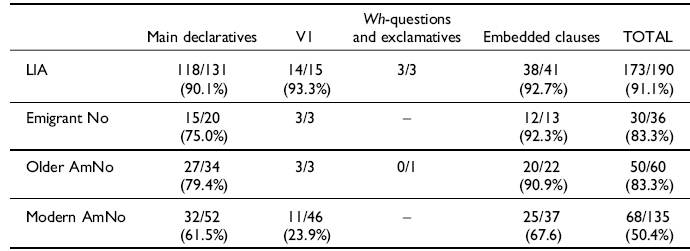
In this section, we focus on subject placement relative to negation. We restrict the investigation to pronominal subjects; non-initial full DPs (which are expected to show a partly different pattern; see, e.g., Lundquist & Tengesdal Reference Lundquist and Tengesdal2022 and references therein) are simply too scarce in our corpus data.Footnote 23 Table 5 gives an overview of subject placement in different clause types with non-initial subjects; in the modern AmNo data, we include the four examples with V2 violations.
Proportion of shifted pronominal subjects in different clause types with non-initial subjects

As is evident from table 5, there is a considerable drop in the frequency of subject shift in modern AmNo, from 91.1 percent in LIA to 50.4 percent in modern AmNo. This resembles the results in the study by Anderssen & Westergaard (Reference Anderssen and Westergaard2020), where modern AmNo has 60 percent pronominal subject shift in main clauses (both declarative clauses and questions) compared to 84.7 percent in modern homeland Norwegian.Footnote 24 Considering only non-initial subjects, it is clear, then, that the proportion of shifted subjects decreases gradually in AmNo; the drop can be observed already in older AmNo (compared to LIA), and to an even higher degree in modern AmNo. The decrease in shifted subjects is clear in declarative main clauses. In V1 clauses, there is also a considerable drop in the frequency of shifted subjects from LIA to modern AmNo; in the other two subcorpora (emigrants and older AmNo), the number of examples is too small to draw any conclusions. Most of the V1 clauses in modern AmNo are tag questions; this is why there are more examples of V1 clauses in modern AmNo than in the other speaker groups in table 5. We return to tag questions below.
It can be noted that there is also an apparent difference between LIA and emigrant Norwegian declarative main clauses. The emigrant data set is small, and the difference is not statistically significant (p = 0.117); however, it is worth commenting on. There is both inter- and intraindividual variation in subject shift in Norwegian (see, e.g., Bentzen Reference Bentzen2014b and references therein), and this is probably what is behind the seemingly low proportion of subject shift in emigrant Norwegian; recall that the emigrant speakers have a more varied dialect background than the other speaker groups and that some of the speakers have a background from Western Norway (see section 2). Importantly, it seems quite clear that there is already inter- and intraindividual variation in the input for heritage speakers recorded in the 1930s/1940s.
The general pattern in the baseline is that focused subject pronouns can be unshifted, whereas weak, non-focused pronouns generally shift; compare the focused – and unshifted – subject in (10a) to the shifted pronoun in (10b) (and see, e.g., Keihl Olsen Reference Keihl Olsen2019, Lundquist & Tengesdal Reference Lundquist and Tengesdal2022 and references therein).

However, while the examples in (10) illustrate the general pattern, not all unshifted subjects are focused in LIA, nor in the emigrant data; consider the examples in (11), where the subject pronouns are deaccented, and topical or expletive.

Data like these show that there is variation in the placement of non-focused pronouns in the baseline, even when we restrict the investigation to speakers with background in Oppland in Eastern Norway. This is important – as Polinsky (Reference Polinsky2018:33–35) points out, change in heritage languages can sometimes be traced back to variation, or “incipient change,” in the baseline. However, variation in the baseline does not deterministically lead to change, although it may be a factor promoting it.
As we will argue below, there are two partly independent developments that lead to the changes observed in table 5: the increase in SV order, and the use of English-like tag-questions in modern AmNo. First, however, it is important to note that the general pattern of subject shift is the same in AmNo as in the baseline: topical pronominal subjects and expletives tend to shift, as in (12a), whereas focused subjects are unshifted, as in (12b); (12b) is an answer to the interviewer who has commented that “it is strange that something didn’t burst,” and the subject is clearly focused and contrastive. As in the baseline, there is some variation, and we find examples of unshifted topical pronouns and expletives, as in (12c). Again, examples like (12c) are unexpected from a present-day (Eastern) Norwegian perspective, but as we saw in (11) above, they occur in the baseline.

Let us now consider a context where we can observe a clear change: subject shift in questions. Anderssen & Westergaard (Reference Anderssen and Westergaard2020) have previously suggested that the decrease in subject shift is due to cross-linguistic influence from English. They observe that there are many unshifted subjects in questions (V1 clauses in table 5 above), where English often has the order negation–subject (isn’t she clever?). In our modern AmNo data, there are many examples of tag questions, as in (13) below. Tag questions do not occur in the baseline data, and this clearly looks like cross-linguistic influence from English (see further discussion in section 6.3).

However, the effect of CLI on subject shift seems to be restricted to questions in modern AmNo. There are no examples of tag questions in our older AmNo sample. Moreover, CLI seems less relevant in embedded clauses and declaratives, since English does not have the order negation–subject in these contexts (cf. that she isn’t clever). We conclude, with Anderssen & Westergaard, that CLI is involved, but that this affects only a specific type of questions, tag questions. With the exception of tag questions, CLI does not seem to directly affect the proportion of unshifted subjects.
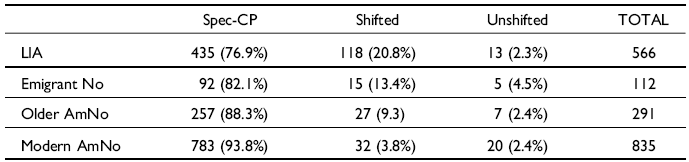
However, as we will argue below, the increase in SV order, which we suggest is due to pressure to ease processing (and possibly CLI), has consequences for subject shift in main clauses.Footnote 25 Table 6 shows the placement of subjects in declarative main clauses, including also the initial position. Here, there is no statistically significant difference in the proportions of unshifted subjects between LIA, Older AmNo, and Modern AmNo.Footnote 26 The decrease in the proportion of shifted subjects (20.8% in LIA, 3.8% in modern AmNo), on the other hand, is highly significant (p << 0.01). The difference between older AmNo and modern AmNo is also significant (p < 0.01). Considering all three positions, there are, in other words, not significantly more unshifted subjects in AmNo, but still significantly fewer shifted subjects – and significantly more SV.
Three subject positions in declarative main clauses; pronominal subjects

We propose that the decrease in subject shift in declarative main clauses from 90.1 percent in LIA to 61.5 percent in modern AmNo (table 5) is at least partly due to the increase in SV. The strong preference to front subjects to Spec-CP in AmNo seems to particularly affect the shifted position in the T-domain; in other words, when the proportion of sentence-initial subjects increases, it is mainly the shifted position that is bled (not the unshifted position), which leads to a decrease of shifted subjects. This is not completely unexpected, since the shifted position, like the initial position, mostly contains topical subjects, whereas unshifted subjects are generally focused (see, e.g., Keihl Olsen Reference Keihl Olsen2019 and cf. (11) above; see also Westergaard Reference Westergaard2011).Footnote 27
The effects of the increase in SV order on the proportion of shifted subjects is perhaps particularly clear if we consider clauses where the baseline has a topicalized object. One effect of the increase in SV order observed in section 3 above, is that the frequency of topicalized objects drops considerably in AmNo. Object-initial examples in the baseline often correspond to SV clauses in AmNo; compare emigrant Norwegian in (14) to modern AmNo in (15). There are many examples like these in the corpora.


As observed by Lindahl & Engdahl (Reference Lindahl and Engdahl2022), initial objects are often switch topics in homeland Scandinavian, and typically refer back to (part of) the focus in a previous utterance. Svenonius (Reference Svenonius and Svenonius2002) similarly notes that the initial position in homeland Scandinavian is often used to “redirect the discourse” and often contains switch topics: “if there is no switch topic or other suitable element, a continued topic may appear in initial position (frequently the subject)” (2002:217). In examples like (14), the initial object is a switch topic; the subject is not focused, and it precedes negation. In AmNo, the subject is placed in initial position even when the clause includes a switch topic, as in (15). This leads to a lower proportion of shifted subjects. However, it should also be noted that the preference for preposing switch topics is not absolute, even in the baseline, and Lindahl & Engdahl (2022) argue convincingly that it is not encoded in the C-domain (their data set is Swedish, but their arguments can be applied to Norwegian, as well). Instead, Lindahl & Engdahl suggest that the choice between fronting a switch topic or a continuing topic is a choice between two different pragmatic strategies (focus chaining and topic chaining). Recall also that we suggested in section 3 above that the increase in SV order does not involve representational change.
In a small number of cases with topicalized objects in LIA and emigrant Norwegian, the subject is unshifted; see (16). Interestingly, similar cases with topicalized objects and unshifted subjects occur also in modern AmNo, although the number of examples is small.


In LIA, there are 47 examples like (14), with a topicalized object and shifted subject (8.3% of all declarative main clauses), and 8 examples like (16), with a topicalized object and a non-shifted subject (1.4% of all declaratives). In modern AmNo, there are only 2 examples like (14), with a topicalized object and a shifted, non-focused subject (0.2% of all declaratives). In AmNo these subjects are typically sentence-initial rather than shifted. Considering the unshifted position, there is somewhat more stability: there are 5 examples like (16) and (17) with a topicalized object and an unshifted subject (0.6% of all declaratives) in AmNo.Footnote 28 Again, the preference for SV order has a stronger effect on the shifted position than on the unshifted position.
If our account is on the right track, the decrease in the frequency of subject shift observed for declarative main clauses by Anderssen & Westergaard (Reference Anderssen and Westergaard2020) and in table 5 above is largely epiphenomenal: it is a by-product of the stronger preference for SV in AmNo. The change in V1 clauses, on the other hand, is explained by CLI: unlike the baseline (and older AmNo), modern AmNo has tag questions where the subject follows negation.
However, there is also a change in embedded clauses (see table 5), which is not fully accounted for. In embedded clauses, Spec-CP is generally not available for the subject, and the decrease in subject shift can therefore not be explained by a tendency to move the subject to the C-domain. However, there is yet another change which might interfere: in modern AmNo the verb often moves across negation in cases where this is illicit in the baseline; modern AmNo appears to have optional, independent V-to-T movement in all clause types, as well as V-to-C movement in main clauses and certain embedded clauses (see Larsson & Johannessen Reference Larsson and Bondi Johannessen2015a, b and Jensberg et al. Reference Jensberg, Anderssen, Lohndal, Lundquist and Westergaard2024). In the baseline, there is no independent V-to-T movement, and embedded V-to-C is restricted to certain clause types (typically asserted that-clauses; see Julien Reference Julien2015, Reference Julien2020, but see also footnote 12 for some qualification). An AmNo example with unambiguous V-to-T is given in (18a), and an example with V-to-T or V-to-C is given in (18b); (18a) is unambiguous since V-to-C would involve verb movement across the subject, and (18b) is treated as ambiguous since it is a context (an asserted that-clause) where the baseline allows V-to-C. In these cases, the verb moves to a position between the subject and negation; since subject shift is only possible when subject and negation are adjacent, these contexts will no longer have the option of subject shift. They have therefore been excluded from our investigation. As mentioned, our current understanding is that homeland Norwegian and emigrant Norwegian lack independent V-to-T movement (the verb either moves all the way to C or stays in situ; see section 2.2). Therefore, examples like (19) have been treated as unambiguous cases of embedded V2, and they are included among the declarative main clauses (i.e., clauses where Spec-CP is available for the subject; see section 2 above). One consequence of this is that the data from the baseline and (modern) AmNo are not necessarily comparable with respect to subject placement in embedded clauses. On the contrary, we expect that subject placement varies between different types of embedded contexts (due to factivity, presupposition, information structure, and perhaps other factors), but this needs to be investigated further (also in the baseline) in future work. We also know from previous studies (see Larsson & Johannessen Reference Larsson and Bondi Johannessen2015a, b and references therein) that the frequency of embedded clauses drops in the heritage language context; this might also have an effect on our results.


In other words, it is possible that independent differences in the distribution and properties of embedded clauses to some extent can explain the difference in subject placement observed in table 5. Another possibility is that there is an increase in unshifted subjects, even with keeping the type of embedded clause constant; the data are, however, too limited for us to draw any conclusions. It should be noted, though, that there is some variability already in the baseline, and we find examples of unshifted weak subject pronouns in embedded clauses in both LIA and AmNo; see (20) and (21). It would therefore not be completely surprising if the frequencies had shifted somewhat. Here, we conclude that subject placement in different types of embedded clauses still needs to be investigated in more detail both in the homeland varieties and in AmNo.


To sum up this section: it has been shown that in declaratives, there is a decrease in the proportion of shifted subjects in AmNo, whereas the proportion of unshifted subjects remains stable – when the initial position is considered. We have suggested that this is due to the stronger preference for SV order in AmNo; since the initial and shifted position both typically contain topics, unlike the unshifted position, the preference for SV affects the shifted position in particular. While it might be reasonable to consider only the two non-initial positions in homeland corpora, where the amount of SV is expected to be rather stable, this is not the case for the heritage language corpora, where both the frequency and type of non-initial subjects vary considerably. It has also been shown that there is evidence for CLI in questions: modern AmNo has tag questions (with unshifted subjects), like English, but unlike the baseline. Finally, there is variation already in the baseline: not all unstressed subjects are shifted, and we noted a difference between our data from LIA and the emigrant data. It is possible that there is a shift in this variation even disregarding the change in the proportion of SV, and in all clause types, and that this is visible in the slightly stronger preference for unshifted subjects in embedded clauses in AmNo. However, it is also possible that this difference between the baseline and AmNo is due to independent structural and distributional differences with regard to embedded clauses.
5. Object shift
Both homeland and American Norwegian are VO languages. In clauses with an auxiliary, the object always follows the non-finite verb, as in (22), unless it has been topicalized. There are no exceptions to this in AmNo.

When the verb has moved out of the VP (Holmberg’s generalization), and there is no intervening subject or indirect object, a weak object pronoun can shift across negation (object shift). The contexts for object shift are quite rare in spontaneous speech, and in our corpus study, the numbers will therefore necessarily be small. However, it is still clear that AmNo has pronominal object shift much like homeland Norwegian; compare the example from LIA in (23) to modern AmNo in (24).


In Mainland Scandinavian, non-pronominal objects never shift across negation, and this is true also in American Norwegian; the object therefore follows negation in examples like (25). Moreover, Holmberg’s generalization also seems to hold; there is no object shift in examples like (26), where the main verb remains in the VP; (26a) has an auxiliary, and (26b) is an embedded clause with V in situ.


Object shift is strongly preferred in some contexts in homeland Norwegian, but it is not (always) obligatory (see Lundquist & Tengesdal Reference Lundquist and Tengesdal2022 and references therein). Different types of pronouns can have varying tendencies to shift. The relevant examples in the corpora have therefore been annotated for type of pronominal reference: we distinguish object pronouns with nominal reference, reflexive pronouns, and det with a VP/CP antecedent or type reference (on type reference, see, e.g., Borthen Reference Borthen2003). The latter are expected to shift much less frequently than reflexives and pronouns with nominal reference; in a corpus study of present-day homeland Norwegian, Bentzen et al. (Reference Bentzen, Anderssen and Waldmann2013) find 87 percent object shift of pronouns with nominal antecedents, as compared to 5 percent object shift of pronouns with non-nominal reference (Bentzen et al. Reference Bentzen, Anderssen and Waldmann2013: 133, their table 6). We include non-referential objects among the pronouns with nominal reference, due to their distribution.Footnote 29 Since object shift is less likely in copular clauses (see Mikkelsen Reference Mikkelsen2011 on specificational clauses), we also distinguish these in the following. The different types of object pronouns are illustrated in (27). In (27e) the pronoun det has a nominal antecedent, ‘boss’ in the previous utterance.

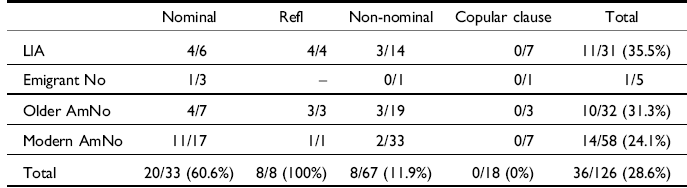
The results are summarized in table 7; we refrain from giving percentages when the numbers are very low. Despite the small numbers, the results indicate that the overall patterns for object shift are the same in modern AmNo as in the baseline. The preference for object shift varies between contexts in all four data sets. In copular clauses, there are no examples of object shift. (Some of the pronouns in copular clauses have nominal antecedents, and some do not.) Reflexives and personal pronouns with nominal reference have a preference for the shifted position, whereas pronouns with non-nominal reference are generally unshifted, as expected. In the following, we will in turn look closer at reflexives, pronouns with nominal reference, and non-nominal det. As we will see, the qualitative analysis of the data confirms that there is considerable stability in object shift – but also some variability in all speaker groups.
The proportion of object shift in relevant clauses, including cases with shifted or unshifted object pronouns (but not topicalized objects)

First, consider reflexives. In modern homeland Norwegian experimental data, object shift is almost fully obligatory with reflexives (97.2% shift, Lundquist & Tengesdal Reference Lundquist and Tengesdal2022). This is also true in our corpus data, both in the baseline and in AmNo. The numbers are small, but there are no examples of unshifted reflexives; an older AmNo example with a reflexive is given in (28) (see also (27b) above).

Second, there is some variability in the placement of pronouns with nominal reference, but overall a preference for the shifted position; examples of shifted pronouns are given in (29) and (30) below (see also (27a)).


However, object shift does not appear to be fully obligatory in any of the speaker groups, and there is no clear difference between LIA, where all speakers have the same dialect background, and the more mixed older AmNo group. Rather, weak pronouns with nominal reference are sometimes unshifted in all four subcorpora; an example from LIA is given in (31) and AmNo examples are given in (32). Note that the examples in (31) and (32a) are very similar, and both have unshifted first person pronouns. In the data in Lundquist & Tengesdal (Reference Lundquist and Tengesdal2022), first person pronouns are most likely to remain unshifted in present-day homeland Norwegian, as well (7.6% unshifted). However, there appears to be somewhat more variation in our data also with third person pronouns, than in present-day spoken Norwegian corpora with similar dialect backgrounds – particularly examples like (32b–c) are rare in present-day spoken Eastern Norwegian. For instance, only 4.7 percent of the third person pronouns are unshifted in the experimental data in Lundquist & Tengesdal (Reference Lundquist and Tengesdal2022).


Third, consider pronominal det with non-nominal reference. Here, there is a strong preference for the unshifted position, which is also expected (cf. above), but again, there is some variability both in the baseline and in older and modern AmNo. Examples of shifted det are given in (33), and unshifted det is exemplified in (34).


The difference between (33) and (34) with regard to object placement relates to differences in information structure. In (33), the object pronoun is a continuing topic. In (33a), det refers back to an event that has been introduced in the previous discourse; a previous det in the utterance refers back to the same event. The same is true for (33b). In (34), the object pronoun is a switch topic, referring back to (part of) the focus in the previous utterance (see section 4 above on subject shift). In (34a), the utterance is preceded by a question by the interviewer (‘you don’t know that?’), and det refers to the VP in that utterance. The utterance in (34b) is preceded by a comment by a different speaker, that they believed something was ‘from around here’. As argued by Bentzen & Anderssen (Reference Bentzen and Anderssen2019) and Lindahl & Engdahl (2022), switch topics do not generally undergo object shift, whereas continuing topics do. This seems to be the case both in the baseline and in AmNo, and it can to a large extent explain the lower frequency of object shift with pronouns with non-nominal reference; these are often switch topics, as in (34), but can also sometimes be continuing topics, as in (33) (cf. Lindahl & Engdahl 2022). The connection between information structure and word order seems to be the quite the same in AmNo as in the baseline.
Now, the increased preference for SV order in AmNo seems to have some consequences for the proportion of object shift – but without affecting the general principles. As noted in section 4 above, switch topics are often sentence-initial in the baseline, and when the initial position is unavailable (e.g., due to topicalization of another element or wh-movement), they are unshifted (see further Bentzen & Anderssen Reference Bentzen and Anderssen2019, Lindahl & Engdahl 2022). Consider the present-day homeland Norwegian examples in (35). In the answer to the question Did you see the church?, the switch topic object pronoun can be initial or unshifted, but the shifted position is infelicitous.

This means that the strong preference for SV order in AmNo can affect the proportions of shifted and unshifted object pronouns. As we saw in section 4, modern AmNo has SV order, where the baseline would rather topicalize the object (see (14) and (15) above). In AmNo, the object pronoun is instead unshifted, as expected from the pattern found in homeland Norwegian (see (36)). When the effect of the change in the frequency of SV is taken into account, the distribution of object pronouns appears to be remarkably stable in AmNo.

In the discussion of information structure and SV order, we have so far only included pronouns with non-nominal reference (which are often, but not always, switch topics). Let us now also consider pronouns with nominal reference (although they are less frequent). Anderssen & Westergaard (Reference Anderssen and Westergaard2020) find a lower proportion of object shift with nominal antecedents in modern AmNo than in present-day homeland Norwegian. In their data set, which is drawn from a previous version of CANS, 61 percent (25/41) of these object pronouns shift (Anderssen & Westergaard Reference Anderssen and Westergaard2020, their table 8); their results are similar to ours for modern AmNo (and the data sets partly overlap). In present-day homeland Norwegian corpus data and experimental data, there is around 90–95 percent object shift of pronouns with nominal reference (Anderssen & Westergaard Reference Anderssen and Westergaard2020; Lundquist & Tengesdal Reference Lundquist and Tengesdal2022). Based on our data sets, it is difficult to ascertain whether there is a quantitative drop in object shift over time; we do not exclude the possibility that this may be the case, but it is not entirely clear from our results. What is evident, however, is that there is variation already in the baseline, and when we look at the baseline examples from a qualitative perspective, this variation appears to be greater than in present-day (urban) Eastern Norwegian, where object shift is more categorical. This has consequences for the interpretation of the results from modern AmNo. Variation in object shift in modern AmNo (in contexts where it would apply more or less categorically in present-day Eastern Norwegian) could at least in part represent continuity from the baseline. The preference for SV order might affect the proportions of shifted and unshifted pronouns with nominal reference, as well. As mentioned in connection to table 4 above, some of the initial pronouns in LIA have nominal reference, whereas there are very few initial pronouns (with nominal or non-nominal reference) in AmNo. An example with an initial pronoun in the baseline is given in (37a) and an example with an unshifted pronoun in AmNo is given in (32c), repeated as (37b); note that as with the examples with non-nominal pronouns above, the pronouns are switch topics.Footnote 31

Although initial object pronouns with nominal reference are infrequent in the baseline, the growing preference for SV order is still expected to affect the proportion of unshifted objects, since object pronouns with nominal reference are also overall very infrequent.
As we have seen, the increased preference for SV has effects on the frequency of contexts for object shift: in several cases, object pronouns that would be topicalized in the baseline instead appear in the unshifted position in AmNo. Still, the general principles of object shift appear to be the same as in the baseline.
6. Discussion
In this section we discuss the results in further detail. In section 6.1, we briefly comment on the status of V2 and the C-domain over time in AmNo. In section 6.2, we turn to the increase in subject-initial clauses. We discuss pragmatic and information-structural aspects of this change, and how it may have knock-on effects for subject shift and object shift. In section 6.3, we discuss the role of cross-linguistic influence, and in section 6.4, we discuss the stability and variation over time. We argue that the grammatical representations of AmNo generally remain intact, and we interpret the changes as quantitative fluctuations permitted by an essentially unchanged grammar.
6.1 V2 and the C-domain over time in AmNo
There are not many V2 violations in our modern AmNo material. This is unsurprising in the context of previous studies of AmNo (Larsson & Johannessen Reference Larsson and Bondi Johannessen2015b, Eide & Hjelde Reference Hjelde2015, Westergaard & Lohndal Reference Westergaard, Lohndal, Lightfoot and Havenhill2019, Westergaard et al. Reference Westergaard, Lohndal and Lundquist2021), and it also ties in with studies of other Scandinavian heritage languages in the the US (Larsson & Kinn Reference Larsson and Kinn2022 on Swedish, Kühl & Petersen Reference Kühl and Heegård Petersen2018 on Danish, and Arnbjörnsdóttir et al. Reference Arnbjörnsdóttir, Thráinsson and Edda Nowenstein2018 on Icelandic).Footnote 32 In terms of diachrony, a main result in our study is that the V2 violations that do occur are a recent phenomenon – we do not find any clear attestation in the emigrant or older AmNo groups. This corroborates previous proposals by Eide & Hjelde (Reference Hjelde2015); however, we can now make this statement with greater confidence, as we have had access to a larger, tagged corpus.
With respect to the structure of the C-domain, we have argued that the architecture proposed by Eide (Reference Eide2011) and Holmberg (Reference Holmberg2020) for homeland Norwegian (and Swedish) (see section 3) is retained. A main argument for this is that the left-dislocation patterns observed in the homeland variety are also attested in AmNo, and they do not seem to be in any decline. This finding is similar to what Larsson & Kinn (Reference Larsson and Kinn2022) observe in American Swedish, where left-dislocation patterns are also a stable feature. As Bosquette et al. (Reference Bousquette, Melum Eide, Hjelde and Putnam2021) point out, the retention of left-dislocation structures which involve resumption (as is the case for both CLD and HTLD) could be related to a preference to avoid silent elements (see, e.g., Laleko & Polinsky Reference Laleko and Polinsky2017). More generally, the results resonnate with Meklenborg’s (Reference Meklenborg, Woods and Wolfe2020) survey of the diachrony of (adverbial) resumptive elements in the history of Germanic – Meklenborg shows that these elements have a long history, and in fact, she argues that the resumptive elements could be a factor promoting the stability of V2.
As is clear from the previous sections, we see no “slimming down” of the structure of the C-domain in AmNo. Importantly, however, there are clear changes over time in terms of how the available positions in the left periphery are used. The most conspicuous reflection of this is the increase in the proportion of subject-initial clauses. We address this in the following section.
6.2 The increase in subject-initial clauses and its consequences
Consistently with previous studies of AmNo (Westergaard & Lohndal Reference Westergaard, Lohndal, Lightfoot and Havenhill2019, Westergaard et al. Reference Westergaard, Lohndal and Lundquist2021) we see an increase in subject-initial (SV) clauses (see table 2) at the expense of non-subject-initial clauses. With our new, diachronic data sets, we have been able to trace this development over time, and we have shown that the increase in SV starts in older AmNo.
Westergaard & Lohndal (Reference Westergaard, Lohndal, Lightfoot and Havenhill2019) and Westergaard et al. (Reference Westergaard, Lohndal and Lundquist2021) argue that the increase in SV clauses is a result of cross-linguistic influence from English. Modern English has a much lower proportion of non-subject-initial clauses than Norwegian (less than 10 percent according to Yang 2001, cited in Westergaard & Lohndal Reference Westergaard, Lohndal, Lightfoot and Havenhill2019: 92),Footnote 33 while the proportion in Germanic V2 languages is between 30 and 40 percent (see section 3 above). However, we remain cautious with regard to how the similarity to English should be interpreted; although the proportions in some AmNo speakers resemble English, this does not necessarily mean that CLI from English has to be the only (or even main) cause. As mentioned in section 3, we suggest that the increase in subject-initial clauses is, at least in part, a consequence of pressure to ease processing in a non-dominant language. SV order is known to be easier to process than OVS order (see, e.g., Bickel et al. Reference Bickel Balthasar, Choudhary, Schlesewsky and Bornkessel-Schlesewsky2015, Hörberg Reference Hörberg2016 and references therein). CLI from English could perhaps also play a role in this respect, as English-like structures would be accessible to the speakers, and sometimes difficult to inhibit (see further below, and note that this implies that CLI is related to ease of processing; it does not “compete” with it). However, other factors also stand out as relevant. As mentioned in section 3, fronting of subjects to Spec-CP involves shorter syntactic dependencies than fronting of other constituents, such as objects, and heritage speakers are known to prefer shorter dependencies (Benmamoun et al. Reference Benmamoun, Montrul and Polinsky2013 and references therein). Relatedly, fronting to Spec-CP is A'-movement, and a recurring finding in heritage languages is a preference for A'-movement of the structurally highest constituent (i.e., the subject) rather than structurally lower constituents (see Polinsky Reference Polinsky2018: 241ff). Moreover, the increase in SV involves a new way of using the fronting options which relies more on syntactic function and less on information structure (recall that object pronouns that are switch topics tend to be fronted in homeland Scandinavian, while AmNo speakers seem to prefer fronting the subject even in these cases; see section 5). This is compatible with the Interface Hypothesis (e.g., Sorace & Filiaci Reference Sorace and Filiaci2006, Sorace Reference Sorace2011), which posits (informally) that phenomena involving interaction between different modules of language, such as syntax and discourse/information structure, are more vulnerable in bilinguals.
Laleko (Reference Laleko, Montrul and Polinsky2021) points out that an increase in SV order has been observed in other heritage languages; in order to establish more firmly which roles are played by different (potential) factors in AmNo, we should compare it to the language of Norwegian heritage speakers whose dominant language is not English, but some other language in which SV is not as ubiquitous. Exploratory work with Norwegian heritage speakers in Latin America whose dominant language is Spanish tentatively suggests that SV is increasing in this contact situation too, although Spanish clearly has more variation than English in terms of what occupies the clause-initial position (Melvær Reference Melvær2023).
Building on Eide (Reference Eide2011), Holmberg (Reference Holmberg2020), and Lindahl & Engdahl (2022), we have assumed a complex C-domain in the baseline, which is retained in AmNo (see section 6.1 above). We have also assumed a symmetric analysis of V2: in SV clauses, the subject moves to the C-domain, and in XVS clauses, X (e.g., an object or an adverbial) does so instead; following previous work, we assume that X and S can compete for the same position. Moreover, as argued more extensively by Lindahl & Engdahl (2022), the difference between focus chaining (i.e., fronting a switch topic) and topic chaining (fronting of a continuing topic) is not encoded in the C-domain in Scandinavian. The stronger preference for SV order in AmNo means that topic chaining is sometimes chosen where focus chaining would rather be used in the baseline; this is a shift in pragmatic strategies, but does not involve a change in grammar.
Our investigation of subject and object placement relative to negation suggests that the stronger preference for SV order has consequences further down in the clause. Fronting of subjects to Spec-CP mostly bleeds the shifted position, whereas the unshifted position is less affected. For subjects that are not fronted, the overall patterns for subject shift remain stable: shifted subjects tend to be topical and deaccented, whereas unshifted subjects are generally focused and accented. (There is some variation in all speaker groups, which we return to in section 6.4 below.) With regard to object shift, the data are too scarce for us to draw firm quantitative conclusions. However, it is clear that object pronouns (particularly those with non-nominal reference, but also with nominal reference) that are switch topics are often topicalized to Spec-CP in the baseline, but unshifted in AmNo (due to the preference for SV order); switch topics generally do not undergo object shift, and this seems to hold both in the baseline and in AmNo. Overall, the principles of object shift are remarkably stable in AmNo, despite the infrequency of object shift in corpus data (and presumably in the input for the HL speakers) and the fine-grained and partly pragmatically determined patterns.
Although there is a high degree of stability in AmNo, we have also observed change. Apart from the conspicuous increase in SV order, we also see tag questions with unshifted subjects in modern AmNo, as well as a few V2 violations. In the next section, we look more closely at these changes, and discuss them in terms of CLI.
6.3 Cross-linguistic influence
We have proposed that the increase in SV order in AmNo is primarily a consequence of pressure to ease processing, although it is also possible that CLI from English is to some extent involved. In any case, the change does not involve the underlying representation. CLI (and processing ease) rather lead to fluctuations in usage, within the limits of what the heritage grammar (and in this case also the baseline grammar) already allows.
There are two other changes in modern AmNo that more clearly seem to be a consequence of CLI. First, V2 violations sometimes occur in modern AmNo. These are not a consequence of representational change, either (see also Larsson & Johannessen Reference Larsson and Bondi Johannessen2015b, Westergaard et al. Reference Westergaard, Lohndal and Lundquist2021, Larsson & Kinn Reference Larsson and Kinn2022); overall, V2 remains robust, and there is evidence for a complex C-domain with the same structure as in the baseline. Larsson & Kinn (Reference Larsson and Kinn2022) propose that V2 violations in American Swedish have English-like syntax (and therefore lack V-to-C movement), due to the simultaneous activation of the heritage language and the dominant language, English (see also, e.g., Bialystok Reference Bialystok2009, de Groot Reference Groot2016 and references therein, and Westergaard et al. Reference Westergaard, Lohndal and Lundquist2021). Along similar lines, we propose that the AmNo speakers on occasion fail to inhibit their English grammar, leading to non-V2 (presumably with the subject in Spec-TP, as in English).
The second change involves the use of tag questions in the heritage language (see examples in (13) above). Tag questions do not occur in our baseline data; this does not mean that they are completely unheard of in (present-day) Norwegian, but the use seems more restricted, and the word order would typically involve subject shift, contrary to the AmNo pattern illustrated in (13) above. Tag questions resemble discourse markers in terms of function (one important function is to make the addressee participate in the interaction; Tottie & Hoffmann Reference Tottie and Hoffmann2006), and also in terms of level of integration in the sentence – they are peripheral and “detachable” from the matrix clause (Matras Reference Matras2020:209). Discourse markers have been shown to be easily affected by CLI (Matras Reference Matras2020:209 and references therein; see Moquin & Salmons Reference Moquin and Salmons2020 and Søfteland & Hjelde Reference Søfteland and Hjelde2021 on AmNo) and, descriptively speaking, the rise of tag questions in modern AmNo could be seen as an instance of this generalization. With regard to the internal structure of these tag questions, the position of the subject (unshifted) also resembles English, but note that this position also exists in the baseline system, although it is typically used in other contexts (ordinary questions with unshifted pronouns are found in Norwegian, Urbanik & Svennevig Reference Urbanik and Svennevig2019; this is also pointed out by Anderssen & Westergaard Reference Anderssen and Westergaard2020).
Thus, in our study, the consequences of CLI are rather limited. Considering V2 and tag questions, the effects of CLI are only visible in the most recent set of recordings (modern AmNo). With subject shift and object shift it is rather unclear to us what the consequences of CLI would look like (possibly less subject shift in all types of questions, and overall less object shift), but, regardless, we have seen that the general patterns of subject shift (apart from tags) and object shift are stable even in modern AmNo, when we control for the effects of the increase in subject-initial clauses.
6.4 Stability of representations and variation over time
We have argued, on the basis of the patterns in AmNo over time, that the clause structure of this heritage variety is stable. V2 remains robust, and there is evidence for an extended C-domain similar to that of homeland Norwegian. There are clear changes in fronting patterns in the sense that subject-initial clauses are gaining in frequency, and we have argued that this has consequences also for subject and object shift. However, none of these changes introduces fundamentally new structures into the grammar; what we see is quantitative fluctuations within the boundaries of what the baseline grammar permits.Footnote 34 This lends further support to the by now long-standing notion that syntax is a stable domain in heritage languages (e.g., Benmamoun et al. Reference Benmamoun, Montrul and Polinsky2013, Lohndal et al. Reference Lohndal, Rothman, Kupisch and Westergaard2019), which implies that syntax can be acquired and maintained under conditions of limited input and use.
An interesting aspect of this stability concerns the subtle patterns of subject and object shift, which involve a number of interacting factors (e.g., information structure, prosody, and antecedent relations), and which are also subject to some dialectal and individual variation. In the context of previous research on heritage languages, one could possibly expect to see more pronounced changes than what we observe (when the effect of the increase in subject-initial clauses is controlled for) given that both subject shift and object shift can, at least on the face of it, be assumed to be interface phenomena (cf. the Interface Hypothesis above). There are, however, several possible reasons why subject shift and object shift might be more stable than the topicalization patterns. First, whereas movement to Spec-CP is syntactically and pragmatically rather free, subject shift and, in particular, object shift are much more restricted. As we have seen, only weak object pronouns can shift, and only under certain (syntactically defined) conditions. Moreover, there are prosodic factors involved. Unshifted weak pronouns (subjects or objects) need to be prosodically incorporated into a preceding word, or be upgraded to their own prosodic word (and then accented); see, for example, Erteshik-Shir et al. (Reference Erteschik-Shir, Josefsson and Köhnlein2021) on the prosody of object shift. Like syntax, prosody is one of the more robust areas in heritage languages (heritage speakers are more baseline-like than L2 speakers in terms of both perception and production; see Polinsky Reference Polinsky2018:147ff. and references therein), and the two domains might conspire for the stability of subject shift and object shift.
The overall principles of subject shift and object shift remain stable across time: for instance, focused pronouns and switch topics are generally unshifted. At the same time, we see intra- and interindividual variation in all speaker groups investigated. We noted that there is a statistically significant difference between LIA and emigrants with regard to subject shift; this is most likely a consequence of the more varied dialect background of the emigrant speakers. However, also among the LIA speakers there is some variability, and this variability seems to be retained in modern AmNo – even if the modern AmNo speakers are old (often over 70 years old at the time of recording) and belong to different generations of immigrants. It is possible that there are shifts in this variation across time that cannot be fully explored with the available data (e.g., with respect to subject shift in embedded contexts, and object shift). In fact, we would rather expect some shifts in the variation. As mentioned, change in heritage languages can sometimes be traced back to variation in the baseline (Polinsky Reference Polinsky2018:33–35). Moreover, even if we have limited the investigation of modern AmNo to speakers with a certain geographical family background, the input for the speakers could include several different dialects (see, e.g., Hjelde Reference Hjelde2015). With this in mind, it is no less striking that subtle variability is transmitted over time in the heritage language context.
7. Conclusion
In this article, we have investigated subject and object placement in American Norwegian. We have compared modern AmNo speakers to an older generation of heritage speakers, and a baseline with emigrant speakers and old dialect recordings from Norway. We included three positions for subjects and objects in the investigation: Spec-CP, a shifted position (pronoun–negation), and an unshifted position (negation–pronoun). The results suggest that although the structure of the C-domain remains intact, as evidenced by the relative robustness of V2 and left-dislocation patterns, there is a clear change in what is fronted to Spec-CP: there is a preference for SV order in AmNo, and it grows stronger with time. We have suggested that this change is primarily due to pressure to ease processing in the heritage language, which favors SV order. The increase in SV order has knock-on effects for argument placement further down in the clause. Fronting of subjects to Spec-CP bleeds the shifted subject position, but does not affect unshifted subjects to the same extent. Moreover, due to SV, there are considerably fewer topicalized object pronouns in AmNo than in the baseline. This has an effect on object shift: topicalized objects are often switch topics, and they generally do not undergo object shift – when subjects are topicalized, the object will therefore be unshifted in AmNo. Despite shifts in the proportions, the subtle patterns for subject shift and object shift appear strikingly stable in the heritage language. At the same time, variation in subject shift and object shift can be observed in all speaker groups, and there is more variability in the baseline than in present-day homeland Eastern Norwegian. To a large extent, this variation is transmitted across time in the heritage language.
Acknowledgments
The research reported in this article was supported by the Research Council of Norway, project number 301114. We would like to thank the editors and two anonymous reviewers for their constructive feedback, as well as the audiences at Syntactic Change in Progress (SCiP), University of Konstanz, 2021, Comparative Germanic Syntax Workshop (CGSW) 35, University of Trento, 2021, and the workshop on Heritage Languages at Nordic and General Linguistics (NGL) 12, University of Oslo, 2021.