Adolescence is a period of major biological, psychological, and social development, which makes heavy demands on adolescents' ability to cope adequately with the diverse environmental challenges they encounter during this phase of life. Failure to meet these demands may have serious consequences for (future) mental health (e.g., Ferdinand & Verhulst, 1995; Fergusson, Lynskey, & Horwood, 1996; Kessler, Foster, Saunders, & Stang, 1995). How individuals deal with environmental challenges and how these experiences affect their mental health depends on an interplay of several brain systems. Part of these systems involve emotional responses to stimuli, whereas others concern self-regulatory processes such as the inhibition of habitual responses and goal-directed behavior (Nelson, Leibenluft, McClure, & Pine, 2005). The past decade has shown an increased interest in the role of these dispositional emotionality and regulation processes in adjustment (e.g., Eisenberg et al., 2005; Rothbart & Bates, 1998), especially in the field of child psychology and psychiatry.
Negative emotionality or negative affectivity refers to a temperamental disposition characterized by high distress in response to elicitors of fear (novel, intense, or unpredictable stimuli) and frustration (attractive out-of-reach stimuli). Although fearfulness and frustration belong to the same broad factor of negative emotionality, they have been found to become increasingly uncorrelated during early development (Rothbart & Putnam, 2002), and to be differentially associated with internalizing and externalizing problems in childhood and adolescence (Eisenberg et al., 2001; Oldehinkel, Hartman, De Winter, Veenstra, & Ormel, 2004; Rydell, Berlin, & Bohlin, 2003). Various studies have linked negative emotionality in childhood to later mental health problems (e.g., Akiskal, 1996; Bates, Dodge, Pettit, & Ridge, 1998; Caspi, Henry, McGee, Moffitt, & Silva, 1995; Colder & Stice, 1998; Kagan, 1997; Maziade et al., 1985; Ormel et al., 2005). Nevertheless, many children do not develop psychiatric symptoms despite high levels of fearfulness or frustration.
Effortful control, based on the executive attention system, refers to the ability to inhibit a dominant (habitual) response to perform a subdominant one (Rothbart, Ellis, Rueda, & Posner, 2003). In other words, effortful control is the capacity to voluntarily regulate behavior and attention. Individual differences in effortful control can be seen as early as late in infancy, and the capacity to self-regulate attention and behavior continues to develop through the preschool and grade-school years until early adulthood (Casey, Geidd, & Thomas, 2000; Gogtay et al., 2004; Murphy, Eisenberg, Fabes, Shepard, & Guthrie, 1999). Effortful control is believed to be a major contributor to successful social development (Eisenberg, Fabes, Guthrie, & Reiser, 2000; Kochanska, Murray, & Harlan, 2000; Posner & Rothbart, 1998). A growing body of evidence has linked inadequate effortful control to externalizing problems (e.g., Olson, Schilling, & Bates, 1999; Oosterlaan & Sergeant, 1996). Internalizing problems often involve the inability to regulate negative emotionality; hence, one would expect an association of internalizing problems and effortful control, particularly attentional control, as well (Derryberry & Rothbart, 1988; Eisenberg et al., 2001; Oldehinkel et al., 2004; Vasey, El-Hag, & Daleiden, 1996; Wolfson, Fields, & Rose, 1987). Yet several researchers failed to find evidence for this (e.g., Krueger, Caspi, Moffitt, White, & Stouthamer-Loeber, 1996; O'Brien & Frick, 1996; Oosterlaan & Sergeant, 1996). A possible explanation is that measures of self-regulation may contain aspects of both voluntary regulation (effortful control) and involuntary or reactive control (as reflected in behavioral inhibition), which are assumed to be oppositely associated with internalizing problems. Furthermore, the association between effortful control and internalizing problems may depend on the kind of effortful control and on age. Eisenberg et al. (2001, 2005), for example, found no association between inhibitory control and internalizing problems, whereas the association between attentional control and internalizing problems became weaker between (approximately) age 6 and age 8.
Although often inversely related (Rothbart, Ellis, & Posner, 2004), at least in Western cultures (Ahadi, Rothbart, & Ye, 1993), researchers generally agree that negative emotionality and effortful control should be treated a separate phenomena (Murphy et al., 1999; Rubin, Coplan, Fox, & Calkins, 1995): low emotional reactivity can go hand in hand with poor regulation, and an emotional person may still be a good regulator (Rydell et al., 2003). This study focuses on the role of negative emotionality and effortful control with respect to the development of externalizing and internalizing problems in early adolescence. It is conceivable that the ability to constrain undesirable thoughts and behaviors is particularly relevant for adolescents who tend to experience intense negative emotions (Blair & Cipolotti, 2000, Eisenberg et al., 2000; Muris & Ollendick, 2005; Rothbart & Bates, 1998); after all, adolescents who do not react strongly to potentially stressful stimuli have less need for self-regulation than those who tend to be emotionally very reactive (i.e., have high negative emotionality). If their self-regulatory capacity is limited, such highly reactive youngsters may be at particular risk to develop behavioral and emotional problems (Lengua, West, & Sandler, 1998; Shoda, Mischel, & Peake, 1990; Wachs & Bates, 2001).
Despite the intuitive appeal of a model in which the (additive and) multiplicative effects of negative emotionality and effortful control are assumed to predict juvenile mental health problems, relatively few studies have focused on the interaction between these two temperament dimensions in relation to internalizing or externalizing problems so far. The results of these studies suggest that negative emotionality (particularly anger/frustration) and effortful control interact with respect to their effect on externalizing problems (Eisenberg et al., 1996, 2004; Valiente et al., 2003), although it should be noted that some studies failed to find such an interaction effect (Belsky, Friedman, & Hsieh, 2001; Rydell et al., 2003). Regarding internalizing problems, the (limited) existing evidence does not point to any interaction of significance (Eisenberg et al., 2001, 2004). However, these studies were based on relatively small samples, and hence had limited power to detect interaction effects. Furthermore, the samples involved children rather than adolescents. Effortful control may become increasingly important when children enter and pass through adolescence; a phase characterized by major changes, including the emergence of sexuality, and a social reorientation from family to peers. The threats and temptations associated with these developments make heavy demands on adolescents' ability to regulate, plan, and inhibit behavior and attention in a context-appropriate manner, particularly for those adolescents who tend to have strong negative emotional responses to challenging situations (Nelson et al., 2005).
Adolescence is an interesting period to study the interaction of negative emotionality and effortful control not only because of its concentration of developmental challenges, but also because the incidence of internalizing problems rises substantially during this period, particularly in girls (e.g., Hankin et al., 1998; Lewinsohn, Gotlib, & Seeley, 1995; Oldehinkel, Wittchen, & Schuster, 1999; Rutter, Caspi, & Moffitt, 2003). Initial signs of these gender differences become evident during early adolescence (Angold, Costello, & Worthman, 1998; Cohen et al., 1993). These developmental changes could influence the interplay of effortful control and negative emotionality with respect to internalizing problems, in that interactions not yet manifest in childhood may start to emerge in adolescence, especially in girls.
We investigated the extent to which effortful control moderates the risk of internalizing or externalizing problems induced by high negative emotionality in a large sample of early adolescents. We hypothesized that the effects of a strong liability to distress (i.e., high levels of negative emotionality) would be attenuated by high levels of effortful control. In other words, high effortful control was supposed to prevent fearfulness and frustration to be expressed in internalizing or externalizing problems; or conversely, high negative emotionality was assumed to be particularly detrimental in combination with low effortful control.
Methods
Sample
The Tracking Adolescents' Individual Lives Survey (TRAILS) is a prospective cohort study of Dutch (pre)adolescents, with the aim to chart and explain the development of mental health from preadolescence into adulthood, both at the level of mental health problems and the levels of underlying vulnerability and environmental risk. The present study involves data from the first (T1) and second (T2) assessment wave of TRAILS, which ran from March 2001 to July 2002, respectively, September 2003 to December 2004.
Sample selection involved two steps. First, five municipalities in the North of The Netherlands, including both urban and rural areas, were requested to give names and addresses of all inhabitants born between October 1, 1989, and September 30, 1990 (first two municipalities), or October 1, 1990, and September 30, 1991 (last three municipalities), yielding 3,483 names. Simultaneously, primary schools (including schools for special education) within these municipalities were approached with the request to participate in TRAILS, that is, pass on students' lists, provide information about TRAILS participants' behavior and performance at school, and allow class administration of questionnaires and individual testing (neurocognitive, intelligence, and physical) at school. School participation was a prerequisite for eligible children and their parents to be approached by the TRAILS staff, with the exception of those already attending secondary schools (<1%), who were contacted without involving their schools. Of the 135 primary schools within the municipalities, 122 (90.4% of the schools accommodating 90.3% of the children) agreed to participate in the study.
If schools agreed to participate, parents (or guardians) received two brochures, one for themselves and one for their children, with information about the study; and a TRAILS staff member visited the school to inform eligible children about the study. Shortly thereafter, a TRAILS interviewer contacted parents by telephone to give additional information, answer questions, and ask whether they and their son or daughter was willing to participate in the study. Respondents with an unlisted telephone number were requested by mail to pass on their number. If they reacted neither to that letter, nor to a reminder letter sent a few weeks later, staff members paid personal visits to their house. Parents who refused to participate were asked for permission to call back in about 2 months to minimize the number of refusals because of temporary reasons. If both parents and children agreed to participate, parental written informed consent was obtained after the procedures had been fully explained. Children were excluded from the study if they were incapable to participate because of mental retardation or a serious physical illness or handicap, or if no Dutch-speaking parent or parent surrogate was available and it was not feasible to administer part of the measurements in the parent's language. Of all children approached for enrollment in the study (i.e., selected by the municipalities and attending a school that was willing to participate, N = 3,145), 6.7% were excluded because of mental or physical incapability or language problems. Of the remaining 2,935 children, 76.0% (N = 2,230, mean age = 11.09, SD = 0.56, 50.8% girls) were enrolled in the study (i.e., both child and parent agreed to participate). Responders and nonresponders did not differ with respect to the prevalence of teacher-rated problem behavior. Furthermore, no differences between responders and nonresponders were found regarding associations between sociodemographic variables and mental health outcomes (De Winter et al., 2005).
Of the 2,230 baseline participants, 96.4% (N = 2,149), 51.0% girls participated in the first follow-up assessment (T2), which was held 2 to 3 years after T1 (mean number of months = 29.44, SD = 5.37, range = 16.69–48.06). Mean age at T2 was 13.56 (SD = 0.53). We excluded persons with missing temperament data at T1 (n = 226). This group did not differ from the other participants with respect to internalizing problems (t = 1.16, p = .25), but had slightly more externalizing problems (t = 2.21, p = .03).
Measures
Data collection
At T1, well-trained interviewers visited one of the parents or guardians (preferably the mother, 95.6%) at their homes to administer an interview covering a wide range of topics, including developmental history and somatic health, parental psychiatric disorders and care utilization. Besides the interview, the parent was asked to fill out a self-report questionnaire. Children were measured at school, where they filled out questionnaires, in groups, under the supervision of one or more TRAILS assistants. In addition to that, information processing capacities (neurocognitive tasks), intelligence, and a number of biological parameters were assessed individually (at school, except for saliva samples, which were collected at home). Teachers were asked to fill out a brief questionnaire for all TRAILS children in their class. T2 involved only self-report questionnaires, to be filled out by the children (adolescents now), their parents, and their teachers. As in T1, the adolescents completed their questionnaires at school, supervised by one or more TRAILS assistants. Measures that were used in the present study are described more extensively below. Temperament was assessed at T1, internalizing and externalizing symptoms at both T1 and T2. As associations between temperament and mental health at T1 may be artificially inflated because of their simultaneous assessment, and temperament is not only cross-sectionally but also prospectively related to mental health problems (Ormel et al., 2005), we focused on internalizing and externalizing problems assessed at T2 in particular, and used T1 data to test the robustness of the model and examine developments between pre- and early adolescence.
Fearfulness, frustration, and effortful control
Temperament was assessed by the parent version of the short form of the Early Adolescent Temperament Questionnaire—Revised (EATQ-R; Hartman, 2000; Putnam, Ellis, & Rothbart, 2001). The EATQ is a questionnaire based on the temperament model developed by Rothbart and colleagues (e.g., Rothbart, Ahadi, & Evans, 2000). Because the EATQ had not been confirmed empirically in large population samples, we examined the item structure using principal components analysis and included only items with a loading of >|.40| and at least .15 greater than the loadings on all other components (Oldehinkel & Hartman, 2003; internal report available upon request; Oldehinkel et al., 2004). This led to some minor alterations to the scales originally proposed by Rothbart and her group. For the present study, we used the scales Fearfulness, which denotes worrying and unpleasant affect related to the anticipation of distress; frustration, measuring negative affect related to interruption of ongoing tasks or goals blocking; and effortful control, which refers to the capacity to voluntarily regulate behavior and attention. Rothbart's model distinguishes between three components of effortful control: activation control (the capacity to perform an action when there is a strong tendency to avoid it), attention control (the capacity to focus attention as well as to shift attention when desired), and inhibitory control (the capacity to plan and to suppress inappropriate responses); but these components failed to emerge as separate factors in the TRAILS sample. The effortful control scale mainly encompasses items reflecting activation control and attention control.
Internalizing and externalizing problems
Internalizing and externalizing problem behaviors were assessed with the Child Behavior Checklist (CBCL; Achenbach, 1991a; Verhulst & Achenbach, 1995), Youth Self-Report (YSR; Achenbach, 1991b), and the Teacher Checklist of Psychopathology (TCP). The CBCL is one of the most commonly used questionnaires in current child and adolescent psychiatric research. It contains a list of 120 behavioral and emotional problems, which parents can rate as 0 = not true, 1 = somewhat or sometimes true, or 2 = very or often true in the past 6 months. The YSR is the self-report version of the CBCL. Because some of the teachers had many TRAILS participants in their class, it was not feasible to have them fill out a long list of problem behaviors for each child. Therefore, we developed the TCP, which contains descriptions (vignettes) of problem behaviors corresponding to the syndromes of the CBCL and YSR. The vignettes are listed in Appendix A. Response options for each description of the TCP ranged from 0 (not applicable) to 4 (very clearly or frequently applicable). CBCL, YSR, and TCP items can be divided into an internalizing problems dimension, including items describing anxious/depressed behavior, withdrawn/depressed behavior, and somatic complaints; and an externalizing problems dimension, which reflects aggressive and rule-breaking behavior. To establish as uncontaminated dimensions as possible, we performed principal components analyses (two components, oblique rotation) on the CBCL and YSR data and included only items with factor loadings of >.25 that were at least twice as high as the loading on the other dimension (this approach was not applicable to the TCP vignettes), which were used in subsequent analyses.
Exclusion of overlapping items
Item-content overlap between the temperament and mental health scales was examined by means of a series of exploratory factor (EFA) and confirmatory factor analyses using SPSS 12 and Mplus 3.11 software, according to Lemery, Essex, and Smider (2002). For both the CBCL and the YSR, separate analyses were performed for every combination of temperament traits (EATQ fearfulness, frustration, and effortful control) and mental health dimensions (internalizing and externalizing). Items that were identified as potentially problematic (i.e., loading < .30 on the correct factor or loading > .30 on the wrong factor) through EFA were allowed to load on both factors in the confirmatory model; all other items were fixed to 0 on the wrong factor. Maximum likelihood algorithms were used for extraction, and the factors were allowed to covary. Items with a loading of >.30 on the wrong factor or a loading of <.30 on the right factor were excluded, after which the resulting shortened scales were resubjected to EFA and the process was repeated until all remaining items loaded above .30 on the correct factor and did not load > .30 on the wrong factor.
Resulting scales
All of this yielded the following scales: CBCL internalizing (22 items, Cronbach α = 0.84), CBCL externalizing (25 items, α = 0.89), YSR internalizing (24 items, α = 0.88), YSR externalizing (24 items, α = 0.83), TCP internalizing (3 items, α = 0.71), TCP externalizing (2 items, α = 0.78), EATQ fearfulness (4 items, α = 0.62), EATQ frustration (5 items, α = 0.74), and EATQ effortful control (11 items, α = 0.86). The scale items are described in Appendix A, including those that were excluded because of overlap. In total, 27% (range = 23–31%) of the CBCL/YSR items were excluded because they were insufficiently representative of their own scale (with respect to overlap between the internalizing and externalizing dimension or between mental health and temperament measures). Only one item was removed from the EATQ, from the Fearfulness Scale.
Multiple-informant measures
The agreement between parent-reported, adolescent-reported, and teacher-reported internalizing and externalizing problems was moderate (r = .23–.38 for internalizing problems and .35–.42 for externalizing problems). Each informant perceives different aspects of problem behavior and differences between informants are meaningful. An additional advantage of using multiple informants is that it reduces the bias associated with monoinformant information (Angold & Costello, 1996; Sourander, Helstelä, & Helenius, 1999). Mental health problems that are rated as present by multiple informants are assumed to be more severe (more generalized) than problems rated by only one informant. Based on these considerations, we used the mean of the standardized parent, adolescent, and teacher scores as a measure of internalizing and externalizing problems in this study. When data of one or two informants were missing or unreliable (YSR: n = 50, CBCL: n = 157, TCP: n = 535), the composite score was based on the remaining informant(s). One person had missing or unreliable problem data of all informants and was hence excluded from the analyses, leaving 1922 cases.
Statistical analysis
Means of and correlations between the variables used in the study were calculated and gender differences tested by means of t tests and z tests. After that, internalizing and externalizing problems were predicted by temperament factors in a three-step regression analysis, where main effects of gender and the temperament variables were entered in the first step and interactions of fearfulness and frustration with effortful control in the second. Whereas gender and main effects of temperament always entered the model, interactions were selected by a forward stepwise procedure. Finally, significant two- and three-way interactions (if any) with gender were added in the third step, also by stepwise selection. In case of three-way interactions, all two-way interactions with the variables involved were included as well, regardless of their significance. To minimize problems of multicollinearity and ease interpretation of the regression coefficients, all continuous variables were standardized to M = 0 and SD = 1. Interaction terms were created by multiplying the standardized scores. A p value of <.05 was considered statistically significant.
To test the robustness of the findings and examine possible age effects, the same regression analyses were repeated for internalizing and externalizing problems at T1 (i.e., at the time temperament was assessed, approximately age 11). In addition, we examined the effect of gender and temperament on the development of problems between the first and second assessment wave, by adjusting the effects on problems at T2 for the amount of problems at T1. This method, also referred to as analysis of covariance, is preferable to using change scores, which tend to be negatively correlated with the baseline scores because of regression to the mean (Vickers & Altman, 2001).
Results
Descriptive statistics
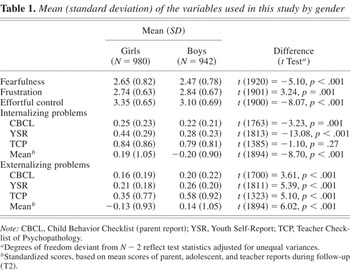
Table 1 presents descriptive statistics of the variables used in this study. Girls had higher scores on fearfulness, effortful control, and internalizing problems (except teacher-reported problems), whereas boys scored higher on frustration and externalizing problems.
Mean (standard deviation) of the variables used in this study by gender

Bivariate associations
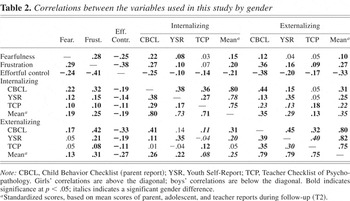
Correlations between the key variables in the study were generally low to moderate (Table 2). In both genders, fearfulness, frustration, and effortful control were significantly associated with (mean) internalizing and externalizing problems. Despite significant gender differences in means (Table 1), associations between temperament and mental health measures, as well as associations among the temperament factors, were approximately similar for boys and girls. The correlation between internalizing and externalizing problems was higher in girls (r = .35) than in boys (r = .25), mainly because of the fact that teacher-reported internalizing problems correlated weakly (if at all) with externalizing problems in boys.
Correlations between the variables used in this study by gender

Regression model
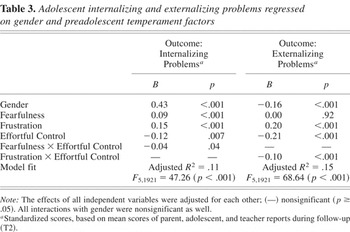
Internalizing problems were predicted by fearfulness, frustration, effortful control, and the interaction between fearfulness and effortful control (Table 3). The interaction between frustration and effortful control was not included, because it did not improve the model significantly (t = 0.65, p = .52). Likewise, none of the interactions with gender reached statistical significance. Externalizing problems were predicted by frustration, effortful control, and the interaction between frustration and effortful control. The main effect of fearfulness and its interaction with effortful control (t = 1.52, p = .13) were not statistically significant, nor was any of the interactions with gender. The interactions with effortful control indicate that the risk of internalizing and externalizing problems associated with, respectively, temperamental fearfulness and frustration was highest for adolescents with low levels of effortful control. The interactions explained 0.2% of the variance in internalizing problems and 1.2% of the variance in externalizing problems, indicating that effortful control was most relevant to prevent externalizing problems in adolescents who were easily frustrated.
Adolescent internalizing and externalizing problems regressed on gender and preadolescent temperament factors

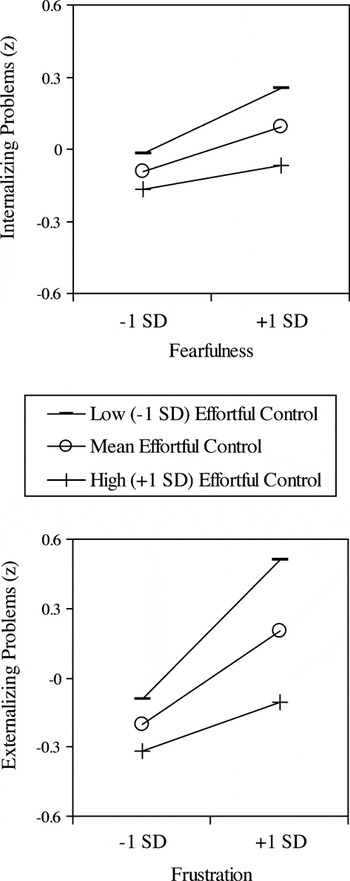
Estimated regression lines for various levels of effortful control are presented in Figure 1. For the effect of fearfulness on internalizing problems, the slope for adolescents 1 SD below the mean of effortful control was 0.14 (t = 4.47, p < .001), whereas the slope for adolescents 1 SD above the mean of effortful control was 0.05 (t = 1.62, p = .11). For the effect of frustration on externalizing problems, the slopes were 0.30 (t = 9.98, p < .001) and 0.11 (t = 3.48, p = .001), respectively.

A graphical presentation of the interaction of negative emotionality (fearfulness, frustration) and effortful control in relation to internalizing and externalizing problems.
Cross-sectional associations
To test the robustness of the findings, the same regression analyses were repeated for internalizing and externalizing problems at T1 (i.e., at the time temperament was assessed, mean age = 11.1), with the similar set of items as used for T2. As might be expected, the amount of variance explained by the predictor variables (adjusted R2) was higher than for T2 outcomes: .16 for internalizing problems and .28 for externalizing problems, which was reflected by stronger main effects of the temperament variables. Furthermore, the effect of gender was weaker for internalizing problems (B = 0.14, p = .001) and stronger for externalizing problems (B = −0.44, p < .001). Otherwise, the effects were very similar; that is, the interaction between fearfulness and effortful control was significant (B = −0.05, p = .02) for internalizing problems, and the interaction between frustration and effortful control was significant for externalizing problems (B = −0.09, p < .001). Also comparable to the prospective findings, the interaction between frustration and effortful control did not improve the prediction of internalizing problems (t = 0.47, p = .64), and the interaction between fearfulness and effortful control failed to reach significance in the model regarding externalizing problems (t = −1.90, p = .06).
Development of problems in early adolescence
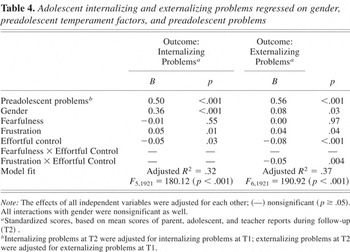
Table 4 shows the effects of gender and temperament on internalizing and externalizing problems at T2 (mean age 13.6), adjusted for problems at T1 (mean age 11.1). By adjusting for earlier problem levels, it was possible to assess the effect of the predictor variables on the development of problem behavior in early adolescence (i.e., between T1 and T2). The coefficients in Table 4 suggest that part of the association between preadolescent temperament (notably frustration and effortful control, no effects were found for fearfulness) and adolescent mental health problems was because of problems that emerged in early adolescence. It is interesting to note that this is also true for the interaction between frustration and effortful control with respect to externalizing problems. Hence, temperament features, notably frustration and effortful control, appear not only associated with the amount of problems (pre)adolescents experience at a certain point in time, but also with the development of problems across time. The combination of high frustration and low effortful control is particularly likely to be followed by an increase in externalizing problems.
Adolescent internalizing and externalizing problems regressed on gender, preadolescent temperament factors, and preadolescent problems

Discussion
The aim of this study was to investigate if effortful control moderated the risk of internalizing or externalizing problems induced by high fearfulness and frustration (i.e., high negative emotionality) in a population sample of early adolescents. As hypothesized, the effects of fearfulness and frustration were attenuated by high levels of effortful control. The associations differed between the two domains of mental health investigated: effortful control reduced the effect of fearfulness on internalizing problems and the effect of frustration on externalizing problems. The effects were stronger for externalizing problems, and similar for preadolescent (age 11) as for adolescent (age 13/14) outcomes. Effortful control and frustration, but not fearfulness, also predicted the development of problems between pre- and early adolescence.
Our results confirm the significance of effortful control for successful emotional and behavioral development suggested previously (e.g., Kochanska et al., 2000; Posner & Rothbart, 1998). Over and above additive main effects of negative emotionality and effortful control on internalizing and externalizing problems, effortful control also reduced the risk associated with negative emotionality, in other words, moderated its effect. Hence, as opposed to early temperament models emphasizing how people are moved by emotions or arousal, people are not always at the mercy of affect: effortful control can help to deal with elicitors of fear and frustration and prevent aversive mental health outcomes (Rothbart & Rueda, 2005).
With respect to externalizing problems, interactions between frustration/anger and effortful control were also found in a number of previous studies on this topic (Eisenberg et al., 1996, 2004; Valiente et al., 2003); hence, our findings support existing evidence that effortful control moderates the effect of negative emotionality on the development of child and adolescent behavioral adjustment (Eisenberg et al., 2000; Muris & Ollendick, 2005). In contrast, Belsky et al. (2001), who studied the effect of infant negative emotionality and effortful control (attentional persistence) on 3-year-olds, did not find such an interaction. Because negative emotionality proved not related at all to externalizing problems in their study, the authors postulated that the lack of effect might be because of measurement flaws. Rydell et al. (2003), using a sample of 6- to 8-year-old children, did not find an interaction with negative emotionality either. The discrepancy between their findings and ours could be because of their smaller sample (about 130 children) or because part of the scales of their (newly constructed) temperament questionnaire were only weakly related to corresponding constructs in the Children's Behavior Questionnaire (Rothbart, Ahadi, Hershey, & Fisher, 2001), the child version of the EATQ used in the present study. Hence, they may have been measuring other traits.
Regarding internalizing problems, despite the fact that several authors have proposed a model in which effortful control moderates the effect of negative emotionality on anxiety and depression (e.g., Muris & Ollendick, 2005), the evidence in favor of such a model has largely been lacking so far (Eisenberg et al., 2001, 2004). A possible explanation for the fact that we did find an interaction of effortful control and fearfulness is our sample size, which is considerably larger than in previous studies, allowing relatively small effects to become statistically significant. Indeed, the interaction effect of fearfulness and effortful control was only modest and explained little (<1%) variance. An alternative explanation could be that our sample was at an age where the prevalence of internalizing problems starts to increase, especially in girls, and where developmental challenges make a stronger appeal to emotion-regulation capacities than before. In contradiction of the latter explanation is that we found the same interaction (i.e., of fearfulness and effortful control) in both pre- and early adolescence, that this interaction did not influence the development of internalizing problems between the two assessment waves (as opposed to the interaction effect of effortful control and frustration on externalizing problems), and that we did not find any interactions with gender. Hence, we tend to ascribe to the fact that we are among the first to report an interaction of emotionality and regulation with respect to internalizing problems primarily to our large sample size. Nevertheless, the finding was robust and consistent with theoretical notions.
Effortful control involves a variety of related capacities, each of which may contribute to regulation and successful adaptation in different ways (Eisenberg et al., 2005). The EATQ (Putnam et al., 2001), based on Rothbart's temperament model (e.g., Rothbart et al., 2000), distinguishes between attention control, activation control, and inhibitory control. Attention control has been proposed to be particularly relevant with respect to internalizing problems and activation control with respect to externalizing problems (Eisenberg et al. 2001). In our sample, these conceptually distinct aspects of effortful control did not appear empirically: virtually all attention and activation control items loaded on a single factor (inhibitory control items spread over a variety of factors; Oldehinkel & Hartman, 2003). Hence, individuals high on attention control were usually high on activation control as well, and vice versa, which is quite plausible given that executive attention is required for the control of actions (Norman & Shallice, 1986).
Effortful control as used in this study should be distinguished from reactive control, which includes behavioral inhibition (not to be confused with inhibitory control) and constraint, and is generally less voluntary. As opposed to effortful control, which protects against the development of maladjustment, high reactive control impedes the ability to flexibly respond to the demands of experience, and has been found to be a risk factor for internalizing problems (Cole, Michel, & Teti, 1994; Eisenberg et al., 2001).
Our sample consisted of adolescents at an age where gender differences in internalizing problems are assumed to increase. Indeed, the effect of gender on internalizing problems was stronger in adolescence than in preadolescence. Although gender differences in internalizing problems increased between pre- and early adolescence, the opposite pattern emerged with respect to externalizing problems: larger differences in preadolescence than in adolescence. Despite these changes in the distribution of internalizing and externalizing problems, and despite the finding that temperament predicted the development of problems between pre- and early adolescence, associations between temperament and mental health problems were remarkably similar at both ages and showed no differences between boys and girls. Hence, levels of temperament and mental health may vary inter- and intraindividually, but their interrelation seems to be stable across genders and time, at least between late childhood and early adolescence. Obviously, it is possible that most of the developmental challenges associated with adolescence were still ahead of our sample at the time we assessed internalizing and externalizing problems (age 13/14), and that alterations in the temperament–mental health associations will only become evident in future measurements.
Considering the resilience associated with good self-regulatory skills, a highly relevant question is whether effortful control could be enhanced by training. The widely demonstrated effectiveness of (cognitive behavioral) therapy programs containing elements aimed at improving self-regulation (e.g., behavioral planning) indicates that effortful control may be alterable indeed (e.g., Compton et al., 2004; Rappaport & Thomas, 2004). More direct evidence comes from research in nonhuman primates, suggesting that attentional skills can be increased by computer-based training (Rumbaugh & Washburn, 1995). Moreover, the researchers observed that improvement in attentional skills tended to be associated with a reduction in aggression and higher sociability. Inspired by these results, Rothbart and colleagues developed a training program to enhance executive attentional skills (closely related to effortful control) in preschoolers; the results of which seem promising (Rueda, Rothbart, McCandliss, Saccomanno, & Posner, 2005).
Our study has a number of notable assets, among which are the large population-based sample, the prospective design, the use of composite measures of mental health based on three informants (parent, teacher, child), and the inclusion of both internalizing and externalizing problems. Further strengths include the use of purified measures of mental health and temperament from which items with similar content were removed, reducing the likelihood that the associations between temperament and psychopathology were inflated by item–content overlap. There are also limitations. First, measures of temperament and mental health were partly based on information from the same informant, which brings along the risk of inflated associations. Indeed, the correlations presented in Table 2 show that temperament was stronger related to parent reports of internalizing and externalizing problems than to child or teacher reports, but the associations were generally present in all informants. Second, despite the fact that we removed overlapping items, the distinction between temperament, particularly negative emotionality, and mental health remains complex, and there is a grey area between state and trait. Nevertheless, there are differences, not only with respect to the time frame used during measurement, but also conceptually. We consider temperament features vulnerability/resilience traits, which, in the face of adversity, set in motion processes that cause the development of mental health problems, or protect against it (Shiner & Caspi, 2003). In other words, mental health problems are regarded a possible outcome of an unfavorable person–environment interaction. It should be noted, however, that temperament was assessed only once, which precludes a test of the assumption that measures of temperament persist, whereas those of mental health fluctuate over time. In any case, whether negative emotionality and mental health problems can be properly distinguished does not affect the main message of the paper, that is, that effortful control modifies the association between the two. A final limitation of this study is that we relied solely on questionnaire-based data. Questionnaires provide a valuable measure of individuals' consistent behaviors in multiple settings (Lengua, 2002), but may also involve reporter bias and other measurement problems. Observational assessments of temperament, for instance by frustration-provoking (e.g., Van Goozen et al., 1998), stop-signal (Logan, Cowan, & Davis, 1984), and (sustained and shifting) attention tasks (e.g., De Sonneville, 1999), would be an interesting complementary approach for future research.
Appendix A