Introduction
Eric Matthews (Reference Matthews1961) revised and organised New World Copris Geoffroy, 1762 (Coleoptera: Scarabaeidae: Scarabaeinae: Coprini). At the time, New World Copris consisted of 23 species that Matthews divided into two species groups: Copris fricator (Fabricius, 1787) and Copris minutus (Drury, 1773). The former was divided into five species complexes and the latter into two. Since then, 11 additional New World species have been discovered and added to the genus (Matthews and Halffter Reference Matthews and Halffter1968; Warner Reference Warner1990; Ratcliffe Reference Ratcliffe1998; Delgado and Kohlmann Reference Delgado and Kohlmann2001; Kohlmann et al. Reference Kohlmann, Cano and Delgado2003; Solís and Kohlmann Reference Solís and Kohlmann2003; McCleve and Kohlmann Reference McCleve and Kohlmann2005; Mora-Aguilar and Delgado Reference Mora-Aguilar and Delgado2015). With the exception of Copris igualensis Warner, Reference Warner1990 (of which only three specimens are known), the taxonomic organisation of the Copris incertus Say, Reference Say1835 species complex of the C. minutus species group has yet to be revised since Matthews (Reference Matthews1961). The incentive to review the taxonomy of the group came from the fact that its type species, C. incertus, as noted by Matthews (Reference Matthews1961), has a discontinuous distribution in Central and South America. Matthews (Reference Matthews1961) noted that C. incertus has a “remarkably extended distribution, which appears to be made up of isolated populations”. He is referring to the abrupt disappearance of C. incertus between Yucatán, Mexico and Costa Rica, as well as its sporadic South American localities in Colombia and Ecuador. The species was not recorded from Brazil or Peru at the time. Matthews (Reference Matthews1961) never explored the possibility of speciation occurring between these populations likely because he relied heavily upon external morphology to organise this group and did not extensively use genital structure as a taxonomic character. Finally, it is important to note that C. incertus has been intentionally introduced from Mexico to several Pacific islands as a biological control agent (Simmonds Reference Simmonds1940; Thomas Reference Thomas1960; Funasaki et al. Reference Funasaki, Lai, Nakahara and Beardsley1988). Its intended function as a biological control agent was to remove livestock dung, which provides a breeding medium for flies and parasites that act as disease vectors.
In this work, we consider that five of the isolated populations of what had been considered C. incertus are morphologically differentiated enough as to represent distinct species: Copris amazonicus new species, Copris brevicornis new species, C. incertus, Copris moroni new species, and Copris susanae new species. Copris amazonicus shows considerable southward range extension for the genus that includes the Amazonian rainforest of Peru and Brazil and the northern portion of the Brazilian Cerrado. The other new species have been previously classified as C. incertus, but upon closer examination of external morphology and male genital structure it is apparent that they each represent distinct species based on the phylogenetic species concept as defined by Wheeler and Platnick (Reference Wheeler and Platnick2000): “the smallest aggregation of (sexual) populations or (asexual) lineages diagnosable by a unique set of character states”. In addition, we propose a new species complex based on our findings, the Copris laeviceps Harold, 1869 species complex, which includes Copris davidi new species, C. igualensis, and C. laeviceps. Identification of previously described species is largely based on the descriptions of Matthews (Reference Matthews1961), except for C. igualensis, the holotype of which was examined. This work includes an identification key for all three species complexes of the C. minutus species group as well as a complete description of the first female C. igualensis specimen to be identified.
Materials and methods
Specimens were examined with a Wild Heerbrugg (Switzerland) M-5 stereomicroscope under a white light-emitting diode ring lamp. Aedeagi of types and selected individuals were dissected, cleaned in a solution of 20% potassium hydroxide and glued to a card paper point. Internal sacs were extracted from the phallobase and the internal sac was cleaned in 20% potassium hydroxide then cut open in order to set each of the sclerites flat to ease comparison and compare diagnostic features associated with the internal sclerites. Sacs and sclerites were embedded in water and alcohol-soluble dimethylhydantoin formaldehyde resin on a piece of white card. All dissected structures were pinned under corresponding individuals.
Specimen metadata were compiled and input into the World Scarab Database (WSD) powered by Mantis version 2.0.1 (Naskrecki Reference Naskrecki2008). Geographic data were exported from this programme and used to generate specimen distribution maps in SimpleMappr (Shorthouse Reference Shorthouse2010). Images of the type specimens were captured using the digital multi-focus system of a Leica (Wetzlar, Germany) Z16 APOA microscope and DFC 495 camera and images were stacked with LAS software version 4.9.
The primary type label text is recorded verbatim, each label text is set between square brackets and vertical lines separate each text line. This information is followed by a description of the media for each label; if no indications are given, the label is printed on white card paper. The methods and format used here are detailed in Génier and Moretto (Reference Génier and Moretto2017).
Material examined
This revision is based on the examination of 1492 specimens belonging to the C. incertus species complex and four New World Copris species to evaluate interspecific variation outside the C. incertus species complex. This material was borrowed from the institutions and private collections listed below. Curators and collection staff that assisted in providing this material are gratefully acknowledged.
AMNH – American Museum of Natural History, New York, New York, United States of America (Lee H. Herman).
BDGC – Bruce D. Gill, Ottawa, Ontario, Canada; personal collection.
CEMT – Seção de Entomologia da Coleção Zoológica da UFMT, Cuiabá, Mato Grosso, Brazil (Fernando Vaz-de-Mello).
CMD – Michaël Dierkens personal collection, Lyon, France.
CMNC – Canadian Museum of Nature, Gatineau, Québec, Canada.
CNC – Canadian National Collection of Insects, Arachnids, and Nematodes, Ottawa, Ontario, Canada (Serge Laplante).
FSCA – Florida State Collection of Arthropods, Gainesville, Florida, United States of America (Paul E. Skelley).
IEXA – Instituto de Ecología de México, Xalapa, Veracruz, Mexico (Miguel Angel MorónFootnote † ).
IRSNB – Institut Royal des Sciences Naturelle de Belgique, Brussels, Belgium (Alain Drumont, Pol Limbourg).
JLMC – José Luis Moreno personal collection, Barcelona, Spain.
LEMQ – Lyman Entomological Museum and Research Laboratory, Sainte-Anne-de-Bellevue, Québec, Canada (Stéphanie Boucher).
MEL – Museo Entomológico de Léon, Léon, Nicaragua (Jean-Michel Maes).
MNHN – Muséum National d’Histoire Naturelle, Paris, France (Olivier Montreuil, Antoine Mantilleri).
UNSM – University of Nebraska State Museum, Lincoln, Nebraska, United States of America (Brett C. Ratcliffe).
The Copris incertus species complex
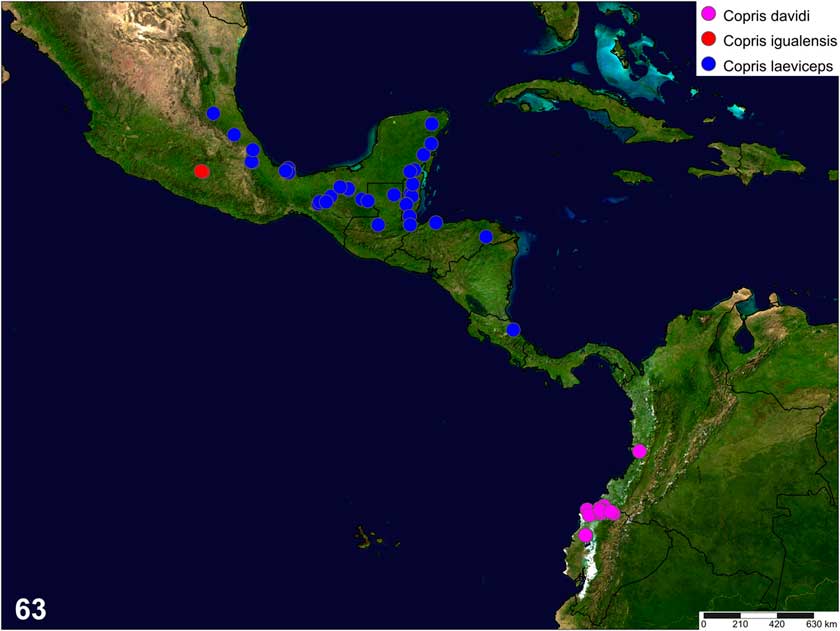
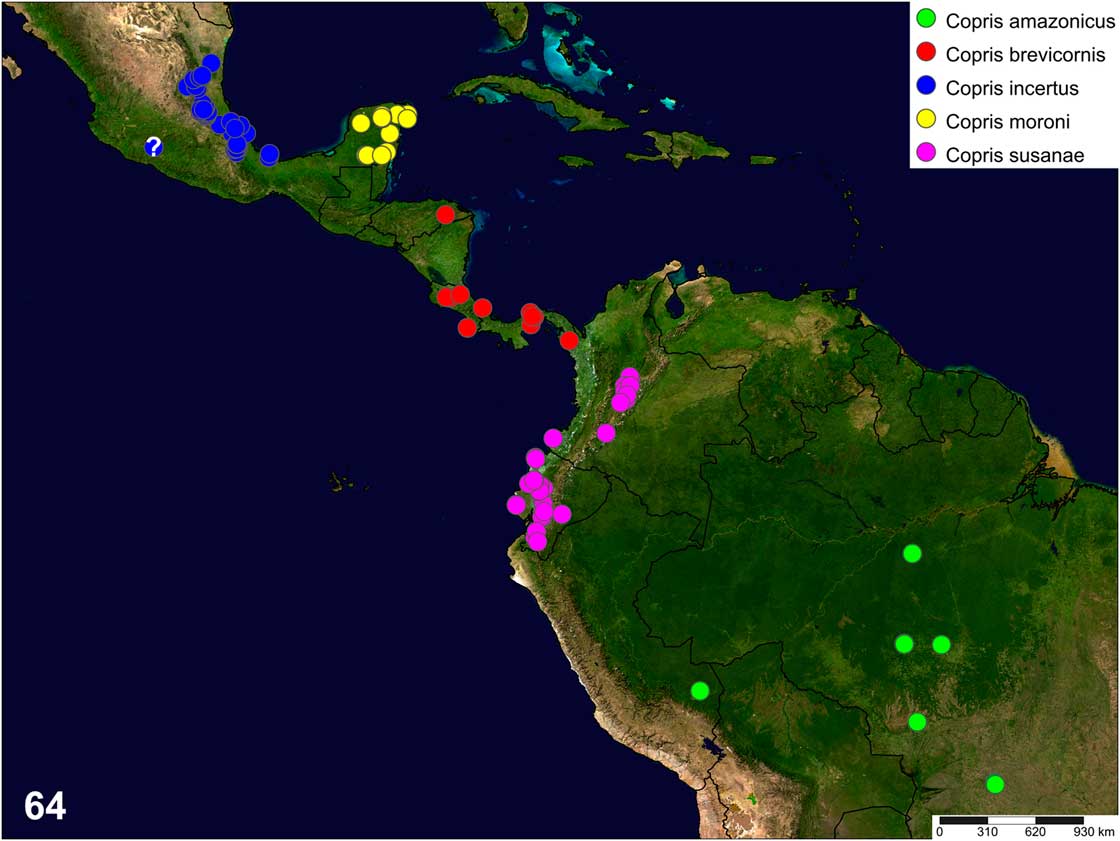
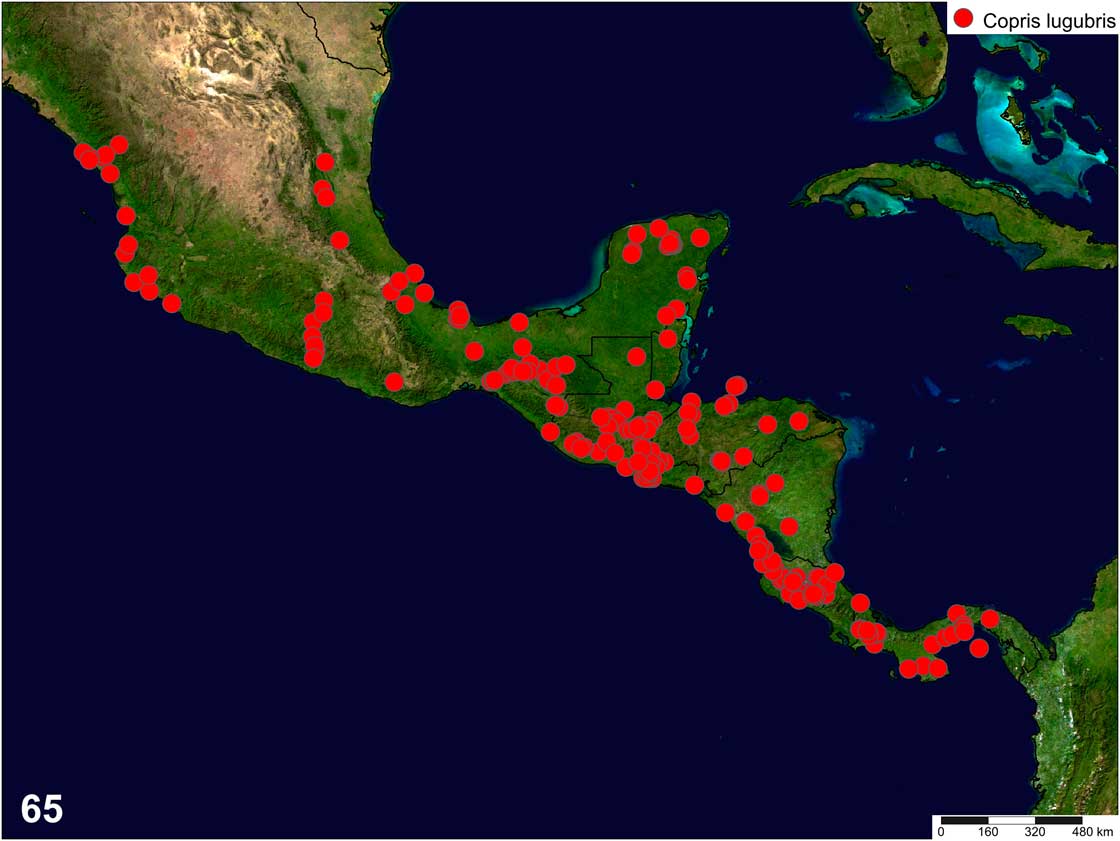
Diagnosis. Irregular setigerous serrations present along the anterolateral pronotal margin. Prosternal-proepisternal suture strongly carinate. Male primary cephalic horn curved and followed by secondary tubercle, which may be indistinct or minute; ventrobasal emargination between parameres rounded; left margin of frontolateral peripheral sclerite curved. Female with confluent punctation present along anterior pronotal ridge; median surface of pronotal disc finely punctate (median pronotal sulcus coarsely punctate). Distribution: Mexico, Belize, Guatemala, El Salvador, Honduras, Nicaragua, Costa Rica, Panama, Colombia, Ecuador, Peru, Brazil (Figs. 64–65).
Copris amazonicus Darling and Génier, new species
http://zoobank.org/urn:lsid:zoobank.org:act:C8ECDFDB-AFCF-4034-975C-C3433CA9A5C1
(Figs. 1, 10, 19, 28, 37, 46, 64)
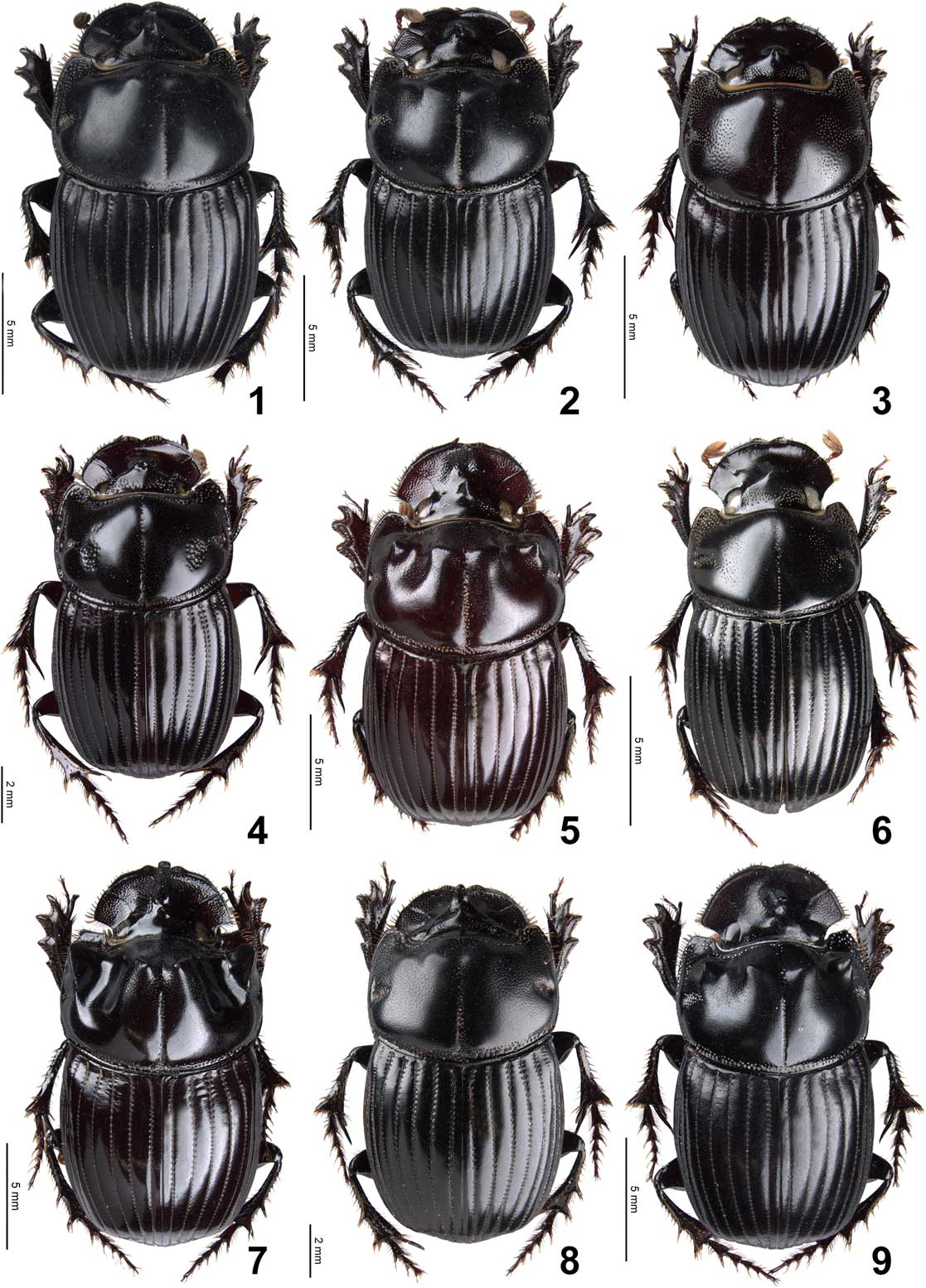
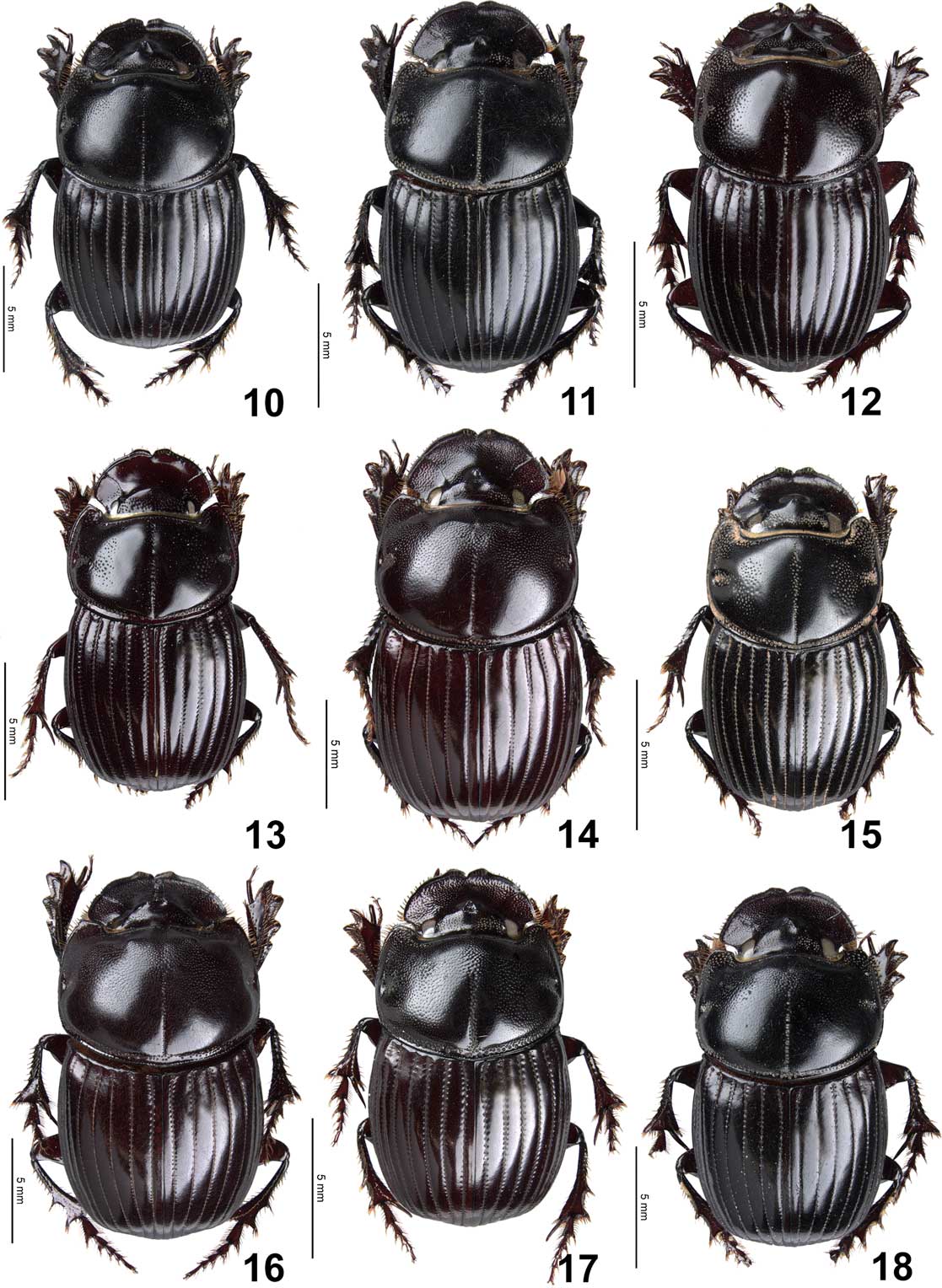
Male dorsal habitus (largest individuals). 1, Copris amazonicus, holotype; 2, Copris brevicornis, holotype; 3, Copris davidi, holotype; 4, Copris igualensis, holotype; 5, C. incertus; 6, Copris laeviceps; 7, Copris lugubris; 8, Copris moroni, holotype; 9, Copris susanae, holotype.

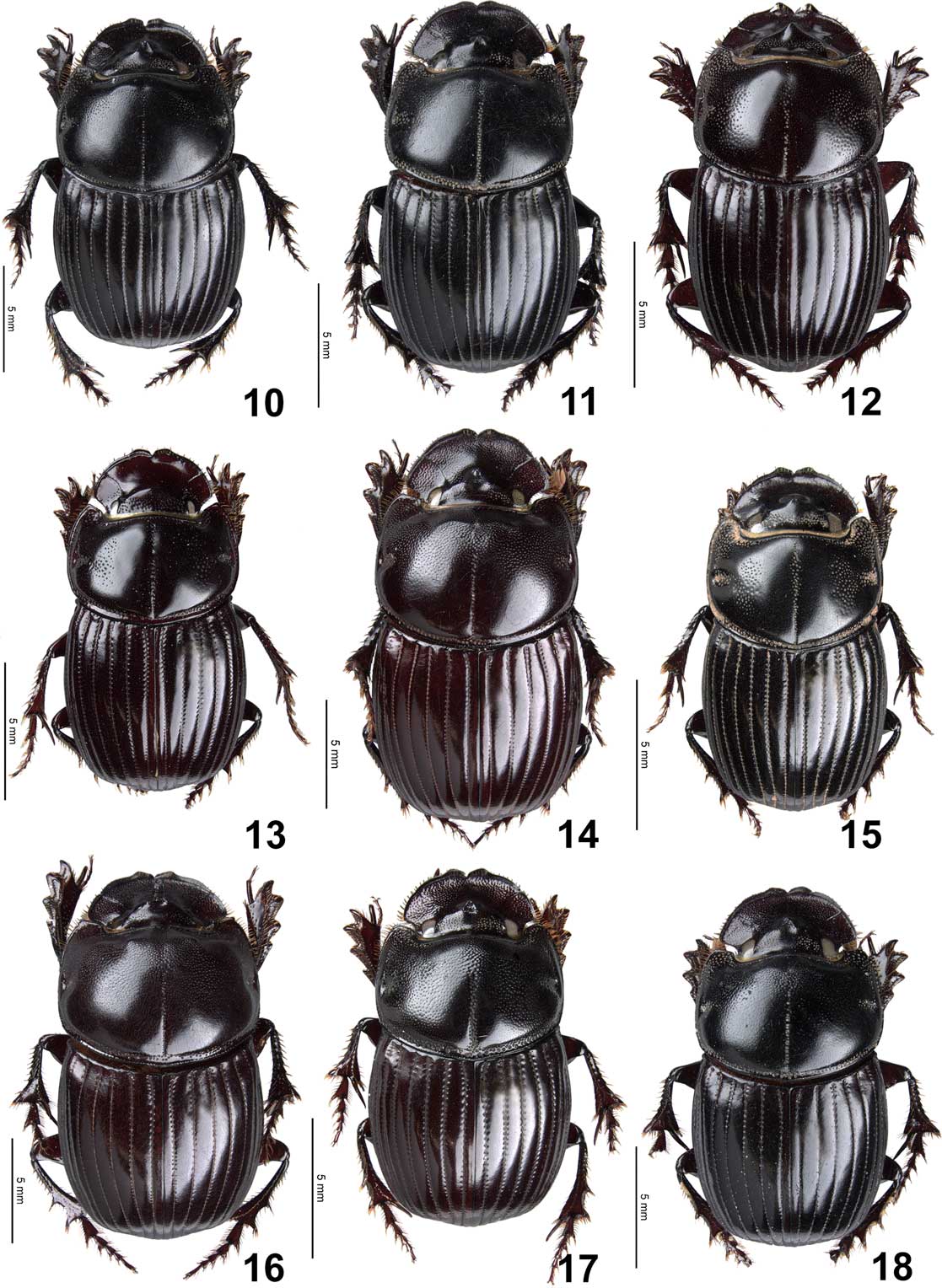
Female dorsal habitus. 10, Copris amazonicus, allotype; 11, Copris brevicornis, allotype; 12, Copris davidi, allotype; 13, Copris igualensis; 14, C. incertus; 15, Copris laeviceps; 16, Copris lugubris; 17, Copris moroni, allotype; 18, Copris susanae, allotype.
Parameres, lateral view. 19, Copris amazonicus, holotype; 20, Copris brevicornis, holotype; 21, Copris davidi, holotype; 22, Copris igualensis, holotype; 23, C. incertus; 24, Copris laeviceps; 25, Copris lugubris; 26, Copris moroni, holotype; 27, Copris susanae, holotype.

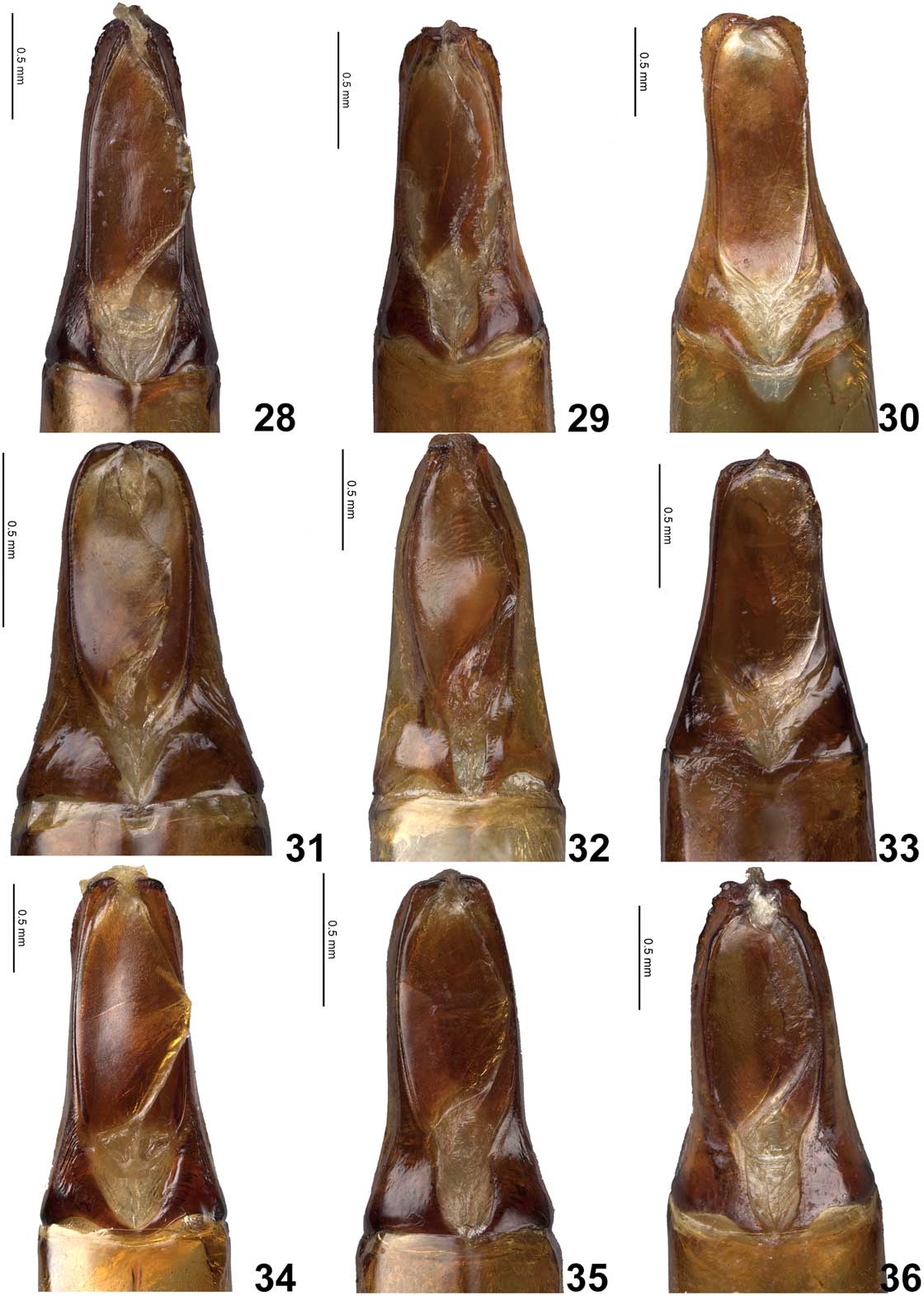
Parameres, ventral view. 28, Copris amazonicus, holotype; 29, Copris brevicornis, holotype; 30, Copris davidi, holotype; 31, Copris igualensis, holotype; 32, C. incertus; 33, Copris laeviceps; 34, Copris lugubris; 35, Copris moroni, holotype; 36, Copris susanae, holotype.

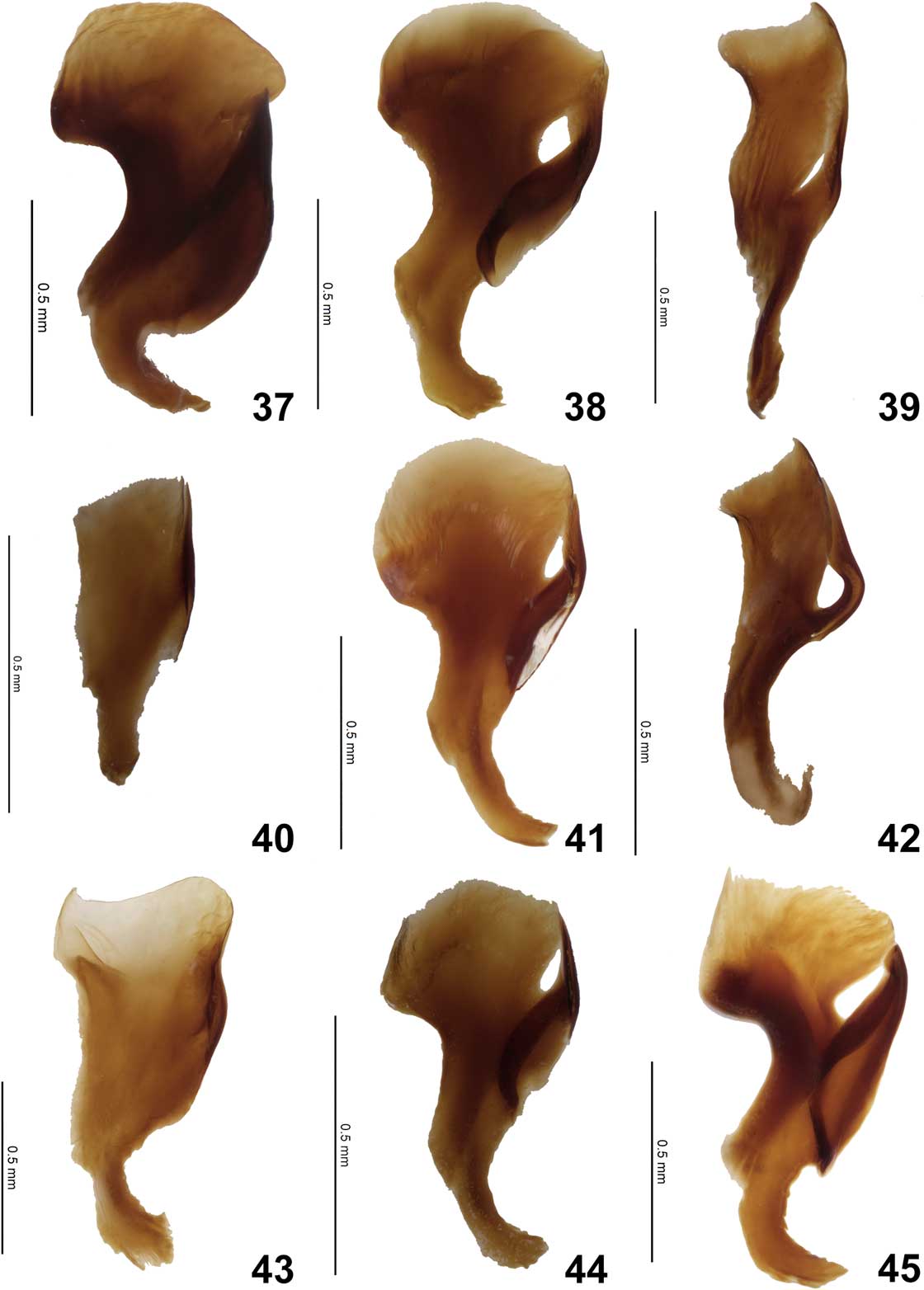
Frontolateral peripheral sclerite, ventral view. 37, Copris amazonicus, holotype; 38, Copris brevicornis, holotype; 39, Copris davidi, holotype; 40, Copris igualensis, holotype; 41, C. incertus; 42, Copris laeviceps; 43, Copris lugubris; 44, Copris moroni, holotype; 45, Copris susanae, holotype.

Male head and thorax (largest individuals), lateral view. 46, Copris amazonicus, holotype; 47, Copris brevicornis, holotype; 48, Copris davidi, holotype; 49, Copris igualensis, holotype; 50, C. incertus; 51, Copris laeviceps; 52, Copris lugubris; 53, Copris moroni, holotype; 54, Copris susanae, holotype.

Type locality. Ríos Los Amigos base camp (12°34′10″S, 70°06′01″W), 290 m, Madre de Dios, Peru.
Diagnosis. Indistinct longitudinal carina running medially along prosternum. Tuft of setae along margin of mesotrochanter and metatrochanter. Posteroventral surface of mesofemur and metafemur coarsely punctate. Male cephalic horn length is approximately half the interocular distance and transversely truncate in well-developed individuals. Secondary tubercle appears minute or indistinct. Lateral pronotal prominences atrophied. Protibial spur distally expanded. Parameres separated by a wide rounded ventrobasal gap and have acute teeth before apex. Left lateral edge of frontolateral peripheral sclerite strongly curved, right lateral frontolateral peripheral sclerite process truncate, heavily sclerotised along margin and acutely curved at apex. Female cephalic horn truncate and apically excavate in well-developed individuals. Pronotal ridge marks abrupt transition between fine punctation and coarse, fused punctation.
Description of male holotype. Total length: 15.6 mm. Head (Figs. 1, 46) – Clypeus bidentate, teeth flat, and not prominent. Teeth separated by wide, shallow emargination. Clypeus impunctate and gena finely punctate. Interocular surface with coarse, medially effaced punctation. Posterior angle of gena slightly obtuse. Demarcation between gula and submentum arcuate. Cephalic horn curved upward, slightly tapered apically and 1.2 mm in length. Posterobasal surface of horn with minute tubercle. Thorax – Anterolateral angle obtuse with irregular setigerous serrations along anterolateral margin. Entire lateral margin arcuate. Anterolateral lobe with coarse punctation continuing sparsely along lateral margin, becoming denser posteriorly along submargin. Lateral fossa and median longitudinal sulcus coarsely punctate with sulcal punctation effaced anteriorly. Median pronotal prominences low, transversely truncate, with indistinct apices. Lateral pronotal prominences atrophied. Surface of pronotal disc minutely punctate, appearing impunctate. Sternellum concave with indistinct longitudinal carina running medially through setigerous punctation. Elytra – Striae punctate with interpunctural space approximately equal to or greater than puncture diameter. Interstriae slightly convex and impunctate. Striae 1–7 and 10 complete. Eighth stria obsolete basally, complete anteriorly until disintegrating halfway along elytron, reappears after posterior angle. Ninth stria emerges from tenth stria halfway down elytron. Abdomen – Median lobe of metasternum finely punctate, lateral lobes coarsely punctate, and setigerous. Anteromedian projection of first visible abdominal ventrite impunctate. Pygidium coarsely punctate on disc with punctation gradually becoming finer ventrally. Pygidial margin effaced ventrally. Prothoracic legs – Anterior femoral carina and row of setae separate. Anteroventral surface of femur minutely punctate, posteroventral surface with coarse, setigerous punctation. Protibial spur apically widened. Mesothoracic legs – Coxal surface impunctate with few isolated coarse punctures. Femur length double maximum femur width. Posterior margin of trochanter with setal tuft consisting of six setae. Ventral surface of femur finely punctate with distal setigerous punctures. Posteroventral surface of femur coarsely punctate. Metathoracic legs – Coarse punctation present along median coxal groove. Posterior margin of trochanter with setal tuft consisting of six setae. Ventral surface of femur finely punctate with coarse distal punctures. Posteroventral surface of femur with coarse punctation. Male genitalia (Figs. 19, 28, 37) – Parameres separated by wide rounded ventrobasal gap, with acute teeth before apex. Left lateral edge of frontolateral peripheral sclerite strongly curved. Right lateral frontolateral peripheral sclerite process truncate, heavily sclerotised along margin and acutely curved at apex. Axial and subaxial sclerite longer than frontolateral peripheral sclerite.
Description of female allotype. Total length: 15.5 mm (Fig. 10). Similar to male with following exceptions: Clypeal teeth broader, separated by deep narrow notch not breaking clypeal margin. Cephalic horn short and transversely truncate with excavate apex. Median pronotal prominences lower and indistinct. Protibial spur tapers distally.
Variation. Total length: 14.3–16.3 mm. Clypeus impunctate to finely punctate. Interocular punctation absent, medially effaced, or complete. Cephalic horn conical and truncate in smaller specimens. Sulcal punctation effaced anteriorly or complete. Median pronotal prominences low and truncate or absent in smallest individuals. Interstriae impunctate to finely punctate. Setal tufts on middle and posterior trochanters comprised of four to six setae (damaged specimens may have lost some setae).
Distribution. (Fig. 64). Copris amazonicus is represented in the rainforest of Madre de Dios in Peru as well as the rainforest of Amazonas and Mato Grosso in Brazil. Its range continues south into the savannas of the Cerrado in Goiás. Copris amazonicus may also occur in Bolivia and Rondônia if its distribution is continuous between collection localities. Not only does this species represent the first recorded occurrence of Copris in Brazil and Peru, it also represents a broad southward extension of the entire generic range in the western hemisphere.
Primary type data. Holotype ♂ (CMNC): [PERU, Madre de Dios: (FLP) Río | Madre de Dios. Río Los | Amigos base camp, 1° terra | firme, 290 m, pitfall human | dung, T2 | 12°34′10.0″S, 70°06′01.4″W | T. Larsen, IV-14/15, 2000]; [4-14/15 | TF, T2]; [WORLD | SCARAB | DATABASE | WSD00032897]; [HOLOTYPE ♂ | Copris | amazonicus | des. J. Darling and F. Génier, Reference Génier and Moretto2018] red card.
Material examined. 8 ♂♂, 10 ♀♀. BRAZIL: AMAZONAS, Río Paranary (4°36′S, 57°47′W), xii.1937 – 1 ♀ (paratype) (CMNC); GOIÁS, Parque Nacional das Emas, Mineiros, 837 m (17°54′31″S, 53°0′30″W), 15.iii.2011, M.F. Souza – 1 ♂ (paratype) (CEMT); Parque Nacional das Emas, Mineiros, 837 m (17°59′48″S, 52°58′9″W), 15.iii.2011, M.F. Souza – 1 ♀ (paratype) (CEMT); MATO GROSSO, Comissão Executiva do Plano da Lavoura Cacaueira, Alta Floresta (9°53′30″S, 56°5′30″W), 4.ix.2009, V. Gonçalves – 1 ♀, 2 ♂♂ (paratypes) (CEMT); Comissão Executiva do Plano da Lavoura Cacaueira, Alta Floresta (9°53′30″S, 56°5′30″W), 5.iii.2010, V. Gonçalves – 1 ♀, 1 ♂ (paratypes) (CEMT); Comissão Executiva do Plano da Lavoura Cacaueira, Alta Floresta (9°53′30″S, 56°5′30″W), 7.v.2010, V. Gonçalves – 3 ♀♀, 1 ♂ (paratypes) (CEMT); Comissão Executiva do Plano da Lavoura Cacaueira, Alta Floresta (9°53′30″S, 56°5′30″W), 8.vii.2010, V. Gonçalves – 1 ♀ (paratype) (CEMT); Fazenda Curitiba, Tangará da Serra, 342 m (14°22′20″S, 57°29′24″W), 30.iii.2012, R.J. Silva – 1 ♂ (paratype) (CEMT); Fazenda São Nicolau (Site 6), 220 m (9°49′16″S, 58°15′33″W), 1.xii.2013, F. Génier (2013-117) – 1 ♀ (paratype) (CMNC); Fazenda São Nicolau, Cotriguaçu (9°51′23″S, 58°14′57″W), 16.x.2007, O. Peres Filho – 1 ♂ (paratype) (CEMT); PERU: MADRE DE DIOS, Los Amigos Base Camp, Río Madre de Dios, 250 m (12°34′10″S, 70°6′1.4″W), 14–15.iv.2000, T. Larsen – 1 ♀, 1 ♂ (holotype, allotype) (CMNC).
Etymology. This species is named after its geographic origin, namely the Amazonian basin of Peru and Brazil.
Natural history. All specimens were captured in pitfall traps baited with tapir (Tapirus Brünnich, 1772; Mammalia: Tapiridae) dung except for two Peruvian specimens and a specimen from Fazenda Nicolau (Mato Grosso), which were captured using human faeces. Specificity to tapir dung may have arisen from competition avoidance amongst other dung beetles. Such interspecific competition may limit the population growth of C. amazonicus and explain the rarity of this species in collection. The broad distribution of this species may be attributed to repeated displacement by highly competitive species.
Remarks. Further collecting from the Amazon and Cerrado is required to provide a more detailed distribution map of C. amazonicus.
Copris brevicornis Darling and Génier, new species
http://zoobank.org/urn:lsid:zoobank.org:act:C396B217-C348-4F75-8DE6-4BC29B4EC890
(Figs. 2, 11, 20, 29, 38, 47, 64).
Type locality. Cerro Campana, 3000 feet, Panamá Oeste, Panama.
Diagnosis. Indistinct longitudinal carina running medially along prosternum. Tuft of setae along margin of mesotrochanter and metatrochanter. Posteroventral surface of mesofemur and metafemur impunctate or with a few isolated coarse punctures. Male cephalic horn length is less than half the interocular distance. Secondary tubercle behind cephalic horn indistinct. Lateral pronotal prominences atrophied. Protibial spur parallel sided or tapers apically (never distally expanded). Parameres separated by a narrow rounded ventrobasal gap and have acute teeth before apex. Left lateral edge of frontolateral peripheral sclerite strongly curved, right lateral frontolateral peripheral sclerite process acute and sinuate. Female cephalic horn truncate and only apically excavated in well-developed individuals. Pronotal ridge marks abrupt transition between fine punctation and coarse, fused punctation.
Description of male holotype. Total length: 16.7 mm. Head (Figs. 2, 47) – Clypeus bidentate, teeth broadly flat and indistinct. Teeth separated by wide, shallow emargination. Clypeus and gena finely punctate. Interocular surface with coarse punctation. Posterior angle of gena approximately quadrate. Demarcation between gula and submentum arcuate. Cephalic horn curved, tapered and 1 mm in length. Surface immediately behind cephalic horn raised. Thorax – Anterolateral angle obtuse with irregular setigerous serrations along immediate lateral margin. Entire lateral margin arcuate. Anterolateral lobe with coarse punctation continuing along lateral margin and posterior submargin. Lateral fossae and median longitudinal sulcus coarsely punctate, sulcal punctation fine at pronotal ridge. Median pronotal prominences low, transversely truncate with indistinct apices. Lateral pronotal prominences atrophied. Surface of pronotal disc minutely punctate; broadly appearing impunctate. Sternellum concave with indistinct longitudinal carina running medially through setigerous punctation. Elytra – Striae punctate with interpunctural space approximately equal to or greater than puncture diameter. Interstriae slightly convex and minutely punctate. Striae 1–7 and 10 complete. Eighth stria obsolete basally, complete anteriorly until disintegrating halfway along elytron, reappears after posterior angle. Ninth stria emerges from tenth stria halfway down elytron. Abdomen – Median lobe of metasternum minutely punctate, lateral lobes coarsely punctate and setigerous. Pygidium coarsely punctate on disc with punctation gradually becoming finer ventrally. Pygidial margin effaced ventrally. Prothoracic legs – Anterior femoral carina and row of setae separate. Anteroventral surface of femur minutely punctate, posteroventral surface with coarse, setigerous punctation. Protibial spur tapers apically. Mesothoracic legs – Coxal surface impunctate. Posterior margin of trochanter with setal tuft consisting of four setae. Ventral surface of femur minutely punctate. Posterior surface of femur impunctate. Metathoracic legs – Coarse punctation present along median coxal groove. Posterior margin of trochanter with setal tuft consisting of four setae. Ventral surface of femur minutely punctate with fine distal punctures. Posteroventral surface of femur with sparse punctures. Male genitalia (Figs. 20, 29, 38) – Parameres separated by narrow, rounded ventrobasal gap, with acute teeth before apex. Left lateral edge of frontolateral peripheral sclerite strongly curved. Right lateral frontolateral peripheral sclerite process acute and sinuate. Axial and subaxial sclerite longer than frontolateral peripheral sclerite.
Description of female allotype. Total length: 15.8 mm (Fig. 11). Similar to male with following exceptions: Clypeal teeth broad, prominent and divided by rounded notch not breaking clypeal margin. Cephalic horn short and transversely truncate. Coarse interocular punctation medially effaced. Fused punctation present medially along posterior side of anterior pronotal ridge. Median pronotal prominences low and indistinct. Protibial spur tapers distally.
Variation. Total length: 9.3–16.7 mm. Clypeus impunctate to finely punctate. Interocular punctation absent, medially effaced, or complete. Cephalic horn conical and truncate in smaller specimens. Sulcal punctation effaced anteriorly or complete. Median pronotal prominences low and truncate or absent in smallest individuals. Interstriae impunctate to finely punctate. Setal tufts on mesotrochanters and metatrochanters comprised of four to five setae (damaged specimens may have lost some setae).
Distribution. (Fig. 64). Copris brevicornis is initially present in the wet rainforest of Gracias a Dios in Honduras, is not known in Nicaragua and then reappears in Alajuela, Costa Rica. It continues into Limón, Costa Rica and crosses the Talamanca Mountain Range into Puntarenas, Costa Rica, where it occurs in Corcovado National Park. From Limón, the distribution continues into Panama through Bocas del Toro. It appears in Colón, then in Panama on islands within the Panama Canal. Southernmost populations occur in the forests of Darién province.
Primary type data. Holotype ♂ (CMNC): [Cerro Campana, | 3000’, Panama. | Aug. 1, 1970, | H. and A. Howden]; [WORLD | SCARAB | DATABASE | WSD00032899] barcode label; [HOLOTYPE ♂ | Copris | brevicornis | des. J. Darling and F. Génier, 2018] red card.
Material examined. 53 ♂♂, 45 ♀♀. COSTA RICA: ALAJUELA, Río San Lorencito, San Ramón, 800 m (10°13′39″N, 84°36′2″W), 5.ix.1986, A. Solís B. – 1 ♀ (paratype) (CMNC); Río San Lorencito, San Ramón, 800 m (10°13′39″N, 84°36′2″W), 3.x.1986, A. Solís B. – 1 ♀ (paratype) (CMNC); Río San Lorencito, San Ramón, 800 m (10°13′39″N, 84°36′2″W), 4.v.1987, A. Solís B. – 1 ♂ (paratype) (CMNC); HEREDIA, La Selva Biological Station, 150–300 m (10°25′19″N, 84°0′54″W), 12–13.x.2004, K. Beuke – 3 ♀♀, 1 ♂ (paratypes) (FSCA); LIMÓN, 4 km E Puerto Viejo, 10–30 m (9°38′36″N, 82°43′18″W), 28–30.xi.1996, F. Génier and R. Barrett – 2 ♂♂ (paratypes) (CMNC); PUNTARENAS, 6 km S Santa Elena, 1100 m (10°15′58″N, 84°50′8″W), 15.viii.1987, H.F. and A.T. Howden – 1 ♀ (paratype) (CMNC); Estación Sirena, Parque Nacional Corcovado, 30 m (8°30′N, 83°36′W), vii.2009, D.J. Mann – 18 ♀♀, 28 ♂♂ (paratypes) (CEMT); Estación Sirena, Parque Nacional Corcovado, 30 m (8°30′N, 83°36′W), 15–17.viii.1983, D.H. Lindeman – 2 ♂♂ (paratypes) (CMNC); HONDURAS: GRACIAS A DIOS, Krausirpi (15°3′N, 84°52′W), 21–24.v.1994, B.D. Gill – 2 ♀♀, 2 ♂♂ (paratypes) (BDGC); PANAMA: BOCAS DEL TORO, Fortuna – Robalo, 700 m, 18–21.vi.1982, B.D. Gill – 1 ♀, 1 ♂ (paratypes) (CMNC); COLÓN, Isla Lion Hill (9°13′32″N, 79°53′33″W), 11–21.v.1981, B.D. Gill – 2 ♂♂ (paratypes) (BDGC); Limbo Hunt Club, Pipeline Road (9°7′44″N, 79°42′56″W), 17.v.1977, L.R. Davis – 1 ♂ (paratype) (FSCA); Limbo Hunt Club, Pipeline Road (9°7′44″N, 79°42′56″W), 31.v.1977, L.R. Davis – 1 ♂ (paratype) (FSCA); vicinity of Fort Sherman (9°22′N, 79°57′W), 15–24.ii.1999, J.E. Wappes – 1 ♀ (paratype) (FSCA); DARIÉN, Estación Ambiental Cana, 500 m (7°45.32′N, 77°41.07′W), 7–10.vi.1996, R.S. Anderson (1996–117) – 4 ♀♀, 3 ♂♂ (paratypes) (CMNC); PANAMÁ, Cerro Campana, 914 m (8°41′N, 79°55′W), 1.viii.1970, H.F. and A.T. Howden – 2 ♀♀, 2 ♂♂ (holotype, paratypes) (CMNC); Isla Barro Colorado (9°9′N, 79°51′W), iii.1964, L.J. Bottimer – 1 ♀ (paratype) (CNC); Isla Barro Colorado (9°9′N, 79°51′W), 18.ii.1963, L.J. Bottimer – 2 ♂♂ (paratypes) (CNC); Isla Barro Colorado (9°9′N, 79°51′W), 9.xii.1963, L.J. Bottimer – 1 ♀ (paratype) (CNC); Isla Barro Colorado (9°9′N, 79°51′W), 18.xii.1963, L.J. Bottimer – 1 ♀ (paratype) (CNC); Isla Barro Colorado (9°9′N, 79°51′W), 15.i.1964, L.J. Bottimer – 1 ♀ (paratype) (CNC); Isla Barro Colorado (9°9′N, 79°51′W), 18.iii.1964, L.J. Bottimer – 1 ♀ (paratype) (CNC); Isla Barro Colorado (9°9′N, 79°51′W), 23.iii.1964, L.J. Bottimer – 1 ♀ (paratype) (CNC); Isla Barro Colorado (9°9′N, 79°51′W), 17.ix.1975, H. Wolda – 1 ♀ (paratype) (UNSM); Isla Barro Colorado (9°9′N, 79°51′W), 7–9.v.1981, B.D. Gill – 1 ♂ (paratype) (BDGC); Isla Barro Colorado (9°9′N, 79°51′W), 8–12.vi.1981, B.D. Gill – 1 ♀ (paratype) (BDGC); Isla Barro Colorado (9°9′N, 79°51′W), 6–12.ix.1983, B.D. Gill – 1 ♀ (paratype) (BDGC); Isla Barro Colorado (9°9′N, 79°51′W), 28.x–4.xii.1984, H. Wolda – 1 ♂ (paratype) (BDGC); Isla Barro Colorado (9°9′N, 79°51′W), 24–30.iv.1985, H. Wolda – 1 ♂ (paratype) (BDGC); Isla Barro Colorado (9°9′N, 79°51′W), 8–14.v.1985, H. Wolda – 1 ♂ (paratype) (BDGC); Isla Barro Colorado (9°9′N, 79°51′W), 24.v–4.vi.1985, H. Wolda – 1 ♂ (paratype) (BDGC); Isla Barro Colorado, Lago Gatún (9°9′N, 79°51′W), 15.v.1981, B.D. Gill – 1 ♀ (paratype) (CMNC); Isla Barro Colorado, Lago Gatún (9°9′N, 79°51′W), 29–30.v.1981, B.D. Gill – 1 ♀ (paratype) (BDGC).
Etymology. The combination of two Latin words: brevis (short) and cornis (horn). It is named after the short cephalic horn that is associated with male specimens.
Natural history. Collected using black light and dung traps, which contained either pig or human dung. Harvey et al. (Reference Harvey, González and Somarriba2006) found that Costa Rican C. incertus (herein considered C. brevicornis) is highly abundant in forest habitats and significantly less abundant in agricultural systems.
Remarks. The ventrobasal gap between the parameres of male specimens is rounded in all populations except those occurring west of the Talamanca Mountain Range in Puntarenas. Instead of a rounded ventrobasal gap, these western specimens have an angular gap. There are no other morphological differences between specimens that occur east and west of this mountain range. Therefore, these populations are all designated as C. brevicornis.
Copris brevicornis, cited as C. incertus, was included in a distributional analysis of Costa Rican dung beetle diversity (Kohlmann et al. Reference Kohlmann, Solís, Elle, Soto and Russo2007) and in a checklist of Costa Rican dung beetles (Solís and Kohlmann Reference Solís and Kohlmann2012).
Copris incertus Say, Reference Say1835
(Figs. 5, 14, 23, 32, 41, 50, 56, 59, 61, 64)
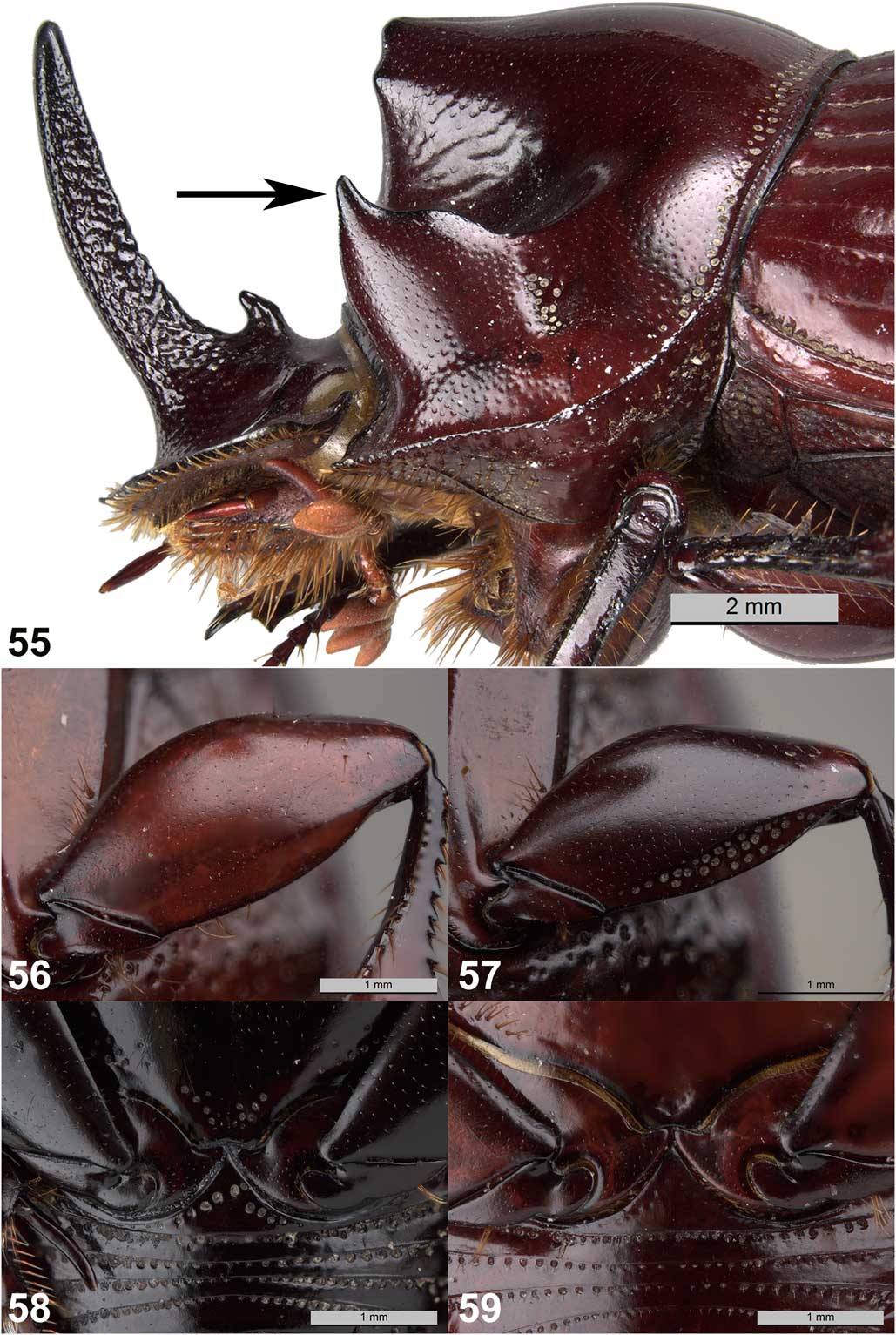
55, Lateral view of abnormal pronotal prominence of a Panamanian male Copris lugubris; 56, ventral view of punctation of the posteroventral mesofemoral surface of C. incertus; 57, ventral view of punctation of the posteroventral mesofemoral surface of Copris susanae; 58, ventral view of metasternum and abdominal ventrites of Copris davidi; 59, ventral view of metasternum and abdominal ventrites of C. incertus.

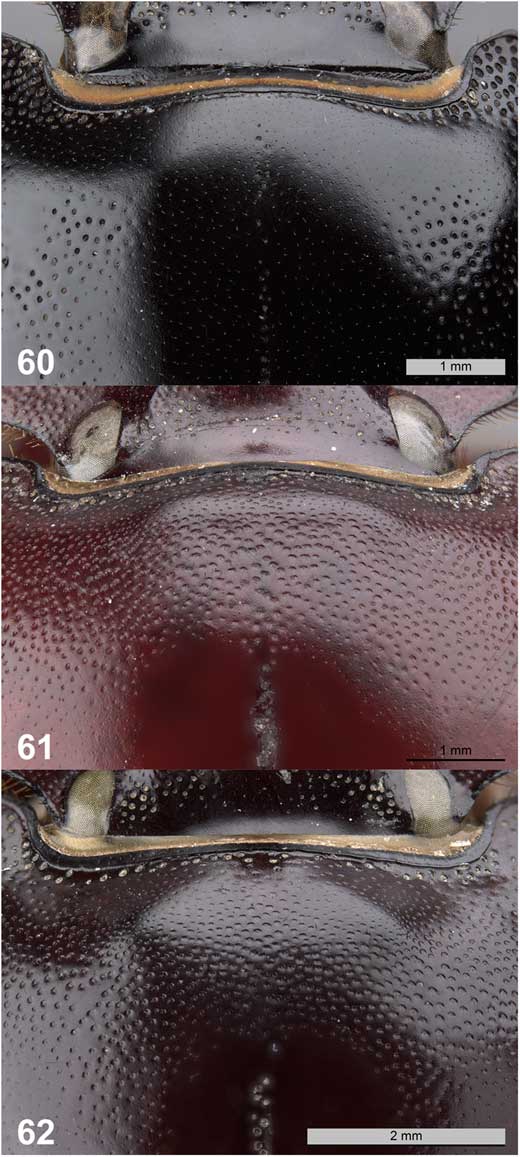
Dorsal view of punctation along anterior pronotal ridge in female specimens. 60, Copris laeviceps; 61, Copris incertus; 62, Copris lugubris.

Copris incérta Say, Reference Say1835: 175 (original description).
Copris procídua Say, Reference Say1835: 176 (original description).
Copris incertus – Harold Reference Harold1869a: 61 (comment); Harold Reference Harold1869b, 494 (monograph); Harold Reference Harold1869c: 1014 (catalogue); Harold Reference Harold1873: 107 (comment); Bates Reference Bates1887: 55 (comment, distribution); Gillet Reference Gillet1910: 24 (catalogue); Gillet Reference Gillet1911: 75 (catalogue); Leng Reference Leng1920: 248 (catalogue); Pereira and d’Andretta Reference Pereira and d’Andretta1955: 261 (comment, taxonomy); Matthews Reference Matthews1959: 135 (identification key); Pereira and Halffter Reference Pereira and Halffter1961: 58 (distribution, ecology); Matthews Reference Matthews1961: 44 (monograph); Matthews and Halffter Reference Matthews and Halffter1968: 148 (comment, distribution); Howden and Young Reference Howden and Young1981: 133 (monograph); Halffter et al. Reference Halffter, Huerta and Lopez-Portillo1996: 133 (parental care); Kohlmann et al. Reference Kohlmann, Cano and Delgado2003: 47 (catalogue, distribution); Cabral-de-Mello et al. Reference Cabral-de-Mello, Gomes de Oliveira, Ramos and Cássia de Moura2008: 1247 (chromosomal formula); Halffter et al. Reference Halffter, Verdú, Márquez and Moreno2008: 285 (biogeography); Marchisio and Zunino Reference Marchisio and Zunino2012: 98 (reproductive organs).
Copris prociduus – Harold Reference Harold1869a: 61 (synonymy, comment); Harold Reference Harold1869b: 495 (monograph); Harold Reference Harold1869c: 1015 (catalogue); Harold Reference Harold1880: 27 (distribution); Bates Reference Bates1887: 54 (distribution); Schaeffer Reference Schaeffer1906: 255 (identification key); Gillet Reference Gillet1910: 28 (mentioned as synonym); Matthews Reference Matthews1959: 135 (identification key).
Copris incertus prociduus – Leng Reference Leng1920: 248 (catalogue); Pereira and d’Andretta Reference Pereira and d’Andretta1955: 261 (mentioned as synonym).
Copris incerta – Blackwelder Reference Blackwelder1944: 208 (checklist).
Copris incerta var. procidua – Blackwelder Reference Blackwelder1944: 208 (checklist).
Copris procidua – Matthews Reference Matthews1961: 44 (mentioned as synonym); Howden and Young Reference Howden and Young1981: 133 (mentioned as synonym).
Type locality. Mexico.
Diagnosis. Indistinct longitudinal carina running medially along prosternum. Tuft of setae along margin of mesotrochanter and metatrochanter. Posteroventral surface of mesofemur and metafemur impunctate. Male cephalic horn length is approximately equal to interocular distance in well-developed individuals. Secondary tubercle behind cephalic horn forwardly inclined. Lateral pronotal prominences conical. Protibial spur distally expanded. Parameres separated by a narrow ventrobasal gap and with acute teeth before apex. Left lateral edge of frontolateral peripheral sclerite strongly curved, right lateral frontolateral peripheral sclerite process acute and sinuate. Female cephalic horn truncate and apically excavated in well-developed individuals. Pronotal ridge marks abrupt transition between fine punctation to coarser, fused punctation.
Distribution (Fig. 64). The range of C. incertus was considered to begin in Mexico, and then skip several Central American countries before continuing into Costa Rica, Panama, Colombia, and Ecuador. Mexican C. incertus specimens, however, were found to be distinct from Central and South American specimens, which represent three new species. In addition, another new species was found within Mexican C. incertus. This species, C. moroni, makes up what had been considered the C. incertus populations occupying the Yucatán Peninsula. Therefore, the true range of C. incertus is confined to eastern Mexico; beginning in Tamaulipas and continuing alongside the eastern coast until ending in southern Veracruz.
Material examined. 87 ♂♂, 81 ♀♀. MEXICO: HIDALGO, 1 km, N Tlanchinol on Highway 105 (21°0′23″N, 98°39′29″W), 30–31.v.1984, A. Reifschneider, D.B. Thomas, B.C. Ratcliffe, D. Caldwell, and T. Taylor – 1 ♂ (UNSM); 10 mi. E Jacala (21°2′53″N, 99°6′8″W), 20.viii.1960, H.F. Howden – 2 ♀♀ (CNC); 20 mi. NE Jacala (21°8′26″N, 99°4′49″W), 1–2.viii.1960, H.F. Howden – 1 ♀, 1 ♂ (CNC); 3 km N Tlanchinol, 1550 m (21°1′10″N, 98°38′51″W), vi.1992, J. Blackaller – 2 ♀♀ (IEXA); 3 mi. N Chapulhuancan on Highway 85 (21°11′28″N, 98°54′14″W), 28–29.v.1984, B.C. Ratcliffe – 1 ♀ (UNSM); Acuatitlán (20°45′39″N, 98°43′55″W), 27.v.1979, M. Zunino and M.A. Morón – 1 ♂ (IEXA); Chapulhuacán (21°9′N, 98°54′W), 20.v.1952, M. Cazier, W. Gertsch, and R. Schrammel – 2 ♂♂ (AMNH); Chapulhuacán (21°9′N, 98°54′W), 26–27.vii.1981, B.C. Ratcliffe and C.L. Messenger – 2 ♀♀, 11 ♂♂ (UNSM); Ixtlahuaco (20°53′1″N, 98°42′14″W), 27.iv.1979, R. Terrón – 1 ♀ (IEXA); Laguna Azteca (20°48′21″N, 98°44′44″W), 26.viii.1979, M.A. Morón – 1 ♀ (IEXA); Minera Autlan, Otongo (20°58′N, 98°44′W), 7.v.1983, C.W. and L. O’Brien and G.B. Marshall – 1 ♂ (CMNC); Minera Autlan, Otongo (20°58′N, 98°44′W), 9.v.1983, C.W. and L. O’Brien, and G.B. Marshall – 1 ♀ (CMNC); Molango, Cañada Otongo, 1600 m (20°47′13″N, 98°43′44″W), 16.vii.1980, R. Terrón – 1 ♀ (IEXA); Molango, Cañada Otongo, 1600 m (20°47′13″N, 98°43′44″W), 2.vii.1981, M.A. Morón – 1 ♂ (IEXA); Molango, Cañada Otongo, 1600 m (20°47′13″N, 98°43′44″W), 2.vii.1981, R. Terrón – 1 ♂ (IEXA); Molango, Cañada Otongo, 1600 m (20°47′13″N, 98°43′44″W), 26.ix.1981, R. Terrón – 1 ♀ (IEXA); Tlanchinol, 1500 m (20°59′31″N, 98°39′26″W), 12.vi.1991, G. Nogueira – 1 ♀, 1 ♂ (IEXA); MICHOACÁN, La Huacana (18°58′N, 101°48′W), 4.vii.1967, G. and V. Halffter – 1 ♂ (FSCA); PUEBLA, Villa Juárez [=Xicotepec de Juárez] (20°16′30″N, 97°57′40″W), 30.iii.1963, Martínez and Halffter – 1 ♀ (CMNC); QUERÉTARO, 25 mi. E Landa de Matamoro, 1524 m (21°18′27″N, 99°5′2″W), 14–17.vii.1969, S.B. and J. Peck – 2 ♂♂ (CMNC, CNC); SAN LUIS POTOSÍ, 23 mi. W Antiguo Morelos (22°31′N, 99°22′W), 28.vii.1981, B.C. Ratcliffe and C.L. Messenger – 2 ♂♂ (UNSM); 5 mi. E Ciudad del Maíz (22°27′33″N, 99°33′44″W), 27.v.1984, B.C. Ratcliffe – 1 ♀, 2 ♂♂ (UNSM); 6 mi. N Tamazunchale (21°19′50″N, 98°49′23″W), 30.vii.1960, H.F. Howden – 1 ♂ (CNC); El Salto de Agua (22°21′40″N, 99°15′56″W), 28–30.vii.1960, H.F. Howden – 3 ♀♀ (CNC); El Salto de Agua (22°21′40″N, 99°15′56″W), 23–24.viii.1960, H.F. Howden – 4 ♀♀, 1 ♂ (CNC); El Salto de Agua, 50 mi. NNW Ciudad Valles (22°21′40″N, 99°15′56″W), 6–9.vii.1969, S.B. and J. Peck – 1 ♀ (CMNC); Huichihuyán, 20 mi. N Tamazunchale (21°29′N, 98°58′W), 19.v.1952, M. Cazier and R. Schrammel – 1 ♀ (AMNH); near Palomas (22°29′N, 99°51′W), 11.v.1996, T. Robacker – 1 ♂ (UNSM); Tamazunchales (21°15′33″N, 98°47′20″W), 29.iii.1951, J.D. Lattin – 1 ♂ (AMNH); Tamazunchales (21°15′33″N, 98°47′20″W), 20.v.1952, M. Cazier, W. Gertsch, and R. Schrammel – 7 ♀♀, 1 ♂ (AMNH); TAMAULIPAS, 20.6 mi. E Villa de Casas (23°50′26″N, 98°27′42″W), 5.vii.1966, G.E. Ball and D.R. Whitehead – 1 ♀, 1 ♂ (CNC); El Abra S of Ciudad Mante (23°7′N, 98°59′W), 7–9.vii.1969, S.B. and J. Peck – 1 ♂ (CMNC); El Nacimiento del Río Frío, Gómez Farías (23°1′49″N, 99°8′52″W), 29.vi.1969, S.B. Peck – 1 ♀, 1 ♂ (CMNC); El Nacimiento del Río Frío, Gómez Farías (23°1′49″N, 99°8′52″W), 29.vi–5.vii.1969, S.B. and J. Peck – 1 ♀, 1 ♂ (CMNC); El Nacimiento del Río Frío, Gómez Farías (23°1′49″N, 99°8′52″W), 29.vii.1969, S.B. and J. Peck – 2 ♀♀, 2 ♂♂ (CNC); El Nacimiento del Río Frío, Gómez Farías (23°1′49″N, 99°8′52″W), 6.vi.1983, S.B. Peck and M. Kaulbars – 2 ♀♀, 1 ♂ (CMNC); Ocampo–Tula Road (22°54′N, 99°29′W), 30.viii.1997, D.B. Thomas and D. Robacker – 2 ♀♀ (USNM); Rancho del Cielo, Gómez Farías, 1950 m (23°2′N, 99°9′W), 1.xi.1982, P. Reyes-Castillo – 1 ♀, 2 ♂♂ (CEMT, IEXA); VERACRUZ, 1.2 mi. S Huatusco, 1344 m (19°8′8″N, 96°59′37″W), 2.viii.1968, S.B. and J. Peck (171) – 2 ♀♀ (CMNC); 10 km S Totutla (19°10′N, 96°53′W), 25.iii.1967, A. Barrera – 1 ♀, 1 ♂ (UNSM); 10 mi. E Tlapacoyan (20°3′22″N, 97°5′15″W), 5.viii.1960, H.F. Howden – 1 ♂ (CNC); 15 mi. E Teziutlán (19°47′8″N, 97°14′39″W), 5–6.viii.1960, H.F. Howden – 2 ♀♀, 2 ♂♂ (CNC); Barranca de Metlac (18°53′49″N, 97°0′33″W), vi.1952, [anonymous] – 1 ♂ (AMNH); Coatepec (19°27′N, 96°58′W), 17.viii.1947, [anonymous] – 1 ♀ (AMNH); Córdoba (18°53′36″N, 96°54′56″W), [no date], [anonymous] – 1 ♀, 2 ♂♂ (AMNH, MNHN); Estación de Biología Tropical Los Tuxtlas (18°35′5″N, 95°4′29″W), v.2007, Díaz and Sarges – 1 ♀, 1 ♂ (CEMT); Fortín de las Flores (18°54′N, 97°0′W), 20–31.vii.1976, E. Giesbert – 1 ♂ (UNSM); Fortín de las Flores, Canyon Río Metlac (18°54′N, 97°0′40″W), 1–4.x.1967, E. Greenwood – 1 ♀ (CMNC); Fortín de las Flores, Canyon Río Metlac (18°54′N, 97°0′40″W), 5–8.viii.1969, S.B. and J. Peck – 1 ♂ (CMNC); Huatusco (19°9′N, 96°58′W), 21.vii.1956, D.H. Janzen – 1 ♂ (CNC); Instituto de Ecología A.C. (19°30′N, 96°56′W), viii.2003, F.Z. Vaz-de-Mello – 1 ♂ (CEMT); Instituto de Ecología A.C. (19°30′N, 96°56′W), ix.2003, F.Z. Vaz-de-Mello – 2 ♂♂ (CEMT); Jadín Botánico Francisco Javier Clavijero, Xalapa (19°30′39″N, 96°56′37″W), 28.vi.2004, J. Bueno – 1 ♂ (CEMT); La Victoria, Municipio Catemaco (18°22′26″N, 95°7′18″W), ix.2006, S. Rodriguez – 1 ♀ (CEMT); Las Minas, Perote (19°41′26″N, 97°8′47″W), 28.ix.1973, M.A. Morón – 2 ♀♀ (IEXA); Orizaba (18°51′N, 97°6′W), i.1892, [anonymous] – 2 ♀♀, 2 ♂♂ (UNSM); Palma Sola, 320 m (19°46′20″N, 96°25′54″W), 25.x.1989, A. Díaz – 1 ♂ (CEMT); Papantla, 274 m (20°27′N, 97°20′W), 1.viii.1955, P. and C. Vaurie – 1 ♀, 1 ♂ (AMNH); Plan de Sedeño, Acajete, 1950 m (19°34′17″N, 97°0′10″W), 28.v.2004, F.Z. Vaz-de-Mello – 2 ♀♀, 2 ♂♂ (CEMT); Playa Paraiso, N of Nautla (20°13′12″N, 96°46′15″W), 27.iv.1969, H.F. Howden – 2 ♀♀ (CMNC); Rancho Guadalupe, 1360 m (19°30′N, 96°56′W), x–xi.1989, M.A. Morón – 1 ♂ (IEXA); Rancho Guadalupe, 1360 m (19°30′N, 96°56′W), 15.ii.1990, M.A. Morón – 1 ♂ (IEXA); Rancho Guadalupe, km 2.5 Antigua Carratera a Coatepec, Xalapa (19°30′N, 96°56′W), 17–26.v.1991, L. Delgado – 1 ♂ (CEMT); Rancho Guadalupe, km 2.5 Antigua Carratera a Coatepec, Xalapa (19°30′N, 96°56′W), 12.ii.1992, L. Delgado – 1 ♀ (IEXA); Xalapa (19°32′N, 96°54′W), [no date], Hoege – 2 ♀♀, 8 ♂♂ (AMNH, CNC, IRSNB, MNHN); Xalapa (19°32′N, 96°54′W), [no date], [anonymous] – 1 ♂ (AMNH); Xalapa (19°32′N, 96°54′W), [no date], W. Schaus – 2 ♂♂ (AMNH); Xalapa (19°32′N, 96°54′W), v.1991, F. Capistran – 1 ♂ (IEXA); Xalapa (19°32′N, 96°54′W), [no date], A. Fenyes – 1 ♀, 1 ♂ (IRSNB); Xalapa (19°32′N, 96°54′W), [no date], M. Trujillo – 1 ♀ (MNHN); Xalapa (19°32′N, 96°54′W), [no date], Morrison – 1 ♀ (MNHN); Xalapa (19°32′N, 96°54′W), 22.v.1946, J. and D. Pallister – 1 ♀ (AMNH); Xalapa (19°32′N, 96°54′W), 16.ix.1947, J. Hendrichs – 2 ♂♂ (CMNC); Xalapa (19°32′N, 96°54′W), 19.ix.1947, J. Hendrichs – 6 ♀♀, 2 ♂♂ (AMNH); Xalapa (19°32′N, 96°54′W), 4.v.1999, H.F. and A.T. Howden – 1 ♀ (CMNC); Xalapa (19°32′N, 96°54′W), 7.v.1999, H.F. and A.T. Howden – 1 ♀ (CMNC); Xalapa (19°32′N, 96°54′W), 8.v.1999, H.F. and A.T. Howden – 1 ♂ (CMNC); Zongonlica (18°40′N, 97°0′W), 2.vi.1963, G. and V. Halffter – 1 ♀, 1 ♂ (CMNC); SOLOMON ISLANDS: Guadalcanal Province, Guadacanal Island (9°37′S, 160°11′E), xii.2012, [anonymous] – 1 ♀, 1 ♂ (CMD); UNITES STATES OF AMERICA: HAWAII, Honolulu County, Pupukea (21°40′11″N, 158°2′58″W), viii.1940, R.H. Marlowe – 1 ♀, 1 ♂ (CEMT); Maui County, Hana (20°45′27″N, 155°59′18″W), 24.vii.1987, E. Giesbert – 1 ♀ (UNSM); VANUATU: TAFEA, Baie des Tortues, Tanna Island (19°30′S, 169°20′E), 7.xii.2007, [anonymous] – 1 ♀, 1 ♂ (CEMT).
Natural history. Collected from pitfall traps baited with cow, pig, human, and horse dung. Often collected at light sources.
Generally, C. incertus is representative of a typical coprine; adults excavate a tunnel adjacent to animal droppings and store a packed mass of dung (a dung cake) in the terminal tunnel chamber. The female isolates smaller portions of dung (brood balls) from the dung cake and implants each with a single egg (Halffter and Edmonds Reference Halffter and Edmonds1982). She then remains inside the nest for the duration of egg and larval development (Thomas Reference Thomas1960). Females of C. incertus and Copris lugubris differ from other Copris by ovipositing into the dung mass before forming the respective brood balls (Halffter and Matthews Reference Halffter and Matthews1966).
Remarks. It has been demonstrated that dung beetles can serve economically valuable ecological functions including soil turbation, nutrient cycling, and dung removal (Nichols et al. Reference Nichols, Spector, Louzada, Larsen, Amézquita and Favila2008). In the case of C. incertus, it has intentionally been introduced from Mexico to several oceanic islands for the purpose of removing dung, which provides a breeding medium for flies and parasites that act as disease vectors in humans and livestock. The introduced locations include: Hawaii (Funasaki et al. Reference Funasaki, Lai, Nakahara and Beardsley1988), New Zealand (through Western Samoa), New Caledonia, Vanuatu (Thomas Reference Thomas1960), and Fiji (Simmonds Reference Simmonds1940). There were a total of 17 C. incertus specimens examined in this revision that originated from introduced populations in Hawaii (2♂, 3♀), Vanuatu (1♂, 1♀), and Fiji (9♂, 3♀). Each specimen was examined and identified as C. incertus, corresponding with the Mexican origin of these introduced populations. Although C. incertus has become well established in its introduced ranges, it has proven to be an ineffective control agent (Blank et al. Reference Blank, Black and Olson1983). It is important to note that given the supposed Mexican origin of the various introduced populations, there is a considerable chance that C. moroni was accidentally introduced in addition to C. incertus.
A single specimen was recorded to have been collected in Michoacán, a location that is substantially westward of the putative range of C. incertus. This locality may be mislabelled but the collection data seem reliable, so it has been included in the distribution map of Figure 64 with a question mark. The specimen may have been accidentally introduced to Michoacán from eastern Mexico via human transport of goods (i.e., livestock, produce, etc.).
Palestrini et al. (Reference Palestrini, Pavan and Zunino1990, Reference Palestrini, Pavan and Zunino1991) examined the stridulatory structures and acoustic signals in C. incertus. They observed that the structures consisted of a pars stridens on the ventral elytral surface and a plectrum on the medial surface of the sixth abdominal tergite. These structures and the signals they produce may be of taxonomic importance and should be examined for interspecific variation.
Copris lugubris Boheman, Reference Boheman1858
(Figs. 7, 16, 25, 34, 43, 52, 55, 62, 65).
Copris lugubris – Boheman Reference Boheman1858: 42 (original description).
Copris lugubris – Gillet Reference Gillet1910: 25 (catalogue); Gillet Reference Gillet1911: 75 (catalogue); Blackwelder Reference Blackwelder1944: 208 (checklist); Pereira and d’Andretta Reference Pereira and d’Andretta1955: 261 (synonymy (erroneous)); Matthews Reference Matthews1961: 49 (monograph); Matthews and Halffter Reference Matthews and Halffter1968: 148 (comment, distribution); Howden and Young Reference Howden and Young1981: 133 (monograph); Kohlmann et al. Reference Kohlmann, Cano and Delgado2003: 14, 47 (catalogue, distribution); Cabral-de-Mello et al. Reference Cabral-de-Mello, Gomes de Oliveira, Ramos and Cássia de Moura2008: 1248 (chromosomal formula); Marchisio and Zunino, Reference Marchisio and Zunino2012: 97 (reproductive organs).
Pinotus lugubris – Harold Reference Harold1869c: 1010 (catalogue); Felsche Reference Felsche1901: 145 (comment).
Type locality. Unknown (erroneously recorded as the Galápagos Islands).
Diagnosis. Indistinct longitudinal carina running medially along prosternum. Tuft of setae along margin of mesotrochanter and metatrochanter. Posteroventral surface of mesofemur and metafemur impunctate. Male cephalic horn length exceeds interocular distance in well-developed individuals. Secondary tubercle behind cephalic horn vertical or slightly bent forward (never inclined). Lateral pronotal prominences internally flat. Protibial spur distally expanded. Parameres separated by a wide ventrobasal gap and lacking teeth before apex. Left lateral edge of frontolateral peripheral sclerite slightly curved, right lateral process reduced and indistinct. Female cephalic horn truncate and apically excavated in well-developed individuals. Punctation homogeneous across anterior pronotal ridge. Distribution: Mexico, Guatemala, Belize, Honduras, El Salvador, Nicaragua, Costa Rica, Panama.
Distribution. (Fig. 65). Copris lugubris has a broad, continuous distribution spanning from Mexico to southern Panama. In Mexico, it occupies the forests adjacent to both the eastern and western coasts. Its southern-most populations occur along the Panama Canal.
Material examined. 351 ♂♂, 279 ♀♀. BELIZE: ORANGE WALK, Lamanai (17°45′52″N, 88°39′17″W), 22–26.ii.1980, G. Kit – 1 ♂ (CMNC); TOLEDO, Blue Creek (16°11′57″N, 89°2′26″W), 16.i.1982, A.T. Finnamore – 1 ♀ (LEMC); COSTA RICA: ALAJUELA, 1.7 km E Atenas (9°59′N, 84°22′W), 4.ix.1993, C.J. Borkent – 1 ♂ (LEMC); ALAJUELA, 1.7 km E Atenas (9°59′N, 84°22′W), 17.ix.1993, C.J. Borkent – 2 ♂♂ (LEMC); 6–8 km W Atenas (9°59′N, 84°27′W), 1–2.vi.1980, J.E. Wappes – 1 ♀ (FSCA); Alajuela (10°1′N, 84°13′W), 25.ix.1972, J. Helava – 2 ♂♂ (CMNC); Alajuela (10°1′N, 84°13′W), 4.xii.1976, B.D. Gill – 1 ♀, 1 ♂ (BDGC); Estación Experimental Agrícola Fabio Baudrit Moreno (10°0′27″N, 84°15′58″W), 5.x.1966, D.H. Habek – 1 ♂ (FSCA); Jesús María, 200 m (9°57′N, 84°35′W), i.1907, P. Biolley – 2 ♂♂ (IRSNB); CARTAGO, Pacayas (9°54′53″N, 83°48′30″W), [no date], C. Werckele – 3 ♀♀, 3 ♂♂ (AMNH); GUANACASTE, 3.5 km NW Cañas (10°27′06″N, 85°07′38″W), 9–12.vi.1978, E. Giesbert – 1 ♂ (FSCA); 6 km S La Cruz, on Road 1 (11°0′49″N, 85°38′4″W), 10.vi.1964, R.E. Woodruff – 2 ♀♀, 2 ♂♂ (FSCA); 6 km S La Cruz, on Road 1 (11°0′49″N, 85°38′4″W), 11.vi.1964, R.E. Woodruff – 3 ♀♀, 3 ♂♂ (FSCA); 6 mi. S 6 mi. W Cañas (10°19′N, 85°9′W), 5.vii.1968, H. Hespenheide – 1 ♀ (CMNC); Finca La Pacifica (10°29′N, 85°9′W), 9.vii.1966, S.B. Peck – 3 ♂♂ (CMNC, CNC); Finca La Pacifica (10°29′N, 85°9′W), 14.vii.1966, S.B. Peck – 2 ♂♂ (CMNC); Finca La Pacifica (10°29′N, 85°9′W), 2.viii.1972, G. Otis – 1 ♀ (CMNC); Finca La Pacifica (10°29′N, 85°9′W), 3.vi.1983, J.E. Wappes – 2 ♀♀ (FSCA); Finca La Pacifica (10°29′N, 85°9′W), 22–26.v.1984, D. Rider and D. LeDoux – 2 ♀♀, 2 ♂♂ (FSCA); Hacienda Guachipelín (10°45′7″N, 85°22′45″W), 13.viii.1999, J.L. Moreno and T. Mestre – 4 ♀♀, 4 ♂♂ (JLMC); Hacienda La Pacifica, 3 km N Cañas, 90 m (10°27′5″N, 87°5′38″W), 5–6.vi.1979, H.F. and A.T. Howden – 1 ♀ (CMNC); Hacienda La Pacifica, 3 km N Cañas, 90 m (10°27′5″N, 87°5′38″W), 9–11.viii.1987, H.F. and A.T. Howden – 1 ♀ (CMNC); Hacienda La Pacifica, 7 km N Cañas (10°27′N, 85°8′W), 19–20.vi.1976, J.K. Balciunas – 1 ♂ (FSCA); Hacienda Taboga, 7 mi. SW Cañas (10°22′20″N, 85°11′7″W), 27.vi.1967, D.R. Paulson – 1 ♀ (FSCA); La Cañas (10°25′40″N, 85°5′40″W), 28.i.1968, H. Hespenheide – 1 ♀, 1 ♂ (CMNC); Liberia (10°38′N, 85°26′W), 20.i.1968, D. Kazan – 1 ♂ (FSCA); Parque Nacional Santa Rosa (10°52′N, 85°44′W), 29–31.v.1979, D.H. Janzen – 1 ♀, 1 ♂ (CMNC); Parque Nacional Santa Rosa (10°52′N, 85°44′W), 8–12.vii.1983, B.D. Gill – 2 ♀♀ (BDGC); Parque Nacional Volcán Arenal (10°27′N, 84°42′W), 10.viii.1999, J.L. Moreno and T. Mestre – 2 ♀♀, 1 ♂ (JLMC); Volcan Cacao, 1000–1650 m (10°56′N, 85°27′W), 17.viii–2.ix.1987, D. Good – 1 ♂ (CMNC); HEREDIA, 10 km W Puerto Viejo, 170 m (10°26′N, 84°7′W), 2–5.iii.1991, H.F. and A.T. Howden – 1 ♀ (CMNC); 10 km W Puerto Viejo, 170 m (10°26′N, 84°7′W), 3.iii.1991, H.F. and A.T. Howden – 1 ♀ (CMNC); Chilamate (10°27′N, 84°5′W), 7–14.iv.1990, P. and F. Bouchard – 2 ♀♀ (FSCA); Finca La Selva Verde, 152 m (10°27′2″N, 84°4′12″W), 23–26.ix.1986, J.E. Eger – 1 ♀ (FSCA); Finca La Selva, 1.5 mi. S Puerto Viejo (10°25′51″N, 84°0′25″W), 17–22.ix.1966, D.R. and M.L. Paulson – 1 ♀ (FSCA); LIMÓN, Guapiles, 260 m (10°12′N, 83°46′W), 4.i.1976, B.D. Gill – 2 ♀♀, 2 ♂♂ (BDGC); Guapiles, 260 m (10°12′N, 83°46′W), 20.i.1976, B.D. Gill – 2 ♀♀ (BDGC); Puerto Viejo (9°39′N, 82°45′W), 15.vi.1965, R.T. Allen – 1 ♂ (UNSM); Turtle Camp, Parque Nacional Tortuguero (10°35′N, 83°32′W), 3.viii.1964, D. Kelso – 2 ♀♀, 2 ♂♂ (FSCA); PUNTARENAS, 6 km S Santa Elena, 1100 m (10°15′58″N, 84°50′8″W), 30.v.1979, H.F. and A.T. Howden – 3 ♂♂ (CMNC); Isla San Lucas (9°56′41″N, 84°54′11″W), [no date], [anonymous] – 1 ♂ (IRSNB); Monteverde, 1400 m (10°19′15″N, 84°49′1″W), 21–31.v.1979, H.F. and A.T. Howden – 2 ♀♀ (CMNC); Monteverde, 1400 m (10°19′15″N, 84°49′1″W), 26.v.1979, H.F. and A.T. Howden – 1 ♂ (CMNC); Monteverde, 1400 m (10°19′15″N, 84°49′1″W), 4.vi.1979, H.F. and A.T. Howden – 1 ♂ (CMNC); Monteverde, 1400 m (10°19′15″N, 84°49′1″W), 2–6.xii.1987, F. Génier and I. Bertrand – 3 ♂♂ (CMNC); Monteverde, 1400 m (10°19′15″N, 84°49′1″W), 20.ii.–20.iii.1988, B. Hubley – 2 ♂♂ (BDGC); Parque Nacional Carara (9°44′50″N, 84°37′40″W), vii.1998, P. Arnaud – 1 ♂ (CEMT); Pension Monteverde, 1350 m (10°19′N, 84°49′W), 11.viii.1976, H. Hespenheide – 1 ♂ (CMNC); Reserva Biológica Bosque Nuboso Monteverde (10°18′N, 84°49′W), 13.viii.1999, J.L. Moreno and T. Mestre – 1 ♀ (CEMT); SAN JOSE, 2 km E Colón (9°55′N, 84°13′W), 2.vi.1983, G.V. Manley – 1 ♀ (CMNC); 2 km S Colón (9°53′N, 84°14′W), 21.ii.1984, H.F. and A.T. Howden – 1 ♀ (CMNC); Aserri (9°52′N, 84°6′W), 5.ii.1975, E.J. Gerberg – 2 ♀♀, 1 ♂ (FSCA); San José (9°56′N, 84°5′W), v.1928, [anonymous] – 1 ♀, 1 ♂ (CMNC); San José (9°56′N, 84°5′W), viii.1964, F. Fisk – 1 ♀ (CMNC); Santa Ana (9°56′N, 84°11′W), ii.1980, W. Eberhard – 1 ♀, 1 ♂ (CMNC); EL SALVADOR: AHUACHAPAN, Centro de Interpretación Mixtepe, Parque Nacional El Imposible, 775 m (13°49′39″N, 89°56′51″W), 14.v.2000, A.B.T. Smith, F.C. Ocampo, R.D. Cave, and R. Cordero – 1 ♂ (CMNC); CABAÑAS, Chorrera del Guayabo (13°59′13″N, 88°45′20″W), 6.v.1971, H.F. Howden – 1 ♀, 3 ♂♂ (CMNC); CHALATENANGO, Chalatenango (14°2′N, 88°56′W), 10.vii.1959, Virkki – 1 ♂ (CMNC); La Palma, 1200 m (14°19′N, 89°10′W), 12.v.1971, H.F. Howden – 2 ♀♀, 2 ♂♂ (CMNC); CUSCATLÁN, [unspecified locality] (13°50′N, 89°1′W), 3.ii.1960, Virkki – 1 ♂ (CMNC); LA LIBERTAD, 12 km W La Libertad (13°30′N, 89°25′W), 13.v.1971, H.F. Howden – 1 ♂ (CMNC); 20 km E La Libertad (13°29′N, 89°8′W), 3–5.v.1971, S.B. Peck (698–699) – 3 ♀♀ (CMNC); 20 km E La Libertad (13°29′N, 89°8′W), 13.v.1971, H.F. Howden – 2 ♂♂ (CMNC); 5 mi. E La Libertad (13°28′54″N, 89°14′47″W), 30.iv.1971, H.F. Howden – 2 ♀♀ (CMNC); La Libertad (13°29′14″N, 89°19′25″W), 17.ix.1959, Virkki – 1 ♂ (CMNC); La Libertad (13°29′14″N, 89°19′25″W), 21.ix.1959, Virkki – 1 ♂ (CMNC); Los Chorros, 4 km S Santa Tecla (13°38′N, 89°17′W), 7.v.1971, H.F. Howden – 3 ♂♂ (CMNC); 4 km S Santa Tecla (13°38′N, 89°17′W), 13.v.1971, H.F. Howden – 1 ♂ (CMNC); LA UNIÓN, Volcán de Conchagua (13°16′30″N, 87°50′30″W), 27–29.v.1958, L.J. Bottimer – 2 ♂♂ (CNC); SAN SALVADOR, near Aguilares (13°57′N, 89°11′W), 12.v.1971, H.F. Howden – 1 ♀ (CMNC); San Salvador (13°42′N, 89°13′W), 24.v.1958, L.J. Bottimer – 1 ♀, 1 ♂ (CNC); San Salvador (13°42′N, 89°13′W), 25.v.1958, L.J. Bottimer – 1 ♂ (CNC); San Salvador (13°42′N, 89°13′W), 26.v.1958, L.J. Bottimer – 1 ♀ (CNC); San Salvador (13°42′N, 89°13′W), 15.vi.1958, L.J. Bottimer – 2 ♀♀ (CNC); San Salvador (13°42′N, 89°13′W), 22.vi.1958, L.J. Bottimer – 1 ♀ (CNC); San Salvador (13°42′N, 89°13′W), 25.vi.1958, L.J. Bottimer – 1 ♀ (CNC); San Salvador (13°42′N, 89°13′W), 2.vii.1959, Virkki – 1 ♂ (CMNC); San Salvador (13°42′N, 89°13′W), 10.ix.1959, Virkki – 1 ♂ (CMNC); San Salvador (13°42′N, 89°13′W), 15.v.1960, Virkki – 1 ♂ (CMNC); San Salvador (13°42′N, 89°13′W), 3.x.1960, Virkki – 1 ♂ (CNC); SANTA ANA, 23 km N Metapan, 1300 m (14°29′N, 89°28′W), 8–10.v.1971, H.F. Howden – 1 ♂ (CMNC); 9 km N Metapan, 1200 m (14°24′N, 89°26′W), 7.v.1971, H.F. Howden – 1 ♂ (CMNC); Santa Ana (13°58′40″N, 89°33′50″W), 23.vi.1959, Virkki – 2 ♂♂ (CMNC); GUATEMALA: ALTA VERAPAZ, 16 km N Salamá on Pantín Road, 1550 m (15°12′40″N, 90°17′50″W), 21.vi.1993, B.D. Gill – 1 ♂ (BDGC); Beleú, Municipio San Cristobal Varapaz (15°22′N, 90°29′W), ii.1968, [anonymous] – 2 ♂♂ (CMNC); Beleú, Municipio San Cristobal Varapaz (15°22′N, 90°29′W), 1.ii.1966, E.C. Welling – 2 ♀♀, 2 ♂♂ (LEMC); San Augustín Lanquín (15°34′30″N, 89°58′50″W), 28–30.viii.1969, S.B. and J. Peck – 1 ♀ (CMNC); Tactic (15°19′N, 90°21′W), 18.v.1991, B.D. Gill – 1 ♀ (BDGC); BAJA VERAPAZ, 8 km S Purulhá (15°11′44″N, 90°12′27″W), 20.v.1992, P. Hubbell – 7 ♂♂ (CMNC); Rabinal (15°5′N, 90°30′W), 2.i.1965, G.S. O’Neal – 1 ♂ (CMNC); EL PROGRESSO, 3 km N Estancia de La Virgen (14°57′37″N, 89°53′23″W), 5.vi.1991, B.D. Gill – 1 ♀, 1 ♂ (BDGC); 3 km N Estancia de La Virgen (14°57′37″N, 89°53′23″W), 5.vi.1991, H.F. and A.T. Howden – 1 ♀, 1 ♂ (CMNC); ESCUINTLA, Escuintla (14°18′N, 90°47′W), 26.iii.1948, Asúa – 1 ♀ (CMNC); GUATEMALA, Guatemala City (14°36′N, 90°32′W), [no date], Champion – 1 ♂ (MNHN); IZABAL, Los Amates (15°16′N, 89°6′W), 16–20.i.1905, [anonymous] – 1 ♀ (CMNC); PETÉN, Tikal (17°12′46″N, 89°37′3″W), 23–26.viii.1972, S.B. and J. Peck – 1 ♀ (CMNC); Tikal (17°12′46″N, 89°37′3″W), 28–30.vii.1978, J. Helava and Kukal – 1 ♀, 1 ♂ (CMNC); QUICHÉ, Alrededores Chixinquin, Road Rio Chixoy–Chicamán (15°21.28′N, 90°42.8′W), 1.ii.1996, E. Cano – 1 ♀ (CEMT); SANTA ROSA, Los Esclavos, 3 km S Cuilapa, 1200 m (14°15′14″N, 90°16′39″W), 23.vi.1993, H.F. and A.T. Howden – 1 ♂ (CMNC); SUCHITEPÉQUEZ, Finca Parraxé, Samayac, 610 m (14°36′N, 91°28′0″W), 12.ix.1964, J.M. Campbell – 1 ♂ (CNC); Finca San Rafael Olimpo, Cuyotenango, 518 m (14°32′31″N, 91°34′20″W), 5.xii.1964, J.M. Campbell – 1 ♀ (CNC); Finca San Rafael Olimpo, Cuyotenango, 518 m (14°32′31″N, 91°34′20″W), 10.xii.1964, J.M. Campbell – 1 ♂ (CNC); Finca San Rafael Olimpo, Cuyotenango, 518 m (14°32′31″N, 91°34′20″W), 15.iv.1965, J.M. Campbell – 1 ♂ (CNC); Finca San Rafael Olimpo, Cuyotenango, 518 m (14°32′31″N, 91°34′20″W), 20.i.1966, J.M. Campbell – 1 ♀, 1 ♂ (CNC); Finca San Rafael Olimpo, Cuyotenango, 518 m (14°32′31″N, 91°34′20″W), 1–9.iii.1966, J.M. Campbell – 1 ♂ (CNC); Finca Santa Maria, Santa Barbara (14°26′10″N, 91°13′36″W), 11.vi.1993, P. Hubbell – 1 ♀ (CMNC); Rio Bravo (14°23′50″N, 91°19′17″W), 1–9.viii.1987, D.B. Thomas – 1 ♂ (CMNC); ZACAPA, 2 km W Rio Hondo (15°2′7″N, 89°36′27″W), 14.vi.1993, H.F. Howden – 1 ♂ (CMNC); 24.0 km E Gualán, 280 m (15°9′N, 89°12′W), 26.vi.1993, F. Génier – 5 ♀♀, 5 ♂♂ (CMNC); 3 km S Jones (15°6′N, 89°32′W), 2.vi.1991, B.D. Gill – 1 ♀ (BDGC); 5 km W Rio Hondo (15°1′31″N, 89°38′4″W), 14.vi.1993, B.D. Gill – 2 ♀♀ (BDGC); La Palmilla, 6 km W Teculután (14°58′N, 89°45′W), 4.vi.1991, H.F. and A.T. Howden – 1 ♂ (CMNC); La Palmilla, 6 km W Teculután (14°58′N, 89°45′W), 5.vi.1991, H.F. and A.T. Howden – 1 ♂ (CMNC); La Palmilla, 6 km W Teculután (14°58′N, 89°45′W), 16.vi.1993, H.F. and A.T. Howden – 1 ♂ (CMNC); La Unión (14°57′58″N, 89°17′24″W), viii.1972, [anonymous] – 1 ♀, 1 ♂ (CMNC); Rio Hondo, 300 m (15°2′39″N, 89°35′6″W), 26.vi.1993, F. Génier – 1 ♀, 1 ♂ (CMNC); HONDURAS: ATLÁNTIDA, La Ceiba (15°46′N, 86°47′W), 12.ix.1975, B.D. Gill – 1 ♂ (BDGC); La Ceiba (15°46′N, 86°47′W), 22.x.1975, B.D. Gill – 1 ♂ (BDGC); La Ceiba (15°46′N, 86°47′W), 9.vii.1979, G.V. Manley – 3 ♂♂ (CMNC); Río Zacate, Parque Nacional Pico Bonito, 35 m (15°41′35″N, 86°55′58″W), 5.v.2000, B.C. Ratcliffe, A.B.T. Smith, F.C. Ocampo, and R.D. Cave – 1 ♂ (CMNC); CORTÉS, La Lima (15°26′N, 87°55′W), 8.iii.1968, [anonymous] – 2 ♀♀, 1 ♂ (FSCA); Lago Yojoa, 790 m (14°47′N, 87°59′W), 31.v.–1.vi.1994, B.D. Gill – 2 ♀♀, 2 ♂♂ (BDGC); Lago Yojoa, 790 m (14°47′N, 87°59′W), 31.v–1.vi.1994, H.F. and A.T. Howden – 1 ♂ (CMNC); Puerto Cortés (15°49′N, 87°56′W), 25.ii.1973, H.E. Ostmark – 2 ♀♀, 2 ♂♂ (FSCA); Puerto Cortés (15°49′N, 87°56′W), 27.v.1973, H.E. Ostmark – 2 ♀♀ (FSCA); San Pedro Sula (15°30′N, 88°2′W), [no date], [anonymous] – 3 ♂♂ (MNHN); EL PARAÍSO, 35 km E Danlí, 700 m (14°9′N, 86°20′W), 10.vi.1994, B.D. Gill – 2 ♂♂ (BDGC); 35 km E Danlí, 700 m (14°9′N, 86°20′W), 10.vi.1994, H.F. and A.T. Howden – 1 ♀ (CMNC); FRANCISCO MORAZÁN, 6 km SE El Zamorano (13°57′30″N, 86°59′30″W), 30.v–2.vi.1994, B.D. Gill – 3 ♀♀ (BDGC); Cerro Uyuca, 30 km E Tegucigalpa, 1800 m (14°1′N, 87°5′W), 18.v.1994, B.D. Gill – 1 ♀ (BDGC); Cerro Uyuca, 5 km W El Zamorano, 1100 m (14°1′36″N, 87°2′52″W), 17.v.2000, A.B.T. Smith and F.C. Ocampo – 1 ♂ (CMNC); El Macuelis, 4 km El Zamorano (14°0′30″N, 87°2′30″W), 2.vi.1994, B.D. Gill – 1 ♂ (BDGC); El Zamorano (14°0′30″N, 87°0′40″W), vii.1965, G.F. Freytag – 1 ♂ (CMNC); El Zamorano (14°0′30″N, 87°0′40″W), 2.i.1961, P.H. and G.F. Freytag – 1 ♀ (FSCA); El Zamorano (14°0′30″N, 87°0′40″W), 21.xii.1965, P.H. Freytag and H.J. Harlan – 1 ♂ (CMNC); El Zamorano (14°0′30″N, 87°0′40″W), 24.xii.1965, P.H. Freytag and H.J. Harlan – 1 ♂ (CMNC); El Zamorano (14°0′30″N, 87°0′40″W), 26.xii.1965, P.H. Freytag and H.J. Harlan – 1 ♀, 2 ♂♂ (CMNC); El Zamorano (14°0′30″N, 87°0′40″W), 16.iv.1966, G.F. Freytag – 1 ♂ (CMNC); El Zamorano (14°0′30″N, 87°0′40″W), 20.v.1994, H.F. and A.T. Howden – 1 ♂ (CMNC); El Zamorano (14°0′30″N, 87°0′40″W), 6.vi.1994, J.S. Ashe and R. Brooks (1994–015) – 3 ♂♂ (CMNC); El Zamorano (14°0′30″N, 87°0′40″W), 8–11.vi.1994, B.D. Gill – 1 ♀ (BDGC); El Zamorano (14°0′30″N, 87°0′40″W), 17–30.vi.2002, A.B.T. Smith, F.C. Ocampo, and M.J. Paulsen – 2 ♀♀ (CMNC); Escuela Agrícola Panamericana, El Zamorano, 792 m (14°0′36″N, 87°0′40″W), 5.vii.1948, T.H. Hubbell – 1 ♂ (CNC); GRACIAS A DIOS, Wampusirpi (15°14′N, 84°38′W), 25–27.v.1994, B.D. Gill – 1 ♀, 2 ♂♂ (BDGC); ISLAS DE LA BAHÍA, Isla de Roatán (16°20′N, 86°31′W), [no date], Gaumer. – 1 ♀ (MNHN); Isla de Roatán (16°20′N, 86°31′W), 26.vi.1993, D.C. Carlson – 1 ♀ (BDGC); West End, Isla de Roatán (16°18′12″N, 86°35′28″W), 1.vii.1993, D.C. Carlson – 1 ♂ (BDGC); OLANCHO, Montaña del Malacate, 900 m (15°8′4″N, 85°35′36″W), 18.vi.2001, B.C. Ratcliffe, M.L. Jameson, and R.D. Cave – 1 ♂ (CMNC); SANTA BARBARA, 5 km NW Peña Blanca, 820 m (14°59′56″N, 88°3′59″W), 1.vi.1994, H.F. and A.T. Howden – 1 ♂ (CMNC); MEXICO: CHIAPAS, 1 mi. SW Rizo de Oro, 823 m (16°27′55″N, 94°5′31″W), 26.viii.1971, A.F. Newton (366) – 1 ♂ (CMNC); 10 km E Cintalapa (16°41′N, 93°37′W), 10.vi.1990, B.D. Gill – 2 ♀♀, 2 ♂♂ (BDGC); 10 mi. E Teopisca (16°30′18″N, 92°19′44″W), 11–12.v.1969, H.F. Howden – 2 ♂♂ (CMNC); 17 mi. SE Teopisca on Road 24 (16°26′8″N, 92°16′6″W), 3–4.vi.1969, H.F. Howden – 3 ♀♀, 2 ♂♂ (CMNC); 17 mi. SE Teopisca on Road 24 (16°26′8″N, 92°16′6″W), 3–4.vi.1969, J.E.H. Martin – 2 ♀♀, 2 ♂♂ (CNC); 25 mi. E Santo Domingo Zanatepec (16°26′56″N, 94°5′53″W), 25.vi.1969, J.M. Campbell and D.E. Bright – 1 ♀ (CNC); 4.9 mi. N Frontera Comalapa (15°43′53″N, 92°7′18″W), 17.vi.1966, G.E. Ball and D.R. Whitehead – 1 ♂ (CNC); 5 km E Ocozocoautla (16°44′35″N, 93°19′42″W), 4.vi.1990, H.F. and A.T. Howden – 2 ♀♀, 1 ♂ (CMNC); 8 mi. E San Cristóbal de las Casas (16°43′3″N, 92°30′28″W), 17.v.1969, J.E.H. Martin – 1 ♀ (CNC); 8 mi. NE San Cristóbal de las Casas (16°48′35″N, 92°35′4″W), 5.v.1969, J.E.H. Martin – 1 ♀ (CNC); 9 mi. SE Teopisca on Ruta 24 (16°30′37″N, 92°20′33″W), 16.v.1969, H.F. Howden – 1 ♂ (CMNC); 9 mi. SE Teopisca on Ruta 24 (16°30′37″N, 92°20′33″W), 3.vi.1969, H.F. Howden – 2 ♀♀ (CMNC); Bochil, 1220 m (16°59′47″N, 92°53′32″W), 21.v.1982, M.A. Morón – 1 ♀ (IEXA); Chiapa de Corzo (16°43′N, 93°1′W), 10.v.1969, D.E. Bright and J.M. Campbell – 1 ♀ (CNC); Chiapas–Oaxaca border on Pan American Highway (16°27′9″N, 94°5′7″W), 9.vi.1990, B.D. Gill – 1 ♀ (BDGC); Cinco Cerros (16°28′36″N, 94°0′52″W), 31.v.1990, B.D. Gill – 1 ♀, 2 ♂♂ (BDGC); Ciudad Cuauhtémoc (15°40′N, 92°0′W), 30.v.1969, H.F. Howden – 3 ♀♀, 4 ♂♂ (CMNC); El Aguacero, 16 km W Ocozocoautlan (16°45′30″N, 93°31′35″W), 9–11.ix.1985, B.C. Ratcliffe and C.L. Messenger – 1 ♀ (UNSM); El Aguacero, 16 km W Ocozocoautlan (16°45′30″N, 93°31′35″W), 28.vi–8.vii.1986, E. Giesbert – 2 ♂♂ (FSCA); El Aguacero, 16 km W Ocozocoautlan (16°45′30″N, 93°31′35″W), 20.vi.1989, H.F. Howden – 1 ♂ (CMNC); El Aguacero, 16 km W Ocozocoautlan (16°45′30″N, 93°31′35″W), 24.vi.1989, H.F. Howden – 1 ♂ (CMNC); El Aguacero, 16 km W Ocozocoautlan (16°45′30″N, 93°31′35″W), 29.ix.1989, F.T. Hovore – 1 ♀ (BDGC); El Aguacero, 16 km W Ocozocoautlan (16°45′30″N, 93°31′35″W), 5.vi.1990, B.D. Gill – 1 ♀, 1 ♂ (BDGC); El Aguacero, 16 km W Ocozocoautlan (16°45′30″N, 93°31′35″W), 5–10.vi.1990, B.D. Gill – 1 ♂ (BDGC); El Aguacero, 16 km W Ocozocoautlan (16°45′30″N, 93°31′35″W), 5.vi.1990, H.F. and A.T. Howden – 1 ♀ (CMNC); El Aguacero, 16 km W Ocozocoautlan (16°45′30″N, 93°31′35″W), 10.vi.1990, B.D. Gill – 2 ♀♀, 2 ♂♂ (BDGC); El Aguacero, 16 km W Ocozocoautlan (16°45′30″N, 93°31′35″W), 10.vi.1990, H.F. and A.T. Howden – 1 ♀, 1 ♂ (CMNC); El Chorreadero, 8 km E Chiapa de Corzo (16°45′19″N, 92°58′17″W), 17.vi.1989, H.F. Howden – 1 ♂ (CMNC); El Chorreadero, 8 km E Chiapa de Corzo (16°45′19″N, 92°58′17″W), 25.v.1990, B.D. Gill – 2 ♀♀, 2 ♂♂ (BDGC); El Chorreadero, 8 km E Chiapa de Corzo (16°45′19″N, 92°58′17″W), 25.v.1990, H.F. and A.T. Howden – 3 ♂♂ (CMNC); El Rincón, Ruta 17, 13–14.v.1969, H.F. Howden – 1 ♀ (CMNC); El Rincón, Ruta 17, 1.vi.1969, H.F. Howden – 1 ♀ (CMNC); El Suspiro, Barriozábal (16°48′N, 93°16′W), 21.vi.1955, R.B. and J.M. Selander – 1 ♂ (CMNC); Junction Highways 190–195 (16°45′34″N, 92°56′40″W), 6.vi.1969, H.F. Howden – 2 ♀♀, 2 ♂♂ (CMNC); km 30 on Highway 190, Cinco Cerros, 860 m (16°28′36″N, 94°0′52″W), 8.vi.1989, H.F. Howden – 2 ♀♀ (CMNC); km 30 on Highway 190, Cinco Cerros, 860 m (16°28′36″N, 94°0′52″W), 9.vi.1990, H.F. and A.T. Howden – 1 ♀ (CMNC); Ocosingo (16°54′N, 92°5′W), 1–2.vi.1969, D.E. Bright and J.M. Campbell – 1 ♀ (CNC); Ocozocoautla, Cerro Juarez, 700 m (16°45′44″N, 93°22′29″W), 25.vi.1976, V. Sánchez – 1 ♀ (IEXA); Parque Laguna Belgica, 16 km NW Ocozocoautla (16°51′40″N, 93°27′19″W), 7.vi.1989, H.F. Howden – 1 ♀ (CMNC); Parque Laguna Belgica, 16 km NW Ocozocoautla (16°51′40″N, 93°27′19″W), 21.vi.1989, H.F. Howden – 1 ♂ (CMNC); Parque Laguna Belgica, 16 km NW Ocozocoautla (16°51′40″N, 93°27′19″W), 7.vi.1990, B.D. Gill – 2 ♂♂ (BDGC); Parque Laguna Belgica, 16 km NW Ocozocoautla (16°51′40″N, 93°27′19″W), 7–8.vi.1990, H.F. and A.T. Howden – 1 ♂ (CMNC); Parque Laguna Belgica, 16 km NW Ocozocoautla (16°51′40″N, 93°27′19″W), 13.vi.1990, B.D. Gill – 1 ♂ (BDGC); Pichucalco (17°30′N, 93°7′W), 4.vii.1973, B.D. Gill – 2 ♀♀, 2 ♂♂ (BDGC); Puente Macuilapa, on road 190 near Los Amates (16°29′40″N, 93°58′31″W), 22.v.1964, F.S. Blanton and R.E. Woodruff – 1 ♂ (FSCA); Santa Rosa (15°43′25″N, 92°6′15″W), viii.1962, G. Halffter – 1 ♂ (CMNC); Tapachula (14°54′27″N, 92°15′42″W), 21.v.1963, G. Halffter and A. Martínez – 2 ♀♀, 2 ♂♂ (CMNC); Tuxtla Gutiérrez (16°45′35″N, 93°6′47″W), viii.1976, J. Valenzuela – 2 ♀♀ (IEXA); Tuxtla Gutiérrez (16°45′35″N, 93°6′47″W), 14.vi.1976, V. Sánchez – 1 ♂ (IEXA); Yalumá Comitán (16°20′1″N, 92°4′40″W), 22.v.2000, Farmers – 1 ♂ (IEXA); Yaxoquintela (16°58′N, 91°47′W), 7.x.1978, J.E. Rawlins – 1 ♀, 1 ♂ (CMNC); COLIMA, 4 km S Tecomán (18°51′N, 103°53′W), 12.vii.1973, B.D. Gill – 1 ♀ (BDGC); 4 km S Tecomán (18°51′N, 103°53′W), 17.vii.1973, B.D. Gill – 1 ♀ (BDGC); 4 km S Tecomán (18°51′N, 103°53′W), 18.xi.1975, B.D. Gill – 2 ♀♀, 2 ♂♂ (BDGC); DURANGO, 10 mi. W El Salto (23°43′13″N, 105°30′9″W), 7.vii.1964, W.C. McGuffin – 1 ♀ (CNC); GUERRERO, 2.1 mi. S Iguala (18°17′N, 99°33′W), 1.vii.1992, W.N. Johnson – 1 ♀, 1 ♂ (CMNC); 22 mi. N Chilpancingo (17°50′8″N, 99°34′8″W), 24.viii.1958, H.F. Howden – 1 ♂ (CNC); 6 mi. N El Ocotito, 884 m (17°18′19″N, 99°28′12″W), 5.ix.1971, A.F. Newton (380) – 1 ♂ (CMNC); 7 mi. S Chilpancingo (17°25′N, 99°28′W), 20.vii.1956, V.D. Roth – 1 ♀ (FSCA); Acahuizotla, 800 m (17°21′38″N, 99°28′3″W), iv–vi.1995, J. Villanueva – 1 ♀, 1 ♂ (IEXA); Chilpancingo (17°33′N, 99°30′W), 9.vii.1955, R.B. and J.M. Selander – 1 ♀ (CMNC); Chilpancingo (17°33′N, 99°30′W), 14.vii.1992, R.S. Anderson – 1 ♀ (CMNC); Tierra Colorada (17°10′N, 99°32′W), vii.1962, G. Halffter – 1 ♀ (FSCA); HIDALGO, Molango, Cañada Otongo, 650 m (20°47′N, 98°44′W), 2.vi.1981, R. Terrón – 1 ♂ (IEXA); Molango, Cañada Otongo, 650 m (20°47′N, 98°44′W), 2.vii.1981, M.A. Morón – 1 ♀ (IEXA); JALISCO, 6 km N El Tuito (20°23′N, 105°19′W), 15.vii.1993, J. Huether and J.E. Wappes – 1 ♀ (FSCA); Ciuatlán (19°14′N, 104°34′W), 28.vi.1962, O. Hecht – 1 ♂ (FSCA); Estación de Biología Chamela, UNAM (19°29′54″N, 105°2′41″W), 10–20.vii.1985, E. Giesbert – 1 ♂ (FSCA); Estación de Biología Chamela, UNAM (19°29′54″N, 105°2′41″W), 9–14.vii.1993, J. Huether and J.E. Wappes – 3 ♀♀ (FSCA); Puerto Vallarta (20°39′N, 105°13′W), 16.xi.1975, B.D. Gill – 2 ♀♀, 2 ♂♂ (BDGC); Puerto Vallarta (20°39′N, 105°13′W), 6–7.viii.1987, B.D. Gill – 1 ♂ (BDGC); Vila Purificación, 300 m (19°43′N, 104°36′W), i.1941, Bolivar and Pelaez – 1 ♀ (CMNC); MORELOS, Cuernavaca (18°56′N, 99°13′W), 8.vi.1957, W.W. Gibson – 1 ♂ (FSCA); Jojutla, Vicente Aranda (18°33′46″N, 99°14′15″W), 30.x.1982, A.C. Deloya – 1 ♀, 1 ♂ (IEXA); Jojutla, Vicente Aranda (18°33′46″N, 99°14′15″W), 11.xii.1982, A.C. Deloya – 2 ♀♀, 2 ♂♂ (IEXA); NAYARIT, San Blas (21°32′39″N, 105°17′9″W), 24–26.iv.1961, H.F. Howden and J.E.H. Martin – 7 ♀♀, 8 ♂♂ (CNC); OAXACA, 75 mi. S Oaxaca on Highway 131 (16°26′8″N, 97°3′21″W), 30.v.1971, D.E. Bright – 1 ♀ (CNC); PUEBLA, 20 mi. NW Huatusco on Route 144 (19°12′46″N, 97°8′53″W), 28.vi.1963, R.E. Woodruff – 1 ♂ (FSCA); QUINTANA ROO, 12 km N Felipe Carillo Puerto (19°41′50″N, 88°4′50″W), 27.x.1991, F.W. Skillman – 1 ♀ (FSCA); Bacalar (18°40′37″N, 88°23′43″W), 27.xi.1958, J. Lamb – 1 ♂ (CNC); Carretera Bacalar–Xpujil (18°28′N, 88°42′W), 25.vii.1995, J.L. Moreno and T. Mestre – 1 ♀ (JLMC); Felipe Carrillo Puerto (19°34′N, 88°3′W), 28.v.1984, J.F. Canal – 1 ♀, 1 ♂ (IEXA); X–can (20°52′N, 87°40′W), viii.1963, E.C. Welling – 2 ♀♀, 1 ♂ (CNC); X–can (20°52′N, 87°40′W), vii.1968, [anonymous] – 2 ♀♀, 2 ♂♂ (FSCA); SAN LUIS POTOSÍ, El Salto de Agua (22°21′40″N, 99°15′56″W), 23–24.viii.1960, H.F. Howden – 1 ♀ (CNC); Platamito (22°5′41″N, 99°8′37″W), 3.viii.1949, L.J. Bottimer – 1 ♀ (CNC); SINALOA, 10.6 km NE Concordia on Highway 40 (23°19′46″N, 105°59′4″W), 3.xii.1989, J. Rifkind – 1 ♂ (BDGC); 27 mi. E Villa Unión (23°24′26″N, 105°54′36″W), 7.vii.1964, H.F. Howden – 1 ♀ (CNC); 5 mi. N Mazatlán (23°21′N, 106°25′W), 24–29.vii.1964, H.F. Howden – 1 ♂ (CNC); 5 mi. N Mazatlán (23°21′N, 106°25′W), 27.vii.1964, H.F. Howden – 2 ♀♀ (CNC); 5 mi. N Mazatlán (23°21′N, 106°25′W), 5–7.viii.1964, H.F. Howden – 1 ♀ (CNC); Escuinapa (22°50′N, 105°46′30″W), [no date], J.H. Batty – 2 ♀♀, 2 ♂♂ (AMNH); Mármol (23°29′N, 106°36′W), 1.viii.1987, B.D. Gill – 1 ♀ (BDGC); Mazatlán (23°15′N, 106°25′W), 21.vi.1955, R.B. and J.M. Selander – 2 ♀♀ (CMNC); Mazatlán (23°15′N, 106°25′W), 7.vii.1964, H.F. Howden – 1 ♀ (CNC); TABASCO, Comalcalco (18°16′N, 93°13′W), 20.ix.1962, G. Carrillo – 1 ♀ (FSCA); TAMAULIPAS, 10 km W El Encino, 200 m (23°11′N, 99°10′30″W), 18–20.vii.1979, Kukal – 1 ♀ (BDGC); VERACRUZ, Coyame (18°26′13″N, 95°1′25″W), 28.xii.1953, V. Aguilar – 1 ♂ (CMNC); Coyame (18°26′13″N, 95°1′25″W), 28.xii.1963, V. Aguilar – 1 ♂ (CMNC); Cuitlahuac (18°48′50″N, 96°43′19″W), 26.vi.1965, P.H. Freytag and L.P. Gibson – 2 ♀♀ (CMNC); Dos Amates (17°22′56″N, 94°35′37″W), v.1964, G. Halffter – 6 ♀♀, 3 ♂♂ (CNC); Dos Amates (17°22′56″N, 94°35′37″W), iv–v.1969, A. Ramirez – 1 ♂ (CNC); Dos Amates (17°22′56″N, 94°35′37″W), v.1964, G. Halffter and P. Reyes – 1 ♂ (FSCA); Estación de Biología Tropical Los Tuxtlas (18°35′5″N, 95°4′29″W), v.2007, Díaz and Sarges – 1 ♂ (CEMT); Estación de Biología Tropical Los Tuxtlas (18°35′5″N, 95°4′29″W), x.1997, F.Z. Vaz-de-Mello – 1 ♂ (CEMT); Hotel Playa Azul, Lake Catemaco (18°25′48″N, 95°5′27″W), 15.viii.1963, H.V. Weems – 2 ♀♀ (FSCA); La Victoria, Municipio Catemaco (18°22′26″N, 95°7′18″W), ix.2006, S. Rodriguez – 1 ♂ (CEMT); Lago de Catemaco (18°21′27″N, 95°3′36″W), 30.iv.–24.v.1969, H.F. Howden – 1 ♀ (CMNC); Lago de Catemaco (18°21′27″N, 95°3′36″W), 24–25.v.1969, H.F. Howden – 2 ♀♀, 6 ♂♂ (CMNC); Lago de Catemaco (18°21′27″N, 95°3′36″W), 24–26.v.1969, J.E.H. Martin – 1 ♂ (CNC); Lago de Catemaco (18°21′27″N, 95°3′36″W), 9.vi.1969, H.F. Howden – 1 ♂ (CMNC); Montepío, Laguna Escondida (18°38′28″N, 95°5′44″W), 27.vi.1976, M.A. Morón – 1 ♂ (IEXA); Palma Sola, 320 m (19°46′20″N, 96°25′54″W), 29.v.1975, P. Reyes and R. Blume – 1 ♀, 2 ♂♂ (IEXA); Palma Sola, 320 m (19°46′20″N, 96°25′54″W), 17–18.ix.1989, A. Díaz – 2 ♂♂ (IEXA); Parque de la Flora y Fauna Silvestre Tropical, Pipiapan, 600 m (18°27′34″N, 95°2′29″W), v.1990, F. Capistran – 1 ♀, 1 ♂ (IEXA); Veracruz (19°10′N, 96°8′W), 25.vii.1956, V.D. Roth – 1 ♂ (FSCA); Veracruz (19°10′N, 96°8′W), 29.iv.1962, F.D. Parker and L.A. Stange – 3 ♂♂ (CMNC); Xalapa, 1400 m (19°32′N, 96°54′W), v.1991, F. Capistran – 1 ♀ (IEXA); Xalapa, 1400 m (19°32′N, 96°54′W), [no date], Hoege – 1 ♀ (MNHN); YUCATÁN, 1 km S Xcalacoop (20°38′26″N, 88°32′9″W), 26.v.1984, J.E. Wappes – 2 ♂♂ (CMNC, FSCA); 1 km S Xcalacoop (20°38′26″N, 88°32′9″W), 26.v.1984, R. Turnbow – 1 ♂ (FSCA); 10 km S Pisté (20°37′11″N, 88°38′43″W), 14.vi.1991, F.W. Skillman – 1 ♂ (FSCA); 12 km N Pisté (20°48′30″N, 88°33′10″W), 24.v.1984, R. Turnbow – 2 ♀♀ (FSCA); 2 km E Chichén Itzá (20°39′58″N, 88°33′7″W), 16.vi.1990, M.C. Thomas – 1 ♂ (FSCA); 3 km E Xcalacoop (20°38′32″N, 88°29′20″W), 16.x.1990, M.C. Thomas – 2 ♀♀, 1 ♂ (FSCA); 3 mi. E Chichén Itzá (20°39′15″N, 88°31′57″W), 23.x.1991, F.W. Skillman – 1 ♂ (FSCA); 3 mi. E Chichén Itzá (20°39′15″N, 88°31′57″W), 24.x.1991, F.W. Skillman – 3 ♀♀, 2 ♂♂ (FSCA); 3 mi. S Muná (20°26′50″N, 89°44′6″W), viii.1971, A.F. Newton (346) – 1 ♀ (CMNC); Chichén Itzá (20°41′1″N, 88°34′9″W), 16.ix.1952, J. and D. Pallister – 3 ♂♂ (AMNH); Chichén Itzá (20°41′1″N, 88°34′9″W), 22.iv.1965, C.L. Bolton – 1 ♂ (CMNC); Chichén Itzá (20°41′1″N, 88°34′9″W), 25.v.1984, R. Turnbow – 2 ♀♀, 2 ♂♂ (FSCA); Chichén Itzá (20°41′1″N, 88°34′9″W), 26.vi.1984, R. Turnbow – 1 ♂ (FSCA); Chichén Itzá (20°41′1″N, 88°34′9″W), 28.vii.1995, J.L. Moreno and T. Mestre – 1 ♀, 1 ♂ (JLMC); Chuminopolis, Merida (20°58′20″N, 89°36′2″W), 4.viii.1952, J. and D. Pallister – 1 ♂ (AMNH); Chuminopolis, Merida (20°58′20″N, 89°36′2″W), 7.viii.1952, J. and D. Pallister – 2 ♀♀, 1 ♂ (AMNH); Pisté (20°42′N, 88°35′30″W), 3–5.vi.1959, P. and C. Vaurie – 3 ♀♀, 1 ♂ (AMNH); Pisté (20°42′N, 88°35′30″W), 8–10.vi.1959, P. and C. Vaurie – 2 ♀♀, 5 ♂♂ (AMNH); Temax (21°9′N, 88°56′W), [no date], Gaumer. – 3 ♂♂ (AMNH, IRSNB, MNHN); Uxmal (20°21′36″N, 89°46′14″W), 16–18.vi.1959, P. and C. Vaurie – 1 ♀ (AMNH); Uxmal (20°21′36″N, 89°46′14″W), 12.vi.1991, F.W. Skillman – 1 ♀, 4 ♂♂ (FSCA); Uxmal (20°21′36″N, 89°46′14″W), 13.vi.1991, F.W. Skillman – 1 ♀ (FSCA); Uxmal (20°21′36″N, 89°46′14″W), 27.vii.1995, J.L. Moreno and T. Mestre – 1 ♀, 1 ♂ (JLMC); NICARAGUA: CHONTALES, Quinama (11°59′47″N, 84°56′0″W), 14–15.vi.1963, L.J. Bottimer – 2 ♂♂ (CNC); GRANADA, Headquarters, Reserva Silvetre Privada Domitila (11°42′32″N, 85°57′13″W), 31.v.2006, P. Kaufman – 2 ♀♀ (FSCA); LEÓN, León (12°26′N, 86°53′W), [no date], [illegible] – 1 ♀ (IRSNB); MANAGUA, Managua (12°9′N, 86°16′W), 13.vi.1963, L.J. Bottimer – 3 ♀♀, 9 ♂♂ (CNC); Managua (12°9′N, 86°16′W), 21.vi.1963, L.J. Bottimer – 1 ♂ (CNC); Managua (12°9′N, 86°16′W), 24.vi.1963, L.J. Bottimer – 1 ♂ (CNC); MATAGALPA, Finca La Cumplida (13°0′N, 85°51′W), 1.viii.1956, F.G. Thompson – 1 ♂ (FSCA); San Ramón (12°55′N, 85°50′W), [no date], Rosenberg – 1 ♀, 2 ♂♂ (MNHN); REGIÓN AUTÓNOMA DE LA COSTA CARIBE NORTE, Waslala (13°20′N, 85°22′W), 5.ii.2005, P. Kaufman – 1 ♂ (FSCA); Waslala (13°20′N, 85°22′W), 1.viii.2005, P. Kaufman – 1 ♂ (FSCA); Waslala (13°20′N, 85°22′W), 23.xii.2006, P. Kaufman – 1 ♂ (FSCA); RIVAS, 10 km NW Sapoá (11°18′40″N, 85°41′53″W), 9.vi.1964, R.E. Woodruff – 3 ♀♀, 3 ♂♂ (FSCA); Rivas (11°26′N, 85°50′W), 30.iv.1956, Duret – 1 ♂ (MNHN); San Juan del Sur (11°15′12″N, 85°52′14″W), 1.i.1988, B. Contré – 1 ♀, 2 ♂♂ (CMNC); PANAMA: CHIRIQUÍ, Cerro Pelota, 2 km N Santa Clara, 1200 m (8°51′N, 82°45′W), [no date], [anonymous] – 1 ♂ (BDGC); Cerro Pelota, 4 km N Santa Clara, 1500 m (8°52′14″N, 82°44′9″W), 4–10.viii.1982, B.D. Gill – 1 ♂ (BDGC); Cerro Pelota, 4 km N Santa Clara, 1500 m (8°52′14″N, 82°44′9″W), 9–18.viii.1982, B.D. Gill – 1 ♀ (BDGC); Chiriquí (8°24′N, 82°19′W), [no date], [anonymous] – 1 ♀ (MNHN); Hartmann’s Finca, 2 km N Santa Clara, 1300 m (8°51′N, 82°46′W), 20.v.1977, H.F. and A.T. Howden – 1 ♀ (CMNC); Hartmann’s Finca, 2 km N Santa Clara, 1300 m (8°51′N, 82°46′W), 27.vi–3.vii.1981, B.D. Gill – 4 ♀♀, 4 ♂♂ (BDGC, CMNC); Hartmann’s Finca, 2 km N Santa Clara, 1300 m (8°51′N, 82°46′W), 19.viii.1982, B.D. Gill – 1 ♂ (BDGC); Hornito, 1280 m (8°43′N, 82°13′W), 14–18.v.1996, J.E. Wappes, J. Huether, and R.F. Morris – 1 ♂ (FSCA); La Fortuna Dam, 1000 m (8°45′3″N, 82°15′18″W), 20.vi.1982, B.D. Gill – 1 ♀ (BDGC); Potrerillos (8°40′N, 82°29′W), 13.iii.1933, D.V. Brown – 1 ♀ (CMNC); Santa Clara (8°50′N, 82°45′W), 4.vii.1977, R. Hartmann – 1 ♂ (UNSM); Santa Clara (8°50′N, 82°45′W), 13.viii.1977, R. Hartmann – 1 ♂ (UNSM); Volcán de Chiriquí, 762–1219 m (8°48′30″N, 82°32′30″W), [no date], Champion – 1 ♀ (AMNH); COCLÉ, 5 km N Natá (8°23′6″N, 80°31′43″W), 12.vi.1982, B.D. Gill – 1 ♀, 2 ♂♂ (BDGC); El Valle (8°36′N, 80°8′W), 19.xii.1963, L.J. Bottimer – 1 ♀, 1 ♂ (CNC); El Valle (8°36′N, 80°8′W), 16–22.v.1981, J.H. Wappes – 1 ♂ (UNSM); COLÓN, Santa Rita Ridge, 300 m (9°19′N, 79°47′W), 10–11.vi.1977, H.F. and A.T. Howden – 1 ♂ (CMNC); HERRERA, Chepo (7°43′30″N, 80°49′30″W), iii.1978, [anonymous] – 1 ♀ (UNSM); LOS SANTOS, Cerro La Venta (7°39′N, 80°22′W), 28.xii.1936, R. Bliss – 1 ♀, 1 ♂ (CMNC); PANAMÁ, Cerro Campana, 914 m (8°41′N, 79°55′W), 1.viii.1970, H.F. and A.T. Howden – 1 ♀ (CMNC); Cerro Campana, 914 m (8°41′N, 79°55′W), 11–15.v.1980, E.G. Riley and D. LeDoux – 1 ♂ (CMNC); Cerro Campana, 914 m (8°41′N, 79°55′W), 21.vi.1981, B.D. Gill – 1 ♂ (BDGC); Corozal (8°59′N, 79°34′W), 7.ii.1937, R. Bliss – 1 ♂ (CMNC); Fort Kobbe (8°54′N, 79°35′W), 11.i.1963, L.J. Bottimer – 1 ♀ (CNC); Isla San José, Islas Perlas (8°16′N, 79°6′W), 7–11.ix.1982, B.D. Gill – 2 ♀♀, 2 ♂♂ (BDGC); Isla Taboga (8°47′N, 79°33′W), xii.1915–i.1916, T.M. – 1 ♂ (CMNC); Majé (9°10′N, 78°46′W), 9.viii.1970, H.P. Stockwell – 1 ♀, 2 ♂♂ (CMNC); VERAGUAS, Playa Santa Catalina (7°38′N, 81°15′38″W), vii.1982, K. Myers – 1 ♀ (BDGC); Punta Brava, Santa Catalina (7°38′9″N, 81°15′47″W), 1.viii.1982, K. Myers – 2 ♂♂ (BDGC).
Natural history. Collected from traps baited with cow, pig, human, and burro dung. This species is often collected at light sources. The process of nidification in C. lugubris is similar to that of C. incertus except males also take part in the compaction of dung cakes (Halffter and Matthews Reference Halffter and Matthews1966).
Remarks. The apices of the lateral pronotal prominences of a single Panamanian male were found to be abruptly narrowed and curved upward (Fig. 55). No other specimens exhibit such armament. Despite this irregular morphological feature, the specimen resembles a typical male C. lugubris in all other respects, including genitalia.
Copris moroni Darling and Génier, new species
http://zoobank.org/urn:lsid:zoobank.org:act:28D6A26B-AB63-4E17-8919-8580BF6A275F
(Figs. 8, 17, 26, 35, 44, 53, 64).
Type locality. 12 km N Piste, Yucatán, Mexico.
Diagnosis. Indistinct longitudinal carina running medially along prosternum. Tuft of setae along margin of mesotrochanter and metatrochanter. Posteroventral surface of mesofemur and metafemur impunctate. Male cephalic horn length is less than half the interocular distance. Secondary tubercle behind cephalic horn flat, basally truncate, and strongly inclined. Lateral pronotal prominences atrophied. Protibial spur distally expanded. Parameres separated by narrow, rounded ventrobasal gap and have acute teeth at apex. Left lateral edge of frontolateral peripheral sclerite curved, right lateral frontolateral peripheral sclerite process sinuate. Female cephalic horn truncate and conical, sometimes slightly curved upward in well-developed individuals. Pronotal ridge marks abrupt transition between fine punctation and coarse, fused punctation.
Description of male holotype. Total length: 14.5 mm. Head (Figs. 8, 53) – Clypeus bidentate, teeth broadly flat and indistinct. Teeth separated by wide, shallow emargination not breaking the clypeal margin. Clypeus and gena finely punctate. Interocular surface with coarse punctation. Posterior angle of gena slightly obtuse. Demarcation between gula and submentum arcuate. Cephalic horn curved, approximately 1 mm in length and followed by acute, strongly flat, and inclined tubercle. Thorax – Anterolateral angle obtuse, slightly rounded with irregular setigerous serrations along anterolateral margin. Entire lateral margin arcuate. Anterolateral lobe with coarse punctation continuing sparsely along lateral margin, becoming denser along submargin. Lateral fossae and median longitudinal sulcus coarsely punctate, sulcal punctation disintegrating anteriorly. Surface of pronotal disc finely punctate. Median pronotal prominences low and indistinct. Lateral pronotal prominences atrophied. Sternellum concave with indistinct longitudinal carina running medially through setigerous punctation. Elytra – Striae punctate with interpunctural space approximately equal to or greater than puncture diameter. Interstriae slightly convex and minutely punctate. Striae 1–7 and 10 complete. Eighth stria obsolete basally, complete anteriorly until disintegrating halfway along elytron, reappears after posterior angle. Ninth stria emerges from tenth stria halfway down elytron. Abdomen – Median lobe of metasternum minutely punctate, lateral lobes coarsely punctate and setigerous. Pygidium coarsely punctate on disc with punctation gradually becoming finer ventrally. Pygidial margin effaced ventrally. Prothoracic legs – Anterior femoral carina and row of setae separate. Anteroventral surface of femur minutely punctate, posteroventral surface with coarse, setigerous punctation. Protibial spur distally expanded. Mesothoracic legs – Coxal surface impunctate. Posterior margin of trochanter with setal tuft consisting of six setae. Ventral surface of femur finely punctate. Posteroventral surface of femur impunctate. Metathoracic legs – Coarse punctation along median coxal groove. Posterior margin of trochanter with a setal tuft consisting of six setae. Ventral surface of femur finely punctate. Posteroventral surface of femur impunctate. Male genitalia (Figs. 26, 35, 44) – Parameres separated by narrow, rounded ventrobasal gap, with minute teeth before apex. Left lateral edge of frontolateral peripheral sclerite curved. Right lateral frontolateral peripheral sclerite process sinuate. Axial and subaxial sclerite longer than frontolateral peripheral sclerite.
Description of female allotype. Total length: 14 mm (Fig. 17). Similar to male with following exceptions: clypeal teeth broad, prominent and divided by rounded notch not breaking clypeal margin. Cephalic horn short and transversely truncate. Coarse interocular punctation medially effaced. Fused coarse punctation is present medially along posterior side of anterior pronotal ridge. Median pronotal prominences low and indistinct. Protibial spur parallel sided.
Variation. Total length: 12–15 mm. Clypeus impunctate or finely punctate. Interocular punctation absent, medially effaced or complete. Cephalic horn apically excavated in well-developed females and truncate or absent in smallest individuals. Sulcal punctation effaced anteriorly or complete. Median pronotal prominences low and truncate or absent in smallest individuals. Setal tufts on mesotrochanters and metatrochanters consist of three to five setae (damaged specimens may have lost some setae).
Distribution. (Fig. 64). Occurs in the dry and moist Neotropical forests of the Yucatán Peninsula. Specimens have been collected from the provinces of Yucatán, Quintana Roo, and Campeche.
Primary type data. Holotype ♂ (CMNC): [MEX., Yucatán | 12 km. N Piste | May 24, 1984 | J. E. Wappers]; [WORLD | SCARAB | DATABASE | WSD00032792] barcode label; [HOLOTYPE ♂ | Copris | moroni | des. J. Darling and F. Génier, 2018] red card.
Material examined. 32 ♂♂, 37 ♀♀. MEXICO: Yucatán, [no date], [anonymous] – 2 ♀♀, 1 ♂ (paratypes) (MNHN); CAMPECHE, Chicaná, 10 km W Xpujil, 300 m (18°30′25″N, 89°29′11″W), 12–14.vii.1983, S.B. and J. Peck – 2 ♀♀ (paratypes) (CMNC); Xpujil (18°30′N, 89°24′W), 26.vii.1995, J.L. Moreno and T. Mestre – 2 ♀♀ (paratypes) (CEMT, JLMC); QUINTANA ROO, 10 mi. N Chetumal (18°41′N, 88°17′W), xi.1985, D.B. Thomas – 1 ♀ (paratype) (UNSM); 15 mi. W Chetumal (18°30′N, 88°34′W), 9–14.viii.1971, A.F. Newton (338) – 1 ♂ (paratype) (CMNC); 17 km NW Felipe Carrilo Puerto (19°44′40″N, 88°5′41″W), 17.vi.1990, M.C. Thomas – 1 ♂ (paratype) (FSCA); 20 km N Felipe Carrilo Puerto (19°45′50″N, 88°6′2″W), 12–14.vi.1983, E.G. Riley – 2 ♀♀ (paratypes) (FSCA); 20 km W Puerto Morelos (20°51′52″N, 87°3′37″W), 14–16.vi.1993, J.E. Wappes – 2 ♀♀ (paratypes) (UNSM); X–can (20°52′N, 87°40′W), vi.1963, E.C. Welling – 9 ♀♀, 11 ♂♂ (paratypes) (CNC); X–can (20°52′N, 87°40′W), viii.1963, E.C. Welling – 2 ♀♀, 5 ♂♂ (paratypes) (CNC); X–can (20°52′N, 87°40′W), vi.1963, [anonymous] – 1 ♂ (paratype) (UNSM); YUCATÁN, 1 km S Xcalacoop (20°38′26″N, 88°32′9″W), 11.vi.1983, E.G. Riley – 1 ♀ (paratype) (FSCA); 1 km S Xcalacoop (20°38′26″N, 88°32′9″W), 26.v.1984, J.E. Wappes – 1 ♀ (paratype) (FSCA); 12 km N Pisté (20°48′30″N, 88°33′10″W), 24.v.1984, J.E. Wappes – 1 ♂ (holotype) (CMNC); 3 mi. E Chichén Itzá (20°39′15″N, 88°31′57″W), 23.x.1991, F.W. Skillman – 1 ♂ (paratype) (FSCA); 3 mi. E Chichén Itzá (20°39′15″N, 88°31′57″W), 24.x.1991, F.W. Skillman – 1 ♀, 2 ♂♂ (paratypes) (FSCA); Chichén Itzá (20°41′1″N, 88°34′9″W), 16.ix.1952, J. and D. Pallister – 2 ♀♀ (paratypes) (AMNH); Playa del Carmen (20°37′N, 87°5′W), xii.1997, B. and M. Holme – 1 ♀ allotype (CMNC); Uxmal (20°21′36″N, 89°46′14″W), 16.vi.1959, P. and C. Vaurie – 2 ♀♀, 3 ♂♂ (paratypes) (AMNH); Uxmal (20°21′36″N, 89°46′14″W), 12.vi.1991, F.W. Skillman – 6 ♀♀, 4 ♂♂ (paratypes) (CMNC, FSCA); Uxmal (20°21′36″N, 89°46′14″W), 27.vii.1995, J.L. Moreno and T. Mestre – 1 ♀, 1 ♂ (paratypes) (JLMC).
Etymology. The epithet “moroni” is the genitive form of Morón. Named in honour of the late Dr. Miguel Ángel Morón.
Natural history. Collection data is limited, but some specimens are known to have been collected via light traps.
Remarks. This species is comprised of specimens that had previously been considered to represent the populations of C. incertus occupying the Yucatán Peninsula. However, the male specimens can easily be differentiated from those of C. incertus by an overall smaller body size, flat, and truncate cephalic armament, lack of pronotal armament, as well as a truncate aedeagus. Matthews (Reference Matthews1961) cites a C. incertus specimen from Yucatán that, based on our findings, is probably C. moroni.
Copris susanae Darling and Génier, new species
http://zoobank.org/urn:lsid:zoobank.org:act:406F0325-F6C0-4E54-B4ED-50080D14AA08
(Figs. 9, 18, 27, 36, 45, 54, 57, 64).
Type locality. 20 km N Chone, 300 m, Manabí, Ecuador.
Diagnosis. Indistinct longitudinal carina running medially along prosternum. Tuft of setae along margin of mesotrochanter and metatrochanter. Posteroventral surface of mesofemur and coarsely punctate. Male cephalic horn length is approximately equal to interocular distance in well-developed individuals. Secondary tubercle behind cephalic horn inclined. Lateral pronotal prominences conical. Protibial spur distally expanded or parallel sided. Parameres separated by a narrow ventrobasal gap and have acute teeth at apex. Left lateral edge of frontolateral peripheral sclerite strongly curved, right lateral frontolateral peripheral sclerite process truncate, heavily sclerotized along margin and acutely curved at apex. Female cephalic horn truncate and apically excavated in well-developed individuals. Pronotal ridge marks abrupt transition between fine punctation and coarse, fused punctation.
Description of male holotype. Total length: 16.3 mm. Head (Figs. 9, 54) – Clypeus bidentate, teeth broadly flat and indistinct. Teeth separated by wide, shallow emargination not breaking clypeal margin. Clypeus, gena, and interocular surface minutely punctate. Posterior angle of gena approximately quadrate. Demarcation between gula and submentum arcuate. Cephalic horn curved, 2.7 mm in length and followed by acute, anteriorly inclined tubercle. Thorax – Anterolateral angle obtuse with irregular setigerous serrations along anterolateral margin. Entire lateral margin arcuate. Anterolateral lobe with coarse punctation continuing sparsely along lateral margin, becoming denser along submargin. Lateral fossae and median longitudinal sulcus coarsely punctate, sulcal punctation disintegrating anteriorly. Surface of pronotal disc minutely punctate, broadly appearing impunctate. Median pronotal prominences low, transversely truncate. Apices of median prominences blunt and rounded. Lateral pronotal prominences low, conical and directed upwards. Sternellum concave with indistinct longitudinal carina running medially through setigerous punctation. Elytra – Striae punctate with interpunctural space approximately equal to or greater than puncture diameter. Interstriae slightly convex and minutely punctate. Striae 1–7 and 10 complete. Eighth stria obsolete basally, complete anteriorly until disintegrating halfway along elytron, reappears after posterior angle. Ninth stria emerges from tenth stria halfway down elytron. Abdomen – Median lobe of metasternum minutely punctate, lateral lobes coarsely punctate, and setigerous. Pygidium coarsely punctate on disc with punctation gradually becoming finer ventrally. Pygidial margin effaced ventrally. Prothoracic legs – Anterior femoral carina and row of setae separate. Coarse punctation immediately along submargin of anterior femoral carina. Anteroventral surface of femur minutely punctate, posteroventral surface with coarse, setigerous punctation. Protibial spur parallel sided. Mesothoracic legs – Coxal surface impunctate. Posterior margin of trochanter with setal tuft consisting of five setae. Ventral surface of femur finely punctate with sparse, distal setigerous punctures. Posteroventral surface of femur coarsely punctate. Metathoracic legs – Coarse punctation along median coxal groove. Posterior margin of trochanter with setal tuft consisting of five setae. Ventral surface of femur finely punctate with sparse, coarse punctation distally. Posteroventral surface of femur with coarse punctation. Male genitalia (Figs. 27, 36, 45) – Parameres separated by narrow, rounded ventrobasal gap, with acute teeth before apex. Left lateral edge of frontolateral peripheral sclerite strongly curved. Right lateral frontolateral peripheral sclerite process truncate, heavily sclerotised along margin and acutely curved at apex. Axial and subaxial sclerite longer than frontolateral peripheral sclerite.
Description of female allotype. Total length: 15.8 mm (Fig. 18). Similar to male with following exceptions: clypeal teeth broad, prominent, and divided by rounded notch not breaking clypeal margin. Cephalic horn short and transversely truncate. Coarse punctation between eyes medially effaced. Fused coarse punctation present medially along the posterior side of the anterior pronotal ridge. Median pronotal prominences low and indistinct. Protibial spur tapers distally.
Variation. Total length: 11.0–17.9 mm. Clypeus impunctate or finely punctate. Punctation between eyes absent, medially effaced, or complete. Cephalic horn apically excavated in well-developed females and truncate or absent in smallest individuals. Sulcal punctation effaced anteriorly or complete. Median pronotal prominences low and truncate or absent in smallest individuals. Setal tufts on mesotrochanters and metatrochanters consist of three to five setae (damaged specimens may have lost setae).
Distribution. (Fig. 64). Copris susanae occurs in the high elevation forests immediately west of the Cordillera Oriental. Its range between the Cordillera Oriental and the Cordillera Central begins in Santander Department and continues south, ending in the Huila Department. Copris susanae also occurs west of the Cordillera Occidental; its range beginning in Narino and continuing throughout the high and low elevation forests of western Ecuador.
Primary type data. Holotype ♂ (CMNC): [ECUADOR: MANABÍ | 20 km N Chone, 300 m | 6-9.VI.1976, S. Peck | dng tps 1-2, cacao plant.]; [WORLD | SCARAB | DATABASE | WSD00033031] barcode label; [HOLOTYPE ♂ | Copris | susanae | des. J. Darling and F. Génier, 2018] red card.
Material examined. 128 ♂♂, 106 ♀♀. COLOMBIA: [unspecified locality], [no date], Felipe Ovalle Q. – 3 ♂♂ (paratypes) (AMNH); [unspecified locality], [no date], [anonymous] – 1 ♂ (paratype) (MNHN); BOYACÁ, Muzo (5°32′N, 74°6′W), [no date], [anonymous] – 1 ♀ (paratype) (IRSNB); Otanche (5°39′30″N, 74°10′52″W), i.1986, [anonymous] – 1 ♂ (paratype) (CEMT); CUNDINAMARCA, Anolaima (4°45′42″N, 74°27′50″W), iv.1988, I. Zenner – 1 ♂ (paratype) (CEMT); Anolaima (4°45′42″N, 74°27′50″W), 10.vii.1988, I. Zenner – 1 ♀ (paratype) (CEMT); Finca El Eden y alrededores, Municipio Quebrada Negra, 1372 m (5°7′2″N, 74°28′46″W), 28.iii.1991, A. Mera C. – 1 ♂ (paratype) (CEMT); Fusagasugá (4°21′N, 74°22′W), v.1972, [anonymous] – 1 ♂ (paratype) (CMD); Fusagasugá (4°21′N, 74°22′W), [no date], [anonymous] – 2 ♀♀ (paratypes) (MNHN); La Mesa (4°37′45″N, 74°27′40″W), [no date], [anonymous] – 1 ♂ (paratype) (MNHN); Las Tibayas, entre Honda et Bogota (4°50′N, 74°28′W), 1877, O. Thiems – 6 ♀♀, 4 ♂♂ (paratypes) (MNHN); Pacho (5°7′40″N, 74°9′30″W), [no date], [anonymous] – 1 ♀ (paratype) (IRSNB); Santandercito (4°35′37″N, 74°20′36″W), 5.iv.1961, [anonymous] – 1 ♂ (paratype) (CEMT); Santandercito (4°35′37″N, 74°20′36″W), 23.xii.1968, [anonymous] – 1 ♀ (paratype) (CEMT); HUILA, Gigante (2°23′N, 75°33′W), [no date], [anonymous] – 1 ♀, 2 ♂♂ (paratypes) (CEMT); NARIÑO, Yarí (2°5′N, 78°37′W), x.1982, Reinhard – 2 ♀♀, 2 ♂♂ (paratypes) (CMNC); TOLIMA, Carmen de Apicalá (4°9′N, 74°43′W), viii.1979, Martínez – 1 ♀ (paratype) (CMNC); ECUADOR: San Rafael, [no date], F. Campos R. – 1 ♀, 1 ♂ (paratypes) (IRSNB); [unspecified locality], 1897, [anonymous] – 1 ♂ (paratype) (IRSNB); [unspecified locality], 1882–1883, Siemiradski – 1 ♂ (paratype) (MNHN); [unspecified locality], [no date], [anonymous] – 2 ♂♂ (paratypes) (MNHN); BOLÍVAR, B.P. Filo Palanga (1°25′56″S, 79°16′0″W), 15.vi.2012, P. Cadena – 1 ♀ (paratype) (CEMT); Balzapamba (1°46′S, 79°11′W), [no date], R. Haensch S. – 1 ♂ (paratype) (IRSNB); CANAR, Route La Troncal – Canar, 300 m (2°27′53″S, 79°16′23″W), iii.1989, P. and L. Arnaud – 1 ♀ (paratype) (MNHN); Route La Troncal – Canar, 300 m (2°27′53″S, 79°16′23″W), iii.1989, P. and L. Arnaud – 1 ♂ (paratype) (MNHN); COTOPAXI, Guasaganda, 500 m (0°48′S, 79°10′W), 15.xii.1995, A. Barragán – 1 ♂ (paratype) (CEMT); EL ORO, Piñas, 1200 m (3°40′41″S, 79°40′51″W), 2.ix.1997, C. Carpio – 4 ♀♀, 1 ♂ (paratypes) (CEMT); Uzhcurrumi, 500 m (3°19′25″S, 79°35′42″W), 8.v.1998, P. Krol – 1 ♀ (paratype) (CEMT); ESMERALDAS, Esmeraldas (0°58′N, 79°39′W), v.1956, [anonymous] – 10 ♀♀, 12 ♂♂ (paratypes) (CNC); Esmeraldas (0°58′N, 79°39′W), vii.1956, [anonymous] – 11 ♀♀, 5 ♂♂ (paratypes) (CNC); Esmeraldas (0°58′N, 79°39′W), 26.ix.1950, [anonymous] – 2 ♂♂ (paratypes) (AMNH); Esmeraldas (0°58′N, 79°39′W), 15.vi.1956, [anonymous] – 1 ♀, 1 ♂ (paratypes) (MEL); San Mateo (0°53′15″N, 79°38′5″W), vii.1956, Forster – 1 ♀ (paratype) (CMNC); San Mateo (0°53′15″N, 79°38′5″W), vi.1958, Forster – 1 ♂ (paratype) (CMNC); San Mateo (0°53′15″N, 79°38′5″W), ix.1958, Forster – 2 ♂♂ (paratypes) (CMNC); GUAYAS, 27 km S Puerto Lopez, 76 km N Santa Elena, 152 m (1°45′49″S, 80°45′18″W), 25–27.vii.1976, S.B. Peck – 1 ♀ (paratype) (CMNC); Bucay (2°10′S, 79°9′W), [no date], F. Campos R. – 1 ♂ (paratype) (IRSNB); LOJA, 5 km N Zambi, 1300 m (3°54′34″S, 79°31′45″W), 10.v.1998, P. Krol – 1 ♂ (paratype) (CEMT); LOS RÍOS, Estación Científica Río Palenque (0°38′S, 79°24′W), iii.1989, P. and L. Arnaud – 1 ♀, 5 ♂♂ (paratypes) (CEMT); Estación Científica Río Palenque, 47 km S Santo Domingo, 250 m (0°37′48″S, 79°24′26″W), 19–25.v.1975, S.B. Peck – 1 ♀, 1 ♂ (paratypes) (CMNC); Estación Científica Río Palenque, 47 km S Santo Domingo, 250 m (0°37′48″S, 79°24′26″W), 22–27.ii.1976, H.F. and A.T. Howden – 1 ♀, 2 ♂♂ (paratypes) (CMNC); Estación Científica Río Palenque, 47 km S Santo Domingo, 250 m (0°37′48″S, 79°24′26″W), 28–31.vii.1976, S.B. Peck – 6 ♀♀, 3 ♂♂ (paratypes) (BDGC, CMNC); Estación Experimental Tropical Pichilingue, Quevedo (1°0′13″S, 79°27′50″W), viii.1972, Martínez – 8 ♀♀, 11 ♂♂ (paratypes) (CMNC); Hacienda Ana María, Quevedo (0°58′S, 79°25′W), [no date], F. v. B. – 1 ♂ (paratype) (CMNC); MANABÍ, 20 km N Chone, 300 m (0°32′32″S, 80°2′20″W), 6–9.vi.1976, S.B. Peck – 3 ♀♀, 11 ♂♂ (holotype, paratypes) (BDGC, CMNC); 78 km NE Chone, 85 km WSW Santo Domingo, 450 m (0°20′46″S, 79°42′20″W), 9–12.vi.1976, S.B. Peck – 1 ♀ (paratype) (CMNC); 90 km WSW Santo Domingo, 73 km NE Chone, 300 m (0°20′52″S, 79°44′22″W), 6–9.vi.1976, S.B. Peck – 2 ♂♂ (paratypes) (CMNC); MORONA–SANTIAGO, Macas (2°19′20″S, 78°6′58″W), [no date], [anonymous] – 1 ♂ (paratype) (MNHN); SANTA ELENA, Olón, 8 m (1°47′46″S, 80°45′25″W), 20.xii.2012, R. Robalino – 37 ♀♀, 39 ♂♂ (paratypes) (CEMT, CMNC).
Etymology. The epithet “susanae” is the genitive form of Susan. Named in honour of the first author’s mother, Susan Darling.
Natural history. Collected from pitfall traps baited with pig dung.
Remarks. There was a single specimen of C. susanae from Bates’ original collection that, according to its label, was collected from Macas, Ecuador. This locality occurs in the Amazonian rainforest of Ecuador on the eastern side of the Andes. All other Ecuadorian C. susanae occur on the western side of the Andes from Esmeraldas to Santa Elena. This specimen is most likely mislabelled given the disparity in geography and habitat of its locality in comparison to all other specimens.
The Copris laeviceps species complex
Diagnosis. Anteromedian surface of pronotal disc impunctate (median pronotal sulcus coarsely punctate). Irregular setigerous serrations along the anterolateral pronotal margin. Prosternal – proepisternal suture strongly carinate. Male primary cephalic horn truncate and conical; ventrobasal emargination between parameres angular; left margin of frontolateral peripheral sclerite straight or weakly curved. Distribution: Mexico, Belize, Guatemala, Honduras, El Salvador, Nicaragua, Costa Rica, Panama, Colombia, Ecuador, Peru, Brazil (Fig. 63).
Distribution map of all species in the Copris laeviceps species complex. Legend and scale bar are included in the top and bottom right corners, respectively.
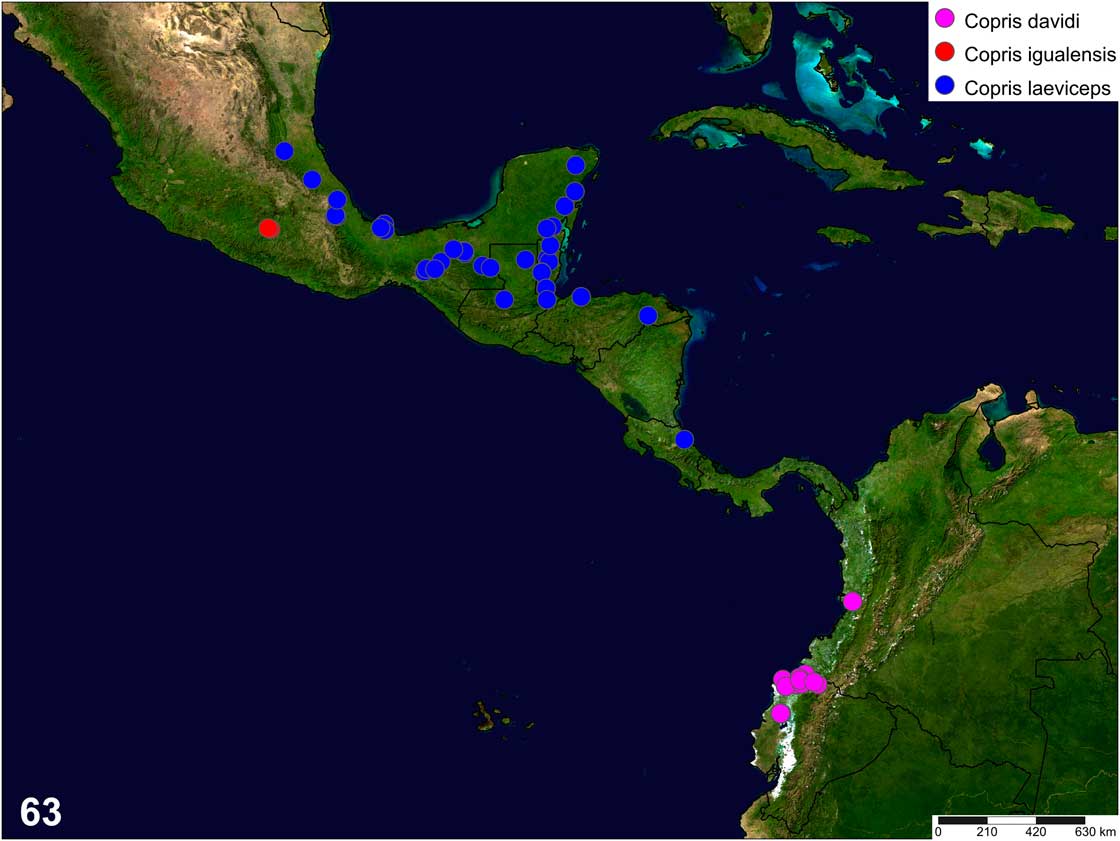
Distribution map of species included in the Copris incertus species complex (except Copris lugubris). Legend and scale bar are included in the top and bottom right corners, respectively. For C. incertus, only its native range is included.
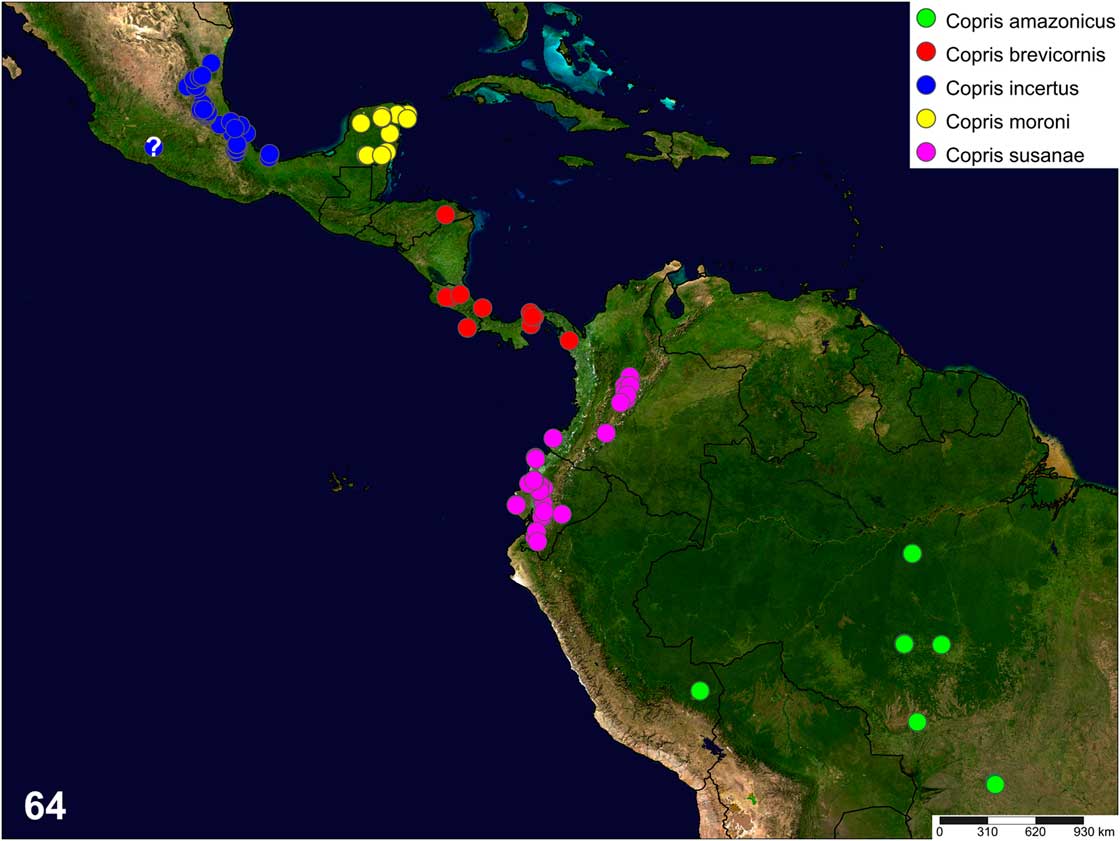
Distribution map of Copris lugubris. Legend and scale bar are included in the top and bottom right corners, respectively.

Copris davidi Darling and Génier, new species
http://zoobank.org/urn:lsid:zoobank.org:act:D6B58BD9-FFD1-47F3-BF53-E933FEA21C54
(Figs. 3, 12, 21, 30, 39, 48, 58, 63)
Type locality. Pajonal, Esmeraldas, Ecuador.
Diagnosis. Cephalic horn indistinct or truncate and conical. Absence of pronotal armament. Punctation of pronotal disc medially interrupted by an impunctate band extending anteroposteriorly across the pronotal disc. Prosternum lacks longitudinal carina. Tuft of setae present along margin of mesotrochanter and metatrochanter. Posteroventral surface of mesofemur and metafemur coarsely punctate. Male protibial spur distally expanded with a rounded apex. Parameres separated by a wide, angular ventrobasal gap, and lacking acute teeth at apex. Frontolateral peripheral sclerite elongate, right lateral frontolateral peripheral sclerite process acute, spiniform and gently curved.
Description of male holotype. Total length: 12.9 mm. Head (Figs. 3, 48) – Clypeus bidentate, teeth broadly flat, and separated by wide V-shaped emargination not breaking clypeal margin. Clypeus and gena finely punctate, appearing impunctate. Interocular surface coarsely punctate. Posterior angle of gena obtuse. Cephalic armament limited to one small, conical process 0.5 mm in length. Thorax – Anterolateral angle obtuse with irregular setigerous serrations along anterolateral margin. Entire lateral margin arcuate. Pronotal disc finely punctate medially and coarsely punctate: on anterolateral lobe, along lateral and posterior margin, in lateral fossae, along median sulcus and in two broad patches situated on either side of disc; patches connect with punctation in fossae and anterolateral lobe. Sternellum concave with coarse setigerous punctation and lacks longitudinal carina. Elytra – Striae punctate with interpunctural space approximately equal to or slightly greater than puncture diameter. Interstriae slightly convex and finely punctate. Striae 1–7 and 10 complete. Eighth stria obsolete basally, complete anteriorly until disintegrating halfway along elytron, reappears after posterior angle. Ninth stria emerges from tenth stria halfway down elytron. Abdomen – Median lobe of metasternum finely punctate with several coarse punctures sparsely located along anterolateral margin. Lateral lobes of metasternum with coarse punctation continuing medially along submargin. Anteromedian projection of first visible abdominal ventrite coarsely punctate. Pygidial punctation coarse dorsally, fine ventrally. Pygidial margin effaced ventrally. Prothoracic legs – Anterior femoral carina and row of setae separate. Coarse, granular punctation present immediately along submargin of anterior femoral carina. Anteroventral surface of femur finely punctate, posteroventral surface with coarse, setigerous punctation. Protibial spur distally expanded with rounded apex. Mesothoracic legs – Coxal surface finely punctate. Posterior margin of trochanter with setal tuft consisting of three setae. Ventral surface of femur finely punctate with distal setigerous punctures. Posteroventral surface of mesofemur coarsely punctate. Metathoracic legs – Coarse punctation present along median coxal groove. Posterior margin of trochanter with setal tuft consisting of three setae. Ventral surface of femur finely punctate with distal setigerous punctures. Posteroventral surface of metafemur coarsely punctate. Male genitalia (Figs. 21, 30, 39) – Parameres separated by wide, angular ventrobasal gap, and lacks acute teeth at apex. Frontolateral peripheral sclerite elongate. Right lateral frontolateral peripheral sclerite process acute, spiniform and gently curved. Axial and subaxial sclerite length subequal to frontolateral peripheral sclerite.
Description of female allotype. Total length: 13.1 mm (Fig. 12). Similar to male with following exceptions: clypeal teeth prominent. Protibial spur tapers distally.
Variation. Total length: 10.7–13.9 mm. Clypeal teeth range from broad and flat with rounded to acute edges, almost appear equilateral. Notch between clypeal teeth either wide and shallow or narrow and deep (never breaks clypeal margin). Clypeus and gena impunctate or finely punctate. Sulcal punctation effaced anteriorly or complete.
Distribution. (Fig. 63). Copris davidi occurs in moist forests along the western coasts of Colombia and Ecuador. One specimen is known from Valle del Cauca Department in Colombia, all other specimens occur in the Ecuadorian provinces of Esmeraldas and Imbabura. Given the continuous forest habitat between Esmeraldas and Valle del Cauca, as well as the lack of geographic barriers, C. davidi distribution likely continues through the departments of Nariño and Cauca.
Primary type data. Holotype ♂ (CMNC): [Ecuador, Esmeraldas | Pajonal | Ex. Pitfall carroña | 01/05/01 I. Yépez]; [16062]; [WORLD | SCARAB | DATABASE | WSD00032957] barcode label; [HOLOTYPE ♂ | Copris | davidi | des. J. Darling and F. Génier, 2018] red card.
Material examined. 47 ♂♂, 50 ♀♀. COLOMBIA: VALLE DEL CAUCA, Estación Forestal Bajo Calima, 50 m (3°59′N, 76°57′W), 19–23.iv.1995, M. Hitchcox – 1 ♂ (paratype) (BDGC); ECUADOR: ESMERALDAS, Chispero, 19.viii.2000, J. Celi and T. Ghia – 2 ♀♀, 1 ♂ (paratypes) (CMNC); Colón del Ónzole (0°47′N, 79°4′W), 1.iv.2000, J. Celi – 1 ♀, 1 ♂ (paratypes) (CEMT); Colón del Ónzole (0°47′N, 79°4′W), 3.v.2001, I. Yépez – 2 ♂♂ (paratypes) (CMNC); Colón del Ónzole (0°47′N, 79°4′W), 4.v.2001, I. Yépez – 1 ♀, 2 ♂♂ (paratypes) (CMNC); Esmeraldas (0°58′N, 79°39′W), v.1956, [anonymous] – 1 ♀ (paratype) (CNC); Esmeraldas (0°58′N, 79°39′W), vii.1956, [anonymous] – 2 ♀♀, 1 ♂ (paratypes) (CNC); Esmeraldas (0°58′N, 79°39′W), 26.ix.1950, [anonymous] – 1 ♀, 1 ♂ (paratypes) (AMNH); Estación Forestal La Chiquita, 11 km SE San Lorenzo, 5 m (1°10′N, 78°47′W), 6–11.vi.1975, S.B. Peck – 3 ♀♀, 4 ♂♂ (paratypes) (CMNC); Gualpí del Ónzole (0°46′N, 79°9′W), 1.iv.2000, A. Dávalos and J. Celi – 1 ♀ (paratype) (CEMT); Gualpí del Ónzole (0°46′N, 79°9′W), 27.iv.2001, I. Yépez – 4 ♂♂ (paratypes) (CMNC); Gualpí del Ónzole (0°46′N, 79°9′W), 28.iv.2001, I. Yépez – 2 ♀♀, 4 ♂♂ (paratypes) (CMNC); La Concordia (1°2′N, 79°1′W), 21.xi.2000, J. Celi – 1 ♂ (paratype) (CMNC); Majua (0°42′11″N, 79°32′27″W), 15.viii.2000, J. Celi and T. Ghia – 5 ♀♀, 1 ♂ (paratypes) (CMNC); Majua (0°42′11″N, 79°32′27″W), 23.xi.2000, J. Celi – 2 ♀♀ (paratypes) (CMNC); Pajonal (0°46′N, 79°9′W), 1.iv.2000, A. Dávalos – 3 ♀♀, 2 ♂♂ (paratypes) (CEMT); Pajonal (0°46′N, 79°9′W), 30.iv.2001, I. Yépez – 14 ♀♀, 6 ♂♂ (paratypes) (CMNC); Pajonal (0°46′N, 79°9′W), 1.v.2001, I. Yépez – 3 ♀♀, 6 ♂♂ (holotype, paratypes) (CMNC); PMFC [=Plan de Manejo Forestal Comunitario], Jeyambi (0°48′N, 78°56′W), 18.i.2000, A. Dávalos – 1 ♂ (paratype) (CEMT); Punta de Venado (0°56′38″N, 78°59′46″W), 23.xi.2000, J. Celi – 5 ♀♀, 2 ♂♂ (paratypes) (CMNC); IMBABURA, Carolina, 1000 m (0°47′N, 78°18′W), 21.x.1997, C. Carpio – 1 ♂ (paratype) (CEMT); Lita, 500 m (0°52′9″N, 78°27′1″W), 21.x.1997, C. Carpio – 1 ♀, 1 ♂ (paratypes) (CEMT); MANABÍ, 78 km NE Chone, 85 km WSW Santo Domingo, 450 m (0°20′46″S, 79°42′20″W), 9–12.vi.1976, S.B. Peck – 2 ♀♀, 3 ♂♂ (paratypes) (CMNC); 90 km WSW Santo Domingo, 73 km NE Chone, 300 m (0°20′52″S, 79°44′22″W), 6–9.vi.1976, S.B. Peck – 1 ♀, 2 ♂♂ (paratypes) (CMNC).
Etymology. The epithet “davidi” is the genitive form of David. Named in honour of the first author’s late father, David Darling.
Natural history. Similarly to C. laeviceps, C. davidi has been collected from traps baited with either human dung or carrion. Nidification in C. davidi has never been studied, but it probably resembles that of C. laeviceps based on the seemingly apomorphic morphology and diet observed in the two species.
Remarks. Copris davidi bears close resemblance to C. laeviceps, but it keys to C. incertus in Matthews (Reference Matthews1961) key due to the presence of a setal tuft along the margin of the mesotrochanter and metatrochanter. This feature provides a convenient means of distinguishing C. davidi from C. laeviceps based on external morphology.
Copris igualensis Warner, Reference Warner1990
(Figs. 4, 13, 22, 31, 40, 49, 63).
Copris igualensis – Warner Reference Warner1990: 236 (original description).
Copris igualensis – Kohlmann Reference Kohlmann2003: 47 (catalogue, distribution).
Type locality. 6 mi NW Iguala, Guerrero, Mexico.
Diagnosis. Dorsal ocular width one-eighth the interocular distance. Cephalic horn indistinct. Absence of pronotal armament. Two broad patches of coarse punctation on either side of pronotal disc. Prosternum lacks longitudinal carina. Anterior carina and row of setae on profemur contiguous. Tuft of setae absent along margin of mesotrochanter and metatrochanter. Posteroventral surface of mesofemur and metafemur impunctate. Male protibial spur distally expanded with a rounded apex. Parameres separated by a narrow, angular ventrobasal gap, and lack acute teeth at apex. Entire aedeagus highly truncate. Frontolateral peripheral sclerite truncate, right lateral frontolateral peripheral sclerite process acute, spiniform and gently curved.
Description of female. Total length: 12.6 mm (Fig. 13). Head – Clypeus bidentate, teeth broadly flat and separated by narrow notch not breaking clypeal margin. Clypeus and anterior gena surface minutely punctate, posterior gena surface coarsely punctate. Interocular surface coarsely punctate. Posterior angle of gena obtuse. Cephalic horn truncate and conical. Ocular width one-eighth interocular distance. Thorax – Anterolateral angle obtuse with irregular setigerous serrations along anterolateral margin. Entire lateral margin arcuate. Pronotal disc finely punctate medially and coarsely punctate: sparsely on anterolateral lobe, along lateral and posterior margin, in lateral fossae, along median sulcus and in two patches situated on either side of disc; patches connect with punctation in fossae. Sternellum concave with coarse setigerous punctation and lacks longitudinal carina. Elytra – Striae punctate with interpunctural space approximately equal to or slightly greater than puncture diameter. Interstriae slightly convex and minutely punctate. Striae 1–7 and 10 complete. Eighth stria obsolete basally, complete anteriorly until disintegrating halfway along elytron, reappears after posterior angle. Ninth stria emerges from tenth stria halfway down elytron. Abdomen – Median lobe of metasternum minutely punctate with fine punctures located along the anterolateral margin. Lateral lobes of metasternum with coarse punctation. Anteromedian projection of first visible abdominal ventrite impunctate. Pygidium coarsely punctate on disc, ventral surface minutely punctate. Pygidial margin effaced ventrally. Prothoracic legs – Anterior femoral carina and row of setae contiguous. Anteroventral surface of femur finely punctate, posteroventral surface with coarse, setigerous punctation. Protibial spur distally tapered. Mesothoracic legs – Coxal surface finely punctate. Posterior margin of trochanter lacks setal tuft. Mesofemur elongate; length threefold greater than width in ventral view. Ventral surface of mesofemur finely punctate, with distal setigerous punctures. Posteroventral surface of mesofemur impunctate. Metathoracic legs – Coarse punctation along median coxal groove. Posterior margin of trochanter lacks setal tuft. Ventral surface of metafemur finely punctate, with distal setigerous punctures. Posteroventral surface of metafemur impunctate. Metafemur elongate; length threefold greater than width in ventral view.
Distribution. (Fig. 65). This species is known from two collection events in the high elevation forests occurring within a 10 km radius north of Iguala, Guerrero, Mexico.
Material examined. 1 ♂, 1 ♀. MEXICO: GUERRERO, 6 mi. NW Iguala (18°26′N, 99°34′W), 2.viii.1981, F. Jump – 1 ♂ (holotype) (FSCA); 9 mi. NE Iguala, 1341 m (18°23′39″N, 99°28′47″W), 29.viii.1971, A.F. Newton (378) – 1 ♀ (CMNC).
Natural history. With only three specimens representing the species, very little is known about the natural history of C. igualensis. The two males that contributed to the Warner (Reference Warner1990) description were collected via light trap. In his description, Warner (Reference Warner1990) suggests that the rarity of C. igualensis may be attributed to an inquiline life history.
Remarks. This description is based on the first female specimen of C. igualensis to have been identified. As of now, there are three known specimens of C. igualensis represented in collection.
Copris laeviceps Harold, 1869
(Figs. 6, 15, 24, 33, 42, 51, 60, 63).
Copris laeviceps – Harold Reference Harold1869b: 496 (original description).
Copris laeviceps – Bates Reference Bates1887: 54 (distribution); Gillet Reference Gillet1910: 25 (catalogue); Gillet Reference Gillet1911: 75 (catalogue); Blackwelder Reference Blackwelder1944: 208 (checklist); Matthews Reference Matthews1959: 135 (identification key); Pereira and Halffter Reference Pereira and Halffter1961: 58 (distribution, ecology); Matthews Reference Matthews1961: 54 (monograph); Matthews and Halffter Reference Matthews and Halffter1968: 148 (comment, distribution); Deloya et al. Reference Deloya, Ruiz-Lizarraga and Morón1987: 169 (faunistic); Kohlmann et al. Reference Kohlmann, Cano and Delgado2003: 14 (distribution); Kohlmann Reference Kohlmann2003: 47 (catalogue, distribution); Halffter et al. Reference Halffter, Verdú, Márquez and Moreno2008: 285 (biogeography).
Type locality. Tuxtla, Chiapas, Mexico.
Diagnosis. Cephalic horn indistinct or truncate and conical. Absence of pronotal armament. Punctation of pronotal disc medially interrupted by an impunctate band extending anteroposteriorly across the pronotal disc. Prosternum lacks longitudinal carina. Tuft of setae absent along margin of mesotrochanter and metatrochanter. Posteroventral surface of mesofemur and metafemur coarsely punctate. Male protibial spur distally expanded with a rounded apex. Parameres separated by a wide angular ventrobasal gap and lack acute teeth at apex. Frontolateral peripheral sclerite elongate, right lateral frontolateral peripheral sclerite process acute, spiniform, and strongly curved basally.
Description of male lectotype. Total length: 11.1 mm. Head – Clypeus bidentate, teeth flat and separated by wide, V-shaped emargination not breaking clypeal margin. Clypeus and gena finely punctate, appearing impunctate. Posterior surface between eyes coarsely punctate. Posterior angle of gena obtuse. Cephalic horn truncate and conical. Thorax – Anterolateral angle obtuse with irregular setigerous serrations along anterolateral margin. Entire lateral margin arcuate. Pronotal disc finely punctate medially and coarsely punctate: on anterolateral lobe, along lateral and posterior margin, in lateral fossae, along median sulcus and in two broad patches situated on either side of disc; patches connect with punctation in fossae. Sternellum concave with coarse setigerous punctation and lacking longitudinal carina. Elytra – Striae punctate with interpunctural space approximately equal to or slightly greater than puncture diameter. Interstriae slightly convex and finely punctate. Striae 1–7 and 10 complete. Eighth stria obsolete basally, complete anteriorly until disintegrating halfway along elytron, reappears after posterior angle. Ninth stria emerges from tenth stria halfway down elytron. Abdomen – Median lobe of metasternum finely punctate with coarse punctures located along anterolateral margin. Lateral lobes of metasternum with coarse punctation continuing medially along submargin. Anteromedian projection of the first visible abdominal ventrite coarsely punctate. Pygidium coarsely punctate on disc with punctation gradually becoming finer ventrally. Pygidial margin effaced ventrally. Prothoracic legs – Anterior femoral carina and row of setae separate. Anteroventral surface of femur finely punctate, posteroventral surface with coarse, setigerous punctation. Protibial spur distally expanded with rounded apex. Mesothoracic legs – Coxal surface finely punctate. Posterior margin of trochanter lacks setal tuft. Ventral surface of mesofemur finely punctate, with distal setigerous punctures. Posteroventral surface of mesofemur coarsely punctate. Metathoracic legs – Coarse punctation along median coxal groove. Posterior margin of trochanter lacks setal tuft. Ventral surface of metafemur finely punctate, with distal setigerous punctures. Posteroventral surface of metafemur coarsely punctate. Male genitalia – Parameres separated by wide, angular ventrobasal gap, lacking acute teeth at apex. Frontolateral peripheral sclerite elongate. Right lateral frontolateral peripheral sclerite process acute, spiniform, and strongly curved basally. Axial and subaxial sclerite length subequal to frontolateral peripheral sclerite.
Distribution. (Fig. 63). Copris laeviceps occurs in Veracruz and continues into Chiapas and Guatemala. It is present within the lowland forests adjacent to the coasts of Quintana Roo, Belize, and Honduras. Barbero (Reference Barbero2001) documented the first account of C. laeviceps in Nicaragua. Its distribution ends in northern Costa Rica.
Material examined. 99 ♂♂, 77 ♀♀. BELIZE: CAYO, Belmopan (17°15′12″N, 88°46′17″W), 8–14.viii.1972, S.B. and J. Peck – 1 ♀, 1 ♂ (CMNC); Belmopan (17°15′12″N, 88°46′17″W), 11–16.viii.1972, S.B. and J. Peck – 1 ♂ (CMNC); Caves Branch (17°8′N, 88°42′W), 23–29.viii.1972, S.B. and J. Peck – 3 ♂♂ (CMNC); Las Cuevas Field Station, Chiquibul Forest Reserve, 500–700 m (16°44′N, 88°59′W), 8.vi.2007, [anonymous] – 1 ♂ (CMD); Las Cuevas Research Station, Chiquibul Forest Reserve, San Ignacio (16°43′N, 88°59′W), 2–17.iv.2004, R. Pateman – 1 ♀, 4 ♂♂ (BDGC, CMNC); ORANGE WALK, Lamanai (17°45′52″N, 88°39′17″W), 22–26.ii.1980, G. Kit – 8 ♀♀, 5 ♂♂ (CMNC); TOLEDO, Punta Gorda (16°6′24″N, 88°48′57″W), vi.1934, J.J. White – 1 ♂ (CMNC); COSTA RICA: LIMÓN, Hamburgfarm, Reventazon, Ebene Limon, 15 m (10°15′N, 83°28′W), 8.v.1925, F. Nevermann – 1 ♀ (CMNC); GUATEMALA: [unspecified locality], [no date], L. Conradt – 1 ♀ (MNHN); ALTA VERAPAZ, Cubilhuitz (15°40′N, 90°26′W), [no date], Champion – 1 ♀, 1 ♂ (MNHN); IZABAL, Cerro San Gil, 8 km N Las Escobas, 800 m (15°40′N, 88°47′W), 11–14.vi.1993, B.D. Gill – 1 ♂ (BDGC); PETÉN, Tikal (17°12′46″N, 89°37′3″W), 23–26.viii.1972, S.B. and J. Peck – 5 ♀♀ (CMNC, CNC); Tikal (17°12′46″N, 89°37′3″W), 28–30.vii.1978, J. Helava and Kukal – 2 ♂♂ (CMNC); HONDURAS: ATLÁNTIDA, Tela (15°46′29″N, 87°27′25″W), 10.v.1923, T.H. Hubbell – 1 ♂ (CMNC); GRACIAS A DIOS, Krausirpi (15°3′N, 84°52′W), 21–24.v.1994, B.D. Gill – 3 ♀♀, 3 ♂♂ (BDGC); MEXICO: [unspecified locality], [no date], [anonymous] – 1 ♂ (paralectotype) (MNHN); CHIAPAS, 1 km N Palenque (17°33′45″N, 91°59′16″W), 25.vii.1973, J. Reddell et al. – 1 ♂ (CMNC); 20 mi. N Bochil, 1707 m (17°8′N, 92°53′W), 24.viii.1971, A.F. Newton (357) – 1 ♀ (CMNC); 3 mi. S Palenque (17°27′45″N, 91°57′52″W), 1.vi.1987, W.B. Warner – 1 ♀, 1 ♂ (CMNC); 4 mi. S Palenque, 183 m (17°27′22″N, 91°57′59″W), 15.viii.1971, A.F. Newton (326) – 6 ♀♀, 4 ♂♂ (CMNC); Bonampak Road, 100 km SE Palenque, 230 m (16°58′56″N, 91°16′35″W), 8–24.vii.1983, S.B. and J. Peck – 1 ♂ (BDGC); El Aguacero, 16 km W Ocozocoautlan (16°45′30″N, 93°31′35″W), 5–10.vi.1990, B.D. Gill – 2 ♀♀ (BDGC); El Aguacero, 16 km W Ocozocoautlan (16°45′30″N, 93°31′35″W), 5–10.vi.1990, H.F. and A.T. Howden and B.D. Gill – 1 ♂ (CMNC); Palenque (17°31′38″N, 91°58′39″W), 22.v.1965, G. Halffter – 4 ♀♀, 6 ♂♂ (CNC); Palenque (17°31′38″N, 91°58′39″W), 22–23.vi.1969, D.E. Bright and J.M. Campbell – 3 ♀♀, 1 ♂ (CNC); Palenque (17°31′38″N, 91°58′39″W), 2–30.vii.1983, S.B. and J. Peck – 1 ♂ (BDGC); Palenque (17°31′38″N, 91°58′39″W), 6–9.vii.1983, S.B. and J. Peck – 1 ♀, 3 ♂♂ (BDGC, CMNC); Parque Laguna Belgica, 16 km NW Ocozocoautla (16°51′40″N, 93°27′19″W), 7.vi.1990, B.D. Gill – 1 ♂ (BDGC); Parque Laguna Belgica, 16 km NW Ocozocoautla (16°51′40″N, 93°27′19″W), 13.vi.1990, B.D. Gill – 2 ♀♀, 2 ♂♂ (BDGC); Parque Nacional Cañón del Sumidero (16°51′N, 93°7′W), 25.v–1.vi.1990, B.D. Gill – 2 ♀♀, 4 ♂♂ (BDGC); Parque Nacional Cañón del Sumidero (16°51′N, 93°7′W), 25.v–1.vi.1990, B.D. Gill and H.F. and A.T. Howden – 3 ♂♂ (CMNC); Parque Nacional Cañón del Sumidero (16°51′N, 93°7′W), 7.vi.1990, H.F. and A.T. Howden and B.D. Gill – 1 ♂ (CMNC); Selva Lacandona, vii–viii.1977, M. Lamotte – 4 ♀♀, 4 ♂♂ (MNHN); Yaxchilán, 140 m (16°53′58″N, 90°57′58″W), 7.v.1981, E. Fuentes – 1 ♂ (IEXA); Yaxchilán, 140 m (16°53′58″N, 90°57′58″W), 10.v.1981, E. Fuentes – 2 ♂♂ (IEXA); Yaxchilán, 140 m (16°53′58″N, 90°57′58″W), 14.vi.1981, E. Fuentes – 1 ♂ (IEXA); PUEBLA, Tlaxcalantongo, 549 m (20°18′44″N, 97°52′19″W), 8.vii.1971, A.F. Newton (273) – 1 ♂ (CMNC); QUINTANA ROO, 15 mi. W Chetumal (18°30′N, 88°34′W), 9–14.viii.1971, A.F. Newton (338) – 3 ♀♀, 1 ♂ (CMNC); 20 mi. S Felipe Carrillo Puerto, 30 m (19°17′18″N, 88°5′40″W), 13.viii.1971, A.F. Newton (341) – 1 ♀ (CMNC); Kohunlich, 68 km W Chetumal (18°25′11″N, 88°47′29″W), 15–17.vii.1982, S.B. and J. Peck – 1 ♂ (CMNC); Reserva de la biósfera Sian–Ka’an, 10 m (19°51′N, 87°42′W), 19.vi.1984, O. Canul and J.F. Camal – 1 ♀, 1 ♂ (IEXA); Reserva de la biósfera Sian–Ka’an, 10 m (19°51′N, 87°42′W), 10.v.1985, O. Canul and J.F. Camal – 1 ♀ (IEXA); X–can (20°52′N, 87°40′W), viii.1963, E.C. Welling – 1 ♀, 1 ♂ (CNC); SAN LUIS POTOSÍ, 5.6 mi. E Xilitla, 400 m (21°24′52″N, 98°56′34″W), 17–19.vii.1969, S.B. and J. Peck – 1 ♀ (CMNC); TABASCO, 46 mi. SE Villahermosa, 150 m (17°37′N, 92°24′W), 15.viii.1971, A.F. Newton (334) – 1 ♂ (CMNC); VERACRUZ, 33 km NE Catemaco, 160 m (18°35′5″N, 95°4′29″W), 1–30.vii.1983, S.B. and J. Peck – 3 ♀♀, 3 ♂♂ (BDGC); 33 km NE Catemaco, 160 m (18°35′5″N, 95°4′29″W), 13–20.vii.1984, D.H. Lindeman – 1 ♂ (BDGC); Córdoba (18°53′36″N, 96°54′56″W), 4.viii.1969, S.B. and J. Peck – 3 ♀♀, 3 ♂♂ (CMNC); Estación de Biología Tropical Los Tuxtlas (18°35′5″N, 95°4′29″W), vii.1984, Martínez – 4 ♀♀, 4 ♂♂ (CMNC); Estación de Biología Tropical Los Tuxtlas (18°35′5″N, 95°4′29″W), 31.viii.1978, M.A. Morón – 3 ♀♀, 1 ♂ (IEXA); Estación de Biología Tropical Los Tuxtlas, 33 km NE Catemaco, 160 m (18°35′5″N, 95°4′29″W), 1.vii.1983, S.B. and J. Peck – 1 ♀ (CMNC); Estación de Biología Tropical Los Tuxtlas, 33 km NE Catemaco, 160 m (18°35′5″N, 95°4′29″W), 13.vii.1984, D.H. Lindeman – 2 ♀♀, 3 ♂♂ (CMNC); Fortín de las Flores, Canyon Río Metlac (18°54′N, 97°0′40″W), 5–8.viii.1969, S.B. and J. Peck – 2 ♀♀, 7 ♂♂ (CMNC); Guadalupe Barreal, Córdoba, 940 m (18°55′52″N, 96°58′3″W), iii.1992, E. Santos – 1 ♀ (IEXA); Guadalupe Barreal, Córdoba, 940 m (18°55′52″N, 96°58′3″W), vi.1992, E. Santos – 1 ♂ (IEXA); Lago de Catemaco (18°21′27″N, 95°3′36″W), 30.iv.–1.v.1969, H.F. Howden – 1 ♂ (CMNC); Lago de Catemaco (18°21′27″N, 95°3′36″W), 31.vii.–4.viii.1970, A.F. Newton – 1 ♀, 3 ♂♂ (CMNC); Río Metlac, 975 m, 1.viii.1973, A.F. Newton (512DH) – 1 ♀ (CMNC); San Andrés Tuxtla (18°27′N, 95°13′W), [no date], [anonymous] – 1 ♂ (lectotype) (MNHN); Xalapa (19°32′N, 96°54′W), [no date], Hoege – 1 ♀, 2 ♂♂ (MNHN).
Natural history. Collected from pitfall traps baited with carrion as well as horse, cow, and human dung. Commonly collected via flight intercept trap. The process of nidification in C. laeviceps is similar to that of C. lugubris and C. incertus except the female oviposits into each brood ball after isolating them from the dung cake (Halffter and Matthews Reference Halffter and Matthews1966).
Remarks. Intraspecific variation in external morphology and male genital structure was found to be homogenous throughout the geographic distribution of C. laeviceps. Therefore, the current taxonomy of the species is considered valid herein and requires no revision.
Identification keys

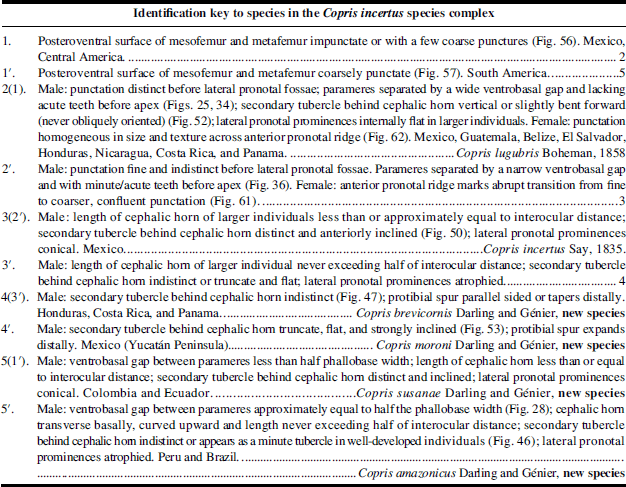

Concluding remarks
Recognition of C. amazonicus, C. brevicornis, C. davidi, C. moroni, and C. susanae as distinct species brings the total number of New World Copris to 39, 16 more than the total included in the Matthews (Reference Matthews1961) revision. Upon the description of C. amazonicus, the geographic distribution of Copris now extends much deeper into South America than previously thought. The extent to which C. amazonicus has occupied the Amazon and Cerrado is unclear, but likely remarkable based on the known collection localities in Brazil and Peru. Further collecting from these and neighbouring regions like Bolivia is required to generate an accurate distribution map of C. amazonicus.
This study suggests that multiple species had been classified as C. incertus and confirms the Mexican origin of the introduced C. incertus populations. Although specimens from some of these introduced populations have been confirmed to be true C. incertus (therefore of Mexican origin), there are still specimens from populations in Western Samoa, New Zealand, and New Caledonia that should be assessed.
Acknowledgements
J.D.G.D. would like to express my sincere gratitude towards: the editors and anonymous reviewers for their thorough proofreading of the manuscript, Dr. Naomi Cappuccino for the administrative assistance she provided while I was conducting this project as an undergraduate student at Carleton University, Joan Mallet for giving me the opportunity that ultimately lead to the completion of this project, and my ever-supportive friends and family.