INTRODUCTION
Eighteenth-century Britain was certainly familiar with both the idea and the physical products of forgery. As contemporary proceedings from the Old Bailey indicate, indictments for committing finance-related fraud (half of the cases involved bills of exchange or promissory notes) were generally, if not consistently, on the rise during the period.Footnote 1 Of course, this was not the only type of forgery prevalent at the time and, as critics have pointed out, numerous high-profile cases of forged antiquarian literature were in circulation, too: this aspect of eighteenth-century culture has been explored by, among others, Paul Baines.Footnote 2 Of these works, two authors – James Macpherson (1736–96) and Thomas ChattertonFootnote 3 (1752–70) – are cases that are especially familiar not only to literary critics and cultural historians, but to anyone interested in the literary and antiquarian cultures of the period more broadly.Footnote 4 Even Kenneth Clark’s pioneering monograph on the Gothic Revival mentions these high-profile examples of eighteenth-century forgery.Footnote 5 It is, indeed, impossible to escape mention of the Ossianic debate initiated by Macpherson when he claimed to have recovered the fragmentary remnants of ancient Gaelic poetry, not to mention Chatterton’s ‘uncovering’ and attempt at publishing the poetry of the medieval monk Thomas Rowley that he claimed were discovered in the year 1768. The preface to Macpherson’s Ossianic Fragments of Ancient Poetry (1760) emphasised the processes of discovery and translation that apparently lent to the Fragments their historical and antiquarian credentials. Certainly, the theme of fragmentary ‘discovery’ looms large in the history of mid-Georgian forgery, often serving to obfuscate the origins of modern creative productions by attempting to pass them off as authentic historic relics:
The public may depend on the following fragments as genuine remains of ancient Scottish poetry. The date of their composition cannot be exactly ascertained. Tradition, in the country where they were written, refers to them as an æra of the most remote antiquity: and this tradition is supported by the spirit and strain of the poems themselves. […] In particular there is reason to hope that one work of considerable length, and which deserves to be styled an heroic poem, might be recovered and translated, if encouragement were given to such an undertaking.Footnote 6
Macpherson is here advertising and celebrating the claimed historic value of the fragments, though, of course, they were taken by many to lack the historic legitimacy that he claimed for them.Footnote 7 Chatterton’s posthumously published Poems, Supposed to Have Been Written at Bristol, by Thomas Rowley, and Others, in the Fifteenth Century (1777) was similarly premised upon discovery, which, according to George Catcott, was as follows:
The first discovery of certain MSS having been deposited in Redclift [sic] church, above three centuries ago, was made in the year 1768, at the time of the opening the new bridge at Bristol and was owing to a publication in Farley’s Weekly Journal, 1 October 1768, containing an Account of the ceremonies observed at the opening of the old bridge, taken, as it was said, from a very ancient MS. This excited the curiosity of some persons to enquire after the original.Footnote 8
It was upon such fragments – especially physical – that antiquaries based their interpretations and reconstructions of the antique past.
Horace Walpole (1717–97) was keenly aware of, and personally involved in, both of these cases of forgery: initially, he had been taken in by Macpherson’s work, though later he eventually came to consider the Fragments as ‘dull forgeries’.Footnote 9 By the time that Chatterton approached Walpole in 1769 with the request that he assist with the publication of the Rowley poems, Walpole was far more cautious: after he showed a sample of the manuscripts to antiquaries Thomas Gray (1716–71) and William Mason (1725–97), and upon receiving sceptical feedback concerning the works’ authenticity, he dismissed them as fakes. His dismissal of the Rowley poetry was thought at the time, and thereafter, to have precipitated Chatterton’s death by apparent suicide in 1770. In a letter to the antiquary Michael Lort (1724/25–90) from 12 November 1788, Walpole writes that:
I received a letter two or three sheets, an anonymous letter, and consequently abusing me, for saying in my defence that all the house of forgery are relations, and telling me it was so cruel, that, though I had cleared myself of the charge of ill usage of Chatterton, still the writer could from that sentence think me guilty of his death – Such an ex post facto murder was droll enough; and the more, as though that sentence was only a general assertion and but hinted that forging handwriting might be dangerous and lead a necessitous lad to guilty forgeries, I actually did acquit Chatterton of such guilt.Footnote 10
Walpole – author, famous supporter of things Gothic and enthusiastic collector of all manner of historic fragments – was a touchstone for Chatterton to help legitimise and publish what were effectively his teenage musings in a deeply historic style and designed to be passed for the genuine work of a fifteenth-century monk.Footnote 11 Despite rejecting them as forgeries, Walpole was hardly innocent of manufacturing antiquarian literature himself: the first edition of The Castle of Otranto: a story, published on Christmas Eve 1764, was intentionally misrepresented as the work of William Marshal, Gent., a ‘translator’Footnote 12 who felt compelled to share a sixteenth-century work translated into English ‘From the Original Italian of Onuphrio Muralto, Canon of the Church of St. Nicholas at Otranto’ based upon a much older text dating from the time of the Crusades.Footnote 13 This novel, ‘printed at Naples, in the black letter, in the year 1529’, we are told in the translator’s preface to the first edition, ‘was found in the library of an ancient Catholic family in the north of England’.Footnote 14 The nature of his historical production was realised by the antiquary-draftsman John Carter (1748–1817) in 1790.Footnote 15 Walpole confessed to his deception in the second edition of Otranto of 1765. Although he did not go so far as to declare his novel a forgery, he framed it as a premeditated act of misrepresentation:
The favourable manner in which this little piece has been received by the public, calls upon the author to explain the grounds on which he composed it. But before he opens those motives, it is fit that he should ask pardon of his readers for having offered his work to them under the borrowed personable of a translator. As diffidence of his own abilities, and the novelty of the attempt, were his sole inducements to assume that disguise, he flatters himself he shall appear excusable.Footnote 16
Compared with the productions of Macpherson and Chatterton, the case of Walpole’s Otranto and his subsequent plea for critical clemency illustrates the variety of forgeries emerging in Georgian literature, even if the theme of discovery to legitimise such works is a common thread. These popular cases promoted historic literary forgery as a genre and raised its awareness within Georgian culture.
THE PARIAN CHRONICLE: ITS SIGNIFICANCE IN AN AGE OF FORGERIES
The cases of premeditated forgery discussed above are well known, yet another largely forgotten debate emerged towards the end of the 1780s concerning the status of the Parian Chronicle as a forged or authentic fragment from the third century bc (fig 1).Footnote 17 Its significance to the antiquarian method of study and the reconstruction of history and historic fragments is as significant as the case of the more well-known Woodward Shield.Footnote 18 The iron and gold shield, acquired by the physician Dr John Woodward (1665/68–1728) around 1693 from the daughter of the apothecary John Conyers (c 1633–94), was thought to date to as early as 210 bc, though this was not universally accepted; in the 1720s it was generally considered of a much later date – an early modern fake.Footnote 19 This article will not assess the validity of the various arguments, nor advance any definitive arguments concerning the Parian Chronicle’s authenticity beyond noting its acceptance today as a genuine historic fragment. Rather, the event is of significance because it brings to light a purported case of forgery that has remained unexamined, and one that has much to tell us about perceptions of forgery in the eighteenth century that far exceed the well-documented examples of Woodward’s Shield, Macpherson, Chatterton and, later, the Shakespearean forger W H Ireland (1775–1835). Referring to the case in The Monthly Review for October 1788, an anonymous contributor underscored the prevalence of such deceptions, and the possibility that numerous other examples – both new and old – remained undiscovered: ‘Literary forgeries have frequently been attended with astonishing success; and during the lapse of many centuries, some of these treacherous frauds have eluded all discovery’.Footnote 20 Indeed, it took four centuries for the well-intentioned, if ultimately spurious, Historia Regnum Britanniae (1136) by Geoffrey of Monmouth (d 1154/5) to be overwhelmingly accepted as compelling nonsense.Footnote 21 The controversial proposition that emerged in the late eighteenth century was that the Parian Chronicle was one such historic forgery that, until 1788, had managed to remain unexposed. It was claimed that such a forgery could have easily been passed off as an authentic fragment because it had originally been
brought into England at a time when the learned were not so scrupulous about what they received as the remains of antiquity. They were the property of a celebrated and much-respected nobleman. […] But circumstances are now changed. The influence of the donor no longer exists. The literati are more curious and inquisitive, and to disposed to receive any thing on the authority of unsupported tradition.Footnote 22
The Parian Chronicle, from Inscriptiones Graecae, xii, (1903–9). Image: courtesy of Yale University.

While this was enough for some to question the Chronicle’s authenticity, not everyone shared in this assumption. For a start, it established a dangerous precedent, for the authenticity of fragments was central to the antiquarian endeavour, and something upon which the practice of antiquarianism itself wholly depended. As Rosemary Sweet explains, ‘Antiquaries proceeded upon the Baconian assumption that antiquities were the fragments of the historical shipwreck of time, and if sufficient were collected some progress could be made towards recovering the shape of that wreck’.Footnote 23 As Frances Bacon (1561–1626), viscount St Alban, had written:
Antiquities, or remnants of history, are when industrious persons, by an exact and scrupulous diligence and observations, out of monuments, names, words, proverbs, traditions, private records and evidences, fragments of stories, passages of books, that concern not story, and the like, preserve and recover somewhat from the deluge of time.Footnote 24
Such objects were clearly central to the reconstruction of the past, especially if they were the only extant remains; one could not doubt the authenticity of the fragment without calling the entire practice of antiquarianism into question.
The importance of objects to antiquarian study was raised explicitly at the Society of Antiquaries of London’s second weekly meeting on 12 December 1707, where it was agreed that ‘The business of this Society shall be limited to the subject of Antiquities; and more particularly, to such things as may Illustrate or Relate to the History of Great Britain’.Footnote 25 On 1 January 1718 William Stukeley (1687–1765), as the Society’s Secretary, minuted the importance of such fragments to the Society and, in turn, antiquarian study more broadly:
AND Whereas Our Own Country without Vanity may be Said to abound with many Valuable Relicks of former Ages, now in the Custody of Private Gentlemen or lying in Obscurity: & more are daily discovered by Chance, or the diligence of Such as tread in the commendable Footsteps of those who revivd the Spirit of this kind of Learning amongst Us in the last Century: to the End the knowledge of them may become more Universal, be preserved & transmitted to Futurity Several Gentlemen have agreed to form themselves into such a Society here in London, with a design at their Own Charge, to collect & Print All Accounts of Ancient Monuments that come to their hands whether Ecclesiastic or Civil, which may be communicated to from All Parts of the Kingdoms of Great Bryttain & Ireland, Such as Old Citys, Stations, Camps, public Buildings, Roads, ~ Churches, Temples, Abbys, Statues, Tombs, Busts, Inscriptions, Genealogys, Historys, Observations, Illustrations, Emendations of Books already published & whatever may properly belong to the History of BRITISH ANTIQUITYS.Footnote 26
This remained the case throughout the century. In 1784 Edward King (1734/5–1807) published his letter of resignation from a short-term tenure as Director of the Society of Antiquaries of London, in which he emphasised the continued value and importance of such fragments to the study of history:
Memorials, which I am persuaded will be of the utmost importance to future ages; both because, merely for want of such notice being taken of them, many fragments, of former times, pregnant with information, are almost totally unknown; and because all true conclusions of Science must depend upon the collection of a variety of facts; and upon comparing very many remains and appearances of things, one with another.Footnote 27
The debate over the authenticity of the Parian Chronicle, as will be elaborated below, questioned the validity of scholarly studies that had repeatedly treated it as an authentic ancient fragment. The case’s repercussions extended far beyond its immediate context; it established a precedent enabling long-held opinions on the validity of authentic historical fragments to be challenged and potentially jeopardising the work of antiquaries that, to use the Baconian metaphor, had been indefatigably devoted to reconstructing the shipwreck of historical time.
A FORGOTTEN CASE OF ACCUSED ANTIQUARIAN FORGERY
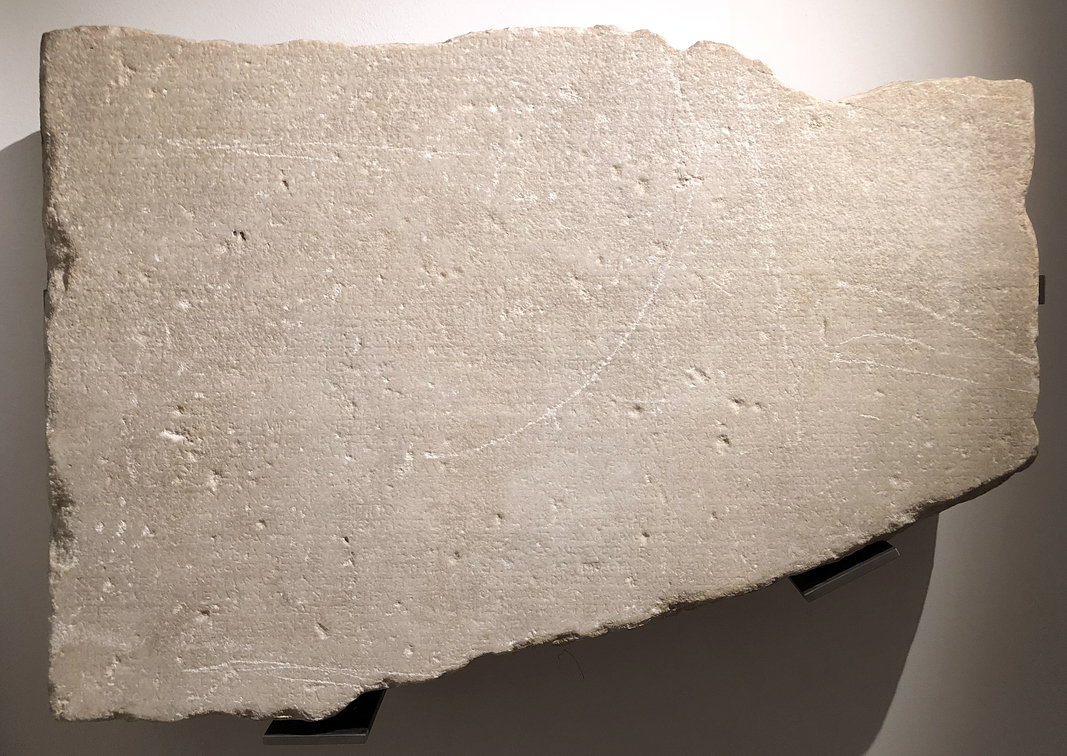
The fragment of the Parian Chronicle, known also as the Parian Marble, or the Chronicle of the Arundelian Marbles, explored in this article is today in the care of the University of Oxford’s Ashmolean Museum (fig 2), having been given in 1667 to the institution by the Catholic Henry Howard (1628–84), 6th Duke of Norfolk, grandson of Thomas Howard (1585–1646), the 14th Earl of Arundel, for whom the artefact was originally acquired.Footnote 28 A second surviving fragment from the base of the stele was discovered in 1897, and is now in the Archaeological Museum on Paros. The remains in Oxford, currently measuring 56.5 × 81.2cm in its damaged state, was produced in 264 bc, and it traces events in Greek history from 1581 bc through to 354 bc (instead of 264 bc). A transcription of the Chronicle (as it existed in the eighteenth century) is included in Appendix I (see the Supplementary Material). The Chronicle’s entries are both historical and legendary, and somewhere in between; such as the Flood of Deucalion and the Trojan War. The former is entered thus:
4. Since the deluge happened in the time of Deucalion; and Deucalion escaped the rains [and went] from Lycoria to Athens, to Cranaus, and built the temple of Jupiter Olympius, and offered sacrifices for his preservation, 1265 years, Cranaus reigning at Athens. 1529 bc.Footnote 29
The Parian Chronicle. Ashmolean Museum, Oxford, Howard Gift 1667, Chandler 2.59. Photograph: Peter Lindfield.

And the latter is mentioned briefly:
24. Since the Greeks undertook their expedition to Troy, 954 years, Menestheus reigning at Athens in the thirteenth year [of his reign]. 1218 bc.Footnote 30
Other more recent events included tangible – rather than mythic – history, such as the Battle of Leuctra (371 bc):
73. Since the battle was fought at Leuctra between the Thebans and the Lacedæmo nians, in which the Thebans conquered, 107 years, Phrasiclides being archon at Athens. At this time Alexander [the son] of Amyntas reigns over the Macedonians. 371 bc.Footnote 31
Notably, the Parian Chronicle blends these mythical and tangible histories within the same timeline.
The Oxford fragment, in its mutilated form, was apparently used during the English Civil War (1642–51) to repair a chimney in Arundel House, London, a fact that illustrates its colourful and varied history after its acquisition in the seventeenth century for the 14th Earl of Arundel.Footnote 32 Much like the other examples of forgery mentioned above, the fragment was found or serendipitously discovered – in this case, by the earl’s agent, William Petty – in 1626, as recorded in a letter from the diplomat and collector of antiquities Sir Thomas Roe (1581–1644) to the earl on 28 March that year:
I am informed hee [Petty] hath gotten many things, rare, and ancient. There was neuer men so fitted to an imployment, that encouters all accident with so unwearied patience; eates with Grekes on their worst dayes; Iyes with fishermen of plancks, at the best; is all things to all men, that he may obteyne his ends, which are your lordships seruice.Footnote 33
Given the rise of a nascent excavation industry, such discoveries were not particularly unusual at the time, with the practice of excavation often yielding important treasures that were valued highly by collectors.Footnote 34 This is articulated well in a letter dating to 8–18 May 1626 from Roe to George Villiers (1592–1628), 1st Duke of Buckingham:
My agents from Greece are retorned with no great fruit of their labours, other than discoueryes of some marbles vunder ground, which will require tyme and priuacy to take vpp, to auoid the enuy of these people, who suspect treasure in euery place where Christians breake the earth.Footnote 35
After the Chronicle’s transportation to England and incorporation into Arundel’s collection, the antiquary John Selden (1584–1654) transcribed it in his Marmora Arundelliana (1628–9).Footnote 36 At no stage in this or subsequent publications was there ever the suggestion that the Parian Chronicle was anything other than a genuine fragment from Greek antiquity.
Arundel was held by Walpole in the highest esteem: he described the earl as the ‘father of virtue in England’ and ‘was the first who professedly began to collect in this country’, the ‘very ruins of which are [now, 1762] ornaments to several principal collections’.Footnote 37 The importance and authenticity of the earl’s collection, including especially the Arundel Marbles, was addressed by Walpole in a letter to William Mason (1725–97), dated 5 May 1783:
but where are the national remains of Carthage? Who inquires after the relics of a country that is sunk, annihilated? If it has once carried its arms, and arts and talents to the height, some pious traveller perhaps will dig amidst the ruins of a fallen temple, and exult fervently if he finds a mutilated bust of Epaminondas, Demosthenes or Pindar – nay, it may be he will transport home some Arundelian marbles that record the private heroes who fell at Thermopylæ.Footnote 38
The debate over the Parian Chronicle’s authenticity, consequently, cast aspersions regarding the value of England’s most important early modern private collector, and, beyond this, the value of artefacts from his collection. Walpole must surely have been aware of the controversy around the Chronicle that emerged in the late 1780s, but he does not appear to have become involved in it at all. He did not own any of the volumes addressing the debate, and nor is it mentioned in any of his letters.Footnote 39 Walpole’s apparent lack of engagement is telling and suggests, perhaps, the debate’s relative obscurity; this may, on the other hand, have arisen because his antiquarian interests were largely Gothic. We do, however, have to bear in mind that, having resigned from the Society of Antiquaries of London in 1773Footnote 40 in high dudgeon over the reaction to his Historic Doubts on the Life and Reign of King Richard the Third (1768), he had, from this moment onwards, turned his back on institutionalised antiquarianism in order to cultivate a more idiosyncratic and imaginative approach. There are also notable omissions from his letters concerning other objects and works, such as the Gothic Revival church of Shobdon, Herefordshire, that was directed by his acquaintance and friend Dickie Bateman (1705–73).Footnote 41 Therefore, it is not prudent to marginalise the debate based upon one of the most prolific commentators of the century not referring to it.
Matters pertaining to the authenticity of the Parian Chronicle were debated publicly in 1787 and 1788. The primary players in the affair were the Oxford-educated Joseph Robertson (1726–1802), a Church of England clergyman and writer who challenged its authenticity, and John Hewlett (1762–1844), a biblical scholar who vehemently defended the Chronicle from Robertson’s claims. Their treatises and pamphlets on the matter stand apart from the rest of the authors’ outputs that respectively focus upon language, poetry and religion.Footnote 42 Richard Gough (1735–1809), antiquary and Director of the Society of Antiquaries of London, also waded in with the publication of a pamphlet, Observations in Vindication of the Authenticity of the Parian Chronicle published (c 1788).Footnote 43 The debacle concerned not only the authenticity of the Parian Chronicle as a genuine historical fragment, but also the validity of its representation of Greek chronology. In ‘On the origin of points’, the first chapter of An Essay on Punctuation (1785), Robertson began by citing the Parian Chronicle as an important example of historic writing:
The ancient way of writing among the Greeks and Romans was in capitals, placed at equal distances, without any blank spaces to separate the words, or any marks to divide or subdivide the sentences. The celebrated Chronicle of the Arundel Marbles, the Alexandrian manuscript in the British Museum, the manuscript, containing the four Gospels and the Acts of the Apostles in Greek and Latin, presented to the University of Cambridge by Beza, in 1581, the small fragment of Livy, discovered by Mr. Burns in the Vatican at Rome, in 1772, and a great variety of other Greek and Latin manuscripts of the most ancient date, are written in capitals, without any distances between the words, without any accents, and, for the most part, without points.Footnote 44
This argument is hardly inflammatory. It did not ignite the ensuing debate explored here, and indeed the fragment is referred to by Robertson as the ‘celebrated Chronicle of the Arundel Marbles’ and worthy of citation as an example of ancient writing. The asterisked footnote to Robertson’s text, however, challenged the Chronicle’s status as a genuine artefact. Contradicting his acknowledgement of the Parian Chronicle as a fine example of Greek writing, Robertson’s footnote subtly cast doubt over its authenticity, claiming that ‘the Arundel Marbles are said to have been engraved 263 years before the Christian æra. – But is there no room to question their authenticity?’Footnote 45 While almost certainly intended to be rhetorical, this question did not remain so, and responses and reactions were quick to appear.
An early and very brief response to Robertson’s statement appeared in The Gentleman’s Magazine. Authored by a self-proclaimed ‘Lover of Antiquities’, a note in the July 1785 issue sought further information and clarification:
The Author of a very ingenious and elegant production lately published, entitled ‘An Essay on Punctuation’, has however thrown out a hint which has surprized me not a little, as it will certainly do many others, viz. that there is some reason to question the authenticity of the Arundel Marbles.
I do not doubt the judgement of this writer, for he appears to be a critic of taste and learning; but I wish to be informed by him, or any other competent judge, what the foundation there is for this surmise.Footnote 46
In questioning the authenticity of the Parian Chronicle, Robertson had also challenged received opinion concerning the status of the antiquarian fragment, an aspersion that, as this note suggests, applied to the Arundel Marbles collectively.
Replying to the ‘Lover of Antiquities’, Robertson published The Parian Chronicle, Or the Chronicle of the Arundelian Marbles; With a Dissertation Concerning its Authenticity (1788), an indexed 225-page treatise outlining his reasons for questioning the Chronicle’s authenticity in the footnote to the earlier work. The Preface to this treatise makes clear his intention to satisfy the curiosity of the ‘Lover of Antiquities’: ‘As I am thus desired to assign my reasons for a question, which I proposed without any particular investigation, I shall freely and ingeniously submit them to the consideration of the learned reader’.Footnote 47 In response to this, Hewlett replied to all of the points raised by Robertson in his own treatise-length contribution to the debate: his Vindication of the Authenticity of the Parian Chronicle, in Answer to a Dissertation on that Subject, Lately Published (1789) was followed the same year by a much shorter Answers to Some Critical Strictures Relative to the Controversy on the Authenticity of the Parian Chronicle. Both of Hewlett’s responses attempt to dismantle Robertson’s argument and reassert the Chronicle’s authenticity.Footnote 48 In the wake of Robertson’s and Hewlett’s treatises, a number of essays were published in The Gentleman’s Magazine, The European Magazine and London Review Footnote 49 and the Monthly Review,Footnote 50 each voicing opinions about the Chronicle and each variously questioning, or vouching for, its authenticity.
In the concluding paragraph to his Answers to Some Critical Strictures, Hewlett hoped that the affair would be swiftly forgotten:
Notwithstanding I am satisfied that in writing these pages, I have discharged a duty, yet I freely acknowledge it has been a painful one. However it is passed; and I wish to forget the subject gave rise to it for ever. I need not fear, indeed, that it will be long remembered, or generally known. It is hastening to oblivion, before it has well seen the light. Yes, Sir, the controversy between us is almost as dead as if it had never been; and I am happy to find that the Parian Chronicle rests precisely on the same grounds of authenticity, that it has always done.Footnote 51
His wish seems to have been granted, as, despite exercising some antiquaries and scholars in the 1780s, it is now largely forgotten.Footnote 52 Despite Hewlett’s wish for a line to be drawn under the matter – not least because he felt that the argument had been decided overwhelmingly in favour of the Chronicle’s authenticity – this important moment in eighteenth-century antiquarianism exposes the fragility of assumptions made concerning the authenticity of objects and fragments at the centre of antiquarian study. One conjectural footnote in a treatise unrelated to a well-regarded antiquarian object that, as Robertson freely admitted in the Preface to his treatise, was ‘proposed without any particular investigation’ could jeopardise its long-established authenticity and importance.
ROBERTSON’S OBJECTIONS TO THE CHRONICLE’S AUTHENTICITY
After outlining the Chronicle’s treatment by earlier scholars, starting with John Selden’s 1628–9 commentary,Footnote 53 followed by a further fourteen publications on the subject published over the following 130 years, Robertson set his assessment of the artefact apart from these preceding works. Perhaps his most barbed criticism (one intended to lend weight to his own argument and discredit the earlier interpretations) is reserved for Marmora Oxoniensia (1763) by Richard Chandler (1737–1810), a classical scholar and traveller: he claims that Chandler, as the ‘learned and ingenious editor’, ‘corrected the mistake of his predecessors; and in some of the inscriptions, particularly of the Parian Chronicle, has supplied the lacunæ by many happy conjectures’.Footnote 54 Robertson took particular exception to these conjectures, a mode favoured by the conjectural historian of the period, having remarked earlier in his Dissertation that the fragment is ‘so much corroded and effaced, that the sense [of its narrative] can only be discovered by very learned and industrious antiquaries, or, more properly speaking, supplied by their conjectures’.Footnote 55 Conjectural history directly contradicted the antiquarian mode of enquiry that was based upon facts, from which, as Sweet describes it, the demonstration of truth would follow.Footnote 56 The President of the Society of Antiquaries of London articulated the Society’s testable, evidence-based and scientific method in comparison with conjectural history in 1784, writing that ‘all true conclusions of Science must depend upon the collection of a variety of facts; and upon comparing very many remains and appearances of things, one with another’.Footnote 57 And in his British Topography (1780) Gough wrote that ‘whoever sits down to compile the history and antiquities of a county or a town, should confirm the evidence he collects from books and MSS. by inspection of places described’.Footnote 58
Antiquaries, judged by the accuracy of their work, needed to supply incontrovertible and evidential proof to substantiate their arguments.Footnote 59 The need for and nature of such conjectures advanced in relation to the Parian Chronicle and its treatment by antiquaries clearly fed into Robertson’s assessment of the Chronicle, and ultimately its authenticity as a fragmentary relic from 264 bc. Contrary to his conjectural statement in his Essay on Punctuation (1785) that initiated the debate, he attempted an evidence-based assessment of the fragment. His nine points that challenge the Chronicle’s status as a genuine relic are as follows:
i. The characters have no certain or unequivocal marks of antiquity.
ii. It is not probable that the Chronicle was engraved for private use.
iii. It does not appear to have been engraved by public authority.
iv. The Greek and Roman writers, for a long time after the date of this work, complain that they had no chronological account of the affairs of ancient Greece.
v. This Chronicle is not once mentioned by any writers of antiquity.
vi. Some of the facts seem to have been taken from authors of a later date.
vii. Parachronisms appear in some of the epochas, which we can scarcely suppose a Greek chronologer, in the cxxix Olympiad, would be liable to commit.
viii. The history of the discovery of the marbles is obscure and unsatisfactory.
Lastly, The literary world has been frequently imposed upon, by spurious books and inscriptions; and therefore we should be extremely cautious, with regard to what we receive under the venerable name of antiquity.Footnote 60
Robertson’s argument here is based upon a number of different themes, the ninth of which is particularly relevant to this essay’s point about the culture of forgery in Georgian Britain, and in particular Gough’s response to the debate.
With regard to his first objection, Robertson writes that ‘Selden informs us, that all the letters, except Π and Z, are exactly represented by the common Greek types; that the Pi has the perpendicular line, on the right hand, only half as long as the parallel line on the left, thus, Π; and the Zeta, the form of a prostrate H,


Beyond all of the other concerns raised by Robertson, perhaps the most challenging for him to reconcile, if it is, indeed, genuine, is the reason for its very existence: ‘Would a private citizen, or a magistrate of Paros’, he reasons, ‘order a crude and inaccurate series of epochas to be engraved, at a great expense, and transmitted to posterity on a marble monument? – It is hardly probable.’Footnote 68 Contrary to this, he suggests the distressed state of the Chronicle upon its presentation to Selden ‘is a proof of their authenticity’, since ‘it cannot be supposed, that any man, in his senses, would deface his own inscription’. He does, however, in his circuitous style, counter this proposition by suggesting that, when reviewed, the ‘Chronicle may be a modern compilation, and yet not have come immediately from the hands of the original fabricator. It may have been accidentally defaced, before it was purchased’.Footnote 69 His suggestion is that its fragmentary and ruined state was intentional: together, they lend to the marbles ‘a venerable air of antiquity, which was not sufficiently conspicuous in the Greek characters’, and that ‘it is well known, that a true antiquary values a fragment, as much as a perfect piece; and his gusto is perhaps more stimulated by the idea of what is lost, than gratified by the parts, which is preserved’.Footnote 70 While possible, this, of course, is mere conjecture that is uncannily close to that of Richard Chandler.
Robertson’s cynicism can be seen to have emerged from a culture in which forgery was rife. Indeed, Chapter xv of his dissertation is concerned with the ‘spurious books and inscriptions’ that have ‘been often imposed upon’ not only contemporary Britain, but the world at large:
The number of forgeries, false records, and counterfeit antiquities, imposed upon the world by the advocates of the church of Rome, in support of their religion, or, more properly speaking, their system of superstition, exceeds almost all imagination, and affords a deplorable instance of the depravity of mankind, and the facility, with which knaves and bigots have supressed every suggestion of conscience, reason, and religion, while they were engaged in the pursuit of what is absurdly, if not ironically, called a pious fraud!
If we continue our observations to the present century, and to our own country in particular, we shall meet with several notorious instances of literary craft and imposition.Footnote 71
Of these Georgian forgeries, Robertson mentions in particular Macpherson and Chatterton:
And though we may allow the pretend translator to have collected some traditionary stories, some ancient fragments, and some strolling ballads, we may reasonably suspect, that the greatest part of these poems have been composed by the editor, as he has never condescended to favour the world with the works of Ossian in their original language, though such a publication has been frequently requested.
And referring to Chatterton, he believes that:
Chatterton’s abilities for a work of this nature can hardly be doubted, if we attend either to his comments on the poems attributed to Rowley, or to many similar pieces, which, we are assured, are his genuine and acknowledged productions.Footnote 72
Robertson’s doubts over the Chronicle’s authenticity were founded, at least in part, upon the repeated cases of antiquarian forgery present in early modern Britain – a worrying trend for forgery that he had actually traced back much further in history.
RESPONSES TO ROBERTSON’S DISSERTATION
Robertson’s publication elicited swift responses within The Gentleman’s Magazine for April and May 1788.Footnote 73 The reviewer of new books in the April issue begins courteously: ‘Mr. R. has therefore thrown together his motives for thus doubting, with the utmost deference to the sentiments of abler judges, and with the highest respect for those learned writers who have given their sanction to the Parian Chronicle’.Footnote 74 The reviewer continues, however, in a far more sceptical tone and requests more information concerning the Chronicle itself: ‘his arguments, which, however specious, do not appear to us incontrovertible. It is much wished, that the University, who are the depositories of this Chronicle, would oblige the world for a fac simile of it, which might be a first step to a conviction of its genuineness or fiction’.Footnote 75 Dr Johnson’s A Dictionary of the English Language (1755) defines specious as ‘1. Showy; pleasing to the view. Milton. 2. Plausible; superficially; not solidly right. Dryden. Rogers. Atterbury’,Footnote 76 consolidating the view that while Robertson’s treatise peaked interest in the Chronicle, the reviewer felt that it lacked the substance necessary to carry the argument. The April review clearly did not satisfy some readers, just as Robertson’s argument had failed to convince the reviewer. A letter by ‘A Constant Reader’ in the May issue of The Gentleman’s Magazine illustrates the level of discontent concerning Robertson’s The Parian Chronicle and its review especially well:
in your last Magazine you have given us a very imperfect account of a book, much in your own way, the Dissertation on the Parian Chronicle, which surely deserves a far more particular review than you have given it. I have always had a veneration for that ancient inscription, but I am sorry to find its authenticity now called into question; and I should be glad to see what could be advanced in favour of the marbles.Footnote 77
The author, nevertheless, acknowledges the effort expended by Robertson in criticising its authenticity:
I must ingeniously confess, that this late publication appears to me a very ingenious, astute, and learned piece of criticism, written with great modesty and candour, and affording much more entertainment than I expected on so dry and barren a subject. Though I am no well-wisher to the success of this new hypothesis in general, as it gives us an unfavourable opinion of mankind, I could not forbear paying this impartial tribute to the merit of the anonymous author.Footnote 78
It appears that the concept of forgery, as a reflection upon society, troubled the author just as much as the accusation that the Chronicle, venerated for more than a century because of its inscription, was not a genuine product of Greek antiquity. The opening paragraph to the review of Hewlett’s Vindication of the Authenticity of the Parian Chronicle that was published in the January 1789 issue of The Gentleman’s Magazine summarised the period’s propensity towards forgery and how it was responsible for the devaluing of authentic works:
In this sceptical age, when almost every reality is made an object of doubtful disputation, we are not to wonder that an ancient inscription is brought under the critical canvas; though, perhaps, after all, the point in dispute is of little consequence, and can at best be but an object of curiosity’.Footnote 79
The author also trivialised what was a personal and heated exchange between Hewlett and Robertson by indicating that the debate is ‘of little consequence’ and that the Chronicle is, at best, an ‘object of curiosity’ rather than an important antiquarian fragment.
John Hewlett’s response to Robertson addressed concerns including not just a sample of the Chronicle’s writing,Footnote 80 but a reproduction of the Chronicle proper, even if the characters were too small to be legible (figs 3 and 4).Footnote 81 As demonstrated above, a visual representation rather than just a transcription of the Chronicle was requested in the April 1788 review of Robertson’s treatise in The Gentleman’s Magazine. This, it was hoped, ‘might be a first step to a conviction of its genuineness or fiction’,Footnote 82 and, indeed, well aligned with antiquaries’ scientific research and object-based interpretation; a visual representation would help underpin an evidence-based and empirical, rather than unsubstantiated, analysis of the fragment. Hewlett’s attempt was clearly ineffectual on this count. Like Robertson, Hewlett began his treatise by including a transcription of the Chronicle in ‘the original Greek, with a Latin and English translation, that readers of every description may understand the subject of the present controversy’.Footnote 83 It is clear that Hewlett found Robertson’s claims offensive to the Chronicle’s reputation, maintaining that he was oblivious to how historic fragments should be approached, and disrespectful towards antiquarian scholarship in general:
It may be necessary to remark, in this place, that the authority of this valuable relic of antiquity was immediately acknowledged throughout all Europe. Men who were living at the time of its discovery, or who wrote soon after its publication, and were certainly best qualified to obtain information on the subject, have never questioned its authenticity, but derived the greatest advantages from it, in their historical and chronological researches. A monument, therefore, of such consequence to the republic of letters, ought not to be deemed the spurious production of modern times without the most solid and substantial proofs of imposture.Footnote 84
Specimen literarum, quibus exaratum est Chronicon Marmoreum, from Robertson 1788, opp. 56. Image: courtesy of Yale University.

Fac-Simile of the Characters of the Parian Chronicle, from Hewlett Reference Hewlett1789a, opp. 50. Image: courtesy of Yale University.

Hewlett spends the remainder of his treatise dismantling Robertson’s points that suggest that the Chronicle was a forgery. Much like Robertson’s inability to offer any decisive indicators of the Chronicle’s forged status, Hewlett was unable to offer any conclusive proof that the fragment did, indeed, date to the third century bc. Concerning the first point that ‘the characters have no certain or unequivocal marks of antiquity’,Footnote 85 he writes that it ‘possesses that plainness and simplicity, which are among the most genuine marks of antiquity’ and that it ‘bears a general resemblance therefore, in this respect, to the most authentic monuments, whose sates are nearly equal, without being a slavish imitation of any one in particular’.Footnote 86 Hewlett also believed that Robertson’s second to fifth points ‘consist of such vague conjectures and distant probabilities as may be urged against almost any relic of antiquity, but which certainly prove nothing’.Footnote 87
Perhaps the most important point questioning the Chronicle’s authenticity was the presentation and sequence of the chronology itself. Hewlett, however, argued that it was:
not the fabrication of modern imposture, but that, with all its imperfections, it is a genuine monument of antiquity. As the author deals in simple assertions, without authorities, and as it is utterly impossible for us to judge from what materials he derived his information, we can form but a very inadequate idea of the range of enquiries, or the extent of his learning. […] The difficulties, however, arose not from want of authorities, but from the irreconcilable variety of decisions on the same facts.Footnote 88
He writes that ‘Human knowledge is sufficiently embarrassed with real difficulties, without the admission of those idle doubts, which will ever arise within the wide bounds of possibility’;Footnote 89 maintaining that, although the Chronicle could well be a forgery, Hewlett was of the opinion that Robertson’s exercise had, without merit, brought disrepute upon a Classical fragment that was never worthy of suspicion. To conclude his argument, Hewlett summarised his reply to each of the nine points raised by Robertson as follows:
i. That the Characters of the Parian Chronicle possess all “the certain and unequivocal marks of antiquity,” that any inscription can have.
ii. That there is no improbability in supposing, that the Chronicle was engraved by a private person.
iii. That it does not appear it was not engraved by public authority; and that, in either case, its authenticity cannot be affected by the present supposition.
iv. That the Greek and Roman writers, for a long time after the date of this work, do not complain of their having no chronological account of the affairs of ancient Greece. They only complain, that there was no authentic and consistent chronology of those ages; a complaint which still exists.
v. That though this Chronicle is not mentioned by any writer of antiquity, yet there are abundant reasons to prove, that the ancients could have no motive, or fair opportunity, for mentioning it.
vi. That there are no facts in the Parian Chronicle, which seem to have been taken from authors of a later date.
vii. That if there really are parachronisms in some of the epochas, the authorities opposed to the Parian Chronicle are extremely doubtful; and that the circumstance of its differing from the few remaining authors of antiquity, in some particulars, is rather an inherent proof of its authenticity.
viii. That the history of the discovery of the Parian Chronicle, upon the whole, is not unsatisfactory and obscure; since almost all the commentators and historians, who have had occasion to mention it, and who have a clear idea of what it was, agree as to the time and place of its discovery, and with regard to the person who procured it. And that, though we are not precisely informed of the sum which was paid for it, not of the particular circumstances under which it was purchased, yet this must necessarily have proceeded from the negligence and inadvertence, and not from ignorance, or doubts, of the first editor. And,
Lastly. That though the literary world has been frequently imposed upon by spurious books and inscriptions, yet spurious books apply not to the present question; and as to inscriptions, there is nothing to be found in the whole history of impostures, that bears the least resemblance, in point of learning, labor, and expence, [sic] to the Parian Chronicle.Footnote 90
Despite the strength of his argument, Hewlett rested his case upon improbability rather than solid historical fact or evidence – the lack of such evidence being the basis of Robertson’s argument, too:
In addition to these remarks, let it be observed, that very few men, since the revival of learning, have been capable of executing such a literary monument as the Parian Chronicle. Of that few, not many, it is hoped, would have had the baseness to attempt it, and others might have been withheld from doing it, but the labor of the undertaking, and the danger of detection; since it would require three months to cut the characters only; and in executing such a project, it is scarcely possible that many persons should not be privy to it, and that the author should not be guilty of some error, or meet with some untoward circumstance that would have betrayed the imposition, particularly to such a man as Petty, who purchased the Chronicle, and to those who examined it immediately after its arrival.Footnote 91
Although lacking any provenance to legitimise its antiquity, Hewlett was satisfied that he had re-affirmed the Chronicle’s age beyond reasonable doubt.
The debate did not, however, end here. Robertson replied to Hewlett’s Vindication in The European Magazine for July and August 1789,Footnote 92 and, among other accusations, he charged Hewlett with plagiarism, gross misrepresentation of his argumentFootnote 93 and errors or points of dispute.Footnote 94 In reply, Hewlett issued his Answers to Some Critical Strictures (1789), a tract in which he addressed criticisms levelled at his Vindication. Defending his position, Hewlett writes that:
I asserted, that “your learning was sometimes ostentatiously displayed.” Had I spoken the whole truth, I should have said that it was invariably so; and that not one tenth part of the mass of facts, anecdotes, and quotations, which you have collected together, apply to the subject in debate.Footnote 95
Ending his remarks on the subject, he casts doubt over the entire debate:
I will only say, for myself, that I cannot discover any clear proof of its being a forgery; nor can I fix upon one of your great men in the sixteenth century, whom I think capable of writing such an essay, all circumstances considered.Footnote 96
The debate appeared to have been won, and the legitimacy of the Parian Chronicle reasserted. Robertson was clearly offended by the reception of his theory, especially at the hands of Hewlett. In the March 1790 issue of The European Magazine, he expressed his frustrations: ‘Almost every Author who attracts the public attention, or strikes out of the common road, is attacked and calumniated by some conceited scribbler, who takes it upon himself to write an answer to what he does not understand, or is pleased to dislike.’Footnote 97 The hostile reception of his treatise may not simply have related to the originality of his argument, but its conjectural nature undermining antiquarian certainty and empiricism.
Without getting involved for the sake of personal advantage, Richard Gough’s Observations in Vindication of the Authenticity of the Parian Chronicle (1788) can be seen as a manifesto on antiquarianism, and the defence of scholarly studies. As did Hewlett, Gough employed the same method of reply to Robertson’s nine points of suspicion, and concludes his analysis in favour of that Chronicle’s authenticity, writing that it is ‘incumbent upon me to apologize to that learned University [Oxford], who are the depositories of its subject: that I have thus presumed to anticipate its defence, which it would be unjust to suppose they will any longer decline’.Footnote 98 He begins by praising Robertson as an ‘ingenious author’ demonstrating ‘much learning and diligence’, though he frames the Chronicle’s prestige and status at the ‘head of her [Oxford’s] Collection of Marbles’.Footnote 99 Gough immediately tackles the most important point of the debate relative not only to antiquarian study, but also to Robertson’s claim: forgery. He writes that there have been ‘spurious monuments obtruded on the public, both in the form of MSS. inscriptions, medals, &c. ever since curiosity after such articles has been awakened’ and equally notorious is that through ‘the skill and judgement of the learned the imposture has been detected, and the mask torn off before these fictions had obtained a firm foundation’.Footnote 100 Even though Gough deems Robertson’s argument invalid, the thesis was sufficiently controversial and with such widespread ramifications that it had to be examined: ‘but that the charge of fiction should apply to the Parian Chronicle, or that it should come under any of the characters which constitute a forgery, seems so bold a conjecture that it merits the fullest examination.’Footnote 101 The importance of the debate was such that even though outside his area of speciality – he called upon ‘those learned members of the Society of Antiquaries, who have made classical Antiquity their particular study, will moderate between us’Footnote 102 – Gough had to intervene on a matter of principle alone. He acknowledged his partiality to the Chronicle, a fragment that he had ‘always been taught to cherish […as a] venerable monument’.Footnote 103 Despite this, Gough approached the debate from a balanced perspective, writing that it is ‘surely right to take alarm at novel opinions; and if the established ones cannot be supported, it is equally right to give them up’.Footnote 104 Despite this claim to impartiality, he asserts the Chronicle’s likely authenticity even at the start of his Observations, claiming that, unlike other cases of forgery, it had long been taken to be authentic and true: ‘few forgeries, whether literary or others, have been able to maintain themselves beyond a shortest period; and it is the glory of this age and nation to have contributed beyond any other to the detection of some of the grossest’.Footnote 105 There are, of course, a few notable examples, one of which is Geoffrey of Monmouth’s imaginative Historia Regnum Britanniae (1136), which was circulated widely and accepted for centuries as an authoritative record filling in the gaps left by Bede, though some, including Gerald of Wales (c 1146–1223) had challenged its authenticity early on.Footnote 106
The participation of the ardent Gothicist, Gough, in the Classical Parian Chronicle debate is, in itself, important.Footnote 107 Robertson’s proposal had the fundamental ability to call into question assumptions made by antiquaries regarding the authenticity of the materials and fragments that they studied, and this required urgent attention, exploration and response. Robertson’s ‘bold conjecture’, as Gough phrased it, required the ‘fullest examination’,Footnote 108 without which any engagement with or use of the Chronicle would be potentially compromised. The anxiety that the debate be resolved concerned antiquaries’ need for reliable authentic material at the heart of their research. Less than a decade later, this anxiety came to the fore again when James Wyatt (1746–1813), one of the leading architects of the period with significant experience in ‘restoring’ or ‘improving’ medieval churches and cathedrals with the ‘scalping knife of modern taste’,Footnote 109 was proposed for election to the Society of Antiquaries of London. Wyatt was blackballed in 1797, though a second, more carefully orchestrated and successful, election followed, after which Gough resigned as the Society’s Director.Footnote 110 Much as in the debate, Gough took a stance to defend and preserve the Society of Antiquaries of London and antiquarianism from those who, to some, were considered to threaten their scholarly integrity.
CODA
Today, the Parian Chronicle is accepted as a genuine fragment from the third century bc, although, as has been argued in this article, it was at the heart of broader debates around notions of forgery and authenticity in British antiquarian circles of the 1780s. But, whereas other well-known literary forgers in Georgian Britain were largely modern creations, this was framed as an historic example – a ‘sleeping’ forgery undetected by scholars for over a century after its discovery. Even though the debate came to naught, it is crucial not only to the perception of forgery in Georgian Britain, but also for its potential to expose the fragility of the antiquarian dependence upon fragments if not the practice of antiquarianism itself. Robertson’s thesis questioned the validity of every interpretation of the Chronicle, and set a precedent according to which any object could, without due examination, be labelled a fraud. Based upon the Baconian principles of reclaiming history through the piecing together of fragmentary objects, antiquarianism required that its fragments be authentic if its undertakings were to remain valid. Robertson’s treatise and accusation of forgery threatened to undo the value of antiquaries’ work at their methodological foundations.
ACKNOWLEDGEMENTS
The author wishes to thank the Leverhulme Trust for supporting his postdoctoral research into antiquarian forgery in Georgian Britain. Professor Dale Townshend has rendered invaluable assistance by reading drafts of this essay; the author cannot thank him sufficiently for the time and effort offered. Kristen McDonald at the Lewis Walpole Library has been her usual impeccable, efficient and unstintingly helpful self with regard to all Walpole-related material inaccessible save at the Lewis Walpole Library. Finally, the author wishes to thank the Beinecke Rare Books and Manuscripts Library for facilitating his research into the Parian Chronicle while he was a visiting scholar at Yale University in 2017.
SUPPLEMENTARY MATERIAL
Supplementary material for this article is available online and can be found at https://doi.org/10.1017/S0003581519000106.