1 Introduction
Whether tax-favored retirement saving instruments increase the net saving is of critical importance to future generations of elderly and to the health of the economy in general. All policies that give tax-favored status to some saving instruments are costly as they imply a loss in tax revenues. Therefore, in order for these policies to be successful, public sector dissaving should be offset by a substantial increase in private sector saving, and not simply by a reshuffling of existing wealth among the available saving vehicles. Further, if investors in retirement accounts exhibit a relatively higher propensity to save and would have saved the same amount without the tax incentives, these incentives would simply represent a transfer from taxpayers to savers. On the other hand, saving for retirement through contributions to retirement saving plans can be desirable in itself even if it occurs through the reallocation of resources from other instruments. In fact, pension fund investments are a form of long-term saving that can be cashed in before retirement and used for current expenditure only in part, and at a cost. For all these reasons, a rigorous evaluation of existing private pension schemes may lead to insights as to the debate on the effectiveness of fiscal incentives and also regarding the implementation of similar systems in other countries.
This paper concerns the evaluation of a reform of the private pension fund system carried out in Italy in the early 1990s, designed to boost and protect long-term private saving by Italian households. The reform that we study was implemented as part of a major social security reform package which was prompted by the huge Italian budget deficit and the severe political crisis of the early 1990s. Before the reform, a supplementary social security system was in place, but was barely regulated. The new pension fund discipline combines broad tax incentives for contributors and a strict market discipline for fund managers, which have substantially improved the risk-return trade off of private pension funds relative to other assets.
A key impediment that one meets when determining the impact on saving of retirement plans is unobservable saver heterogeneity: when tastes for saving are heterogeneous, some people save more than others and those who do tend to save more in all forms, including pension funds. Hence, one cannot appraise the effect of the pension fund legislation by comparing pension fund contributors’ saving with non-contributors’ saving. To overcome this issue and avoid the comparison, one could focus on pension fund contributors and check whether contributors’ saving after the reform is higher, lower or the same as contributors’ saving before the reform. A key issue when exploiting over time variation of contributors’ saving comes from any shocks affecting saving that may have occurred over the period considered. One such shock is the social security reform, which induced a substantial reduction in public pension wealth. The inability to control for this and other aggregate shocks may bias the estimate of the policy effect. In addition to this, the pension fund reform may have modified the composition of the set of contributors by bringing to the market for pension funds households with a relatively lower (unobservable) preference for saving. This is an additional source of bias. To address all these issues, for our empirical analysis, we combine a simple difference in difference (DID) estimator with instrumental variables (IV). DID takes care of aggregate shocks that may have hit households over the period considered. IV address issues of self-selection due to unobserved heterogeneity and of reform-induced selection in the sample of contributors.
We find that the generous tax incentives attributed to pension fund investment have triggered a non-negligible substitution of non-retirement for retirement wealth. Indeed, pension fund contributors appear to have reduced their holdings of liquid financial assets and deferred debt repayments. In contrast, their overall saving does not appear to be higher had the pension fund reform not been carried out, all else equal. These results hold whether we focus on our data sample as a whole or on a restricted sample of workers who were penalized relatively more by the social security reform. In fact, the social security reform had a differential impact on different groups of workers, such that some workers underwent larger public pension cuts than others. The evidence of substitution across assets and of essentially no higher saving in response to the pension fund reform is confirmed also for these sub-samples of workers. Besides this, we find that also the diffusion of pension funds, which has increased substantially starting from the mid-1990s, has not risen relatively more among these workers. In contrast, it has increased the most among workers in the private sector (as opposed to public employees and the self-employed), which is were the social partners (trade unions and sectoral employers’ associations) have set up the bulk of newly established, post-reform pension funds, which are ‘closed’, sector-specific funds.
Our results are in line with some of the evidence from the studies on the impact of tax-favored private retirement plans on household saving in the USA for which the literature is voluminous but the results are mixed. Similarly to what we find for Italy, Attanasio and DeLeire (Reference Attanasio and DeLeire2002), Engen et al. (Reference Engen, Gale and Scholz1994, Reference Engen, Gale and Scholz1996) and others find that US households finance their private pension contributions mainly from existing savings or from saving that would have done anyway. Engen et al. find also that US households significantly substitute other assets for private pensions. By contrast, Poterba et al. (Reference Poterba, Venti and Wise1994, Reference Poterba, Venti and Wise1995, Reference Poterba, Venti and Wise1996 and others) find that the bulk of individual retirement account contributions are net additions to saving and claim that these plans work to increase overall household saving.Footnote 1 As to most other countries, the evidence on the issue is scarce. Despite the financial imbalances of most social security systems and although in recent years the governments of several large European countries have scaled back public retirements benefits and developed and subsidized new channels for private retirement savings, most governments have not gone too far in this direction or have done so only in the most recent past and data are still scarce. Italy is an ‘exception’ as its government passed a set of laws establishing the basic principles for the discipline of private retirement saving plans between 1993 and 1995. Data on the contributions to these plans have been regularly collected as part of a long-living periodic survey on household income and wealth.
In addition to the papers on tax-favored retirement schemes in the USA, other related studies include the works on Italy by Attanasio and Brugiavini (Reference Attanasio and Brugiavini2003) and Bottazzi et al. (Reference Bottazzi, Jappelli and Padula2006) who also look at the social security reform of the early nineties, but focus on the effect on saving of the public pension cut. These studies provide evidence on the substitutability between private wealth and pension wealth and show convincingly that Italian household saving rates have increased as a result of the reduction in pension wealth and the offset is substantial. Another paper by Bottazzi et al. (Reference Bottazzi, Jappelli and Padula2011) also consider the effect of the pension cut on the allocation of private saving and find that, following the social security reform, real assets have increased more than financial assets. Consistent with our evidence, they also find that the reduction in social security wealth has not affected the propensity to invest in private retirement plans. Another recent, related study is Cesari et al. (Reference Cesari, Grande and Panetta2008), which examines the features of supplementary pension schemes in Italy and comments on the system outlook and the opportunities for workers.
The rest of the paper is organized as follows. In Section 2, we introduce the market for pension funds in Italy and discuss the pension fund legislation. In Section 3, we present the methodology that we use for the evaluation. In Section 4, we describe the data. In Section 5, we discuss the empirical results. In Section 6, we summarize the evidence and offer some concluding comments.
2 Description of the structure and regulation of pension funds in Italy, before and after the 1993–1995 acts
The Italian social security system as it is known today was set up in the early 1970s. Over time it became progressively more generous and, by the end of the 1980s, it was clearly unsustainable.Footnote 2 In the first half of the 1990s it underwent a major transformation that has led to a system consisting of three sources of retirement income: social security, occupational and other collective private pension funds, and individual retirement accounts (IRAs). As to social security, the reform modified substantially the rules for computing benefits with respect to the past, inducing a substantial reduction in public pension wealth. Furthermore, the legislator envisaged a long transitional phase such that public sector, younger, and educated employees and the self-employed ended up being more affected than older, private sector, and uneducated employees.Footnote 3 As to occupational pension funds and IRAs, they were originally devised as two separate and distinct supplementary pension pillars. Occupational pensions represent the real novelty of the reform. Occupational pensions were intended as collective investment schemes to be set up to provide explicitly for retirement, supplementing public pensions. They were to be financed through tax-deductible contributions from new saving's flows and through diverting saving from other uses (e.g., severance pay). In practice, occupational pension funds have been set up through collective agreements between trade unions and sectoral employers’ associations and are open only to those workers employed in the firm or sector for which the union signed the agreement establishing the fund. By the end of 1998, 16 such funds had been created; by the end of 2006, they were 42. Despite that, for workers in many sectors, including most public sector workers, no occupational funds were available. Participation in these schemes is voluntary and, until 2007, the default, set by the law, was ‘non-participation’.Footnote 4 IRAs were intended to add an additional instrument for own or dependants’ saving for retirement and to lengthen the duration of financial investment to provide for retirement. For contributions to enjoy the same favorable tax treatment of pension fund contributions, accounts must satisfy a set of constraint as to their duration and managing institution. In practice, there has hardly ever been a real distinction between occupational pensions and IRAs as portability between the two types of schemes was allowed in order to increase competition among private pension providers.
The basic principles for the discipline of private retirement saving plans (pension funds and IRAs) were set between 1993 and 1995. Before 1993, a supplementary social security system was in place, but was barely regulated and at the beginning of the 1990s only around 3% of workers contributed to the system. The system included insurance-based saving schemes that could be turned into a capital or an annuity at retirement. These schemes, which shared most characteristics with the post-1993 individual retirement accounts, were widely available to everybody as they were sold by banks and insurance companies and contributions were tax-deductible. Besides these products, actual supplementary pension schemes were available to some workers, typically employees of large or multinational firms (e.g., IBM), managers who were members of some national association of managers (e.g., Federmanager), lawyers, and medical doctors who were members of the Bar and the Italian medical association, respectively,Footnote 5 and employees of large banks and insurance companies.
The 1993–1995 reform encouraged the creation of a proper private pension system as a relevant supplementary pillar of social security by establishing pension funds as separate legal entities subject to a set of specific rules. Pre-existing employers’ funds had also to adhere to the new regulation.Footnote 6 As opposed to most pre-existing employers’ pension funds, schemes had to be defined contribution, which ensures funding and eases portability, encouraging competition among suppliers. Explicit criteria were established regarding pension fund governance, asset allocation strategies, contributor insurance, and activity transparency and supervision. In particular and in contrast with the past, funds had to be held in a depository bank and their accounting had to be completely separate from that of the employer. Limits were set on the amount to be invested in individual company shares, in real estate and as to leverage through derivatives. Also, a specific and separate surveillance authority was set up to supervise the pension fund industry.
The reform was aimed at increasing participation rates and pension fund financing by allowing and promoting severance pay contribution into the scheme and making all other contributions tax-deductible up to a limit.Footnote 7 Interests earned on the contributions are taxed at a lower rate than bonds and stocks. The pension payout (annuity or capital) is taxed at favorable rates. This system makes participation in private retirement schemes particularly advantageous for the young (who can defer more the tax payments) and the wealthy (for whom the tax break is relatively larger).
Overall, the legislation had several effects, which contributed to improve significantly the risk-return trade off of pension funds. First, it increased the transparency of pension fund investments and reduced their riskiness (real and perceived), as it subdued their providers to strict rules of conduct. Second, it spurred an intense debate around pension funds, their features and use, which may have reduced the (fixed) costs of information of investing in these products. In fact, pension funds are quite complex financial instruments in terms of risks and benefits and their cost in terms of information gathering and processing can be expected to be quite high. Third, the legislation ensured a very favorable tax treatment for contributions and payouts that makes pension fund investment particularly convenient. Finally, the increase in competition among providers and the increase in the fund size, with related economies of scale, have brought about substantial fee cuts. Currently, fees on pension funds are lower than fees on the most mutual funds and managed portfolios.Footnote 8
The private pension system underwent another transformation in 2007. The most recent intervention builds on the 1993–1995 reform and was intended to increase participation further and boost investment by means of additional fiscal stimuli and by making the investment of severance pay automatic, unless otherwise requested by the worker. In the paper, we do not analyze this further policy change and restrict the evaluation to the effects of the 1993–1995 reform.
3 The evaluation problem
The focus of this analysis is on the impact on Italian household saving of the 1993–1995 pension fund legislation, which was issued with the explicit goal of rising private long-term saving to offset the public pension cut. As mentioned earlier, Attanasio and Brugiavini (Reference Attanasio and Brugiavini2003) and Bottazzi et al. (Reference Bottazzi, Jappelli and Padula2006) provide evidence that private wealth accumulation increased as a consequence of the social security reduction. Our objective is to verify whether the regulation of the pension fund industry induced an additional increase. Besides this, we look at the impact on the stock of household non-retirement assets to check whether households have been reallocating their wealth to finance their pension fund contributions, exploiting the fiscal benefits.
In the first part of the analysis, we do not allow for the heterogeneity of the impact of the social security reform and focus on the set of workers as a whole. In the second part, we restrict the analysis to the sample of workers who underwent the largest reduction in their social security wealth and for whom the pension fund legislation was explicitly issued.
We use data from the Bank of Italy Survey of Household Income and Wealth (SHIW) which is run every two years. Each survey contains interviews from a random sample of around 8,000 Italian households and collects detailed data on household balance sheets together with thorough information on demographic characteristics, income, and other variables. Our data set consists in a sequence of cross-sections that runs from 1989 to 2006. More details and descriptive statistics are in Section 4.
3.1 Identification and estimation of the effect of the pension fund legislation on saving
Given the data available, to appraise the effect of the pension fund legislation on saving, in principle one can restrict the analysis to pension fund contributors before and after the reform, use the time variation in their saving and estimate the following equation:
 $$Y_{h} = \delta D_{h}^{post} + \alpha{^\prime}X_{h} + \varepsilon _{h} , \quad h\, \in [ {\rm pension}\,{\rm fund}\,{\rm contributors}] $$
Footnote 9 where Yh denotes contributor h saving rate or non-retirement assets; Dpost h is a dummy equal to 1 if contributor h is surveyed after the reform; Xh denotes a vector of household socio-demographic and other characteristics, controlling for systematic differences in attributes that might affect Yh ; ∊h is a zero mean error, capturing all the unobservable factors determining the outcome that are orthogonal to Xh .
The key issue from a policy point of view concerns the sign, size, and significance of the parameter δ, which tells whether after the reform contributors’ saving increased or, if saving is unchanged, whether contributors have been accumulating less non-retirement assets and substituting them with pension funds. However, the evaluation of equation (1) poses two problems. The first is an identification issue that comes from any aggregate shocks affecting saving that may have occurred over the period of the reform, such as the reduction in social security wealth and the business cycle. The effect of any such shock would also be captured by the dummy Dpost h and show up in its coefficient, preventing the researcher from identifying the impact of the policy of interest. The second problem is a sample selection issue, which is related to the fact that the composition of the group of contributors may be affected by the reform of pension funds and vary over time. If the reform induces households with a relatively lower (unobservable) taste for saving to invest in pension funds, e.g., because it has made pension funds more easily available and has reduced their cost, (average) contributors’ saving will fall after the reform. If this were the case, using equation (1) we would be erroneously induced to attribute the reform a negative impact on saving, even if individual saving were unchanged or increased.
When aggregate shocks are pervasive and reform-related compositional changes are likely, one cannot appraise the impact of the policy of interest, i.e., the pension fund legislation, by standard ordinary least-square (OLS) estimation of equation (1). One way of controlling for aggregate shocks is to identify the policy effect by comparing saving differentials between pension fund contributors and non-contributors before and after the reform. The double differencing ‘differences out’ the aggregate shocks that have affected similarly contributors’ and non-contributors’ saving. In practice, policy incidence analysis with DID estimation can be implemented by running a regression of the form:
 $$Y_{h} = \beta D_{h}^{c} + \gamma D_{h}^{post} + \delta D_{h}^{c} D_{h}^{post} + \alpha{^\prime}X_{h} + u_{h} .$$
Dc h is a dummy that is equal to one if the household contributes to a pension fund. The coefficient δ on the interaction term, Dc h Dpost h , gives an estimate of the policy incidence on the group of contributors. Within this DID estimation framework, the effect of the policy is estimated as the post-reform change in outcome for contributors, after controlling for the mean change in outcomes observed pre- and post-reform (Dpost h )Footnote 10 and for the mean difference in outcomes between the contributors and non-contributors (Dc h ). In other words, the coefficient δ provides an estimate of the impact of the pension fund legislation on pension fund contributors’ saving or assets, separating the effect of the policy from that of other observed and unobserved factors that possibly changed over the same period. It tells whether pension fund contributors save more than what they would have saved in the absence of the reform, all else equal.
Several assumptions must be satisfied for OLS estimation of equation (2) to yield an unbiased estimate of the effect of interest. The first is the exogeneity of the contribution status with respect to individual decisions – in particular to saving decisions. This assumption is unlikely to be met due to unobserved heterogeneity in the taste for saving. The second, related and key assumption that is unlikely to be met is that, over the period, there are no systematic, reform-related changes in the composition of the groups of pension fund contributors and non-contributors. If the groups’ composition varies with the reform, OLS estimates may be biased and the direction of the bias is unclear.Footnote 11 Another assumption regards the exogeneity of the reform. We believe that the endogeneity of the pension fund regulation can be ruled out. In fact, it was implemented as part of a major social security reform package, which was in turn prompted by the huge budget deficit and the severe political crisis of the early 1990s, which was exacerbated by the dramatic devaluation of the Italian lira in 1992. A final assumption that must be met is that, except for the control variables included (Xh ), no other factors affect contributors and non-contributors differentially before and after the reform. This is known as the common trend assumption and, in practice, it requires that, except for the policy change, all shocks affecting saving that have occurred over the period considered are aggregate. We checked the validity of this assumption by comparing pension fund contributors and non-contributors over time with respect to saving rates. The common trend assumption appears to hold because the curves for the two groups are roughly parallel.Footnote 12
We address the problems of endogenous contribution to pension funds and of systematic compositional changes of the groups of contributors and non-contributors by IV. The key issue becomes finding some variables that have an independent effect on the choice of contributing to a pension fund and not on saving. Our instruments are based on the sector of employment of the household head. A list of nine branches of activity is given in the survey. First, we create a dummy that takes on value one if the household head works in finance, manufacturing or transport and communication, which are the sectors where the diffusion of pension funds has been highest before and after the reform. In addition to this, we create nine dummies corresponding to the branch of activity and interact them with the post-reform dummy. This choice can be rationalized by the fact that most post-reform pension funds have been set up by trade unions and sectoral employers’ associations and are available only to the workers of that sector.
We believe that the sector of employment is a good instrument for the choice to contribute to a pension fund for the following reasons. On the one hand, workers in sectors with sector funds (after the reform) or with firms offering their employees the possibility to contribute to a fund (before the reform) basically had all the information regarding pension fund contribution delivered to their desk, by personnel or trade union representatives. In contrast, workers in other sectors can contribute only to funds sold by financial institutions, which involves higher costs and effort. On the other hand, we feel that we can rule out issues of sorting of employees, based on saving preferences, into sectors with access to supplementary pension schemes. In fact, before the reform, public pensions were very generous. More importantly, employment in sectors or firms offering supplementary pension schemes was particularly desirable because it came with wages higher than average, several fringe benefits and often with a certain status. After the reform, public pensions fell dramatically and indeed jobs in sectors offering large and well-established pension funds have presumably become worth seeking. However, our sample runs only up to 8 years after the reform and most employees in our sample had been employed in the firm where they were at the time of the interview for many years and for long before the reform. The average tenure in our post-reform sample, spanning from 1998 to 2006, is 24 years (with a median worker age of 44). Based on this, we feel that issues of workers’ selection into sectors based on pension provisions are unlikely to arise and invalidate our instruments.
3.2 The effect of the pension fund legislation allowing for the heterogeneous impact of social security reform
As we explained in Section 2, the social security reform, of which the pension fund legislation was part, penalized the young, public employees, and the self-employed more than old workers and private sector, payroll employees. From a policy perspective, it matters whether the workers who underwent the most severe reduction in their social security wealth and for whom the pension fund legislation was issued exploit this instrument and take advantage of the tax saving. Hence, in addition to evaluating the average impact of the legislation on pension fund contributors’ saving as a whole, we also analyze the impact on these subsets of workers. First, we consider the diffusion of pension funds, which has increased enormously over the time period considered, and verify whether the increase has been relatively larger among the most penalized workers. Then, we appraise the effect on these workers’ saving, by allowing for heterogeneous responses that might vanish, if they are small, when one considers the set of contributors as a whole.
To appraise the diffusion of pension funds and differential changes across groups of workers, we estimate a DID probit model. Let Dg h be a dummy singling out a worker of a group that has been relatively more penalized by the social security reform and has undergone a relatively more severe reduction in pension wealth. We then focus on the following equation:
 $$\Pr {\rm ob}( D_{h}^{c} = 1) = \rm \Phi \left( {\beta D_{h}^{g} + \gamma D_{h}^{post} + \delta D_{h}^{g} D_{h}^{post} + \alpha{^\prime} X_{h} } \right), $$
where Φ is the standard normal cumulative distribution. Dg h controls for unobservable differences in the taste for saving across groups, which may determine differences in the propensity to invest in private pension funds; Dpost h captures all aggregate shocks that may have occurred over the period considered and may have affected the choice to invest in pension funds. The interaction term Dg hDpost h captures the effect on participation of the social security reduction incurred by households of type g. A positive, statistically significant δ would imply that the most penalized workers have increased their participation in the market for pension funds relatively more than other workers.Footnote 13
4 Descriptive evidence
For our analysis we use data from the Bank of Italy SHIW. We consider the pre-reform years 1989 and 1991 and the post-reform ones 1998 to 2006 (five surveys) and exclude the 1993 and 1995 surveys,Footnote 14 which were carried out when most of the social security and pension fund reforms took place. Each survey contains interviews from a random sample of about 8,000 Italian households and collects detailed data on household socio economic characteristics. We carry out the analysis at the household level. Carrying out the analysis at the individual level is problematic for two reasons. First, it is only from 1995 onwards that information on who in the household contributes to a pension fund is available. The 1989 and 1991 surveys report only whether someone in the household contributes to a pension plan.Footnote 15 Second, many variables that are relevant for our analysis, such as total saving and wealth, are available only at the household level.
From the initial sample, we drop those households whose heads are not in the labor force, such as the retired, the unemployed, first-job seekers, students and housewives (50% of the sample), those aged less than 20 or more than 60, because of the complications in modeling savings by the very young and the elderly (5% of the remaining sample) and those for whom the information on pension fund contribution is missing (another 5%). This leaves us with about 3,500 households per year.
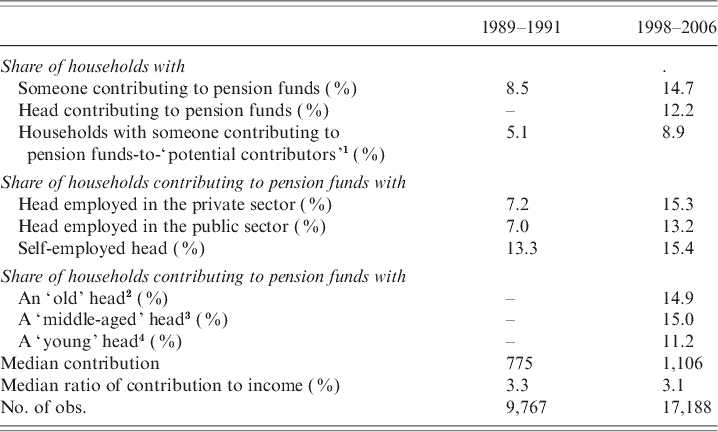
Table 1 reports some statistics on the distribution of private pensions in the pre- and post-reform years. Overall, the percentage of households with someone contributing to a private pension has risen over time and gone from less than 9% to 15% after the reforms. In the post-legislation period, the share of households whose head contributes to a pension fund is just over 12%, which implies that, in around 3% of households, it is someone other than the head that holds a private pension. The table reports also the ratio of households with someone contributing to a private pension to the number of individuals in the survey who work (potential contributors). This ratio has risen from 5% to 9%.
Pension fund contributors

Note: Data are weighted to represent the Italian population in the year of the survey.
1 ‘Potential contributors’ include all household members who are aged between 20 and 60 and are employed.
2 ‘Old’ workers denote those workers who had contributed for 18 years or more to the social security system at the end of 1995.
3 ‘Middle-aged’ workers denote those who had contributed for less than 18 years.
4 ‘Young’ workers denote those who started contributing after the end of 1995.
Median contributions are in euros of year 2004. They are conditional on contributing to pension funds.
Next, we check whether there are differences in the distribution of private pensions depending on the extent of the public pension reduction. The table shows that private pension holding is highest among the self-employed, whose replacement ratio has traditionally been lower than that of payroll workers and has fallen relatively more after the reform. Holdings by public sector workers, whose public pension cut was also substantial, increased substantially after the reform, but remain low compared to the other groups of workers. After the reforms, participation among private sector employees doubled, reaching a level indistinguishable from that of the self-employed. The sharp increase in participation among private sector employees could be due to the provision of ‘closed’ supplementary pension funds promoted by trade unions and sectoral employers’ associations. As mentioned, there are no such funds for public sector employees, with the exception of education employees.
Based on the number of years of contributions to the social security system, we can group workers in three categories: the ‘young’, the ‘middle-aged’, and the ‘old’.Footnote 16 The ‘young’ underwent a larger cut than the ‘middle-aged’ who, in turn, underwent a larger cut than the ‘old’. ‘Young’, ‘middle-aged’, and ‘old’ are not well-defined categories of workers in the pre-reform period as the pension reform was yet to be implemented. Hence, participation rates according to this classification are not reported for the pre-reform years. In the 1998–2006 period, the rates of participation in the market for pension funds among the ‘old’ and the ‘middle-aged’ are higher than among the ‘young’.Footnote 17
At the bottom of the table, we report household median (nominal) contribution and the median contribution-to-income ratio, conditional on investing in pension funds. Median contribution is below the limit for the tax benefit, which was set to about €1,300 per person until 2000 and then raised to about €5,200.Footnote 18 As a ratio of income, contributions have held basically constant over time.
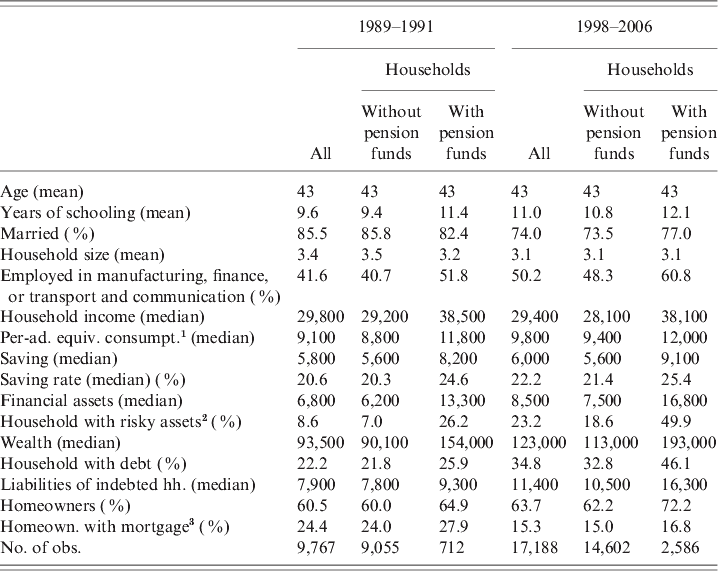
Table 2 presents data on demographic and socioeconomic characteristics of contributors and non-contributors during the pre- and post-legislation periods. The table shows that there are significant differences in income, assets and net wealth between those with and without pension funds. The differences between the two groups are quite stable across the periods. The median contributor earns 30% more income, has twice as many financial assets and almost 70% more wealth than the median non-contributor. This evidence is consistent with the hypothesis that pension funds are a costly instrument, in terms of brokerage and management charges and fees, and only wealthy investors can afford them. Furthermore, it seems that the median pension fund holder has enough financial (liquid) assets to be able to exploit the tax benefits by reallocating some of her wealth into pension funds, without increasing her saving rate, but still maintaining a sizable buffer stock of wealth. The issue is whether she actually does it. The fact that she does not contribute to the limit for tax deferral implies that the pension fund legislation may still provide a marginal incentive to save.
Characteristics of households with and without pension funds

Note: Data are weighted to represent the Italian population in the year of the survey. Real values, in euros of year 2004.
1 Per-adult equivalent consumption is computed using an adult-equivalent scale that attributes weight 1 to the household head, weight 0.8 to the other adults in the household and weight 0.5 to children.
2 Risky assets include investments in stocks and shares, corporate bonds, mutual funds and foreign assets.
3 The information on mortgages is not available in 1989 and 1991. Hence, for 1989–1991 we report the share of homeowners with positive financial liabilities.
Contributors’ saving rate is 20% higher than non-contributors’, which is consistent with both the hypothesis that contributors exhibit a greater propensity to save and with the hypothesis that the fiscal incentives of pension fund contributions have a positive effect on household savings.
Pension fund holders are more likely to own their home and invest more in real estate, despite the fact that housing can be viewed as a substitute for pension funds. In fact, real estate, in excess of owner-occupied housing, is a type of long-term investment and, like pension funds, it is largely illiquid. However, contributors may substitute between pension funds and housing by taking out larger mortgage loans, by not accelerating mortgage repayments or by not trading up into a bigger house. This may be indeed the case as contributors appear to be more likely to hold a mortgage. On the other hand, the greater percentage of indebted households among contributors may be read as evidence that this group has easier access to credit, which makes them more inclined to hold illiquid assets in general.
As a final point, pension fund contributors are more educated in terms of years of schooling. They are also more likely to work in manufacturing, finance or communication, and transport. These are the sectors where more ‘closed’ funds were set up after the reform, and where there were relatively more firms offering their employees supplementary pension schemes before the reform. Besides this, contributors are more likely to hold some relatively complex financial instrument such as stocks, corporate bonds or mutual funds. This is consistent with the hypothesis that it is the more financially educated who take greatest advantage of the tax shield, but it could be simply related to the fact that these households are substantially wealthier than the median household and typically have more diversified portfolios.
5 The empirical evidence
This section reports the estimates of the impact of the 1993–1995 pension fund legislation. In Section 5.1, we present evidence as to whether it generated new saving by increasing contributor saving rate. In Section 5.2, we verify whether households finance pension fund contributions by reallocating their wealth to exploit the fiscal benefits. In Section 5.3, we run the analysis allowing for heterogeneity in the reduction of social security wealth.
5.1 The effect on saving
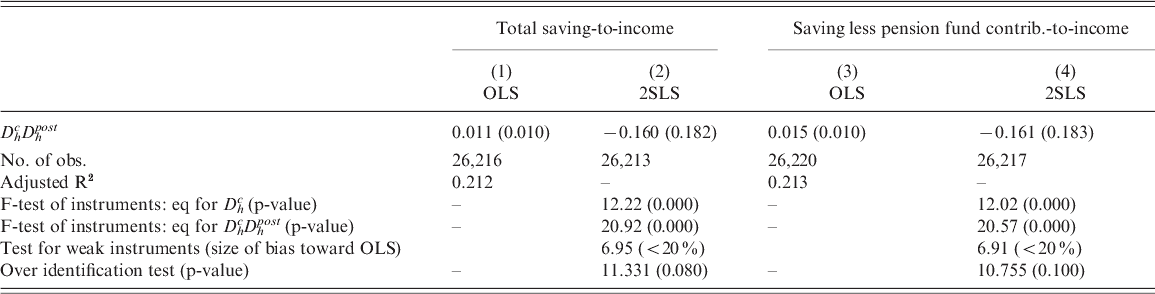
Table 3 reports the estimates of the effect of the pension fund legislation on saving rates based on equation (2). We pool the observations from the surveys run in 1989 and 1991 and those from the surveys run in 1998, 2000, 2002, and 2004 and denote them as ‘pre-reform’ (Dpost h =0) and ‘post-reform’ (Dpost h =1), respectively. Since, from the descriptive analysis, systematic differences between pension fund contributors and non-contributors are apparent for education, marital status, income, home-ownership status, and debt, in our regressions we include all these and some other sociodemographic variables that could influence saving behavior and that are listed in the note to the table. In the first and third columns of the table, we report OLS estimates. In the second and fourth columns, we report two-stage least squares (2SLS) estimates, where we allow for the endogeneity of the contribution decision and for reform-related compositional changes and, thus, instrument Dc h and Dc hDpost h . As explained in Section 3.1, our instruments are based on the sector of employment of the household head.Footnote 19 The sector of employment does not appear to affect the saving rate once we control for income, education and other observable characteristics. In contrast, it is significant and we control for it in the regressions for non-retirement assets (Table 4). Overidentification tests can be used to check whether instruments are inappropriate because they have independent effects on the outcome of interest.
The effect of the pension fund legislation on household saving rate

Note: The right-hand-side control set includes the dummies Dc h and Dpost h , household income, age, education, gender, marital status, household size, number of income recipients, a dummy for children, dummies for public and self-employment, number of years in the labor force, dummies for homeownership and debt, dummies for the area of residence and for municipal size and time dummies for the survey year. The instruments used in 2SLS are a dummy that is equal to 1 if the household head works in manufacturing or finance or transport and communication plus nine dummies for the sector of employment interacted with Dpost h . The sectors are: agriculture; manufacturing; construction; trade; transport and communication; finance; real estate and renting services and other professional or business activities; general government and defense; and, education or health and other services. From the sample, we dropped those households in the top and bottom 1% of the distribution of the left-hand-side variable. Robust standard errors in parentheses.
The effect of the pension fund legislation on non-retirement wealth

Note: Liquid financial assets include checking and saving accounts and Italian government bonds and bills. The left-hand-side variables are in 100,000 of euros. For the regressions in col. (1) and (2), we dropped those households with less than 1,000 euros in liquid assets (10% of the sample); for the regressions in column (3) and (4), we dropped those with zero real assets (30% of the sample); for the regressions in the last two columns we dropped those with no liabilities (70% of the sample). See the note to table 3 for a list of the right-hand-side controls and instruments. As controls, these regressions include also a full set of sector dummies. Robust standard errors in parentheses. * significant at 10%; ** significant at 5%; *** significant at 1%.
Table 3 reports only the estimates of the coefficient of Dc hDpost h , capturing the effect of the policy. The estimates of the coefficients of the other controls included in the regression are not reported for brevity, but are available upon request. In the first two columns of the table, the left-hand-side variable is the ratio of total saving, computed as difference between total household income and expenditure on non-durable goods and services, to income. The OLS estimate of the policy effect, in the first column, is positive, but small and statistically insignificant.
In the second column, we report the results of 2SLS estimation.Footnote 20 The instruments are jointly highly significant (p-value of 0.0000). At 6.95 the weak identification statistics signals that we could have a weak instruments problem such that our estimate is biased toward its OLS counterpart. However, based on Stock and Yogo (Reference Stock, Yogo, Andrews and Stock2005) tabulations of the critical values for weak instrument tests, we can reject the null of a relative bias greater than 20%. The table also reports the Hansen J statistic and its p-value from an over identification test showing that we cannot reject the null that the instruments are uncorrelated with the regression residual with 5% confidence. The 2SLS estimate is negative, but it remains insignificant. Thus, we cannot reject the hypothesis that the reform had no impact on household saving.
In the last two columns of Table 3, we look at non-retirement saving, computed as total saving minus any contribution to pension funds, as a ratio of income. Both the OLS and 2SLS estimates imply that after the reform also contributors’ non-retirement savings did not change. The OLS estimate can be read as evidence that composition changes in the groups of contributors and non-contributors, if any, are not a significant source of bias. In fact, if the legislation had induced less dedicated savers to invest in pension funds, we would record a drop in contributors’ non-retirement saving. Instead, we find that the estimated coefficient is statistically insignificant.Footnote 21
Besides this, since it may take some time for households to respond to the reform and take advantage of the tax saving, we have tried to distinguish between short-term and medium-term impact of the reform. Specifically, we have run two sets of regressions. The first pools the years 1998–2002 (three surveys) and compares these years to 1989–1991; the second pools 2004–2006 (two surveys) and compares them to 1989–1991. The results, which are available upon request, suggest that the reform had a negligible effect on the saving rate both in the short- and in the medium-run. In fact, the OLS and 2SLS estimates of the policy effect are always statistically insignificant.Footnote 22
5.2 The effect on non-retirement assets
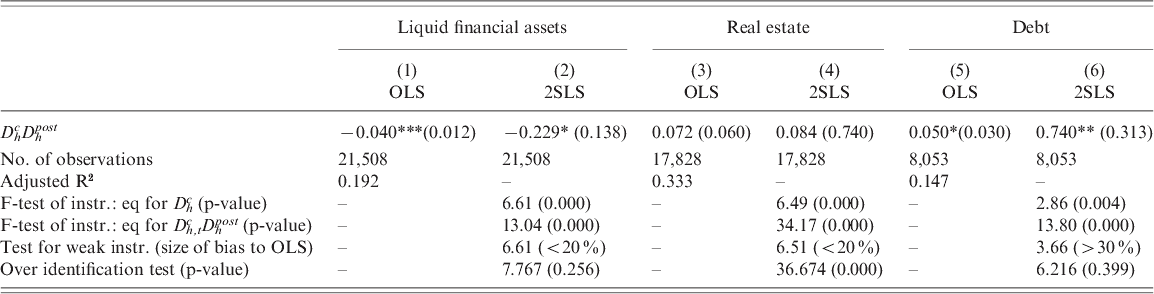
Table 4 reports the results of the estimation of the effect of the policy on various types of non-retirement assets. For these regressions we use only the observations on asset holders, i.e., we drop the zeros.Footnote 23 In general, the 2SLS estimates are similar in sign and significance to the OLS ones, but tend to be larger in magnitude.
In the first two columns, we look at liquid financial assets, which consist of bank accounts and government bonds. We do not consider shares, corporate bonds, and other risky assets because ownership of these assets is not widespread and is higher among pension fund contributors, who are wealthier on average. Hence, stock market fluctuations (aggregate shock) tend to affect contributors’ assets more than non-contributors’, in violation of the assumption of common time effects across groups. The estimated policy effect on bank accounts and government bonds is negative and statistically significant. This suggests that contributors’ liquid assets fell relative to non-contributors’ after the reform was passed, i.e., we cannot rule out that after the reform contributors financed their investment in pension funds by substituting out of some of their liquid wealth. The effect is economically large because in response to the reform contributors appear to have reduced their liquid assets by 15%, which corresponds to 12% of their average total financial wealth.
In the other columns of the table, we verify whether pension wealth shows up as a reduction in other net worth, which appears to be the case for the USA, as illustrated by Engen et al. (Reference Engen, Gale and Scholz1994) and Gale (Reference Gale1998). Examining the substitution between pension funds and housing wealth is motivated by the fact that both are illiquid, tax-preferred assets that are often held for long periods. Since homeownership is widespread, and housing represents a substantial fraction of most households’ wealth, ignoring saving that occurs in housing may severely understate household saving. We also consider the impact on debt because home equity loans, such as mortgages, allow extracting equity from one's home. According to our analysis, over the reform period, the stock of contributors’ real assets did not change, but debt increased significantly, which suggests that some substitution out of real estate is also taking place. Contributors appear to finance part of their investment in pension funds through higher debt. These results are robust to the exclusion of owner-occupied housing from the stock of real estate.
The results from the analysis on non-retirement assets do not change if we scale assets and liabilities by income and use these ratios as left-hand-side variables in the regressions.
5.3 Social security reduction and pension fund contribution
In this section, we allow for the differential impact of the social security reform. First, we analyze the increase in the diffusion of pension funds and compare the most to the least penalized workers. Then, we restrict the sample to the most penalized workers and consider the effect of the pension fund legislation on their saving behavior.
5.3.1 The diffusion of pension funds
Table 5 reports the results of the estimation of the probit in equation (3) for the probability of holding a pension fund. The values in the table are marginal effects and give the change in the probability of holding a pension fund for a discrete change in the dummy variables of interest. In the first/second column, we compare ‘young'/’middle-aged’ workers with ‘old’ workers. In the third/fourth column, we compare public employees/self-employed with private employees.Footnote 24 , Footnote 25 Note that the ‘young’, the ‘middle-aged’ and the ‘old’ are well-defined categories only in the post-pension reform years. To implement our regression model, we need to identify corresponding groups in the pre-reform years. We chose to denote as pre-reform ‘young’ those who report to have worked for 5 years or less in the year of interview,Footnote 26 which corresponds to the median of the distribution of the years of contribution of the ‘young’ in the post-reform sample. We also experiment with 11 years, which is the maximum years of contribution possible in the post-reform period. We denote as pre-reform ‘old’ those who have worked for at least 25 years, which corresponds to the 10th percentile of the distribution for the ‘old’ in the post-reform sample. We also experiment with a threshold of 21 years, which corresponds to the minimum number of years of contribution in the sample. Those who have worked more than 5 years and less than 25 are classified as pre-reform ‘middle-aged’. The thresholds used in the regressions reported in the table ensure that the shares of ‘young’, ‘middle-aged’, and ‘old’ in the pre-reform years are close to the corresponding shares in the post-reform years.
The propensity to contribute to pension funds: a comparison across different groups of workers

Note: The estimates are based on probit regressions and give changes in the probability of holding a pension fund for a discrete change in the dummy variables. See note to table 3 for a list of the right-hand-side variables. Robust standard errors in parentheses. * significant at 10%; ** significant at 5%; *** significant at 1%.
The coefficient on the interaction Dg hDpost h captures the effect of the social security reduction in terms of difference in the diffusion of pension funds between groups of workers who underwent different reductions in social security. This is the variable of interest from a policy perspective. The coefficient on the dummy Dpost h captures the effect of any aggregate shock on the diffusion of pension funds. Dg h controls for unobservable differences in the taste for saving across groups.
From Table 5, the coefficient on the interaction Dg hDpost h is not significant in the regressions ‘young’ vs. ‘old’ and ‘middle-aged’ vs. ‘old’. This suggests that the ‘young’ and ‘middle aged’ have not increased their participation in the market for private pensions more than the ‘old’ despite the larger reduction in their public pension. In contrast, the coefficient on Dg hDpost h is significant in the regressions public vs. private employees and self-employed vs. private employees. These coefficients are negative which implies that after the social security reform private employees increased their holdings of private pensions more than public employees and more than the self-employed, i.e., more than the categories of workers whose public pensions was cut the most. This apparently puzzling result could be rationalized by remembering that, after the social security was reformed, the bulk of newly established private retirement scheme was set up by the social partners acting just in the private sector.
Overall, these results are consistent with the evidence of Bottazzi et al. (Reference Bottazzi, Jappelli and Padula2011) who find that the demand for private pension plans is not related to social security wealth and that, controlling for social security wealth, the most severely hit by the social security reform are not significantly more likely to invest in pension funds.
Table 5 reports also the coefficients of the dummy Dpost h which are always positive, statistically significant and large as expected given the sharp increase in the diffusion of pension funds. Finally, the coefficients on the dummy Dg h imply that ‘young’ workers (first column) are significantly less likely to invest than the ‘old’, whereas there are no significant differences between ‘middle-aged’ (second column) and ‘old’. The difference in participation rates between the ‘young’ and the ‘old’ may be due to liquidity constraints, which the ‘young’ are relatively more likely to be subject to, and to the fact that pension funds are quite illiquid, as they are typically subject to penalties for early withdrawal. Also, the ‘young’ tend to accumulate less long-term financial assets, due to saving for home purchase or mortgage repayments, among other things. In addition, the ‘old’ may be investing more in pension funds because they are wealthier and may be in a better position to incur any fixed cost that a pension fund investment may involve. As to the comparison between the self-employed (last column) and private employees, we find that the former, whose social security benefits have traditionally been relatively low, are more likely to invest in pension funds. In contrast, there are no differences between public (third column) and private employees, all else equal.
5.3.2 Social security reform, saving, and non-retirement asset accumulation
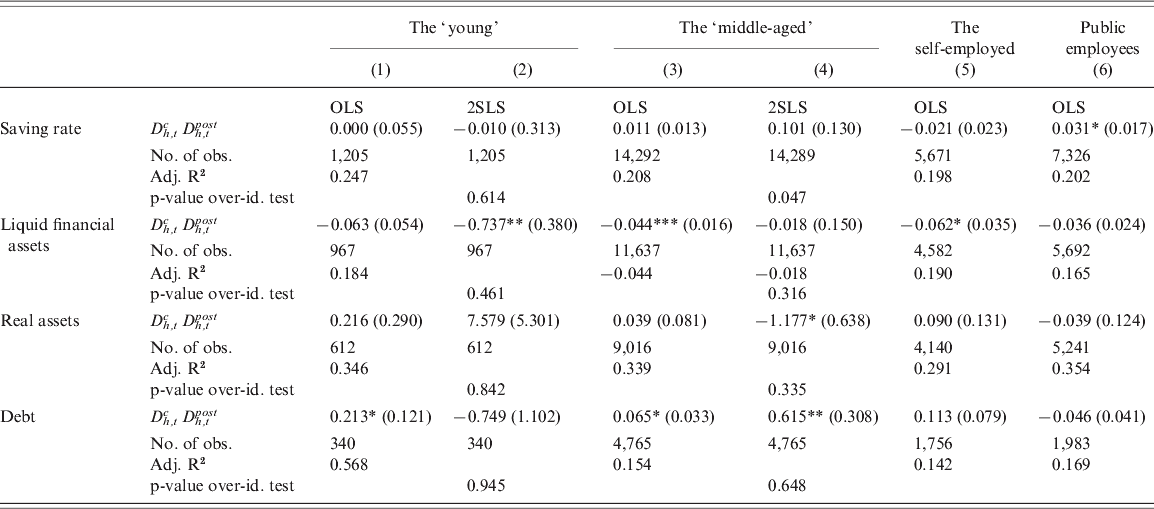
Table 6 reports the results from the estimation of equation (2), where the left-hand-side variable is the household saving rate or non-retirement assets, restricting the sample to groups of workers whose social security wealth fell the most. The sample for the regressions in columns (1) and (2) is restricted to ‘young’ workers, that for columns (3) and (4) to the ‘middle-aged’, that for column (5) to the self-employed and that for column (6) to public employees. The coefficient on the interaction term, Dc h Dpost h , is the parameter of interest. It provides an estimate of the impact of the pension fund legislation on the saving rate (or non-retirement assets) of those pension fund contributors who underwent relatively larger reductions in their public pensions. It tells whether ‘young’ (or ‘middle-aged’, publicly employed, self-employed) pension fund contributors save more than what they would have saved in the absence of the reform, all else equal.
The effect of the pension fund legislation on the saving behavior of the workers whose social security wealth was reduced the most

Note: The sample used in columns (1) and (2) includes only households whose heads are ‘young’; that in columns (3) and (4) those whose heads are ‘middle-aged’; that in column (5) and that in column (6) those whose heads are self-employed and public employees, respectively. The right-hand-side control variables are the same as those for table 3. The instruments used in columns (2) and (4) for 2SLS are the same as those used in table 3. Robust standard errors in parentheses. * significant at 10%; ** significant at 5%; *** significant at 1%.
For the regressions on the samples of ‘young’ and ‘middle-aged’, we report both OLS and 2SLS estimates. As instruments we use the same variables based on the sector of employment that we have used before. These instruments cannot be used in the regressions for public employees because of lack of variation. Also, the rational for using sector-based variables for the self-employed is limited because the provision of closed sectoral pension funds regards employees only. Hence, given the lack of other suitable instruments, for public employees and the self-employed, we report only OLS estimates.
Based on the evidence in Table 6, the ‘young’ and the ‘middle-aged’ have not significantly changed their saving rate to take advantage of tax-favored pension funds. There is some evidence that public employees may have increased their saving, even though OLS estimates could be biased. In contrast, all heavily penalized workers appear to be substituting liquid financial assets with retirement assets in response to the pension fund legislation. The ‘middle-aged’ appear also to be substituting real estate with retirement assets both by reducing their stock of real assets and by delaying mortgage repayments.
6 Concluding remarks and policy implications
In the first half of the 1990s, the Italian social security system underwent a major transformation leading to a substantial reduction in public expenditure for pensions. As a part of the reform, the government issued a set of new rules disciplining the pension fund industry, which improved significantly the risk-return trade off of pension funds. The explicit goal was to increase pension fund investment in order to rise private long-term saving offsetting the public pension reductions. Our objective is to appraise the impact of the pension fund legislation on household saving decisions.
Based on the evidence presented, we cannot reject the hypothesis that the pension fund legislation has not increased household saving rates. One would have expected that the lower risk and cost of pension funds would have had a positive effect on private saving, but generally this appears not to have been the case.
There are several reasons why the saving incentives may have not worked. One possibility is that they are poorly designed. Based on a thorough review of existing academic works on tax incentives and personal saving, Bernheim and Scholz, (Reference Bernheim, Scholz and Poterba1993) claim that the life-cycle hypothesis may have had an excessive influence on the design and conceptualization of empirical investigations concerning taxation and saving. While other behavioral hypotheses are mentioned in the literature with increasing frequency, this usually occurs to explain anomalous results, rather than at the stage of designing an empirical strategy. In part, this is no doubt attributable to the absence of sufficiently well-developed organizing principles for a compelling behavioral alternative. But even so, it is important to be aware of the potential for reaching misleading conclusions by imposing a potentially false structure on the data.
Another reason why saving incentives may have not worked is that households have very low intertemporal elasticities of substitution (Hall, Reference Hall1988). If so, it may prove difficult to raise savings via any voluntary mechanism. Furthermore, people may remain uninformed about the need and opportunities for savings or may have not understood the scope of the benefits enjoyed by pension fund contributions. This would make a clear case for investing public resources in the dissemination of information about future pension rights and about the instruments available to accumulate a suitable level of wealth at retirement.
A final possibility is that saving incentives may eventually raise savings, even if they have not done so, yet. In this instance, the policy implication is to be patient.
Still, it is worth stressing that the pension fund legislation has not been completely ineffective because pension fund contributors do appear to have increased their contributions to pension funds, even though they seem to do so by reallocating some of their wealth from other saving instruments. Specifically, they have substituted liquid assets, in particular government bonds and bills, with pension fund investments and have financed some contributions by borrowing.
Overall, these findings are consistent with the hierarchy of behavioral responses to taxation developed by Slemrod (Reference Slemrod and Slemrod1990) and Auerbach and Slemrod (Reference Auerbach and Slemrod1997). These authors find that at the top of the hierarchy of behavioral response is the effect of taxes on the timing of economic transactions. The classic example is corporate stock sales and the realization of capital gains. The next tier of responses includes financial and accounting choices, such as just the allocation of a given amount of savings to tax-favored vs. other assets. The least responsive category of behavior applies to agents’ real decisions, such as the level of savings.
The effect on the allocation of savings vis à vis no effect on the level of savings raises issues relating to the efficiency and equity of tax-based saving incentives. If the tax incentives do not raise private savings, but just lead to a reallocation of existing savings, a question of costs arises. However, computing the cost to tax-payers is problematic because contributions are not tax-exempt, but will be taxed as income when the supplementary pension is paid out. Essentially, by deducing their contributions, contributors are deferring the tax payment. Hence, the cost to taxpayers depends on the amount contributed, on the contributor's marginal tax rate, on her age, on her retirement age, and on the fiscal treatment of (future) pension income. The latter two factors have undergone several changes over the past 10 years. Also, in a progressive tax system, the benefit of deferring the tax payment is larger for the higher incomes relative to the lower incomes, because their marginal tax rates drop relatively more after retirement, which implies some redistribution to the richer. Apart from these issues that are beyond the scope of this paper, there still may be good reasons to provide access to saving incentives to some groups, such as those with limited pension coverage.
Finally, it is worth stressing that the analysis points toward one factor that could significantly affect the decision to invest in a private retirement plan, which is the provision of ‘closed’ pension funds.