Introduction
Horseweed is consistently ranked as one of the most common and troublesome weeds in soybean (Riar et al. Reference Riar, Norsworthy, Steckel, Stephenson, Eubank and Scott2013; Van Wychen Reference Van Wychen2016). Competition from horseweed causes yield loss (Bruce and Kells Reference Bruce and Kells1990; Byker et al. Reference Byker, Soltani, Robinson, Tardif and Lawton2013) and plants produce many seeds, which can disperse up to 500 km and contribute to emergence in subsequent years (Shields et al. Reference Shields, Dauer, VanGessel and Neumann2006; Tozzi and Van Acker Reference Tozzi and Van Acker2014). Horseweed seeds are small and germinate best at the soil surface (Nandula et al. Reference Nandula, Eubank, Poston, Koger and Reddy2006). Given the prevalence of no-till production in Kentucky, horseweed is especially problematic for Kentucky’s soybean growers (Martin and Green Reference Martin and Green2016). Horseweed can emerge during the fall and throughout the spring (Bolte Reference Bolte2015; Davis and Johnson Reference Davis and Johnson2008; Main et al. Reference Main, Steckel, Hayes and Mueller2006; Regehr and Bazzaz Reference Regehr and Bazzaz1979); in recent years in Kentucky, there has been abundant fall emergence (E. R. Haramoto, unpublished data). Horseweed is best managed when small (Loux and Johnson Reference Loux and Johnson2010; Mellendorf et al. Reference Mellendorf, Young, Matthews and Young2013), which complicates management efforts, because of its extended and often unpredictable emergence pattern.
The first confirmed glyphosate-resistant horseweed was reported in Delaware in 2000 (VanGessel Reference VanGessel2001); in Kentucky, it was reported in 2001 (Heap Reference Heap2019). Horseweed populations resistant to other herbicide modes of action, including the acetolactate synthase inhibitors, photosystem I inhibitors (e.g., paraquat), and photosystem II inhibitors have also been confirmed (Heap Reference Heap2019). Many herbicides are still effective against this species, and chemical control remains a viable option. Saflufenacil is an effective herbicide for control of horseweed (Mellendorf et al. Reference Mellendorf, Young, Matthews and Young2013). This protoporphyrinogen oxidase-inhibiting herbicide is compatible (preplant) with small-grain cover crops like cereal rye (Anonymous 2014) and so can be used in integrated weed management systems. The growth regulators 2,4-D and dicamba are also effective against horseweed; at certain horseweed heights, dicamba was 10% to 20% more effective than 2,4-D at controlling horseweed (Bolte Reference Bolte2015).
Optimal management of weeds with extended emergence, like horseweed, may require two herbicide applications prior to soybean planting (Hasty et al. Reference Hasty, Sprague and Hager2004; Vollmer et al. Reference Vollmer, VanGessel, Johnson and Scott2019). Including soil residual herbicides improves the longevity of control, but when applied in the fall or early before planting, these herbicides do not persist long enough for control of later-emerging species like Palmer amaranth (Amaranthus palmeri S. Watson) and waterhemp [A. tuberculatus (Moq.) J. D. Sauer]. This makes additional applications necessary, and integration of other tactics to reduce horseweed density could help reduce the number of preplant applications needed. In addition, though there are many active ingredients that work effectively against horseweed, using only chemical management techniques could increase the selection pressure for more herbicide resistance. Integrating winter cover crops prior to soybean can help diversify weed management programs and provide other ecosystem services (Blanco-Canqui et al. Reference Blanco-Canqui, Shaver, Lindquist, Shapiro, Elmore, Francis and Hergert2015; Norsworthy et al. Reference Norsworthy, Ward, Shaw, Llewellyn, Nichols, Webster, Bradley, Frisvold, Powles, Burgos, Witt and Barrett2012). Cover crops manage weeds while growing and after termination. While actively growing, cover crops outcompete weeds for resources like light and nutrients (Sarrantonio and Gallandt Reference Sarrantonio and Gallandt2003) and typically result in lower weed density and biomass (Haramoto Reference Haramoto2019; Hayden et al. Reference Hayden, Brainard, Henshaw and Ngouajio2012; Werle et al. Reference Werle, Burr and Blanco-Canqui2017). After termination, small-grain cover crop residues reduce light penetration to the soil surface, provide physical impediment to emerging weed seedlings, and immobilize soil nitrogen (Teasdale and Mohler Reference Teasdale and Mohler2000; Wells et al. Reference Wells, Reberg-Horton, Smith and Grossman2013). The net effect typically is also reduced weed pressure that depends on the amount of biomass produced (Haramoto et al. Reference Haramoto, Sherman and Green2019; Ryan et al. Reference Ryan, Mirsky, Mortensen, Teasdale and Curran2011; Webster et al. Reference Webster, Simmons, Culpepper, Grey, Bridges and Scully2016). Cereal rye is a popular cover crop choice prior to soybean because of its flexible planting date, ability to accumulate large amounts of biomass, and its persistent residue after termination.
Although not all weed species are affected by cover crops and their residues, overwintering cover crops reduced density and/or biomass of both fall-emerging and spring-emerging horseweed cohorts (Brainard et al. Reference Brainard, Bakker, Noyes and Myers2012; Cholette et al. Reference Cholette, Soltani, Hooker, Robinson and Sikkema2018; Martin Reference Martin2013; Wallace et al. Reference Wallace, Curran and Mortensen2019). Cereal rye provided 84% visual control of horseweed soon after corn planting, though did not result in reduced horseweed density or biomass later in the summer relative to no cover crop control or many other cover crops evaluated (Cholette et al. Reference Cholette, Soltani, Hooker, Robinson and Sikkema2018). Cereal rye also reduced horseweed density in the fall, and, after termination, prior to PRE and POST herbicide applications, in soybean (Wallace et al. Reference Wallace, Curran and Mortensen2019). Wallace et al. (Reference Wallace, Curran and Mortensen2019) also found that residue from a cereal rye cover crop as well as from other cover crop species, was associated with smaller horseweed plants and less variability in plant size at the time of preplant soybean herbicide application. Compared with fall residual herbicides, a wheat cover crop reduced spring horseweed density through 1 mo after soybean planting in 1 yr of a 4-yr study (Davis et al. Reference Davis, Gibson, Bauman, Weller and Johnson2007; Davis et al. Reference Davis, Gibson, Bauman, Weller and Johnson2009). Although cover crops can contribute to managing horseweed, they are not as effective as herbicides (Cornelius and Bradley Reference Cornelius and Bradley2017), so combining both may lead to the best control.
The density of horseweed plants present at soybean planting and emergence depends on how many plants are established the previous fall and spring, how many of the fall-established plants survive the winter, and on the success of weed management efforts prior to planting. In Kentucky, peak horseweed emergence typically occurs well before soybean planting (E. R. Haramoto, unpublished data), so management efforts before this time will effectively determine the in-season horseweed population. The development and release of new herbicide-resistant soybean traits have facilitated POST weed control, but reducing the density of weeds before planting remains important for reducing yield loss potential. In addition, reducing the number of weeds that must be killed by POST herbicides reduces the probability of developing resistance to these modes of action (Maxwell et al. Reference Maxwell, Roush and Radosevich1990; Jasieniuk et al. Reference Jasieniuk, Brule-Babel and Morrison1996).
The objective of our study was to evaluate the effects of a fall-planted cover crop, a fall-applied herbicide, and spring-applied herbicides on the density of fall-emerging and spring-emerging cohorts of glyphosate-resistant horseweed through soybean emergence. A fully factorial experiment was used to evaluate each treatment individually, as well as all possible combinations of treatments. This represents a unique contribution to integrated horseweed studies, because we can determine the impact of management treatments with and without inclusion of others, providing useful information for growers seeking to adopt these practices.
Materials and Methods
Site Preparation and Treatment Implementation
Field studies were conducted from fall 2016 to spring 2017 (year 1) and fall 2017 to spring 2018 (year 2) at the University of Kentucky’s C. Oran Little Research Center in Versailles, KY (38.05°N, 84.71°W). Adjacent fields were used in the 2-yr study and each field was maintained in a weedy fallow dominated by horseweed the year prior to use in this study to increase the horseweed seedbank. The horseweed population at this site has a history of poor control (<20%) with Group 9 herbicides (Legleiter and Green Reference Legleiter and Green2019). The soil type was a Bluegrass-Maury silt loam (fine, mixed, active, mesic Typic Paleudalfs). The study was arranged as a split-plot, randomized, complete block design. The cover crop (cereal rye or none) was the main plot factor, and the subplot factor was a fully factorial combination of fall- and spring-applied herbicide treatments. The fall herbicide treatments were with or without saflufenacil, and the spring treatments included 2,4-D, dicamba, or no spring herbicide (Table 1). Each subplot treatment was examined once within each main plot treatment, with each combination replicated six times. Individual plots for each treatment measured 3.1 m × 6.2 m.
Herbicide active ingredients and rates used in this trial.

a Glyphosate was used to terminate the cover crop and winter weeds. Saflufenacil was used as the fall herbicide treatment. 2,4-D ester and dicamba were applied as the spring herbicides.
b 2.5% vol/vol ammonium sulfate was added to the spray solution.
c 1% vol/vol methylated seed oil and 2.5% vol/vol ammonium sulfate were added to the spray solution.
Dates of important field operations are provided in Table 2; Table 1 lists herbicide active ingredient rates, sources, and adjuvants. Cereal rye (‘Aroostook’) was planted with a no-till drill at 19-cm spacing at a seeding rate of 91 kg ha−1 in each fall. Saflufenacil was applied in the fall using a backpack sprayer equipped with TeeJet AIXR 11002 nozzles (TeeJet Technologies, Glendale Heights, IL) at a spray volume of 140 L ha−1. Dicamba and 2,4-D ester were applied the following spring, using the same application methods, spray volume, and nozzles. At the timing of the spring application, the cereal rye was approximately 45 to 50-cm tall and at Feekes growth stages 6 and 7 in 2017 and 2018, respectively. Glyphosate was applied to all plots in late April to terminate the cover crop and winter weeds. Termination occurred when the cover crop was approximately 1-m tall and at the Feekes growth stage 10. Fertilizer was applied according to soil test results (0 to 20 cm), and soybean seed (AG42X6; Asgrow, Creve Coeur, MO) was subsequently drilled on 38-cm rows at a rate of 346,000 seeds ha−1. No additional herbicides were applied at planting so that we could determine the impact of our treatments alone on horseweed density.
Dates of key field operations and data collection.

a Abbreviations: T1, approximately 4 wk after the cover crop planting and fall herbicide application; T2, 3 or 5 wk after the spring herbicide application; T3, 1 or 2 wk after soybean planting.
Data Collection
Before cover crop termination, the aboveground biomass of the cereal rye cover crop and/or winter weeds was sampled in all plots by randomly placing a 0.25-m2 quadrat and clipping all plants within at the soil surface. In cover-cropped plots, each quadrat contained two rows of cereal rye. Two subsamples were collected from each subplot. Biomass was separated into cover crop and weed fractions, dried at 60 C until a constant mass was achieved, then weighed.
Horseweed density was determined in two quadrats per plot. These quadrats were initially placed randomly, then staked so the same area was counted at each density evaluation. The initial quadrat size was 0.085 m2, and quadrats were then expanded to 0.25 m2 as horseweed density declined through the season and in response to treatments. Density was evaluated at three times: approximately 4 wk after the cover crop planting and fall herbicide application (T1), 3 or 5 wk after the spring herbicide application (T2), and 1 or 2 wk after soybean planting (T3).
Statistical Analysis
Before conducting statistical analyses, all horseweed densities were standardized to number m−2. All measurements taken on multiple quadrats within an experimental unit were averaged before analysis. Block was treated as a random factor, and treatment factors were considered fixed effects. All data were analyzed using PROC MIXED in SAS, version 9.4 (SAS Institute Inc., Cary, NC). Data were transformed, if necessary, to meet assumptions of ANOVA; data were also checked for homogeneity of variances and analyzed separately by high- and low-variance groups, if necessary. Transformations and grouping used are noted individually in the ANOVA tables. Effects were considered significant if P < 0.05. Either effects slicing or single degree of freedom contrasts were used to separate significant interactions or main effects; the specific means separation procedure used is given in the text. When significant two-way interactions were separated, the means presented are pooled across all levels of any nonsignificant factors.
Results and Discussion
Weather
The fall and winter of 2016 to 2017 were characterized by temperatures warmer than the 30-yr average; temperatures during the winter and spring of 2017 to 2018 were colder than the 30-yr average (Table 3). Precipitation during the fall and early winter of 2016 to 2017 was far below average, although most months for the remainder of the 2016 to 2017 season were near or above the 30-yr average. The year 2017 to 2018 was also characterized by a dry fall, followed by above average precipitation for the remainder of the season.
Monthly weather conditions at the University of Kentucky’s C. Oran Little research farm in Versailles, KY, during the study periods in 2016–2017 and 2017–2018.a

a Observations were collected from a weather station approximately 1 km from the experimental fields. The 30-yr average weather data are from the Bluegrass Airport, located approximately 5 km from the research farm.
Cover Crop and Winter Weed Biomass
Cover crop biomass was affected by year but not by any of the treatment main effects or interactions (Table 4). Cover crop biomass in 2018 (1,505 kg ha−1) was approximately half of the biomass measured in 2017 (3,140 kg ha−1). Weather conditions over the two winters (Table 3) likely contributed to observed biomass differences. The winter of 2016 to 2017 was relatively mild, leading to ideal cereal rye growing conditions. In contrast, the winter of 2017 to 2018 had below-average temperatures and above-average precipitation, especially in February 2018, which likely reduced the cereal rye growth.
P value results from four-way ANOVA on spring cover crop and winter weed biomass at cover crop termination.a

a Cover crop biomass is provided in the text; winter weed biomass is provided in the text and in Table 5.
b Statistical significance set at P < 0.05.
c Abbreviations: CC, cover crop; FH, fall herbicide; NA, not applicable; SH, spring herbicide.
The winter weed community at the time of cover crop and winter weed termination was dominated by purple deadnettle (Lamium purpureum L.), Carolina geranium (Geranium carolinianum L.), common chickweed [Stellaria media (L.) Vill.], claspleaf pennycress [Microthlaspi perfoliatum (L.) F. K. Mey.], and field pansy (Viola bicolor Pursh); these species formed a majority of the biomass collected prior to termination. Other weeds present to a lesser extent included daisy fleabane [Erigeron annuus (L.) Pers.], henbit (L. amplexicaule L.), common mouse-ear chickweed (Cerastium fontanum Baumg.), and ivyleaf speedwell (Veronica hederifolia L.). Horseweed was also present but formed a minimal portion of weed biomass collected at this time, because it had not yet bolted.
Winter weed biomass at cover crop termination was affected differently by the spring herbicides across the 2 yr as well as by the interaction between cover crop and fall herbicide across the 2 yr (Table 4). In 2017, both 2,4-D and dicamba reduced winter weed biomass relative to no spring herbicide (Table 4); winter weed biomass, pooled over the cover crop and fall herbicide treatments, was 232 and 261 kg ha−1 after treatment with 2,4-D and dicamba, respectively; and 429 kg ha−1 if no spring herbicide was applied—a 43% reduction. Winter weed biomass was not affected by the spring herbicide treatments in 2018 and averaged 174 kg ha−1 across all treatments. Cooler weather in April 2018 (Table 3) may have slowed activity of the spring herbicide; weed biomass sampling occurred just 2 wk after the application. Some species present, like field pansy, were not well controlled by these products, though we expected the majority of the species present in the field to be controlled. In our previous research, we noted this cereal rye cover crop interfered with herbicide deposition (Haramoto et al. Reference Haramoto, Sherman and Green2019). In spring 2017, the year with more cover crop biomass, 2,4-D deposition was reduced and more variable immediately adjacent to cover crop rows relative to areas between the cover crop rows or where no cover crop was present. Because winter weed biomass was not affected by the interaction of the cover crop and spring herbicide treatments, it is unlikely that reduced and more variable spring herbicide deposition resulted in reduced control of these winter weeds in that year.
Separating the significant interaction between the cover crop and fall herbicide across years indicated that both of these treatments were effective in reducing winter weed biomass in each year (Table 5). Pooled over spring herbicide treatments, winter weed biomass after a fall herbicide treatment was reduced by at least 70% without a cover crop and at least 83% with a cover crop (Table 5). Likewise, the cereal rye cover crop consistently reduced winter weed biomass regardless of whether the fall herbicide was applied; winter weed biomass was 90% to 98% lower with a cover crop relative to no cover crop (Table 5). Comparing across years, winter weed biomass was similar in 2017 and 2018 where there was cereal rye, regardless of whether the fall herbicide was applied. However, without cereal rye, winter weed biomass was 43% lower in 2018 relative to 2017, regardless of whether the fall herbicide was applied.
Mean (SE) winter weed biomass at the time of cover crop termination in spring 2017 and 2018 for each combination of fall herbicide and cover crop.a

a Data are averaged over each spring herbicide treatment.
b Abbreviations: CC, cover crop; FH, fall herbicide.
c Statistical significance was set at P < 0.05.
d P values for effects slicing across years.
e P values for effects slicing across different FH or CC treatments.
The cereal rye cover crop reduced winter weed biomass in both years, consistent with other research highlighting similar effects (Baraibar et al. Reference Baraibar, Hunter, Schipanski, Hamilton and Mortensen2018; Haramoto Reference Haramoto2019; Werle et al. Reference Werle, Burr and Blanco-Canqui2017). Similarly, reductions in winter weed biomass after application of a fall herbicide were not surprising. As with cover crop biomass, we also observed lower winter weed biomass after the colder winter of 2017 to 2018 in the absence of a cover crop.
Horseweed Density
We did not explicitly test for year effects on horseweed density nor for differences between sampling times. It is important to note, however, that both the horseweed density and temporal emergence patterns varied across the 2 yr and these likely affected our results. Average density recorded in all treatments (with SEs) is provided in Supplementary Table 1. The first year (2016 to 2017) was characterized by high initial horseweed density and relatively little spring emergence. Horseweed density in untreated plots was 1,093 plants m−2 at T1, decreasing to 172 plants m−2 at T2 and 81 plants m−2 at T3 (Supplementary Table 1). These declines were attributed to competition and overwinter mortality. Some spring emergence was noted between T2 and T3 in treatments without a cover crop and with at least one herbicide applied (discussed later in this section). The second year (2017 to 2018) was characterized by lower fall density, greater overwinter mortality of fall-emerged plants, and more spring emergence before and after the spring herbicide was applied. Only 225 plants m−2 were present in fall 2017, decreasing to 34 plants m−2 by T2, but then increasing to 121 plants m−2 at T3 in untreated plots (Supplementary Table 1). Overwinter mortality was likely greater in this year due to cold and wet soils that led to more frost heaving (E. R. Haramoto, personal observation).
Initial density across the 2 yr, as well as the magnitude of the spring emergence flush, likely reflected differences in the initial horseweed seedbank in the two fields used or environmental and edaphic conditions. Seed rain in Kentucky begins in mid to late August and continues into the fall (E. R. Haramoto, personal observation). Environmental and edaphic conditions favorable for horseweed germination and fall emergence include soil temperatures higher than 12 C and available soil moisture after seed rain (Bolte Reference Bolte2015; Main et al. Reference Main, Steckel, Hayes and Mueller2006; Nandula et al. Reference Nandula, Eubank, Poston, Koger and Reddy2006; Regehr and Bazzaz Reference Regehr and Bazzaz1979); August and September conditions in both years were adequate for seed germination (Table 3). Cold and wet conditions during the winter of 2017 to 2018 (Table 3) likely contributed to greater overwinter mortality of plants that did successfully establish, and delayed emergence of plants in the spring.
Because of the high efficacy of the fall herbicide, we evaluated the main effect of the cover crop separately on subplots with and without the fall herbicide. The fall herbicide resulted in 98% to 100% control of horseweed at T1 (2016 and 2017, respectively; Supplementary Table 1), so we did not evaluate the main effect of the fall herbicide nor the interactive effects with the cover crop. The cereal rye cover crop consistently reduced horseweed density regardless of the fall herbicide treatment (Table 6). Where no fall herbicide was applied, the cereal rye cover crop alone reduced horseweed density by 58% and 45% in 2016 and 2017, respectively (Figure 1). Horseweed density with the cover crop and no fall herbicide, however, remained high—452 and 113 plants m−2 in 2016 and 2017, respectively. The cover crop also reduced horseweed density by 62% to 8 plants m−2 where the fall herbicide was applied in 2016; horseweed density at T1 in 2017 with the fall herbicide ranged from 0 to 1.6 plants m−2 without and with a cover crop, respectively, and was not analyzed, because of low density.
ANOVA results for horseweed density after T1, T2, and T3 in 2016–2017 and 2017–2018.a

a Years were analyzed separately.
b Abbreviations: +, with; −, without; CC, cover crop; FH, fall herbicide; NA, not applicable; SH, spring herbicide; T1, approximately 4 wk after the cover crop planting and fall herbicide application; T2, 3 or 5 wk after the spring herbicide application; T3, 1–2 wk after soybean planting.
c For T1 horseweed density, the main effect of cover crop was examined separately with and without the fall herbicide application.
d For T2 and T3, all main effects and interactions were examined with a three-way ANOVA.
e Statistical significance was set at P < 0.05.
f On November 28, 2017, no horseweed plants were measured in CC + FH, so no analysis was conducted.
The effect of cereal rye cover crop (CC) on average horseweed density (+SE) at T1 (approximately 1 mo after fall herbicide [FH] application) in 2016 and 2017, with and without the FH application. No horseweed remained after the FH application at T1 in 2017. *P < 0.05 in horseweed density between CC and no CC. NA, not applicable.

Density was next evaluated at T2 (3 or 5 wk after the spring herbicide application) and again at T3 (1 or 2 wk after soybean planting). Because horseweed density at these two times was often affected in a similar way by the same interactions (Table 6), we discuss T2 and T3 findings together. For example, spring 2017 horseweed density at both T2 and T3, and at T2 in spring 2018, was affected similarly by the interaction of the spring herbicide with the cover crop. Slicing was used to analyze the significant interactions, as described, so data presented in each of the following sections are averaged over levels of the third factor.
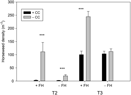
The interaction between cover crop and spring herbicide treatments affected horseweed density in both years at T2 and at T3 in year 1 (Table 6). The effect of the cover crop was first evaluated with effects slicing over different spring herbicide treatments; data were pooled over the fall herbicide treatments for this slicing, so all means presented in this paragraph are averaged over with and without fall herbicide. Without the spring herbicide, horseweed density decreased from 96 plants m−2 without a cover crop to 17 plants m−2 with a cover crop at T2 in 2017 (Figure 2A). At T3 in 2017, density without the spring herbicide decreased from 69 plants m−2 without a cover crop to 4 plants m−2 with the cover crop. A similar effect within the no-spring-herbicide treatment was observed at T2 in 2018, with the cover crop reducing horseweed density to 4 plants m−2 from 153 plants m−2 without a cover crop (Figure 2B). The cover crop also reduced horseweed density at T3 in 2017 and T2 in 2018 where either 2,4-D or dicamba was applied, with both 2,4-D and dicamba resulting in similar reductions in these cases. At T3 in 2017, with either 2,4-D or dicamba applied in the spring, density was decreased from an average of 32 to 7 plants m−2 without and with a cover crop, respectively (Figure 2A). At T2 in 2018, density with either 2,4-D or dicamba plus a cover crop averaged 1.5 plants m−2, and 21 plants m−2 without a cover crop (Figure 2B).
The effect of spring herbicide (SH) application (2,4-D, dicamba, or no SH) and cover crop (CC) on average horseweed density (+SE) either 3 or 5 wk after application (T2) or 1 or 2 wk after soybean planting (T3) in (A) 2017 and (B) 2018. Data are averaged over each fall herbicide treatment. Within each timing and SH treatment (i.e., T2 2,4-D or T2 dicamba), significant CC effects are denoted by *P < 0.05, **P < 0.01, or ***P < 0.001. Within each timing, the SH effect is discussed in the text.

Next, the effect of the spring herbicide treatment was evaluated across the two cover crop treatments, with data again pooled over the fall herbicide treatments. Where there was a cover crop, neither 2,4-D nor dicamba reduced horseweed density relative to no spring herbicide at T2 in both years or T3 in 2017 (compare black bars within an evaluation time in Figure 2; effects slicing P = 0.081, 0.274, and 0.401 for 2017 T2, 2017 T3, and 2018 T2, respectively). Without the cover crop, however, either 2,4-D or dicamba resulted in lower horseweed density compared with no spring herbicide (compare grey bars in Figure 2; effects slicing P < 0.0001 for each), with 2,4-D and dicamba again providing similar levels of control. Without the cover crop, 2017 T2 horseweed density was reduced from 96 plants m−2 without a spring herbicide to an average of 3.5 plants m−2 with either 2,4-D or dicamba (Figure 2A). At T3 in 2017, density without a spring herbicide or cover crop was 69 plants m−2, decreasing to an average of 7 plants m−2 if either 2,4-D or dicamba was also applied. Last, at T2 in 2018, density without a cover crop decreased from 153 plants m−2 to an average of 1.5 plants m−2 without and with a spring herbicide, respectively.
Similar to the cover crop, there was an interaction between the fall and spring herbicide treatments, though different impacts were noted in the 2 yr (Table 6). The fall herbicide treatment was first evaluated within each spring herbicide treatment, with data pooled over cover crop treatments. Similar to the cover crop, the fall herbicide application reduced spring 2017 horseweed density at T2 and T3 if no spring herbicide was applied (Figure 3A). T2 density with no spring herbicide averaged 13 and 93 plants m−2 with and without a fall herbicide, respectively. At T3, density in the no spring herbicide treatment averaged 30 and 44 plants m−2 with and without the fall herbicide, respectively. In some cases, however, the fall herbicide increased horseweed density if a spring herbicide was also used. At T3, the fall application resulted in more horseweed where 2,4-D was applied (25 and 14 plants m−2 with and without the fall herbicide, respectively); a similar trend was noted for dicamba, but significant differences were not detected (Figure 3A). Similarly, at T3 in 2018, the fall herbicide also resulted in greater horseweed densities in some spring herbicide treatments. Density after the dicamba application was 194 and 81 plants m−2 with and without the fall herbicide, respectively (Figure 3B). If no spring herbicide was applied, density was 199 and 124 plants m−2 with and without the fall herbicide, respectively (Figure 3B).
The effect of spring herbicide (SH) application (2,4-D, dicamba, or no SH) and fall herbicide (FH) on average horseweed density (+SE) either 3 or 5 wk after application (T2) or 1 or 2 wk after soybean planting (T3) in (A) 2017 and (B) 2018. Data are averaged over each cover crop treatment. Within each timing and SH combination (i.e., T2 2,4-D or T2 dicamba). *P < 0.05), **P < 0.01), ***P < 0.001 for significant FH effects. Within each timing, the SH effect is discussed in the text.

The spring herbicide treatment effect was next compared within each fall herbicide treatment, with data again pooled over the cover crop levels. Where the fall herbicide was applied, horseweed density was similar across all spring herbicide treatments in 2017 (compare black bars within each time in Figure 3A; effects slicing P = 0.207 and 0.760 for T2 and T3, respectively). Average horseweed density was 7 and 26 plants m−2 in 2017 T2 and T3, respectively, with the fall herbicide. Without the fall herbicide, both 2,4-D and dicamba reduced horseweed density relative to no spring herbicide at T2 and T3 in 2017, respectively (compare grey bars in Figure 3A; P < 0.0001 for both times), with both 2,4-D and dicamba providing similar levels of control. This effect of the spring herbicide was not observed in spring 2018, though differences between spring herbicide treatments were noted both with the fall herbicide (compare black bars in Figure 3B; P = 0.005) and without the fall herbicide (compare grey bars in Figure 3B; P = 0.019). With the fall herbicide treatment, 2,4-D resulted in lower T3 horseweed density (133 plants m−2) relative to the other two spring herbicide treatments (194 and 199 plants m−2 for dicamba and no spring herbicide, respectively). Without the fall herbicide application, dicamba resulted in lower horseweed density—81 plants m−2 for dicamba compared with 111 and 124 plants m−2 for 2,4-D and no spring herbicide, respectively.
Last, T2 and T3 horseweed densities in 2018 were affected by the interaction between the fall herbicide and the cover crop (Table 6). The cover crop effect was first examined within each fall herbicide treatment, with data pooled over the spring herbicide treatments. At T2, the cereal rye cover crop continued to result in lower horseweed density regardless of the fall herbicide treatment; average density where there was a cover crop was only 2 or 3 plants m−2, whereas density without a cover crop was either 19 or 111 plants m−2, both without and with the fall herbicide, respectively (Figure 4). By T3, however, the cereal rye cover crop only reduced horseweed density if the herbicide was applied the previous fall—from 244 to 100 plants m−2 (Figure 4). Looking within each cover crop treatment for differences in fall herbicide treatments showed horseweed density (pooled over all spring herbicide treatments) in the absence of a cereal rye cover crop was greater after the fall herbicide application relative to no fall herbicide (compare grey bars in Figure 4; effects slicing P = 0.001 and <0.0001 for T2 and T3, respectively). Thus, whereas the cover crop reduced horseweed density in spring 2018, density increased to at least 100 plants m−2 by T3 (Figure 4).
The effect of cereal rye cover crop (CC) and fall herbicide (FH) on average horseweed density (±SE) either 5 wk after spring herbicide application (T2) or 1 wk after soybean planting (T3) in 2018. Data are averaged over each spring herbicide treatment. ***P < 0.001.

Our results highlight the potential of a cereal rye cover crop to suppress horseweed during the fall and early spring periods. In the first year of our experiment, when the cereal rye cover crop produced more biomass by termination (>3,000 kg ha−1), this effect was observed while the cover crop was actively growing (at T1 and T2) and the residue continued to suppress horseweed after cover crop termination (at T3). This year (2016 to 2017) was characterized by a high density of fall-emerged plants followed by a modest spring flush that was noted only in plots without the cover crop (Supplementary Table 1). Horseweed density after soybean planting remained relatively low in plots with cover crops (<10 plants m−2; Figure 2A; Supplementary Table 1). This density, however, is likely still sufficient to cause yield loss and would necessitate control at planting (Bruce and Kells Reference Bruce and Kells1990). When cover crop biomass was lower in the second year (2017 to 2018; <1,500 kg ha−1), the cover crop effect was observed while the cover crop was actively growing at T1 and T2 but less suppression was provided by T3. Significant reductions in T3 density from the cover crop only occurred where the fall herbicide was also applied (Figure 4), and resulting densities at T3 (96 and 164 plants m−2 with and without a cover crop, respectively) were much higher than in the first year. The second year was characterized by more spring emergence compared with the first year, and this was observed to some extent in all treatments. The cover crop did reduce density after soybean planting in each year, more so with fall emerged plants and more biomass, yet density was not reduced to an acceptable level and additional control at planting would be necessary.
Residue remaining from less than 2,000 kg ha−1 of cover crop biomass can increase weed emergence in dry conditions by retaining soil moisture (Haramoto and Brainard Reference Haramoto and Brainard2017; Teasdale and Mohler Reference Teasdale and Mohler2000). Our experimental site received adequate precipitation during this period in 2018 (Table 3) and we did not observe low soil moisture conditions so we do not believe this mechanism was in effect. Others have noted that more cover crop biomass results in improved horseweed suppression (Wallace et al. Reference Wallace, Curran and Mortensen2019; Cholette et al. Reference Cholette, Soltani, Hooker, Robinson and Sikkema2018). It is likely that there was not sufficient cover crop biomass to suppress this late horseweed emergence flush (i.e., after soybean planting) in the majority of treatments in 2018.
The fall herbicide effectively controlled horseweed within one month of application in both years (Figure 1), but the effects on spring horseweed density were less consistent (Figure 3). In the first year, when most horseweed emerged in the fall, this application continued to be effective for reducing spring density and applying either 2,4-D or dicamba did not result in additional reductions in density compared to no early spring herbicide (Figure 3A). In other cases, the fall herbicide resulted in greater horseweed density relative to where it was not used. This was observed after planting in spring 2017 (with 2,4-D; Figure 3A) and to a greater extent in 2018 (with dicamba or with no spring herbicide; Figure 3B). Horseweed density with the fall herbicide was almost double that without the fall herbicide in many of these cases. This result could suggest that the fall herbicide, through killing winter weeds, eliminated potential horseweed competitors, increased resource availability, and thus allowed a larger spring flush of horseweed emergence to occur (Davis et al. Reference Davis, Kruger, Young and Johnson2010). The fall herbicide reduced winter weed biomass to 50 g m−2 without a cover crop and negligible biomass with a cover crop by spring 2018 (Table 5). In contrast, winter weed biomass in 2016 to 2017 ranged from 18 to 236 g m−2 with and without a cover crop, respectively. Less winter weed biomass, as well as greater amounts of spring emergence overall, could explain why this effect was stronger in spring 2018 (Figure 3B). It is important to note that the cover crop suppressed some of the spring-emerging horseweed that followed the fall herbicide in spring 2018 (Figure 4), but resulting horseweed density was still high enough to necessitate treatment closer to soybean planting. In cases where the fall herbicide treatment resulted in lower horseweed density (i.e., spring 2017), resulting density was still high enough to necessitate control at planting. Others have noted the need for two applications to manage winter weeds like horseweed prior to soybean (Hasty et al. Reference Hasty, Sprague and Hager2004; Vollmer et al. Reference Vollmer, VanGessel, Johnson and Scott2019), and our results corroborate these findings.
The spring herbicide treatments also had contrasting effects across the 2 yr. In many cases, applying either 2,4-D or dicamba in early spring provided no additional horseweed control relative to the no spring herbicide treatment. This was observed in both years where the cover crop was present (Figure 2), though only for T2 in 2018. Where the fall herbicide was used, this was true only in 2017 (Figure 3). The lack of spring herbicide effect suggests that either fall-emerged plants were controlled by other means (as in 2017, when most emergence occurred in the fall) or that the cover crop was effective in suppressing the spring emergence (as in 2018). Dicamba and 2,4-D were generally similar in their control of horseweed, though different interactions were observed with the fall herbicide for unknown reasons.
Horseweed emergence patterns varied considerably between the 2 yr of this study, as did cover crop biomass, though we detected some consistent treatment effects of our management practices on horseweed density prior to soybean. The cereal rye cover crop effectively reduced horseweed density in the fall and into the following spring. When cereal rye biomass production was greater, the cover crop continued to result in reduced horseweed density 2 wk after soybean planting. However, in the year with less cereal rye biomass and a large flush of spring emergence, horseweed suppression from the cover crop was more short-lived. The fall herbicide also reduced horseweed density, and this effect persisted in most treatments until the early the following spring in1 yr. In both years, this application actually increased horseweed density by soybean planting in some treatments, likely because this fall application removed potential horseweed competitors and increased resource availability. This occurred earlier and to a greater extent in the second year, when the fall application was more effective in controlling winter weeds. Having a cover crop present suppressed this flush of emergence, though unacceptably high horseweed density still resulted. The spring herbicides also reduced horseweed density, though the efficacy of this application varied across years. However, where either cover crops or a fall herbicide were used, this spring application did not result in additional horseweed control in 2017 and across most treatments in 2018. Despite our previous finding that 2,4-D deposition was reduced and more variable immediately adjacent to cover crop rows in spring 2017, when more biomass was produced (Haramoto et al. Reference Haramoto, Sherman and Green2019), there was no indication of reduced control in these treatments, though we did not separate out the overwhelming cover crop effect from any potential reductions in control from reduced deposition.
Overall, both of our herbicide treatments effectively reduced horseweed density, though neither of these provided long-lasting control. The cover crop, and the residue remaining after its termination, better suppressed additional spring horseweed emergence. It is important to note that none of our treatments resulted in adequate control of the glyphosate-resistant horseweed by the time of soybean emergence. Certain treatment combinations, particularly those including cover crops, resulted in the lowest density, though growers would still need to use additional herbicide applications to avoid yield loss and prevent seed production.
Acknowledgements
The financial support provided for this trial by the Kentucky Soybean Promotion Board is much appreciated. The authors thank Matthew Allen and Sara Carter for technical assistance and advice; Eric Roemmele and Ben Goff for statistical analysis advice; and Vinicius dos Santos Cunha, Victoria Stanton, and Ryan Collins for assistance in data collection.
Supplementary material
To view supplementary material for this article, please visit https://doi.org/10.1017/wet.2019.116