INTRODUCTION
Whereas men typically have the 46,XY chromosomal pattern, one in 500 to 1000 boys (Bojesen, Juul, & Gravholt, Reference Bojesen, Juul and Gravholt2003) are born with an extra X chromosome, leading to the 47,XXY chromosomal pattern (referred to as Klinefelter syndrome). Studying the cognitive and behavioral phenotype of such genetically defined syndromes may yield insights into mechanisms of neurodevelopment beyond what is known of behaviorally defined disorders. As the intellectual level of boys and men with Klinefelter syndrome is typically within the normal range, albeit somewhat lower on average in verbal IQ (Boada, Janusz, Hutaff-Lee, & Tartaglia, Reference Boada, Janusz, Hutaff-Lee and Tartaglia2009; Leggett, Jacobs, Nation, Scerif, & Bishop, Reference Leggett, Jacobs, Nation, Scerif and Bishop2010), specific cognitive mechanisms that underlie developmental risk can be identified.
Social functioning lists (high) amongst the reported areas of developmental risk in Klinefelter syndrome. Associated social difficulties include shyness, social withdrawal, social anxiety, difficulties in peer-relationships, social impulsivity, communication difficulties, depressed social adaptive skills, and reduced social assertiveness (Boone et al., Reference Boone, Swerdloff, Miller, Geschwind, Razani, Lee and Paul2001; Geschwind & Dykens, Reference Geschwind and Dykens2004; Ratcliffe, Reference Ratcliffe1999; Ratcliffe, Butler, & Jones, Reference Ratcliffe, Butler and Jones1991; Robinson, Bender, Linden, & Salbenblatt, Reference Robinson, Bender, Linden and Salbenblatt1991; Stewart, Bailey, Netley, & Park, Reference Stewart, Bailey, Netley and Park1991; van Rijn, Swaab, Aleman, & Kahn, Reference van Rijn, Swaab, Aleman and Kahn2008; Visootsak & Graham, Reference Visootsak and Graham2009). The severity of social difficulties in boys with an extra X chromosome is illustrated by reported increased levels of autistic traits. Dimensional measures of autism symptoms, such as the Social Responsiveness Scale (SRS), show that 20–25% (Tartaglia, Cordeiro, Howell, Wilson, & Janusz, Reference Tartaglia, Cordeiro, Howell, Wilson and Janusz2010; van Rijn et al., Reference van Rijn, Stockmann, van Buggenhout, van Ravenswaaij-Arts and Swaab2014) of individuals with 47,XXY score in the moderate to severe range. Also, using the Autism spectrum Quotient (AQ), an effect size (Cohen’s d) of 2.2 for total score was documented for men with 47,XXY as compared to non-clinical controls (van Rijn et al., Reference van Rijn, Swaab, Aleman and Kahn2008). In some cases, autistic traits are substantially elevated and even exceed the clinical threshold. On the Autism Diagnostic Interview Revised (ADI-R), the percentage of children scoring above cut-off on all three domains was 27% in a study of 51 boys (Bruining, Swaab, Kas, & Van Engeland, Reference Bruining, Swaab, Kas and Van Engeland2009) and approximately 20% in a study of 60 girls and boys with an extra X (van Rijn et al., Reference van Rijn, Stockmann, van Buggenhout, van Ravenswaaij-Arts and Swaab2014). Bishop et al. (Reference Bishop, Jacobs, Lachlan, Wellesley, Barnicoat, Boyd and Scerif2011) documented that 2 of nineteen 47,XXY boys (11%) had a diagnosis of autism spectrum disorders (ASD) in their prenatal follow-up sample. Based on clinical screening, Tartaglia et al. (Reference Tartaglia, Cordeiro, Howell, Wilson and Janusz2010) found that 1 of twenty 47,XXY boys (5%) met full criteria for ASD.
This increased vulnerability for autism symptomatology illustrates that social development may be compromised in several individuals with 47,XXY. However, little is known about information processing deficits that may underlie social dysfunction in Klinefelter syndrome, despite the recent rise in interest. This study focusses on face processing, as faces are probably the most important visual stimuli to humans in terms of our social interactions. By adulthood, humans are experts in recognizing and extracting information from faces (Langton, Watt, & Bruce, Reference Langton, Watt and Bruce2000).
Klinefelter syndrome has been associated with an increased risk of difficulties in the identification of emotions of others based on facial expressions (van Rijn, Swaab, Aleman, & Kahn, Reference van Rijn, Swaab, Aleman and Kahn2006) and reduced sensitivity to gaze direction (van 't Wout, van Rijn, Jellema, Kahn, & Aleman, Reference van 't Wout, van Rijn, Jellema, Kahn and Aleman2009). It is unclear, however, to what degree individuals with 47,XXY visually scan faces, in particular the most informative facial features such as the eyes. More so than other facial features, the eyes are central to most aspects of social communication such as identity, familiarity, emotional state, intentions and mental state. This is also illustrated by studies showing that, regardless of facial expression, scanning of the face often starts with the eyes (Schyns, Petro, & Smith, Reference Schyns, Petro and Smith2007; Vinette, Gosselin, & Schyns, Reference Vinette, Gosselin and Schyns2004). A review by Itier and Batty (Reference Itier and Batty2009) demonstrated that of all facial features the eye region is the source of information most used and to which we most attend, independent of gaze direction, head orientation, identity, gender, facial expression, or age.
The documentation of reduced attention to eyes in eyetracking studies on ASD and genetic syndromes such as fragile X syndrome (Farzin, Rivera, & Hessl, Reference Farzin, Rivera and Hessl2009; Papagiannopoulou, Chitty, Hermens, Hickie, & Lagopoulos, Reference Papagiannopoulou, Chitty, Hermens, Hickie and Lagopoulos2014) suggests that we should assess whether reduced gaze fixation on eyes is also found in individuals with 47,XXY. We have recently discovered that individuals with 47,XXY tend to fixate less on the eyes of characters in affective movie clips (van Rijn, Barendse, van Goozen, & Swaab, Reference van Rijn, Barendse, van Goozen and Swaab2014). The aim of this study is to explore more systematically how individuals with 47,XXY scan faces. In pursuit of this, it was assessed whether facial expression scanning deficits are emotion-specific. In other words, do individuals with 47,XXY possess a generalized social attention impairment or is the degree of impairment defined by insensitivity to a specific type of facial expression? We also attempt to evaluate whether facial expression scanning deficits are dependent on the intensity of the expressions, as more pronounced facial expressions might trigger social attention more effectively; indeed, higher intensity emotional expressions have been associated with improved decoding abilities in the past (Hess, Blairy, & Kleck, Reference Hess, Blairy and Kleck1997).
To summarize, individuals with 47,XXY often experience problems with social functioning and are at increased risk for autistic traits. A more thorough investigation of facial processing may help identify the mechanisms driving these social difficulties in individuals with 47,XXY, which may in turn improve both the diagnosis and treatment of social dysfunction in the general population.
METHODS
Participants
A group of 17 adults with 47,XXY (mean age, 37.9 years; SD 12.0) were included in this study, as well as 20 non-clinical controls (mean age, 32.6 years; SD 12.2), with groups overlapping with Van Rijn, Barendse, et al. (2014). Mean age did not significantly differ between groups (t(35)=−1.3; p=.20). The group with 47,XXY may have had ascertainment bias, as participants were all seeking information about their condition (many subjects were recruited from the Dutch Klinefelter support group (NKV) and organized symposia about 47,XXY), or were attending the outpatient clinic at the department of Child and Adolescent Studies at Leiden University. Of the 17 men with 47,XXY, all were Caucasian. Highest education levels include eight community college degrees, eight high school degrees, and one unfinished high school education. All men with 47,XXY were diagnosed non-mosaic 47,XXY, based on standard karyotyping in one of the University Medical Centers in the Netherlands. Aside from seven individuals taking testosterone supplements, none of the remaining subjects with 47,XXY were taking medication. In terms of comorbidity, the Adult Behavior Checklist (ABCL) (Achenbach & Rescorla, Reference Achenbach and Rescorla2003) showed that some of the men scored in the clinical range on various subscales: Anxious/depressed (n=4), Withdrawn/depressed (n=4), Somatic complaints (n=2), Thought problems (n=2), Attention problems (n=3), Aggression (n=3), and Rule braking behavior (n=2). Men with scores in the clinical range were not excluded, as these clinical characteristics are established features of the 47,XXY phenotype and exclusion would have biased the sample.
Control participants were recruited by the researchers, with the help of information brochures that were distributed in public areas outside the university campus. None of the control participants scored in the clinical range on the Adult Behavior Checklist (ABCL) (Achenbach & Rescorla, Reference Achenbach and Rescorla2003). All were Caucasian. Highest education levels included six university degrees, six community college degrees, and eight high school degrees.
Both the clinical group and the control group had participated in a previous study on eyegaze patterns during viewing of complex socio-emotional scenes in relation to psychophysiological responses, which has been published previously (van Rijn, Barendse, et al., Reference van Rijn, Barendse, van Goozen and Swaab2014).
All participants had normal or corrected-to-normal vision. The study was approved by the Ethics Committee of the Leiden University Medical Center. Written informed consent, according to the declaration of Helsinki, was obtained from all participants.
Intellectual Functioning
All participants completed the subtests Block Design (perceptual organization skills) and Vocabulary (verbal skills) of the Dutch adaptation of the WAIS-III (WechslerAdult Intelligence Scales; Wechsler, Reference Wechsler1997, Reference Wechsler2005), that is, V-BD short form. This short form can be used to estimate full scale IQ (FSIQ) according to the algorithm (2.9*(sum of normed scores)+42) (Campbell, Reference Campbell1998). The V-BD short form correlates high with full scale IQ (r =.88) (HerreraGraf, Dipert, & Hinton, Reference HerreraGraf, Dipert and Hinton1996) and the V-BD short form has been found valid for the estimation of intelligence, with good reliability (r=.91) and validity (.82) (Campbell, Reference Campbell1998).
Social Functioning
Social behavior was evaluated using the Scale for Interpersonal Behavior (SIB), a self-report questionnaire. The SIB was only available for the clinical group, as this was collected as part of standard clinical practice. The SIB has been well validated in the general population (United States, France, The Netherlands) as well as in individuals with social phobia, psychiatric outpatients and -inpatients (Arrindell et al., Reference Arrindell, Bridges, van der Ende, St. Lawrence, Gray-Shellberg, Harnish and Sanderman2001; Arrindell, de Groot, & Walburg, Reference Arrindell, de Groot and Walburg1984; Bouvard et al., Reference Bouvard, Arrindell, Guerin, Bouchard, Rion, Ducottet and Cottraux1999). Moreover, it has good psychometric properties, such as high test–retest reliability, good internal consistency and good discriminative validity (Arrindell & Van der Ende, Reference Arrindell and Van der Ende1985). Besides an overall measure of frequency of participation in social interactions and distress during social interactions, there are also four factorially-derived subscales: negative assertion, expression of and dealing with personal limitations, initiating assertiveness, and positive assertion. Besides raw scores, Z scores as compared to norms from the general population can be calculated. Z scores were labeled as being in the normal range (Z<1.5 or Z>−1.5), mild range (1.5<Z<2.0 or −1.5>Z>−2.0) and severe range (Z>2.0 or Z<−2.0).
Stimuli
The stimuli were pictures taken from the facial expressions set of Ekman and Friesen (Ekman & Friesen, Reference Ekman and Friesen1976), which contains gray scale pictures of facial expressions of male and female actors. No background, hair, beards, mustaches, earrings, eyeglasses, or make-up are visible in these pictures. Using Eprime software, 80 pictures of facial expressions were sequentially shown in randomized order, with a 2-s inter-trial interval during which a white screen was presented.
As the aim was to assess whether social attention deficits are emotion specific, several types of expressions were chosen. A maximum of four expressions were selected to keep the test as short as possible for this clinical group: neutral (20 stimuli), happy (20 stimuli), angry (20 stimuli), and scared (20 stimuli). We selected two types of negative emotions to allow assessment of emotion specificity in the context of preferential processing of negative emotions (Öhman, Reference Öhman1993). The facial expressions happy, scared, and angry were shown in four levels of intensity (25%, 50%, 75%, and 100% emotion), which was achieved by blending the respective expressions with their neutral counterparts (0% emotion).
The participants were exposed to each picture for 15 s, after which the four response options were displayed on the screen; the participants could then select the emotion displayed by pressing one of four buttons, each corresponding to a different emotion. The relatively long presentation time was chosen to improve the assessment of eye gaze throughout evaluation of the facial expressions. We anticipated that the 47,XXY group would need more time to evaluate the stimuli, considering the reported difficulties in facial affect identification in individuals with 47,XXY.
Eye Tracking
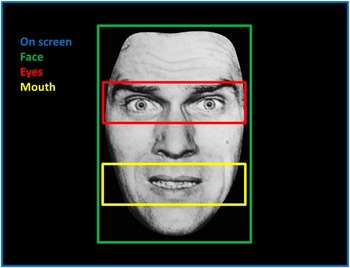
Eye gaze was measured with the Tobii T120 eye tracker (Tobii Technology, Sweden), which records the X and Y coordinates of each participant’s eye position at 120 Hz by using corneal reflection techniques. A 5-point calibration procedure was used, with successful calibration defined as a maximum calibration error of 1 degree for individual calibration points (i.e., <1 cm at a distance of 60 cm from the eyetracker). The pictures of facial expressions were presented in randomized order on an LCD screen 65 cm away from the participant. Eprime 2.0 was used for stimulus presentation (Psychology Software Tools, Pittsburgh, PA). Gaze data were collected using the Eprime Extension for Tobii (http://www.pstnet.com/downloads/ eet/EETVersion6.pdf). The fixation filter defined a fixation as a period in which the eye position did not move more than 50 pixels for at least 200 ms. Only gaze-data points with validity code “0” (indicating that high quality data of both eyes was collected) were included in analysis. Total fixation duration within specific areas of interest (AOIs) was measured. A visual illustration of the AOI regions is presented in Figure 1. Dynamic AOIs were grouped into the following categories: eyes, mouth, face other than mouth or eyes, outside face but on screen.
Visual illustration of the areas of interest (AOIs).

Statistical Analyses
For groupwise (XXY, control) comparisons of fixation duration across AOIs, area and latency of first fixation within the AOIs, type of emotion and intensity of emotion (all having four levels), GLM repeated measures analysis was used, with IQ as a covariate. MANCOVA, with the covariate IQ, was used to assess group differences in accuracy of identifying the facial expressions in the eyetracking task. For correlations between social attention parameters and self-reported social behavior, raw SIB scores were used, with higher scores reflecting better social functioning. For correlational analysis Spearman’s rho was used. Level of significance was set at p <.05.
RESULTS
Intellectual Functioning
Mean IQ was 95.39 (±15.9) in the 47,XXY group and 108.1 (±10.3) in the control group, which was significantly different (F(1,35)=8.5; p=.006).
Social Functioning
Mean Z score for distress during social interactions in the 47,XXY group was 1.4 (±1.5), which was significantly elevated, t(16)=3.5; p=.003 (95% confidence interval: 0.55–2.25). Mean Z score for frequency of social interactions in the 47,XXY group was -0.53 (±0.9), which was significantly reduced t(16)=−2.2, p=.04 (95% confidence interval: −1.05–0.02).
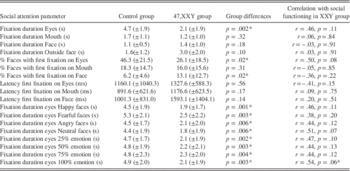
To illustrate, for distress during social interactions 58.8% scored in the normal range, 23.5% in the mild range and 17.6% in the severe range. For frequency of social interactions, 70.6% scored in the normal range, 23.5% in the mild range and 5.9% in the severe range. There were no significant correlations between self-reported social and eyetracking parameters, except for one borderline significant correlation between SIB score and fixation duration toward eyes of 100% intensity expressions. This was in the expected direction, that is, longer fixation durations were associated with better social functioning. See Table 1 for all correlation statistics.
Means and standard deviations for social attention parameters in the 47,XXY group and control group, and correlations between social attention parameters and social functioning within the 47,XXY group

Note. Positive correlations indicate better social attention associated with better social functioning.
*Significant at p<.05 or borderline significant.
(s)=seconds; (ms): milliseconds.
Eyetracking: Attention Toward the Screen
Total valid on-screen fixation duration (averaged across trials) was 9.0 (±1.5) s in the control group and 7.8 (±2.0) s in the 47,XXY group, which was not significantly different (F(1,35)=3.8; p=.06). Excluding men with 47,XXY with a score on ABCL Attention problems in the clinical range (n=3), did not change the significance of any of the eyetracking findings.
Eyetracking of Faces: Areas of Interest
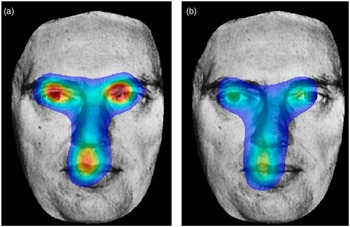
GLM repeated measures analysis with the factors “group” (control, XXY) and “AOI” (eyes, mouth, face other than mouth or eyes, outside face but on screen) indicated a significant main effect of group (F(1,32)=4.5; p=.004) and a significant AOI by group interaction (F(3,30)=4.6; p=.009). There was no main effect of IQ (p=.41) or AOI (p=.41). Post hoc analysis showed significant group differences in total duration fixation on the AIO “eyes” (F(1,34)=42.1; p=.002). The 47,XXY group spent less time fixating on eyes when compared to the control group, with an effect size of 1.4 (Cohen’s d). This appeared to be a specific effect, as other AOIs did not show significant group effects. For average total fixation durations in each AOI, see Table 1. An illustration of eye gaze patterns in both groups is presented in Figure 2.
Heat maps of the control group (a) and XXY group (b) reflecting total fixation duration averaged across all faces, illustrating the group differences in visual fixation on the eyes.

Eyetracking of Faces: Areas of Interest for First Fixation
There were no significant group differences in percentages of valid first fixations; 92.8% in the control group and 89.0% in the 47,XXY group for the AOI “Mouth” (F(1,35)=0.24; p=.62), 64.1% in the control group and 69.4% in the 47,XXY group for the AOI “Face other than mouth or eyes” (F(1,35)=0.17; p=.68), 96.6% in the control group and 91.4% in the 47,XXY group for the AOI “Eyes” (F(1,35)=0.86; p=.36). A substantial number of participants had no data on latency of first fixations due to lack of first fixations in the AOI “Outside face but on screen”. This AOI was, therefore, removed from the analyses of first fixations (areas first fixated on and latency to first fixation).
For areas of first fixation, GLM repeated measures analysis, with the fixed factor “group” (control, XXY) and the “AOI” upon which subjects first fixated (eyes, mouth, face other than mouth or eyes) as dependent variables, there was a significant AOI by group interaction, F(2,33)=6.5; p=.004. There was no main effect of IQ (p=.66) and AOI (p=.51), yet a significant effect for group (p=.04). Post hoc analysis showed significant group differences were present for first fixation on the AIO “eyes” (F(1,34)=5.3; p=.02) and “face other than mouth or eyes” (F(1,34)=5.3; p=.02). The 47,XXY group had less first fixations on “eyes” (i.e., the percentage of faces where they first fixated on the eyes) as compared to the control group, with an effect size of 1.0 (Cohen’s d). In contrast, the 47,XXY group had more first fixations on “face other than mouth or eyes” as compared to the control group, with an effect size of 0.8 (Cohen’s d). For an overview of the average percentage of faces with first fixation in each AIO, see Table 1.
To assess whether the eyes is the first area of fixation as compared to other areas, repeated measure analyses were performed for each group with “AOI” first fixated on (eyes, mouth, face other than mouth or eyes) as dependent variables. Within the control group, there was a significant main multivariate effect of AOI, F(3,17)=59.3, p<.001. Least significant difference (LSD) post hoc comparisons of the AOIs showed that the “eyes” were more often the first area of fixation as compared to the “mouth” (p=.002) and “face other than mouth or eyes” (p<.001). Within the 47,XXY group, there was no significant main multivariate effect of AOI, F(3,14)=2.0, p=.16. In line with this, LSD post hoc comparisons showed no significant differences between first fixations across the AOIs.
With regard to latency of the first fixation, GLM repeated measures analysis with the fixed factor “group” (control, XXY) and “latency” of first fixation in each AOI (eyes, mouth, and face other than mouth or eyes) as dependent variables, showed no significant AOI by group interaction (p=.43), and no significant main effect of IQ (p=.57), AOI (p=.46) or group (p=.06). See Table 1 for means and standard deviations.
Eyetracking of Eyes: Intensity and Type of Emotional Expressions
Two GLM repeated measures analyses, with the fixed factors “group” (control, XXY) and total fixation duration on the eyes for four “types” and four “intensities” of emotional expressions as dependent variables, indicated a significant main effect of group for type F(1,32)=10.6, p=.003 and intensity F(1,32)=10.8, p=.002. In short, when compared to controls, the 47,XXY group spent less time fixating on the eyes irrespective of type or intensity of facial expressions. The two GLM analyses showed no main effects of IQ, type of expression, intensity of expression, and no AOI by group interactions. For average total fixation durations across the four types and intensities of expressions, see Table 1.
With regard to accuracy of identifying emotions, two MANCOVAs, with the fixed factors “group” (control, XXY) and accuracy in identifying the four types and four intensities of emotional expressions, showed no significant main multivariate effects of group or IQ on accuracy in identifying emotions.
DISCUSSION AND CONCLUSIONS
This study focused on social attention, as expressed by the visual scanning of faces, in individuals with 47,XXY. Overall, the 47,XXY group fixated less on the eye regions of faces than the control group, an effect independent of intellectual functioning levels. This effect was large, as the average duration of total fixation on the eyes was 1.4 standard deviations below that of controls. Furthermore, 47,XXY subjects exhibited a significantly lower tendency to initially fixate on the eyes when presented with a face, a difference of 1.0 standard deviation below that of controls. Lower attention to the eye region in 47,XXY individuals during the overall assessment and upon initial exposure occurred despite a similar latency of first fixations across the groups (independent of area of interest), suggesting that there was no speed-accuracy trade off in the 47,XXY group. In other words, the 47,XXY group assessed facial expressions as fast as the control group, but was less consistent in its choice of focal area when presented with a face. As expected, the control group exhibited a preference for initially fixating on the eyes: for 46% of the faces that were shown, the first fixation was more often on the eye region than on other regions of the face. In contrast, within the 47,XXY group there was no detectable inclination to fixate on the eye region first.
Type of emotional expression had no effect on visual scanning in the 47,XXY group, as a reduced fixation on eyes was observed for all types of facial expressions: happy, fearful, angry, and neutral expressions. Similarly, the intensity of the emotional expressions also had no effect on visual scanning the 47,XXY group, with similar gaze avoidance for various intensities of emotional expression. If avoidance of the eye region is a result of the labelling of emotional messages conveyed by a face, then one would expect the degree of avoidance to depend on the intensity and type of expressions, which was not found in this study. Of interest, this tentatively suggests that “avoiding” the eye region is not necessarily a consequence of the labelling of emotional expressions in a social counterpart, but may rather point to a general deficit in attending toward relevant parts of the face. Attentional orientation toward the eyes is considered a rapid and automatic process in the general population (Langton et al., Reference Langton, Watt and Bruce2000), and even obligatorily, considering that information from the eyes of others, such as changes in gaze direction, will trigger rapid, reflexive shifts of an individual’s visual attention, even when they are explicitly asked to ignore such cues and when the gaze direction does not convey relevant information (Langton et al., Reference Langton, Watt and Bruce2000). Indeed, within the control group there was a tendency to first fixate on the eyes when presented with a face. In contrast, this initial shift toward the eyes was not found in the 47,XXY group, suggesting a reduced tendency to rapidly and automatically orient to the eyes of others. Dawson et al. have coined the term social orienting impairment to refer to such a lack of spontaneous orientation toward social stimuli in children with autism (Dawson et al., Reference Dawson, Toth, Abbott, Osterling, Munson, Estes and Liaw2004).
Although individuals with 47,XXY may be at risk for a social orienting deficit, in a previous eyetracking study we found evidence to suggest that avoidance of the eye region in individuals with 47,XXY may be part of an emotion regulation strategy aimed at reducing increased physiological arousal triggered by observing others experiencing emotions (van Rijn, Barendse, et al., Reference van Rijn, Barendse, van Goozen and Swaab2014). This was found for negative emotions such as pain and fear, using dynamic video clips of complex social-emotional scenes. Therefore, it cannot be excluded that reduced orientation toward the eyes of others may arise as an overgeneralization of this emotion regulation strategy, indicating profound impairments in social orienting at different levels.
Chronic inattention to such socially meaningful stimuli may result in limited opportunities to acquire social knowledge in individuals with 47,XXY, as has also been suggested in the field of autism (for example, Grelotti, Gauthier, & Schultz, Reference Grelotti, Gauthier and Schultz2002). Attending to another person’s face allows one to monitor their reactions, to share their experience of objects and events, and to understand their feelings and intentions. A reduced tendency to attend to the eyes of others may result in a reduced state of “preparedness” to pick up on subtle social signs conveyed by the eyes.
Avoidance of the eyes might also have a wide impact on more complex social-cognitive abilities, such as theory of mind, which are thought to build upon such basic social–perceptual information (Hobson, Reference Hobson1993). It would be interesting to evaluate the impact of reduced attention to the eyes of others on more complex social cognitive abilities in individuals with 47,XXY, especially considering the recently reported theory of mind impairments in boys with 47,XXY (van Rijn, Barendse, et al., Reference van Rijn, Barendse, van Goozen and Swaab2014). Although more complex social cognitive abilities were not assessed in this study, the group with 47,XXY did show elevated levels of social dysfunction, in terms of high distress during social interactions and reduced frequency of social interactions. Of interest, there was a borderline significant association between shorter looking times toward eyes of explicit facial expressions and poorer social functioning in the 47,XXY group, with an explained variance of 29%. In addition, there were several correlations between social attention parameters and social behavior, that were of similar strength yet not significant. Although these findings require replication in a larger sample with more statistical power, this tentatively suggests that inattentiveness to faces or avoidance of faces may be mechanisms playing a role in social dysfunction in individuals with 47,XXY. The observation of increased social dysfunction replicates findings of an earlier study with adults with 47,XXY using the same measure of social functioning (van Rijn et al., Reference van Rijn, Swaab, Aleman and Kahn2008). The observed percentage of men with severe social problems (6% for frequency and 23% for distress) corresponds with percentages of up to ∼25% of the individuals with social problems in terms of mild/severe autism traits, as found in other studies (Cordeiro, Tartaglia, Roeltgen, & Ross, Reference Cordeiro, Tartaglia, Roeltgen and Ross2012; Tartaglia et al., Reference Tartaglia, Cordeiro, Howell, Wilson and Janusz2010; van Rijn et al., Reference van Rijn, Stockmann, van Buggenhout, van Ravenswaaij-Arts and Swaab2014). Although speculative, these parallels suggest that the 47,XXY group in this study was characterized by an increased risk for social difficulties to a degree similar to other studies, rather than representing a biased, severely affected subgroup.
Although the current study showed that individuals with 47,XXY were able to correctly label the various emotional expressions, it is important to stress that the task used in this study was not designed to be sensitive to emotion identification deficits. To illustrate, the stimuli had a long presentation time, which was chosen to facilitate assessment of the visual scanning of faces throughout the evaluation process of facial stimuli. The 47,XXY group was expected to need more time to evaluate the stimuli, considering the reported difficulties in facial affect identification. Also, basic emotions rather than complex socio-emotional stimuli were used to reduce task complexity, and the stimuli were static pictures of faces rather than movie clips of dynamic social scenes. Thus, the focus was on the process of visual face scanning, rather than on outcome in terms of emotion identification skills. Limitations of the study also include the lack of social functioning data in the control group and rather small sample sizes; hence, it cannot be excluded that the moderate yet not significant correlations between eyetracking parameters and social functioning are due to the lack of statistical power. Small sample sizes and lack of psychiatric diagnoses prevented us from linking social attention deficits to the risk of clinical diagnosis of autism. It would be particularly interesting to assess this from a developmental perspective in future studies; that is, are social attention abnormalities predictive of social developmental problems, and possibly autism spectrum symptoms? In addressing this issue, it may be important to rely on measures such as eyetracking, as these more specifically relate to quantifiable underlying mechanisms of social dysfunction as opposed to behavioral measures. This is crucial as underlying mechanisms of social dysfunction in 47,XXY and idiopathic ASD may involve shared but also unique deficits, as illustrated in other studies where we for example compared cognitive (van Rijn, Stockmann, van Buggenhout, van Ravenswaaij-Arts, & Swaab, Reference van Rijn, Stockmann, van Buggenhout, van Ravenswaaij-Arts and Swaab2014) and brain functioning (Brandenburg-Goddard, Rijn, Rombouts, Veer, & Swaab, Reference Brandenburg-Goddard, Rijn, Rombouts, Veer and Swaab2014) in boys with 47,XXY and boys with autism.
Future studies should also focus on the role of attentional deficits in contributing to defective social attention, although findings in this study do suggest very selective social attention defects, that is, avoidance of specifically the eye region, rather than a global attentional impairment. Also, total on-screen fixation time was similar between groups, and the exclusion of 47,XXY subjects in the clinical range of Attention problems (from the Adult Behavior Checklist) did not change the significance of any of the findings.
Taken together, the current study has shown reduced attention toward the eyes of others in individuals with 47,XXY, irrespective of type and intensity of emotional expression. Considering the potential impact of eye avoidance on social adaptation, understanding social attention impairments may help identify targets in the diagnosis and treatment of individuals with 47,XXY. Findings in this study indicate that intervention may involve the training of social attention, taking into account the affective arousal response and coping strategies that are used to regulate this arousal. More studies of this nature are needed, preferably those including younger populations so that the opportunity to positively influence social attention and the social skills that build upon it can be evaluated.
Current findings also call for a developmental approach by studying whether there is a predictive value of early deficits in face scanning for developing psychopathology later in development. 47, XXY is a genetic disorder that can be identified even prenatally, so the opportunity exists to study these traits very early in development. In addition to studies of behaviorally defined disorders such as ASD, studies of individuals with an extra X chromosome may prove to be an avenue of research leading to new hypotheses and insights into mechanisms underlying “at risk” pathways to social dysfunction and factors that mediate this risk.
Acknowledgments
I thank Thijs Schrama and Marjolein Barendse at Leiden University for help with the technical aspects of the study. I thank Francien Martin for help with participant recruitment. The author had no conflicts of interest.