Introduction
Second language acquisition research has a well-established tradition of studying cross-linguistic influences (Odlin, Reference Odlin1989, Reference Odlin and Robinson2013). In these investigations, the influence of L1 on L2 has ranked high in importance on the research agenda. Such influence was conceptualized in early L2 scholarship as one of the elements of the developing system of L2 representations, the interlanguage (Selinker, Reference Selinker1972), or as one of the central elements in the description of bilingualism (Mackey, 1967/Reference Mackey and Wei2000). L1 influence on L2 has also been analyzed as an outcome of hypothesis testing by L2 learners (Schachter, Reference Schachter, Gass and Selinker1993), or as resulting from the use of strategic skills for the resolution of communication breakdowns while bilinguals use their weaker languages (Dörnyei & Kormos, Reference Dörnyei and Kormos1998). L1-to-L2 phenomena have fueled discussions about the role of Universal Grammar in L2 acquisition and the L2 user's capacity to reset L1 parameters (White, Reference White2003). In contrast to this rich tradition, it has only been more recently that investigators have turned their attention toward the consequences that acquiring and regularly using an L2 may have on L1 (Cook, Reference Cook and Cook2002; Pavlenko & Jarvis, Reference Pavlenko and Jarvis2002; see Liu, Bates & Li, Reference Liu, Bates and Li1992, for an early exception, which uses the Competition Model framework to compare different patterns of transfer and relate them to language experience and proficiency). The research we present in this paper is aligned with this emerging domain of inquiry on the psycholinguistics of bilingualism, and suggests that experience with L2 triggers non-monolingual-like elements in L1. We use this evidence to formulate a preliminary proposal that such experience may be among the various mechanisms leading to long-term reorganization of the L1 grammar and ultimately a contributor to diachronic language change.
In what follows, we discuss evidence of integration of grammatical representations in bilinguals, by bringing together two separate investigations that tell two sides of the same story and serve to motivate our preliminary proposal. It is beyond the scope of this paper to provide the details in methods and results from the two investigations, which appear in print elsewhere (Fernández & Souza, Reference Fernández, Souza, Heredia, Altarriba and Cieslicka2016; Carando, Reference Carando2015). We focus instead on how their findings, combined, provide suggestive evidence for our preliminary proposal on priming, cross-linguistic interactions, and language change. In both investigations, the contact language is English, and the first language – the one of interest – is Portuguese or Spanish. The first investigation (Study 1, Fernández & Souza, Reference Fernández, Souza, Heredia, Altarriba and Cieslicka2016) is a sentence recall/sentence matching experiment looking at a cross-linguistic difference between English and Portuguese concerning argument structure realization with manner of motion verbs, a contrast which Portuguese–English bilinguals highly fluent in their L2 are not sensitive to. We observe that bilinguals tolerate, in their L1, ungrammatical structures based on counterparts that are grammatical in L2, suggesting that long-term L1 representations can be changed with L2 experience. The second investigation (Study 2, Carando, Reference Carando2015) uses a cross-language priming protocol to examine three constructions, with Spanish–English bilinguals. The constructions are alternations of three types – voice, reciprocal, and dative alternation – which vary in the degree to which each differs between English and Spanish. Cross-language priming is stronger with the structures that are shared between the two languages, a condition that also leads to the production of innovative constructions, modeled on L2 structures that would be judged as ungrammatical in L1.
Bidirectional influences on the bilingual's two steady-state grammars are central to our argument, which draws from broader models of bilingual competence, all cast from holistic views of bilingualism (Grosjean, Reference Grosjean2008, Reference Grosjean2010, Reference Grosjean and Chapelle2013). In their sustained use of two or more languages for everyday communicative needs, bilinguals have experiences that shape specific linguistic and cognitive states. In the multicompetence proposal, Cook (Reference Cook1992, Reference Cook, Brown, Malmkjaer and Williams1996, Reference Cook and Cook2002) points out that bilingualism results in a unique long-term state of linguistic knowledge for both L2 and L1. This view of competence in bilinguals, as different from monolinguals, is also compatible with multiple grammars theory (Amaral & Roeper, Reference Amaral and Roeper2014), which suggests that the language faculty accommodates contradictory linguistic rules. Our proposal that bilingual experience might trigger language change is based on sentence-level structure and formulated using experimental evidence, but this preliminary idea also complements existing proposals from other domains regarding the mechanisms influencing diachronic language change, most significantly from corpus studies in the variationist sociolinguistics and cognitive linguistics traditions (e.g., Otheguy, Zentella & Livert, Reference Otheguy, Zentella and Livert2007; Silva-Corvalán, Reference Silva-Corvalán1994; Torres Cacoullos & Travis, Reference Torres Cacoullos and Travis2015; Doğruöz & Backus, Reference Doğruöz and Backus2009). Another related domain is research on phonological change documenting how unintentional errors and imitations lead to long-term change (e.g., Harrington, Reference Harrington, Cohn, Fougeron and Huffman2012).
Bilinguals as possible agents in language change: experience, convergence, and innovations
Linguistic experience plays a significant role in the human language faculty at all stages of development, and frequency effects are pervasive in the processing of all levels of linguistic organization. Frequency information is derived from both monolingual and bilingual speakers’ experience with the distributional properties of the linguistic input they interact with (Ellis, Reference Ellis2002). Evidence of this comes from studies of phonetic and phonological development, for instance: linguistic experience may produce magnet effects for phonetic perception of infants by six months of age (Kuhl, Williams, Lacerda, Stevens & Lindblom, Reference Kuhl, Williams, Lacerda, Stevens and Lindblom1992); experience with different regional dialects results in better categorization of dialectal variation (Clopper & Pisoni, Reference Clopper and Pisoni2004); and even very short-term exposure to the novel frequency distributions present in foreign accented speech can lead to changes in the accuracy of lexical retrieval (Clarke & Garrett, Reference Clarke and Garrett2004).
Nowhere is the role of experience in language processing more salient than in structural priming. Structural priming is the tendency, apparently unintentional and automatic, to repeat the syntactic pattern of a string of words just read or heard (Bock, Reference Bock1986, Reference Bock1989). Priming has been reported for various constructions and various language combinations, including cross-linguistic structural priming with bilinguals (e.g., Hartsuiker, Pickering & Veltkamp, Reference Hartsuiker, Pickering and Veltkamp2004; Loebell & Bock, Reference Loebell and Bock2003; Schoonbaert, Hartsuiker & Pickering, Reference Schoonbaert, Hartsuiker and Pickering2007). Priming has also been proposed as the trigger for choices of language form not only in language production but also comprehension, on the assumption that speakers seek to accommodate their utterances to what is predictable and therefore more promptly perceived by their audiences (MacDonald, Reference MacDonald2013).
Although primarily a performance phenomenon, priming has also been hypothesized to be a psycholinguistic mechanism behind language change (e.g., Jäger & Rosenbach, Reference Jäger and Rosenbach2008), specifically with regards to the directionality from lexical to functional morphemes generally observed in grammaticalization processes. Jäger and Rosenbach argue that an adult grammar is not fixed after L1 acquisition, but rather remains plastic and malleable, with changes derived from lifelong episodes of language use over which the likelihood of occurrences of a given linguistic unit is a function of prior uses of that unit. That priming underlies language change is a hypothesis supported by evidence suggesting that priming is not an evanescing immediate effect but rather one that may be persistent, cumulative, and possibly linked to implicit learning (Bock & Griffin, Reference Bock and Griffin2000; Branigan, Pickering, Stewart & McLean, Reference Branigan, Pickering, Stewart and McLean2000; Jaeger & Snider, Reference Jaeger and Snider2008; Chang, Reference Chang2008; Hartsuiker & Bernolet, Reference Hartsuiker and Bernolet2015; but see Gries, Reference Gries2005 and Szmrecsanyi, Reference Szmrecsanyi2005). Thus, priming might be an experience-driven cognitive base responsible for long-term language representations. In other words, it may be a mechanism shaping linguistic competence.
The cross-linguistic influences observed in bilingual performance may be relevant for developing a better understanding about the role of bilingualism in diachronic language change (Thomason & Kaufman, Reference Thomason and Kaufman1991). Along these lines, Mufwene (Reference Mufwene2010) suggests that communication needs (driven by variables like sociolinguistic dominance) were triggers for the development of creoles, challenging the more standard view that creole formation is related to grammatical acquisition. Mufwene hints at the hypothesis that multilingualism can be a driving force in language change. We can link this idea to the framework about long-term changes in a bilingual's L1 drawn from the literature on convergence. Convergence is the tendency towards greater structural similarity between the languages of the bilingual: the “search for parallels” (Bullock & Toribio, Reference Bullock and Toribio2004; Myers-Scotton, Reference Myers-Scotton2002; Toribio, Reference Toribio2004). When faced with a choice between alternative structures in the native language, bilinguals tend to prefer the representation that is shared with the contact language. Generalizing further, this “search for parallels” that takes place within bilinguals is plausibly intimately related to the psycholinguistic processes that lead to interactive alignment in dialogue (Pickering & Garrod, Reference Pickering and Garrod2004, who also discuss the implications of their model for monologue), processes thought to be grounded on enhancing communication: interlocutors align their linguistic choices at multiple levels (phonological, syntactic, semantic, lexical) in order to promote mutual intelligibility (Pickering & Garrod, Reference Pickering and Garrod2004; Ferreira & Bock, Reference Ferreira and Bock2006). Such alignment, when manifested as the repetition of recently generated patterns in dialogue (e.g., Schenkein, Reference Schenkein and Butterworth1980; Tannen, Reference Tannen1987, Garrod & Anderson, Reference Garrod and Anderson1987), has been characterized as emerging from priming between interlocutors, happening indiscriminately at lexical or structural levels (e.g., Levelt & Kelter, Reference Levelt and Kelter1982; Branigan et al., Reference Branigan, Pickering, Stewart and McLean2000).
In the investigations we describe below, we measure the extent to which bilinguals establish correspondences between their languages, leading to novel constructions via grammatical replication. These investigations provide preliminary albeit suggestive evidence that bilinguals’ behavior in their first language is affected by their linguistic experience as speakers of more than one language. The novel constructions in L1 that we will argue are triggered by experience with L2 will be described as innovations, borrowing from the historical linguistics literature, to indicate “any element of usage (or grammars) which differs from previous usage (or grammars)” (Andersen, Reference Andersen, Breivik and Jahr1989, p. 13), deeming an utterance “unconventional” in the speech of a given community (Doğruöz & Backus, Reference Doğruöz and Backus2009). Our overall preliminary hypothesis is that some highly language-specific structures – especially structures which may have only been processed at some cost in an earlier stage of a bilingual's language history – may be strong candidates to trigger innovations in the language where they did not originally belong, even when this language remains the bilingual's dominant language.
Both investigations (Study 1 and Study 2) focus on contrasts in the realization of argument structure, a domain of linguistic knowledge that poses special difficulties in second language acquisition (Juffs, Reference Juffs and Archibald2000; Montrul, Reference Montrul2001; White, Reference White2003). Argument realization relies on subcategorization information, which is specified in lexical representations and linked to syntactic structure (Juffs, Reference Juffs and Archibald2000; Levin & Rappaport Hovav, Reference Levin and Rappaport Hovav2005; Randall, Reference Randall2010). Both subcategorization frames and their links to syntax vary abundantly between languages (Levin & Rappaport Hovav, Reference Levin and Rappaport Hovav2005).
Study 1: Manner of motion verbs in English and Portuguese
We begin with an investigation of an alternation that exists in English involving verbs of manner of motion. Agentive verbs of manner of motion in English, such as run and walk, are generally intransitive but a subset of such verbs can participate in a type of causative construction referred to as the induced-motion alternation, including verbs such as run, march, dance, and swim (Levin, Reference Levin1993; Randall, Reference Randall2010); (1) provides illustrations.
-
1.
-
a. The researcher ran the mice through the maze.
-
b. The general marched his soldiers along the street.
-
In the induced-motion alternation, participating manner of motion verbs display transitive syntactic behavior, taking a direct object that is read as agent of the motion event depicted by the verb and having the syntactic subject read as cause of such event.
In Brazilian Portuguese, verbs of manner of motion that are equivalent to verbs participating in the induced-motion alternation in English do not typically permit this alternation, which Cambrussi (Reference Cambrussi2009) attributes to a semantic restriction on the assignment of a trigger of action role to a second argument by primitively unergative verbs in this language. Therefore, speakers of Brazilian Portuguese will normally express induced motion with verbs of manner of motion through periphrastic constructions with light verbs such as fazer (‘make’), which allow for the maintenance of the manner of motion verb in a monoargumental structure, where this argument is read as trigger of the action. Hence sentences like those in (3) are licensed in Brazilian Portuguese, whereas sentences like those in (2) are not.
-
2.
-
a. * A pesquisadora correu os ratos em uma caixa.
[The researcher ran the mice through a box.]
-
b. * O general marchou seus soldados através da rua.
[The general marched his soldiers along the street.]
-
-
3.
-
a. A pesquisadora fez os ratos correr em uma caixa.
[The researcher made the mice run through a box.]
-
b. O general fez os soldados marcharem através da rua.
[The general made the soldiers march along the street.]
-
Behavioral evidence supporting this analysis comes from studies of untimed acceptability judgments (Souza, Reference Souza2011) and speeded acceptability judgments with monolingual speakers of Brazilian Portuguese (Souza, Oliveira, Silva, Penzin & Santos, Reference Souza, Oliveira, Silva, Penzin and Santos2015), which reveal that, in a time window of just 4 seconds, sentences like (2a) and (2b) elicit acceptability judgments significantly lower than those elicited by grammatical sentences. Also, the level of acceptability elicited by such sentences did not differ significantly from the judgments elicited by sentences containing violations of agreement and long-distance dependencies. Portuguese monolinguals quickly detect anomaly in the induced-motion alternation when they encounter it in their language. In contrast, the learnability of the English language induced-motion alternation by Brazilian-Portuguese–English bilinguals with high proficiency in the L2 has been attested in studies based on both non-speeded and speeded acceptability judgment (Souza, Reference Souza2011; Souza, Oliveira, Guimarães & Almeida, Reference Souza, Oliveira, Guimarães and Almeida2014) and self-paced reading tasks (Souza, Reference Souza2012). The results reported in these studies show that L1-Portuguese speakers of English who have achieved high levels of L2 proficiency do attain knowledge that English manner of motion verbs can occur in transitive sentences, and that this knowledge is accessed even within quite narrow time windows.
If induced-motion alternations with verbs of manner of motion are rejected by monolingual speakers of Portuguese, the next logical question is to ask to what extent this “innovation” in Portuguese causes a disruption in processing. In a second experiment, Souza (Reference Souza2012) compared monolingual and bilingual speakers of the two languages, using a between-participants design. Within the bilinguals, proficiency in English (L2) was low or high in two sub-groups of participants; proficiency was determined using the Vocabulary Levels Test (Nation, Reference Nation1990) and self-assessments of proficiency gathered through a language history questionnaire (modeled on Fernández, Reference Fernández2003). Importantly, these were all Portuguese-dominant bilinguals. The task was moving-window self-paced reading, with sentences appearing initially as a sequence of dashes replaced by words with the segmentation shown in (4).
-
4.
-
a. A pesquisadora | correu | os ratos | em uma caixa.
-
b. The researcher | ran | the mice | through a box.
-
The measure of disruption was reading times for the second noun phrase, the object of the verb (os ratos or the mice). A large and stable difference between monolingual speakers of the two languages confirmed the grammaticality of the construction of interest in English (slower reading times) and the ungrammaticality in Portuguese (faster reading times). In addition, low English-proficiency bilinguals behaved like Portuguese monolinguals, with high reading times when reading materials in English. In contrast, high-proficiency bilinguals, who resembled English monolinguals in English (with slower reading times, as expected, given their high proficiency), did not resemble monolinguals of their native language, exhibiting no processing cost associated with the innovative construction in Portuguese (their reading times were similar in the two languages). The bilinguals in this study were all Portuguese-dominant; what distinguished the two groups were differences in the level of proficiency in English. The crucial observation is that, as English proficiency increases, the behavior of these bilinguals in Portuguese reflects a divergence from the expected restrictions of their L1: they have become more tolerant of the innovative construction.
The processor or the grammar?
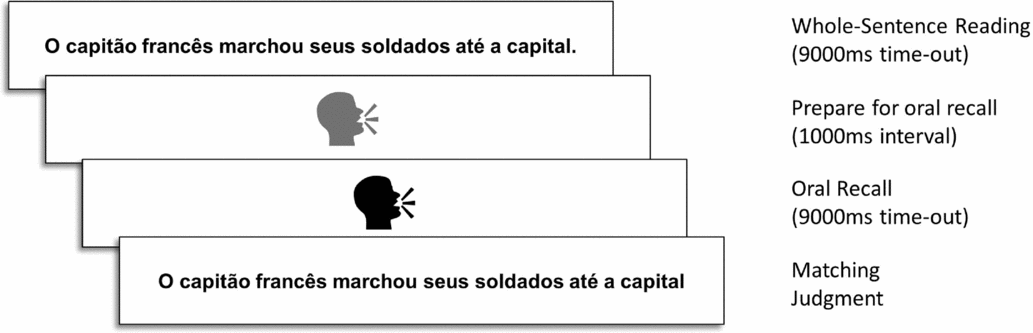
What exactly could be causing this tolerance for constructions that are, for monolinguals, ungrammatical? The tolerance for the induced-motion construction with manner of motion verbs might be related to processing: the system is busy with other things, and fails to notice the ungrammaticality, for instance. If processing is the source, then the effect should not be sustained over temporal windows longer than the few hundred milliseconds required to read a segment in a self-paced reading task. An alternative explanation invokes changes in the L1 grammar, as a function of exposure to English. To see if the reading time patterns reflect processing costs or restrictions imposed by grammatical representations, we conducted a third experiment (Fernández & Souza, Reference Fernández, Souza, Heredia, Altarriba and Cieslicka2016), a sentence recall / sentence matching procedure, to explore to what extent argument structure representations in L1 undergo long-term changes as a result of bilingualism. The task was designed to offer data we could compare to data from the reading time experiment (Souza, Reference Souza2012). The procedure is schematized in Figure 1.
Presentation sequence for sentence recall/sentence matching procedure. Sequenced presentation frames are shown top to bottom, with corresponding measures on the right.

The various measures collected using this procedure included whole-sentence reading times, speech initiation times, and oral recall errors. We assume these reflect the speaker's internal representations, at the level of linguistic competence, for the subcategorization frames of verbs and the corresponding syntactic structures generated from those. No single measure exists to tap such implicit representations directly. Grammaticality judgment tasks can be subject to interference from explicit knowledge (which may or may not correlate with implicit knowledge) and other individual differences among study participants (Schütze, Reference Schütze1996). Our task provided multiple measures that have been traditionally associated with detecting grammaticality (for whole-sentence reading times, see Gass, Reference Gass2001; for speech initiation times, see Ferreira, Reference Ferreira1991, and Tsiamtsouris & Cairns, Reference Tsiamtsouris and Cairns2009; for oral recall errors, see Munnich, Flynn & Marthohardjono, Reference Munnich, Flynn, Martohardjono, Tarone, Gass and Cohen1994).
Each trial began with a sentence displayed centered on a screen, which participants read silently. A button press initiated a presentation sequence indicating that audio was being recorded. Participants then had to perform an oral recall of the sentence they just read. Immediately after the time allotted for recording, a new sentence appeared on the screen, for participants to make a matching judgment, with feedback provided after every trial (see Fernández & Souza, Reference Fernández, Souza, Heredia, Altarriba and Cieslicka2016, for further details on the method.) Presenting the task as a sentence matching task allowed some justification for including materials of questionable grammaticality. Monolingual participants performed the task once, in English; bilinguals completed it twice within the same session, first in Portuguese, later in English, spending 5 minutes between languages playing a language-neutral video game (“Pac-Man”, 2011). Presenting the task first in Portuguese eliminates the possibility of the influence of L2 on L1 being due to priming within the experimental session.
This procedure records multiple measures of processing difficulty, each tapping different temporal windows, none particularly susceptible to online processing difficulties: whole-sentence reading times (time participants took to read the sentence silently on the initial screen), speech initiation times (time participants took to begin uttering the sentence when the recording icon appeared on the second screen), and oral recall errors (the number of words omitted or recalled inaccurately when participants uttered the sentence). We assume that all of these measures reflect ease or difficulty with the projection of internal grammatical representations, rather than ease or difficulty with temporary integration of an element into an ongoing representation, an assumption derived from both how these kinds of measures have been used before (as discussed earlier) and from the materials design (discussed below) which will compare responses to the construction of interest with both grammatical and ungrammatical controls. Two modes of linguistic performance (reading comprehension and oral production) are integrated into a procedure that is intuitive but is nonetheless quite demanding of the participants’ attention to the linguistic stimuli. We present data here only for whole sentence reading times, which are representative of the data patterns found with other measures (speech initiation times and oral recall errors; see Fernández & Souza, Reference Fernández, Souza, Heredia, Altarriba and Cieslicka2016, for the complete report).
The participants for this study were English monolinguals (N = 12, mean age 19 [SD = 2.8]), and Portuguese–English bilinguals with English proficiency that was low (N = 11, mean age 35 [SD = 12.5]) or high (N = 13, mean age 29 [SD = 6.6]). The two groups of bilinguals were L1-Portuguese dominant, having learned English in adolescence or adulthood (mean age of English acquisition: 16 [SD = 7.9] for low-English bilinguals, 10 [SD = 3.7] for high-English bilinguals). Though English was their weaker language, they were all extremely fluent speakers of the language; our labels for participant groups (“low-English” and “high-English”) are shorthand for speakers with lower or higher proficiency in English, respectively. Proficiency was assessed, as in the preceding studies, using a test probing vocabulary size (Nation, Reference Nation1990), the Vocabulary Levels Test (VLT), which places participants on a 5-band scale (Read, Reference Read2000). VLT scores were used to assign participants to groups. The rationale for using VLT, rather than some other independent measure of proficiency, included evidence that vocabulary size is a reliable predictor of overall L2 proficiency (Meara, Reference Meara, Brown, Malmkjær and Williams1996; Zareva, Schwanenflugel & Nikolova, Reference Zareva, Schwanenflugel and Nikolova2005). For low-English bilinguals the lower cut-off was VLT level 3 (an English vocabulary including the 5,000 most frequent words in the language); for high-English bilinguals, the lower cutoff was VLT level 5 (10,000 most frequent words, which include academic/scientific vocabulary). The depth of vocabulary for a VLT level 5 speaker will include combinatorial and subcategorization details in lexical representations, that is, precisely the type of usage information that was at stake in our experiment. Self-assessed proficiency, which was collected using a language history questionnaire, also corresponded to this vocabulary measure. Self-assessments were recorded using a five-point scale with extreme values of 5 (“Very Good”) and 1 (“Very Poor”). The mean was 3.5 (SD = 1.4) for low-English proficiency bilinguals and 4.8 (SD = 0.38) for high-English proficiency bilinguals.
The materials design was somewhat more complex than for the preceding studies conducted by Souza and colleagues (Souza, Reference Souza2011, Reference Souza2012; Souza et al., Reference Souza, Oliveira, Silva, Penzin and Santos2015). Specifically, the target construction (grammatical in English, ungrammatical in Portuguese) would be compared to two kinds of control materials: grammatical and ungrammatical. Induced-motion construction items (5a) were presented alongside sentences with change-of-state verbs that are grammatical in both English and Portuguese (5b), and intransitive verbs presented with direct objects as pseudo-causatives that are ungrammatical in both languages (5c).
-
5.
-
a. IM: induced-motion
* O capitão francês marchou seus soldados até a capital.
The French captain marched the soldiers to the capital.
-
b. CS: change of state
A menina calada esquentou sua sopa na panela.
The hungry girl warmed her soup in a pan.
-
c. PS: pseudo-causatives
* A mulher riu as crianças durante a festa.
* The funny woman laughed the children at the party.
-
Six items in each of these three types were interspersed among fillers created with the lexical content from the target items. Fillers, however, had structures where the verbs appeared as intransitives and were followed by a conjunct (e.g., A mulher criativa riu mas o aluno falava sério, The funny woman laughed but the children's joke was offensive). In addition, half of the materials (change-of-state targets and fillers) were presented as mismatching trials, in which a mismatched word appeared in the frame where participants were asked to make a matching judgment.
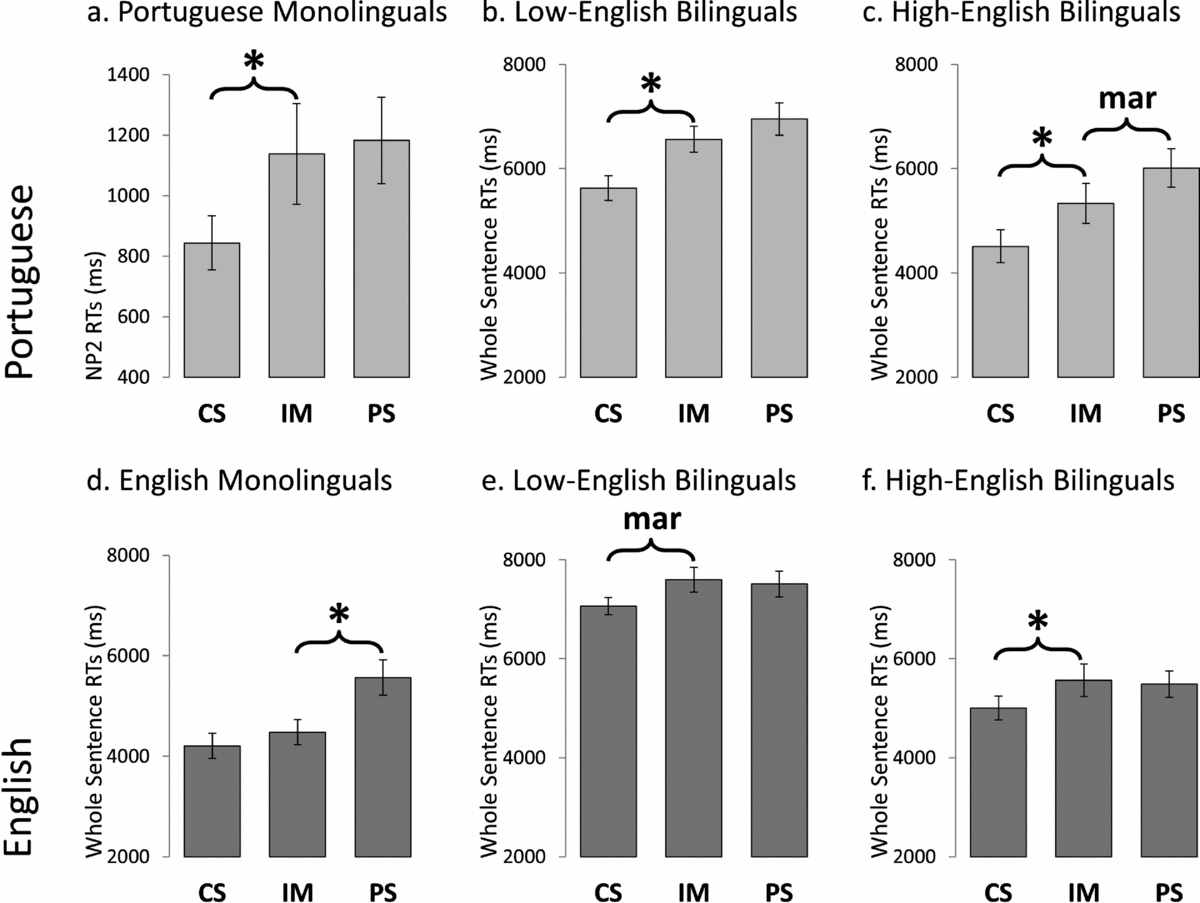
Whole-sentence reading times are provided in Figure 2; paired t-tests for participant- and item-based means were performed to detect simple effects between induced motion materials and the comparison grammatical change-of-state or ungrammatical pseudocausatives. Panel (a) displays data from a self-paced reading experiment with Portuguese monolinguals, using the same materials design (Souza, Fernández & Guimarães, Reference Souza, Fernández and Guimarães2012).
Whole sentence reading times for sentence recall/sentence matching task in Portuguese (top) and English (bottom), for three groups of participants in panels (b)-(f), and for a self-paced reading task with monolingual participants in panel (a). Brackets indicate significance levels of paired comparisons. IM = induced-movement (5a); CS = change-of-state (5b); PS = pseudocausative (5c). (Data from Fernández & Souza, 2016.)

By comparing the two leftmost panels (a) and (d) in Figure 2, we have some evidence about the difference between English and Portuguese. Clearly, the induced motion construction is grammatical in English: induced-motion materials have whole-sentence reading times that differ from grammatical change-of-state materials by an average 271 ms, a difference that is reliable only in the participant-based analysis, t 1(11) = 2.68, p<.05, t 2(10) = 1.46, p>.10; in contrast, induced-motion materials are reliably faster than ungrammatical pseudocausatives by a robust 1084 ms, t 1(11) = 7.63, p<.0001, t 2(10) = 5.67, p<.001. In Portuguese, by comparison, induced-motion materials are ungrammatical: induced motion materials are slower than change-of-state materials, t1 (8) = 2.93, p<.02, t2 (7) = 4.38, p<.005, and do not differ from pseudocausatives, t1<1, t2<1.
In their first language, Portuguese, low-English bilinguals (panel (b)) have the same pattern as their monolingual counterparts: induced motion materials are reliably slower than change-of-state materials, t 1(10) = 4.36, p<.002, t 2(10) = 4.40, p<.002, and do not differ from pseudocausatives, t 1(10) = 1.77, p>.10, t 2(10) = 1.58, p>.10. In contrast, high-English bilinguals’ reading times (panel (c)) suggest a tolerance for induced motion constructions in Portuguese: while induced-motion materials were reliably slower than change-of-state materials, as with other Portuguese speakers, t 1(12) = 5.18, p<.001, t 2(10) = 3.18, p<.01, induced motion materials were reliably faster than ungrammatical pseudocausatives, t 1(12) = 2.53, p<.05, t 2(10) = 2.00, p = 0.074.
The high-proficiency bilinguals seem to have representations of argument structure in their first language that differ from those of monolinguals, data that accords with data about the representation of induced motion in Portuguese–English bilinguals coming from acceptability judgment tasks and self-paced reading tasks (Souza, Reference Souza2011, Reference Souza2012; Souza, Oliveira, Guimarães & Almeida, Reference Souza, Oliveira, Guimarães and Almeida2014). Our data also conform with findings from a recent study of bilinguals by Higby (Reference Higby2016), which used a design quite similar to ours, but a different language combination (Spanish–English) and a different technique (ERP). Higby reports electrophysiological evidence that highly proficient Spanish–English bilinguals show similar patterns with materials instantiating the induced motion construction in Spanish (a language which, like Portuguese, disallows this construction in the monolingual norm) and grammatical controls. Higby argues that this finding reflects that induced motion causatives have been associated implicitly with Spanish verbs – and have not merely been “borrowed”.
In their second language, English, neither bilingual group patterns after its monolingual counterpart. In both groups (see panels (e) and (f) in Figure 2), induced-motion constructions incur higher reading times than change-of-state constructions (low-English bilinguals, t 1(10) = 2.65, p<.05, t 2(10) = 1.94, p = .081; high-English bilinguals, t 1(12) = 2.25, p<.05, t 2(10) = 2.58, p<.05), and do not differ from ungrammatical pseudocausatives (for both low-English and high-English bilinguals, t1<1, t2<1). That high-English bilinguals do not show evidence of tolerating induced-motion in English, their L2, presents a puzzle that we cannot tackle with the data on hand. As mentioned above, there is evidence from studies using both acceptability judgment and self-paced reading measures that attest that high L2 proficiency Brazilian Portuguese–English bilinguals learn the English induced-motion alternations. Recall that the English data were collected in the second half of the same session as the Portuguese data. Certain elements in our procedure were designed to induce a unilingual language mode for the second half of the experiment, including asking participants to play a non-linguistic videogame (“Pac Man”, 2011) for five minutes between the two halves of the experimental session. There is no guarantee that our precautions worked as intended, though, and the display of identical structures in Portuguese followed by English trials may have resulted in the induced motion sentences becoming particularly salient to some of the participants when the English stimuli were presented. Such salience may have led participants to become consciously aware of the contrast between the two languages, thus stimulating explicit metalinguistic deliberation during the task, which in turn may have slowed down the mean overall reading times of the induced motion sentences. Block order effects in bilingual laboratory settings have been reported elsewhere. Misra, Guo, Bobb, and Kroll (Reference Misra, Guo, Bobb and Kroll2012), for example, conducted a picture naming task comparing naming first in L1 or first in L2. Their L1-dominant bilinguals exhibited evidence of inhibition when L2 preceded L1 naming, but facilitation when L1 preceded L2 naming. In another even more relevant investigation, Kootstra and Doedens (Reference Kootstra and Doedens2016) report priming, with Dutch–English bilinguals producing datives, resulting from different types of experience, including cumulative priming within and between experimental blocks. The between-block priming effect was observed from L1 to L2, but not the other way around, in line with other studies that have found that L1-to-L2 priming is stronger and more consistent than L2-to-L1 priming. Our focus for this study was performance in the L1, Portuguese, hence our decision to collect data in Portuguese first, regardless of the consequences for the responses in English in the subsequent experimental block. Additional studies that systematically manipulate task type and block order will shed light on whether there is indeed a gap between tasks that tap into implicit and explicit language representations in the type of innovation we report here, and whether this can be manipulated externally by varying the order of presentation of the bilingual's two languages. Existing evidence (e.g., Misra et al., Reference Misra, Guo, Bobb and Kroll2012; Kootstra & Doedens, Reference Kootstra and Doedens2016) suggests this will be a productive line of investigation.
Summary: Changes in L1 argument structure representations
Our data converge with findings from other investigations in demonstrating that, for argument structure, a bilingual is not simply two monolingual systems within a single person. Representations in L2 can be influenced by L1, as we saw with bilinguals’ performance in English. In addition, representations in L1 can also be influenced by L2, as proficiency in L2 increases. These changes in L1 do not result in compromised overall proficiency in L1, but nevertheless appear to be stable properties of the bilingual's L1 competence. These findings are in accord with empirical data from other research approaches. For instance, Brown and Gullberg (Reference Brown and Gullberg2013), examining Japanese and English clausal packaging in emerging bilinguals in an elicited production task, report bi-directional cross-linguistic influences in the way bilinguals express manner and path of motion. Numerous studies conducted under the framework of the Competition Model (MacWhinney, Reference MacWhinney, Kroll and DeGroot2005) have also documented evidence of L1-to-L2 (“forward”) transfer and L2-to-L1 (“backward”) transfer (among many others, Liu, Bates & Li, Reference Liu, Bates and Li1992; Morett & MacWhinney, Reference Morett and MacWhinney2013).
One of the unresolved questions we will have to probe with future studies is the source for the observed change in argument structure realizations, whose lexical or syntactic status requires empirical clarification (Almeida & Manouilidou, Reference de Almeida, Manouilidou, Almeida and Manouilidou2015). Yet another unresolved question is whether the bidirectional patterns reported here emerge with other more strictly syntactic cross-linguistic differences, such as the expression of subject pronouns in pro-drop and non-pro-drop languages. (The expression of subject pronouns is exactly the focus of Torres Cacoullos and Travis (Reference Torres Cacoullos and Travis2015), who track cross-language priming in a large corpus of Spanish–English bilingual speech.) For now, we turn to one mechanism that might be triggering the change: priming.
Study 2: Priming to innovate
Our second set of evidence on the topic of cross-linguistic influences in bilinguals in their L1 comes from an investigation using laboratory-based priming techniques (Carando, Reference Carando2015). In the context of the theoretical questions we are pursuing, these data offer preliminary answers to a question raised in the previous section about bilinguals’ apparent tolerance of ungrammatical structures in their L1: can the processing advantages reflected in the recorded shorter reading times be induced by immediate exposure to L2? If so, we might be in a position to suggest that priming is a catalyst for language change.
The priming procedure used by Carando (Reference Carando2015) tracks modulations in frequency of L1 constructions in the presence of L2 primes, and documents evidence of grammatical replication or innovations. We describe a priming experiment with targets in Spanish and primes in English (L2) or Spanish (L1). The data were provided by two groups of Spanish–English bilinguals, to permit a comparison between contact and non-contact settings: a group tested in the United States (contact-language setting) and another tested in Argentina (non-contact-language setting).
Three alternations in Spanish and English
The materials included three alternations in English and Spanish: voice, reciprocal, dative. The three types relate differently to each other cross-linguistically, so comparing priming effects between them will allow us to refine the kinds of cross-linguistic conditions that lead to priming. The first two alternations (voice and reciprocal alternations) involve shared structures between English and Spanish; the third alternation (dative alternation) involves mechanisms that operate differently in the two languages. Due to space considerations, we omit much detail regarding additional constraints on these alternations, some linked to lexical preferences encoded in verbs, others driven by prosodic/rhythmic preferences or genre conventions. Our choice to include voice and dative alternations was strongly driven by the fact that they are very common in existing priming studies, providing an empirical frame of reference for our data.
The first alternation, illustrated in (6), the voice alternation (active/passive voice), has been studied extensively (e.g., Bock, Reference Bock1986, Reference Bock1989; Hartsuiker et al., Reference Hartsuiker, Pickering and Veltkamp2004; Loebell & Bock, Reference Loebell and Bock2003):
-
6.
-
a. La bailarina empuja al portero.
El portero es empujado por la bailarina.
-
b. The dancer pushes the janitor.
The janitor is pushed by the dancer.
-
The two alternative forms of the sentences in (6) are reasonably similar in English and Spanish, involving parallel syntax, except for the use of the accusative marker a in the Spanish active construction, applied to direct objects that are [+Human] and [+Specific] (Zagona, Reference Zagona2002, p. 13). One notable cross-linguistic difference is the baseline frequency of passives in each of the two languages. The periphrastic passive, though less frequent than active voice, is used liberally in English, particularly in writing (Roland, Dick & Elman, Reference Roland, Dick and Elman2007). In contrast, passives are extremely rare in Spanish (Gámez, Shimpi, Waterfall & Huttenlocher, Reference Gámez, Shimpi, Waterfall and Huttenlocher2009); the language's repertoire offers se-passives, which emerge as the preferred form to emphasize the patient and downplay the agent (Quesada, Reference Quesada1997).
The second alternation involves reciprocal verbs, whose arguments can appear as a conjoined NP subject, (7a), or as subject and object in a transitive construction, (7b).
-
7.
-
a. La cocinera y el policía se abrazan.
La cocinera abraza al policía.
-
b. The chef and the policeman hug.
The chef hugs the policeman.
-
To our knowledge, the kind of alternation in (7) has not been studied using priming techniques. The two alternative forms are similar in English and Spanish, except that the Spanish version requires a reflexive pronoun (se) in the conjoined NP subject construction.
The third subset of the materials is the dative alternation, illustrated in (8), an alternation that has received substantial attention in priming studies in English (e.g., Arai, van Gompel & Scheepers, Reference Arai, van Gompel and Scheepers2007; Bock & Griffin, Reference Bock and Griffin2000; Bock & Loebell, Reference Bock and Loebell1990; Bock, Reference Bock1986, Reference Bock1989; Gries, Reference Gries2005; Kaschak & Borreggine, Reference Kaschak and Borreggine2008; Loebell & Bock, Reference Loebell and Bock2003; Pickering, Branigan & McLean, Reference Pickering, Branigan and McLean2002; Pickering & Branigan, Reference Pickering and Branigan1998; Potter & Lombardi, Reference Potter and Lombardi1998; Salamoura & Williams, Reference Salamoura and Williams2007; Schoonbaert et al., Reference Schoonbaert, Hartsuiker and Pickering2007). However, Spanish datives have only been used as primes for English targets (Meijer & Fox Tree, Reference Meijer and Fox Tree2003).
-
8.
-
a. La científica le da una maleta al ángel.
La científica le da al ángel una maleta.
-
b. The scientist gives a suitcase to the angel.
The scientist gives the angel a suitcase.
-
The dative alternation involves two rather different alternation mechanisms in English and Spanish. In English, a dative (DO) construction where the indirect object is adjacent to the verb (gave the angel a suitcase) alternates with a prepositional object (PO) construction (gave a book to the dancer). In Spanish, in contrast, the canonical word order where the indirect object follows the direct object (da una maleta al ángel) is scrambled to produce the alternative (da al ángel una maleta). The preposition in both versions of the Spanish alternation functions as a dative marker.
Priming
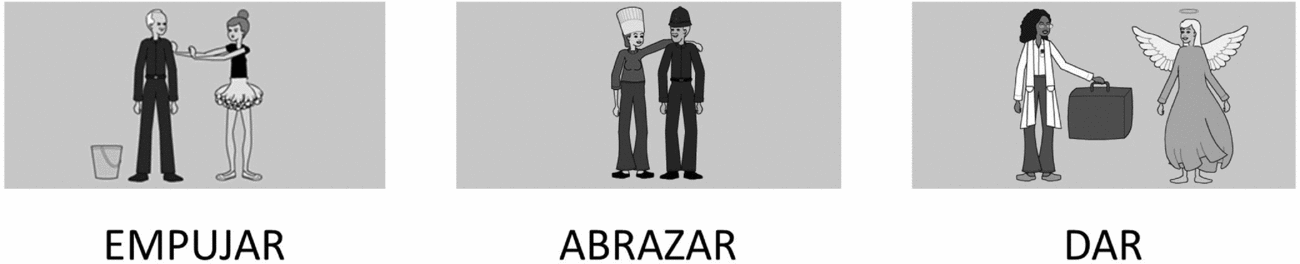
For each of these alternations, we constructed 16 translation-equivalent sentence pairs in Spanish and English and 16 visual displays, illustrated in Figure 3. Each display was preceded by written sentence primes in English or in Spanish.
Sample visual displays used in the picture description and priming procedures. The leftmost display (EMPUJAR, ‘push’) was designed to elicit sentences like (6), instantiations of the voice alternation; the display in the center (ABRAZAR, ‘hug’) for sentences like (7), the reciprocal alternation; the display in the right (DAR, ‘give’) for sentences like (8), the dative alternation. (The images were generated using tools from Pixton Comics, www.pixton.com.)

To get baseline estimates of the frequency preferences for these alternations in Spanish, a group of Spanish–English bilinguals (N = 12) completed a picture description task: they were shown the displays and asked to produce a description in Spanish using the verb provided. In Spanish, actives (89% of the descriptions) were overwhelmingly more frequent than passives (6%) or other constructions (6%) (χ 2(2) = 263.34, p<.001), and canonical datives (78% of the descriptions) were overwhelmingly preferred over non-canonical (scrambled) datives (3%) or other constructions (20%) (χ 2(2) = 177.84, p<.001). Reciprocals with conjoined NPs (53% of the descriptions) were slightly preferred over transitive reciprocals (37%) or other constructions (10%) (χ 2(2) = 54.97, p<.001). Carando (Reference Carando2015) also reports picture description data from monolingual English speakers, documenting that frequency preferences are similar in English for the voice and reciprocal alternations, but not for the dative alternation, where there is no clear preference for PO over DO datives; these frequency preferences map well with existing data for these constructions.
The priming tasks were completed by two maximally different groups of bilinguals, though both highly fluent in both languages: one tested in a contact-language setting (New York City, United States, N = 24) and the other in a non-contact setting (Córdoba, Argentina, N = 24). The bilinguals completed both priming tasks, first a cross-linguistic priming task with English primes, then a within-language priming task with Spanish primes (participants saw one version of the Latin Square design in English, the other in Spanish). This test order applied to all participants, and was chosen to reduce the impact that Spanish primes (if shown first) might have had on participants’ responses with English primes. For each trial, participants saw a prime sentence (in English or in Spanish) and were asked to read it aloud. A button press extinguished the sentence and displayed an image they were to describe using the verb that appeared below the image, which was presented in Spanish, in its infinitival form.
The 24 contact-setting bilinguals (mean age 22 [SD = 5.09], mean age of English acquisition 6 [SD = 4.81]) were English-dominant, living in New York City at the time of testing. A vocabulary test (adapted from Woodcock, Muñoz-Sandoval, McGrew & Mather, Reference Woodcock, Muñoz-Sandoval, McGrew and Mather2007) indicated a Spanish proficiency score of 39%. Additional data collected using a language history questionnaire confirmed their English dominance in self-assessment of proficiency questions (on a six-point scale, where 0 = “very poor” and 5 = “very good”, the mean response for Spanish was 3.78, and 4.43 for English), and determined a clear preference for use of English (mean of 1.38 for 19 questions that asked about usage habits on a six-point scale, where 0 = “always English” and 5 = “always Spanish”).
The 24 non-contact-setting bilinguals (mean age 28 [SD = 4.68], age of English acquisition 10 [SD = 3.91]) were Spanish-dominant, living in Córdoba at the time of testing. Their Spanish vocabulary score was 70%; their self-assessed proficiency confirmed their Spanish dominance (mean of 4.88 for Spanish, and 3.28 for English); and their responses to usage questions reflected their preference for use of Spanish (mean of 3.58 for questions about usage habits).
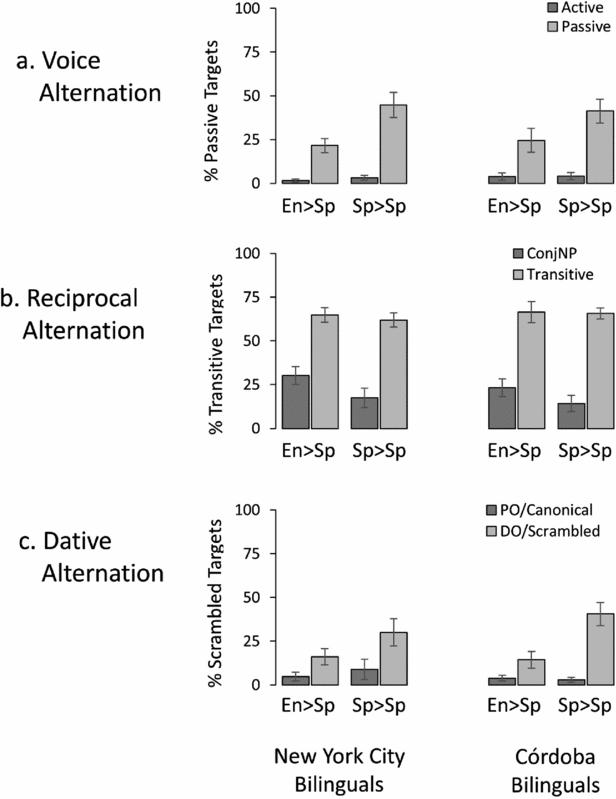
The data from the priming tasks estimate the influence of the form of the prime on the produced target. Figure 4 displays the percent of targets produced as the dispreferred variant of the alternation: passives (for the voice alternation), transitives (for the reciprocal alternation), or scrambled datives (for the dative alternation). Analyses of variance performed on participant- and item-based means used Participant Group (contact, non-contact) as a between-participants/within-items factor and Language of Prime (English or Spanish) and Prime Type (preferred variant or dispreferred variant) as within-participants and -items factors. As the figure indicates, the two groups were remarkably similar (the Participant Group main effect was not significant in any of the analyses (p>.05) and did not engage in any higher order interactions (p>.10)): priming effects patterned the same way for both contact- and non-contact-setting bilinguals. Let us examine those patterns in some more detail.
Percent targets produced as the dispreferred alternate in each alternation variant (voice alternation: passives; reciprocal alternation: transitives; dative alternation: scrambled order) for the English-to-Spanish priming task (En>Sp) and the Spanish-to-Spanish priming task (Sp>Sp), for contact-setting (New York City) and non-contact setting (Córdoba) bilinguals. (Data from Carando, 2015.)

For both participant groups, for the three constructions, and for both English (cross-linguistic) and Spanish (within-language) primes, this procedure elicited reliable priming effects. These effects differed slightly, depending on the alternation and depending on the language of the prime. For the voice alternation (panel (a) in Figure 4), dispreferred passives were overall 29% more likely with passive primes (main effect of Prime Type: F 1(1,46) = 50.70, p<.001, F 2(1,15) = 78.50, p<.001). This effect was approximately twice the size with Spanish primes (39%) than English primes (20%), as confirmed by a significant interaction between Language of Prime and Prime Type (F 1(1,46) = 21.70, p<.001, F 2(1,15) = 28.20, p<.001).
The reciprocal alternation (panel (b) in Figure 4) elicited the largest priming effect, transitives being overall 44% more likely after a transitive prime (main effect of Prime Type: F 1(1,46) = 7.81, p<.01, F 2(1,15) = 14.90, p<.002). The size of the effect is numerically bigger with Spanish primes (48%) than English primes (39%), but with reciprocals the Language of Prime and Prime Type interaction was not significant (F 1(1,46) = 2.24, p>.10, F 2(1,15) = 4.03, p>.05).
The smallest priming effect (still highly significant) was observed with the dative alternation, where scrambled datives were overall 20% more likely with DO or scrambled primes (main effect of Prime Type: F 1(1,46) = 15.50, p<.001, F 2(1,15) = 56.40, p<.001). This effect was accompanied by a robust Language of Prime and Prime Type interaction (F 1(1,46) = 12.90, p<.001, F 2(1,15) = 90.30, p<.001): the priming effect was almost three times the size with Spanish primes (30% difference) than with English primes (11%).
The differences in priming patterns between the three alternation types are plausibly related to differences in the alternations between the two languages. First, the structural dissimilarity between English PO/DO datives and Spanish canonical/scrambled datives could be the reason behind the extremely small priming effect with English primes with datives (small, compared to other priming effects recorded in other conditions for this experiment). This finding is parallel to what has been reported elsewhere regarding a lack of cross-linguistic priming when the structural representations for the two languages are different (Bernolet, Hartsuiker & Pickering, Reference Bernolet, Hartsuiker and Pickering2007; Loebell & Bock, Reference Loebell and Bock2003; Salamoura & Williams, Reference Salamoura and Williams2007). Such findings might on the surface be taken to be at odds with a recent report by Chen, Jia, Wang, Dunlap, and Shin (Reference Chen, Jia, Wang, Dunlap and Shin2013) of cross-linguistic priming when the word order differs between the two languages. Chen and colleagues observed priming effects between English and Chinese, with the voice alternation, which is similar in word order for actives but different for passives: Chinese passives place the agent before the verb. This word order difference does not involve a difference in the hierarchical representation of the constituents: in Chinese passives, the phrase containing the agent is dominated by the verb phrase node, like the English prepositional phrase. In contrast, the Spanish dative alternation involves scrambling of the direct and indirect object, whereas the English dative alternation requires not only movement of the arguments but also the insertion of a preposition for the indirect object to create a prepositional phrase. Our comparison of priming effects across structures is an attempt to determine the conditions that lead to priming: in our data, close similarity in the structures between the two languages (as with the reciprocal alternation) leads to very large priming effects, while less similarity attenuates priming effects.
That the priming effects observed were stronger with Spanish compared to English primes with the voice and dative alternations is consistent with other studies reporting stronger effects with L1 primes and with same-language primes (e.g., Kootstra & Doedens, Reference Kootstra and Doedens2016; Schoonbaert et al., Reference Schoonbaert, Hartsuiker and Pickering2007). Contact-setting bilinguals exhibited priming effects identical to non-contact-setting bilinguals, even though the non-contact bilinguals had more limited regular exposure to English and were Spanish dominant. This corresponds to findings reported elsewhere, including a study of bilingual children by Hsin, Legendre, and Omaki (Reference Hsin, Legendre, Omaki, Baiz, Goldman and Hawkes2013), who argue persuasively that neither language dominance nor cumulative exposure explain the cross-linguistic effects observed in their data. Our design does not discriminate between proficiency and exposure, and yet neither of these provoked differences between the two groups. Other studies have found proficiency to be a determinant of the strength of cross-linguistic priming (e.g., Bernolet, Hartsuiker & Pickering, Reference Bernolet, Hartsuiker and Pickering2013; Hartsuiker & Bernolet, Reference Hartsuiker and Bernolet2015), specifically, more proficient bilinguals are more likely to exhibit cross-linguistic priming, a finding which has been attributed to abstract representations being more advanced or complex with more advanced proficiency (Hartsuiker & Bernolet, Reference Hartsuiker and Bernolet2015). We speculate that both groups of bilinguals in our investigation had sufficiently advanced proficiency to trigger priming effects. To study how proficiency modulates priming effects, future work should build into its design proficiency versus exposure, and consider proficiency in and exposure to both L1 and L2. Advanced proficiency has been identified as a requirement for other bilingual performance phenomena, like code-switching (e.g., Poplack, Reference Poplack1980; MacSwan, Reference MacSwan1999) or translation and interpreting ability (e.g., Angelelli, Reference Angelelli2012): adding to the empirical base on the relationship between proficiency and priming would enrich our understanding of bilingual performance more generally.
Innovations
For the alternations in this study, we expected four possible patterns of innovation. The first, illustrated in (9a), involves the absence of the accusative marker a in active sentences with transitive verbs. (This innovation differs from the others in that it involves a marker associated with a semantic/pragmatic function; Leonetti, Reference Leonetti2004.) The second, (9b), involves the omission of the reflexive pronoun se in reciprocals. The third innovation pattern, (9c), results from the omission of the dative clitic le in scrambled datives. A fourth expected innovation pattern, (9d), results from the omission of the dative marker a in scrambled datives; we failed to find any instances of this innovation pattern, so it will not be reported below. (The symbol Ø marks the linear position for omitted elements.)
-
9.
-
a. La científica saluda Ø la cantante.
[The scientist greets the singer.]
-
b. El turista y la novia Ø abrazaron.
[The tourist and the bride hugged.]
-
c. El portero Ø dio a la enfermera un regalo.
[The janitor gave the nurse a gift.]
-
d. El mesero envió Ø la princesa una carta.
[The waiter sent the princess a letter.]
-
These innovations closely resemble the category of lexico-syntactic calques documented by Silva-Corvalán (Reference Silva-Corvalán1994, Reference Silva-Corvalán, Schwegler, Tranel and Uribe-Etxebarria1998) in the Spanish of Spanish–English bilinguals in Los Angeles. Lexico-syntactic calques sometimes involve changes in verb subcategorization frames and occur (albeit infrequently) only in the English-dominant speakers in Silva-Corvalán's corpus. We differentiate between innovative constructions and loan translations (calques) that happen at the word-, phrase-, or even idiom-level, in that structural innovations like those in (9) are related to syntactic frames and are therefore generalizable beyond the specific lexical items used here, while strictly lexical loan translations are linked to specific meanings. For example, loan translations represent new forms to perform communicative functions (e.g., Spanish has no word for Thanksgiving, hence the loan translation día de dar gracias, ‘day of giving thanks’; Otheguy, Reference Otheguy, Contini-Morava and Goldberg1995). Omitting an accusative marker or a reflexive pronoun or a clitic has no such communicative impact.
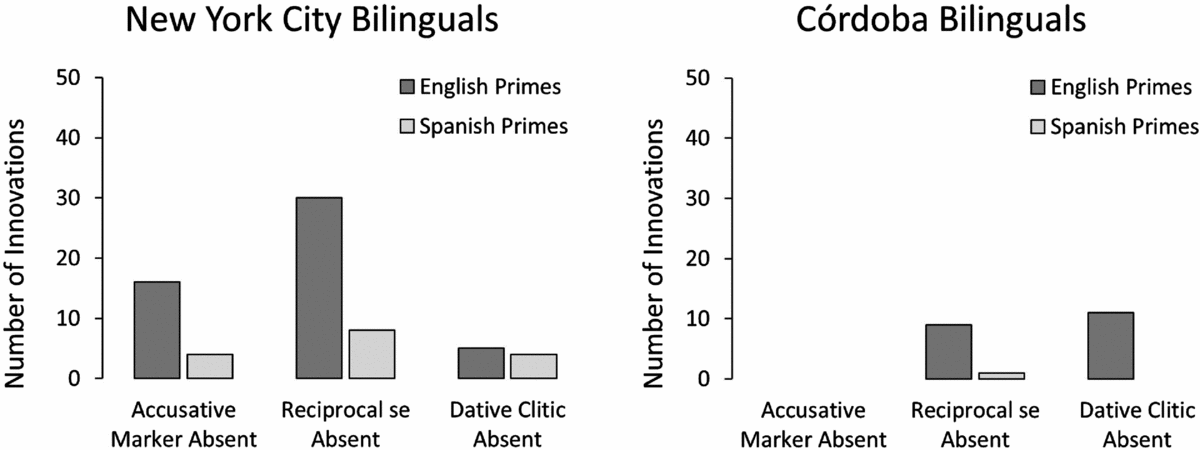
Figure 5 displays the number of innovations produced by each participant group, for targets produced in the presence of English or Spanish primes. Contact bilinguals produced over three times as many innovations as did non-contact bilinguals, though for both groups the overall innovation rate was extremely low (contact group: 2.9%; non-contact group: 0.9%). Chi-square analyses were used to determine whether the distribution of innovative and non-innovative targets differed for English versus Spanish primes, for each innovation type and participant group separately.
Total number of innovations produced by contact-setting (New York City) and non-contact setting (Córdoba) bilinguals for each of three innovation categories, in the context of English or Spanish primes. (Data from Carando, 2015.)

Non-contact bilinguals did not produce any targets with missing accusative markers; contact bilinguals did, and approximately four times as many in the presence of English primes (χ 2(1) = 12.26, p<.01). Non-contact bilinguals produced very few reciprocals with a missing se marker, though almost all of these were produced in the presence of English primes (χ 2(1) = 11.16, p<.02). Reciprocals with a missing se were the most frequent innovative construction for contact bilinguals, and the overwhelming majority of these were produced in the presence of English primes (χ 2(1) = 19.17, p<.001). Lastly, non-contact bilinguals produced datives with a missing clitic only in the presence of English primes (χ 2(1) = 16.65, p<.001), while contact bilinguals produced clitic-free datives at equal rates with English and Spanish primes (χ 2(1) = 1.27, p>.50).
The very low rates of innovations compel cautious interpretation of these data. Still, the patterns are suggestive: innovations are driven not only by the presence of English, but also by the absence of an alternative Spanish model. Non-contact bilinguals only produced innovations in the English primes task. Contact bilinguals produced innovations much more frequently in the English primes task, with the exception of datives, where the dative clitic was hardly ever omitted. We could speculate that the structural differences between Spanish and English datives apply here too (innovations were less likely with datives for the contact bilinguals, whose English is more robust and therefore includes representations for the English dative alternation that differ from their representations for the Spanish dative alternation), but the data are too sparse to warrant any further comment.
The innovations data suggest constraints as to what can be primed: having a model in English is not sufficient; it is also necessary to have a similar structure available in Spanish, since structures that are highly dispreferred in one language are not likely to be affected by priming (Bernolet et al., Reference Bernolet, Hartsuiker and Pickering2007; Loebell & Bock, Reference Loebell and Bock2003). A similar structure in Spanish is indeed available for the most frequent innovation, type (9b). In the presence of English primes, omission of the reflexive se with conjoined NP reciprocals occurs at a mean rate of 7.8% for contact bilinguals with English primes (compared to 2.1% with Spanish primes.) Spanish offers plenty of non-se reciprocal verbs, including discutir (‘argue’), conversar (‘converse’), competir (‘compete’), and negociar (‘negotiate). The existence of these verbs in Spanish might encourage extending this omission to other reciprocals.
The innovation illustrated in (9a) is another construction that occurs in Spanish, although omitting the accusative marker a is subject to semantic restrictions (e.g., when the direct object is inanimate, Veo un libro, ‘I see a book’; under certain specificity conditions, Necesito un profesor de inglés, ‘I need an English teacher’; Leonetti, Reference Leonetti2004). For contact bilinguals, in the presence of English primes, actives that omit the accusative a occurred at a rate of 4.2%, compared to a rate of 1.0% in the presence of Spanish primes.
The overall rate of 2.9% innovations is quite low, yet it is similar to what has been reported in experiments designed to elicit number attraction errors; for example, Bock and Miller's (Reference Bock and Miller1991) seminal study reports agreement error rates that range from 2% to 5% of all responses. It is possible that variants of this priming protocol can be designed that will elicit higher rates of innovations. For example, the prime sentences could be produced by a bilingual who speaks a contact variety of Spanish with abundant cross-linguistic features; such a bilingual could also be incorporated into the procedure as a confederate performing alongside the participants. Adding time pressure or a risk-taking component to the procedure could be another way to increase innovations.
Summary: Priming
Even though this study was not designed to test the predictions of models of bilingual language production (Hartsuiker & Pickering, Reference Hartsuiker and Pickering2008), our results have some implications in this respect. The data just presented suggest that priming instigates changes in the frequency of alternatives, even when the prime is in the L2. L2-to-L1 priming was reduced compared to L1-to-L1 priming, but was still stable; this corresponds to patterns reported elsewhere (e.g., Schoonbaert et al., Reference Schoonbaert, Hartsuiker and Pickering2007). Our data is also in accord with previous reports of cross-linguistic priming being more likely when structures are shared between languages, and less likely or absent when they are not (Bernolet et al., Reference Bernolet, Hartsuiker and Pickering2007; Salamoura & Williams, Reference Salamoura and Williams2007). Indeed, the differences between the three constructions tested suggest that one area ripe for priming research is to examine the variable of linguistic distance not by varying the overall genetic relationship between the languages tested (since closely related languages could have very different critical specific properties) but rather by examining linguistic distance at a finer grain: construction-by-construction. In our data, neither proficiency nor exposure played a role in determining priming. As such, our data contribute to an area of the literature identified by Hartsuiker and Pickering as sparse, and lend empirical support to models of bilingual production which predict no effects of proficiency (e.g., Hartsuiker et al., Reference Hartsuiker, Pickering and Veltkamp2004, but see Hartsuiker & Bernolet, Reference Hartsuiker and Bernolet2015).
We reported some evidence that cross-linguistic priming may play a role in the emergence of L1 innovations, which in our data were more prevalent in the presence of English primes and minimized in the presence of Spanish primes. Innovative patterns are more likely to occur when the constructions are shared between the languages and when there is a parallel structure elsewhere in the L1. We stress again that the sparseness of the data requires we interpret these results with some caution.
Discussion
We have reported evidence of a state of changing L1 knowledge, a state in which constructions specific to L2 appear to be becoming a part of the L1 linguistic repertoire, as shared representations or as representations in L1 that have been altered through experience with L2. The evidence from our two investigations supports Grosjean's insistent defense of a holistic view of bilingualism (Grosjean, Reference Grosjean2008, Reference Grosjean2010, Reference Grosjean and Chapelle2013). Under this view, bilinguals are individuals who experience unique linguistic situations and whose experiences shape unique profiles of linguistic competence.
Our findings are also compatible, as suggested earlier, with the notion of multicompetence (Cook, Reference Cook1992, Reference Cook, Brown, Malmkjaer and Williams1996, Reference Cook and Cook2003), regarding the compound state of linguistic knowledge deriving from the situation of a mind with more than one grammar. The multicompetence framework explicitly rejects monolingual-like knowledge repositories (Cook, Reference Cook, Brown, Malmkjaer and Williams1996, p. 64), and is presented as a complement to interlanguage (Cook, Reference Cook and Cook2003). Whereas interlanguage is employed by second language scholars to describe non-native-like L2 knowledge, the proposal that bilinguals are linguistically multicompetent implies that at times their representations will depart from those of their monolingual counterparts in both L1 and L2, rendering the native/non-native dichotomy no longer relevant. The evidence from both of our studies of argument structure in bilinguals suggests that a higher tolerance for constructions not licensed in one of the languages of a bilingual is one possible consequence of cross-linguistic influences.
Bilinguals highly proficient in both languages may attain a broader range of acceptability for innovative constructions in the languages they speak, as a result of richer exposure to linguistic forms in using both languages on a regular basis. Such amplified gradience in acceptability of novel constructions could reach a point at which the language specificity of certain constructions is overridden by a shared repertoire of syntactic patterns available for both languages. While our evidence comes from behavioral manifestations of acceptability (lower processing costs or produced innovations), we have argued that our data reflect access to the representational base. This idea is compatible with Amaral and Roeper's (Reference Amaral and Roeper2014) Multiple Grammars Theory, which proposes the presence of contradictory rules, or “sub-grammars”. This state may actually be a universal condition, manifesting itself as dialectal variation, as diachronic language change, or as the often resistant optionality pervasive in second languages. The extended linguistic experience of the bilingual could well enhance the presence and approximation of such contradictory rules. This hypothesis obviously calls for further empirical exploration, at least to determine the limits of amplified gradience but also to pin down its constraints. Muysken (Reference Muysken2013) outlines a relevant framework, which could be used to model the application of such constraints.
By breaking diachronic developments down into their smallest components, innovations offer insights into the mechanisms of language change, as older forms are seldom abruptly replaced but rather often co-exist with newer ones. In this sense, innovations contribute to language variation by overlapping with traditional forms, though time could lead to a given innovation becoming the preferred form, or to a given innovation going out of use, having been displaced by an existing form or by yet another innovation (Andersen, Reference Andersen, Breivik and Jahr1989). Frequency distributions of competing forms can be taken to reflect the preferences generated by the grammar of the speakers; as such, shifts in frequency distributions can be taken to reflect shifts in the mental grammar (Guy, Reference Guy2005). Our data suggest that parallel structures and structures with models in the host language are the places most likely to provoke innovations, and innovations are most likely in the presence of the contact language. So priming could be mediating contact-induced language change. Our evidence is preliminary, but is very much in line with other recent empirical work also focused on the possible role of priming in contact-induced language change (Kootstra & Doedens, Reference Kootstra and Doedens2016). Combined, evidence such as this offers suggestive support for psycholinguistic models of contact-induced language change (Muysken, Reference Muysken2005), and leads us to formulate the empirically testable hypothesis that priming is one of the cognitive mechanisms underlying linguistic development in individuals and diachronic language change.
Loebell and Bock (Reference Loebell and Bock2003) found that fully acceptable forms in one language can affect the production of more restricted forms in the other language, prompting these structures to “become imperceptibly more accessible for subsequent, less restricted use” (p. 813). Greater availability may, in turn, motivate further use, increasing the acceptability of an innovative form in the wider community. The notions of syntactic satiation, where judgments of ungrammaticality are attenuated after repeated exposure (Snyder, Reference Snyder2000), and structural facilitation (Luka & Barsalou, Reference Luka and Barsalou2005; Luka & Choi, Reference Luka and Choi2012), may also play a role here. Being able to demonstrate that priming supports generalization – that is, the extension of certain forms to new environments, particularly those that resemble the contact language – would offer evidence consistent with the notion of convergence as defined above.
Parallel structures in the bilingual's two languages are a critical nexus for cross-linguistic interactions, preventing an “anything goes” scenario (Silva-Corvalán, Reference Silva-Corvalán2008, p. 221). In fact, it has been argued that the establishment of perceived equivalence or correspondence between constructions in the two languages is a prerequisite for contact-induced innovations (e.g., Doğruöz & Backus, Reference Doğruöz and Backus2009). In cross-language priming studies, as discussed in the previous section, parallel structures result in amplified priming effects. Parallel structures also proffer the ideal conditions for code-switching, a notion that is embedded in many models of code-switching formulated on evidence from corpus studies (e.g., Poplack's (Reference Poplack1980) equivalence constraint; Myers-Scotton's (Reference Myers-Scotton2002) matrix-language frame model, and Sebba's (Reference Sebba1998) congruence of categories hypothesis). Code-switching elicited under laboratory conditions is also thus constrained, as Kootstra, van Hell, and Dijkstra (Reference Kootstra, van Hell and Dijkstra2010) demonstrate in a series of experiments confirming that shared word order facilitates code-switching. However, through the process of cross-linguistic interactions, parallel structures will emerge that do not necessarily exist in the two standard systems. Clyne (Reference Clyne1987) provides excellent examples of this kind of convergence, and its relation to code-switching, from a corpus of German–English bilinguals (which Sebba, Reference Sebba1998, compares to his notion of ‘harmonization’). Similarly, analyzing structural innovations in Dutch in the Netherlands, Doğruöz and Backus (Reference Doğruöz and Backus2009) report hybrid constructions that combine elements from both languages, rather than reflect an exact copy of the source language.
Conclusion
Argument realization syntax varies across languages. In this paper we exploited two instances of such cross-linguistic variation to probe corollaries of the multicompetence hypothesis concerning bilinguals’ L1, taking advantage of the existence of differences between the monolingual norms of two languages, allowing us to explore what happens when two different systems are represented within and used by a single individual (Fernández, Reference Fernández2003, among others). We reported experimental results suggesting that bilinguals of Portuguese and English and bilinguals of Spanish and English reconfigure constraints in argument structure realization in their L1, apparently converging with argument structure constructions that occur in their L2.
We interpret our results as a laboratory-based snapshot of two interrelated phenomena in bilingual performance: cross-linguistic priming with impacts on preference frequencies, and augmented tolerance for violations of grammatical constraints. That our observations include effects on participants’ dominant language is particularly relevant. L1 is not a solidly stable system providing features transferable to a yet fragile interlanguage. On the contrary, the picture of the L1 emerging from our results is that of a plastic and malleable system that can indeed be continuously affected by one's linguistic experience, even when this is the experience of a different (and perhaps weaker) language. This laboratory-based snapshot offers clues regarding the nature of the psycholinguistic mechanisms that support innovations in language. Usage of such types of innovation might spread, especially given the appropriate sociolinguistic circumstances, ultimately becoming one of the many variables that drive language change.
Our conjectures so far unleash a number questions for future investigations to take on. Our work has focused on the realization of argument structure: would similar evidence emerge with other morphosyntactic phenomena? The data presented here came from tasks restricted to comprehension or production, but none comparing the two modalities: are innovations treated equally in comprehension and production? Also, we observed a modulating role for L2 proficiency. What is the precise nature of this role, and how could it be interacting with other individual differences in cognition and in language learning and use histories of bilinguals? These are relevant questions not only for a deeper understanding of the role played by bilingualism in the area of language change, but also for proposals of comprehensive models of bilingual cognitive architecture.